A Narrative Inquiry into the
negotiation of the dominant
stories of physical education:
Living, telling, re-telling, and
re-living
Ashley Casey
Loughborough University
University of Limerick
Lee Schaefer
University of Regina
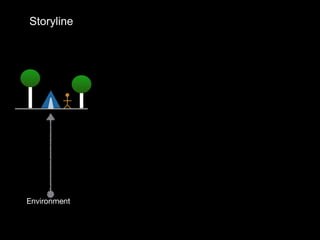
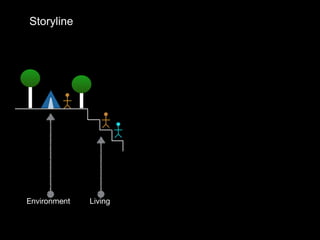
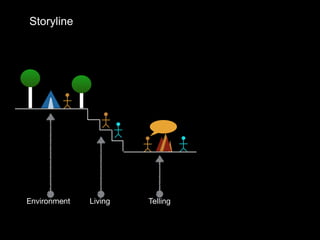
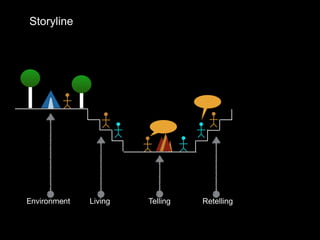
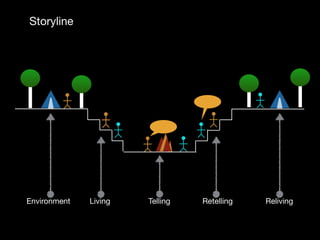
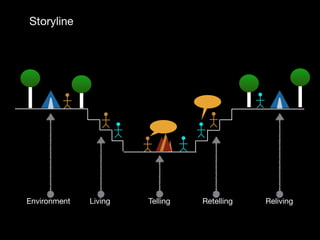
Storyline
Environment
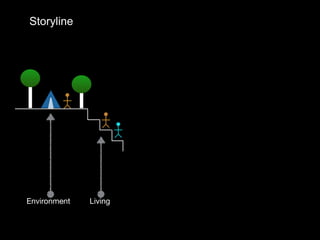
Storyline
Environment Living
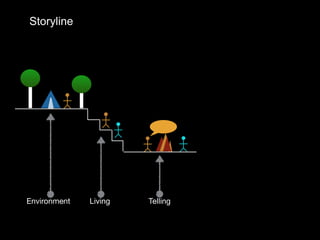
Storyline
Environment Living Telling
Storyline
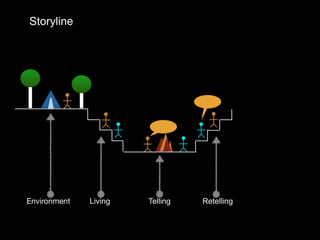
Environment Living Telling Retelling
Storyline
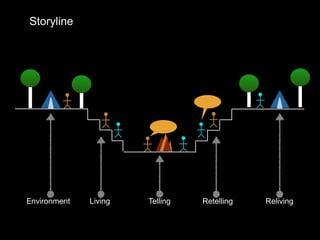
Environment Living Telling RelivingRetelling
Storyline
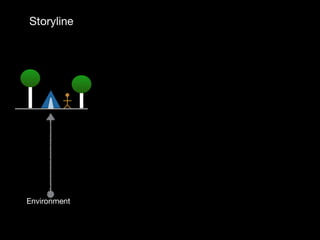
Environment
Storyline
“”
“”
Experience thus reaches
down into nature; it has
depth. It also has breadth
and to it an indefinitely
elastic extent. It stretches.
Dewey (1958, p. 4a).
“”
“”
The answer to the question,
why narrative? Is, because
experience.
Clandinin and Connelly (2000, p. 50).
Our inquiry is framed by Dewey’s (1938)
pragmatic ontology and Clandinin and
Connelly’s (1995) narrative conception of
experience as the living and telling, re-
telling and re-living of stories of
experience.
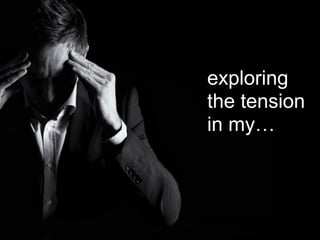
exploring
the tension
in my…
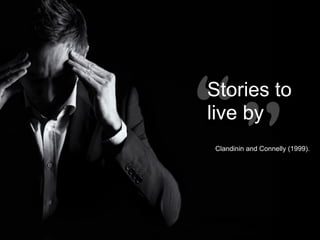
“”“”Clandinin and Connelly (1999).
Stories to
live by
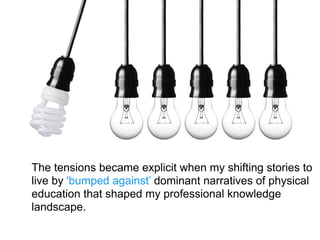
The tensions became explicit when my shifting stories to
live by 'bumped against’ dominant narratives of physical
education that shaped my professional knowledge
landscape.
“”
“”
Clandinin (2013),
While narrative research has moved
in from the margins the words
narrative and research together still
seem to breed. resistance from
those engaged in more dominant
research paradigms.
“”
“”
Clandinin (2013),
While this resistance takes on
different feels in different contexts, it
seems that often times the critiques
point out the absence of rigor, the
lack of theory, and the deficiency of
generalizable findings.
“”
“”
Like many narrative researchers, Dowling,
Garrett, Hunter and Wrench (2013), take
up these critiques and illustrate the
plethora of narrative research that has
taken place in, and added to, the
knowledge base of physical education.
“”“”Clandinin (2013, p. 206).
We write to
learn
and this writing allows us to think
hard not only about how we
negotiated the ‘bumping places’
but also how we might begin to prepare our pre service PETE
teachers for the bumping that will no doubt ensue as their
imagined stories of physical education bump with the grand
narratives on the professional knowledge landscapes
Rossi, lisahunter, Christensen & Macdonald, (2015) Schaefer & Clandinin (2013).
Environment Living
Storyline
Clandinin and Connelly (2000)
“”“”
We began our conversations by thinking about the notion of
‘living, telling, re-telling, and re-
living’
Living:
each of us live stories, and live in
stories. While we live in our own
personal stories, we also live in
institutional stories, cultural stories
and other stories that shift and
shape how we live.
1 2 3
1 2 3
1 8 N A R R AT I V E S W R I T T E N
F R O M A R E - R E A D I N G O F
M Y L I V E D E X P E R I E N C E S
A S T E A C H E R - A S -
R E S E A R C H E R
1 2 3
T H E O R I G I N A L D I A R I E S
W E R E T H E L I V I N G
A N D T H E N A R R AT I V E S W E R E W R I T T E N
F R O M T H I S P E R S P E C T I V E A N D T H E Y
R E P R E S E N T A L I T E R AT U R E O F P L A C E
Environment Living Telling
Storyline
Telling:
each of us tell stories. We tell
stories about ourselves, and again
we tell stories about the institutions
within which we work and the
cultures within which we live.
1 2 3
1 Y E A R
B E F O R E T H E
W R I T I N G O F
T H I S PA P E R
T H E Y W E R E
S H A R E D W I T H
L E E A N D I N
T H I S WAY I
TO L D H I M M Y
S TO R I E S
1 2 3
P R I O R TO A N Y
I N T E R - A U T H O R
C O N V E R S AT I O N S
L E E I N Q U I R E D
I N TO T H E 1 8
N A R R AT I V E S
T H R O U G H H I S
AT T E N T I V E N E S S
TO T H E N O T I O N S
O F S O C I A L I T Y,
T E M P O R A L I T Y
A N D P L A C E .
1 2 3
L E E A N D I E N Q U I R E D
I N TO O U R E X P E R I E N C E S
U S I N G M Y 1 8
N A R R AT I V E S A S F I E L D
T E X T S .
1 2 3T H R O U G H F I V E O N E A N D A H A L F TO
T W O H O U R V O I C E R E C O R D E D
C O N V E R S AT I O N S , A N D A VA R I E T Y O F
O T H E R L E S S F O R M A L C O N V E R S AT I O N S
Environment Living Telling Retelling
Storyline
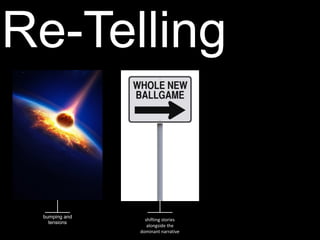
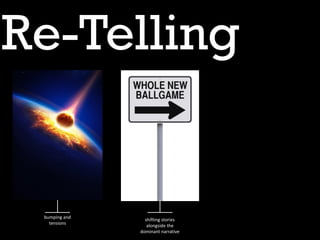
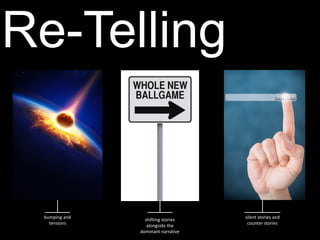
Re-Telling:
while each of us live and tell
stories we may not get the
opportunity to re-tell our stories; to
think deeply about the multiplicity
of stories shaping our experiences,
our ‘stories to live by’, and perhaps
come to see our stories differently.
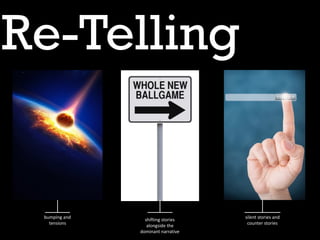
bumping	and	
tensions
shifting	stories	
alongside	the	
dominant	
narrative
silent	stories	and	
counter	stories
Re-Telling
bumping	and	
tensions
shifting	stories	
alongside	the	
dominant	
narrative
silent	stories	and	
counter	stories
Re-Telling
bumping and
tensions
shifting	stories	
alongside	the	
dominant	narrative
silent	stories	and	
counter	stories
Re-Telling
bumping	and	
tensions
silent	stories	and	
counter	stories
Re-Telling
shifting	stories	
alongside	the	
dominant	narrative
bumping	and	
tensions
shifting	stories	
alongside	the	
dominant	
narrative
silent	stories	and	
counter	stories
Re-Telling
“”“”
We began our conversations by thinking about the notion of
I was an idiot or an idealist to try
anything like this.
In thinking about sociality, the initial
phase of the narrative fragment
denotes a tension and self-doubt
around the implementation of
something outside of what the
students expected in physical
education.
From the fragment above we also denote a
story of physical education being told by the
students whom I was attempting to teach.
While there is certainly an institutional story of
physical education and a larger socio-cultural
story of physical education, in staying with my
lived experiences we see that the students
also carry with them a story of what physical
educations is, should be, and should not be.
“”
“”
School is a place that these kids
dislike being anyway, well some of
them, but at least when I’m being
bossy they understand their place
and their role.
In conversations during our re-telling, we
came to understand the being bossy, and
the yelling as a part of the story of
physical education that students
expected.
Thinking temporally and moving back to our
own experiences with physical education, we
are reminded that the yelling and authoritative
nature was also a part of the story of physical
education we were involved in both as
students ourselves and early on in our
careers.
bumping	and	
tensions
silent	stories	and	
counter	stories
Re-Telling
shifting	stories	
alongside	the	
dominant	narrative
“”
“”
Talk about a battle. Yet I get the feeling that
some of the battle was with themselves
[personally] and themselves [as classes]. I
wouldn’t say that it was a success as some
lessons descended into a bit of a farce [while
others were really quite good.
While at the time I may not have seen
this ‘battle’ as a struggle for a story that
made sense, through the re-telling
process, and thinking temporally about
the students’ experiences, we see that
just as I bumped with the dominant
stories of physical education, the
students are bumping with a new story of
physical education.
bumping	and	
tensions
silent	stories	and	
counter	stories
Re-Telling
shifting	stories	
alongside	the	
dominant	narrative
“”
“”
This is certainly my project, as Adam [My
HOD] couldn’t give a shit. In investing
nothing in the project, beyond his ‘trust’ in
me, and making little or no effort to learn
what I’m doing and why I think it’s important,
then he places the responsibility squarely on
me and my shoulders.
By unpacking this narrative and taking off
my ‘rose-coloured spectacles’ when it
came to doing ‘this’ we come to see that
there is a counterstory being written
(Lindeman Nelson, 1995).
Schaefer, Clandinin and Downey (2014)
posited that dominant narratives can
serve to silence or control particular
groups by framing them as ‘less than’ or
deficient.
It becomes easy at this point to think about
me vs. Adam, and to position Adam as the
physical education teacher in deficit, i.e. the
one that needs fixing up. Yet as our re-telling
unfolded we began to wonder about Adam’s
stories.
Imagine Adam’s own isolation as a
physical educator within a system that
particularly devalues the epistemic
status of physical education and greatly
values the success of the sports teams
he coaches.
We wonder about how difficult it must
have been for Adam to be challenged
by a new story of physical education. A
story that from my perspective, and
perhaps the broader research
perspective, was a better way to
engage students in physical education.
Environment Living Telling RelivingRetelling
Storyline
Re-Living:
This is the transactional nature of
narrative inquiry. It is the notion
that as we have the opportunity to
think deeply about how our
experiences are shaped by
sociality, temporality and place.
1 2 3
1 2 3I M A G I N I N G N E W
S TO R I E S O F P H Y S I C A L
E D U C AT I O N
1 2 3T H E R E WA S A T E N S I O N W I T H T H E
S TO R I E S O F P H Y S I C A L E D U C AT I O N I
WA S L I V I N G B U M P I N G A G A I N S T W H AT W E
I D E N T I F I E D A S D O M I N A N T S TO R I E S O F
P H Y S I C A L E D U C AT I O N .
1 2 3A LT H O U G H I T W O U L D H AV E B E E N Q U I T E
E A S Y, A N D D E F I N I T E LY H AV E C R E AT E D
L E S S T E N S I O N , TO C O N T I N U E L I V I N G
T H E D O M I N A N T S TO R I E S O F P H Y S I C A L
E D U C AT I O N , A S H I S ‘ S TO R I E S TO L I V E
B Y ’ S H I F T E D H I S P R O F E S S I O N A L
K N O W L E D G E L A N D S C A P E S E E M E D TO
M A K E L E S S A N D L E S S S E N S E .
1 2 3L I V I N G I N
C O H E R E N T
WAY S
1 2 3
W H I L E I T I S O N E
T H I N G TO S H I F T
O N E ’ S ‘ S TO R I E S TO
L I V E B Y ’ , I T I S
A N O T H E R TO B E
A B L E TO L I V E I N
C O H E R E N T WAY S O N
A P R O F E S S I O N A L
K N O W L E D G E
L A N D S C A P E T H AT
H A S S TO R I E S W H I C H
A R E N O T S O E A S I LY
S H I F T E D .
1 2 3
A LT H O U G H T H E R E I S
C E RTA I N LY A N AT T E M P T
TO ‘ T RY S O M E T H I N G
N E W ’ , T H I S AT T E M P T TO
T RY S O M E T H I N G N E W
P O S I T I O N S H I M I N
I S O L AT I O N , A S T H E
I N T E RV E N T I O N I S T, AWAY
F R O M T H E S T U D E N T S . W E
A L S O S E E T H AT T H I S
‘ S O M E T H I N G N E W ’ B U M P S
H A R D W I T H
I N S T I T U T I O N A L S TO R I E S ,
A N D C O L L E G I A L S TO R I E S .
1 2 3L I V I N G C U R R I C U L U M
1 2 3I N T H I S C A S E W E S E E T H E C U R R I C U L U M
A S B E C O M I N G L I V E D B E C A U S E I T C A M E
F R O M I N S I D E N O T O U T S I D E , A N D I T
H A P P E N E D I N R E L AT I O N A N D N O T
I S O L AT I O N .
1 2 3
D R AW I N G O N T H E W O R K O F G R E E N E
( 1 9 9 7 ) , E N R I G H T A N D O ’ S U L L I VA N
( 2 0 1 2 ) C O N C L U D E D , “ W E C A N N O T
M A K E S I G N I F I C A N T C H A N G E O N O U R
O W N . W E N E E D TO ‘ M O V E
N E W C O M E R S ’ ( G R E E N E , 1 9 9 7 , P. 1 0 )
TO J O I N W I T H U S A N D T R A N S F O R M ” .
Environment Living Telling RelivingRetelling
Storyline
We see this process as interwoven with
identity making and, as such, a rich
contextual process that is imbued with
individuals’ ‘stories to live by’ (Clandinin,
1995). We also see this process as a re-
living and changing of stories.
“”“”
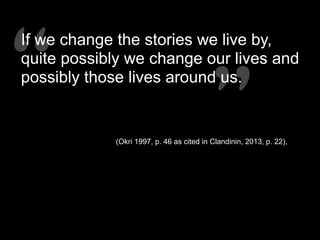
If we change the stories we live by,
quite possibly we change our lives and
possibly those lives around us.
(Okri 1997, p. 46 as cited in Clandinin, 2013, p. 22),
Designed by
Ashley Casey
I am a researcher
A.J.B.Casey@lboro.ac.uk
I can be found on twitter
@DrAshCasey
Using hashtags like
#pegeeks #pegeek #pechat #physed
thanks for listening
References
Clandinin, D.J. (1995). Stories of possibility: Living on the landscape with children. Earl
Childhood Education, 28 (2), 4-8.
Clandinin, D.J. (2013). Engaging in narrative inquiry. Walnut Creek: Left Coast Press
Clandinin, D.J., & Connelly, F.M. (1995). Teachers' professional knowledge landscapes
New York: Teachers College Press.
Clandinin, D.J., & Connelly, F.M. (1999). Storying and restorying ourselves: Narrative an
reflection. In A. Y. Chen & J. Van Maanen (Eds.), The reflective spin: Case studies of
teachers in higher education transforming action (pp. 15-23). Singapore: World Scientif
Clandinin, D.J., & Connelly, F.M. (2000). Narrative Inquiry: Experience and story in
qualitative research. San Francisco: Jossey-Bass.
Clandinin, D.J., Schaefer, L., & Downey, A. (2014). Narrative conceptions of knowledge
Towards understanding teacher attrition. Bingley: Emerald Group Publishing.
Dewey, J. (1938). Experience and education. New York: Collier Books.
Dewey, J. (1958). Nature and experience. New York: Dover
Enright, E. & O'Sullivan, M. (2012). Physical Education “in All Sorts of Corners”, Resear
Quarterly for Exercise and Sport, 83:2, 255-267, DOI: 10.1080/02701367.2012.105998
References
Greene, M. (1995). Releasing the imagination: Essays on education the arts, and Socia
Change. San Francisco: Jossey Bass.
Lindeman-Nelson, H. (1995). Resistance and insubordination. Hypatia: A Journal of
Feminist Philosophy, 10(2), 23–40.
Rossi, T., lisahunter, Christensen, E. & Macdonald, D. (2015). Workplace learning in
Physical Education: Emerging teachers’ stories from the staffroom and beyond. London
Routledge.
Schaefer, L. & Clandinin, D. J. (2011) Stories of sustaining: A narrative inquiry into the
experiences of two beginning teachers. Learning Landscapes, 4 (2), 275-295.
NB: All images were purchased and downloaded from iStockphoto

A Narrative Inquiry in physical education

  • 1.
    A Narrative Inquiryinto the negotiation of the dominant stories of physical education: Living, telling, re-telling, and re-living Ashley Casey Loughborough University University of Limerick Lee Schaefer University of Regina
  • 2.
  • 3.
  • 4.
  • 5.
  • 6.
    Environment Living TellingRetelling Storyline
  • 7.
    Environment Living TellingRelivingRetelling Storyline
  • 8.
  • 9.
    “” “” Experience thus reaches downinto nature; it has depth. It also has breadth and to it an indefinitely elastic extent. It stretches. Dewey (1958, p. 4a).
  • 10.
    “” “” The answer tothe question, why narrative? Is, because experience. Clandinin and Connelly (2000, p. 50).
  • 11.
    Our inquiry isframed by Dewey’s (1938) pragmatic ontology and Clandinin and Connelly’s (1995) narrative conception of experience as the living and telling, re- telling and re-living of stories of experience.
  • 12.
  • 13.
    “”“”Clandinin and Connelly(1999). Stories to live by
  • 14.
    The tensions becameexplicit when my shifting stories to live by 'bumped against’ dominant narratives of physical education that shaped my professional knowledge landscape.
  • 15.
    “” “” Clandinin (2013), While narrativeresearch has moved in from the margins the words narrative and research together still seem to breed. resistance from those engaged in more dominant research paradigms.
  • 16.
    “” “” Clandinin (2013), While thisresistance takes on different feels in different contexts, it seems that often times the critiques point out the absence of rigor, the lack of theory, and the deficiency of generalizable findings.
  • 17.
    “” “” Like many narrativeresearchers, Dowling, Garrett, Hunter and Wrench (2013), take up these critiques and illustrate the plethora of narrative research that has taken place in, and added to, the knowledge base of physical education.
  • 18.
    “”“”Clandinin (2013, p.206). We write to learn
  • 19.
    and this writingallows us to think hard not only about how we negotiated the ‘bumping places’
  • 20.
    but also howwe might begin to prepare our pre service PETE teachers for the bumping that will no doubt ensue as their imagined stories of physical education bump with the grand narratives on the professional knowledge landscapes Rossi, lisahunter, Christensen & Macdonald, (2015) Schaefer & Clandinin (2013).
  • 21.
  • 22.
    Clandinin and Connelly(2000) “”“” We began our conversations by thinking about the notion of ‘living, telling, re-telling, and re- living’
  • 23.
    Living: each of uslive stories, and live in stories. While we live in our own personal stories, we also live in institutional stories, cultural stories and other stories that shift and shape how we live.
  • 24.
  • 25.
    1 2 3 18 N A R R AT I V E S W R I T T E N F R O M A R E - R E A D I N G O F M Y L I V E D E X P E R I E N C E S A S T E A C H E R - A S - R E S E A R C H E R
  • 26.
    1 2 3 TH E O R I G I N A L D I A R I E S W E R E T H E L I V I N G A N D T H E N A R R AT I V E S W E R E W R I T T E N F R O M T H I S P E R S P E C T I V E A N D T H E Y R E P R E S E N T A L I T E R AT U R E O F P L A C E
  • 27.
  • 28.
    Telling: each of ustell stories. We tell stories about ourselves, and again we tell stories about the institutions within which we work and the cultures within which we live.
  • 29.
    1 2 3 1Y E A R B E F O R E T H E W R I T I N G O F T H I S PA P E R T H E Y W E R E S H A R E D W I T H L E E A N D I N T H I S WAY I TO L D H I M M Y S TO R I E S
  • 30.
    1 2 3 PR I O R TO A N Y I N T E R - A U T H O R C O N V E R S AT I O N S L E E I N Q U I R E D I N TO T H E 1 8 N A R R AT I V E S T H R O U G H H I S AT T E N T I V E N E S S TO T H E N O T I O N S O F S O C I A L I T Y, T E M P O R A L I T Y A N D P L A C E .
  • 31.
    1 2 3 LE E A N D I E N Q U I R E D I N TO O U R E X P E R I E N C E S U S I N G M Y 1 8 N A R R AT I V E S A S F I E L D T E X T S .
  • 32.
    1 2 3TH R O U G H F I V E O N E A N D A H A L F TO T W O H O U R V O I C E R E C O R D E D C O N V E R S AT I O N S , A N D A VA R I E T Y O F O T H E R L E S S F O R M A L C O N V E R S AT I O N S
  • 33.
    Environment Living TellingRetelling Storyline
  • 34.
    Re-Telling: while each ofus live and tell stories we may not get the opportunity to re-tell our stories; to think deeply about the multiplicity of stories shaping our experiences, our ‘stories to live by’, and perhaps come to see our stories differently.
  • 35.
  • 36.
  • 37.
  • 38.
  • 39.
  • 40.
    “”“” We began ourconversations by thinking about the notion of I was an idiot or an idealist to try anything like this.
  • 41.
    In thinking aboutsociality, the initial phase of the narrative fragment denotes a tension and self-doubt around the implementation of something outside of what the students expected in physical education.
  • 42.
    From the fragmentabove we also denote a story of physical education being told by the students whom I was attempting to teach. While there is certainly an institutional story of physical education and a larger socio-cultural story of physical education, in staying with my lived experiences we see that the students also carry with them a story of what physical educations is, should be, and should not be.
  • 43.
    “” “” School is aplace that these kids dislike being anyway, well some of them, but at least when I’m being bossy they understand their place and their role.
  • 44.
    In conversations duringour re-telling, we came to understand the being bossy, and the yelling as a part of the story of physical education that students expected.
  • 45.
    Thinking temporally andmoving back to our own experiences with physical education, we are reminded that the yelling and authoritative nature was also a part of the story of physical education we were involved in both as students ourselves and early on in our careers.
  • 46.
  • 47.
    “” “” Talk about abattle. Yet I get the feeling that some of the battle was with themselves [personally] and themselves [as classes]. I wouldn’t say that it was a success as some lessons descended into a bit of a farce [while others were really quite good.
  • 48.
    While at thetime I may not have seen this ‘battle’ as a struggle for a story that made sense, through the re-telling process, and thinking temporally about the students’ experiences, we see that just as I bumped with the dominant stories of physical education, the students are bumping with a new story of physical education.
  • 49.
  • 50.
    “” “” This is certainlymy project, as Adam [My HOD] couldn’t give a shit. In investing nothing in the project, beyond his ‘trust’ in me, and making little or no effort to learn what I’m doing and why I think it’s important, then he places the responsibility squarely on me and my shoulders.
  • 51.
    By unpacking thisnarrative and taking off my ‘rose-coloured spectacles’ when it came to doing ‘this’ we come to see that there is a counterstory being written (Lindeman Nelson, 1995).
  • 52.
    Schaefer, Clandinin andDowney (2014) posited that dominant narratives can serve to silence or control particular groups by framing them as ‘less than’ or deficient.
  • 53.
    It becomes easyat this point to think about me vs. Adam, and to position Adam as the physical education teacher in deficit, i.e. the one that needs fixing up. Yet as our re-telling unfolded we began to wonder about Adam’s stories.
  • 54.
    Imagine Adam’s ownisolation as a physical educator within a system that particularly devalues the epistemic status of physical education and greatly values the success of the sports teams he coaches.
  • 55.
    We wonder abouthow difficult it must have been for Adam to be challenged by a new story of physical education. A story that from my perspective, and perhaps the broader research perspective, was a better way to engage students in physical education.
  • 56.
    Environment Living TellingRelivingRetelling Storyline
  • 57.
    Re-Living: This is thetransactional nature of narrative inquiry. It is the notion that as we have the opportunity to think deeply about how our experiences are shaped by sociality, temporality and place.
  • 58.
  • 59.
    1 2 3IM A G I N I N G N E W S TO R I E S O F P H Y S I C A L E D U C AT I O N
  • 60.
    1 2 3TH E R E WA S A T E N S I O N W I T H T H E S TO R I E S O F P H Y S I C A L E D U C AT I O N I WA S L I V I N G B U M P I N G A G A I N S T W H AT W E I D E N T I F I E D A S D O M I N A N T S TO R I E S O F P H Y S I C A L E D U C AT I O N .
  • 61.
    1 2 3ALT H O U G H I T W O U L D H AV E B E E N Q U I T E E A S Y, A N D D E F I N I T E LY H AV E C R E AT E D L E S S T E N S I O N , TO C O N T I N U E L I V I N G T H E D O M I N A N T S TO R I E S O F P H Y S I C A L E D U C AT I O N , A S H I S ‘ S TO R I E S TO L I V E B Y ’ S H I F T E D H I S P R O F E S S I O N A L K N O W L E D G E L A N D S C A P E S E E M E D TO M A K E L E S S A N D L E S S S E N S E .
  • 62.
    1 2 3LI V I N G I N C O H E R E N T WAY S
  • 63.
    1 2 3 WH I L E I T I S O N E T H I N G TO S H I F T O N E ’ S ‘ S TO R I E S TO L I V E B Y ’ , I T I S A N O T H E R TO B E A B L E TO L I V E I N C O H E R E N T WAY S O N A P R O F E S S I O N A L K N O W L E D G E L A N D S C A P E T H AT H A S S TO R I E S W H I C H A R E N O T S O E A S I LY S H I F T E D .
  • 64.
    1 2 3 ALT H O U G H T H E R E I S C E RTA I N LY A N AT T E M P T TO ‘ T RY S O M E T H I N G N E W ’ , T H I S AT T E M P T TO T RY S O M E T H I N G N E W P O S I T I O N S H I M I N I S O L AT I O N , A S T H E I N T E RV E N T I O N I S T, AWAY F R O M T H E S T U D E N T S . W E A L S O S E E T H AT T H I S ‘ S O M E T H I N G N E W ’ B U M P S H A R D W I T H I N S T I T U T I O N A L S TO R I E S , A N D C O L L E G I A L S TO R I E S .
  • 65.
    1 2 3LI V I N G C U R R I C U L U M
  • 66.
    1 2 3IN T H I S C A S E W E S E E T H E C U R R I C U L U M A S B E C O M I N G L I V E D B E C A U S E I T C A M E F R O M I N S I D E N O T O U T S I D E , A N D I T H A P P E N E D I N R E L AT I O N A N D N O T I S O L AT I O N .
  • 67.
    1 2 3 DR AW I N G O N T H E W O R K O F G R E E N E ( 1 9 9 7 ) , E N R I G H T A N D O ’ S U L L I VA N ( 2 0 1 2 ) C O N C L U D E D , “ W E C A N N O T M A K E S I G N I F I C A N T C H A N G E O N O U R O W N . W E N E E D TO ‘ M O V E N E W C O M E R S ’ ( G R E E N E , 1 9 9 7 , P. 1 0 ) TO J O I N W I T H U S A N D T R A N S F O R M ” .
  • 68.
    Environment Living TellingRelivingRetelling Storyline
  • 69.
    We see thisprocess as interwoven with identity making and, as such, a rich contextual process that is imbued with individuals’ ‘stories to live by’ (Clandinin, 1995). We also see this process as a re- living and changing of stories.
  • 70.
    “”“” If we changethe stories we live by, quite possibly we change our lives and possibly those lives around us. (Okri 1997, p. 46 as cited in Clandinin, 2013, p. 22),
  • 71.
  • 72.
    I am aresearcher A.J.B.Casey@lboro.ac.uk
  • 73.
    I can befound on twitter @DrAshCasey
  • 74.
    Using hashtags like #pegeeks#pegeek #pechat #physed
  • 75.
  • 76.
    References Clandinin, D.J. (1995).Stories of possibility: Living on the landscape with children. Earl Childhood Education, 28 (2), 4-8. Clandinin, D.J. (2013). Engaging in narrative inquiry. Walnut Creek: Left Coast Press Clandinin, D.J., & Connelly, F.M. (1995). Teachers' professional knowledge landscapes New York: Teachers College Press. Clandinin, D.J., & Connelly, F.M. (1999). Storying and restorying ourselves: Narrative an reflection. In A. Y. Chen & J. Van Maanen (Eds.), The reflective spin: Case studies of teachers in higher education transforming action (pp. 15-23). Singapore: World Scientif Clandinin, D.J., & Connelly, F.M. (2000). Narrative Inquiry: Experience and story in qualitative research. San Francisco: Jossey-Bass. Clandinin, D.J., Schaefer, L., & Downey, A. (2014). Narrative conceptions of knowledge Towards understanding teacher attrition. Bingley: Emerald Group Publishing. Dewey, J. (1938). Experience and education. New York: Collier Books. Dewey, J. (1958). Nature and experience. New York: Dover Enright, E. & O'Sullivan, M. (2012). Physical Education “in All Sorts of Corners”, Resear Quarterly for Exercise and Sport, 83:2, 255-267, DOI: 10.1080/02701367.2012.105998
  • 77.
    References Greene, M. (1995).Releasing the imagination: Essays on education the arts, and Socia Change. San Francisco: Jossey Bass. Lindeman-Nelson, H. (1995). Resistance and insubordination. Hypatia: A Journal of Feminist Philosophy, 10(2), 23–40. Rossi, T., lisahunter, Christensen, E. & Macdonald, D. (2015). Workplace learning in Physical Education: Emerging teachers’ stories from the staffroom and beyond. London Routledge. Schaefer, L. & Clandinin, D. J. (2011) Stories of sustaining: A narrative inquiry into the experiences of two beginning teachers. Learning Landscapes, 4 (2), 275-295. NB: All images were purchased and downloaded from iStockphoto