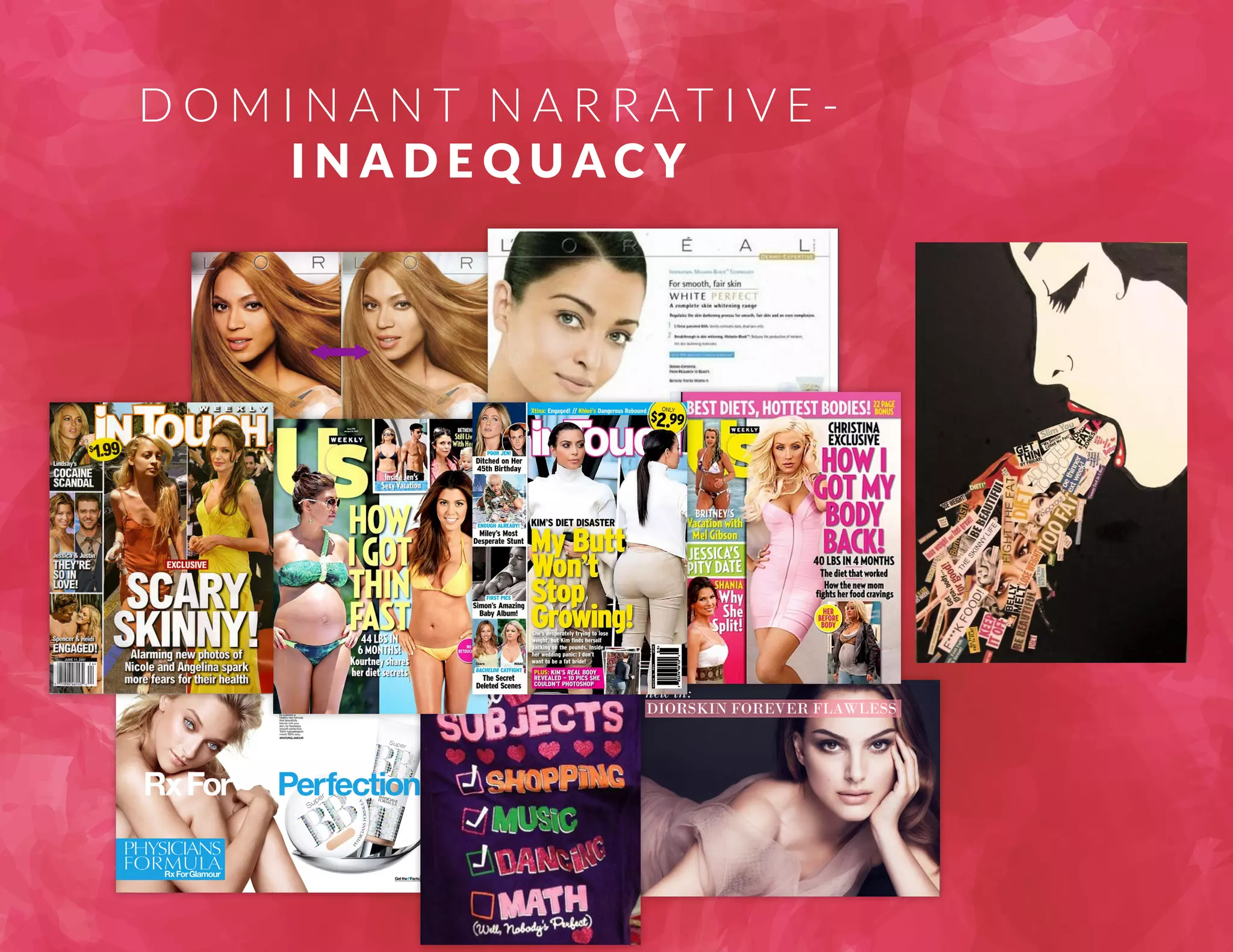
DOMINANT NARRAT I V E - 
INADEQUACY
S TO R I E S H O L D 
O U R I D E N T I T I E S 
TOGETHER.
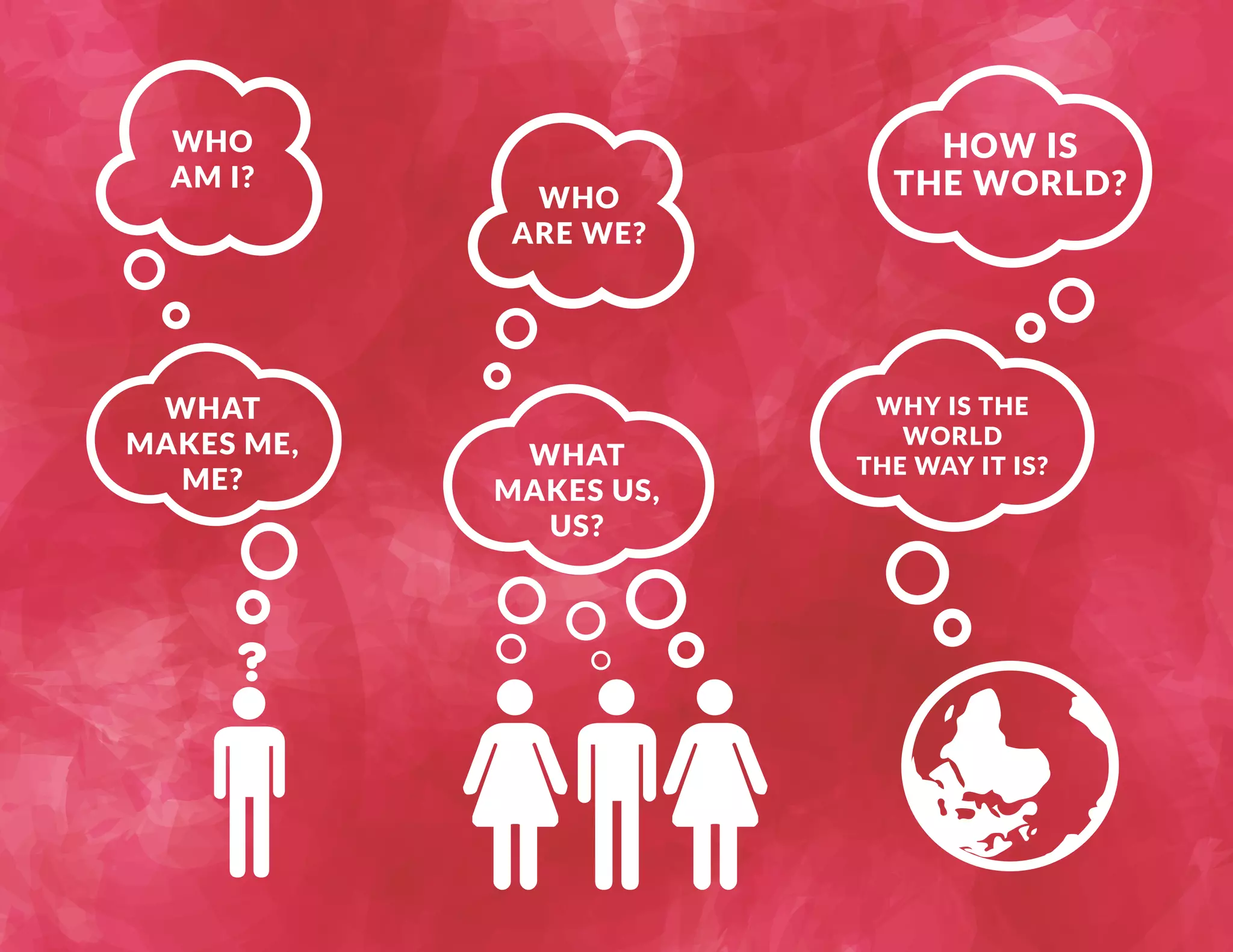
WHO 
AM I? 
WHO 
ARE WE? 
HOW IS 
THE WORLD? 
WHAT 
MAKES ME, 
ME? 
WHAT 
MAKES US, 
US? 
WHY IS THE 
WORLD 
THE WAY IT IS?
WHATEVER ANSWER WE COME UP WITH TO 
THESE QUESTIONS IS A NARRATIVE.
STORIES 
beliefs 
beliefs beliefs 
STORIES 
BELIEFS 
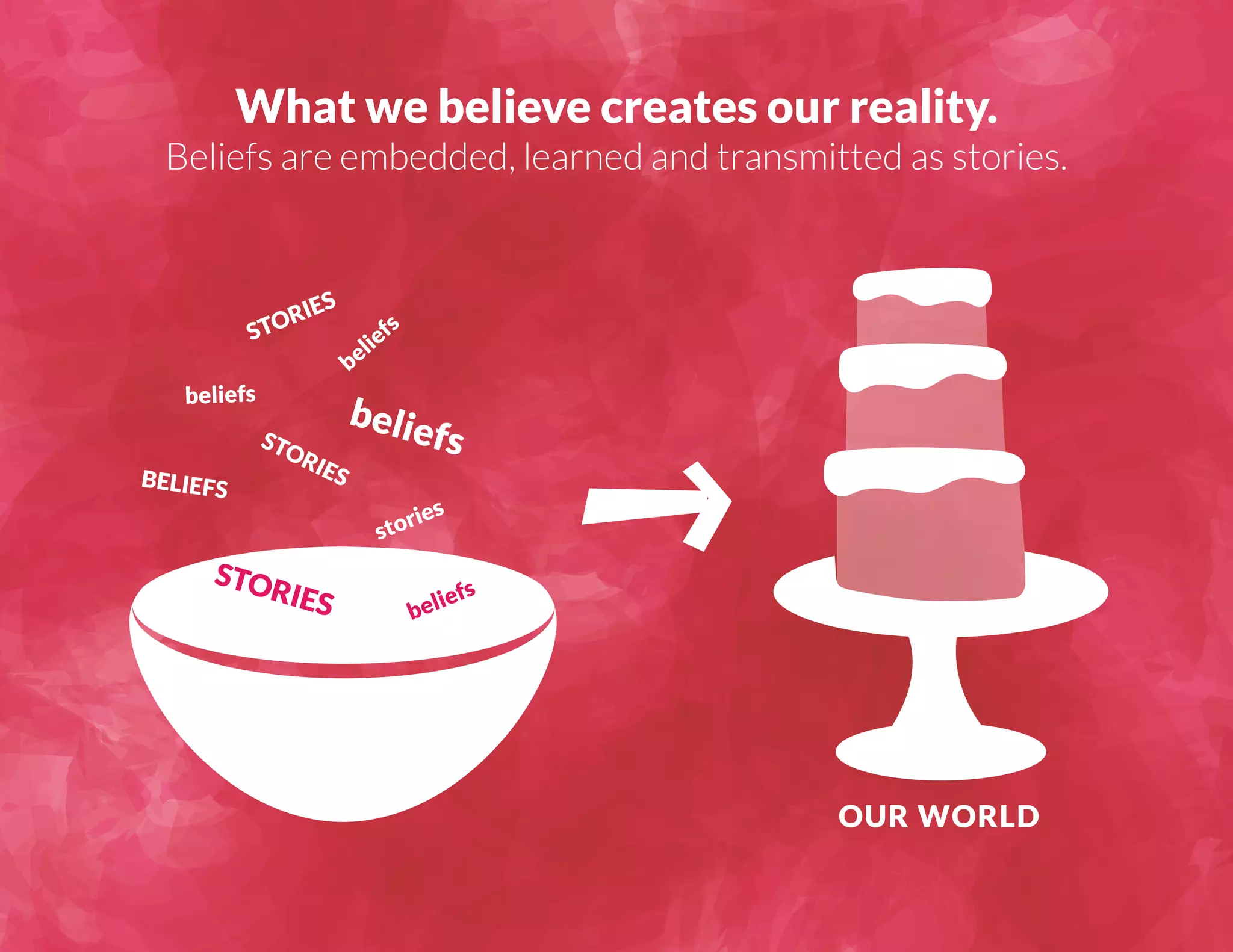
What we believe creates our reality. 
Beliefs are embedded, learned and transmitted as stories. 
stories 
STORIES 
beliefs 
OUR WORLD
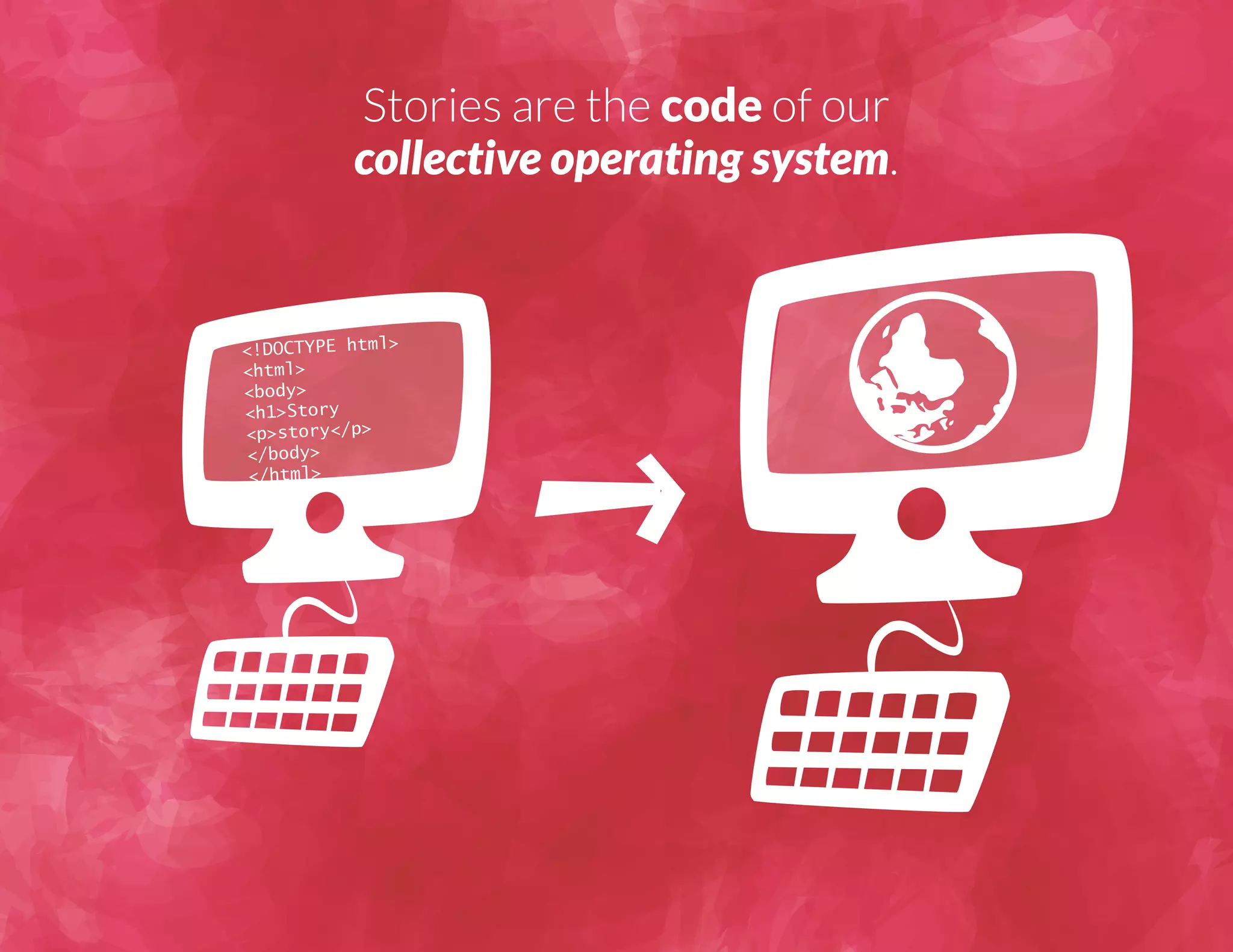
Stories are the code of our 
collective operating system. 
<!DOCTYPE html> 
<html> 
<body> 
<h1>Story 
<p>story</p> 
</body> 
</html>
4 FUNCTIONS OF 
MYTHS: 
1. MYSTICAL- stories that reveal the wonder of the world and of being human. 
2. COSMOLOGICAL- stories that attempt to describe the shape of the universe. 
3. SOCIOLOGICAL- stories that support & validate a certain social order. 
4. PEDOGOGICAL- stories that teach us how to overcome the challenges of being human.
WE’VE EVOLVED TO 
LOVE STORIES 
BECAUSE THEY 
HELP US SURVIVE.
Stories are designed to persuade an 
audience of a storyteller’s worldview. 
H O W D O T H E Y D O T H I S ? 
Stories express values.
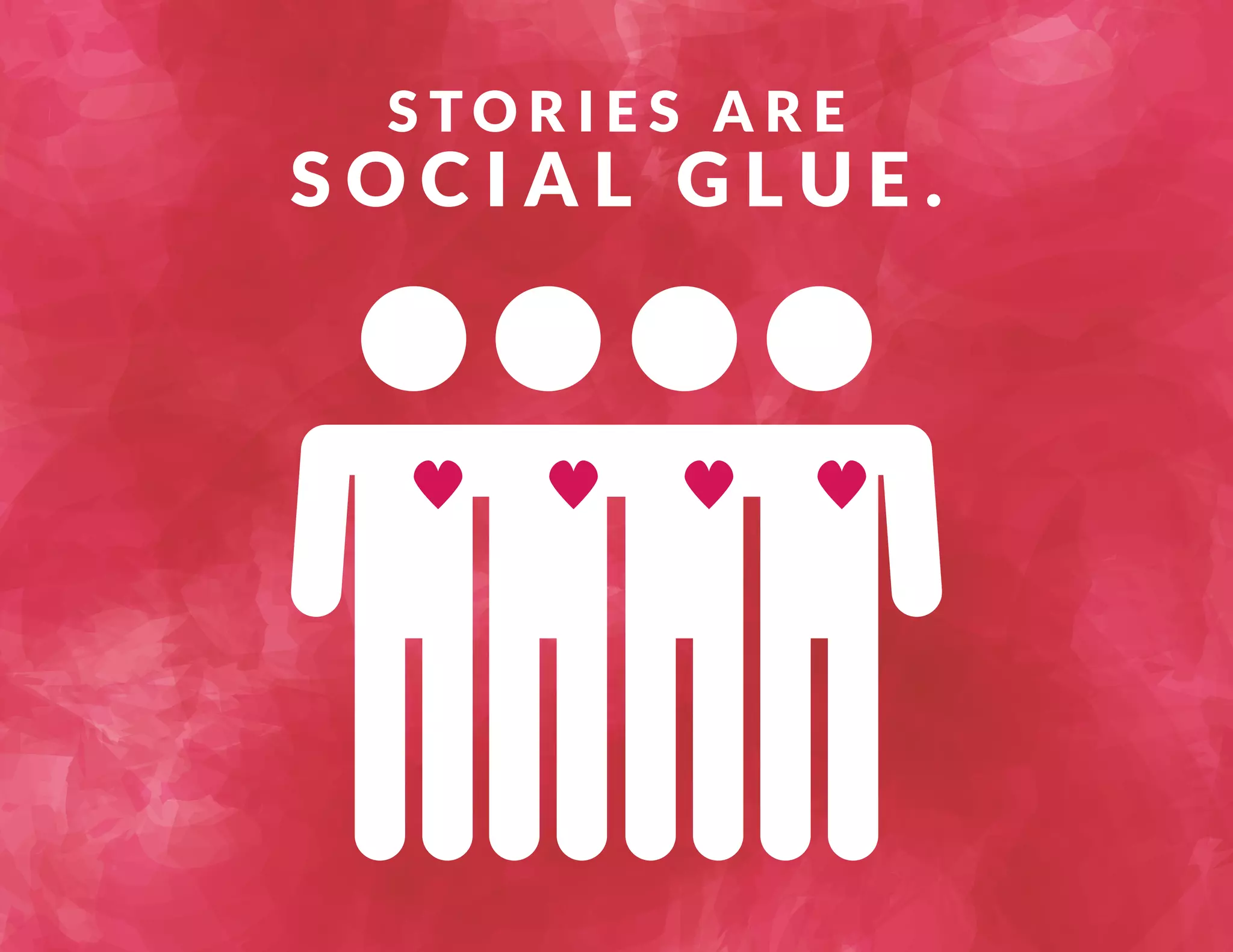
S TO R I E S A R E 
S O C I A L G L U E .
Stories remain the invisible glue 
through which people narrate the 
meaning of their lives and interweave 
their lives with other lives. 
-Michael Margolis, Believe Me.
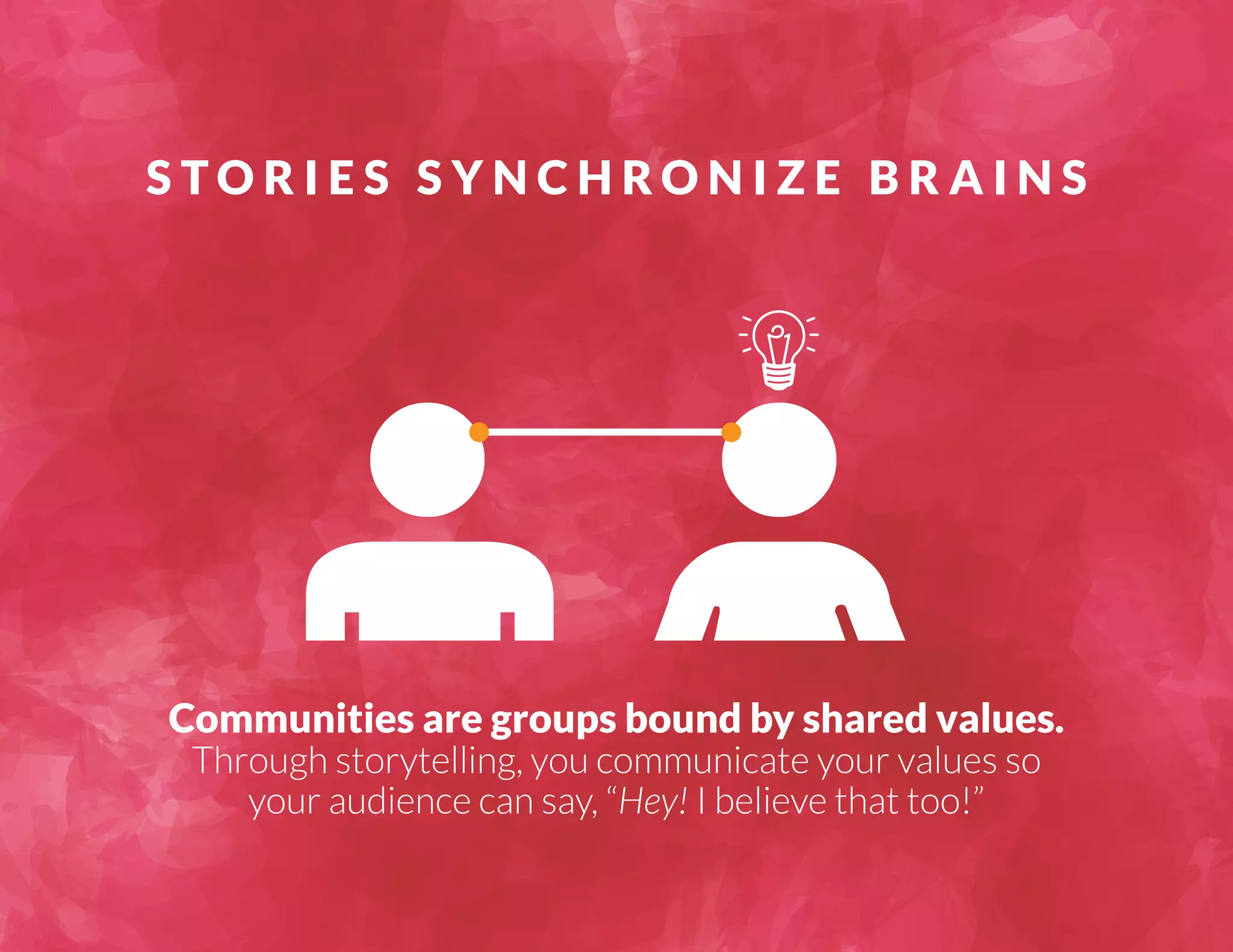
S TO R I E S S Y N C H RO N I Z E B R A I N S 
Communities are groups bound by shared values. 
Through storytelling, you communicate your values so 
your audience can say, “Hey! I believe that too!”
Great stories combine conviction and revelation
S TO R I E S A L LOW US 
TO CREAT E ORDER 
O U T O F T H E 
CHAOT I C .
They do this by 
E D I T I N G O U T 
irrelevant details.
AND D E F I N I N G A 
CAU S E FOR EACH 
E F F E C T.
Dominant narratives are the 
ARMOR OF THE STATUS QUO.
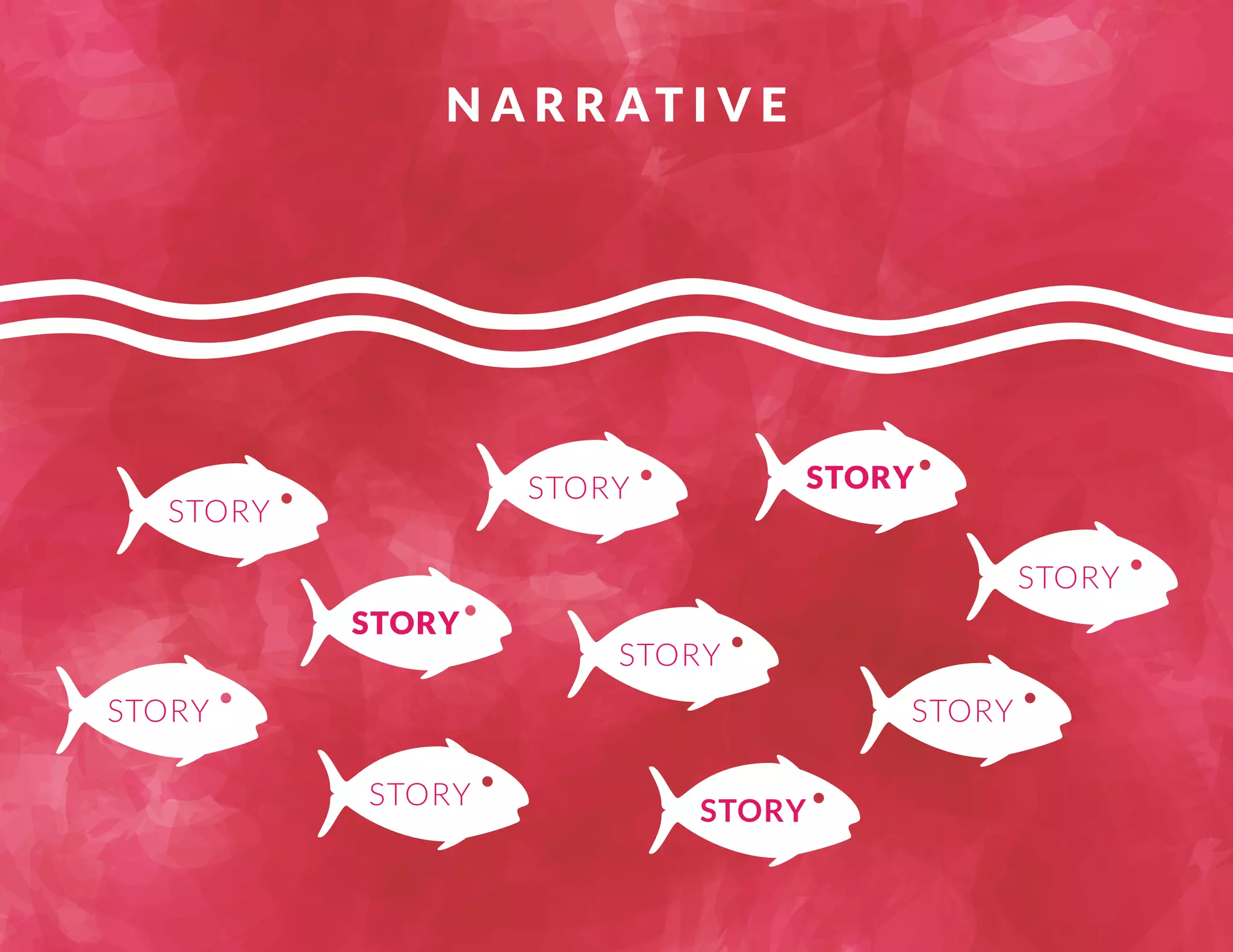
NARRAT I V E 
STORY 
STORY STORY 
STORY 
STORY 
STORY 
STORY 
STORY 
STORY 
STORY
S TORY 
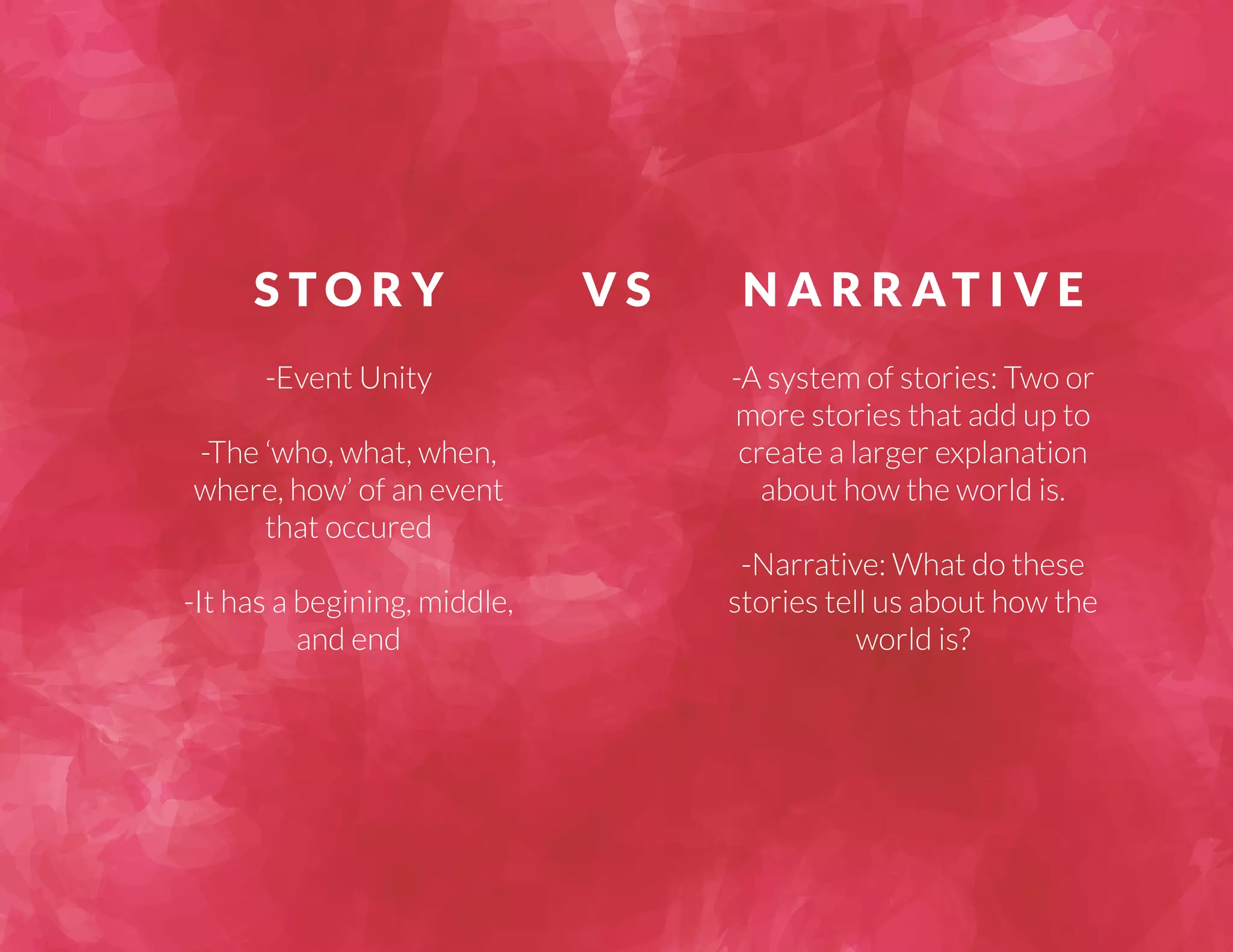
-Event Unity 
-The ‘who, what, when, 
where, how’ of an event 
that occured 
-It has a begining, middle, 
and end 
NARRAT I V E 
-A system of stories: Two or 
more stories that add up to 
create a larger explanation 
about how the world is. 
-Narrative: What do these 
stories tell us about how the 
world is? 
VS
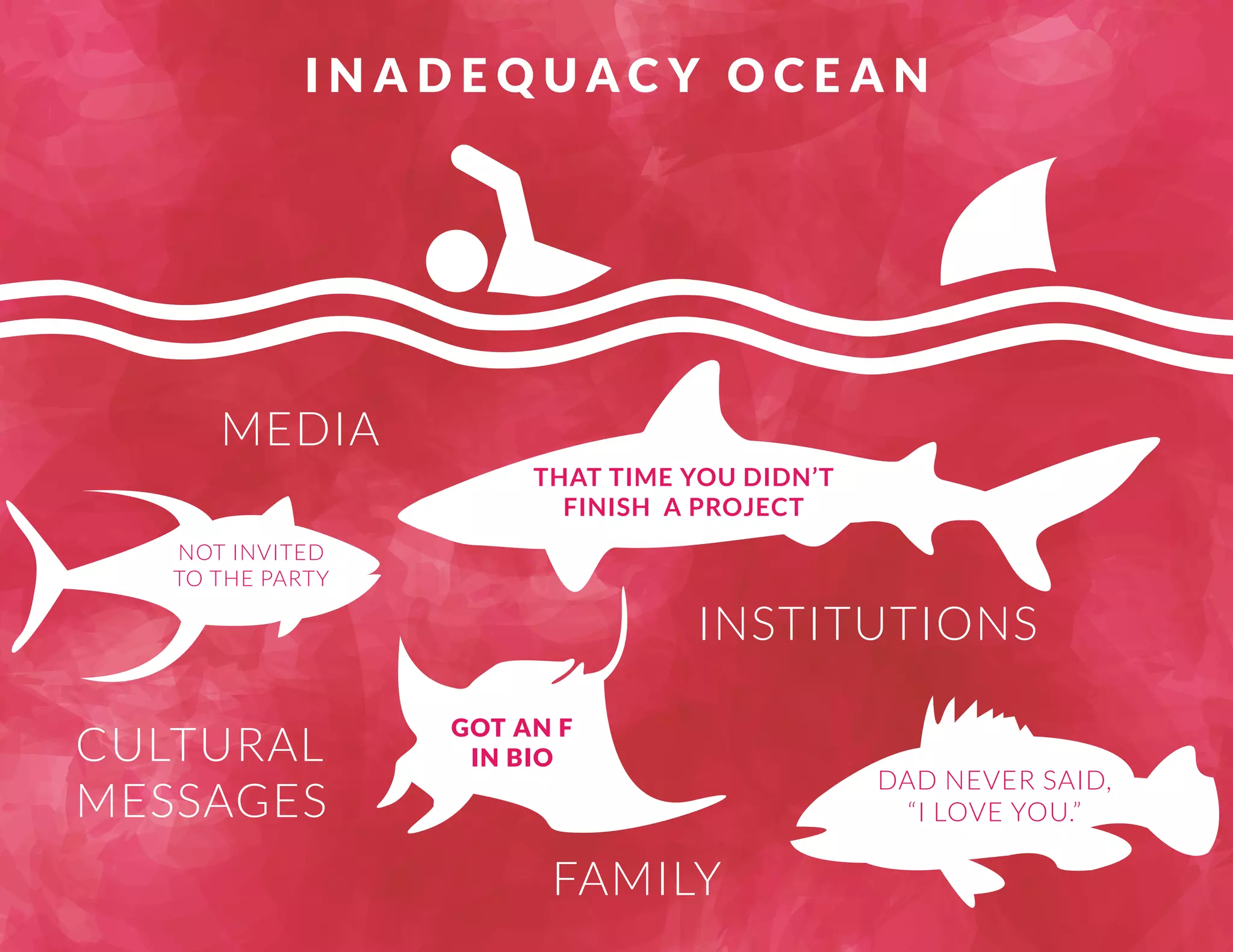
INADEQUACY OCEAN 
THAT TIME YOU DIDN’T 
FINISH A PROJECT 
DAD NEVER SAID, 
“I LOVE YOU.” 
GOT AN F 
IN BIO 
MEDIA 
INSTITUTIONS 
FAMILY 
NOT INVITED 
TO THE PARTY 
CULTURAL 
MESSAGES
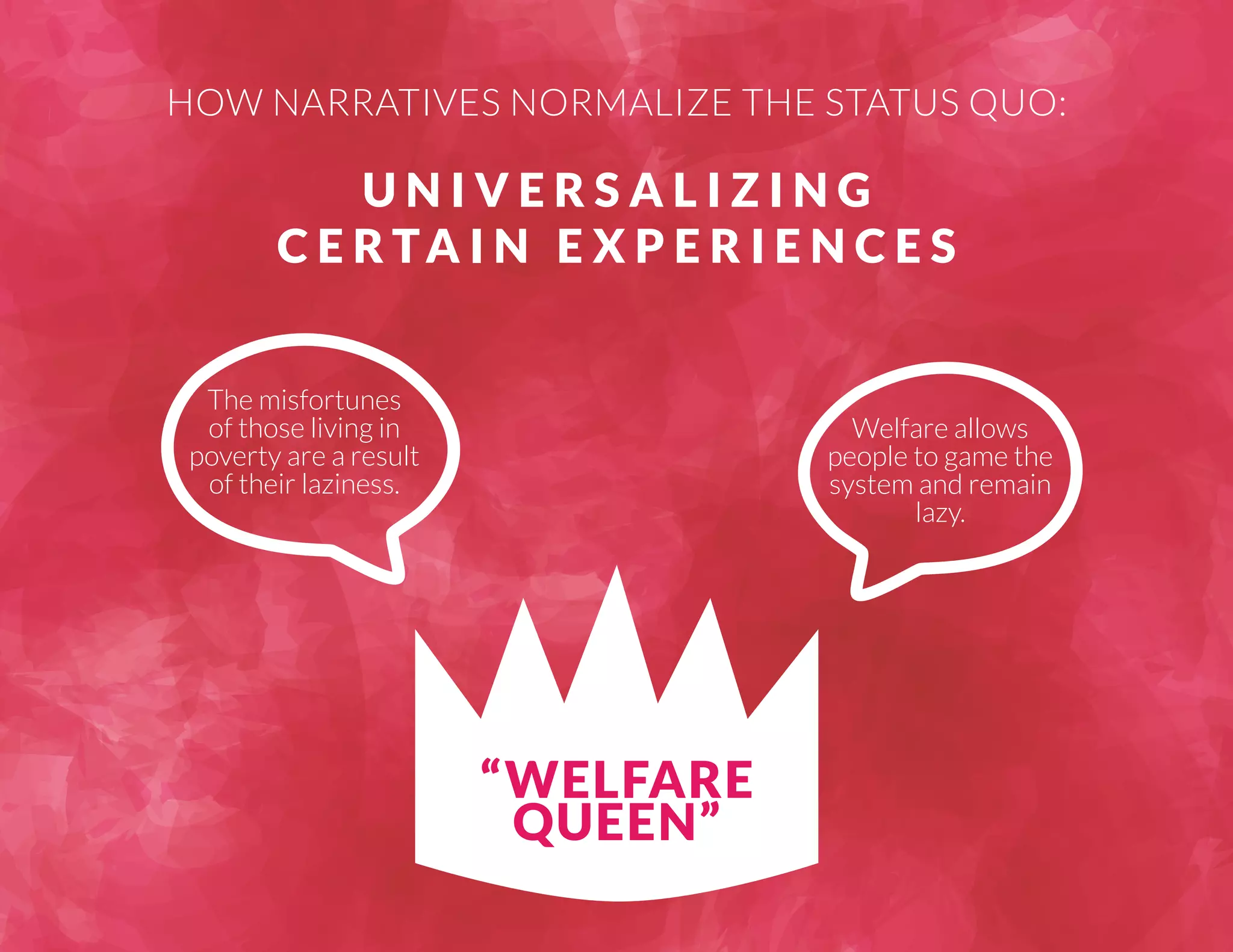
HOW NARRATIVES NORMALIZE THE STATUS QUO: 
The misfortunes 
of those living in 
poverty are a result 
of their laziness. 
Welfare allows 
people to game the 
system and remain 
lazy. 
U N I V E R S A L I Z I N G 
CERTA I N E X P E R I E N C E S 
“WELFARE 
QUEEN”
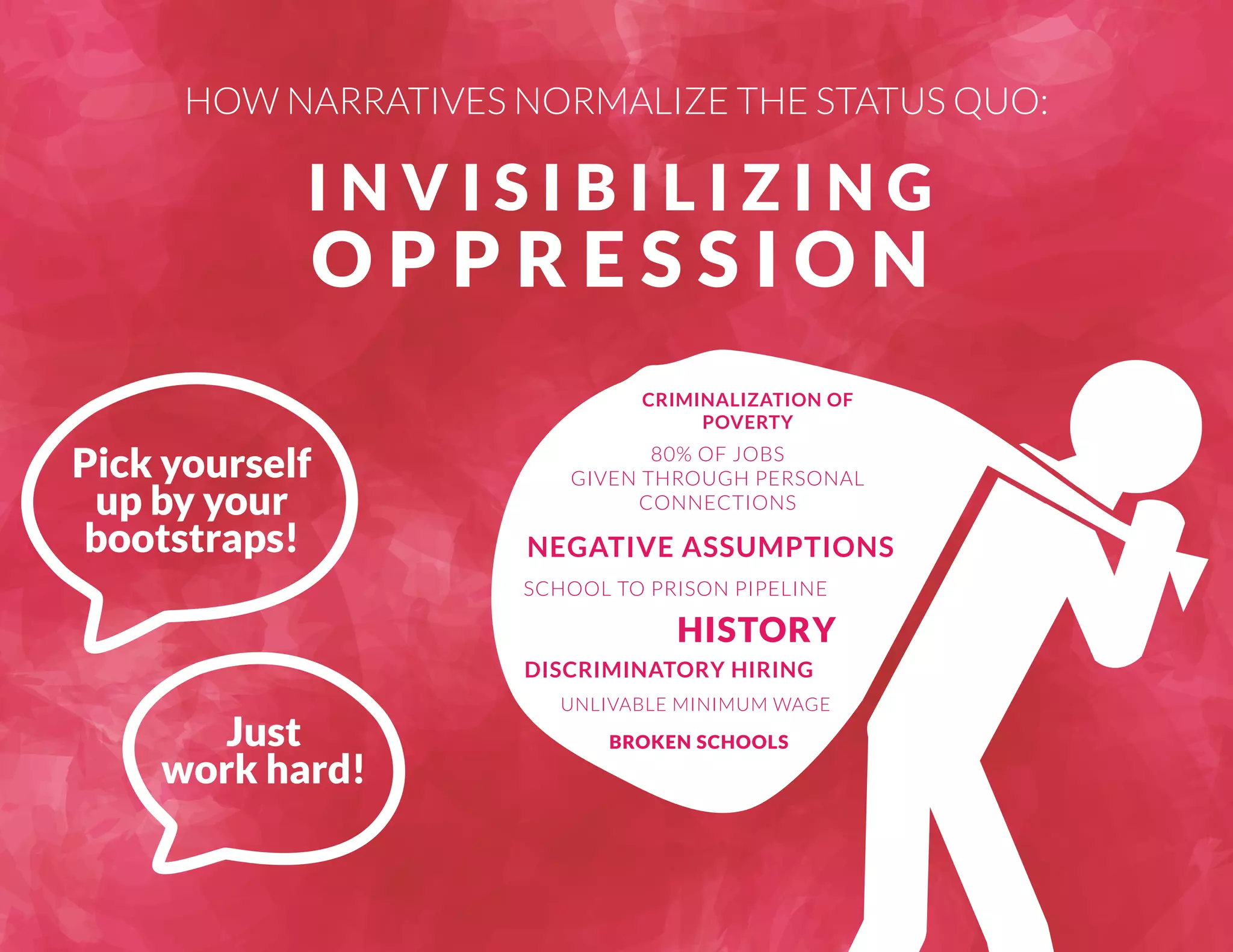
HOW NARRATIVES NORMALIZE THE STATUS QUO: 
I N V I S I B I L I Z I N G 
OPPRESSION 
CRIMINALIZATION OF 
POVERTY 
80% OF JOBS 
GIVEN THROUGH PERSONAL 
CONNECTIONS 
NEGATIVE ASSUMPTIONS 
SCHOOL TO PRISON PIPELINE 
HISTORY 
DISCRIMINATORY HIRING 
UNLIVABLE MINIMUM WAGE 
BROKEN SCHOOLS 
Pick yourself 
up by your 
bootstraps! 
Just 
work hard!
HOW NARRATIVES NORMALIZE THE STATUS QUO: 
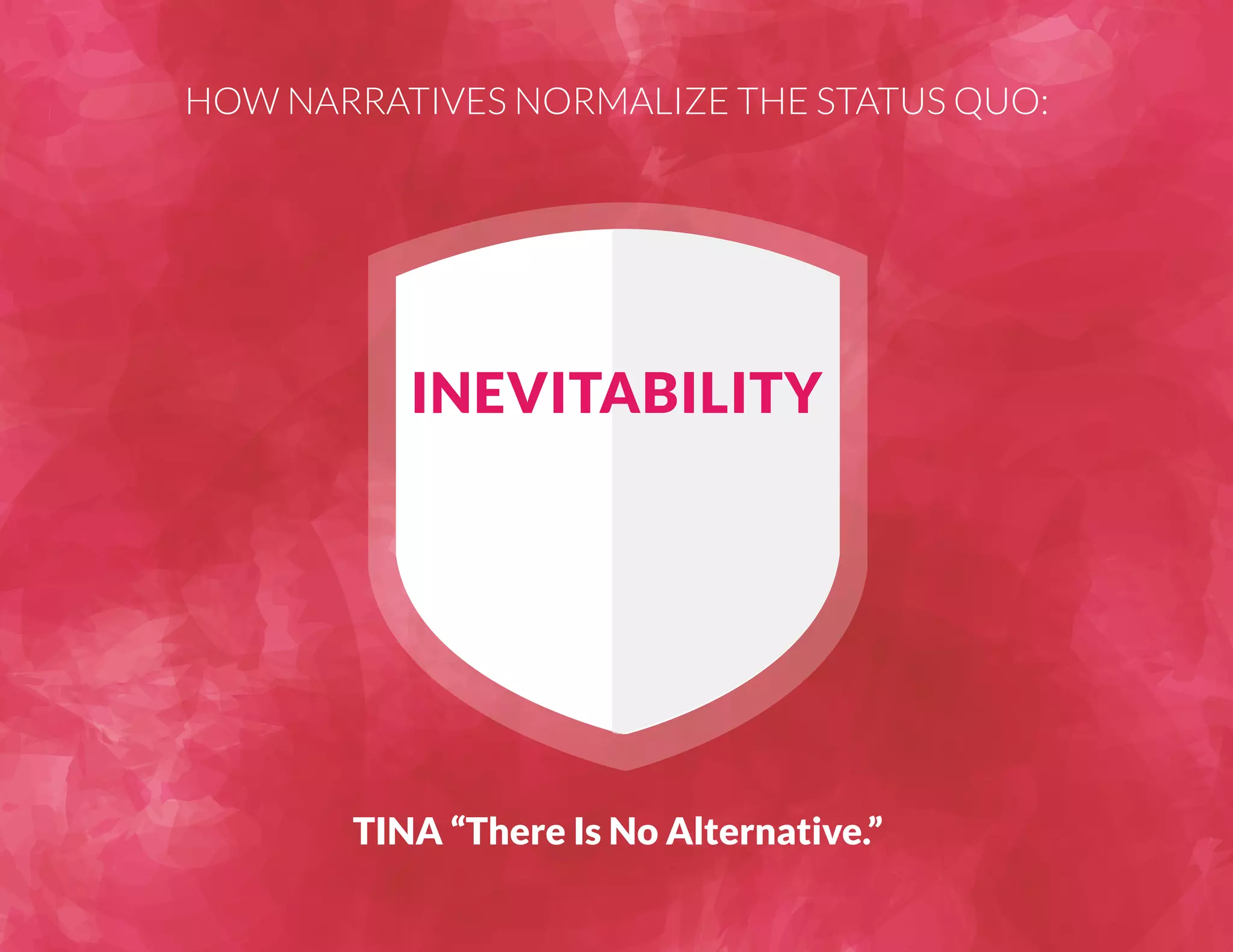
INEVITABILITY 
TINA “There Is No Alternative.”
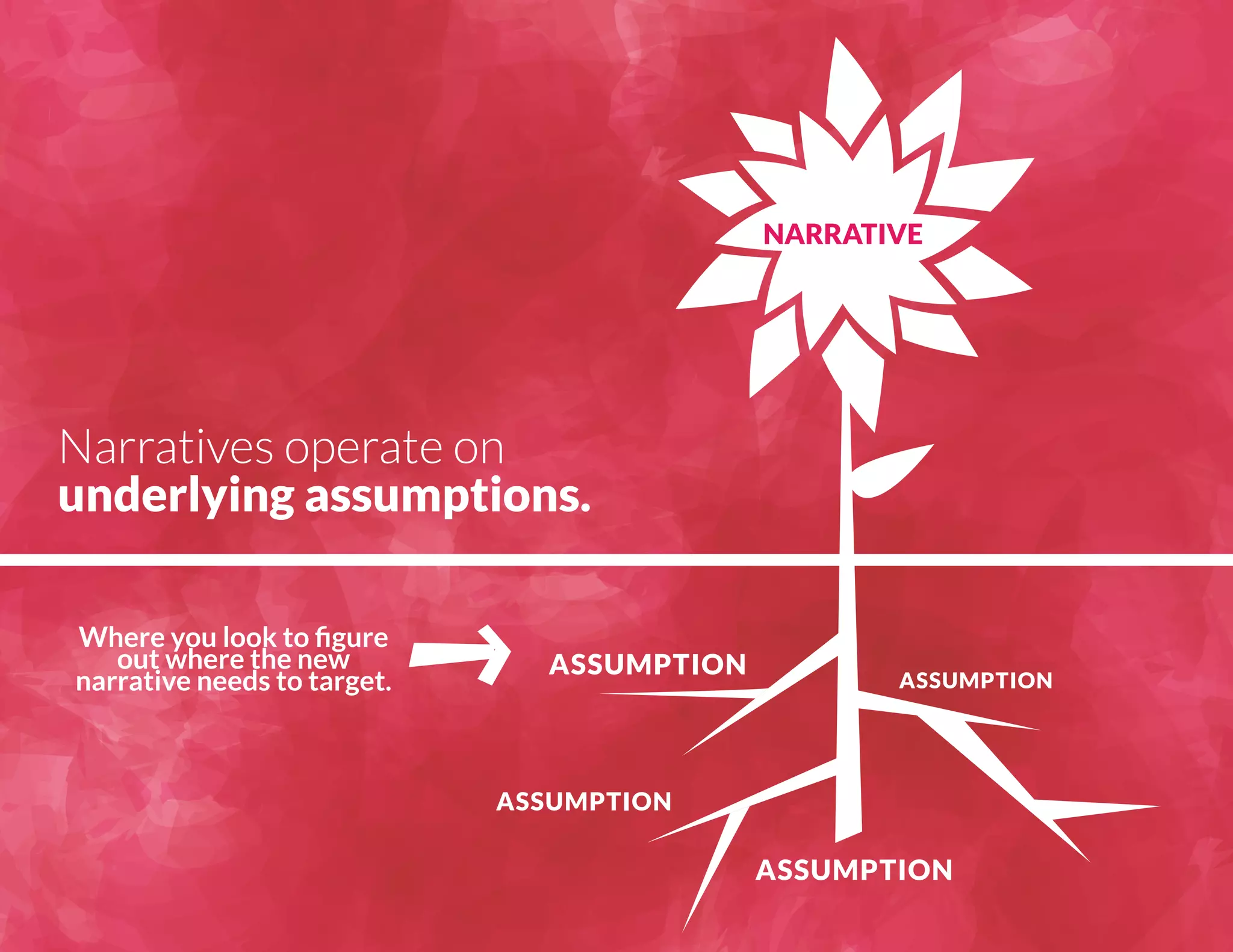
Narratives operate on 
underlying assumptions. 
ASSUMPTION 
ASSUMPTION 
ASSUMPTION 
ASSUMPTION 
Where you look to figure 
out where the new 
narrative needs to target. 
NARRATIVE
EXAMPLES OF DOMINANT 
NARRAT I V E S 
DRAW & FILL OUT 
‘Deconstructing the Dominant Narrative’ 
(5 min) 
THEN, IN GROUPS OF 3 DISCUSS: 
What element of the status quo would 
you like to be changed? 
How is this part of the status quo protected 
by a dominant narrative? 
Tell the story as it’s told in dominant tculture. 
(5 min)
By telling new stories, 
we can build 
A NEW WORLD.
The ability to dream up and spread 
these solutions lives or dies on the 
ability to tell great stories that 
inspire people to think differently. 
-Jonah Sachs, Story Wars
T H E J O B O F 
T H E C O N S C I O U S S TO R Y T E L L E R : 
Use narrative to 
create new frames.
Storytelling is not 
just a communications tool. 
It is an essential part 
of creating change.
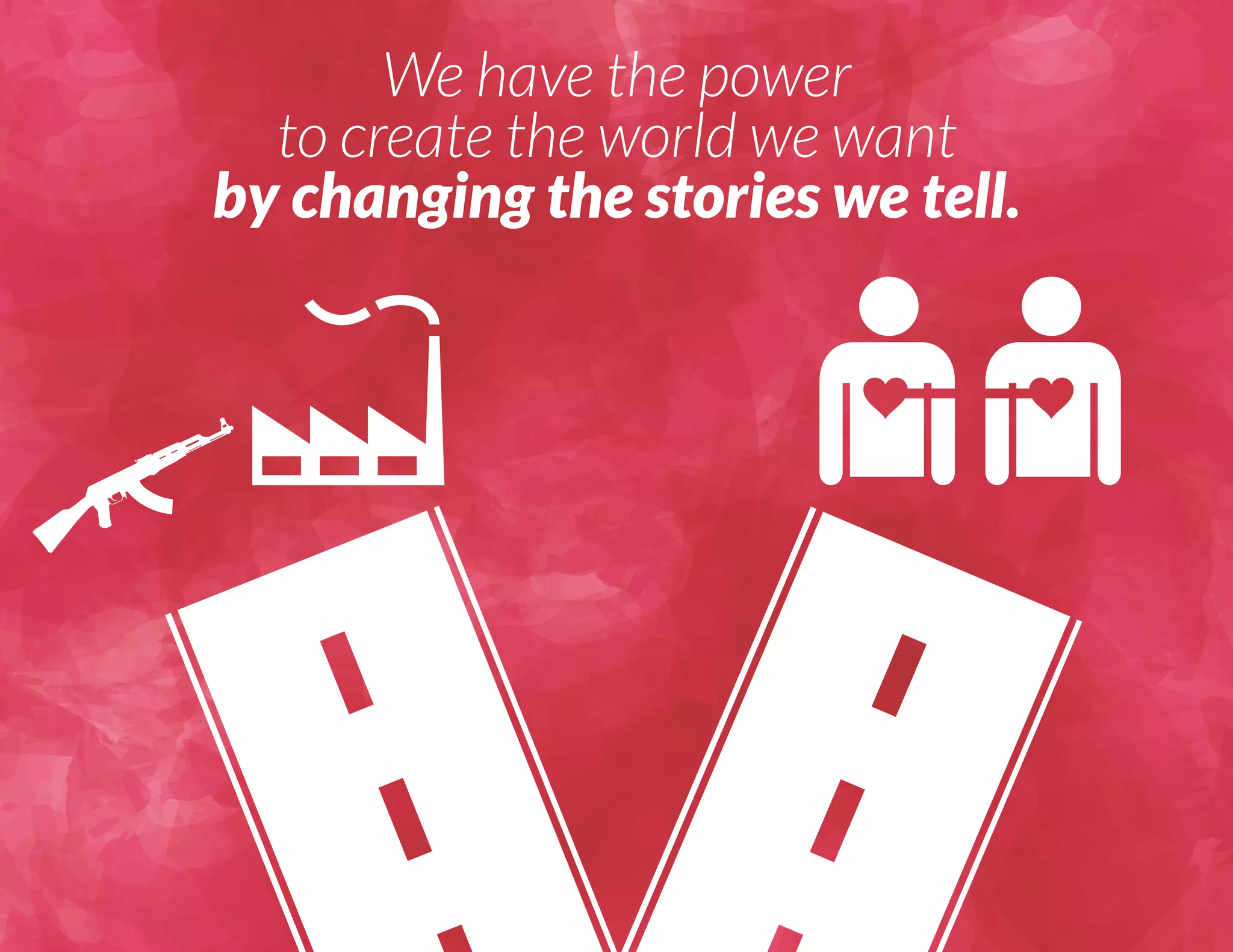
We have the power 
to create the world we want 
by changing the stories we tell.
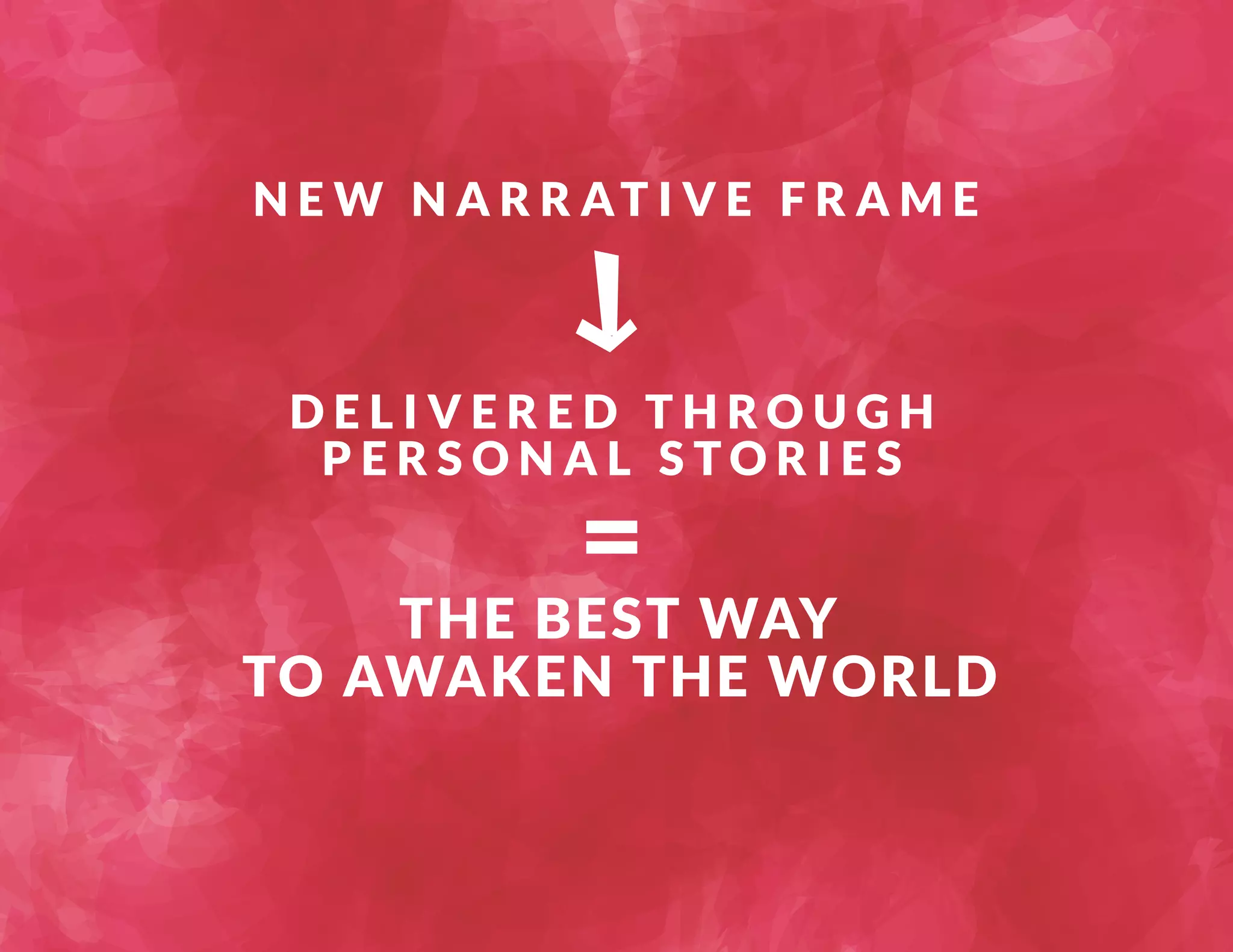
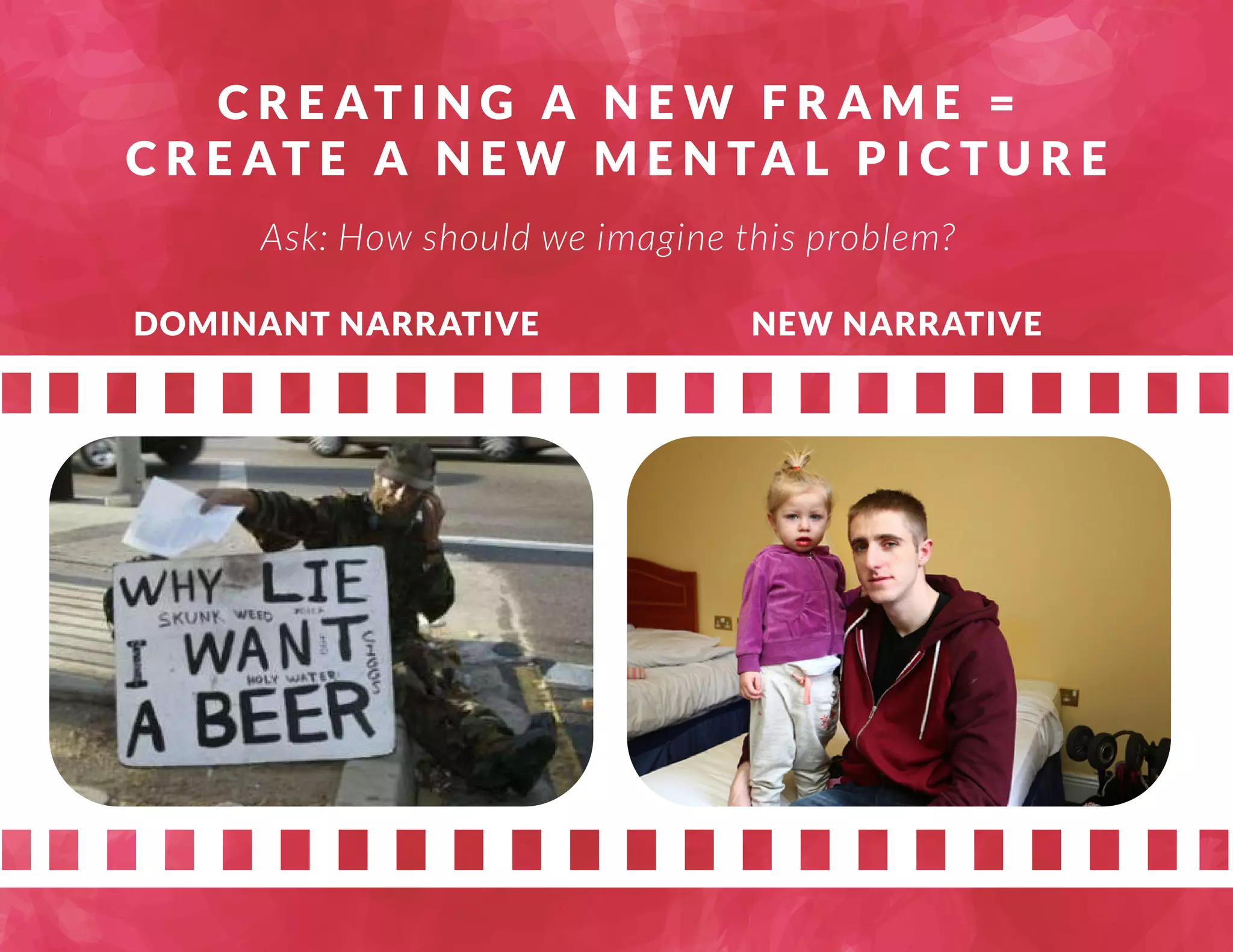
CREAT I N G A N E W F R A M E = 
CREAT E A N E W M E N TA L P I C T U R E 
Ask: How should we imagine this problem? 
DOMINANT NARRATIVE NEW NARRATIVE
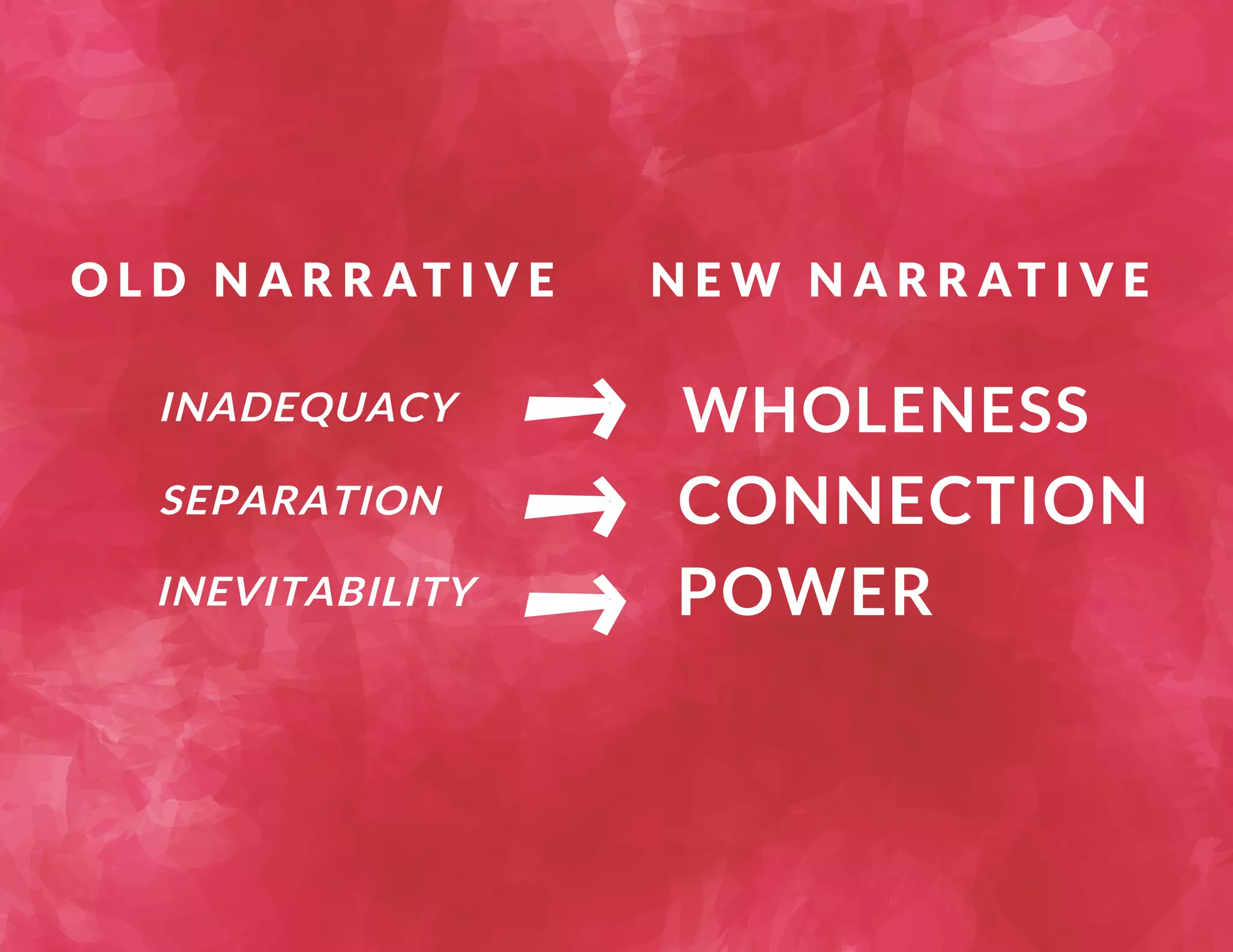
OLD NARRAT I V E NEW NARRAT I V E
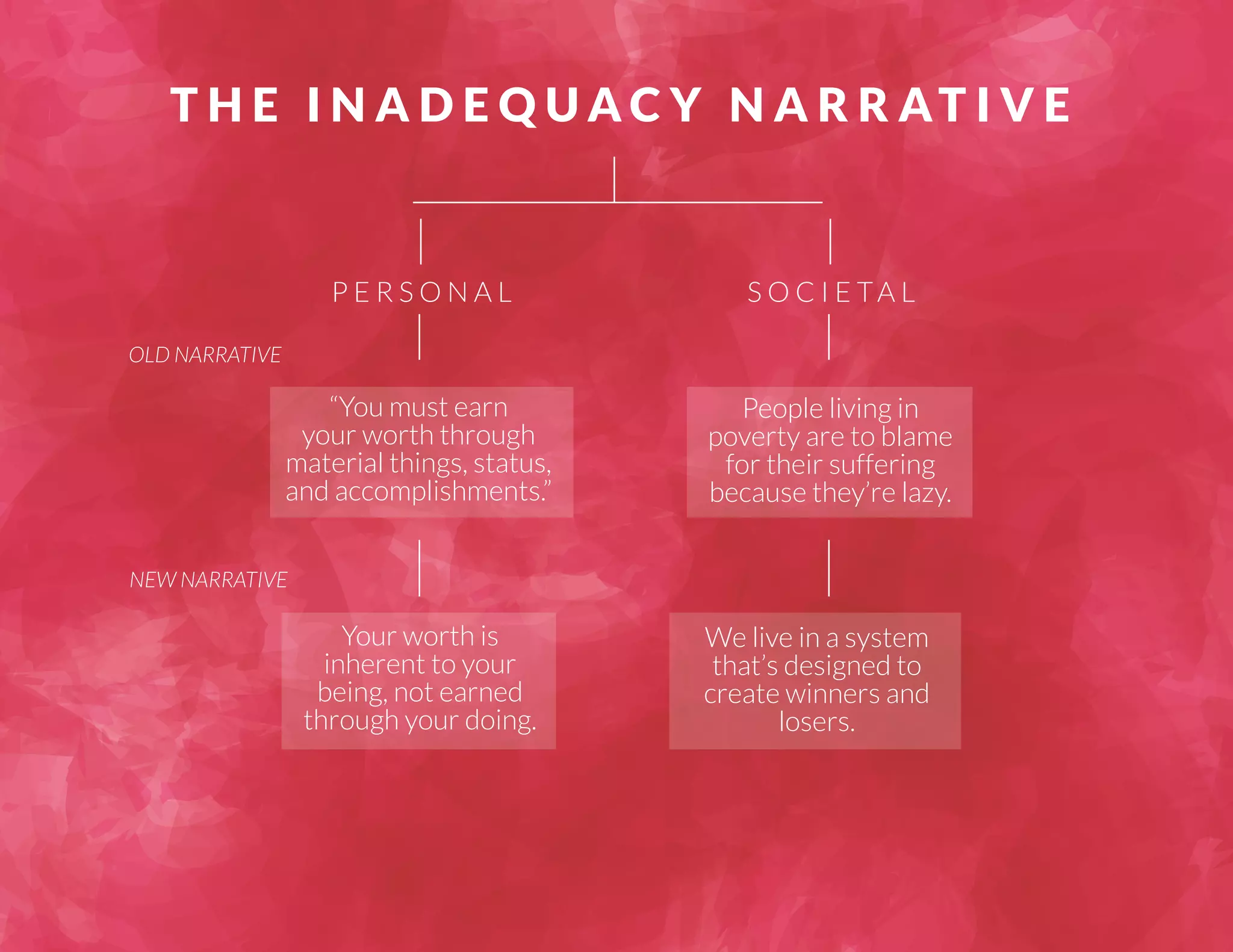
THE INADEQUACY NARRAT I V E 
PERSONAL S O C I E TA L 
“You must earn 
your worth through 
material things, status, 
and accomplishments.” 
We live in a system 
that’s designed to 
create winners and 
losers. 
Your worth is 
inherent to your 
being, not earned 
through your doing. 
People living in 
poverty are to blame 
for their suffering 
because they’re lazy. 
OLD NARRATIVE 
NEW NARRATIVE
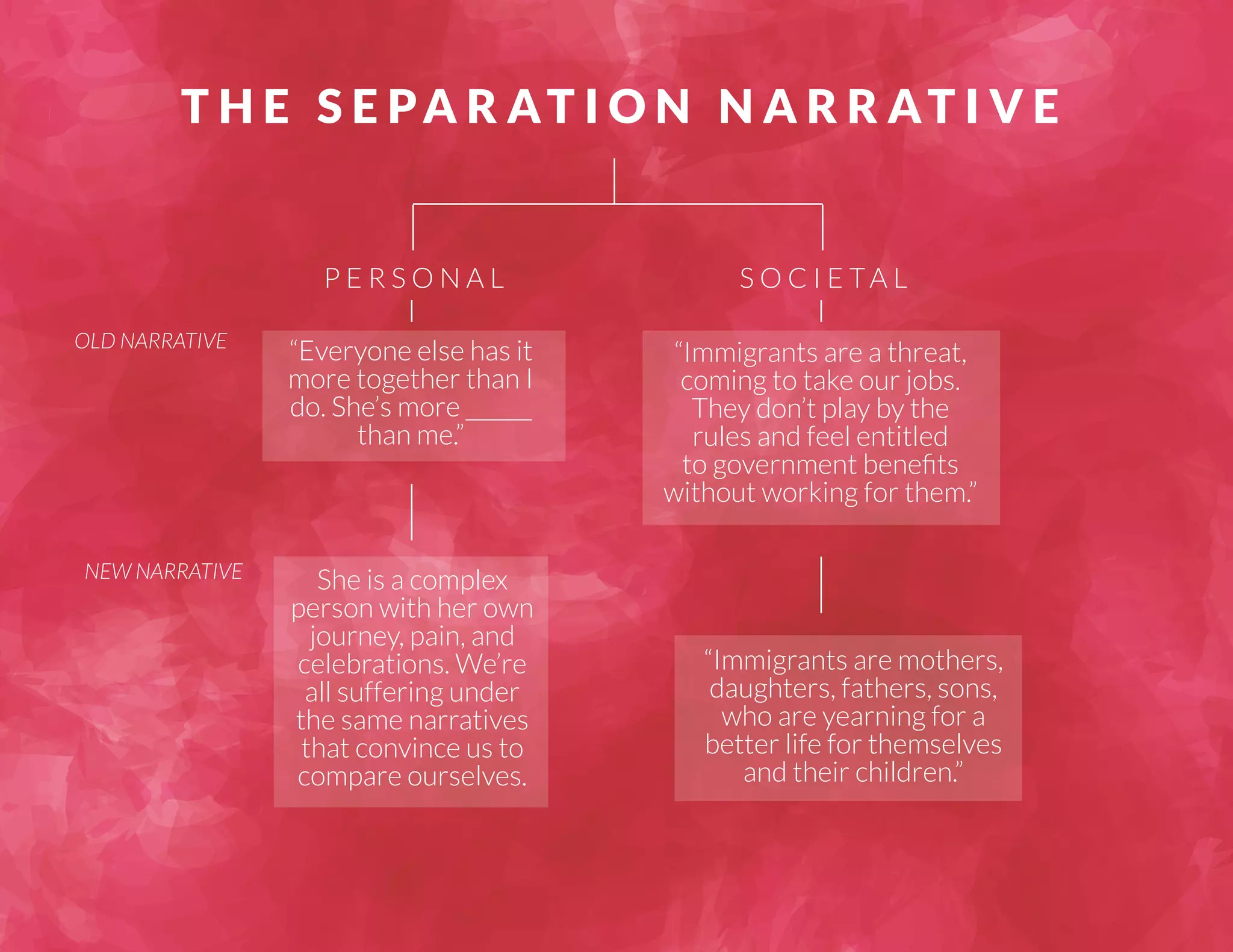
T H E S E PARATION NARRAT I V E 
PERSONAL S O C I E TA L 
“Everyone else has it 
more together than I 
do. She’s more ______ 
than me.” 
“Immigrants are mothers, 
daughters, fathers, sons, 
who are yearning for a 
better life for themselves 
and their children.” 
She is a complex 
person with her own 
journey, pain, and 
celebrations. We’re 
all suffering under 
the same narratives 
that convince us to 
compare ourselves. 
“Immigrants are a threat, 
coming to take our jobs. 
They don’t play by the 
rules and feel entitled 
to government benefits 
without working for them.” 
OLD NARRATIVE 
NEW NARRATIVE
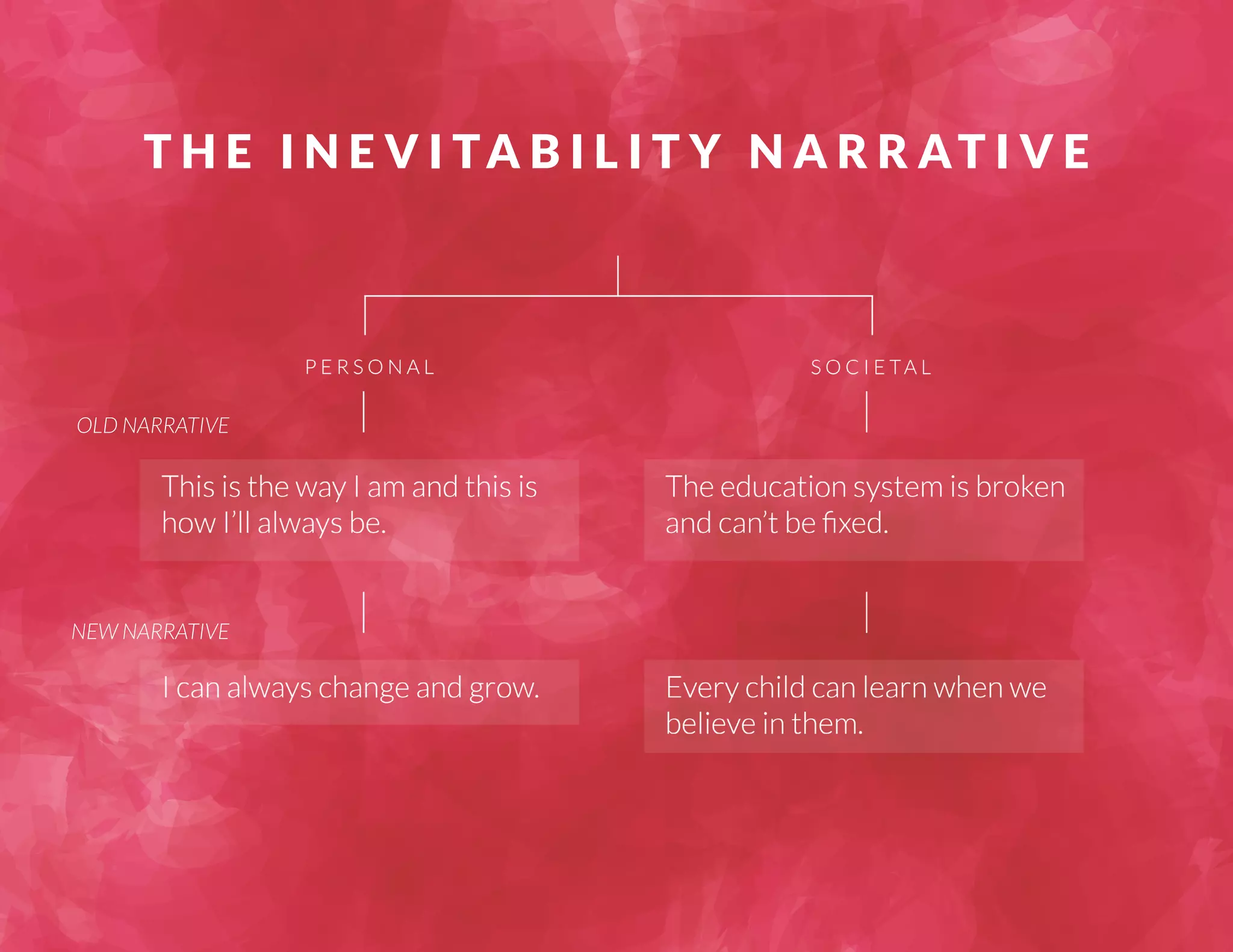
T H E I N E V I TA B I L I T Y N A R R AT I V E 
OLD NARRATIVE 
NEW NARRATIVE
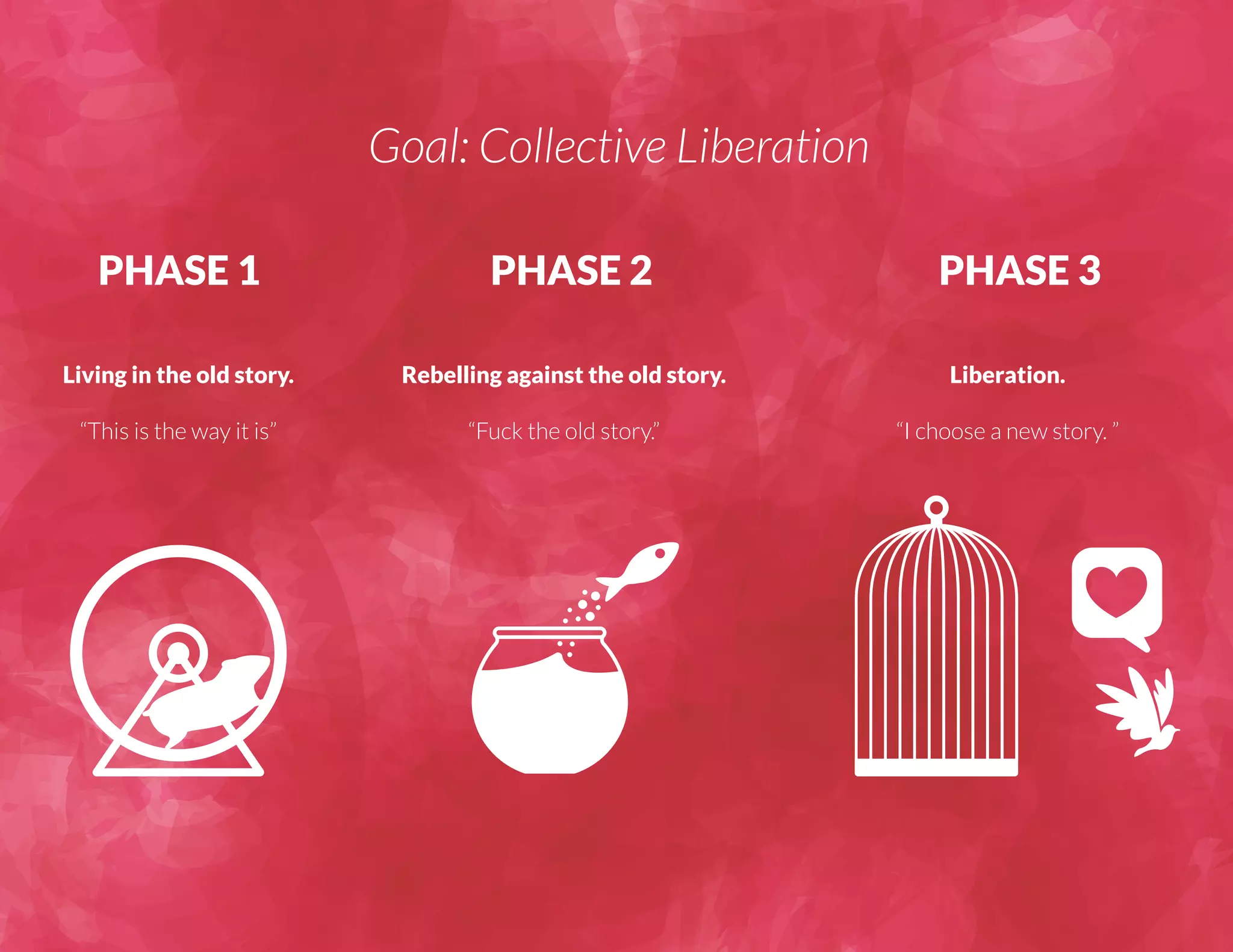
PHASE 1 PHASE 2 PHASE 3 
Living in the old story. 
“This is the way it is” 
Rebelling against the old story. 
“Fuck the old story.” 
Liberation. 
“I choose a new story. ” 
Goal: Collective Liberation
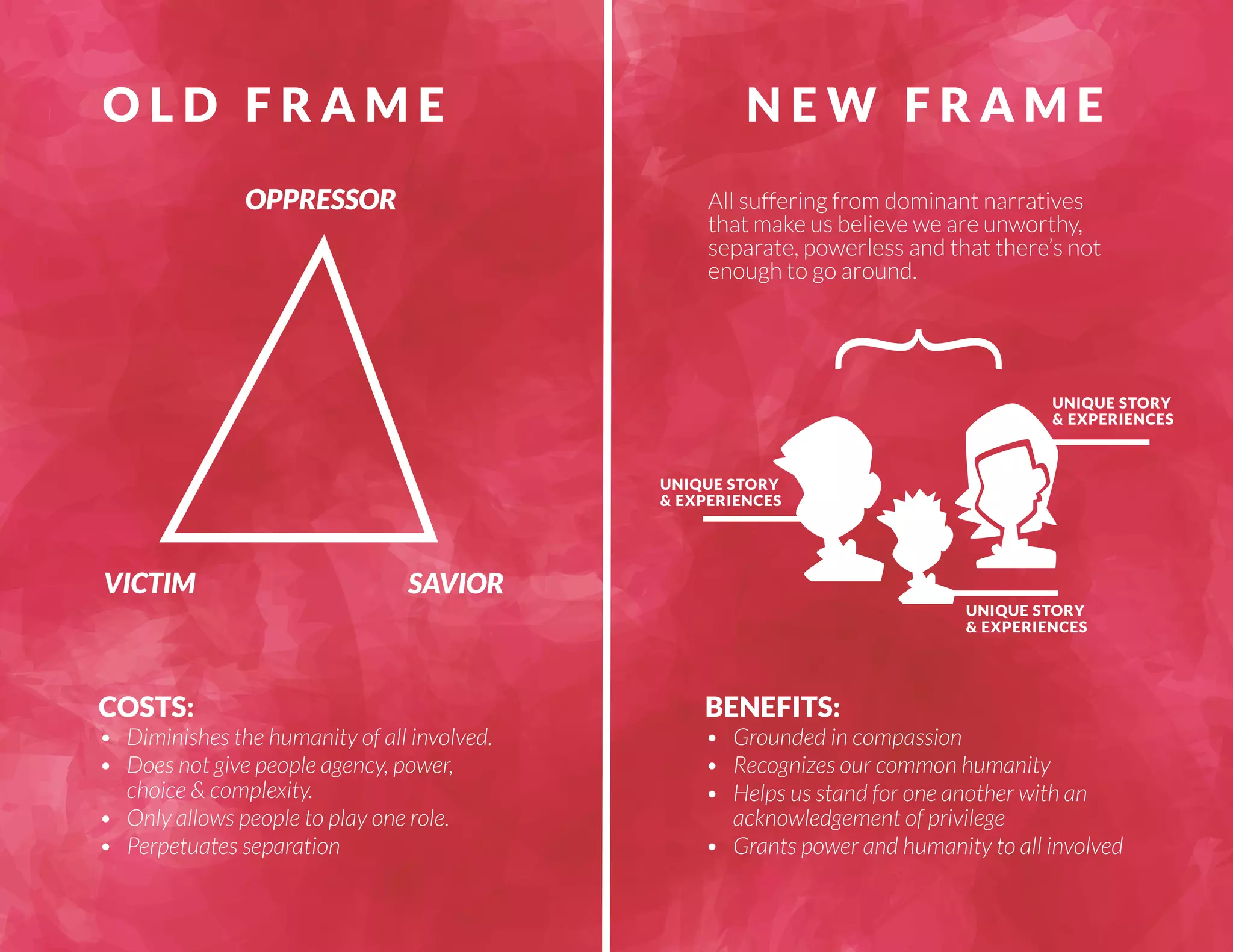
OLD FRAME NEW FRAME 
OPPRESSOR 
VICTIM SAVIOR 
COSTS: 
• Diminishes the humanity of all involved. 
• Does not give people agency, power, 
choice & complexity. 
• Only allows people to play one role. 
• Perpetuates separation 
All suffering from dominant narratives 
that make us believe we are unworthy, 
separate, powerless and that there’s not 
enough to go around. 
UNIQUE STORY 
& EXPERIENCES 
UNIQUE STORY 
& EXPERIENCES 
} 
UNIQUE STORY 
& EXPERIENCES 
BENEFITS: 
• Grounded in compassion 
• Recognizes our common humanity 
• Helps us stand for one another with an 
acknowledgement of privilege 
• Grants power and humanity to all involved
DRAW: 
HOW SHOULD PEOPLE 
IMAGINE THE SITUATION?
ENVISION THE WORLD 
YOU WA N T TO L I V E I N 
If every campaign, project and 
program succeeded, what would the 
world look, taste, smell, feel like?
FILL OUT: 
‘IMAGINING A 
NEW NARRATIVE.’
COMMUNICAT I N G YOUR 
NEW NARRAT I V E : 
“This is how it has been, but this is how it could be. 
Here’s how we are making that happen 
and why we need you.”
VISIONARY NARRAT I V E = 
SOUL OF A 
MOVEMENT.
HOW TO C R A F T A 
VISIONARY NARRAT I V E 
1. Hook: Personal story that 
describes the status quo
Choosing a personal story: 
Think about the shift in perspective you 
want the audience to have. 
Do you have a story of when you had 
that shift in perspective yourself?
2. Describe the status quo 
from a macro perspective.
3. Cost of the status quo. 
What does the status quo mean for people? 
What’s at stake if things stay the way they are?
4. How could things be instead? 
Alternate reality. Other Possibility. 
Paint a picture of the future with 
compelling details.
5. How is this vision of the future going 
to come true? What’s it going to take? 
Why do you believe this is possible? 
(this is where you introduce your solution 
or organization).
6. How your audience is 
essential/needed in order for 
this new future to come true.
8. Call to Action-what 
can your audience do to affirm their 
participation in your narrative?
Questions to consider when crafting a visionary narrative: 
1. What does the narrative you are creating mean for your audience? 
2. How is your audience a character in this story? How might you 
empower them through this story? 
3. what values will they be expressing to their networks if they share 
your message?
1. Form a group of 3. 
2. Individually draw two pictures or 
write: How It Is & How It Could Be. 
3. Each share your visionary 
narrative with each other.
P I C K I N G A S TORY 
What is your goal? 
What action do you want them to take? 
What Ah-Ha! moment might 
help them take that action? 
What story will lead to 
that Ah-Ha! moment? 
CHOOSE THE STORY THAT WILL GET 
THEM TO TAKE THAT ACTION.
Write on an index card: 
1. One ah-ha moment you had. 
2. What’s your next step? 
3. What additional questions do you have? What would you 
love to learn more about? How can I serve you further on this 
journey?
www.awakestorytelling.com 
facebook.com/awakestorytelling 
annie@awakestorytelling.com
ELEMENTS OF 
GREAT S TO R I E S
GREAT STORIES... 
Are emotional and show vulnerability.
GREAT STORIES... 
Are about journeys where the 
protagonist learns something 
about the world.
GREAT STORIES... 
Describe a personal transformation.
GREAT STORIES... 
have dramatic tension. The stakes 
are high. They make the audience 
wonder, “What will happen next?”
GREAT STORIES... 
Include memorable, vivid, sensory details 
that are relevant to the core message.
GREAT STORIES... 
Are simple- they only include details 
that illustrate the mesage.
T U R N TO A N E I G H B O R : 
Tell a story that represents why you do what you do. 
It must include a specific scene with vivid, sensory details. 
While listening, be a story detective: 
What values are expressed in this story? 
What makes a good story?
S TORY PORT F O L I O : 
The individual stories that add up to 
your visionary narrative.
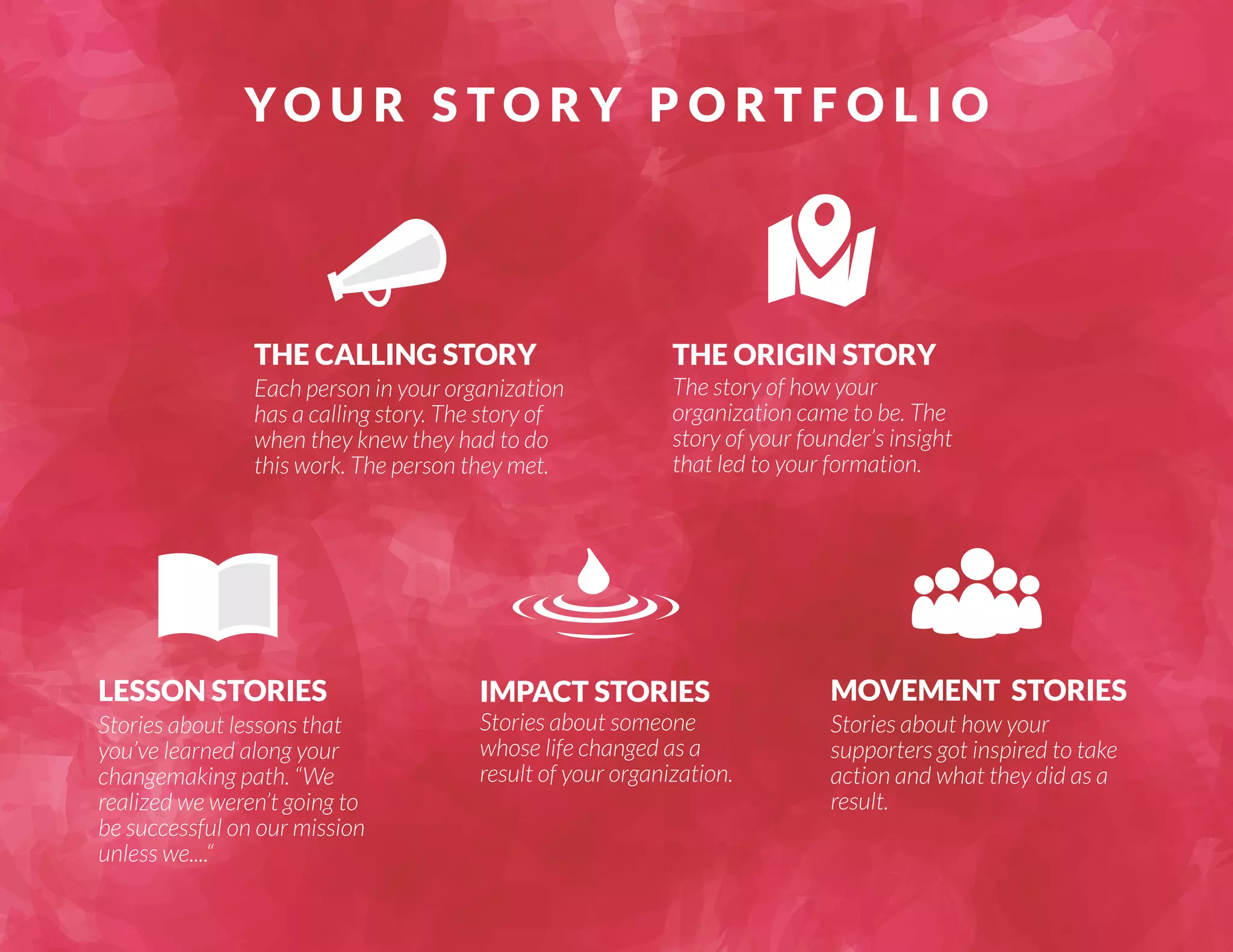
YO U R S TORY PORT F O L I O 
THE CALLING STORY 
Each person in your organization 
has a calling story. The story of 
when they knew they had to do 
this work. The person they met. 
THE ORIGIN STORY 
The story of how your 
organization came to be. The 
story of your founder’s insight 
that led to your formation. 
LESSON STORIES 
Stories about lessons that 
you’ve learned along your 
changemaking path. “We 
realized we weren’t going to 
be successful on our mission 
unless we....“ 
MOVEMENT STORIES 
Stories about how your 
supporters got inspired to take 
action and what they did as a 
result. 
IMPACT STORIES 
Stories about someone 
whose life changed as a 
result of your organization.
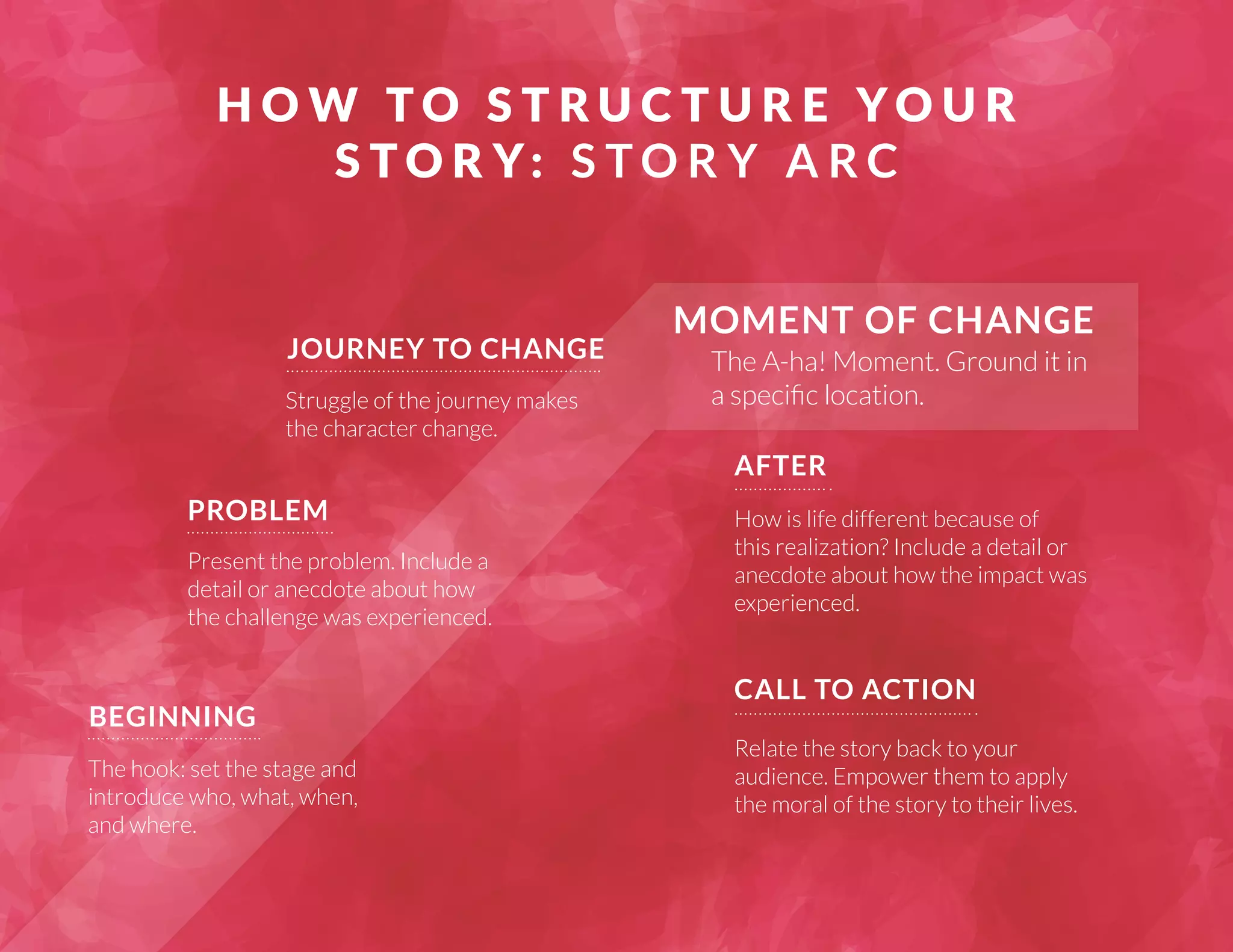
HOW TO S T RUCTURE YOUR 
S TORY: S TORY ARC 
MOMENT OF CHANGE 
The A-ha! Moment. Ground it in 
a specific location. 
AFTER 
How is life different because of 
this realization? Include a detail or 
anecdote about how the impact was 
experienced. 
CALL TO ACTION 
Relate the story back to your 
audience. Empower them to apply 
the moral of the story to their lives. 
JOURNEY TO CHANGE 
Struggle of the journey makes 
the character change. 
PROBLEM 
Present the problem. Include a 
detail or anecdote about how 
the challenge was experienced. 
BEGINNING 
The hook: set the stage and 
introduce who, what, when, 
and where.
Using the Power of Storytelling to Change the World September 2014

Using the Power of Storytelling to Change the World September 2014

  • 5.
    DOMINANT NARRAT IV E - INADEQUACY
  • 8.
    S TO RI E S H O L D O U R I D E N T I T I E S TOGETHER.
  • 9.
    WHO AM I? WHO ARE WE? HOW IS THE WORLD? WHAT MAKES ME, ME? WHAT MAKES US, US? WHY IS THE WORLD THE WAY IT IS?
  • 10.
    WHATEVER ANSWER WECOME UP WITH TO THESE QUESTIONS IS A NARRATIVE.
  • 11.
    STORIES beliefs beliefsbeliefs STORIES BELIEFS What we believe creates our reality. Beliefs are embedded, learned and transmitted as stories. stories STORIES beliefs OUR WORLD
  • 12.
    Stories are thecode of our collective operating system. <!DOCTYPE html> <html> <body> <h1>Story <p>story</p> </body> </html>
  • 14.
    4 FUNCTIONS OF MYTHS: 1. MYSTICAL- stories that reveal the wonder of the world and of being human. 2. COSMOLOGICAL- stories that attempt to describe the shape of the universe. 3. SOCIOLOGICAL- stories that support & validate a certain social order. 4. PEDOGOGICAL- stories that teach us how to overcome the challenges of being human.
  • 15.
    WE’VE EVOLVED TO LOVE STORIES BECAUSE THEY HELP US SURVIVE.
  • 16.
    Stories are designedto persuade an audience of a storyteller’s worldview. H O W D O T H E Y D O T H I S ? Stories express values.
  • 17.
    S TO RI E S A R E S O C I A L G L U E .
  • 18.
    Stories remain theinvisible glue through which people narrate the meaning of their lives and interweave their lives with other lives. -Michael Margolis, Believe Me.
  • 19.
    S TO RI E S S Y N C H RO N I Z E B R A I N S Communities are groups bound by shared values. Through storytelling, you communicate your values so your audience can say, “Hey! I believe that too!”
  • 20.
    Great stories combineconviction and revelation
  • 21.
    S TO RI E S A L LOW US TO CREAT E ORDER O U T O F T H E CHAOT I C .
  • 22.
    They do thisby E D I T I N G O U T irrelevant details.
  • 23.
    AND D EF I N I N G A CAU S E FOR EACH E F F E C T.
  • 24.
    Dominant narratives arethe ARMOR OF THE STATUS QUO.
  • 26.
    NARRAT I VE STORY STORY STORY STORY STORY STORY STORY STORY STORY STORY
  • 27.
    S TORY -EventUnity -The ‘who, what, when, where, how’ of an event that occured -It has a begining, middle, and end NARRAT I V E -A system of stories: Two or more stories that add up to create a larger explanation about how the world is. -Narrative: What do these stories tell us about how the world is? VS
  • 28.
    INADEQUACY OCEAN THATTIME YOU DIDN’T FINISH A PROJECT DAD NEVER SAID, “I LOVE YOU.” GOT AN F IN BIO MEDIA INSTITUTIONS FAMILY NOT INVITED TO THE PARTY CULTURAL MESSAGES
  • 29.
    HOW NARRATIVES NORMALIZETHE STATUS QUO: The misfortunes of those living in poverty are a result of their laziness. Welfare allows people to game the system and remain lazy. U N I V E R S A L I Z I N G CERTA I N E X P E R I E N C E S “WELFARE QUEEN”
  • 30.
    HOW NARRATIVES NORMALIZETHE STATUS QUO: I N V I S I B I L I Z I N G OPPRESSION CRIMINALIZATION OF POVERTY 80% OF JOBS GIVEN THROUGH PERSONAL CONNECTIONS NEGATIVE ASSUMPTIONS SCHOOL TO PRISON PIPELINE HISTORY DISCRIMINATORY HIRING UNLIVABLE MINIMUM WAGE BROKEN SCHOOLS Pick yourself up by your bootstraps! Just work hard!
  • 31.
    HOW NARRATIVES NORMALIZETHE STATUS QUO: INEVITABILITY TINA “There Is No Alternative.”
  • 32.
    Narratives operate on underlying assumptions. ASSUMPTION ASSUMPTION ASSUMPTION ASSUMPTION Where you look to figure out where the new narrative needs to target. NARRATIVE
  • 33.
    EXAMPLES OF DOMINANT NARRAT I V E S DRAW & FILL OUT ‘Deconstructing the Dominant Narrative’ (5 min) THEN, IN GROUPS OF 3 DISCUSS: What element of the status quo would you like to be changed? How is this part of the status quo protected by a dominant narrative? Tell the story as it’s told in dominant tculture. (5 min)
  • 34.
    By telling newstories, we can build A NEW WORLD.
  • 35.
    The ability todream up and spread these solutions lives or dies on the ability to tell great stories that inspire people to think differently. -Jonah Sachs, Story Wars
  • 36.
    T H EJ O B O F T H E C O N S C I O U S S TO R Y T E L L E R : Use narrative to create new frames.
  • 37.
    Storytelling is not just a communications tool. It is an essential part of creating change.
  • 39.
    We have thepower to create the world we want by changing the stories we tell.
  • 40.
    CREAT I NG A N E W F R A M E = CREAT E A N E W M E N TA L P I C T U R E Ask: How should we imagine this problem? DOMINANT NARRATIVE NEW NARRATIVE
  • 41.
    OLD NARRAT IV E NEW NARRAT I V E
  • 42.
    THE INADEQUACY NARRATI V E PERSONAL S O C I E TA L “You must earn your worth through material things, status, and accomplishments.” We live in a system that’s designed to create winners and losers. Your worth is inherent to your being, not earned through your doing. People living in poverty are to blame for their suffering because they’re lazy. OLD NARRATIVE NEW NARRATIVE
  • 43.
    T H ES E PARATION NARRAT I V E PERSONAL S O C I E TA L “Everyone else has it more together than I do. She’s more ______ than me.” “Immigrants are mothers, daughters, fathers, sons, who are yearning for a better life for themselves and their children.” She is a complex person with her own journey, pain, and celebrations. We’re all suffering under the same narratives that convince us to compare ourselves. “Immigrants are a threat, coming to take our jobs. They don’t play by the rules and feel entitled to government benefits without working for them.” OLD NARRATIVE NEW NARRATIVE
  • 44.
    T H EI N E V I TA B I L I T Y N A R R AT I V E OLD NARRATIVE NEW NARRATIVE
  • 45.
    PHASE 1 PHASE2 PHASE 3 Living in the old story. “This is the way it is” Rebelling against the old story. “Fuck the old story.” Liberation. “I choose a new story. ” Goal: Collective Liberation
  • 46.
    OLD FRAME NEWFRAME OPPRESSOR VICTIM SAVIOR COSTS: • Diminishes the humanity of all involved. • Does not give people agency, power, choice & complexity. • Only allows people to play one role. • Perpetuates separation All suffering from dominant narratives that make us believe we are unworthy, separate, powerless and that there’s not enough to go around. UNIQUE STORY & EXPERIENCES UNIQUE STORY & EXPERIENCES } UNIQUE STORY & EXPERIENCES BENEFITS: • Grounded in compassion • Recognizes our common humanity • Helps us stand for one another with an acknowledgement of privilege • Grants power and humanity to all involved
  • 47.
    DRAW: HOW SHOULDPEOPLE IMAGINE THE SITUATION?
  • 48.
    ENVISION THE WORLD YOU WA N T TO L I V E I N If every campaign, project and program succeeded, what would the world look, taste, smell, feel like?
  • 49.
    FILL OUT: ‘IMAGININGA NEW NARRATIVE.’
  • 50.
    COMMUNICAT I NG YOUR NEW NARRAT I V E : “This is how it has been, but this is how it could be. Here’s how we are making that happen and why we need you.”
  • 51.
    VISIONARY NARRAT IV E = SOUL OF A MOVEMENT.
  • 52.
    HOW TO CR A F T A VISIONARY NARRAT I V E 1. Hook: Personal story that describes the status quo
  • 53.
    Choosing a personalstory: Think about the shift in perspective you want the audience to have. Do you have a story of when you had that shift in perspective yourself?
  • 54.
    2. Describe thestatus quo from a macro perspective.
  • 55.
    3. Cost ofthe status quo. What does the status quo mean for people? What’s at stake if things stay the way they are?
  • 56.
    4. How couldthings be instead? Alternate reality. Other Possibility. Paint a picture of the future with compelling details.
  • 57.
    5. How isthis vision of the future going to come true? What’s it going to take? Why do you believe this is possible? (this is where you introduce your solution or organization).
  • 58.
    6. How youraudience is essential/needed in order for this new future to come true.
  • 59.
    8. Call toAction-what can your audience do to affirm their participation in your narrative?
  • 60.
    Questions to considerwhen crafting a visionary narrative: 1. What does the narrative you are creating mean for your audience? 2. How is your audience a character in this story? How might you empower them through this story? 3. what values will they be expressing to their networks if they share your message?
  • 61.
    1. Form agroup of 3. 2. Individually draw two pictures or write: How It Is & How It Could Be. 3. Each share your visionary narrative with each other.
  • 62.
    P I CK I N G A S TORY What is your goal? What action do you want them to take? What Ah-Ha! moment might help them take that action? What story will lead to that Ah-Ha! moment? CHOOSE THE STORY THAT WILL GET THEM TO TAKE THAT ACTION.
  • 63.
    Write on anindex card: 1. One ah-ha moment you had. 2. What’s your next step? 3. What additional questions do you have? What would you love to learn more about? How can I serve you further on this journey?
  • 64.
  • 65.
    ELEMENTS OF GREATS TO R I E S
  • 66.
    GREAT STORIES... Areemotional and show vulnerability.
  • 67.
    GREAT STORIES... Areabout journeys where the protagonist learns something about the world.
  • 68.
    GREAT STORIES... Describea personal transformation.
  • 69.
    GREAT STORIES... havedramatic tension. The stakes are high. They make the audience wonder, “What will happen next?”
  • 70.
    GREAT STORIES... Includememorable, vivid, sensory details that are relevant to the core message.
  • 71.
    GREAT STORIES... Aresimple- they only include details that illustrate the mesage.
  • 72.
    T U RN TO A N E I G H B O R : Tell a story that represents why you do what you do. It must include a specific scene with vivid, sensory details. While listening, be a story detective: What values are expressed in this story? What makes a good story?
  • 73.
    S TORY PORTF O L I O : The individual stories that add up to your visionary narrative.
  • 74.
    YO U RS TORY PORT F O L I O THE CALLING STORY Each person in your organization has a calling story. The story of when they knew they had to do this work. The person they met. THE ORIGIN STORY The story of how your organization came to be. The story of your founder’s insight that led to your formation. LESSON STORIES Stories about lessons that you’ve learned along your changemaking path. “We realized we weren’t going to be successful on our mission unless we....“ MOVEMENT STORIES Stories about how your supporters got inspired to take action and what they did as a result. IMPACT STORIES Stories about someone whose life changed as a result of your organization.
  • 75.
    HOW TO ST RUCTURE YOUR S TORY: S TORY ARC MOMENT OF CHANGE The A-ha! Moment. Ground it in a specific location. AFTER How is life different because of this realization? Include a detail or anecdote about how the impact was experienced. CALL TO ACTION Relate the story back to your audience. Empower them to apply the moral of the story to their lives. JOURNEY TO CHANGE Struggle of the journey makes the character change. PROBLEM Present the problem. Include a detail or anecdote about how the challenge was experienced. BEGINNING The hook: set the stage and introduce who, what, when, and where.