Practice in
Schools and
Communities
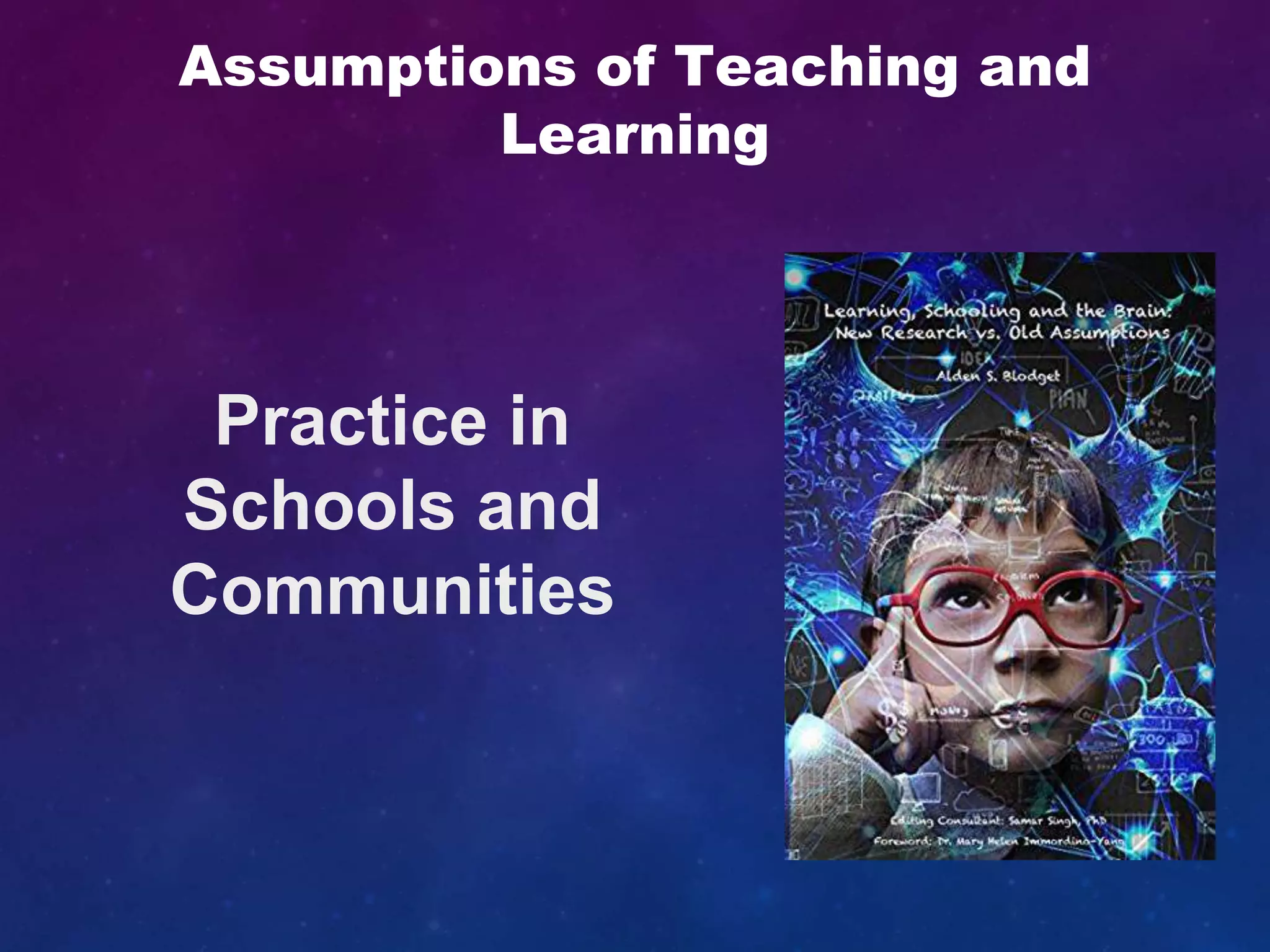
Assumptions of Teaching and
Learning
CLASS AGENDA
• Attendance/Concerns/Housekeeping
• Relationship between Living and Telling
• Summerhill School
• Preparing for Observation
• Reading week next week!!!!!!!!!
• Break ☺
• Oral Chronicles: Oliva, Bronte, Madalyn, Rachel
• Triad work time
• Exit Card
HOUSEKEEPING
• Related Literacy Feedback:
• Using the readings to discuss previous letters ☺
• Push your “So what?” further by explaining how
engaging in narrative inquiry is impacting your
philosophy of education
• Remember, we are still engaging in narrative inquiry
so you need to address the three commonplaces:
Temporality; Sociality; Place
• No class next week – Feb 20
RELATIONSHIP BETWEEN LIVING AND
TELLING:
• Living - you experience life through your
biases/assumptions/hardened stories.
• Telling - you begin to uncover those
assumptions/biases; because you experience life
through your lens, your telling will include those
biases.
• It is through the telling (and re-telling) that we
begin to uncover those biases.
HOW THIS COULD LOOK IN REAL LIFE:
• Have you ever shared a story or a joke and found
it didn’t get the reaction you were anticipating?
• Did it make you re-think your story or joke, at all?
• Did the re-examination influence the re-telling of
that story or joke?
• Do you see how, with each retelling, your
understanding is being shaped?
RELATIONSHIP BETWEEN LIVING AND
TELLING:
• Living - you experience life through your
biases/assumptions/hardened stories.
• Telling - you begin to uncover those
assumptions/biases; because you experience life
through your lens, your telling will include those
biases.
• It is through the telling (and re-telling) that we
begin to uncover those biases.
HOW DOES THIS FRAMEWORK SERVE US, AS
EDUCATORS?
• We use this framework to uncover our
biases/assumptions/hardened and frozen in our
stories
• Often, especially when we are a part of the
dominant group, we believe that our perspective is
the “truth”
• Middle class notions of success and learning are
often a default view (grades = smart = success) –
these default views become questioned when
dissonance arises from hearing other’s stories and
hearing our stories told and re-told
THEORETICAL GROUNDING
The 3Rs in Literacy Narratives
Narrative Reveal
(excavated assumptions that surface in stories)
Narrative Revelation
(interrogated storied experience that leads to awakened
perspective on hardened stories)
Narrative Reformation
(transformed teacher knowledge through the awakened
new story)
Equity and Inclusion
ACTIVITY
• In 6 groups of 5
•
Please do not open the bag until I say to. The
goal of this activity is to complete this task under
5 minutes using the instructions provided. I will
not have any helping role in this activity so
please do not ask me any questions.
•
What you need to do:
• Open your bag and read the instructions first, before touching
anything. Again, you will not be given any additional instructions
beyond what is on your paper. After you read the instructions, you
can begin the activity.
•
If you have a limitation...
•
Follow through with it until your team completes the task. The
timer begins now!
• FIVE MINUTE TIMER
Let’s Have a Round of Applause for the Winners!!
Reflection
• What feelings came up for you during this activity?
•
How does this activity relate to people who have limitations?
•
Was the winning group the best group? Why or why not?
•
For those who won or who had an advantage, did you assist those who did
not have the same advantages? Why or why not?
•
For those who did not have an advantage, did you ask those who had an
advantage for help? Why or why not?
•
Does it make sense to mock someone who wasn’t able to complete this
task? Was their limitation something they could control?
•
How has this activity influenced you, going forward?
• How can we do better?
• Honour and affirm one another’s identity,
celebrate each other’s successes, and be
supportive of weaknesses, as well as
strengths.
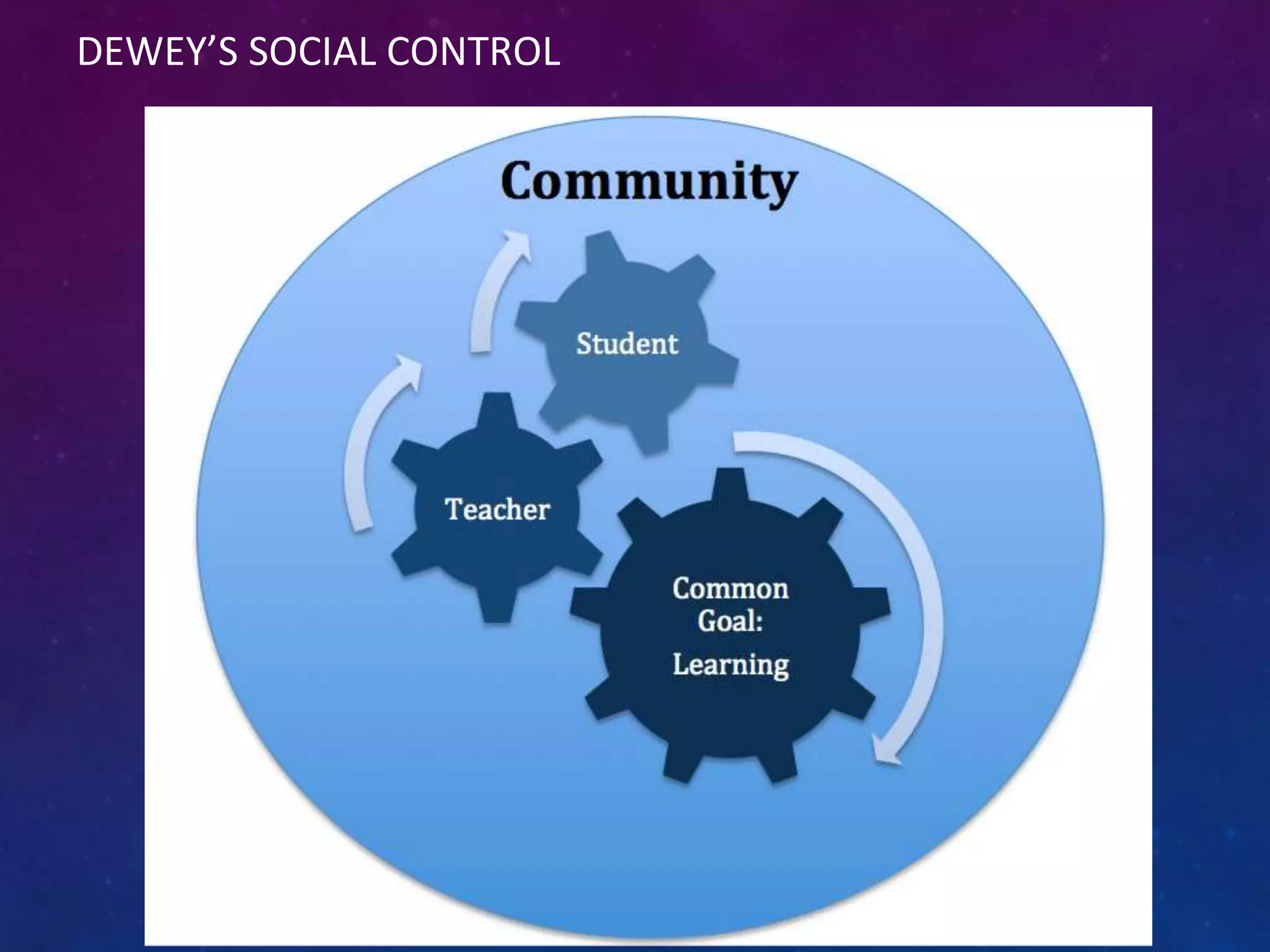
DEWEY’S SOCIAL CONTROL
SUMMERHILL SCHOOL
http://www.summerhillschool.co.uk/about.php
“Summerhill school is a democratic, self-governing
school in which the adults and children have equal
status. The daily life of the school is governed by
the school Meetings, usually held twice a week in
which everybody has an equal vote...adults and
children have equal status in the school but, of
course, have different roles.”
- How do we see this approach connecting to
Dewey’s discussion of social control? Schwabb?
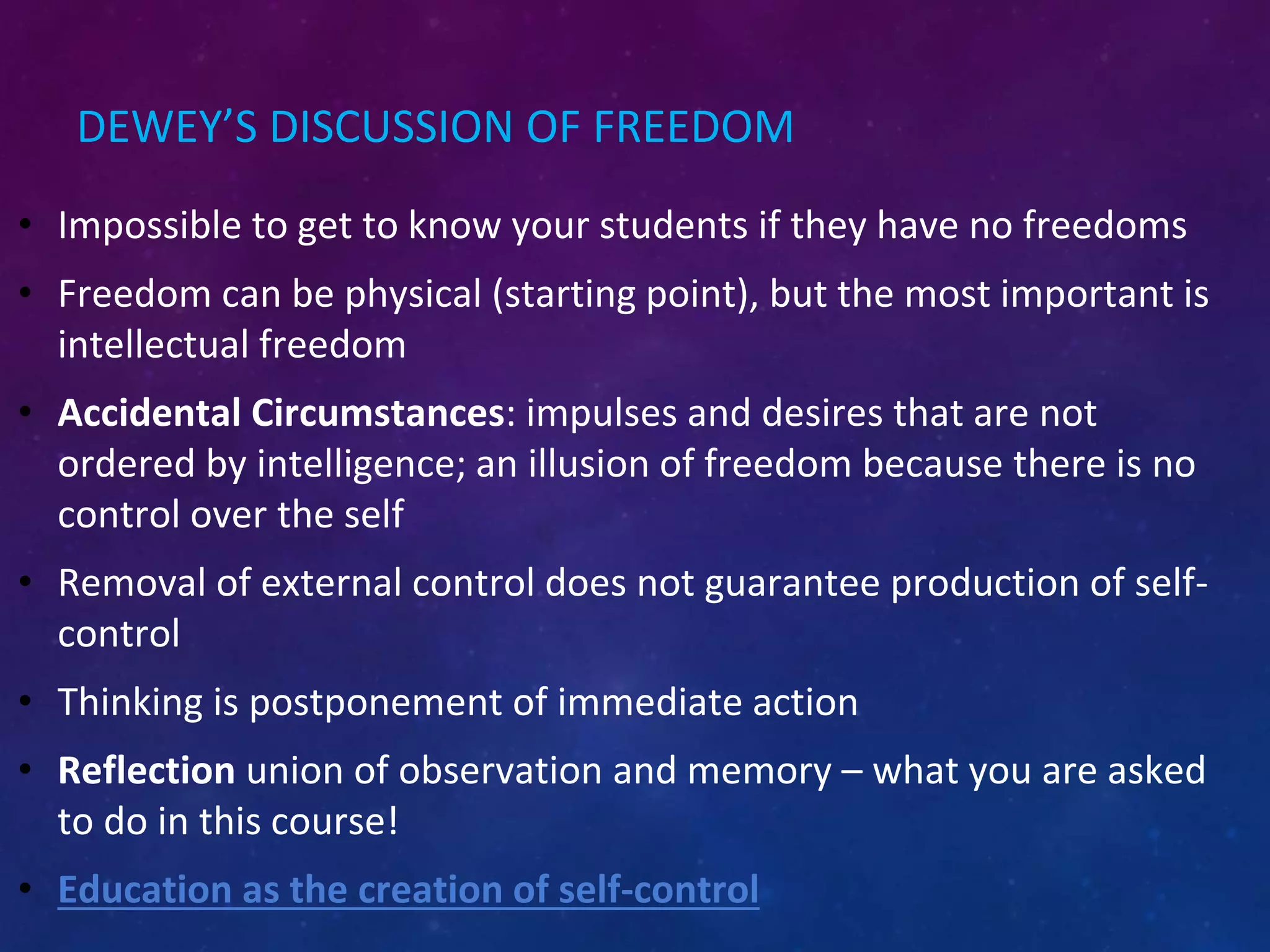
DEWEY’S DISCUSSION OF FREEDOM
• Impossible to get to know your students if they have no freedoms
• Freedom can be physical (starting point), but the most important is
intellectual freedom
• Accidental Circumstances: impulses and desires that are not
ordered by intelligence; an illusion of freedom because there is no
control over the self
• Removal of external control does not guarantee production of self-
control
• Thinking is postponement of immediate action
• Reflection union of observation and memory – what you are asked
to do in this course!
• Education as the creation of self-control
DEWEY SAID...
“The single most important source of
happiness is for students to go and
find out what they’re ‘fitted’ to do –
which is ultimately what will bring
them happiness”
ADVICE FROM DEWEY
• Teachers need to be intelligently aware of the
capacities, needs and past experiences of students,
and invite the contributions of students to direct the
plan as a cooperative enterprise, not a dictation.
• Essential point: That the purpose grow and take shape
through the process of social intelligence.
TEACHERS MUST ALWAYS BE LOOKING AHEAD…
• Teachers have an eye to the future, recognizing how
present experiences are going to contribute to those
in the future, ensuring they are relevant and
meaningful
… WHEN THEY’RE NOT REFLECTING!
• Our frame of reference for understanding our present
is only as wide as we’ve stretched it, so far
• Sound principle:
• Objectives of learning are in the future
• Materials are found in the present
• Impact is determined by how effectively we connect
with the past to extend the sphere of understanding
LET’S BRAINSTORM IDEAS, CHECKLISTS, ”CHEAT SHEETS”
& WAYS TO ORGANIZE YOUR OBSERVATIONS
What readings do we need to rely on for our observation?
How can we remind ourselves during the observation to use
our readings?
What would go on a “cheat sheet” to help keep ideas
organized?
Form two circles or two lines facing each other- share an idea
with your partner, after a minute, we’ll switch partners and
continue
Using the link under week 6 on Sakai, log onto Padlet and
share some of the best ideas you had, or heard, from your
sharing.
SCHWAB COMMONPLACES
TEACHER
LEARNER
MILIEU
SUBJECT MATTER/CURRICULUM
WATCH FOR EVIDENCE OF...
Trust Respect
Integrity Care
Constructivism
Students take an active role in their
learning
•The learner constructs new knowledge
on prior knowledge, building
understanding and making sense of new
information
•Students experience successful
learning when they are actively engaged
in:
•constructing knowledge for
themselves;
•reflecting on their views and the views
of others;
•Arriving at new understandings that
expand their worldview
Foundations of Professional
Practice:
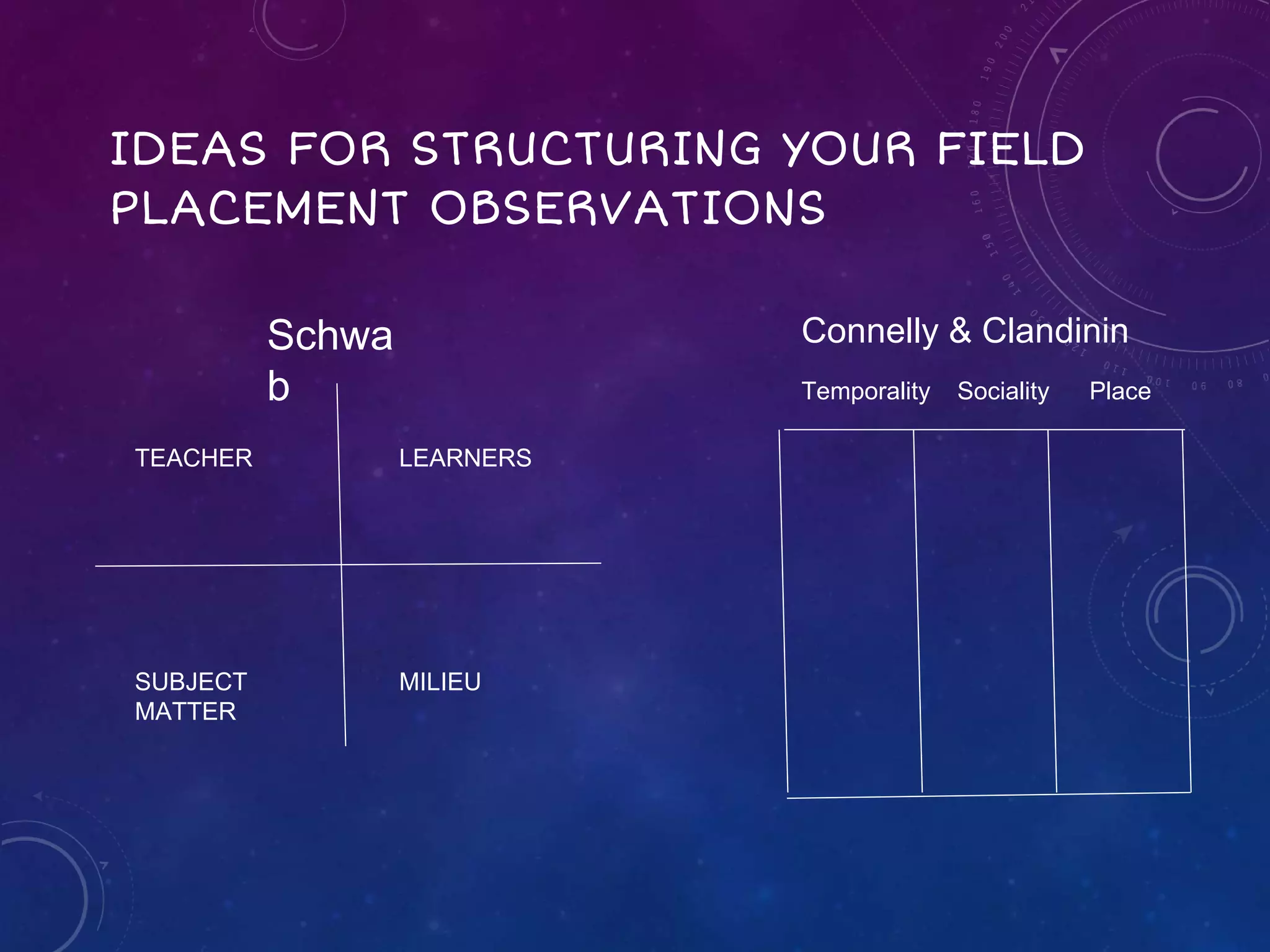
IDEAS FOR STRUCTURING YOUR FIELD
PLACEMENT OBSERVATIONS
TEACHER LEARNERS
SUBJECT
MATTER
MILIEU
Temporality Sociality Place
Schwa
b
Connelly & Clandinin
TAKE 10
ORAL CHRONICLE PRESENTATIONS
• Olivia, Bronte, Madalyn, Rachel
TRIAD WORK TIME
THANK YOU FOR
ANOTHER GREAT
CLASS!

2020 bc session 6

  • 1.
  • 2.
    CLASS AGENDA • Attendance/Concerns/Housekeeping •Relationship between Living and Telling • Summerhill School • Preparing for Observation • Reading week next week!!!!!!!!! • Break ☺ • Oral Chronicles: Oliva, Bronte, Madalyn, Rachel • Triad work time • Exit Card
  • 3.
    HOUSEKEEPING • Related LiteracyFeedback: • Using the readings to discuss previous letters ☺ • Push your “So what?” further by explaining how engaging in narrative inquiry is impacting your philosophy of education • Remember, we are still engaging in narrative inquiry so you need to address the three commonplaces: Temporality; Sociality; Place • No class next week – Feb 20
  • 4.
    RELATIONSHIP BETWEEN LIVINGAND TELLING: • Living - you experience life through your biases/assumptions/hardened stories. • Telling - you begin to uncover those assumptions/biases; because you experience life through your lens, your telling will include those biases. • It is through the telling (and re-telling) that we begin to uncover those biases.
  • 5.
    HOW THIS COULDLOOK IN REAL LIFE: • Have you ever shared a story or a joke and found it didn’t get the reaction you were anticipating? • Did it make you re-think your story or joke, at all? • Did the re-examination influence the re-telling of that story or joke? • Do you see how, with each retelling, your understanding is being shaped?
  • 6.
    RELATIONSHIP BETWEEN LIVINGAND TELLING: • Living - you experience life through your biases/assumptions/hardened stories. • Telling - you begin to uncover those assumptions/biases; because you experience life through your lens, your telling will include those biases. • It is through the telling (and re-telling) that we begin to uncover those biases.
  • 7.
    HOW DOES THISFRAMEWORK SERVE US, AS EDUCATORS? • We use this framework to uncover our biases/assumptions/hardened and frozen in our stories • Often, especially when we are a part of the dominant group, we believe that our perspective is the “truth” • Middle class notions of success and learning are often a default view (grades = smart = success) – these default views become questioned when dissonance arises from hearing other’s stories and hearing our stories told and re-told
  • 8.
    THEORETICAL GROUNDING The 3Rsin Literacy Narratives Narrative Reveal (excavated assumptions that surface in stories) Narrative Revelation (interrogated storied experience that leads to awakened perspective on hardened stories) Narrative Reformation (transformed teacher knowledge through the awakened new story)
  • 9.
  • 10.
    ACTIVITY • In 6groups of 5 • Please do not open the bag until I say to. The goal of this activity is to complete this task under 5 minutes using the instructions provided. I will not have any helping role in this activity so please do not ask me any questions. •
  • 11.
    What you needto do: • Open your bag and read the instructions first, before touching anything. Again, you will not be given any additional instructions beyond what is on your paper. After you read the instructions, you can begin the activity. • If you have a limitation... • Follow through with it until your team completes the task. The timer begins now! • FIVE MINUTE TIMER
  • 12.
    Let’s Have aRound of Applause for the Winners!!
  • 13.
    Reflection • What feelingscame up for you during this activity? • How does this activity relate to people who have limitations? • Was the winning group the best group? Why or why not? • For those who won or who had an advantage, did you assist those who did not have the same advantages? Why or why not? • For those who did not have an advantage, did you ask those who had an advantage for help? Why or why not? • Does it make sense to mock someone who wasn’t able to complete this task? Was their limitation something they could control? • How has this activity influenced you, going forward?
  • 15.
    • How canwe do better? • Honour and affirm one another’s identity, celebrate each other’s successes, and be supportive of weaknesses, as well as strengths.
  • 16.
  • 17.
    SUMMERHILL SCHOOL http://www.summerhillschool.co.uk/about.php “Summerhill schoolis a democratic, self-governing school in which the adults and children have equal status. The daily life of the school is governed by the school Meetings, usually held twice a week in which everybody has an equal vote...adults and children have equal status in the school but, of course, have different roles.” - How do we see this approach connecting to Dewey’s discussion of social control? Schwabb?
  • 18.
    DEWEY’S DISCUSSION OFFREEDOM • Impossible to get to know your students if they have no freedoms • Freedom can be physical (starting point), but the most important is intellectual freedom • Accidental Circumstances: impulses and desires that are not ordered by intelligence; an illusion of freedom because there is no control over the self • Removal of external control does not guarantee production of self- control • Thinking is postponement of immediate action • Reflection union of observation and memory – what you are asked to do in this course! • Education as the creation of self-control
  • 19.
    DEWEY SAID... “The singlemost important source of happiness is for students to go and find out what they’re ‘fitted’ to do – which is ultimately what will bring them happiness”
  • 20.
    ADVICE FROM DEWEY •Teachers need to be intelligently aware of the capacities, needs and past experiences of students, and invite the contributions of students to direct the plan as a cooperative enterprise, not a dictation. • Essential point: That the purpose grow and take shape through the process of social intelligence.
  • 21.
    TEACHERS MUST ALWAYSBE LOOKING AHEAD… • Teachers have an eye to the future, recognizing how present experiences are going to contribute to those in the future, ensuring they are relevant and meaningful
  • 22.
    … WHEN THEY’RENOT REFLECTING! • Our frame of reference for understanding our present is only as wide as we’ve stretched it, so far • Sound principle: • Objectives of learning are in the future • Materials are found in the present • Impact is determined by how effectively we connect with the past to extend the sphere of understanding
  • 23.
    LET’S BRAINSTORM IDEAS,CHECKLISTS, ”CHEAT SHEETS” & WAYS TO ORGANIZE YOUR OBSERVATIONS What readings do we need to rely on for our observation? How can we remind ourselves during the observation to use our readings? What would go on a “cheat sheet” to help keep ideas organized? Form two circles or two lines facing each other- share an idea with your partner, after a minute, we’ll switch partners and continue Using the link under week 6 on Sakai, log onto Padlet and share some of the best ideas you had, or heard, from your sharing.
  • 24.
  • 25.
    WATCH FOR EVIDENCEOF... Trust Respect Integrity Care Constructivism Students take an active role in their learning •The learner constructs new knowledge on prior knowledge, building understanding and making sense of new information •Students experience successful learning when they are actively engaged in: •constructing knowledge for themselves; •reflecting on their views and the views of others; •Arriving at new understandings that expand their worldview Foundations of Professional Practice:
  • 26.
    IDEAS FOR STRUCTURINGYOUR FIELD PLACEMENT OBSERVATIONS TEACHER LEARNERS SUBJECT MATTER MILIEU Temporality Sociality Place Schwa b Connelly & Clandinin
  • 27.
  • 28.
    ORAL CHRONICLE PRESENTATIONS •Olivia, Bronte, Madalyn, Rachel
  • 29.
  • 30.