A Journey with ...
&
Doneby:WeamMahmoud,OlaQatu
CONTENTS :
 1. tooth brush
a. history
b. objectives
c. characteristics
d. types
e. techniques
f. hygiene and care
 2. Interdentally cleansing
a. types of gingival embrasures
b.planning of Interdental Care
c. dental floss
I. featured of waxed
II. featured of unwaxed
III. types
IV. Techniques
V. Benefits
Doneby:WeamMahmoud,OlaQatu
d. gauze strip
e. interdental brushing
I. types
II. indications
f. interdental tip
I.wooden interdental cleaner
g. dental water floss
 Tongue cleansing
a. tounge brushing techniques
b. using tounge scarpers
c. how often to clean your tounge
 Misswak
a. benefits
Doneby:WeamMahmoud,OlaQatu
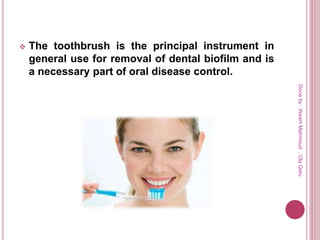
 The toothbrush is the principal instrument in
general use for removal of dental biofilm and is
a necessary part of oral disease control.
Doneby:WeamMahmoud,OlaQatu
 3500-3000 B.C when the Babylonians and the
Egyptians made a brush by fraying the end of a
twig. Tombs of the ancient Egyptians have been
found containing tooth sticks alongside their
owners.
 3000 B.C – Sumerians Excavations at Ur in
Mesopotamia uncovered gold toothpicks.
 Around 1600 B.C, the Chinese developed
"chewing sticks" which were made from
aromatic tree twigs to freshen breath.
Doneby:WeamMahmoud,OlaQatu
 Earliest record about care of mouth was
associated with a religious ritual and
training – Buddhist used ‘tooth stick’ &
Muslims used ‘Miswak’ - crushing the end
& spreading the fibers in a brush-like
manner
 The first toothbrush of a more modern
design was made by William Addis in
England around 1780 – the handle was
carved from cattle bone and the brush
portion was still made from swine bristles.
In 1844, the first 3-row bristle brush was
designed.
Doneby:WeamMahmoud,OlaQatu
 1857 – H. N. Wadsworth was the first
person to patent the toothbrush -
design had a bone handle with holes –
 Natural bristles were the only source of
bristles until Du Pont invented nylon.
The invention of nylon started the
development of the truly modern
toothbrush in 1938.
 The first electric toothbrush was made
in 1939 and the first electric toothbrush
in the US was the Broxodent in 1960.
Doneby:WeamMahmoud,OlaQatu
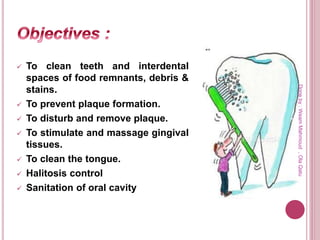
 To clean teeth and interdental
spaces of food remnants, debris &
stains.
 To prevent plaque formation.
 To disturb and remove plaque.
 To stimulate and massage gingival
tissues.
 To clean the tongue.
 Halitosis control
 Sanitation of oral cavity
Doneby:WeamMahmoud,OlaQatu
 Conforms to individual patient
requirements in size, shape & texture.
 Easily & efficiently manipulated.
 Impervious to moisture ; readily cleaned &
aerated.
 Durable & Inexpensive.
 Has prime functional properties of
flexibility, softness, & of strength, rigidity
& lightness of the handle.
Doneby:WeamMahmoud,OlaQatu
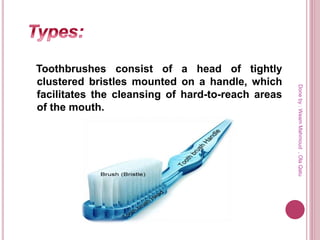
Toothbrushes consist of a head of tightly
clustered bristles mounted on a handle, which
facilitates the cleansing of hard-to-reach areas
of the mouth.
Doneby:WeamMahmoud,OlaQatu
A. Manual toothbrush :
1. According to head shape 
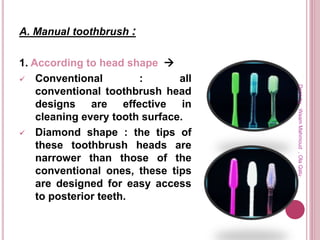
 Conventional : all
conventional toothbrush head
designs are effective in
cleaning every tooth surface.
 Diamond shape : the tips of
these toothbrush heads are
narrower than those of the
conventional ones, these tips
are designed for easy access
to posterior teeth.
Doneby:WeamMahmoud,OlaQatu
2. According to head size 
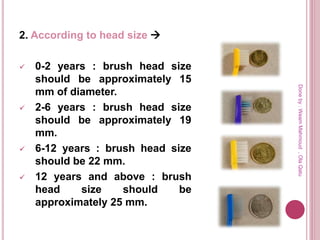
 0-2 years : brush head size
should be approximately 15
mm of diameter.
 2-6 years : brush head size
should be approximately 19
mm.
 6-12 years : brush head size
should be 22 mm.
 12 years and above : brush
head size should be
approximately 25 mm.
Doneby:WeamMahmoud,OlaQatu
3. According to bristle
pattern 
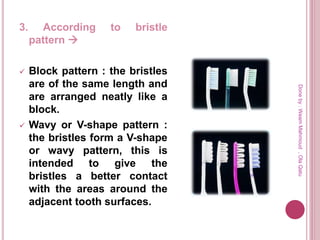
 Block pattern : the bristles
are of the same length and
are arranged neatly like a
block.
 Wavy or V-shape pattern :
the bristles form a V-shape
or wavy pattern, this is
intended to give the
bristles a better contact
with the areas around the
adjacent tooth surfaces.
Doneby:WeamMahmoud,OlaQatu
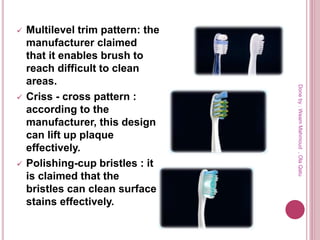
 Multilevel trim pattern: the
manufacturer claimed
that it enables brush to
reach difficult to clean
areas.
 Criss - cross pattern :
according to the
manufacturer, this design
can lift up plaque
effectively.
 Polishing-cup bristles : it
is claimed that the
bristles can clean surface
stains effectively.
Doneby:WeamMahmoud,OlaQatu
4. According to handle
design :
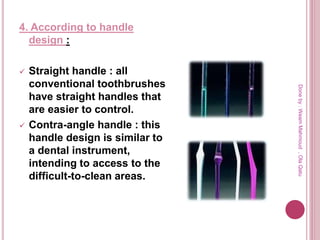
 Straight handle : all
conventional toothbrushes
have straight handles that
are easier to control.
 Contra-angle handle : this
handle design is similar to
a dental instrument,
intending to access to the
difficult-to-clean areas.
Doneby:WeamMahmoud,OlaQatu
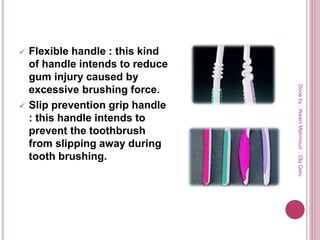
 Flexible handle : this kind
of handle intends to reduce
gum injury caused by
excessive brushing force.
 Slip prevention grip handle
: this handle intends to
prevent the toothbrush
from slipping away during
tooth brushing.
Doneby:WeamMahmoud,OlaQatu
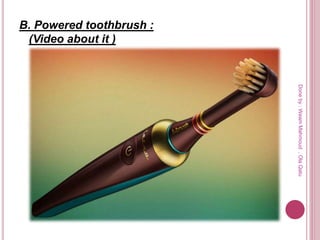
B. Powered toothbrush :
(Video about it )
Doneby:WeamMahmoud,OlaQatu
 performs oscillations or rotations of its bristles,
driven by a motor.
 most studies report a medical performance
equal to that of a manual brush, the electric
version can be more comfortable, and an
additional timer and pressure sensors can
encourage a correct cleaning process.
 can be classified according to the speed of their
movements as standard power toothbrushes,
sonic toothbrushes or ultrasonic toothbrushes.
 uses less brushing force than manual
toothbrushes.
 mostly indicated for handicapped and elderly
patients.
Doneby:WeamMahmoud,OlaQatu
First : Video about brushing
Doneby:WeamMahmoud,OlaQatu
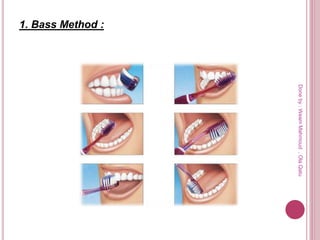
1. Bass Method :
Doneby:WeamMahmoud,OlaQatu
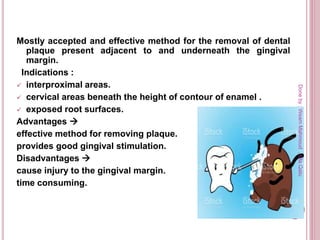
Mostly accepted and effective method for the removal of dental
plaque present adjacent to and underneath the gingival
margin.
Indications :
 interproximal areas.
 cervical areas beneath the height of contour of enamel .
 exposed root surfaces.
Advantages 
effective method for removing plaque.
provides good gingival stimulation.
Disadvantages 
cause injury to the gingival margin.
time consuming.
Doneby:WeamMahmoud,OlaQatu
 Procedure :
 The bristles are placed at a 45 angle to the
gingiva and moved in small circular motions.
 Strokes are repeated around 20 times,3 teeth at
a time.
 On the lingual aspect of the anterior teeth, the
brush is pressed into the gingival sulci and
proximal surfaces at a 45 angle. The bristles are
then activated.
 Occlusal surfaces are cleaned by pressing the
bristles firmly and then activating the bristles.
Doneby:WeamMahmoud,OlaQatu
2 . Modified Bass Method :
Differs from bass technique in that it has
sweeping motion from cervical to incisal or
occlusal surface.
Indication :
As a routine oral hygiene measure
intrasulcular cleansing.
Advantage 
 excellent sulcus cleaning.
 good inter proximal and gingival cleaning.
 good gingival stimulation.
Doneby:WeamMahmoud,OlaQatu
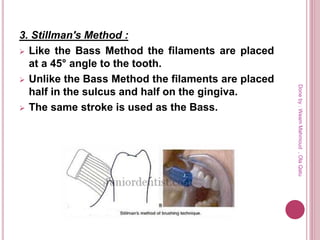
3. Stillman's Method :
 Like the Bass Method the filaments are placed
at a 45° angle to the tooth.
 Unlike the Bass Method the filaments are placed
half in the sulcus and half on the gingiva.
 The same stroke is used as the Bass.
Doneby:WeamMahmoud,OlaQatu
 Indication :
 dental plaque removal
 cleaning tooth surfaces and gingival
massage .
 Disadvantages 
 time consuming.
 damage epithelial attachment.
Doneby:WeamMahmoud,OlaQatu
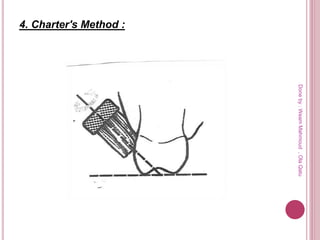
4. Charter's Method :
Doneby:WeamMahmoud,OlaQatu
 Indications :
 missing papilla and exposed root surfaces.
 FPD and orthodontic appliances.
 periodontal surgery.
 interproximal gingival recession.
 Disadvantages 
 Poor removal of subgingival bacterial
accumulations.
 Limited brush placement.
 Requirements in digital dexterity are high.
Advantage 
Massage and stimulation of gingiva.
Doneby:WeamMahmoud,OlaQatu
Procedure :
 Position the filaments toward the
chewing surface of the tooth
 Place the sides of the filaments against
the enamel and angle them at a 45° to
the tooth.
 Vibrate the filaments gently but firmly,
keeping the filaments against the tooth.
 Reposition on the next set of teeth.
Doneby:WeamMahmoud,OlaQatu
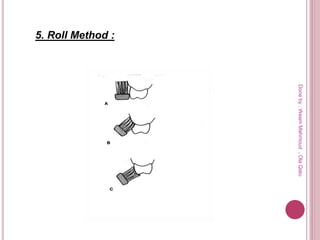
5. Roll Method :
Doneby:WeamMahmoud,OlaQatu
 Direct the filaments toward the root of the
tooth.
 Place side of the brush on the gingiva and
have the plastic part of the brush even with
the tooth.
 When the plastic portion is even with the
tooth press the filaments against the
gingiva and roll the brush over the teeth.
 The wrist is turned slightly and the
filaments follow the contours of the teeth.
Doneby:WeamMahmoud,OlaQatu
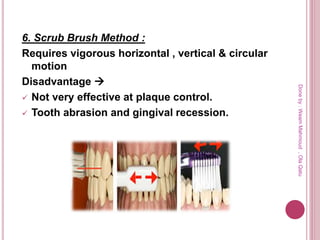
6. Scrub Brush Method :
Requires vigorous horizontal , vertical & circular
motion
Disadvantage 
 Not very effective at plaque control.
 Tooth abrasion and gingival recession.
Doneby:WeamMahmoud,OlaQatu
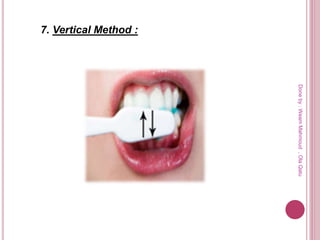
7. Vertical Method :
Doneby:WeamMahmoud,OlaQatu
 Vertical stroke is used
 Maxillary and mandibular teeth are brushed
separately.
 Bristles of brush are placed at 90° to the facial
surface of teeth.
 Brush vigorously without great pressure
mostly up and down strokes.
 Advantage 
most convenient and effective for small
children with deciduous teeth.
 Disadvantage 
interdental space of permanent teeth of adult
are not properly cleaned.
Doneby:WeamMahmoud,OlaQatu
8. Physiologic Method :
 Based on the principle that toothbrush
should follow the physiologic pathway that
is followed by the food when it traverses
over the tissue during mastication.
 Bristles are pointed incisally or occlusally
and then moved along and over the tooth
surface and gingiva.
Advantages 
 natural self cleansing mechanism.
 supragingival cleaning is good.
Disadvantages 
interdental spaces and sulcular areas of
teeth are not properly cleaned.
Doneby:WeamMahmoud,OlaQatu
9. Circular Method :
Indication :
 Young children.
 Physically or emotionally handicapped
individuals.
 Patients who lack dexterity.
Advantage 
 easy to learn.
 shorter time required.
Disadvantage 
 possible trauma to gingiva.
 interdental areas not properly cleaned.
Doneby:WeamMahmoud,OlaQatu
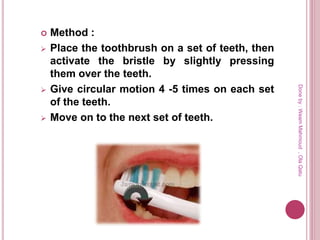
 Method :
 Place the toothbrush on a set of teeth, then
activate the bristle by slightly pressing
them over the teeth.
 Give circular motion 4 -5 times on each set
of the teeth.
 Move on to the next set of teeth.
Doneby:WeamMahmoud,OlaQatu
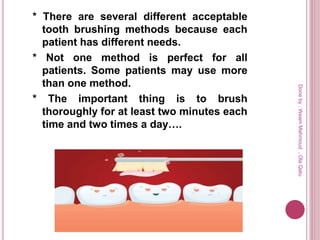
* There are several different acceptable
tooth brushing methods because each
patient has different needs.
* Not one method is perfect for all
patients. Some patients may use more
than one method.
* The important thing is to brush
thoroughly for at least two minutes each
time and two times a day….
Doneby:WeamMahmoud,OlaQatu
 Don’t share toothbrushes :
using someone else’s toothbrush exposes you
to another person’s body fluids and potential
germs, which could make you sick. People with
compromised immune systems or who are sick
with something they could pass on to another
person should take special care to use only
their own toothbrush.
 Rinse your toothbrush after brushing :
give it a thorough washing to remove any
leftover toothpaste or debris.
Doneby:WeamMahmoud,OlaQatu
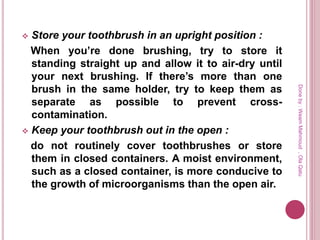
 Store your toothbrush in an upright position :
When you’re done brushing, try to store it
standing straight up and allow it to air-dry until
your next brushing. If there’s more than one
brush in the same holder, try to keep them as
separate as possible to prevent cross-
contamination.
 Keep your toothbrush out in the open :
do not routinely cover toothbrushes or store
them in closed containers. A moist environment,
such as a closed container, is more conducive to
the growth of microorganisms than the open air.
Doneby:WeamMahmoud,OlaQatu
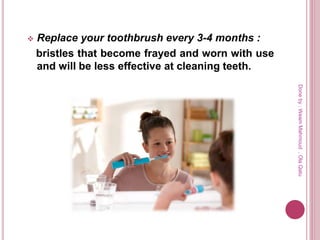
 Replace your toothbrush every 3-4 months :
bristles that become frayed and worn with use
and will be less effective at cleaning teeth.
Doneby:WeamMahmoud,OlaQatu
Video about it
Doneby:WeamMahmoud,OlaQatu
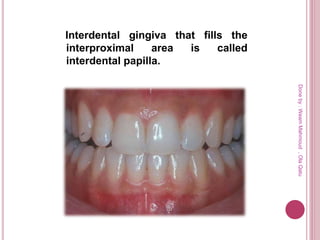
Interdental gingiva that fills the
interproximal area is called
interdental papilla.
Doneby:WeamMahmoud,OlaQatu
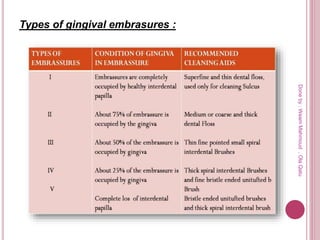
Types of gingival embrasures :
Doneby:WeamMahmoud,OlaQatu
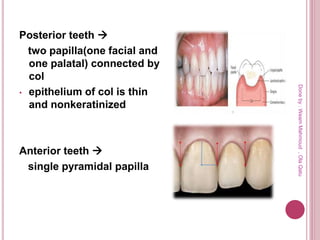
Posterior teeth 
two papilla(one facial and
one palatal) connected by
col
• epithelium of col is thin
and nonkeratinized
Anterior teeth 
single pyramidal papilla
Doneby:WeamMahmoud,OlaQatu
 Planning of Interdental Care :
 History of personal oral care
 Dental and gingival anatomy
assessment-teeth position, embrassure,
probing depth
 Extent and location of dental biofilm
 Personal factors- handicap or disability,
knowledge of interdental oral care
Doneby:WeamMahmoud,OlaQatu
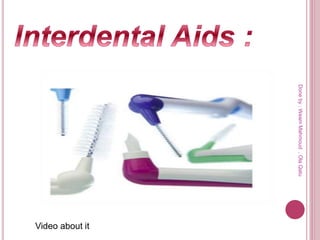
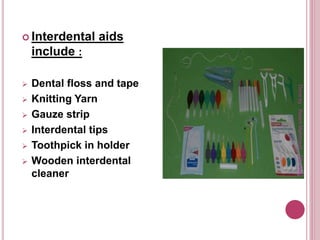
 Interdental aids
include :
 Dental floss and tape
 Knitting Yarn
 Gauze strip
 Interdental tips
 Toothpick in holder
 Wooden interdental
cleaner
Doneby:WeamMahmoud,OlaQatu
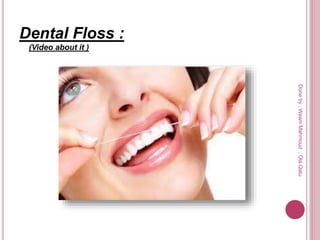
Dental Floss :
(Video about it )
Doneby:WeamMahmoud,OlaQatu
 Dental floss is a bundle of thin filaments
which may be made of either nylon or silk, it
is placed between the teeth and pulled to
clean the gaps between the teeth, as it is
pulled, it removes food particles and other
debris which may have got stuck between
teeth.
 Some of them coated with fluoride, it can be
flavored or unflavored..Some of them may
be waxed or unwaxed.
Doneby:WeamMahmoud,OlaQatu
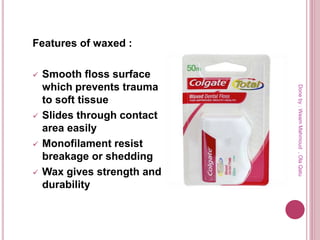
Features of waxed :
 Smooth floss surface
which prevents trauma
to soft tissue
 Slides through contact
area easily
 Monofilament resist
breakage or shedding
 Wax gives strength and
durability
Doneby:WeamMahmoud,OlaQatu
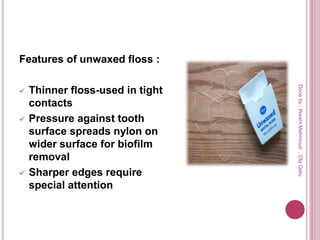
Features of unwaxed floss :
 Thinner floss-used in tight
contacts
 Pressure against tooth
surface spreads nylon on
wider surface for biofilm
removal
 Sharper edges require
special attention
Doneby:WeamMahmoud,OlaQatu
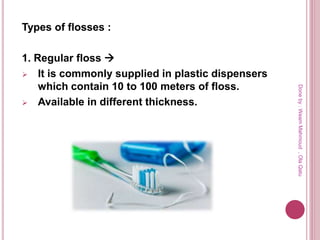
Types of flosses :
1. Regular floss 
 It is commonly supplied in plastic dispensers
which contain 10 to 100 meters of floss.
 Available in different thickness.
Doneby:WeamMahmoud,OlaQatu
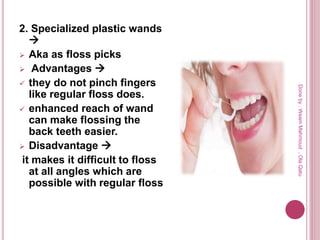
2. Specialized plastic wands

 Aka as floss picks
 Advantages 
 they do not pinch fingers
like regular floss does.
 enhanced reach of wand
can make flossing the
back teeth easier.
 Disadvantage 
it makes it difficult to floss
at all angles which are
possible with regular floss
Doneby:WeamMahmoud,OlaQatu
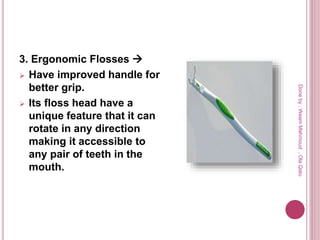
3. Ergonomic Flosses 
 Have improved handle for
better grip.
 Its floss head have a
unique feature that it can
rotate in any direction
making it accessible to
any pair of teeth in the
mouth.
Doneby:WeamMahmoud,OlaQatu
4. Automatic flosses 
suit those who find it
difficult to perfect their
flossing techniques.
Doneby:WeamMahmoud,OlaQatu
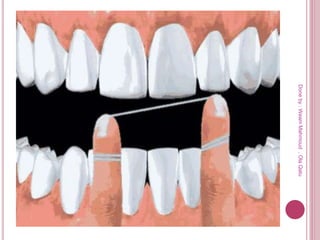
Technique of flossing :
1. Measure around 18 inches of floss and wind
each end around the middle finger of both of
your hands. Grab around 2 inches of floss with
your thumb and index finger.
2. Move floss smoothly between your teeth in a
sawing motion and take extra care not to break
the floss while doing this or it will hurt your
gums.
3. When the floss is between your teeth curve it
(making a C shape) and slide it up and down.
When done, curve the floss in the opposite
direction and do the same.
4. In the end, brush your teeth and rinse with
mouthwash or water.
Doneby:WeamMahmoud,OlaQatu
Benefits of flossing :
 Improves oral hygiene.
 Also Clean those area where
toothbrush cannot reach.
 Removes plaque and food
particles from interdental
spaces.
 Cleans tooth surface beneath
gum line.
 Prevents halitosis.
 Polishes tooth surface.
Doneby:WeamMahmoud,OlaQatu
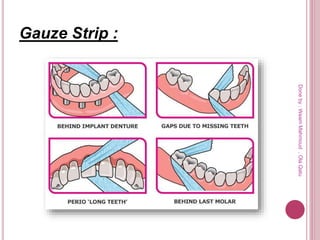
Gauze Strip :
Doneby:WeamMahmoud,OlaQatu
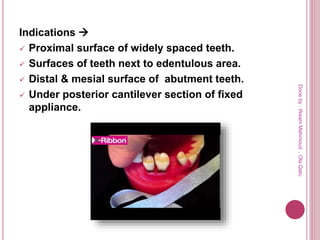
Indications 
 Proximal surface of widely spaced teeth.
 Surfaces of teeth next to edentulous area.
 Distal & mesial surface of abutment teeth.
 Under posterior cantilever section of fixed
appliance.
Doneby:WeamMahmoud,OlaQatu
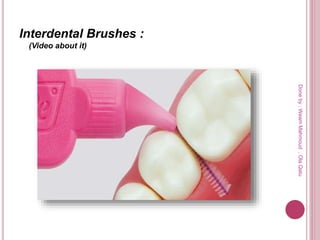
Interdental Brushes :
(Video about it)
Doneby:WeamMahmoud,OlaQatu
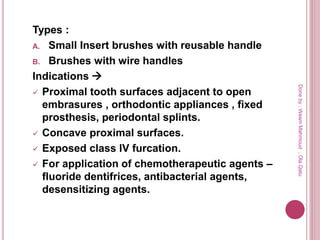
Types :
A. Small Insert brushes with reusable handle
B. Brushes with wire handles
Indications 
 Proximal tooth surfaces adjacent to open
embrasures , orthodontic appliances , fixed
prosthesis, periodontal splints.
 Concave proximal surfaces.
 Exposed class IV furcation.
 For application of chemotherapeutic agents –
fluoride dentifrices, antibacterial agents,
desensitizing agents.
Doneby:WeamMahmoud,OlaQatu
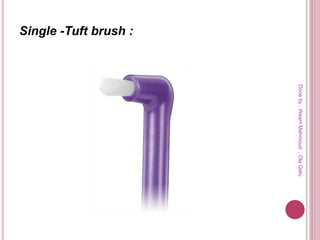
Single -Tuft brush :
Doneby:WeamMahmoud,OlaQatu
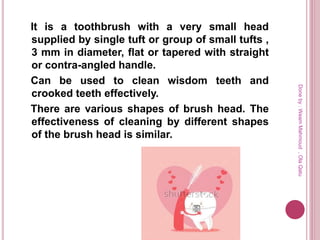
It is a toothbrush with a very small head
supplied by single tuft or group of small tufts ,
3 mm in diameter, flat or tapered with straight
or contra-angled handle.
Can be used to clean wisdom teeth and
crooked teeth effectively.
There are various shapes of brush head. The
effectiveness of cleaning by different shapes
of the brush head is similar.
Doneby:WeamMahmoud,OlaQatu
Indications 
 For open interproximal areas.
 For dental prosthesis.
 Difficult to reach area – lingual surface of
mandibular molars, abutment teeth , distal
surface of posterior most teeth.
Procedure :
 Direct the end of tuft into the interproximal
area along the gingival margin.
 Combine a rotating motion with intermittent
pressure.
Doneby:WeamMahmoud,OlaQatu
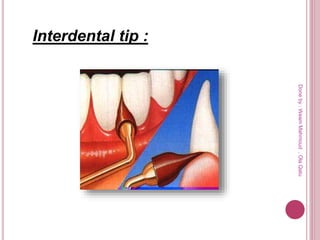
Interdental tip :
Doneby:WeamMahmoud,OlaQatu
Conical or pyramidal flexible rubber tip
attached to handle.
Indications 
 For cleaning debries from interdental areas
 Biofilm removal at and just below gingival
margin.
Procedure :
 Trace along the gingival margin with the tip
position just beneath the margin (1-2 mm )
 Rub the tip against the teeth as it is moved in
& out of an embrasure and under a contact
area. Position with gingival form.
Doneby:WeamMahmoud,OlaQatu
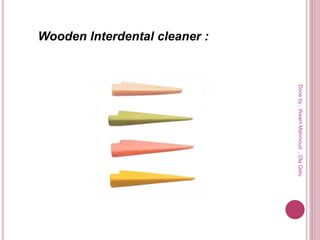
Wooden Interdental cleaner :
Doneby:WeamMahmoud,OlaQatu
2 inch long device made of Bass wood or
Birch wood used for wider gingival
embrasures.
Procedure :
 First teach the patient to use a rest by
placing the hand on cheek/chin/ or by
placing a finger on the gingiva , convenient
to the place where tip will be applied.
 Soften the pointed end of wood in mouth &
moistening with saliva.
Doneby:WeamMahmoud,OlaQatu
 Hold the base of the triangle towards the
gingival border of interdental area & insert
horizontally.
 Clean the tooth surface by moving the
wedge in & out while applying the
burnishing stroke with moderate pressure
, 1st on one side of the embrassure & then
on other. Four strokes each
Doneby:WeamMahmoud,OlaQatu
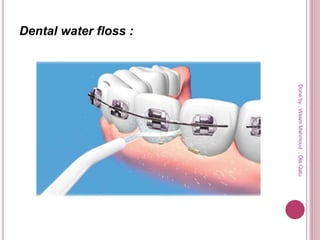
Dental water floss :
Doneby:WeamMahmoud,OlaQatu
 Irrigation helps to reduce the levels of
biofilm and debris from around crowns,
bridges, orthodontic appliances and
implants, and in interdental areas.
 There are a variety of devices on the market.
Usually power driven and handheld, these
deliver a pulsating jet of water (or
prescribed solution) from a reservoir to the
required area .
 The pressure at which the solution is
delivered can be altered by the patient.
 A selection of tips are often available,
depending on manufacturer, for targeted
delivery of the solution.
Doneby:WeamMahmoud,OlaQatu
Method of use :
 The manufacturer’s instructions should be
followed, the tip should be directed towards
the interdental area and held at 90° to the
long axis of the tooth.
 Patients should start with a low pressure
setting until they are used to the device.
 The temperature of the liquid should be
comfortable to them
 A sink or basin should be nearby, so water
or solution can be drained away
 Tissues/towels should be nearby.
Doneby:WeamMahmoud,OlaQatu
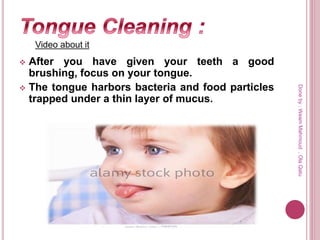
 After you have given your teeth a good
brushing, focus on your tongue.
 The tongue harbors bacteria and food particles
trapped under a thin layer of mucus.
Video about it
Doneby:WeamMahmoud,OlaQatu
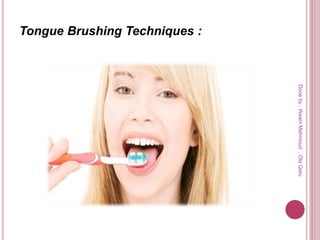
Tongue Brushing Techniques :
Doneby:WeamMahmoud,OlaQatu
It is simple enough to use the bristles of your
toothbrush. You can also try a specialized
brush with a built-in tongue cleaner on the
back of the head.
Use a small dab of toothpaste and carefully
brushing the top of the tongue. Start by
reaching to the back of the tongue, and then
work forward toward the opening of the
mouth. Brush the entire top surface of the
tongue using gentle pressure, and finish by
rinsing with water.
Doneby:WeamMahmoud,OlaQatu
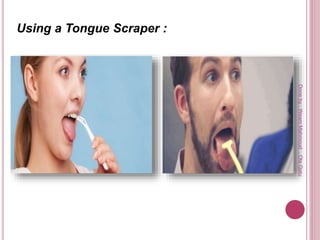
Using a Tongue Scraper :
Doneby:WeamMahmoud,OlaQatu
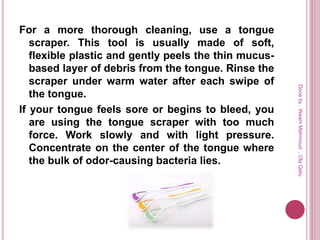
For a more thorough cleaning, use a tongue
scraper. This tool is usually made of soft,
flexible plastic and gently peels the thin mucus-
based layer of debris from the tongue. Rinse the
scraper under warm water after each swipe of
the tongue.
If your tongue feels sore or begins to bleed, you
are using the tongue scraper with too much
force. Work slowly and with light pressure.
Concentrate on the center of the tongue where
the bulk of odor-causing bacteria lies.
Doneby:WeamMahmoud,OlaQatu
How Often to Clean Your Tongue ?
Each time you brush and floss your teeth,
finish your dental care routine with a tongue
cleaning. At a minimum, clean your tongue
once in the morning and once in the evening
before bedtime. If you have dry mouth or
notice a foul taste in your mouth midday, try
cleaning your tongue to remedy the
situation.
.. A mouthwash rinse used after cleaning your
tongue moisturizes the mouth and kills
additional bacteria ..
Doneby:WeamMahmoud,OlaQatu
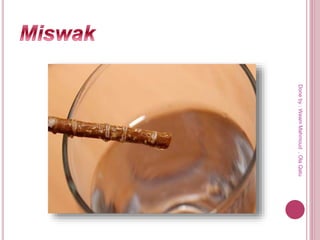
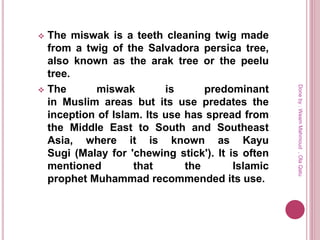
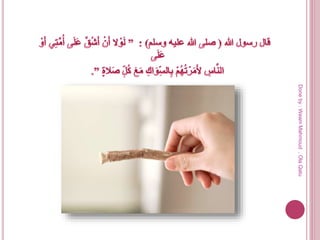
 The miswak is a teeth cleaning twig made
from a twig of the Salvadora persica tree,
also known as the arak tree or the peelu
tree.
 The miswak is predominant
in Muslim areas but its use predates the
inception of Islam. Its use has spread from
the Middle East to South and Southeast
Asia, where it is known as Kayu
Sugi (Malay for 'chewing stick'). It is often
mentioned that the Islamic
prophet Muhammad recommended its use.
Doneby:WeamMahmoud,OlaQatu
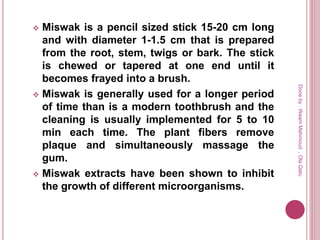
 Miswak is a pencil sized stick 15-20 cm long
and with diameter 1-1.5 cm that is prepared
from the root, stem, twigs or bark. The stick
is chewed or tapered at one end until it
becomes frayed into a brush.
 Miswak is generally used for a longer period
of time than is a modern toothbrush and the
cleaning is usually implemented for 5 to 10
min each time. The plant fibers remove
plaque and simultaneously massage the
gum.
 Miswak extracts have been shown to inhibit
the growth of different microorganisms.
Doneby:WeamMahmoud,OlaQatu
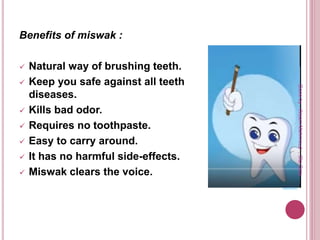
Benefits of miswak :
 Natural way of brushing teeth.
 Keep you safe against all teeth
diseases.
 Kills bad odor.
 Requires no toothpaste.
 Easy to carry around.
 It has no harmful side-effects.
 Miswak clears the voice.
Doneby:WeamMahmoud,OlaQatu

a journey with tooth brush & floss

  • 1.
    A Journey with... & Doneby:WeamMahmoud,OlaQatu
  • 2.
    CONTENTS :  1.tooth brush a. history b. objectives c. characteristics d. types e. techniques f. hygiene and care  2. Interdentally cleansing a. types of gingival embrasures b.planning of Interdental Care c. dental floss I. featured of waxed II. featured of unwaxed III. types IV. Techniques V. Benefits Doneby:WeamMahmoud,OlaQatu
  • 3.
    d. gauze strip e.interdental brushing I. types II. indications f. interdental tip I.wooden interdental cleaner g. dental water floss  Tongue cleansing a. tounge brushing techniques b. using tounge scarpers c. how often to clean your tounge  Misswak a. benefits Doneby:WeamMahmoud,OlaQatu
  • 4.
  • 5.
     The toothbrushis the principal instrument in general use for removal of dental biofilm and is a necessary part of oral disease control. Doneby:WeamMahmoud,OlaQatu
  • 6.
     3500-3000 B.Cwhen the Babylonians and the Egyptians made a brush by fraying the end of a twig. Tombs of the ancient Egyptians have been found containing tooth sticks alongside their owners.  3000 B.C – Sumerians Excavations at Ur in Mesopotamia uncovered gold toothpicks.  Around 1600 B.C, the Chinese developed "chewing sticks" which were made from aromatic tree twigs to freshen breath. Doneby:WeamMahmoud,OlaQatu
  • 7.
     Earliest recordabout care of mouth was associated with a religious ritual and training – Buddhist used ‘tooth stick’ & Muslims used ‘Miswak’ - crushing the end & spreading the fibers in a brush-like manner  The first toothbrush of a more modern design was made by William Addis in England around 1780 – the handle was carved from cattle bone and the brush portion was still made from swine bristles. In 1844, the first 3-row bristle brush was designed. Doneby:WeamMahmoud,OlaQatu
  • 8.
     1857 –H. N. Wadsworth was the first person to patent the toothbrush - design had a bone handle with holes –  Natural bristles were the only source of bristles until Du Pont invented nylon. The invention of nylon started the development of the truly modern toothbrush in 1938.  The first electric toothbrush was made in 1939 and the first electric toothbrush in the US was the Broxodent in 1960. Doneby:WeamMahmoud,OlaQatu
  • 9.
     To cleanteeth and interdental spaces of food remnants, debris & stains.  To prevent plaque formation.  To disturb and remove plaque.  To stimulate and massage gingival tissues.  To clean the tongue.  Halitosis control  Sanitation of oral cavity Doneby:WeamMahmoud,OlaQatu
  • 10.
     Conforms toindividual patient requirements in size, shape & texture.  Easily & efficiently manipulated.  Impervious to moisture ; readily cleaned & aerated.  Durable & Inexpensive.  Has prime functional properties of flexibility, softness, & of strength, rigidity & lightness of the handle. Doneby:WeamMahmoud,OlaQatu
  • 11.
    Toothbrushes consist ofa head of tightly clustered bristles mounted on a handle, which facilitates the cleansing of hard-to-reach areas of the mouth. Doneby:WeamMahmoud,OlaQatu
  • 12.
    A. Manual toothbrush: 1. According to head shape   Conventional : all conventional toothbrush head designs are effective in cleaning every tooth surface.  Diamond shape : the tips of these toothbrush heads are narrower than those of the conventional ones, these tips are designed for easy access to posterior teeth. Doneby:WeamMahmoud,OlaQatu
  • 13.
    2. According tohead size   0-2 years : brush head size should be approximately 15 mm of diameter.  2-6 years : brush head size should be approximately 19 mm.  6-12 years : brush head size should be 22 mm.  12 years and above : brush head size should be approximately 25 mm. Doneby:WeamMahmoud,OlaQatu
  • 14.
    3. According tobristle pattern   Block pattern : the bristles are of the same length and are arranged neatly like a block.  Wavy or V-shape pattern : the bristles form a V-shape or wavy pattern, this is intended to give the bristles a better contact with the areas around the adjacent tooth surfaces. Doneby:WeamMahmoud,OlaQatu
  • 15.
     Multilevel trimpattern: the manufacturer claimed that it enables brush to reach difficult to clean areas.  Criss - cross pattern : according to the manufacturer, this design can lift up plaque effectively.  Polishing-cup bristles : it is claimed that the bristles can clean surface stains effectively. Doneby:WeamMahmoud,OlaQatu
  • 16.
    4. According tohandle design :  Straight handle : all conventional toothbrushes have straight handles that are easier to control.  Contra-angle handle : this handle design is similar to a dental instrument, intending to access to the difficult-to-clean areas. Doneby:WeamMahmoud,OlaQatu
  • 17.
     Flexible handle: this kind of handle intends to reduce gum injury caused by excessive brushing force.  Slip prevention grip handle : this handle intends to prevent the toothbrush from slipping away during tooth brushing. Doneby:WeamMahmoud,OlaQatu
  • 18.
    B. Powered toothbrush: (Video about it ) Doneby:WeamMahmoud,OlaQatu
  • 19.
     performs oscillationsor rotations of its bristles, driven by a motor.  most studies report a medical performance equal to that of a manual brush, the electric version can be more comfortable, and an additional timer and pressure sensors can encourage a correct cleaning process.  can be classified according to the speed of their movements as standard power toothbrushes, sonic toothbrushes or ultrasonic toothbrushes.  uses less brushing force than manual toothbrushes.  mostly indicated for handicapped and elderly patients. Doneby:WeamMahmoud,OlaQatu
  • 20.
    First : Videoabout brushing Doneby:WeamMahmoud,OlaQatu
  • 21.
    1. Bass Method: Doneby:WeamMahmoud,OlaQatu
  • 22.
    Mostly accepted andeffective method for the removal of dental plaque present adjacent to and underneath the gingival margin. Indications :  interproximal areas.  cervical areas beneath the height of contour of enamel .  exposed root surfaces. Advantages  effective method for removing plaque. provides good gingival stimulation. Disadvantages  cause injury to the gingival margin. time consuming. Doneby:WeamMahmoud,OlaQatu
  • 23.
     Procedure : The bristles are placed at a 45 angle to the gingiva and moved in small circular motions.  Strokes are repeated around 20 times,3 teeth at a time.  On the lingual aspect of the anterior teeth, the brush is pressed into the gingival sulci and proximal surfaces at a 45 angle. The bristles are then activated.  Occlusal surfaces are cleaned by pressing the bristles firmly and then activating the bristles. Doneby:WeamMahmoud,OlaQatu
  • 24.
    2 . ModifiedBass Method : Differs from bass technique in that it has sweeping motion from cervical to incisal or occlusal surface. Indication : As a routine oral hygiene measure intrasulcular cleansing. Advantage   excellent sulcus cleaning.  good inter proximal and gingival cleaning.  good gingival stimulation. Doneby:WeamMahmoud,OlaQatu
  • 25.
    3. Stillman's Method:  Like the Bass Method the filaments are placed at a 45° angle to the tooth.  Unlike the Bass Method the filaments are placed half in the sulcus and half on the gingiva.  The same stroke is used as the Bass. Doneby:WeamMahmoud,OlaQatu
  • 26.
     Indication : dental plaque removal  cleaning tooth surfaces and gingival massage .  Disadvantages   time consuming.  damage epithelial attachment. Doneby:WeamMahmoud,OlaQatu
  • 27.
    4. Charter's Method: Doneby:WeamMahmoud,OlaQatu
  • 28.
     Indications : missing papilla and exposed root surfaces.  FPD and orthodontic appliances.  periodontal surgery.  interproximal gingival recession.  Disadvantages   Poor removal of subgingival bacterial accumulations.  Limited brush placement.  Requirements in digital dexterity are high. Advantage  Massage and stimulation of gingiva. Doneby:WeamMahmoud,OlaQatu
  • 29.
    Procedure :  Positionthe filaments toward the chewing surface of the tooth  Place the sides of the filaments against the enamel and angle them at a 45° to the tooth.  Vibrate the filaments gently but firmly, keeping the filaments against the tooth.  Reposition on the next set of teeth. Doneby:WeamMahmoud,OlaQatu
  • 30.
    5. Roll Method: Doneby:WeamMahmoud,OlaQatu
  • 31.
     Direct thefilaments toward the root of the tooth.  Place side of the brush on the gingiva and have the plastic part of the brush even with the tooth.  When the plastic portion is even with the tooth press the filaments against the gingiva and roll the brush over the teeth.  The wrist is turned slightly and the filaments follow the contours of the teeth. Doneby:WeamMahmoud,OlaQatu
  • 32.
    6. Scrub BrushMethod : Requires vigorous horizontal , vertical & circular motion Disadvantage   Not very effective at plaque control.  Tooth abrasion and gingival recession. Doneby:WeamMahmoud,OlaQatu
  • 33.
    7. Vertical Method: Doneby:WeamMahmoud,OlaQatu
  • 34.
     Vertical strokeis used  Maxillary and mandibular teeth are brushed separately.  Bristles of brush are placed at 90° to the facial surface of teeth.  Brush vigorously without great pressure mostly up and down strokes.  Advantage  most convenient and effective for small children with deciduous teeth.  Disadvantage  interdental space of permanent teeth of adult are not properly cleaned. Doneby:WeamMahmoud,OlaQatu
  • 35.
    8. Physiologic Method:  Based on the principle that toothbrush should follow the physiologic pathway that is followed by the food when it traverses over the tissue during mastication.  Bristles are pointed incisally or occlusally and then moved along and over the tooth surface and gingiva. Advantages   natural self cleansing mechanism.  supragingival cleaning is good. Disadvantages  interdental spaces and sulcular areas of teeth are not properly cleaned. Doneby:WeamMahmoud,OlaQatu
  • 36.
    9. Circular Method: Indication :  Young children.  Physically or emotionally handicapped individuals.  Patients who lack dexterity. Advantage   easy to learn.  shorter time required. Disadvantage   possible trauma to gingiva.  interdental areas not properly cleaned. Doneby:WeamMahmoud,OlaQatu
  • 37.
     Method : Place the toothbrush on a set of teeth, then activate the bristle by slightly pressing them over the teeth.  Give circular motion 4 -5 times on each set of the teeth.  Move on to the next set of teeth. Doneby:WeamMahmoud,OlaQatu
  • 38.
    * There areseveral different acceptable tooth brushing methods because each patient has different needs. * Not one method is perfect for all patients. Some patients may use more than one method. * The important thing is to brush thoroughly for at least two minutes each time and two times a day…. Doneby:WeamMahmoud,OlaQatu
  • 39.
  • 40.
     Don’t sharetoothbrushes : using someone else’s toothbrush exposes you to another person’s body fluids and potential germs, which could make you sick. People with compromised immune systems or who are sick with something they could pass on to another person should take special care to use only their own toothbrush.  Rinse your toothbrush after brushing : give it a thorough washing to remove any leftover toothpaste or debris. Doneby:WeamMahmoud,OlaQatu
  • 41.
     Store yourtoothbrush in an upright position : When you’re done brushing, try to store it standing straight up and allow it to air-dry until your next brushing. If there’s more than one brush in the same holder, try to keep them as separate as possible to prevent cross- contamination.  Keep your toothbrush out in the open : do not routinely cover toothbrushes or store them in closed containers. A moist environment, such as a closed container, is more conducive to the growth of microorganisms than the open air. Doneby:WeamMahmoud,OlaQatu
  • 42.
     Replace yourtoothbrush every 3-4 months : bristles that become frayed and worn with use and will be less effective at cleaning teeth. Doneby:WeamMahmoud,OlaQatu
  • 43.
  • 44.
    Interdental gingiva thatfills the interproximal area is called interdental papilla. Doneby:WeamMahmoud,OlaQatu
  • 45.
    Types of gingivalembrasures : Doneby:WeamMahmoud,OlaQatu
  • 46.
    Posterior teeth  twopapilla(one facial and one palatal) connected by col • epithelium of col is thin and nonkeratinized Anterior teeth  single pyramidal papilla Doneby:WeamMahmoud,OlaQatu
  • 47.
     Planning ofInterdental Care :  History of personal oral care  Dental and gingival anatomy assessment-teeth position, embrassure, probing depth  Extent and location of dental biofilm  Personal factors- handicap or disability, knowledge of interdental oral care Doneby:WeamMahmoud,OlaQatu
  • 48.
     Interdental aids include:  Dental floss and tape  Knitting Yarn  Gauze strip  Interdental tips  Toothpick in holder  Wooden interdental cleaner Doneby:WeamMahmoud,OlaQatu
  • 49.
    Dental Floss : (Videoabout it ) Doneby:WeamMahmoud,OlaQatu
  • 50.
  • 51.
     Dental flossis a bundle of thin filaments which may be made of either nylon or silk, it is placed between the teeth and pulled to clean the gaps between the teeth, as it is pulled, it removes food particles and other debris which may have got stuck between teeth.  Some of them coated with fluoride, it can be flavored or unflavored..Some of them may be waxed or unwaxed. Doneby:WeamMahmoud,OlaQatu
  • 52.
    Features of waxed:  Smooth floss surface which prevents trauma to soft tissue  Slides through contact area easily  Monofilament resist breakage or shedding  Wax gives strength and durability Doneby:WeamMahmoud,OlaQatu
  • 53.
    Features of unwaxedfloss :  Thinner floss-used in tight contacts  Pressure against tooth surface spreads nylon on wider surface for biofilm removal  Sharper edges require special attention Doneby:WeamMahmoud,OlaQatu
  • 54.
    Types of flosses: 1. Regular floss   It is commonly supplied in plastic dispensers which contain 10 to 100 meters of floss.  Available in different thickness. Doneby:WeamMahmoud,OlaQatu
  • 55.
    2. Specialized plasticwands   Aka as floss picks  Advantages   they do not pinch fingers like regular floss does.  enhanced reach of wand can make flossing the back teeth easier.  Disadvantage  it makes it difficult to floss at all angles which are possible with regular floss Doneby:WeamMahmoud,OlaQatu
  • 56.
    3. Ergonomic Flosses  Have improved handle for better grip.  Its floss head have a unique feature that it can rotate in any direction making it accessible to any pair of teeth in the mouth. Doneby:WeamMahmoud,OlaQatu
  • 57.
    4. Automatic flosses suit those who find it difficult to perfect their flossing techniques. Doneby:WeamMahmoud,OlaQatu
  • 58.
    Technique of flossing: 1. Measure around 18 inches of floss and wind each end around the middle finger of both of your hands. Grab around 2 inches of floss with your thumb and index finger. 2. Move floss smoothly between your teeth in a sawing motion and take extra care not to break the floss while doing this or it will hurt your gums. 3. When the floss is between your teeth curve it (making a C shape) and slide it up and down. When done, curve the floss in the opposite direction and do the same. 4. In the end, brush your teeth and rinse with mouthwash or water. Doneby:WeamMahmoud,OlaQatu
  • 59.
    Benefits of flossing:  Improves oral hygiene.  Also Clean those area where toothbrush cannot reach.  Removes plaque and food particles from interdental spaces.  Cleans tooth surface beneath gum line.  Prevents halitosis.  Polishes tooth surface. Doneby:WeamMahmoud,OlaQatu
  • 60.
  • 61.
  • 62.
    Indications   Proximalsurface of widely spaced teeth.  Surfaces of teeth next to edentulous area.  Distal & mesial surface of abutment teeth.  Under posterior cantilever section of fixed appliance. Doneby:WeamMahmoud,OlaQatu
  • 63.
    Interdental Brushes : (Videoabout it) Doneby:WeamMahmoud,OlaQatu
  • 64.
    Types : A. SmallInsert brushes with reusable handle B. Brushes with wire handles Indications   Proximal tooth surfaces adjacent to open embrasures , orthodontic appliances , fixed prosthesis, periodontal splints.  Concave proximal surfaces.  Exposed class IV furcation.  For application of chemotherapeutic agents – fluoride dentifrices, antibacterial agents, desensitizing agents. Doneby:WeamMahmoud,OlaQatu
  • 65.
    Single -Tuft brush: Doneby:WeamMahmoud,OlaQatu
  • 66.
    It is atoothbrush with a very small head supplied by single tuft or group of small tufts , 3 mm in diameter, flat or tapered with straight or contra-angled handle. Can be used to clean wisdom teeth and crooked teeth effectively. There are various shapes of brush head. The effectiveness of cleaning by different shapes of the brush head is similar. Doneby:WeamMahmoud,OlaQatu
  • 67.
    Indications   Foropen interproximal areas.  For dental prosthesis.  Difficult to reach area – lingual surface of mandibular molars, abutment teeth , distal surface of posterior most teeth. Procedure :  Direct the end of tuft into the interproximal area along the gingival margin.  Combine a rotating motion with intermittent pressure. Doneby:WeamMahmoud,OlaQatu
  • 68.
  • 69.
    Conical or pyramidalflexible rubber tip attached to handle. Indications   For cleaning debries from interdental areas  Biofilm removal at and just below gingival margin. Procedure :  Trace along the gingival margin with the tip position just beneath the margin (1-2 mm )  Rub the tip against the teeth as it is moved in & out of an embrasure and under a contact area. Position with gingival form. Doneby:WeamMahmoud,OlaQatu
  • 70.
    Wooden Interdental cleaner: Doneby:WeamMahmoud,OlaQatu
  • 71.
    2 inch longdevice made of Bass wood or Birch wood used for wider gingival embrasures. Procedure :  First teach the patient to use a rest by placing the hand on cheek/chin/ or by placing a finger on the gingiva , convenient to the place where tip will be applied.  Soften the pointed end of wood in mouth & moistening with saliva. Doneby:WeamMahmoud,OlaQatu
  • 72.
     Hold thebase of the triangle towards the gingival border of interdental area & insert horizontally.  Clean the tooth surface by moving the wedge in & out while applying the burnishing stroke with moderate pressure , 1st on one side of the embrassure & then on other. Four strokes each Doneby:WeamMahmoud,OlaQatu
  • 73.
    Dental water floss: Doneby:WeamMahmoud,OlaQatu
  • 74.
     Irrigation helpsto reduce the levels of biofilm and debris from around crowns, bridges, orthodontic appliances and implants, and in interdental areas.  There are a variety of devices on the market. Usually power driven and handheld, these deliver a pulsating jet of water (or prescribed solution) from a reservoir to the required area .  The pressure at which the solution is delivered can be altered by the patient.  A selection of tips are often available, depending on manufacturer, for targeted delivery of the solution. Doneby:WeamMahmoud,OlaQatu
  • 75.
    Method of use:  The manufacturer’s instructions should be followed, the tip should be directed towards the interdental area and held at 90° to the long axis of the tooth.  Patients should start with a low pressure setting until they are used to the device.  The temperature of the liquid should be comfortable to them  A sink or basin should be nearby, so water or solution can be drained away  Tissues/towels should be nearby. Doneby:WeamMahmoud,OlaQatu
  • 76.
     After youhave given your teeth a good brushing, focus on your tongue.  The tongue harbors bacteria and food particles trapped under a thin layer of mucus. Video about it Doneby:WeamMahmoud,OlaQatu
  • 77.
    Tongue Brushing Techniques: Doneby:WeamMahmoud,OlaQatu
  • 78.
    It is simpleenough to use the bristles of your toothbrush. You can also try a specialized brush with a built-in tongue cleaner on the back of the head. Use a small dab of toothpaste and carefully brushing the top of the tongue. Start by reaching to the back of the tongue, and then work forward toward the opening of the mouth. Brush the entire top surface of the tongue using gentle pressure, and finish by rinsing with water. Doneby:WeamMahmoud,OlaQatu
  • 79.
    Using a TongueScraper : Doneby:WeamMahmoud,OlaQatu
  • 80.
    For a morethorough cleaning, use a tongue scraper. This tool is usually made of soft, flexible plastic and gently peels the thin mucus- based layer of debris from the tongue. Rinse the scraper under warm water after each swipe of the tongue. If your tongue feels sore or begins to bleed, you are using the tongue scraper with too much force. Work slowly and with light pressure. Concentrate on the center of the tongue where the bulk of odor-causing bacteria lies. Doneby:WeamMahmoud,OlaQatu
  • 81.
    How Often toClean Your Tongue ? Each time you brush and floss your teeth, finish your dental care routine with a tongue cleaning. At a minimum, clean your tongue once in the morning and once in the evening before bedtime. If you have dry mouth or notice a foul taste in your mouth midday, try cleaning your tongue to remedy the situation. .. A mouthwash rinse used after cleaning your tongue moisturizes the mouth and kills additional bacteria .. Doneby:WeamMahmoud,OlaQatu
  • 82.
  • 83.
     The miswakis a teeth cleaning twig made from a twig of the Salvadora persica tree, also known as the arak tree or the peelu tree.  The miswak is predominant in Muslim areas but its use predates the inception of Islam. Its use has spread from the Middle East to South and Southeast Asia, where it is known as Kayu Sugi (Malay for 'chewing stick'). It is often mentioned that the Islamic prophet Muhammad recommended its use. Doneby:WeamMahmoud,OlaQatu
  • 84.
     Miswak isa pencil sized stick 15-20 cm long and with diameter 1-1.5 cm that is prepared from the root, stem, twigs or bark. The stick is chewed or tapered at one end until it becomes frayed into a brush.  Miswak is generally used for a longer period of time than is a modern toothbrush and the cleaning is usually implemented for 5 to 10 min each time. The plant fibers remove plaque and simultaneously massage the gum.  Miswak extracts have been shown to inhibit the growth of different microorganisms. Doneby:WeamMahmoud,OlaQatu
  • 85.
    Benefits of miswak:  Natural way of brushing teeth.  Keep you safe against all teeth diseases.  Kills bad odor.  Requires no toothpaste.  Easy to carry around.  It has no harmful side-effects.  Miswak clears the voice. Doneby:WeamMahmoud,OlaQatu
  • 86.
  • 87.
  • 88.