Psychotic Disorders
Muhammad Junaid Farrukh
Pharm D, M Clin Pharm
Hamdard Institute of Pharmaceutical Sciences
Islamabad Campus
Psychosis
• Psychosis is a loss of contact with reality, usually including
false beliefs about what is taking place or who one is
(delusions) and seeing or hearing things that aren't there
(hallucinations).
2
Psychosis is also part of a number of
psychiatric disorders, including:
• Bipolar disorder (manic or depressed)
• Delusional disorder
• Depression with psychotic features
• Personality disorders (schizotypal, shizoid,
paranoid, and sometimes borderline)
• Schizoaffective disorder
• Schizophrenia
3
Definition
Schizophrenia is a serious mental illness characterized by
illogical thoughts, bizarre behavior and speech, and
delusions or hallucinations, such as hearing voice
(American psychiatry association)
Pathophysiology
Diagnostic criteria for Schizophrenia
(DSM IV) diagnostic and statistical manual of mental
disorders
A. Characteristic symptoms
(1) delusions
(2) hallucinations
(3) disorganized speech (e.g., frequent derailment or
incoherence)
(4) grossly disorganized or catatonic behavior
(5) negative symptoms, i.e., affective flattening
B. Social/occupational dysfunction: Failure to achieve
expected level of interpersonal, academic, or occupational
achievement).
C. Duration: Continuous signs of the disturbance persist for
at least 6 months
Positive and negative symptoms scoring
To assess a patient using PANSS, an approximately 45-minute clinical interview is
conducted. The patient is rated from 1 to 7 on 30 different symptoms based on the
interview as well as reports of family members or primary care hospital workers
Positive scale
7 Items, (minimum score = 7, maximum score = 49)
•Delusions
•Conceptual disorganization
•Hallucinations
•Hyperactivity
•Grandiosity
•Suspiciousness/persecution
•Hostility
Negative scale
7 Items, (minimum score = 7, maximum score = 49)
•Blunted affect
•Emotional withdrawal
•Poor rapport
•Passive/apathetic social withdrawal
•Difficulty in abstract thinking
•Lack of spontaneity and flow of conversation
•Stereotyped thinking
Positive and negative symptoms scoring
General Psychopathology scale
16 Items, (minimum score = 16, maximum score = 112)
•Somatic concern
•Anxiety
•Guilt feelings
•Tension
•Mannerisms and posturing
•Depression
•Motor retardation
•Uncooperativeness
•Unusual thought content
•Disorientation
•Poor attention
•Lack of judgment and insight
•Disturbance of volition
•Poor impulse control
•Preoccupation
•Active social avoidance
PANSS Total score minimum = 30, maximum = 210
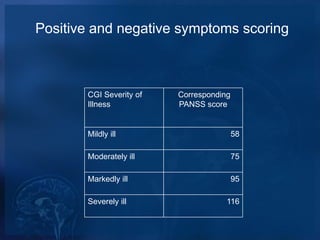
Positive and negative symptoms scoring
CGI Severity of
Illness
Corresponding
PANSS score
Mildly ill 58
Moderately ill 75
Markedly ill 95
Severely ill 116
Treatment of schizophrenia
Typical
• Chlorpromazine
(Largactil®)
• Flupenthixol
(Fluanxol®)
• Haloperidol
(Serenace® Haldol®)
• Sulpiride (Dogmatil®)
• Thioridazine
(Melleril®)
• Trifluoperazine
(Stelazine®)
Atypical
• Amisulpiride (Solian®)
• Quetiapine (Seroquel®)
• Ziprasidone (Zeldox®)
• Risperidone
(Risperdal®)
• Olanzapine (Zyprexa®)
• Clozapine (Clozaril®)
• Aripiprazole (Abilify®)
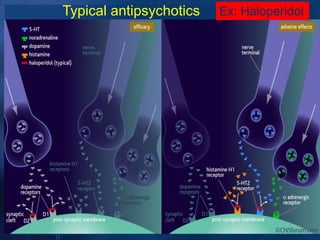
Typical antipsychotics - MOA
 Blocks receptors for dopamine,
acetylcholine, histamine and
norepinephrine
 Current theory suggests dopamine2
(D2) receptors suppresses psychotic
symptoms
 All typical antipsychotics block D2
receptors
Typical antipsychotics Ex: Haloperidol
Typical antipsychotics - cont
• Properties
• Effective in reducing positive symptoms during acute
episodes and in preventing their recurrence
• Less effective in treating negative symptoms
• Some concern that they may exacerbate negative
symptoms
• Higher incidence of EPS
EPS
Early
reaction
Can be
managed with
drugs
Late reaction
Drug
treatment
unsatisfactory
Dystonias
• Develops within a few hours to 5 days after first dose
• Muscle spasm of tongue, face, neck and back
• Oculogyric crisis (involuntary upward deviation of eyeballs)
• Opisthotonus (tetanic spasm of back muscles, causing trunk
to arch forward, while head and lower limbs are thrust
backwards)
• Laryngeal dystonia can impair respiration
• Management
• Anticholinergics (Benztropine, diphenhydramine IM/IV)
• Add scheduled benztropine / diphenhydramine with
antipsychotic
Parkinsonism
• Occurs within first month of therapy
• Management
• Centrally acting anticholinergics (scheduled benztropine /
diphenhydramine / benzhexol with antipsychotics) and
amantadine
• Avoid levodopa as it may counteract antipsychotic effects
• Switch to atypical antipsychotics
Akathisia
• Develop within first 2 months of therapy
• Compulsive, restless movement
• Symptoms of anxiety, agitation
• Management
• Benzodiazepines (e.g. lorazepam)
• Anticholinergics (e.g. benztropine, benzhexol)
• Reduce antipsychotic dosage or switch to low potency
agent
Tardive dyskinesia (TD)
• Develops months to years after therapy
• Involuntary movements of tongue and face
• Can interfere with chewing, swallowing and
speaking
• Symptoms are usually irreversible
• Management:
• Mild: Use milder atypical
• Severe: Clozapine
• Gradual drug withdrawal
Atypical antipsychotics
Ex: Risperidone
Atypical antipsychotics
• Properties
• Available evidence to show advantage for some
(clozapine, risperidone, olanzapine) but not all atypicals
when compared with typicals
• At least as effective as typicals for positive symptoms
• May be more efficacious for negative symptoms (still
under debate)
Atypical antipsychotics
• Properties – cont
• Less frequently associated with EPS
• More risk of weight gain, new onset
diabetes, hyperlipidemia
• Novel agents, more expensive
Atypical antipsychotics
• All atypical antipsychotics are equally
effective at therapeutic doses
• Except clozapine
• Most effective antipsychotic
• For resistant schizophrenia
• 2nd line due to life-threatening side effect
Atypical antipsychotics
Drug Advantages Disadvantages
Clozapine For treatment-resistant
cases, little EPS
Risk of fatal agranulocytosis
Risperidone Broad efficacy, little or no
EPS at low doses
EPS and hypotension at high
doses
Olanzapine Effective with positive and
negative symptoms, little
or no EPS
Weight gain
Quetiapine Similar to risperidone,
maybe less weight gain
Dose adjustment with
associated hypotension, BD
dosing
Ziprasidone Perhaps less weight gain
than clozapine, Inj A/V
QT prolongation
Aripiprazole Less weight gain, novel
mechanism potential
Uncertain
Atypical antipsychotics
• 1st line atypical antipsychotics
• All atypicals except clozapine
• NICE recommendations
• Atypical antipsychotics considered when choosing 1st
line treatment of newly diagnosed schizophrenia
• Treatment option of choice for managing acute
schizophrenic episode
• Considered when suffering unacceptable Adverse
effects from a conventional antipsychotic
• Changing to an atypical not necessary if typical
controls symptoms adequately and no unacceptable
Adverse effects
Atypical antipsychotics
• 2nd line atypical antipsychotic
• Clozapine
• Most effective antipsychotic for reducing symptoms
and preventing relapse
• Use of clozapine effectively reduce suicide risk
• 1% risk of potentially fatal agranulocytosis
• Acute pronounced leukopenia with great reduction
in number of neutrophil
• NICE recommendations
• Clozapine should be introduced if schizophrenia is
inadequately controlled despite sequential use of 2 or
more antipsychotic (one of which should be an
atypical) each for at least 6-8 weeks)
Depot antipsychotics
• Depot APs
• Fluphenazine decanoate
• Flupenthixol decanoate
• Risperidone
• Depot APs may confer an advantage over conventional oral APs by
improving adherence to drug treatment.
• Depot preparations could ensure continuous drug delivery, overcome
bioavailability problems and avoid the risk of overdose with oral
medications.
• However, depot preparations do not allow flexibility in administration and
dose adjustment.
• Patients may also complain of side effects at site of injection e.g. pain,
oedema, pruritus and sometimes a palpable mass.
Common side effects of atypical antipsychotics
Patient counselling and Family education
Patient should be counseled to follow the prescribed medications.
Family member are advised
 to monitor patients routine
 To check if he is taking medicine in time or any family member take
self responsibility to administer medicine
 To ensure monthly administration of i/m depot to minimize risk of
relapse
 If patient shows any signs or symptoms of relapse or ineffective
treatment report the doctor immediately
References
 https://ww1.cpa-
apc.org/Publications/Clinical_Guidelines/schizophrenia/november2005/Pharmacotherapy.asp
 http://www.ncbi.nlm.nih.gov/pubmed/16086618
 http://bjp.rcpsych.org/content/195/52/S13.full.pdf
 http://www.ingentaconnect.com/content/apl/pcp/2001/00000005/00000003/art00005
 Conley RR, Mahmoud R. Am J Psychiatry 2001; 158: 765-774.
 Zhong KX et al. Poster presented at the 16th European College of
Neuropsychopharmacology Congress, Prague, Czech Republic, 2003
 http://www.ncbi.nlm.nih.gov/pubmed/15231461
Schizophreniaaaaaa

Schizophreniaaaaaa

  • 1.
    Psychotic Disorders Muhammad JunaidFarrukh Pharm D, M Clin Pharm Hamdard Institute of Pharmaceutical Sciences Islamabad Campus
  • 2.
    Psychosis • Psychosis isa loss of contact with reality, usually including false beliefs about what is taking place or who one is (delusions) and seeing or hearing things that aren't there (hallucinations). 2
  • 3.
    Psychosis is alsopart of a number of psychiatric disorders, including: • Bipolar disorder (manic or depressed) • Delusional disorder • Depression with psychotic features • Personality disorders (schizotypal, shizoid, paranoid, and sometimes borderline) • Schizoaffective disorder • Schizophrenia 3
  • 4.
    Definition Schizophrenia is aserious mental illness characterized by illogical thoughts, bizarre behavior and speech, and delusions or hallucinations, such as hearing voice (American psychiatry association)
  • 5.
  • 6.
    Diagnostic criteria forSchizophrenia (DSM IV) diagnostic and statistical manual of mental disorders A. Characteristic symptoms (1) delusions (2) hallucinations (3) disorganized speech (e.g., frequent derailment or incoherence) (4) grossly disorganized or catatonic behavior (5) negative symptoms, i.e., affective flattening B. Social/occupational dysfunction: Failure to achieve expected level of interpersonal, academic, or occupational achievement). C. Duration: Continuous signs of the disturbance persist for at least 6 months
  • 7.
    Positive and negativesymptoms scoring To assess a patient using PANSS, an approximately 45-minute clinical interview is conducted. The patient is rated from 1 to 7 on 30 different symptoms based on the interview as well as reports of family members or primary care hospital workers Positive scale 7 Items, (minimum score = 7, maximum score = 49) •Delusions •Conceptual disorganization •Hallucinations •Hyperactivity •Grandiosity •Suspiciousness/persecution •Hostility Negative scale 7 Items, (minimum score = 7, maximum score = 49) •Blunted affect •Emotional withdrawal •Poor rapport •Passive/apathetic social withdrawal •Difficulty in abstract thinking •Lack of spontaneity and flow of conversation •Stereotyped thinking
  • 8.
    Positive and negativesymptoms scoring General Psychopathology scale 16 Items, (minimum score = 16, maximum score = 112) •Somatic concern •Anxiety •Guilt feelings •Tension •Mannerisms and posturing •Depression •Motor retardation •Uncooperativeness •Unusual thought content •Disorientation •Poor attention •Lack of judgment and insight •Disturbance of volition •Poor impulse control •Preoccupation •Active social avoidance PANSS Total score minimum = 30, maximum = 210
  • 9.
    Positive and negativesymptoms scoring CGI Severity of Illness Corresponding PANSS score Mildly ill 58 Moderately ill 75 Markedly ill 95 Severely ill 116
  • 10.
    Treatment of schizophrenia Typical •Chlorpromazine (Largactil®) • Flupenthixol (Fluanxol®) • Haloperidol (Serenace® Haldol®) • Sulpiride (Dogmatil®) • Thioridazine (Melleril®) • Trifluoperazine (Stelazine®) Atypical • Amisulpiride (Solian®) • Quetiapine (Seroquel®) • Ziprasidone (Zeldox®) • Risperidone (Risperdal®) • Olanzapine (Zyprexa®) • Clozapine (Clozaril®) • Aripiprazole (Abilify®)
  • 11.
    Typical antipsychotics -MOA  Blocks receptors for dopamine, acetylcholine, histamine and norepinephrine  Current theory suggests dopamine2 (D2) receptors suppresses psychotic symptoms  All typical antipsychotics block D2 receptors
  • 12.
  • 13.
    Typical antipsychotics -cont • Properties • Effective in reducing positive symptoms during acute episodes and in preventing their recurrence • Less effective in treating negative symptoms • Some concern that they may exacerbate negative symptoms • Higher incidence of EPS
  • 14.
    EPS Early reaction Can be managed with drugs Latereaction Drug treatment unsatisfactory
  • 15.
    Dystonias • Develops withina few hours to 5 days after first dose • Muscle spasm of tongue, face, neck and back • Oculogyric crisis (involuntary upward deviation of eyeballs) • Opisthotonus (tetanic spasm of back muscles, causing trunk to arch forward, while head and lower limbs are thrust backwards) • Laryngeal dystonia can impair respiration • Management • Anticholinergics (Benztropine, diphenhydramine IM/IV) • Add scheduled benztropine / diphenhydramine with antipsychotic
  • 16.
    Parkinsonism • Occurs withinfirst month of therapy • Management • Centrally acting anticholinergics (scheduled benztropine / diphenhydramine / benzhexol with antipsychotics) and amantadine • Avoid levodopa as it may counteract antipsychotic effects • Switch to atypical antipsychotics
  • 17.
    Akathisia • Develop withinfirst 2 months of therapy • Compulsive, restless movement • Symptoms of anxiety, agitation • Management • Benzodiazepines (e.g. lorazepam) • Anticholinergics (e.g. benztropine, benzhexol) • Reduce antipsychotic dosage or switch to low potency agent
  • 18.
    Tardive dyskinesia (TD) •Develops months to years after therapy • Involuntary movements of tongue and face • Can interfere with chewing, swallowing and speaking • Symptoms are usually irreversible • Management: • Mild: Use milder atypical • Severe: Clozapine • Gradual drug withdrawal
  • 19.
  • 20.
    Atypical antipsychotics • Properties •Available evidence to show advantage for some (clozapine, risperidone, olanzapine) but not all atypicals when compared with typicals • At least as effective as typicals for positive symptoms • May be more efficacious for negative symptoms (still under debate)
  • 21.
    Atypical antipsychotics • Properties– cont • Less frequently associated with EPS • More risk of weight gain, new onset diabetes, hyperlipidemia • Novel agents, more expensive
  • 22.
    Atypical antipsychotics • Allatypical antipsychotics are equally effective at therapeutic doses • Except clozapine • Most effective antipsychotic • For resistant schizophrenia • 2nd line due to life-threatening side effect
  • 23.
    Atypical antipsychotics Drug AdvantagesDisadvantages Clozapine For treatment-resistant cases, little EPS Risk of fatal agranulocytosis Risperidone Broad efficacy, little or no EPS at low doses EPS and hypotension at high doses Olanzapine Effective with positive and negative symptoms, little or no EPS Weight gain Quetiapine Similar to risperidone, maybe less weight gain Dose adjustment with associated hypotension, BD dosing Ziprasidone Perhaps less weight gain than clozapine, Inj A/V QT prolongation Aripiprazole Less weight gain, novel mechanism potential Uncertain
  • 24.
    Atypical antipsychotics • 1stline atypical antipsychotics • All atypicals except clozapine • NICE recommendations • Atypical antipsychotics considered when choosing 1st line treatment of newly diagnosed schizophrenia • Treatment option of choice for managing acute schizophrenic episode • Considered when suffering unacceptable Adverse effects from a conventional antipsychotic • Changing to an atypical not necessary if typical controls symptoms adequately and no unacceptable Adverse effects
  • 25.
    Atypical antipsychotics • 2ndline atypical antipsychotic • Clozapine • Most effective antipsychotic for reducing symptoms and preventing relapse • Use of clozapine effectively reduce suicide risk • 1% risk of potentially fatal agranulocytosis • Acute pronounced leukopenia with great reduction in number of neutrophil • NICE recommendations • Clozapine should be introduced if schizophrenia is inadequately controlled despite sequential use of 2 or more antipsychotic (one of which should be an atypical) each for at least 6-8 weeks)
  • 26.
    Depot antipsychotics • DepotAPs • Fluphenazine decanoate • Flupenthixol decanoate • Risperidone • Depot APs may confer an advantage over conventional oral APs by improving adherence to drug treatment. • Depot preparations could ensure continuous drug delivery, overcome bioavailability problems and avoid the risk of overdose with oral medications. • However, depot preparations do not allow flexibility in administration and dose adjustment. • Patients may also complain of side effects at site of injection e.g. pain, oedema, pruritus and sometimes a palpable mass.
  • 29.
    Common side effectsof atypical antipsychotics
  • 30.
    Patient counselling andFamily education Patient should be counseled to follow the prescribed medications. Family member are advised  to monitor patients routine  To check if he is taking medicine in time or any family member take self responsibility to administer medicine  To ensure monthly administration of i/m depot to minimize risk of relapse  If patient shows any signs or symptoms of relapse or ineffective treatment report the doctor immediately
  • 31.
    References  https://ww1.cpa- apc.org/Publications/Clinical_Guidelines/schizophrenia/november2005/Pharmacotherapy.asp  http://www.ncbi.nlm.nih.gov/pubmed/16086618 http://bjp.rcpsych.org/content/195/52/S13.full.pdf  http://www.ingentaconnect.com/content/apl/pcp/2001/00000005/00000003/art00005  Conley RR, Mahmoud R. Am J Psychiatry 2001; 158: 765-774.  Zhong KX et al. Poster presented at the 16th European College of Neuropsychopharmacology Congress, Prague, Czech Republic, 2003  http://www.ncbi.nlm.nih.gov/pubmed/15231461

Editor's Notes

  • #13 It can bind to dopamine D1 and D2, 5-HT2, histamine H1 and α2 adrenergic receptors in the brain. The efficacy of neuroleptics is thought to be due to antagonism of dopamine receptors in the mesolimbic and mesofrontal systems. The adverse effects of typical neuroleptics include tachycardia, impotence and dizziness, and these unwanted effects are caused by non-selective interaction at the α adrenoreceptor. Other adverse effects include and sedation and weight gain, which is due to histamine H1 receptor blockade.
  • #20 Risperidone can bind to dopamine D2, 5-HT2 and α2 adrenergic receptors in the brain. The efficacy of neuroleptics is thought to be due to antagonism of dopamine receptors in the mesolimbic and mesofrontal systems. The atypical neuroleptics, which have little or no affinity for D1 receptors, do not exhibit some of the side effects associated with D1 antagonism that the older neuroleptics have. The adverse effects associated with atypical neuroleptics, such as tachycardia, impotence and dizziness, are due to the non selective binding to α adrenoreceptors.
  • #27 Indicated