Professional nursing
concept and
practice
INTRODUCTION
 Nursing is a intensive course and
designed to introduce care concept
related to Nursing.
 Professional nursing concept is a
philosophy and conceptual
framework of the nursing.
INTRODUCTION
 In making decisions about their
individual scope of practice; nurses
should keep to the fore the rights,
needs and overall benefit to the
patient and the importance of
promoting and maintaining the highest
standards of quality in the health
services.
INTRODUCTION
 Nurses respect all people equally without
discriminating on the grounds of age,
gender, race, ethnicity, religion, civil status,
family status, sexual orientation, disability
(physical, mental or intellectual).
 Fundamental to nursing practice is the
therapeutic relationship between the nurse
and the patient that is based on open
communication, trust, understanding,
compassion and kindness, and serves to
empower the patient to make life choices.
INTRODUCTION
 Nursing practice must always be based on
the principles of professional conduct stated
in the latest edition of the Code of
Professional Conduct and Ethics for
Registered Nurses and Registered Midwives
(2014).
 Nursing is a profession within the health care
sector focused on the care of individuals,
families, and communities so they may attain,
maintain, or recover optimal health and
quality of life.
INTRODUCTION
Nurses develop a plan of care, working
collaboratively with physicians,
therapists, the patient, the patient's
family and other team members, that
focuses on treating illness to improve
quality of life
DEFINITION
Professional Nursing concept is a Nursing
encompasses autonomous and collaborative
care of individuals of all ages, families, groups
and communities, sick or well and in all settings.
Nursing includes the promotion of health,
prevention of illness, and the care of ill, disabled
and dying people. Advocacy, promotion of a
safe environment, research, participation in
shaping health policy and in patient and health
systems management, and education are also
key nursing roles.
-Parul Datta
DEFINITION
The professional nursing practice is a
nursing, as an integral part of the health
care system, encompasses the promotion of
health, prevention of illness, and care of
physically ill, mentally ill, and disabled
people of all ages, in all heath care and
other community setting.
-K.P. Neerja
DEFINITION – NURSING
CONCEPT
Health as a fundamental nursing concept
involves both mental and physiological well
being, and it changes over a patient's lifetime.
Nurses work in health care to promote and
protect health by instructing patients about
self-care, and about how lifestyle and behavior
affects their health.
DEFINITION- NURSING
PRACTICE
The scope of nursing practice is the range of
roles, functions, responsibilities and activities
which a registerednurse is educated,
competent and has authority to
perform.Nursing practice is underpinned by
values that guide the way in which nursing
care is provided.
CONCEPTOFPROFESSIONAL
NURSING CONCEPTAND
PRACTICE
ELEMENT’S OFPROFESSIONAL
NURSING CONCEPT
1. Person
2. Health
3. Environment
ELEMENT’S OF
PROFESSIONAL NURSING
CONCEPT
PERSON
1. Need
Nursing is a profession
within the health care
sector focused on the
care of individuals,
families and communities
so they may attain,
maintain, or recover
optimal health and quality
of life.
PERSON
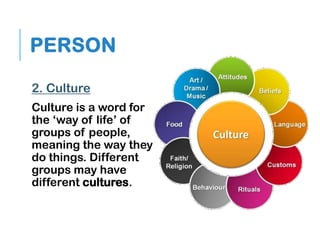
2. Culture
Culture is a word for
the ‘way of life’ of
groups of people,
meaning the way they
do things. Different
groups may have
different cultures.
PERSON
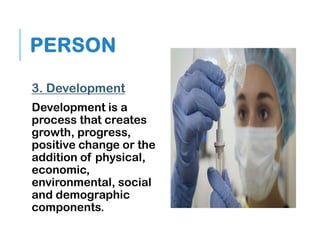
3. Development
Development is a
process that creates
growth, progress,
positive change or the
addition of physical,
economic,
environmental, social
and demographic
components.
PERSON
4. Behaviour
Behaviourism, also known
as behavioural psychology,
is a theory of learning
based on the idea that all
behaviours are acquired
through conditioning.
Conditioning occurs
through interaction with
the environment.
HEALTH
1. Healing
Healing is the process of
the restoration of health
from an unbalanced,
diseased or damaged
organism. The result of
healing can be a cure to a
health challenge, but one
can heal without being
cured.
HEALTH
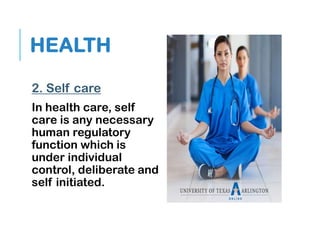
2. Self care
In health care, self
care is any necessary
human regulatory
function which is
under individual
control, deliberate and
self initiated.
HEALTH
3. Wellness
Wellness is an active
process of becoming
aware of and making
choices toward a healthy
and fulfilling life. Wellness
is more than being free
from illness, it is a dynamic
process of change and
growth.
ENVIRONMENT
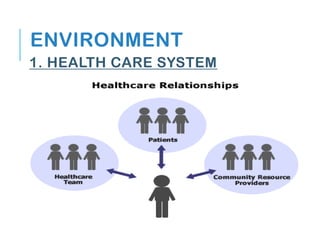
1. HEALTH CARE SYSTEM
ENVIRONMENT
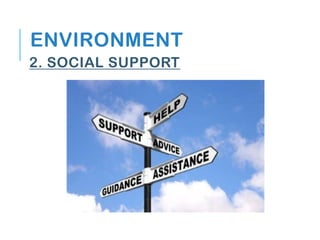
2. SOCIAL SUPPORT
ENVIRONMENT
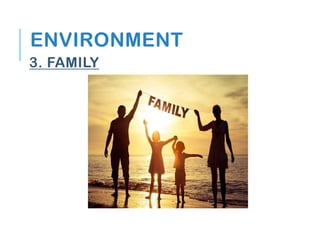
3. FAMILY
ENVIRONMENT
4. WHOLENESS
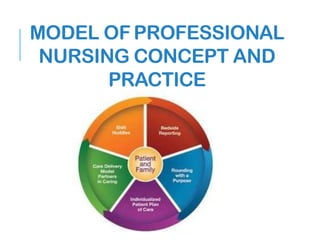
MODEL OFPROFESSIONAL
NURSING CONCEPT AND
PRACTICE
1. Holistic Model
2. Healh Belief Model
3. Health Promotion
Model
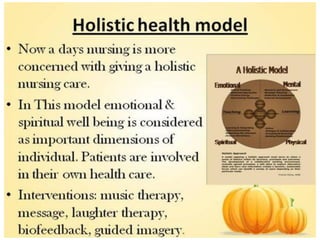
HOLISTICMODEL
• The holistic treatment of the body’s expression
of symptoms is done through natural and
preventative approaches.
• The individual is looked at as a person- not as
the disease they have or ailments they exhibit.
• With holistic health, one’s health is measured
not just with the absence of symptoms and
disease, but an overall positive state of being.
HOLISTIC HEALTH
• Therefore, individuals also have a
responsibility for their own total health
and have to be an active participant in
their approaches towards day-to-day
wellness and healing to keep the body in
balance.
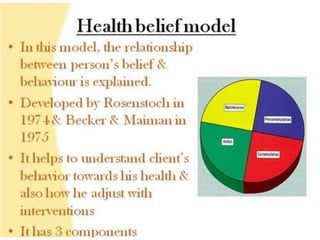
HEALTH BELIEF MODEL
The Health Belief Model (HBM) is one of
the most widely used conceptual
frameworks for understanding health
behaviour.
Developed in the early 1950s, the model
has been used with great success for
almost half a century to promote greater
condom use, seat belt use, medical
compliance, and health screening use, to
name a few behaviors.
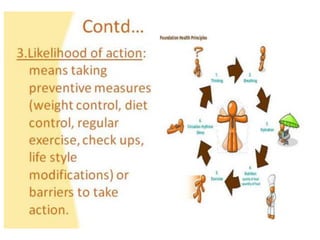
HEALTH BELIEF MODEL
• The HBM is based on the understanding that a
person will take a health-related action (i.e.,
use condoms) if that person: feels that a
negative health condition (i.e., HIV) can be
avoided,
• has a positive expectation that by taking a
recommended action, he/she will avoid a
negative health condition (i.e., using condoms
will be effective at preventing HIV), and
• believes that he/she can successfully take a
recommended health action (i.e., he/she can
use condoms comfortably and with
confidence).
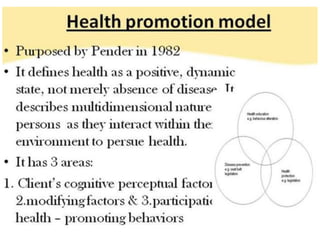
HEALTH PROMOTION
MODEL
THEORIES OF
PROFESSIONAL NURSING
CONCEPT AND PRACTICE
ESSENTIAL CONCEPTS COMMON AMONG
NURSING THEORIES:
Man
Health
Environment
Nursing
THEORIES
Nightingale’s theory
Peplau’s theory
Henderson’s theory
Orem’s theory
Neuman’s theory
Roger’s theory
Roy’s theory
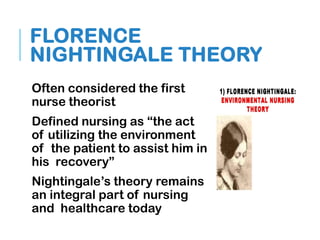
FLORENCE
NIGHTINGALE THEORY
Often considered the first
nurse theorist
Defined nursing as “the act
of utilizing the environment
of the patient to assist him in
his recovery”
Nightingale’s theory remains
an integral part of nursing
and healthcare today
CONTD...
5 factors of healthy environment
Pure or fresh air
Pure water
Efficient drainage
Cleanliness
Light, especially directs sunlight
CONTD….
Nightingale’s general concepts of
Environmental Sanitation includes:
 Proper ventilation
 Adequate lighting
 Cleanliness
 Adequate warmth
 Quiet
 Diet
PEPLAU’STHEORY
in ReadingTheorist -Hildegard. E. Peplau Born
Pennsylvania [1909], USA
The theory explains the purpose of nursing is to
help others identify their felt difficulties.
Nurses should apply principles of human
relations to the problems that arise at all levels
of experience.
Peplau's theory explains the phases of
interpersonal process, roles in nursing
situations and methods for studying nursing as
an interpersonal process.
PEPLAU’STHEORY
Nursing is therapeutic in that it is a healing art,
assisting an individual who is sick or in need of
health care.
Nursing is an interpersonal process because it
involves interaction between two or more
individuals with a common goal.
The attainment of goal is achieved through the
use of a series of steps following a series of
pattern.
The nurse and patient work together so both
become mature and knowledgeable in the
process.
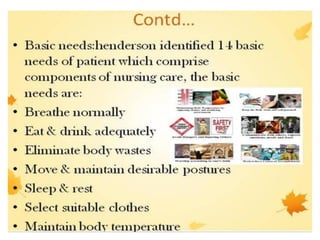
VIRGINIA HENDERSON’S
THEORY
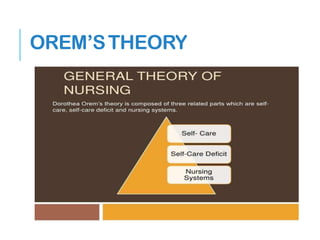
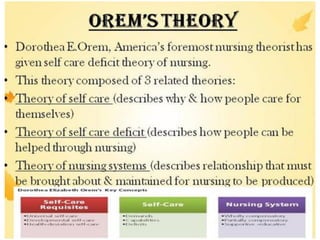
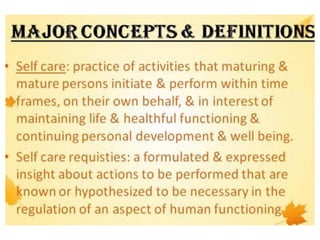
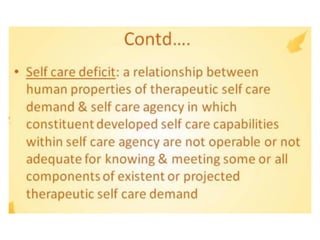
OREM’STHEORY
NEUMAN’STHEORY
ROGER’STHEORY
ROY’STHEORY
APPLICATION
Best applied in the performance of the Nursing
Process which is cyclical in nature.
The Assessment component is the Stimuli or
Input The Planning & Implementation are the
Through put process.
The Evaluation which provides necessary
feedback to the Goal of care is the Output
THANKYOU

Professional nursing concept and practice

  • 1.
  • 2.
    INTRODUCTION  Nursing isa intensive course and designed to introduce care concept related to Nursing.  Professional nursing concept is a philosophy and conceptual framework of the nursing.
  • 3.
    INTRODUCTION  In makingdecisions about their individual scope of practice; nurses should keep to the fore the rights, needs and overall benefit to the patient and the importance of promoting and maintaining the highest standards of quality in the health services.
  • 4.
    INTRODUCTION  Nurses respectall people equally without discriminating on the grounds of age, gender, race, ethnicity, religion, civil status, family status, sexual orientation, disability (physical, mental or intellectual).  Fundamental to nursing practice is the therapeutic relationship between the nurse and the patient that is based on open communication, trust, understanding, compassion and kindness, and serves to empower the patient to make life choices.
  • 5.
    INTRODUCTION  Nursing practicemust always be based on the principles of professional conduct stated in the latest edition of the Code of Professional Conduct and Ethics for Registered Nurses and Registered Midwives (2014).  Nursing is a profession within the health care sector focused on the care of individuals, families, and communities so they may attain, maintain, or recover optimal health and quality of life.
  • 6.
    INTRODUCTION Nurses develop aplan of care, working collaboratively with physicians, therapists, the patient, the patient's family and other team members, that focuses on treating illness to improve quality of life
  • 7.
    DEFINITION Professional Nursing conceptis a Nursing encompasses autonomous and collaborative care of individuals of all ages, families, groups and communities, sick or well and in all settings. Nursing includes the promotion of health, prevention of illness, and the care of ill, disabled and dying people. Advocacy, promotion of a safe environment, research, participation in shaping health policy and in patient and health systems management, and education are also key nursing roles. -Parul Datta
  • 8.
    DEFINITION The professional nursingpractice is a nursing, as an integral part of the health care system, encompasses the promotion of health, prevention of illness, and care of physically ill, mentally ill, and disabled people of all ages, in all heath care and other community setting. -K.P. Neerja
  • 9.
    DEFINITION – NURSING CONCEPT Healthas a fundamental nursing concept involves both mental and physiological well being, and it changes over a patient's lifetime. Nurses work in health care to promote and protect health by instructing patients about self-care, and about how lifestyle and behavior affects their health.
  • 10.
    DEFINITION- NURSING PRACTICE The scopeof nursing practice is the range of roles, functions, responsibilities and activities which a registerednurse is educated, competent and has authority to perform.Nursing practice is underpinned by values that guide the way in which nursing care is provided.
  • 12.
  • 25.
  • 26.
    1. Person 2. Health 3.Environment ELEMENT’S OF PROFESSIONAL NURSING CONCEPT
  • 27.
    PERSON 1. Need Nursing isa profession within the health care sector focused on the care of individuals, families and communities so they may attain, maintain, or recover optimal health and quality of life.
  • 28.
    PERSON 2. Culture Culture isa word for the ‘way of life’ of groups of people, meaning the way they do things. Different groups may have different cultures.
  • 29.
    PERSON 3. Development Development isa process that creates growth, progress, positive change or the addition of physical, economic, environmental, social and demographic components.
  • 30.
    PERSON 4. Behaviour Behaviourism, alsoknown as behavioural psychology, is a theory of learning based on the idea that all behaviours are acquired through conditioning. Conditioning occurs through interaction with the environment.
  • 31.
    HEALTH 1. Healing Healing isthe process of the restoration of health from an unbalanced, diseased or damaged organism. The result of healing can be a cure to a health challenge, but one can heal without being cured.
  • 32.
    HEALTH 2. Self care Inhealth care, self care is any necessary human regulatory function which is under individual control, deliberate and self initiated.
  • 33.
    HEALTH 3. Wellness Wellness isan active process of becoming aware of and making choices toward a healthy and fulfilling life. Wellness is more than being free from illness, it is a dynamic process of change and growth.
  • 34.
  • 35.
  • 36.
  • 37.
  • 39.
  • 40.
    1. Holistic Model 2.Healh Belief Model 3. Health Promotion Model
  • 41.
    HOLISTICMODEL • The holistictreatment of the body’s expression of symptoms is done through natural and preventative approaches. • The individual is looked at as a person- not as the disease they have or ailments they exhibit. • With holistic health, one’s health is measured not just with the absence of symptoms and disease, but an overall positive state of being.
  • 42.
    HOLISTIC HEALTH • Therefore,individuals also have a responsibility for their own total health and have to be an active participant in their approaches towards day-to-day wellness and healing to keep the body in balance.
  • 48.
    HEALTH BELIEF MODEL TheHealth Belief Model (HBM) is one of the most widely used conceptual frameworks for understanding health behaviour. Developed in the early 1950s, the model has been used with great success for almost half a century to promote greater condom use, seat belt use, medical compliance, and health screening use, to name a few behaviors.
  • 49.
    HEALTH BELIEF MODEL •The HBM is based on the understanding that a person will take a health-related action (i.e., use condoms) if that person: feels that a negative health condition (i.e., HIV) can be avoided, • has a positive expectation that by taking a recommended action, he/she will avoid a negative health condition (i.e., using condoms will be effective at preventing HIV), and • believes that he/she can successfully take a recommended health action (i.e., he/she can use condoms comfortably and with confidence).
  • 51.
  • 55.
  • 56.
    ESSENTIAL CONCEPTS COMMONAMONG NURSING THEORIES: Man Health Environment Nursing
  • 57.
    THEORIES Nightingale’s theory Peplau’s theory Henderson’stheory Orem’s theory Neuman’s theory Roger’s theory Roy’s theory
  • 58.
    FLORENCE NIGHTINGALE THEORY Often consideredthe first nurse theorist Defined nursing as “the act of utilizing the environment of the patient to assist him in his recovery” Nightingale’s theory remains an integral part of nursing and healthcare today
  • 59.
    CONTD... 5 factors ofhealthy environment Pure or fresh air Pure water Efficient drainage Cleanliness Light, especially directs sunlight
  • 60.
    CONTD…. Nightingale’s general conceptsof Environmental Sanitation includes:  Proper ventilation  Adequate lighting  Cleanliness  Adequate warmth  Quiet  Diet
  • 61.
    PEPLAU’STHEORY in ReadingTheorist -Hildegard.E. Peplau Born Pennsylvania [1909], USA The theory explains the purpose of nursing is to help others identify their felt difficulties. Nurses should apply principles of human relations to the problems that arise at all levels of experience. Peplau's theory explains the phases of interpersonal process, roles in nursing situations and methods for studying nursing as an interpersonal process.
  • 62.
    PEPLAU’STHEORY Nursing is therapeuticin that it is a healing art, assisting an individual who is sick or in need of health care. Nursing is an interpersonal process because it involves interaction between two or more individuals with a common goal. The attainment of goal is achieved through the use of a series of steps following a series of pattern. The nurse and patient work together so both become mature and knowledgeable in the process.
  • 65.
  • 71.
  • 77.
  • 82.
  • 87.
  • 88.
    APPLICATION Best applied inthe performance of the Nursing Process which is cyclical in nature. The Assessment component is the Stimuli or Input The Planning & Implementation are the Through put process. The Evaluation which provides necessary feedback to the Goal of care is the Output
  • 89.