for the edentulous patient
Dr. Ahmad Rabah
Following the satisfactorily obtained master cast, and to
record the relation between mandible and maxilla; record
bases and record blocks are fabricated.
After this relation is accurately obtained the cast with the
record blocks can be then mounted on an articulator.
So, the record blocks is two parts:
• Record base
• Record rims (occlusion rims)
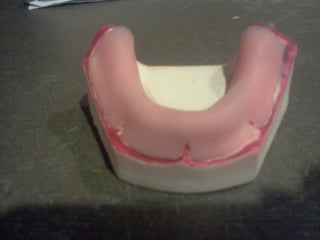
It’s the interim denture base supporting the occlusion rims while recording
the maxillomandibular relations.
Requirements of an ideal record base material
1. Natural appearance
2. Ease of manipulation
3. Ease of fabrication and repair
4. High mechanical properties (strength, toughness)
5. High surface hardness with low specific gravity
6. Biologically compatible
7. Dimensionally stable throughout the procedure
8. Low cost
Record bases are either interim or final record bases.
Interim record bases
Which is to be replaced later during flasking and can be
made of:
1. Shellac baseplate
2. Stabilized shellac baseplate
3. Cold curing acrylic resin
4. Vacuum-adapted resin baseplates
5. VLC resin
6. Modeling wax
Final record bases
Which will contribute a part of the completed denture and
can be made of:
1. Heat cured acrylic resin
2. Metallic record bases
A. Cast gold type IV
B. Chrome-Cobalt alloy
C. Aluminum
Criteria of the record bases
1. Adaptation
It should be well-adapted, fitted and accurately reproduce the surface of
the master cast alongside with reproduction of the sulci (width and
depth)
2. Form
It should be smooth with rounded borders to avoid injury to the patient
3. Thickness
Minimums of 1 mm thickness over the crest of the ridge and the flanges
to provide space for artificial teeth and 2 mm at the rest to provide
rigidity
4. Colour
Realistic natural colour, matching that of the oral tissues is mandatory
specially for final record bases
5. Rigidity
They should be sufficiently rigid to withstand pressure and resist
breakage
6. Dimensional stability
Lack of dimensional stability overall the procedure either on the cast or
in patient’s mouth will hinder the relations obtained inaccurate
7. Cost and ease of manipulation
8. Easy and quick fabrication of the record bases is needed with low cost
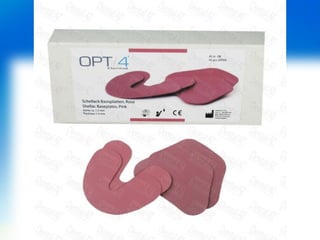
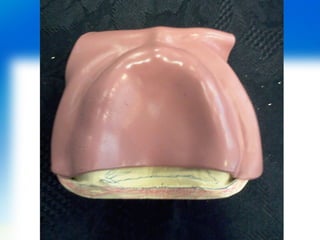
1. Shellack baseplates
2. Stabilized Shellack baseplates
Done by adding a lining material such as Zn/O paste to
improove the fit and adaptability of shellack record
bases
3. Autopolymerizing acrylic resin
• Dough technique
• Sprinkle-on method
4. VLC resin
5. Vacuum adapted resins
• Good thickness control and minimum time
• Expensive and hard to get max adaptation
6. Modeling wax
• Unsuitable material. Lacks rigidity and softens at body temperature
Heat cured acrylic resin
• The most commonly used material for the finished complete denture base.
• It has good mechanical properties and natural appearance.
• Light weight so achieves good retention for maxillary denture.
• Non-irritant if properly polymerized.
• Maintains good polish.
• Easy to fabricate with low cost.
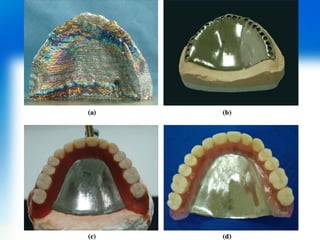
Metallic denture bases
• Used to add strength to the denture and provides thermal conductivity
• Forms the basal surface of the denture and has a portion fabricated to attach
the resin part of the denture with the artificial teeth on top.
• Thermal conductivity is needed to provide the underlying tissues with
thermal stimulation and vice versa loss of heat from the mucosa to the
mouth. This conforms with the better tissue reaction associated with metal-
based dentures.
Advantages
1. It has superior fit over resin based denture bases so more retention is
acquired.
2. Less occlusal errors
3. Resistance to fractures
4. Causes less sore spots
5. Allows for thinner thicknesses so increases the patient’s tolerance
6. Provides thermal conductivity
7. No chance of deformity and dimensionally stable
Disadvantages
1. Cost
2. Time
3. Difficult to reline or rebase
4. Can cause allergy in some cases
Indications
In general; when additional strength is needed or processing changes are
expected, the metal-based dentures are indicated so it’s recommended in
cases of:
1. Overdentures, due to stress concentration
2. Shallow, flat palate, due to increase in flexure forces
3. Patient’s with impaired orientation who frequently drop their
dentures
4. Patients allergic to resins
5. In mandibular arches when additional weight is required to add
in retention
6. Professional speakers or patients with gag reflex to provide
thinner denture thus reduces intolerance
They are the occluding surfaces built on interim or final denture bases for
the purpose of making the maxillomandibular relation records and for
arrangement of artificial teeth
Marking the master cast
Before construction of the occlusion rims, some guidelines are drawn on
the master cast to aid in the correct positioning of the occlusion rims
and then proper arrangement of teeth in relation to the residual ridge.
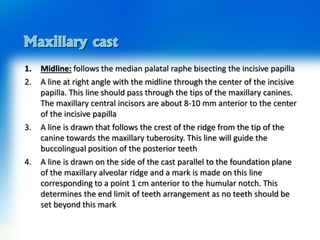
1. Midline: follows the median palatal raphe bisecting the incisive papilla
2. A line at right angle with the midline through the center of the incisive
papilla. This line should pass through the tips of the maxillary canines.
The maxillary central incisors are about 8-10 mm anterior to the center
of the incisive papilla
3. A line is drawn that follows the crest of the ridge from the tip of the
canine towards the maxillary tuberosity. This line will guide the
buccolingual position of the posterior teeth
4. A line is drawn on the side of the cast parallel to the foundation plane
of the maxillary alveolar ridge and a mark is made on this line
corresponding to a point 1 cm anterior to the humular notch. This
determines the end limit of teeth arrangement as no teeth should be
set beyond this mark
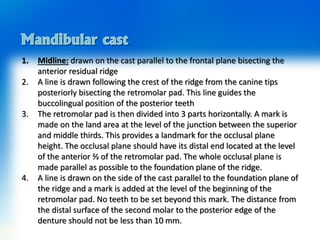
1. Midline: drawn on the cast parallel to the frontal plane bisecting the
anterior residual ridge
2. A line is drawn following the crest of the ridge from the canine tips
posteriorly bisecting the retromolar pad. This line guides the
buccolingual position of the posterior teeth
3. The retromolar pad is then divided into 3 parts horizontally. A mark is
made on the land area at the level of the junction between the superior
and middle thirds. This provides a landmark for the occlusal plane
height. The occlusal plane should have its distal end located at the level
of the anterior ⅔ of the retromolar pad. The whole occlusal plane is
made parallel as possible to the foundation plane of the ridge.
4. A line is drawn on the side of the cast parallel to the foundation plane of
the ridge and a mark is added at the level of the beginning of the
retromolar pad. No teeth to be set beyond this mark. The distance from
the distal surface of the second molar to the posterior edge of the
denture should not be less than 10 mm.
Constructionof the occlusal rims
Occlusal rims can be made of:
Baseplate wax (Pink wax)
Simple, quick and easy to handle. Either manual molding, pouring molten
wax or using preformed rims techniques can be used satisfactorily.
Modelling compound
The preferred type if the functionally generated path procedure for jaw
relations recording is carried out. It takes longer time than wax to be
modified so the best way is to soften the occlusal surface with a flame
and flatten against wet flat surface as a glass slab then cut of the excess.
Plaster and pumice
A mix of plaster of Paris and pumice is used to form 2 mm in height over
a previously constructed wax rims. Based on guiding the patient to grind
the lower rim against the upper in the various mandibular movements
until even gliding contact is produced
1. The form and curvature should correspond to the arch.
2. Should be slightly labially and buccally to the crest of the ridge. Anteriorly,
the labial surface of the wax is located 8-10 mm anterior to the center of
the incisive papilla while posteriorly, the center of the wax rim should be 2-
3 mm buccal to the center of the ridge
3. Posteriorly, 1 cm anterior to the humular notch, tapered towards the base
to prevent interference with the ascending ramus of the mandible.
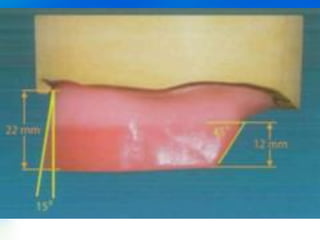
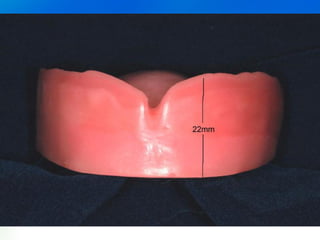
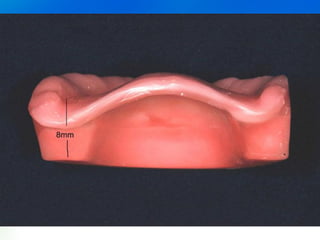
4. Dimensions:
• Height: approx. 22 mm at the highest point labially till the occlusal
surface, 18 mm in the posterior region and 10-15 mm anterior to the
tuberosity. This will vary from patient to patient.
• Width: approx. 4 mm in the anterior region, 6 mm in the premolar area
and 8-10 mm posteriorly
5. The walls are perpendicular with the occlusal surface tapering towards the
sulcus and palate to provide space for the tongue with good tissue molding
from outside
6. All surfaces should be smooth, occlusal surface should be flat
7. Transfer the cast markings to the wax
Principles of construction
1. Conform to all curvatures
2. Both anterior and posterior segments should be located directly over
the ridge
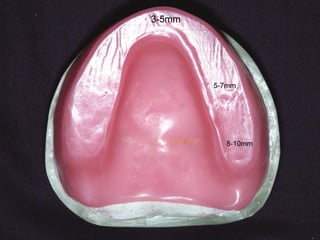
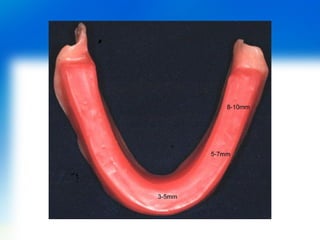
3. Dimensions:
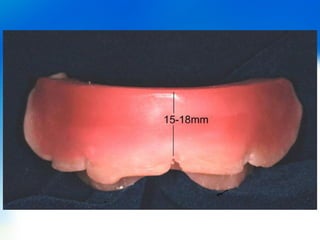
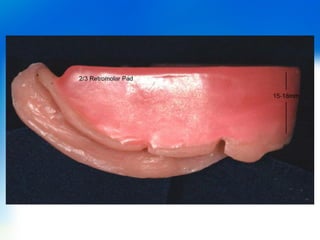
• Height: approx. 18 mm anteriorly from the depth of the sulcus till
the occlusal plane while posteriorly should not exceed ⅔ of
retromolar pad height.
• Width: approx. 5 mm anteriorly and 8-10 mm posteriorly
4. The wax should terminate 2-3 mm anterior to the retromolar papillae
5. The walls are perpendicular with the occlusal surface tapering towards
the sulcus labially, buccally and lingually to provide space for the
tongue with good tissue molding from outside
6. All surfaces should be smooth, occlusal surface should be flat
7. Transfer the cast markings to the wax
Wax rims & jaw relations

Wax rims & jaw relations

  • 1.
    for the edentulouspatient Dr. Ahmad Rabah
  • 2.
    Following the satisfactorilyobtained master cast, and to record the relation between mandible and maxilla; record bases and record blocks are fabricated. After this relation is accurately obtained the cast with the record blocks can be then mounted on an articulator. So, the record blocks is two parts: • Record base • Record rims (occlusion rims)
  • 3.
    It’s the interimdenture base supporting the occlusion rims while recording the maxillomandibular relations. Requirements of an ideal record base material 1. Natural appearance 2. Ease of manipulation 3. Ease of fabrication and repair 4. High mechanical properties (strength, toughness) 5. High surface hardness with low specific gravity 6. Biologically compatible 7. Dimensionally stable throughout the procedure 8. Low cost
  • 4.
    Record bases areeither interim or final record bases. Interim record bases Which is to be replaced later during flasking and can be made of: 1. Shellac baseplate 2. Stabilized shellac baseplate 3. Cold curing acrylic resin 4. Vacuum-adapted resin baseplates 5. VLC resin 6. Modeling wax
  • 5.
    Final record bases Whichwill contribute a part of the completed denture and can be made of: 1. Heat cured acrylic resin 2. Metallic record bases A. Cast gold type IV B. Chrome-Cobalt alloy C. Aluminum
  • 6.
    Criteria of therecord bases 1. Adaptation It should be well-adapted, fitted and accurately reproduce the surface of the master cast alongside with reproduction of the sulci (width and depth) 2. Form It should be smooth with rounded borders to avoid injury to the patient 3. Thickness Minimums of 1 mm thickness over the crest of the ridge and the flanges to provide space for artificial teeth and 2 mm at the rest to provide rigidity 4. Colour Realistic natural colour, matching that of the oral tissues is mandatory specially for final record bases
  • 7.
    5. Rigidity They shouldbe sufficiently rigid to withstand pressure and resist breakage 6. Dimensional stability Lack of dimensional stability overall the procedure either on the cast or in patient’s mouth will hinder the relations obtained inaccurate 7. Cost and ease of manipulation 8. Easy and quick fabrication of the record bases is needed with low cost
  • 8.
    1. Shellack baseplates 2.Stabilized Shellack baseplates Done by adding a lining material such as Zn/O paste to improove the fit and adaptability of shellack record bases
  • 13.
    3. Autopolymerizing acrylicresin • Dough technique • Sprinkle-on method 4. VLC resin 5. Vacuum adapted resins • Good thickness control and minimum time • Expensive and hard to get max adaptation 6. Modeling wax • Unsuitable material. Lacks rigidity and softens at body temperature
  • 14.
    Heat cured acrylicresin • The most commonly used material for the finished complete denture base. • It has good mechanical properties and natural appearance. • Light weight so achieves good retention for maxillary denture. • Non-irritant if properly polymerized. • Maintains good polish. • Easy to fabricate with low cost. Metallic denture bases • Used to add strength to the denture and provides thermal conductivity • Forms the basal surface of the denture and has a portion fabricated to attach the resin part of the denture with the artificial teeth on top. • Thermal conductivity is needed to provide the underlying tissues with thermal stimulation and vice versa loss of heat from the mucosa to the mouth. This conforms with the better tissue reaction associated with metal- based dentures.
  • 15.
    Advantages 1. It hassuperior fit over resin based denture bases so more retention is acquired. 2. Less occlusal errors 3. Resistance to fractures 4. Causes less sore spots 5. Allows for thinner thicknesses so increases the patient’s tolerance 6. Provides thermal conductivity 7. No chance of deformity and dimensionally stable Disadvantages 1. Cost 2. Time 3. Difficult to reline or rebase 4. Can cause allergy in some cases
  • 16.
    Indications In general; whenadditional strength is needed or processing changes are expected, the metal-based dentures are indicated so it’s recommended in cases of: 1. Overdentures, due to stress concentration 2. Shallow, flat palate, due to increase in flexure forces 3. Patient’s with impaired orientation who frequently drop their dentures 4. Patients allergic to resins 5. In mandibular arches when additional weight is required to add in retention 6. Professional speakers or patients with gag reflex to provide thinner denture thus reduces intolerance
  • 18.
    They are theoccluding surfaces built on interim or final denture bases for the purpose of making the maxillomandibular relation records and for arrangement of artificial teeth Marking the master cast Before construction of the occlusion rims, some guidelines are drawn on the master cast to aid in the correct positioning of the occlusion rims and then proper arrangement of teeth in relation to the residual ridge.
  • 19.
    1. Midline: followsthe median palatal raphe bisecting the incisive papilla 2. A line at right angle with the midline through the center of the incisive papilla. This line should pass through the tips of the maxillary canines. The maxillary central incisors are about 8-10 mm anterior to the center of the incisive papilla 3. A line is drawn that follows the crest of the ridge from the tip of the canine towards the maxillary tuberosity. This line will guide the buccolingual position of the posterior teeth 4. A line is drawn on the side of the cast parallel to the foundation plane of the maxillary alveolar ridge and a mark is made on this line corresponding to a point 1 cm anterior to the humular notch. This determines the end limit of teeth arrangement as no teeth should be set beyond this mark
  • 21.
    1. Midline: drawnon the cast parallel to the frontal plane bisecting the anterior residual ridge 2. A line is drawn following the crest of the ridge from the canine tips posteriorly bisecting the retromolar pad. This line guides the buccolingual position of the posterior teeth 3. The retromolar pad is then divided into 3 parts horizontally. A mark is made on the land area at the level of the junction between the superior and middle thirds. This provides a landmark for the occlusal plane height. The occlusal plane should have its distal end located at the level of the anterior ⅔ of the retromolar pad. The whole occlusal plane is made parallel as possible to the foundation plane of the ridge. 4. A line is drawn on the side of the cast parallel to the foundation plane of the ridge and a mark is added at the level of the beginning of the retromolar pad. No teeth to be set beyond this mark. The distance from the distal surface of the second molar to the posterior edge of the denture should not be less than 10 mm.
  • 23.
    Constructionof the occlusalrims Occlusal rims can be made of: Baseplate wax (Pink wax) Simple, quick and easy to handle. Either manual molding, pouring molten wax or using preformed rims techniques can be used satisfactorily. Modelling compound The preferred type if the functionally generated path procedure for jaw relations recording is carried out. It takes longer time than wax to be modified so the best way is to soften the occlusal surface with a flame and flatten against wet flat surface as a glass slab then cut of the excess. Plaster and pumice A mix of plaster of Paris and pumice is used to form 2 mm in height over a previously constructed wax rims. Based on guiding the patient to grind the lower rim against the upper in the various mandibular movements until even gliding contact is produced
  • 24.
    1. The formand curvature should correspond to the arch. 2. Should be slightly labially and buccally to the crest of the ridge. Anteriorly, the labial surface of the wax is located 8-10 mm anterior to the center of the incisive papilla while posteriorly, the center of the wax rim should be 2- 3 mm buccal to the center of the ridge 3. Posteriorly, 1 cm anterior to the humular notch, tapered towards the base to prevent interference with the ascending ramus of the mandible. 4. Dimensions: • Height: approx. 22 mm at the highest point labially till the occlusal surface, 18 mm in the posterior region and 10-15 mm anterior to the tuberosity. This will vary from patient to patient. • Width: approx. 4 mm in the anterior region, 6 mm in the premolar area and 8-10 mm posteriorly 5. The walls are perpendicular with the occlusal surface tapering towards the sulcus and palate to provide space for the tongue with good tissue molding from outside 6. All surfaces should be smooth, occlusal surface should be flat 7. Transfer the cast markings to the wax Principles of construction
  • 29.
    1. Conform toall curvatures 2. Both anterior and posterior segments should be located directly over the ridge 3. Dimensions: • Height: approx. 18 mm anteriorly from the depth of the sulcus till the occlusal plane while posteriorly should not exceed ⅔ of retromolar pad height. • Width: approx. 5 mm anteriorly and 8-10 mm posteriorly 4. The wax should terminate 2-3 mm anterior to the retromolar papillae 5. The walls are perpendicular with the occlusal surface tapering towards the sulcus labially, buccally and lingually to provide space for the tongue with good tissue molding from outside 6. All surfaces should be smooth, occlusal surface should be flat 7. Transfer the cast markings to the wax