Working casts and dies
-The working cast is the replica of the
prepared teeth, ridge areas, and the other
parts of the dental arch.
-The accuracy of a cast and die is a
function of completeness and accuracy of
the impression.
There are three requirements for
good casts
1.They must be bubble free, especially
along the finish lines of the prepared teeth.
2.All portions of the cast must be distortion
free.
3.The casts must be trimmed to insure
access for carving wax pattern margins.
Classification
There are two basic working cast and
die systems
I. Working cast with a Separate die
-Single die for wax coping and margins
-Solid cast for proximal contacts and occlusion
II. Working cast with removable dies
-Retained by pins in a base (stone or plastic(
-One die used for proximal contacts, occlusion and
margins
Requirements of Die Material
1.High mechanical strength properties to withstand
handling without being fractured or destroyed.
2.High surface hardness to resist scratching and
abrasion while the wax pattern is being fabricated.
3.Compatible with the impression material.
4.Good color contrast with the other materials so that
the preparation margins can be easily detected.
5.Compatible with the separating medium used.
6.Easily wettable with the wax used.
7.High stability and excellent dimensional accuracy.
I. Working cast with a Separate die
-The working cast with a separate die is the simplest
means of fabricating a working cast and die.
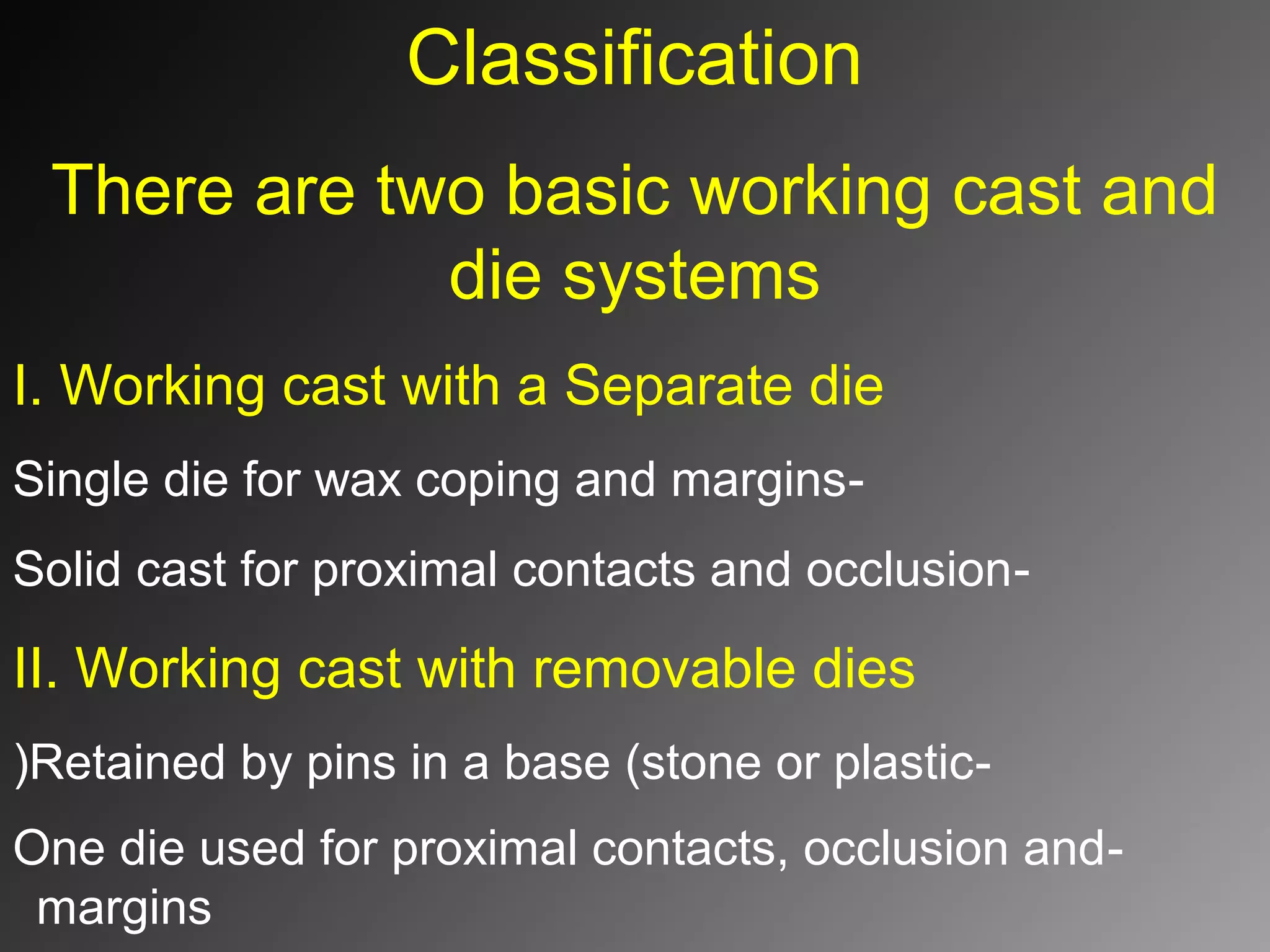
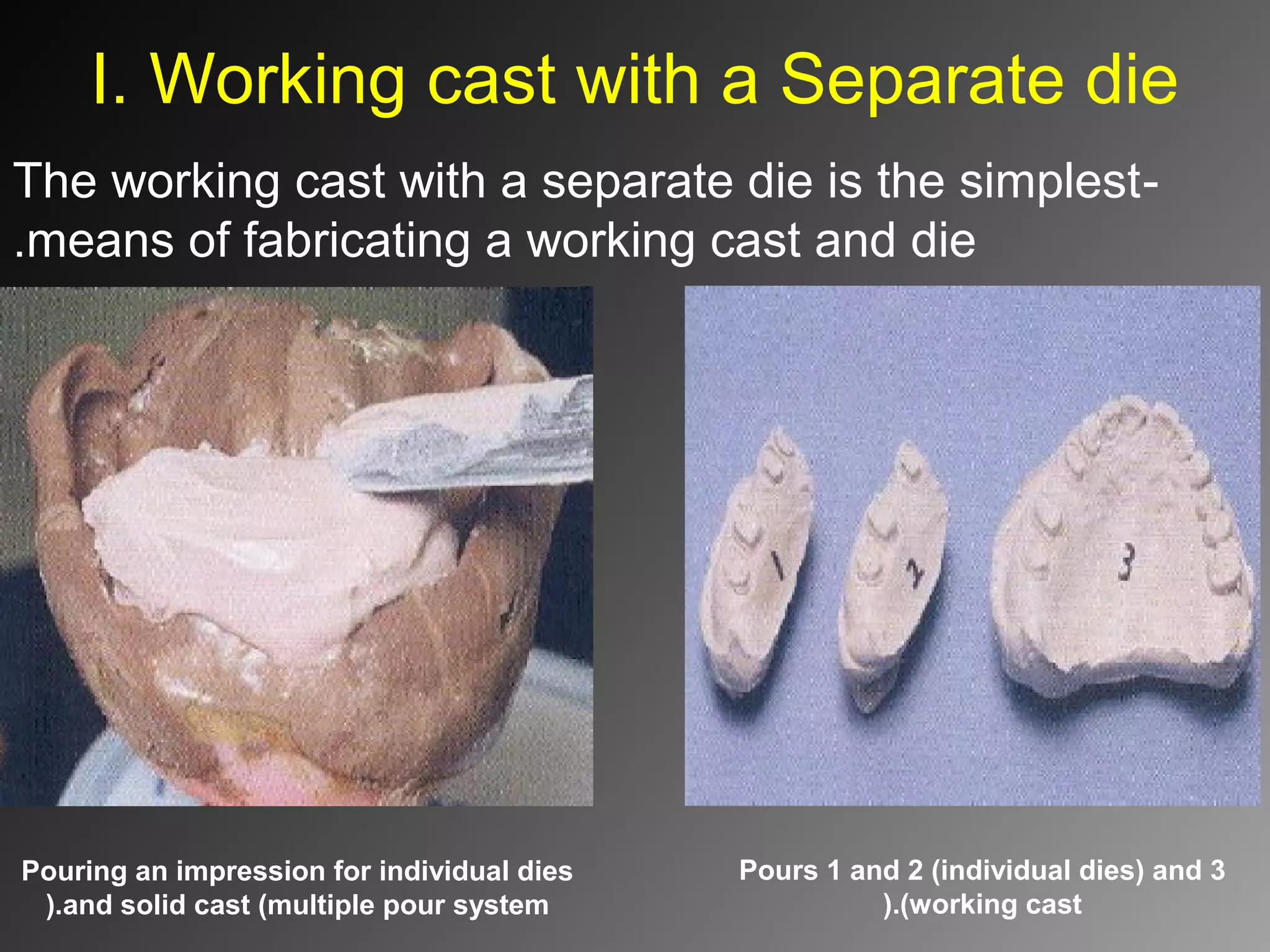
Pours 1 and 2 (individual dies) and 3
(working cast).
Pouring an impression for individual dies
and solid cast (multiple pour system).
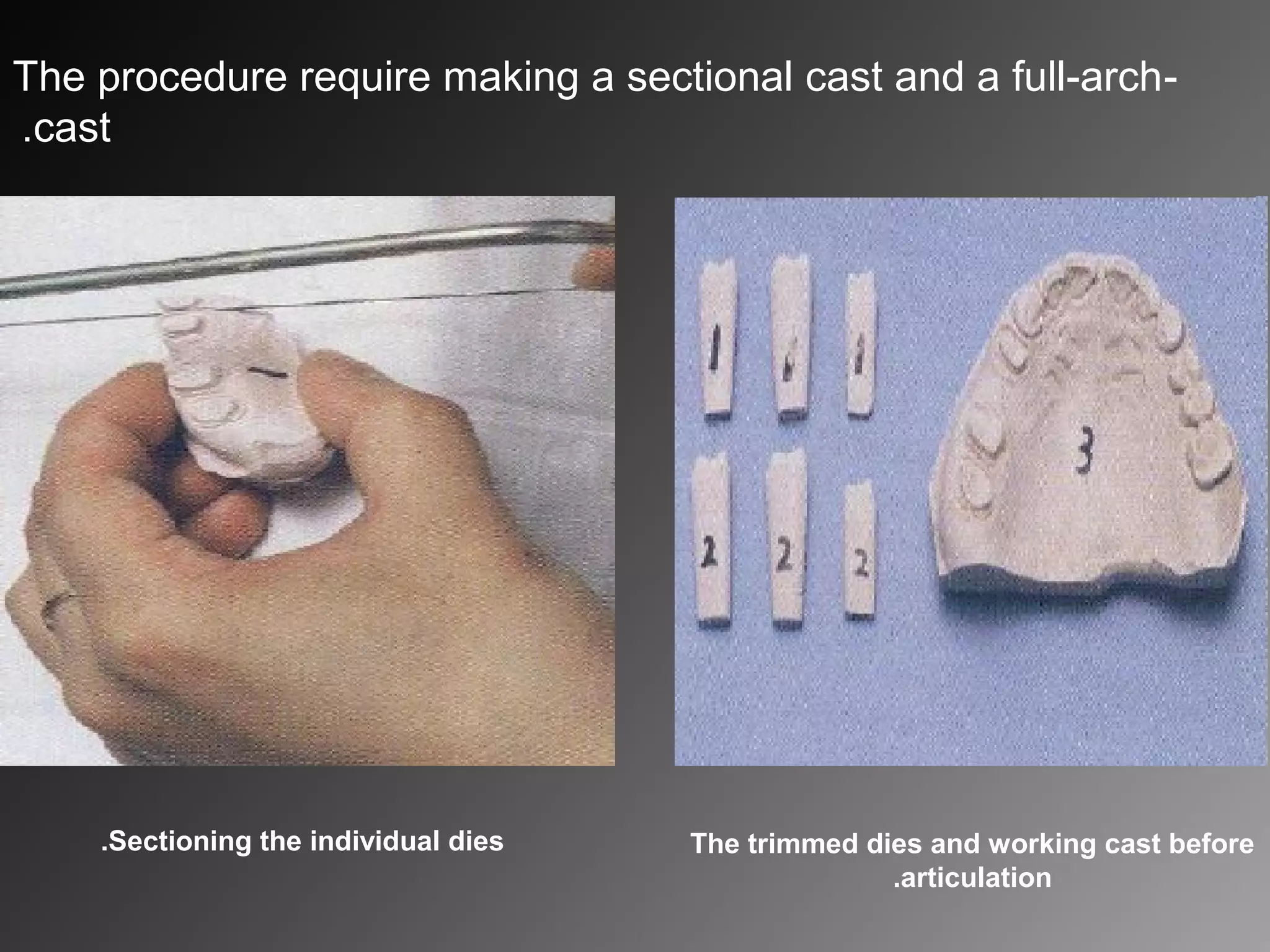
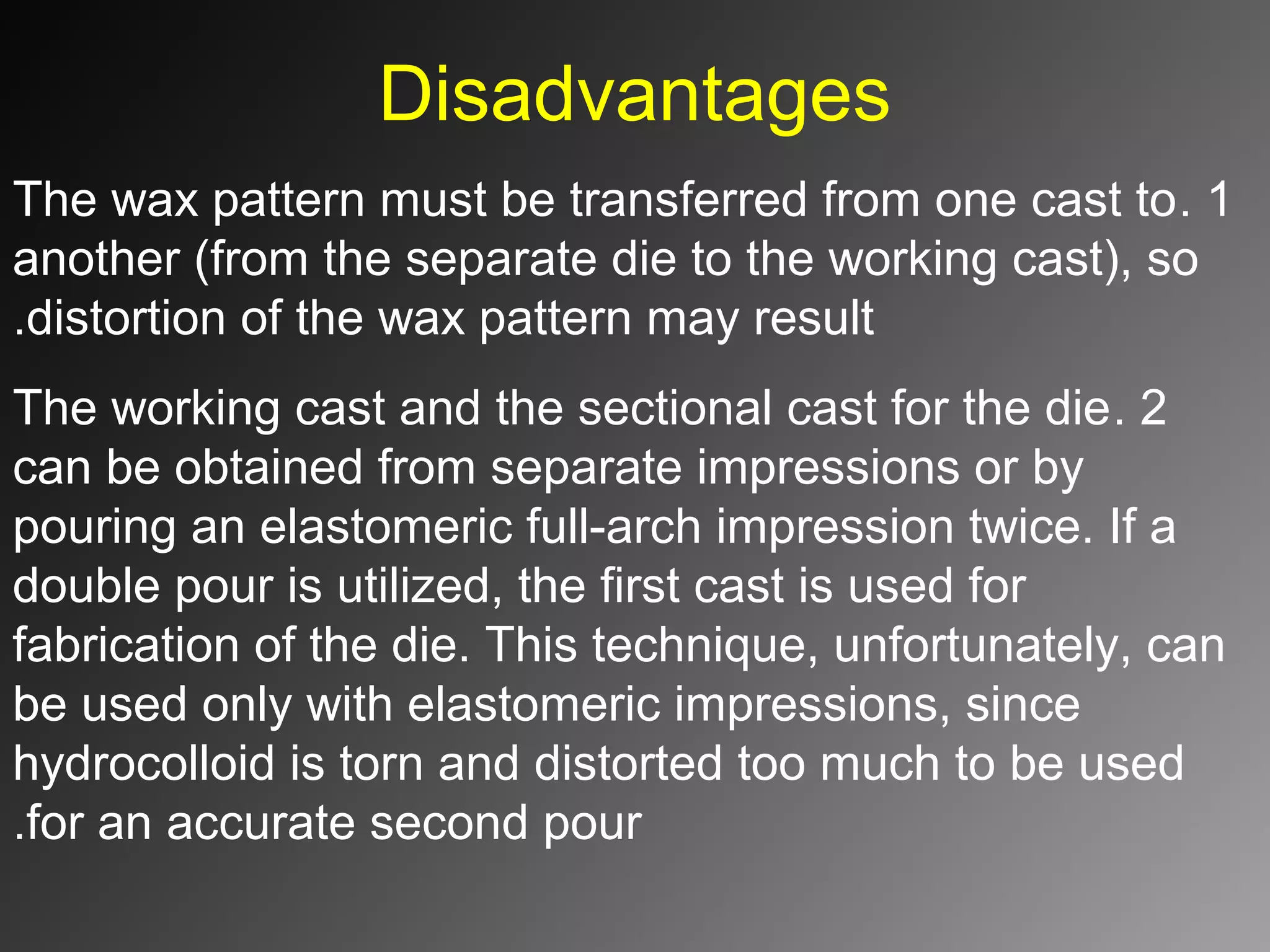
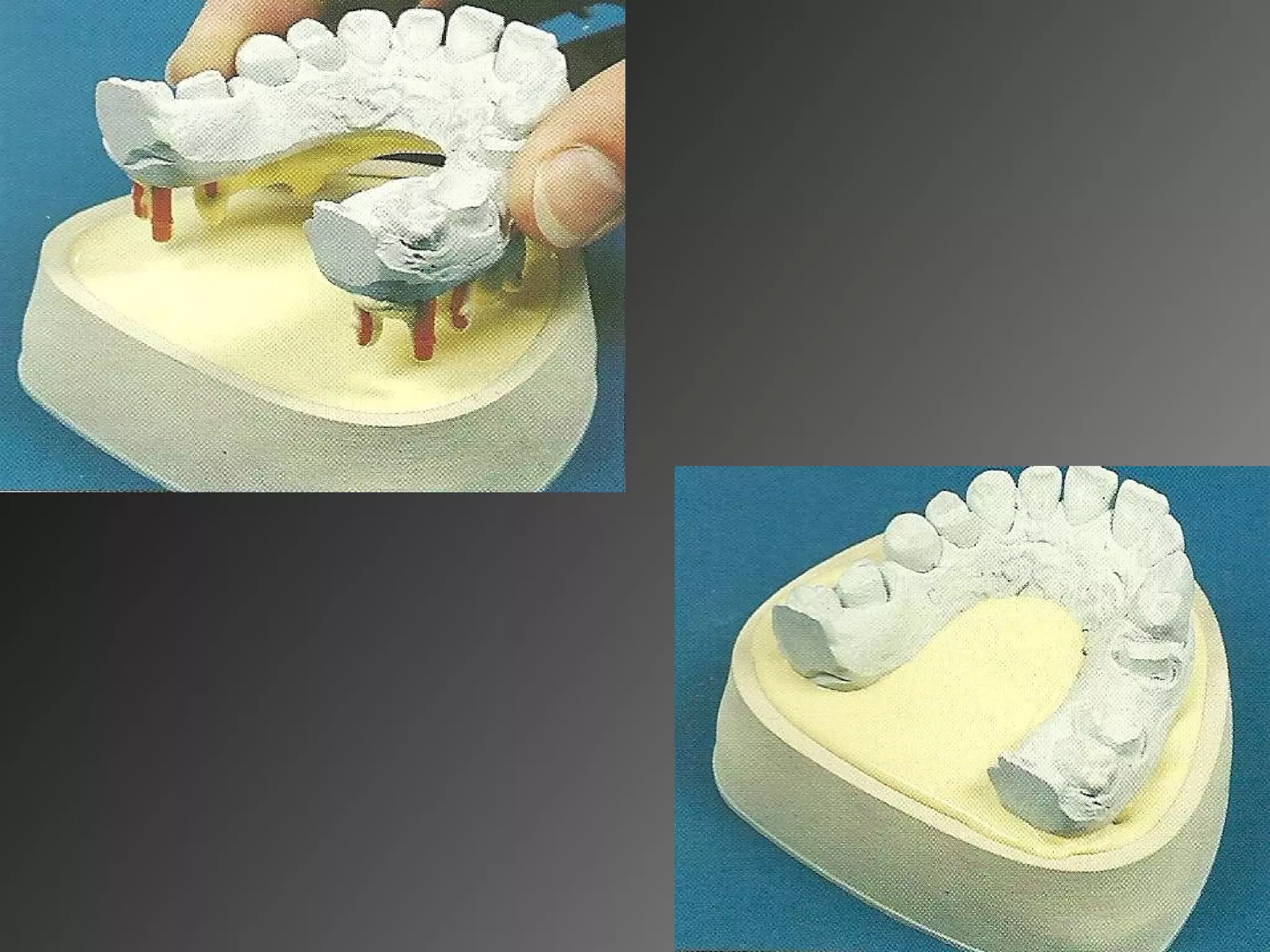
-The procedure require making a sectional cast and a full-arch
cast.
Sectioning the individual dies. The trimmed dies and working cast before
articulation.
Advantages
1.Ease of fabrication.
2.Keeps the relationship between abutments
fixed and immovable.
3.The gingival tissue and other landmarks are
intact.
Disadvantages
1.The wax pattern must be transferred from one cast to
another (from the separate die to the working cast(, so
distortion of the wax pattern may result.
2.The working cast and the sectional cast for the die
can be obtained from separate impressions or by
pouring an elastomeric full-arch impression twice. If a
double pour is utilized, the first cast is used for
fabrication of the die. This technique, unfortunately, can
be used only with elastomeric impressions, since
hydrocolloid is torn and distorted too much to be used
for an accurate second pour.
Impression Pouring:
-Hard improved stone (type IV or V( should be used for
fabricating the die and the cast to prevent surface
abrasion when wax pattern is fabricated.
3-kg improved dental stone Hard improved stone
-Wash the impression under cold running tap water to
remove mucous and saliva which may cover the
impression, disinfection is then carried out according to
the impression material used.
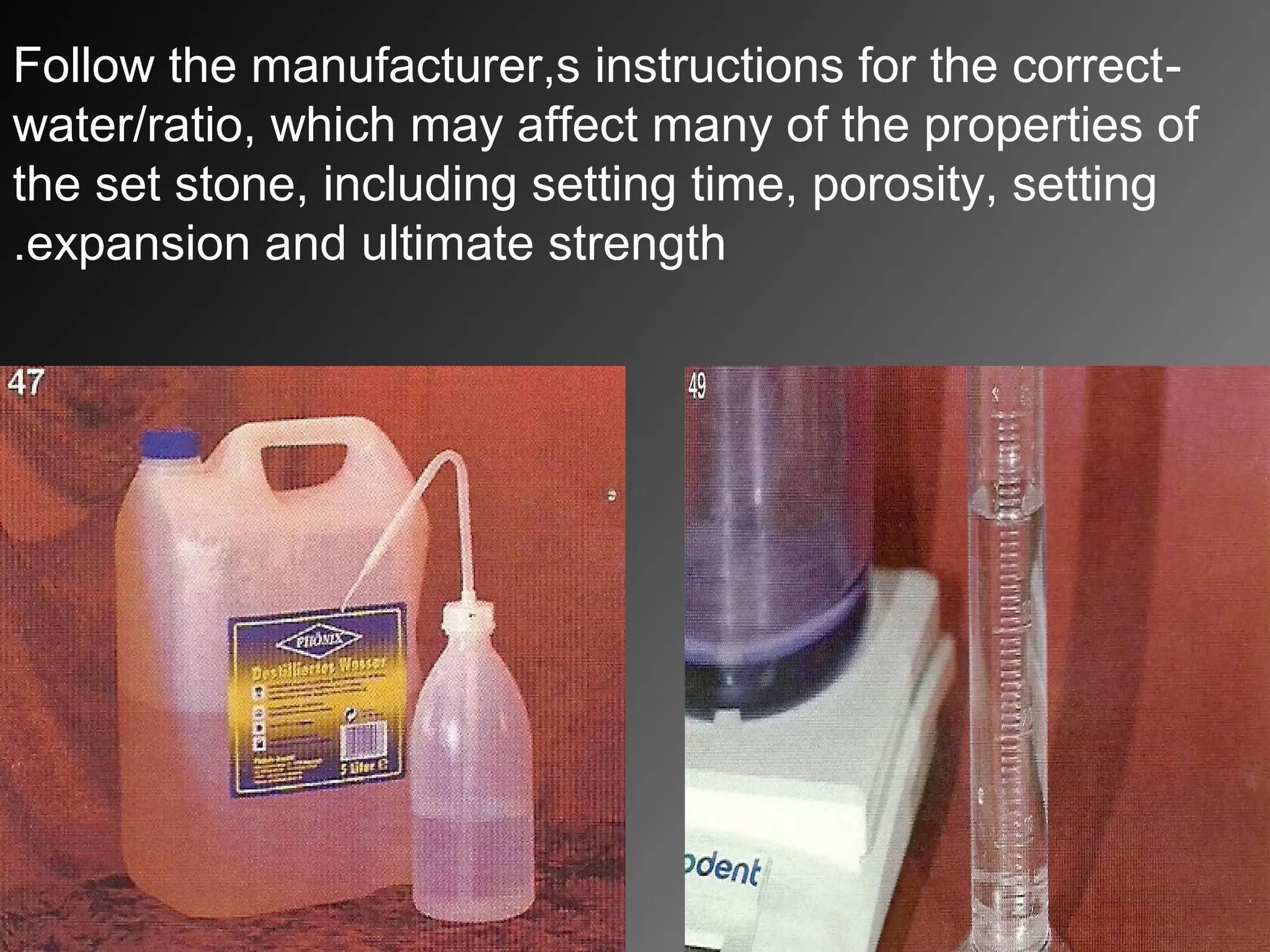
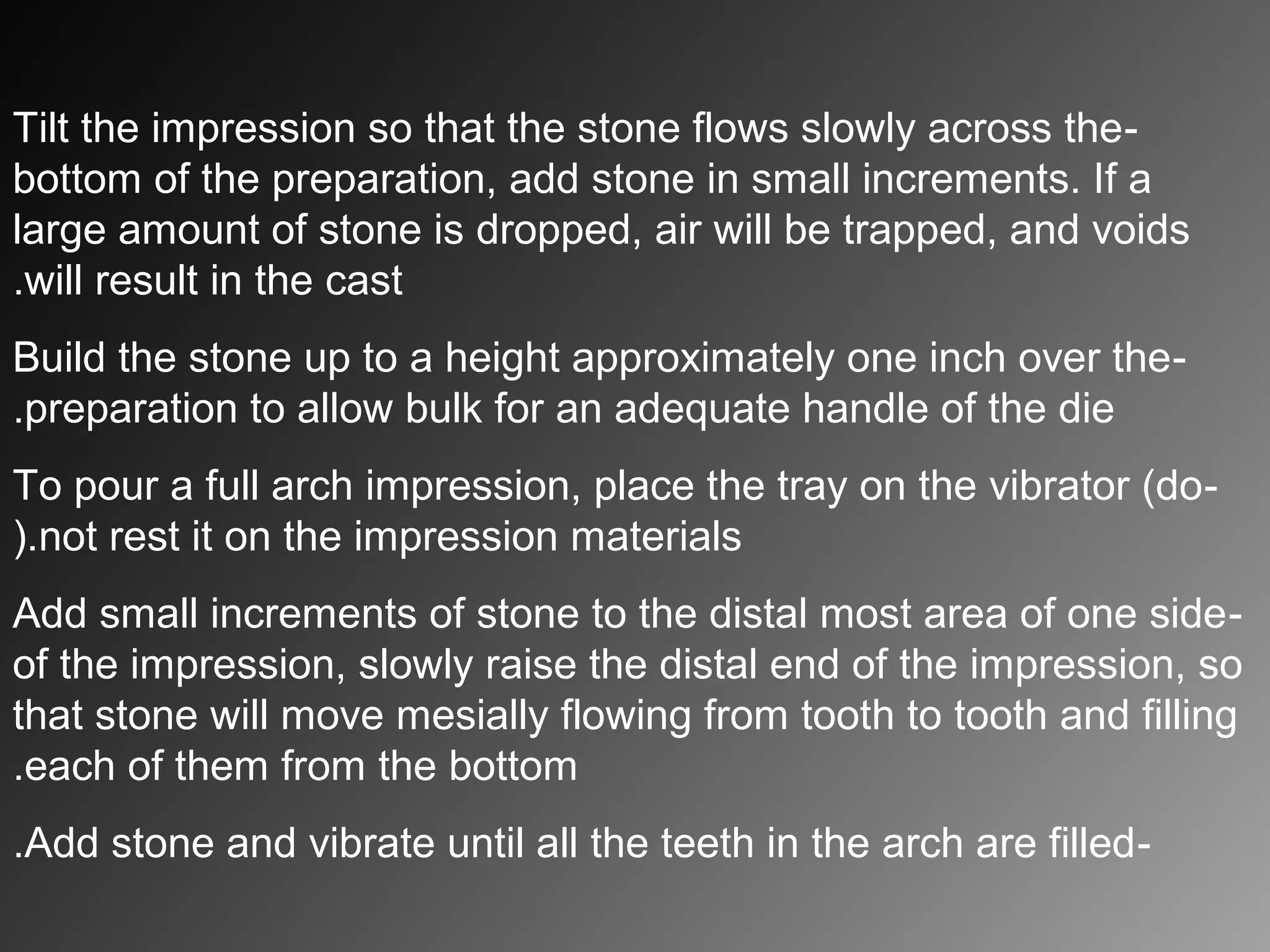
-Follow the manufacturer,s instructions for the correct
water/ratio, which may affect many of the properties of
the set stone, including setting time, porosity, setting
expansion and ultimate strength.
-Mix water and stone by
hand with spatula until the
powder is completely wet
then use vacuum.
-Using a small instrument to carry stone to the
impression of the prepared tooth, place a small amount
of stone on the side of the impression above the
preparation and vibrate till stone reaches the occlusal
surface of the preparation.
Pouring an impression. To avoid trapping
air, start with a very small amount of stone
-Tilt the impression so that the stone flows slowly across the
bottom of the preparation, add stone in small increments. If a
large amount of stone is dropped, air will be trapped, and voids
will result in the cast.
-Build the stone up to a height approximately one inch over the
preparation to allow bulk for an adequate handle of the die.
-To pour a full arch impression, place the tray on the vibrator (do
not rest it on the impression materials(.
-Add small increments of stone to the distal most area of one side
of the impression, slowly raise the distal end of the impression, so
that stone will move mesially flowing from tooth to tooth and filling
each of them from the bottom.
-Add stone and vibrate until all the teeth in the arch are filled.
Die Preparation
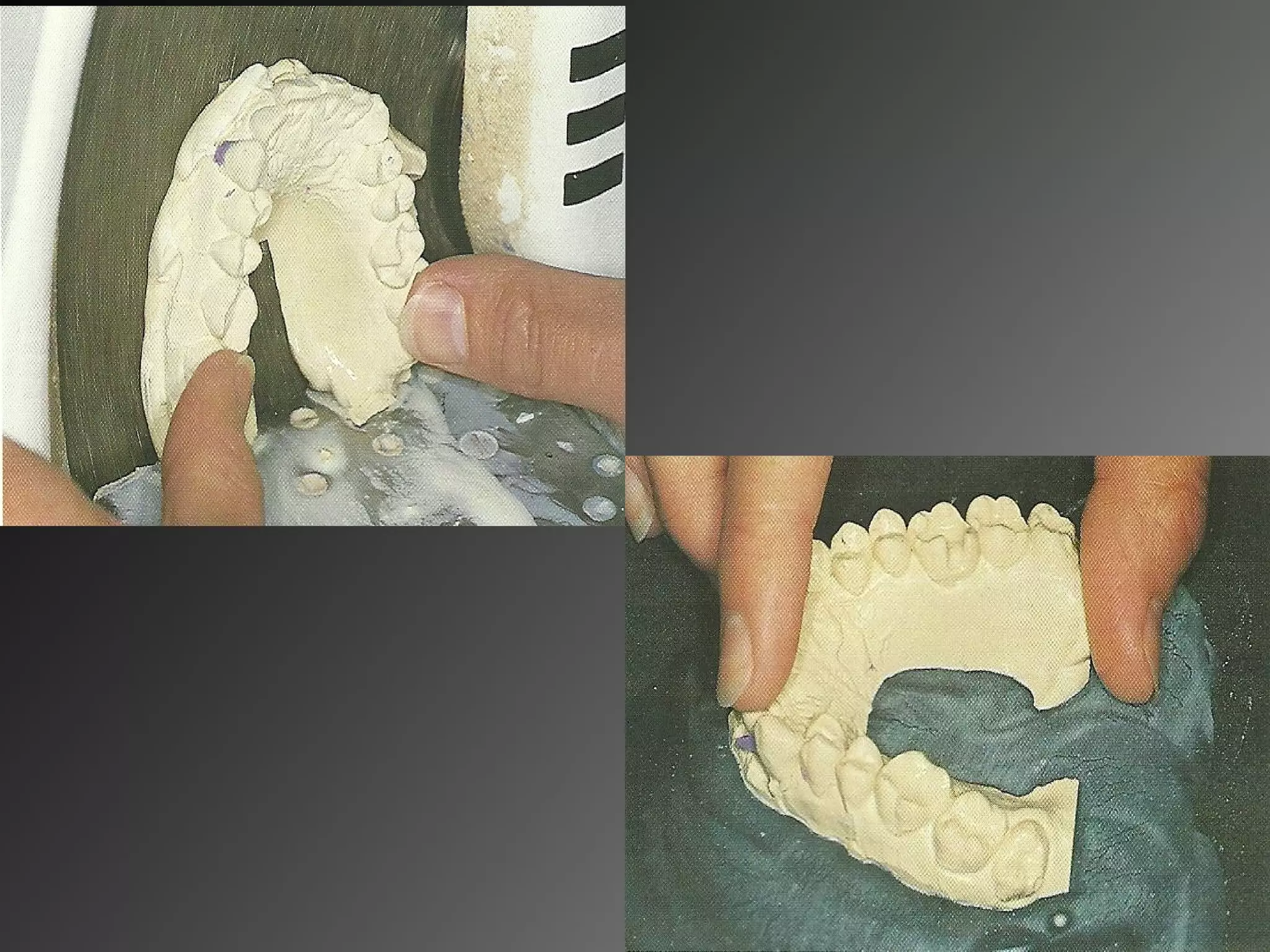
-The cast from which the die is made, is trimmed on a model
trimmer to remove all excess stone around the prepared tooth.
-The cast is held by the base while cutting it down to form the
handle of the die, the handle of the die should be slightly large in
the diameter than the preparation. Its sides should be parallel or
slightly tapered toward the base, and should be parallel to the long
axis of the tooth, because if not parallel it will be more difficult to
adapt the wax pattern margins. The handle is approximately one
inch long.
-Trim the die gingival to the finish line of the preparation, this area
should be smooth and free from irregularities.
-The contour of the die gingival to the finish line should
approximate that of the root to facilitate good axial contours in the
finished restoration.
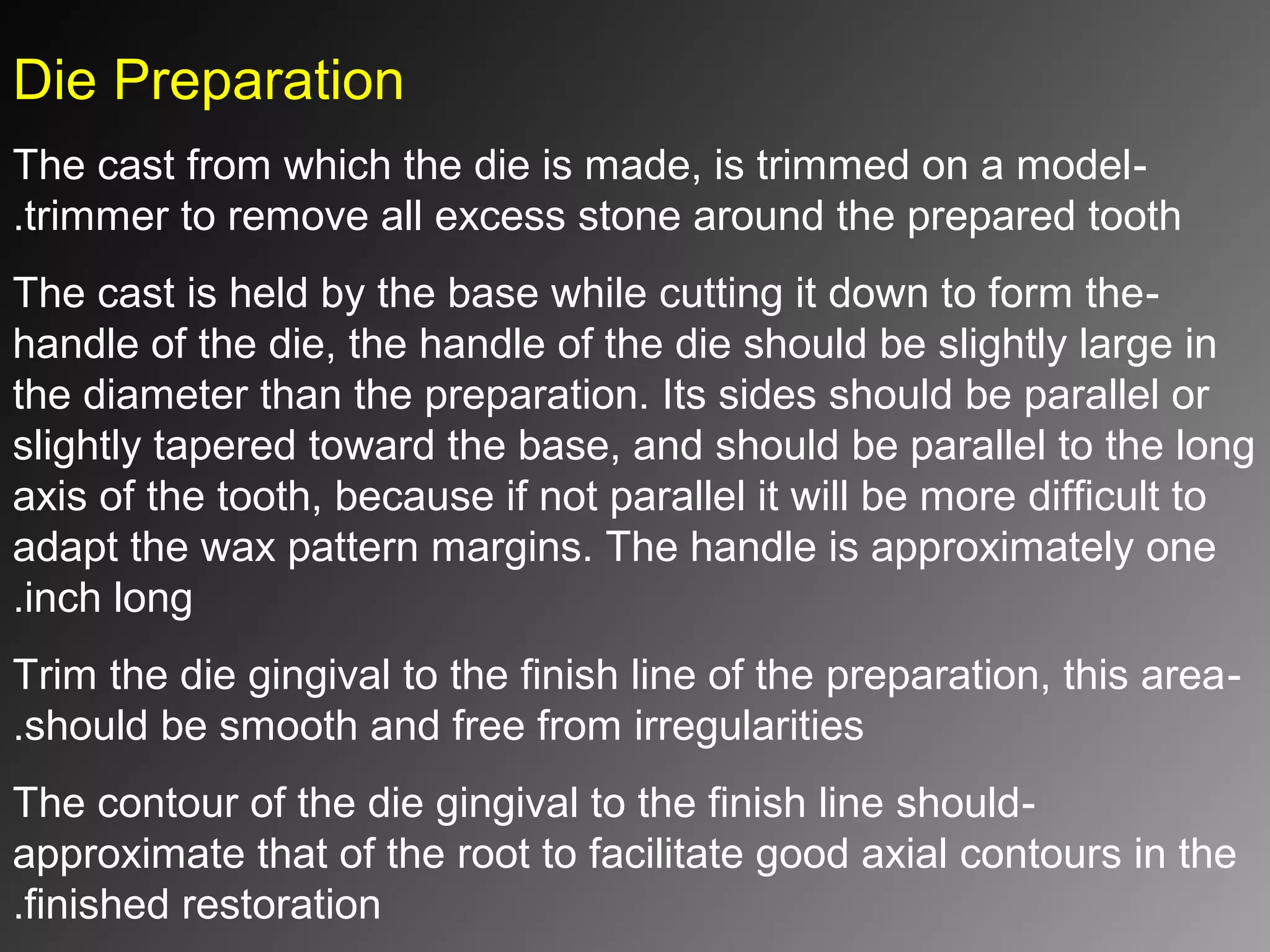
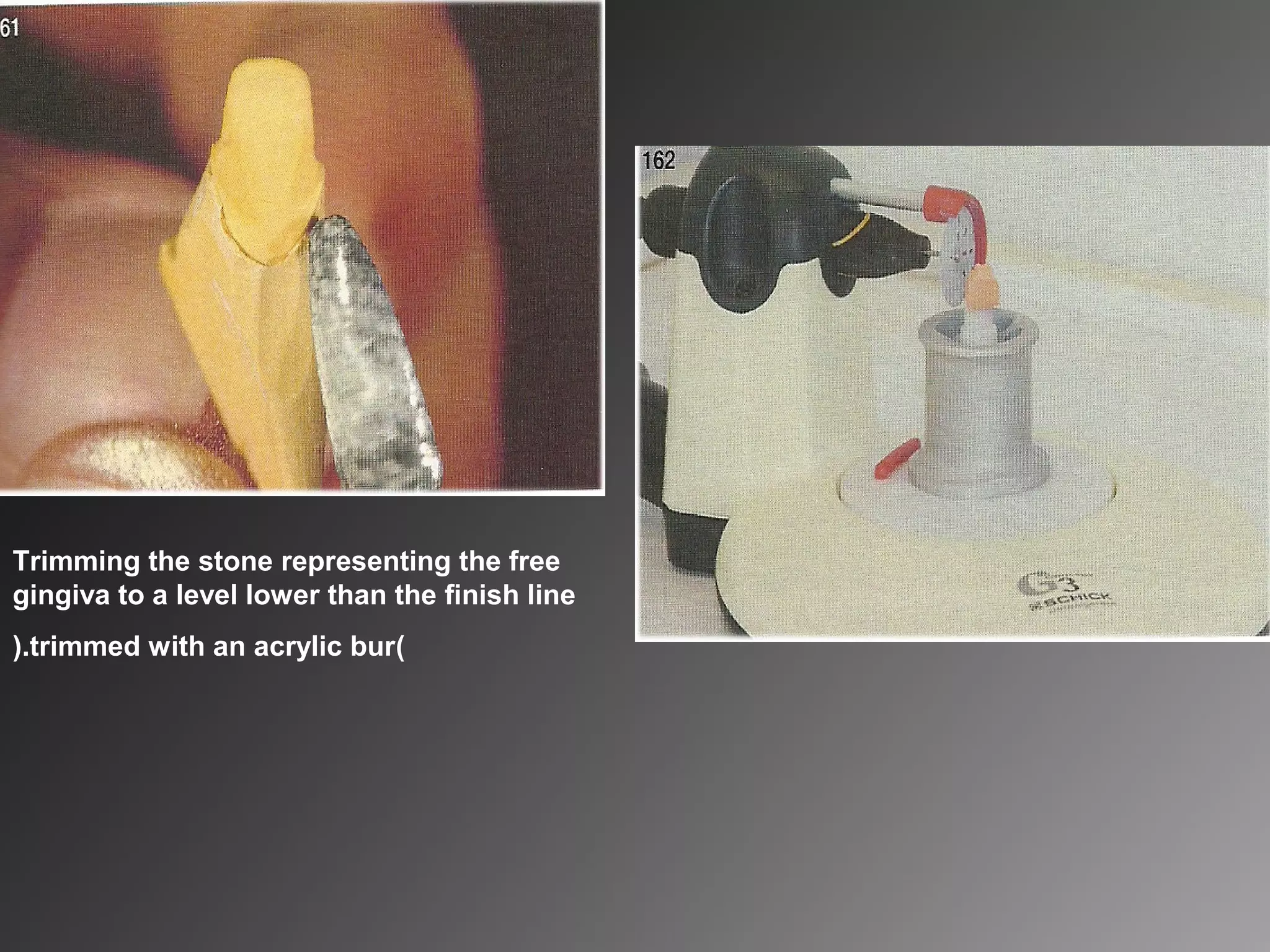
Trimming the stone representing the free
gingiva to a level lower than the finish line
(trimmed with an acrylic bur).
The preparation finish line on the die should
be outlined with a red pencil
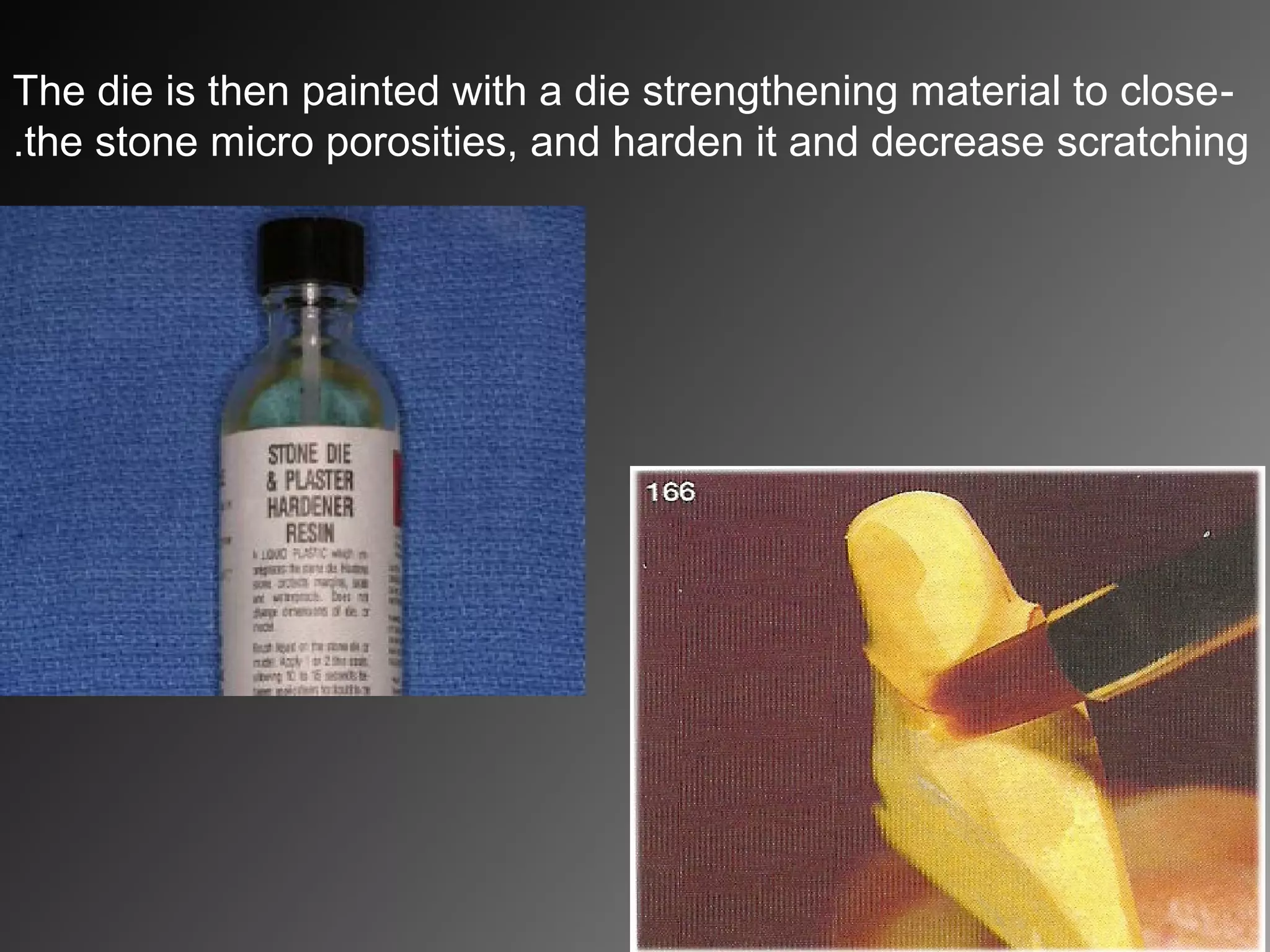
-The die is then painted with a die strengthening material to close
the stone micro porosities, and harden it and decrease scratching.
-After the die has been trimmed, the finish line should be
highlighted with a sharp color bright red pencil, this facilitate
carving the margins of the wax pattern.
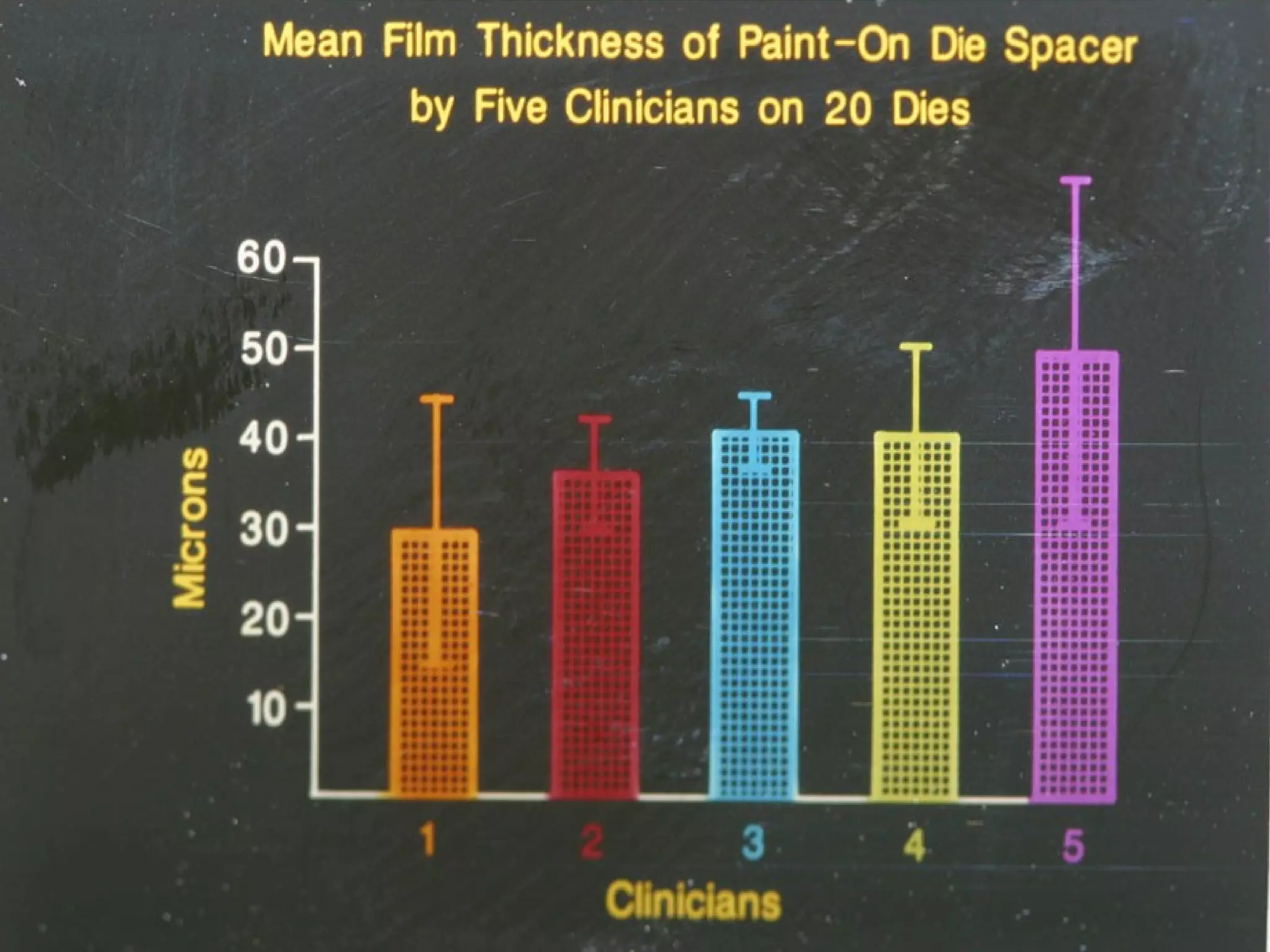
-The preparation area of the die should be painted with
a die relief material to provide space for cement, a relief
of 25 microns is desired, the tooth preparation on the die
is painted within 0.5-1.0 mm of the finish line.
II. Working cast with removable dies
Examples
1(Working cast with dowel pins
2(Accutrac system
3(E-Z-Tray system
4(Fix-pin system
5(Model tray (Di-Lok Tray( system
6(MODU system
7(Opti-base system
8(Pindex system
9(Splitfix system
10(Jet-pin system (VIDEO(
11(cross-pin system
12(Zeiser system
Requirements of removable Dies
1.The dies must return to their exact original
positions.
2.The dies must remain stable, even when
inverted.
3.The cast containing the dies must be easy to
mount on an articulator.
1.Working cast with dowel pins
-A dowel pin is positioned over each prepared tooth in
the impression, if the dowel pins are positioned
inaccurately, they may impinge on the margins, weaken
the die, or prevent it from being easily removed from the
cast.
-A number of items can be used for positioning the
dowel pins, anesthetic needles, paper clips and bobby
pins. A dowel is placed between the arms of the bobby
pins, the bobby pin is positioned bucco-lingually across
the impression so that the dowel pin will be entered
directly over the preparation.
-Push a straight pin between the arms of bobby pin
and into the impression material on both the buccal
and lingual of each tooth to have a dowel pin placed
over it. Stabilize the dowel in the bobby pin and the
bobby pin itself against the straight pin with sticky wax.
Positioning dowel pins before cast pouring can be accomplished with bobby pins and
sticky wax
-Die stone is then poured into the impression, filling the
impression of the teeth and covering the knurled end
“constriction” of the dowel pin.
A) Incorrect technique for pouring an impression.
An air bubble (arrows) will be trapped if two masses
of stone are allowed to meet.
B) Dowel pins must be carefully positioned so
the first pour of stone completely covers the knurled head;
otherwise, the parts will not separate cleanly. However, the
stone should not extend onto the shaft and reduce stability.
A B
-Paper clips are set into the stone before it sets, to
provide retention for the base which will be placed later,
these clips should be placed in all parts of the model that
are not to be removable from the completed cast.
Dowel pins are positioned over the
impression with bobby pins.
Paper clips are added to non/removable
parts of the unset first pour to provide
retention for the second pour of stone.
-The stone around each dowel is lubricated with a thin
coat of petrolatum to permit easier separation of the die
from the working cast, then pour stone of the complete
base. After complete setting of the stone, remove the
cast from the impression and trim off the excess on a
model trimmer.
The stone around the dowel pins
is lubricated.
A wet paper towel can be used to
fill in the open, center portion of the
impression.
-Use sharp knife to remove the spheres of utility wax.
-When the stone is hard and dry, use a saw frame to cut
through the layer of the stone, mesially and distally on
each die, the cuts should taper toward each other
slightly from occlusal to gingival.
Wax at the ends of the dowel pins is
located and removed.
Dies are separated from the rest of
the cast with a fine saw.
-Loosen the die gently using an instrument handle.
-Place wax around the tips of the dowels to protect
them from the plaster contamination.
-Soak the cast in the water and mount it on the
articulator, using mounting plaster. After hardening of
the plaster remove the wax covering the tips of the
dowels.
-Trim away any excess stone gingival to finish line, then
mark the finish line with the red pencil.
-Repeat the procedure for each die on the cast.
-Reseat the dies to make certain that they will seat
completely and will be stable.
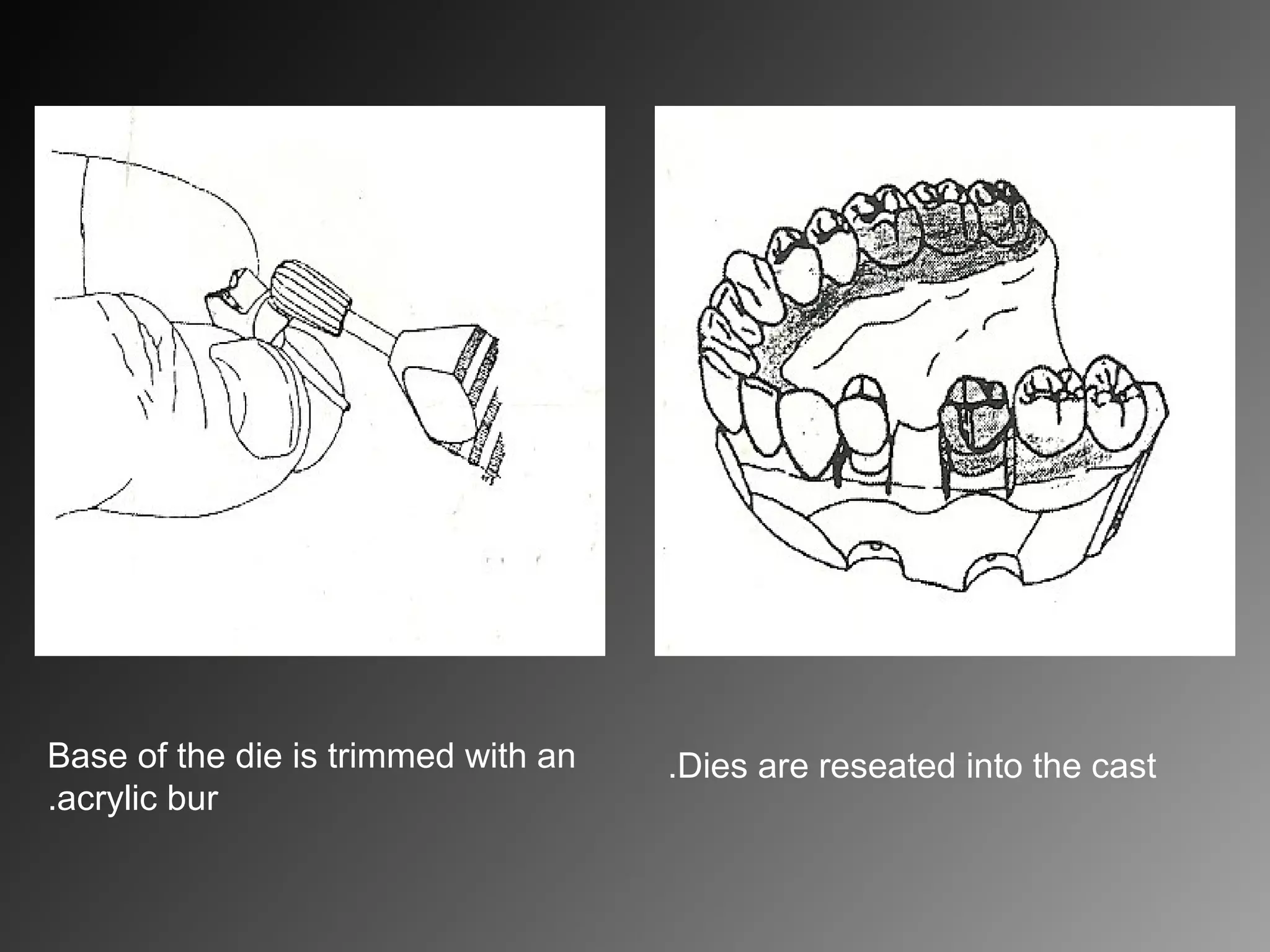
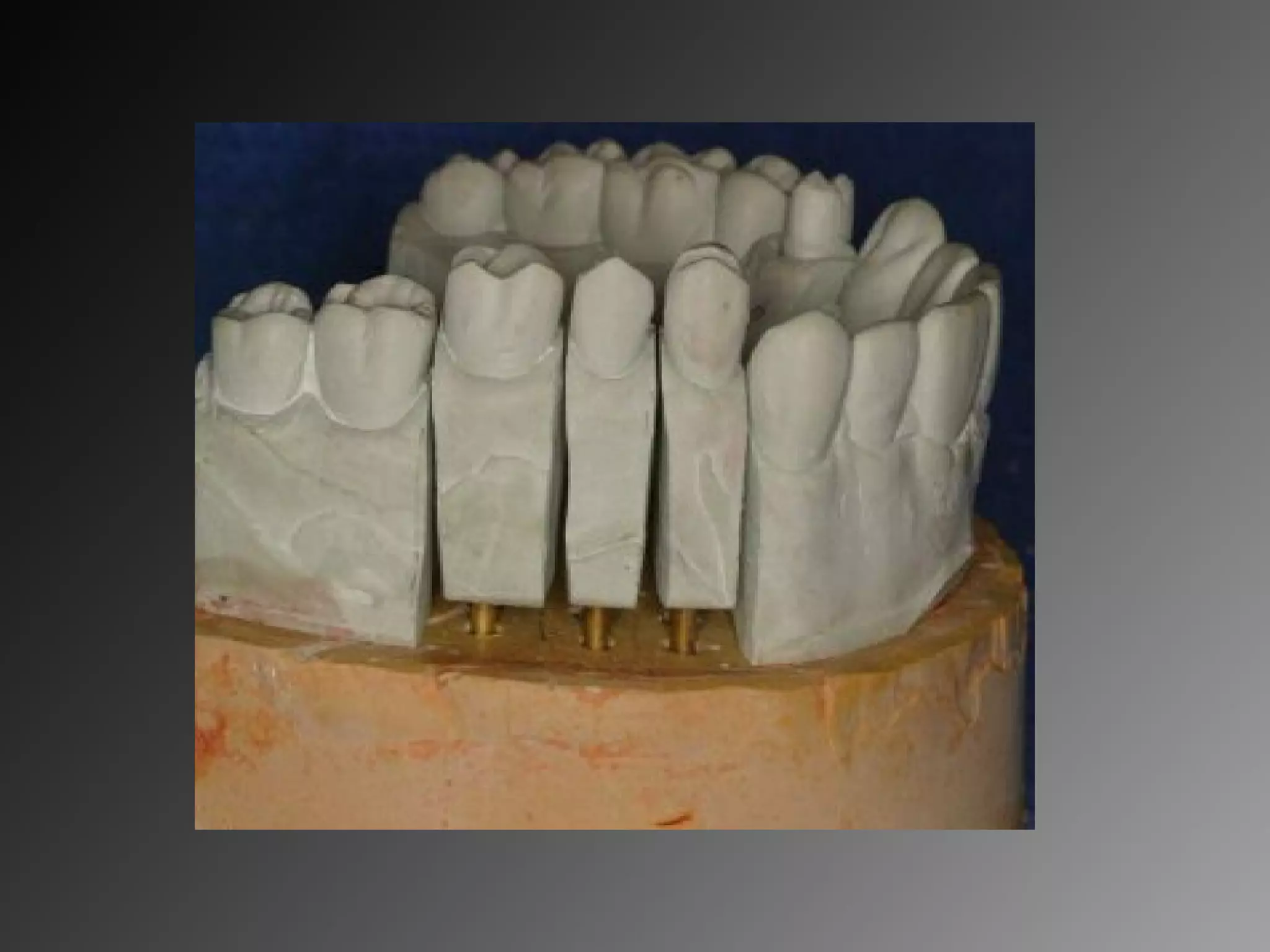
Base of the die is trimmed with an
acrylic bur.
Dies are reseated into the cast.
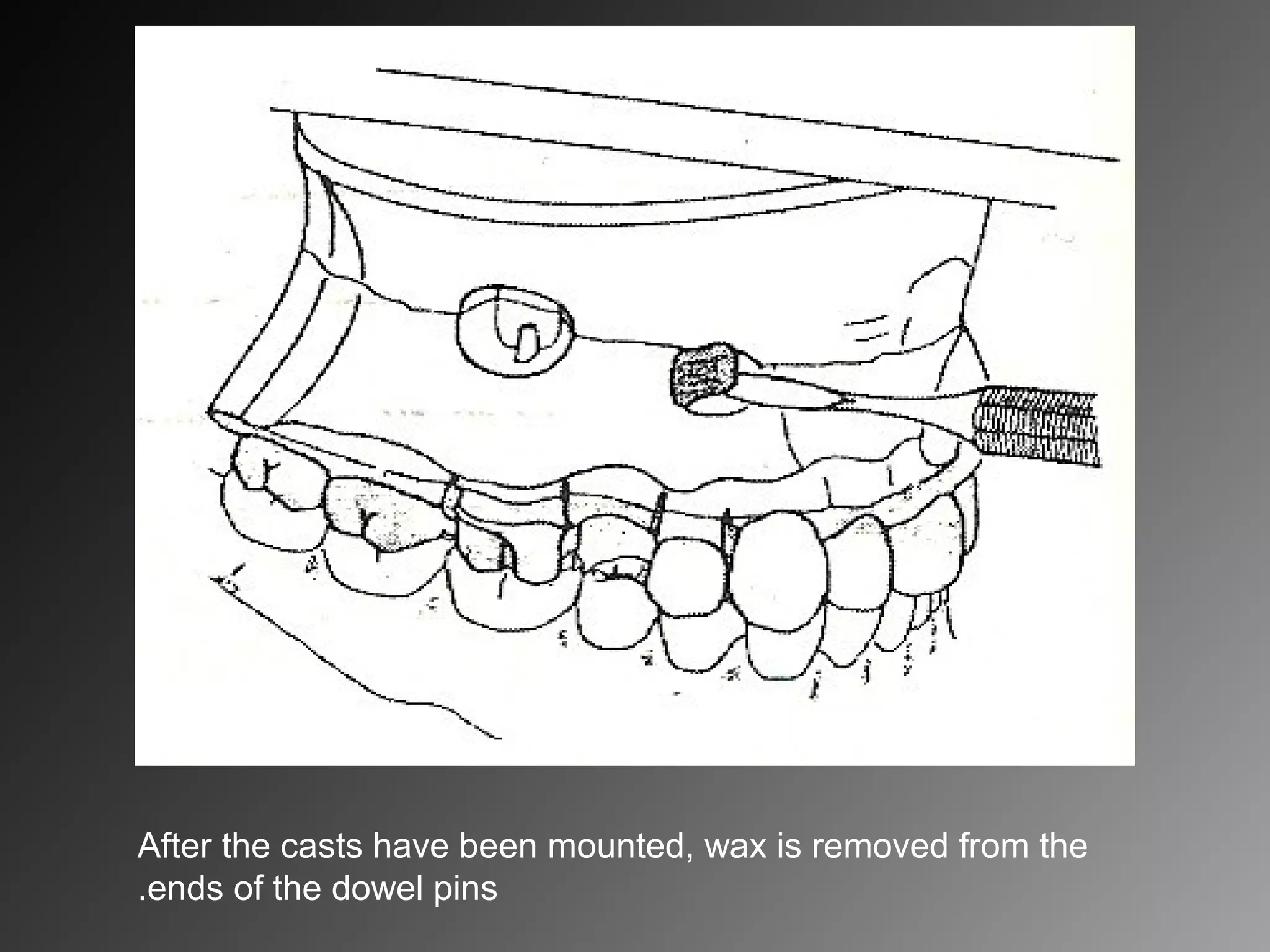
After the casts have been mounted, wax is removed from the
ends of the dowel pins.
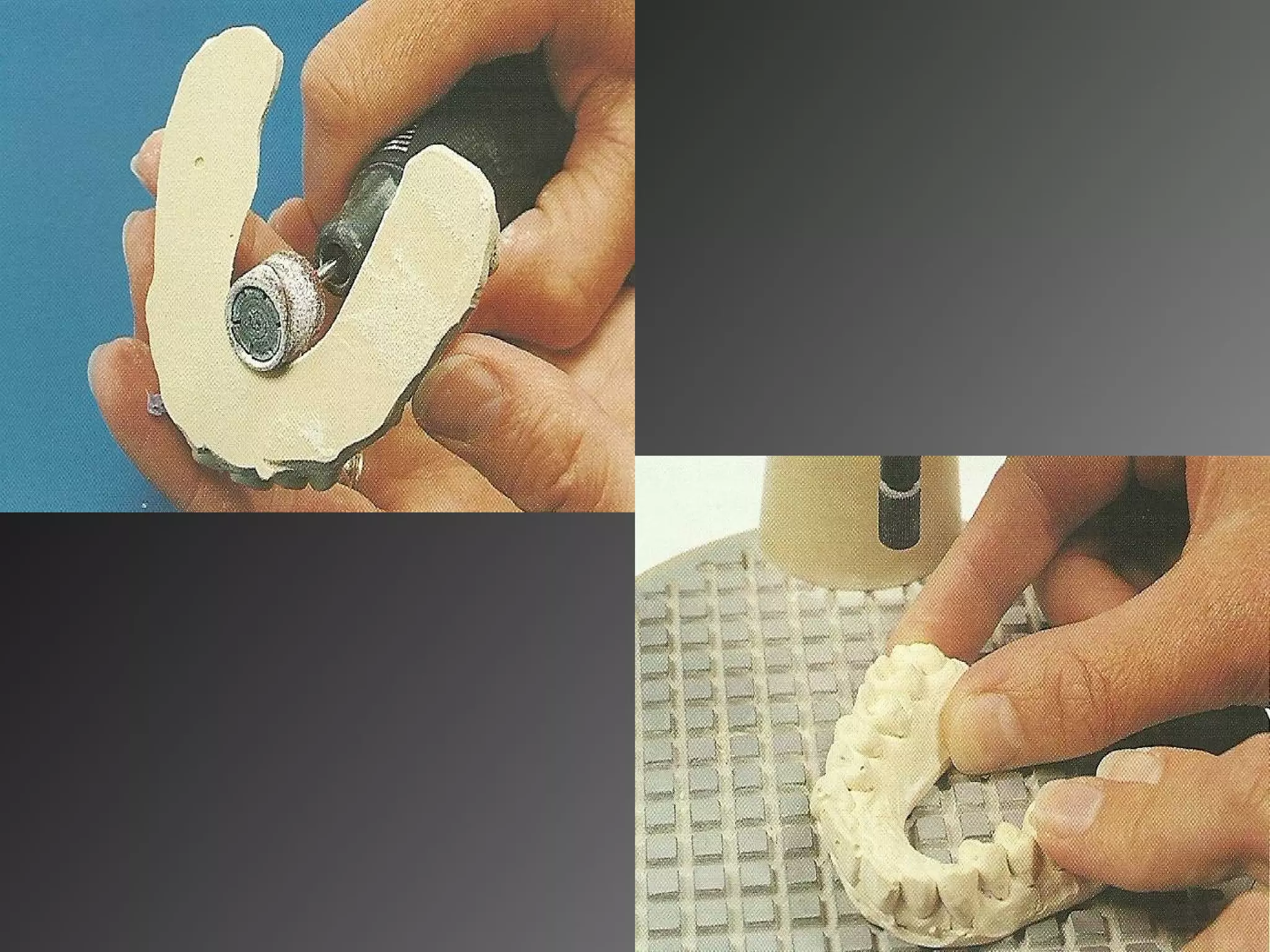
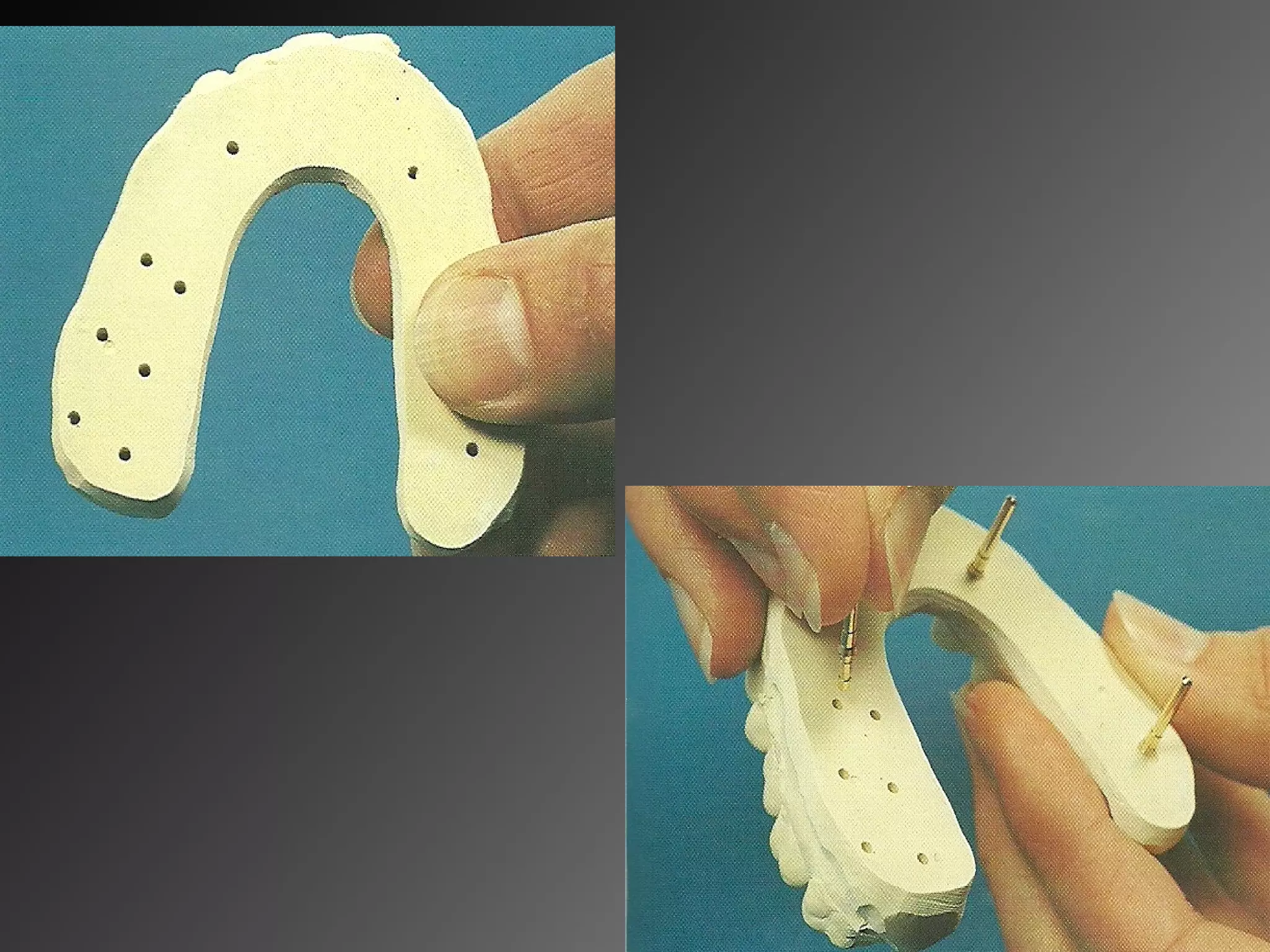
2-Pindex system
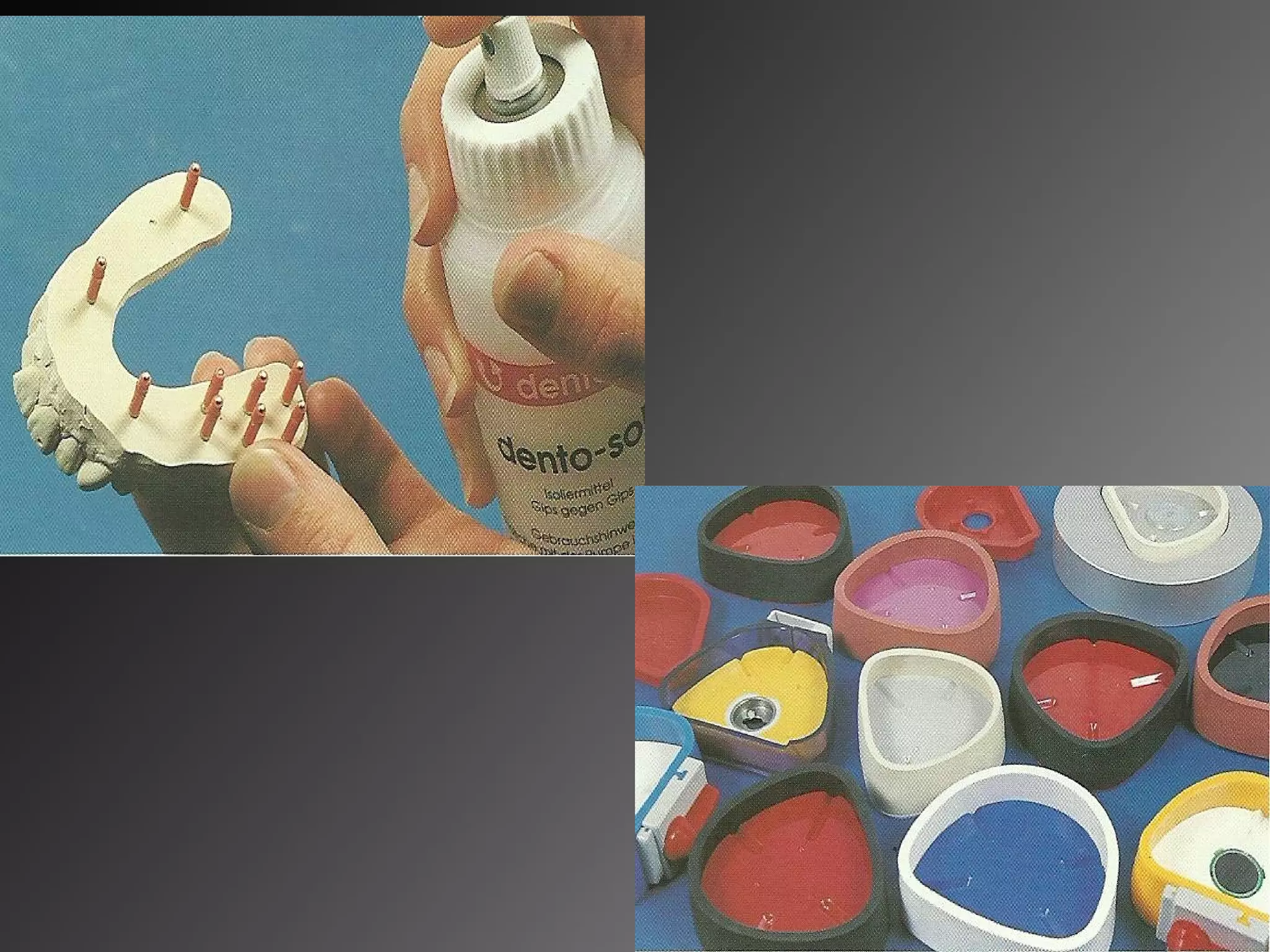
-The pindex system ( Coltene / whaledent, Mahwah, NJ)
is a reverse drill press is used to create a master cast
with dies that can be removed and replaced repeatedly
with great precision.
-The impression is poured without positioning and
attaching dowel pins. The machine accurately drills
parallel holes from the underside of trimmed cast.
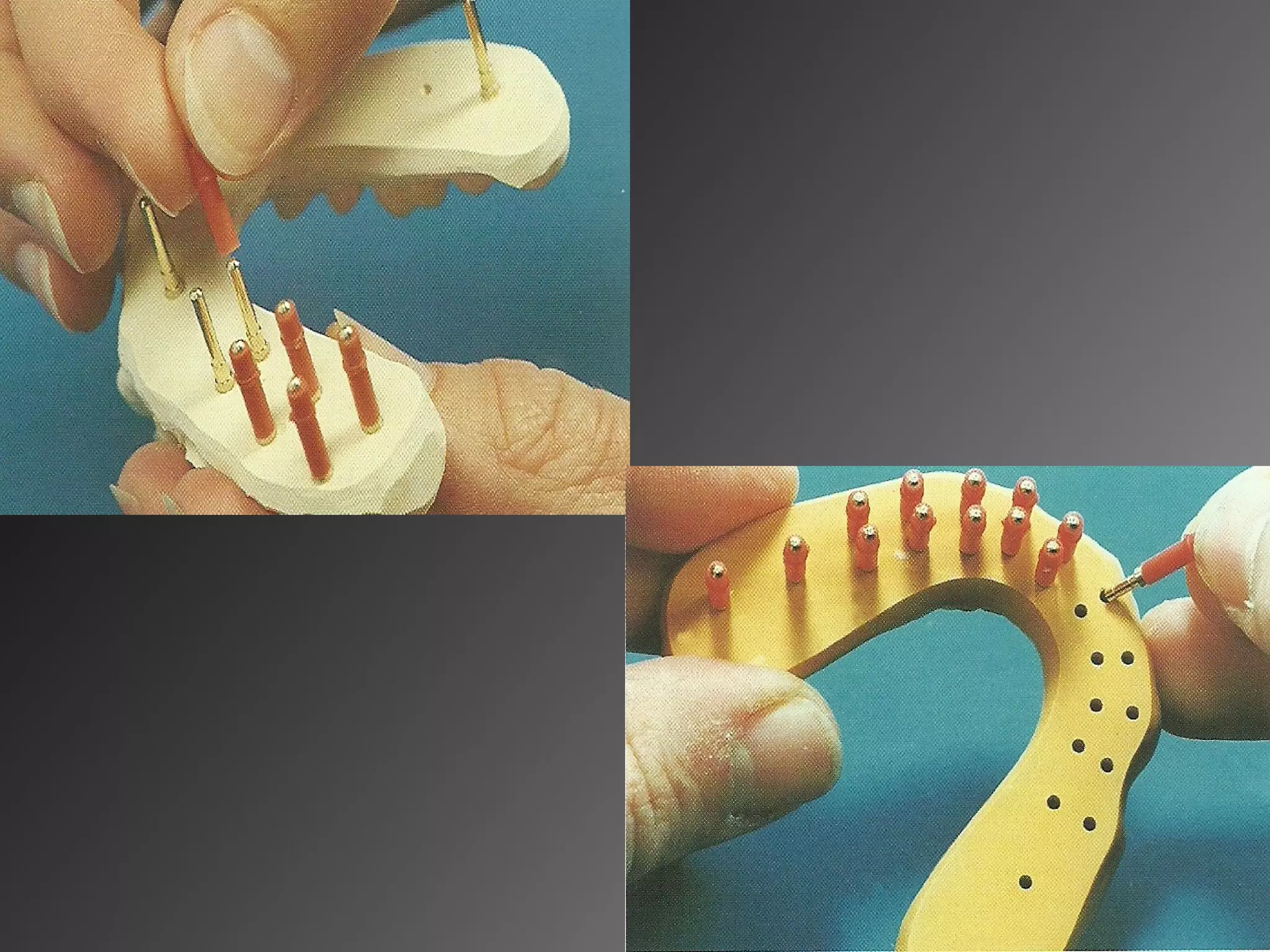
Index the cast
1.Glue pins with cianoacrylate cement
-Long pin toward facial
-Short pin toward lingual
-Glue short pins first (better access)
2.Place sleeves on pins (stability of pins)
3.Box and seal cast
4.Apply separating solution
5.Pour second base with yellow stone
Section & Trim dies
1.Mark planned saw cuts with a pencil
2.Create removable segments with a saw
-Parallel saw cuts
-Each segment individually removable
3.Using microscope, remove gross stone beyond finish
line with a#7 lab carbide bur in straight handpiece
4.Finish trimming with scalpel or cleoid-discoid under
microscope
Die Trimming
1.Remove most of excess stone with # 7 lab carbide bur
with protective eyewear
2.Fine trimming with scalpel or cleoid-discoid carver
3.Margin should be sharp and distinct for access, but it
should not be undermined
4.Uncut tooth beyond finish line should be maintained to
provide proper contours in wax
Die preparation
1.Apply die hardener
-Cover die beyond finish lines
-Allow to set for 5 minutes
2.Apply die spacer
-25micron thickness allows space for cement
-Spacer 1 mm from finish line
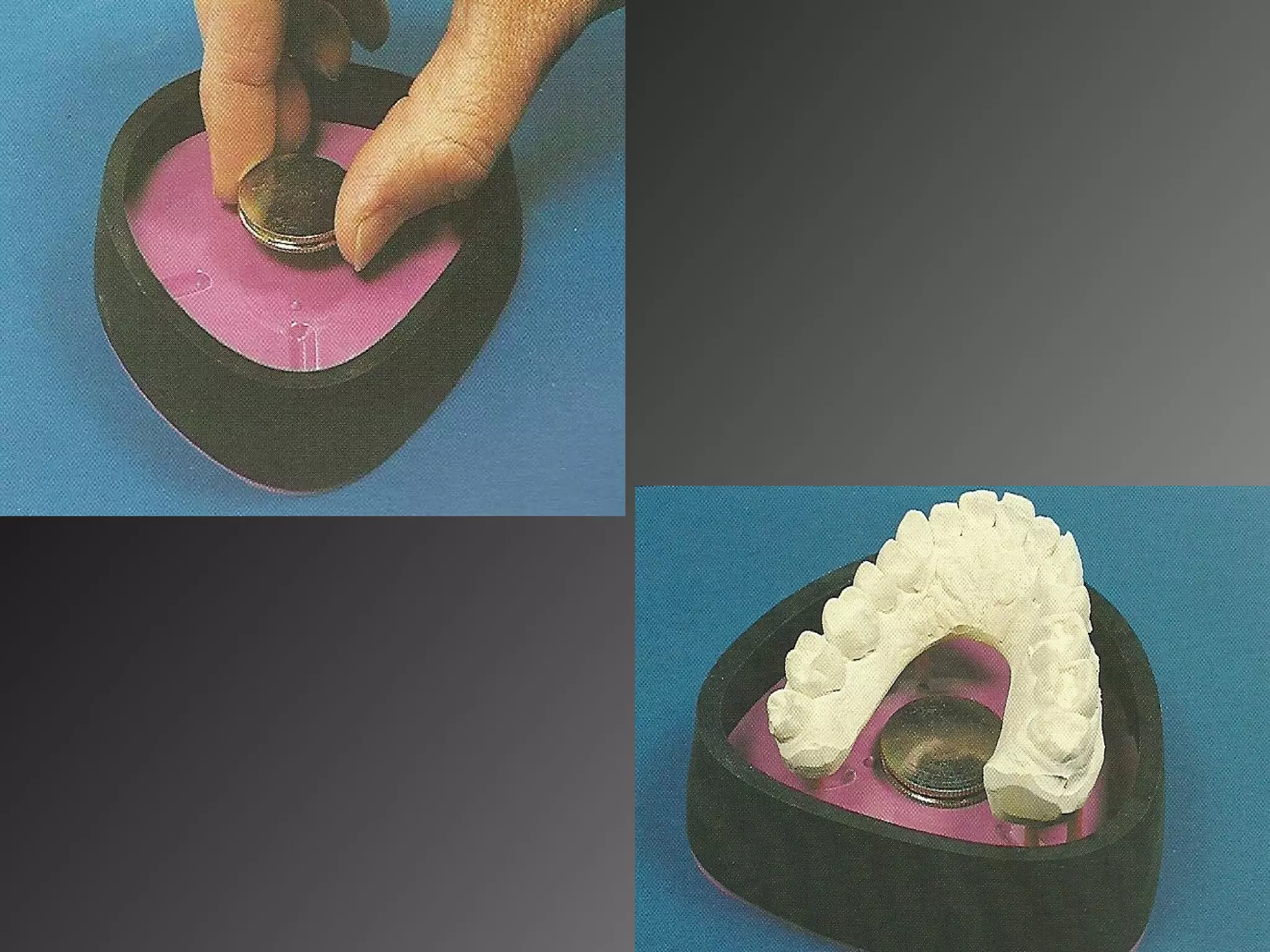
3-Di-Lok Tray
-A snap-apart plastic tray with internal orienting
grooves and notches also can be used to
reassemble the working cast and die
Armamentarium
1.5OO-ccVac-U-Mixerand vacuum tubing
2.Vibrator
3.Water measure
4.Large and small spatulas
5.Die stone (Silky-Rock,Vel-Mix(
6.Humidor
7.Model trimmer
8.Straight handpiece and pear-shaped acrYlic bur
9.Laboratory knife with no. 25 blade
10.Tanner carver,
11.Colorbrite red pencil
Model tray
system
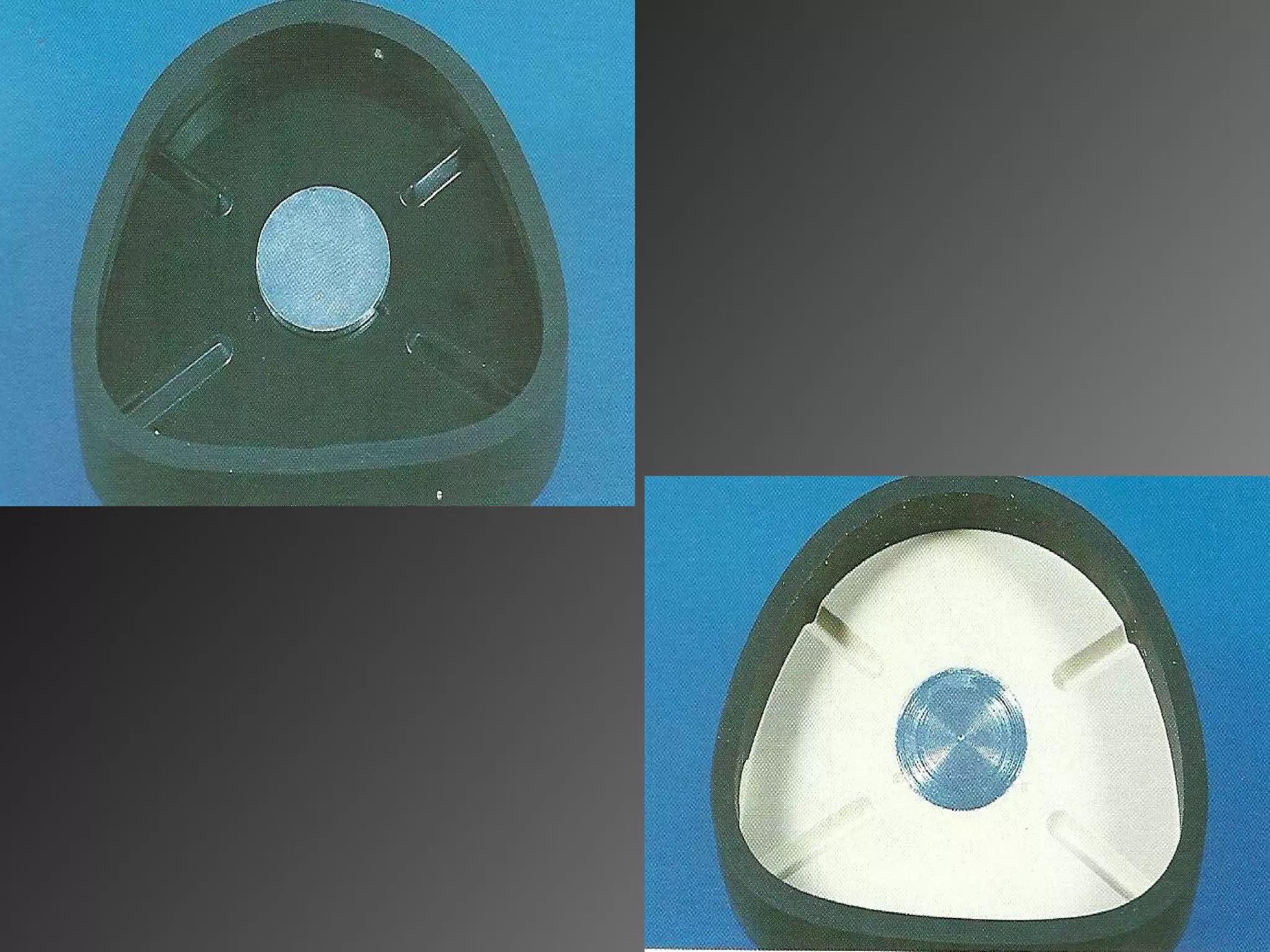
The model tray system
consists of a part plastic
tray, wit internal orienting
grooves and notches. for
mounting in the articulator
are the fixation systems
(magnets, connectors) at
disposal.
Impression and tray are filled with
super hard stone and put together
so that the stone is very hard, the model with
the teeth is taken down.
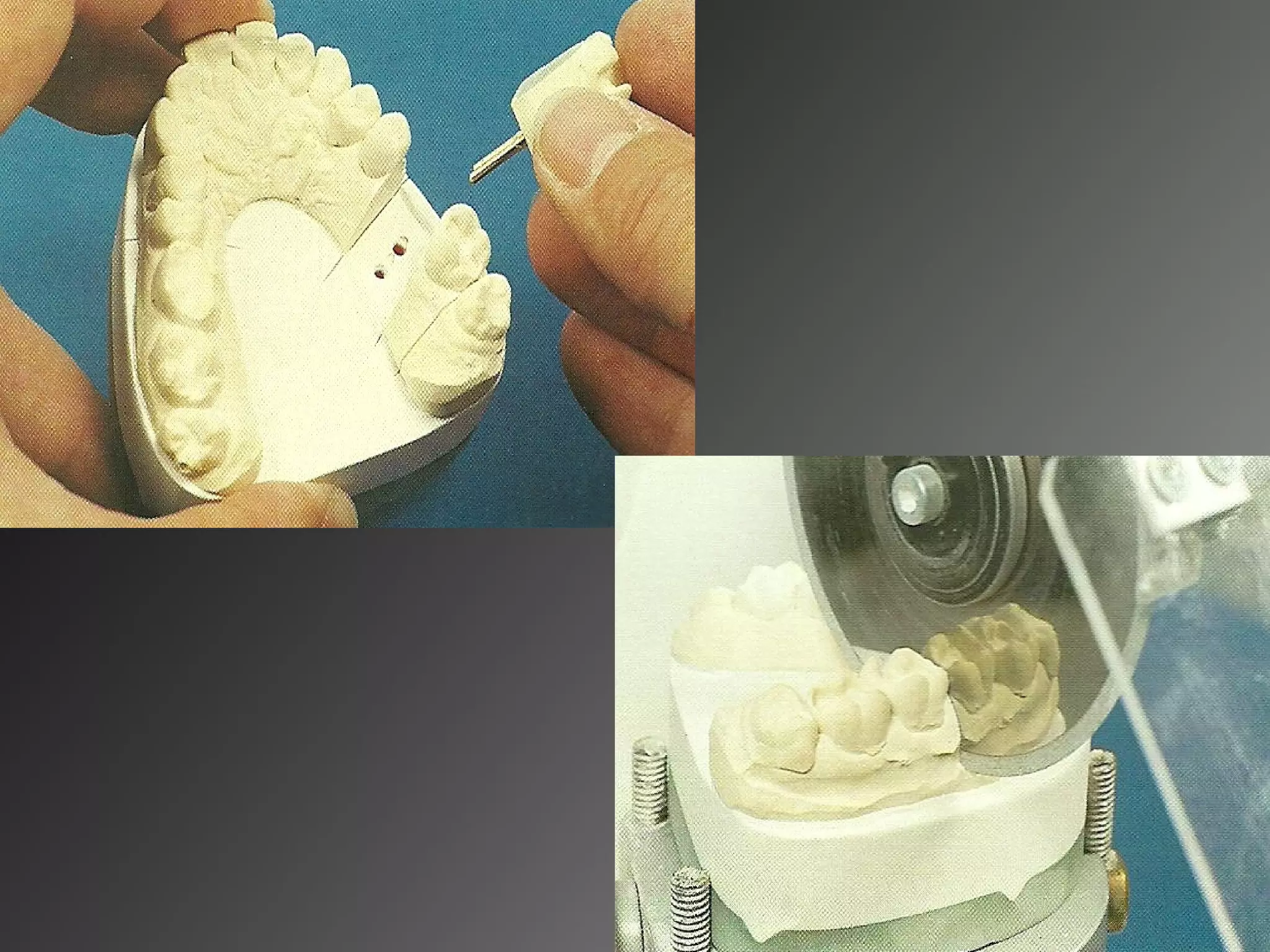
Disassembly of the cast
In the center of the base we drill with
a thicker round bur a hole. With a
compressed air nozzle, the cast of
the tray is blown.
A saw cut is made on each side
of the prepared tooth.
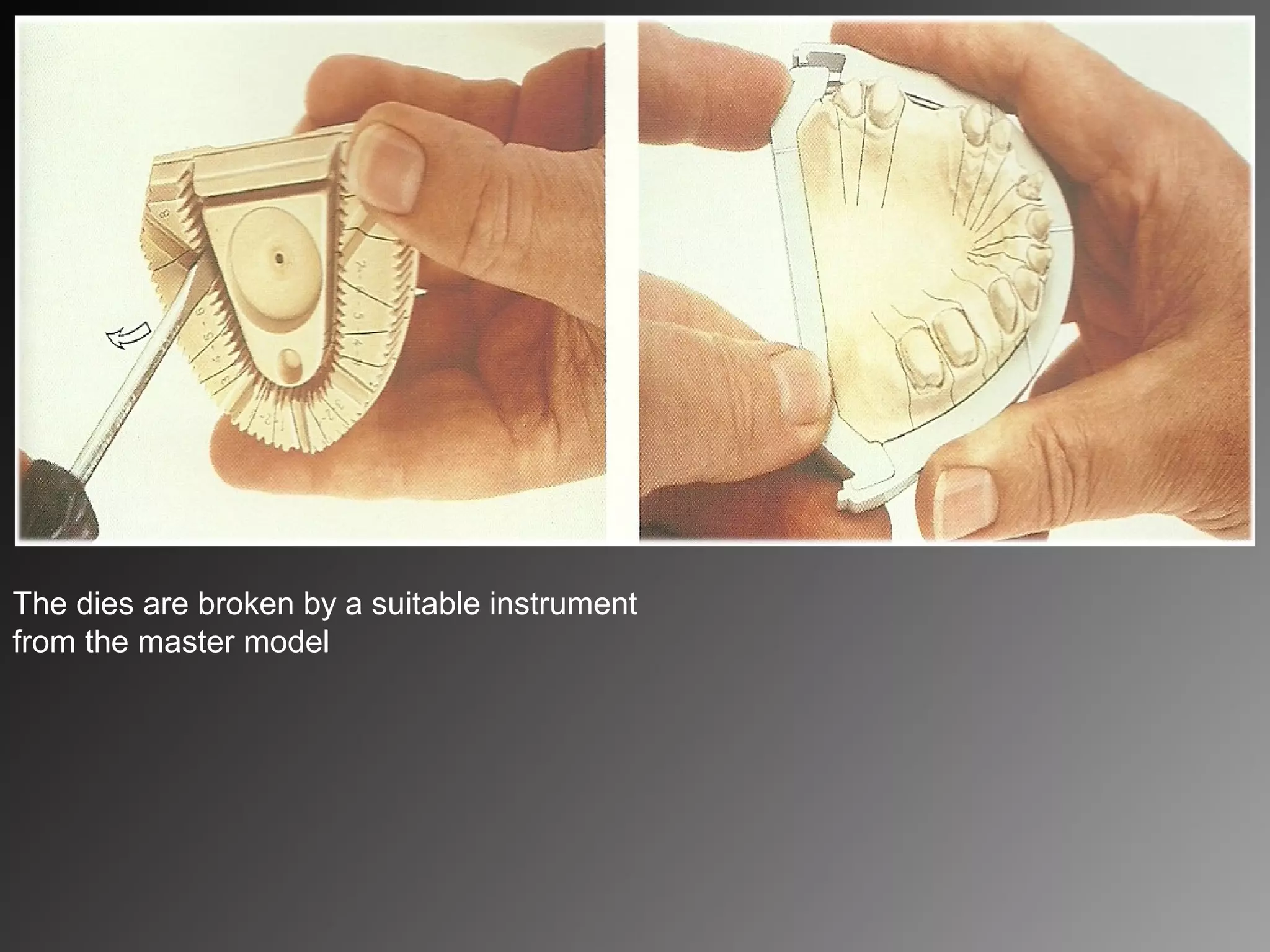
The dies are broken by a suitable instrument
from the master model
to be mounted in the articulator different
retention methods are available: plug-
retention......
........Snapper retention and.......
.......Magnetic retainers
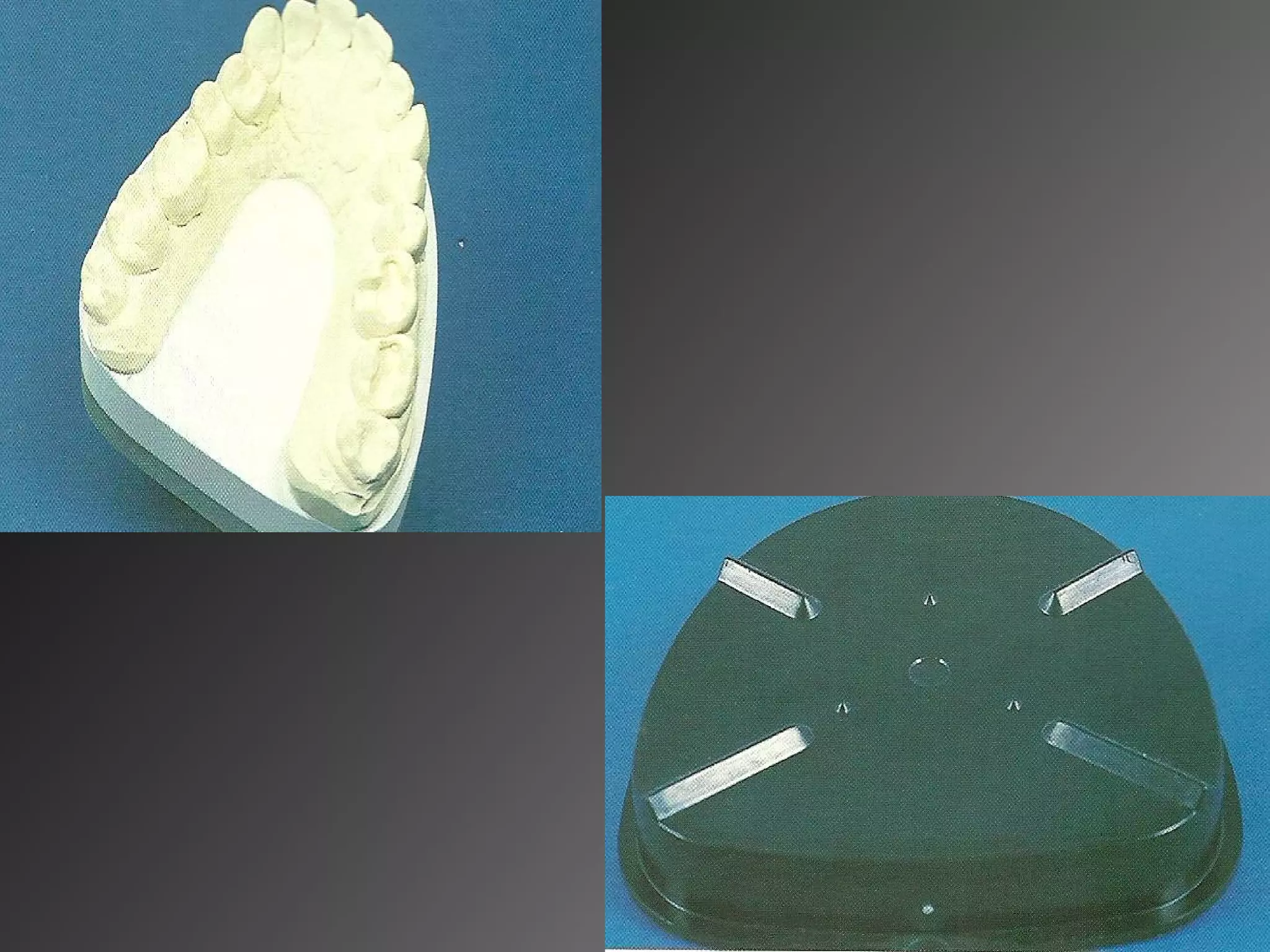
Zeiser system
The double expansion in the base and in the
teeth leads to undesirable heights and axial
displacements of the whole model
Portions of impression, which are not required to
be circumcised
At Zeiser model are the original dimensions of
the impression on a dimensionally stable base
plate transfer
The impression is leveled and fixed
with silicon putty.
Portions on the master model need
not be shown to be blocked out with
silicone putty.
The transparent plate is used The pin locations and the saw cuts
are determined
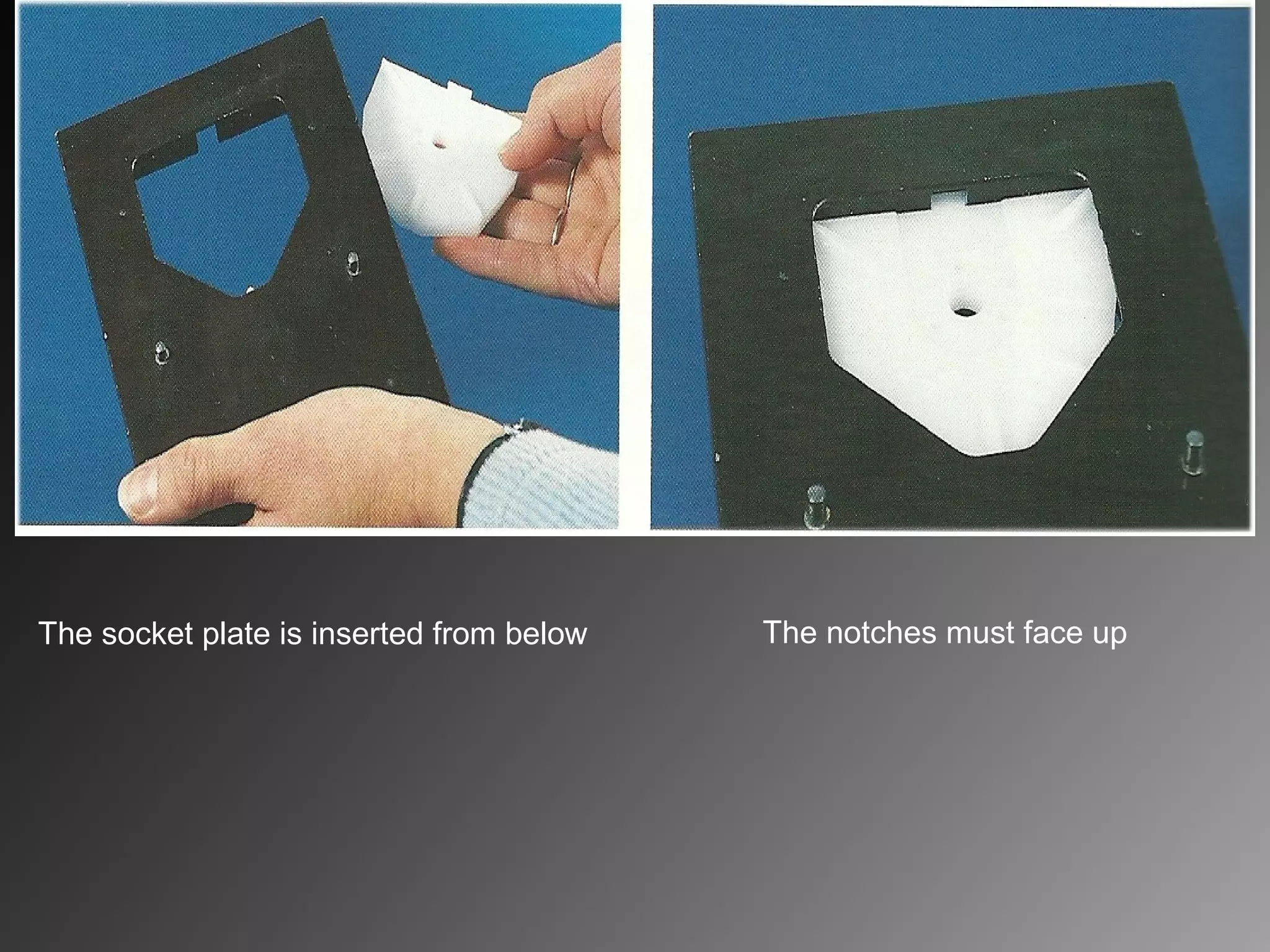
The socket plate is inserted from below The notches must face up
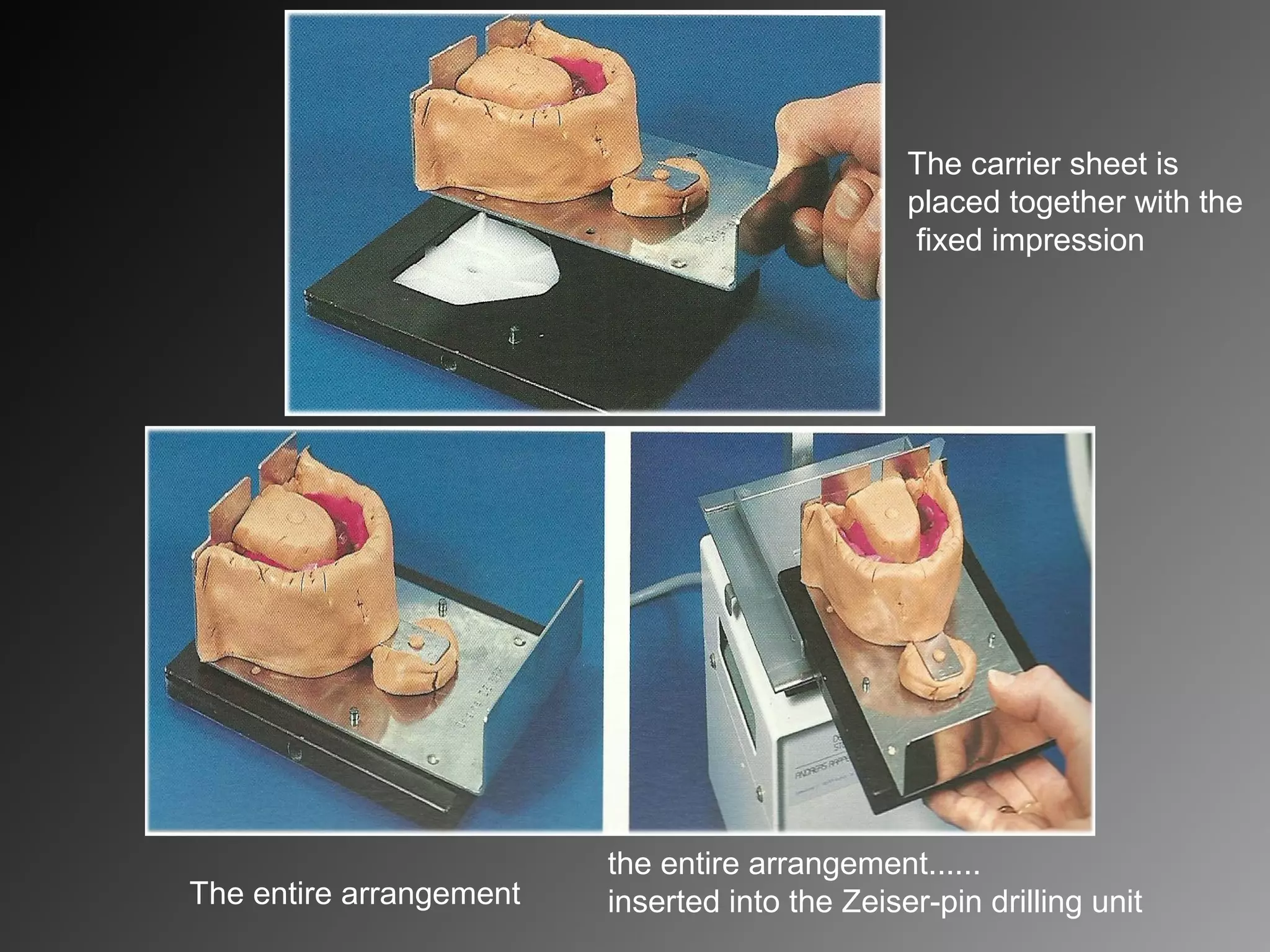
The carrier sheet is
placed together with the
fixed impression
The entire arrangement
......the entire arrangement
inserted into the Zeiser-pin drilling unit
The pinholes drilled in the
base
For drilling, press the entire
assembly down quickly
Pins are inserted into the base.
With the base plate to check whether the
pins were positioned correctly
The impression material is pretreated
.....And poured the full arch
impression with die stone, restricted
to u-shaped arch i.e. with no stone
on the center
With one instrument, the base plate
is filled with stone...
….......And then filled to the brim of
kneading silicone with stone
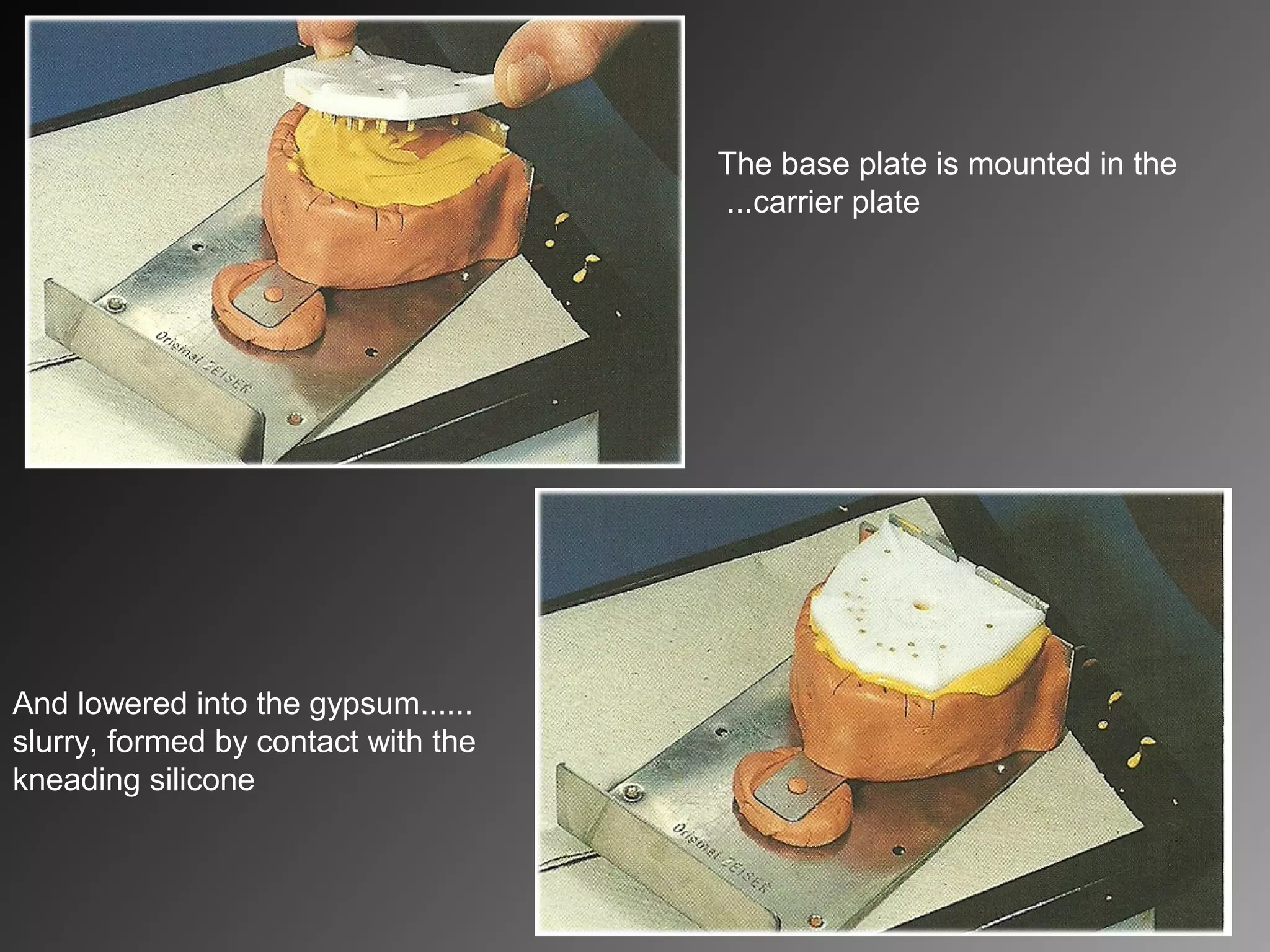
The base plate is mounted in the
carrier plate...
......And lowered into the gypsum
slurry, formed by contact with the
kneading silicone
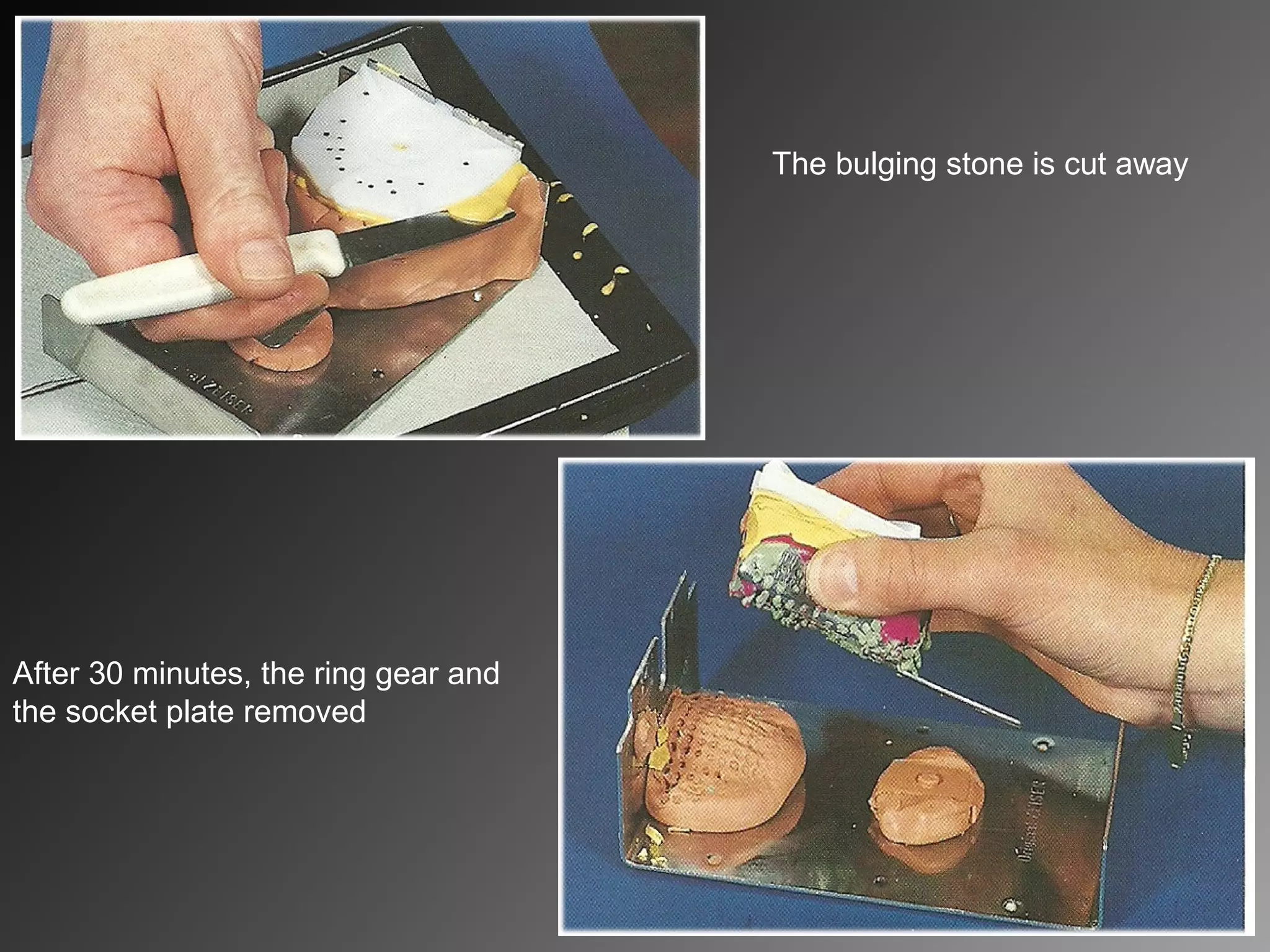
The bulging stone is cut away
After 30 minutes, the ring gear and
the socket plate removed
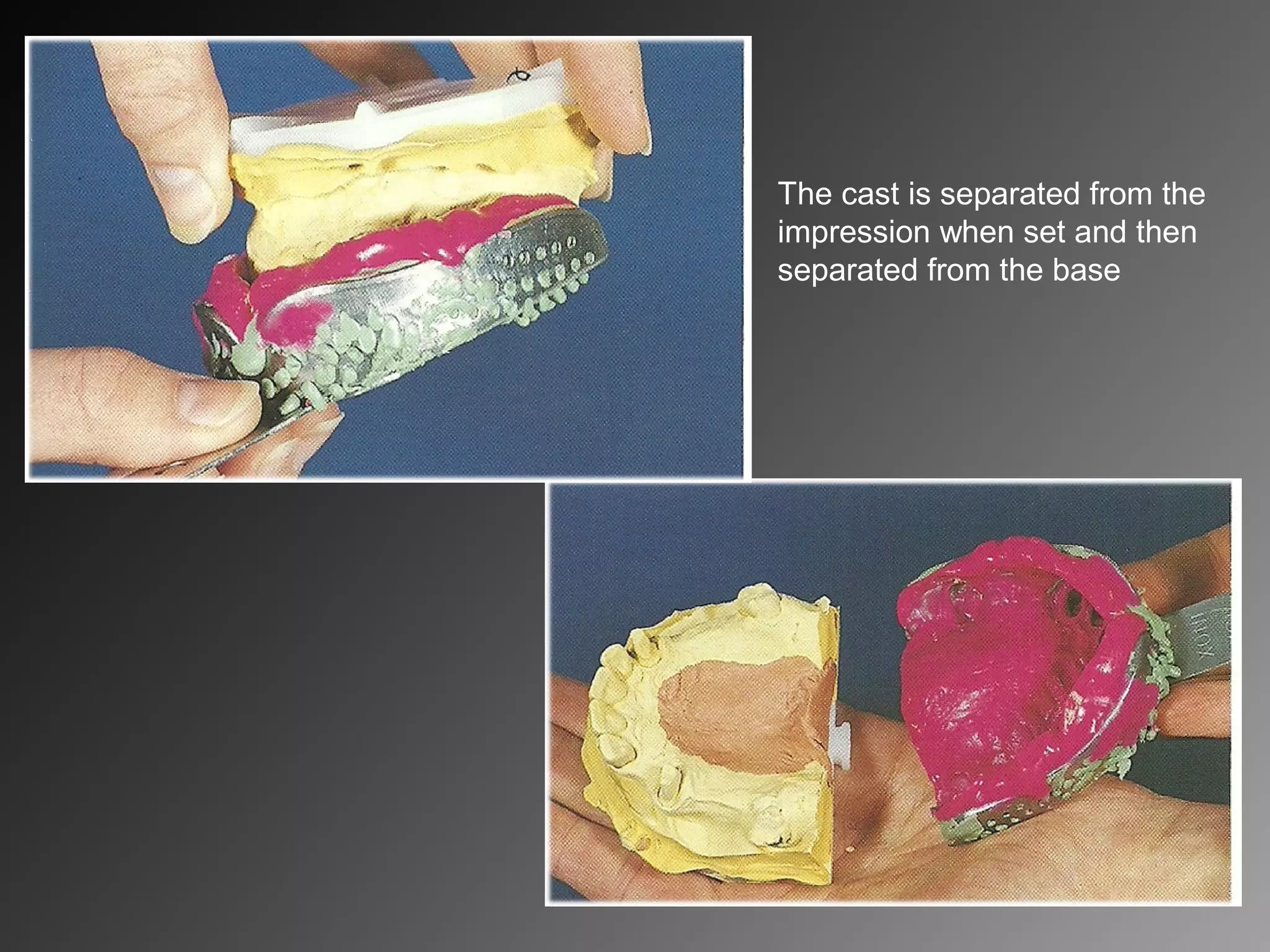
The cast is separated from the
impression when set and then
separated from the base
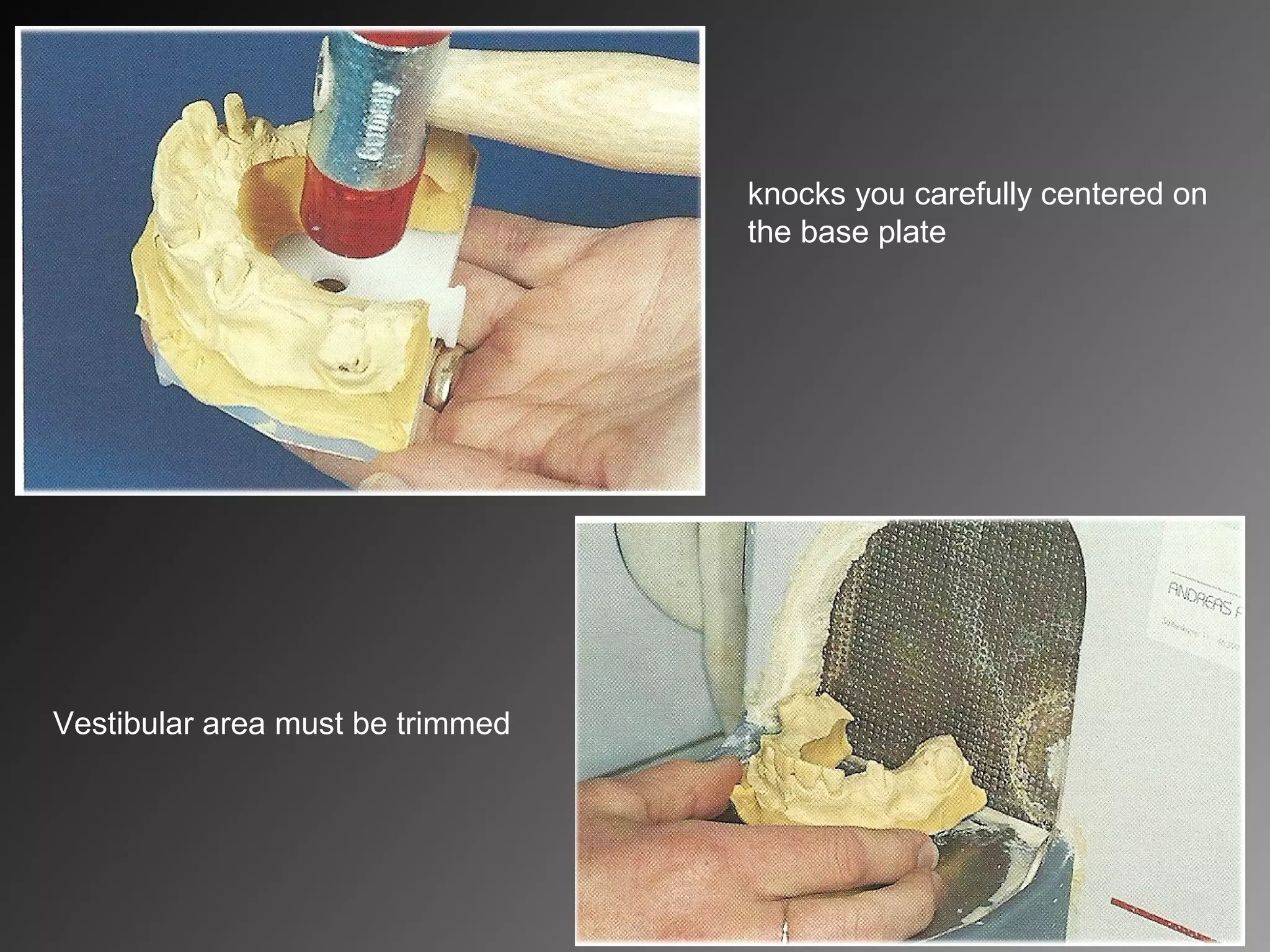
knocks you carefully centered on
the base plate
Vestibular area must be trimmed
The Palatal or lingual side of the
cast base is trimmed with an
arbor band
a gap!!!
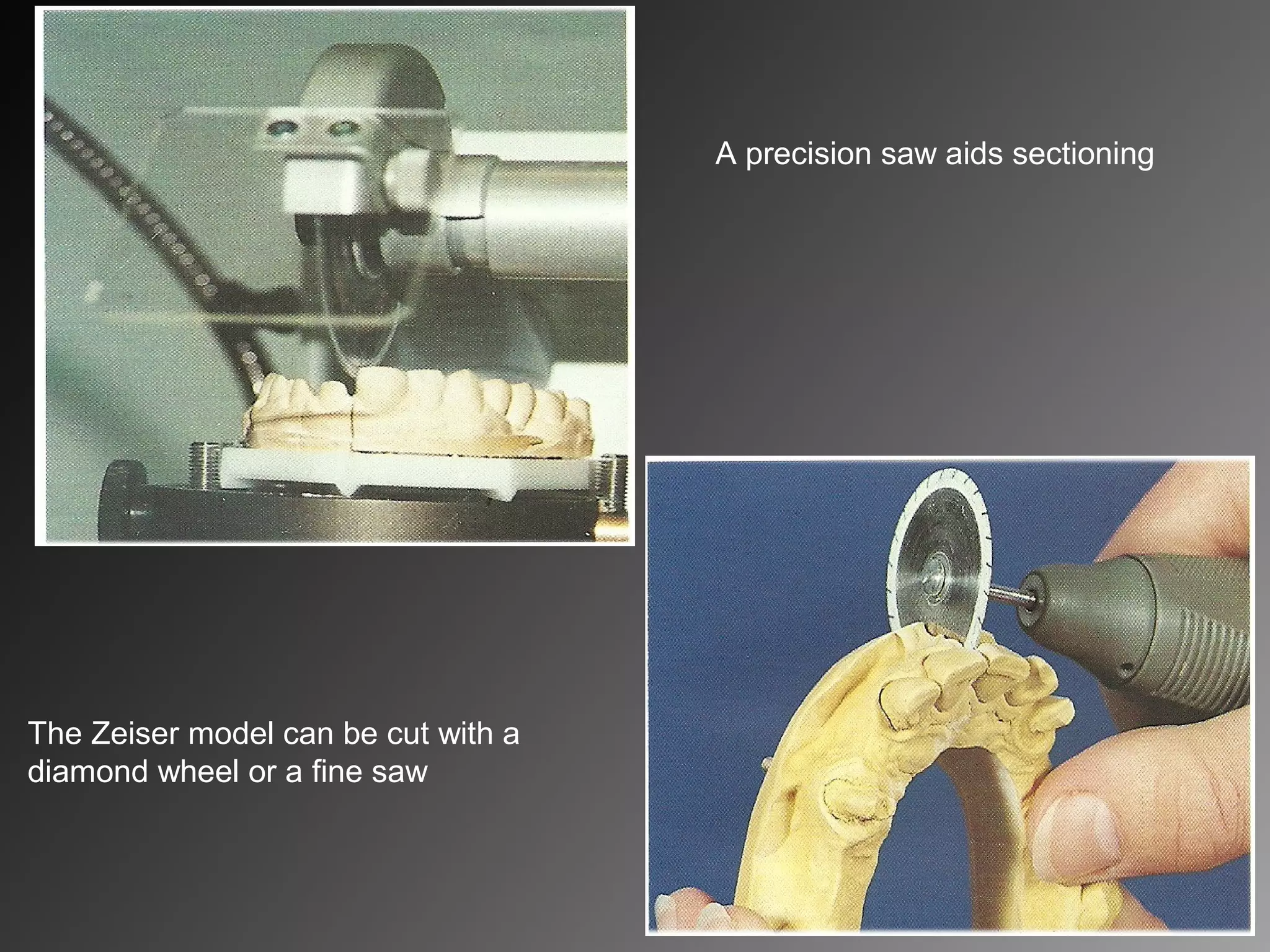
A precision saw aids sectioning
The Zeiser model can be cut with a
diamond wheel or a fine saw
The sectioned cast
The die is trimmed apical to
the finish line with an arbor
band or with an acrylic bur
....and thoroughly cleaned
with a brush from the dust
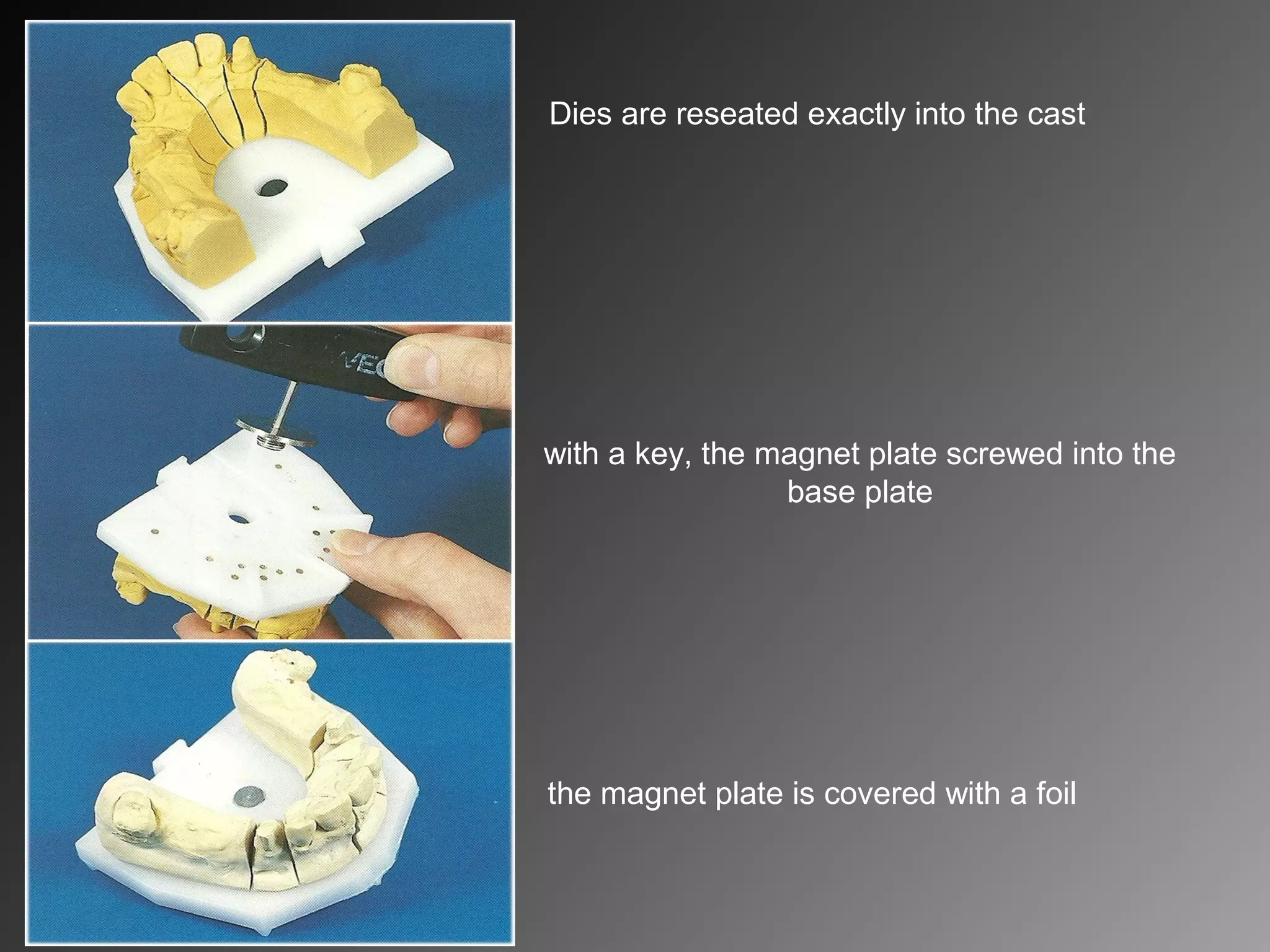
Dies are reseated exactly into the cast
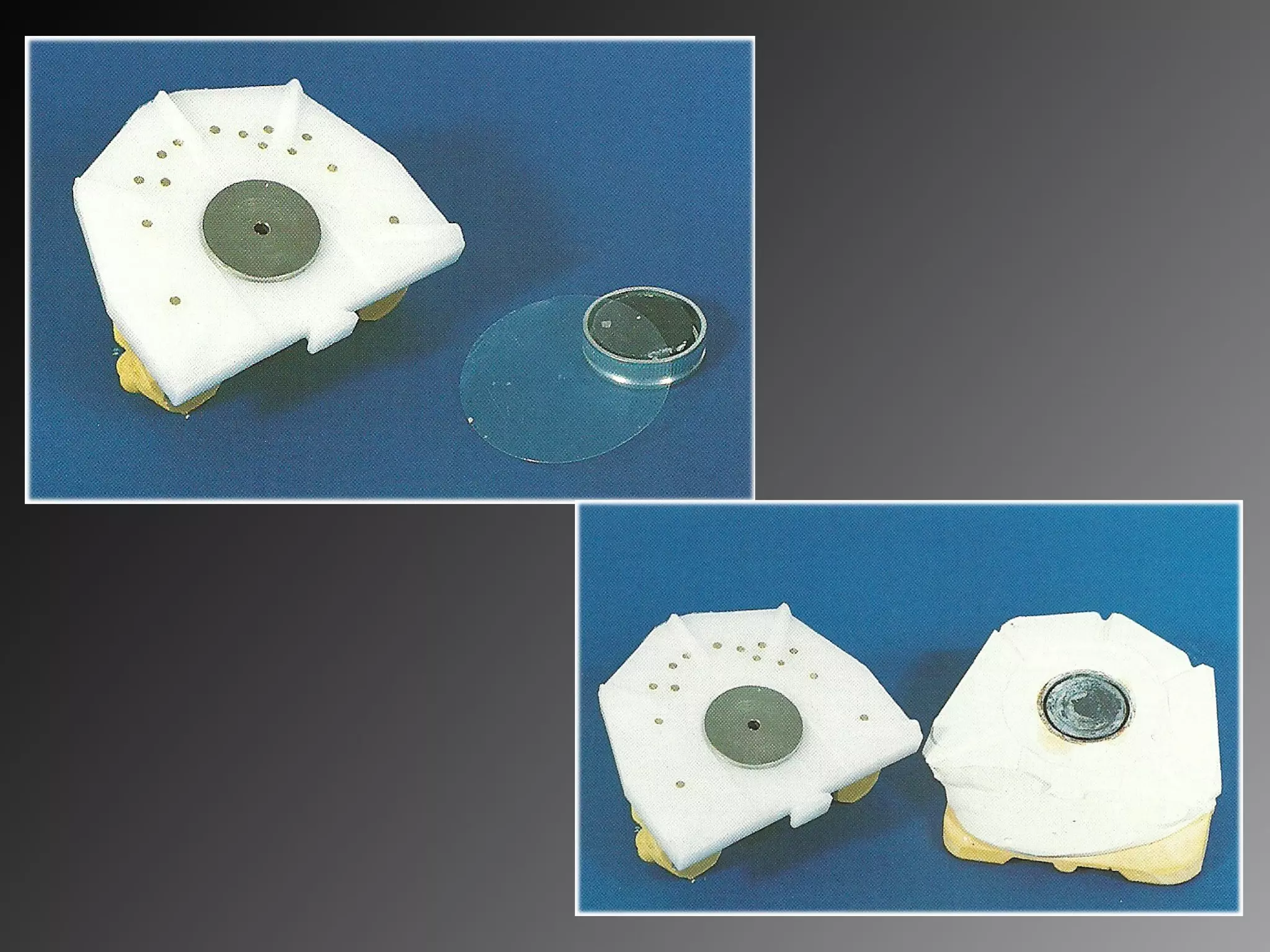
with a key, the magnet plate screwed into the
base plate
the magnet plate is covered with a foil
8.working casts and dies

8.working casts and dies

  • 1.
    Working casts anddies -The working cast is the replica of the prepared teeth, ridge areas, and the other parts of the dental arch. -The accuracy of a cast and die is a function of completeness and accuracy of the impression.
  • 2.
    There are threerequirements for good casts 1.They must be bubble free, especially along the finish lines of the prepared teeth. 2.All portions of the cast must be distortion free. 3.The casts must be trimmed to insure access for carving wax pattern margins.
  • 3.
    Classification There are twobasic working cast and die systems I. Working cast with a Separate die -Single die for wax coping and margins -Solid cast for proximal contacts and occlusion II. Working cast with removable dies -Retained by pins in a base (stone or plastic( -One die used for proximal contacts, occlusion and margins
  • 4.
    Requirements of DieMaterial 1.High mechanical strength properties to withstand handling without being fractured or destroyed. 2.High surface hardness to resist scratching and abrasion while the wax pattern is being fabricated. 3.Compatible with the impression material. 4.Good color contrast with the other materials so that the preparation margins can be easily detected. 5.Compatible with the separating medium used. 6.Easily wettable with the wax used. 7.High stability and excellent dimensional accuracy.
  • 5.
    I. Working castwith a Separate die -The working cast with a separate die is the simplest means of fabricating a working cast and die. Pours 1 and 2 (individual dies) and 3 (working cast). Pouring an impression for individual dies and solid cast (multiple pour system).
  • 6.
    -The procedure requiremaking a sectional cast and a full-arch cast. Sectioning the individual dies. The trimmed dies and working cast before articulation.
  • 7.
    Advantages 1.Ease of fabrication. 2.Keepsthe relationship between abutments fixed and immovable. 3.The gingival tissue and other landmarks are intact.
  • 8.
    Disadvantages 1.The wax patternmust be transferred from one cast to another (from the separate die to the working cast(, so distortion of the wax pattern may result. 2.The working cast and the sectional cast for the die can be obtained from separate impressions or by pouring an elastomeric full-arch impression twice. If a double pour is utilized, the first cast is used for fabrication of the die. This technique, unfortunately, can be used only with elastomeric impressions, since hydrocolloid is torn and distorted too much to be used for an accurate second pour.
  • 9.
    Impression Pouring: -Hard improvedstone (type IV or V( should be used for fabricating the die and the cast to prevent surface abrasion when wax pattern is fabricated. 3-kg improved dental stone Hard improved stone
  • 10.
    -Wash the impressionunder cold running tap water to remove mucous and saliva which may cover the impression, disinfection is then carried out according to the impression material used.
  • 11.
    -Follow the manufacturer,sinstructions for the correct water/ratio, which may affect many of the properties of the set stone, including setting time, porosity, setting expansion and ultimate strength.
  • 12.
    -Mix water andstone by hand with spatula until the powder is completely wet then use vacuum.
  • 13.
    -Using a smallinstrument to carry stone to the impression of the prepared tooth, place a small amount of stone on the side of the impression above the preparation and vibrate till stone reaches the occlusal surface of the preparation. Pouring an impression. To avoid trapping air, start with a very small amount of stone
  • 14.
    -Tilt the impressionso that the stone flows slowly across the bottom of the preparation, add stone in small increments. If a large amount of stone is dropped, air will be trapped, and voids will result in the cast. -Build the stone up to a height approximately one inch over the preparation to allow bulk for an adequate handle of the die. -To pour a full arch impression, place the tray on the vibrator (do not rest it on the impression materials(. -Add small increments of stone to the distal most area of one side of the impression, slowly raise the distal end of the impression, so that stone will move mesially flowing from tooth to tooth and filling each of them from the bottom. -Add stone and vibrate until all the teeth in the arch are filled.
  • 15.
    Die Preparation -The castfrom which the die is made, is trimmed on a model trimmer to remove all excess stone around the prepared tooth. -The cast is held by the base while cutting it down to form the handle of the die, the handle of the die should be slightly large in the diameter than the preparation. Its sides should be parallel or slightly tapered toward the base, and should be parallel to the long axis of the tooth, because if not parallel it will be more difficult to adapt the wax pattern margins. The handle is approximately one inch long. -Trim the die gingival to the finish line of the preparation, this area should be smooth and free from irregularities. -The contour of the die gingival to the finish line should approximate that of the root to facilitate good axial contours in the finished restoration.
  • 16.
    Trimming the stonerepresenting the free gingiva to a level lower than the finish line (trimmed with an acrylic bur).
  • 17.
    The preparation finishline on the die should be outlined with a red pencil
  • 18.
    -The die isthen painted with a die strengthening material to close the stone micro porosities, and harden it and decrease scratching.
  • 19.
    -After the diehas been trimmed, the finish line should be highlighted with a sharp color bright red pencil, this facilitate carving the margins of the wax pattern.
  • 20.
    -The preparation areaof the die should be painted with a die relief material to provide space for cement, a relief of 25 microns is desired, the tooth preparation on the die is painted within 0.5-1.0 mm of the finish line.
  • 22.
    II. Working castwith removable dies Examples 1(Working cast with dowel pins 2(Accutrac system 3(E-Z-Tray system 4(Fix-pin system 5(Model tray (Di-Lok Tray( system 6(MODU system 7(Opti-base system 8(Pindex system 9(Splitfix system 10(Jet-pin system (VIDEO( 11(cross-pin system 12(Zeiser system
  • 23.
    Requirements of removableDies 1.The dies must return to their exact original positions. 2.The dies must remain stable, even when inverted. 3.The cast containing the dies must be easy to mount on an articulator.
  • 24.
  • 25.
    -A dowel pinis positioned over each prepared tooth in the impression, if the dowel pins are positioned inaccurately, they may impinge on the margins, weaken the die, or prevent it from being easily removed from the cast. -A number of items can be used for positioning the dowel pins, anesthetic needles, paper clips and bobby pins. A dowel is placed between the arms of the bobby pins, the bobby pin is positioned bucco-lingually across the impression so that the dowel pin will be entered directly over the preparation.
  • 26.
    -Push a straightpin between the arms of bobby pin and into the impression material on both the buccal and lingual of each tooth to have a dowel pin placed over it. Stabilize the dowel in the bobby pin and the bobby pin itself against the straight pin with sticky wax. Positioning dowel pins before cast pouring can be accomplished with bobby pins and sticky wax
  • 27.
    -Die stone isthen poured into the impression, filling the impression of the teeth and covering the knurled end “constriction” of the dowel pin. A) Incorrect technique for pouring an impression. An air bubble (arrows) will be trapped if two masses of stone are allowed to meet. B) Dowel pins must be carefully positioned so the first pour of stone completely covers the knurled head; otherwise, the parts will not separate cleanly. However, the stone should not extend onto the shaft and reduce stability. A B
  • 28.
    -Paper clips areset into the stone before it sets, to provide retention for the base which will be placed later, these clips should be placed in all parts of the model that are not to be removable from the completed cast. Dowel pins are positioned over the impression with bobby pins. Paper clips are added to non/removable parts of the unset first pour to provide retention for the second pour of stone.
  • 29.
    -The stone aroundeach dowel is lubricated with a thin coat of petrolatum to permit easier separation of the die from the working cast, then pour stone of the complete base. After complete setting of the stone, remove the cast from the impression and trim off the excess on a model trimmer. The stone around the dowel pins is lubricated. A wet paper towel can be used to fill in the open, center portion of the impression.
  • 30.
    -Use sharp knifeto remove the spheres of utility wax. -When the stone is hard and dry, use a saw frame to cut through the layer of the stone, mesially and distally on each die, the cuts should taper toward each other slightly from occlusal to gingival. Wax at the ends of the dowel pins is located and removed. Dies are separated from the rest of the cast with a fine saw.
  • 31.
    -Loosen the diegently using an instrument handle. -Place wax around the tips of the dowels to protect them from the plaster contamination. -Soak the cast in the water and mount it on the articulator, using mounting plaster. After hardening of the plaster remove the wax covering the tips of the dowels. -Trim away any excess stone gingival to finish line, then mark the finish line with the red pencil. -Repeat the procedure for each die on the cast. -Reseat the dies to make certain that they will seat completely and will be stable.
  • 32.
    Base of thedie is trimmed with an acrylic bur. Dies are reseated into the cast.
  • 33.
    After the castshave been mounted, wax is removed from the ends of the dowel pins.
  • 35.
    2-Pindex system -The pindexsystem ( Coltene / whaledent, Mahwah, NJ) is a reverse drill press is used to create a master cast with dies that can be removed and replaced repeatedly with great precision. -The impression is poured without positioning and attaching dowel pins. The machine accurately drills parallel holes from the underside of trimmed cast.
  • 38.
    Index the cast 1.Gluepins with cianoacrylate cement -Long pin toward facial -Short pin toward lingual -Glue short pins first (better access) 2.Place sleeves on pins (stability of pins) 3.Box and seal cast 4.Apply separating solution 5.Pour second base with yellow stone
  • 39.
    Section & Trimdies 1.Mark planned saw cuts with a pencil 2.Create removable segments with a saw -Parallel saw cuts -Each segment individually removable 3.Using microscope, remove gross stone beyond finish line with a#7 lab carbide bur in straight handpiece 4.Finish trimming with scalpel or cleoid-discoid under microscope
  • 41.
    Die Trimming 1.Remove mostof excess stone with # 7 lab carbide bur with protective eyewear 2.Fine trimming with scalpel or cleoid-discoid carver 3.Margin should be sharp and distinct for access, but it should not be undermined 4.Uncut tooth beyond finish line should be maintained to provide proper contours in wax
  • 44.
    Die preparation 1.Apply diehardener -Cover die beyond finish lines -Allow to set for 5 minutes 2.Apply die spacer -25micron thickness allows space for cement -Spacer 1 mm from finish line
  • 68.
    3-Di-Lok Tray -A snap-apartplastic tray with internal orienting grooves and notches also can be used to reassemble the working cast and die
  • 69.
    Armamentarium 1.5OO-ccVac-U-Mixerand vacuum tubing 2.Vibrator 3.Watermeasure 4.Large and small spatulas 5.Die stone (Silky-Rock,Vel-Mix( 6.Humidor 7.Model trimmer 8.Straight handpiece and pear-shaped acrYlic bur 9.Laboratory knife with no. 25 blade 10.Tanner carver, 11.Colorbrite red pencil
  • 70.
    Model tray system The modeltray system consists of a part plastic tray, wit internal orienting grooves and notches. for mounting in the articulator are the fixation systems (magnets, connectors) at disposal.
  • 71.
    Impression and trayare filled with super hard stone and put together so that the stone is very hard, the model with the teeth is taken down.
  • 72.
    Disassembly of thecast In the center of the base we drill with a thicker round bur a hole. With a compressed air nozzle, the cast of the tray is blown. A saw cut is made on each side of the prepared tooth.
  • 73.
    The dies arebroken by a suitable instrument from the master model
  • 74.
    to be mountedin the articulator different retention methods are available: plug- retention...... ........Snapper retention and....... .......Magnetic retainers
  • 75.
    Zeiser system The doubleexpansion in the base and in the teeth leads to undesirable heights and axial displacements of the whole model Portions of impression, which are not required to be circumcised At Zeiser model are the original dimensions of the impression on a dimensionally stable base plate transfer
  • 76.
    The impression isleveled and fixed with silicon putty. Portions on the master model need not be shown to be blocked out with silicone putty. The transparent plate is used The pin locations and the saw cuts are determined
  • 77.
    The socket plateis inserted from below The notches must face up
  • 78.
    The carrier sheetis placed together with the fixed impression The entire arrangement ......the entire arrangement inserted into the Zeiser-pin drilling unit
  • 79.
    The pinholes drilledin the base For drilling, press the entire assembly down quickly
  • 80.
    Pins are insertedinto the base. With the base plate to check whether the pins were positioned correctly
  • 81.
    The impression materialis pretreated .....And poured the full arch impression with die stone, restricted to u-shaped arch i.e. with no stone on the center
  • 82.
    With one instrument,the base plate is filled with stone... ….......And then filled to the brim of kneading silicone with stone
  • 83.
    The base plateis mounted in the carrier plate... ......And lowered into the gypsum slurry, formed by contact with the kneading silicone
  • 84.
    The bulging stoneis cut away After 30 minutes, the ring gear and the socket plate removed
  • 85.
    The cast isseparated from the impression when set and then separated from the base
  • 86.
    knocks you carefullycentered on the base plate Vestibular area must be trimmed
  • 87.
    The Palatal orlingual side of the cast base is trimmed with an arbor band a gap!!!
  • 88.
    A precision sawaids sectioning The Zeiser model can be cut with a diamond wheel or a fine saw
  • 89.
    The sectioned cast Thedie is trimmed apical to the finish line with an arbor band or with an acrylic bur ....and thoroughly cleaned with a brush from the dust
  • 90.
    Dies are reseatedexactly into the cast with a key, the magnet plate screwed into the base plate the magnet plate is covered with a foil