10. Maxillo-mandibular Relation Records Eleni Roumanas DDS Division of Advanced Prosthodontics, Biomaterials and Hospital Dentistry UCLA School of Dentistry   Frank Lauciello DDS Ivoclar Vivadent This program of instruction is protected by copyright ©.  No portion of this program of instruction may be reproduced, recorded or transferred by any means electronic, digital, photographic, mechanical etc., or by any information storage or retrieval system, without prior permission.
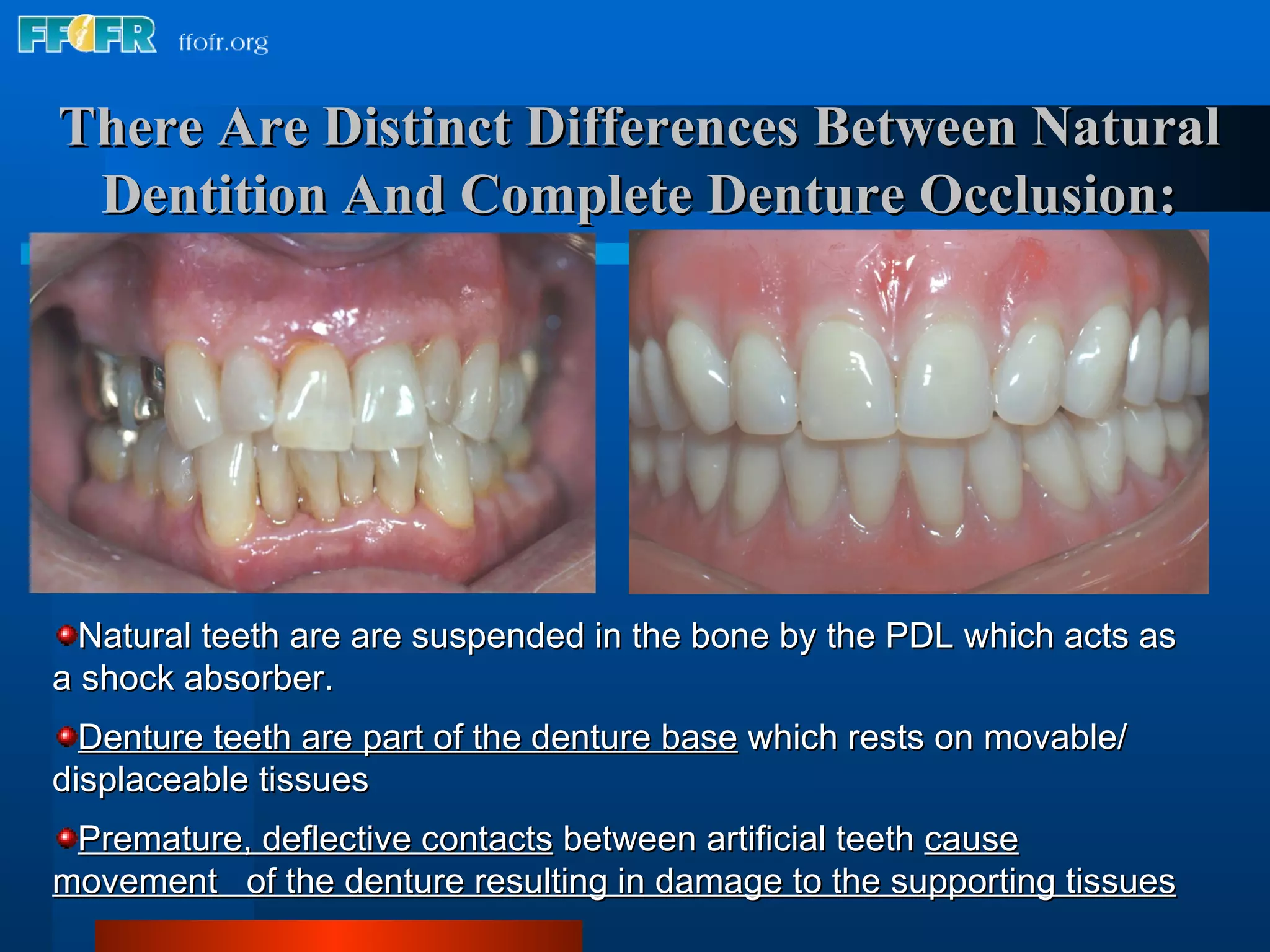
Natural teeth are are suspended in the bone by the PDL which acts as a shock absorber. Denture teeth are part of the denture base  which rests on movable/ displaceable tissues Premature, deflective contacts  between artificial teeth  cause movement  of the denture resulting in damage to the supporting tissues There Are Distinct Differences Between Natural  Dentition And Complete Denture Occlusion:
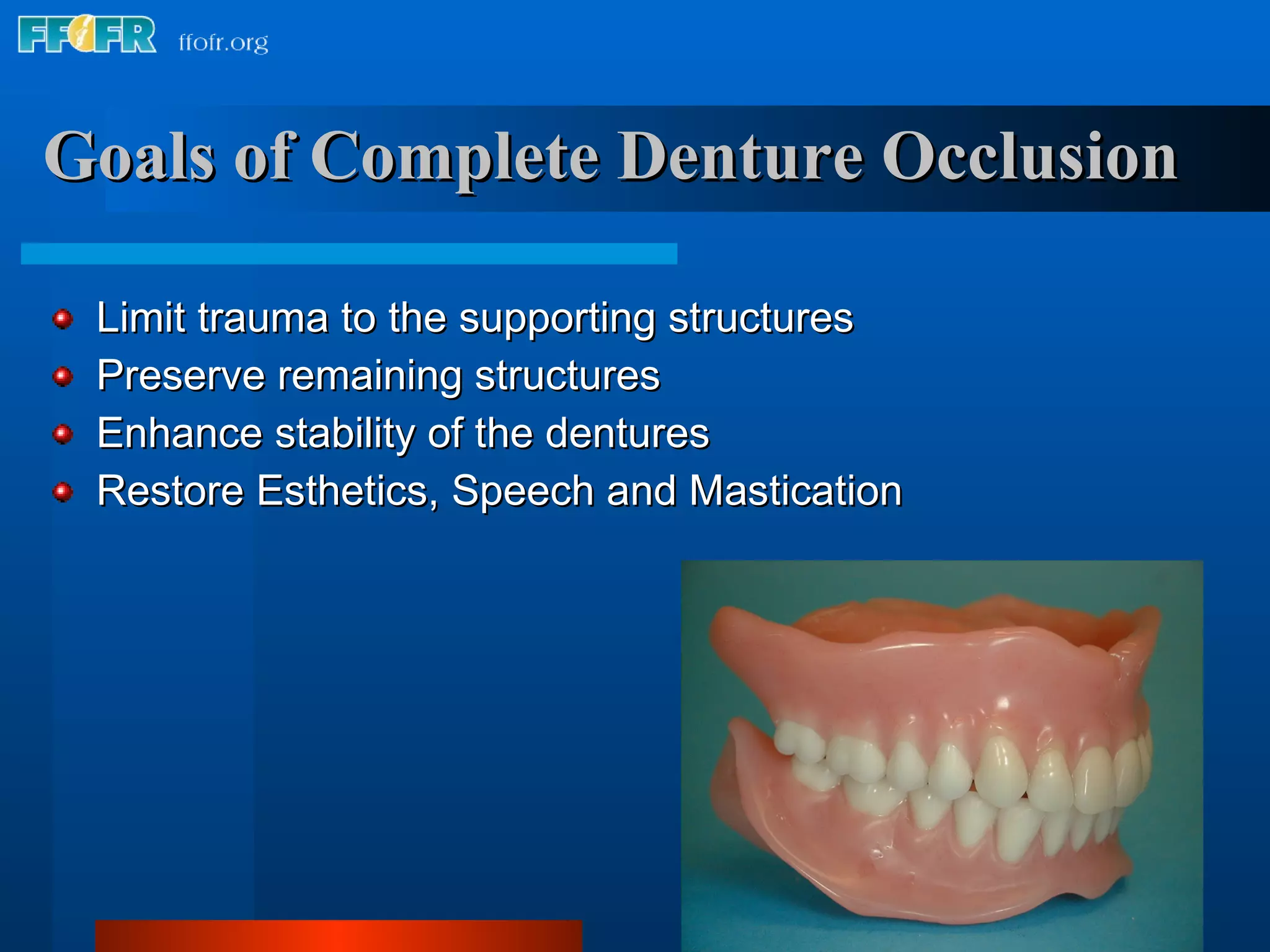
Goals of Complete Denture Occlusion Limit trauma to the supporting structures Preserve remaining structures Enhance stability of the dentures Restore Esthetics, Speech and Mastication
Balancing   Prot rus I ve Wor k i ng   Defn: is the  simultaneous contacting  of the maxillary and mandibular teeth in the  R and L  and in the  anterior and posterior  occlusal areas when the jaws are  either in centric or eccentric  relations. Balanced Occlusion Centric Re l a t i on L i n g u a l i z e d O c c l u s s i o n
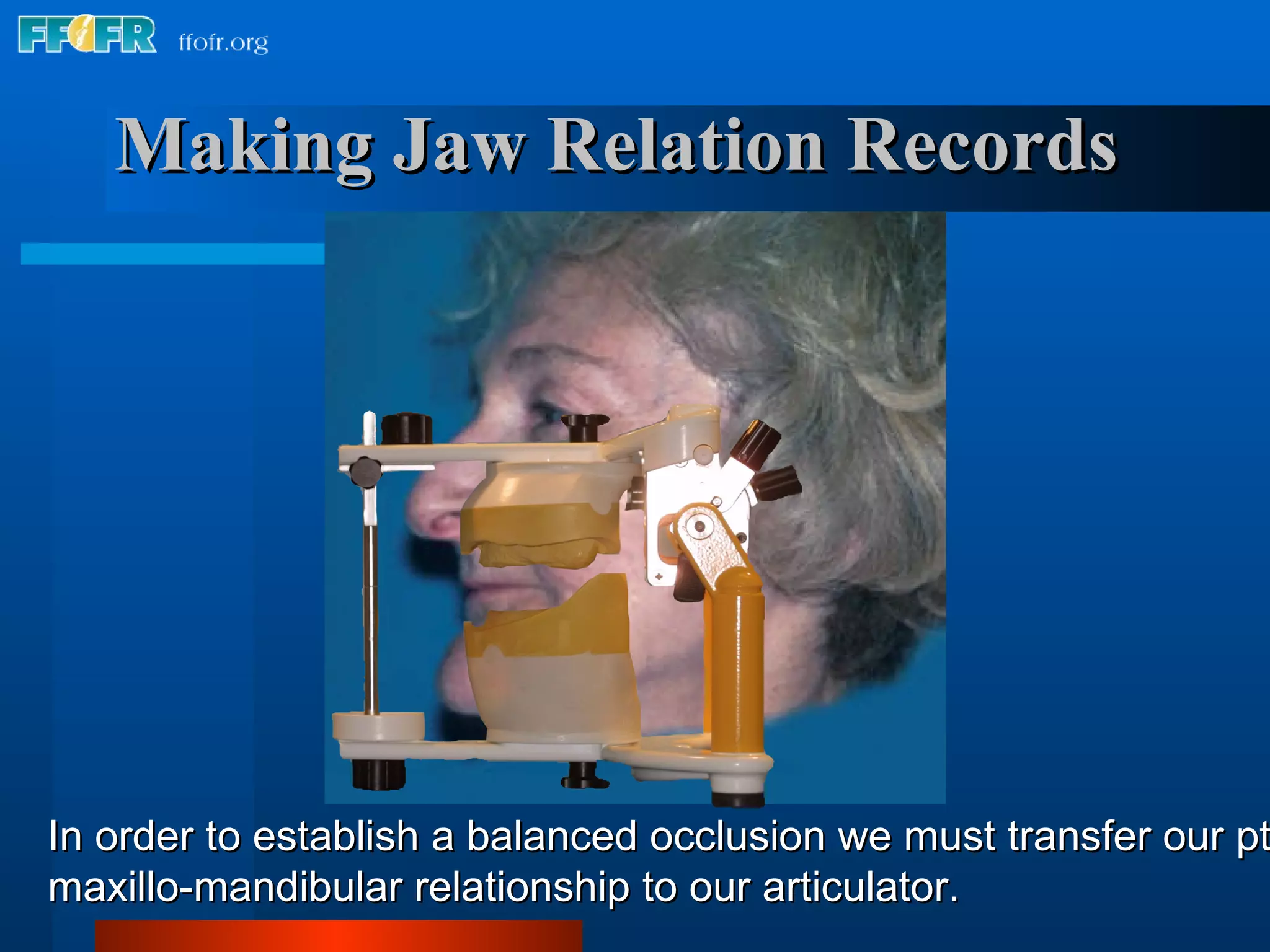
Making Jaw Relation Records In order to establish a balanced occlusion we must transfer our pts. maxillo-mandibular relationship to our articulator.
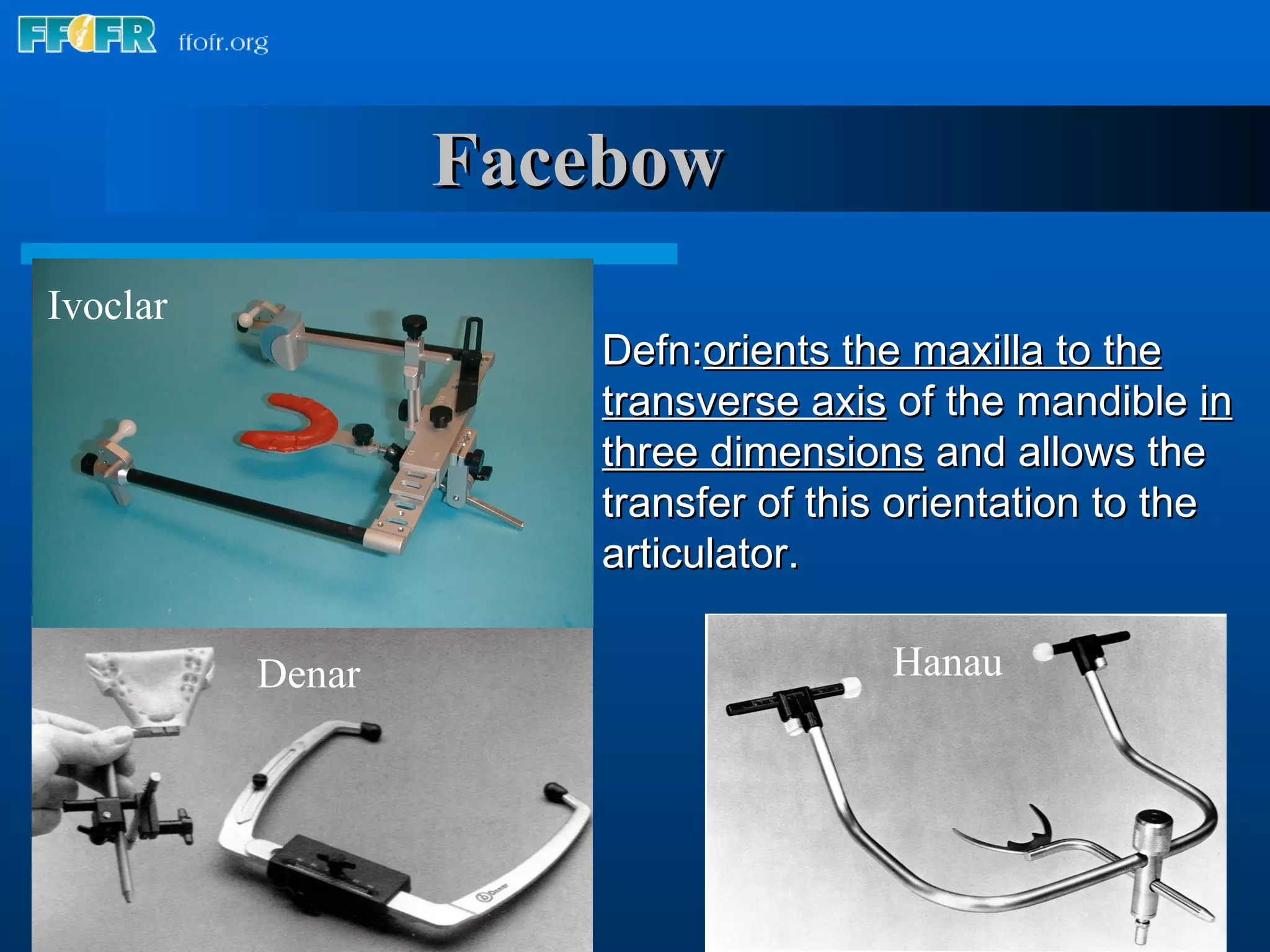
Facebow Record Records the orientation of the maxilla to the terminal hinge axis. Provides the same relative opening axis on the articulator as the  mandible has to the TMJ.
Defn: orients the maxilla to the transverse axis  of the mandible  in three dimensions  and allows the transfer of this orientation to the articulator. Denar Hanau Ivoclar Facebow
Hinge Axis Defn:A hypothetical line through the two mandibular condyles around which the mandible may rotate.
Arbitrary Hinge Axis: Is  an estimated axis location , using any of the current techniques will place the position within  + 6mm of the  true hinge axis. Earbows   use the external auditory meatus reference point as the  arbitrary hinge axis location. True Hinge Axis: Is difficult to determine  especially in edentulous pts. and  requires special armamentarium. Hinge Axis
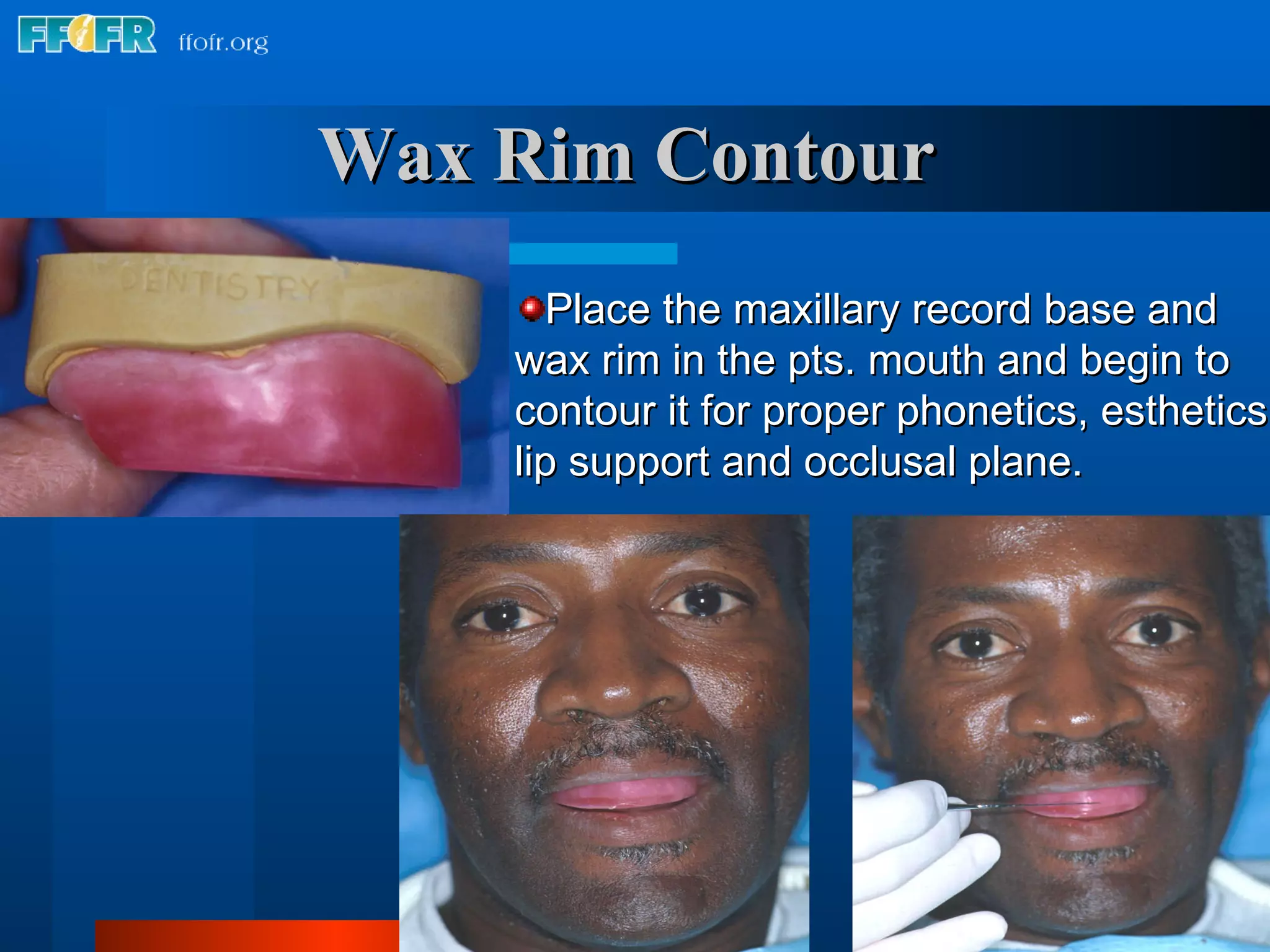
Wax Rim Contour Place the maxillary record base and wax rim in the pts. mouth and begin to  contour it for proper phonetics, esthetics  lip support and occlusal plane.
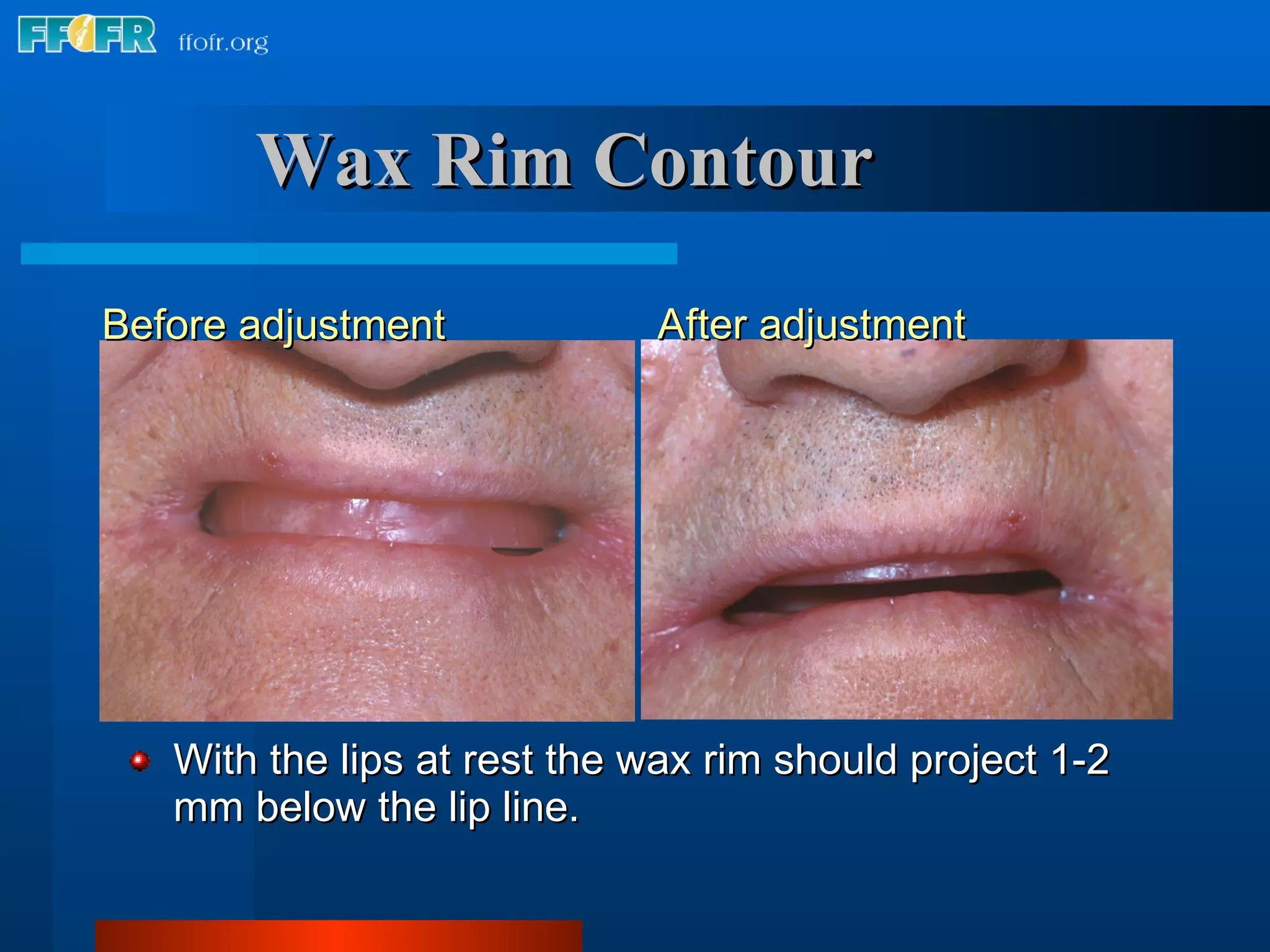
With the lips at rest the wax rim should project 1-2 mm below the lip line. Before adjustment   After adjustment Wax Rim Contour
Adjust the plane of the wax rim so that it is parallel to Camper’s plane. Adjust the plane of the wax rim so that it is parallel to the interpupillary line. Occlusal Plane
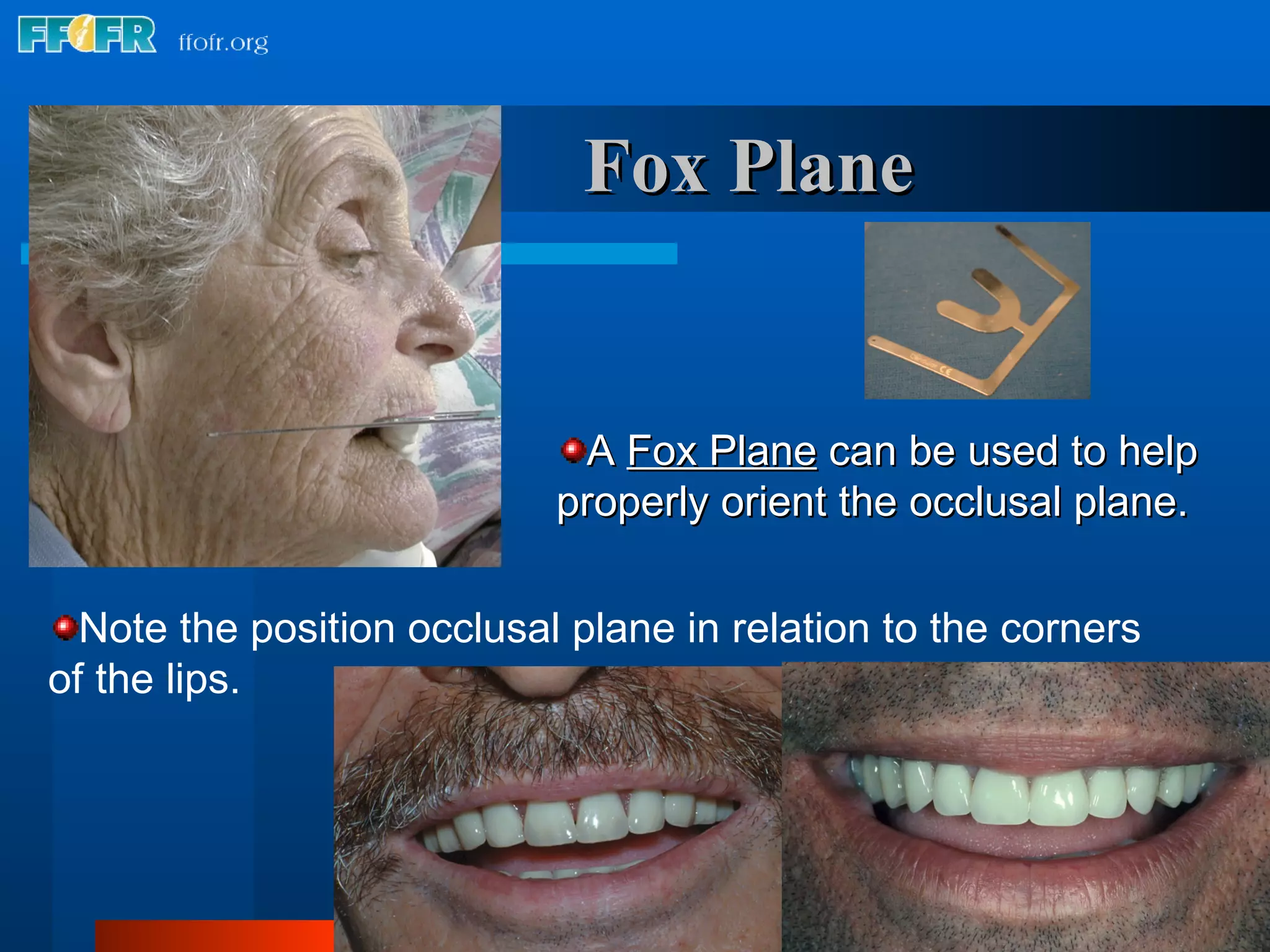
Fox Plane A  Fox Plane  can be used to help properly orient the occlusal plane. Note the position occlusal plane in relation to the corners of the lips.
The Occlusal Plane
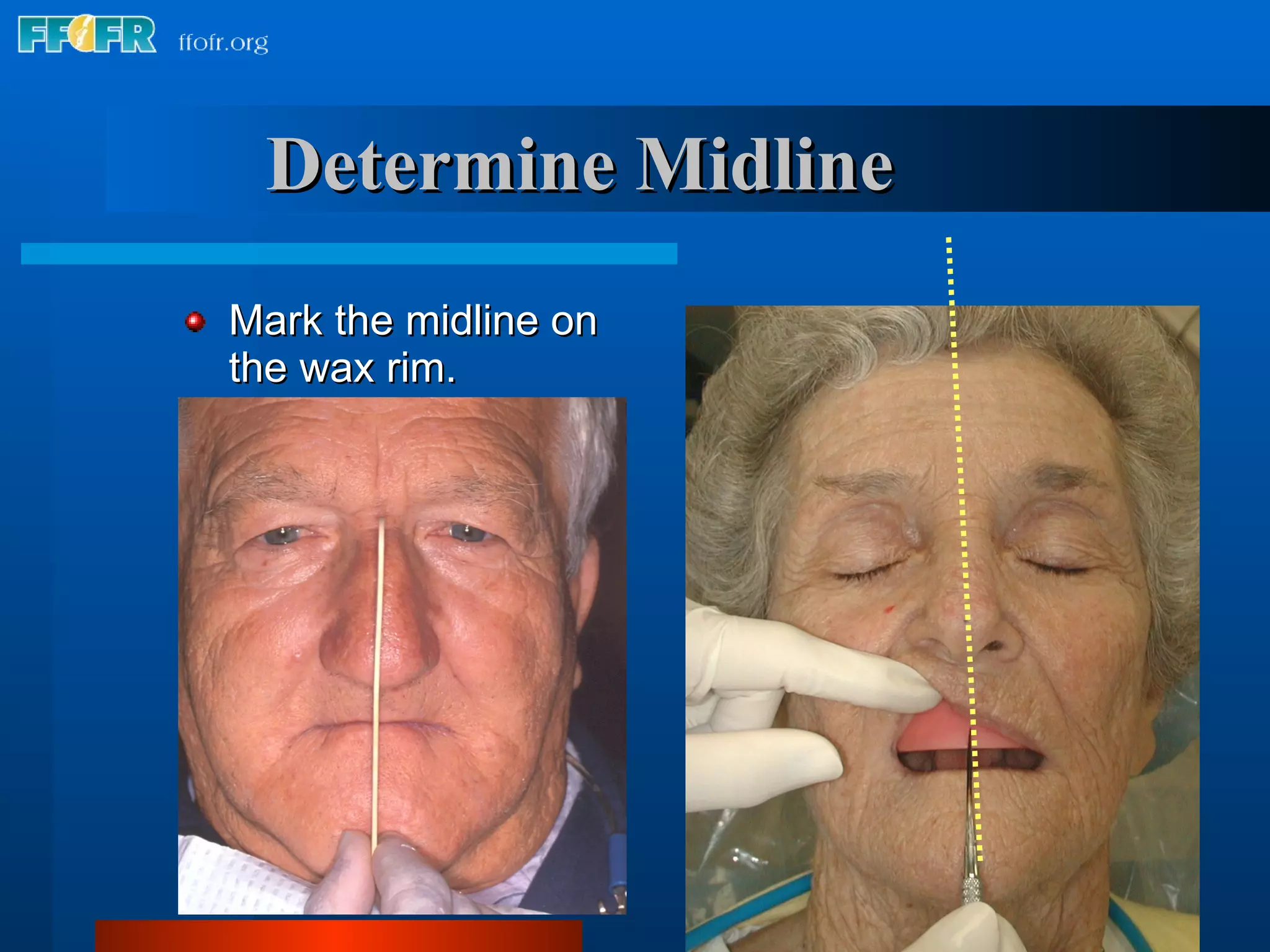
Mark the midline on the wax rim. Determine Midline
Facebow Transfer Record Armamentarium -Compound -Water bath -Alcohol torch -Vaseline -Red handled knife -Facebow
Place notches in the maxillary wax rim as shown Facebow Transfer Record
Index wax rim to bite fork with compound as shown   vaseline thin layer temper   center midline soften compound
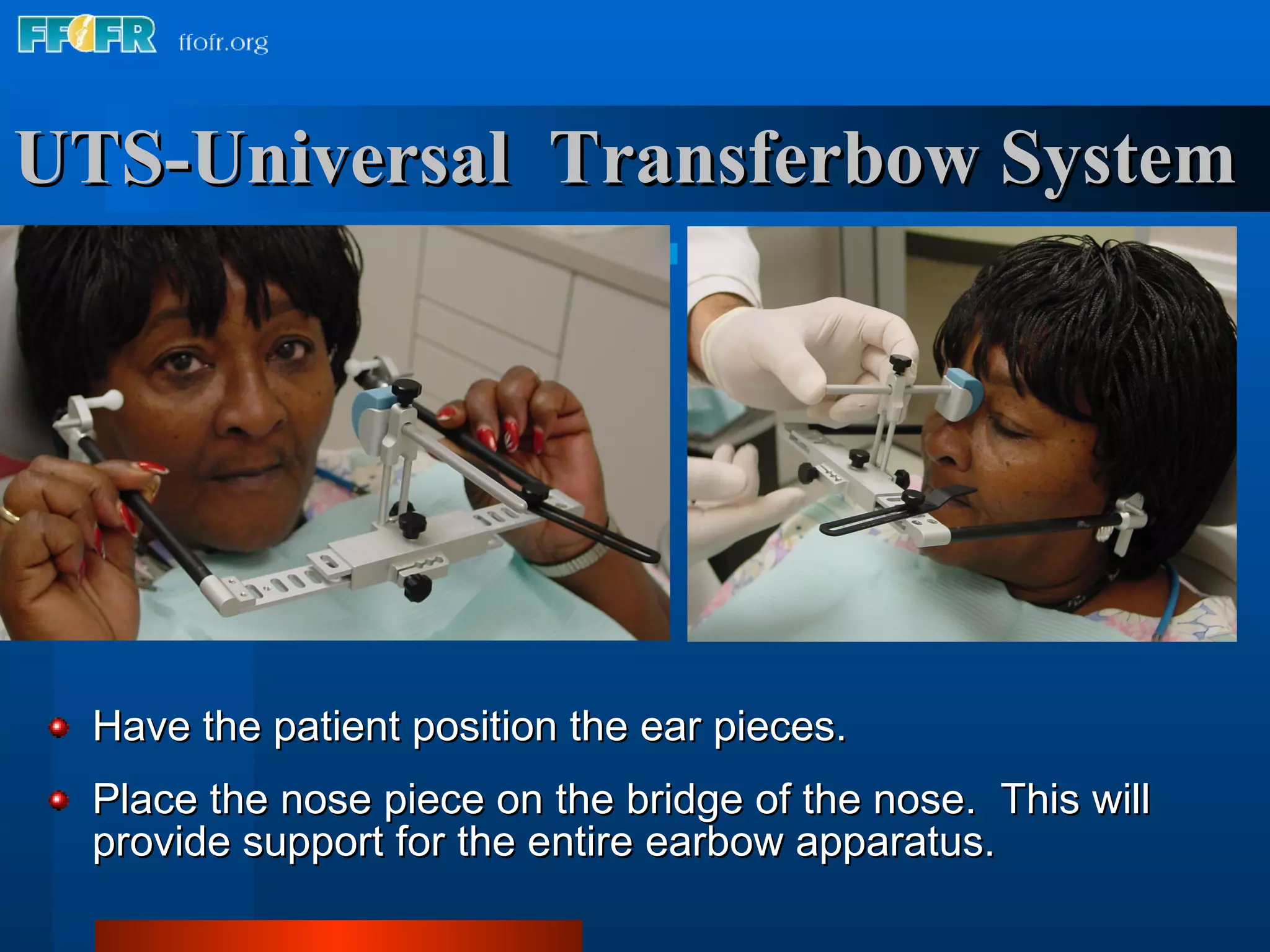
UTS-Universal  Transferbow System Have the patient position the ear pieces.  Place the nose piece on the bridge of the nose.  This will provide support for the entire earbow apparatus.
UTS-Universal  Transferbow System Position the 3 rd  point of reference at the base of the ala. The earpieces can be adjusted up or down to level the bow parallel to the interpupillary line.
UTS-Universal  Transferbow System The record base, wax rim and bite fork are now inserted in the patients mouth and connected to the facebow.
UTS-Universal  Transferbow System Remove the facebow from the patient.  Insert the maxillary cast into the record on the bite fork and attach the cast and face bow to the Stratos articulator with the mounting jig.   The record on the bite fork is indexed to the maxillary wax rim
Reminder: After mounting the upper cast, make sure the incisal guide pin is at zero and in contact with the incisal guide table. UTS-Universal  Transferbow System
Articulator Mountings The mounting is carefully smoothed and sanded.  When you are finished  all  your mountings must look like this one.
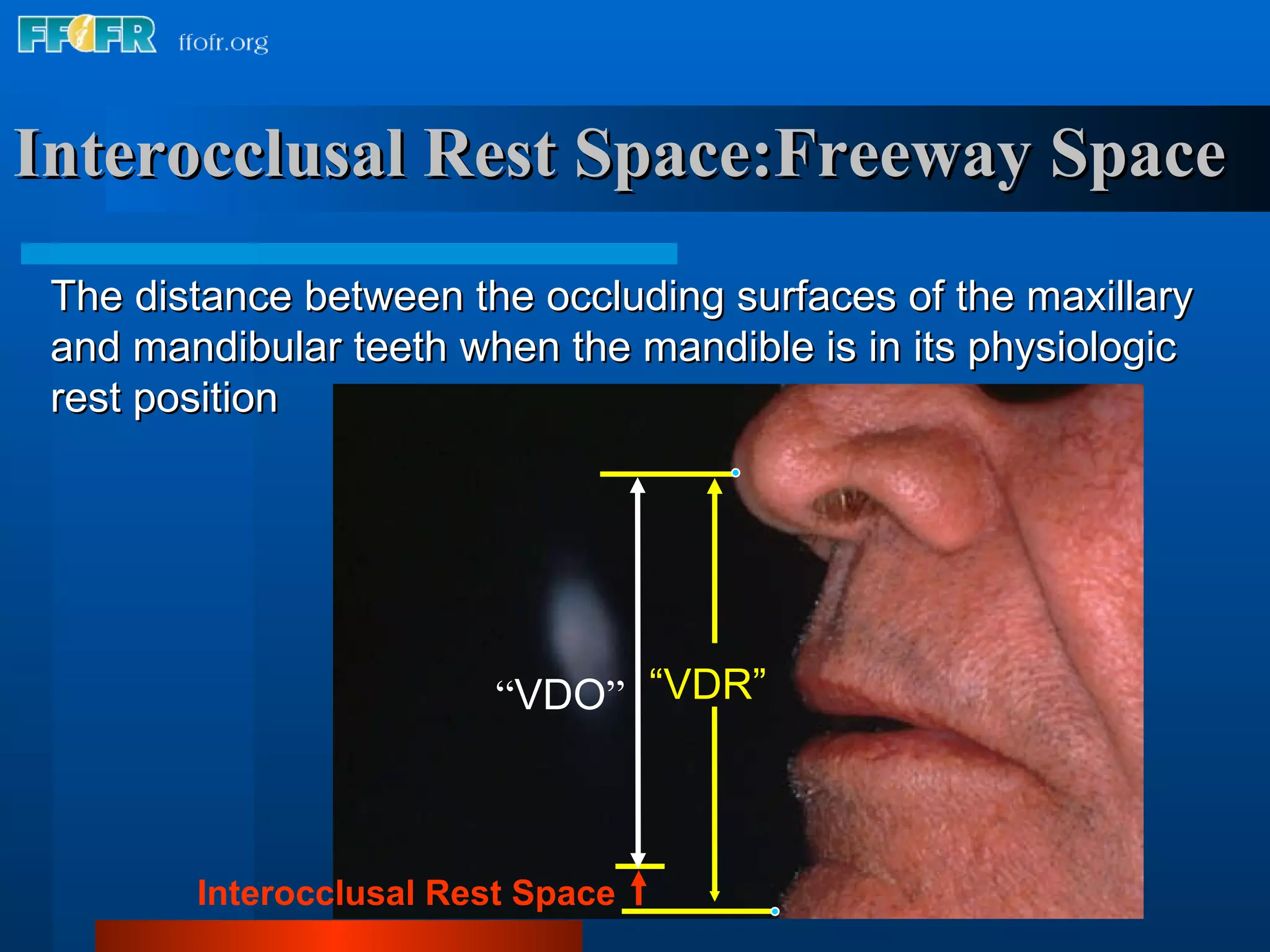
Refers to the  length of the face. It’s  the distance between two selected points, one on the fixed member (nose tip) and one on the movable member (chin point). Is maintained either by the occlusion of the teeth( vertical dimension of occlusion VDO ) or the balanced tonic contraction of the opening and closing muscles of mandibular movements ( vertical dimension of physiologic rest position VDR ). Determination of Vertical Dimension Establishing the vertical separation between the arches
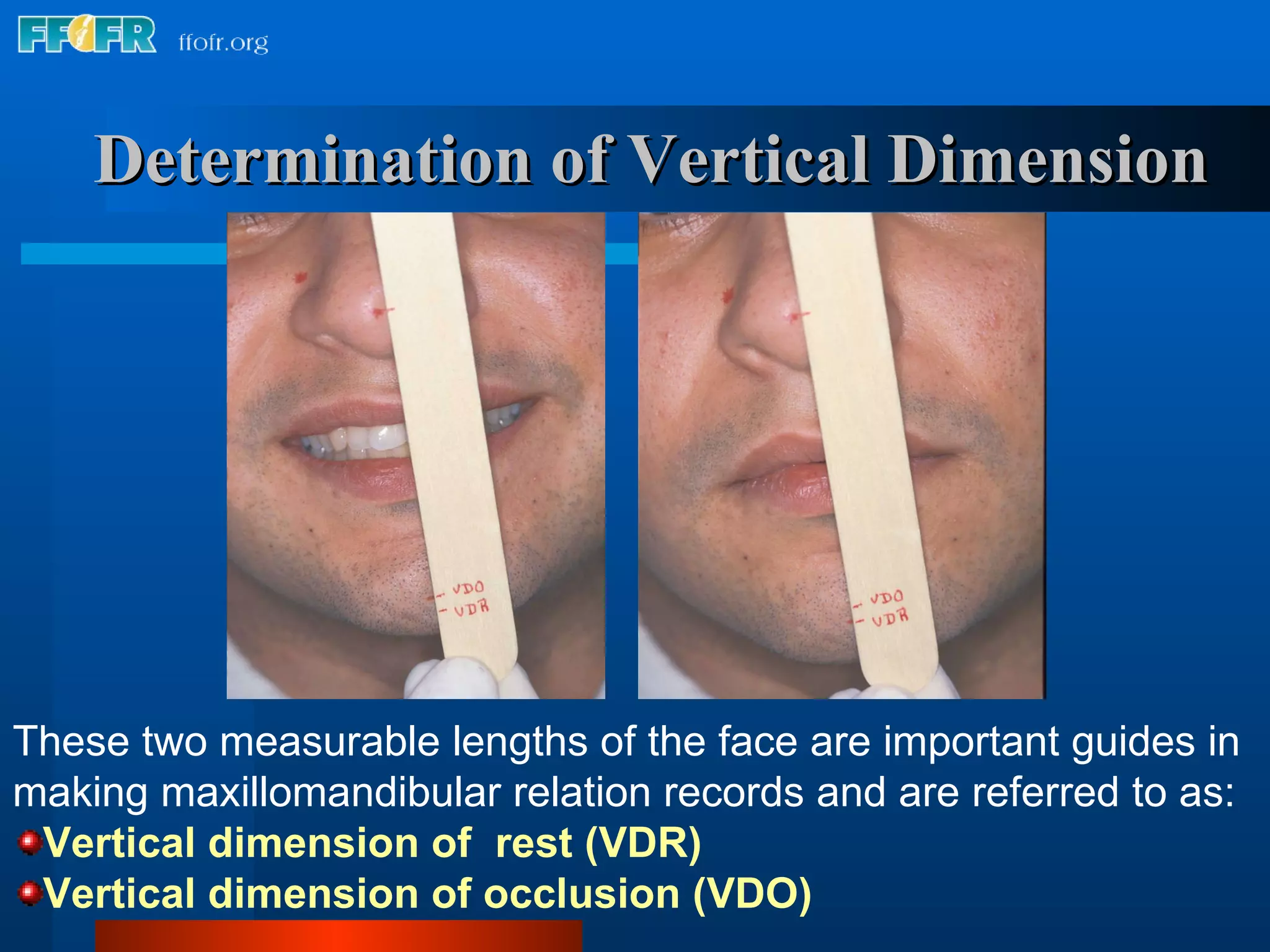
These two measurable lengths of the face are important guides in  making maxillomandibular relation records and are referred to as: Vertical dimension of  rest (VDR) Vertical dimension of occlusion (VDO) Determination of Vertical Dimension
PHYSIOLOGIC REST POSITION: In the absence of pathosis the  relation is  fairly constant  throughout  life. The position  can be accurately recorded  and measured within acceptable limits. It is  used to determine the vertical dimension of occlusion . Defn: Is the  vertical separation of the jaws when the opening & closing muscles of the mandible are at rest in tonic contraction . It is the length of the face when the mandible is in rest position. Vertical Dimension of Rest
Establishing  VDR Place the patient in an upright position Place marks on the tip of nose and the tip of the chin, on the greatest height of curvature.  Make sure the chin is unstrained “ VDR”
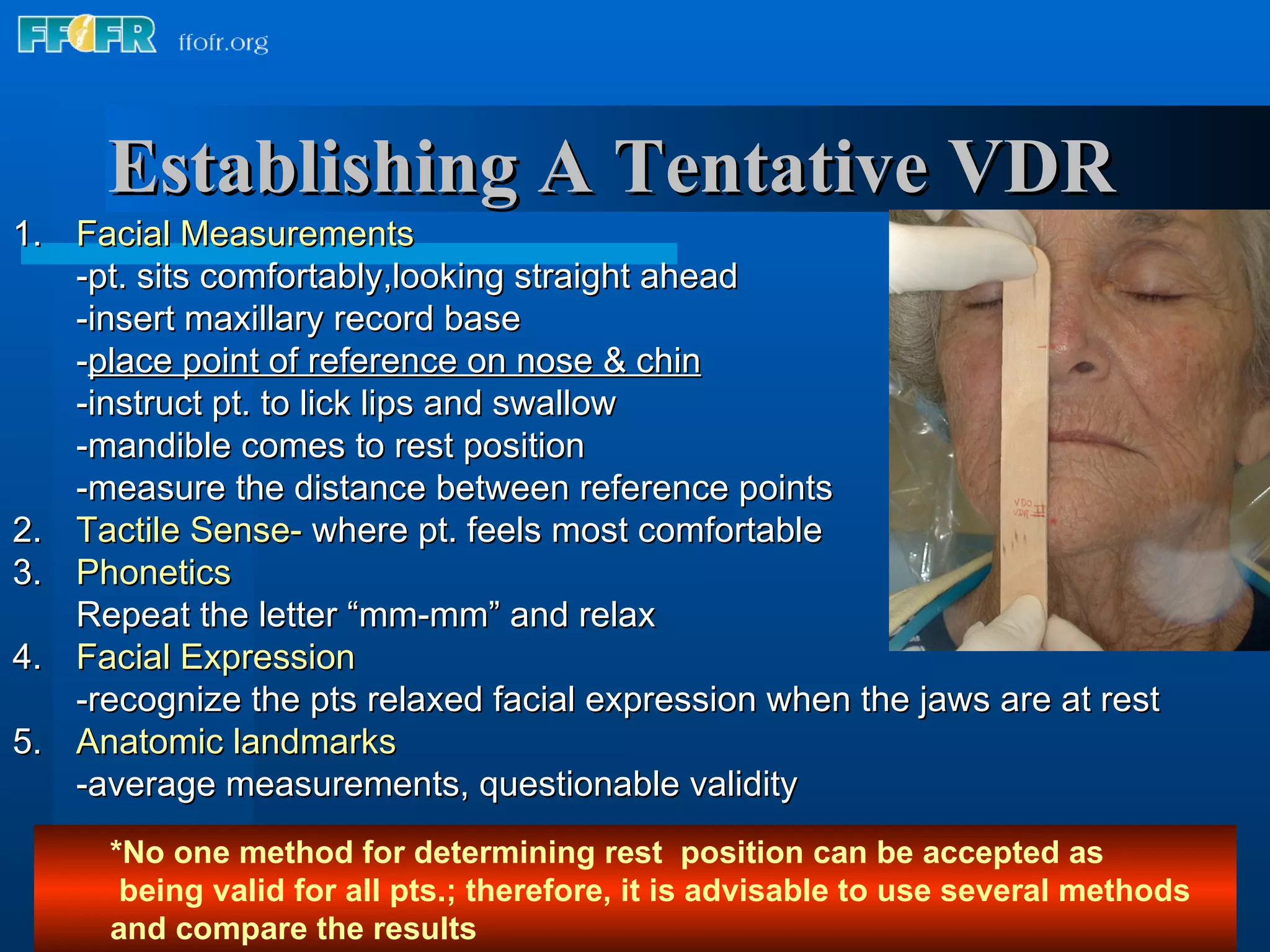
Facial Measurements -pt. sits comfortably,looking straight ahead -insert maxillary record base - place point of reference on nose & chin -instruct pt. to lick lips and swallow -mandible comes to rest position -measure the distance between reference points 2. Tactile Sense-  where pt. feels most comfortable 3. Phonetics Repeat the letter “mm-mm” and relax 4. Facial Expression -recognize the pts relaxed facial expression when the jaws are at rest 5. Anatomic landmarks -average measurements, questionable validity Establishing A Tentative VDR *No one method for determining rest  position can be accepted as  being valid for all pts.; therefore, it is advisable to use several methods and compare the results
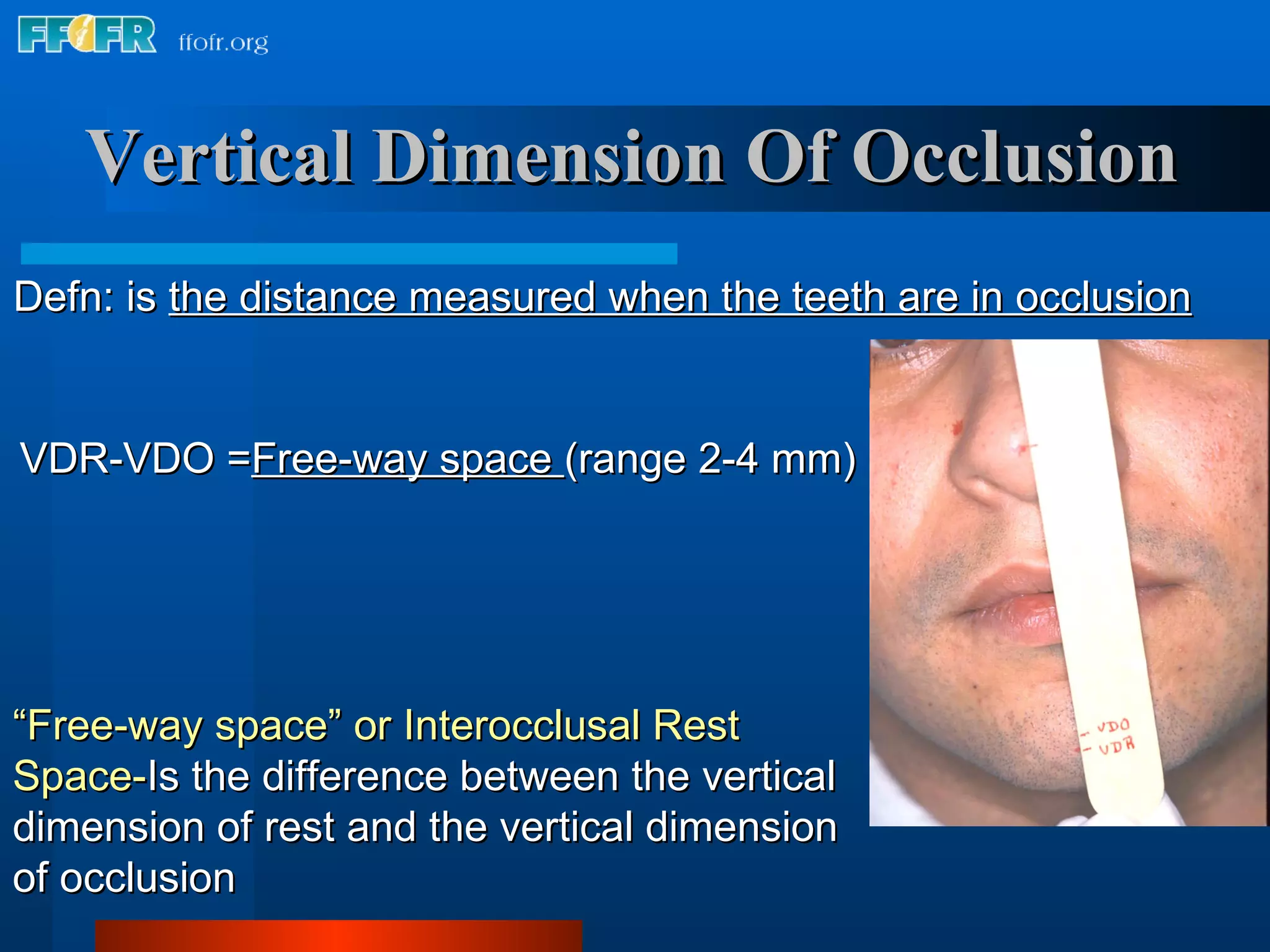
“ Free-way space” or Interocclusal Rest Space- Is the difference between the vertical dimension of rest and the vertical dimension of occlusion Vertical Dimension Of Occlusion Defn: is  the distance measured when the teeth are in occlusion VDR-VDO = Free-way space  (range 2-4 mm)
Method of Obtaining VDO   Soften mandibular wax rim  with hot spatula Temper in water bath
Method of Obtaining VDO Insert mandibular record base Have patient bite down on the softened wax rim  Repeat until patient is at previously determined VDO position. * VDR-(2-4mm)=VDO
Interocclusal Rest Space:Freeway Space “ VDR” “ VDO ”  The distance between the occluding surfaces of the maxillary and mandibular teeth when the mandible is in its physiologic rest position Interocclusal Rest Space
results in: - clicking  of the teeth - facial distortion , tense strained  appearance - difficulty closing lips - difficulty swallowing - soreness and discomfort  under the denture - increased ridge resorption  due to trauma Inadequate Interocclusal Rest Space = Excessive VDO Inadequate Interocclusal Rest Space
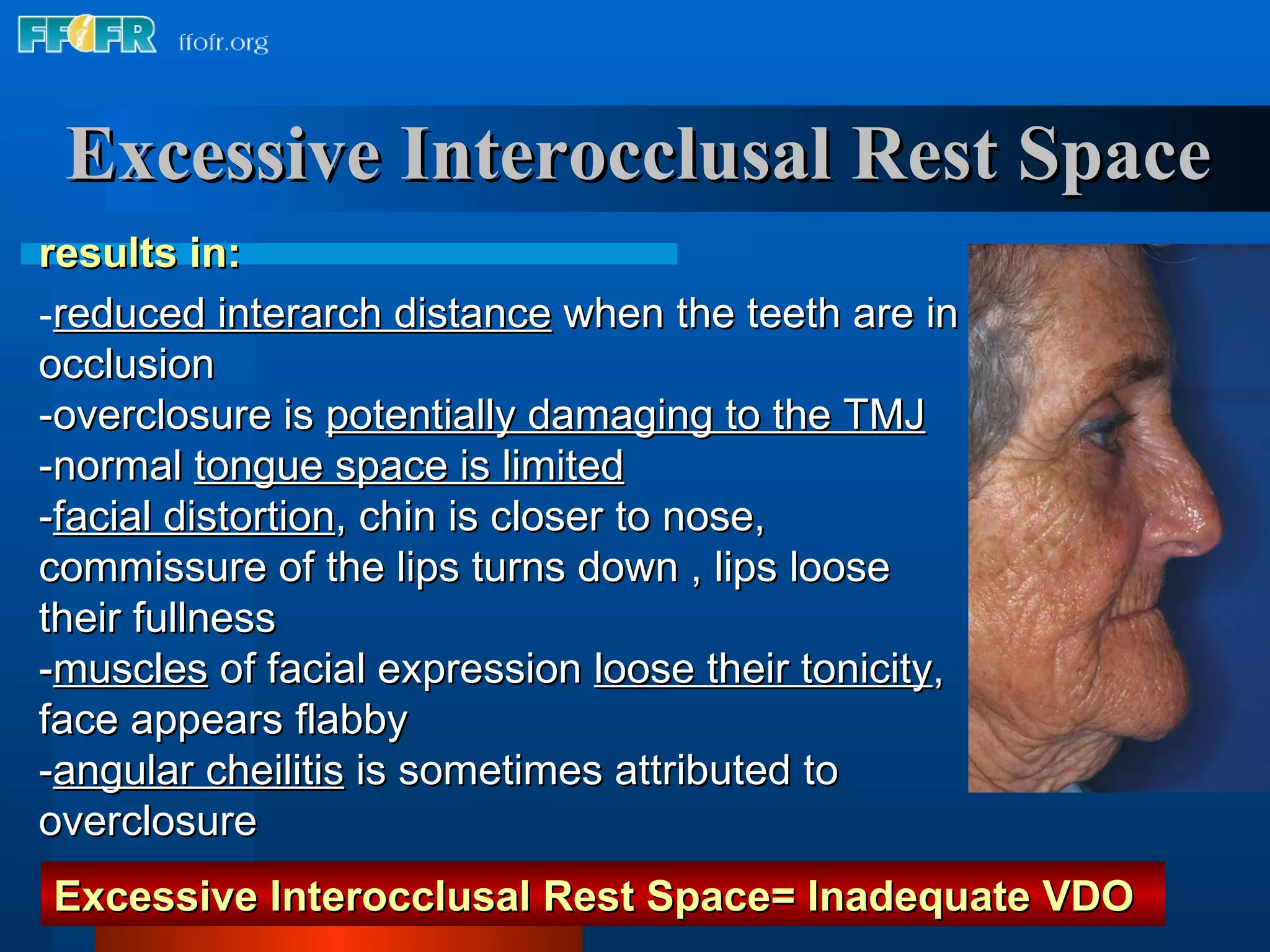
results in: - reduced interarch distance  when the teeth are in occlusion -overclosure is  potentially damaging to the TMJ -normal  tongue space is limited - facial distortion , chin is closer to nose, commissure of the lips turns down , lips loose their fullness - muscles  of facial expression  loose their tonicity , face appears flabby - angular cheilitis  is sometimes attributed to overclosure Excessive Interocclusal Rest Space= Inadequate VDO Excessive Interocclusal Rest Space
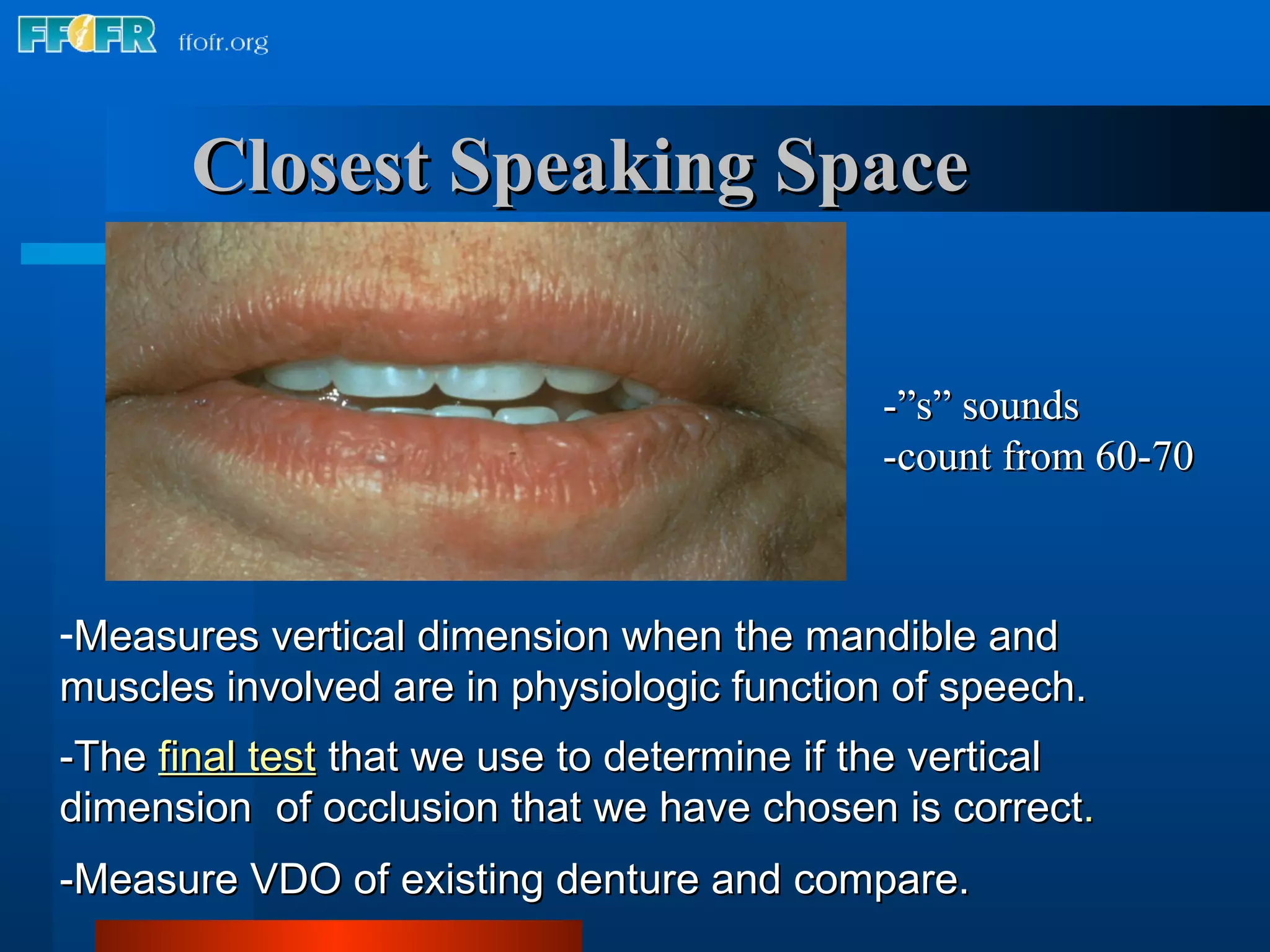
Measures vertical dimension when the mandible and muscles involved are in physiologic function of speech. -The  final test  that we use to determine if the vertical dimension  of occlusion that we have chosen is correct . -Measure VDO of existing denture and compare. -”s” sounds -count from 60-70 Closest Speaking Space
Now that we have determined the vertical of occlusion how do we record the position of the mandible so that we can mount the mandibular cast on the articulator? Maxillo-Mandibular Records
Centric Occlusion(CO): Defn: is the relation of opposing occlusal surfaces that provide  maximum intercuspation . Centric Relation(CR): Defn: a maxillomandibular relationship in which  the condyles articulate with the thinnest avascular portion of their respective discs with the complex in the anterior-superior position against the slopes of the articular eminences. Centric occlusion  with teeth present is a  tooth-to-tooth  relation,whereas  centric relation , is a static position, is a  bone to bone  relation. Centric Records
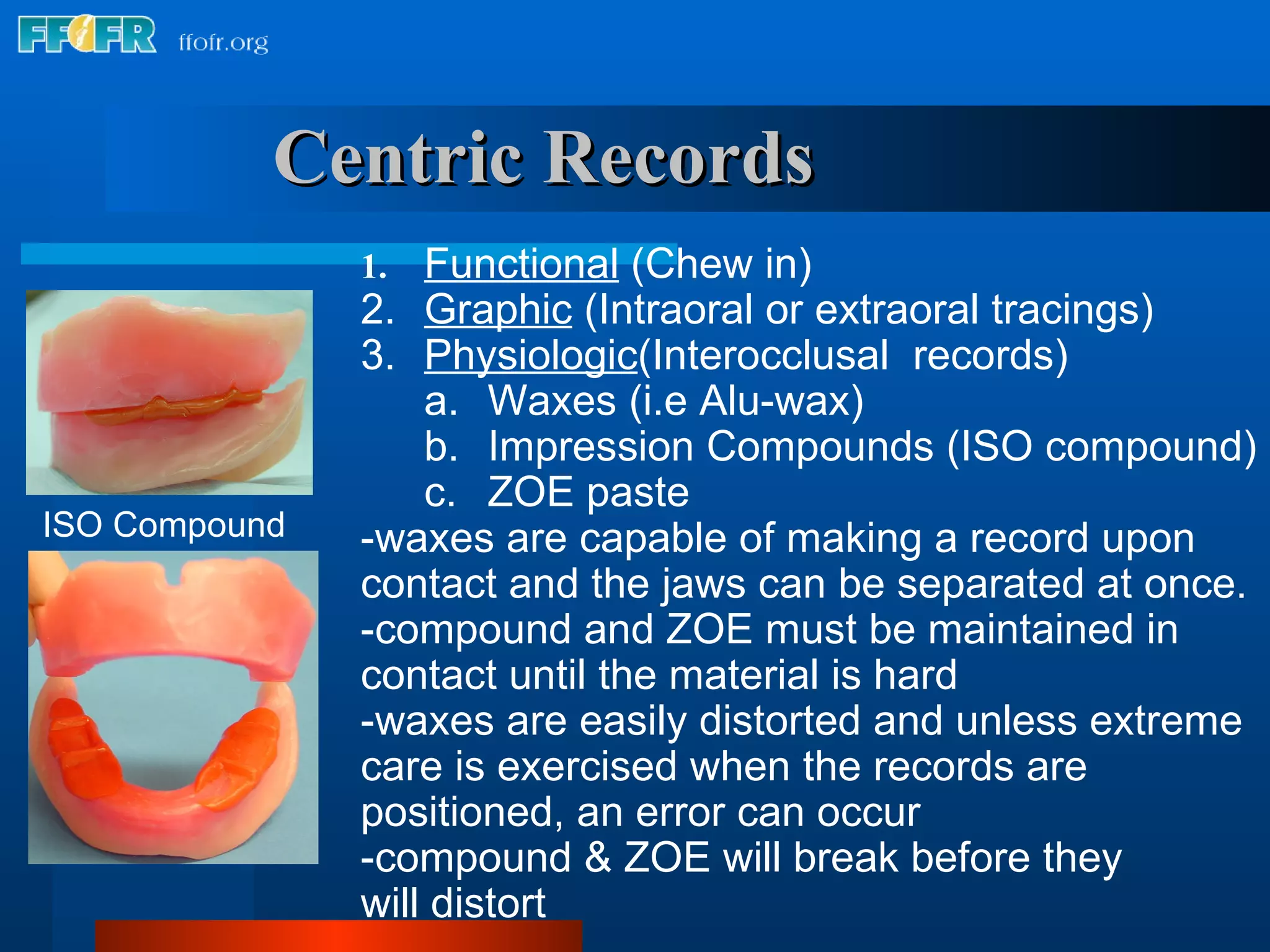
1. Functional  (Chew in) Graphic  (Intraoral or extraoral tracings) Physiologic (Interocclusal  records) Waxes (i.e Alu-wax) Impression Compounds (ISO compound) ZOE paste -waxes are capable of making a record upon  contact and the jaws can be separated at once. -compound and ZOE must be maintained in  contact until the material is hard -waxes are easily distorted and unless extreme  care is exercised when the records are  positioned, an error can occur -compound & ZOE will break before they  will distort Centric Records ISO Compound
Material Properties -Virtual is an addition-reaction silicone -Thixotropic viscocity -Fast setting time -Dimensionally stable -Final hardness (95 Shore-A) Alternative Material- Virtual Application -Inject material on occlusal surfaces -Guide patient into a CR position -Hold the position until material is set (60 sec.)
The technique can be divided into 2 steps: A tentative record using wax occlusion  rims attached to accurate stable  record bases. Interocclusal check records with teeth  arranged during the final try-in. Alu-wax Centric Records
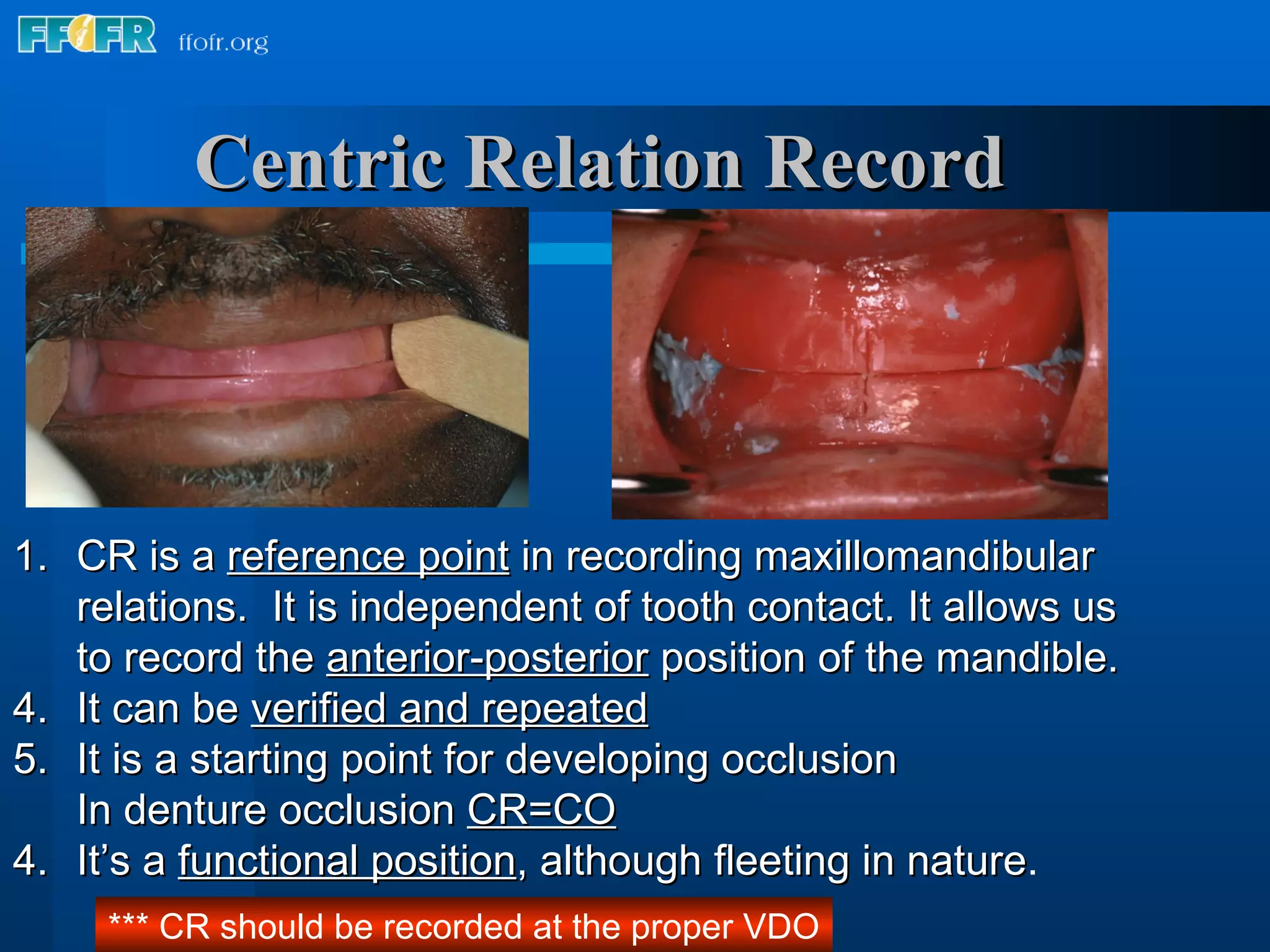
CR is a  reference point  in recording maxillomandibular relations.  It is independent of tooth contact. It allows us to record the  anterior-posterior  position of the mandible. It can be  verified and repeated It is a starting point for developing occlusion In denture occlusion  CR=CO 4. It’s a  functional position , although fleeting in nature . Centric Relation Record *** CR should be recorded at the proper VDO
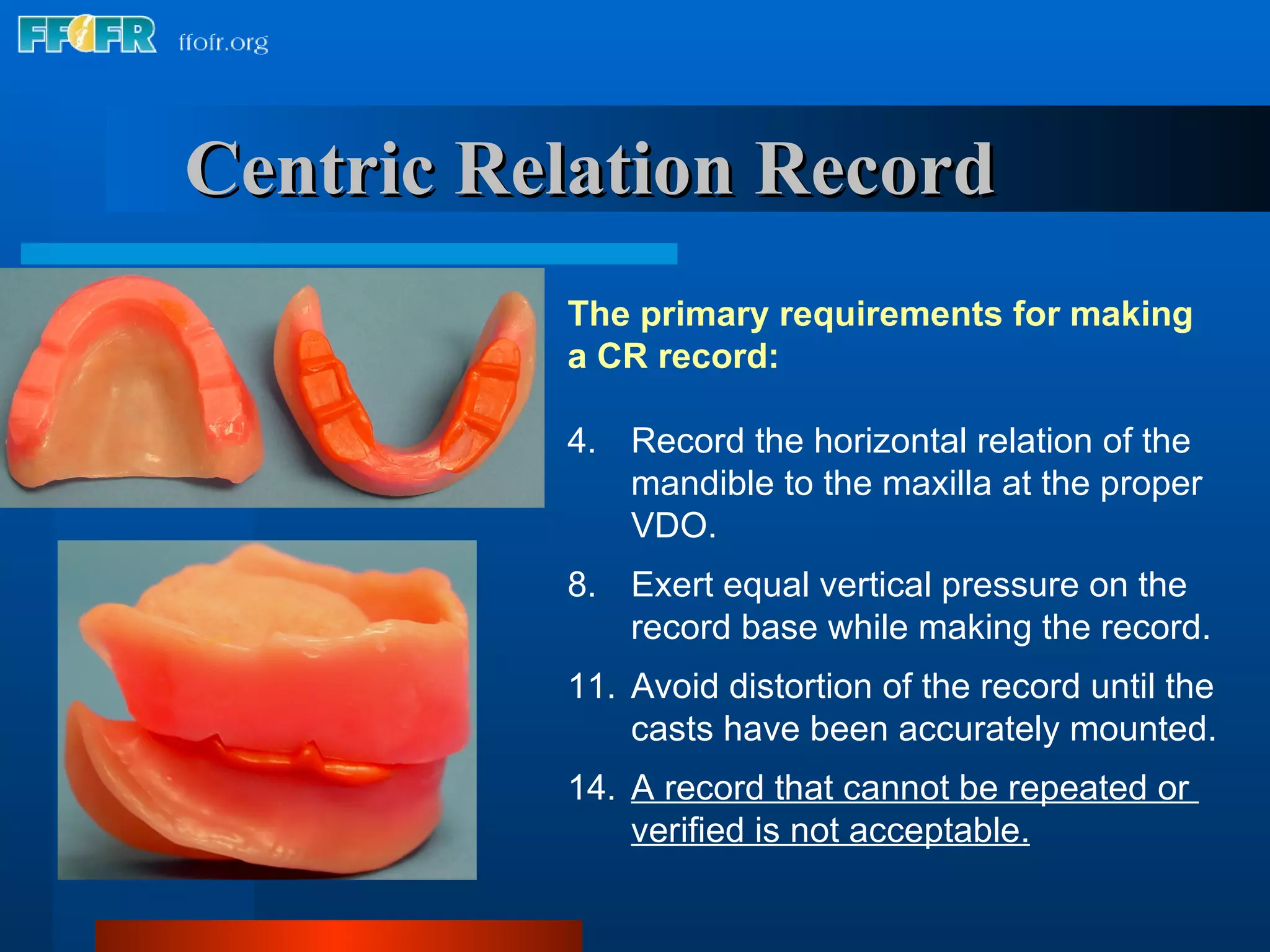
The primary requirements for making a CR record: Record the horizontal relation of the  mandible to the maxilla at the proper  VDO. Exert equal vertical pressure on the  record base while making the record. Avoid distortion of the record until the  casts have been accurately mounted. A record that cannot be repeated or  verified is not acceptable. Centric Relation Record
Recording Centric Relation Before making the final record check for interferences between the record bases Adjust record bases as necessary Warning
If retention is lacking sprinkle a thin layer of powder adhesive onto the record base Tap off excess powder Wet the surface Denture Adhesive
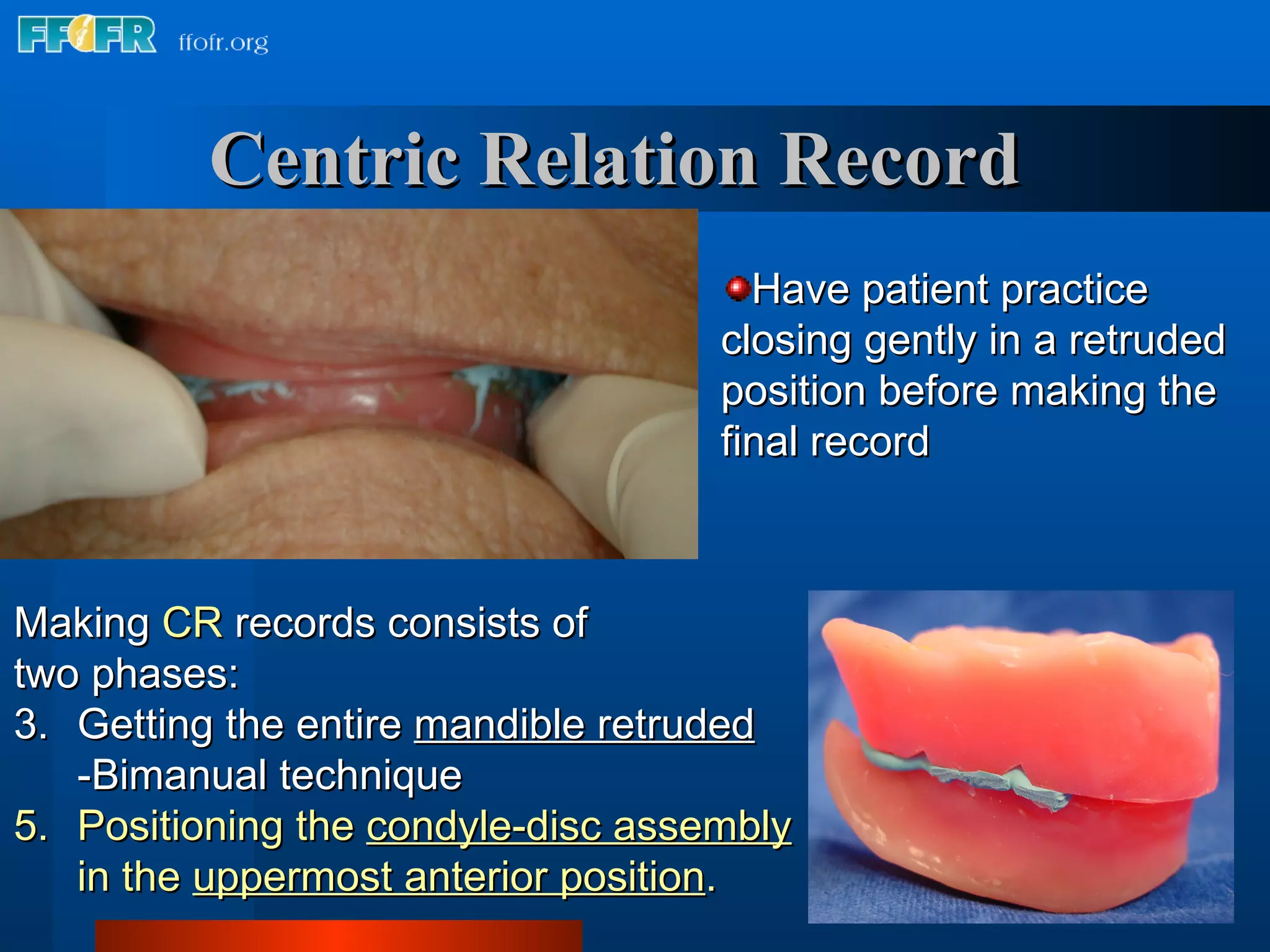
Making  CR  records consists of  two phases: Getting the entire  mandible retruded -Bimanual technique Positioning the  condyle-disc assembly in the  uppermost anterior position . Centric Relation Record Have patient practice closing gently in a retruded position before making the final record
Note: The casts and mountings are smoothed and sanded as shown Mounting the mandibular cast: Centric Relation Record
The  movement  the mandible and condyle  is downward and forward .  The angle of the slide varies from pt. to pt. and from side to side. We will  use this record to set condylar  inclinations  so that the articulator can perform eccentric movements equivalent to the relative movements of the mandible to the maxillae.  This makes it possible to arrange the teeth for complete dentures in balanced occlusion. The mandible must be protruded a minimum of 5-6 mm when making the record. Protrusive Record
Setting the Condylar Inclination Loosen the centric locking pins on the Stratos 200 articulator Observe the space that develops between the condylar elements when the casts are completely seated in the protrusive record
Setting the Condylar Inclination Select a protrusive insert that best fits the space Place the protrusive insert into position Orange 20 ° protrusive insert Note space remaining
Setting the Condylar Inclination Black  30 ° protrusive insert Fits perfectly into position & completely fills the space
1.   Seat pt. comfortably with head upright. 2.  Contour and mark the maxillary wax occlusion rim  (lip contour, midline,  occlusal plane). 3.  Make a  facebow transfer record  and mount the maxillary cast. 4.  Establish  (a)  VDR   &  (b)  VDO 5.  Make a tentative  CR record  at the proper VDO  6.  Use CR record to mount the mandibular cast on the articulator. 7.  Make a  Protrusive record  to set condylar inclinations. Maxillomandibular Records in Summary:
Alternate  Technique- Centric Tray The Centric Tray may be used to record  a preliminary occlusal relationship.  This  can be quickly accomplished during the  impressions appointment.  This record permits the laboratory technician  to mount the master casts prior to fabricating  record bases and wax rims. The record can be verified at the following  appointment with the record bases.
Alternate  Technique- Centric Tray Clinical Application: 1) Determine the patients VDR  and VDO 2) Load the try with heavy body  Virtual and place in patients  mouth. 3) Have the patient close to the  previously determine vertical dimension of rest. 4) Allow the material to set and remove from the mouth.
Alternate  Technique-Centric Tray The UTS Transferbow is  placed in position   The Centric Tray is gently inserted
Alternate  Technique-Centric Tray The Centric Tray is attached to the Transferbow and secured in place Once the alignment of the transferbow is  verified and all the   set screws are secured   the  apparatus is removed and ready for mounting.
The Centric Tray is removed from the  Transferbow and placed on the Stratos  articulator.  Set the models in the silicone impression and check the fit.  Trim back the vestibular edges of the silicone as necessary. Mount the models on the articulator,  positioning them in relation to the occlusal  record.
THE END!

10.maxillomandibular relation records

  • 1.
    10. Maxillo-mandibular RelationRecords Eleni Roumanas DDS Division of Advanced Prosthodontics, Biomaterials and Hospital Dentistry UCLA School of Dentistry Frank Lauciello DDS Ivoclar Vivadent This program of instruction is protected by copyright ©. No portion of this program of instruction may be reproduced, recorded or transferred by any means electronic, digital, photographic, mechanical etc., or by any information storage or retrieval system, without prior permission.
  • 2.
    Natural teeth areare suspended in the bone by the PDL which acts as a shock absorber. Denture teeth are part of the denture base which rests on movable/ displaceable tissues Premature, deflective contacts between artificial teeth cause movement of the denture resulting in damage to the supporting tissues There Are Distinct Differences Between Natural Dentition And Complete Denture Occlusion:
  • 3.
    Goals of CompleteDenture Occlusion Limit trauma to the supporting structures Preserve remaining structures Enhance stability of the dentures Restore Esthetics, Speech and Mastication
  • 4.
    Balancing Prot rus I ve Wor k i ng Defn: is the simultaneous contacting of the maxillary and mandibular teeth in the R and L and in the anterior and posterior occlusal areas when the jaws are either in centric or eccentric relations. Balanced Occlusion Centric Re l a t i on L i n g u a l i z e d O c c l u s s i o n
  • 5.
    Making Jaw RelationRecords In order to establish a balanced occlusion we must transfer our pts. maxillo-mandibular relationship to our articulator.
  • 6.
    Facebow Record Recordsthe orientation of the maxilla to the terminal hinge axis. Provides the same relative opening axis on the articulator as the mandible has to the TMJ.
  • 7.
    Defn: orients themaxilla to the transverse axis of the mandible in three dimensions and allows the transfer of this orientation to the articulator. Denar Hanau Ivoclar Facebow
  • 8.
    Hinge Axis Defn:Ahypothetical line through the two mandibular condyles around which the mandible may rotate.
  • 9.
    Arbitrary Hinge Axis:Is an estimated axis location , using any of the current techniques will place the position within + 6mm of the true hinge axis. Earbows use the external auditory meatus reference point as the arbitrary hinge axis location. True Hinge Axis: Is difficult to determine especially in edentulous pts. and requires special armamentarium. Hinge Axis
  • 10.
    Wax Rim ContourPlace the maxillary record base and wax rim in the pts. mouth and begin to contour it for proper phonetics, esthetics lip support and occlusal plane.
  • 11.
    With the lipsat rest the wax rim should project 1-2 mm below the lip line. Before adjustment After adjustment Wax Rim Contour
  • 12.
    Adjust the planeof the wax rim so that it is parallel to Camper’s plane. Adjust the plane of the wax rim so that it is parallel to the interpupillary line. Occlusal Plane
  • 13.
    Fox Plane A Fox Plane can be used to help properly orient the occlusal plane. Note the position occlusal plane in relation to the corners of the lips.
  • 14.
  • 15.
    Mark the midlineon the wax rim. Determine Midline
  • 16.
    Facebow Transfer RecordArmamentarium -Compound -Water bath -Alcohol torch -Vaseline -Red handled knife -Facebow
  • 17.
    Place notches inthe maxillary wax rim as shown Facebow Transfer Record
  • 18.
    Index wax rimto bite fork with compound as shown vaseline thin layer temper center midline soften compound
  • 19.
    UTS-Universal TransferbowSystem Have the patient position the ear pieces. Place the nose piece on the bridge of the nose. This will provide support for the entire earbow apparatus.
  • 20.
    UTS-Universal TransferbowSystem Position the 3 rd point of reference at the base of the ala. The earpieces can be adjusted up or down to level the bow parallel to the interpupillary line.
  • 21.
    UTS-Universal TransferbowSystem The record base, wax rim and bite fork are now inserted in the patients mouth and connected to the facebow.
  • 22.
    UTS-Universal TransferbowSystem Remove the facebow from the patient. Insert the maxillary cast into the record on the bite fork and attach the cast and face bow to the Stratos articulator with the mounting jig. The record on the bite fork is indexed to the maxillary wax rim
  • 23.
    Reminder: After mountingthe upper cast, make sure the incisal guide pin is at zero and in contact with the incisal guide table. UTS-Universal Transferbow System
  • 24.
    Articulator Mountings Themounting is carefully smoothed and sanded. When you are finished all your mountings must look like this one.
  • 25.
    Refers to the length of the face. It’s the distance between two selected points, one on the fixed member (nose tip) and one on the movable member (chin point). Is maintained either by the occlusion of the teeth( vertical dimension of occlusion VDO ) or the balanced tonic contraction of the opening and closing muscles of mandibular movements ( vertical dimension of physiologic rest position VDR ). Determination of Vertical Dimension Establishing the vertical separation between the arches
  • 26.
    These two measurablelengths of the face are important guides in making maxillomandibular relation records and are referred to as: Vertical dimension of rest (VDR) Vertical dimension of occlusion (VDO) Determination of Vertical Dimension
  • 27.
    PHYSIOLOGIC REST POSITION:In the absence of pathosis the relation is fairly constant throughout life. The position can be accurately recorded and measured within acceptable limits. It is used to determine the vertical dimension of occlusion . Defn: Is the vertical separation of the jaws when the opening & closing muscles of the mandible are at rest in tonic contraction . It is the length of the face when the mandible is in rest position. Vertical Dimension of Rest
  • 28.
    Establishing VDRPlace the patient in an upright position Place marks on the tip of nose and the tip of the chin, on the greatest height of curvature. Make sure the chin is unstrained “ VDR”
  • 29.
    Facial Measurements -pt.sits comfortably,looking straight ahead -insert maxillary record base - place point of reference on nose & chin -instruct pt. to lick lips and swallow -mandible comes to rest position -measure the distance between reference points 2. Tactile Sense- where pt. feels most comfortable 3. Phonetics Repeat the letter “mm-mm” and relax 4. Facial Expression -recognize the pts relaxed facial expression when the jaws are at rest 5. Anatomic landmarks -average measurements, questionable validity Establishing A Tentative VDR *No one method for determining rest position can be accepted as being valid for all pts.; therefore, it is advisable to use several methods and compare the results
  • 30.
    “ Free-way space”or Interocclusal Rest Space- Is the difference between the vertical dimension of rest and the vertical dimension of occlusion Vertical Dimension Of Occlusion Defn: is the distance measured when the teeth are in occlusion VDR-VDO = Free-way space (range 2-4 mm)
  • 31.
    Method of ObtainingVDO Soften mandibular wax rim with hot spatula Temper in water bath
  • 32.
    Method of ObtainingVDO Insert mandibular record base Have patient bite down on the softened wax rim Repeat until patient is at previously determined VDO position. * VDR-(2-4mm)=VDO
  • 33.
    Interocclusal Rest Space:FreewaySpace “ VDR” “ VDO ” The distance between the occluding surfaces of the maxillary and mandibular teeth when the mandible is in its physiologic rest position Interocclusal Rest Space
  • 34.
    results in: -clicking of the teeth - facial distortion , tense strained appearance - difficulty closing lips - difficulty swallowing - soreness and discomfort under the denture - increased ridge resorption due to trauma Inadequate Interocclusal Rest Space = Excessive VDO Inadequate Interocclusal Rest Space
  • 35.
    results in: -reduced interarch distance when the teeth are in occlusion -overclosure is potentially damaging to the TMJ -normal tongue space is limited - facial distortion , chin is closer to nose, commissure of the lips turns down , lips loose their fullness - muscles of facial expression loose their tonicity , face appears flabby - angular cheilitis is sometimes attributed to overclosure Excessive Interocclusal Rest Space= Inadequate VDO Excessive Interocclusal Rest Space
  • 36.
    Measures vertical dimensionwhen the mandible and muscles involved are in physiologic function of speech. -The final test that we use to determine if the vertical dimension of occlusion that we have chosen is correct . -Measure VDO of existing denture and compare. -”s” sounds -count from 60-70 Closest Speaking Space
  • 37.
    Now that wehave determined the vertical of occlusion how do we record the position of the mandible so that we can mount the mandibular cast on the articulator? Maxillo-Mandibular Records
  • 38.
    Centric Occlusion(CO): Defn:is the relation of opposing occlusal surfaces that provide maximum intercuspation . Centric Relation(CR): Defn: a maxillomandibular relationship in which the condyles articulate with the thinnest avascular portion of their respective discs with the complex in the anterior-superior position against the slopes of the articular eminences. Centric occlusion with teeth present is a tooth-to-tooth relation,whereas centric relation , is a static position, is a bone to bone relation. Centric Records
  • 39.
    1. Functional (Chew in) Graphic (Intraoral or extraoral tracings) Physiologic (Interocclusal records) Waxes (i.e Alu-wax) Impression Compounds (ISO compound) ZOE paste -waxes are capable of making a record upon contact and the jaws can be separated at once. -compound and ZOE must be maintained in contact until the material is hard -waxes are easily distorted and unless extreme care is exercised when the records are positioned, an error can occur -compound & ZOE will break before they will distort Centric Records ISO Compound
  • 40.
    Material Properties -Virtualis an addition-reaction silicone -Thixotropic viscocity -Fast setting time -Dimensionally stable -Final hardness (95 Shore-A) Alternative Material- Virtual Application -Inject material on occlusal surfaces -Guide patient into a CR position -Hold the position until material is set (60 sec.)
  • 41.
    The technique canbe divided into 2 steps: A tentative record using wax occlusion rims attached to accurate stable record bases. Interocclusal check records with teeth arranged during the final try-in. Alu-wax Centric Records
  • 42.
    CR is a reference point in recording maxillomandibular relations. It is independent of tooth contact. It allows us to record the anterior-posterior position of the mandible. It can be verified and repeated It is a starting point for developing occlusion In denture occlusion CR=CO 4. It’s a functional position , although fleeting in nature . Centric Relation Record *** CR should be recorded at the proper VDO
  • 43.
    The primary requirementsfor making a CR record: Record the horizontal relation of the mandible to the maxilla at the proper VDO. Exert equal vertical pressure on the record base while making the record. Avoid distortion of the record until the casts have been accurately mounted. A record that cannot be repeated or verified is not acceptable. Centric Relation Record
  • 44.
    Recording Centric RelationBefore making the final record check for interferences between the record bases Adjust record bases as necessary Warning
  • 45.
    If retention islacking sprinkle a thin layer of powder adhesive onto the record base Tap off excess powder Wet the surface Denture Adhesive
  • 46.
    Making CR records consists of two phases: Getting the entire mandible retruded -Bimanual technique Positioning the condyle-disc assembly in the uppermost anterior position . Centric Relation Record Have patient practice closing gently in a retruded position before making the final record
  • 47.
    Note: The castsand mountings are smoothed and sanded as shown Mounting the mandibular cast: Centric Relation Record
  • 48.
    The movement the mandible and condyle is downward and forward . The angle of the slide varies from pt. to pt. and from side to side. We will use this record to set condylar inclinations so that the articulator can perform eccentric movements equivalent to the relative movements of the mandible to the maxillae. This makes it possible to arrange the teeth for complete dentures in balanced occlusion. The mandible must be protruded a minimum of 5-6 mm when making the record. Protrusive Record
  • 49.
    Setting the CondylarInclination Loosen the centric locking pins on the Stratos 200 articulator Observe the space that develops between the condylar elements when the casts are completely seated in the protrusive record
  • 50.
    Setting the CondylarInclination Select a protrusive insert that best fits the space Place the protrusive insert into position Orange 20 ° protrusive insert Note space remaining
  • 51.
    Setting the CondylarInclination Black 30 ° protrusive insert Fits perfectly into position & completely fills the space
  • 52.
    1. Seat pt. comfortably with head upright. 2. Contour and mark the maxillary wax occlusion rim (lip contour, midline, occlusal plane). 3. Make a facebow transfer record and mount the maxillary cast. 4. Establish (a) VDR & (b) VDO 5. Make a tentative CR record at the proper VDO 6. Use CR record to mount the mandibular cast on the articulator. 7. Make a Protrusive record to set condylar inclinations. Maxillomandibular Records in Summary:
  • 53.
    Alternate Technique-Centric Tray The Centric Tray may be used to record a preliminary occlusal relationship. This can be quickly accomplished during the impressions appointment. This record permits the laboratory technician to mount the master casts prior to fabricating record bases and wax rims. The record can be verified at the following appointment with the record bases.
  • 54.
    Alternate Technique-Centric Tray Clinical Application: 1) Determine the patients VDR and VDO 2) Load the try with heavy body Virtual and place in patients mouth. 3) Have the patient close to the previously determine vertical dimension of rest. 4) Allow the material to set and remove from the mouth.
  • 55.
    Alternate Technique-CentricTray The UTS Transferbow is placed in position The Centric Tray is gently inserted
  • 56.
    Alternate Technique-CentricTray The Centric Tray is attached to the Transferbow and secured in place Once the alignment of the transferbow is verified and all the set screws are secured the apparatus is removed and ready for mounting.
  • 57.
    The Centric Trayis removed from the Transferbow and placed on the Stratos articulator. Set the models in the silicone impression and check the fit. Trim back the vestibular edges of the silicone as necessary. Mount the models on the articulator, positioning them in relation to the occlusal record.
  • 58.