About the Presentations
• The presentations cover the objectives found in the
  opening of each chapter.
• All chapter objectives are listed in the beginning of
  each presentation.
• You may customize the presentations to fit your
  class needs.
• Some figures from the chapters are included. A
  complete set of images from the book can be found
  on the Instructor Resources disc.
Ethics in Information
Technology, Fourth Edition


          Chapter 1
     An Overview of Ethics
Objectives

• As you read this chapter, consider the following
  questions:
      – What is ethics, and why is it important to act
        according to a code of ethics?
      – Why is business ethics becoming increasingly
        important?
      – What are organizations doing to improve their
        business ethics?


Ethics in Information Technology, Fourth Edition         3
Objectives (cont’d.)

     – Why are organizations interested in fostering good
       business ethics?
     – What approach can you take to ensure ethical
       decision making?
     – What trends have increased the risk of using
       information technology in an unethical manner?


Ethics in Information Technology, Fourth Edition            4
What is Ethics?

• Moral code
     – Set of rules
     – Establishes boundaries of generally accepted
       behavior
     – Different rules often have contradictions
• Morality
     – Social conventions about right and wrong
     – Widely shared
     – Form basis for an established consensus


Ethics in Information Technology, Fourth Edition      5
What is Ethics? (cont’d.)

• Morality may vary by:
     –   Age
     –   Cultural group
     –   Ethnic background
     –   Religion
     –   Life experiences
     –   Education
     –   Gender


Ethics in Information Technology, Fourth Edition   6
Definition of Ethics

• Ethics
     – Set of beliefs about right and wrong behavior
• Virtues
     – Habits that incline people to do what is acceptable
• Vices
     – Habits of unacceptable behavior
• Virtues and vices define a personal value system
     – Scheme of moral values


Ethics in Information Technology, Fourth Edition             7
The Importance of Integrity

• Integrity is a cornerstone of ethical behavior
• People with integrity:
     – Act in accordance with a personal code of principles
     – Extend to all the same respect and consideration
     – Apply the same moral standards in all situations
• Lack of integrity emerges if you apply moral
  standards differently according to situation or people
  involved
• Many ethical dilemmas are not as simple as right
  versus wrong
Ethics in Information Technology, Fourth Edition              8
The Difference Between Morals,
                Ethics, and Laws
• Morals: one’s personal beliefs about right and wrong
• Ethics: standards or codes of behavior expected of
  an individual by a group
• Law: system of rules that tells us what we can and
  cannot do
     – Laws are enforced by a set of institutions
     – Legal acts conform to the law
     – Moral acts conform to what an individual believes is
       the right belief of right and wrong


Ethics in Information Technology, Fourth Edition              9
Ethics in the Business World

• Both the likelihood and the negative impact of
  inappropriate behavior have increased
• Several trends have increased the likelihood of
  unethical behavior:
     – Globalization creating complex work environments
     – Organizations challenged to maintain profits / revenue
     – Heightened vigilance by:
        • Employees
        • Shareholders
        • Regulatory agencies
Ethics in Information Technology, Fourth Edition           10
Ethics in the Business World (cont’d.)

• Recent scandals in IT companies
     –   Satyam Computer Services (India)
     –   Hewlett Packard
     –   Computer Associates International
     –   IBM
• Not just executives, but even lower-level employees,
  can find themselves in the middle of an ethical
  dilemma


Ethics in Information Technology, Fourth Edition    11
Why Fostering Good Business Ethics
              Is Important
• To gain the good will of the community
• To create an organization that operates consistently
• To foster good business practices
• To protect organization/employees from legal action
• To avoid unfavorable publicity


Ethics in Information Technology, Fourth Edition     12
Gaining the Good Will
                       of the Community
• Organizations have fundamental responsibilities to
  society
     – Declared in formal statement of company’s principles
       or beliefs
     – Include:
           • Making contributions to charitable organizations and
             nonprofit institutions
           • Providing benefits for employees in excess of legal
             requirements
           • Choosing economic opportunities that might be more
             socially desirable than profitable

Ethics in Information Technology, Fourth Edition                    13
Gaining the Good Will of the
                 Community (cont’d.)
• Socially responsible activities create good will
• Good will makes it easier for corporations to conduct
  business


Ethics in Information Technology, Fourth Edition     14
Creating an Organization That
               Operates Consistently
• Consistency ensures that employees:
     – Know what is expected of them
     – Can employ the organization’s values to help them in
       decision making
• Consistency also means that shareholders,
  customers, suppliers, and community know what
  they can expect of the organization


Ethics in Information Technology, Fourth Edition          15
Creating an Organization That
           Operates Consistently (cont’d.)
• Many companies share the following values:
     – Operate with honesty and integrity, staying true to
       organizational principles
     – Operate according to standards of ethical conduct, in
       words and action
     – Treat colleagues, customers, and consumers with
       respect
     – Strive to be the best at what matters to the company
     – Value diversity
     – Make decisions based on facts and principles

Ethics in Information Technology, Fourth Edition           16
Fostering Good Business Practices

• Good ethics means good business/improved profits
• Companies that:
     – Produce safe and effective products
        • Avoid costly recalls and lawsuits
     – Provide excellent service that retains customers
     – Develop and maintain strong employee relations
        • Suffer lower turnover rates
        • Enjoy better employee morale


Ethics in Information Technology, Fourth Edition          17
Fostering Good Business Practices
                 (cont’d.)
• Suppliers/business partners place priority on
  working with companies that operate in a fair and
  ethical manner
• Bad ethics means bad business/waning profits
     – Bad ethics can lead to bad business results
     – Bad ethics can have a negative impact on employees


Ethics in Information Technology, Fourth Edition        18
Protecting the Organization and Its
        Employees from Legal Actions
• U.S. Supreme Court established that an employer
  can be held responsible for the acts of its
  employees
• This principle is called respondeat superior
• Coalition of several legal organizations argues
  establishment of ethics and compliance programs
  should reduce criminal liability of organization
• Others argue company officers should not be given
  light sentences if their ethics programs are
  ineffective

Ethics in Information Technology, Fourth Edition      19
Avoiding Unfavorable Publicity

• Public reputation of company strongly influences:
     –   Value of its stock
     –   How consumers regard products and services
     –   Degree of oversight received from government
     –   Amount of support and cooperation received
• Organizations are motivated to build strong ethics
  programs to avoid negative publicity


Ethics in Information Technology, Fourth Edition        20
Improving Corporate Ethics

• Characteristics of a successful ethics program
     – Employees willing to seek advice about ethical issues
     – Employees feel prepared to handle situations that
       could lead to misconduct
     – Employees are rewarded for ethical behavior
     – Employees are not rewarded for success obtained
       through questionable means
     – Employees feel positive about their company


Ethics in Information Technology, Fourth Edition           21
Appointing a Corporate Ethics Officer

• Corporate ethics officer
     – Provides vision and leadership in business conduct
     – Should be well-respected, senior-level manager who
       reports directly to the CEO
     – Ensures ethical procedures are put in place
     – Creates and maintains ethics culture
     – Is responsible for key knowledge/contact person for
       ethical issues


Ethics in Information Technology, Fourth Edition             22
Ethical Standards Set by Board of
                   Directors
• Board oversees the organization’s business
  activities and management
• Board members of company are expected to:
     – Conduct themselves according to the highest
       standards of personal and professional integrity
     – Set standard for company-wide ethical conduct
     – Ensure compliance with laws and regulations
     – Create environment in which employees can seek
       advice about business conduct, raise issues, and
       report misconduct

Ethics in Information Technology, Fourth Edition          23
Establishing a Corporate Code of
                       Ethics
• Code of ethics
     – Highlights an organization’s key ethical issues
     – Identifies overarching values and important principles
     – Focuses employees on areas of ethical risk
     – Offers guidance for employees to recognize and deal
       with ethical issues
     – Provides mechanisms to report unethical conduct
     – Help employees abide by the law, follow necessary
       regulations, and behave in an ethical manner


Ethics in Information Technology, Fourth Edition            24
Establishing a Corporate
                   Code of Ethics (cont’d.)
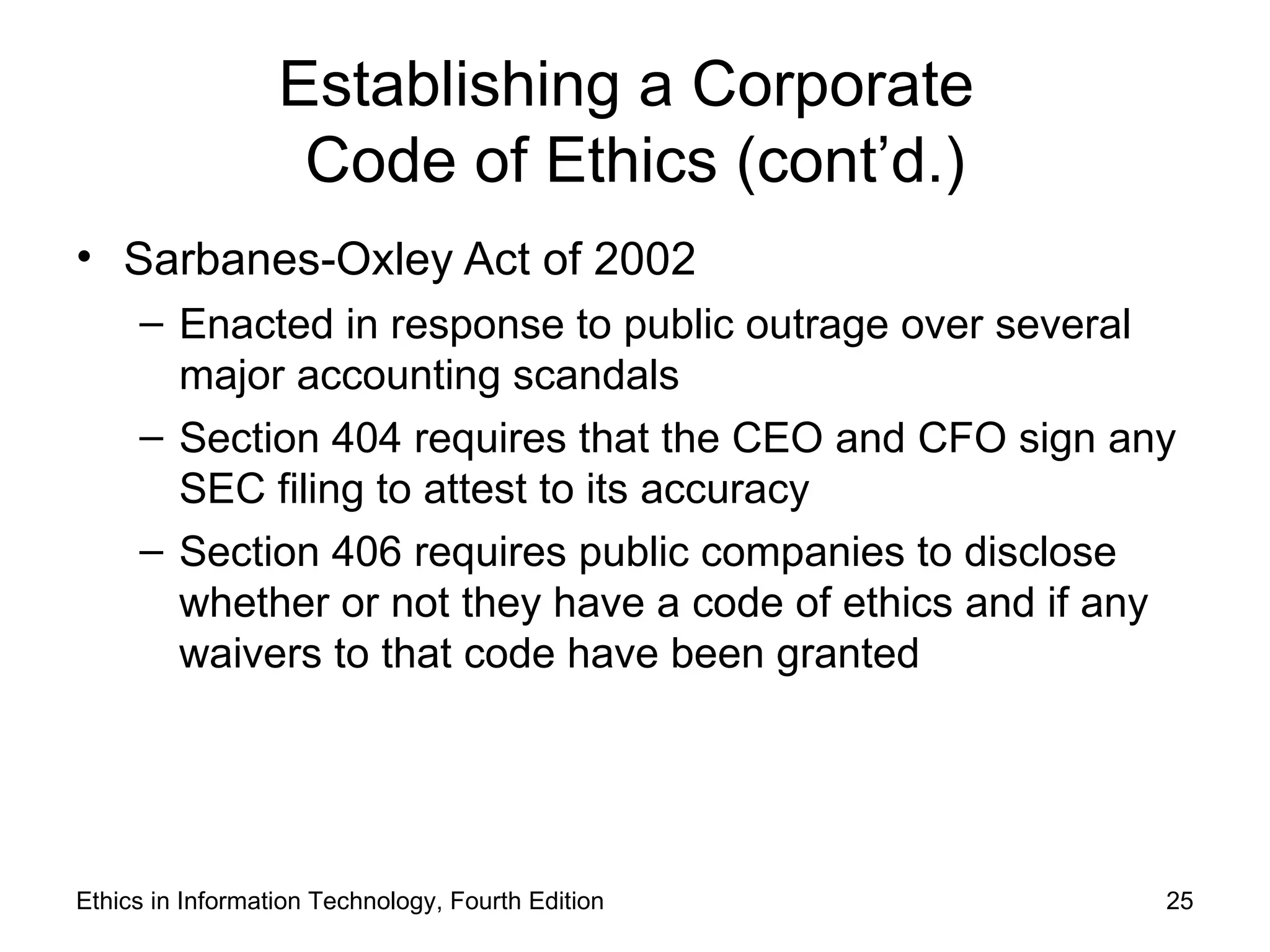
• Sarbanes-Oxley Act of 2002
     – Enacted in response to public outrage over several
       major accounting scandals
     – Section 404 requires that the CEO and CFO sign any
       SEC filing to attest to its accuracy
     – Section 406 requires public companies to disclose
       whether or not they have a code of ethics and if any
       waivers to that code have been granted


Ethics in Information Technology, Fourth Edition          25
Establishing a Corporate
                   Code of Ethics (cont’d.)
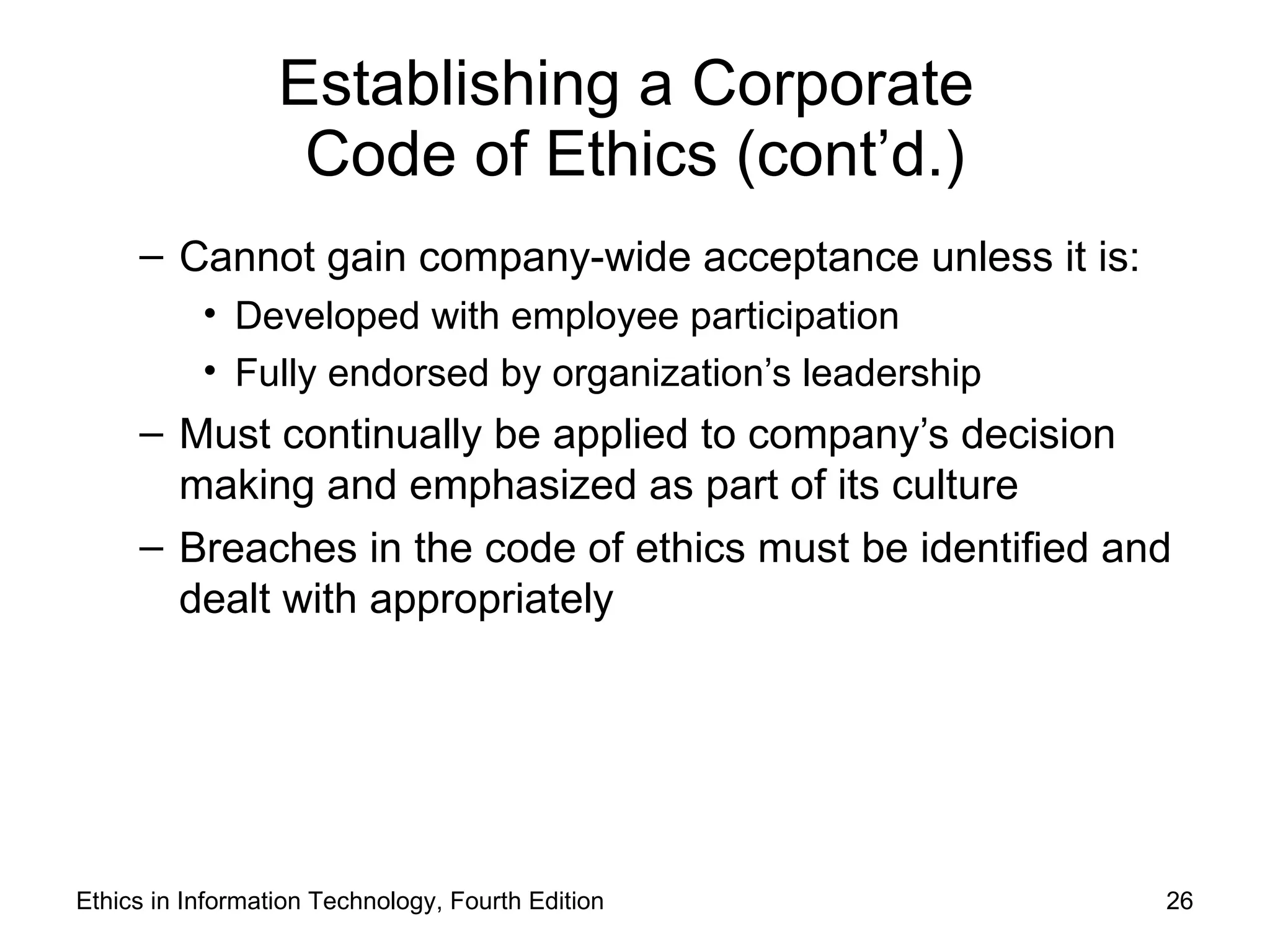
     – Cannot gain company-wide acceptance unless it is:
           • Developed with employee participation
           • Fully endorsed by organization’s leadership
     – Must continually be applied to company’s decision
       making and emphasized as part of its culture
     – Breaches in the code of ethics must be identified and
       dealt with appropriately


Ethics in Information Technology, Fourth Edition           26
Establishing a Corporate
                   Code of Ethics (cont’d.)


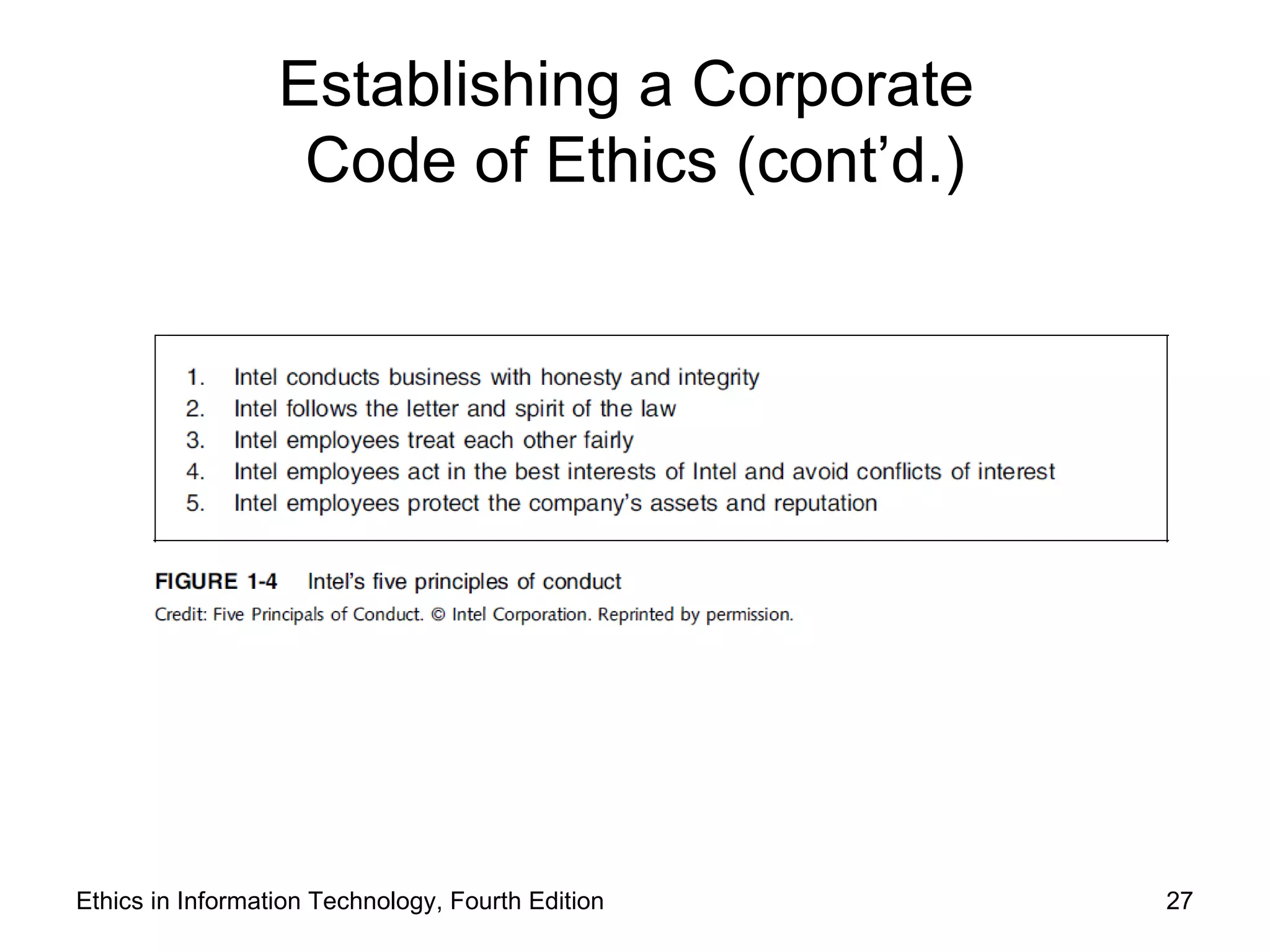
Ethics in Information Technology, Fourth Edition   27
Conducting Social Audits

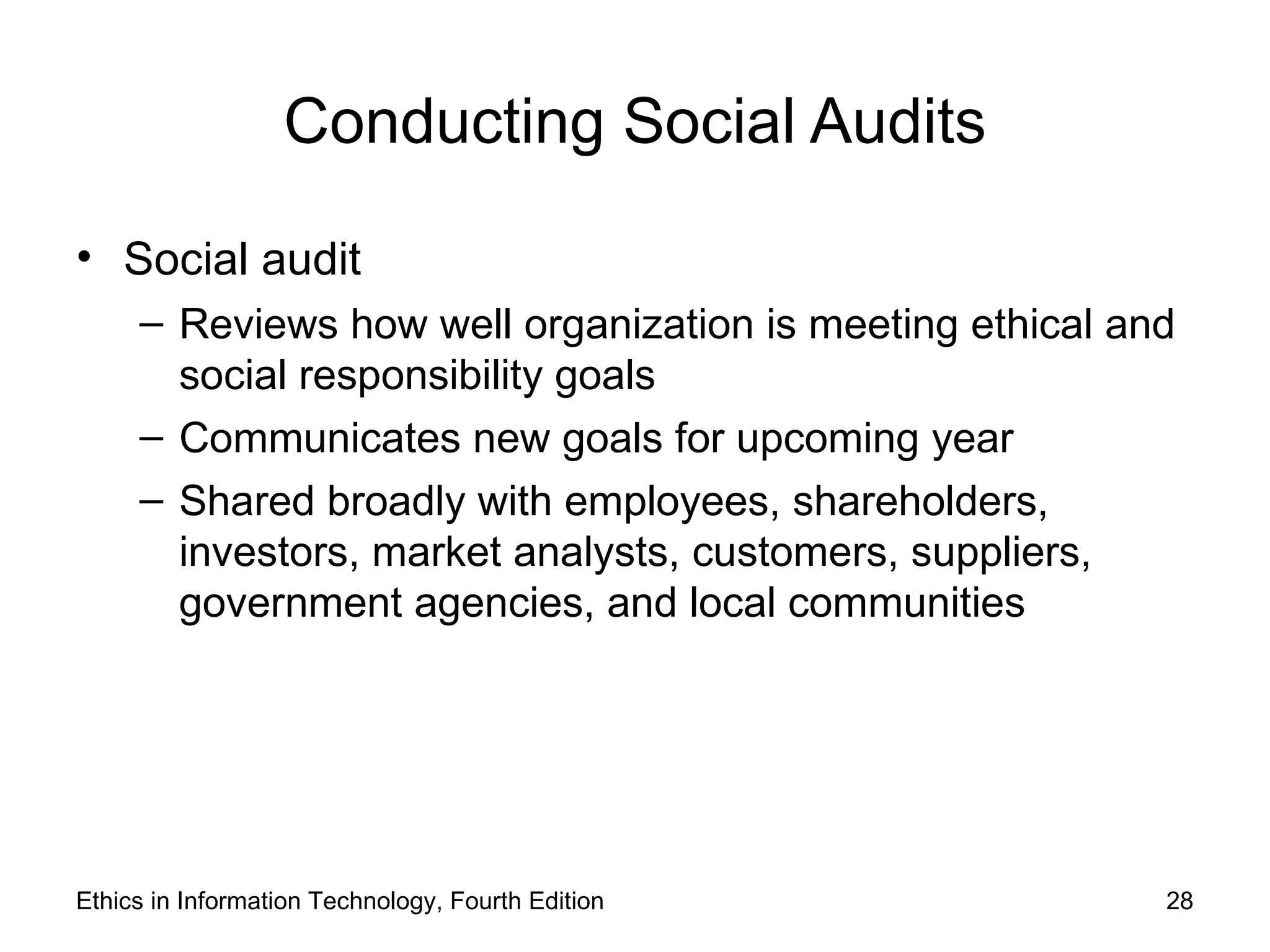
• Social audit
     – Reviews how well organization is meeting ethical and
       social responsibility goals
     – Communicates new goals for upcoming year
     – Shared broadly with employees, shareholders,
       investors, market analysts, customers, suppliers,
       government agencies, and local communities


Ethics in Information Technology, Fourth Edition          28
Requiring Employees to
                    Take Ethics Training
• Personal convictions improved through education
• Comprehensive ethics education program
  encourages employees to act responsibly and
  ethically
     – Often presented in small workshop formats
     – Employees apply code of ethics to hypothetical but
       realistic case studies
     – Demonstration of recent company decisions based on
       principles from the code of ethics


Ethics in Information Technology, Fourth Edition       29
Requiring Employees to
             Take Ethics Training (cont’d.)
• Critical that training increase the percentage of
  employees who report incidents of misconduct
• Employees must:
     – Learn effective ways of reporting incidents
     – Be reassured their feedback will be acted on without
       retaliation


Ethics in Information Technology, Fourth Edition              30
Including Ethical Criteria in
                  Employee Appraisals
• Only 43% of companies include ethical conduct in
  employee’s performance appraisal
• Ethical criteria include:
     –   Treating others fairly and with respect
     –   Operating effectively in a multicultural environment
     –   Accepting personal accountability
     –   Continually developing themselves and others
     –   Operating openly and honestly with all


Ethics in Information Technology, Fourth Edition                31
Creating an Ethical Work Environment

• Good employees may make bad ethical choices
• May be encouraged to do “whatever it takes” to get
  the job done
• Employees need a knowledgeable resource to
  discuss perceived unethical practices
     –   A manager
     –   Legal or Internal Audit Department
     –   Business Unit’s legal counsel
     –   Anonymously through internal Web site


Ethics in Information Technology, Fourth Edition       32
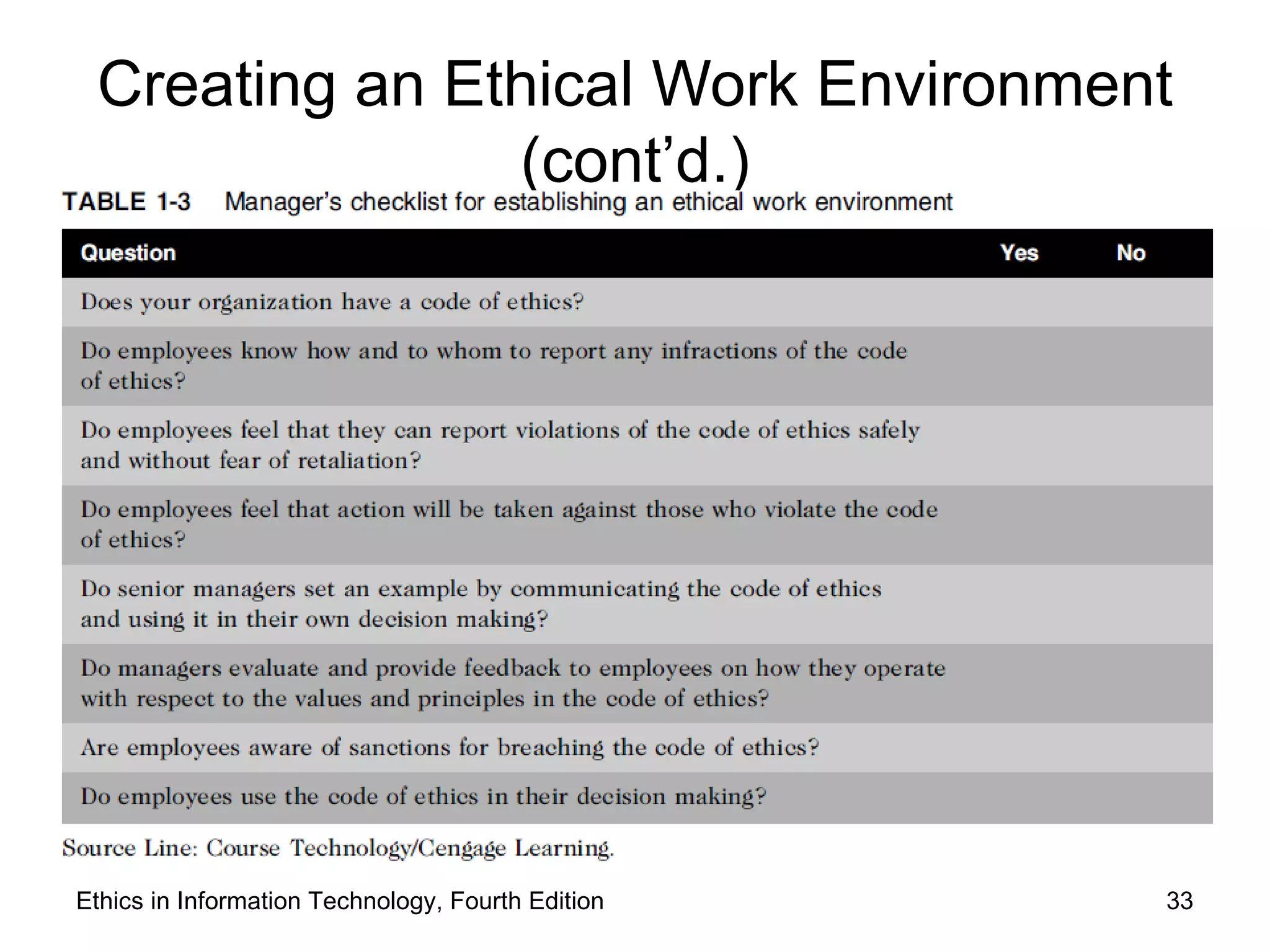
Creating an Ethical Work Environment
               (cont’d.)


Ethics in Information Technology, Fourth Edition   33
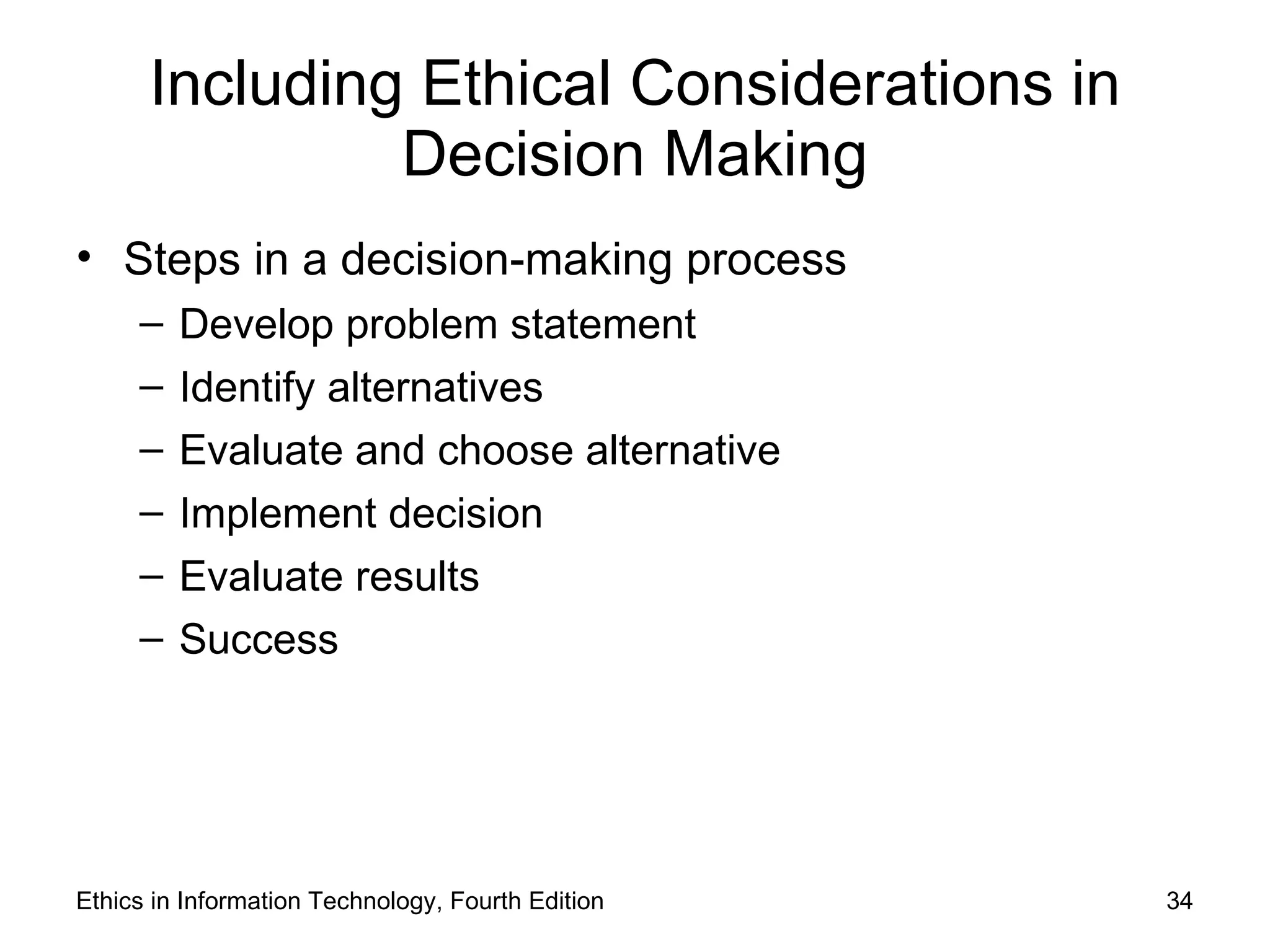
Including Ethical Considerations in
               Decision Making
• Steps in a decision-making process
     –   Develop problem statement
     –   Identify alternatives
     –   Evaluate and choose alternative
     –   Implement decision
     –   Evaluate results
     –   Success


Ethics in Information Technology, Fourth Edition   34
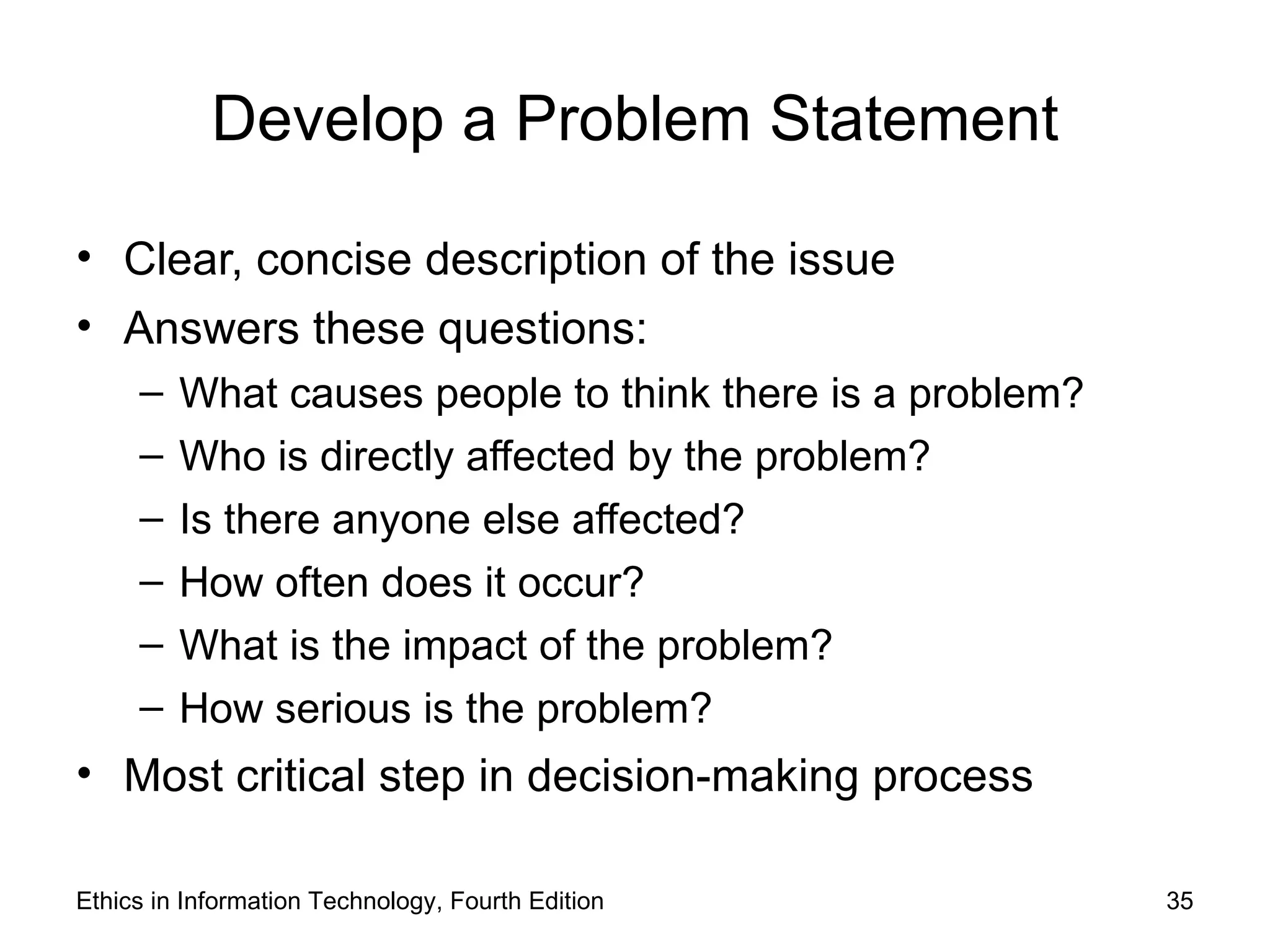
Develop a Problem Statement

• Clear, concise description of the issue
• Answers these questions:
     –   What causes people to think there is a problem?
     –   Who is directly affected by the problem?
     –   Is there anyone else affected?
     –   How often does it occur?
     –   What is the impact of the problem?
     –   How serious is the problem?
• Most critical step in decision-making process

Ethics in Information Technology, Fourth Edition           35
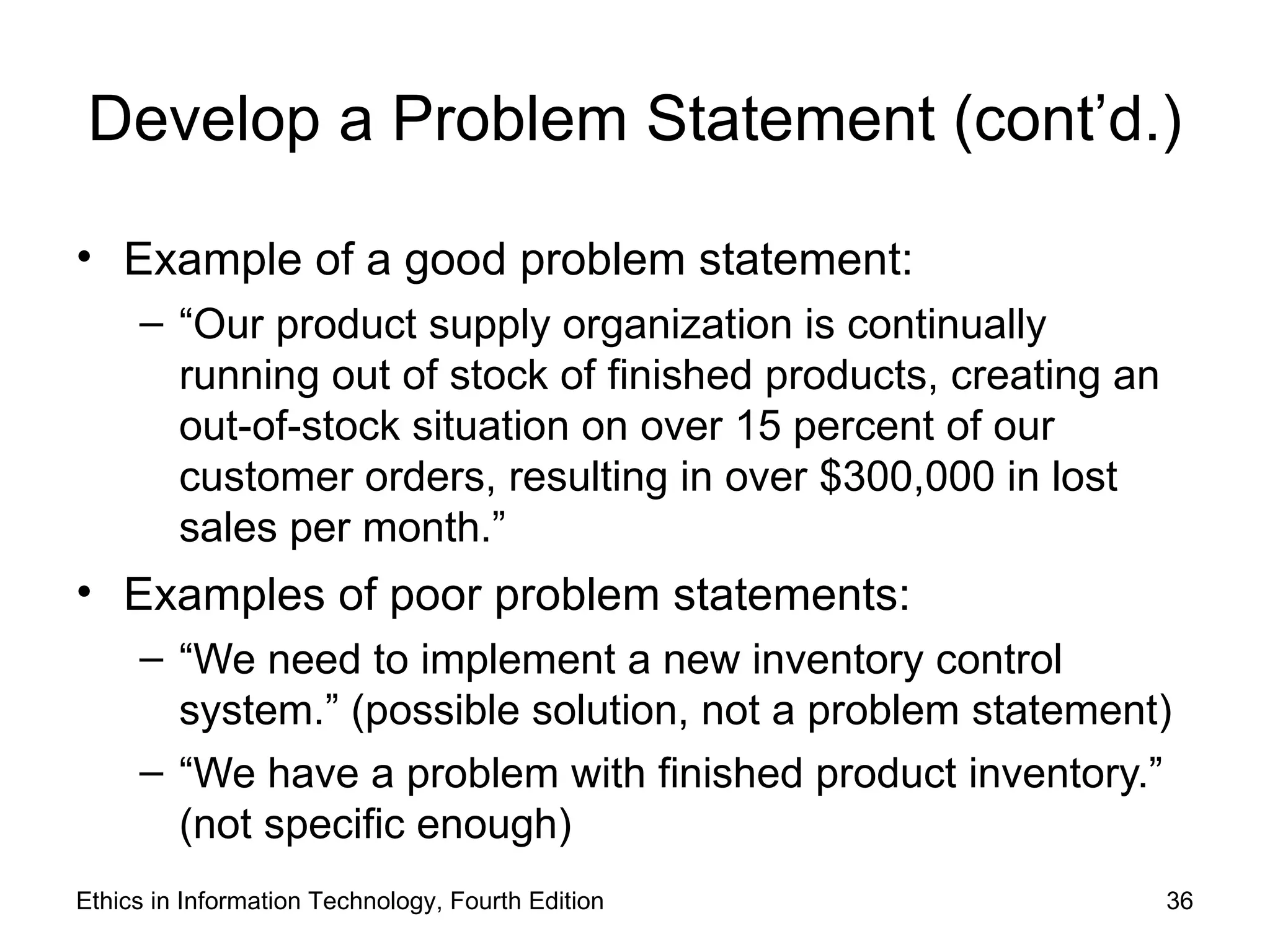
Develop a Problem Statement (cont’d.)

• Example of a good problem statement:
     – “Our product supply organization is continually
       running out of stock of finished products, creating an
       out-of-stock situation on over 15 percent of our
       customer orders, resulting in over $300,000 in lost
       sales per month.”
• Examples of poor problem statements:
     – “We need to implement a new inventory control
       system.” (possible solution, not a problem statement)
     – “We have a problem with finished product inventory.”
       (not specific enough)
Ethics in Information Technology, Fourth Edition                36
Identify, Evaluate, and Choose an
                   Alternative
• Enlist help to brainstorm alternative solutions
• Evaluate by weighing laws, guidelines, and
  principles
• Consider likely consequences of each alternative
• Alternative selected must:
     –   Be ethically and legally defensible
     –   Be consistent with policies and code of ethics
     –   Take into account impact on others
     –   Provide a good solution to problem

Ethics in Information Technology, Fourth Edition          37
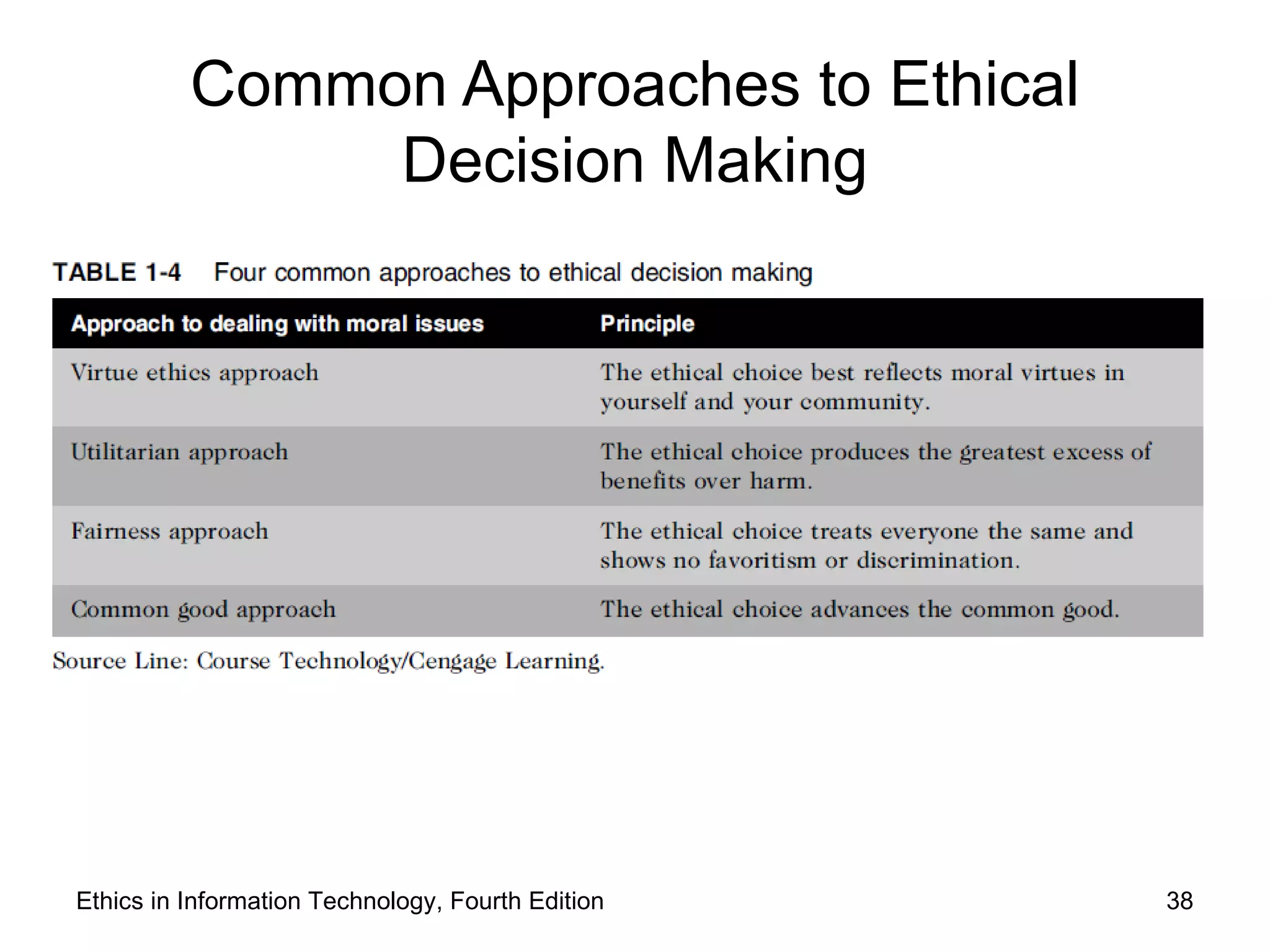
Common Approaches to Ethical
               Decision Making


          Table 1-5 Four common approaches to ethical decision making


Ethics in Information Technology, Fourth Edition                        38
Virtue Ethics Approach

• Virtue ethics approach
     – Focuses on concern with daily life in a community
     – People guided by virtues to reach “right” decision
     – More effective than following set of principles/rules
• Problems
     – Does not provide guide for action
     – Virtue cannot be worked out objectively; depends on
       circumstances


Ethics in Information Technology, Fourth Edition               39
Utilitarian Approach

• Utilitarian approach
     – Chooses action that has best overall consequences
     – Finds the greatest good by balancing all interests
     – Fits concept of value in economics and the use of
       cost-benefit analysis
• Problems
     – Measuring and comparing values is often difficult
     – Predicting resulting benefits and harm is difficult


Ethics in Information Technology, Fourth Edition             40
Fairness Approach

• Fairness approach
     – Focuses on fair distribution of benefits/burdens
     – Guiding principle is to treat all people the same
• Problems
     – Decisions can be influenced by personal bias
     – Others may consider the decision unfair


Ethics in Information Technology, Fourth Edition           41
Common Good Approach

• Common good approach
     – Work together for common set of values and goals
     – Implement systems that benefit all people
• Problems
     – Consensus is difficult
     – Some required to bear greater costs than others


Ethics in Information Technology, Fourth Edition          42
Implement the Decision and
                 Evaluate the Results
• Implement the decision
     – Efficient, effective, timely implementation
     – Communication is key for people to accept change
     – Transition plan made easy and pain-free
• Evaluate the results
     – Monitor results for desired effect
     – Observe impact on organization and stakeholders
     – Return to “Develop problem statement” step if further
       refinements may be needed


Ethics in Information Technology, Fourth Edition           43
Ethics in Information Technology

• Public concern about the ethical use of information
  technology includes:
     –   E-mail and Internet access monitoring
     –   Downloading in violation of copyright laws
     –   Unsolicited e-mail (spam)
     –   Hackers and identify theft
     –   Students and plagiarism
     –   Cookies and spyware


Ethics in Information Technology, Fourth Edition        44
Ethics in Information Technology
                      (cont’d.)
• The general public does not understand the critical
  importance of ethics as applied to IT
• Important decisions are often left to technical
  experts
• General business managers must assume greater
  responsibility for these decisions by:
     – Making decisions based on technical savvy, business
       know-how, and a sense of ethics
     – Creating an environment where ethical dilemmas can
       be discussed openly, objectively, and constructively

Ethics in Information Technology, Fourth Edition          45
Ethics in Information Technology
                      (cont’d.)
• Goals of this text
     – To educate people about the tremendous impact of
       ethical issues in the successful and secure use of
       information technology
     – To motivate people to recognize these issues when
       making business decisions
     – To provide tools, approaches, and useful insights for
       making ethical decisions


Ethics in Information Technology, Fourth Edition               46
Summary

• Ethics is important because the risks associated
  with inappropriate behavior have increased
• Organizations have at least five good reasons for
  encouraging employees to act ethically
     – To gain the good will of the community
     – To create an organization that operates consistently
     – To foster good business practices
     – To protect the organization and its employees against
       legal action
     – To avoid unfavorable publicity

Ethics in Information Technology, Fourth Edition           47
Summary (cont’d.)

• Organizations require successful ethics programs
• The corporate ethics officer ensures that ethical
  procedures are installed and followed
• Managers’ behaviors and expectations can strongly
  influence employees’ ethical behavior
• Most of us have developed a simple decision-
  making model that includes five steps
• Ethical considerations must be incorporated into
  decision making


Ethics in Information Technology, Fourth Edition   48
Summary (cont’d.)

• Four common approaches to ethical decision
  making
     –   Virtue ethics approach
     –   Utilitarian approach
     –   Fairness approach
     –   Common good approach


Ethics in Information Technology, Fourth Edition   49

9781111534127 ppt ch01

  • 1.
    About the Presentations •The presentations cover the objectives found in the opening of each chapter. • All chapter objectives are listed in the beginning of each presentation. • You may customize the presentations to fit your class needs. • Some figures from the chapters are included. A complete set of images from the book can be found on the Instructor Resources disc.
  • 2.
    Ethics in Information Technology,Fourth Edition Chapter 1 An Overview of Ethics
  • 3.
    Objectives • As youread this chapter, consider the following questions: – What is ethics, and why is it important to act according to a code of ethics? – Why is business ethics becoming increasingly important? – What are organizations doing to improve their business ethics? Ethics in Information Technology, Fourth Edition 3
  • 4.
    Objectives (cont’d.) – Why are organizations interested in fostering good business ethics? – What approach can you take to ensure ethical decision making? – What trends have increased the risk of using information technology in an unethical manner? Ethics in Information Technology, Fourth Edition 4
  • 5.
    What is Ethics? •Moral code – Set of rules – Establishes boundaries of generally accepted behavior – Different rules often have contradictions • Morality – Social conventions about right and wrong – Widely shared – Form basis for an established consensus Ethics in Information Technology, Fourth Edition 5
  • 6.
    What is Ethics?(cont’d.) • Morality may vary by: – Age – Cultural group – Ethnic background – Religion – Life experiences – Education – Gender Ethics in Information Technology, Fourth Edition 6
  • 7.
    Definition of Ethics •Ethics – Set of beliefs about right and wrong behavior • Virtues – Habits that incline people to do what is acceptable • Vices – Habits of unacceptable behavior • Virtues and vices define a personal value system – Scheme of moral values Ethics in Information Technology, Fourth Edition 7
  • 8.
    The Importance ofIntegrity • Integrity is a cornerstone of ethical behavior • People with integrity: – Act in accordance with a personal code of principles – Extend to all the same respect and consideration – Apply the same moral standards in all situations • Lack of integrity emerges if you apply moral standards differently according to situation or people involved • Many ethical dilemmas are not as simple as right versus wrong Ethics in Information Technology, Fourth Edition 8
  • 9.
    The Difference BetweenMorals, Ethics, and Laws • Morals: one’s personal beliefs about right and wrong • Ethics: standards or codes of behavior expected of an individual by a group • Law: system of rules that tells us what we can and cannot do – Laws are enforced by a set of institutions – Legal acts conform to the law – Moral acts conform to what an individual believes is the right belief of right and wrong Ethics in Information Technology, Fourth Edition 9
  • 10.
    Ethics in theBusiness World • Both the likelihood and the negative impact of inappropriate behavior have increased • Several trends have increased the likelihood of unethical behavior: – Globalization creating complex work environments – Organizations challenged to maintain profits / revenue – Heightened vigilance by: • Employees • Shareholders • Regulatory agencies Ethics in Information Technology, Fourth Edition 10
  • 11.
    Ethics in theBusiness World (cont’d.) • Recent scandals in IT companies – Satyam Computer Services (India) – Hewlett Packard – Computer Associates International – IBM • Not just executives, but even lower-level employees, can find themselves in the middle of an ethical dilemma Ethics in Information Technology, Fourth Edition 11
  • 12.
    Why Fostering GoodBusiness Ethics Is Important • To gain the good will of the community • To create an organization that operates consistently • To foster good business practices • To protect organization/employees from legal action • To avoid unfavorable publicity Ethics in Information Technology, Fourth Edition 12
  • 13.
    Gaining the GoodWill of the Community • Organizations have fundamental responsibilities to society – Declared in formal statement of company’s principles or beliefs – Include: • Making contributions to charitable organizations and nonprofit institutions • Providing benefits for employees in excess of legal requirements • Choosing economic opportunities that might be more socially desirable than profitable Ethics in Information Technology, Fourth Edition 13
  • 14.
    Gaining the GoodWill of the Community (cont’d.) • Socially responsible activities create good will • Good will makes it easier for corporations to conduct business Ethics in Information Technology, Fourth Edition 14
  • 15.
    Creating an OrganizationThat Operates Consistently • Consistency ensures that employees: – Know what is expected of them – Can employ the organization’s values to help them in decision making • Consistency also means that shareholders, customers, suppliers, and community know what they can expect of the organization Ethics in Information Technology, Fourth Edition 15
  • 16.
    Creating an OrganizationThat Operates Consistently (cont’d.) • Many companies share the following values: – Operate with honesty and integrity, staying true to organizational principles – Operate according to standards of ethical conduct, in words and action – Treat colleagues, customers, and consumers with respect – Strive to be the best at what matters to the company – Value diversity – Make decisions based on facts and principles Ethics in Information Technology, Fourth Edition 16
  • 17.
    Fostering Good BusinessPractices • Good ethics means good business/improved profits • Companies that: – Produce safe and effective products • Avoid costly recalls and lawsuits – Provide excellent service that retains customers – Develop and maintain strong employee relations • Suffer lower turnover rates • Enjoy better employee morale Ethics in Information Technology, Fourth Edition 17
  • 18.
    Fostering Good BusinessPractices (cont’d.) • Suppliers/business partners place priority on working with companies that operate in a fair and ethical manner • Bad ethics means bad business/waning profits – Bad ethics can lead to bad business results – Bad ethics can have a negative impact on employees Ethics in Information Technology, Fourth Edition 18
  • 19.
    Protecting the Organizationand Its Employees from Legal Actions • U.S. Supreme Court established that an employer can be held responsible for the acts of its employees • This principle is called respondeat superior • Coalition of several legal organizations argues establishment of ethics and compliance programs should reduce criminal liability of organization • Others argue company officers should not be given light sentences if their ethics programs are ineffective Ethics in Information Technology, Fourth Edition 19
  • 20.
    Avoiding Unfavorable Publicity •Public reputation of company strongly influences: – Value of its stock – How consumers regard products and services – Degree of oversight received from government – Amount of support and cooperation received • Organizations are motivated to build strong ethics programs to avoid negative publicity Ethics in Information Technology, Fourth Edition 20
  • 21.
    Improving Corporate Ethics •Characteristics of a successful ethics program – Employees willing to seek advice about ethical issues – Employees feel prepared to handle situations that could lead to misconduct – Employees are rewarded for ethical behavior – Employees are not rewarded for success obtained through questionable means – Employees feel positive about their company Ethics in Information Technology, Fourth Edition 21
  • 22.
    Appointing a CorporateEthics Officer • Corporate ethics officer – Provides vision and leadership in business conduct – Should be well-respected, senior-level manager who reports directly to the CEO – Ensures ethical procedures are put in place – Creates and maintains ethics culture – Is responsible for key knowledge/contact person for ethical issues Ethics in Information Technology, Fourth Edition 22
  • 23.
    Ethical Standards Setby Board of Directors • Board oversees the organization’s business activities and management • Board members of company are expected to: – Conduct themselves according to the highest standards of personal and professional integrity – Set standard for company-wide ethical conduct – Ensure compliance with laws and regulations – Create environment in which employees can seek advice about business conduct, raise issues, and report misconduct Ethics in Information Technology, Fourth Edition 23
  • 24.
    Establishing a CorporateCode of Ethics • Code of ethics – Highlights an organization’s key ethical issues – Identifies overarching values and important principles – Focuses employees on areas of ethical risk – Offers guidance for employees to recognize and deal with ethical issues – Provides mechanisms to report unethical conduct – Help employees abide by the law, follow necessary regulations, and behave in an ethical manner Ethics in Information Technology, Fourth Edition 24
  • 25.
    Establishing a Corporate Code of Ethics (cont’d.) • Sarbanes-Oxley Act of 2002 – Enacted in response to public outrage over several major accounting scandals – Section 404 requires that the CEO and CFO sign any SEC filing to attest to its accuracy – Section 406 requires public companies to disclose whether or not they have a code of ethics and if any waivers to that code have been granted Ethics in Information Technology, Fourth Edition 25
  • 26.
    Establishing a Corporate Code of Ethics (cont’d.) – Cannot gain company-wide acceptance unless it is: • Developed with employee participation • Fully endorsed by organization’s leadership – Must continually be applied to company’s decision making and emphasized as part of its culture – Breaches in the code of ethics must be identified and dealt with appropriately Ethics in Information Technology, Fourth Edition 26
  • 27.
    Establishing a Corporate Code of Ethics (cont’d.) Ethics in Information Technology, Fourth Edition 27
  • 28.
    Conducting Social Audits •Social audit – Reviews how well organization is meeting ethical and social responsibility goals – Communicates new goals for upcoming year – Shared broadly with employees, shareholders, investors, market analysts, customers, suppliers, government agencies, and local communities Ethics in Information Technology, Fourth Edition 28
  • 29.
    Requiring Employees to Take Ethics Training • Personal convictions improved through education • Comprehensive ethics education program encourages employees to act responsibly and ethically – Often presented in small workshop formats – Employees apply code of ethics to hypothetical but realistic case studies – Demonstration of recent company decisions based on principles from the code of ethics Ethics in Information Technology, Fourth Edition 29
  • 30.
    Requiring Employees to Take Ethics Training (cont’d.) • Critical that training increase the percentage of employees who report incidents of misconduct • Employees must: – Learn effective ways of reporting incidents – Be reassured their feedback will be acted on without retaliation Ethics in Information Technology, Fourth Edition 30
  • 31.
    Including Ethical Criteriain Employee Appraisals • Only 43% of companies include ethical conduct in employee’s performance appraisal • Ethical criteria include: – Treating others fairly and with respect – Operating effectively in a multicultural environment – Accepting personal accountability – Continually developing themselves and others – Operating openly and honestly with all Ethics in Information Technology, Fourth Edition 31
  • 32.
    Creating an EthicalWork Environment • Good employees may make bad ethical choices • May be encouraged to do “whatever it takes” to get the job done • Employees need a knowledgeable resource to discuss perceived unethical practices – A manager – Legal or Internal Audit Department – Business Unit’s legal counsel – Anonymously through internal Web site Ethics in Information Technology, Fourth Edition 32
  • 33.
    Creating an EthicalWork Environment (cont’d.) Ethics in Information Technology, Fourth Edition 33
  • 34.
    Including Ethical Considerationsin Decision Making • Steps in a decision-making process – Develop problem statement – Identify alternatives – Evaluate and choose alternative – Implement decision – Evaluate results – Success Ethics in Information Technology, Fourth Edition 34
  • 35.
    Develop a ProblemStatement • Clear, concise description of the issue • Answers these questions: – What causes people to think there is a problem? – Who is directly affected by the problem? – Is there anyone else affected? – How often does it occur? – What is the impact of the problem? – How serious is the problem? • Most critical step in decision-making process Ethics in Information Technology, Fourth Edition 35
  • 36.
    Develop a ProblemStatement (cont’d.) • Example of a good problem statement: – “Our product supply organization is continually running out of stock of finished products, creating an out-of-stock situation on over 15 percent of our customer orders, resulting in over $300,000 in lost sales per month.” • Examples of poor problem statements: – “We need to implement a new inventory control system.” (possible solution, not a problem statement) – “We have a problem with finished product inventory.” (not specific enough) Ethics in Information Technology, Fourth Edition 36
  • 37.
    Identify, Evaluate, andChoose an Alternative • Enlist help to brainstorm alternative solutions • Evaluate by weighing laws, guidelines, and principles • Consider likely consequences of each alternative • Alternative selected must: – Be ethically and legally defensible – Be consistent with policies and code of ethics – Take into account impact on others – Provide a good solution to problem Ethics in Information Technology, Fourth Edition 37
  • 38.
    Common Approaches toEthical Decision Making Table 1-5 Four common approaches to ethical decision making Ethics in Information Technology, Fourth Edition 38
  • 39.
    Virtue Ethics Approach •Virtue ethics approach – Focuses on concern with daily life in a community – People guided by virtues to reach “right” decision – More effective than following set of principles/rules • Problems – Does not provide guide for action – Virtue cannot be worked out objectively; depends on circumstances Ethics in Information Technology, Fourth Edition 39
  • 40.
    Utilitarian Approach • Utilitarianapproach – Chooses action that has best overall consequences – Finds the greatest good by balancing all interests – Fits concept of value in economics and the use of cost-benefit analysis • Problems – Measuring and comparing values is often difficult – Predicting resulting benefits and harm is difficult Ethics in Information Technology, Fourth Edition 40
  • 41.
    Fairness Approach • Fairnessapproach – Focuses on fair distribution of benefits/burdens – Guiding principle is to treat all people the same • Problems – Decisions can be influenced by personal bias – Others may consider the decision unfair Ethics in Information Technology, Fourth Edition 41
  • 42.
    Common Good Approach •Common good approach – Work together for common set of values and goals – Implement systems that benefit all people • Problems – Consensus is difficult – Some required to bear greater costs than others Ethics in Information Technology, Fourth Edition 42
  • 43.
    Implement the Decisionand Evaluate the Results • Implement the decision – Efficient, effective, timely implementation – Communication is key for people to accept change – Transition plan made easy and pain-free • Evaluate the results – Monitor results for desired effect – Observe impact on organization and stakeholders – Return to “Develop problem statement” step if further refinements may be needed Ethics in Information Technology, Fourth Edition 43
  • 44.
    Ethics in InformationTechnology • Public concern about the ethical use of information technology includes: – E-mail and Internet access monitoring – Downloading in violation of copyright laws – Unsolicited e-mail (spam) – Hackers and identify theft – Students and plagiarism – Cookies and spyware Ethics in Information Technology, Fourth Edition 44
  • 45.
    Ethics in InformationTechnology (cont’d.) • The general public does not understand the critical importance of ethics as applied to IT • Important decisions are often left to technical experts • General business managers must assume greater responsibility for these decisions by: – Making decisions based on technical savvy, business know-how, and a sense of ethics – Creating an environment where ethical dilemmas can be discussed openly, objectively, and constructively Ethics in Information Technology, Fourth Edition 45
  • 46.
    Ethics in InformationTechnology (cont’d.) • Goals of this text – To educate people about the tremendous impact of ethical issues in the successful and secure use of information technology – To motivate people to recognize these issues when making business decisions – To provide tools, approaches, and useful insights for making ethical decisions Ethics in Information Technology, Fourth Edition 46
  • 47.
    Summary • Ethics isimportant because the risks associated with inappropriate behavior have increased • Organizations have at least five good reasons for encouraging employees to act ethically – To gain the good will of the community – To create an organization that operates consistently – To foster good business practices – To protect the organization and its employees against legal action – To avoid unfavorable publicity Ethics in Information Technology, Fourth Edition 47
  • 48.
    Summary (cont’d.) • Organizationsrequire successful ethics programs • The corporate ethics officer ensures that ethical procedures are installed and followed • Managers’ behaviors and expectations can strongly influence employees’ ethical behavior • Most of us have developed a simple decision- making model that includes five steps • Ethical considerations must be incorporated into decision making Ethics in Information Technology, Fourth Edition 48
  • 49.
    Summary (cont’d.) • Fourcommon approaches to ethical decision making – Virtue ethics approach – Utilitarian approach – Fairness approach – Common good approach Ethics in Information Technology, Fourth Edition 49