Ethics in Information Technology,
Second Edition
1
Ethics in Information
Technology, Second Edition
Chapter 1
An Overview of Ethics
Ethics in Information Technology,
Second Edition
2
Objectives
• What is ethics, and why is it important to act
according to a code of principles?
• Why is business ethics becoming increasingly
important?
• What are corporations doing to improve business
ethics?
• Why are corporations interested in fostering good
business ethics?
Book Page 2
Ethics in Information Technology,
Second Edition
3
Objectives (continued)
• What approach can you take to ensure ethical
decision making?
• What trends have increased the risk of using
information technology unethically?
Book Page 2
Ethics in Information Technology,
Second Edition
4
What is Ethics?
• Moral code
– Set of rules
– Establishes boundaries of generally accepted behavior
– Different rules often have contradictions
• Morality
– Social conventions about right and wrong
– Widely shared
Book Page 3
Ethics in Information Technology,
Second Edition
5
What is Ethics? (continued)
• Morality may vary by:
– Age
– Cultural group
– Ethnic background
– Religion
– Gender
Book Page 3
Ethics in Information Technology,
Second Edition
6
Definition of Ethics
• Ethics - set of beliefs about right and wrong behavior
• Ethical behavior conforms to generally accepted
social norms
• Virtues - Habits that incline people to do what is
acceptable
• Vices - Habits of unacceptable behavior
• Value system - Scheme of moral values
Book Page 3-4
Ethics in Information Technology,
Second Edition
7
The Importance of Integrity
• Integrity is a cornerstone of ethical behavior
• People with integrity
– Act in accordance with a personal code of principles
– Extend to all people the same respect and
consideration that you desire
– Apply the same moral standards in all situations
Book Page 4
Ethics in Information Technology,
Second Edition
8
Ethics in the Business World
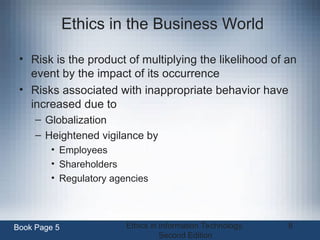
• Risk is the product of multiplying the likelihood of an
event by the impact of its occurrence
• Risks associated with inappropriate behavior have
increased due to
– Globalization
– Heightened vigilance by
• Employees
• Shareholders
• Regulatory agencies
Book Page 5
Ethics in Information Technology,
Second Edition
9
Why Fostering Good Business Ethics Is
Important
Note: Slide on each item follows
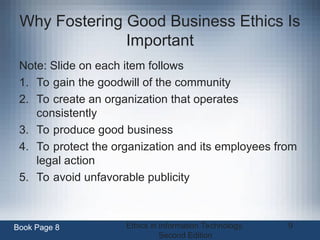
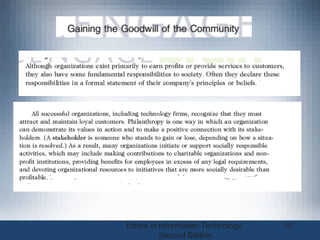
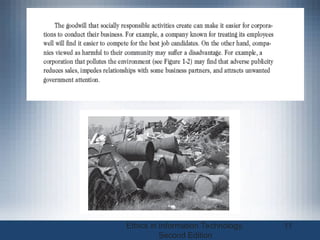
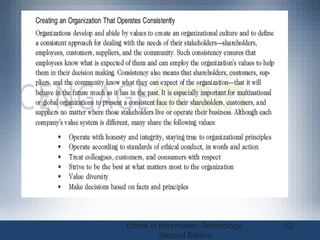
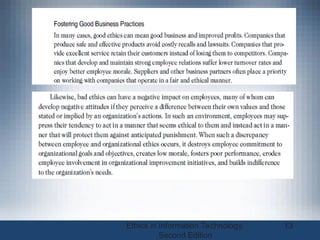
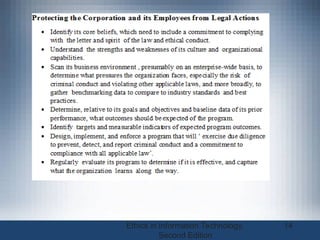
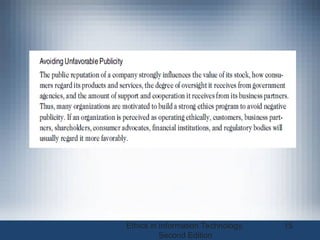
1. To gain the goodwill of the community
2. To create an organization that operates
consistently
3. To produce good business
4. To protect the organization and its employees from
legal action
5. To avoid unfavorable publicity
Book Page 8
Ethics in Information Technology,
Second Edition
10
Ethics in Information Technology,
Second Edition
11
Ethics in Information Technology,
Second Edition
12
Ethics in Information Technology,
Second Edition
13
Ethics in Information Technology,
Second Edition
14
Ethics in Information Technology,
Second Edition
15
Ethics in Information Technology,
Second Edition
16
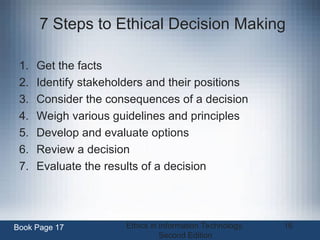
7 Steps to Ethical Decision Making
1. Get the facts
2. Identify stakeholders and their positions
3. Consider the consequences of a decision
4. Weigh various guidelines and principles
5. Develop and evaluate options
6. Review a decision
7. Evaluate the results of a decision
Book Page 17
Ethics in Information Technology,
Second Edition
17
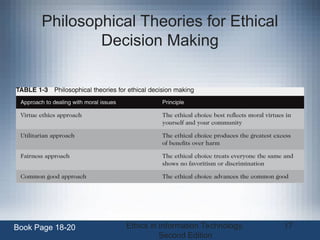
Philosophical Theories for Ethical
Decision Making
Book Page 18-20
Ethics in Information Technology,
Second Edition
18
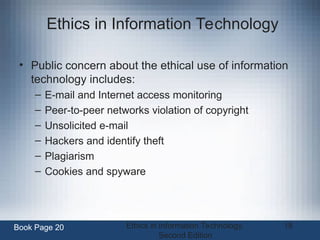
Ethics in Information Technology
• Public concern about the ethical use of information
technology includes:
– E-mail and Internet access monitoring
– Peer-to-peer networks violation of copyright
– Unsolicited e-mail
– Hackers and identify theft
– Plagiarism
– Cookies and spyware
Book Page 20
Ethics in Information Technology,
Second Edition
19
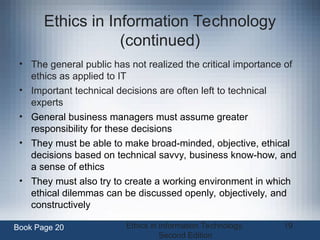
Ethics in Information Technology
(continued)
• The general public has not realized the critical importance of
ethics as applied to IT
• Important technical decisions are often left to technical
experts
• General business managers must assume greater
responsibility for these decisions
• They must be able to make broad-minded, objective, ethical
decisions based on technical savvy, business know-how, and
a sense of ethics
• They must also try to create a working environment in which
ethical dilemmas can be discussed openly, objectively, and
constructively
Book Page 20
Ethics in Information Technology,
Second Edition
20
An Overview of This Text
• Chapter 2
– Ethics is important to IT professionals and IT users
• Chapter 3
– Computer crime
• Chapter 4
– Personal data privacy
– Employee monitoring
Book Page 21
Ethics in Information Technology,
Second Edition
21
An Overview of This Text (continued)
• Chapter 5
– Internet communications
– Freedom of expression
• Chapter 6
– Protection of intellectual property rights through
patents, copyrights, and trade secrets
• Chapter 7
– Software development process
Book Page 21
Ethics in Information Technology,
Second Edition
22
An Overview of This Text (continued)
• Chapter 8
– Use of nontraditional employees
– Implications of whistle-blowing
• Chapter 9
– Impact of IT on society
Book Page 21
Ethics in Information Technology,
Second Edition
23
Summary
• Ethics is a set of beliefs about right and wrong
behavior
• Ethics in business is becoming more important
because the risks associated with inappropriate
behavior have grown
• Corporations want to protect themselves and their
employees from legal action
Book Page 22
Ethics in Information Technology,
Second Edition
24
Summary (continued)
• 7-step approach to ethical decision making
• Trends contributing to the risk of using information
technology unethically include:
– Growth of the Internet
– Ability to capture and store vast amounts of personal
data online
– Greater reliance on information systems
Book Page 22

01-overview.overview.overview.overview.overview.ppt

  • 1.
    Ethics in InformationTechnology, Second Edition 1 Ethics in Information Technology, Second Edition Chapter 1 An Overview of Ethics
  • 2.
    Ethics in InformationTechnology, Second Edition 2 Objectives • What is ethics, and why is it important to act according to a code of principles? • Why is business ethics becoming increasingly important? • What are corporations doing to improve business ethics? • Why are corporations interested in fostering good business ethics? Book Page 2
  • 3.
    Ethics in InformationTechnology, Second Edition 3 Objectives (continued) • What approach can you take to ensure ethical decision making? • What trends have increased the risk of using information technology unethically? Book Page 2
  • 4.
    Ethics in InformationTechnology, Second Edition 4 What is Ethics? • Moral code – Set of rules – Establishes boundaries of generally accepted behavior – Different rules often have contradictions • Morality – Social conventions about right and wrong – Widely shared Book Page 3
  • 5.
    Ethics in InformationTechnology, Second Edition 5 What is Ethics? (continued) • Morality may vary by: – Age – Cultural group – Ethnic background – Religion – Gender Book Page 3
  • 6.
    Ethics in InformationTechnology, Second Edition 6 Definition of Ethics • Ethics - set of beliefs about right and wrong behavior • Ethical behavior conforms to generally accepted social norms • Virtues - Habits that incline people to do what is acceptable • Vices - Habits of unacceptable behavior • Value system - Scheme of moral values Book Page 3-4
  • 7.
    Ethics in InformationTechnology, Second Edition 7 The Importance of Integrity • Integrity is a cornerstone of ethical behavior • People with integrity – Act in accordance with a personal code of principles – Extend to all people the same respect and consideration that you desire – Apply the same moral standards in all situations Book Page 4
  • 8.
    Ethics in InformationTechnology, Second Edition 8 Ethics in the Business World • Risk is the product of multiplying the likelihood of an event by the impact of its occurrence • Risks associated with inappropriate behavior have increased due to – Globalization – Heightened vigilance by • Employees • Shareholders • Regulatory agencies Book Page 5
  • 9.
    Ethics in InformationTechnology, Second Edition 9 Why Fostering Good Business Ethics Is Important Note: Slide on each item follows 1. To gain the goodwill of the community 2. To create an organization that operates consistently 3. To produce good business 4. To protect the organization and its employees from legal action 5. To avoid unfavorable publicity Book Page 8
  • 10.
    Ethics in InformationTechnology, Second Edition 10
  • 11.
    Ethics in InformationTechnology, Second Edition 11
  • 12.
    Ethics in InformationTechnology, Second Edition 12
  • 13.
    Ethics in InformationTechnology, Second Edition 13
  • 14.
    Ethics in InformationTechnology, Second Edition 14
  • 15.
    Ethics in InformationTechnology, Second Edition 15
  • 16.
    Ethics in InformationTechnology, Second Edition 16 7 Steps to Ethical Decision Making 1. Get the facts 2. Identify stakeholders and their positions 3. Consider the consequences of a decision 4. Weigh various guidelines and principles 5. Develop and evaluate options 6. Review a decision 7. Evaluate the results of a decision Book Page 17
  • 17.
    Ethics in InformationTechnology, Second Edition 17 Philosophical Theories for Ethical Decision Making Book Page 18-20
  • 18.
    Ethics in InformationTechnology, Second Edition 18 Ethics in Information Technology • Public concern about the ethical use of information technology includes: – E-mail and Internet access monitoring – Peer-to-peer networks violation of copyright – Unsolicited e-mail – Hackers and identify theft – Plagiarism – Cookies and spyware Book Page 20
  • 19.
    Ethics in InformationTechnology, Second Edition 19 Ethics in Information Technology (continued) • The general public has not realized the critical importance of ethics as applied to IT • Important technical decisions are often left to technical experts • General business managers must assume greater responsibility for these decisions • They must be able to make broad-minded, objective, ethical decisions based on technical savvy, business know-how, and a sense of ethics • They must also try to create a working environment in which ethical dilemmas can be discussed openly, objectively, and constructively Book Page 20
  • 20.
    Ethics in InformationTechnology, Second Edition 20 An Overview of This Text • Chapter 2 – Ethics is important to IT professionals and IT users • Chapter 3 – Computer crime • Chapter 4 – Personal data privacy – Employee monitoring Book Page 21
  • 21.
    Ethics in InformationTechnology, Second Edition 21 An Overview of This Text (continued) • Chapter 5 – Internet communications – Freedom of expression • Chapter 6 – Protection of intellectual property rights through patents, copyrights, and trade secrets • Chapter 7 – Software development process Book Page 21
  • 22.
    Ethics in InformationTechnology, Second Edition 22 An Overview of This Text (continued) • Chapter 8 – Use of nontraditional employees – Implications of whistle-blowing • Chapter 9 – Impact of IT on society Book Page 21
  • 23.
    Ethics in InformationTechnology, Second Edition 23 Summary • Ethics is a set of beliefs about right and wrong behavior • Ethics in business is becoming more important because the risks associated with inappropriate behavior have grown • Corporations want to protect themselves and their employees from legal action Book Page 22
  • 24.
    Ethics in InformationTechnology, Second Edition 24 Summary (continued) • 7-step approach to ethical decision making • Trends contributing to the risk of using information technology unethically include: – Growth of the Internet – Ability to capture and store vast amounts of personal data online – Greater reliance on information systems Book Page 22