Overview of ITEthics
This presentation provides an overview of ethics in Information
Technology based on Hamed Taherdoost's book, 'Information
Technology Ethics'. It highlights key ethical issues, frameworks, and the
importance of ethics in the IT industry.
2.
IT ethics involvesprinciples and
standards guiding technology
usage.
Definition and Importance
Introduction to IT Ethics
Relevance to Stakeholders
The evolution of IT ethics
influenced by tech advancements
and challenges.
Various stakeholders must be
aware of ethical implications.
Historical Context
3.
3
2
1
Ethical Theories inIT
This approach advocates for the development of good character
traits. Virtuous IT professionals prioritize integrity and
accountability in their work.
Focuses on the morality of actions rather than their outcomes. IT
professionals must adhere to ethical codes despite potential
negative consequences.
Deontological Ethics
Virtue Ethics
This theory emphasizes the greatest good for the greatest
number. In IT, it guides decision-making towards beneficial
outcomes for users and society.
Utilitarianism
4.
1
2
3
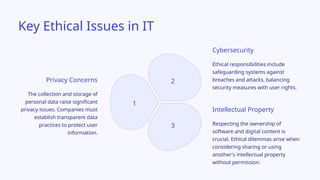
Privacy Concerns
Ethical responsibilitiesinclude
safeguarding systems against
breaches and attacks, balancing
security measures with user rights.
Intellectual Property
Cybersecurity
Key Ethical Issues in IT
Respecting the ownership of
software and digital content is
crucial. Ethical dilemmas arise when
considering sharing or using
another's intellectual property
without permission.
The collection and storage of
personal data raise significant
privacy issues. Companies must
establish transparent data
practices to protect user
information.
5.
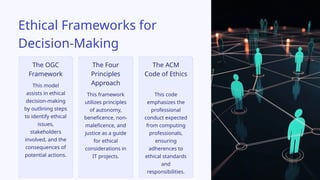
This framework
utilizes principles
ofautonomy,
beneficence, non-
maleficence, and
justice as a guide
for ethical
considerations in
IT projects.
This code
emphasizes the
professional
conduct expected
from computing
professionals,
ensuring
adherences to
ethical standards
and
responsibilities.
This model
assists in ethical
decision-making
by outlining steps
to identify ethical
issues,
stakeholders
involved, and the
consequences of
potential actions.
The ACM
Code of Ethics
The Four
Principles
Approach
Ethical Frameworks for
Decision-Making
The OGC
Framework
6.
1
3
2
Case Studies inIT Ethics
Social Media Responsibility
Ethical considerations in AI include
bias in algorithms and the
implications of automation on
employment and society,
necessitating careful ethical
scrutiny.
Platforms face ethical dilemmas
related to misinformation, user
safety, and content moderation,
highlighting the need for
responsible governance.
Analyzing high-profile data
breaches showcases the real-
world implications of
neglecting ethical practices,
with severe consequences for
companies and users alike.
Data Breaches
Artificial Intelligence
7.
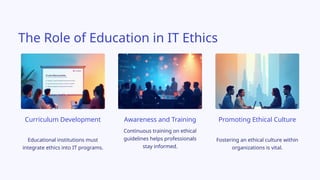
Fostering an ethicalculture within
organizations is vital.
Curriculum Development
Continuous training on ethical
guidelines helps professionals
stay informed.
Awareness and Training
Educational institutions must
integrate ethics into IT programs.
Promoting Ethical Culture
The Role of Education in IT Ethics
8.
3
2
1
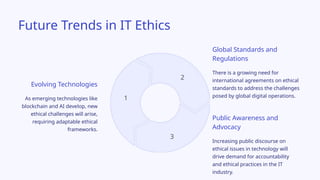
Future Trends inIT Ethics
Public Awareness and
Advocacy
Increasing public discourse on
ethical issues in technology will
drive demand for accountability
and ethical practices in the IT
industry.
As emerging technologies like
blockchain and AI develop, new
ethical challenges will arise,
requiring adaptable ethical
frameworks.
Evolving Technologies
Global Standards and
Regulations
There is a growing need for
international agreements on ethical
standards to address the challenges
posed by global digital operations.
9.
Conclusion on EthicalAwareness in IT
Ongoing discussions and training
on ethical issues should be
prioritized to keep pace with
technological advancements.
Importance of Ethical
Awareness
Commitment to Ethical
Practice
Continuous Improvement
Professionals must remain
committed to ethical practices,
fostering public trust and
ensuring technological benefits
are equitably shared.
Ethical awareness in Information
Technology is essential for
professionals to navigate complex
moral landscapes effectively.
10.
3
2 4
How canethical
frameworks be
applied to
emerging
technologies?
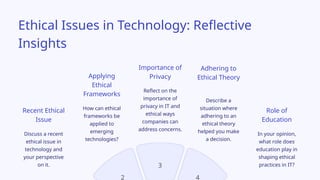
Ethical Issues in Technology: Reflective
Insights
Importance of
Privacy
Describe a
situation where
adhering to an
ethical theory
helped you make
a decision.
Discuss a recent
ethical issue in
technology and
your perspective
on it.
Role of
Education
Reflect on the
importance of
privacy in IT and
ethical ways
companies can
address concerns.
Adhering to
Ethical Theory
In your opinion,
what role does
education play in
shaping ethical
practices in IT?
Recent Ethical
Issue
Applying
Ethical
Frameworks