Acquire Resources
Coincides with PMBOK 9.3
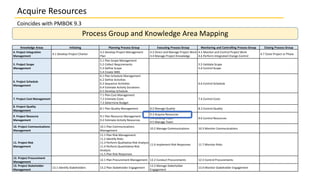
Process Group and Knowledge Area Mapping
Knowledge Areas Initiating Planning Process Group Executing Process Group Monitoring and Controlling Process Group Closing Process Group
4. Project Integration
Management
4.1 Develop Project Charter
4.2 Develop Project Management
Plan
4.3 Direct and Manage Project Work
4.4 Manage Project Knowledge
4.5 Monitor and Control Project Work
4.6 Perform Integrated Change Control
4.7 Close Project or Phase
5. Project Scope
Management
5.1 Plan Scope Management
5.2 Collect Requirements
5.3 Define Scope
5.4 Create WBS
5.5 Validate Scope
5.6 Control Scope
6. Project Schedule
Management
6.1 Plan Schedule Management
6.2 Define Activities
6.3 Sequence Activities
6.4 Estimate Activity Durations
6.5 Develop Schedule
6.6 Control Schedule
7. Project Cost Management
7.1 Plan Cost Management
7.2 Estimate Costs
7.3 Determine Budget
7.4 Control Costs
8. Project Quality
Management
8.1 Plan Quality Management 8.2 Manage Quality 8.3 Control Quality
9. Project Resource
Management
9.1 Plan Resource Management
9.2 Estimate Activity Resources
9.3 Acquire Resources
9.4 Develop Team
9.5 Manage Team
9.6 Control Resources
10. Project Communications
Management
10.1 Plan Communications
Management
10.2 Manage Communications 10.3 Monitor Communications
11. Project Risk
Management
11.1 Plan Risk Management
11.2 Identify Risks
11.3 Perform Qualitative Risk Analysis
11.4 Perform Quantitative Risk
Analysis
11.5 Plan Risk Responses
11.6 Implement Risk Responses 11.7 Monitor Risks
12. Project Procurement
Management
12.1 Plan Procurement Management 12.2 Conduct Procurements 12.3 Control Procurements
13. Project Stakeholder
Management
13.1 Identify Stakeholders 13.2 Plan Stakeholder Engagement
13.3 Manage Stakeholder
Engagement
13.4 Monitor Stakeholder Engagement
Acquire Resources
What is it?
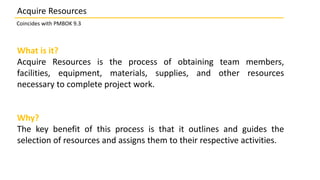
Acquire Resources is the process of obtaining team members,
facilities, equipment, materials, supplies, and other resources
necessary to complete project work.
Why?
The key benefit of this process is that it outlines and guides the
selection of resources and assigns them to their respective activities.
Acquire Resources
Coincides with PMBOK 9.3
Acquire Resources
Coincides with PMBOK 9.3
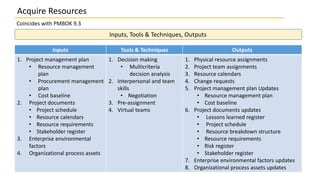
Inputs Tools & Techniques Outputs
1. Project management plan
• Resource management
plan
• Procurement management
plan
• Cost baseline
2. Project documents
• Project schedule
• Resource calendars
• Resource requirements
• Stakeholder register
3. Enterprise environmental
factors
4. Organizational process assets
1. Decision making
• Multicriteria
decision analysis
2. Interpersonal and team
skills
• Negotiation
3. Pre-assignment
4. Virtual teams
1. Physical resource assignments
2. Project team assignments
3. Resource calendars
4. Change requests
5. Project management plan Updates
• Resource management plan
• Cost baseline
6. Project documents updates
• Lessons learned register
• Project schedule
• Resource breakdown structure
• Resource requirements
• Risk register
• Stakeholder register
7. Enterprise environmental factors updates
8. Organizational process assets updates
Inputs, Tools & Techniques, Outputs
Coincides with PMBOK 9.3
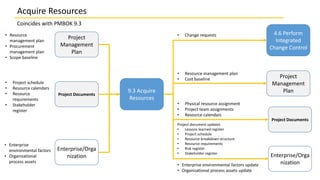
9.3 Acquire
Resources
Project
Management
Plan
Enterprise/Orga
nization
• Resource
management plan
• Procurement
management plan
• Scope baseline
• Enterprise
environmental factors
• Organizational
process assets
Project Documents
Project Documents
• Project schedule
• Resource calendars
• Resource
requirements
• Stakeholder
register
Acquire Resources
4.6 Perform
Integrated
Change Control
Enterprise/Orga
nization
Project
Management
Plan
• Enterprise environmental factors update
• Organizational process assets update
• Change requests
• Resource management plan
• Cost baseline
• Physical resource assignment
• Project team assignments
• Resource calendars
Project document updates
• Lessons learned register
• Project schedule
• Resource breakdown structure
• Resource requirements
• Risk register
• Stakeholder register
Overview
Coincides with PMBOK 9.3
Acquire Resources
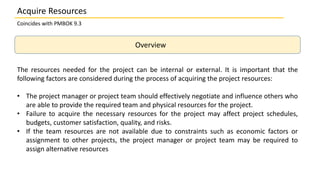
The resources needed for the project can be internal or external. It is important that the
following factors are considered during the process of acquiring the project resources:
• The project manager or project team should effectively negotiate and influence others who
are able to provide the required team and physical resources for the project.
• Failure to acquire the necessary resources for the project may affect project schedules,
budgets, customer satisfaction, quality, and risks.
• If the team resources are not available due to constraints such as economic factors or
assignment to other projects, the project manager or project team may be required to
assign alternative resources
Acquire Resources - Inputs
Coincides with PMBOK 9.3
Project Management Plan
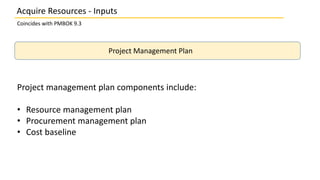
Project management plan components include:
• Resource management plan
• Procurement management plan
• Cost baseline
Coincides with PMBOK 9.3
Project Documents
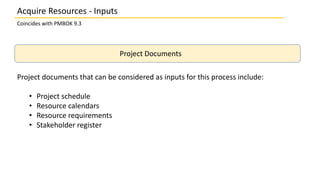
Project documents that can be considered as inputs for this process include:
• Project schedule
• Resource calendars
• Resource requirements
• Stakeholder register
Acquire Resources - Inputs
Enterprise Environmental Factors
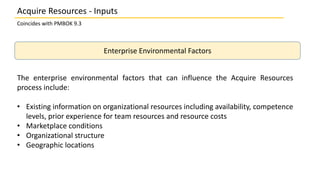
The enterprise environmental factors that can influence the Acquire Resources
process include:
• Existing information on organizational resources including availability, competence
levels, prior experience for team resources and resource costs
• Marketplace conditions
• Organizational structure
• Geographic locations
Coincides with PMBOK 9.3
Acquire Resources - Inputs
Organisational Process Assets
The organizational process assets that can influence the Acquire Resources process
include:
• Policies and procedures for acquiring, allocating, and assigning resources to the
project
• Historical information and lessons learned repository
Coincides with PMBOK 9.3
Acquire Resources - Inputs
Acquire Resources – Tools & Techniques
Coincides with PMBOK 9.3
Decision Making
Decision-making techniques that can be used in the Acquire Resources process include
the multicriteria decision analysis. The criteria are weighted according to their relative
importance and values can be changed for different types of resources.
Some selection criteria that are
unique for team resources are:
• Experience
• Knowledge
• Skills
• Attitude
• International factors
Some examples of selection
criteria that can be used are:
• Availability
• Cost
• Ability
Coincides with PMBOK 9.3
Interpersonal and Team Skills
Acquire Resources – Tools & Techniques
An interpersonal and team skill that can be used for this process includes, negotiation.
Many projects need to negotiate for required resources. The project management team
may need to negotiate with:
• Functional managers
• Other project management teams within the performing organization
• External organizations and suppliers
Coincides with PMBOK 9.3
Pre-Assignment
Acquire Resources – Tools & Techniques
When physical or team resources for a project are determined in advance, they are
considered pre-assigned. This situation can occur if the project is the result of specific
resources being identified as part of a competitive proposal or if the project is
dependent upon the expertise of particular persons. Pre-assignment might also include
the team members who have already been assigned in Develop Project Charter Process
or other processes before the initial Resource Management Plan has been completed.
Coincides with PMBOK 9.3
Virtual Teams
Acquire Resources – Tools & Techniques
Virtual teams can be defined as groups of people with a shared goal who fulfil their roles with
little or no time spent meeting face to face. The virtual team model makes it possible to:
• Form teams of people from the same organization who live in widespread geographic areas
• Add special expertise to a project team even though the expert is not in the same
geographic area
• Incorporate employees who work from home offices
• Form teams of people who work different shifts, hours, or days
• Include people with mobility limitations or disabilities
• Move forward with projects that would have been held or cancelled due to travel expenses
• Save the expense of offices and all physical equipment needed for employees
Coincides with PMBOK 9.3
Physical Resource Assignments
Documentation of the physical resource assignments records the
material, equipment, supplies, locations, and other physical resources
that will be used during the project.
Acquire Resources – Outputs
Coincides with PMBOK 9.3
Project Team Assignments
Documentation of team assignments records the team members and their roles and
responsibilities for the project. Documentation can include a project team directory
and names inserted into the project management plan, such as the project
organization charts and schedules.
Acquire Resources – Outputs
Coincides with PMBOK 9.3
Resource Calendars
A resource calendar identifies the working days, shifts, start and end of normal
business hours, weekends, and public holidays when each specific resource is
available. Information on which resources (such as team resource, equipment, and
material) are potentially available during a planned activity period is used for
estimating resource utilization.
Acquire Resources – Outputs
Coincides with PMBOK 9.3
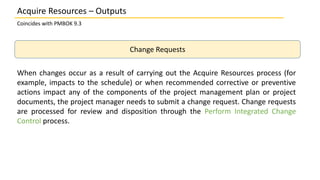
Change Requests
When changes occur as a result of carrying out the Acquire Resources process (for
example, impacts to the schedule) or when recommended corrective or preventive
actions impact any of the components of the project management plan or project
documents, the project manager needs to submit a change request. Change requests
are processed for review and disposition through the Perform Integrated Change
Control process.
Acquire Resources – Outputs
Coincides with PMBOK 9.3
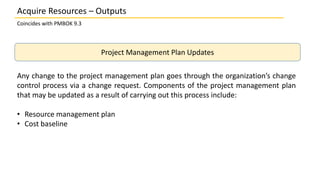
Project Management Plan Updates
Any change to the project management plan goes through the organization’s change
control process via a change request. Components of the project management plan
that may be updated as a result of carrying out this process include:
• Resource management plan
• Cost baseline
Acquire Resources – Outputs
Coincides with PMBOK 9.3
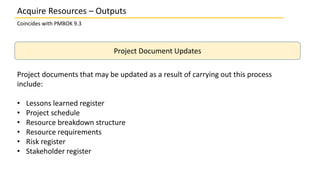
Project Document Updates
Project documents that may be updated as a result of carrying out this process
include:
• Lessons learned register
• Project schedule
• Resource breakdown structure
• Resource requirements
• Risk register
• Stakeholder register
Acquire Resources – Outputs
Coincides with PMBOK 9.3
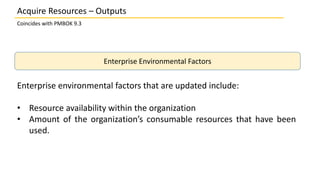
Enterprise Environmental Factors
Enterprise environmental factors that are updated include:
• Resource availability within the organization
• Amount of the organization’s consumable resources that have been
used.
Acquire Resources – Outputs
Coincides with PMBOK 9.3
Organizational Process Assets Updates
Organizational process assets that are updated as a result of the Acquire Resources
process include but are not limited to documentation related to acquiring, assigning
and allocating resources.
Acquire Resources – Outputs

9.3 Acquire Resources

  • 1.
  • 2.
    Coincides with PMBOK9.3 Process Group and Knowledge Area Mapping Knowledge Areas Initiating Planning Process Group Executing Process Group Monitoring and Controlling Process Group Closing Process Group 4. Project Integration Management 4.1 Develop Project Charter 4.2 Develop Project Management Plan 4.3 Direct and Manage Project Work 4.4 Manage Project Knowledge 4.5 Monitor and Control Project Work 4.6 Perform Integrated Change Control 4.7 Close Project or Phase 5. Project Scope Management 5.1 Plan Scope Management 5.2 Collect Requirements 5.3 Define Scope 5.4 Create WBS 5.5 Validate Scope 5.6 Control Scope 6. Project Schedule Management 6.1 Plan Schedule Management 6.2 Define Activities 6.3 Sequence Activities 6.4 Estimate Activity Durations 6.5 Develop Schedule 6.6 Control Schedule 7. Project Cost Management 7.1 Plan Cost Management 7.2 Estimate Costs 7.3 Determine Budget 7.4 Control Costs 8. Project Quality Management 8.1 Plan Quality Management 8.2 Manage Quality 8.3 Control Quality 9. Project Resource Management 9.1 Plan Resource Management 9.2 Estimate Activity Resources 9.3 Acquire Resources 9.4 Develop Team 9.5 Manage Team 9.6 Control Resources 10. Project Communications Management 10.1 Plan Communications Management 10.2 Manage Communications 10.3 Monitor Communications 11. Project Risk Management 11.1 Plan Risk Management 11.2 Identify Risks 11.3 Perform Qualitative Risk Analysis 11.4 Perform Quantitative Risk Analysis 11.5 Plan Risk Responses 11.6 Implement Risk Responses 11.7 Monitor Risks 12. Project Procurement Management 12.1 Plan Procurement Management 12.2 Conduct Procurements 12.3 Control Procurements 13. Project Stakeholder Management 13.1 Identify Stakeholders 13.2 Plan Stakeholder Engagement 13.3 Manage Stakeholder Engagement 13.4 Monitor Stakeholder Engagement Acquire Resources
  • 3.
    What is it? AcquireResources is the process of obtaining team members, facilities, equipment, materials, supplies, and other resources necessary to complete project work. Why? The key benefit of this process is that it outlines and guides the selection of resources and assigns them to their respective activities. Acquire Resources Coincides with PMBOK 9.3
  • 4.
    Acquire Resources Coincides withPMBOK 9.3 Inputs Tools & Techniques Outputs 1. Project management plan • Resource management plan • Procurement management plan • Cost baseline 2. Project documents • Project schedule • Resource calendars • Resource requirements • Stakeholder register 3. Enterprise environmental factors 4. Organizational process assets 1. Decision making • Multicriteria decision analysis 2. Interpersonal and team skills • Negotiation 3. Pre-assignment 4. Virtual teams 1. Physical resource assignments 2. Project team assignments 3. Resource calendars 4. Change requests 5. Project management plan Updates • Resource management plan • Cost baseline 6. Project documents updates • Lessons learned register • Project schedule • Resource breakdown structure • Resource requirements • Risk register • Stakeholder register 7. Enterprise environmental factors updates 8. Organizational process assets updates Inputs, Tools & Techniques, Outputs
  • 5.
    Coincides with PMBOK9.3 9.3 Acquire Resources Project Management Plan Enterprise/Orga nization • Resource management plan • Procurement management plan • Scope baseline • Enterprise environmental factors • Organizational process assets Project Documents Project Documents • Project schedule • Resource calendars • Resource requirements • Stakeholder register Acquire Resources 4.6 Perform Integrated Change Control Enterprise/Orga nization Project Management Plan • Enterprise environmental factors update • Organizational process assets update • Change requests • Resource management plan • Cost baseline • Physical resource assignment • Project team assignments • Resource calendars Project document updates • Lessons learned register • Project schedule • Resource breakdown structure • Resource requirements • Risk register • Stakeholder register
  • 6.
    Overview Coincides with PMBOK9.3 Acquire Resources The resources needed for the project can be internal or external. It is important that the following factors are considered during the process of acquiring the project resources: • The project manager or project team should effectively negotiate and influence others who are able to provide the required team and physical resources for the project. • Failure to acquire the necessary resources for the project may affect project schedules, budgets, customer satisfaction, quality, and risks. • If the team resources are not available due to constraints such as economic factors or assignment to other projects, the project manager or project team may be required to assign alternative resources
  • 7.
    Acquire Resources -Inputs Coincides with PMBOK 9.3 Project Management Plan Project management plan components include: • Resource management plan • Procurement management plan • Cost baseline
  • 8.
    Coincides with PMBOK9.3 Project Documents Project documents that can be considered as inputs for this process include: • Project schedule • Resource calendars • Resource requirements • Stakeholder register Acquire Resources - Inputs
  • 9.
    Enterprise Environmental Factors Theenterprise environmental factors that can influence the Acquire Resources process include: • Existing information on organizational resources including availability, competence levels, prior experience for team resources and resource costs • Marketplace conditions • Organizational structure • Geographic locations Coincides with PMBOK 9.3 Acquire Resources - Inputs
  • 10.
    Organisational Process Assets Theorganizational process assets that can influence the Acquire Resources process include: • Policies and procedures for acquiring, allocating, and assigning resources to the project • Historical information and lessons learned repository Coincides with PMBOK 9.3 Acquire Resources - Inputs
  • 11.
    Acquire Resources –Tools & Techniques Coincides with PMBOK 9.3 Decision Making Decision-making techniques that can be used in the Acquire Resources process include the multicriteria decision analysis. The criteria are weighted according to their relative importance and values can be changed for different types of resources. Some selection criteria that are unique for team resources are: • Experience • Knowledge • Skills • Attitude • International factors Some examples of selection criteria that can be used are: • Availability • Cost • Ability
  • 12.
    Coincides with PMBOK9.3 Interpersonal and Team Skills Acquire Resources – Tools & Techniques An interpersonal and team skill that can be used for this process includes, negotiation. Many projects need to negotiate for required resources. The project management team may need to negotiate with: • Functional managers • Other project management teams within the performing organization • External organizations and suppliers
  • 13.
    Coincides with PMBOK9.3 Pre-Assignment Acquire Resources – Tools & Techniques When physical or team resources for a project are determined in advance, they are considered pre-assigned. This situation can occur if the project is the result of specific resources being identified as part of a competitive proposal or if the project is dependent upon the expertise of particular persons. Pre-assignment might also include the team members who have already been assigned in Develop Project Charter Process or other processes before the initial Resource Management Plan has been completed.
  • 14.
    Coincides with PMBOK9.3 Virtual Teams Acquire Resources – Tools & Techniques Virtual teams can be defined as groups of people with a shared goal who fulfil their roles with little or no time spent meeting face to face. The virtual team model makes it possible to: • Form teams of people from the same organization who live in widespread geographic areas • Add special expertise to a project team even though the expert is not in the same geographic area • Incorporate employees who work from home offices • Form teams of people who work different shifts, hours, or days • Include people with mobility limitations or disabilities • Move forward with projects that would have been held or cancelled due to travel expenses • Save the expense of offices and all physical equipment needed for employees
  • 15.
    Coincides with PMBOK9.3 Physical Resource Assignments Documentation of the physical resource assignments records the material, equipment, supplies, locations, and other physical resources that will be used during the project. Acquire Resources – Outputs
  • 16.
    Coincides with PMBOK9.3 Project Team Assignments Documentation of team assignments records the team members and their roles and responsibilities for the project. Documentation can include a project team directory and names inserted into the project management plan, such as the project organization charts and schedules. Acquire Resources – Outputs
  • 17.
    Coincides with PMBOK9.3 Resource Calendars A resource calendar identifies the working days, shifts, start and end of normal business hours, weekends, and public holidays when each specific resource is available. Information on which resources (such as team resource, equipment, and material) are potentially available during a planned activity period is used for estimating resource utilization. Acquire Resources – Outputs
  • 18.
    Coincides with PMBOK9.3 Change Requests When changes occur as a result of carrying out the Acquire Resources process (for example, impacts to the schedule) or when recommended corrective or preventive actions impact any of the components of the project management plan or project documents, the project manager needs to submit a change request. Change requests are processed for review and disposition through the Perform Integrated Change Control process. Acquire Resources – Outputs
  • 19.
    Coincides with PMBOK9.3 Project Management Plan Updates Any change to the project management plan goes through the organization’s change control process via a change request. Components of the project management plan that may be updated as a result of carrying out this process include: • Resource management plan • Cost baseline Acquire Resources – Outputs
  • 20.
    Coincides with PMBOK9.3 Project Document Updates Project documents that may be updated as a result of carrying out this process include: • Lessons learned register • Project schedule • Resource breakdown structure • Resource requirements • Risk register • Stakeholder register Acquire Resources – Outputs
  • 21.
    Coincides with PMBOK9.3 Enterprise Environmental Factors Enterprise environmental factors that are updated include: • Resource availability within the organization • Amount of the organization’s consumable resources that have been used. Acquire Resources – Outputs
  • 22.
    Coincides with PMBOK9.3 Organizational Process Assets Updates Organizational process assets that are updated as a result of the Acquire Resources process include but are not limited to documentation related to acquiring, assigning and allocating resources. Acquire Resources – Outputs

Editor's Notes

  • #4 This process is performed periodically throughout the project as needed.
  • #7 Internal resources are acquired (assigned) from functional or resource managers. External resources are acquired through the procurement processes. Insufficient resources or capabilities decrease the probability of success and, in a worst-case scenario, could result in project cancellation. The project management team may or may not have direct control over resource selection because of collective bargaining agreements, use of subcontractor personnel, a matrix project environment, internal or external reporting relationships, or other reasons.
  • #8 Resource management plan - The resource management plan provides guidance on how to acquire resources for the project. Procurement management plan - The procurement management plan has information regarding resources that will be acquired from outside the project. This includes information on how procurements will be integrated with other project work and stakeholders involved in procuring resources. Cost baseline. Described in Section 7.3.3.1. The cost baseline provides the overall budget for the project activities.
  • #9 Project schedule - The project schedule shows the activities and their planned start and end dates to help determine when the resources need to be available and acquired. Resource calendars - Resource calendars document the time periods that each resource needed for the project is available for the project. Resource requirements - Resource requirements identify which resources need to be acquired. Stakeholder register - The stakeholder register may reveal stakeholders’ needs or expectations for specific resources to be used on the project that need to be considered in the Acquire Resources process.
  • #12 Selection criteria are often used to select physical project resources, or the project team. Using a multicriteria decision analysis tool, criteria are developed and used to rate or score potential resources (for example, choosing between internal and external team resources).\ Some examples of selection criteria that can be used are: Availability. Verify that the resource is available to work on the project within the time period needed Cost. Verify if the cost of adding the resource is within the prescribed budget. Ability. Verify that the team member provides the capability needed by the project. Some selection criteria that are unique for team resources are: Experience. Verify that the team member has the relevant experience that will contribute to the project success. Knowledge. Consider if the team member has relevant knowledge of the customer, similar implemented projects, and nuances of the project environment. Skills. Determine if the team member has the relevant skills to use a project tool. Attitude. Determine if the team member has the ability to work with others as a cohesive team. International factors. Consider team member location, time zone, and communication capabilities.
  • #13 Functional managers. Ensure that the project receives the best resources possible in the required timeframe and until their responsibilities are complete. Other project management teams within the performing organization. Appropriately assign or share scarce or specialized resources. External organizations and suppliers. Provide appropriate, scarce, specialized, qualified, certified, or other specific team or physical resources. Special consideration should be given to external negotiating policies, practices, processes, guidelines, legal, and other such criteria. The project management team’s ability to influence others plays an important role in negotiating resource allocation, as does the politics of the organizations involved. For example, convincing a functional manager about the high visibility of the project may influence him or her to assign the best resources to this project over competing ones.
  • #15 The availability of communication technology such as email, audio conferencing, social media, web-based meetings, and video conferencing has made virtual teams feasible. Communication planning becomes increasingly important in a virtual team environment. Additional time may be needed to set clear expectations, facilitate communications, develop protocols for resolving conflict, include people in decision making, understand cultural differences, and share credit in successes.
  • #18 Resource calendars also specify when and for how long identified team and physical resources will be available during the project. This information may be at the activity or project level. This includes consideration of attributes such as resource experience and/or skill level, as well as various geographical locations.
  • #20 Resource management plan - The resource management plan may be updated to reflect actual experience in acquiring resources for the project, including lessons learned in acquiring resources early in the project that will impact how resources are acquired later in the project. Cost baseline - The cost baseline may change as a result of the acquisition of resources for the project.
  • #21 Lessons learned register - The lessons learned register is updated with information on challenges encountered and how they could have been avoided as well as approaches that worked well for acquiring resources. Project schedule - Changes to the project schedule may result from the availability of required resources. Resource breakdown structure - Resources acquired during this process are recorded in the resource breakdown structure. Resource requirements. - Resource requirements documentation is updated to reflect resources acquired for the project. Risk register - New risks identified during this process are recorded in the risk register and managed using the risk management processes. Stakeholder register -The stakeholder register is updated with any new stakeholders and any new information about existing stakeholders that has been gained as a result of this process.