Auxiliary Agile and Lean
Frameworks
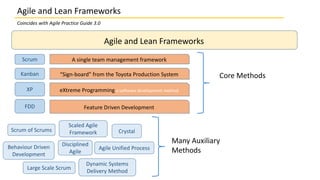
Agile and Lean Frameworks
Scrum
XP
Kanban
Behaviour Driven
Development
Agile Unified Process
Dynamic Systems
Delivery Method
A single team management framework
“Sign-board” from the Toyota Production System
eXtreme Programming a software development method
Crystal
Scaled Agile
Framework
Core Methods
Many Auxiliary
Methods
Agile and Lean Frameworks
Scrum of Scrums
Large Scale Scrum
Disciplined
Agile
Coincides with Agile Practice Guide 3.0
Feature Driven DevelopmentFDD
Coincides with APG 3.0
Crystal
Crystal
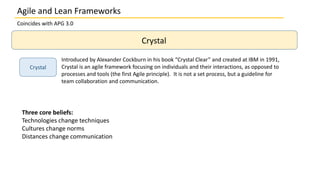
Introduced by Alexander Cockburn in his book “Crystal Clear” and created at IBM in 1991,
Crystal is an agile framework focusing on individuals and their interactions, as opposed to
processes and tools (the first Agile principle). It is not a set process, but a guideline for
team collaboration and communication.
Three core beliefs:
Technologies change techniques
Cultures change norms
Distances change communication
Agile and Lean Frameworks
Coincides with APG 3.0
Crystal
Crystal
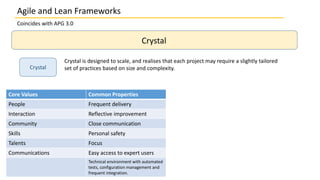
Crystal is designed to scale, and realises that each project may require a slightly tailored
set of practices based on size and complexity.
Core Values Common Properties
People Frequent delivery
Interaction Reflective improvement
Community Close communication
Skills Personal safety
Talents Focus
Communications Easy access to expert users
Technical environment with automated
tests, configuration management and
frequent integration.
Agile and Lean Frameworks
Coincides with APG 3.0
Crystal
Crystal
Sizing framework:
Life (L) L3 L10 L30 L80
Essential
Money (E)
E3 E10 E30 E80
Discretionary
money (D)
D3 D10 D30 D80
Comfort (C) C3 C10 C30 C80
Number of people
involved +- 20% 1 - 4 6-20 20-40 5-100
Crystal clear Crystal yellow Crystal orange Crystal red
Crystal is designed to scale, and realises that each project may require a slightly tailored
set of practices based on size and complexity.
Agile and Lean Frameworks
Coincides with APG 3.0
Dynamic Systems Delivery Method
Dynamic Systems Delivery
Method
DSDM was designed to add more rigour to the rising iterative methods of the
1990s. It is most known for its emphasis on constraint-driven delivery, which
sets Cost, Quality and Time at the beginning, then uses formalised prioritisation
of scope to meet those constraints.
Agile and Lean Frameworks
Coincides with APG 3.0
Dynamic Systems Delivery Method
Dynamic Systems Delivery
Method
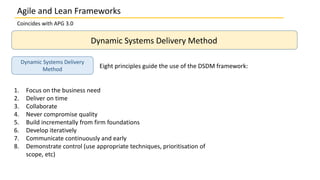
Eight principles guide the use of the DSDM framework:
1. Focus on the business need
2. Deliver on time
3. Collaborate
4. Never compromise quality
5. Build incrementally from firm foundations
6. Develop iteratively
7. Communicate continuously and early
8. Demonstrate control (use appropriate techniques, prioritisation of
scope, etc)
Agile and Lean Frameworks
Coincides with APG 3.0
Agile Unified Process
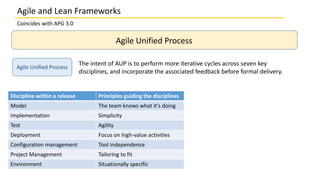
The intent of AUP is to perform more iterative cycles across seven key
disciplines, and incorporate the associated feedback before formal delivery.
Discipline within a release Principles guiding the disciplines
Model The team knows what it’s doing
Implementation Simplicity
Test Agility
Deployment Focus on high-value activities
Configuration management Tool independence
Project Management Tailoring to fit
Environment Situationally specific
Agile and Lean Frameworks
Coincides with APG 3.0
Behaviour Driven Development
Behaviour-driven development allows a developer to focus on testing the code
based on the expected behaviour of the software. It is a method of writing user
stories.
Specific behaviour-driven development frameworks can be used to define
acceptance criteria based on the given/when/then format:
• Given some initial context,
• When an event occurs,
• Then ensure some outcomes.
Behaviour Driven Development
Agile and Lean Frameworks
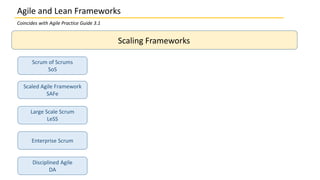
Scaling Frameworks
Scrum of Scrums
SoS
Large Scale Scrum
LeSS
Scaled Agile Framework
SAFe
Enterprise Scrum
Disciplined Agile
DA
Agile and Lean Frameworks
Coincides with Agile Practice Guide 3.1
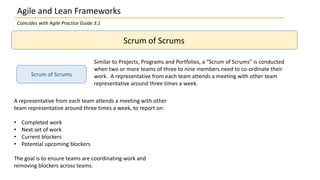
Scrum of Scrums
Scrum of Scrums
Similar to Projects, Programs and Portfolios, a “Scrum of Scrums” is conducted
when two or more teams of three to nine members need to co-ordinate their
work. A representative from each team attends a meeting with other team
representative around three times a week.
A representative from each team attends a meeting with other
team representative around three times a week, to report on:
• Completed work
• Next set of work
• Current blockers
• Potential upcoming blockers
The goal is to ensure teams are coordinating work and
removing blockers across teams.
Agile and Lean Frameworks
Coincides with Agile Practice Guide 3.1
Scrum of Scrums
Scrum of Scrums
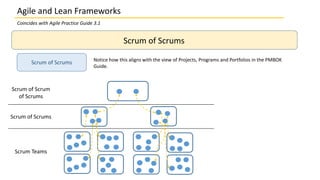
Scrum of Scrum
of Scrums
Scrum of Scrums
Scrum Teams
Notice how this aligns with the view of Projects, Programs and Portfolios in the PMBOK
Guide.
Agile and Lean Frameworks
Coincides with Agile Practice Guide 3.1
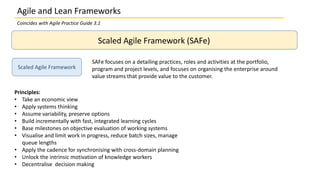
Scaled Agile Framework (SAFe)
Scaled Agile Framework
SAFe focuses on a detailing practices, roles and activities at the portfolio,
program and project levels, and focuses on organising the enterprise around
value streams that provide value to the customer.
Principles:
• Take an economic view
• Apply systems thinking
• Assume variability, preserve options
• Build incrementally with fast, integrated learning cycles
• Base milestones on objective evaluation of working systems
• Visualise and limit work in progress, reduce batch sizes, manage
queue lengths
• Apply the cadence for synchronising with cross-domain planning
• Unlock the intrinsic motivation of knowledge workers
• Decentralise decision making
Agile and Lean Frameworks
Coincides with Agile Practice Guide 3.1
Large Scale Scrum (LeSS)
Large Scale Scrum
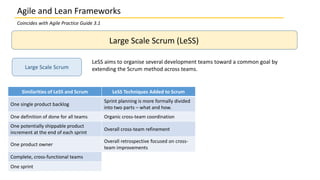
LeSS aims to organise several development teams toward a common goal by
extending the Scrum method across teams.
Similarities of LeSS and Scrum LeSS Techniques Added to Scrum
One single product backlog
Sprint planning is more formally divided
into two parts – what and how.
One definition of done for all teams Organic cross-team coordination
One potentially shippable product
increment at the end of each sprint
Overall cross-team refinement
One product owner
Overall retrospective focused on cross-
team improvements
Complete, cross-functional teams
One sprint
Agile and Lean Frameworks
Coincides with Agile Practice Guide 3.1
Enterprise Scrum
Enterprise Scrum
Enterprise Scrum is a framework designed to apply the Scrum method at an
organisational level, not just a single product development effort.
It advises leaders to:
• Extend the use of Scrum across all aspects of the organisation
• Generalise the Scrum techniques to apply easily at those various levels
• Scale the Scrum method with supplemental techniques as necessary
Agile and Lean Frameworks
Coincides with Agile Practice Guide 3.1
Disciplined Agile (DA)
Disciplined Agile
Disciplined Agile is a process decision framework that blends various Agile
techniques based on the following principles:
People First Enumerating roles and organisation elements at various levels
Learning-oriented Encouraging collaborative improvement
Full delivery life-cycle Promoting several fit-for-purpose life cycles
Goal-driven Tailoring processes to achieve specific outcomes
Enterprise awareness Offering guidance on cross-departmental governance
Scalable Covering multiple dimensions of program complexity
Agile and Lean Frameworks
Coincides with Agile Practice Guide 3.1

6.0 Auxiliary Agile and Lean Frameworks

  • 1.
    Auxiliary Agile andLean Frameworks
  • 2.
    Agile and LeanFrameworks Scrum XP Kanban Behaviour Driven Development Agile Unified Process Dynamic Systems Delivery Method A single team management framework “Sign-board” from the Toyota Production System eXtreme Programming a software development method Crystal Scaled Agile Framework Core Methods Many Auxiliary Methods Agile and Lean Frameworks Scrum of Scrums Large Scale Scrum Disciplined Agile Coincides with Agile Practice Guide 3.0 Feature Driven DevelopmentFDD
  • 3.
    Coincides with APG3.0 Crystal Crystal Introduced by Alexander Cockburn in his book “Crystal Clear” and created at IBM in 1991, Crystal is an agile framework focusing on individuals and their interactions, as opposed to processes and tools (the first Agile principle). It is not a set process, but a guideline for team collaboration and communication. Three core beliefs: Technologies change techniques Cultures change norms Distances change communication Agile and Lean Frameworks
  • 4.
    Coincides with APG3.0 Crystal Crystal Crystal is designed to scale, and realises that each project may require a slightly tailored set of practices based on size and complexity. Core Values Common Properties People Frequent delivery Interaction Reflective improvement Community Close communication Skills Personal safety Talents Focus Communications Easy access to expert users Technical environment with automated tests, configuration management and frequent integration. Agile and Lean Frameworks
  • 5.
    Coincides with APG3.0 Crystal Crystal Sizing framework: Life (L) L3 L10 L30 L80 Essential Money (E) E3 E10 E30 E80 Discretionary money (D) D3 D10 D30 D80 Comfort (C) C3 C10 C30 C80 Number of people involved +- 20% 1 - 4 6-20 20-40 5-100 Crystal clear Crystal yellow Crystal orange Crystal red Crystal is designed to scale, and realises that each project may require a slightly tailored set of practices based on size and complexity. Agile and Lean Frameworks
  • 6.
    Coincides with APG3.0 Dynamic Systems Delivery Method Dynamic Systems Delivery Method DSDM was designed to add more rigour to the rising iterative methods of the 1990s. It is most known for its emphasis on constraint-driven delivery, which sets Cost, Quality and Time at the beginning, then uses formalised prioritisation of scope to meet those constraints. Agile and Lean Frameworks
  • 7.
    Coincides with APG3.0 Dynamic Systems Delivery Method Dynamic Systems Delivery Method Eight principles guide the use of the DSDM framework: 1. Focus on the business need 2. Deliver on time 3. Collaborate 4. Never compromise quality 5. Build incrementally from firm foundations 6. Develop iteratively 7. Communicate continuously and early 8. Demonstrate control (use appropriate techniques, prioritisation of scope, etc) Agile and Lean Frameworks
  • 8.
    Coincides with APG3.0 Agile Unified Process Agile Unified Process The intent of AUP is to perform more iterative cycles across seven key disciplines, and incorporate the associated feedback before formal delivery. Discipline within a release Principles guiding the disciplines Model The team knows what it’s doing Implementation Simplicity Test Agility Deployment Focus on high-value activities Configuration management Tool independence Project Management Tailoring to fit Environment Situationally specific Agile and Lean Frameworks
  • 9.
    Coincides with APG3.0 Behaviour Driven Development Behaviour-driven development allows a developer to focus on testing the code based on the expected behaviour of the software. It is a method of writing user stories. Specific behaviour-driven development frameworks can be used to define acceptance criteria based on the given/when/then format: • Given some initial context, • When an event occurs, • Then ensure some outcomes. Behaviour Driven Development Agile and Lean Frameworks
  • 10.
    Scaling Frameworks Scrum ofScrums SoS Large Scale Scrum LeSS Scaled Agile Framework SAFe Enterprise Scrum Disciplined Agile DA Agile and Lean Frameworks Coincides with Agile Practice Guide 3.1
  • 11.
    Scrum of Scrums Scrumof Scrums Similar to Projects, Programs and Portfolios, a “Scrum of Scrums” is conducted when two or more teams of three to nine members need to co-ordinate their work. A representative from each team attends a meeting with other team representative around three times a week. A representative from each team attends a meeting with other team representative around three times a week, to report on: • Completed work • Next set of work • Current blockers • Potential upcoming blockers The goal is to ensure teams are coordinating work and removing blockers across teams. Agile and Lean Frameworks Coincides with Agile Practice Guide 3.1
  • 12.
    Scrum of Scrums Scrumof Scrums Scrum of Scrum of Scrums Scrum of Scrums Scrum Teams Notice how this aligns with the view of Projects, Programs and Portfolios in the PMBOK Guide. Agile and Lean Frameworks Coincides with Agile Practice Guide 3.1
  • 13.
    Scaled Agile Framework(SAFe) Scaled Agile Framework SAFe focuses on a detailing practices, roles and activities at the portfolio, program and project levels, and focuses on organising the enterprise around value streams that provide value to the customer. Principles: • Take an economic view • Apply systems thinking • Assume variability, preserve options • Build incrementally with fast, integrated learning cycles • Base milestones on objective evaluation of working systems • Visualise and limit work in progress, reduce batch sizes, manage queue lengths • Apply the cadence for synchronising with cross-domain planning • Unlock the intrinsic motivation of knowledge workers • Decentralise decision making Agile and Lean Frameworks Coincides with Agile Practice Guide 3.1
  • 14.
    Large Scale Scrum(LeSS) Large Scale Scrum LeSS aims to organise several development teams toward a common goal by extending the Scrum method across teams. Similarities of LeSS and Scrum LeSS Techniques Added to Scrum One single product backlog Sprint planning is more formally divided into two parts – what and how. One definition of done for all teams Organic cross-team coordination One potentially shippable product increment at the end of each sprint Overall cross-team refinement One product owner Overall retrospective focused on cross- team improvements Complete, cross-functional teams One sprint Agile and Lean Frameworks Coincides with Agile Practice Guide 3.1
  • 15.
    Enterprise Scrum Enterprise Scrum EnterpriseScrum is a framework designed to apply the Scrum method at an organisational level, not just a single product development effort. It advises leaders to: • Extend the use of Scrum across all aspects of the organisation • Generalise the Scrum techniques to apply easily at those various levels • Scale the Scrum method with supplemental techniques as necessary Agile and Lean Frameworks Coincides with Agile Practice Guide 3.1
  • 16.
    Disciplined Agile (DA) DisciplinedAgile Disciplined Agile is a process decision framework that blends various Agile techniques based on the following principles: People First Enumerating roles and organisation elements at various levels Learning-oriented Encouraging collaborative improvement Full delivery life-cycle Promoting several fit-for-purpose life cycles Goal-driven Tailoring processes to achieve specific outcomes Enterprise awareness Offering guidance on cross-departmental governance Scalable Covering multiple dimensions of program complexity Agile and Lean Frameworks Coincides with Agile Practice Guide 3.1