Control Resources
Coincides with PMBOK 9.6
Process Group and Knowledge Area Mapping
Knowledge Areas Initiating Planning Process Group Executing Process Group Monitoring and Controlling Process Group Closing Process Group
4. Project Integration
Management
4.1 Develop Project Charter
4.2 Develop Project Management
Plan
4.3 Direct and Manage Project Work
4.4 Manage Project Knowledge
4.5 Monitor and Control Project Work
4.6 Perform Integrated Change Control
4.7 Close Project or Phase
5. Project Scope
Management
5.1 Plan Scope Management
5.2 Collect Requirements
5.3 Define Scope
5.4 Create WBS
5.5 Validate Scope
5.6 Control Scope
6. Project Schedule
Management
6.1 Plan Schedule Management
6.2 Define Activities
6.3 Sequence Activities
6.4 Estimate Activity Durations
6.5 Develop Schedule
6.6 Control Schedule
7. Project Cost Management
7.1 Plan Cost Management
7.2 Estimate Costs
7.3 Determine Budget
7.4 Control Costs
8. Project Quality
Management
8.1 Plan Quality Management 8.2 Manage Quality 8.3 Control Quality
9. Project Resource
Management
9.1 Plan Resource Management
9.2 Estimate Activity Resources
9.3 Acquire Resources
9.4 Develop Team
9.5 Manage Team
9.6 Control Resources
10. Project Communications
Management
10.1 Plan Communications
Management
10.2 Manage Communications 10.3 Monitor Communications
11. Project Risk
Management
11.1 Plan Risk Management
11.2 Identify Risks
11.3 Perform Qualitative Risk Analysis
11.4 Perform Quantitative Risk
Analysis
11.5 Plan Risk Responses
11.6 Implement Risk Responses 11.7 Monitor Risks
12. Project Procurement
Management
12.1 Plan Procurement Management 12.2 Conduct Procurements 12.3 Control Procurements
13. Project Stakeholder
Management
13.1 Identify Stakeholders 13.2 Plan Stakeholder Engagement
13.3 Manage Stakeholder
Engagement
13.4 Monitor Stakeholder Engagement
Control Resources
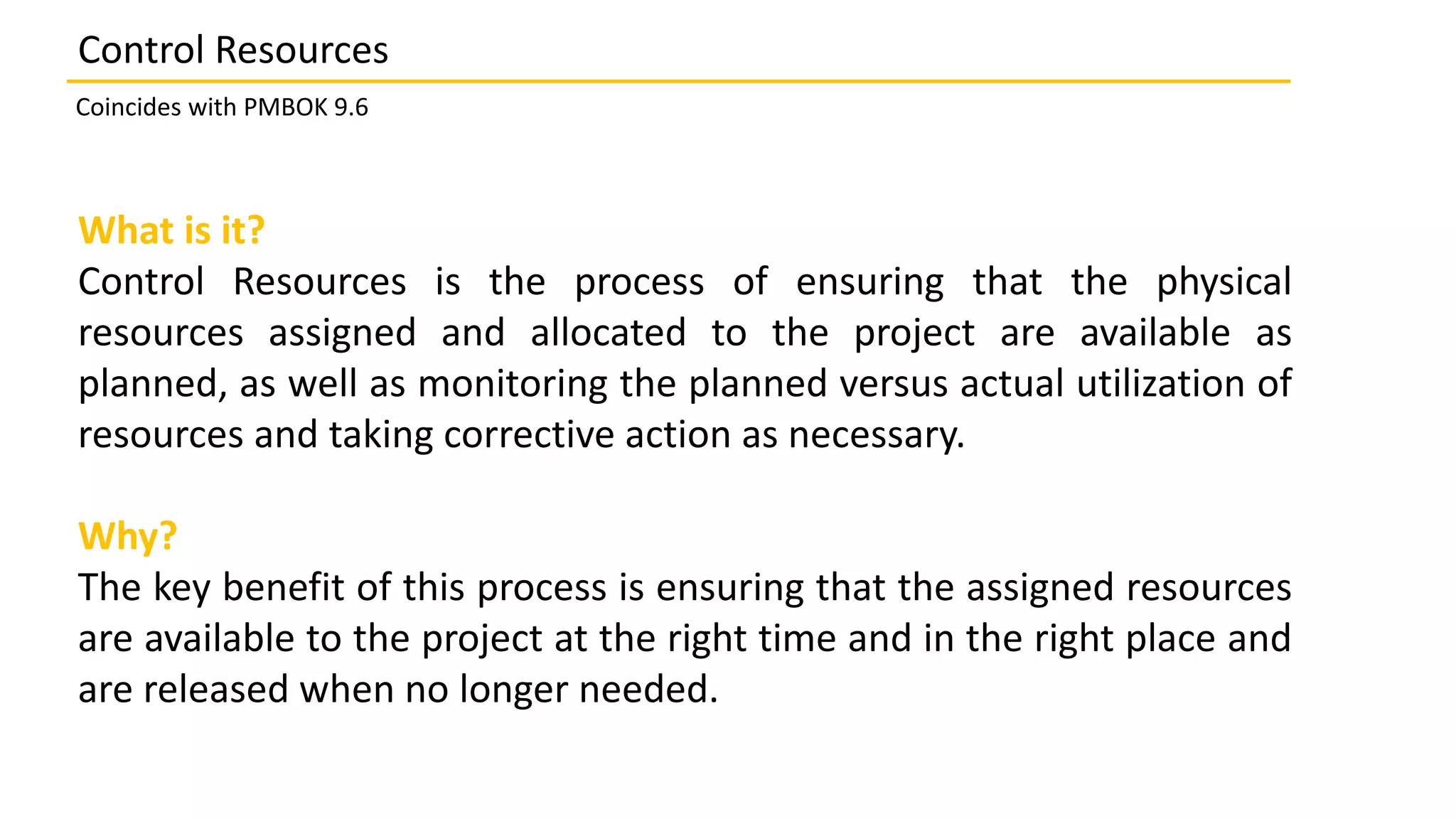
What is it?
Control Resources is the process of ensuring that the physical
resources assigned and allocated to the project are available as
planned, as well as monitoring the planned versus actual utilization of
resources and taking corrective action as necessary.
Why?
The key benefit of this process is ensuring that the assigned resources
are available to the project at the right time and in the right place and
are released when no longer needed.
Control Resources
Coincides with PMBOK 9.6
Overview
Coincides with PMBOK 9.6
Control Resources
Control Resources is concerned with:
• Monitoring resource expenditures
• Identifying and dealing with resource shortage/surplus in a timely manner
• Ensuring that resources are used and released according to the plan and project
needs
• Informing appropriate stakeholders if any issues arise with relevant resources
• Influencing the factors that can create resources utilization change
• Managing the actual changes as they occur
Control Resources
Coincides with PMBOK 9.6
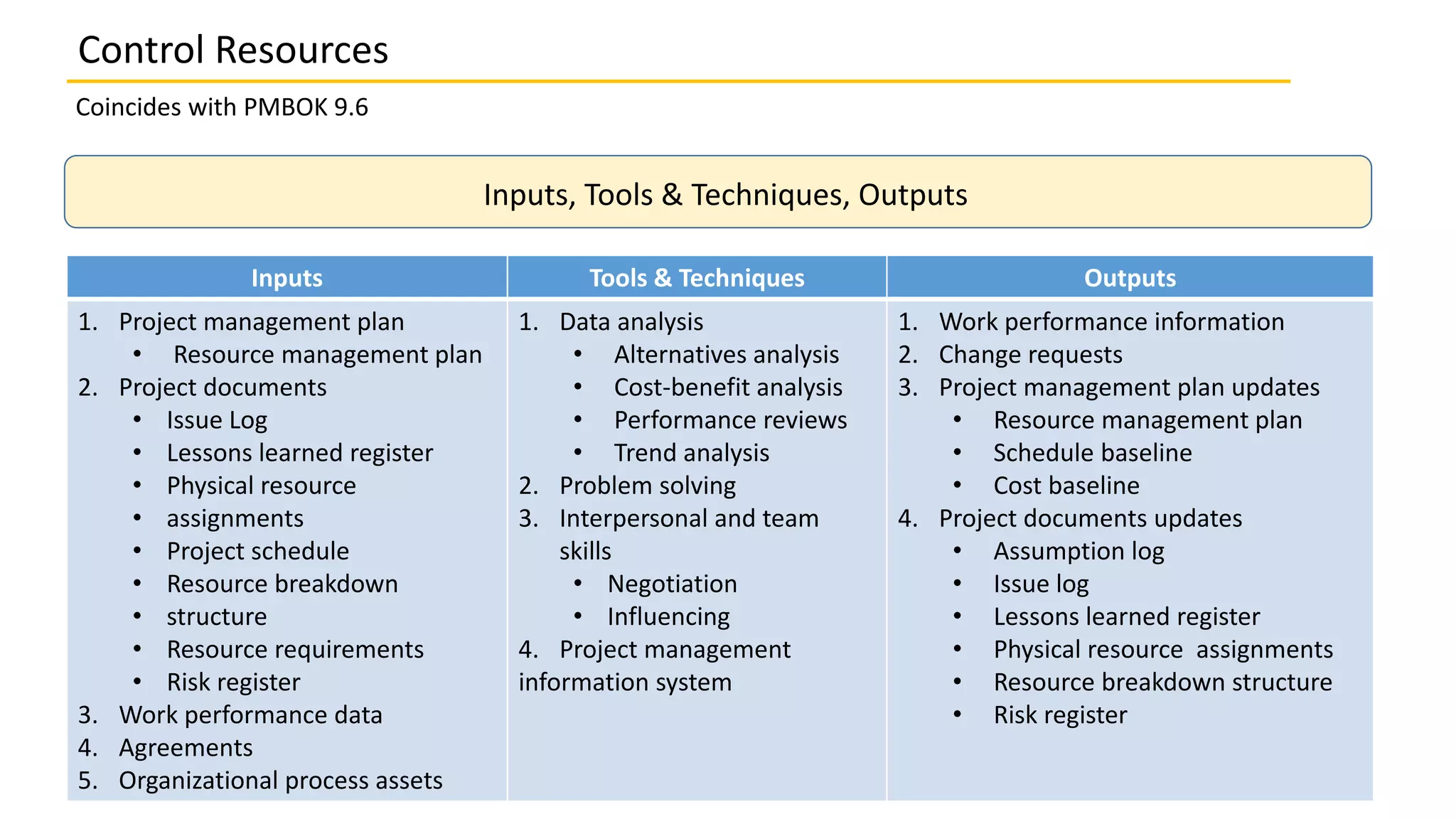
Inputs Tools & Techniques Outputs
1. Project management plan
• Resource management plan
2. Project documents
• Issue Log
• Lessons learned register
• Physical resource
• assignments
• Project schedule
• Resource breakdown
• structure
• Resource requirements
• Risk register
3. Work performance data
4. Agreements
5. Organizational process assets
1. Data analysis
• Alternatives analysis
• Cost-benefit analysis
• Performance reviews
• Trend analysis
2. Problem solving
3. Interpersonal and team
skills
• Negotiation
• Influencing
4. Project management
information system
1. Work performance information
2. Change requests
3. Project management plan updates
• Resource management plan
• Schedule baseline
• Cost baseline
4. Project documents updates
• Assumption log
• Issue log
• Lessons learned register
• Physical resource assignments
• Resource breakdown structure
• Risk register
Inputs, Tools & Techniques, Outputs
Coincides with PMBOK 9.6
9.6 Control
Resources
Project
Management
Plan
Enterprise/Orga
nization
• Resource
management plan
• Organizational
process assets
Project Documents
Project Documents
Control Resources
4.5 Monitor
and Control
Project Work
Project
Management
Plan
• Work Performance Information
12.2 Conduct
Procurements
4.3 Direct and
Manage
Project Work
• Agreements
• Resource management plan
• Schedule baseline
• Cost baseline
• Change Requests
• Work performance
data
• Issue Log
• Lessons learned register
• Physical resource assignments
• Project schedule
• Resource breakdown structure
• Resource requirements
• Risk register
4.6 Perform
Integrated
Change Control
• Assumption log
• Issue log
• Lessons learned register
• Physical resource assignments
• Resource breakdown structure
• Risk register
Control Resources - Inputs
Coincides with PMBOK 9.6
Project Management Plan
Project management plan components include but are not limited to the
resource management plan. The resource management plan provides
guidance on how physical resources should be used, controlled, and
eventually released.
Coincides with PMBOK 9.6
Project Documents
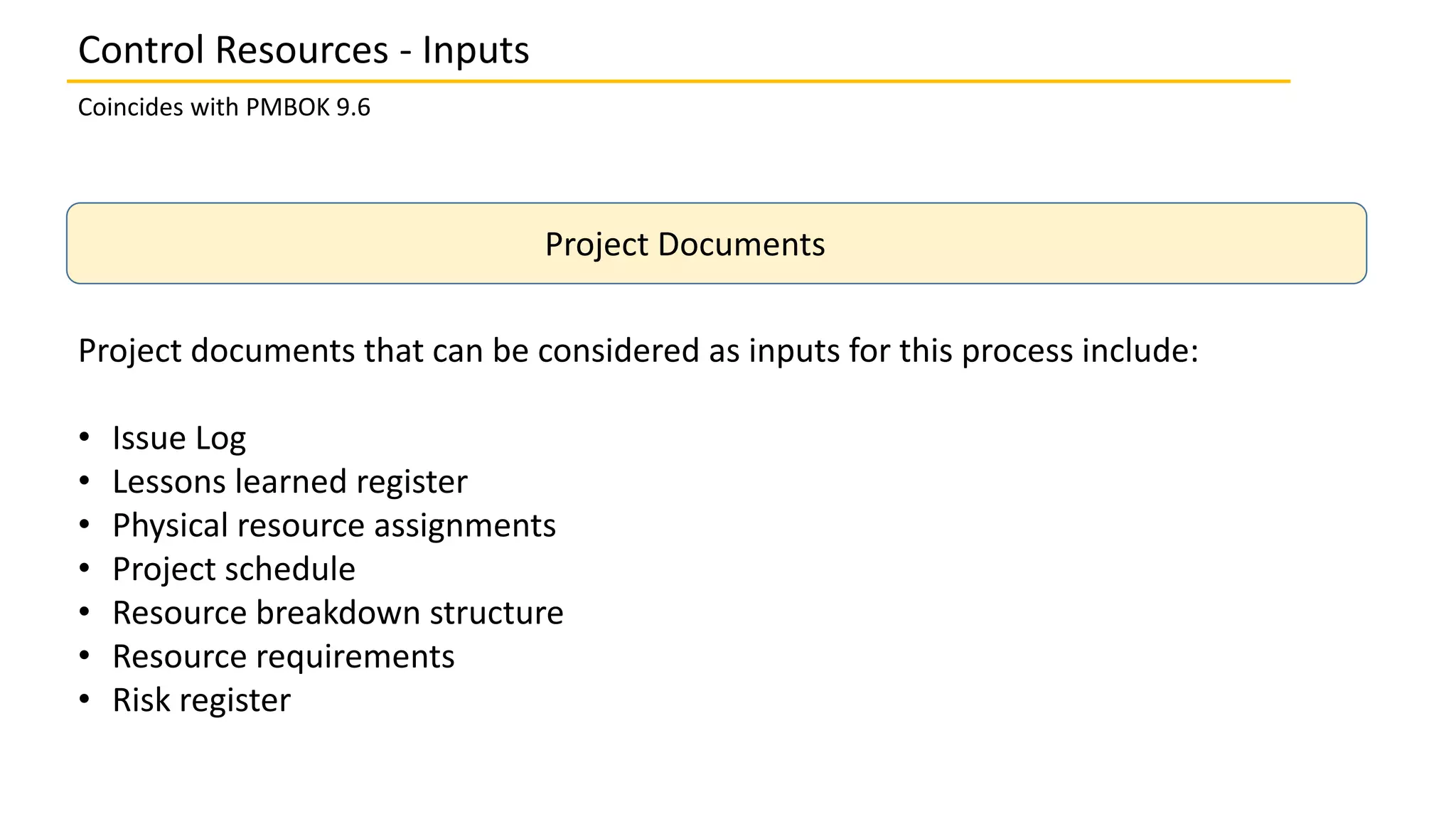
Project documents that can be considered as inputs for this process include:
• Issue Log
• Lessons learned register
• Physical resource assignments
• Project schedule
• Resource breakdown structure
• Resource requirements
• Risk register
Control Resources - Inputs
Coincides with PMBOK 9.6
Work Performance Report
Work performance data contains data on project status such as the
number and type of resources that have been used.
Control Resources - Inputs
Coincides with PMBOK 9.6
Agreements
Agreements made within the context of the project are the basis for all
resources external to the organization and should define procedures
when new, unplanned resources are needed or when issues arise with the
current resources.
Control Resources - Inputs
Organisational Process Assets
The organizational process assets that can influence the Control Resources
process include but are not limited to:
• Policies regarding resource control and assignment
• Escalation procedures for handling issues within the performing organization
• Lessons learned repository from previous similar projects.
Coincides with PMBOK 9.6
Control Resources - Inputs
Control Resources - Tools & Techniques
Coincides with PMBOK 9.6
Data Analysis
Data analysis techniques that can be used in this process include:
• Alternatives analysis
• Cost-benefit analysis
• Performance reviews
• Trend analysis
Control Resources - Tools & Techniques
Coincides with PMBOK 9.6
Problem Solving
Problem solving may use a set of tools that helps the project manager to solve
problems that arise during the control resource process.. The project manager should
use methodical steps to deal with problem solving, which can include:
• Identify the problem
• Define the problem
• Investigate
• Analyse
• Solve
• Check the solution
Control Resources - Tools & Techniques
Coincides with PMBOK 9.6
Interpersonal and Team Skills – Conflict Management
Interpersonal and team skills, sometimes known as “soft skills,” are
personal competencies. The interpersonal and team skills used in this
process include:
• Negotiation
• Influencing
Control Resources - Tools & Techniques
Coincides with PMBOK 9.6
Project Management Information System
Project management information systems can include resource
management or scheduling software that can be used to monitor the
resource utilization which helps ensure that the right resources are
working on the right activities at the right time and place.
Coincides with PMBOK 9.6
Work Performance Information
Work performance information includes information on how the project work
is progressing by comparing resource requirements and resource allocation to
resource utilization across the project activities. This comparison can show
gaps in resource availability that need to be addressed.
Control Resources – Outputs
Coincides with PMBOK 9.6
Change Requests
When change requests occur as a result of carrying out the Control Resources process
or when recommended, corrective, or preventive actions impact any of the
components of the project management plan or project documents, the project
manager needs to submit a change request. Change requests are processed for
review and disposition through the Perform Integrated Change Control process
Control Resources – Outputs
Coincides with PMBOK 9.6
Project Management Plan Updates
Any change to the project management plan goes through the organization’s
change control process via a change request. Components that may require a
change request for the project management plan include but are not limited
to:
• Resource management plan
• Schedule baseline
• Cost baseline
Control Resources – Outputs
Coincides with PMBOK 9.6
Project Document Updates
Project documents that may be updated as a result of carrying out this process
include:
• Assumption log
• Issue log
• Lessons learned register
• Physical resource assignments
• Resource breakdown structure
• Risk register
Control Resources – Outputs

9.6 Control Resources

  • 1.
  • 2.
    Coincides with PMBOK9.6 Process Group and Knowledge Area Mapping Knowledge Areas Initiating Planning Process Group Executing Process Group Monitoring and Controlling Process Group Closing Process Group 4. Project Integration Management 4.1 Develop Project Charter 4.2 Develop Project Management Plan 4.3 Direct and Manage Project Work 4.4 Manage Project Knowledge 4.5 Monitor and Control Project Work 4.6 Perform Integrated Change Control 4.7 Close Project or Phase 5. Project Scope Management 5.1 Plan Scope Management 5.2 Collect Requirements 5.3 Define Scope 5.4 Create WBS 5.5 Validate Scope 5.6 Control Scope 6. Project Schedule Management 6.1 Plan Schedule Management 6.2 Define Activities 6.3 Sequence Activities 6.4 Estimate Activity Durations 6.5 Develop Schedule 6.6 Control Schedule 7. Project Cost Management 7.1 Plan Cost Management 7.2 Estimate Costs 7.3 Determine Budget 7.4 Control Costs 8. Project Quality Management 8.1 Plan Quality Management 8.2 Manage Quality 8.3 Control Quality 9. Project Resource Management 9.1 Plan Resource Management 9.2 Estimate Activity Resources 9.3 Acquire Resources 9.4 Develop Team 9.5 Manage Team 9.6 Control Resources 10. Project Communications Management 10.1 Plan Communications Management 10.2 Manage Communications 10.3 Monitor Communications 11. Project Risk Management 11.1 Plan Risk Management 11.2 Identify Risks 11.3 Perform Qualitative Risk Analysis 11.4 Perform Quantitative Risk Analysis 11.5 Plan Risk Responses 11.6 Implement Risk Responses 11.7 Monitor Risks 12. Project Procurement Management 12.1 Plan Procurement Management 12.2 Conduct Procurements 12.3 Control Procurements 13. Project Stakeholder Management 13.1 Identify Stakeholders 13.2 Plan Stakeholder Engagement 13.3 Manage Stakeholder Engagement 13.4 Monitor Stakeholder Engagement Control Resources
  • 3.
    What is it? ControlResources is the process of ensuring that the physical resources assigned and allocated to the project are available as planned, as well as monitoring the planned versus actual utilization of resources and taking corrective action as necessary. Why? The key benefit of this process is ensuring that the assigned resources are available to the project at the right time and in the right place and are released when no longer needed. Control Resources Coincides with PMBOK 9.6
  • 4.
    Overview Coincides with PMBOK9.6 Control Resources Control Resources is concerned with: • Monitoring resource expenditures • Identifying and dealing with resource shortage/surplus in a timely manner • Ensuring that resources are used and released according to the plan and project needs • Informing appropriate stakeholders if any issues arise with relevant resources • Influencing the factors that can create resources utilization change • Managing the actual changes as they occur
  • 5.
    Control Resources Coincides withPMBOK 9.6 Inputs Tools & Techniques Outputs 1. Project management plan • Resource management plan 2. Project documents • Issue Log • Lessons learned register • Physical resource • assignments • Project schedule • Resource breakdown • structure • Resource requirements • Risk register 3. Work performance data 4. Agreements 5. Organizational process assets 1. Data analysis • Alternatives analysis • Cost-benefit analysis • Performance reviews • Trend analysis 2. Problem solving 3. Interpersonal and team skills • Negotiation • Influencing 4. Project management information system 1. Work performance information 2. Change requests 3. Project management plan updates • Resource management plan • Schedule baseline • Cost baseline 4. Project documents updates • Assumption log • Issue log • Lessons learned register • Physical resource assignments • Resource breakdown structure • Risk register Inputs, Tools & Techniques, Outputs
  • 6.
    Coincides with PMBOK9.6 9.6 Control Resources Project Management Plan Enterprise/Orga nization • Resource management plan • Organizational process assets Project Documents Project Documents Control Resources 4.5 Monitor and Control Project Work Project Management Plan • Work Performance Information 12.2 Conduct Procurements 4.3 Direct and Manage Project Work • Agreements • Resource management plan • Schedule baseline • Cost baseline • Change Requests • Work performance data • Issue Log • Lessons learned register • Physical resource assignments • Project schedule • Resource breakdown structure • Resource requirements • Risk register 4.6 Perform Integrated Change Control • Assumption log • Issue log • Lessons learned register • Physical resource assignments • Resource breakdown structure • Risk register
  • 7.
    Control Resources -Inputs Coincides with PMBOK 9.6 Project Management Plan Project management plan components include but are not limited to the resource management plan. The resource management plan provides guidance on how physical resources should be used, controlled, and eventually released.
  • 8.
    Coincides with PMBOK9.6 Project Documents Project documents that can be considered as inputs for this process include: • Issue Log • Lessons learned register • Physical resource assignments • Project schedule • Resource breakdown structure • Resource requirements • Risk register Control Resources - Inputs
  • 9.
    Coincides with PMBOK9.6 Work Performance Report Work performance data contains data on project status such as the number and type of resources that have been used. Control Resources - Inputs
  • 10.
    Coincides with PMBOK9.6 Agreements Agreements made within the context of the project are the basis for all resources external to the organization and should define procedures when new, unplanned resources are needed or when issues arise with the current resources. Control Resources - Inputs
  • 11.
    Organisational Process Assets Theorganizational process assets that can influence the Control Resources process include but are not limited to: • Policies regarding resource control and assignment • Escalation procedures for handling issues within the performing organization • Lessons learned repository from previous similar projects. Coincides with PMBOK 9.6 Control Resources - Inputs
  • 12.
    Control Resources -Tools & Techniques Coincides with PMBOK 9.6 Data Analysis Data analysis techniques that can be used in this process include: • Alternatives analysis • Cost-benefit analysis • Performance reviews • Trend analysis
  • 13.
    Control Resources -Tools & Techniques Coincides with PMBOK 9.6 Problem Solving Problem solving may use a set of tools that helps the project manager to solve problems that arise during the control resource process.. The project manager should use methodical steps to deal with problem solving, which can include: • Identify the problem • Define the problem • Investigate • Analyse • Solve • Check the solution
  • 14.
    Control Resources -Tools & Techniques Coincides with PMBOK 9.6 Interpersonal and Team Skills – Conflict Management Interpersonal and team skills, sometimes known as “soft skills,” are personal competencies. The interpersonal and team skills used in this process include: • Negotiation • Influencing
  • 15.
    Control Resources -Tools & Techniques Coincides with PMBOK 9.6 Project Management Information System Project management information systems can include resource management or scheduling software that can be used to monitor the resource utilization which helps ensure that the right resources are working on the right activities at the right time and place.
  • 16.
    Coincides with PMBOK9.6 Work Performance Information Work performance information includes information on how the project work is progressing by comparing resource requirements and resource allocation to resource utilization across the project activities. This comparison can show gaps in resource availability that need to be addressed. Control Resources – Outputs
  • 17.
    Coincides with PMBOK9.6 Change Requests When change requests occur as a result of carrying out the Control Resources process or when recommended, corrective, or preventive actions impact any of the components of the project management plan or project documents, the project manager needs to submit a change request. Change requests are processed for review and disposition through the Perform Integrated Change Control process Control Resources – Outputs
  • 18.
    Coincides with PMBOK9.6 Project Management Plan Updates Any change to the project management plan goes through the organization’s change control process via a change request. Components that may require a change request for the project management plan include but are not limited to: • Resource management plan • Schedule baseline • Cost baseline Control Resources – Outputs
  • 19.
    Coincides with PMBOK9.6 Project Document Updates Project documents that may be updated as a result of carrying out this process include: • Assumption log • Issue log • Lessons learned register • Physical resource assignments • Resource breakdown structure • Risk register Control Resources – Outputs

Editor's Notes

  • #4 This process is performed throughout the project
  • #5 The Control Resources process should be performed continuously in all project phases and throughout the project life cycle. The resources needed for the project should be assigned and released at the right time, right place, and right amount for the project to continue without delays. The Control Resources process is concerned with physical resources such as equipment, materials, facilities, and infrastructure. Team members are addressed in the Manage Team process.
  • #9 Issue log - The issue log is used to identify issues such as lack of resources, delays in raw material supplies, or low grades of raw material. Lessons learned register - Lessons learned earlier in the project can be applied to later phases in the project to improve physical resource control. Physical resource assignments - The physical resource assignments describe the expected resource utilization along with details such as type, amount, location, and whether the resource is internal to the organization or outsourced. Project schedule - The project schedule shows the resources that are needed, when they are needed, and the location where they are needed. Resource breakdown structure - The resource breakdown structure provides a reference in case any resource needs to be replaced or reacquired during the course of the project. Resource requirements - Resource requirements identify the needed material, equipment, supplies, and other resources. Risk register - The risk register identifies individual risks that can impact equipment, materials, or supplies.
  • #13 Alternative analysis - Alternatives can be analyzed to select the best resolution for correcting variances in resource utilization. Alternatives such as paying additional for overtime or additional team resources can be weighed against a late delivery or phased deliveries. Cost benefit Analysis - This analysis helps to determine the best corrective action in terms of cost in case of project deviations. Performance reviews - measure, compare, and analyze planned resource utilization to actual resource utilization. Trend Analysis - Trend analysis examines project performance over time and can be used to determine whether performance is improving or deteriorating.
  • #14 The problem can come from inside the organization (machines or infrastructure used by another department in the organization and not released in time, materials that have been damaged because of unsuitable storage conditions, etc) or Problem solving can come from outside the organization (major supplier that has gone bankrupt or bad weather that has damaged resources)
  • #15 Negotiation - The project manager may need to negotiate for additional physical resources, changes in physical resources, or costs associated with the resources. Influencing - Influencing can help the project manager solve problems and obtain the resources needed in a timely manner.
  • #19 Resource Management Plan - The resource management plan is updated to reflect actual experience in managing project resources. Schedule baseline - Changes to the project schedule may be required to reflect the way project resources are being managed. Cost Baseline - Changes to the project cost baseline may be required to reflect the way project resources are being managed.
  • #20 Assumption log - The assumption log may be updated with new assumptions regarding equipment, materials, supplies, and other physical resources. Issue log- New issues raised as a result of this process are recorded in the issue log. Lessons learned register - The lessons learned register can be updated with techniques that were effective in managing resource logistics, scrap, utilization variances, and corrective actions that were used to respond to resource variances. Physical resource assignments - Physical resource assignments are dynamic and subject to change due to availability, the project, organization, environment, or other factors. Resource breakdown structure - Changes to the resource breakdown structure may be required to reflect the way project resources are being used. Risk register - The risk register is updated with any new risks associated with resource availability, utilization, or other physical resource risks.