Plan Scope
Management
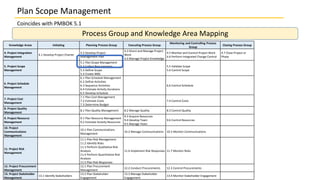
Process Group and Knowledge Area Mapping
Knowledge Areas Initiating Planning Process Group Executing Process Group
Monitoring and Controlling Process
Group
Closing Process Group
4. Project Integration
Management
4.1 Develop Project Charter
4.2 Develop Project
Management Plan
4.3 Direct and Manage Project
Work
4.4 Manage Project Knowledge
4.5 Monitor and Control Project Work
4.6 Perform Integrated Change Control
4.7 Close Project or
Phase
5. Project Scope
Management
5.1 Plan Scope Management
5.2 Collect Requirements
5.3 Define Scope
5.4 Create WBS
5.5 Validate Scope
5.6 Control Scope
6. Project Schedule
Management
6.1 Plan Schedule Management
6.2 Define Activities
6.3 Sequence Activities
6.4 Estimate Activity Durations
6.5 Develop Schedule
6.6 Control Schedule
7. Project Cost
Management
7.1 Plan Cost Management
7.2 Estimate Costs
7.3 Determine Budget
7.4 Control Costs
8. Project Quality
Management
8.1 Plan Quality Management 8.2 Manage Quality 8.3 Control Quality
9. Project Resource
Management
9.1 Plan Resource Management
9.2 Estimate Activity Resources
9.3 Acquire Resources
9.4 Develop Team
9.5 Manage Team
9.6 Control Resources
10. Project
Communications
Management
10.1 Plan Communications
Management
10.2 Manage Communications 10.3 Monitor Communications
11. Project Risk
Management
11.1 Plan Risk Management
11.2 Identify Risks
11.3 Perform Qualitative Risk
Analysis
11.4 Perform Quantitative Risk
Analysis
11.5 Plan Risk Responses
11.6 Implement Risk Responses 11.7 Monitor Risks
12. Project Procurement
Management
12.1 Plan Procurement
Management
12.2 Conduct Procurements 12.3 Control Procurements
13. Project Stakeholder
Management
13.1 Identify Stakeholders
13.2 Plan Stakeholder
Engagement
13.3 Manage Stakeholder
Engagement
13.4 Monitor Stakeholder Engagement
Plan Scope Management
Coincides with PMBOK 5.1
What is it?
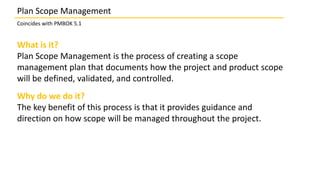
Plan Scope Management is the process of creating a scope
management plan that documents how the project and product scope
will be defined, validated, and controlled.
Why do we do it?
The key benefit of this process is that it provides guidance and
direction on how scope will be managed throughout the project.
Plan Scope Management
Coincides with PMBOK 5.1
Overview
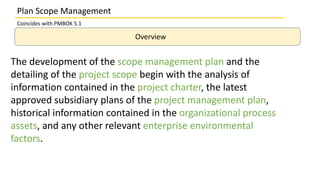
The development of the scope management plan and the
detailing of the project scope begin with the analysis of
information contained in the project charter, the latest
approved subsidiary plans of the project management plan,
historical information contained in the organizational process
assets, and any other relevant enterprise environmental
factors.
Plan Scope Management
Coincides with PMBOK 5.1
Plan Scope Management
Coincides with PMBOK 5.1
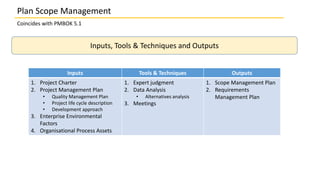
Inputs, Tools & Techniques and Outputs
Inputs Tools & Techniques Outputs
1. Project Charter
2. Project Management Plan
• Quality Management Plan
• Project life cycle description
• Development approach
3. Enterprise Environmental
Factors
4. Organisational Process Assets
1. Expert judgment
2. Data Analysis
• Alternatives analysis
3. Meetings
1. Scope Management Plan
2. Requirements
Management Plan
Plan Scope Management
Coincides with PMBOK 5.1
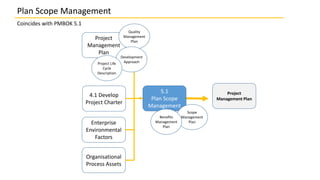
5.1
Plan Scope
Management
Project
Management
Plan
Enterprise
Environmental
Factors
Organisational
Process Assets
Quality
Management
Plan
Development
ApproachProject Life
Cycle
Description
Project
Management Plan
4.1 Develop
Project Charter
Scope
Management
Plan
Benefits
Management
Plan
Plan Scope Management - Inputs
Coincides with PMBOK 5.1
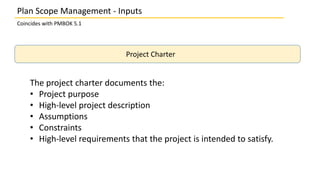
Project Charter
The project charter documents the:
• Project purpose
• High-level project description
• Assumptions
• Constraints
• High-level requirements that the project is intended to satisfy.
Plan Scope Management - Inputs
Coincides with PMBOK 5.1
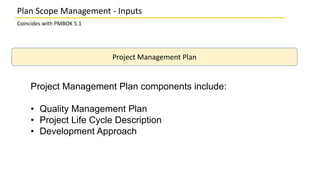
Project Management Plan
Project Management Plan components include:
• Quality Management Plan
• Project Life Cycle Description
• Development Approach
Plan Scope Management - Inputs
Coincides with PMBOK 5.1
Enterprise Environmental Factors
• Organization’s culture
• Infrastructure
• Personnel Administration
• Marketplace conditions
Things that can affect Project Management Plan:
Plan Scope Management - Inputs
Coincides with PMBOK 5.1
Organisational Process Assets
• Policies and Procedures
• Historical information and lessons learned
repository
Things that can influence the Project Scope Management Process:
Plan Scope Management – Tools & Techniques
Coincides with PMBOK 5.1
Expert Judgment
• Previous Similar Projects
• Information in the industry, discipline and application
area
Expertise should be considered from individuals or groups with
specialized knowledge of or training in the following topics:
Plan Scope Management – Tools & Techniques
Coincides with PMBOK 5.1
Data Analysis
• Alternatives Analysis
Use for the various ways of:
• Collecting Requirements
• Elaborating the project and product scope
• Validating the scope
• Controlling the scope
Plan Scope Management – Tools & Techniques
Coincides with PMBOK 5.1
Meetings
Project teams may attend project meetings to develop
the scope management plan, held with key stakeholders:
• Project Manager
• Project Sponsor
• Project Team Members
• Selected Stakeholders
• Anyone responsible for any of the scope management
processes.
Plan Scope Management – Outputs
Coincides with PMBOK 5.1
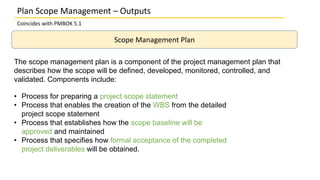
Scope Management Plan
The scope management plan is a component of the project management plan that
describes how the scope will be defined, developed, monitored, controlled, and
validated. Components include:
• Process for preparing a project scope statement
• Process that enables the creation of the WBS from the detailed
project scope statement
• Process that establishes how the scope baseline will be
approved and maintained
• Process that specifies how formal acceptance of the completed
project deliverables will be obtained.
Plan Scope Management – Outputs
Coincides with PMBOK 5.1
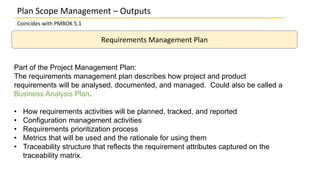
Requirements Management Plan
Part of the Project Management Plan:
The requirements management plan describes how project and product
requirements will be analysed, documented, and managed. Could also be called a
Business Analysis Plan.
• How requirements activities will be planned, tracked, and reported
• Configuration management activities
• Requirements prioritization process
• Metrics that will be used and the rationale for using them
• Traceability structure that reflects the requirement attributes captured on the
traceability matrix.

5.1 Plan Scope Management

  • 1.
  • 2.
    Process Group andKnowledge Area Mapping Knowledge Areas Initiating Planning Process Group Executing Process Group Monitoring and Controlling Process Group Closing Process Group 4. Project Integration Management 4.1 Develop Project Charter 4.2 Develop Project Management Plan 4.3 Direct and Manage Project Work 4.4 Manage Project Knowledge 4.5 Monitor and Control Project Work 4.6 Perform Integrated Change Control 4.7 Close Project or Phase 5. Project Scope Management 5.1 Plan Scope Management 5.2 Collect Requirements 5.3 Define Scope 5.4 Create WBS 5.5 Validate Scope 5.6 Control Scope 6. Project Schedule Management 6.1 Plan Schedule Management 6.2 Define Activities 6.3 Sequence Activities 6.4 Estimate Activity Durations 6.5 Develop Schedule 6.6 Control Schedule 7. Project Cost Management 7.1 Plan Cost Management 7.2 Estimate Costs 7.3 Determine Budget 7.4 Control Costs 8. Project Quality Management 8.1 Plan Quality Management 8.2 Manage Quality 8.3 Control Quality 9. Project Resource Management 9.1 Plan Resource Management 9.2 Estimate Activity Resources 9.3 Acquire Resources 9.4 Develop Team 9.5 Manage Team 9.6 Control Resources 10. Project Communications Management 10.1 Plan Communications Management 10.2 Manage Communications 10.3 Monitor Communications 11. Project Risk Management 11.1 Plan Risk Management 11.2 Identify Risks 11.3 Perform Qualitative Risk Analysis 11.4 Perform Quantitative Risk Analysis 11.5 Plan Risk Responses 11.6 Implement Risk Responses 11.7 Monitor Risks 12. Project Procurement Management 12.1 Plan Procurement Management 12.2 Conduct Procurements 12.3 Control Procurements 13. Project Stakeholder Management 13.1 Identify Stakeholders 13.2 Plan Stakeholder Engagement 13.3 Manage Stakeholder Engagement 13.4 Monitor Stakeholder Engagement Plan Scope Management Coincides with PMBOK 5.1
  • 3.
    What is it? PlanScope Management is the process of creating a scope management plan that documents how the project and product scope will be defined, validated, and controlled. Why do we do it? The key benefit of this process is that it provides guidance and direction on how scope will be managed throughout the project. Plan Scope Management Coincides with PMBOK 5.1
  • 4.
    Overview The development ofthe scope management plan and the detailing of the project scope begin with the analysis of information contained in the project charter, the latest approved subsidiary plans of the project management plan, historical information contained in the organizational process assets, and any other relevant enterprise environmental factors. Plan Scope Management Coincides with PMBOK 5.1
  • 5.
    Plan Scope Management Coincideswith PMBOK 5.1 Inputs, Tools & Techniques and Outputs Inputs Tools & Techniques Outputs 1. Project Charter 2. Project Management Plan • Quality Management Plan • Project life cycle description • Development approach 3. Enterprise Environmental Factors 4. Organisational Process Assets 1. Expert judgment 2. Data Analysis • Alternatives analysis 3. Meetings 1. Scope Management Plan 2. Requirements Management Plan
  • 6.
    Plan Scope Management Coincideswith PMBOK 5.1 5.1 Plan Scope Management Project Management Plan Enterprise Environmental Factors Organisational Process Assets Quality Management Plan Development ApproachProject Life Cycle Description Project Management Plan 4.1 Develop Project Charter Scope Management Plan Benefits Management Plan
  • 7.
    Plan Scope Management- Inputs Coincides with PMBOK 5.1 Project Charter The project charter documents the: • Project purpose • High-level project description • Assumptions • Constraints • High-level requirements that the project is intended to satisfy.
  • 8.
    Plan Scope Management- Inputs Coincides with PMBOK 5.1 Project Management Plan Project Management Plan components include: • Quality Management Plan • Project Life Cycle Description • Development Approach
  • 9.
    Plan Scope Management- Inputs Coincides with PMBOK 5.1 Enterprise Environmental Factors • Organization’s culture • Infrastructure • Personnel Administration • Marketplace conditions Things that can affect Project Management Plan:
  • 10.
    Plan Scope Management- Inputs Coincides with PMBOK 5.1 Organisational Process Assets • Policies and Procedures • Historical information and lessons learned repository Things that can influence the Project Scope Management Process:
  • 11.
    Plan Scope Management– Tools & Techniques Coincides with PMBOK 5.1 Expert Judgment • Previous Similar Projects • Information in the industry, discipline and application area Expertise should be considered from individuals or groups with specialized knowledge of or training in the following topics:
  • 12.
    Plan Scope Management– Tools & Techniques Coincides with PMBOK 5.1 Data Analysis • Alternatives Analysis Use for the various ways of: • Collecting Requirements • Elaborating the project and product scope • Validating the scope • Controlling the scope
  • 13.
    Plan Scope Management– Tools & Techniques Coincides with PMBOK 5.1 Meetings Project teams may attend project meetings to develop the scope management plan, held with key stakeholders: • Project Manager • Project Sponsor • Project Team Members • Selected Stakeholders • Anyone responsible for any of the scope management processes.
  • 14.
    Plan Scope Management– Outputs Coincides with PMBOK 5.1 Scope Management Plan The scope management plan is a component of the project management plan that describes how the scope will be defined, developed, monitored, controlled, and validated. Components include: • Process for preparing a project scope statement • Process that enables the creation of the WBS from the detailed project scope statement • Process that establishes how the scope baseline will be approved and maintained • Process that specifies how formal acceptance of the completed project deliverables will be obtained.
  • 15.
    Plan Scope Management– Outputs Coincides with PMBOK 5.1 Requirements Management Plan Part of the Project Management Plan: The requirements management plan describes how project and product requirements will be analysed, documented, and managed. Could also be called a Business Analysis Plan. • How requirements activities will be planned, tracked, and reported • Configuration management activities • Requirements prioritization process • Metrics that will be used and the rationale for using them • Traceability structure that reflects the requirement attributes captured on the traceability matrix.

Editor's Notes

  • #4 This process is performed throughout the project.
  • #9 Quality management plan. The way the project and product scope will be managed can be influenced by how the organization’s quality policy, methodologies, and standards are implemented on the project. Project life cycle description. The project life cycle determines the series of phases that a project passes through from its inception to the end of the project. Development approach. The development approach defines whether waterfall, iterative, adaptive, agile, or a hybrid development approach will be used.
  • #15 The scope management plan can be formal or informal, broadly framed or highly detailed, based on the needs of the project.
  • #16 Some organizations refer to it as a business analysis plan Configuration management activities : how changes will be initiated; how impacts will be analysed; how they will be traced, tracked, and reported; as well as the authorization levels required to approve these changes