Delivering in an
Agile Environment
Delivering in an Agile Environment
Charter the Project and the Team
A typical project using the Project Management Body of Knowledge (PMBOK) will initiate with a Project
Charter.
In addition using Agile, cross functional teams initiate with a Team Charter.
The Team Charter Includes:
• The project vision or purpose
• A clear set of working agreements
It answers these questions:
• Why are we doing this project?
• Who benefits and how?
• What does “done” mean for the project?
• How are we going to work together?
A servant leader may facilitate the chartering process.
Coincides with Agile Practice Guide 5.0
Delivering in an Agile Environment
Charter the Project and the Team
A team charter is also a “social contract”. It can include:
• Team values, such as sustainable pace and core hours
• Working agreements, such as what “ready” means so the team can take in work, what “done”
means so the team can judge completeness consistently, respecting the time-box and WIP limits.
• Ground rules, such as one person talking in a meeting,
• Group norms, such as how the team treats meeting times.
And other behaviours the team wants to work with or address.
Coincides with Agile Practice Guide 5.0
Delivering in an Agile Environment
Agile Teams Measure Results
Agile favours value-based measurements instead of predictive measurements (like earned value
management).
By measuring what is done and replanning at each iteration by iteration, there is less room for error
and more room to correct course.
Coincides with Agile Practice Guide 5.0
Delivering in an Agile Environment
Agile Teams Measure Results
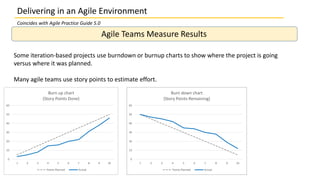
Some iteration-based projects use burndown or burnup charts to show where the project is going
versus where it was planned.
Many agile teams use story points to estimate effort.
0
10
20
30
40
50
60
1 2 3 4 5 6 7 8 9 10
Burn up chart
(Story Points Done)
Points Planned Actual
0
10
20
30
40
50
60
1 2 3 4 5 6 7 8 9 10
Burn down chart
(Story Points Remaining)
Points Planned Actual
Coincides with Agile Practice Guide 5.0
Evolving the Organisation
Organisational Considerations for Project Agility
Evolving the Organisation
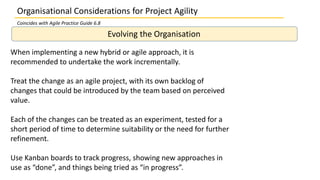
When implementing a new hybrid or agile approach, it is
recommended to undertake the work incrementally.
Treat the change as an agile project, with its own backlog of
changes that could be introduced by the team based on perceived
value.
Each of the changes can be treated as an experiment, tested for a
short period of time to determine suitability or the need for further
refinement.
Use Kanban boards to track progress, showing new approaches in
use as “done”, and things being tried as “in progress”.
Coincides with Agile Practice Guide 6.8
Organisational Considerations for Project Agility
Coincides with Agile Practice Guide 6.8
Evolving the Organisation
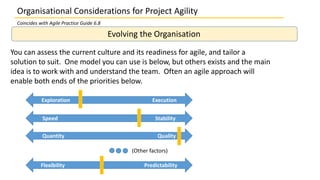
You can assess the current culture and its readiness for agile, and tailor a
solution to suit. One model you can use is below, but others exists and the main
idea is to work with and understand the team. Often an agile approach will
enable both ends of the priorities below.
Exploration Execution
Speed Stability
Quantity Quality
Flexibility Predictability
(Other factors)

7.0 Delivering in an Agile Environment

  • 1.
  • 2.
    Delivering in anAgile Environment Charter the Project and the Team A typical project using the Project Management Body of Knowledge (PMBOK) will initiate with a Project Charter. In addition using Agile, cross functional teams initiate with a Team Charter. The Team Charter Includes: • The project vision or purpose • A clear set of working agreements It answers these questions: • Why are we doing this project? • Who benefits and how? • What does “done” mean for the project? • How are we going to work together? A servant leader may facilitate the chartering process. Coincides with Agile Practice Guide 5.0
  • 3.
    Delivering in anAgile Environment Charter the Project and the Team A team charter is also a “social contract”. It can include: • Team values, such as sustainable pace and core hours • Working agreements, such as what “ready” means so the team can take in work, what “done” means so the team can judge completeness consistently, respecting the time-box and WIP limits. • Ground rules, such as one person talking in a meeting, • Group norms, such as how the team treats meeting times. And other behaviours the team wants to work with or address. Coincides with Agile Practice Guide 5.0
  • 4.
    Delivering in anAgile Environment Agile Teams Measure Results Agile favours value-based measurements instead of predictive measurements (like earned value management). By measuring what is done and replanning at each iteration by iteration, there is less room for error and more room to correct course. Coincides with Agile Practice Guide 5.0
  • 5.
    Delivering in anAgile Environment Agile Teams Measure Results Some iteration-based projects use burndown or burnup charts to show where the project is going versus where it was planned. Many agile teams use story points to estimate effort. 0 10 20 30 40 50 60 1 2 3 4 5 6 7 8 9 10 Burn up chart (Story Points Done) Points Planned Actual 0 10 20 30 40 50 60 1 2 3 4 5 6 7 8 9 10 Burn down chart (Story Points Remaining) Points Planned Actual Coincides with Agile Practice Guide 5.0
  • 6.
  • 7.
    Organisational Considerations forProject Agility Evolving the Organisation When implementing a new hybrid or agile approach, it is recommended to undertake the work incrementally. Treat the change as an agile project, with its own backlog of changes that could be introduced by the team based on perceived value. Each of the changes can be treated as an experiment, tested for a short period of time to determine suitability or the need for further refinement. Use Kanban boards to track progress, showing new approaches in use as “done”, and things being tried as “in progress”. Coincides with Agile Practice Guide 6.8
  • 8.
    Organisational Considerations forProject Agility Coincides with Agile Practice Guide 6.8 Evolving the Organisation You can assess the current culture and its readiness for agile, and tailor a solution to suit. One model you can use is below, but others exists and the main idea is to work with and understand the team. Often an agile approach will enable both ends of the priorities below. Exploration Execution Speed Stability Quantity Quality Flexibility Predictability (Other factors)