THE KORONIVIA JOINT WORK ON
AGRICULTURE AND ADAPTATION METRICS
FOR AGRICULTURE
KOREA GLOBAL ADAPTATIONWEEK
11 April 2019
Theresa Wong
Climate Change Technical Specialist, Climate and Environment Division
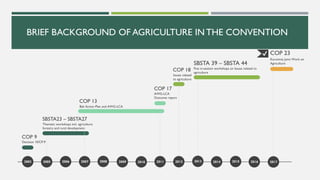
BRIEF BACKGROUND OF AGRICULTURE IN THE CONVENTION
2003
SBSTA23 – SBSTA27
Thematic workshops incl. agriculture
forestry and rural development
COP 13
Bali Action Plan and AWG-LCA
COP 17
AWG-LCA
Outcome report
COP 18
Issues related
to agriculture
COP 23
Koronivia Joint Work on
AgricultureSBSTA 39 – SBSTA 44
Five in-session workshops on Issues related to
agriculture
2005 2006 2007
COP 9
Decision 10/CP.9
2008 2009 2010 2011 2012 2013 2014 2015 2016 2017
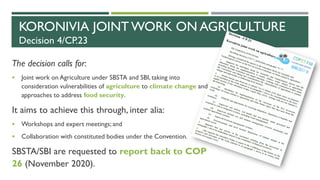
KORONIVIA JOINT WORK ON AGRICULTURE
Decision 4/CP.23
The decision calls for:
▪ Joint work on Agriculture under SBSTA and SBI, taking into
consideration vulnerabilities of agriculture to climate change and
approaches to address food security.
It aims to achieve this through, inter alia:
▪ Workshops and expert meetings; and
▪ Collaboration with constituted bodies under the Convention.
SBSTA/SBI are requested to report back to COP
26 (November 2020).
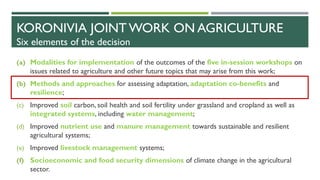
KORONIVIA JOINT WORK ON AGRICULTURE
Six elements of the decision
(a) Modalities for implementation of the outcomes of the five in-session workshops on
issues related to agriculture and other future topics that may arise from this work;
(b) Methods and approaches for assessing adaptation, adaptation co-benefits and
resilience;
(c) Improved soil carbon, soil health and soil fertility under grassland and cropland as well as
integrated systems, including water management;
(d) Improved nutrient use and manure management towards sustainable and resilient
agricultural systems;
(e) Improved livestock management systems;
(f) Socioeconomic and food security dimensions of climate change in the agricultural
sector.
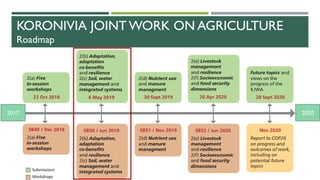
KORONIVIA JOINT WORK ON AGRICULTURE
Roadmap
2017 2020
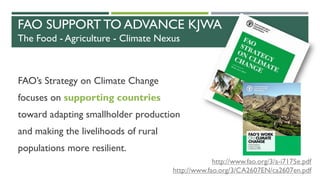
FAO SUPPORT TO ADVANCE KJWA
The Food - Agriculture - Climate Nexus
FAO’s Strategy on Climate Change
focuses on supporting countries
toward adapting smallholder production
and making the livelihoods of rural
populations more resilient.
http://www.fao.org/3/a-i7175e.pdf
http://www.fao.org/3/CA2607EN/ca2607en.pdf
TRACKING ADAPTATION
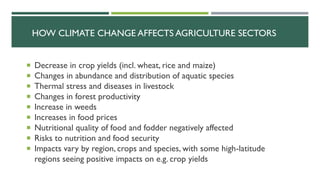
HOW CLIMATE CHANGE AFFECTS AGRICULTURE SECTORS
 Decrease in crop yields (incl. wheat, rice and maize)
 Changes in abundance and distribution of aquatic species
 Thermal stress and diseases in livestock
 Changes in forest productivity
 Increase in weeds
 Increases in food prices
 Nutritional quality of food and fodder negatively affected
 Risks to nutrition and food security
 Impacts vary by region, crops and species, with some high-latitude
regions seeing positive impacts on e.g. crop yields
GLOBAL CONTEXT FOR TRACKING ADAPTATION
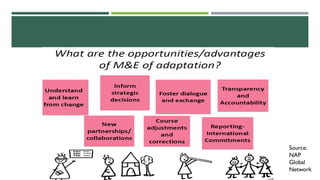
Most countries emphasize the importance of monitoring and evaluating the impact of their
proposed strategies. Where countries plan to introduce M&E for specific regions or
sectors, they often express the intention to scale these measures up to the national level in
the long run. (FAO 2016.The agriculture sectors in the INDCs, Rome).
“each Party shall, as appropriate, engage in adaptation planning processes and the implementation of
actions, including the development or enhancement of relevant plans, policies and/or contributions, which
may include […], (d) monitoring and evaluating and learning from adaptation plans, policies,
programmes and actions” (Decision 1/CP.21.Art.7.9.)
In countries’ Nationally Determined Contributions (NDCs):
In the Paris Agreement:
Source:
NAP
Global
Network
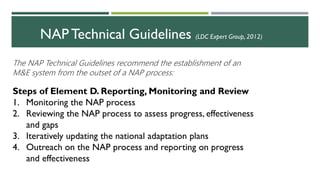
NAP Technical Guidelines (LDC Expert Group, 2012)
The NAP Technical Guidelines recommend the establishment of an
M&E system from the outset of a NAP process:
Steps of Element D. Reporting, Monitoring and Review
1. Monitoring the NAP process
2. Reviewing the NAP process to assess progress, effectiveness
and gaps
3. Iteratively updating the national adaptation plans
4. Outreach on the NAP process and reporting on progress
and effectiveness
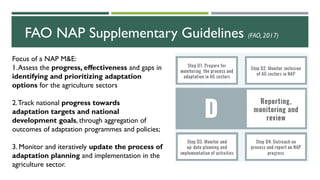
FAO NAP Supplementary Guidelines (FAO, 2017)
Focus of a NAP M&E:
1.Assess the progress, effectiveness and gaps in
identifying and prioritizing adaptation
options for the agriculture sectors
2.Track national progress towards
adaptation targets and national
development goals, through aggregation of
outcomes of adaptation programmes and policies;
3. Monitor and iteratively update the process of
adaptation planning and implementation in the
agriculture sector.
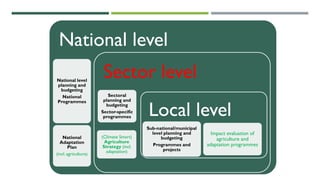
National level
National level
planning and
budgeting
National
Programmes
National
Adaptation
Plan
(incl. agriculture)
Sector level
Sectoral
planning and
budgeting
Sector-specific
programmes
(Climate Smart)
Agriculture
Strategy (incl.
adaptation)
Local level
Sub-national/municipal
level planning and
budgeting
Programmes and
projects
Impact evaluation of
agriculture and
adaptation programmes
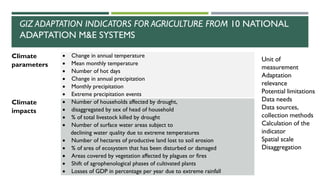
GIZ ADAPTATION INDICATORS FOR AGRICULTURE FROM 10 NATIONAL
ADAPTATION M&E SYSTEMS
Climate
parameters
• Change in annual temperature
• Mean monthly temperature
• Number of hot days
• Change in annual precipitation
• Monthly precipitation
• Extreme precipitation events
Climate
impacts
• Number of households affected by drought,
• disaggregated by sex of head of household
• % of total livestock killed by drought
• Number of surface water areas subject to
declining water quality due to extreme temperatures
• Number of hectares of productive land lost to soil erosion
• % of area of ecosystem that has been disturbed or damaged
• Areas covered by vegetation affected by plagues or fires
• Shift of agrophenological phases of cultivated plants
• Losses of GDP in percentage per year due to extreme rainfall
Unit of
measurement
Adaptation
relevance
Potential limitations
Data needs
Data sources,
collection methods
Calculation of the
indicator
Spatial scale
Disaggregation
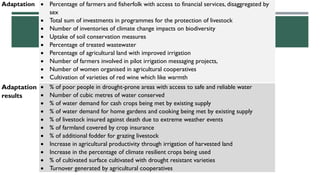
Adaptation • Percentage of farmers and fisherfolk with access to financial services, disaggregated by
sex
• Total sum of investments in programmes for the protection of livestock
• Number of inventories of climate change impacts on biodiversity
• Uptake of soil conservation measures
• Percentage of treated wastewater
• Percentage of agricultural land with improved irrigation
• Number of farmers involved in pilot irrigation messaging projects,
• Number of women organised in agricultural cooperatives
• Cultivation of varieties of red wine which like warmth
Adaptation
results
• % of poor people in drought-prone areas with access to safe and reliable water
• Number of cubic metres of water conserved
• % of water demand for cash crops being met by existing supply
• % of water demand for home gardens and cooking being met by existing supply
• % of livestock insured against death due to extreme weather events
• % of farmland covered by crop insurance
• % of additional fodder for grazing livestock
• Increase in agricultural productivity through irrigation of harvested land
• Increase in the percentage of climate resilient crops being used
• % of cultivated surface cultivated with drought resistant varieties
• Turnover generated by agricultural cooperatives
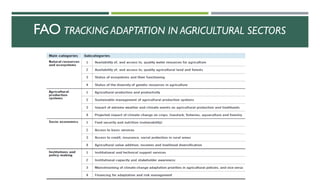
FAO TRACKING ADAPTATION IN AGRICULTURAL SECTORS
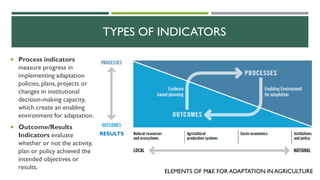
TYPES OF INDICATORS
 Process indicators
measure progress in
implementing adaptation
policies, plans, projects or
changes in institutional
decision-making capacity,
which create an enabling
environment for adaptation.
 Outcome/Results
Indicators evaluate
whether or not the activity,
plan or policy achieved the
intended objectives or
results.
RESULTS
ELEMENTS OF M&E FOR ADAPTATION IN AGRICULTURE
THANK YOU!
Please visit our website: http://www.fao.org/climate-change

9.2.4 Regional TEM-A Part III

  • 1.
    THE KORONIVIA JOINTWORK ON AGRICULTURE AND ADAPTATION METRICS FOR AGRICULTURE KOREA GLOBAL ADAPTATIONWEEK 11 April 2019 Theresa Wong Climate Change Technical Specialist, Climate and Environment Division
  • 2.
    BRIEF BACKGROUND OFAGRICULTURE IN THE CONVENTION 2003 SBSTA23 – SBSTA27 Thematic workshops incl. agriculture forestry and rural development COP 13 Bali Action Plan and AWG-LCA COP 17 AWG-LCA Outcome report COP 18 Issues related to agriculture COP 23 Koronivia Joint Work on AgricultureSBSTA 39 – SBSTA 44 Five in-session workshops on Issues related to agriculture 2005 2006 2007 COP 9 Decision 10/CP.9 2008 2009 2010 2011 2012 2013 2014 2015 2016 2017
  • 3.
    KORONIVIA JOINT WORKON AGRICULTURE Decision 4/CP.23 The decision calls for: ▪ Joint work on Agriculture under SBSTA and SBI, taking into consideration vulnerabilities of agriculture to climate change and approaches to address food security. It aims to achieve this through, inter alia: ▪ Workshops and expert meetings; and ▪ Collaboration with constituted bodies under the Convention. SBSTA/SBI are requested to report back to COP 26 (November 2020).
  • 4.
    KORONIVIA JOINT WORKON AGRICULTURE Six elements of the decision (a) Modalities for implementation of the outcomes of the five in-session workshops on issues related to agriculture and other future topics that may arise from this work; (b) Methods and approaches for assessing adaptation, adaptation co-benefits and resilience; (c) Improved soil carbon, soil health and soil fertility under grassland and cropland as well as integrated systems, including water management; (d) Improved nutrient use and manure management towards sustainable and resilient agricultural systems; (e) Improved livestock management systems; (f) Socioeconomic and food security dimensions of climate change in the agricultural sector.
  • 5.
    KORONIVIA JOINT WORKON AGRICULTURE Roadmap 2017 2020
  • 6.
    FAO SUPPORT TOADVANCE KJWA The Food - Agriculture - Climate Nexus FAO’s Strategy on Climate Change focuses on supporting countries toward adapting smallholder production and making the livelihoods of rural populations more resilient. http://www.fao.org/3/a-i7175e.pdf http://www.fao.org/3/CA2607EN/ca2607en.pdf
  • 7.
  • 8.
    HOW CLIMATE CHANGEAFFECTS AGRICULTURE SECTORS  Decrease in crop yields (incl. wheat, rice and maize)  Changes in abundance and distribution of aquatic species  Thermal stress and diseases in livestock  Changes in forest productivity  Increase in weeds  Increases in food prices  Nutritional quality of food and fodder negatively affected  Risks to nutrition and food security  Impacts vary by region, crops and species, with some high-latitude regions seeing positive impacts on e.g. crop yields
  • 9.
    GLOBAL CONTEXT FORTRACKING ADAPTATION Most countries emphasize the importance of monitoring and evaluating the impact of their proposed strategies. Where countries plan to introduce M&E for specific regions or sectors, they often express the intention to scale these measures up to the national level in the long run. (FAO 2016.The agriculture sectors in the INDCs, Rome). “each Party shall, as appropriate, engage in adaptation planning processes and the implementation of actions, including the development or enhancement of relevant plans, policies and/or contributions, which may include […], (d) monitoring and evaluating and learning from adaptation plans, policies, programmes and actions” (Decision 1/CP.21.Art.7.9.) In countries’ Nationally Determined Contributions (NDCs): In the Paris Agreement:
  • 10.
  • 11.
    NAP Technical Guidelines(LDC Expert Group, 2012) The NAP Technical Guidelines recommend the establishment of an M&E system from the outset of a NAP process: Steps of Element D. Reporting, Monitoring and Review 1. Monitoring the NAP process 2. Reviewing the NAP process to assess progress, effectiveness and gaps 3. Iteratively updating the national adaptation plans 4. Outreach on the NAP process and reporting on progress and effectiveness
  • 12.
    FAO NAP SupplementaryGuidelines (FAO, 2017) Focus of a NAP M&E: 1.Assess the progress, effectiveness and gaps in identifying and prioritizing adaptation options for the agriculture sectors 2.Track national progress towards adaptation targets and national development goals, through aggregation of outcomes of adaptation programmes and policies; 3. Monitor and iteratively update the process of adaptation planning and implementation in the agriculture sector.
  • 13.
    National level National level planningand budgeting National Programmes National Adaptation Plan (incl. agriculture) Sector level Sectoral planning and budgeting Sector-specific programmes (Climate Smart) Agriculture Strategy (incl. adaptation) Local level Sub-national/municipal level planning and budgeting Programmes and projects Impact evaluation of agriculture and adaptation programmes
  • 14.
    GIZ ADAPTATION INDICATORSFOR AGRICULTURE FROM 10 NATIONAL ADAPTATION M&E SYSTEMS Climate parameters • Change in annual temperature • Mean monthly temperature • Number of hot days • Change in annual precipitation • Monthly precipitation • Extreme precipitation events Climate impacts • Number of households affected by drought, • disaggregated by sex of head of household • % of total livestock killed by drought • Number of surface water areas subject to declining water quality due to extreme temperatures • Number of hectares of productive land lost to soil erosion • % of area of ecosystem that has been disturbed or damaged • Areas covered by vegetation affected by plagues or fires • Shift of agrophenological phases of cultivated plants • Losses of GDP in percentage per year due to extreme rainfall Unit of measurement Adaptation relevance Potential limitations Data needs Data sources, collection methods Calculation of the indicator Spatial scale Disaggregation
  • 15.
    Adaptation • Percentageof farmers and fisherfolk with access to financial services, disaggregated by sex • Total sum of investments in programmes for the protection of livestock • Number of inventories of climate change impacts on biodiversity • Uptake of soil conservation measures • Percentage of treated wastewater • Percentage of agricultural land with improved irrigation • Number of farmers involved in pilot irrigation messaging projects, • Number of women organised in agricultural cooperatives • Cultivation of varieties of red wine which like warmth Adaptation results • % of poor people in drought-prone areas with access to safe and reliable water • Number of cubic metres of water conserved • % of water demand for cash crops being met by existing supply • % of water demand for home gardens and cooking being met by existing supply • % of livestock insured against death due to extreme weather events • % of farmland covered by crop insurance • % of additional fodder for grazing livestock • Increase in agricultural productivity through irrigation of harvested land • Increase in the percentage of climate resilient crops being used • % of cultivated surface cultivated with drought resistant varieties • Turnover generated by agricultural cooperatives
  • 16.
    FAO TRACKING ADAPTATIONIN AGRICULTURAL SECTORS
  • 17.
    TYPES OF INDICATORS Process indicators measure progress in implementing adaptation policies, plans, projects or changes in institutional decision-making capacity, which create an enabling environment for adaptation.  Outcome/Results Indicators evaluate whether or not the activity, plan or policy achieved the intended objectives or results. RESULTS ELEMENTS OF M&E FOR ADAPTATION IN AGRICULTURE
  • 19.
    THANK YOU! Please visitour website: http://www.fao.org/climate-change