165 breweries
70 countries
Employs 76,000 people
165 breweries
70 countries
Employs 76,000 people
Why is sustainable
development important to
HEINEKEN
1. Climate change: temperature rise, sea level rise, shrinking ice sheets, extreme events, ocean acidification
2. The COP 21 Paris agreement, committing to keep the overall increase in global temperatures below 2°C
3. Conscious choice – consumer preferences shifting to sustainable brands
Why we do it?
CLIMATE CHANGE ISSUES WE FACE AS A COUNTRY
Consistent with global trends
• Increase in temperatures
• Variability in rainfall (droughts, floods)
• Rise in sea levels
• Dramatic increase in hurricane frequency
• Increases in health impacts (Dengue, Chikungunya, H1N1 epidemics)
• Declining coral reef health
• Erosion
: Our adaptation approach
Water matters because
o With population growing, it is expected that we could face a 40% supply gap by 2030
o Beer is 95% water so a critical resource for our business, also for sourcing our crops
o 23 of our breweries are in water-stressed areas and this number will grow
• Red Stripe’s water source comes
from our wells on site.
• There are licences for each well
that indicate the amount of
water that can be drawn daily.
• Meters are installed on each
well and water usage is tracked
and monitored daily.
• Conservation measures , our
NANO filtration , Reverse
Osmosis and waste water
treatment plants have resulted
in steady decline in water
usage over the years
What have we done at Red Stripe?
Our Results!
Reducing CO2 Emissions
• From brewing our beer using the power of
the sun to looking at how we transport it,
cool it, and deal with our waste.
• Ambitious targets for 2030 that will require
open collaboration and game-changing
innovation from players covering the entire
value chain.
THERMAL CO2 ELECTRICITY
Based on the final Air Dispersion Model Report dated September
2018 submitted to National Environment Planning Agency there was
a significant reduction in pollutant emitted from our site with the use
of LNG.
What have we done at Red Stripe?
95%
85%
80%
82%
84%
86%
88%
90%
92%
94%
96%
1 2
BOTTLE RETURN RATE
2009 2018
What have we done at Red Stripe?
Sustainable sourcing and agriculture
• 9 billion people to feed in 2050: increase agricultural
productivity while protecting natural resources
• Secure our supplies, reduce risk and volatility in our
raw material supply chains
• Potential to provide economic and social benefits to
farmers, their families and communities
• We depend on our suppliers to help us improve supply
chain standards, including human rights
What have we done at Red Stripe?
Project Grow
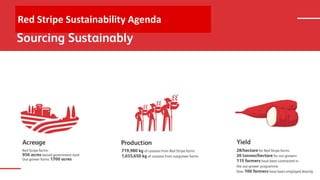
Sourcing Sustainably
Red Stripe Sustainability Agenda
Adaptation approach
Project Grow
Sourcing Sustainably
• Financing instruments
• Development of warning systems
• Science driven data collection
Increased of local raw materials and
development of Climate Smart
production systems for improved yield
Embedding water conservation
throughout the entire supply chain
• Reverse Osmosis Plant Upgrade
• Site wide campaigns
• Rain Harvesting projects
• Collaboration
Bring us to the table to provide data and analytics
on the work being done to support NAP
• Co-creation for Policy Development specific to
private sector integration into local support of NAP
• Calibration through regulation
How can they standardize and offer
incentives/funding to organizations that are
supportive
The Opportunities
6.5 Adaptation forum part 2

6.5 Adaptation forum part 2

  • 2.
  • 3.
  • 6.
    Why is sustainable developmentimportant to HEINEKEN
  • 7.
    1. Climate change:temperature rise, sea level rise, shrinking ice sheets, extreme events, ocean acidification 2. The COP 21 Paris agreement, committing to keep the overall increase in global temperatures below 2°C 3. Conscious choice – consumer preferences shifting to sustainable brands Why we do it?
  • 12.
    CLIMATE CHANGE ISSUESWE FACE AS A COUNTRY Consistent with global trends • Increase in temperatures • Variability in rainfall (droughts, floods) • Rise in sea levels • Dramatic increase in hurricane frequency • Increases in health impacts (Dengue, Chikungunya, H1N1 epidemics) • Declining coral reef health • Erosion
  • 13.
  • 15.
    Water matters because oWith population growing, it is expected that we could face a 40% supply gap by 2030 o Beer is 95% water so a critical resource for our business, also for sourcing our crops o 23 of our breweries are in water-stressed areas and this number will grow
  • 16.
    • Red Stripe’swater source comes from our wells on site. • There are licences for each well that indicate the amount of water that can be drawn daily. • Meters are installed on each well and water usage is tracked and monitored daily. • Conservation measures , our NANO filtration , Reverse Osmosis and waste water treatment plants have resulted in steady decline in water usage over the years What have we done at Red Stripe?
  • 17.
  • 18.
    Reducing CO2 Emissions •From brewing our beer using the power of the sun to looking at how we transport it, cool it, and deal with our waste. • Ambitious targets for 2030 that will require open collaboration and game-changing innovation from players covering the entire value chain.
  • 19.
  • 20.
    Based on thefinal Air Dispersion Model Report dated September 2018 submitted to National Environment Planning Agency there was a significant reduction in pollutant emitted from our site with the use of LNG. What have we done at Red Stripe?
  • 21.
    95% 85% 80% 82% 84% 86% 88% 90% 92% 94% 96% 1 2 BOTTLE RETURNRATE 2009 2018 What have we done at Red Stripe?
  • 22.
    What have wedone at Red Stripe?
  • 24.
    Sustainable sourcing andagriculture • 9 billion people to feed in 2050: increase agricultural productivity while protecting natural resources • Secure our supplies, reduce risk and volatility in our raw material supply chains • Potential to provide economic and social benefits to farmers, their families and communities • We depend on our suppliers to help us improve supply chain standards, including human rights
  • 25.
    What have wedone at Red Stripe? Project Grow Sourcing Sustainably
  • 26.
  • 28.
  • 30.
    • Financing instruments •Development of warning systems • Science driven data collection Increased of local raw materials and development of Climate Smart production systems for improved yield Embedding water conservation throughout the entire supply chain • Reverse Osmosis Plant Upgrade • Site wide campaigns • Rain Harvesting projects
  • 31.
    • Collaboration Bring usto the table to provide data and analytics on the work being done to support NAP • Co-creation for Policy Development specific to private sector integration into local support of NAP • Calibration through regulation How can they standardize and offer incentives/funding to organizations that are supportive The Opportunities

Editor's Notes

  • #4 In 2016
  • #5 In 2016
  • #6 In 2016
  • #7 Sustainable Development is really two ideas: A way to understand our complicated world: How do the economic, the social, the environmental, the political, the cultural factors fit together? The idea of sensible goals for our complex interconnected planet with some 10 billion inhabitants. How do we make the world both prosperous, fair and also environmentally sustainable so that our numbers and our economy don’t over run the physical planet itself?
  • #15 Why it matters: - Climate change: temperature rise, sea level rise, shrinking ice sheets, extreme events, ocean acidification - 197 countries signed the COP 21 Paris agreement, committing to keep the overall increase in global temperatures below 2°C - Conscious choice – consumer preferences shifting to sustainable brands Reducing CO2 Emissions From brewing our beer using the power of the sun to looking at how we transport it, cool it, and deal with our waste. Ambitious targets for 2030 that will require open collaboration and game-changing innovation from players covering the entire value chain. Reducing CO2 Emissions 2018 Performance: - 50% boost in production - 6000 tonne reduction in CO2 - 30% increase in electrical and steam output
  • #17 Heading:,
  • #21 LNG: In October 2017, to reduce its carbon foot print Red Stripe switched to the use of LNG to run its CHP plant and in November 2018 the conversion of boilers from heavy fuel oil LNG was completed. Based on the final Air Dispersion Model Report dated September 2018 submitted to NEPA that indicates a significant reduction in pollutant emitted from our site with the use of LNG.
  • #22 Recycling: The revamping of waste segregation (plastic bottles, cardboard boxes and plastics) is in progress with bins and skips being procured for roll out.
  • #23  Culling – a total of 4,512 tons of glass were culled for return to manufacture in 2018. Wooden pallets – In December 2018 55.69 tons of damaged pallets were sent to Woodcats for repairs. 34.88 tons of scrap were generated from the process with 100% utilized as fuel in boilers or in mulch. None was sent to landfill. Waste from this process has continued to be fully utilized from December 2015.