Adapting the Agriculture Sectors:
Examples of crop production
George Phiri
Programme Manager, FAO
LEG Regional Training Workshop
27 February - 03 March | Lilongwe, Malawi
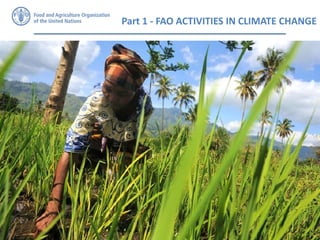
Part 1 - FAO ACTIVITIES IN CLIMATE CHANGE
3
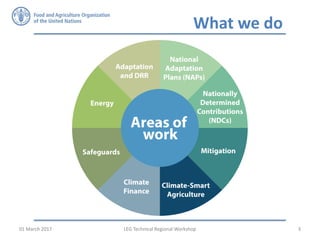
What we do
LEG Technical Regional Workshop01 March 2017
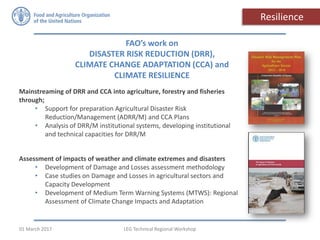
FAO’s work on
DISASTER RISK REDUCTION (DRR),
CLIMATE CHANGE ADAPTATION (CCA) and
CLIMATE RESILIENCE
Mainstreaming of DRR and CCA into agriculture, forestry and fisheries
through;
• Support for preparation Agricultural Disaster Risk
Reduction/Management (ADRR/M) and CCA Plans
• Analysis of DRR/M institutional systems, developing institutional
and technical capacities for DRR/M
Assessment of impacts of weather and climate extremes and disasters
• Development of Damage and Losses assessment methodology
• Case studies on Damage and Losses in agricultural sectors and
Capacity Development
• Development of Medium Term Warning Systems (MTWS): Regional
Assessment of Climate Change Impacts and Adaptation
Resilience
LEG Technical Regional Workshop01 March 2017
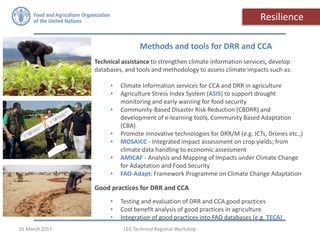
Technical assistance to strengthen climate information services, develop
databases, and tools and methodology to assess climate impacts such as:
• Climate Information services for CCA and DRR in agriculture
• Agriculture Stress Index System (ASIS) to support drought
monitoring and early warning for food security
• Community-Based Disaster Risk Reduction (CBDRR) and
development of e-learning tools, Community Based Adaptation
(CBA)
• Promote innovative technologies for DRR/M (e.g. ICTs, Drones etc.,)
• MOSAICC - Integrated impact assessment on crop yields; from
climate data handling to economic assessment
• AMICAF - Analysis and Mapping of Impacts under Climate Change
for Adaptation and Food Security
• FAO-Adapt: Framework Programme on Climate Change Adaptation
Good practices for DRR and CCA
• Testing and evaluation of DRR and CCA good practices
• Cost benefit analysis of good practices in agriculture
• Integration of good practices into FAO databases (e.g. TECA)
Resilience
Methods and tools for DRR and CCA
LEG Technical Regional Workshop01 March 2017
INTEGRATING AGRICULTURE IN NATIONAL ADAPTATION PLANS (NAPS)
FAO supports countries on the integration of agriculture and food security
concerns into National Adaptation Plans (NAP)/ adaptation planning and
budgeting processes. In particular, Cross-Border Cooperation:
• Supports countries in NAPs negotiation during UNFCCC sessions;
• supports countries in the UNFCCC work streams and with Expert Groups including
on regional trainings and outreach and knowledge sharing;
• supports overall 29 developing countries across Africa, Asia, Latin America at the
national and sub-national level to integrate agriculture and food security in NAPs as
instrument to for implementing Nationally Determined Contributions (NDCs);
• drafted voluntary NAP guidelines on integrating agriculture, forestry and fisheries
and genetic diversity into National Adaptation Plans (NAPs);
Adaptation planning
FAO/UNDP Programme: “Integrating Agriculture in National
Adaptation Plans (NAP-Ag) a joint FAO UNDP Partnership Programme
to support NAPs in 11 countries. - USD 17 million until 2018
LEG Technical Regional Workshop01 March 2017
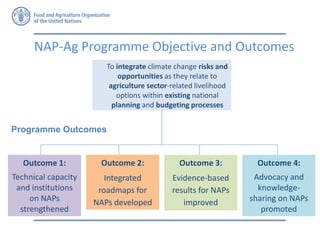
To integrate climate change risks and
opportunities as they relate to
agriculture sector-related livelihood
options within existing national
planning and budgeting processes
NAP-Ag Programme Objective and Outcomes
Outcome 2:
Integrated
roadmaps for
NAPs developed
Outcome 4:
Advocacy and
knowledge-
sharing on NAPs
promoted
Outcome 3:
Evidence-based
results for NAPs
improved
Programme Outcomes
Outcome 1:
Technical capacity
and institutions
on NAPs
strengthened
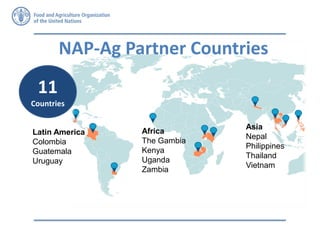
NAP-Ag Partner Countries
Latin America
Colombia
Guatemala
Uruguay
Africa
The Gambia
Kenya
Uganda
Zambia
Asia
Nepal
Philippines
Thailand
Vietnam
11
Countries
9
Adaptation planning
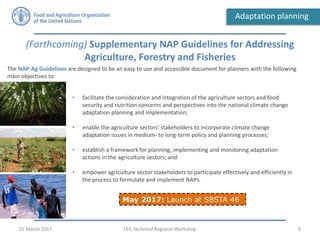
(Forthcoming) Supplementary NAP Guidelines for Addressing
Agriculture, Forestry and Fisheries
LEG Technical Regional Workshop01 March 2017
• facilitate the consideration and integration of the agriculture sectors and food
security and nutrition concerns and perspectives into the national climate change
adaptation planning and implementation;
• enable the agriculture sectors’ stakeholders to incorporate climate change
adaptation issues in medium- to long-term policy and planning processes;
• establish a framework for planning, implementing and monitoring adaptation
actions in the agriculture sectors; and
• empower agriculture sector stakeholders to participate effectively and efficiently in
the process to formulate and implement NAPs.
The NAP-Ag Guidelines are designed to be an easy to use and accessible document for planners with the following
main objectives to:
May 2017: Launch at SBSTA 46
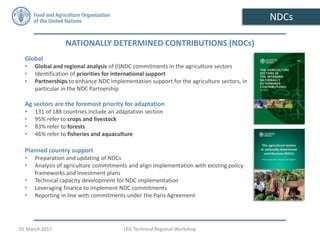
NATIONALLY DETERMINED CONTRIBUTIONS (NDCs)
Global
• Global and regional analysis of (I)NDC commitments in the agriculture sectors
• Identification of priorities for international support
• Partnerships to enhance NDC implementation support for the agriculture sectors, in
particular in the NDC Partnership
Ag sectors are the foremost priority for adaptation
• 131 of 188 countries include an adaptation section
• 95% refer to crops and livestock
• 83% refer to forests
• 46% refer to fisheries and aquaculture
Planned country support
• Preparation and updating of NDCs
• Analysis of agriculture commitments and align implementation with existing policy
frameworks and investment plans
• Technical capacity development for NDC implementation
• Leveraging finance to implement NDC commitments
• Reporting in line with commitments under the Paris Agreement
NDCs
LEG Technical Regional Workshop01 March 2017
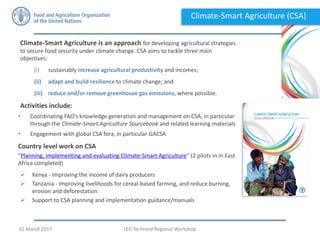
Climate-Smart Agriculture is an approach for developing agricultural strategies
to secure food security under climate change. CSA aims to tackle three main
objectives:
(i) sustainably increase agricultural productivity and incomes;
(ii) adapt and build resilience to climate change; and
(iii) reduce and/or remove greenhouse gas emissions, where possible.
Activities include:
• Coordinating FAO’s knowledge generation and management on CSA, in particular
through the Climate-Smart Agriculture Sourcebook and related learning materials
• Engagement with global CSA fora, in particular GACSA
Country level work on CSA
“Planning, implementing and evaluating Climate-Smart Agriculture” (2 pilots in in East
Africa completed)
 Kenya - Improving the income of dairy producers
 Tanzania - Improving livelihoods for cereal-based farming, and reduce burning,
erosion and deforestation
 Support to CSA planning and implementation guidance/manuals
Climate-Smart Agriculture (CSA)
LEG Technical Regional Workshop01 March 2017
FAO was accredited at the 14th meeting of the Board in October 2016.
FAO is exploring three ways to support Member States to work with the GCF:
• As a GCF-accredited implementing entity.
• Supporting the design and implementation of projects led by other accredited entities.
• As a delivery partner in the GCF Readiness Programme.
Laying the foundation for GCF projects has involved:
• Hosting a series of webinars on the Paris Agreement and Intended/Nationally Determined
Contributions (INDCs/NDCs), and the role of the GCF in supporting implementation;
Supporting countries to access NAP GCF readiness funds:
• Countries can now request up to USD 3 million in support through a new, dedicated NAP
activity area under the GCF Readiness and Preparatory Support Program.
GREEN CLIMATE FUND
Climate Finance
LEG Technical Regional Workshop01 March 2017
This is the name of the Conference 1318 May 2015
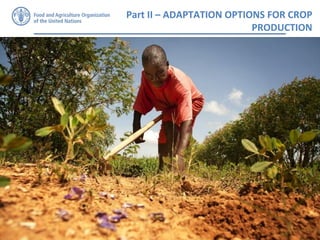
Part II – ADAPTATION OPTIONS FOR CROP
PRODUCTION
14LEG Technical Regional Workshop01 March 2017
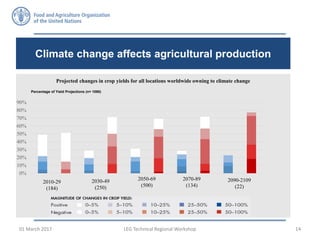
Climate change affects agricultural production
0%
10%
20%
30%
40%
50%
60%
70%
80%
90%
2090-2109
(22)
2070-89
(134)
2050-69
(500)
2030-49
(250)
2010-29
(184)
Projected changes in crop yields for all locations worldwide owning to climate change
Percentage of Yield Projections (n= 1090)
Innovation is the key to adaptation in farming systems
 Sustainable intensification
 Agroecology
 Efficient water management
 Managing carbon and nitrogen
Making production systems more resilient
FAO Economic and Social Development Department 10/ 30LEG Technical Regional Workshop01 March 2017
FAO Economic and Social Development Department 11/ 30
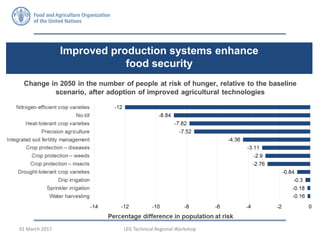
Improved production systems enhance
food security
LEG Technical Regional Workshop01 March 2017
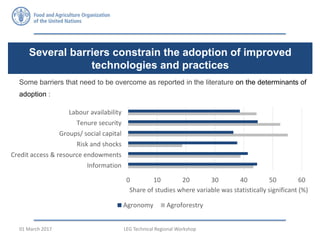
Some barriers that need to be overcome as reported in the literature on the determinants of
adoption :
Several barriers constrain the adoption of improved
technologies and practices
FAO Economic and Social Development Department 14/ 30
0 10 20 30 40 50 60
Information
Credit access & resource endowments
Risk and shocks
Groups/ social capital
Tenure security
Labour availability
Share of studies where variable was statistically significant (%)
Agronomy Agroforestry
LEG Technical Regional Workshop01 March 2017
19
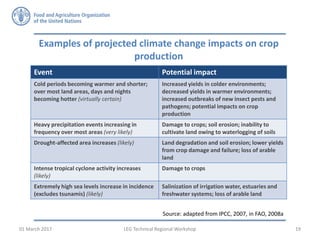
Event Potential impact
Cold periods becoming warmer and shorter;
over most land areas, days and nights
becoming hotter (virtually certain)
Increased yields in colder environments;
decreased yields in warmer environments;
increased outbreaks of new insect pests and
pathogens; potential impacts on crop
production
Heavy precipitation events increasing in
frequency over most areas (very likely)
Damage to crops; soil erosion; inability to
cultivate land owing to waterlogging of soils
Drought-affected area increases (likely) Land degradation and soil erosion; lower yields
from crop damage and failure; loss of arable
land
Intense tropical cyclone activity increases
(likely)
Damage to crops
Extremely high sea levels increase in incidence
(excludes tsunamis) (likely)
Salinization of irrigation water, estuaries and
freshwater systems; loss of arable land
Examples of projected climate change impacts on crop
production
Source: adapted from IPCC, 2007, in FAO, 2008a
LEG Technical Regional Workshop01 March 2017
LEG Technical Regional Workshop 2001 March 2017
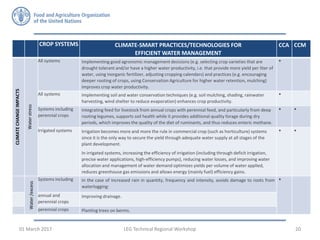
CROP SYSTEMS CLIMATE-SMART PRACTICES/TECHNOLOGIES FOR
EFFICIENT WATER MANAGEMENT
CCA CCM
CLIMATECHANGEIMPACTS
Waterstress
All systems Implementing good agronomic management decisions (e.g. selecting crop varieties that are
drought tolerant and/or have a higher water productivity, i.e. that provide more yield per liter of
water, using inorganic fertilizer, adjusting cropping calendars) and practices (e.g. encouraging
deeper rooting of crops, using Conservation Agriculture for higher water retention, mulching)
improves crop water productivity.
*
All systems Implementing soil and water conservation techniques (e.g. soil mulching, shading, rainwater
harvesting, wind shelter to reduce evaporation) enhances crop productivity.
*
Systems including
perennial crops
Integrating feed for livestock from annual crops with perennial feed, and particularly from deep
rooting legumes, supports soil health while it provides additional quality forage during dry
periods, which improves the quality of the diet of ruminants, and thus reduces enteric methane.
* *
Irrigated systems Irrigation becomes more and more the rule in commercial crop (such as horticulture) systems
since it is the only way to secure the yield through adequate water supply at all stages of the
plant development.
In irrigated systems, increasing the efficiency of irrigation (including through deficit irrigation,
precise water applications, high-efficiency pumps), reducing water losses, and improving water
allocation and management of water demand optimizes yields per volume of water applied,
reduces greenhouse gas emissions and allows energy (mainly fuel) efficiency gains.
* *
Water/excess
Systems including In the case of increased rain in quantity, frequency and intensity, avoids damage to roots from
waterlogging:
*
annual and
perennial crops
Improving drainage.
perennial crops Planting trees on berms.
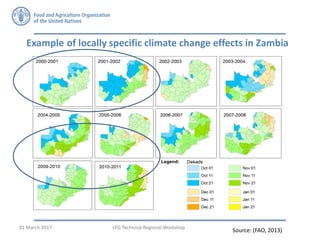
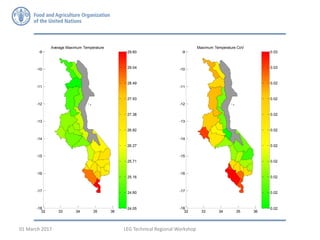
Example of locally specific climate change effects in Zambia
Source: (FAO, 2013)LEG Technical Regional Workshop01 March 2017
32 33 34 35 36
-18
-17
-16
-15
-14
-13
-12
-11
-10
-9
Maximum Temperature CoV
0.02
0.02
0.02
0.02
0.02
0.02
0.02
0.02
0.02
0.03
0.03
32 33 34 35 36
-18
-17
-16
-15
-14
-13
-12
-11
-10
-9
Average Maximum Temperature
24.05
24.60
25.16
25.71
26.27
26.82
27.38
27.93
28.49
29.04
29.60
LEG Technical Regional Workshop01 March 2017
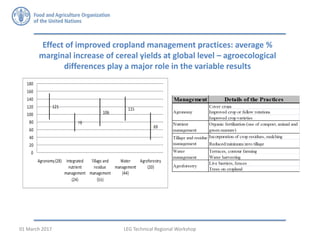
Effect of improved cropland management practices: average %
marginal increase of cereal yields at global level – agroecological
differences play a major role in the variable results
LEG Technical Regional Workshop01 March 2017
 Smallholder agriculture particularly vulnerable to climate change risks
and impacts
 Rural women are among the most vulnerable
LEG Technical Regional Workshop01 March 2017
No eradication of global poverty without resilient
smallholder agriculture
FAO Economic and Social Development Department 9 / 30
 Improving smallholders resilience through:
• improvement of their production systems
• build more resilient livelihood for vulnerable population
WHAT THE SOLUTION CAN BE
Key steps for packaging options into
programmes?
Step 1 – Review the existing framework and identify
the gaps and needs to address climate change impacts
in the agriculture sectors
Step 2 – Identify the priority areas
Step 3 – Map out key milestones necessary to
advance efforts in adapting to climate change
This is the name of the Conference 2618 May 2015
Wrap-up
THANK YOU!
www.fao.org/climatechange
LEG Technical Regional Workshop01 March 2017

Fao leg technical_workshop_malawi_2017_draft (002)

  • 1.
    Adapting the AgricultureSectors: Examples of crop production George Phiri Programme Manager, FAO LEG Regional Training Workshop 27 February - 03 March | Lilongwe, Malawi
  • 2.
    Part 1 -FAO ACTIVITIES IN CLIMATE CHANGE
  • 3.
    3 What we do LEGTechnical Regional Workshop01 March 2017
  • 4.
    FAO’s work on DISASTERRISK REDUCTION (DRR), CLIMATE CHANGE ADAPTATION (CCA) and CLIMATE RESILIENCE Mainstreaming of DRR and CCA into agriculture, forestry and fisheries through; • Support for preparation Agricultural Disaster Risk Reduction/Management (ADRR/M) and CCA Plans • Analysis of DRR/M institutional systems, developing institutional and technical capacities for DRR/M Assessment of impacts of weather and climate extremes and disasters • Development of Damage and Losses assessment methodology • Case studies on Damage and Losses in agricultural sectors and Capacity Development • Development of Medium Term Warning Systems (MTWS): Regional Assessment of Climate Change Impacts and Adaptation Resilience LEG Technical Regional Workshop01 March 2017
  • 5.
    Technical assistance tostrengthen climate information services, develop databases, and tools and methodology to assess climate impacts such as: • Climate Information services for CCA and DRR in agriculture • Agriculture Stress Index System (ASIS) to support drought monitoring and early warning for food security • Community-Based Disaster Risk Reduction (CBDRR) and development of e-learning tools, Community Based Adaptation (CBA) • Promote innovative technologies for DRR/M (e.g. ICTs, Drones etc.,) • MOSAICC - Integrated impact assessment on crop yields; from climate data handling to economic assessment • AMICAF - Analysis and Mapping of Impacts under Climate Change for Adaptation and Food Security • FAO-Adapt: Framework Programme on Climate Change Adaptation Good practices for DRR and CCA • Testing and evaluation of DRR and CCA good practices • Cost benefit analysis of good practices in agriculture • Integration of good practices into FAO databases (e.g. TECA) Resilience Methods and tools for DRR and CCA LEG Technical Regional Workshop01 March 2017
  • 6.
    INTEGRATING AGRICULTURE INNATIONAL ADAPTATION PLANS (NAPS) FAO supports countries on the integration of agriculture and food security concerns into National Adaptation Plans (NAP)/ adaptation planning and budgeting processes. In particular, Cross-Border Cooperation: • Supports countries in NAPs negotiation during UNFCCC sessions; • supports countries in the UNFCCC work streams and with Expert Groups including on regional trainings and outreach and knowledge sharing; • supports overall 29 developing countries across Africa, Asia, Latin America at the national and sub-national level to integrate agriculture and food security in NAPs as instrument to for implementing Nationally Determined Contributions (NDCs); • drafted voluntary NAP guidelines on integrating agriculture, forestry and fisheries and genetic diversity into National Adaptation Plans (NAPs); Adaptation planning FAO/UNDP Programme: “Integrating Agriculture in National Adaptation Plans (NAP-Ag) a joint FAO UNDP Partnership Programme to support NAPs in 11 countries. - USD 17 million until 2018 LEG Technical Regional Workshop01 March 2017
  • 7.
    To integrate climatechange risks and opportunities as they relate to agriculture sector-related livelihood options within existing national planning and budgeting processes NAP-Ag Programme Objective and Outcomes Outcome 2: Integrated roadmaps for NAPs developed Outcome 4: Advocacy and knowledge- sharing on NAPs promoted Outcome 3: Evidence-based results for NAPs improved Programme Outcomes Outcome 1: Technical capacity and institutions on NAPs strengthened
  • 8.
    NAP-Ag Partner Countries LatinAmerica Colombia Guatemala Uruguay Africa The Gambia Kenya Uganda Zambia Asia Nepal Philippines Thailand Vietnam 11 Countries
  • 9.
    9 Adaptation planning (Forthcoming) SupplementaryNAP Guidelines for Addressing Agriculture, Forestry and Fisheries LEG Technical Regional Workshop01 March 2017 • facilitate the consideration and integration of the agriculture sectors and food security and nutrition concerns and perspectives into the national climate change adaptation planning and implementation; • enable the agriculture sectors’ stakeholders to incorporate climate change adaptation issues in medium- to long-term policy and planning processes; • establish a framework for planning, implementing and monitoring adaptation actions in the agriculture sectors; and • empower agriculture sector stakeholders to participate effectively and efficiently in the process to formulate and implement NAPs. The NAP-Ag Guidelines are designed to be an easy to use and accessible document for planners with the following main objectives to: May 2017: Launch at SBSTA 46
  • 10.
    NATIONALLY DETERMINED CONTRIBUTIONS(NDCs) Global • Global and regional analysis of (I)NDC commitments in the agriculture sectors • Identification of priorities for international support • Partnerships to enhance NDC implementation support for the agriculture sectors, in particular in the NDC Partnership Ag sectors are the foremost priority for adaptation • 131 of 188 countries include an adaptation section • 95% refer to crops and livestock • 83% refer to forests • 46% refer to fisheries and aquaculture Planned country support • Preparation and updating of NDCs • Analysis of agriculture commitments and align implementation with existing policy frameworks and investment plans • Technical capacity development for NDC implementation • Leveraging finance to implement NDC commitments • Reporting in line with commitments under the Paris Agreement NDCs LEG Technical Regional Workshop01 March 2017
  • 11.
    Climate-Smart Agriculture isan approach for developing agricultural strategies to secure food security under climate change. CSA aims to tackle three main objectives: (i) sustainably increase agricultural productivity and incomes; (ii) adapt and build resilience to climate change; and (iii) reduce and/or remove greenhouse gas emissions, where possible. Activities include: • Coordinating FAO’s knowledge generation and management on CSA, in particular through the Climate-Smart Agriculture Sourcebook and related learning materials • Engagement with global CSA fora, in particular GACSA Country level work on CSA “Planning, implementing and evaluating Climate-Smart Agriculture” (2 pilots in in East Africa completed)  Kenya - Improving the income of dairy producers  Tanzania - Improving livelihoods for cereal-based farming, and reduce burning, erosion and deforestation  Support to CSA planning and implementation guidance/manuals Climate-Smart Agriculture (CSA) LEG Technical Regional Workshop01 March 2017
  • 12.
    FAO was accreditedat the 14th meeting of the Board in October 2016. FAO is exploring three ways to support Member States to work with the GCF: • As a GCF-accredited implementing entity. • Supporting the design and implementation of projects led by other accredited entities. • As a delivery partner in the GCF Readiness Programme. Laying the foundation for GCF projects has involved: • Hosting a series of webinars on the Paris Agreement and Intended/Nationally Determined Contributions (INDCs/NDCs), and the role of the GCF in supporting implementation; Supporting countries to access NAP GCF readiness funds: • Countries can now request up to USD 3 million in support through a new, dedicated NAP activity area under the GCF Readiness and Preparatory Support Program. GREEN CLIMATE FUND Climate Finance LEG Technical Regional Workshop01 March 2017
  • 13.
    This is thename of the Conference 1318 May 2015 Part II – ADAPTATION OPTIONS FOR CROP PRODUCTION
  • 14.
    14LEG Technical RegionalWorkshop01 March 2017 Climate change affects agricultural production 0% 10% 20% 30% 40% 50% 60% 70% 80% 90% 2090-2109 (22) 2070-89 (134) 2050-69 (500) 2030-49 (250) 2010-29 (184) Projected changes in crop yields for all locations worldwide owning to climate change Percentage of Yield Projections (n= 1090)
  • 15.
    Innovation is thekey to adaptation in farming systems  Sustainable intensification  Agroecology  Efficient water management  Managing carbon and nitrogen Making production systems more resilient FAO Economic and Social Development Department 10/ 30LEG Technical Regional Workshop01 March 2017
  • 16.
    FAO Economic andSocial Development Department 11/ 30 Improved production systems enhance food security LEG Technical Regional Workshop01 March 2017
  • 17.
    Some barriers thatneed to be overcome as reported in the literature on the determinants of adoption : Several barriers constrain the adoption of improved technologies and practices FAO Economic and Social Development Department 14/ 30 0 10 20 30 40 50 60 Information Credit access & resource endowments Risk and shocks Groups/ social capital Tenure security Labour availability Share of studies where variable was statistically significant (%) Agronomy Agroforestry LEG Technical Regional Workshop01 March 2017
  • 18.
    19 Event Potential impact Coldperiods becoming warmer and shorter; over most land areas, days and nights becoming hotter (virtually certain) Increased yields in colder environments; decreased yields in warmer environments; increased outbreaks of new insect pests and pathogens; potential impacts on crop production Heavy precipitation events increasing in frequency over most areas (very likely) Damage to crops; soil erosion; inability to cultivate land owing to waterlogging of soils Drought-affected area increases (likely) Land degradation and soil erosion; lower yields from crop damage and failure; loss of arable land Intense tropical cyclone activity increases (likely) Damage to crops Extremely high sea levels increase in incidence (excludes tsunamis) (likely) Salinization of irrigation water, estuaries and freshwater systems; loss of arable land Examples of projected climate change impacts on crop production Source: adapted from IPCC, 2007, in FAO, 2008a LEG Technical Regional Workshop01 March 2017
  • 19.
    LEG Technical RegionalWorkshop 2001 March 2017 CROP SYSTEMS CLIMATE-SMART PRACTICES/TECHNOLOGIES FOR EFFICIENT WATER MANAGEMENT CCA CCM CLIMATECHANGEIMPACTS Waterstress All systems Implementing good agronomic management decisions (e.g. selecting crop varieties that are drought tolerant and/or have a higher water productivity, i.e. that provide more yield per liter of water, using inorganic fertilizer, adjusting cropping calendars) and practices (e.g. encouraging deeper rooting of crops, using Conservation Agriculture for higher water retention, mulching) improves crop water productivity. * All systems Implementing soil and water conservation techniques (e.g. soil mulching, shading, rainwater harvesting, wind shelter to reduce evaporation) enhances crop productivity. * Systems including perennial crops Integrating feed for livestock from annual crops with perennial feed, and particularly from deep rooting legumes, supports soil health while it provides additional quality forage during dry periods, which improves the quality of the diet of ruminants, and thus reduces enteric methane. * * Irrigated systems Irrigation becomes more and more the rule in commercial crop (such as horticulture) systems since it is the only way to secure the yield through adequate water supply at all stages of the plant development. In irrigated systems, increasing the efficiency of irrigation (including through deficit irrigation, precise water applications, high-efficiency pumps), reducing water losses, and improving water allocation and management of water demand optimizes yields per volume of water applied, reduces greenhouse gas emissions and allows energy (mainly fuel) efficiency gains. * * Water/excess Systems including In the case of increased rain in quantity, frequency and intensity, avoids damage to roots from waterlogging: * annual and perennial crops Improving drainage. perennial crops Planting trees on berms.
  • 20.
    Example of locallyspecific climate change effects in Zambia Source: (FAO, 2013)LEG Technical Regional Workshop01 March 2017
  • 21.
    32 33 3435 36 -18 -17 -16 -15 -14 -13 -12 -11 -10 -9 Maximum Temperature CoV 0.02 0.02 0.02 0.02 0.02 0.02 0.02 0.02 0.02 0.03 0.03 32 33 34 35 36 -18 -17 -16 -15 -14 -13 -12 -11 -10 -9 Average Maximum Temperature 24.05 24.60 25.16 25.71 26.27 26.82 27.38 27.93 28.49 29.04 29.60 LEG Technical Regional Workshop01 March 2017
  • 22.
    Effect of improvedcropland management practices: average % marginal increase of cereal yields at global level – agroecological differences play a major role in the variable results LEG Technical Regional Workshop01 March 2017
  • 23.
     Smallholder agricultureparticularly vulnerable to climate change risks and impacts  Rural women are among the most vulnerable LEG Technical Regional Workshop01 March 2017 No eradication of global poverty without resilient smallholder agriculture FAO Economic and Social Development Department 9 / 30  Improving smallholders resilience through: • improvement of their production systems • build more resilient livelihood for vulnerable population WHAT THE SOLUTION CAN BE
  • 24.
    Key steps forpackaging options into programmes? Step 1 – Review the existing framework and identify the gaps and needs to address climate change impacts in the agriculture sectors Step 2 – Identify the priority areas Step 3 – Map out key milestones necessary to advance efforts in adapting to climate change This is the name of the Conference 2618 May 2015 Wrap-up
  • 25.