Dennis Albert June 4, 2018
www.dennisusa.com
Fluid Mechanics Study Guide
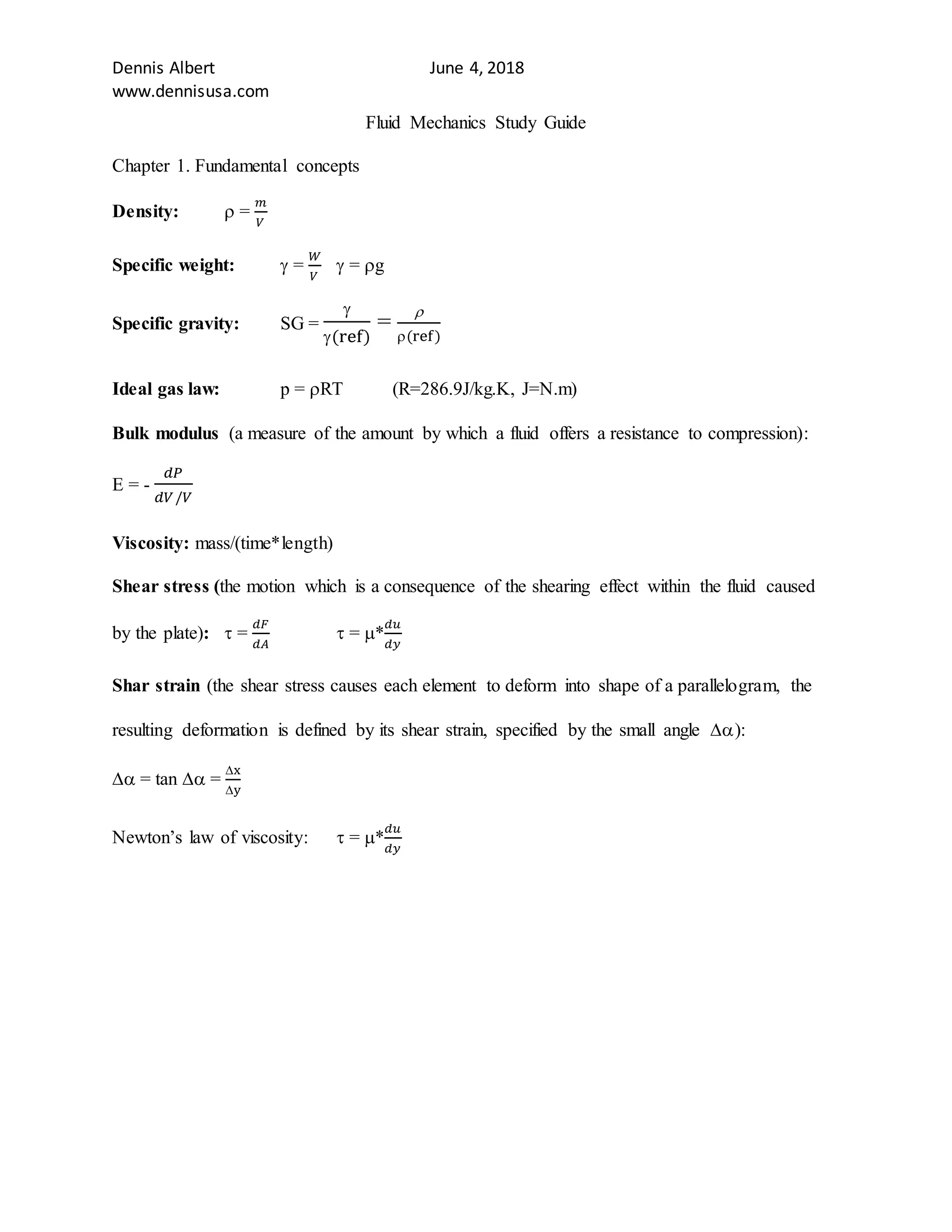
Chapter 1. Fundamental concepts
Density:  =
𝑚
𝑉
Specific weight:  =
𝑊
𝑉
 = g
Specific gravity: SG =

(ref)
=

(ref)
Ideal gas law: p = RT (R=286.9J/kg.K, J=N.m)
Bulk modulus (a measure of the amount by which a fluid offers a resistance to compression):
E = -
𝑑𝑃
𝑑𝑉/𝑉
Viscosity: mass/(time*length)
Shear stress (the motion which is a consequence of the shearing effect within the fluid caused
by the plate):  =
𝑑𝐹
𝑑𝐴
 = *
𝑑𝑢
𝑑𝑦
Shar strain (the shear stress causes each element to deform into shape of a parallelogram, the
resulting deformation is defined by its shear strain, specified by the small angle ):
 = tan  =
x
y
Newton’s law of viscosity:  = *
𝑑𝑢
𝑑𝑦
Dennis Albert June 4, 2018
www.dennisusa.com
Chapter 2 Fluid Statics
Pressure: p =
𝒅𝑭
𝒅𝑨
Pressure can have units of Pa = N/m2, psf = lbf/ft2, psi = lbf/in2
P = F/A = ghA = hA
Pascal’s Law: Pressure at a point in a fluid at rest, or in motion, is independent of direction, as
long as there are no shearing stress present.
Pressure of fluid at rest: dP = -  *dZ Z = elevation
𝑑𝑃
𝑑𝑍
= − 
Incompressible fluid (constant fluid density):
𝑑𝑃
𝑑𝑍
= − 
P1 – P2 = −  (Z2 – Z1)
P1 – P2 =  ∗ h, h=Z2-Z1
Compressible fluid (fluid density changes with temperature and pressure):
P2 = P1exp[- 𝑔(𝑍2−𝑍1)
𝑅𝑇0
]
Atmospheric pressure (measured by barometer): Patm = h + Pvapor
Gauge pressure (measured by manometer): p = h + p0
Manometer rule: p1 + *hdown - *hup = p2
Hydrostatic force on a plane surface: FR = p*A (FR: resultant force)
FR = hc *A (hc is the vertical distance from the fluid surface to the centroid of the area)
Location of the resultant force on x axis: yR = IXC/ycA + yc
Location of the resultant force on y axis: xR = IXC/xcA + xc

Fluid mechanics study guide (Cheat sheet)

  • 1.
    Dennis Albert June4, 2018 www.dennisusa.com Fluid Mechanics Study Guide Chapter 1. Fundamental concepts Density:  = 𝑚 𝑉 Specific weight:  = 𝑊 𝑉  = g Specific gravity: SG =  (ref) =  (ref) Ideal gas law: p = RT (R=286.9J/kg.K, J=N.m) Bulk modulus (a measure of the amount by which a fluid offers a resistance to compression): E = - 𝑑𝑃 𝑑𝑉/𝑉 Viscosity: mass/(time*length) Shear stress (the motion which is a consequence of the shearing effect within the fluid caused by the plate):  = 𝑑𝐹 𝑑𝐴  = * 𝑑𝑢 𝑑𝑦 Shar strain (the shear stress causes each element to deform into shape of a parallelogram, the resulting deformation is defined by its shear strain, specified by the small angle ):  = tan  = x y Newton’s law of viscosity:  = * 𝑑𝑢 𝑑𝑦
  • 2.
    Dennis Albert June4, 2018 www.dennisusa.com Chapter 2 Fluid Statics Pressure: p = 𝒅𝑭 𝒅𝑨 Pressure can have units of Pa = N/m2, psf = lbf/ft2, psi = lbf/in2 P = F/A = ghA = hA Pascal’s Law: Pressure at a point in a fluid at rest, or in motion, is independent of direction, as long as there are no shearing stress present. Pressure of fluid at rest: dP = -  *dZ Z = elevation 𝑑𝑃 𝑑𝑍 = −  Incompressible fluid (constant fluid density): 𝑑𝑃 𝑑𝑍 = −  P1 – P2 = −  (Z2 – Z1) P1 – P2 =  ∗ h, h=Z2-Z1 Compressible fluid (fluid density changes with temperature and pressure): P2 = P1exp[- 𝑔(𝑍2−𝑍1) 𝑅𝑇0 ] Atmospheric pressure (measured by barometer): Patm = h + Pvapor Gauge pressure (measured by manometer): p = h + p0 Manometer rule: p1 + *hdown - *hup = p2 Hydrostatic force on a plane surface: FR = p*A (FR: resultant force) FR = hc *A (hc is the vertical distance from the fluid surface to the centroid of the area) Location of the resultant force on x axis: yR = IXC/ycA + yc Location of the resultant force on y axis: xR = IXC/xcA + xc