Chapter 5
ElectroChemistry
SIR.MUHAMMAD ABDUL MAGEID
CHAPTER 5: ELECTRICITY & CHEMISTRY
01. REDOX REACTIONS
02. ELECTROLYSIS
03. ELECRTROPLATING
04. INDUSTRIAL APPLICATIONS
ELECTROPLATING
03.
CHEMISTRY – SIR. MUHAMMAD
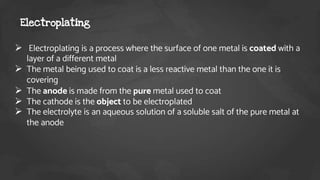
 Electroplating is a process where the surface of one metal is coated with a
layer of a different metal
 The metal being used to coat is a less reactive metal than the one it is
covering
 The anode is made from the pure metal used to coat
 The cathode is the object to be electroplated
 The electrolyte is an aqueous solution of a soluble salt of the pure metal at
the anode
Electroplating
Electroplating
SIR.MUHAMMAD ABDUL MAGEID
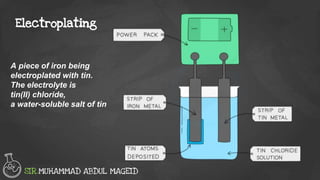
A piece of iron being
electroplated with tin.
The electrolyte is
tin(II) chloride,
a water-soluble salt of tin
 Electroplating is done to make metals more resistant to
corrosion or damage,
e.g.: chromium and nickel plating
 It is also done to improve the appearance of metals,
e.g.: silver plating cutlery
Uses of electroplating
SIR.MUHAMMAD ABDUL MAGEID
Conductors Insulators
 Conductors of electricity allow electrical
charge to pass through them easily
 Conductors can be:
- Solids such as metals or graphite
- Liquids such as molten lead bromide or
molten metals
- Solutions such as sodium chloride solution
 Copper is used extensively in electrical
wiring as it is an excellent conductor and
is malleable and easy to work with
 Aluminium is used in overhead cables
which are reinforced with a steel core
 The steel core provides extra strength
and prevents the cable from breaking
under its own weight .Although not as
good a conductor as copper, it is less
dense and cheaper than copper
 Insulators resist the flow of electricity
and do not conduct
 Most insulators are solids
of plastic, rubber or ceramic
 Plastics are used as insulators and are
placed around electrical wiring and for
some tool and machine handles
 Ceramics are used in very high voltage
lines where contact between the power
line and the metal of the pylon would be
dangerous
ANSWER PAST PAPERS QUESTIONS ON THIS TOPIC
TOPIC(5.3) ELECTROPLATING
THANKS…,
SIR.MUHAMMAD ABDUL MAGEID

5.3-Electroplating

  • 1.
  • 2.
    CHAPTER 5: ELECTRICITY& CHEMISTRY 01. REDOX REACTIONS 02. ELECTROLYSIS 03. ELECRTROPLATING 04. INDUSTRIAL APPLICATIONS
  • 3.
  • 4.
     Electroplating isa process where the surface of one metal is coated with a layer of a different metal  The metal being used to coat is a less reactive metal than the one it is covering  The anode is made from the pure metal used to coat  The cathode is the object to be electroplated  The electrolyte is an aqueous solution of a soluble salt of the pure metal at the anode Electroplating
  • 5.
    Electroplating SIR.MUHAMMAD ABDUL MAGEID Apiece of iron being electroplated with tin. The electrolyte is tin(II) chloride, a water-soluble salt of tin
  • 6.
     Electroplating isdone to make metals more resistant to corrosion or damage, e.g.: chromium and nickel plating  It is also done to improve the appearance of metals, e.g.: silver plating cutlery Uses of electroplating SIR.MUHAMMAD ABDUL MAGEID
  • 7.
    SIR.MUHAMMAD ABDUL MAGEID ConductorsInsulators  Conductors of electricity allow electrical charge to pass through them easily  Conductors can be: - Solids such as metals or graphite - Liquids such as molten lead bromide or molten metals - Solutions such as sodium chloride solution  Copper is used extensively in electrical wiring as it is an excellent conductor and is malleable and easy to work with  Aluminium is used in overhead cables which are reinforced with a steel core  The steel core provides extra strength and prevents the cable from breaking under its own weight .Although not as good a conductor as copper, it is less dense and cheaper than copper  Insulators resist the flow of electricity and do not conduct  Most insulators are solids of plastic, rubber or ceramic  Plastics are used as insulators and are placed around electrical wiring and for some tool and machine handles  Ceramics are used in very high voltage lines where contact between the power line and the metal of the pylon would be dangerous
  • 8.
    ANSWER PAST PAPERSQUESTIONS ON THIS TOPIC TOPIC(5.3) ELECTROPLATING THANKS…, SIR.MUHAMMAD ABDUL MAGEID