Hydropower generation
process and it’s impact on
Environment
Prepared by Bharat upadhyay
Institute of purwanchal
engineering campus
Dharan ,sunsari
A
SIMPLE
OVER
VIEW
Layout of hydropower plant
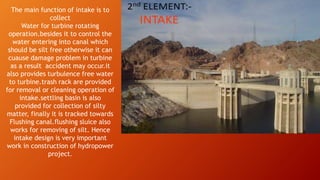
The main function of intake is to
collect
Water for turbine rotating
operation.besides it to control the
water entering into canal which
should be silt free otherwise it can
cuause damage problem in turbine
as a result accident may occur.it
also provides turbulence free water
to turbine.trash rack are provided
for removal or cleaning operation of
intake.settling basin is also
provided for collection of silty
matter, finally it is tracked towards
Flushing canal.flushing sluice also
works for removing of silt. Hence
intake design is very important
work in construction of hydropower
project.
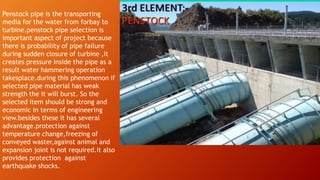
Penstock pipe is the transporting
media for the water from forbay to
turbine.penstock pipe selection is
important aspect of project because
there is probability of pipe failure
during sudden closure of turbine ,it
creates pressure inside the pipe as a
result water hammering operation
takesplace.during this phenomenon if
selected pipe material has weak
strength the it will burst. So the
selected item should be strong and
economic in terms of engineering
view.besides these it has several
advantage.protection against
temperature change,freezing of
conveyed waster,against animal and
expansion joint is not required.it also
provides protection against
earthquake shocks.
It rotates in high rotational speed when water strikes
Its blade.as a result alternating current is generated
In generator. Depending upon force there is two types
Of turbines.which are reaction turbine and impulse
Turbine.depending upon height created there is
Following type of type of turbine are available.Kaplan
Turbine,francis turbine and pelton turbine.
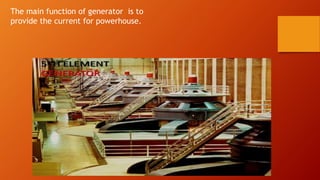
The main function of generator is to
provide the current for powerhouse.
6TH ELEMENT:-
TRANSFORMERS
7TH ELEMENT
OUTFLOW / TAILRACE:-
After passing through the turbine the water
returns to the river trough a short canal called a tailrace.
Working principle of tailrace
8.Power house of hydropower
Powerhouse has three different
structure.subsurface,intermediate and
Super structure.depending upon site
location the powerhouse may be
surface,semi underground and
underground.so the powerhouse
constructed should be economical and
Adequate for electricity generation
Process.
DAM TURBINE
POWER HOUSE
INTAKE
GENERATOR
PENSTOCK
RESEVOIR
POWER LINE
TRANSFORMER
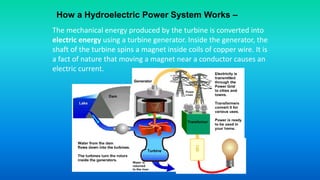
The mechanical energy produced by the turbine is converted into
electric energy using a turbine generator. Inside the generator, the
shaft of the turbine spins a magnet inside coils of copper wire. It is
a fact of nature that moving a magnet near a conductor causes an
electric current.
How a Hydroelectric Power System Works –
1. Minimum potential power is based on the smallest runoff
available in the stream at all times having duration of 100
percent.
2. Small potential power is calculated from the 95 percent
duration discharge .
3. Medium or average potential power is gained from the 50
percent duration discharge.
4. Mean potential power results by evaluating the annual
mean runoff.
For evaluation of hydropower potential of any site
following point should be considered.
Hydropower's effect on the environment
Hydropower is a clean source of energy. There are no problems with air pollution, chemical
runoff, toxic waste or the like.
Hydropower plants also create recreation areas and animal habitat. Because of the change in
water location, wide areas after the dam become great for water edge species of
animals. And the large reservoir is good for many types of large fish. Boating areas are
created in the reservoir too, as well as bird watching sites downstream of the dam.
Some problems may still occur though., but through careful planning these can be
eliminated almost completely.
Temporary disruption in the ecology to build the dam, but afterwards this cleared land
can be used to make animal habitat.
downstream of the dam, water flow may be significantly reduced, but careful
monitoring of the land downstream of the dam can give operators enough information
to allow more water to pass through the dam.
Catadramous fish (fish that live in salt water and spawn in fresh water) migration may
be interupted- but fish ladders and fish elevators may be installed to eliminate this
problem. Anadromous (fish that live in fresh water and spawn in salt water) fish do not
have this problem, because they can go right through the turbines which only spin at
81.8 rpms.
Flooding of land upstream of the dam can be a problem, but careful monitoring of the
land upstream of the dam can give operators enough information to allow more water
to run through the dam to compensate for this problem.
Advantages of hydropower
It is a clean and safe source of energy
They are self sustaining
They create habitat for more types of fish
They can act as a flood controller
They are the most efficient energy source
running from 90-95% efficiency
Other forms of Hydropower
Tidal power: electricity generated by turbines
moved by the tides. This is still in experimental
stages.
Ocean thermal power: power generated by the
thermal expansion of the ocean. This can only
be used in a location like the Gulf stream.
Geothermal power: natural steam is used
underground to turn turbines. This is limited to
location which have these phenomenon.
Advantages of hydropower
It is a clean and safe source of energy
They are self sustaining
They create habitat for more types of fish
They can act as a flood controller
They are the most efficient energy source
running from 90-95% efficiency
Other forms of Hydropower
Tidal power: electricity generated by turbines
moved by the tides. This is still in experimental
stages.
Ocean thermal power: power generated by the
thermal expansion of the ocean. This can only
be used in a location like the Gulf stream.
Geothermal power: natural steam is used
underground to turn turbines. This is limited to
location which have these phenomenon.
Hydropower generation process

Hydropower generation process

  • 1.
    Hydropower generation process andit’s impact on Environment Prepared by Bharat upadhyay Institute of purwanchal engineering campus Dharan ,sunsari
  • 5.
  • 7.
    The main functionof intake is to collect Water for turbine rotating operation.besides it to control the water entering into canal which should be silt free otherwise it can cuause damage problem in turbine as a result accident may occur.it also provides turbulence free water to turbine.trash rack are provided for removal or cleaning operation of intake.settling basin is also provided for collection of silty matter, finally it is tracked towards Flushing canal.flushing sluice also works for removing of silt. Hence intake design is very important work in construction of hydropower project.
  • 8.
    Penstock pipe isthe transporting media for the water from forbay to turbine.penstock pipe selection is important aspect of project because there is probability of pipe failure during sudden closure of turbine ,it creates pressure inside the pipe as a result water hammering operation takesplace.during this phenomenon if selected pipe material has weak strength the it will burst. So the selected item should be strong and economic in terms of engineering view.besides these it has several advantage.protection against temperature change,freezing of conveyed waster,against animal and expansion joint is not required.it also provides protection against earthquake shocks.
  • 9.
    It rotates inhigh rotational speed when water strikes Its blade.as a result alternating current is generated In generator. Depending upon force there is two types Of turbines.which are reaction turbine and impulse Turbine.depending upon height created there is Following type of type of turbine are available.Kaplan Turbine,francis turbine and pelton turbine.
  • 10.
    The main functionof generator is to provide the current for powerhouse.
  • 11.
  • 12.
    7TH ELEMENT OUTFLOW /TAILRACE:- After passing through the turbine the water returns to the river trough a short canal called a tailrace. Working principle of tailrace
  • 13.
    8.Power house ofhydropower Powerhouse has three different structure.subsurface,intermediate and Super structure.depending upon site location the powerhouse may be surface,semi underground and underground.so the powerhouse constructed should be economical and Adequate for electricity generation Process.
  • 14.
  • 15.
    The mechanical energyproduced by the turbine is converted into electric energy using a turbine generator. Inside the generator, the shaft of the turbine spins a magnet inside coils of copper wire. It is a fact of nature that moving a magnet near a conductor causes an electric current. How a Hydroelectric Power System Works –
  • 16.
    1. Minimum potentialpower is based on the smallest runoff available in the stream at all times having duration of 100 percent. 2. Small potential power is calculated from the 95 percent duration discharge . 3. Medium or average potential power is gained from the 50 percent duration discharge. 4. Mean potential power results by evaluating the annual mean runoff. For evaluation of hydropower potential of any site following point should be considered.
  • 17.
    Hydropower's effect onthe environment Hydropower is a clean source of energy. There are no problems with air pollution, chemical runoff, toxic waste or the like. Hydropower plants also create recreation areas and animal habitat. Because of the change in water location, wide areas after the dam become great for water edge species of animals. And the large reservoir is good for many types of large fish. Boating areas are created in the reservoir too, as well as bird watching sites downstream of the dam. Some problems may still occur though., but through careful planning these can be eliminated almost completely. Temporary disruption in the ecology to build the dam, but afterwards this cleared land can be used to make animal habitat. downstream of the dam, water flow may be significantly reduced, but careful monitoring of the land downstream of the dam can give operators enough information to allow more water to pass through the dam. Catadramous fish (fish that live in salt water and spawn in fresh water) migration may be interupted- but fish ladders and fish elevators may be installed to eliminate this problem. Anadromous (fish that live in fresh water and spawn in salt water) fish do not have this problem, because they can go right through the turbines which only spin at 81.8 rpms. Flooding of land upstream of the dam can be a problem, but careful monitoring of the land upstream of the dam can give operators enough information to allow more water to run through the dam to compensate for this problem.
  • 18.
    Advantages of hydropower Itis a clean and safe source of energy They are self sustaining They create habitat for more types of fish They can act as a flood controller They are the most efficient energy source running from 90-95% efficiency Other forms of Hydropower Tidal power: electricity generated by turbines moved by the tides. This is still in experimental stages. Ocean thermal power: power generated by the thermal expansion of the ocean. This can only be used in a location like the Gulf stream. Geothermal power: natural steam is used underground to turn turbines. This is limited to location which have these phenomenon.
  • 19.
    Advantages of hydropower Itis a clean and safe source of energy They are self sustaining They create habitat for more types of fish They can act as a flood controller They are the most efficient energy source running from 90-95% efficiency Other forms of Hydropower Tidal power: electricity generated by turbines moved by the tides. This is still in experimental stages. Ocean thermal power: power generated by the thermal expansion of the ocean. This can only be used in a location like the Gulf stream. Geothermal power: natural steam is used underground to turn turbines. This is limited to location which have these phenomenon.