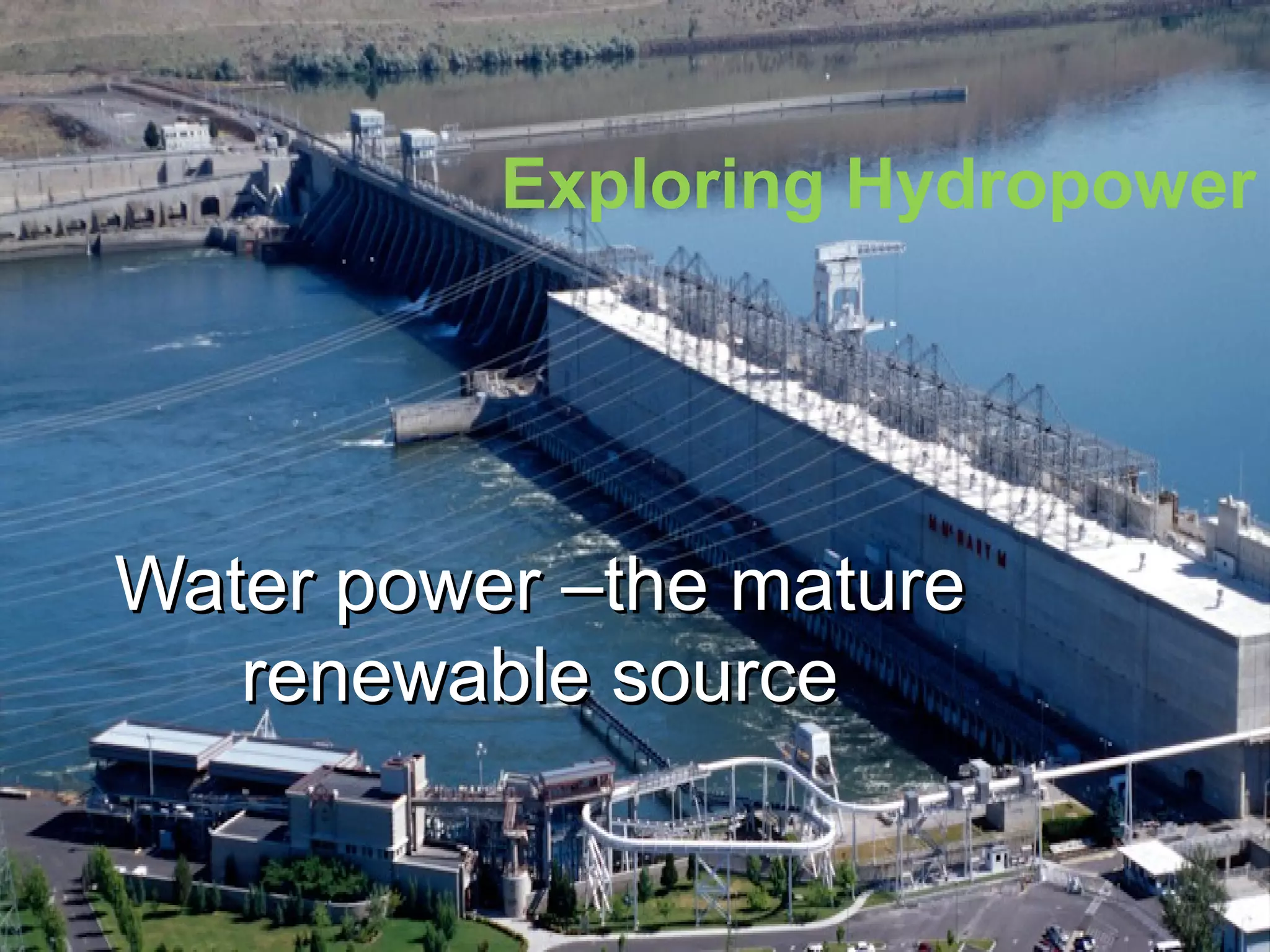
Water power –the matureWater power –the mature
renewable sourcerenewable source
Exploring Hydropower
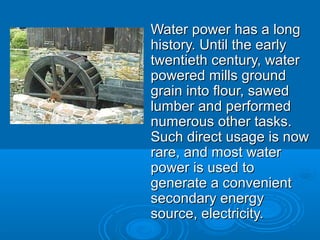
Water power has a longWater power has a long
history. Until the earlyhistory. Until the early
twentieth century, watertwentieth century, water
powered mills groundpowered mills ground
grain into flour, sawedgrain into flour, sawed
lumber and performedlumber and performed
numerous other tasks.numerous other tasks.
Such direct usage is nowSuch direct usage is now
rare, and most waterrare, and most water
power is used topower is used to
generate a convenientgenerate a convenient
secondary energysecondary energy
source, electricity.source, electricity.
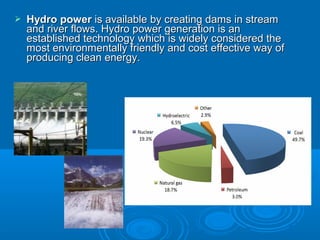
 Hydro powerHydro power is available by creating dams in streamis available by creating dams in stream
and river flows. Hydro power generation is anand river flows. Hydro power generation is an
established technologyestablished technology which is widely considered thewhich is widely considered the
most environmentally friendly and cost effective way ofmost environmentally friendly and cost effective way of
producing clean energy.producing clean energy.
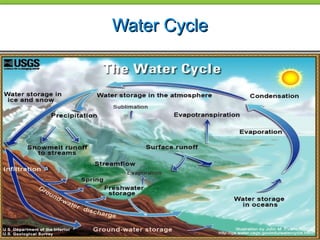
Water CycleWater Cycle
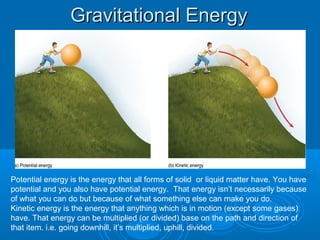
Gravitational EnergyGravitational Energy
Potential energy is the energy that all forms of solid or liquid matter have. You have
potential and you also have potential energy. That energy isn’t necessarily because
of what you can do but because of what something else can make you do.
Kinetic energy is the energy that anything which is in motion (except some gases)
have. That energy can be multiplied (or divided) base on the path and direction of
that item. i.e. going downhill, it’s multiplied, uphill, divided.
Hydroelectric power (hydropower)Hydroelectric power (hydropower)
systems convert the kinetic energy insystems convert the kinetic energy in
flowing water into electric energy.flowing water into electric energy.
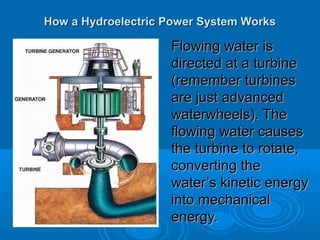
How a Hydroelectric Power System WorksHow a Hydroelectric Power System Works
Flowing water isFlowing water is
directed at a turbinedirected at a turbine
(remember turbines(remember turbines
are just advancedare just advanced
waterwheels). Thewaterwheels). The
flowing water causesflowing water causes
the turbine to rotate,the turbine to rotate,
converting theconverting the
water’s kinetic energywater’s kinetic energy
into mechanicalinto mechanical
energy.energy.
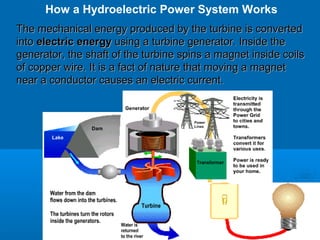
The mechanical energy produced by the turbine is convertedThe mechanical energy produced by the turbine is converted
intointo electric energyelectric energy using a turbine generator. Inside theusing a turbine generator. Inside the
generator, the shaft of the turbine spins a magnet inside coilsgenerator, the shaft of the turbine spins a magnet inside coils
of copper wire.of copper wire. It is a fact of nature that moving a magnetIt is a fact of nature that moving a magnet
near a conductor causes an electric current.near a conductor causes an electric current.
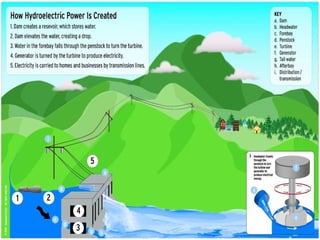
How a Hydroelectric Power System Works
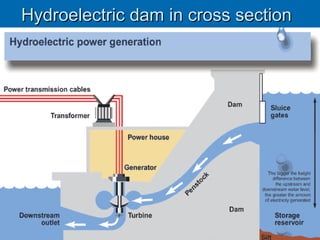
Hydroelectric dam in cross sectionHydroelectric dam in cross section
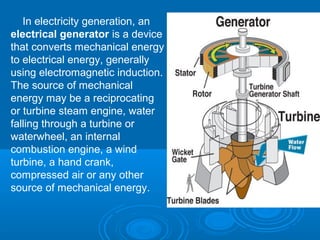
In electricity generation, an
electrical generator is a device
that converts mechanical energy
to electrical energy, generally
using electromagnetic induction.
The source of mechanical
energy may be a reciprocating
or turbine steam engine, water
falling through a turbine or
waterwheel, an internal
combustion engine, a wind
turbine, a hand crank,
compressed air or any other
source of mechanical energy.
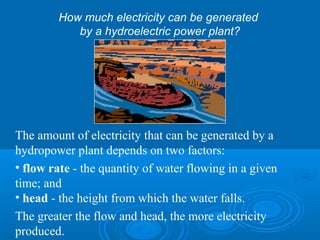
The amount of electricity that can be generated by a
hydropower plant depends on two factors:
• flow rate - the quantity of water flowing in a given
time; and
• head - the height from which the water falls.
The greater the flow and head, the more electricity
produced.
How much electricity can be generated
by a hydroelectric power plant?
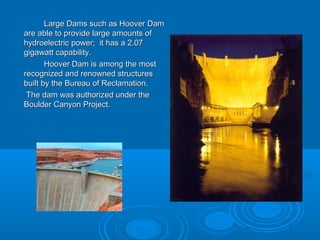
Large Dams such as Hoover DamLarge Dams such as Hoover Dam
are able to provide large amounts ofare able to provide large amounts of
hydroelectric power; it has a 2.07hydroelectric power; it has a 2.07
gigawatt capability.gigawatt capability.
Hoover Dam is among the mostHoover Dam is among the most
recognized and renowned structuresrecognized and renowned structures
built by the Bureau of Reclamation.built by the Bureau of Reclamation.
The dam was authorized under theThe dam was authorized under the
Boulder Canyon Project.Boulder Canyon Project.
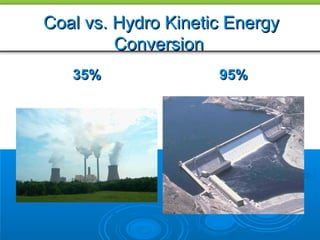
Coal vs. Hydro Kinetic EnergyCoal vs. Hydro Kinetic Energy
ConversionConversion
35%35% 95%95%
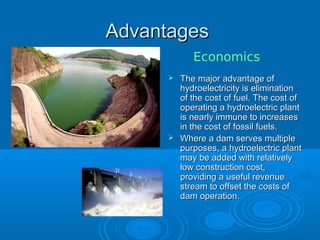
AdvantagesAdvantages
 The major advantage ofThe major advantage of
hydroelectricity is eliminationhydroelectricity is elimination
of the cost of fuel. The cost ofof the cost of fuel. The cost of
operating a hydroelectric plantoperating a hydroelectric plant
is nearly immune to increasesis nearly immune to increases
in the cost of fossil fuels.in the cost of fossil fuels.
 Where a dam serves multipleWhere a dam serves multiple
purposes, a hydroelectric plantpurposes, a hydroelectric plant
may be added with relativelymay be added with relatively
low construction cost,low construction cost,
providing a useful revenueproviding a useful revenue
stream to offset the costs ofstream to offset the costs of
dam operation.dam operation.
Economics
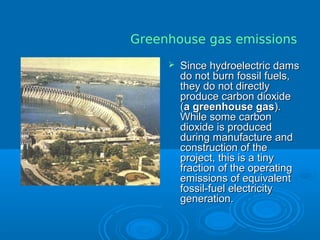
 Since hydroelectric damsSince hydroelectric dams
do not burn fossil fuels,do not burn fossil fuels,
they do not directlythey do not directly
produce carbon dioxideproduce carbon dioxide
((a greenhouse gasa greenhouse gas).).
While some carbonWhile some carbon
dioxide is produceddioxide is produced
during manufacture andduring manufacture and
construction of theconstruction of the
project, this is a tinyproject, this is a tiny
fraction of the operatingfraction of the operating
emissions of equivalentemissions of equivalent
fossil-fuel electricityfossil-fuel electricity
generation.generation.
Greenhouse gas emissions
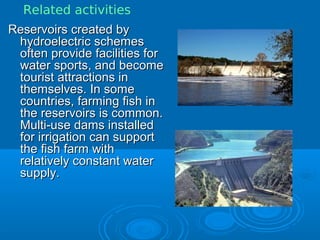
Reservoirs created byReservoirs created by
hydroelectric schemeshydroelectric schemes
often provide facilities foroften provide facilities for
water sports, and becomewater sports, and become
tourist attractions intourist attractions in
themselves. In somethemselves. In some
countries, farming fish incountries, farming fish in
the reservoirs is common.the reservoirs is common.
Multi-use dams installedMulti-use dams installed
for irrigation can supportfor irrigation can support
the fish farm withthe fish farm with
relatively constant waterrelatively constant water
supply.supply.
Related activities
DisadvantagesDisadvantages
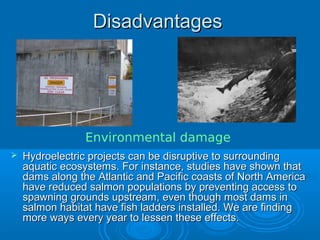
 Hydroelectric projects can be disruptive to surroundingHydroelectric projects can be disruptive to surrounding
aquatic ecosystems. For instance, studies have shown thataquatic ecosystems. For instance, studies have shown that
dams along the Atlantic and Pacific coasts of North Americadams along the Atlantic and Pacific coasts of North America
have reduced salmon populations by preventing access tohave reduced salmon populations by preventing access to
spawning grounds upstream, even though most dams inspawning grounds upstream, even though most dams in
salmon habitat have fish ladders installed. We are findingsalmon habitat have fish ladders installed. We are finding
more ways every year to lessen these effects.more ways every year to lessen these effects.
Environmental damage
Population relocationPopulation relocation
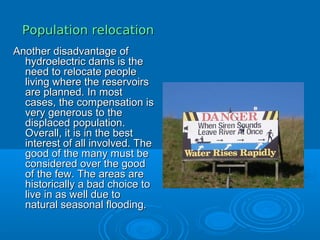
Another disadvantage ofAnother disadvantage of
hydroelectric dams is thehydroelectric dams is the
need to relocate peopleneed to relocate people
living where the reservoirsliving where the reservoirs
are planned. In mostare planned. In most
cases, the compensation iscases, the compensation is
very generous to thevery generous to the
displaced population.displaced population.
Overall, it is in the bestOverall, it is in the best
interest of all involved. Theinterest of all involved. The
good of the many must begood of the many must be
considered over the goodconsidered over the good
of the few. The areas areof the few. The areas are
historically a bad choice tohistorically a bad choice to
live in as well due tolive in as well due to
natural seasonal flooding.natural seasonal flooding.
Dam failuresDam failures
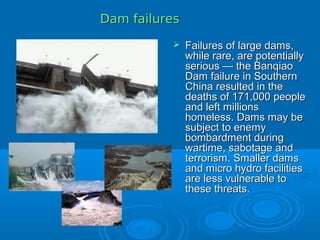
 Failures of large dams,Failures of large dams,
while rare, are potentiallywhile rare, are potentially
serious — the Banqiaoserious — the Banqiao
Dam failure in SouthernDam failure in Southern
China resulted in theChina resulted in the
deaths of 171,000 peopledeaths of 171,000 people
and left millionsand left millions
homeless. Dams may behomeless. Dams may be
subject to enemysubject to enemy
bombardment duringbombardment during
wartime, sabotage andwartime, sabotage and
terrorism. Smaller damsterrorism. Smaller dams
and micro hydro facilitiesand micro hydro facilities
are less vulnerable toare less vulnerable to
these threats.these threats.
The future of hydropower lies in
technologies that are also
environmental friendly.
Hydro1

Hydro1

  • 1.
    Water power –thematureWater power –the mature renewable sourcerenewable source Exploring Hydropower
  • 2.
    Water power hasa longWater power has a long history. Until the earlyhistory. Until the early twentieth century, watertwentieth century, water powered mills groundpowered mills ground grain into flour, sawedgrain into flour, sawed lumber and performedlumber and performed numerous other tasks.numerous other tasks. Such direct usage is nowSuch direct usage is now rare, and most waterrare, and most water power is used topower is used to generate a convenientgenerate a convenient secondary energysecondary energy source, electricity.source, electricity.
  • 3.
     Hydro powerHydropower is available by creating dams in streamis available by creating dams in stream and river flows. Hydro power generation is anand river flows. Hydro power generation is an established technologyestablished technology which is widely considered thewhich is widely considered the most environmentally friendly and cost effective way ofmost environmentally friendly and cost effective way of producing clean energy.producing clean energy.
  • 4.
  • 5.
    Gravitational EnergyGravitational Energy Potentialenergy is the energy that all forms of solid or liquid matter have. You have potential and you also have potential energy. That energy isn’t necessarily because of what you can do but because of what something else can make you do. Kinetic energy is the energy that anything which is in motion (except some gases) have. That energy can be multiplied (or divided) base on the path and direction of that item. i.e. going downhill, it’s multiplied, uphill, divided.
  • 6.
    Hydroelectric power (hydropower)Hydroelectricpower (hydropower) systems convert the kinetic energy insystems convert the kinetic energy in flowing water into electric energy.flowing water into electric energy.
  • 8.
    How a HydroelectricPower System WorksHow a Hydroelectric Power System Works Flowing water isFlowing water is directed at a turbinedirected at a turbine (remember turbines(remember turbines are just advancedare just advanced waterwheels). Thewaterwheels). The flowing water causesflowing water causes the turbine to rotate,the turbine to rotate, converting theconverting the water’s kinetic energywater’s kinetic energy into mechanicalinto mechanical energy.energy.
  • 9.
    The mechanical energyproduced by the turbine is convertedThe mechanical energy produced by the turbine is converted intointo electric energyelectric energy using a turbine generator. Inside theusing a turbine generator. Inside the generator, the shaft of the turbine spins a magnet inside coilsgenerator, the shaft of the turbine spins a magnet inside coils of copper wire.of copper wire. It is a fact of nature that moving a magnetIt is a fact of nature that moving a magnet near a conductor causes an electric current.near a conductor causes an electric current. How a Hydroelectric Power System Works
  • 10.
    Hydroelectric dam incross sectionHydroelectric dam in cross section
  • 11.
    In electricity generation,an electrical generator is a device that converts mechanical energy to electrical energy, generally using electromagnetic induction. The source of mechanical energy may be a reciprocating or turbine steam engine, water falling through a turbine or waterwheel, an internal combustion engine, a wind turbine, a hand crank, compressed air or any other source of mechanical energy.
  • 12.
    The amount ofelectricity that can be generated by a hydropower plant depends on two factors: • flow rate - the quantity of water flowing in a given time; and • head - the height from which the water falls. The greater the flow and head, the more electricity produced. How much electricity can be generated by a hydroelectric power plant?
  • 13.
    Large Dams suchas Hoover DamLarge Dams such as Hoover Dam are able to provide large amounts ofare able to provide large amounts of hydroelectric power; it has a 2.07hydroelectric power; it has a 2.07 gigawatt capability.gigawatt capability. Hoover Dam is among the mostHoover Dam is among the most recognized and renowned structuresrecognized and renowned structures built by the Bureau of Reclamation.built by the Bureau of Reclamation. The dam was authorized under theThe dam was authorized under the Boulder Canyon Project.Boulder Canyon Project.
  • 14.
    Coal vs. HydroKinetic EnergyCoal vs. Hydro Kinetic Energy ConversionConversion 35%35% 95%95%
  • 15.
    AdvantagesAdvantages  The majoradvantage ofThe major advantage of hydroelectricity is eliminationhydroelectricity is elimination of the cost of fuel. The cost ofof the cost of fuel. The cost of operating a hydroelectric plantoperating a hydroelectric plant is nearly immune to increasesis nearly immune to increases in the cost of fossil fuels.in the cost of fossil fuels.  Where a dam serves multipleWhere a dam serves multiple purposes, a hydroelectric plantpurposes, a hydroelectric plant may be added with relativelymay be added with relatively low construction cost,low construction cost, providing a useful revenueproviding a useful revenue stream to offset the costs ofstream to offset the costs of dam operation.dam operation. Economics
  • 16.
     Since hydroelectricdamsSince hydroelectric dams do not burn fossil fuels,do not burn fossil fuels, they do not directlythey do not directly produce carbon dioxideproduce carbon dioxide ((a greenhouse gasa greenhouse gas).). While some carbonWhile some carbon dioxide is produceddioxide is produced during manufacture andduring manufacture and construction of theconstruction of the project, this is a tinyproject, this is a tiny fraction of the operatingfraction of the operating emissions of equivalentemissions of equivalent fossil-fuel electricityfossil-fuel electricity generation.generation. Greenhouse gas emissions
  • 17.
    Reservoirs created byReservoirscreated by hydroelectric schemeshydroelectric schemes often provide facilities foroften provide facilities for water sports, and becomewater sports, and become tourist attractions intourist attractions in themselves. In somethemselves. In some countries, farming fish incountries, farming fish in the reservoirs is common.the reservoirs is common. Multi-use dams installedMulti-use dams installed for irrigation can supportfor irrigation can support the fish farm withthe fish farm with relatively constant waterrelatively constant water supply.supply. Related activities
  • 18.
    DisadvantagesDisadvantages  Hydroelectric projectscan be disruptive to surroundingHydroelectric projects can be disruptive to surrounding aquatic ecosystems. For instance, studies have shown thataquatic ecosystems. For instance, studies have shown that dams along the Atlantic and Pacific coasts of North Americadams along the Atlantic and Pacific coasts of North America have reduced salmon populations by preventing access tohave reduced salmon populations by preventing access to spawning grounds upstream, even though most dams inspawning grounds upstream, even though most dams in salmon habitat have fish ladders installed. We are findingsalmon habitat have fish ladders installed. We are finding more ways every year to lessen these effects.more ways every year to lessen these effects. Environmental damage
  • 19.
    Population relocationPopulation relocation Anotherdisadvantage ofAnother disadvantage of hydroelectric dams is thehydroelectric dams is the need to relocate peopleneed to relocate people living where the reservoirsliving where the reservoirs are planned. In mostare planned. In most cases, the compensation iscases, the compensation is very generous to thevery generous to the displaced population.displaced population. Overall, it is in the bestOverall, it is in the best interest of all involved. Theinterest of all involved. The good of the many must begood of the many must be considered over the goodconsidered over the good of the few. The areas areof the few. The areas are historically a bad choice tohistorically a bad choice to live in as well due tolive in as well due to natural seasonal flooding.natural seasonal flooding.
  • 20.
    Dam failuresDam failures Failures of large dams,Failures of large dams, while rare, are potentiallywhile rare, are potentially serious — the Banqiaoserious — the Banqiao Dam failure in SouthernDam failure in Southern China resulted in theChina resulted in the deaths of 171,000 peopledeaths of 171,000 people and left millionsand left millions homeless. Dams may behomeless. Dams may be subject to enemysubject to enemy bombardment duringbombardment during wartime, sabotage andwartime, sabotage and terrorism. Smaller damsterrorism. Smaller dams and micro hydro facilitiesand micro hydro facilities are less vulnerable toare less vulnerable to these threats.these threats.
  • 21.
    The future ofhydropower lies in technologies that are also environmental friendly.

Editor's Notes

  • #5 Understanding the water cycle is important in order to understand hydropower. The energy driving the water cycle comes from radiant energy released by the sun that heats the water and causes it to evaporate.
  • #6 In addition to the water cycle, hydropower is dependent upon stored gravitational energy. A rock on top of a hill contains potential energy because of its position. If a force pushes the rock, it rolls down the hill because of the force of gravity. Potential energy is then converted to kinetic energy until it reaches the bottom of the hill and stops.
  • #15 A hydropower plant, on the other hand, converts about 95 percent of kinetic energy of the water flowing through the system into electricity.