

INTRODUCTION

HYDRO POWER
1) One of the most widely used renewable source of energy for generating
electricity on large scale basis is hydropower


2) The power obtained from river or ocean water is called as hydropower


3) Hydropower is the renewable source of energy since water is available in
large quantities from rain, rivers, and oceans and this is will be available for
unlimited time to come
HISTORY

- Nearly 2000 years ago the Greeks used water wheels to grind wheat into
flour

- In the 1700's, hydropower was broadly used for milling of lumber and grain
and for pumping irrigation water

- Appleton, Wisconsin became the first operational hydroelectric generating
station in the United States, in 1882, producing 12.5 kilowatts (kW) of power

- The total electrical capacity generated was equivalent to 250 lights

- The largest and last masonry dam built by the U.S. Bureau of Reclamation
was the Roosevelt Dam in Arizona between 1905-1911; its power output has
increased from 4,500 kW to 36,000 kW

- Still in use today, Niagra Falls was the first hydropower site developed for a
vast quantity of electricity
TYPES OF HYDRO POWER PLANT
1) Water wheels
2) Hydro power plants
3) Wave energy from oceans
4) Tidal energy
5) Damless hydro power

         Based on Quantity of Water Available

1) Run-off river hydro plants with pond

2) Run-off river hydro plants with pond

 3) Reservoir hydroelectric power plants
Based on the Head of Water Available

1) Low head hydroelectric power plants

2)Medium head hydroelectric power plants

3) High head hydroelectric power plants

             Based on the Nature of Load

 1) Base load hydroelectric power plants

 2) Peak load hydroelectric power plants
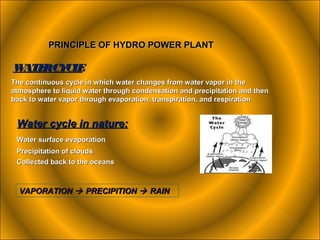
PRINCIPLE OF HYDRO POWER PLANT

WATE CYCL
    R    E
The continuous cycle in which water changes from water vapor in the
atmosphere to liquid water through condensation and precipitation and then
back to water vapor through evaporation, transpiration, and respiration


 Water cycle in nature:
 Water surface evaporation
 Precipitation of clouds
 Collected back to the oceans


  VAPORATION  PRECIPITION  RAIN
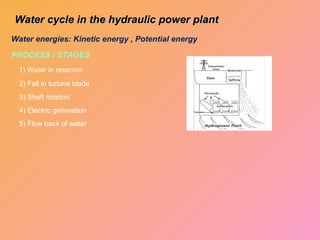
Water cycle in the hydraulic power plant
Water energies: Kinetic energy , Potential energy

PROCESS / STAGES
  1) Water in reservoir
  2) Fall in turbine blade
  3) Shaft rotation
  4) Electric generation
  5) Flow back of water
COMPONENT AND WORKING OF HYDRO POWER PLANT

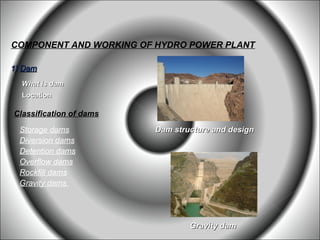
1) Dam
  What is dam
  Location

Classification of dams

 Storage dams            Dam structure and design
 Diversion dams
 Detention dams
 Overflow dams
 Rockfill dams
 Gravity dams


                                 Gravity dam
Storage dams
To impound water
Purpose - Irrigation
         - Flood control
         - Power generation
Diversion dams
For diversion
To provide sufficient pressure
Detention dams
To Minimize the effect of sudden floods
To trap sediment
Overflow dams
They carry water discharge over their crests
Rockfill dams
Rock instead of earth
Embankment dams hold back water by the force of gravity acting upon
their mass
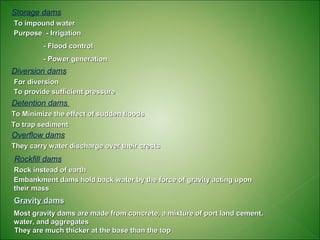
Gravity dams
Most gravity dams are made from concrete, a mixture of port land cement,
water, and aggregates
They are much thicker at the base than the top
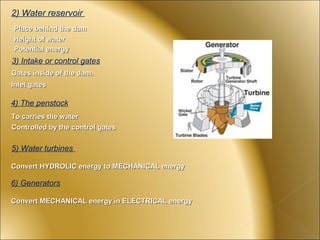
2) Water reservoir
Place behind the dam
Height of water
Potential energy
3) Intake or control gates
Gates inside of the dam.
Inlet gates

4) The penstock
To carries the water
Controlled by the control gates


5) Water turbines

Convert HYDROLIC energy to MECHANICAL energy

6) Generators

Convert MECHANICAL energy in ELECTRICAL energy
7) Transformer
Converts the alternating current to high voltage current.
Two coils: the supply coil and the outlet coil.
Voltage required for various applications is 110V or 230V.
Numbers of turns in outlet coil are double of supply coil, the voltage
produced is also double.

8) Tailrace
Pipeline to drain the water
The potential energy of water in the tailrace has been used to generate
electricity
CASE STUDY OF “HIRAKUND DAM”

INTRODUCTION

Built
          across the Mahanadi river


Located
about 15 km from Sambalpur in the state of Orissa in India.

HISTORY
 Built in 1956

 Length is about (26 km)

  It was the first major multipurpose river valley project started after India's
                                 independence.
Construction history

     Project was proposed by Sir M. Visveswararya
      Foundation stone was laid by sir HOWTHRONE LEWIS
         on 15 march 1946
      Pandit Jawaharlal Nehru laid the first batch of concrete on 12 April 1948.

      The dam was completed in 1953 and was formally inaugurated by
      Prime Minister Jawaharlal Nehru on 13 January 1957

     The total cost of the project was Rs. 100.02 crores (in 1957).
     Power generation along with agricultural irrigation started in 1956,
     achieving full potential in 1966
  Geography

  Hirakund is located at 21°31′N 83°52′E21.52°N 83.87°E
  It has an average elevation of 160 meters (524 feet)
   Demographics
  As of 2001 India census Hirakund had a population of 26,397
  Hirakund has an average literacy rate of 70%
Power generation
Nearly about 307 MW
Structure
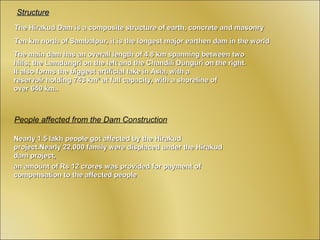
The Hirakud Dam is a composite structure of earth, concrete and masonry
Ten km north of Sambalpur, it is the longest major earthen dam in the world
The main dam has an overall length of 4.8 km spanning between two
hills; the Lamdungri on the left and the Chandili Dunguri on the right.
It also forms the biggest artificial lake in Asia, with a
reservoir holding 743 km² at full capacity, with a shoreline of
over 640 km..


People affected from the Dam Construction

Nearly 1.5 lakh people got affected by the Hirakud
project.Nearly 22,000 family were displaced under the Hirakud
dam project,
an amount of Rs 12 crores was provided for payment of
compensation to the affected people
Details


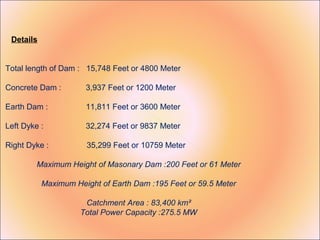
Total length of Dam : 15,748 Feet or 4800 Meter

Concrete Dam :        3,937 Feet or 1200 Meter

Earth Dam :           11,811 Feet or 3600 Meter

Left Dyke :           32,274 Feet or 9837 Meter

Right Dyke :          35,299 Feet or 10759 Meter

         Maximum Height of Masonary Dam :200 Feet or 61 Meter

           Maximum Height of Earth Dam :195 Feet or 59.5 Meter

                      Catchment Area : 83,400 km²
                     Total Power Capacity :275.5 MW
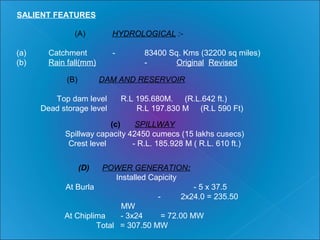
SALIENT FEATURES

                       (A)            HYDROLOGICAL :-

(a)          Catchment                -            83400 Sq. Kms (32200 sq miles)
(b)          Rain fall(mm)                         -       Original Revised

                    (B)          DAM AND RESERVOIR

             Top dam level                R.L 195.680M. (R.L.642 ft.)
          Dead storage level                  R.L 197.830 M (R.L 590 Ft)
                                (c)    SPILLWAY
                   Spillway capacity 42450 cumecs (15 lakhs cusecs)
                    Crest level       - R.L. 185.928 M ( R.L. 610 ft.)


                          (D)     POWER GENERATION:
                                    Installed Capicity
                      At Burla                                              - 5 x 37.5
                                                               -         2x24.0 = 235.50 
                                               MW  
                     At Chiplima              - 3x24        = 72.00 MW
                                    Total = 307.50 MW  
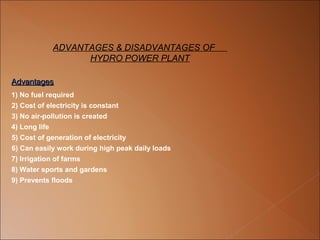
ADVANTAGES & DISADVANTAGES OF
                  HYDRO POWER PLANT

Advantages 
Advantages
1) No fuel required 
2) Cost of electricity is constant 
3) No air-pollution is created 
4) Long life 
5) Cost of generation of electricity 
6) Can easily work during high peak daily loads 
7) Irrigation of farms 
8) Water sports and gardens 
9) Prevents floods 
DISADVANTAGES
1) Disrupts the aquatic ecosystems
2) Disruption in the surrounding areas
3) Requires large areas
4) Large scale human displacement
5) Very high capital cost or investment
6) High quality construction
7) Site specific
8) Effects on environment
9) Safety of the dams

Hydro power-plant

  • 2.
    INTRODUCTION HYDRO POWER 1) Oneof the most widely used renewable source of energy for generating electricity on large scale basis is hydropower 2) The power obtained from river or ocean water is called as hydropower 3) Hydropower is the renewable source of energy since water is available in large quantities from rain, rivers, and oceans and this is will be available for unlimited time to come
  • 3.
    HISTORY - Nearly 2000years ago the Greeks used water wheels to grind wheat into flour - In the 1700's, hydropower was broadly used for milling of lumber and grain and for pumping irrigation water - Appleton, Wisconsin became the first operational hydroelectric generating station in the United States, in 1882, producing 12.5 kilowatts (kW) of power - The total electrical capacity generated was equivalent to 250 lights - The largest and last masonry dam built by the U.S. Bureau of Reclamation was the Roosevelt Dam in Arizona between 1905-1911; its power output has increased from 4,500 kW to 36,000 kW - Still in use today, Niagra Falls was the first hydropower site developed for a vast quantity of electricity
  • 4.
    TYPES OF HYDROPOWER PLANT 1) Water wheels 2) Hydro power plants 3) Wave energy from oceans 4) Tidal energy 5) Damless hydro power Based on Quantity of Water Available 1) Run-off river hydro plants with pond 2) Run-off river hydro plants with pond 3) Reservoir hydroelectric power plants
  • 5.
    Based on theHead of Water Available 1) Low head hydroelectric power plants 2)Medium head hydroelectric power plants 3) High head hydroelectric power plants Based on the Nature of Load 1) Base load hydroelectric power plants 2) Peak load hydroelectric power plants
  • 6.
    PRINCIPLE OF HYDROPOWER PLANT WATE CYCL R E The continuous cycle in which water changes from water vapor in the atmosphere to liquid water through condensation and precipitation and then back to water vapor through evaporation, transpiration, and respiration Water cycle in nature: Water surface evaporation Precipitation of clouds Collected back to the oceans VAPORATION  PRECIPITION  RAIN
  • 7.
    Water cycle inthe hydraulic power plant Water energies: Kinetic energy , Potential energy PROCESS / STAGES 1) Water in reservoir 2) Fall in turbine blade 3) Shaft rotation 4) Electric generation 5) Flow back of water
  • 8.
    COMPONENT AND WORKINGOF HYDRO POWER PLANT 1) Dam What is dam Location Classification of dams Storage dams Dam structure and design Diversion dams Detention dams Overflow dams Rockfill dams Gravity dams Gravity dam
  • 9.
    Storage dams To impoundwater Purpose - Irrigation - Flood control - Power generation Diversion dams For diversion To provide sufficient pressure Detention dams To Minimize the effect of sudden floods To trap sediment Overflow dams They carry water discharge over their crests Rockfill dams Rock instead of earth Embankment dams hold back water by the force of gravity acting upon their mass Gravity dams Most gravity dams are made from concrete, a mixture of port land cement, water, and aggregates They are much thicker at the base than the top
  • 10.
    2) Water reservoir Placebehind the dam Height of water Potential energy 3) Intake or control gates Gates inside of the dam. Inlet gates 4) The penstock To carries the water Controlled by the control gates 5) Water turbines Convert HYDROLIC energy to MECHANICAL energy 6) Generators Convert MECHANICAL energy in ELECTRICAL energy
  • 11.
    7) Transformer Converts thealternating current to high voltage current. Two coils: the supply coil and the outlet coil. Voltage required for various applications is 110V or 230V. Numbers of turns in outlet coil are double of supply coil, the voltage produced is also double. 8) Tailrace Pipeline to drain the water The potential energy of water in the tailrace has been used to generate electricity
  • 12.
    CASE STUDY OF“HIRAKUND DAM” INTRODUCTION Built across the Mahanadi river Located about 15 km from Sambalpur in the state of Orissa in India. HISTORY Built in 1956 Length is about (26 km) It was the first major multipurpose river valley project started after India's independence.
  • 13.
    Construction history Project was proposed by Sir M. Visveswararya Foundation stone was laid by sir HOWTHRONE LEWIS on 15 march 1946 Pandit Jawaharlal Nehru laid the first batch of concrete on 12 April 1948. The dam was completed in 1953 and was formally inaugurated by Prime Minister Jawaharlal Nehru on 13 January 1957 The total cost of the project was Rs. 100.02 crores (in 1957). Power generation along with agricultural irrigation started in 1956, achieving full potential in 1966 Geography Hirakund is located at 21°31′N 83°52′E21.52°N 83.87°E It has an average elevation of 160 meters (524 feet) Demographics As of 2001 India census Hirakund had a population of 26,397 Hirakund has an average literacy rate of 70% Power generation Nearly about 307 MW
  • 14.
    Structure The Hirakud Damis a composite structure of earth, concrete and masonry Ten km north of Sambalpur, it is the longest major earthen dam in the world The main dam has an overall length of 4.8 km spanning between two hills; the Lamdungri on the left and the Chandili Dunguri on the right. It also forms the biggest artificial lake in Asia, with a reservoir holding 743 km² at full capacity, with a shoreline of over 640 km.. People affected from the Dam Construction Nearly 1.5 lakh people got affected by the Hirakud project.Nearly 22,000 family were displaced under the Hirakud dam project, an amount of Rs 12 crores was provided for payment of compensation to the affected people
  • 15.
    Details Total length ofDam : 15,748 Feet or 4800 Meter Concrete Dam : 3,937 Feet or 1200 Meter Earth Dam : 11,811 Feet or 3600 Meter Left Dyke : 32,274 Feet or 9837 Meter Right Dyke : 35,299 Feet or 10759 Meter Maximum Height of Masonary Dam :200 Feet or 61 Meter Maximum Height of Earth Dam :195 Feet or 59.5 Meter Catchment Area : 83,400 km² Total Power Capacity :275.5 MW
  • 16.
    SALIENT FEATURES (A)  HYDROLOGICAL :- (a) Catchment  - 83400 Sq. Kms (32200 sq miles) (b) Rain fall(mm) - Original Revised (B) DAM AND RESERVOIR Top dam level R.L 195.680M. (R.L.642 ft.) Dead storage level R.L 197.830 M (R.L 590 Ft) (c) SPILLWAY Spillway capacity 42450 cumecs (15 lakhs cusecs) Crest level - R.L. 185.928 M ( R.L. 610 ft.) (D) POWER GENERATION: Installed Capicity At Burla - 5 x 37.5                                                          -         2x24.0 = 235.50  MW   At Chiplima - 3x24        = 72.00 MW Total = 307.50 MW  
  • 17.
    ADVANTAGES & DISADVANTAGESOF HYDRO POWER PLANT Advantages  Advantages 1) No fuel required  2) Cost of electricity is constant  3) No air-pollution is created  4) Long life  5) Cost of generation of electricity  6) Can easily work during high peak daily loads  7) Irrigation of farms  8) Water sports and gardens  9) Prevents floods 
  • 18.
    DISADVANTAGES 1) Disrupts theaquatic ecosystems 2) Disruption in the surrounding areas 3) Requires large areas 4) Large scale human displacement 5) Very high capital cost or investment 6) High quality construction 7) Site specific 8) Effects on environment 9) Safety of the dams