
Evaluation of LIFT 
Longitudinal Integrated Flinders 
Training 
Gayle Roberton
Presenter Disclosure 
• Faculty: Gayle Roberton 
• I have no conflict of interest to disclose
Rationale 
• All other Year 3 placements at Flinders 
consist of half-year or full year 
longitudinal placements and have been 
shown to be educationally sound 
• Based on 2 programs in USA that have 
done longitudinal placements in urban 
teaching hospitals 
• Will these models work at FMC or will 
we have to adapt?
LIFT 2013 
• Pilot of 8 students at FMC, 4 in Alice 
Springs 
• Longitudinal – panel of patients followed 
for the whole year 
• 50-100 patients hoped for 
• Integrated – all disciplines at the same 
time
Preceptors 
• Each student had one preceptor in each 
discipline 
• Medicine, surgery, paediatrics, 
psychiatry, obstetrics and gynaecology 
–once per fortnight in outpatient clinic 
• Emergency department – weekly 
• GP – weekly for 6 months
Students 
• Follow patients in their panel to: 
– Other outpatient appointments 
– Inpatient wards and visit daily 
– GP appointments if possible 
• Meet new patients in: 
– Outpatients with preceptors 
– ED
LIFT Evaluations 
• Assessment of Learning by Roberton, 
Heddle, Schuwirth 
• Feedback from Clinicians 
• Feedback from Students 
• End of year Exams and consequent 
place in class
The Clinical Reasoning Test 
• 10 Scenarios 
• For example: Jennifer James is 38 years old and 
presents to ED with a severe headache that started 
suddenly 6 hours ago. She has vomited twice in that 
time and says that the light hurts her eyes. BP is 
150/80, HR is 105, RR is 22 and temperature is 
38.8C
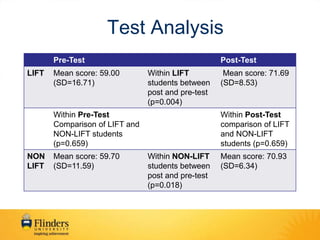
Test Analysis 
Pre-Test Post-Test 
LIFT Mean score: 59.00 
(SD=16.71) 
Within LIFT 
students between 
post and pre-test 
(p=0.004) 
Mean score: 71.69 
(SD=8.53) 
Within Pre-Test 
Comparison of LIFT and 
NON-LIFT students 
(p=0.659) 
Within Post-Test 
comparison of LIFT 
and NON-LIFT 
students (p=0.659) 
NON 
LIFT 
Mean score: 59.70 
(SD=11.59) 
Within NON-LIFT 
students between 
post and pre-test 
(p=0.018) 
Mean score: 70.93 
(SD=6.34)
Change in Class Ranking
Clinician Comments 
• Strengths 
– Relationship with the student 
– Ability to monitor the student’s progress 
– Most said they were confident in their 
ability to assess the student’s clinical ability 
and professional behaviour
Clinician Comments 
• Weaknesses 
– Outpatients only with no inpatient contact 
– Not enough clinicians in all disciplines for 
70 students 
– Consultant teaching only with no 
involvement of Junior Medical Staff in the 
teaching
Summary 
• Clinical Reasoning Test showed no 
significant difference 
• Significant increase in class rank for 
LIFT students 
• Clinician-student relationship valued

81 muster2014 Roberton

  • 1.
    Evaluation of LIFT Longitudinal Integrated Flinders Training Gayle Roberton
  • 2.
    Presenter Disclosure •Faculty: Gayle Roberton • I have no conflict of interest to disclose
  • 3.
    Rationale • Allother Year 3 placements at Flinders consist of half-year or full year longitudinal placements and have been shown to be educationally sound • Based on 2 programs in USA that have done longitudinal placements in urban teaching hospitals • Will these models work at FMC or will we have to adapt?
  • 4.
    LIFT 2013 •Pilot of 8 students at FMC, 4 in Alice Springs • Longitudinal – panel of patients followed for the whole year • 50-100 patients hoped for • Integrated – all disciplines at the same time
  • 5.
    Preceptors • Eachstudent had one preceptor in each discipline • Medicine, surgery, paediatrics, psychiatry, obstetrics and gynaecology –once per fortnight in outpatient clinic • Emergency department – weekly • GP – weekly for 6 months
  • 6.
    Students • Followpatients in their panel to: – Other outpatient appointments – Inpatient wards and visit daily – GP appointments if possible • Meet new patients in: – Outpatients with preceptors – ED
  • 7.
    LIFT Evaluations •Assessment of Learning by Roberton, Heddle, Schuwirth • Feedback from Clinicians • Feedback from Students • End of year Exams and consequent place in class
  • 8.
    The Clinical ReasoningTest • 10 Scenarios • For example: Jennifer James is 38 years old and presents to ED with a severe headache that started suddenly 6 hours ago. She has vomited twice in that time and says that the light hurts her eyes. BP is 150/80, HR is 105, RR is 22 and temperature is 38.8C
  • 9.
    Test Analysis Pre-TestPost-Test LIFT Mean score: 59.00 (SD=16.71) Within LIFT students between post and pre-test (p=0.004) Mean score: 71.69 (SD=8.53) Within Pre-Test Comparison of LIFT and NON-LIFT students (p=0.659) Within Post-Test comparison of LIFT and NON-LIFT students (p=0.659) NON LIFT Mean score: 59.70 (SD=11.59) Within NON-LIFT students between post and pre-test (p=0.018) Mean score: 70.93 (SD=6.34)
  • 10.
  • 11.
    Clinician Comments •Strengths – Relationship with the student – Ability to monitor the student’s progress – Most said they were confident in their ability to assess the student’s clinical ability and professional behaviour
  • 12.
    Clinician Comments •Weaknesses – Outpatients only with no inpatient contact – Not enough clinicians in all disciplines for 70 students – Consultant teaching only with no involvement of Junior Medical Staff in the teaching
  • 13.
    Summary • ClinicalReasoning Test showed no significant difference • Significant increase in class rank for LIFT students • Clinician-student relationship valued

Editor's Notes

  • #4 The existing longitudinal placements are all community based General Practices with access to local general hospitals with some visiting specialists.
  • #9 The test consisted of ten clinical scenarios and the students were asked write down the two most likely pathophysiological processes to explain the presenting symptoms with reason(s) for choosing that process. They were then asked to provide two likely diagnoses within each pathophysiological process. It was designed to elicit ability in making clinical associations and decisions rather than just subject recall.
  • #10 To disentangle effects in a clear and visible way we decided to perform 4 individual tests of significance. In this case we used Wilcoxon rank sum for the dependent-samples comparison (pre versus post-test) and a signed ranks test for the independent-samples comparisons (LIFT versus non-LIFT students) because of the low numbers of students and because we wanted to explore the significant and non-significant effects. In conclusion the test picks up the learning effect, but in these groups there was no difference in effect of the LIFT clerkships versus the traditional block rotations.
  • #11 Average increase in class rank for LIFT students was 18.8 places compared to the rotation cohort of 1.2 places Mann Whitney U Test had a significance of 0.027