Judith Mckay 
Human Services Training Advisory Council 
Dr Pascale Dettwiller 
Flinders University, Katherine Campus 
We have no conflict of interest to disclose
Be a change maker, 
interagency collaboration between government department, university, training operator and community health services in the Katherine region
Collaborators 
Katherine West Health Board
Setting the scene 
• 
Program Evolution 
• 
Collaboration and Program Innovation 
• 
Geographical Demographics 
• 
Program Delivery 
– 
Addressing the Skill Gap 
– 
Community Engagement 
– 
Vocational Training Support through WELL 
– 
Delivery Endorsement
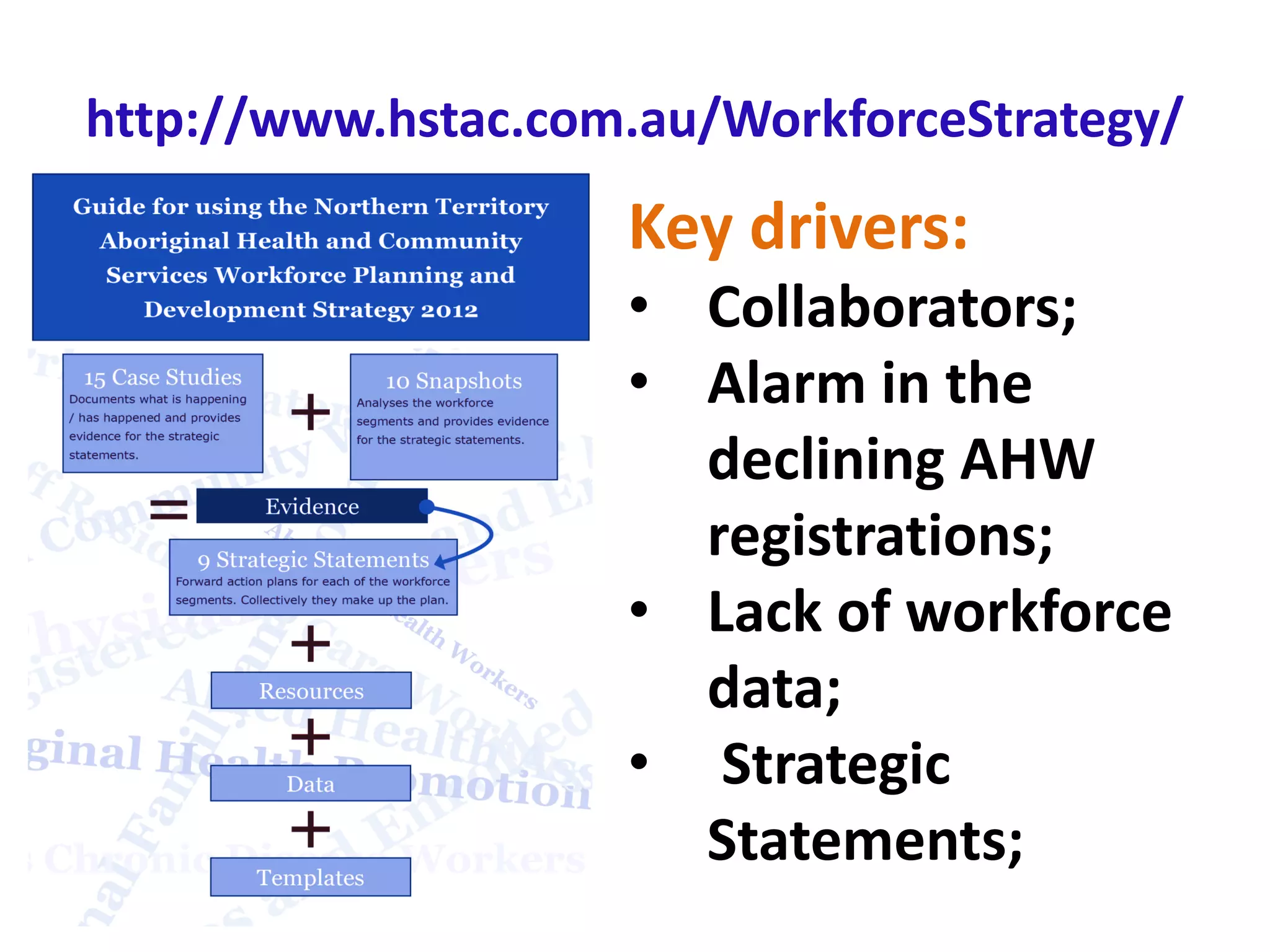
http://www.hstac.com.au/WorkforceStrategy/ 
Key drivers: 
• 
Collaborators; 
• 
Alarm in the declining AHW registrations; 
• 
Lack of workforce data; 
• 
Strategic Statements;
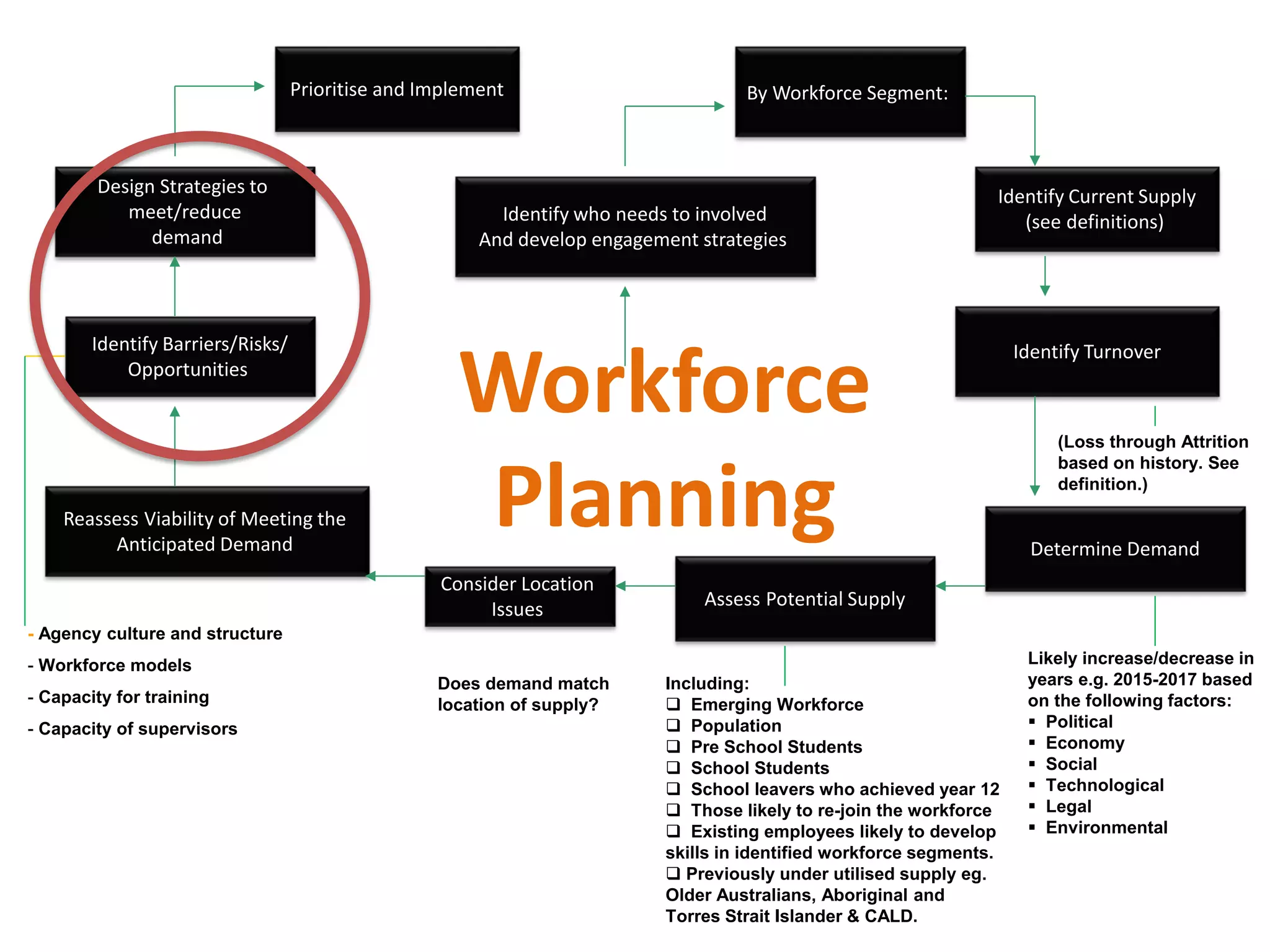
Consider Location 
Issues 
Determine Demand 
Identify Current Supply (see definitions) 
By Workforce Segment: 
Identify Turnover 
Assess Potential Supply 
(Loss through Attrition based on history. See definition.) 
Likely increase/decrease in years e.g. 2015-2017 based on the following factors: 
 
Political 
 
Economy 
 
Social 
 
Technological 
 
Legal 
 
Environmental 
Including: 
 
Emerging Workforce 
 
Population 
 
Pre School Students 
 
School Students 
 
School leavers who achieved year 12 
 
Those likely to re-join the workforce 
 
Existing employees likely to develop skills in identified workforce segments. 
 
Previously under utilised supply eg. Older Australians, Aboriginal and Torres Strait Islander & CALD. 
Does demand match location of supply? 
Reassess Viability of Meeting the Anticipated Demand 
Identify Barriers/Risks/ 
Opportunities 
- Agency culture and structure 
- 
Workforce models 
- 
Capacity for training 
- 
Capacity of supervisors 
Design Strategies to meet/reduce demand 
Prioritise and Implement 
Identify who needs to involved And develop engagement strategies 
Workforce Planning
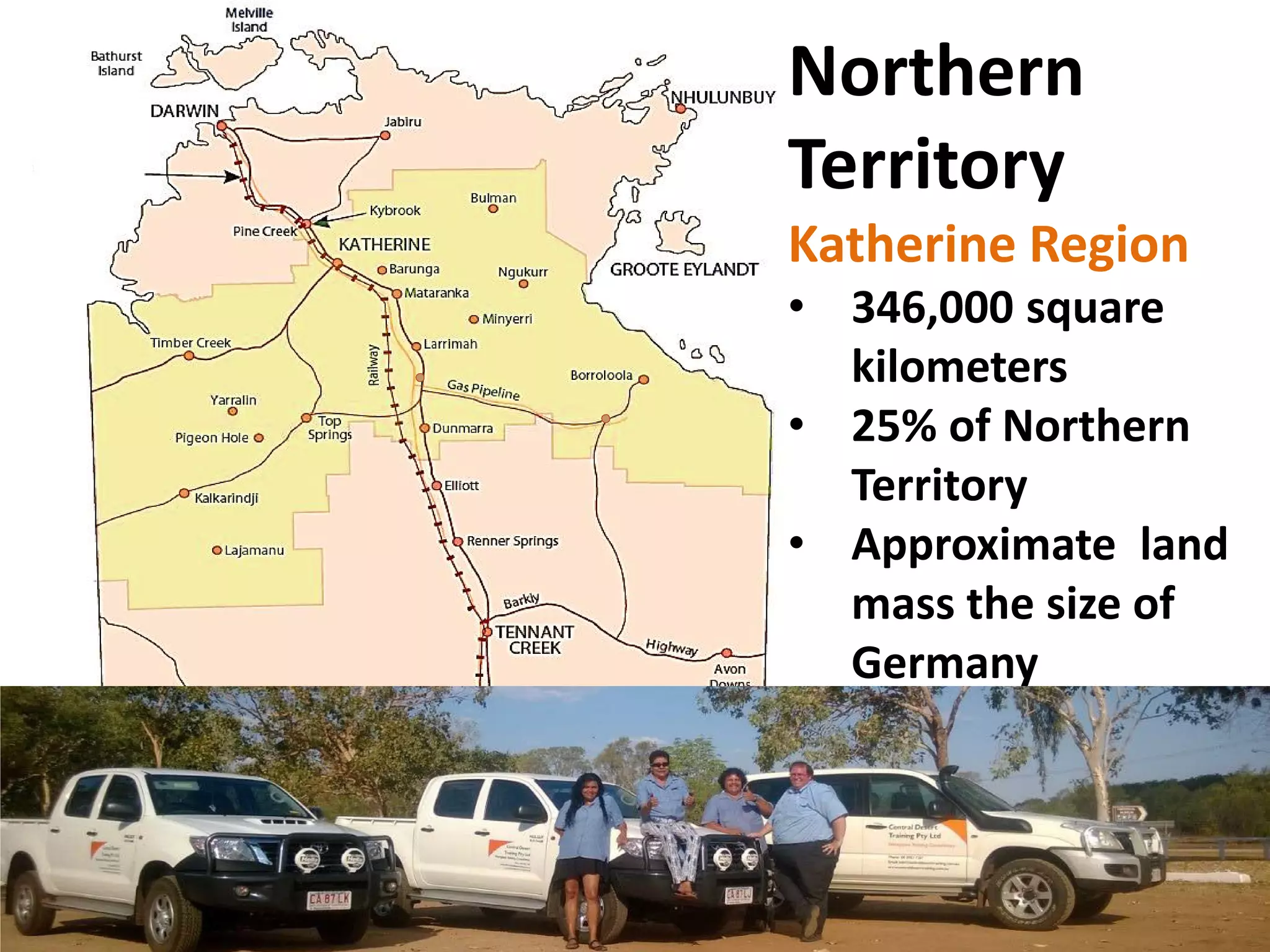
Northern Territory Katherine Region 
• 
346,000 square kilometers 
• 
25% of Northern Territory 
• 
Approximate land mass the size of Germany
Central Desert Training WELL Team
Six weekly meetings with collaborators at Katherine
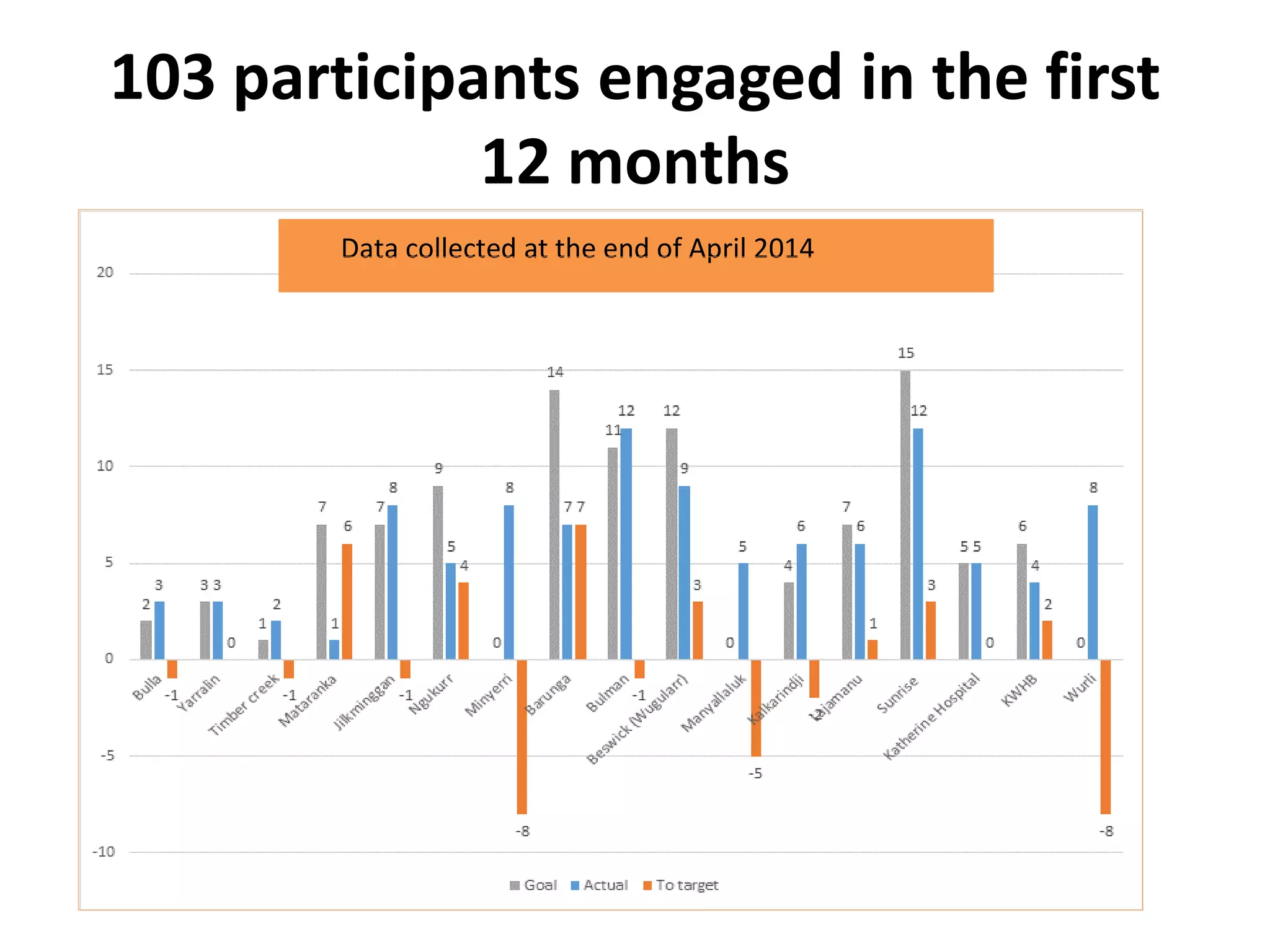
103 participants engaged in the first 12 months 
Data collected at the end of April 2014
WELL… 
• 
Equips employees with the skills needed to be a part of work 
• 
Personalizes instruction to achieve specific workplace learning goals 
• 
Delivers immediate actionable skills for daily work
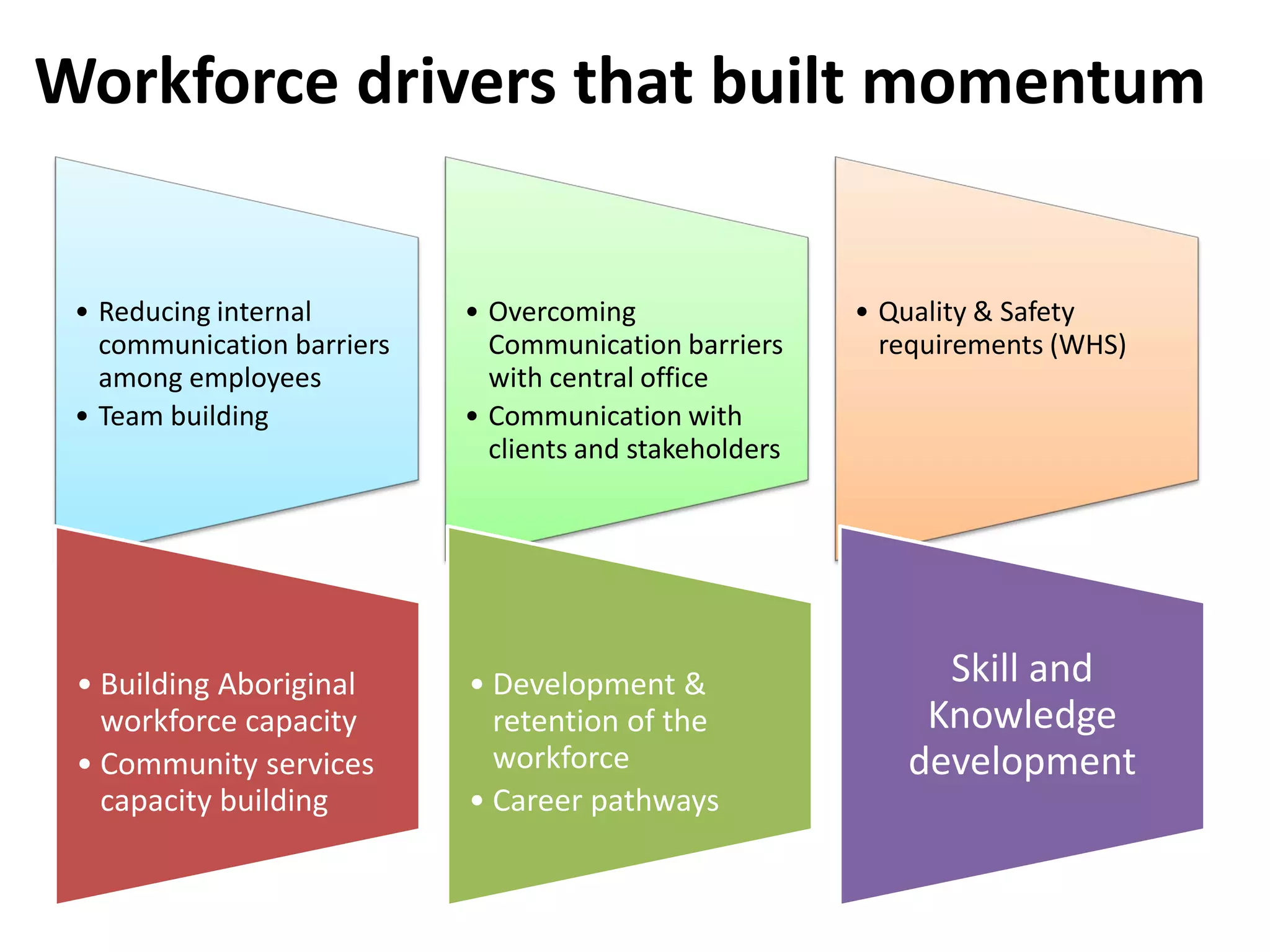
Workforce drivers that built momentum 
•Reducing internal communication barriers among employees 
•Team building 
•Overcoming Communication barriers with central office 
•Communication with clients and stakeholders 
•Quality & Safety requirements (WHS) 
•Building Aboriginal workforce capacity 
•Community services capacity building 
•Development & retention of the workforce 
•Career pathways 
Skill and Knowledge development
An evidenced base - Process Evaluation 
The evaluation agreed upon by the Collaborative was to: 
• 
Explore how LLN delivery (WELL program) meets the current and future workforce needs for Aboriginal people. 
• 
Confirm that effective case management of individuals or groups in communities may often rely on a ‘wrap- around’, cooperative approach being in place. 
• 
Evidence innovative embedding of LLN into vocational areas of Aboriginal Health and Community Service Work. 
• 
Provide evidence of increased collaboration across services
Findings 
Wurli 5% 
SHS 62% 
KWHB 17% 
KDH 3% 
CDT 5% 
HSTAC 8% 
Wurli 
SHS 
KWHB 
Distribution of respondents who participated to the process evaluation 
95% female 
5% male 
GENDER DISTRIBUTION 
DISTRIBUTION BY HEALTH SERVICES
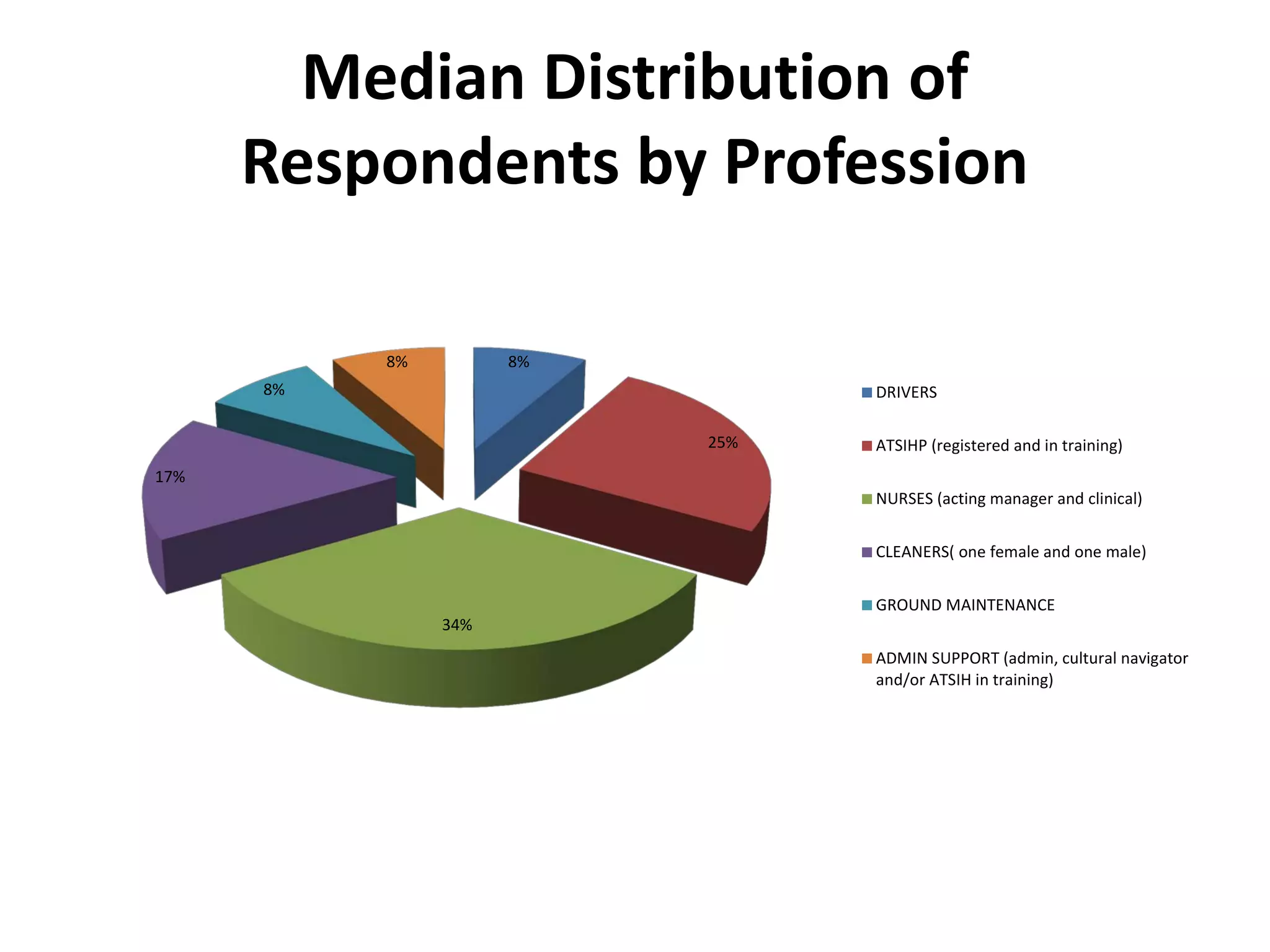
Median Distribution of Respondents by Profession 
8% 
25% 
34% 
17% 
8% 
8% 
DRIVERS 
ATSIHP (registered and in training) 
NURSES (acting manager and clinical) 
CLEANERS( one female and one male) 
GROUND MAINTENANCE 
ADMIN SUPPORT (admin, cultural navigator 
and/or ATSIH in training)
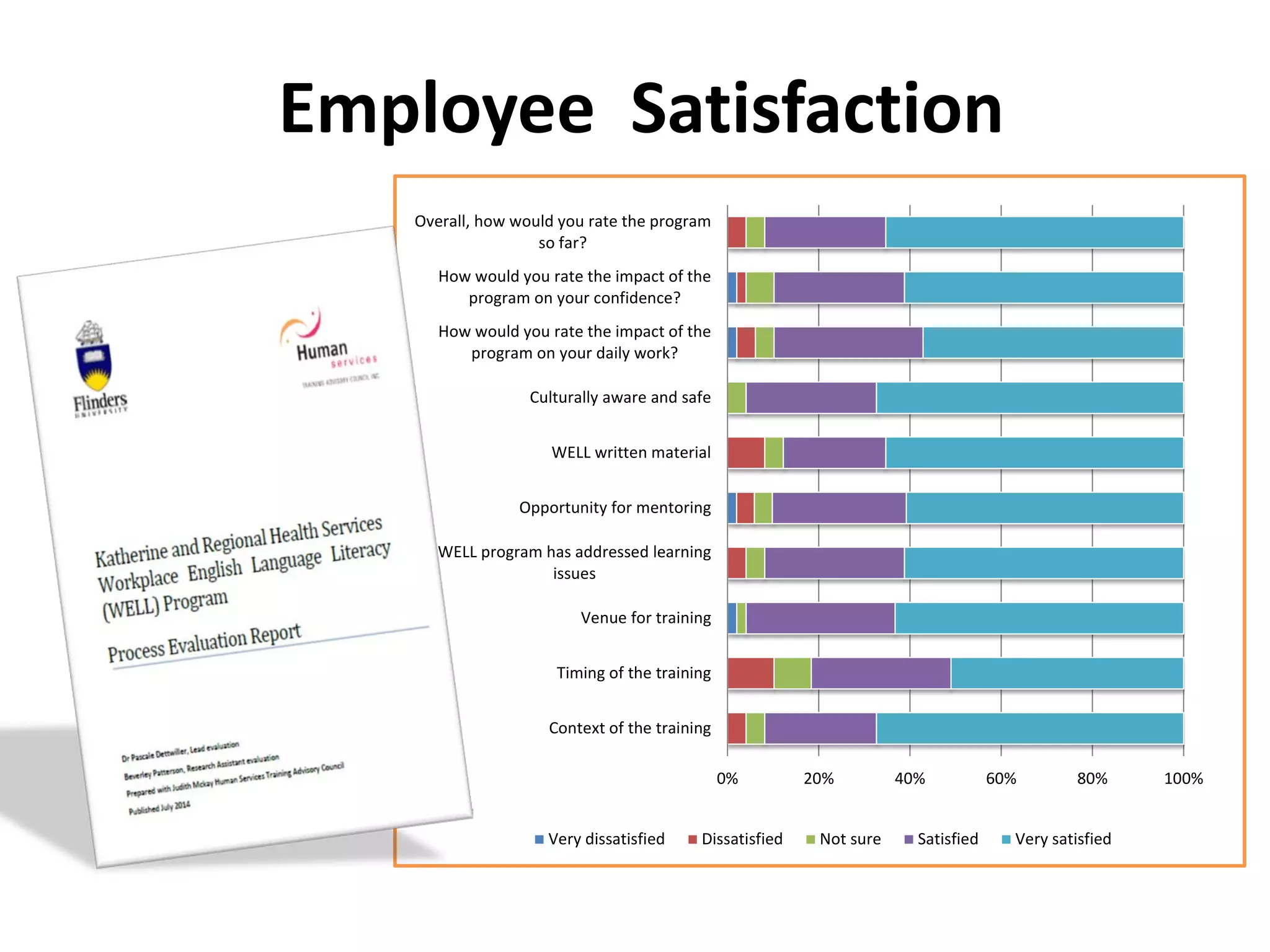
0% 
20% 
40% 
60% 
80% 
100% 
Context of the training 
Timing of the training 
Venue for training 
WELL program has addressed learning 
issues 
Opportunity for mentoring 
WELL written material 
Culturally aware and safe 
How would you rate the impact of the 
program on your daily work? 
How would you rate the impact of the 
program on your confidence? 
Overall, how would you rate the program 
so far? 
Very dissatisfied 
Dissatisfied 
Not sure 
Satisfied 
Very satisfied 
Employee Satisfaction
What they told us 
“..they had never before felt so much a part of their team” 
Their colleagues acknowledged that due to time constraints and language barriers that they had, at times, “worked around” participants perceived limitations but now saw them as a vital part of the success of their Health Centre’s practice. Participants Exec 2.
That it was possible “to have a career not just a job - even if you live in the bush.”
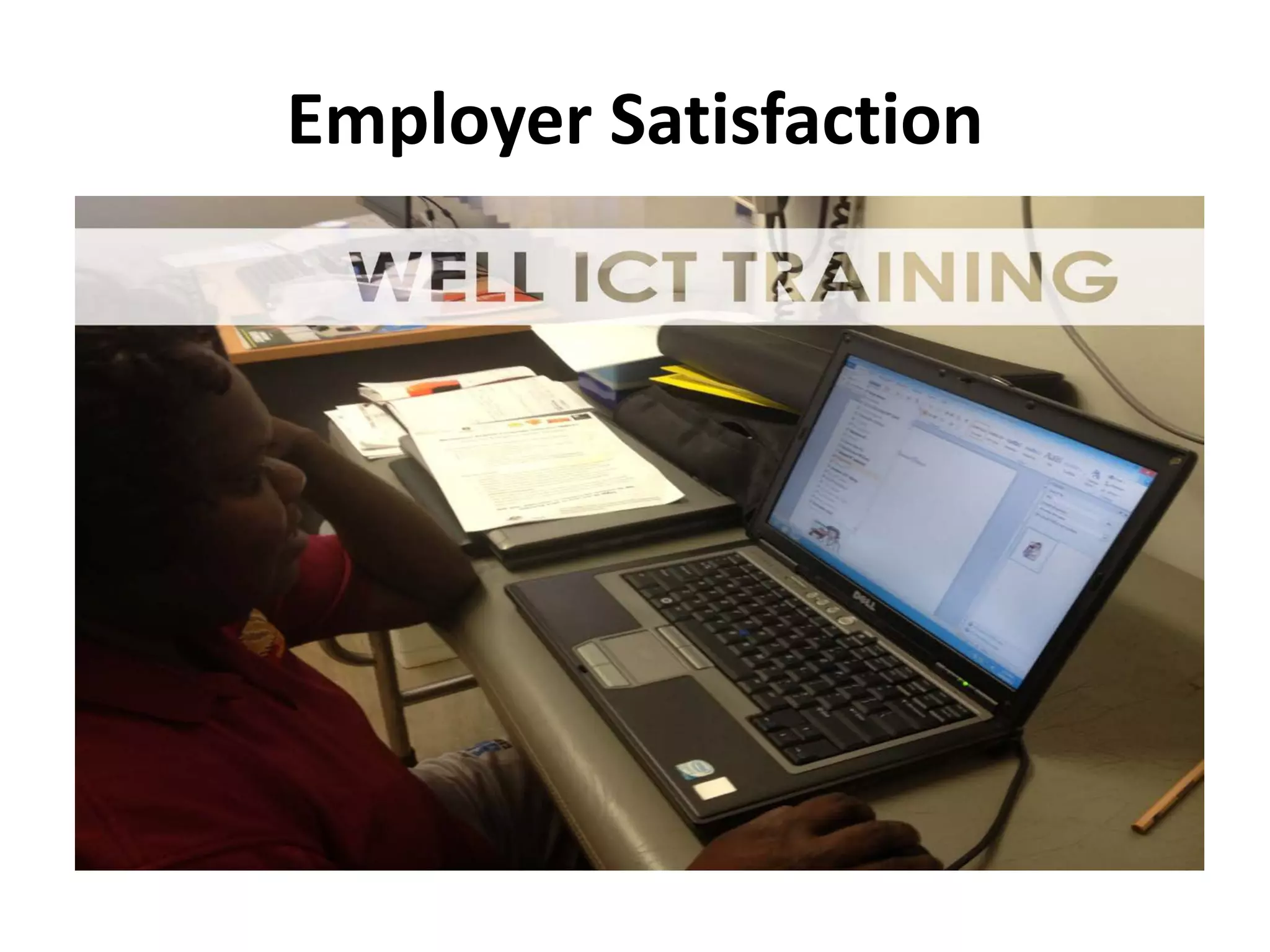
Employer Satisfaction
What did we learn? 
1. Supporting Aboriginal Health and Community Services workforce to develop foundation skills for work will have greater benefits for Aboriginal people to enter, stay and continue to develop vocational skills, with benefits that go beyond the workplace. 
Well being, part of the team, proud, wanting more, belief in what is possible, where to next for the individual?
What did we learn? 
2. There is a high cost investment for front end delivery of programs at regional and remote workplaces that needs to be maintained. 
Shared responsibility, sustained and not for the short time, has to be long term!
What did we learn? 
3. Collaboration and a strong integrated approach are required to reduce barriers and develop enablers that will increase visibility and understanding about literacy development at the workplace. 
Agreed roles and responsibilities, induction and orientation programs are important for success.
What did we learn? 
4. The development of relationships between WELL Trainers and WELL participants are a key component to successful workplace-based programs that will have a positive effect on attendance and workplace dynamics. 
Enabler for employees and employers, building confidence at the workplace.
• 
There is an ongoing need to continue to facilitate a Workforce Development Skill Set to embed these skills at the workplace that will be sustainable for the future. 
• 
Achieving this outcome requires a long-term workforce development investment at the service delivery level. 
• 
The return on investment is increasing community ownership of remote medical services; build leadership capability of remote medical services and the associated health benefits to the community as a whole.
Foundation Skills 
Work based learning 
Sustained for longer periods of time 
Individual or group support 
Contextualised to the workplace
Our contacts 
Human Services Training Advisory Council 
Judith Mckay 
Judith.mckay@hstac.com.au 
2nd floor, Harbourview Plaza, 
8 McMinn Street, Darwin 
GPO Box 1557, Darwin, NT 0801 
T: 0889812550 | M: 0488444556 
Follow us @HSTAC_NT 
Central Desert Training Pty Ltd 
Kailas Kerr 
PO Box 2435, Alice Springs NT 0871 
M: 0439 083 599 F:(08) 8953 3986 P: (08) 8953 7247 
kailas@centraldeserttraining.com.au 
Flinders University 
Katherine Campus 
Dr Pascale Dettwiller 
Flinders University 
Katherine Site Director 
M: 0433308284 
pascale.dettwiller@flinders.edu.au

171 muster2014 mc kay

  • 1.
    Judith Mckay HumanServices Training Advisory Council Dr Pascale Dettwiller Flinders University, Katherine Campus We have no conflict of interest to disclose
  • 2.
    Be a changemaker, interagency collaboration between government department, university, training operator and community health services in the Katherine region
  • 3.
  • 4.
    Setting the scene • Program Evolution • Collaboration and Program Innovation • Geographical Demographics • Program Delivery – Addressing the Skill Gap – Community Engagement – Vocational Training Support through WELL – Delivery Endorsement
  • 6.
    http://www.hstac.com.au/WorkforceStrategy/ Key drivers: • Collaborators; • Alarm in the declining AHW registrations; • Lack of workforce data; • Strategic Statements;
  • 7.
    Consider Location Issues Determine Demand Identify Current Supply (see definitions) By Workforce Segment: Identify Turnover Assess Potential Supply (Loss through Attrition based on history. See definition.) Likely increase/decrease in years e.g. 2015-2017 based on the following factors:  Political  Economy  Social  Technological  Legal  Environmental Including:  Emerging Workforce  Population  Pre School Students  School Students  School leavers who achieved year 12  Those likely to re-join the workforce  Existing employees likely to develop skills in identified workforce segments.  Previously under utilised supply eg. Older Australians, Aboriginal and Torres Strait Islander & CALD. Does demand match location of supply? Reassess Viability of Meeting the Anticipated Demand Identify Barriers/Risks/ Opportunities - Agency culture and structure - Workforce models - Capacity for training - Capacity of supervisors Design Strategies to meet/reduce demand Prioritise and Implement Identify who needs to involved And develop engagement strategies Workforce Planning
  • 8.
    Northern Territory KatherineRegion • 346,000 square kilometers • 25% of Northern Territory • Approximate land mass the size of Germany
  • 9.
  • 10.
    Six weekly meetingswith collaborators at Katherine
  • 11.
    103 participants engagedin the first 12 months Data collected at the end of April 2014
  • 12.
    WELL… • Equipsemployees with the skills needed to be a part of work • Personalizes instruction to achieve specific workplace learning goals • Delivers immediate actionable skills for daily work
  • 13.
    Workforce drivers thatbuilt momentum •Reducing internal communication barriers among employees •Team building •Overcoming Communication barriers with central office •Communication with clients and stakeholders •Quality & Safety requirements (WHS) •Building Aboriginal workforce capacity •Community services capacity building •Development & retention of the workforce •Career pathways Skill and Knowledge development
  • 14.
    An evidenced base- Process Evaluation The evaluation agreed upon by the Collaborative was to: • Explore how LLN delivery (WELL program) meets the current and future workforce needs for Aboriginal people. • Confirm that effective case management of individuals or groups in communities may often rely on a ‘wrap- around’, cooperative approach being in place. • Evidence innovative embedding of LLN into vocational areas of Aboriginal Health and Community Service Work. • Provide evidence of increased collaboration across services
  • 15.
    Findings Wurli 5% SHS 62% KWHB 17% KDH 3% CDT 5% HSTAC 8% Wurli SHS KWHB Distribution of respondents who participated to the process evaluation 95% female 5% male GENDER DISTRIBUTION DISTRIBUTION BY HEALTH SERVICES
  • 16.
    Median Distribution ofRespondents by Profession 8% 25% 34% 17% 8% 8% DRIVERS ATSIHP (registered and in training) NURSES (acting manager and clinical) CLEANERS( one female and one male) GROUND MAINTENANCE ADMIN SUPPORT (admin, cultural navigator and/or ATSIH in training)
  • 17.
    0% 20% 40% 60% 80% 100% Context of the training Timing of the training Venue for training WELL program has addressed learning issues Opportunity for mentoring WELL written material Culturally aware and safe How would you rate the impact of the program on your daily work? How would you rate the impact of the program on your confidence? Overall, how would you rate the program so far? Very dissatisfied Dissatisfied Not sure Satisfied Very satisfied Employee Satisfaction
  • 18.
    What they toldus “..they had never before felt so much a part of their team” Their colleagues acknowledged that due to time constraints and language barriers that they had, at times, “worked around” participants perceived limitations but now saw them as a vital part of the success of their Health Centre’s practice. Participants Exec 2.
  • 19.
    That it waspossible “to have a career not just a job - even if you live in the bush.”
  • 20.
  • 21.
    What did welearn? 1. Supporting Aboriginal Health and Community Services workforce to develop foundation skills for work will have greater benefits for Aboriginal people to enter, stay and continue to develop vocational skills, with benefits that go beyond the workplace. Well being, part of the team, proud, wanting more, belief in what is possible, where to next for the individual?
  • 22.
    What did welearn? 2. There is a high cost investment for front end delivery of programs at regional and remote workplaces that needs to be maintained. Shared responsibility, sustained and not for the short time, has to be long term!
  • 23.
    What did welearn? 3. Collaboration and a strong integrated approach are required to reduce barriers and develop enablers that will increase visibility and understanding about literacy development at the workplace. Agreed roles and responsibilities, induction and orientation programs are important for success.
  • 24.
    What did welearn? 4. The development of relationships between WELL Trainers and WELL participants are a key component to successful workplace-based programs that will have a positive effect on attendance and workplace dynamics. Enabler for employees and employers, building confidence at the workplace.
  • 25.
    • There isan ongoing need to continue to facilitate a Workforce Development Skill Set to embed these skills at the workplace that will be sustainable for the future. • Achieving this outcome requires a long-term workforce development investment at the service delivery level. • The return on investment is increasing community ownership of remote medical services; build leadership capability of remote medical services and the associated health benefits to the community as a whole.
  • 26.
    Foundation Skills Workbased learning Sustained for longer periods of time Individual or group support Contextualised to the workplace
  • 27.
    Our contacts HumanServices Training Advisory Council Judith Mckay Judith.mckay@hstac.com.au 2nd floor, Harbourview Plaza, 8 McMinn Street, Darwin GPO Box 1557, Darwin, NT 0801 T: 0889812550 | M: 0488444556 Follow us @HSTAC_NT Central Desert Training Pty Ltd Kailas Kerr PO Box 2435, Alice Springs NT 0871 M: 0439 083 599 F:(08) 8953 3986 P: (08) 8953 7247 kailas@centraldeserttraining.com.au Flinders University Katherine Campus Dr Pascale Dettwiller Flinders University Katherine Site Director M: 0433308284 pascale.dettwiller@flinders.edu.au