
STUDENT CENTRED LEARNING 
FOR QUALITY TEACHING IN 
ANATOMY 
BUDDHIKA WEERASUNDERA 
SENIOR LECTURER KNOWLEDGE HEALTH AND 
ILLNESS 
FLINDERS NT 
28.10.2014 
*No commercial interests 
*This study has not received any financial support 
*There is no conflict of interests
LEARNING OBJECTIVES 
 IDENTIFY THE TEACHING METHODS 
THAT WERE DESIGNED FOR LEARNING 
ANATOMY 
 COMPARE THE CHANGES THAT WERE 
IMPLEMENTED FOR DISSECTIONS 
OVER A PERIOD OF 3 YEARS 
 ANALYSE THE EFFECTIVENESS OF THE 
CHANGES THAT WERE ADOPTED
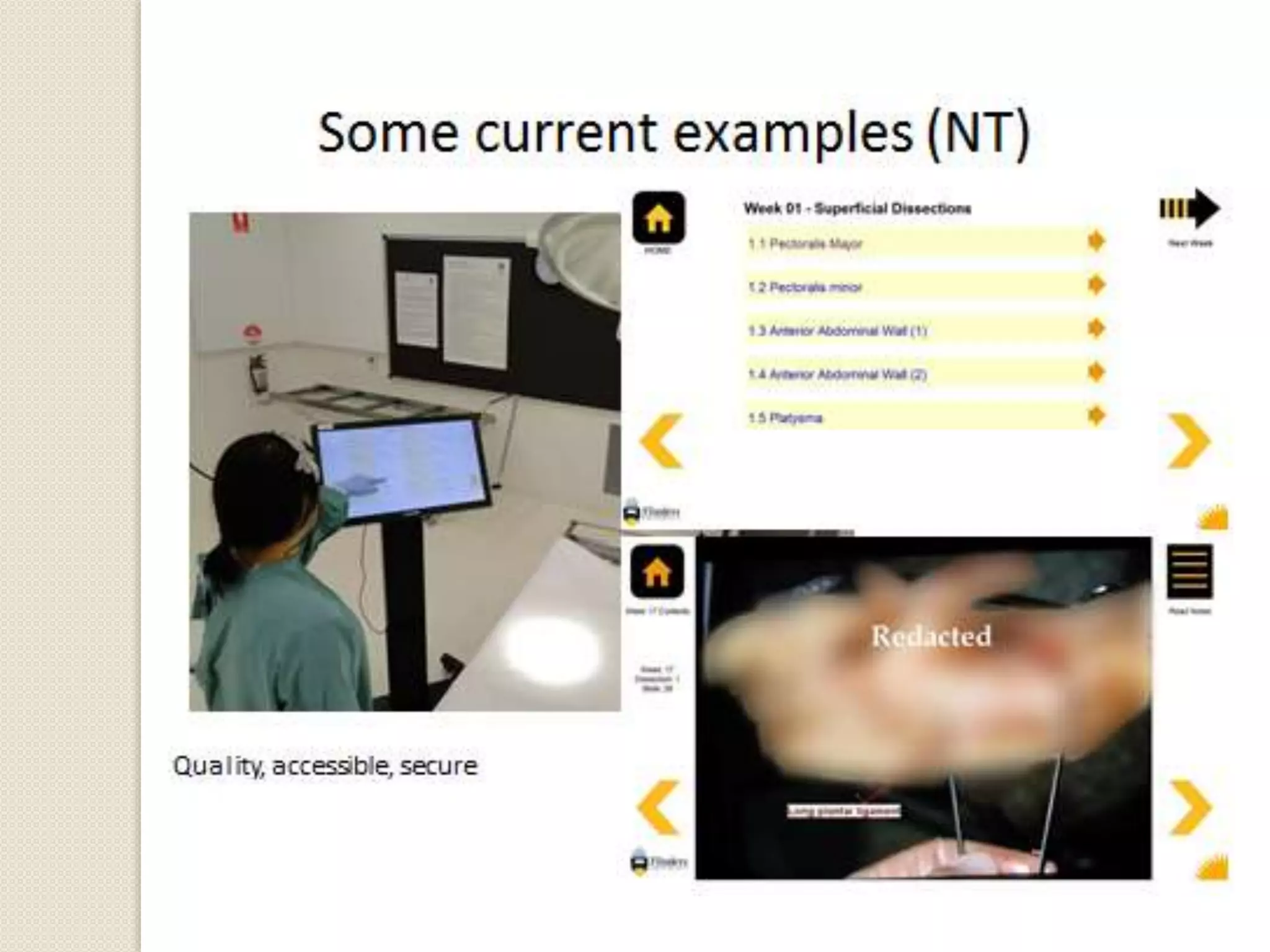
DISSECTIONS AS A LEARNING TOOL
STUDY 
 Student performances in the practical 
exam of the 3 batches of students 
(2011-16, 2012-22, 2013-22) at the KHI 
exams were analysed. 
Three Practical Exams 
 1. KHI 1B at the end of First year 2nd 
semester (CVS, RS, Renal) 
 2. KHI 2A at the end of Second year first 
semester (GIT, ERS, Repro) 
 3. KHI 2B at the end of Second year 
second semester (MSS, BB)
CHANGES IMPLEMENTED 
 METHODS OF TEACHING: Hard copies of 
notes, Digital images and notes on screens 
and predissection lecture by the tutor. 
 TIMING: Second year first semester to First 
year second semester from 2013 cohort. 
 ASSESSMENT: 2 MCQs (each pair of 
students) submitted each week of semester 
(17 in total/student) for 2013 cohort in 
addition to assessing attendance and 
feedback of dissections.
METHOD 
 Marks of total number of 60 students were 
analysed. 
 Of the 60 students, 16 from 2011 cohort, 22 
from 2012 cohort and 22 from the 2013 
cohort. 
 There were 9 Indigenous students and 51 
non-Indigenous students. 
 9 students were from the BCSC programme 
while 51 students were from the graduate 
entry programme. 
 Student feedback to determine their views 
about the changes were also obtained.
RESULTS 
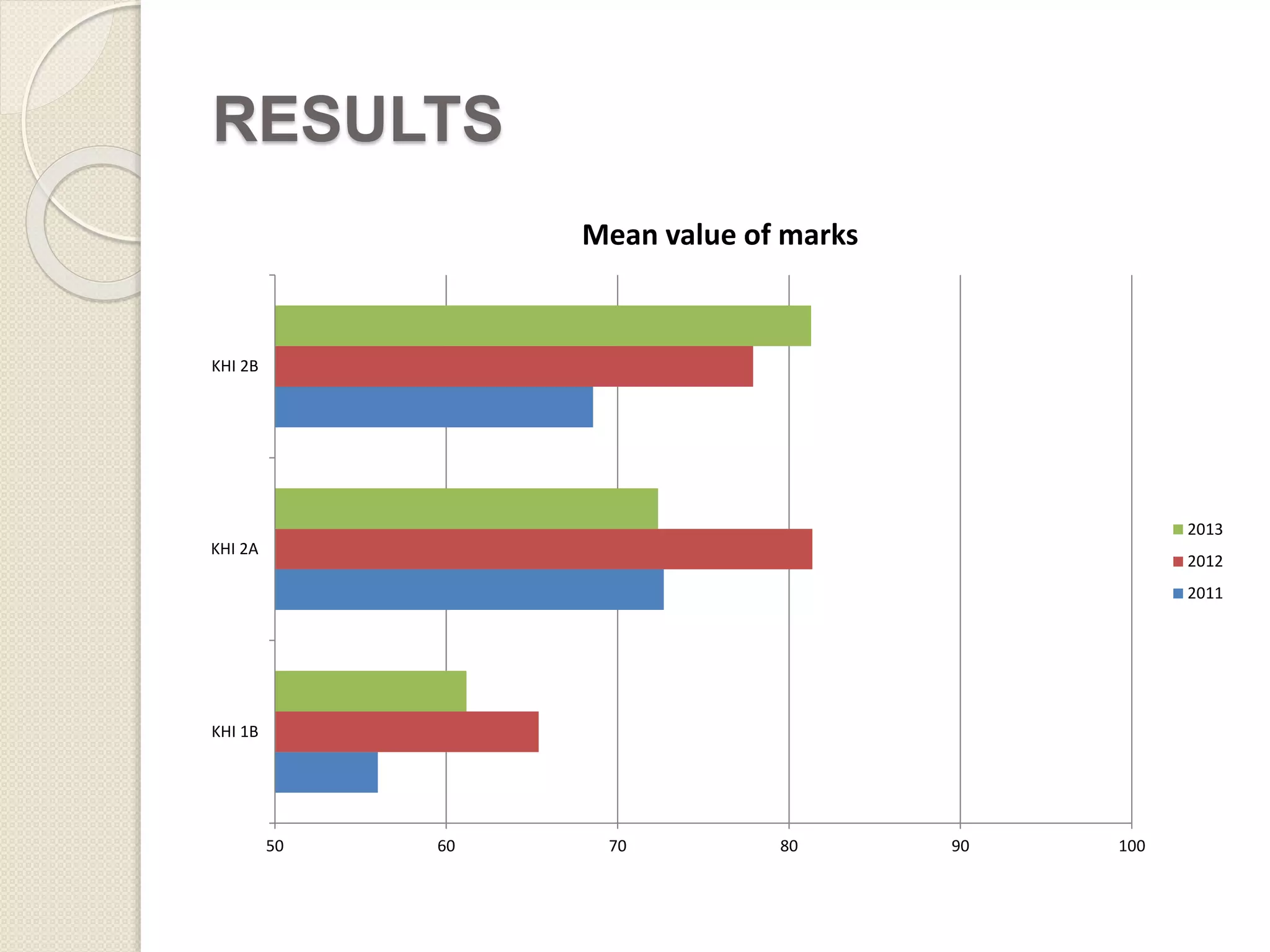
50 60 70 80 90 100 
KHI 2B 
KHI 2A 
KHI 1B 
Mean value of marks 
2013 
2012 
2011
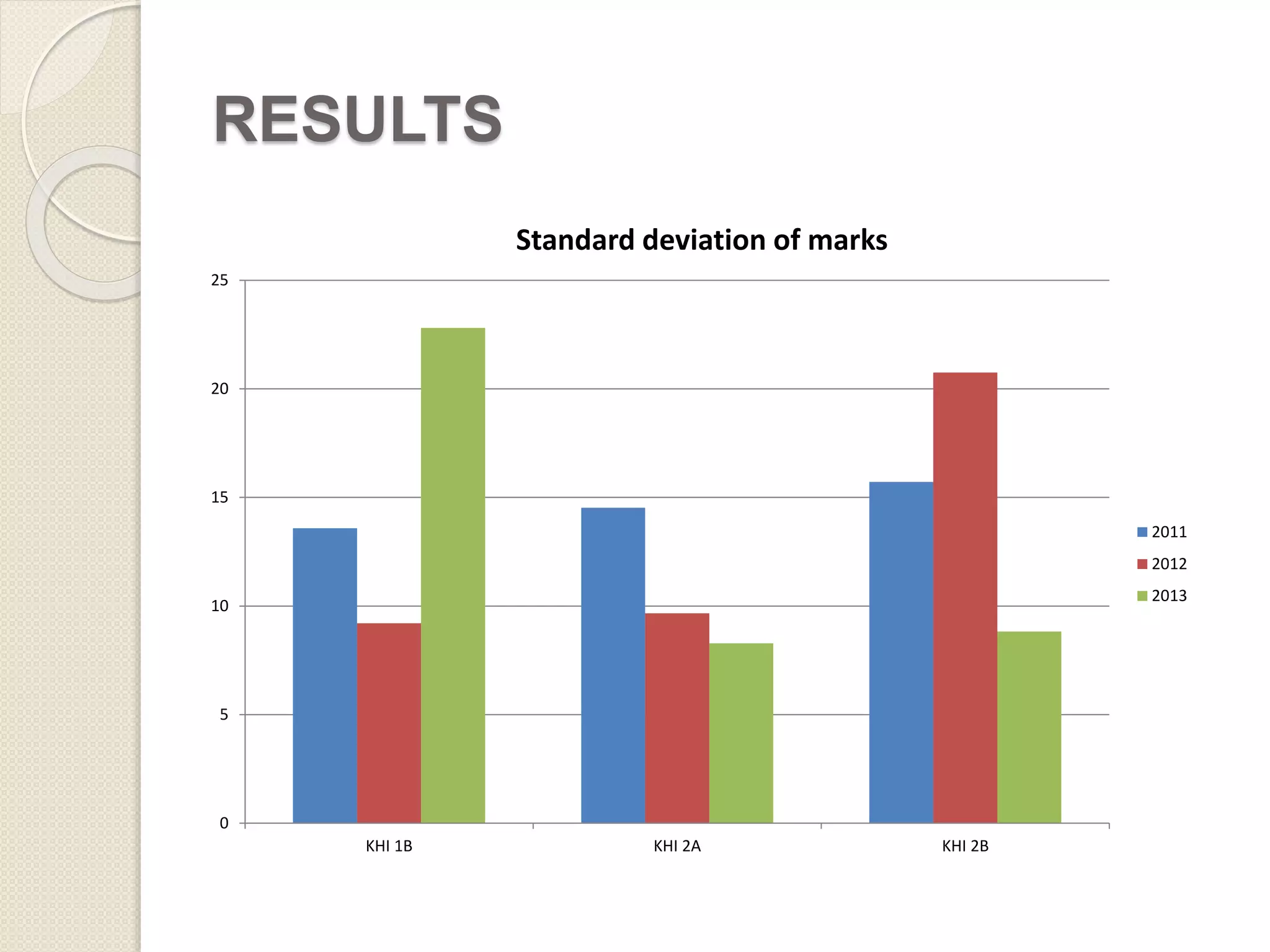
RESULTS 
25 
20 
15 
10 
5 
0 
Standard deviation of marks 
KHI 1B KHI 2A KHI 2B 
2011 
2012 
2013
RESULTS
STUDENT FEEDBACK 
 Questionnaire sent to students of all 
three cohorts (60 students) 
 Responses received from 44 students 
 Anonymity maintained
STUDENT FEEDBACK 
Effectiveness of dissections 
9% 
44% 
33% 
12% 
2% 
A: Extremely effective 
B: Very effective 
C: Moderately effective 
D: Slightly effective 
E: Not effective
STUDENT FEEDBACK
STUDENT FEEDBACK 
44% 
14% 
42% 
Preferred tools and methods of learning 
A: Pre-dissection lecture from tutor 
B: Hard copy of instruction booklet and 
images on touchscreen 
C: Hard copy of instruction booklet, images 
on touchscreen and instructions on-screen
STUDENT FEEDBACK
CONCLUSION 
 KHI1B: No significant difference between the three cohorts 
 KHI2A: 
-Significant differences between 
2011 and 2012 (p=0.043) 
2012 and 2013 (p=0.019) 
-No significant difference between 
2011 and 2013 
 KHI2B: 
-Significant differences between 
2011 and 2012 (p=0.047) 
2011 and 2013 (p=0.004) 
-No significant difference between 
2012 and 2013
CONCLUSION 
 No distinct improvement in 2013 cohort 
after changes in timing and method of 
assessment, compared to 2012 cohort. 
 However, overall performance of 2012 
and 2013 cohorts is better than 2011 
cohort. 
 Student feedback…..
CONFOUNDING FACTORS 
 The selection criteria for the third 
cohort was different from the first two: 
2011 & 2012: Graduate entry* 
2013: Graduate entry and BCSC 
*2011: Lengthy period after graduation, 
variable ‘basic’ degree
LIMITATIONS 
 Part time students and students who were not able to proceed to the 
following years were excluded from the study. 
 Pre-knowledge of students were different and was not assessed and 
therefore not available for comparison. 
 Medical students represent a selected group of high performers and 
are not strongly affected by extra educational efforts. 
 Students usually compensate for any educational intervention in 
their own time as they want to pass and achieve high scores. 
 Acquisition of anatomical knowledge is a complex process that may 
be difficult to research objectively. 
 Learning Outcomes for a dissection course is determined by many 
factors – not just practical exam performance. 
 Students were exposed to a combination of teaching methods for 
learning anatomy and the comparison was done only with changes 
in dissections. 
 Smaller sample size in the NTMP. 
 Some of the questions in the practical exam are blended with 
sections other than dissections (ie, histology, physiology).
ACKNOWLEDGEMENTS 
 Helen Wozniak, Academic Director e-learning 
& Evaluation, Flinders NT 
 A/Prof Greg Raymond, Director of 
Preclinical Education, Flinders NT 
 Dave Newman, AudioVisual/ICT Officer, 
Flinders NT
REFERENCES 
 NT Medicine Programme Course Details 
http://www.flinders.edu.au/medicine/sites/nt-clinical-school/students/medical-students_ 
home.cfm (13.02.2014) 
 Biggs, J., Tang, C. 2011. Teaching for Quality Learning at University, 4th Edition, 
Open University Press, Berkshire, England 
 Winkelmann,A.2007. Anatomical dissection as a teaching method in medical 
school: a review of the evidence, Medical Education 41:15-22 
 December, SKI et al. 2014. Clinical vignettes Improve Performance in Anatomy 
Practical Assessment, Anatomical Sciences Education, ase.1471 
 Nwachukwu,C et al. 2014. Evaluating Dissection in the Gross Anatomy 
Course:Correlation Between Quality of Laboratory Dissection and Students 
Outcomes, Anatomical Sciences Education, ase. 1458 
 Pereira, JA et al. 2007. Effectiveness of using blended learning strategies for 
teaching and learning human anatomy, Medical Education 41:189-195

153 muster2014 buddhika

  • 1.
    STUDENT CENTRED LEARNING FOR QUALITY TEACHING IN ANATOMY BUDDHIKA WEERASUNDERA SENIOR LECTURER KNOWLEDGE HEALTH AND ILLNESS FLINDERS NT 28.10.2014 *No commercial interests *This study has not received any financial support *There is no conflict of interests
  • 2.
    LEARNING OBJECTIVES IDENTIFY THE TEACHING METHODS THAT WERE DESIGNED FOR LEARNING ANATOMY  COMPARE THE CHANGES THAT WERE IMPLEMENTED FOR DISSECTIONS OVER A PERIOD OF 3 YEARS  ANALYSE THE EFFECTIVENESS OF THE CHANGES THAT WERE ADOPTED
  • 3.
    DISSECTIONS AS ALEARNING TOOL
  • 5.
    STUDY  Studentperformances in the practical exam of the 3 batches of students (2011-16, 2012-22, 2013-22) at the KHI exams were analysed. Three Practical Exams  1. KHI 1B at the end of First year 2nd semester (CVS, RS, Renal)  2. KHI 2A at the end of Second year first semester (GIT, ERS, Repro)  3. KHI 2B at the end of Second year second semester (MSS, BB)
  • 6.
    CHANGES IMPLEMENTED METHODS OF TEACHING: Hard copies of notes, Digital images and notes on screens and predissection lecture by the tutor.  TIMING: Second year first semester to First year second semester from 2013 cohort.  ASSESSMENT: 2 MCQs (each pair of students) submitted each week of semester (17 in total/student) for 2013 cohort in addition to assessing attendance and feedback of dissections.
  • 7.
    METHOD  Marksof total number of 60 students were analysed.  Of the 60 students, 16 from 2011 cohort, 22 from 2012 cohort and 22 from the 2013 cohort.  There were 9 Indigenous students and 51 non-Indigenous students.  9 students were from the BCSC programme while 51 students were from the graduate entry programme.  Student feedback to determine their views about the changes were also obtained.
  • 8.
    RESULTS 50 6070 80 90 100 KHI 2B KHI 2A KHI 1B Mean value of marks 2013 2012 2011
  • 9.
    RESULTS 25 20 15 10 5 0 Standard deviation of marks KHI 1B KHI 2A KHI 2B 2011 2012 2013
  • 10.
  • 11.
    STUDENT FEEDBACK Questionnaire sent to students of all three cohorts (60 students)  Responses received from 44 students  Anonymity maintained
  • 12.
    STUDENT FEEDBACK Effectivenessof dissections 9% 44% 33% 12% 2% A: Extremely effective B: Very effective C: Moderately effective D: Slightly effective E: Not effective
  • 13.
  • 14.
    STUDENT FEEDBACK 44% 14% 42% Preferred tools and methods of learning A: Pre-dissection lecture from tutor B: Hard copy of instruction booklet and images on touchscreen C: Hard copy of instruction booklet, images on touchscreen and instructions on-screen
  • 15.
  • 16.
    CONCLUSION  KHI1B:No significant difference between the three cohorts  KHI2A: -Significant differences between 2011 and 2012 (p=0.043) 2012 and 2013 (p=0.019) -No significant difference between 2011 and 2013  KHI2B: -Significant differences between 2011 and 2012 (p=0.047) 2011 and 2013 (p=0.004) -No significant difference between 2012 and 2013
  • 17.
    CONCLUSION  Nodistinct improvement in 2013 cohort after changes in timing and method of assessment, compared to 2012 cohort.  However, overall performance of 2012 and 2013 cohorts is better than 2011 cohort.  Student feedback…..
  • 18.
    CONFOUNDING FACTORS The selection criteria for the third cohort was different from the first two: 2011 & 2012: Graduate entry* 2013: Graduate entry and BCSC *2011: Lengthy period after graduation, variable ‘basic’ degree
  • 19.
    LIMITATIONS  Parttime students and students who were not able to proceed to the following years were excluded from the study.  Pre-knowledge of students were different and was not assessed and therefore not available for comparison.  Medical students represent a selected group of high performers and are not strongly affected by extra educational efforts.  Students usually compensate for any educational intervention in their own time as they want to pass and achieve high scores.  Acquisition of anatomical knowledge is a complex process that may be difficult to research objectively.  Learning Outcomes for a dissection course is determined by many factors – not just practical exam performance.  Students were exposed to a combination of teaching methods for learning anatomy and the comparison was done only with changes in dissections.  Smaller sample size in the NTMP.  Some of the questions in the practical exam are blended with sections other than dissections (ie, histology, physiology).
  • 20.
    ACKNOWLEDGEMENTS  HelenWozniak, Academic Director e-learning & Evaluation, Flinders NT  A/Prof Greg Raymond, Director of Preclinical Education, Flinders NT  Dave Newman, AudioVisual/ICT Officer, Flinders NT
  • 21.
    REFERENCES  NTMedicine Programme Course Details http://www.flinders.edu.au/medicine/sites/nt-clinical-school/students/medical-students_ home.cfm (13.02.2014)  Biggs, J., Tang, C. 2011. Teaching for Quality Learning at University, 4th Edition, Open University Press, Berkshire, England  Winkelmann,A.2007. Anatomical dissection as a teaching method in medical school: a review of the evidence, Medical Education 41:15-22  December, SKI et al. 2014. Clinical vignettes Improve Performance in Anatomy Practical Assessment, Anatomical Sciences Education, ase.1471  Nwachukwu,C et al. 2014. Evaluating Dissection in the Gross Anatomy Course:Correlation Between Quality of Laboratory Dissection and Students Outcomes, Anatomical Sciences Education, ase. 1458  Pereira, JA et al. 2007. Effectiveness of using blended learning strategies for teaching and learning human anatomy, Medical Education 41:189-195