Microcontrollers
4.16
4.6 ADVANCED COPROCESSOR ARCHITECURES
The8085wasan8–bitmicroprocessor.Itwasgenerallyusedinsmallscaleindustrialapplications
to control few operations. To overcome the limitations of 8085, a 16 bit microprocessor 8086
was introduced by Intel in 1978. The 8086 microprocessor has a much more powerful and high
speedcomputationalresources.The8086microprocessorhasamuchmorepowerfulinstruction
set along with the architectural developments. This provides a programming flexibility and
improvementinspeed.
The next subsidiary microprocessor 80186 is described as a microprocessor with integrated
peripherals. The 80186 has near about same architecture of the 8086 with the additional of a few
more instructions and additional on–chip circuits like clock generator, timer, DMA controller and
interrupt controller.
However, the microprocessor 80286 is the first advanced microprocessor with memory
management and protection abilities. The 80286 works in two operating modes; real address mode
and protected virtual address mode. In real mode, the 80286 just acts as a fast 8086. The 16 bit
word length of 80286 put limitations on its operating speed.
Its next subsidiary 80386 is 32 bit microprocessor that supports 8–bit/16–bit / 32 bit data
operands which did not gained much significance. However, 80486 when launched by Intel,
combined all the features of 80386 along with the numerical processing capabilities of
80386 gained much more importance. The 80486 is 32–bit CMOS microprocessor.
In response of increasing demand of processing, Intel came out with first Pentium processors
in 1993, which were followed by its complete series like Pentium Pro., Pentium MMX, P–II, P–
III and P–IV.
Simultaneously, there were developments of microcontrollers, which may be also defined as
‘single chip computer’ since it has all basic features of microprocessor along with many other
additional pheripheral components like ROM, RAM, Timers/Counters, parallel and serial I/O ports
all within the single chip.
Memories and Coprocessor Architectures 4.17
In 1974, Texas Instruments introduced the first microcontroller the TMS1000 series. The
TMS1000 series microcontrollers had on-chip RAM, ROM, and I/Os and were used as microwave
oven controllers, in industrial timers, and in calculators. Next, Intel 8048 was developed as a
microcontroller around 1976. This was the MCS-48 family. On-chip data storage was possible, but
the code was stored in external program memory. It had 1-byte instructions. Its successor in 1980
was the 8051, which was perfected & resulted in a huge success. Intel MCS-51 uses more flexible
2-byte instructions. On-chip program as well as data memory is provided and is now produced
by many companies in many variations. Today many smart devices are using microcontrollers to
control operations as per the requirements.
Let’s study the important features and architectural details of the popular advanced coprocessors.
4.7THE 80286 MICROPROCESSOR
The 80286 microprocessor, with its 24 bit address bus is able to address 16M byte of physical
memory. The 80286 microprocessor is an advanced version of 8086 microprocessor in terms of
enhanced hardware and instruction set.
4.7.1 Features of 80286 Microprocessor
The 80286 microprocessor is a 16 bit microprocessor and has following salient features.
1. The 80286 microprocessor is the first microprocessor to incorporate the integrated memory
management unit.
2. The 80286 microprocessor addresses 16M byte of physical memory and 1G bytes of virtual
memory by using its memory management system.
3. Data protection or unauthorized access prevention is provided with the concept of
segmented memory.
4. It works in two operating modes viz read address mode and protected virtual address mode.
In real address mode, it acts as a fast 8086. In protected virtual address mode, it works
with all of its memory management and protection capabilities.
At this time, the 80286 microprocessor no longer has a place in personal computers (PCs)
but is used in control systems as an embedded controller.
4.7.2 Architecture of 80286 Microprocessor
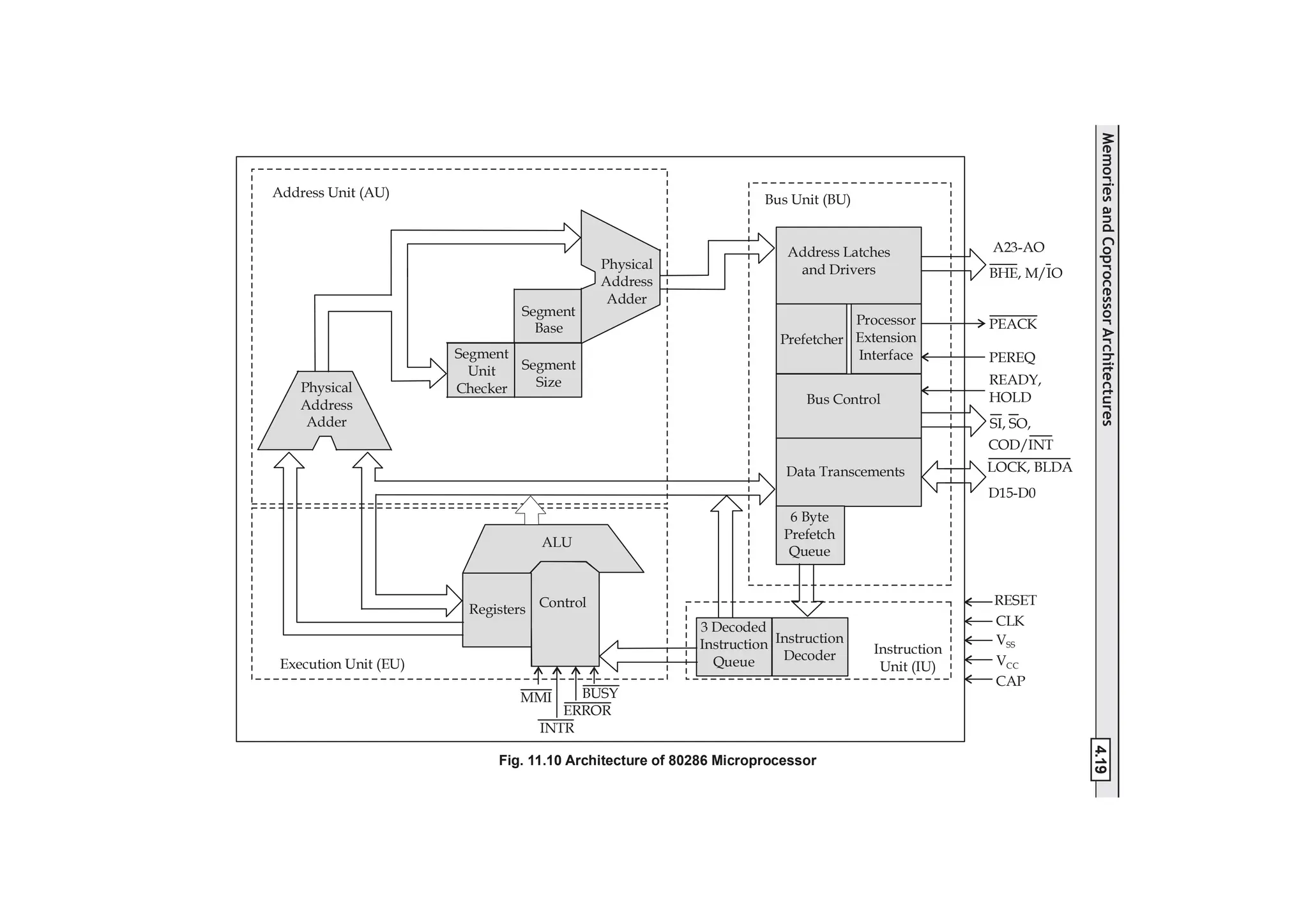
The block diagram of the 80286 microprocessor architecture is shown in figure 4.9. The 80286
microprocessor hardware is internally divided in four functional unit.
Microcontrollers
4.18
(i) Address Unit (AU)
(ii) Bus Unit (BU)
(iii) Instruction Unit
(iv) Execution Unit
(i) Address Unit (AU) : The address unit computes the physical address of the instructions
and data to be accessed by the microprocessor. Address lines of this unit may be used
to address other peripherals.
(ii) Bus Unit (BU) : The physical address computed by the AU is handed over the bus unit.
This physical address is transmitted to address bus (A0 – A23) by this unit. Major function
of bus unit is to fetch instruction bytes from memory and store them in its predefined queue.
This is known as instruction pipelining.
(iii) Instruction Unit (IU) : The instruction unit accepts instructions from perfected queue
and an instruction decoder decodes them one by one. The decoded instructions are stored
into a decoded instruction queue.
(iv) Execution Unit (EU) : The primary function of execution unit is to execute the
instructions received from the decoded instruction queue. The EU carries out all the
arithmetic and logical operations and sends the results either over the data bus or back
to register bank.
Memories
and
Coprocessor
Architectures
4.19
Physical
Address
Adder
Physical
Address
Adder
Segment
Base
Segment
Size
Segment
Unit
Checker
Address Latches
and Drivers
Bus Control
Data Transcements
6 Byte
Prefetch
Queue
Registers Control
Instruction
Decoder
3 Decoded
Instruction
Queue
Prefetcher
Processor
Extension
Interface
MMI
INTR
ERROR
BUSY
Address Unit (AU)
ALU
Execution Unit (EU)
Bus Unit (BU)
A23-AO
BHE, M/IO
PEACK
SI, SO,
READY,
HOLD
PEREQ
COD/INT
LOCK, BLDA
D15-D0
RESET
CLK
VSS
VCC
CAP
Instruction
Unit (IU)
Fig. 11.10 Architecture of 80286 Microprocessor

80286 Architecture foe ECE and EE students

  • 1.
    Microcontrollers 4.16 4.6 ADVANCED COPROCESSORARCHITECURES The8085wasan8–bitmicroprocessor.Itwasgenerallyusedinsmallscaleindustrialapplications to control few operations. To overcome the limitations of 8085, a 16 bit microprocessor 8086 was introduced by Intel in 1978. The 8086 microprocessor has a much more powerful and high speedcomputationalresources.The8086microprocessorhasamuchmorepowerfulinstruction set along with the architectural developments. This provides a programming flexibility and improvementinspeed. The next subsidiary microprocessor 80186 is described as a microprocessor with integrated peripherals. The 80186 has near about same architecture of the 8086 with the additional of a few more instructions and additional on–chip circuits like clock generator, timer, DMA controller and interrupt controller. However, the microprocessor 80286 is the first advanced microprocessor with memory management and protection abilities. The 80286 works in two operating modes; real address mode and protected virtual address mode. In real mode, the 80286 just acts as a fast 8086. The 16 bit word length of 80286 put limitations on its operating speed. Its next subsidiary 80386 is 32 bit microprocessor that supports 8–bit/16–bit / 32 bit data operands which did not gained much significance. However, 80486 when launched by Intel, combined all the features of 80386 along with the numerical processing capabilities of 80386 gained much more importance. The 80486 is 32–bit CMOS microprocessor. In response of increasing demand of processing, Intel came out with first Pentium processors in 1993, which were followed by its complete series like Pentium Pro., Pentium MMX, P–II, P– III and P–IV. Simultaneously, there were developments of microcontrollers, which may be also defined as ‘single chip computer’ since it has all basic features of microprocessor along with many other additional pheripheral components like ROM, RAM, Timers/Counters, parallel and serial I/O ports all within the single chip.
  • 2.
    Memories and CoprocessorArchitectures 4.17 In 1974, Texas Instruments introduced the first microcontroller the TMS1000 series. The TMS1000 series microcontrollers had on-chip RAM, ROM, and I/Os and were used as microwave oven controllers, in industrial timers, and in calculators. Next, Intel 8048 was developed as a microcontroller around 1976. This was the MCS-48 family. On-chip data storage was possible, but the code was stored in external program memory. It had 1-byte instructions. Its successor in 1980 was the 8051, which was perfected & resulted in a huge success. Intel MCS-51 uses more flexible 2-byte instructions. On-chip program as well as data memory is provided and is now produced by many companies in many variations. Today many smart devices are using microcontrollers to control operations as per the requirements. Let’s study the important features and architectural details of the popular advanced coprocessors. 4.7THE 80286 MICROPROCESSOR The 80286 microprocessor, with its 24 bit address bus is able to address 16M byte of physical memory. The 80286 microprocessor is an advanced version of 8086 microprocessor in terms of enhanced hardware and instruction set. 4.7.1 Features of 80286 Microprocessor The 80286 microprocessor is a 16 bit microprocessor and has following salient features. 1. The 80286 microprocessor is the first microprocessor to incorporate the integrated memory management unit. 2. The 80286 microprocessor addresses 16M byte of physical memory and 1G bytes of virtual memory by using its memory management system. 3. Data protection or unauthorized access prevention is provided with the concept of segmented memory. 4. It works in two operating modes viz read address mode and protected virtual address mode. In real address mode, it acts as a fast 8086. In protected virtual address mode, it works with all of its memory management and protection capabilities. At this time, the 80286 microprocessor no longer has a place in personal computers (PCs) but is used in control systems as an embedded controller. 4.7.2 Architecture of 80286 Microprocessor The block diagram of the 80286 microprocessor architecture is shown in figure 4.9. The 80286 microprocessor hardware is internally divided in four functional unit.
  • 3.
    Microcontrollers 4.18 (i) Address Unit(AU) (ii) Bus Unit (BU) (iii) Instruction Unit (iv) Execution Unit (i) Address Unit (AU) : The address unit computes the physical address of the instructions and data to be accessed by the microprocessor. Address lines of this unit may be used to address other peripherals. (ii) Bus Unit (BU) : The physical address computed by the AU is handed over the bus unit. This physical address is transmitted to address bus (A0 – A23) by this unit. Major function of bus unit is to fetch instruction bytes from memory and store them in its predefined queue. This is known as instruction pipelining. (iii) Instruction Unit (IU) : The instruction unit accepts instructions from perfected queue and an instruction decoder decodes them one by one. The decoded instructions are stored into a decoded instruction queue. (iv) Execution Unit (EU) : The primary function of execution unit is to execute the instructions received from the decoded instruction queue. The EU carries out all the arithmetic and logical operations and sends the results either over the data bus or back to register bank.
  • 4.
    Memories and Coprocessor Architectures 4.19 Physical Address Adder Physical Address Adder Segment Base Segment Size Segment Unit Checker Address Latches and Drivers BusControl Data Transcements 6 Byte Prefetch Queue Registers Control Instruction Decoder 3 Decoded Instruction Queue Prefetcher Processor Extension Interface MMI INTR ERROR BUSY Address Unit (AU) ALU Execution Unit (EU) Bus Unit (BU) A23-AO BHE, M/IO PEACK SI, SO, READY, HOLD PEREQ COD/INT LOCK, BLDA D15-D0 RESET CLK VSS VCC CAP Instruction Unit (IU) Fig. 11.10 Architecture of 80286 Microprocessor