
Gamal E. Khalifa
Sudan – Successes, Lessons Learnt & Challenges Ahead
EU-IFAD PROJECT- ICARDA
ARC- Sudan
2
Project target zones:
 In Sudan The legume program has been executed in five states: River Nile,
Northern, Khartoum, Gezira and North Darfur covering 40 villages and more
than 1000 farmers were participated in this activity.
 As usual the faba bean crop was grown in River Nile, Khartoum, North Korodfan
and Northern states.
 While lentil was grown mainly in River Nile State.
 Chickpea in River Nile and Gezira, as it was promising in this region.
3
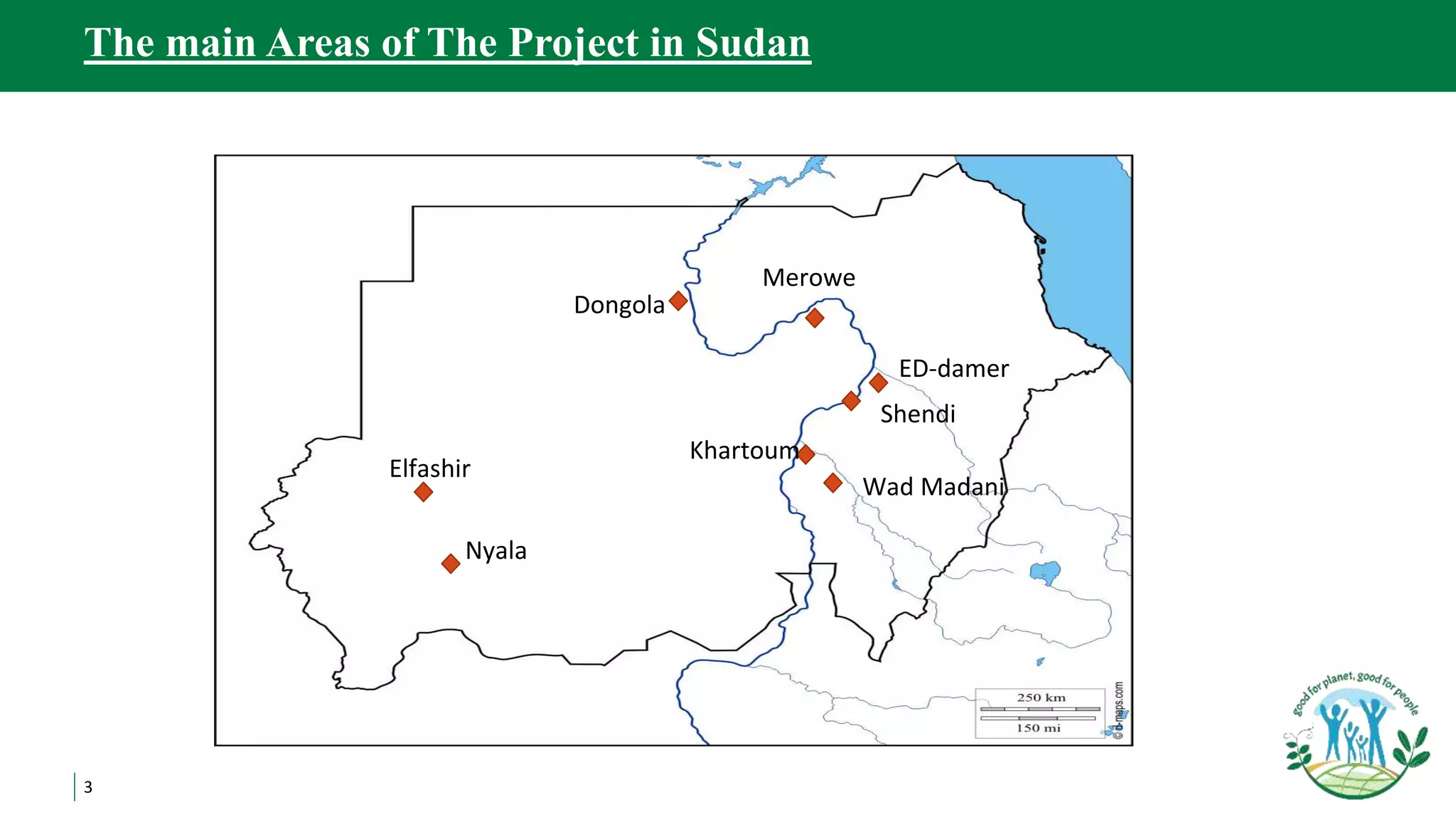
The main Areas of The Project in Sudan
Elfashir
Nyala
Dongola
Merowe
ED-damer
Shendi
Khartoum
Wad Madani
4
Major Focus Areas of Project Activities
Many activities were carried out during ( 2013-2015) with special concentration
on the following activities:
I-Research support
II-Seed increase
III-Technology dissemination
IV-Capacity building
5
Project Outputs
I - Research Support Achievements:-
1 -Released of two new faba bean varieties (Merowe and Shendi)
2- Two chickpea genotypes were submitted to NVRC for release.
3- Three large seeded faba bean genotypes in the pipe line ,will be submitted to
VRC during this year.
4- Screening for heat tolerance:
5 – Mapping of faba bean infested area by Orobanche was determined.
6- Virus survey at Gezira Scheme
6
Project Outputs
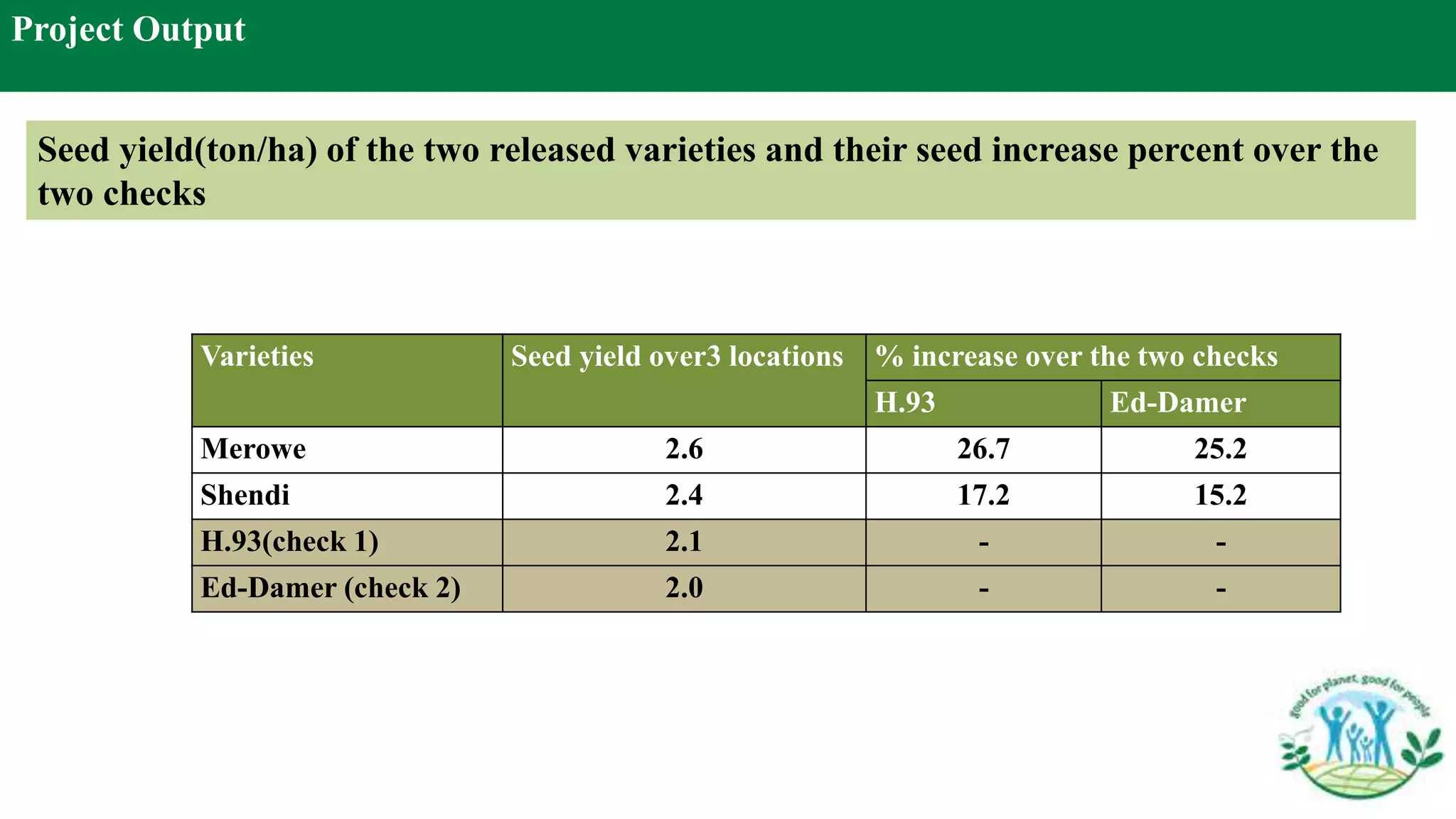
 The two varieties showed stable and significantly higher seed yields than the
checks, in addition to their resistance to dry root rot, which are considered
among the major biotic stresses in the production areas.
 They were also characterized by good seed quality as they have high protein
content (24.62 and 27.05), and short cooking time (45 and40 min.) respectively.
1 -Released of two medium- seeded ( 53.0 g) faba bean varieties
Merowe and Shendi.
Project Output
Seed yield(ton/ha) of the two released varieties and their seed increase percent over the
two checks
Varieties Seed yield over3 locations % increase over the two checks
H.93 Ed-Damer
Merowe 2.6 26.7 25.2
Shendi 2.4 17.2 15.2
H.93(check 1) 2.1 - -
Ed-Damer (check 2) 2.0 - -
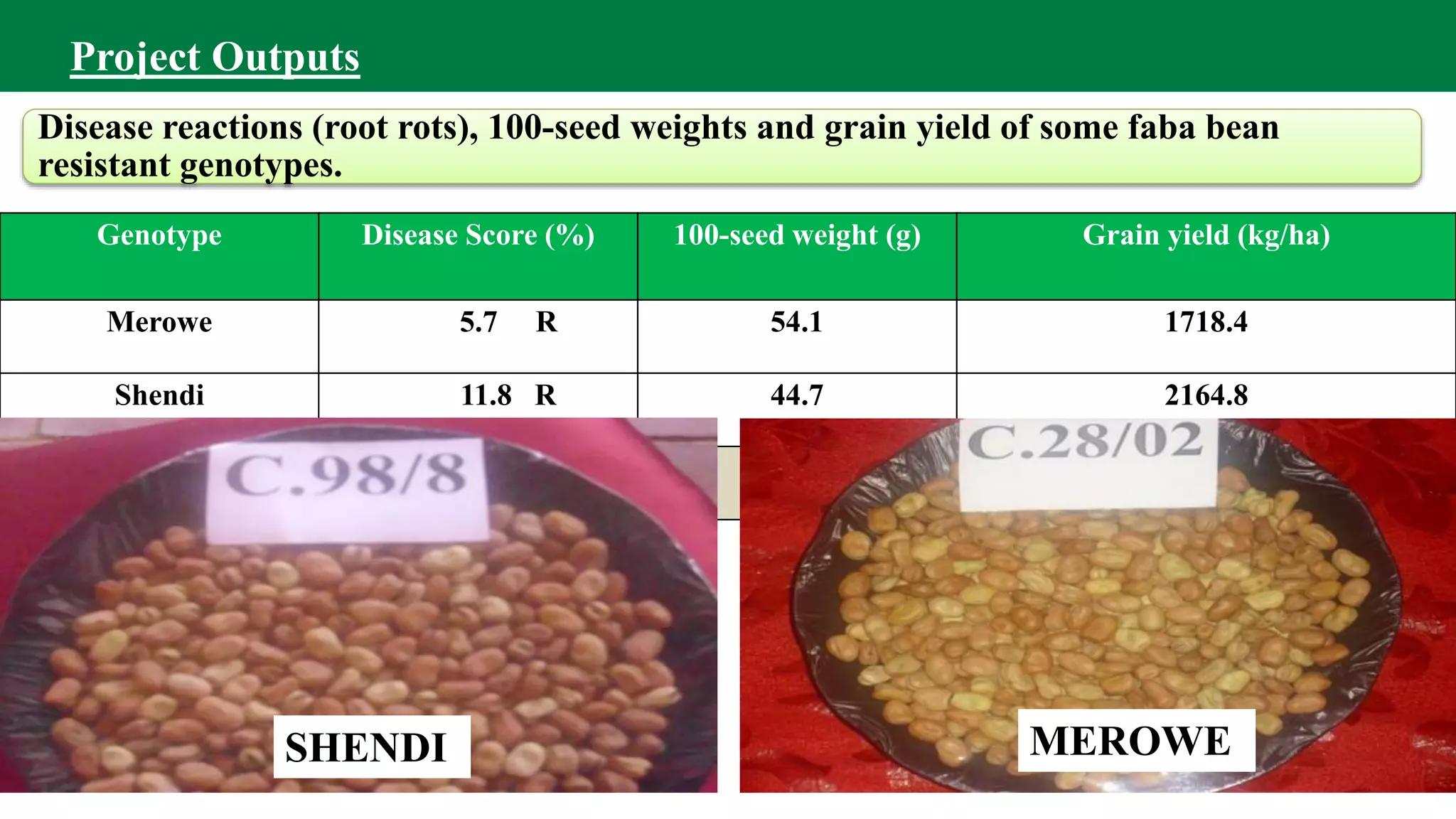
Genotype Disease Score (%) 100-seed weight (g) Grain yield (kg/ha)
Merowe 5.7 R 54.1 1718.4
Shendi 11.8 R 44.7 2164.8
H.72 66.4 S 50.0 1553.6
Disease reactions (root rots), 100-seed weights and grain yield of some faba bean
resistant genotypes.
Project Outputs
SHENDI MEROWE
9
Project Outputs
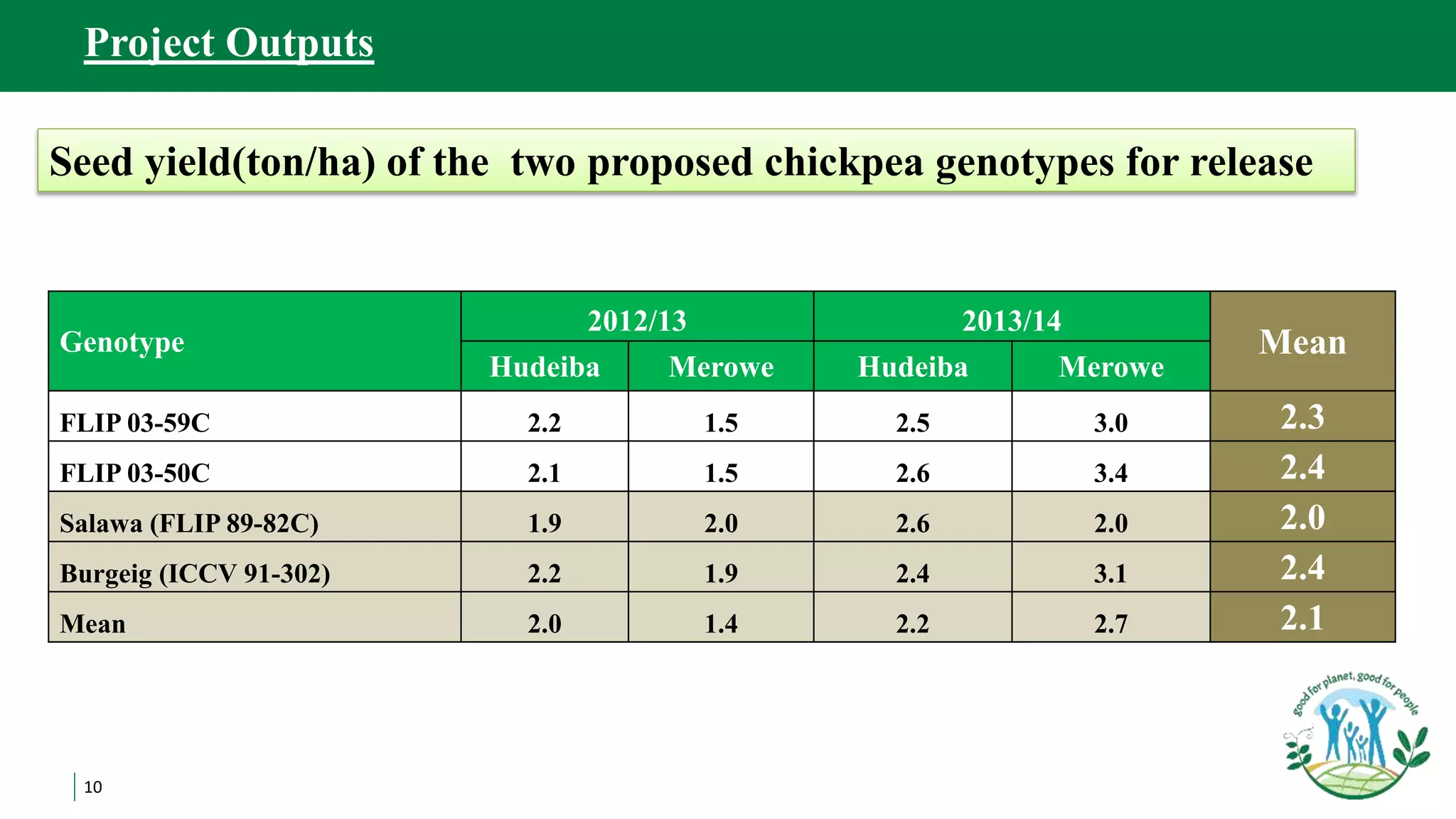
2- Two chickpea genotypes were submitted to NVRC for release
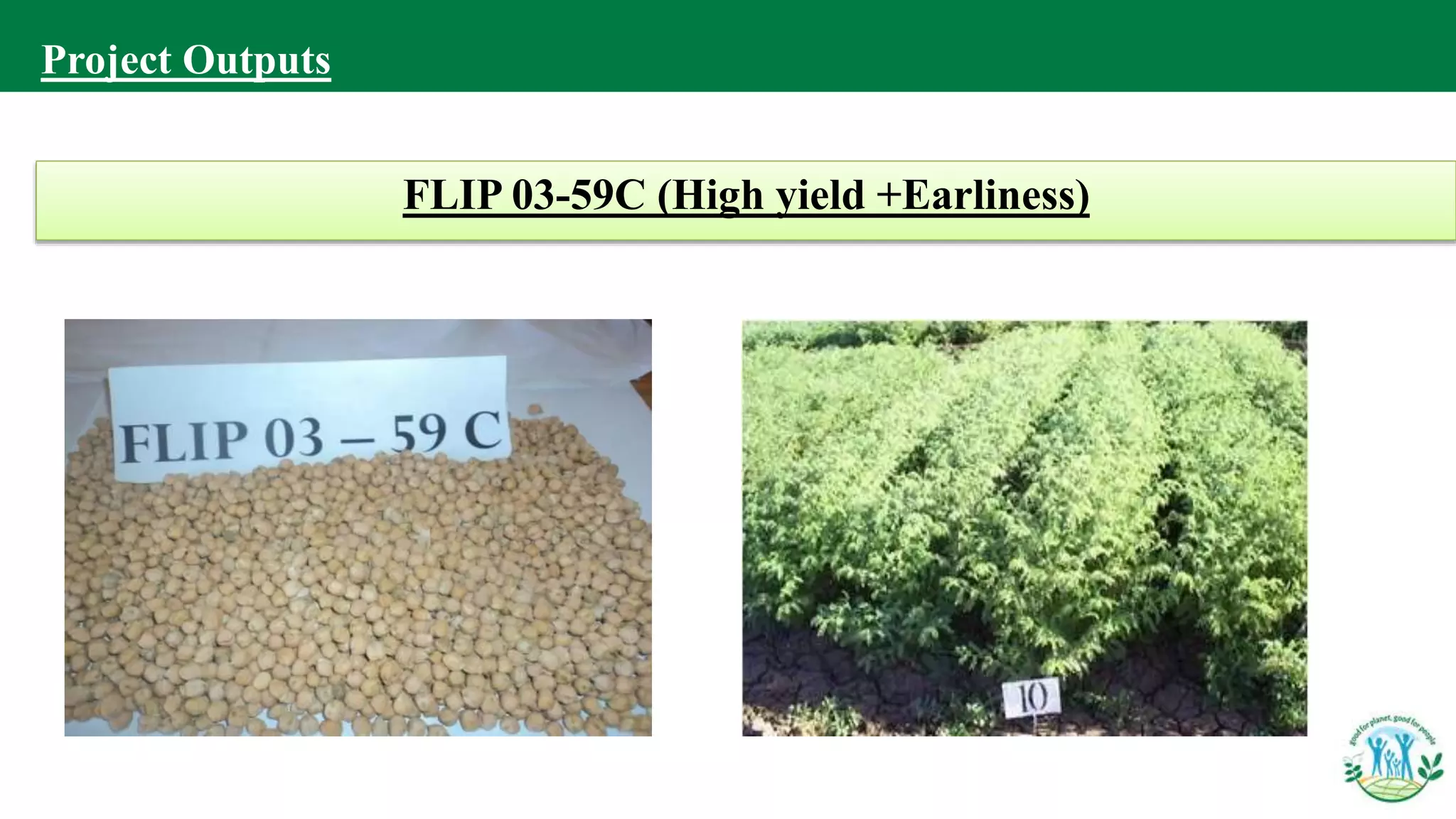
 The two genotypes FLIP03-50C and FLIP03-59C are proposed
for release for commercial production because of their valuable characteristic
(high seed yield, large seed weight, earliness).
 Moreover, the genotype FLIP03-50C is adapted to favorable conditions and
resistant to Fusarium wilt .
 The genotype FLIP03-59C is more stable.
10
Project Outputs
Genotype
2012/13 2013/14
Mean
Hudeiba Merowe Hudeiba Merowe
FLIP 03-59C 2.2 1.5 2.5 3.0 2.3
FLIP 03-50C 2.1 1.5 2.6 3.4 2.4
Salawa (FLIP 89-82C) 1.9 2.0 2.6 2.0 2.0
Burgeig (ICCV 91-302) 2.2 1.9 2.4 3.1 2.4
Mean 2.0 1.4 2.2 2.7 2.1
Seed yield(ton/ha) of the two proposed chickpea genotypes for release
FLIP 03-59C (High yield +Earliness)
Project Outputs
FLIP 03-50C
Project Outputs
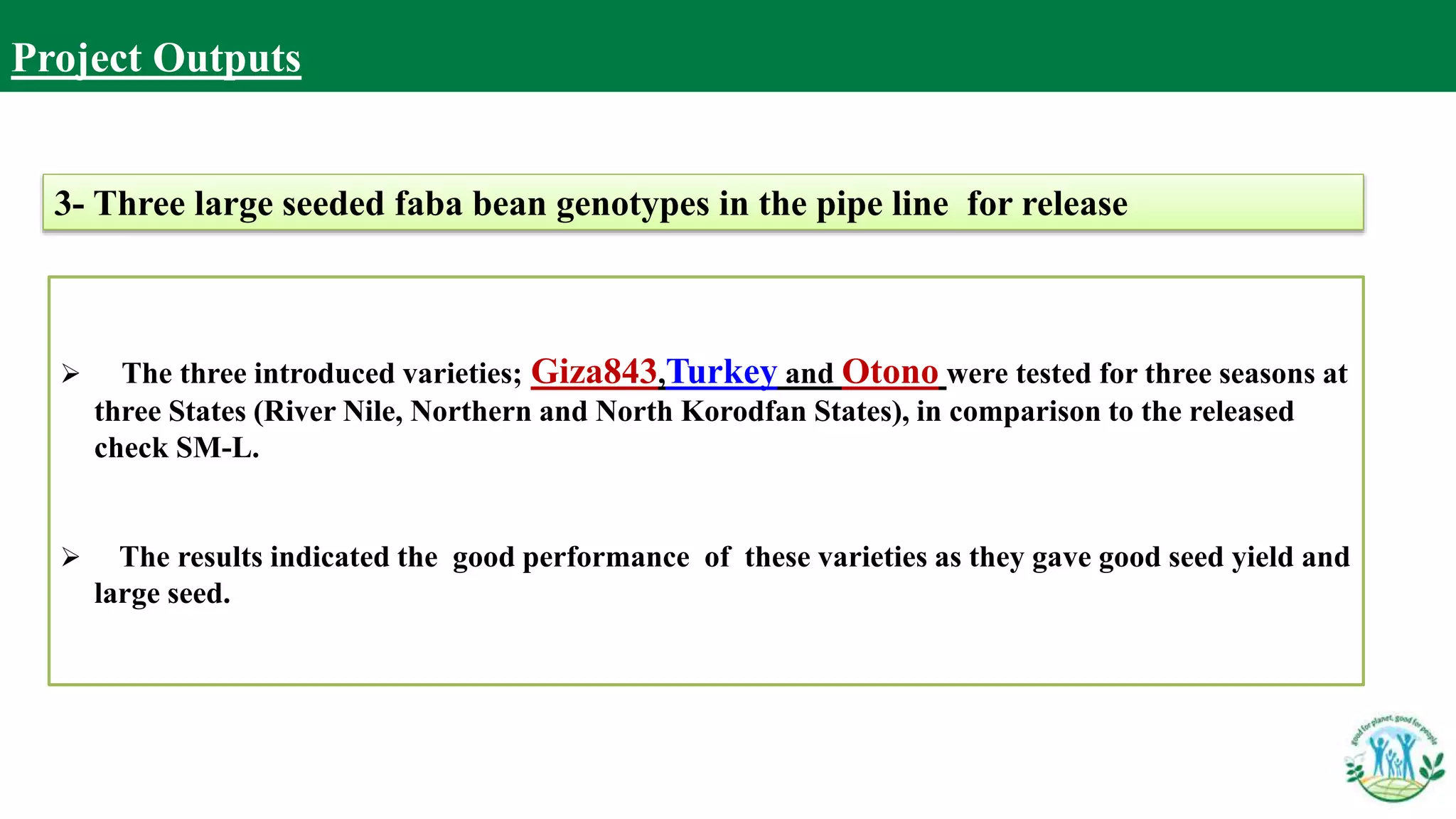
3- Three large seeded faba bean genotypes in the pipe line for release
 The three introduced varieties; Giza843,Turkey and Otono were tested for three seasons at
three States (River Nile, Northern and North Korodfan States), in comparison to the released
check SM-L.
 The results indicated the good performance of these varieties as they gave good seed yield and
large seed.
Project Outputs
Project Outputs
0
500
1000
1500
2000
2500
3000
3500
4000
Turkey Giza 843 Otono SM-L
2770
2916
1956
2557
2769
2573
2306
2709
3124
2806
3897
2874
Northern
R.N.S
N.Kordofan
Giza 843
For the 3 states
Otono
for
North Kordofan
Turkey
for
Northern and N.
Kordofan
Project Outputs
 More than 500 accessions of faba bean genotypes were received from ICARDA and
Sudan Gene Bank.
 Some of ICARDA materials showed good performance under Sudan conditions
and they will be used in the breeding program .
Project Outputs
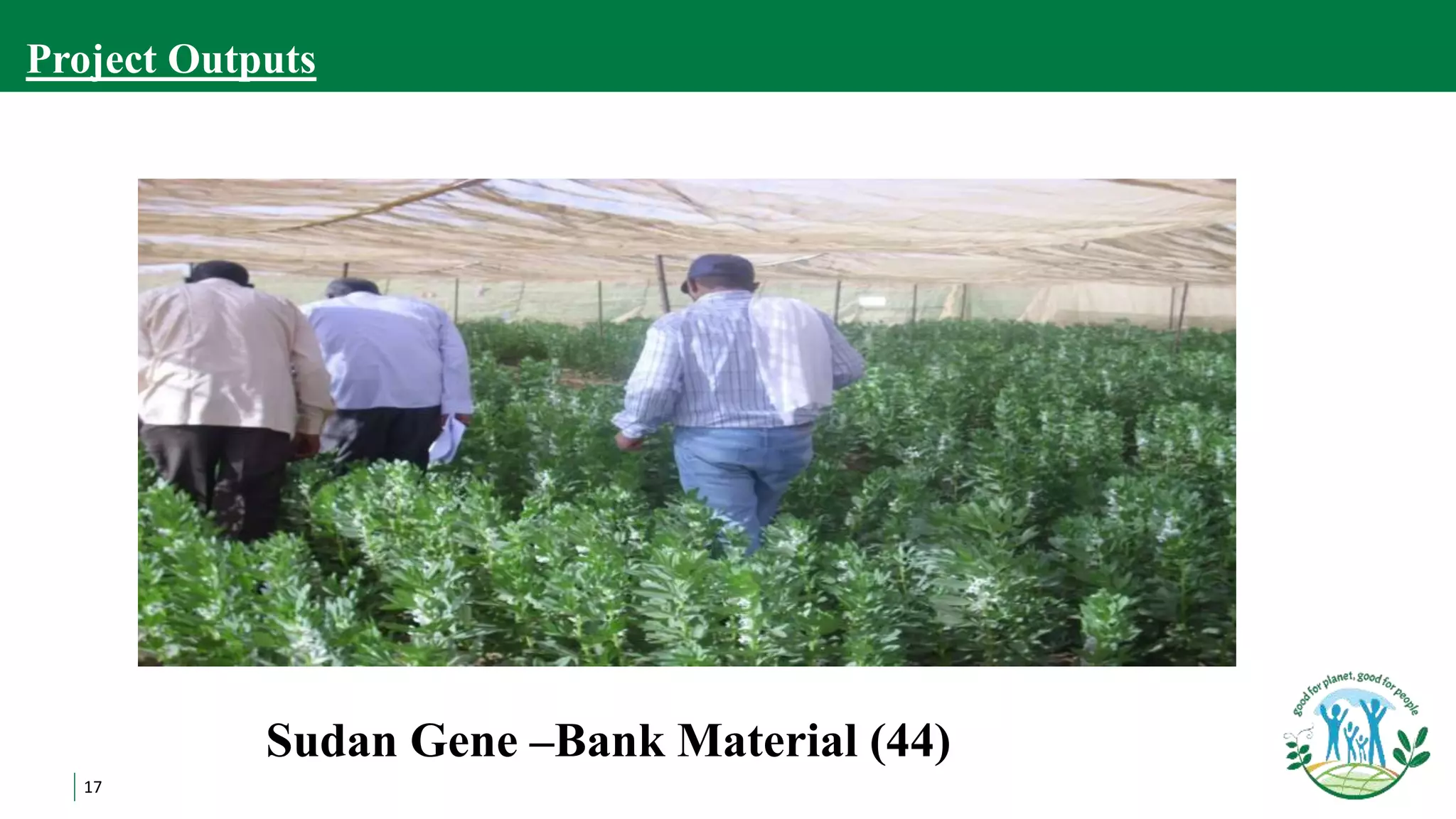
4- Screening for heat tolerance
17
Sudan Gene –Bank Material (44)
Project Outputs
18
ICARDA Material (50)
 Surveys done during 2012- 2015 revealed further dissemination of O. crenata by
more than 350 km downstream from the original focus of infestation in new areas..
It is a real threat for faba bean cultivation
5 – Mapping of faba bean infested area by Orobanche was determined.
Project Outputs
20
Project Outputs
21
Project Outputs
Two Surveys during 2012-2015 in Gezira and River Nile States were
carried out.
Sixty chickpea fields in the Gezira Scheme were visited during Feb. 2013 when
the crop at flowering and podding stage. The field area was ranged between 2-
40 ha.
6- Virus survey at Gezira Scheme
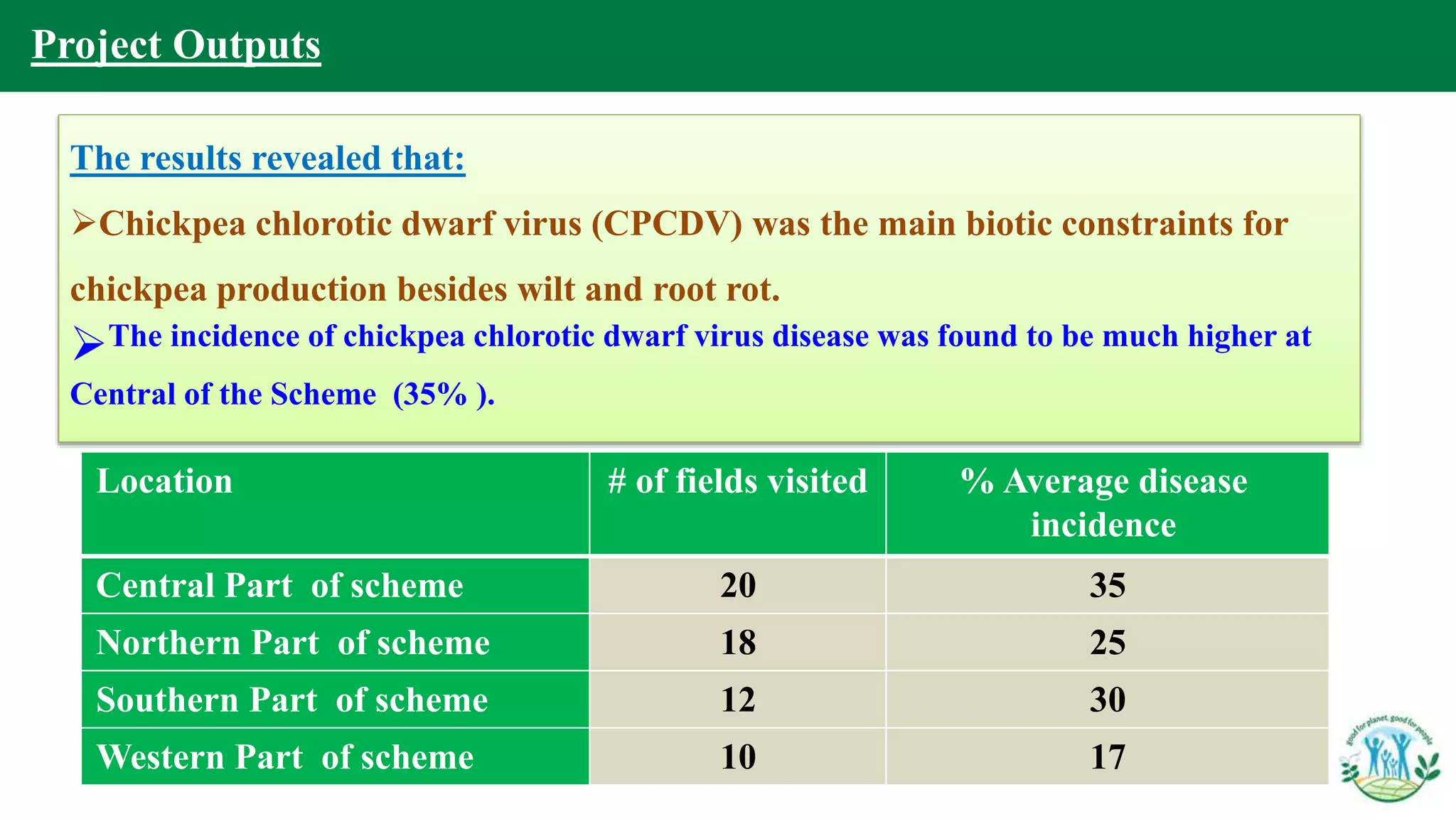
The results revealed that:
Chickpea chlorotic dwarf virus (CPCDV) was the main biotic constraints for
chickpea production besides wilt and root rot.
The incidence of chickpea chlorotic dwarf virus disease was found to be much higher at
Central of the Scheme (35% ).
% Average disease
incidence
# of fields visitedLocation
3520Central Part of scheme
2518Northern Part of scheme
3012Southern Part of scheme
1710Western Part of scheme
Project Outputs
23
Project Outputs
Locations surveyed in Gezira ``
The main Objective
To provide growers by foundation and certified seeds.
Project Outputs
II-SEED INCREASE
25
Seed Increase Achievements
 ARC research stations(4), responsible for foundation seed production, three of them
located in Northern Sudan for production of faba bean and chickpea, and one at Gezira
scheme for chickpea production.
 MOA in River Nile State established small unit of seed production for legume and
wheat in collaboration with wheat and legume programs.
Production and distribution of a considerable amount of legume foundation and
certified seeds of the released varieties.
Project Outputs
1-Early generation seed increase.
2-Foundation and certified seed.
Project Outputs
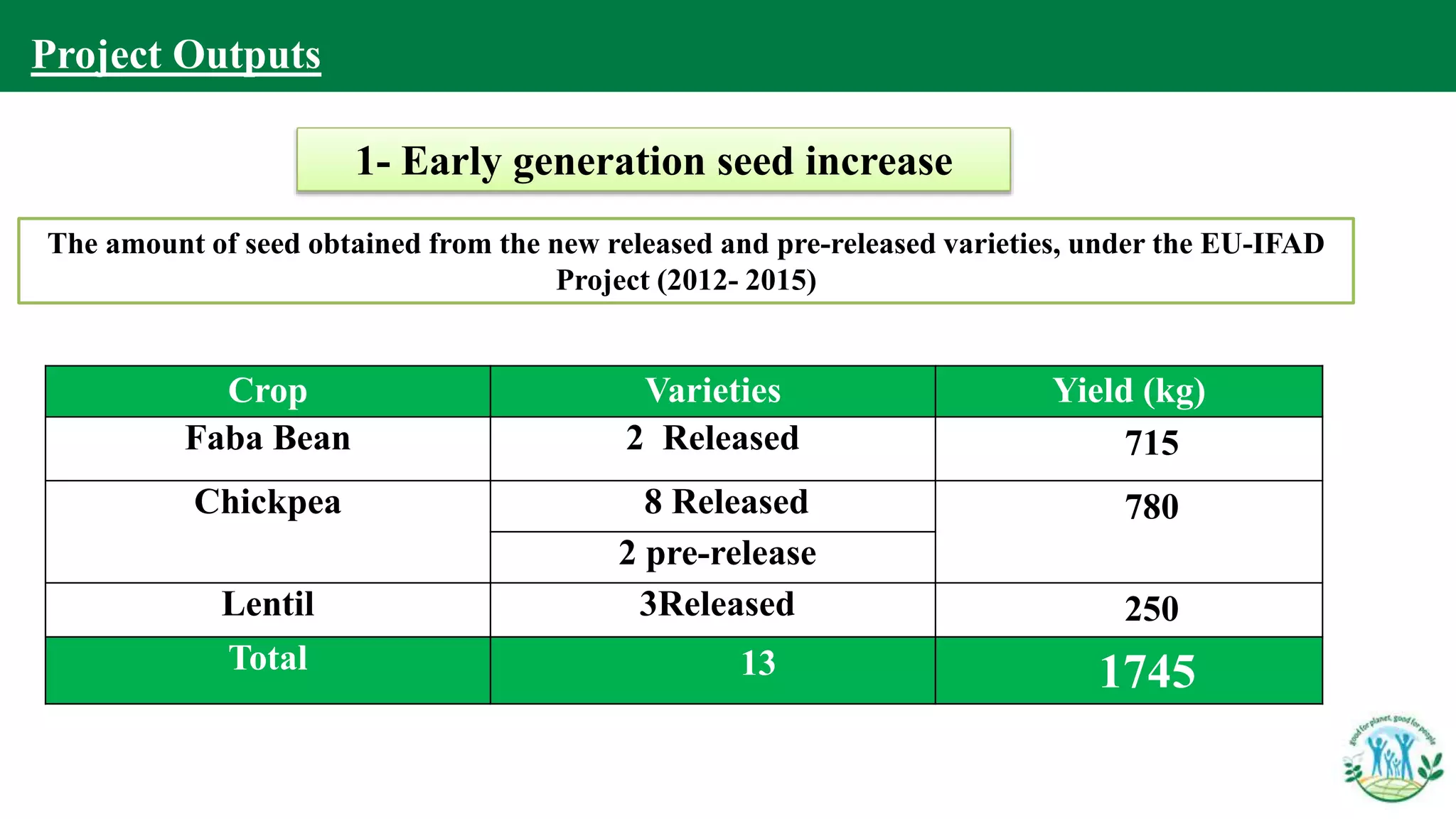
Seed activities under EU-IFAD PROJECT
The amount of seed obtained from the new released and pre-released varieties, under the EU-IFAD
Project (2012- 2015)
Crop Varieties Yield (kg)
Faba Bean 2 Released 715
Chickpea 8 Released 780
2 pre-release
Lentil 3Released 250
Total 13 1745
Project Outputs
1- Early generation seed increase
The amount of certified and foundation seed for the released faba bean cultivars produced at River
Nile and Northern States Research Station Farms, (2012-2015)
4/25/201628
Cultivar 2012-013 2013-14 2014-15
Ed-Damer 1.6 3.3 2.6
Basabeer 2.9 19.5 39.5
Hudeiba93 4.7 7.1 7.5
SML 0.1 2.4 5.4
Total 9.3 32.3 55.0
Grand Total 96.6
90% of the produced seed distributed to farmers
Project Outputs
2-Foundation and certified seed.
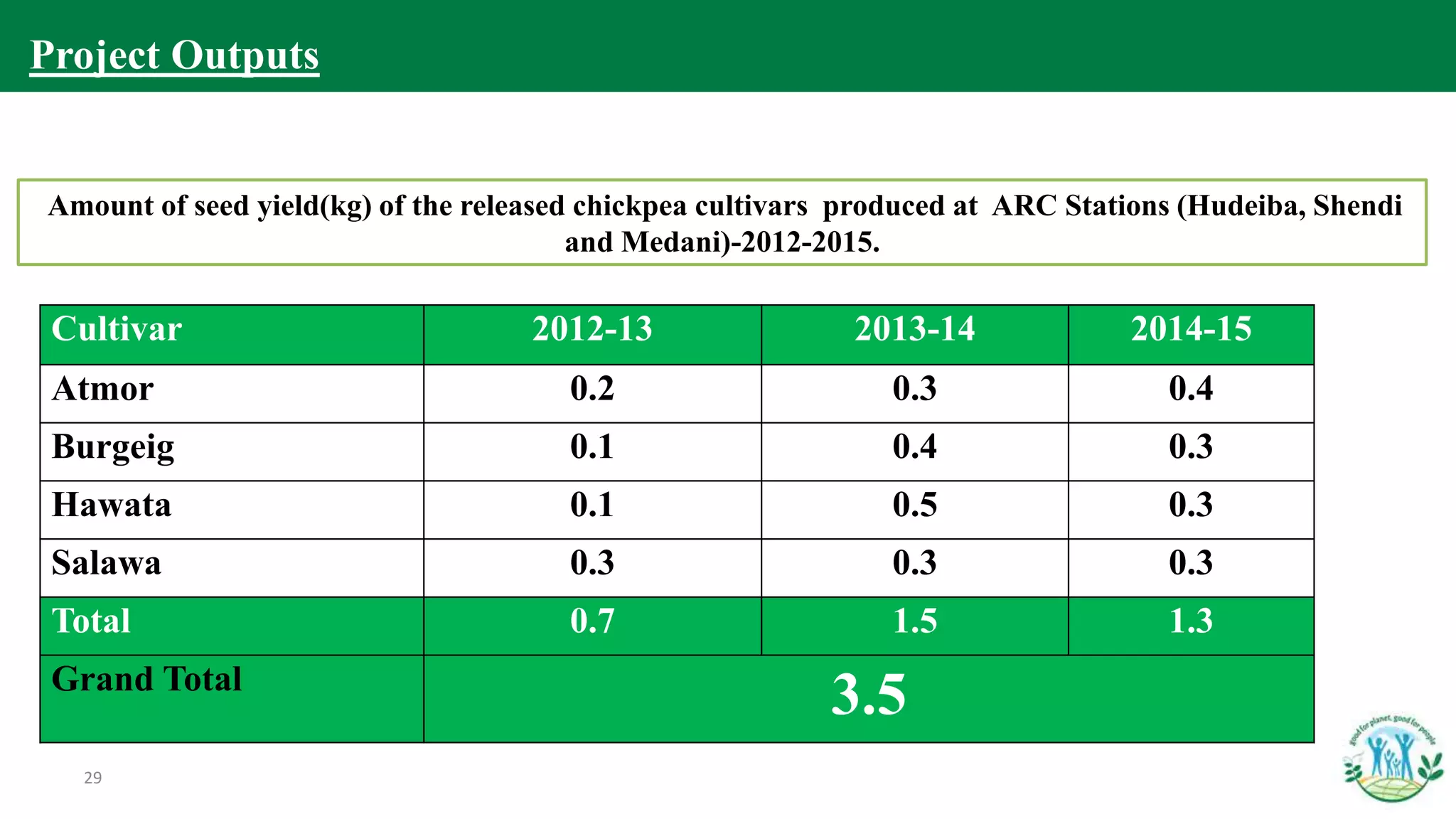
Cultivar 2012-13 2013-14 2014-15
Atmor 0.2 0.3 0.4
Burgeig 0.1 0.4 0.3
Hawata 0.1 0.5 0.3
Salawa 0.3 0.3 0.3
Total 0.7 1.5 1.3
Grand Total
3.5
Amount of seed yield(kg) of the released chickpea cultivars produced at ARC Stations (Hudeiba, Shendi
and Medani)-2012-2015.
29
Project Outputs
Cultivar 2012-013 2013-014 2014-015 Total
Aribo 0.12 0.12 0.1 0.34
Nedi 0.03 0.04 0.1 0.17
Rubatab 0.03 0.04 0.5 0.57
Selaim 0.02 - - 0.02
Total 0.2 0.2 0.7 1.1
The amount of foundation seed (ton)of the released lentil cultivars at River Nile State, Hudeiba
Research Station Farm, (2012-2015)
30
Project Outputs
31
Project Outputs
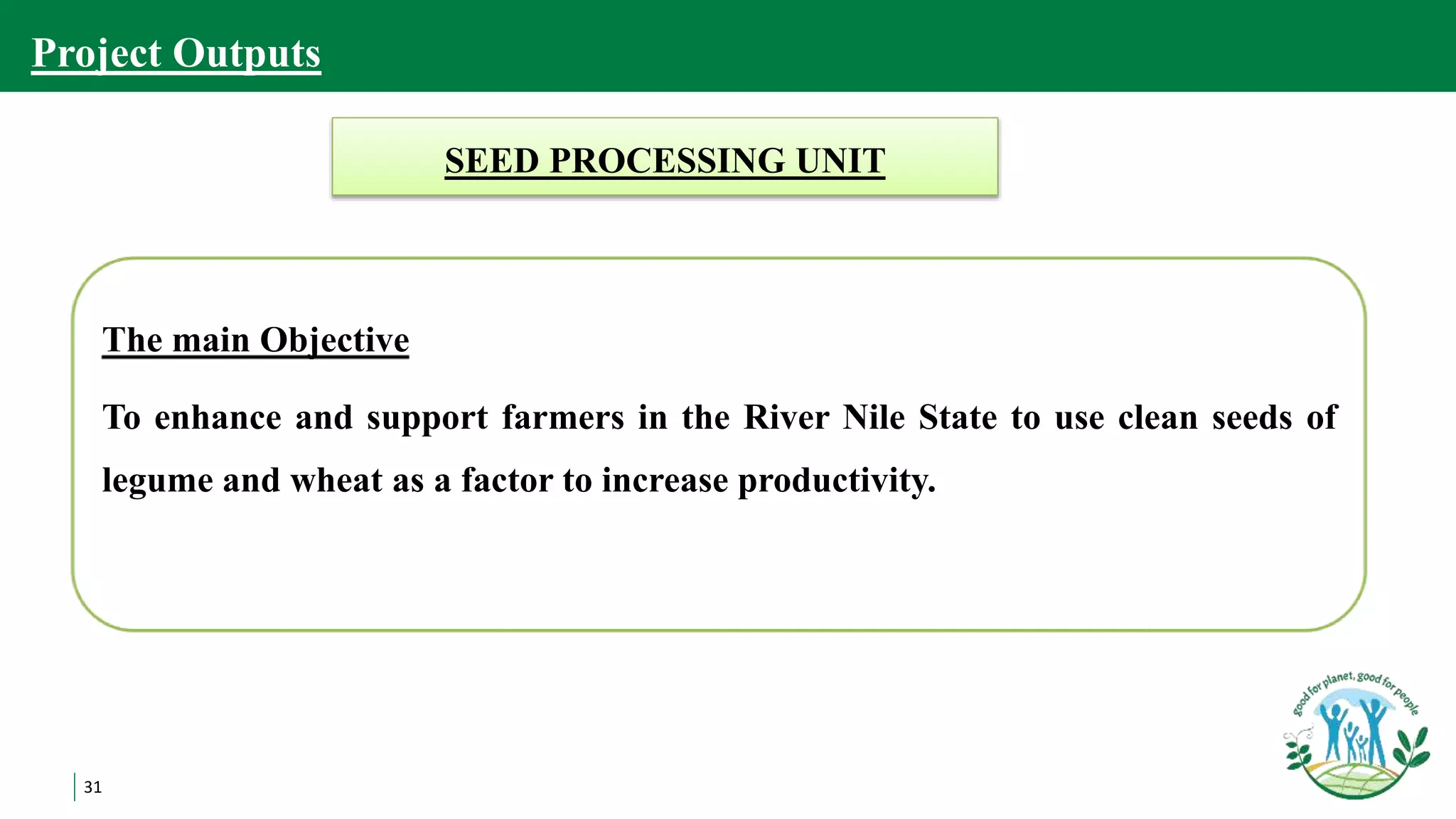
The main Objective
To enhance and support farmers in the River Nile State to use clean seeds of
legume and wheat as a factor to increase productivity.
SEED PROCESSING UNIT
32
 It has been received from EU- IFAD Project in November 2014.
 Season 2014/ 2015 the processed seeds were about 21.2, 3.0, 1.0 and 69 tons of
faba bean, chickpea, lentil and wheat seeds respectively.
32
About the UNIT
Project Outputs
33
Amount of seeds processed for season 2015/016
Crop Faba bean (ton) Wheat (ton)
Variety Ed-Damer Basabeer Hudeiba93 Imam El Nelien
Legume Program 1.700 10.250 1.000 - -
HRS & Farmers 6.100 2.100 48.5 5.0
MDRP * - 5.0 10.5
Total 21.2 69.0
* MDRP = Merowe Dam Rehabilitation Project
Project Outputs
Photos for the Seed Unit
34
Project Outputs
Packing and label the products
35
Project Outputs
III. Technology Dissemination
1- Demonstration Plots
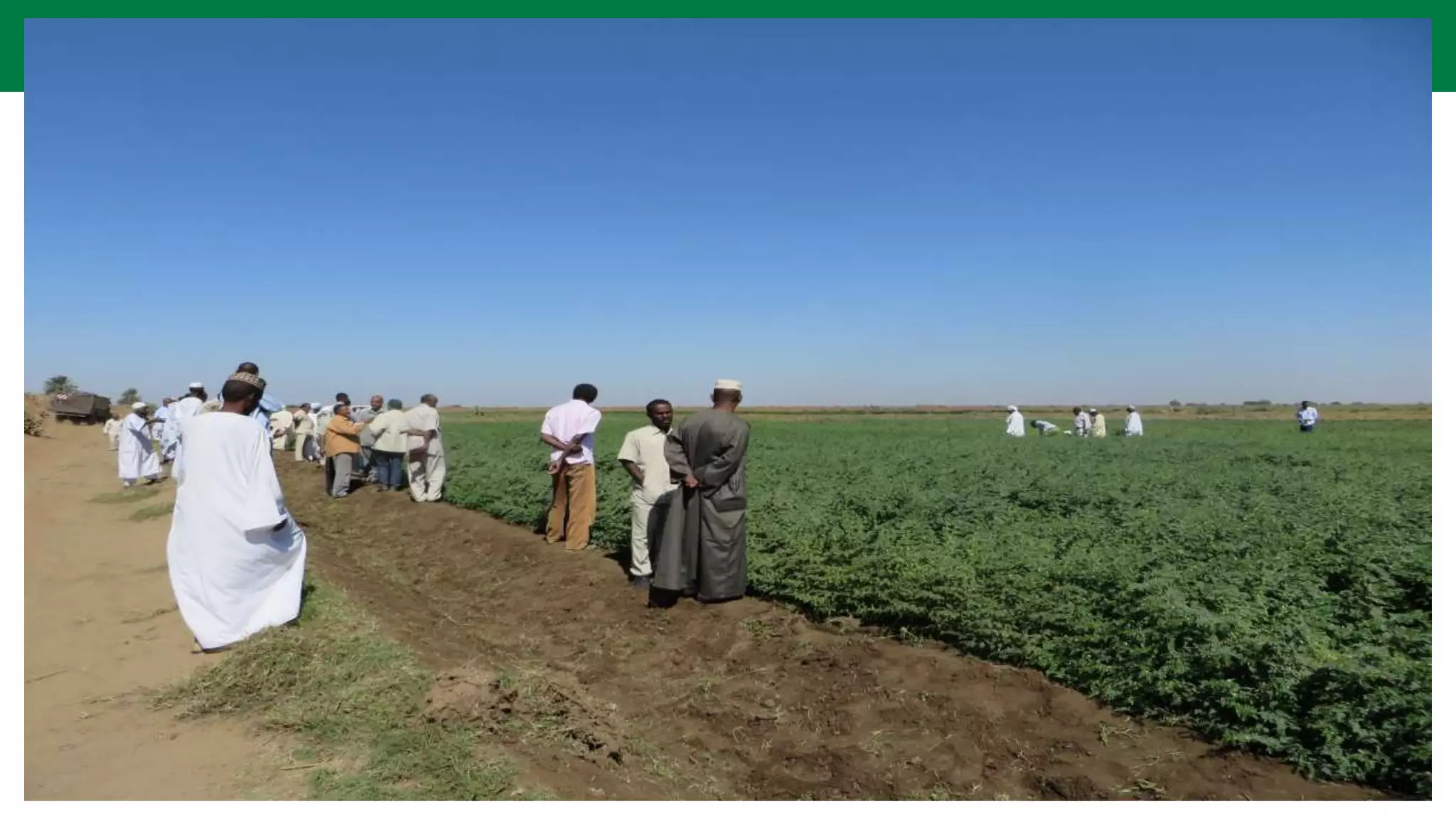
2-Field Days and Farmer Field Schools
Project outcomes
37
Faba Bean, Lentil and Chickpea Demonstration Plots (2012-2015)-River Nile and
Northern States.
2014-0152013-0142012-013Item
331Number of States
13113Number of Localities
1087514Number of Farmers
50156Number of Villages
953Number of Varieties
34.79.24.2Area(ha)
Project Outcomes
38
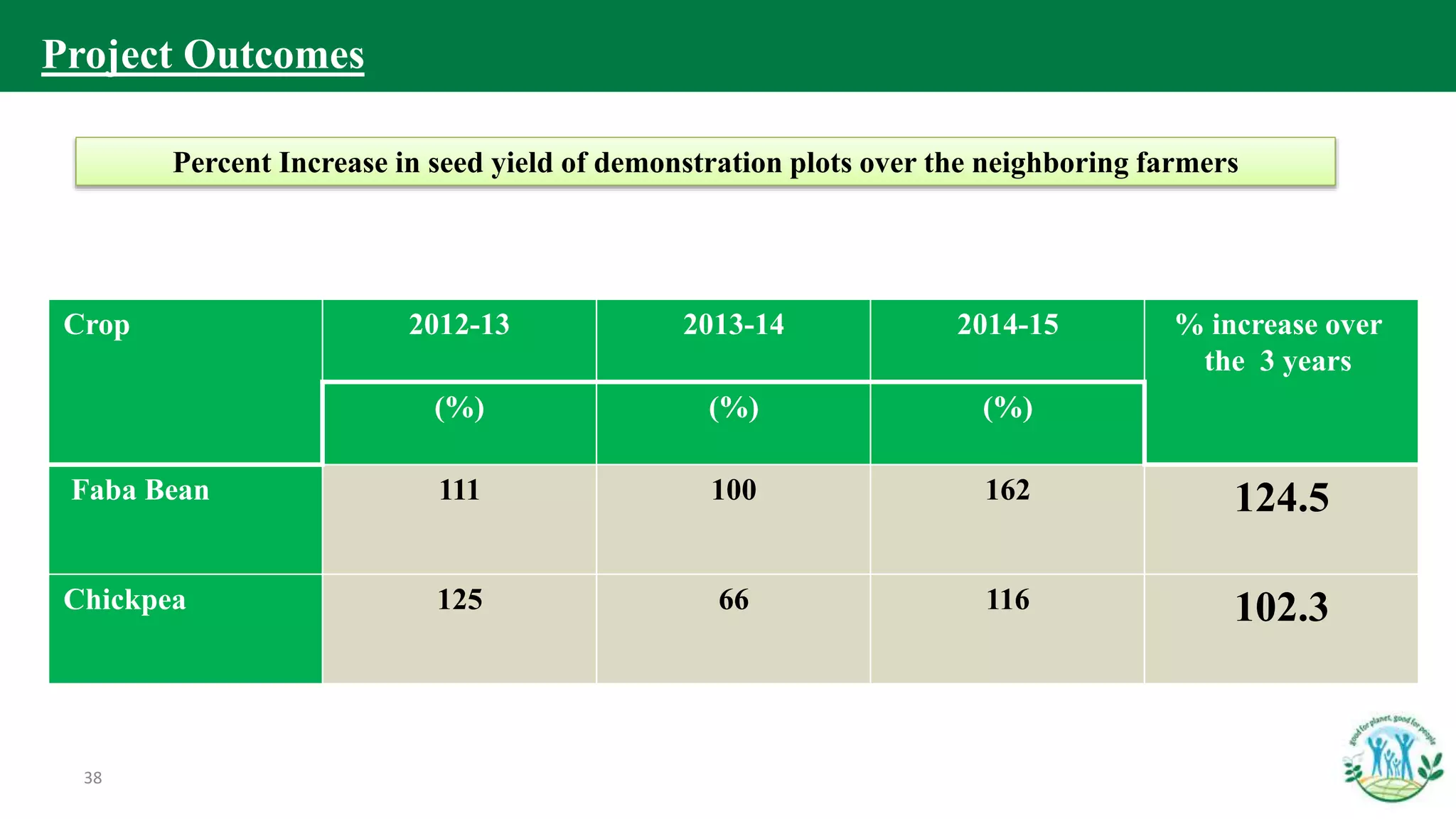
Percent Increase in seed yield of demonstration plots over the neighboring farmers
% increase over
the 3 years
2014-152013-142012-13Crop
(%)(%)(%)
124.5162100111Faba Bean
102.311666125Chickpea
Project Outcomes
39
Average Seed yield (tonha) of faba bean and chickpea demonstration and neighboring
plots over 4 localities, River Nile State.
2014-152013-142012-2013Crop
NPDPNPDPNP*DP*
0.82.11.22.40.91.9Faba Bean
0.61.30.61.00.81.8Chickpea
-0.70.71.5--Lentil
*DP= Demonstration Plots
*NP=Neighboring Plots
Project Outcomes
40
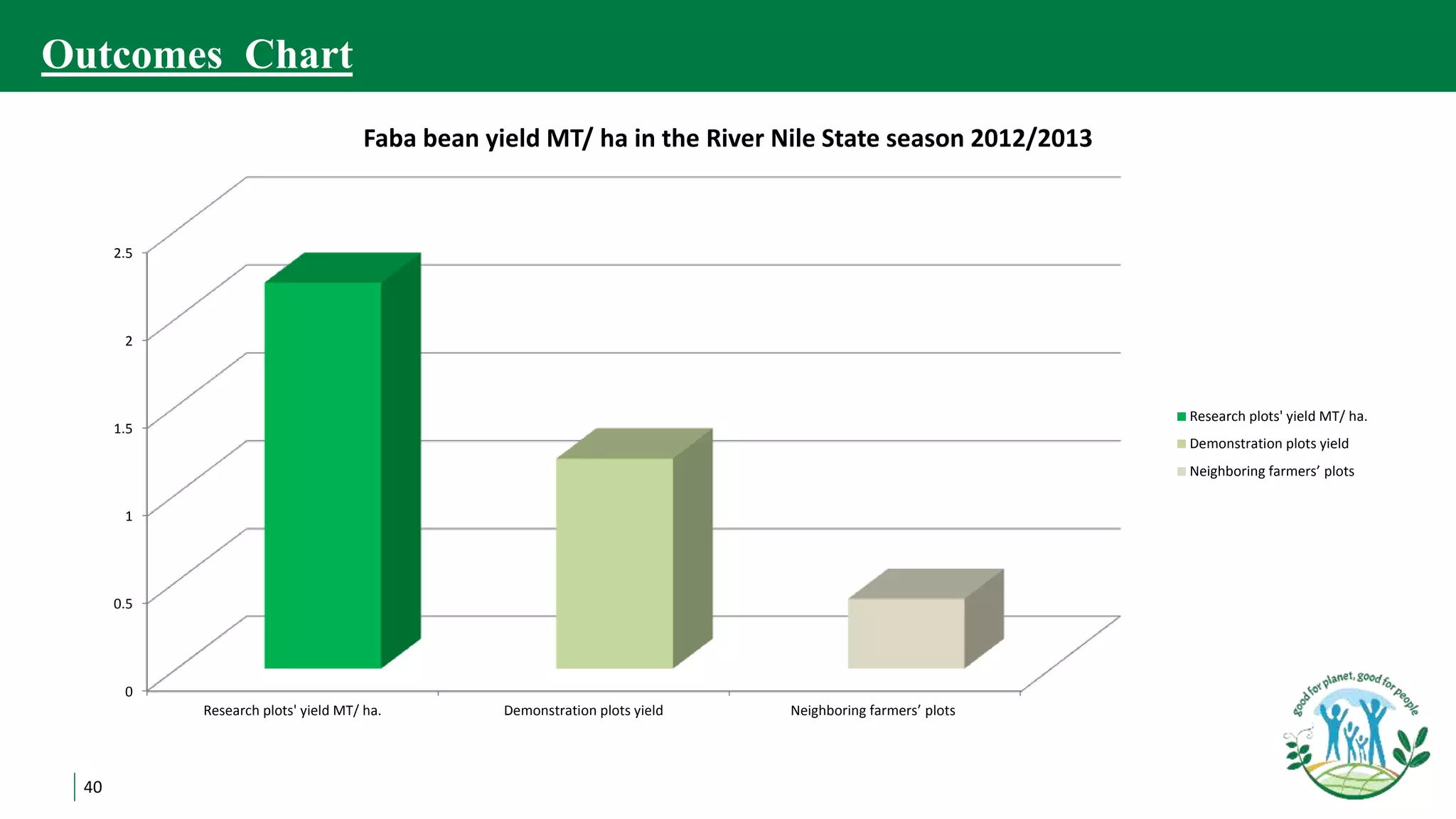
0
0.5
1
1.5
2
2.5
Research plots' yield MT/ ha. Demonstration plots yield Neighboring farmers’ plots
Faba bean yield MT/ ha in the River Nile State season 2012/2013
Research plots' yield MT/ ha.
Demonstration plots yield
Neighboring farmers’ plots
Outcomes Chart
41
Objective:-
1-To enable the farmers to have information related to improved varieties
technology.
2-To raise their awareness regarding the importance of improved varieties and
crop management in increasing crop yield.
2. Field days and Farmer Field School (FFS)
Project Outcomes
Item 2012-013 2013-014 2014-015 Total
Number of field days 7 9 11 27
Number of farmers 230 356 470 1056
Number of other participants
47 94 148 289
Total number of field days, farmers and other participants(2012-2015)
Project Outcomes
Project Outcomes
Project Outcomes
Objective:-
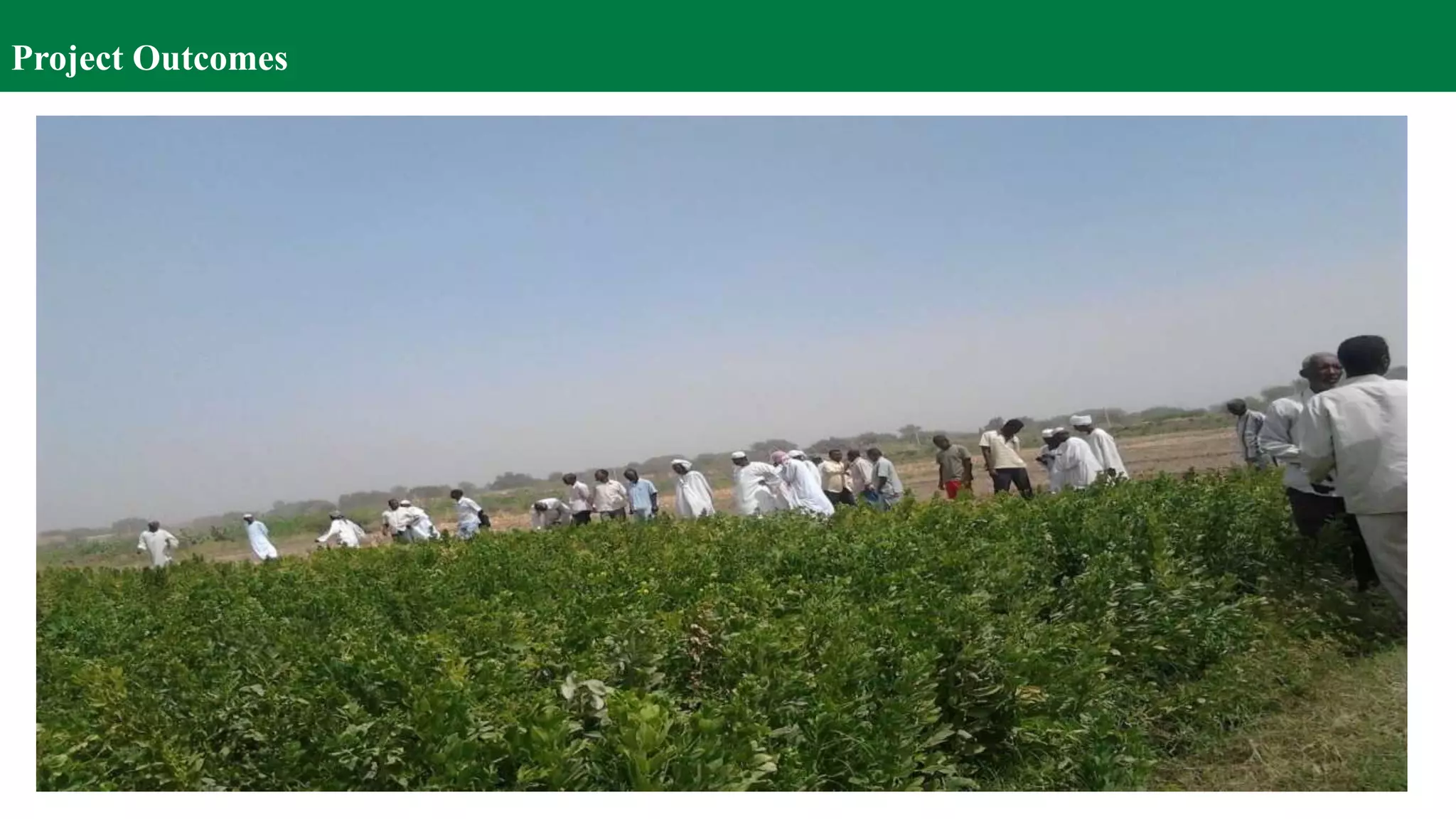
The main objective of this activity is to increase the knowledge of field officers and farmers about the
legume production packages.
49
Project Outcomes
IV. Capacity Building
Number of
Participants
No. of coursesCourse
80 (Field
officers)
2
IPM of faba bean
●Integrated insect pest management of faba bean.
●Integrated diseases management of faba bean.
●Integrated weed managements of faba bean.
320 (Farmers)4Components of legume crops package as recommended by
ARC.
180 (farmers)6Group discussion (FFS)
58011Total
Training of field officers and Farmers organized by ARC in collaboration with the Department of Extension
and Technology Transfer of the RNS Ministry of Agriculture(2013-2015).
50
Project Outcomes
51
Lessons Learnt from the Project
 Participation of farmers in the evaluation and selection processes is an
important approach for increasing their awareness and demand for the
improved production technologies .
 Adoption of the production technologies is necessary for increasing the farmer's
income and raising their livelihood.
 Training of the legume scientists and their participation in the meetings and
workshops have appreciably improved their research performance
52
Outstanding Project Result
 The introduction of chickpea in Gezira Scheme
 The development and demonstration of new IPM technology
are the most outcomes that make the project successful and contribute to
Sudan’s bigger national goals.
53
Outstanding Project Result
 Introduction of Chickpea in Gezira State.
The area allocated to the crop was increased from few hectares during the nineties to
more than 30000 (ha.) during the last phase of the project.
54
1-The eight released chickpea cultivars ,were distributed to farmers in the first
season(2012-13).
2-In the second season (2013-14) only 6 cultivars were selected by farmers .
3-In the third season (2014-15), the best two cultivars (Burgeig and Hawata) selected by
farmers were distributed to 19 farmers in eight locations.
Outstanding Project Result
55
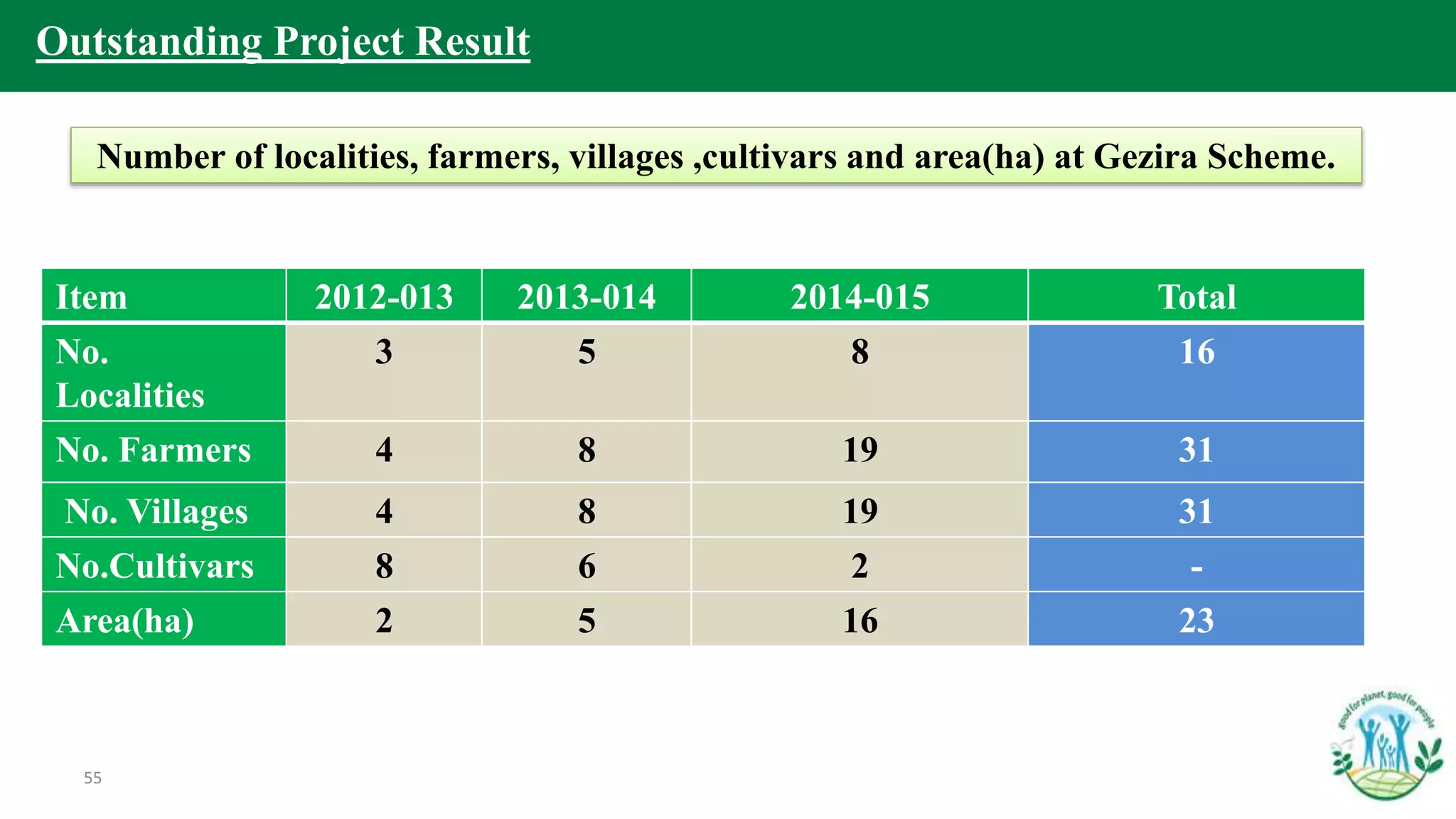
Number of localities, farmers, villages ,cultivars and area(ha) at Gezira Scheme.
Total2014-0152013-0142012-013Item
16853No.
Localities
311984No. Farmers
311984No. Villages
-268No.Cultivars
231652Area(ha)
Outstanding Project Result
56
Average seed yield(tonha) of the best two chickpea cultivars grown by 19 farmers over 8 Locations
,Gezira Scheme.
Cultivar
2012-013 2013-014 2014-015
Yield
(tonha)
% increase Yield
(tonha)
% increase Yield
(tonha)
% increase
Burgeig 3.0 76.5 2.8 86.6 2.5 56.3
Hawata 2.8 64.7 3.1 106.6 2.4 50.0
Farmers seed 1.7 - 1.5 - 1.6
Outstanding Project Result
.Integrated Pest Management
Objective:
 To build on farmers, own perception and knowledge of sustainable crop
production in Northern Sudan by demonstrating to them the effectiveness of
an IPM package for aphids control in faba bean.
Outstanding Project Result
Cont.
The package was consisting of two treatments:
Gaucho & Raxil and Neem water extracts with dosage rate of Gaucho (3g) +Raxil
(4g)/kg seeds and 60g/liter of water, respectively.
The IPM-farmers field school, chosen to promote the technology and evaluation.
Outstanding Project Result
The IPM package gave an increase in yield of about 25-30% and 22-25% over
farmer’s practices for chemical insecticides and botanicals for both SM-L and
Turkey varieties respectively.
Seed dressing insecticides gave a lower percentage of wilted plants (root rot wilt
complex).
 Adoption of the IPM package improved faba bean yield and net profits of farmers.
Outstanding Project Result
20142013
Themes Number of
participants
Field daysNumber of
participants
Field days
23061554Seed dressing with Tricil
to control aphids and
fungus infections
484--The use of pre-
emergence herbicides
Outstanding Project Result
Integrated Pest Management Field Days and FFS
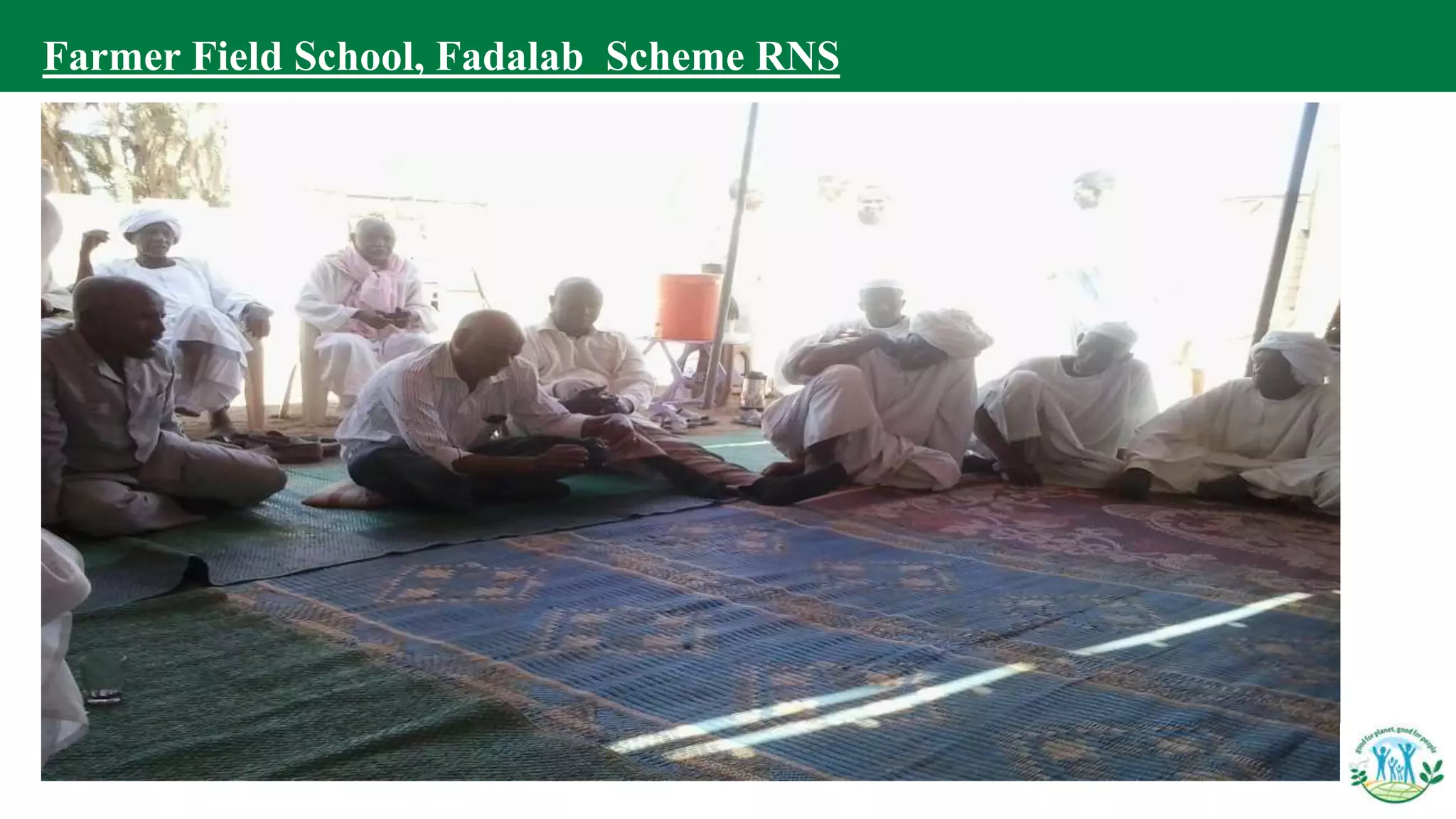
Farmer Field School, Fadalab Scheme RNS
62
Supportive Policy, Regulations & Market Forces
 To enhance small-holder wheat-legume cropping systems and to improve
food security under changing climate in Sudan; The government applied some
polices and regulations, these include :-
 The removal of taxes from all agricultural machines (seed driller, tractor,
harvester, … etc) and agricultural inputs.
 Also, the government encourages the post harvest methods and pulses grading
and packaging.
63
Project Upscaling and Out scaling
 To upscale and out scale the achieved results on both wheat and
food legume crops the following technologies should be applied:-
 On-farm technology dissemination platforms and better adapted wheat and food legume
varieties .
 More proper of integrated pest/ disease management (IPM/IDM).
 Conservation agriculture, supplemental irrigation technology packages and their
combination where new varieties and more appropriate crop production packages should
be used.
64
Policy, Regulations & Market Constraints
 For efficient and adequate pulses markets, they have:
To provide better prices to producers and the availability of
competitively priced produce to consumers.
 Constraints :
There are many constraints that hinder the pulses market:
1-lack of infrastructures.
2- The weakness of rural assembly markets and urban wholesale or
semi-wholesale markets.
THANK YOU

Sudan – Successes, Lessons Learnt & Challenges Ahead

  • 1.
    Gamal E. Khalifa Sudan– Successes, Lessons Learnt & Challenges Ahead EU-IFAD PROJECT- ICARDA ARC- Sudan
  • 2.
    2 Project target zones: In Sudan The legume program has been executed in five states: River Nile, Northern, Khartoum, Gezira and North Darfur covering 40 villages and more than 1000 farmers were participated in this activity.  As usual the faba bean crop was grown in River Nile, Khartoum, North Korodfan and Northern states.  While lentil was grown mainly in River Nile State.  Chickpea in River Nile and Gezira, as it was promising in this region.
  • 3.
    3 The main Areasof The Project in Sudan Elfashir Nyala Dongola Merowe ED-damer Shendi Khartoum Wad Madani
  • 4.
    4 Major Focus Areasof Project Activities Many activities were carried out during ( 2013-2015) with special concentration on the following activities: I-Research support II-Seed increase III-Technology dissemination IV-Capacity building
  • 5.
    5 Project Outputs I -Research Support Achievements:- 1 -Released of two new faba bean varieties (Merowe and Shendi) 2- Two chickpea genotypes were submitted to NVRC for release. 3- Three large seeded faba bean genotypes in the pipe line ,will be submitted to VRC during this year. 4- Screening for heat tolerance: 5 – Mapping of faba bean infested area by Orobanche was determined. 6- Virus survey at Gezira Scheme
  • 6.
    6 Project Outputs  Thetwo varieties showed stable and significantly higher seed yields than the checks, in addition to their resistance to dry root rot, which are considered among the major biotic stresses in the production areas.  They were also characterized by good seed quality as they have high protein content (24.62 and 27.05), and short cooking time (45 and40 min.) respectively. 1 -Released of two medium- seeded ( 53.0 g) faba bean varieties Merowe and Shendi.
  • 7.
    Project Output Seed yield(ton/ha)of the two released varieties and their seed increase percent over the two checks Varieties Seed yield over3 locations % increase over the two checks H.93 Ed-Damer Merowe 2.6 26.7 25.2 Shendi 2.4 17.2 15.2 H.93(check 1) 2.1 - - Ed-Damer (check 2) 2.0 - -
  • 8.
    Genotype Disease Score(%) 100-seed weight (g) Grain yield (kg/ha) Merowe 5.7 R 54.1 1718.4 Shendi 11.8 R 44.7 2164.8 H.72 66.4 S 50.0 1553.6 Disease reactions (root rots), 100-seed weights and grain yield of some faba bean resistant genotypes. Project Outputs SHENDI MEROWE
  • 9.
    9 Project Outputs 2- Twochickpea genotypes were submitted to NVRC for release  The two genotypes FLIP03-50C and FLIP03-59C are proposed for release for commercial production because of their valuable characteristic (high seed yield, large seed weight, earliness).  Moreover, the genotype FLIP03-50C is adapted to favorable conditions and resistant to Fusarium wilt .  The genotype FLIP03-59C is more stable.
  • 10.
    10 Project Outputs Genotype 2012/13 2013/14 Mean HudeibaMerowe Hudeiba Merowe FLIP 03-59C 2.2 1.5 2.5 3.0 2.3 FLIP 03-50C 2.1 1.5 2.6 3.4 2.4 Salawa (FLIP 89-82C) 1.9 2.0 2.6 2.0 2.0 Burgeig (ICCV 91-302) 2.2 1.9 2.4 3.1 2.4 Mean 2.0 1.4 2.2 2.7 2.1 Seed yield(ton/ha) of the two proposed chickpea genotypes for release
  • 11.
    FLIP 03-59C (Highyield +Earliness) Project Outputs
  • 12.
  • 13.
    3- Three largeseeded faba bean genotypes in the pipe line for release  The three introduced varieties; Giza843,Turkey and Otono were tested for three seasons at three States (River Nile, Northern and North Korodfan States), in comparison to the released check SM-L.  The results indicated the good performance of these varieties as they gave good seed yield and large seed. Project Outputs
  • 14.
    Project Outputs 0 500 1000 1500 2000 2500 3000 3500 4000 Turkey Giza843 Otono SM-L 2770 2916 1956 2557 2769 2573 2306 2709 3124 2806 3897 2874 Northern R.N.S N.Kordofan
  • 15.
    Giza 843 For the3 states Otono for North Kordofan Turkey for Northern and N. Kordofan Project Outputs
  • 16.
     More than500 accessions of faba bean genotypes were received from ICARDA and Sudan Gene Bank.  Some of ICARDA materials showed good performance under Sudan conditions and they will be used in the breeding program . Project Outputs 4- Screening for heat tolerance
  • 17.
    17 Sudan Gene –BankMaterial (44) Project Outputs
  • 18.
  • 19.
     Surveys doneduring 2012- 2015 revealed further dissemination of O. crenata by more than 350 km downstream from the original focus of infestation in new areas.. It is a real threat for faba bean cultivation 5 – Mapping of faba bean infested area by Orobanche was determined. Project Outputs
  • 20.
  • 21.
    21 Project Outputs Two Surveysduring 2012-2015 in Gezira and River Nile States were carried out. Sixty chickpea fields in the Gezira Scheme were visited during Feb. 2013 when the crop at flowering and podding stage. The field area was ranged between 2- 40 ha. 6- Virus survey at Gezira Scheme
  • 22.
    The results revealedthat: Chickpea chlorotic dwarf virus (CPCDV) was the main biotic constraints for chickpea production besides wilt and root rot. The incidence of chickpea chlorotic dwarf virus disease was found to be much higher at Central of the Scheme (35% ). % Average disease incidence # of fields visitedLocation 3520Central Part of scheme 2518Northern Part of scheme 3012Southern Part of scheme 1710Western Part of scheme Project Outputs
  • 23.
  • 24.
    The main Objective Toprovide growers by foundation and certified seeds. Project Outputs II-SEED INCREASE
  • 25.
    25 Seed Increase Achievements ARC research stations(4), responsible for foundation seed production, three of them located in Northern Sudan for production of faba bean and chickpea, and one at Gezira scheme for chickpea production.  MOA in River Nile State established small unit of seed production for legume and wheat in collaboration with wheat and legume programs. Production and distribution of a considerable amount of legume foundation and certified seeds of the released varieties. Project Outputs
  • 26.
    1-Early generation seedincrease. 2-Foundation and certified seed. Project Outputs Seed activities under EU-IFAD PROJECT
  • 27.
    The amount ofseed obtained from the new released and pre-released varieties, under the EU-IFAD Project (2012- 2015) Crop Varieties Yield (kg) Faba Bean 2 Released 715 Chickpea 8 Released 780 2 pre-release Lentil 3Released 250 Total 13 1745 Project Outputs 1- Early generation seed increase
  • 28.
    The amount ofcertified and foundation seed for the released faba bean cultivars produced at River Nile and Northern States Research Station Farms, (2012-2015) 4/25/201628 Cultivar 2012-013 2013-14 2014-15 Ed-Damer 1.6 3.3 2.6 Basabeer 2.9 19.5 39.5 Hudeiba93 4.7 7.1 7.5 SML 0.1 2.4 5.4 Total 9.3 32.3 55.0 Grand Total 96.6 90% of the produced seed distributed to farmers Project Outputs 2-Foundation and certified seed.
  • 29.
    Cultivar 2012-13 2013-142014-15 Atmor 0.2 0.3 0.4 Burgeig 0.1 0.4 0.3 Hawata 0.1 0.5 0.3 Salawa 0.3 0.3 0.3 Total 0.7 1.5 1.3 Grand Total 3.5 Amount of seed yield(kg) of the released chickpea cultivars produced at ARC Stations (Hudeiba, Shendi and Medani)-2012-2015. 29 Project Outputs
  • 30.
    Cultivar 2012-013 2013-0142014-015 Total Aribo 0.12 0.12 0.1 0.34 Nedi 0.03 0.04 0.1 0.17 Rubatab 0.03 0.04 0.5 0.57 Selaim 0.02 - - 0.02 Total 0.2 0.2 0.7 1.1 The amount of foundation seed (ton)of the released lentil cultivars at River Nile State, Hudeiba Research Station Farm, (2012-2015) 30 Project Outputs
  • 31.
    31 Project Outputs The mainObjective To enhance and support farmers in the River Nile State to use clean seeds of legume and wheat as a factor to increase productivity. SEED PROCESSING UNIT
  • 32.
    32  It hasbeen received from EU- IFAD Project in November 2014.  Season 2014/ 2015 the processed seeds were about 21.2, 3.0, 1.0 and 69 tons of faba bean, chickpea, lentil and wheat seeds respectively. 32 About the UNIT Project Outputs
  • 33.
    33 Amount of seedsprocessed for season 2015/016 Crop Faba bean (ton) Wheat (ton) Variety Ed-Damer Basabeer Hudeiba93 Imam El Nelien Legume Program 1.700 10.250 1.000 - - HRS & Farmers 6.100 2.100 48.5 5.0 MDRP * - 5.0 10.5 Total 21.2 69.0 * MDRP = Merowe Dam Rehabilitation Project Project Outputs
  • 34.
    Photos for theSeed Unit 34 Project Outputs
  • 35.
    Packing and labelthe products 35 Project Outputs
  • 36.
    III. Technology Dissemination 1-Demonstration Plots 2-Field Days and Farmer Field Schools Project outcomes
  • 37.
    37 Faba Bean, Lentiland Chickpea Demonstration Plots (2012-2015)-River Nile and Northern States. 2014-0152013-0142012-013Item 331Number of States 13113Number of Localities 1087514Number of Farmers 50156Number of Villages 953Number of Varieties 34.79.24.2Area(ha) Project Outcomes
  • 38.
    38 Percent Increase inseed yield of demonstration plots over the neighboring farmers % increase over the 3 years 2014-152013-142012-13Crop (%)(%)(%) 124.5162100111Faba Bean 102.311666125Chickpea Project Outcomes
  • 39.
    39 Average Seed yield(tonha) of faba bean and chickpea demonstration and neighboring plots over 4 localities, River Nile State. 2014-152013-142012-2013Crop NPDPNPDPNP*DP* 0.82.11.22.40.91.9Faba Bean 0.61.30.61.00.81.8Chickpea -0.70.71.5--Lentil *DP= Demonstration Plots *NP=Neighboring Plots Project Outcomes
  • 40.
    40 0 0.5 1 1.5 2 2.5 Research plots' yieldMT/ ha. Demonstration plots yield Neighboring farmers’ plots Faba bean yield MT/ ha in the River Nile State season 2012/2013 Research plots' yield MT/ ha. Demonstration plots yield Neighboring farmers’ plots Outcomes Chart
  • 41.
    41 Objective:- 1-To enable thefarmers to have information related to improved varieties technology. 2-To raise their awareness regarding the importance of improved varieties and crop management in increasing crop yield. 2. Field days and Farmer Field School (FFS) Project Outcomes
  • 42.
    Item 2012-013 2013-0142014-015 Total Number of field days 7 9 11 27 Number of farmers 230 356 470 1056 Number of other participants 47 94 148 289 Total number of field days, farmers and other participants(2012-2015) Project Outcomes
  • 43.
  • 44.
  • 49.
    Objective:- The main objectiveof this activity is to increase the knowledge of field officers and farmers about the legume production packages. 49 Project Outcomes IV. Capacity Building
  • 50.
    Number of Participants No. ofcoursesCourse 80 (Field officers) 2 IPM of faba bean ●Integrated insect pest management of faba bean. ●Integrated diseases management of faba bean. ●Integrated weed managements of faba bean. 320 (Farmers)4Components of legume crops package as recommended by ARC. 180 (farmers)6Group discussion (FFS) 58011Total Training of field officers and Farmers organized by ARC in collaboration with the Department of Extension and Technology Transfer of the RNS Ministry of Agriculture(2013-2015). 50 Project Outcomes
  • 51.
    51 Lessons Learnt fromthe Project  Participation of farmers in the evaluation and selection processes is an important approach for increasing their awareness and demand for the improved production technologies .  Adoption of the production technologies is necessary for increasing the farmer's income and raising their livelihood.  Training of the legume scientists and their participation in the meetings and workshops have appreciably improved their research performance
  • 52.
    52 Outstanding Project Result The introduction of chickpea in Gezira Scheme  The development and demonstration of new IPM technology are the most outcomes that make the project successful and contribute to Sudan’s bigger national goals.
  • 53.
    53 Outstanding Project Result Introduction of Chickpea in Gezira State. The area allocated to the crop was increased from few hectares during the nineties to more than 30000 (ha.) during the last phase of the project.
  • 54.
    54 1-The eight releasedchickpea cultivars ,were distributed to farmers in the first season(2012-13). 2-In the second season (2013-14) only 6 cultivars were selected by farmers . 3-In the third season (2014-15), the best two cultivars (Burgeig and Hawata) selected by farmers were distributed to 19 farmers in eight locations. Outstanding Project Result
  • 55.
    55 Number of localities,farmers, villages ,cultivars and area(ha) at Gezira Scheme. Total2014-0152013-0142012-013Item 16853No. Localities 311984No. Farmers 311984No. Villages -268No.Cultivars 231652Area(ha) Outstanding Project Result
  • 56.
    56 Average seed yield(tonha)of the best two chickpea cultivars grown by 19 farmers over 8 Locations ,Gezira Scheme. Cultivar 2012-013 2013-014 2014-015 Yield (tonha) % increase Yield (tonha) % increase Yield (tonha) % increase Burgeig 3.0 76.5 2.8 86.6 2.5 56.3 Hawata 2.8 64.7 3.1 106.6 2.4 50.0 Farmers seed 1.7 - 1.5 - 1.6 Outstanding Project Result
  • 57.
    .Integrated Pest Management Objective: To build on farmers, own perception and knowledge of sustainable crop production in Northern Sudan by demonstrating to them the effectiveness of an IPM package for aphids control in faba bean. Outstanding Project Result
  • 58.
    Cont. The package wasconsisting of two treatments: Gaucho & Raxil and Neem water extracts with dosage rate of Gaucho (3g) +Raxil (4g)/kg seeds and 60g/liter of water, respectively. The IPM-farmers field school, chosen to promote the technology and evaluation. Outstanding Project Result
  • 59.
    The IPM packagegave an increase in yield of about 25-30% and 22-25% over farmer’s practices for chemical insecticides and botanicals for both SM-L and Turkey varieties respectively. Seed dressing insecticides gave a lower percentage of wilted plants (root rot wilt complex).  Adoption of the IPM package improved faba bean yield and net profits of farmers. Outstanding Project Result
  • 60.
    20142013 Themes Number of participants FielddaysNumber of participants Field days 23061554Seed dressing with Tricil to control aphids and fungus infections 484--The use of pre- emergence herbicides Outstanding Project Result Integrated Pest Management Field Days and FFS
  • 61.
    Farmer Field School,Fadalab Scheme RNS
  • 62.
    62 Supportive Policy, Regulations& Market Forces  To enhance small-holder wheat-legume cropping systems and to improve food security under changing climate in Sudan; The government applied some polices and regulations, these include :-  The removal of taxes from all agricultural machines (seed driller, tractor, harvester, … etc) and agricultural inputs.  Also, the government encourages the post harvest methods and pulses grading and packaging.
  • 63.
    63 Project Upscaling andOut scaling  To upscale and out scale the achieved results on both wheat and food legume crops the following technologies should be applied:-  On-farm technology dissemination platforms and better adapted wheat and food legume varieties .  More proper of integrated pest/ disease management (IPM/IDM).  Conservation agriculture, supplemental irrigation technology packages and their combination where new varieties and more appropriate crop production packages should be used.
  • 64.
    64 Policy, Regulations &Market Constraints  For efficient and adequate pulses markets, they have: To provide better prices to producers and the availability of competitively priced produce to consumers.  Constraints : There are many constraints that hinder the pulses market: 1-lack of infrastructures. 2- The weakness of rural assembly markets and urban wholesale or semi-wholesale markets.
  • 65.