Strategies to improve seed potato quality
and supply in sub-Saharan Africa:
Experience from interventions in five
countries
Demo, P.1 , Lemaga, B.1, Kakuhenzire, R.1, Schulz, S.1, Borus, D.1 , Barker, I.2,
Giorgis, Gebremedin3, and Schulte-Geldermann, E.1
1: International Potato Center (CIP);
2: Syngenta Foundation for Sustainable Agriculture, Schwarzwaldalle, Basel, Switzerland
3: Ethiopian Institute of Agricultural Research (EIAR), Addis Abeba, Ethiopia.
9th Triennial Conference of the African Potato Association,
The Great Rift Valley Lodge Naivasha, Kenya,
30 June – 4 July 2013
Outline of the Presentation
1. Importance of potato in Sub-Saharan Africa
2. The problem
3. Objectives of the interventions
4. Strategies used to tackle the problem
5. Results and discussion
6. Lessons learned
7. Conclusions and recommendations
8. Acknowledgement
1. Importance of potato in Sub-Saharan
Africa
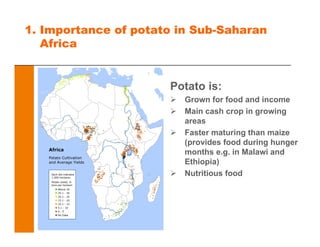
Potato is:
Grown for food and income
Main cash crop in growing
areas
Faster maturing than maize
(provides food during hunger
months e.g. in Malawi and
Ethiopia)
Nutritious food
2. The Problem
Lack and shortage of quality seed potato
leading to low crop yields and poor quality
produce
Formal seed systems
Certified labeled seed – provides less than 5%
of seed planted
Informal seed systems-Supplies over 95% of seed
Non-certified quality planting material
Positively selected planting material
Use of degenerated small tubers from ware
crops as planting material
3. Objectives of interventions
1. To increase the availability of quality seed
potato to resource poor farmers at
affordable prices
2. To improve farmers’ potato crop yields,
food availability, incomes and livelihoods
4. Strategies used to tackle the problem
G1: Massive increase of Minitubers Pre-Basic seed with Aeroponics & Sand
hydroponics
G2 & G3: Field multiplication of minitubers by specialized seed farms
Highly specialized resource rich private and public companies/farms/institutes
Further decentralized seed multiplication by secondary trained seed
multipliers
Farmers with a minimum of 2 ha to ensure proper rotation
Improved farmers knowledge and skills through hands-on training in Positive
Selection methodology, other seed quality maintenance technologies,
management practices, demonstration trials, field days, and small seed bags
( 5 & 10kg)
Small scale resource poor farmers
5. Results and Discussion
Capacity strengthening and Rapid seed
multiplication under lab and screen house
conditions using Aeroponics and other
techniques
Field multiplication
Seed storage
Quality Declared Seed
Cost of seed production
Positive selection and benefits
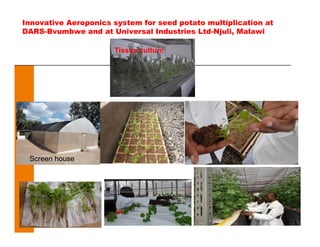
Innovative Aeroponics system for seed potato multiplication at
DARS-Bvumbwe and at Universal Industries Ltd-Njuli, Malawi
Tissue culture
Screen house
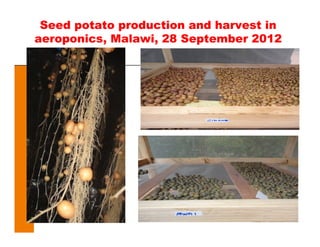
Seed potato production and harvest in
aeroponics, Malawi, 28 September 2012
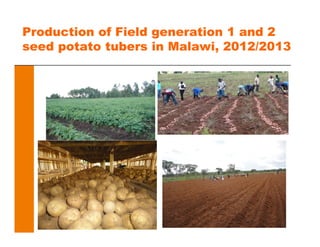
Production of Field generation 1 and 2
seed potato tubers in Malawi, 2012/2013
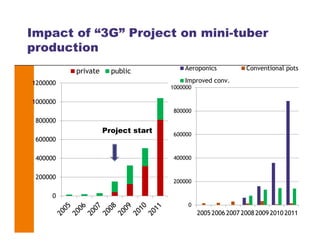
Impact of “3G” Project on mini-tuber
production
0
200000
400000
600000
800000
1000000
1200000
private public
Project start
0
200000
400000
600000
800000
1000000
2005 2006 2007 2008 2009 2010 2011
Aeroponics Conventional pots
Improved conv.
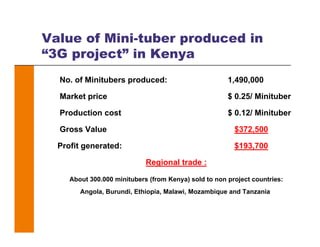
Value of Mini-tuber produced in
“3G project” in Kenya
No. of Minitubers produced: 1,490,000
Market price $ 0.25/ Minituber
Production cost $ 0.12/ Minituber
Gross Value $372,500
Profit generated: $193,700
Regional trade :
About 300.000 minitubers (from Kenya) sold to non project countries:
Angola, Burundi, Ethiopia, Malawi, Mozambique and Tanzania
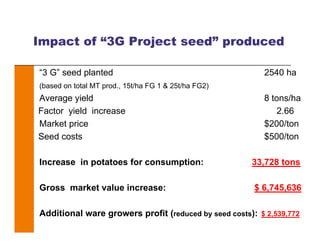
Impact of “3G Project seed” produced
“3 G” seed planted 2540 ha
(based on total MT prod., 15t/ha FG 1 & 25t/ha FG2)
Average yield 8 tons/ha
Factor yield increase 2.66
Market price $200/ton
Seed costs $500/ton
Increase in potatoes for consumption: 33,728 tons
Gross market value increase: $ 6,745,636
Additional ware growers profit (reduced by seed costs): $ 2,539,772
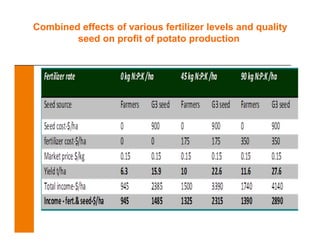
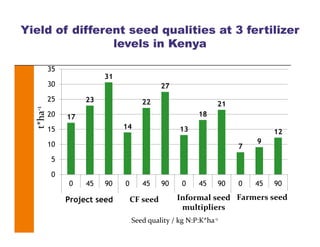
Combined effects of various fertilizer levels and quality
seed on profit of potato production
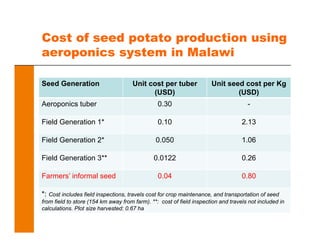
Cost of seed potato production using
aeroponics system in Malawi
Seed Generation Unit cost per tuber
(USD)
Unit seed cost per Kg
(USD)
Aeroponics tuber 0.30 -
Field Generation 1* 0.10 2.13
Field Generation 2* 0.050 1.06
Field Generation 3** 0.0122 0.26
Farmers’ informal seed 0.04 0.80
*: Cost includes field inspections, travels cost for crop maintenance, and transportation of seed
from field to store (154 km away from farm). **: cost of field inspection and travels not included in
calculations. Plot size harvested: 0.67 ha
17
23
31
14
22
27
13
18
21
7
9
12
0
5
10
15
20
25
30
35
0 45 90 0 45 90 0 45 90 0 45 90
2-CF 3-CF 5-informal FPProject seed CF seed Informal seed 
multipliers
Farmers seed
Seed quality / kg N:P:K*ha‐1
t*ha‐1
Yield of different seed qualities at 3 fertilizer
levels in Kenya
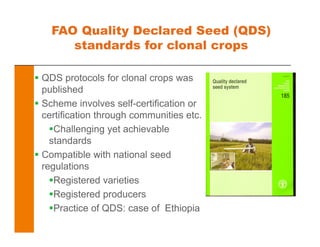
FAO Quality Declared Seed (QDS)
standards for clonal crops
QDS protocols for clonal crops was
published
Scheme involves self-certification or
certification through communities etc.
Challenging yet achievable
standards
Compatible with national seed
regulations
Registered varieties
Registered producers
Practice of QDS: case of Ethiopia
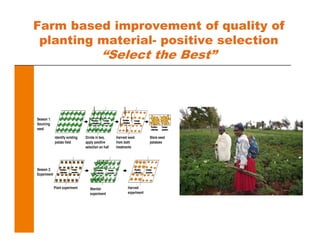
Farm based improvement of quality of
planting material- positive selection
“Select the Best”
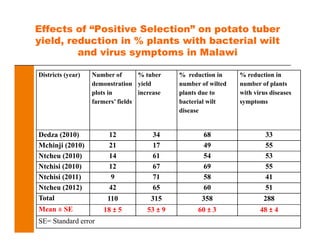
Effects of “Positive Selection” on potato tuber
yield, reduction in % plants with bacterial wilt
and virus symptoms in Malawi
Districts (year) Number of
demonstration
plots in
farmers’ fields
% tuber
yield
increase
% reduction in
number of wilted
plants due to
bacterial wilt
disease
% reduction in
number of plants
with virus diseases
symptoms
Dedza (2010) 12 34 68 33
Mchinji (2010) 21 17 49 55
Ntcheu (2010) 14 61 54 53
Ntchisi (2010) 12 67 69 55
Ntchisi (2011) 9 71 58 41
Ntcheu (2012) 42 65 60 51
Total 110 315 358 288
Mean ± SE 18 ± 5 53 ± 9 60 ± 3 48 ± 4
SE= Standard error
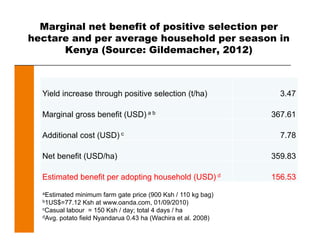
Marginal net benefit of positive selection per
hectare and per average household per season in
Kenya (Source: Gildemacher, 2012)
Yield increase through positive selection (t/ha) 3.47
Marginal gross benefit (USD) a b 367.61
Additional cost (USD) c 7.78
Net benefit (USD/ha) 359.83
Estimated benefit per adopting household (USD) d 156.53
aEstimated minimum farm gate price (900 Ksh / 110 kg bag)
b1US$=77.12 Ksh at www.oanda.com, 01/09/2010)
cCasual labour = 150 Ksh / day; total 4 days / ha
dAvg. potato field Nyandarua 0.43 ha (Wachira et al. 2008)
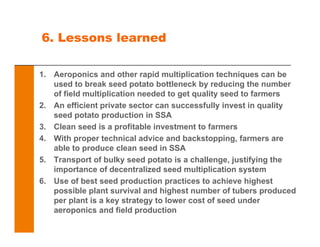
6. Lessons learned
1. Aeroponics and other rapid multiplication techniques can be
used to break seed potato bottleneck by reducing the number
of field multiplication needed to get quality seed to farmers
2. An efficient private sector can successfully invest in quality
seed potato production in SSA
3. Clean seed is a profitable investment to farmers
4. With proper technical advice and backstopping, farmers are
able to produce clean seed in SSA
5. Transport of bulky seed potato is a challenge, justifying the
importance of decentralized seed multiplication system
6. Use of best seed production practices to achieve highest
possible plant survival and highest number of tubers produced
per plant is a key strategy to lower cost of seed under
aeroponics and field production
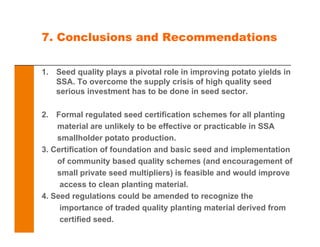
7. Conclusions and Recommendations
1. Seed quality plays a pivotal role in improving potato yields in
SSA. To overcome the supply crisis of high quality seed
serious investment has to be done in seed sector.
2. Formal regulated seed certification schemes for all planting
material are unlikely to be effective or practicable in SSA
smallholder potato production.
3. Certification of foundation and basic seed and implementation
of community based quality schemes (and encouragement of
small private seed multipliers) is feasible and would improve
access to clean planting material.
4. Seed regulations could be amended to recognize the
importance of traded quality planting material derived from
certified seed.
8. Acknowledgements
To:
The donors
USAID
IRISH AID
CFC
Scottish Government
GIZ
The Governments of
Ethiopia
Malawi
Kenya
Uganda
Rwanda
Potato projects implementing partners in the above countries
And
The APA Organizing Committee
Thank You

Sess2 1 demo_th2_abs124 [compatibility mode]

  • 1.
    Strategies to improveseed potato quality and supply in sub-Saharan Africa: Experience from interventions in five countries Demo, P.1 , Lemaga, B.1, Kakuhenzire, R.1, Schulz, S.1, Borus, D.1 , Barker, I.2, Giorgis, Gebremedin3, and Schulte-Geldermann, E.1 1: International Potato Center (CIP); 2: Syngenta Foundation for Sustainable Agriculture, Schwarzwaldalle, Basel, Switzerland 3: Ethiopian Institute of Agricultural Research (EIAR), Addis Abeba, Ethiopia. 9th Triennial Conference of the African Potato Association, The Great Rift Valley Lodge Naivasha, Kenya, 30 June – 4 July 2013
  • 2.
    Outline of thePresentation 1. Importance of potato in Sub-Saharan Africa 2. The problem 3. Objectives of the interventions 4. Strategies used to tackle the problem 5. Results and discussion 6. Lessons learned 7. Conclusions and recommendations 8. Acknowledgement
  • 3.
    1. Importance ofpotato in Sub-Saharan Africa Potato is: Grown for food and income Main cash crop in growing areas Faster maturing than maize (provides food during hunger months e.g. in Malawi and Ethiopia) Nutritious food
  • 4.
    2. The Problem Lackand shortage of quality seed potato leading to low crop yields and poor quality produce Formal seed systems Certified labeled seed – provides less than 5% of seed planted Informal seed systems-Supplies over 95% of seed Non-certified quality planting material Positively selected planting material Use of degenerated small tubers from ware crops as planting material
  • 5.
    3. Objectives ofinterventions 1. To increase the availability of quality seed potato to resource poor farmers at affordable prices 2. To improve farmers’ potato crop yields, food availability, incomes and livelihoods
  • 6.
    4. Strategies usedto tackle the problem G1: Massive increase of Minitubers Pre-Basic seed with Aeroponics & Sand hydroponics G2 & G3: Field multiplication of minitubers by specialized seed farms Highly specialized resource rich private and public companies/farms/institutes Further decentralized seed multiplication by secondary trained seed multipliers Farmers with a minimum of 2 ha to ensure proper rotation Improved farmers knowledge and skills through hands-on training in Positive Selection methodology, other seed quality maintenance technologies, management practices, demonstration trials, field days, and small seed bags ( 5 & 10kg) Small scale resource poor farmers
  • 7.
    5. Results andDiscussion Capacity strengthening and Rapid seed multiplication under lab and screen house conditions using Aeroponics and other techniques Field multiplication Seed storage Quality Declared Seed Cost of seed production Positive selection and benefits
  • 8.
    Innovative Aeroponics systemfor seed potato multiplication at DARS-Bvumbwe and at Universal Industries Ltd-Njuli, Malawi Tissue culture Screen house
  • 9.
    Seed potato productionand harvest in aeroponics, Malawi, 28 September 2012
  • 10.
    Production of Fieldgeneration 1 and 2 seed potato tubers in Malawi, 2012/2013
  • 11.
    Impact of “3G”Project on mini-tuber production 0 200000 400000 600000 800000 1000000 1200000 private public Project start 0 200000 400000 600000 800000 1000000 2005 2006 2007 2008 2009 2010 2011 Aeroponics Conventional pots Improved conv.
  • 12.
    Value of Mini-tuberproduced in “3G project” in Kenya No. of Minitubers produced: 1,490,000 Market price $ 0.25/ Minituber Production cost $ 0.12/ Minituber Gross Value $372,500 Profit generated: $193,700 Regional trade : About 300.000 minitubers (from Kenya) sold to non project countries: Angola, Burundi, Ethiopia, Malawi, Mozambique and Tanzania
  • 13.
    Impact of “3GProject seed” produced “3 G” seed planted 2540 ha (based on total MT prod., 15t/ha FG 1 & 25t/ha FG2) Average yield 8 tons/ha Factor yield increase 2.66 Market price $200/ton Seed costs $500/ton Increase in potatoes for consumption: 33,728 tons Gross market value increase: $ 6,745,636 Additional ware growers profit (reduced by seed costs): $ 2,539,772
  • 14.
    Combined effects ofvarious fertilizer levels and quality seed on profit of potato production
  • 15.
    Cost of seedpotato production using aeroponics system in Malawi Seed Generation Unit cost per tuber (USD) Unit seed cost per Kg (USD) Aeroponics tuber 0.30 - Field Generation 1* 0.10 2.13 Field Generation 2* 0.050 1.06 Field Generation 3** 0.0122 0.26 Farmers’ informal seed 0.04 0.80 *: Cost includes field inspections, travels cost for crop maintenance, and transportation of seed from field to store (154 km away from farm). **: cost of field inspection and travels not included in calculations. Plot size harvested: 0.67 ha
  • 16.
    17 23 31 14 22 27 13 18 21 7 9 12 0 5 10 15 20 25 30 35 0 45 900 45 90 0 45 90 0 45 90 2-CF 3-CF 5-informal FPProject seed CF seed Informal seed  multipliers Farmers seed Seed quality / kg N:P:K*ha‐1 t*ha‐1 Yield of different seed qualities at 3 fertilizer levels in Kenya
  • 17.
    FAO Quality DeclaredSeed (QDS) standards for clonal crops QDS protocols for clonal crops was published Scheme involves self-certification or certification through communities etc. Challenging yet achievable standards Compatible with national seed regulations Registered varieties Registered producers Practice of QDS: case of Ethiopia
  • 18.
    Farm based improvementof quality of planting material- positive selection “Select the Best”
  • 19.
    Effects of “PositiveSelection” on potato tuber yield, reduction in % plants with bacterial wilt and virus symptoms in Malawi Districts (year) Number of demonstration plots in farmers’ fields % tuber yield increase % reduction in number of wilted plants due to bacterial wilt disease % reduction in number of plants with virus diseases symptoms Dedza (2010) 12 34 68 33 Mchinji (2010) 21 17 49 55 Ntcheu (2010) 14 61 54 53 Ntchisi (2010) 12 67 69 55 Ntchisi (2011) 9 71 58 41 Ntcheu (2012) 42 65 60 51 Total 110 315 358 288 Mean ± SE 18 ± 5 53 ± 9 60 ± 3 48 ± 4 SE= Standard error
  • 20.
    Marginal net benefitof positive selection per hectare and per average household per season in Kenya (Source: Gildemacher, 2012) Yield increase through positive selection (t/ha) 3.47 Marginal gross benefit (USD) a b 367.61 Additional cost (USD) c 7.78 Net benefit (USD/ha) 359.83 Estimated benefit per adopting household (USD) d 156.53 aEstimated minimum farm gate price (900 Ksh / 110 kg bag) b1US$=77.12 Ksh at www.oanda.com, 01/09/2010) cCasual labour = 150 Ksh / day; total 4 days / ha dAvg. potato field Nyandarua 0.43 ha (Wachira et al. 2008)
  • 21.
    6. Lessons learned 1.Aeroponics and other rapid multiplication techniques can be used to break seed potato bottleneck by reducing the number of field multiplication needed to get quality seed to farmers 2. An efficient private sector can successfully invest in quality seed potato production in SSA 3. Clean seed is a profitable investment to farmers 4. With proper technical advice and backstopping, farmers are able to produce clean seed in SSA 5. Transport of bulky seed potato is a challenge, justifying the importance of decentralized seed multiplication system 6. Use of best seed production practices to achieve highest possible plant survival and highest number of tubers produced per plant is a key strategy to lower cost of seed under aeroponics and field production
  • 22.
    7. Conclusions andRecommendations 1. Seed quality plays a pivotal role in improving potato yields in SSA. To overcome the supply crisis of high quality seed serious investment has to be done in seed sector. 2. Formal regulated seed certification schemes for all planting material are unlikely to be effective or practicable in SSA smallholder potato production. 3. Certification of foundation and basic seed and implementation of community based quality schemes (and encouragement of small private seed multipliers) is feasible and would improve access to clean planting material. 4. Seed regulations could be amended to recognize the importance of traded quality planting material derived from certified seed.
  • 23.
    8. Acknowledgements To: The donors USAID IRISHAID CFC Scottish Government GIZ The Governments of Ethiopia Malawi Kenya Uganda Rwanda Potato projects implementing partners in the above countries And The APA Organizing Committee
  • 24.