GOAL: 
Enhanced food and nutritional security, improved livelihoods of rural 
communities and agricultural sector growth in the countries of West 
Asia and North Africa (WANA) in the face of increasing climatic 
variability and change 
PURPOSE: 
Deliver pro-poor scientific and technological innovations to 
increase and stabilize the productivity of wheat and food 
legume based production systems in the dry areas of WANA
8 countries of WANA region directly involved : 
(Algeria, Egypt, Jordan, Lebanon, Morocco, Sudan, Tunisia, Turkey) 
Different components are considered 
1. Seed component (seed delivery system) 
2. Technology dissemination 
3. Socio-economic surveys and studies 
4. Backup research for technologies development and adjustement 
5. Capacity Development
Seed Delivery Systems 
1. Wheat and faba bean seed system study (policy, variety release, 
seed production and market, quality assurance, seed value chain) was 
conducted in Morocco and report will be discussed with stakeholders 
in Open Workshop organized in the Agriculture Fair of Meknes in 2015 
2. Communities based seed enterprises/groups targeting mainly food 
legumes are established: 5 mobile seed cleaning and processing units 
were provided to serve 5 farmers communities 
Morocco (Merchouch), Tunisia (Boussalem), Sudan (Eddamer, 
Hudeiba), Algeria (Constantine) and Jordan (Maru region) 
3. Several varieties of food legume and wheat were recently released 
by NARS. They are increased by the project for dissemination
Seed Delivery Systems 
Clean 
treated 
seed 
Original seed 
before processing
Breeder and pre-basic seed increase 
in 2013/14 within ICARDA-EU-IFAD Project 
Crops Number of Varieties 
Increased 
Amount of breeder and Pre- 
Basic seeds produced (T)++ 
Durum wheat 15 27.7 
Bread wheat 14 258.9 
Chickpea 19 382 
Faba bean 18 73.7 
Lentil 17 19.2 
Total* 83 761.7 
53 FL var. 475 T 
475 tons of 53 varieties of faba bean, chickpea and lentil produced 
with NARS partners and will be increased and distributed to 
farmers for dissemination in 2014/15 
* Gross production
On-Farm Demonstrations of Technologies Egypt 
Percentage increase in grain yield between faba bean demonstration fields and 
40% 
30% 
20% 
10% 
0% 
Kafr El- 
Sheikh 
2012/13 
Dakahlia Sharkia Nubaria Assiut Mean 
Governorates 
% increase in Grain Yield 
farmers fields in 2012/13 and 2013/14 cropping Seasons by governorates 
 2013 & 2014 data showed an average increase of around 21% 
in yield of farmers applying recommended package (RP). 
Adoption survey done in 2014 on 700 farmers showed that : 
-Farmers applying recommended package saved 2670 EP/ha (370 USD/ha) 
-24 % of surveyed farmers adopted the FB variety GIZA 843 (tolerant to orobanche) 
-Net margins of farmers applying RP is 540 USD/ha higher than farmers following TP
250 
225 
200 
175 
150 
125 
100 
75 
50 
25 
0 
2010 2011 2012 2013 2014 
Area (1000 ha) 
Production (1000 T) 
Yield (q/ha) 
Year 
The ICARDA-EU-IFAD-ICARDA project and the national campaign 
by promoting the new varieties with improved package start to 
show impact on faba bean production and productivity in Egypt
Sudan 
Performance of Chickpea improved varieties with 
recommended package in Sudan in 2013/14 (Gezira state) 
192 % 
4000 
3500 
3000 
2500 
2000 
1500 
1000 
500 
0 
Grain Yield (kg/ha) 
Chickpea varieties 
For chickpea data of 2013 and 
2014 showed that the Yield is 
doubled in demonstration fields 
applying improved package with 
substantial increase in net 
benefit 
Pioneer Farmer-Shendi Neighboring Farmer Field-Shendi
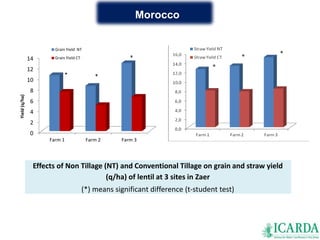
Morocco 
14 
12 
10 
8 
6 
4 
2 
0 
Grain Yield NT 
Grain Yield CT 
* 
Farm 1 Farm 2 Farm 3 
Yield (q/ha) 
Effects of Non Tillage (NT) and Conventional Tillage on grain and straw yield 
(q/ha) of lentil at 3 sites in Zaer 
(*) means significant difference (t-student test)
Participatory Variety Selection 
Many programs have released varieties applying 
participatory approach involving farmers mainly 
in food legumes: 
In 2013: 
- 2 faba bean varieties (Shendi and Merowe) in Sudan 
- 1 chickpea variety (Rebha) in Tunisia 
In 2014: 
- 4 chickpea varieties (FLIP03-59C, FLIP03-50C, 
FLIP01-37C and FLIP01-6C) in Sudan 
Several other wheat and food legumes lines 
are selected for further testing in Tunisia, 
Algeria, Morocco, Egypt, Jordan 
Merowe 
Shendi
Socio – Economic Studies 
Work is in progress 
• Around 1300 farmers surveyed in Morocco in 2013 
• Around 700 farmers surveyed in Egypt in 2013 and 2014 
• The other countries conducted a survey in the project regions in 2014 
• Gender survey is conducted in Morocco in 2014
Capacity Development 
Training activities achieved by NARS partners in 2013/14 season 
Type of 
training 
Numbers Nb of direct 
Beneficiaries 
Countries 
FFS 19 FFS Around 2000 
direct 
beneficiaries 
Egy, Sud, 
Tun, Leb, Mor, 
Tur 
In- 
Country 
Courses 
15 in 6 
countries 
Around 365 
participants 
Egy, Sud, Alg, 
Leb, Mor, Tur 
Field 
days 
370 Around 6100 
participants 
Alg, Egy, Jor, 
Leb, Mor, Sud, 
Tun, Tur 
Total Around 8500 
FFS In Sudan
Electronic newsletter of the project 
H.E. Dr. Lassad Lachaal, Tunisia’s Minister 
of Agriculture, talking to farmers and 
research staff and to media 
Governor of Al Sharkia (Egypt) visiting one 
the project farmer 
President of ARC Sudan talk to media 
about the project achievements
Linkages and Seed 
Morocco: successful collaboration, links and synergy between OCPF initiative on Food 
Legumes with EU-IFAD, CRP-GL and CRP-DS; 3 seed machines support seed activities 
of the three projects. 
Sudan: need more collaboration between ICARDA-EU-IFAD and FS. Seed processing 
machine will be based in ARC Sudan (Hudeiba Research Station) and modalities of its 
use would be under the leadership of the Union of Farmers. 
Algeria: ITGC will provide the seed machine to a small leader farmer (Constantine) 
hoping that this could drive more interest and investments from policy makers. 
Tunisia: seed machine would be made available for a community of small farmers 
based in Boussalem that would facilitate access to agriculture inputs and services for 
the members (presently, farmers associated with the ICARDA- EU-IFAD, FS and CA 
projects). 
Jordan: the seed machine will be managed by an NGO in the North of Jordan near 
Maru station of NCARE that would take care of servicing small farmers of the project 
target area.
IFAD Developmental Projects 
Morocco: 
Agricultural Value Chain Development Programme in the Mountain Zones of Taza Province 
Rural Development Project in the Eastern Middle Atlas Mountains 
Tunisia: 
Agropastoral Development and Local Initiatives 
Integrated Agricultural Development Project in the Governorate of Siliana (Phase II) 
Egypt: 
Promotion of Rural Incomes through Market Enhancement Project 
On-Farm Irrigation Development Project in the Oldlands 
Upper Egypt Rural Development Project 
West Noubaria Rural Development Project 
Sudan: 
Seeds Development Programme 
Butana Integrated Rural Development Project 
Jordan: Agricultural Resource Management Project - Phase II 
Turkey: Murat River Watershed Development Project 
Ardahan-Kars-Artvin Development Project 
Diyarbakir, Batman and Siirt Development Project
Ideas for future collaboration with IFAD 
• Integrate feed legumes and livestock: develop integrated innovation platforms 
for small holder farms to add value (community label products) of farm products. 
• Scale-out the use of faba bean small seed to feed cattle (commonly used in North 
Africa to improve the quality of meat) and develop labeled products (particularly 
in Sudan). (ICARDA has selected several improved lines with low level of tannins 
that can improve the digestibility of FB). 
• Scale-up and Scale-out the raised bed mode of sowing of faba bean initiated in 
2013/14 in few demonstration fields in Egypt in EU-IFAD and CRP DS to cover more 
area in Egypt and Sudan since it gave a promising results (most of faba bean 
demonstration fields will be conducted under raised bed in 2014/15 within EU-IFAD 
in Egypt). 
• Establish new community based seed enterprises targeting mainly food and feed 
legumes and providing them access to new varieties. 
• Adapt legislation to favour small seed enterprise and farmer 
produced and marketed seeds
• Disseminate the new varieties of FL mainly selected through PSV 
(Sudan, Morocco, Jordan, Tunisia, Algeria, Egypt). 
• Extend CA in different countries for small holder farmers in 
appropriate area by using low cost seeders through the IP 
• Use new CA on-farm platforms in Jordan, Lebanon, Tunisia, Algeria 
and Morocco created by ICARDA- EU-IFAD and other projects to 
monitor the advantages of CA. 
• Use new IPM options to reduce yield losses due to diseases and pest 
such as seed dressing with new efficient chemicals. 
• Develop, improve and disseminate the machineries adapted to 
small holder farmers of food and feed legumes (raised bed planter, 
pesticides sprayers, direct seeders, threshers, …)
THANK YOU

Enhanced Wheat-Legume Cropping Project

  • 2.
    GOAL: Enhanced foodand nutritional security, improved livelihoods of rural communities and agricultural sector growth in the countries of West Asia and North Africa (WANA) in the face of increasing climatic variability and change PURPOSE: Deliver pro-poor scientific and technological innovations to increase and stabilize the productivity of wheat and food legume based production systems in the dry areas of WANA
  • 3.
    8 countries ofWANA region directly involved : (Algeria, Egypt, Jordan, Lebanon, Morocco, Sudan, Tunisia, Turkey) Different components are considered 1. Seed component (seed delivery system) 2. Technology dissemination 3. Socio-economic surveys and studies 4. Backup research for technologies development and adjustement 5. Capacity Development
  • 4.
    Seed Delivery Systems 1. Wheat and faba bean seed system study (policy, variety release, seed production and market, quality assurance, seed value chain) was conducted in Morocco and report will be discussed with stakeholders in Open Workshop organized in the Agriculture Fair of Meknes in 2015 2. Communities based seed enterprises/groups targeting mainly food legumes are established: 5 mobile seed cleaning and processing units were provided to serve 5 farmers communities Morocco (Merchouch), Tunisia (Boussalem), Sudan (Eddamer, Hudeiba), Algeria (Constantine) and Jordan (Maru region) 3. Several varieties of food legume and wheat were recently released by NARS. They are increased by the project for dissemination
  • 5.
    Seed Delivery Systems Clean treated seed Original seed before processing
  • 6.
    Breeder and pre-basicseed increase in 2013/14 within ICARDA-EU-IFAD Project Crops Number of Varieties Increased Amount of breeder and Pre- Basic seeds produced (T)++ Durum wheat 15 27.7 Bread wheat 14 258.9 Chickpea 19 382 Faba bean 18 73.7 Lentil 17 19.2 Total* 83 761.7 53 FL var. 475 T 475 tons of 53 varieties of faba bean, chickpea and lentil produced with NARS partners and will be increased and distributed to farmers for dissemination in 2014/15 * Gross production
  • 7.
    On-Farm Demonstrations ofTechnologies Egypt Percentage increase in grain yield between faba bean demonstration fields and 40% 30% 20% 10% 0% Kafr El- Sheikh 2012/13 Dakahlia Sharkia Nubaria Assiut Mean Governorates % increase in Grain Yield farmers fields in 2012/13 and 2013/14 cropping Seasons by governorates  2013 & 2014 data showed an average increase of around 21% in yield of farmers applying recommended package (RP). Adoption survey done in 2014 on 700 farmers showed that : -Farmers applying recommended package saved 2670 EP/ha (370 USD/ha) -24 % of surveyed farmers adopted the FB variety GIZA 843 (tolerant to orobanche) -Net margins of farmers applying RP is 540 USD/ha higher than farmers following TP
  • 8.
    250 225 200 175 150 125 100 75 50 25 0 2010 2011 2012 2013 2014 Area (1000 ha) Production (1000 T) Yield (q/ha) Year The ICARDA-EU-IFAD-ICARDA project and the national campaign by promoting the new varieties with improved package start to show impact on faba bean production and productivity in Egypt
  • 9.
    Sudan Performance ofChickpea improved varieties with recommended package in Sudan in 2013/14 (Gezira state) 192 % 4000 3500 3000 2500 2000 1500 1000 500 0 Grain Yield (kg/ha) Chickpea varieties For chickpea data of 2013 and 2014 showed that the Yield is doubled in demonstration fields applying improved package with substantial increase in net benefit Pioneer Farmer-Shendi Neighboring Farmer Field-Shendi
  • 10.
    Morocco 14 12 10 8 6 4 2 0 Grain Yield NT Grain Yield CT * Farm 1 Farm 2 Farm 3 Yield (q/ha) Effects of Non Tillage (NT) and Conventional Tillage on grain and straw yield (q/ha) of lentil at 3 sites in Zaer (*) means significant difference (t-student test)
  • 11.
    Participatory Variety Selection Many programs have released varieties applying participatory approach involving farmers mainly in food legumes: In 2013: - 2 faba bean varieties (Shendi and Merowe) in Sudan - 1 chickpea variety (Rebha) in Tunisia In 2014: - 4 chickpea varieties (FLIP03-59C, FLIP03-50C, FLIP01-37C and FLIP01-6C) in Sudan Several other wheat and food legumes lines are selected for further testing in Tunisia, Algeria, Morocco, Egypt, Jordan Merowe Shendi
  • 12.
    Socio – EconomicStudies Work is in progress • Around 1300 farmers surveyed in Morocco in 2013 • Around 700 farmers surveyed in Egypt in 2013 and 2014 • The other countries conducted a survey in the project regions in 2014 • Gender survey is conducted in Morocco in 2014
  • 13.
    Capacity Development Trainingactivities achieved by NARS partners in 2013/14 season Type of training Numbers Nb of direct Beneficiaries Countries FFS 19 FFS Around 2000 direct beneficiaries Egy, Sud, Tun, Leb, Mor, Tur In- Country Courses 15 in 6 countries Around 365 participants Egy, Sud, Alg, Leb, Mor, Tur Field days 370 Around 6100 participants Alg, Egy, Jor, Leb, Mor, Sud, Tun, Tur Total Around 8500 FFS In Sudan
  • 14.
    Electronic newsletter ofthe project H.E. Dr. Lassad Lachaal, Tunisia’s Minister of Agriculture, talking to farmers and research staff and to media Governor of Al Sharkia (Egypt) visiting one the project farmer President of ARC Sudan talk to media about the project achievements
  • 15.
    Linkages and Seed Morocco: successful collaboration, links and synergy between OCPF initiative on Food Legumes with EU-IFAD, CRP-GL and CRP-DS; 3 seed machines support seed activities of the three projects. Sudan: need more collaboration between ICARDA-EU-IFAD and FS. Seed processing machine will be based in ARC Sudan (Hudeiba Research Station) and modalities of its use would be under the leadership of the Union of Farmers. Algeria: ITGC will provide the seed machine to a small leader farmer (Constantine) hoping that this could drive more interest and investments from policy makers. Tunisia: seed machine would be made available for a community of small farmers based in Boussalem that would facilitate access to agriculture inputs and services for the members (presently, farmers associated with the ICARDA- EU-IFAD, FS and CA projects). Jordan: the seed machine will be managed by an NGO in the North of Jordan near Maru station of NCARE that would take care of servicing small farmers of the project target area.
  • 16.
    IFAD Developmental Projects Morocco: Agricultural Value Chain Development Programme in the Mountain Zones of Taza Province Rural Development Project in the Eastern Middle Atlas Mountains Tunisia: Agropastoral Development and Local Initiatives Integrated Agricultural Development Project in the Governorate of Siliana (Phase II) Egypt: Promotion of Rural Incomes through Market Enhancement Project On-Farm Irrigation Development Project in the Oldlands Upper Egypt Rural Development Project West Noubaria Rural Development Project Sudan: Seeds Development Programme Butana Integrated Rural Development Project Jordan: Agricultural Resource Management Project - Phase II Turkey: Murat River Watershed Development Project Ardahan-Kars-Artvin Development Project Diyarbakir, Batman and Siirt Development Project
  • 17.
    Ideas for futurecollaboration with IFAD • Integrate feed legumes and livestock: develop integrated innovation platforms for small holder farms to add value (community label products) of farm products. • Scale-out the use of faba bean small seed to feed cattle (commonly used in North Africa to improve the quality of meat) and develop labeled products (particularly in Sudan). (ICARDA has selected several improved lines with low level of tannins that can improve the digestibility of FB). • Scale-up and Scale-out the raised bed mode of sowing of faba bean initiated in 2013/14 in few demonstration fields in Egypt in EU-IFAD and CRP DS to cover more area in Egypt and Sudan since it gave a promising results (most of faba bean demonstration fields will be conducted under raised bed in 2014/15 within EU-IFAD in Egypt). • Establish new community based seed enterprises targeting mainly food and feed legumes and providing them access to new varieties. • Adapt legislation to favour small seed enterprise and farmer produced and marketed seeds
  • 18.
    • Disseminate thenew varieties of FL mainly selected through PSV (Sudan, Morocco, Jordan, Tunisia, Algeria, Egypt). • Extend CA in different countries for small holder farmers in appropriate area by using low cost seeders through the IP • Use new CA on-farm platforms in Jordan, Lebanon, Tunisia, Algeria and Morocco created by ICARDA- EU-IFAD and other projects to monitor the advantages of CA. • Use new IPM options to reduce yield losses due to diseases and pest such as seed dressing with new efficient chemicals. • Develop, improve and disseminate the machineries adapted to small holder farmers of food and feed legumes (raised bed planter, pesticides sprayers, direct seeders, threshers, …)
  • 19.