Crop Improvement: Legumes
ICRISAT-ESA: A. Seetha. Anitha, S.M. Njoroge, C.
Ojiewo, N.V.P.R. Ganga Rao, E. Monyo, M.
Siambi, and P.Okori,
ICRISAT- R.K. Varshney, H.S. Desmae, M. Babu,
H.D.Upadhyaya, P. Janila, H.S. Desmae, PM
Gaur, V.Vadez, H.K Sudini, CV Sameer Kumar
NARS: NARO, IIAM, DARS, EIAR, ZARI, Universities,
Private Seed Companies
Acknowledgments
• Governments in Region
• Public research and extension
• Development Partners
– BMGF, USAID, Irish Aid, IFAD,, UKAID, GTZ, IFAD
• Civil Society
• Farmer organizations
• International research agencies
– CGIAR
– Advanced research centers
• Diverse development projects
Context of ESA Legume Science
Agenda
The demand environment
1. The need to meet food and nutrition
demands of a growing population
Southern
Africa
East Africa
Source: UN population division, 2012.
2. Asymmetric demography: How and S&T provide solution
for harnessing the SSA youth population dividend
Source: Brookings Institutions and Africa progress Panel, 2014
2030 20502010
400,000
300,000
200,000
100,000
0
Populations(Thousands)
1 2 30 94 5 6 87 10
10
20
30
Numberofpeople(Millions)
Mean daily consumption (PPP dollars)
0
$1.25 $2.50
3. Tackle the persistent poverty and
vulnerability
Seed systems are weak to moderate
75% 80% 85% 90% 95% 100% 105%
Maize
Sorghum/Mille
t
Sunflower
Groundnuts
Pigeon pea
Cow peas
Sesame
Beans
Sweet
potatoes Local seed
Improved
Quality declared seeds
Local and improved
< 10% of farmers,
use improved
seeds or quality
declared seeds
Source Africa RISING: Tanzania. KK
team
Medium to high food insecurity
Extreme risk
High risk
Medium risk
Low
riskNo data
Source: Food Security Index & Map,
2013
4. Resilience to an increasing risk
Each “growing degree day” spent at a
temperature above 30°C decreases yields by
1 percent under optimal (drought-free) rainfed
conditions.
Southern Africa faces the risk of more severe
and protracted droughts and periods of
extremely low and extremely high rainfall could
become more common as temperatures
increase from 2-4°C
What Crops and traits shall we breed?
How efficient are our R&D research to
market pathways
5. Mobilize agriculture to deliver solutions for the silent
hunger (nutrition deficiencies)
David Tilman et al. PNAS 2011;108:20260-20264
Projections 2005-2050Previous trajectories
Investment opportunity
Agriculture a big part of Africa’s 2020-2.6
trillion revenue growth
Africa’s economic growth creating new opportunities not
covered by multinational corporations
Growth in agriculture is twice to four times as effective
in reducing poverty
Rwanda UgandaEthiopiaBurkina
Faso
Mozambique Tanzania
0
6
2
4
8
10
%shareofgrowth
Agri. Sector is a significant driver of growth:
What catalysts do we have?
Source: Brookings Institutions and Africa
progress Panel, 2014.
We can unlock the agricultural potential: Most
of ESA can generate 460-1350$/ha
Source: Fisher and Shar, 2010
US$ 201-300
US$ 301-468
US$ 581-907
US 1598-1881
US1881-2729
US$ 468-580
US$ 908-1128
US$ 1129-1349
US$ 1350-1597
Crop varieties for sustainable Intensification
Source: DCL,
2015
Legumes science agenda for ESA
New productive, resilient and nutrient
dense varieties
Increased availability and access to to
productivity enhancing innovations
Crop diversification for food, nutrition
and income security
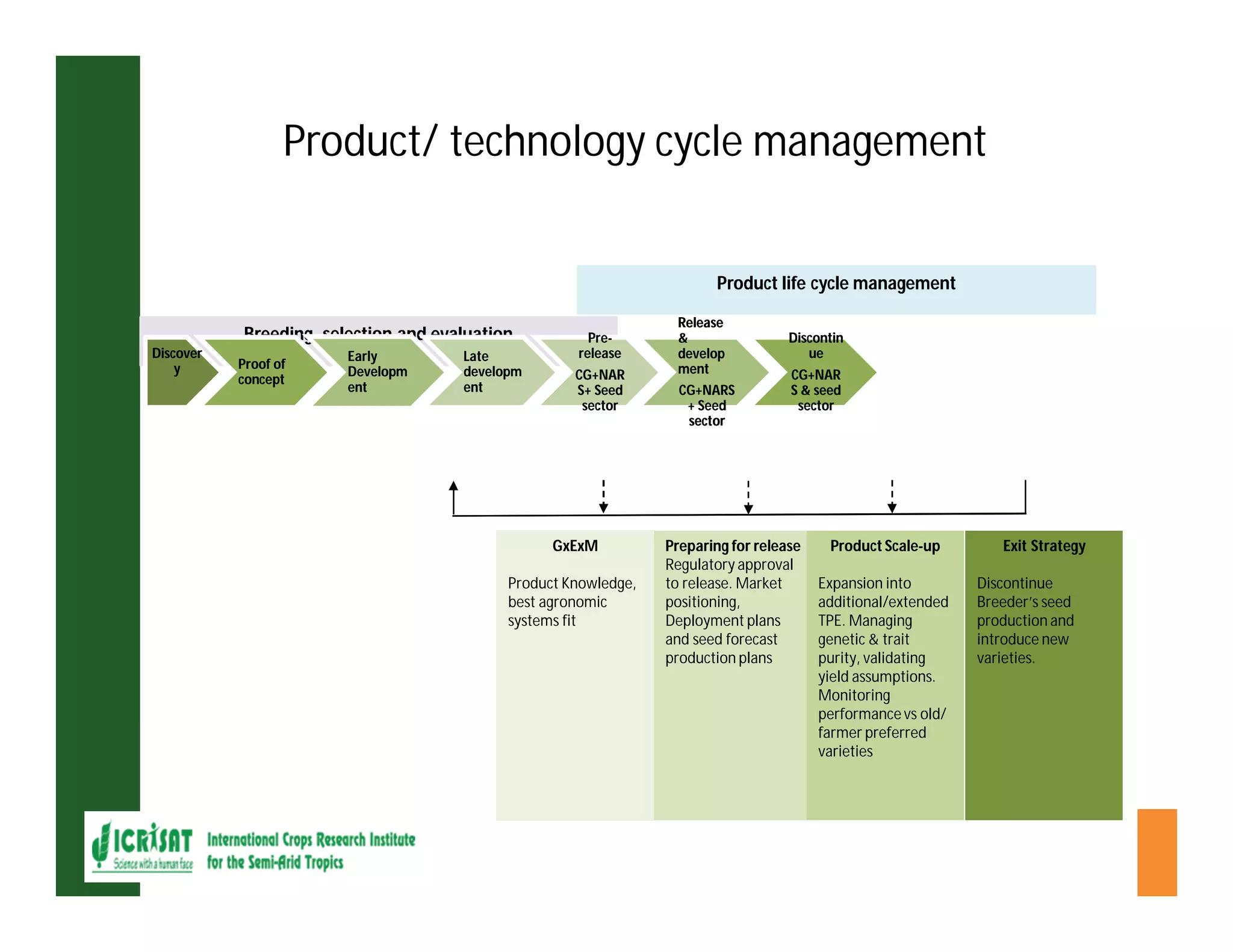
Product/ technology cycle management
Product life cycle management
Breeding, selection and evaluation
DiscoverDiscover
y Proof of
concept
Early
Developm
ent
Late
developm
ent
Pre-
sector
Pre-
release
CG+NAR
S+ Seed
sector
Release
&
+ Seed
sector
Release
&
develop
ment
CG+NARS
+ Seed
sector
Discontin
sector
Discontin
ue
CG+NAR
S & seed
sector
GxExM
Product Knowledge,
best agronomic
systems fit
Preparing for release
Regulatory approval
to release. Market
positioning,
Deployment plans
and seed forecast
production plans
Product Scale-up
Expansion into
additional/extended
TPE. Managing
genetic & trait
purity, validating
yield assumptions.
Monitoring
performancevs old/
farmer preferred
varieties
Exit Strategy
Discontinue
Breeder’s seed
production and
introduce new
varieties.
TL III Focus Geographies and Crops
Tropical legume - III:
Project Management Objectives:
• Ensure implementation of TL III objectives; monitoring of
milestones, outputs and expenditures
• Ensure effective data archiving and dissemination as global
public goods.
• Ensure effective communication of TL III progress,
achievements and impacts.
• Efficient management and reporting.
Salient Results for 2015
Implementing a multi-stakeholder project launch workshop
• Better understanding of the project context and objectives
• Increased understanding of TL III’s interface with respective country
legume strategies
• A sense of ownership of the TL III project by partners
• Country workplans integrating TL III Objectives
• TL III Project Monitoring, Learning and Evaluation (MLE) Plan
Implementing National Annual Planning meetings
• Meetings were successfully held for all countries to
finalize country workplans for groundnut in Burkina
Faso, Ghana, Mali, Nigeria, Tanzania and Uganda;
Chickpea in Ethiopia and Uttar Pradesh India,
Common beans in Ethiopia, Tanzania and Uganda
and cowpea in Burkina Faso, Ghana, Mali and Nigeria
Salient Results cont…
Salient Results cont
Curation and dissemination of TL-III Data as global public goods
• The Integrated Breeding Platform – Breeding Management
System (BMS) was decided as a tool of choice for the
management of TL III data
• 3 training sessions for BMS were conducted for project
implementing staff in Nairobi, Addis Ababa and Bamako btw
Aug and Dec 2015
• A BMS Cloud database for TL-III established.
Salient Results cont
Communicating TL-III project progress, achievements and impact
• Four volumes of the regular Quarterly Bulletin Tropical
legumes were produced highlighting specific aspects of
project successes
• TL III web-page have been updated to include a TL III facebook
and twitter links to communicate project information.
• A 182 page synthesis of the seven seasons of learning and
engaging smallholder farmers through the tropical legumes in
Sub-Saharan Africa and South Asia is ready for publication.
Salient Results cont
Management and reporting of TL-III Project
• Launched TL III (August 17 – 22, 2015)
• Worked with Country focal points and country teams to
develop Country Workplans
• Worked with Objective leaders to synthesize these into Project
workplans (by objective)
• Worked with ALINe Consultancy to develop Project MLE Plan
• Visited project sites in all regions to monitor progress and
provide on the ground advice as needed
Salient Results cont..
Supporting breeding pipelines for groundnuts, cowpea,
common bean, and chickpea in target TL-III countries
• TL III supported the implementation of the BPAT to all CGIAR
Africa based programs which included Program assessments
for groundnut in Mali and Malawi, chickpea in Ethiopia,
cowpea in Nigeria and common beans in Uganda and Malawi.
• Key findings - ICRISAT African based breeding programs have
very competent scientists but are weak in breeding cycle time,
phenotyping for drought, and application of marker assisted
breeding technologies.
• These critical areas have been recommended for
improvement as part of TL III improvement of breeding
efficiency in African CGIAR sites and the target NARS.
Challenges, Constraints & Mitigations
• It has taken long to fill the project positions – hence
the project is off to a slow start (The gender scientist
has not joined to-date and gender related research
activities are behind schedule)
• Ongoing security and instability in parts of Mali and
Nigeria
• Drought in Ethiopia (ElNino effect of 2015) .
Chickpea breeding
MABC for drought tolerance in chickpea
• 7 MABC F7 lines with up to 40g/100 seed weight and up
to 41% higher yield than the std check identified
• Introgresssion crosses initiated
• Reproductive stage drought tolerance under late
planting condition; avoiding ascochyta blight
• 7 MABC F7 lines with up to 40g/100 seed weight and up
to 41% higher yield than the std check identified
• Introgresssion crosses initiated
• Reproductive stage drought tolerance under late
planting condition; avoiding ascochyta blight
0
500
1000
1500
2000
2500
3000
3500
MABC11
MABC4
MABC16
MABC13
MABC14
MABC10
ICCV-939554
ICCV-4958
MABC9
MABC7
MABC6
MABC18
MABC19
MABC3
MABC2
MABC22
DALOTA
Yield of MABCF7 Desi lines at Debre Zeit
Yield(kg/ha)
41%
Drought tolerant
varieties
• High yield under
drought stress
• Trait-based selection
+ MABC
• Evaluation for yield
adaptability
• Identifying new
sources
Heat stress tolerance
• Low pollen viability, pollen
germ. and pollen tube growth
• Causes flower abscission and
pod abortion,
• Reduces pod set, pod fill and
yield
Anther-pollen fertility with Alexander’s stain
ICCV 92944
(Tolerant)
ICC 5912
(Sensitive)
• 4 lines with yield advantage of 178%,
38%, 32% and 11% over std check under
normal T oC
• 7 lines with >2 t/ha selected at T oC > 35
oC
• New tolerance sources from reference
set
• Expansion of production to non-
conventional areas under irrigation
• Late planting to avoid AB
• Changing and variable climates
Ascochyta blight; wilt-root rot complex of CP
• AB and WRR cause
upto 100% loss
• No AB resistant
desi variety
• Majority of
farmers produce
desi
• Planting late to
avoid AB and FW
• Resistance varieties for early
planting
• 3 new sources of double
resistance identified
• NVT for resistant desi
• BC2 to improve released
varieties
• Maturity before terminal
drought
Emerging issues: Early maturity
• Escape end-of-season drought and
heat stresses
• short window of cropping season –
double cropping
• enhance cropping resilience
(intensification and diversification)
• Green pod chickpea market
(challenges with human pest??)
• New sources from local and
reference collections
Nodulation/fixation may be limited by:
• the presence ineffective strains
• low population numbers,
• low infectivity or lack of effectiveness,
• poor survival rate of rhizobia in the soil
• competition amongst strains of rhizobia
• the absence of compatible strains (strain x
variety x environment interaction)
CRP-GL: Even lines earlier reported as non-
nodulating do nodulate with compatible strains
TLIII: include basic N2Africa-recommended
package of inoculum and agronomic practices in
field demos.
 From 50 indigenous rhizobia, 15 Rhizobia isolates
with wide pH tolerance, 5 with salinity tolerance,
3 with high ToC tolerance, 5 with antibiotics
resistance, 15 phosphate solubilizing isolates were
identified.
 The 50 isolates were further grown on yeast extract
mannitol agar and single colonies cultured for molecular
characterization.
 43 isolates are currently being sequenced at UC-Davis
Chickpea cultivars for mechanical harvesting
1. Machine harvestable
• herbicide
tolerant
• frost tolerant
• for double
cropping
2. Disease resistant
3. Efficient N-fixing
4. High yielding
5. Market preferred
6. New sources to be
identified from ref
collection
7. Introgression crosses
Pigeonpea breeding
Pigeonpea Breeding priorities in ESA
• High grain yield
• Phenology for agro-ecol. adaptability and SI
• Photo-thermo insensitivity
• Ratoonability with high yield
• Grain quality for dry & fresh grains
• Climate resilience with drought tolerance
• Fusarium wilt tolerance
• Pest tolerance esp. Pod borers
Workplan targets 2014-2015
1. Evaluation of 25 short, 40 medium, 40 long duration varieties
2. Maintenance of breeder seed of 10 varieties, enhancing NARS capacity and seed
scaling up with stakeholders
3. Development and evaluation of 500 pigeonpea breeding lines for yield, fusarium wilt
and pest tolerance
4. Evaluation of 30-50 early chickpea elite lines for yield, drought, fusarium wilt and
Ascochyta blight
5. Evaluation of 20 chickpea elite lines for heat tolerance and dry root rot
6. Maintenance of breeder seed of 10 released varieties including heat tolerant ICCV
92944
7. Collection, characterization, conservation and distribution of chickpea and pigeonpea
germplasm
8. Evaluation of 30 chickpea genotypes for insect pest and 10 for herbicide tolerance
9. Identification of maintainers and restorers under African germplasm, use of cleisto
lines in breeding program
Evaluation of varieties in ESA
Country Short Medium Long
Kenya 56 75 60
Tanzania 20 42 35
Malawi 22 47 22
Mozambique - 35 60
Ethiopia 22 18 70
Zambia - 15 25
Uganda - 57 -
Mali 22 18 -
Best lines 12 19 15
• Released 5 varieties (4 in Tanzania, 1 in Zambia)
• 4 in Uganda and 2 in Zambia pipeline for release
Maintenance of quality seed
Crop Breeder Foundation Certified +QDS Total
Pigeonpea 18.8 82.4 86.5 478
Chickpea 5.0 4.5 32.4 41.9
Total 23.8 86.9 118.9 519.9
Breeding pipeline
F8 Number Total
ICEAP 00040 X KAT 60/8 29
64
ICEAP 00048 X ICEAP 00557 4
ICEAP 00557 X ICEAP 00576-1 5
ICEAP 00576-1 X ICEAP 00554 15
ICEAP 00576-1 X ICEAP 00557 11
F6
ACC 88 X ICEAP 00576-1 23
87ICEAP 00048 X ICEAP 00040 21
MJ X ICEAP 00040 43
Early generation
F6 : Number Total
KAT 60/8 X ICEAP 00540 118
256
ICEAP 00068 X ICEAP 00540 138
F7 :
ICP 6927 X ICEAP 00554 128
203
ICP 6927 X ICEAP 00557 53
ICP 6927 X ICEAP 00850 16
ICEAP 00068 X ICEAP 00850 6
F8 :
MZ 2/9 X ICEAP 00554 39
301
MZ 2/9 X ICEAP 00557 91
ICEAP 00554 X MZ 2/9 95
MTHAWAJUNI X ICEAP 00554 21
MTHAWAJUNI X ICEAP 00557 19
ICEAP 00554 X MTHAWAJUNI 36
F9 :
ICEAP 00554 X ICP 7035 37
47
ICEAP 00557 X ICP 7035 10
Medium duration
Observation Nurseries Number Total
MD observation 1 57
349MD observation 2 147
MD observation 3 145
Diversity lines 435
F1 HYBRID 26
F2 progenies 16
F3 progenies 27
F4 progenies 80
Long duration
Pest tolerance with purple and constricted pods
Line Plant no. Plant yield(g) Seed colour 100-seed
Mass (g)
MZ 2/9/36/2 3 158 cream 26
MZ 2/9/36/2 10 142 cream 25
MZ 2/9/36/2 12 129 cream 26
MZ 2/9/36/2 11 108 cream 25
MZ 2/9/36/2 14 103 cream 25
MZ 2/9/36/2 7 64 cream 27
MZ 2/9/36/2 14 52 cream 28
MZ 2/9/36/2 2 41 cream 28
ICPL 86022 Cream large seeded
Hybrid Pigeonpea
• 8 CMS, 52 test crosses
• African germplasm – More restorers
• Most of the maintainers from India are brown
seeded
• Use of diverse gene pools for HV over African OPV
• Hybrids are with early vigour and more branches
Hybrid Medium Duration
Variety
Hybrid
Variety
Germplasm Maintenance
1. Germplasm Collection:
– 86 from 9 districts, Lindi R. (6), Ruangwa (17), Nachingwea(3), Tunduru(9),
Masasi (12), Nanyumbu (3), Kilosa (14), Gairo (9) and Bagamoyo (3)
– 122 from 8 districts, Albetong(18), Otuke(18), Kitgum(9), Lira(18), Oyam
(10), Kole(26), Gulu(17) and Lamwo (6)
2. Regeneration and Seed increase:
– Regenerated 55 pigeonpea and 18 chickpea accessions
– Seed increased 117 pigeonpea and 80 chickpea accessions
3. Distribution: 2120 pigeonpea and 87 chickpea samples
4. Evaluation and characterization:
– 92 single plant progenies from Kenyan collection
– 224 elite lines of MZ 2/9 accession with cream big seeds(28 g/100 seed
mass) and dark pods, high pod load, tolerance to drought and insect pests
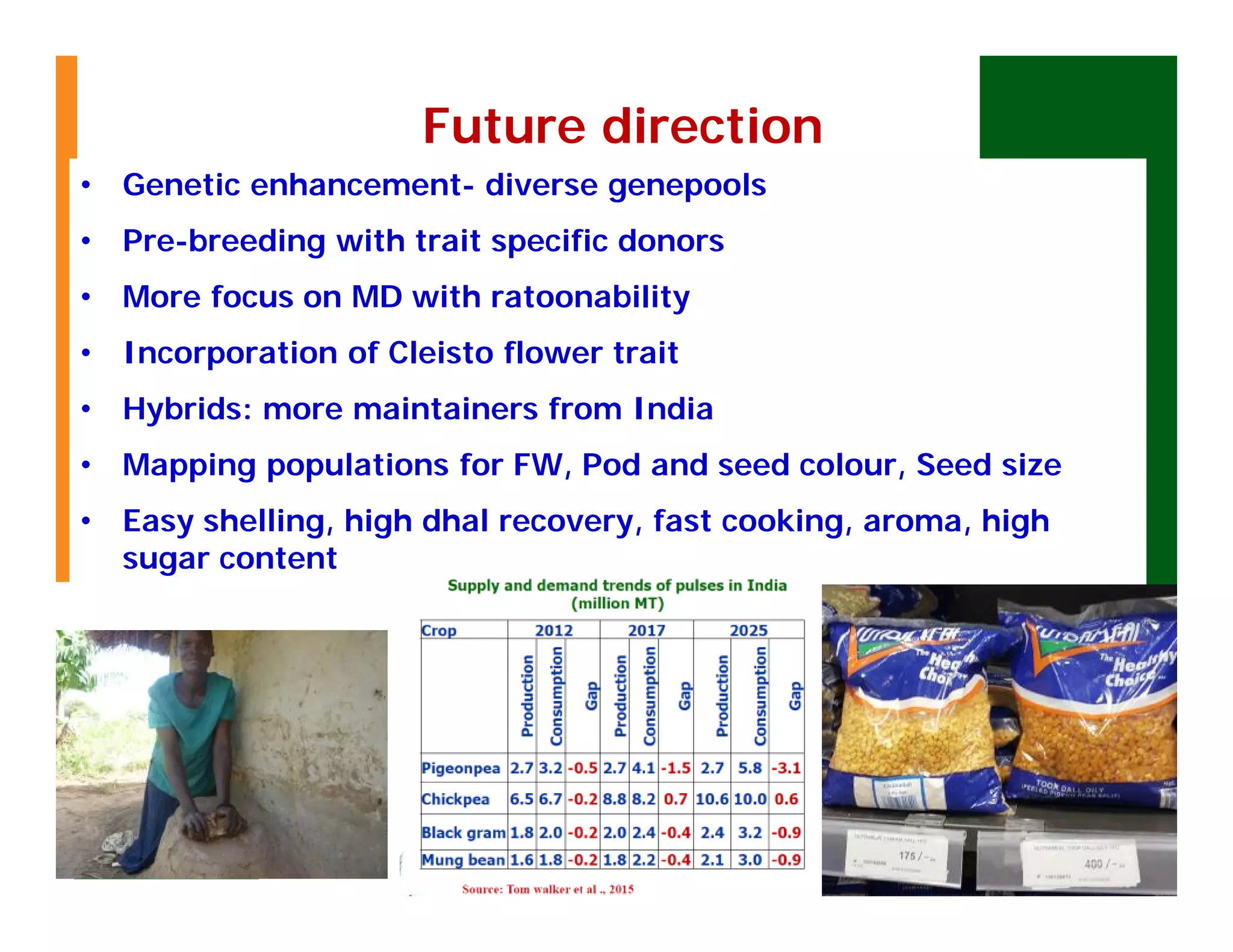
Future direction
• Genetic enhancement- diverse genepools
• Pre-breeding with trait specific donors
• More focus on MD with ratoonability
• Incorporation of Cleisto flower trait
• Hybrids: more maintainers from India
• Mapping populations for FW, Pod and seed colour, Seed size
• Easy shelling, high dhal recovery, fast cooking, aroma, high
sugar content
Aflatoxin Mitigation in Zambia
Objectives
• Quantify the incidence of aflatoxin in
groundnut (along the value chain),
estimate population densities and
characterize A. flavus in Eastern Zambia
AFB1 contamination in peanut butter
• Chipata, Katete, Petauke, and Lusaka
• 954 containers, from 25 brands tested
• A sample = 6 containers of a single brand,
manufacturing date, and from the same shop
• Each container was assayed 5 times, ELISA
• Geometric means calculated (log transformed)
• 9, 12, and 8 brands were repeatedly tested
within 1 year, across 2 years, and in all 3 years,
respectively
• 0% of brands repeatedly tested across 3 years
had AFB1
• 8% of brands tested repeatedly across 2 years
had AFB1 ≤ 20 ppb
• 44% of brands tested in just one year had AFB1
≤ 20 ppb
• Zambia, Zimbabwe, Malawi, South Africa
AFB1 in grain and powder
• 201 grain samples and 39 milled powder
• Chipata, Katete, Petauke, Lusaka, Kitwe,
Ndola, Kabwe
• 1 kg sample, analyzed 6 times
• 77% of 39 powder samples > 20 ppb AFB1
• 45% of 201 grain samples > 20 ppb AFB1
• No documented successful interventions in
informal markets
Food Safety and Nutrition
Baseline Result on Infant and Young Child feeding practices (IYCF).
Indicators Value, Age in
months (Malawi)
Value, Age in
months
(Tanzania)
Exclusively breast
fed (EBF), %
(67%),
<6 months
(69.1%),
<6 months
Dietary diversity
score, mean (SD)
2 (1.02),
6-23 months
3.23 (1.1),
6-23 months
Met minimum
dietary score, %
7 %,
6-23 months
39 %,
6-23 months
Meal frequency,
mean (SD)
2.0 (0.8),
6-23 months
2.31 (0.96),
6-23 months
Met minimum
meal frequency
(MMF), %
50%,
6-23 months
43.7 %,
6-23 months
Met minimum
acceptable diet, %
1.8%
6-23 months
18.4 %,
6-23 months
• Pigeonpea, finger millet,
groundnut and maize
combinations with
vegetables (to improve
protein, Calcium, Zinc ,
Vitamin A and Iron to reduce
malnutrition, improve bone
growth and body function.
• Training on hygiene (to
reduce diarrhoea and
improve Zn absorption).
• Training on post harvest crop
handling (to reduce aflatoxin
exposure and improve
vitamin A and Zn
absorption).
Approach: Learning by doing
positive deviance hearth
model (CORE)
Results of 21 days positive deviance approach (PDA) - Short term
study
Indicators Control group Intervention group
Mean weight at day 0 8.8 kgs±1.5 8.9 kgs±1.2
Mean weight at day 7 8.7 kgs±1.2 9.1 kgs±1.3
Mean weight at day 14 8.7 kgs±1.1 9.7 kgs±1.3
Mean weight at day 21
Mean MUAC at day 0
8.5 kgs±1.1
14.6cm±1.1
10.1kgs±1.3
14.6cm±1.0
Mean MUAC at day 7 14.2cm±1.1 14.5cm±1.0
Mean MUAC at day 14
Mean MUAC at day 21
14.1cm±1.1
14.0cm±1.0
14.6cm±1.0
15.0cm±1.0
Impact of PDA on underweight : DID random effect model
Dependent
Variable:
Weight-for-Age
Z-Score
Coefficient T-statistics
p-value
DID (Day 7) 0.31 1.86 0.063
DID (Day 14) 0.53 3.12 0.002
DID (Day 21) 0.73 4.34 0.000
Impact of PDA on wasting : DID random effect model
Dependent
Variable:
Weight-for-Height
Z-Score
Coefficient T-statistics
p-value
DID (Day 7) 0.37 1.40 0.161
DID (Day 14) 0.71 2.72 0.006
DID (Day 21) 0.85 3.26 0.001
LFD- User friendly diagnostic device
Aflatoxin detection at
field level is crucial to
reduce the
contamination in
value chain.
Antibody reacts with aflatoxin antigen giving
coloured reaction. This is simple to perform, cost
effective (<2$), less time consuming (<5 min) and
accurate
ICRISAT
LFD
ICRISAT
LFD
Results on Validation of LFD
Lateral flow
immunoassay
Number and % of samples tested for AFB1 in ELISA
Positive (above
20 ppb of AFB1)
Negative (below
20 ppb of AFB1)
Total
Positive (above
20 ppb of AFB1)
25 (50.00 %) 0 (0.00 %) 25 (50.00 %)
Negative (below
20 ppb of AFB1)
0 (0.00 %) 25 (50.00 %) 25 (50.00 %)
Total 25 (50.00 %) 25 (50.00 %) 50 (100.00%)
The figure in parentheses were computed based on the visual scoring of lateral
flow device and quantitative data obtained for ELISA after calculation. The
sensitivity of lateral flow device for AFB1 above 20 ppb in samples are 100 %; the
specificity is also 100 %. The positive predictive value is 100 %. The negative
predictive value is 100 %.
Table 1: sensitivity and specificity of lateral flow immunoassay compared to
ELISA for detecting above 20 ppb of aflatoxin in groundnut samples
Groundnut breeding and seed systems
Groundnut breeding
1. Input traits:
• Develop resilient varieties
that increase productivity
above the 2 ton + barrier
1. Input traits:
• Develop resilient varieties
that increase productivity
above the 2 ton + barrier
2. Output traits:
• Low aflatoxin contamination
• Enhanced nutrition density -
Zn, Fe and oleic acid
• Increased oil & confectionary
needs
2. Output traits:
• Low aflatoxin contamination
• Enhanced nutrition density -
Zn, Fe and oleic acid
• Increased oil & confectionary
needs
3. Farming systems
support
• Suitability for intensification
• Livestock feeds
3. Farming systems
support
• Suitability for intensification
• Livestock feeds
Shuttle breeding, capacity building, integrated breeding, Genebank
Output 1: New varieties and lines
Aim: Generate breeding populations improved tolerance to endemic stresses
ICGV-SM 08501
Five new varieties for Zambia
2 Medium duration Virginia types
• ICGV-SM 06729
• ICGV-SM 08503
2 Short duration Spanish types
• ICGV-SM 08513
• ICGV-SM 03517
1 Valencia type
• ICGV0SM 05534
Breeding lines and populations
• 39 families of deriving from released
popular varieties with enhanced Fe,
Zn and Oleic acid generated
• 70 families with a drought tolerance
background have been generated
• 20 regional trial sets used by ZARI,
NARO, ARI-Naliendele, IIAM, ICRISAT-
Bamako and Kano.
• 600 lines distributed to partners
Target population environments: Performance under
farmer management (GxExM)
Genotype Sensitivity SE. Mean SE
Land race 0.1359 0.3265 238.5 83.63
ICGV-SM
03519
0.4537 0.3265 724.8 83.63
ICGV-SM
99568
0.9856 0.3265 445.7 83.63
ICGV-SM
05650
1.1196 0.3265 549 83.63
ICGV-SM
01513
1.1639 0.3265 434.1 83.63
ICGV-SM
02724
2.0546 0.3265 937.6 83.63
Sensitivity tests: Finlay and Wilkinson modified
joint regression analysis shows ICGV-SM02724
highly sensitive and best grown in high potential
areas. Land race is widely adapted i.e. least
sensitive.
Output 1 highlights: Targeting & adoption
Aim: Conduct farmer participatory variety selection (FPVS) and
demonstrations to underpin R4D relevance, adoption and promotions
ICGV-SM 08501
• >1000 demonstrations in
ESA (new varieties + ICM)
• 16,523 farmers trained
• >3000 farmers conduct
FPVS (ESA)
• 60 FRNs (Tanzania and
Malawi) engaged for on-
farm trials.
• >100 para seed inspectors
trained
Fine-tuning technology for intensification:
Cropping systems farmers use in KK
23
20
10 10
2
Sorghum,
Pigeonpea
and Maize
Maize,
Sunflower
and Pearl
millet
Groundnut
and
pigeonpea
Groundnut
and maize
Others
Coverage %
Coverage %
Source: FRN involving 60 farmers engaged in
2015
Implications for research
• Differentiated genotypes
• Materials that can handle
shading
• Agronomy
• Plant population
management
• Optimizing field architecture
Output 2: Strengthening seed supply
• 460 tons of foundation seeds
(groundnut, pigeonpea).
• 1,500 tons of groundnut certified
seed.
• 280 tons of pigeonpea certified seed
Malawi:
• 13 new community seed banks
identified for possible linkages to
markets.
Tanzania
• 6 new community seed banks
Uganda
• 4 new communities engaged in seed
production
David managing a field day in
Uganda
Currently access to seed is
less than 40% in most ESA
countries
Full	
Time	
Poor		
Groundnut	&	Pigeonpea		
Soil	and	water	and	
Livestock	for	nutrient	
recycling	+	drudgery	
reduction	
Intensified	
Cereal,	Pigeonpea+	
Soil	and	water	or	
rotation	systems		
	
	
Rehabilitate	soils:	
Doubled	Up	Legumes,	
Pigeonpea	+	erosion	
management	
Adoption	
Intensified	+	cereal	legume	
systems	(small	units	with	
limited	rotations)	+	S.Fert	
water	+	livestock	
	
Education:	
Agronomy-	Soil	Fert	+	water,	
weeds,	multiple	cropping	+	
Processing,	
Nutrition	+	small	livestock	
Sustainable	
Intensification	
New
varieties
Strategy for scaling up and out
Summary of 2014-2015
Variety development 1. Advancement & evaluation of populations
2. New crosses made especially for output traits
3. Release in new countries: Zambia and Zimbabwe
4. Fundamental work: Resistance & genetic studies + integrated breeding
Technology promotion/
deployment
5. Scaling up and out- (Malawi, Mozambique, Uganda, Tanzania & Zambia)
6. Leverage intensification actions-Tanzania +Malawi+ Mozambique
Aflatoxins, nutrition and
post harvest management
7. Aflatoxin & nutrition studies- Tanzania & Malawi + Zambia
8. Strengthen and deploy diagnostic tools and management options
9. Awareness (all CRP targets and leverage PACA efforts inSADC)
Complementary/leverage
areas 10 New investments (leverage and engagement (HOPE, Harvest Plus)- Uganda, SMEAR-
Mozambique)
Thank you!
ICRISAT is a member of the CGIAR Consortium

ESA crop improvement : legumes

  • 1.
    Crop Improvement: Legumes ICRISAT-ESA:A. Seetha. Anitha, S.M. Njoroge, C. Ojiewo, N.V.P.R. Ganga Rao, E. Monyo, M. Siambi, and P.Okori, ICRISAT- R.K. Varshney, H.S. Desmae, M. Babu, H.D.Upadhyaya, P. Janila, H.S. Desmae, PM Gaur, V.Vadez, H.K Sudini, CV Sameer Kumar NARS: NARO, IIAM, DARS, EIAR, ZARI, Universities, Private Seed Companies
  • 2.
    Acknowledgments • Governments inRegion • Public research and extension • Development Partners – BMGF, USAID, Irish Aid, IFAD,, UKAID, GTZ, IFAD • Civil Society • Farmer organizations • International research agencies – CGIAR – Advanced research centers • Diverse development projects
  • 3.
    Context of ESALegume Science Agenda
  • 4.
  • 5.
    1. The needto meet food and nutrition demands of a growing population Southern Africa East Africa Source: UN population division, 2012.
  • 6.
    2. Asymmetric demography:How and S&T provide solution for harnessing the SSA youth population dividend Source: Brookings Institutions and Africa progress Panel, 2014 2030 20502010 400,000 300,000 200,000 100,000 0 Populations(Thousands)
  • 7.
    1 2 3094 5 6 87 10 10 20 30 Numberofpeople(Millions) Mean daily consumption (PPP dollars) 0 $1.25 $2.50 3. Tackle the persistent poverty and vulnerability
  • 8.
    Seed systems areweak to moderate 75% 80% 85% 90% 95% 100% 105% Maize Sorghum/Mille t Sunflower Groundnuts Pigeon pea Cow peas Sesame Beans Sweet potatoes Local seed Improved Quality declared seeds Local and improved < 10% of farmers, use improved seeds or quality declared seeds Source Africa RISING: Tanzania. KK team
  • 9.
    Medium to highfood insecurity Extreme risk High risk Medium risk Low riskNo data Source: Food Security Index & Map, 2013
  • 10.
    4. Resilience toan increasing risk Each “growing degree day” spent at a temperature above 30°C decreases yields by 1 percent under optimal (drought-free) rainfed conditions. Southern Africa faces the risk of more severe and protracted droughts and periods of extremely low and extremely high rainfall could become more common as temperatures increase from 2-4°C What Crops and traits shall we breed? How efficient are our R&D research to market pathways
  • 11.
    5. Mobilize agricultureto deliver solutions for the silent hunger (nutrition deficiencies) David Tilman et al. PNAS 2011;108:20260-20264 Projections 2005-2050Previous trajectories
  • 12.
  • 13.
    Agriculture a bigpart of Africa’s 2020-2.6 trillion revenue growth Africa’s economic growth creating new opportunities not covered by multinational corporations
  • 14.
    Growth in agricultureis twice to four times as effective in reducing poverty
  • 15.
    Rwanda UgandaEthiopiaBurkina Faso Mozambique Tanzania 0 6 2 4 8 10 %shareofgrowth Agri.Sector is a significant driver of growth: What catalysts do we have? Source: Brookings Institutions and Africa progress Panel, 2014.
  • 16.
    We can unlockthe agricultural potential: Most of ESA can generate 460-1350$/ha Source: Fisher and Shar, 2010 US$ 201-300 US$ 301-468 US$ 581-907 US 1598-1881 US1881-2729 US$ 468-580 US$ 908-1128 US$ 1129-1349 US$ 1350-1597
  • 17.
    Crop varieties forsustainable Intensification Source: DCL, 2015
  • 18.
    Legumes science agendafor ESA New productive, resilient and nutrient dense varieties Increased availability and access to to productivity enhancing innovations Crop diversification for food, nutrition and income security
  • 19.
    Product/ technology cyclemanagement Product life cycle management Breeding, selection and evaluation DiscoverDiscover y Proof of concept Early Developm ent Late developm ent Pre- sector Pre- release CG+NAR S+ Seed sector Release & + Seed sector Release & develop ment CG+NARS + Seed sector Discontin sector Discontin ue CG+NAR S & seed sector GxExM Product Knowledge, best agronomic systems fit Preparing for release Regulatory approval to release. Market positioning, Deployment plans and seed forecast production plans Product Scale-up Expansion into additional/extended TPE. Managing genetic & trait purity, validating yield assumptions. Monitoring performancevs old/ farmer preferred varieties Exit Strategy Discontinue Breeder’s seed production and introduce new varieties.
  • 20.
    TL III FocusGeographies and Crops
  • 21.
    Tropical legume -III: Project Management Objectives: • Ensure implementation of TL III objectives; monitoring of milestones, outputs and expenditures • Ensure effective data archiving and dissemination as global public goods. • Ensure effective communication of TL III progress, achievements and impacts. • Efficient management and reporting.
  • 22.
    Salient Results for2015 Implementing a multi-stakeholder project launch workshop • Better understanding of the project context and objectives • Increased understanding of TL III’s interface with respective country legume strategies • A sense of ownership of the TL III project by partners • Country workplans integrating TL III Objectives • TL III Project Monitoring, Learning and Evaluation (MLE) Plan
  • 23.
    Implementing National AnnualPlanning meetings • Meetings were successfully held for all countries to finalize country workplans for groundnut in Burkina Faso, Ghana, Mali, Nigeria, Tanzania and Uganda; Chickpea in Ethiopia and Uttar Pradesh India, Common beans in Ethiopia, Tanzania and Uganda and cowpea in Burkina Faso, Ghana, Mali and Nigeria Salient Results cont…
  • 24.
    Salient Results cont Curationand dissemination of TL-III Data as global public goods • The Integrated Breeding Platform – Breeding Management System (BMS) was decided as a tool of choice for the management of TL III data • 3 training sessions for BMS were conducted for project implementing staff in Nairobi, Addis Ababa and Bamako btw Aug and Dec 2015 • A BMS Cloud database for TL-III established.
  • 25.
    Salient Results cont CommunicatingTL-III project progress, achievements and impact • Four volumes of the regular Quarterly Bulletin Tropical legumes were produced highlighting specific aspects of project successes • TL III web-page have been updated to include a TL III facebook and twitter links to communicate project information. • A 182 page synthesis of the seven seasons of learning and engaging smallholder farmers through the tropical legumes in Sub-Saharan Africa and South Asia is ready for publication.
  • 26.
    Salient Results cont Managementand reporting of TL-III Project • Launched TL III (August 17 – 22, 2015) • Worked with Country focal points and country teams to develop Country Workplans • Worked with Objective leaders to synthesize these into Project workplans (by objective) • Worked with ALINe Consultancy to develop Project MLE Plan • Visited project sites in all regions to monitor progress and provide on the ground advice as needed
  • 27.
    Salient Results cont.. Supportingbreeding pipelines for groundnuts, cowpea, common bean, and chickpea in target TL-III countries • TL III supported the implementation of the BPAT to all CGIAR Africa based programs which included Program assessments for groundnut in Mali and Malawi, chickpea in Ethiopia, cowpea in Nigeria and common beans in Uganda and Malawi. • Key findings - ICRISAT African based breeding programs have very competent scientists but are weak in breeding cycle time, phenotyping for drought, and application of marker assisted breeding technologies. • These critical areas have been recommended for improvement as part of TL III improvement of breeding efficiency in African CGIAR sites and the target NARS.
  • 28.
    Challenges, Constraints &Mitigations • It has taken long to fill the project positions – hence the project is off to a slow start (The gender scientist has not joined to-date and gender related research activities are behind schedule) • Ongoing security and instability in parts of Mali and Nigeria • Drought in Ethiopia (ElNino effect of 2015) .
  • 29.
  • 30.
    MABC for droughttolerance in chickpea • 7 MABC F7 lines with up to 40g/100 seed weight and up to 41% higher yield than the std check identified • Introgresssion crosses initiated • Reproductive stage drought tolerance under late planting condition; avoiding ascochyta blight • 7 MABC F7 lines with up to 40g/100 seed weight and up to 41% higher yield than the std check identified • Introgresssion crosses initiated • Reproductive stage drought tolerance under late planting condition; avoiding ascochyta blight 0 500 1000 1500 2000 2500 3000 3500 MABC11 MABC4 MABC16 MABC13 MABC14 MABC10 ICCV-939554 ICCV-4958 MABC9 MABC7 MABC6 MABC18 MABC19 MABC3 MABC2 MABC22 DALOTA Yield of MABCF7 Desi lines at Debre Zeit Yield(kg/ha) 41% Drought tolerant varieties • High yield under drought stress • Trait-based selection + MABC • Evaluation for yield adaptability • Identifying new sources
  • 31.
    Heat stress tolerance •Low pollen viability, pollen germ. and pollen tube growth • Causes flower abscission and pod abortion, • Reduces pod set, pod fill and yield Anther-pollen fertility with Alexander’s stain ICCV 92944 (Tolerant) ICC 5912 (Sensitive) • 4 lines with yield advantage of 178%, 38%, 32% and 11% over std check under normal T oC • 7 lines with >2 t/ha selected at T oC > 35 oC • New tolerance sources from reference set • Expansion of production to non- conventional areas under irrigation • Late planting to avoid AB • Changing and variable climates
  • 32.
    Ascochyta blight; wilt-rootrot complex of CP • AB and WRR cause upto 100% loss • No AB resistant desi variety • Majority of farmers produce desi • Planting late to avoid AB and FW • Resistance varieties for early planting • 3 new sources of double resistance identified • NVT for resistant desi • BC2 to improve released varieties • Maturity before terminal drought
  • 33.
    Emerging issues: Earlymaturity • Escape end-of-season drought and heat stresses • short window of cropping season – double cropping • enhance cropping resilience (intensification and diversification) • Green pod chickpea market (challenges with human pest??) • New sources from local and reference collections
  • 34.
    Nodulation/fixation may belimited by: • the presence ineffective strains • low population numbers, • low infectivity or lack of effectiveness, • poor survival rate of rhizobia in the soil • competition amongst strains of rhizobia • the absence of compatible strains (strain x variety x environment interaction) CRP-GL: Even lines earlier reported as non- nodulating do nodulate with compatible strains TLIII: include basic N2Africa-recommended package of inoculum and agronomic practices in field demos.  From 50 indigenous rhizobia, 15 Rhizobia isolates with wide pH tolerance, 5 with salinity tolerance, 3 with high ToC tolerance, 5 with antibiotics resistance, 15 phosphate solubilizing isolates were identified.  The 50 isolates were further grown on yeast extract mannitol agar and single colonies cultured for molecular characterization.  43 isolates are currently being sequenced at UC-Davis
  • 35.
    Chickpea cultivars formechanical harvesting 1. Machine harvestable • herbicide tolerant • frost tolerant • for double cropping 2. Disease resistant 3. Efficient N-fixing 4. High yielding 5. Market preferred 6. New sources to be identified from ref collection 7. Introgression crosses
  • 36.
  • 37.
    Pigeonpea Breeding prioritiesin ESA • High grain yield • Phenology for agro-ecol. adaptability and SI • Photo-thermo insensitivity • Ratoonability with high yield • Grain quality for dry & fresh grains • Climate resilience with drought tolerance • Fusarium wilt tolerance • Pest tolerance esp. Pod borers
  • 38.
    Workplan targets 2014-2015 1.Evaluation of 25 short, 40 medium, 40 long duration varieties 2. Maintenance of breeder seed of 10 varieties, enhancing NARS capacity and seed scaling up with stakeholders 3. Development and evaluation of 500 pigeonpea breeding lines for yield, fusarium wilt and pest tolerance 4. Evaluation of 30-50 early chickpea elite lines for yield, drought, fusarium wilt and Ascochyta blight 5. Evaluation of 20 chickpea elite lines for heat tolerance and dry root rot 6. Maintenance of breeder seed of 10 released varieties including heat tolerant ICCV 92944 7. Collection, characterization, conservation and distribution of chickpea and pigeonpea germplasm 8. Evaluation of 30 chickpea genotypes for insect pest and 10 for herbicide tolerance 9. Identification of maintainers and restorers under African germplasm, use of cleisto lines in breeding program
  • 39.
    Evaluation of varietiesin ESA Country Short Medium Long Kenya 56 75 60 Tanzania 20 42 35 Malawi 22 47 22 Mozambique - 35 60 Ethiopia 22 18 70 Zambia - 15 25 Uganda - 57 - Mali 22 18 - Best lines 12 19 15 • Released 5 varieties (4 in Tanzania, 1 in Zambia) • 4 in Uganda and 2 in Zambia pipeline for release
  • 40.
    Maintenance of qualityseed Crop Breeder Foundation Certified +QDS Total Pigeonpea 18.8 82.4 86.5 478 Chickpea 5.0 4.5 32.4 41.9 Total 23.8 86.9 118.9 519.9
  • 41.
    Breeding pipeline F8 NumberTotal ICEAP 00040 X KAT 60/8 29 64 ICEAP 00048 X ICEAP 00557 4 ICEAP 00557 X ICEAP 00576-1 5 ICEAP 00576-1 X ICEAP 00554 15 ICEAP 00576-1 X ICEAP 00557 11 F6 ACC 88 X ICEAP 00576-1 23 87ICEAP 00048 X ICEAP 00040 21 MJ X ICEAP 00040 43 Early generation F6 : Number Total KAT 60/8 X ICEAP 00540 118 256 ICEAP 00068 X ICEAP 00540 138 F7 : ICP 6927 X ICEAP 00554 128 203 ICP 6927 X ICEAP 00557 53 ICP 6927 X ICEAP 00850 16 ICEAP 00068 X ICEAP 00850 6 F8 : MZ 2/9 X ICEAP 00554 39 301 MZ 2/9 X ICEAP 00557 91 ICEAP 00554 X MZ 2/9 95 MTHAWAJUNI X ICEAP 00554 21 MTHAWAJUNI X ICEAP 00557 19 ICEAP 00554 X MTHAWAJUNI 36 F9 : ICEAP 00554 X ICP 7035 37 47 ICEAP 00557 X ICP 7035 10 Medium duration Observation Nurseries Number Total MD observation 1 57 349MD observation 2 147 MD observation 3 145 Diversity lines 435 F1 HYBRID 26 F2 progenies 16 F3 progenies 27 F4 progenies 80 Long duration
  • 42.
    Pest tolerance withpurple and constricted pods Line Plant no. Plant yield(g) Seed colour 100-seed Mass (g) MZ 2/9/36/2 3 158 cream 26 MZ 2/9/36/2 10 142 cream 25 MZ 2/9/36/2 12 129 cream 26 MZ 2/9/36/2 11 108 cream 25 MZ 2/9/36/2 14 103 cream 25 MZ 2/9/36/2 7 64 cream 27 MZ 2/9/36/2 14 52 cream 28 MZ 2/9/36/2 2 41 cream 28 ICPL 86022 Cream large seeded
  • 43.
    Hybrid Pigeonpea • 8CMS, 52 test crosses • African germplasm – More restorers • Most of the maintainers from India are brown seeded • Use of diverse gene pools for HV over African OPV • Hybrids are with early vigour and more branches Hybrid Medium Duration Variety Hybrid Variety
  • 44.
    Germplasm Maintenance 1. GermplasmCollection: – 86 from 9 districts, Lindi R. (6), Ruangwa (17), Nachingwea(3), Tunduru(9), Masasi (12), Nanyumbu (3), Kilosa (14), Gairo (9) and Bagamoyo (3) – 122 from 8 districts, Albetong(18), Otuke(18), Kitgum(9), Lira(18), Oyam (10), Kole(26), Gulu(17) and Lamwo (6) 2. Regeneration and Seed increase: – Regenerated 55 pigeonpea and 18 chickpea accessions – Seed increased 117 pigeonpea and 80 chickpea accessions 3. Distribution: 2120 pigeonpea and 87 chickpea samples 4. Evaluation and characterization: – 92 single plant progenies from Kenyan collection – 224 elite lines of MZ 2/9 accession with cream big seeds(28 g/100 seed mass) and dark pods, high pod load, tolerance to drought and insect pests
  • 45.
    Future direction • Geneticenhancement- diverse genepools • Pre-breeding with trait specific donors • More focus on MD with ratoonability • Incorporation of Cleisto flower trait • Hybrids: more maintainers from India • Mapping populations for FW, Pod and seed colour, Seed size • Easy shelling, high dhal recovery, fast cooking, aroma, high sugar content
  • 46.
  • 47.
    Objectives • Quantify theincidence of aflatoxin in groundnut (along the value chain), estimate population densities and characterize A. flavus in Eastern Zambia
  • 48.
    AFB1 contamination inpeanut butter • Chipata, Katete, Petauke, and Lusaka • 954 containers, from 25 brands tested • A sample = 6 containers of a single brand, manufacturing date, and from the same shop • Each container was assayed 5 times, ELISA • Geometric means calculated (log transformed)
  • 50.
    • 9, 12,and 8 brands were repeatedly tested within 1 year, across 2 years, and in all 3 years, respectively • 0% of brands repeatedly tested across 3 years had AFB1 • 8% of brands tested repeatedly across 2 years had AFB1 ≤ 20 ppb • 44% of brands tested in just one year had AFB1 ≤ 20 ppb • Zambia, Zimbabwe, Malawi, South Africa
  • 52.
    AFB1 in grainand powder • 201 grain samples and 39 milled powder • Chipata, Katete, Petauke, Lusaka, Kitwe, Ndola, Kabwe • 1 kg sample, analyzed 6 times
  • 54.
    • 77% of39 powder samples > 20 ppb AFB1 • 45% of 201 grain samples > 20 ppb AFB1 • No documented successful interventions in informal markets
  • 55.
    Food Safety andNutrition
  • 56.
    Baseline Result onInfant and Young Child feeding practices (IYCF). Indicators Value, Age in months (Malawi) Value, Age in months (Tanzania) Exclusively breast fed (EBF), % (67%), <6 months (69.1%), <6 months Dietary diversity score, mean (SD) 2 (1.02), 6-23 months 3.23 (1.1), 6-23 months Met minimum dietary score, % 7 %, 6-23 months 39 %, 6-23 months Meal frequency, mean (SD) 2.0 (0.8), 6-23 months 2.31 (0.96), 6-23 months Met minimum meal frequency (MMF), % 50%, 6-23 months 43.7 %, 6-23 months Met minimum acceptable diet, % 1.8% 6-23 months 18.4 %, 6-23 months
  • 57.
    • Pigeonpea, fingermillet, groundnut and maize combinations with vegetables (to improve protein, Calcium, Zinc , Vitamin A and Iron to reduce malnutrition, improve bone growth and body function. • Training on hygiene (to reduce diarrhoea and improve Zn absorption). • Training on post harvest crop handling (to reduce aflatoxin exposure and improve vitamin A and Zn absorption). Approach: Learning by doing positive deviance hearth model (CORE)
  • 58.
    Results of 21days positive deviance approach (PDA) - Short term study Indicators Control group Intervention group Mean weight at day 0 8.8 kgs±1.5 8.9 kgs±1.2 Mean weight at day 7 8.7 kgs±1.2 9.1 kgs±1.3 Mean weight at day 14 8.7 kgs±1.1 9.7 kgs±1.3 Mean weight at day 21 Mean MUAC at day 0 8.5 kgs±1.1 14.6cm±1.1 10.1kgs±1.3 14.6cm±1.0 Mean MUAC at day 7 14.2cm±1.1 14.5cm±1.0 Mean MUAC at day 14 Mean MUAC at day 21 14.1cm±1.1 14.0cm±1.0 14.6cm±1.0 15.0cm±1.0
  • 59.
    Impact of PDAon underweight : DID random effect model Dependent Variable: Weight-for-Age Z-Score Coefficient T-statistics p-value DID (Day 7) 0.31 1.86 0.063 DID (Day 14) 0.53 3.12 0.002 DID (Day 21) 0.73 4.34 0.000 Impact of PDA on wasting : DID random effect model Dependent Variable: Weight-for-Height Z-Score Coefficient T-statistics p-value DID (Day 7) 0.37 1.40 0.161 DID (Day 14) 0.71 2.72 0.006 DID (Day 21) 0.85 3.26 0.001
  • 60.
    LFD- User friendlydiagnostic device Aflatoxin detection at field level is crucial to reduce the contamination in value chain. Antibody reacts with aflatoxin antigen giving coloured reaction. This is simple to perform, cost effective (<2$), less time consuming (<5 min) and accurate
  • 61.
    ICRISAT LFD ICRISAT LFD Results on Validationof LFD Lateral flow immunoassay Number and % of samples tested for AFB1 in ELISA Positive (above 20 ppb of AFB1) Negative (below 20 ppb of AFB1) Total Positive (above 20 ppb of AFB1) 25 (50.00 %) 0 (0.00 %) 25 (50.00 %) Negative (below 20 ppb of AFB1) 0 (0.00 %) 25 (50.00 %) 25 (50.00 %) Total 25 (50.00 %) 25 (50.00 %) 50 (100.00%) The figure in parentheses were computed based on the visual scoring of lateral flow device and quantitative data obtained for ELISA after calculation. The sensitivity of lateral flow device for AFB1 above 20 ppb in samples are 100 %; the specificity is also 100 %. The positive predictive value is 100 %. The negative predictive value is 100 %. Table 1: sensitivity and specificity of lateral flow immunoassay compared to ELISA for detecting above 20 ppb of aflatoxin in groundnut samples
  • 62.
  • 63.
    Groundnut breeding 1. Inputtraits: • Develop resilient varieties that increase productivity above the 2 ton + barrier 1. Input traits: • Develop resilient varieties that increase productivity above the 2 ton + barrier 2. Output traits: • Low aflatoxin contamination • Enhanced nutrition density - Zn, Fe and oleic acid • Increased oil & confectionary needs 2. Output traits: • Low aflatoxin contamination • Enhanced nutrition density - Zn, Fe and oleic acid • Increased oil & confectionary needs 3. Farming systems support • Suitability for intensification • Livestock feeds 3. Farming systems support • Suitability for intensification • Livestock feeds Shuttle breeding, capacity building, integrated breeding, Genebank
  • 64.
    Output 1: Newvarieties and lines Aim: Generate breeding populations improved tolerance to endemic stresses ICGV-SM 08501 Five new varieties for Zambia 2 Medium duration Virginia types • ICGV-SM 06729 • ICGV-SM 08503 2 Short duration Spanish types • ICGV-SM 08513 • ICGV-SM 03517 1 Valencia type • ICGV0SM 05534 Breeding lines and populations • 39 families of deriving from released popular varieties with enhanced Fe, Zn and Oleic acid generated • 70 families with a drought tolerance background have been generated • 20 regional trial sets used by ZARI, NARO, ARI-Naliendele, IIAM, ICRISAT- Bamako and Kano. • 600 lines distributed to partners
  • 65.
    Target population environments:Performance under farmer management (GxExM) Genotype Sensitivity SE. Mean SE Land race 0.1359 0.3265 238.5 83.63 ICGV-SM 03519 0.4537 0.3265 724.8 83.63 ICGV-SM 99568 0.9856 0.3265 445.7 83.63 ICGV-SM 05650 1.1196 0.3265 549 83.63 ICGV-SM 01513 1.1639 0.3265 434.1 83.63 ICGV-SM 02724 2.0546 0.3265 937.6 83.63 Sensitivity tests: Finlay and Wilkinson modified joint regression analysis shows ICGV-SM02724 highly sensitive and best grown in high potential areas. Land race is widely adapted i.e. least sensitive.
  • 66.
    Output 1 highlights:Targeting & adoption Aim: Conduct farmer participatory variety selection (FPVS) and demonstrations to underpin R4D relevance, adoption and promotions ICGV-SM 08501 • >1000 demonstrations in ESA (new varieties + ICM) • 16,523 farmers trained • >3000 farmers conduct FPVS (ESA) • 60 FRNs (Tanzania and Malawi) engaged for on- farm trials. • >100 para seed inspectors trained
  • 67.
    Fine-tuning technology forintensification: Cropping systems farmers use in KK 23 20 10 10 2 Sorghum, Pigeonpea and Maize Maize, Sunflower and Pearl millet Groundnut and pigeonpea Groundnut and maize Others Coverage % Coverage % Source: FRN involving 60 farmers engaged in 2015 Implications for research • Differentiated genotypes • Materials that can handle shading • Agronomy • Plant population management • Optimizing field architecture
  • 68.
    Output 2: Strengtheningseed supply • 460 tons of foundation seeds (groundnut, pigeonpea). • 1,500 tons of groundnut certified seed. • 280 tons of pigeonpea certified seed Malawi: • 13 new community seed banks identified for possible linkages to markets. Tanzania • 6 new community seed banks Uganda • 4 new communities engaged in seed production David managing a field day in Uganda Currently access to seed is less than 40% in most ESA countries
  • 69.
  • 70.
    Summary of 2014-2015 Varietydevelopment 1. Advancement & evaluation of populations 2. New crosses made especially for output traits 3. Release in new countries: Zambia and Zimbabwe 4. Fundamental work: Resistance & genetic studies + integrated breeding Technology promotion/ deployment 5. Scaling up and out- (Malawi, Mozambique, Uganda, Tanzania & Zambia) 6. Leverage intensification actions-Tanzania +Malawi+ Mozambique Aflatoxins, nutrition and post harvest management 7. Aflatoxin & nutrition studies- Tanzania & Malawi + Zambia 8. Strengthen and deploy diagnostic tools and management options 9. Awareness (all CRP targets and leverage PACA efforts inSADC) Complementary/leverage areas 10 New investments (leverage and engagement (HOPE, Harvest Plus)- Uganda, SMEAR- Mozambique)
  • 71.
    Thank you! ICRISAT isa member of the CGIAR Consortium