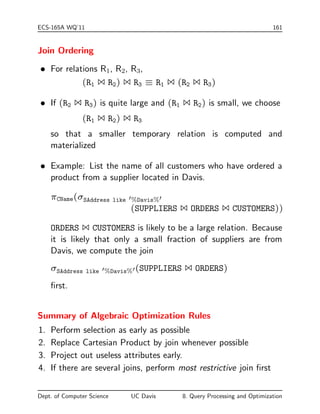
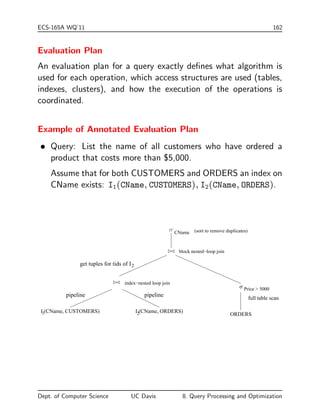
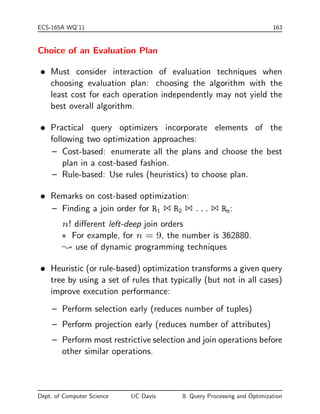
ECS-165A WQ'11 136 
8. Query Processing 
Goals: Understand the basic concepts underlying the steps in 
query processing and optimization and estimating query processing 
cost; apply query optimization techniques; 
Contents: 
 Overview 
 Catalog Information for Cost Estimation 
 Measures of Query Cost 
 Selection 
 Join Operations 
 Other Operations 
 Evaluation and Transformation of Expressions 
Query Processing  Optimization 
Task: Find an ecient physical query plan (aka execution plan) 
for an SQL query 
Goal: Minimize the evaluation time for the query, i.e., compute 
query result as fast as possible 
Cost Factors: Disk accesses, read/write operations, [I/O, page 
transfer] (CPU time is typically ignored) 
Dept. of Computer Science UC Davis 8. Query Processing and Optimization
ECS-165A WQ'11 137 
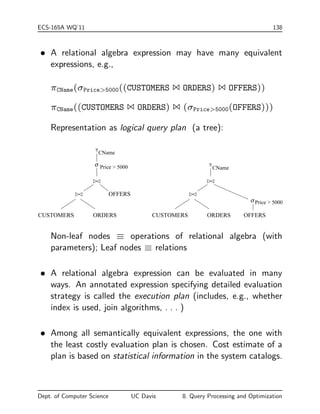
Basic Steps in Processing an SQL Query 
(System Catalogs) 
SQL Query 
Relational Algebra 
Expression 
Optimizer 
Statistics 
Query Result Evaluation Engine Execution Plan 
Data Files 
Parser  
Translator 
 Parsing and Translating 
{ Translate the query into its internal form (parse tree). 
This is then translated into an expression of the relational 
algebra. 
{ Parser checks syntax, validates relations, attributes and 
access permissions 
 Evaluation 
{ The query execution engine takes a physical query plan 
(aka execution plan), executes the plan, and returns the 
result. 
 Optimization: Find the cheapest execution plan for a query 
Dept. of Computer Science UC Davis 8. Query Processing and Optimization
ECS-165A WQ'11 138 
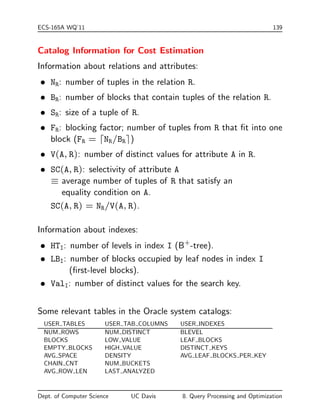
 A relational algebra expression may have many equivalent 
expressions, e.g., 
CName(Price5000((CUSTOMERS 1 ORDERS) 1 OFFERS)) 
CName((CUSTOMERS 1 ORDERS) 1 (Price5000(OFFERS))) 
Representation as logical query plan (a tree): 
o 
o 
CName 
Price  5000 CName 
Price  5000 
OFFERS 
ORDERS CUSTOMERS ORDERS OFFERS 
CUSTOMERS 
Non-leaf nodes  operations of relational algebra (with 
parameters); Leaf nodes  relations 
 A relational algebra expression can be evaluated in many 
ways. An annotated expression specifying detailed evaluation 
strategy is called the execution plan (includes, e.g., whether 
index is used, join algorithms, . . . ) 
 Among all semantically equivalent expressions, the one with 
the least costly evaluation plan is chosen. Cost estimate of a 
plan is based on statistical information in the system catalogs. 
Dept. of Computer Science UC Davis 8. Query Processing and Optimization
ECS-165A WQ'11 139 
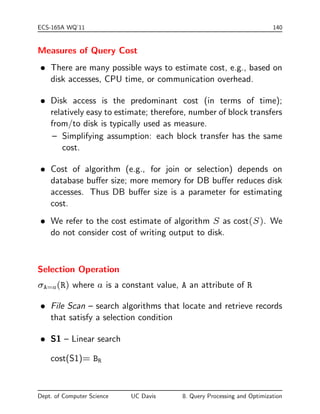
Catalog Information for Cost Estimation 
Information about relations and attributes: 
 NR: number of tuples in the relation R. 
 BR: number of blocks that contain tuples of the relation R. 
 SR: size of a tuple of R. 
 FR: blocking factor; number of tuples from R that
t into one 
block (FR = dNR=BRe) 
 V(A; R): number of distinct values for attribute A in R. 
 SC(A; R): selectivity of attribute A 
 average number of tuples of R that satisfy an 
equality condition on A. 
SC(A; R) = NR=V(A; R). 
Information about indexes: 
 HTI: number of levels in index I (B+-tree). 
 LBI: number of blocks occupied by leaf nodes in index I 
(
rst-level blocks). 
 ValI: number of distinct values for the search key. 
Some relevant tables in the Oracle system catalogs: 
USER TABLES USER TAB COLUMNS USER INDEXES 
NUM ROWS NUM DISTINCT BLEVEL 
BLOCKS LOW VALUE LEAF BLOCKS 
EMPTY BLOCKS HIGH VALUE DISTINCT KEYS 
AVG SPACE DENSITY AVG LEAF BLOCKS PER KEY 
CHAIN CNT NUM BUCKETS 
AVG ROW LEN LAST ANALYZED 
Dept. of Computer Science UC Davis 8. Query Processing and Optimization
ECS-165A WQ'11 140 
Measures of Query Cost 
 There are many possible ways to estimate cost, e.g., based on 
disk accesses, CPU time, or communication overhead. 
 Disk access is the predominant cost (in terms of time); 
relatively easy to estimate; therefore, number of block transfers 
from/to disk is typically used as measure. 
{ Simplifying assumption: each block transfer has the same 
cost. 
 Cost of algorithm (e.g., for join or selection) depends on 
database buer size; more memory for DB buer reduces disk 
accesses. Thus DB buer size is a parameter for estimating 
cost. 
 We refer to the cost estimate of algorithm S as cost(S). We 
do not consider cost of writing output to disk. 
Selection Operation 
A=a(R) where a is a constant value, A an attribute of R 
 File Scan { search algorithms that locate and retrieve records 
that satisfy a selection condition 
 S1 { Linear search 
cost(S1)= BR 
Dept. of Computer Science UC Davis 8. Query Processing and Optimization
ECS-165A WQ'11 141 
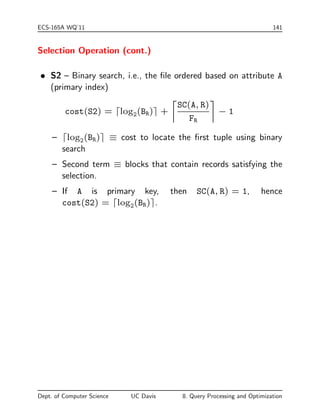
Selection Operation (cont.) 
 S2 { Binary search, i.e., the
le ordered based on attribute A 
(primary index) 
cost(S2) = dlog2(BR)e + 
 
SC(A; R) 
FR 
 
 1 
{ dlog2(BR)e  cost to locate the
rst tuple using binary 
search 
{ Second term  blocks that contain records satisfying the 
selection. 
{ If A is primary key, then SC(A; R) = 1, hence 
cost(S2) = dlog2(BR)e. 
Dept. of Computer Science UC Davis 8. Query Processing and Optimization
ECS-165A WQ'11 142 
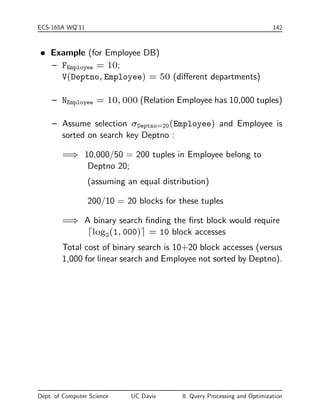
 Example (for Employee DB) 
{ FEmployee = 10; 
V(Deptno; Employee) = 50 (dierent departments) 
{ NEmployee = 10; 000 (Relation Employee has 10,000 tuples) 
{ Assume selection Deptno=20(Employee) and Employee is 
sorted on search key Deptno : 
=) 10,000/50 = 200 tuples in Employee belong to 
Deptno 20; 
(assuming an equal distribution) 
200/10 = 20 blocks for these tuples 
=) A binary search
nding the
rst block would require 
dlog2(1; 000)e = 10 block accesses 
Total cost of binary search is 10+20 block accesses (versus 
1,000 for linear search and Employee not sorted by Deptno). 
Dept. of Computer Science UC Davis 8. Query Processing and Optimization
ECS-165A WQ'11 143 
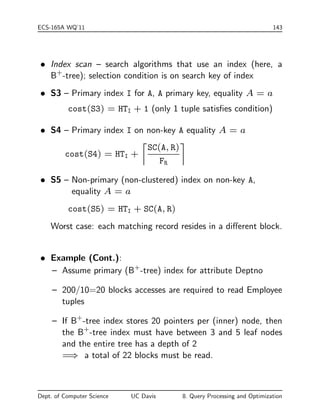
 Index scan { search algorithms that use an index (here, a 
B+-tree); selection condition is on search key of index 
 S3 { Primary index I for A, A primary key, equality A = a 
cost(S3) = HTI + 1 (only 1 tuple satis
es condition) 
 S4 { Primary index I on non-key A equality A = a 
cost(S4) = HTI + 
 
SC(A; R) 
FR 
 
 S5 { Non-primary (non-clustered) index on non-key A, 
equality A = a 
cost(S5) = HTI + SC(A; R) 
Worst case: each matching record resides in a dierent block. 
 Example (Cont.): 
{ Assume primary (B+-tree) index for attribute Deptno 
{ 200/10=20 blocks accesses are required to read Employee 
tuples 
{ If B+-tree index stores 20 pointers per (inner) node, then 
the B+-tree index must have between 3 and 5 leaf nodes 
and the entire tree has a depth of 2 
=) a total of 22 blocks must be read. 
Dept. of Computer Science UC Davis 8. Query Processing and Optimization
ECS-165A WQ'11 144 
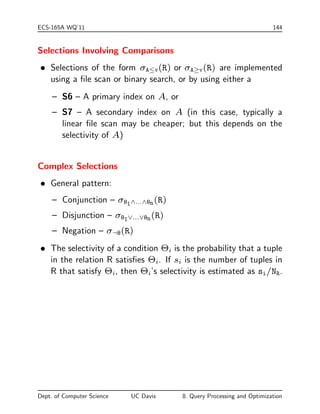
Selections Involving Comparisons 
 Selections of the form Av(R) or Av(R) are implemented 
using a
le scan or binary search, or by using either a 
{ S6 { A primary index on A, or 
{ S7 { A secondary index on A (in this case, typically a 
linear
le scan may be cheaper; but this depends on the 
selectivity of A) 
Complex Selections 
 General pattern: 
{ Conjunction { 1^:::^n(R) 
{ Disjunction { 1_:::_n(R) 
{ Negation { :(R) 
 The selectivity of a condition i is the probability that a tuple 
in the relation R satis
es i. If si is the number of tuples in 
R that satisfy i, then i's selectivity is estimated as si=NR. 
Dept. of Computer Science UC Davis 8. Query Processing and Optimization
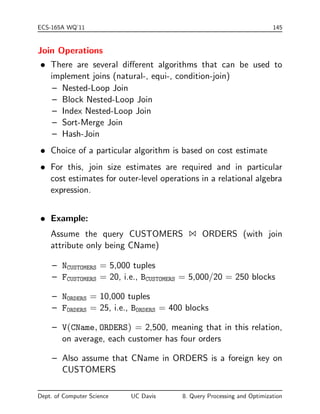
ECS-165A WQ'11 145 
Join Operations 
 There are several dierent algorithms that can be used to 
implement joins (natural-, equi-, condition-join) 
{ Nested-Loop Join 
{ Block Nested-Loop Join 
{ Index Nested-Loop Join 
{ Sort-Merge Join 
{ Hash-Join 
 Choice of a particular algorithm is based on cost estimate 
 For this, join size estimates are required and in particular 
cost estimates for outer-level operations in a relational algebra 
expression. 
 Example: 
Assume the query CUSTOMERS 1 ORDERS (with join 
attribute only being CName) 
{ NCUSTOMERS = 5,000 tuples 
{ FCUSTOMERS = 20, i.e., BCUSTOMERS = 5,000/20 = 250 blocks 
{ NORDERS = 10,000 tuples 
{ FORDERS = 25, i.e., BORDERS = 400 blocks 
{ V(CName; ORDERS) = 2,500, meaning that in this relation, 
on average, each customer has four orders 
{ Also assume that CName in ORDERS is a foreign key on 
CUSTOMERS 
Dept. of Computer Science UC Davis 8. Query Processing and Optimization
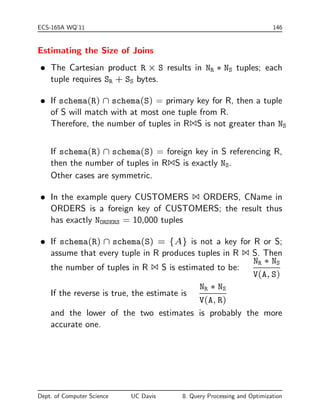
ECS-165A WQ'11 146 
Estimating the Size of Joins 
 The Cartesian product R  S results in NR  NS tuples; each 
tuple requires SR + SS bytes. 
 If schema(R)  schema(S) = primary key for R, then a tuple 
of S will match with at most one tuple from R. 
Therefore, the number of tuples in R1S is not greater than NS 
If schema(R)  schema(S) = foreign key in S referencing R, 
then the number of tuples in R1S is exactly NS. 
Other cases are symmetric. 
 In the example query CUSTOMERS 1 ORDERS, CName in 
ORDERS is a foreign key of CUSTOMERS; the result thus 
has exactly NORDERS = 10,000 tuples 
 If schema(R)  schema(S) = fAg is not a key for R or S; 
assume that every tuple in R produces tuples in R 1 S. Then 
the number of tuples in R 1 S is estimated to be: 
NR  NS 
V(A; S) 
If the reverse is true, the estimate is 
NR  NS 
V(A; R) 
and the lower of the two estimates is probably the more 
accurate one. 
Dept. of Computer Science UC Davis 8. Query Processing and Optimization
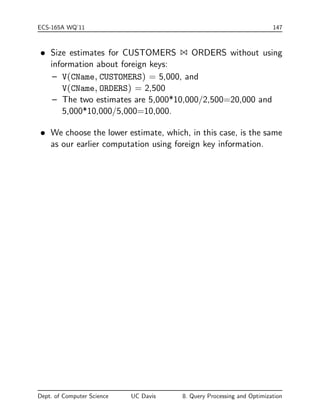
ECS-165A WQ'11 147 
 Size estimates for CUSTOMERS 1 ORDERS without using 
information about foreign keys: 
{ V(CName; CUSTOMERS) = 5,000, and 
V(CName; ORDERS) = 2,500 
{ The two estimates are 5,000*10,000/2,500=20,000 and 
5,000*10,000/5,000=10,000. 
 We choose the lower estimate, which, in this case, is the same 
as our earlier computation using foreign key information. 
Dept. of Computer Science UC Davis 8. Query Processing and Optimization
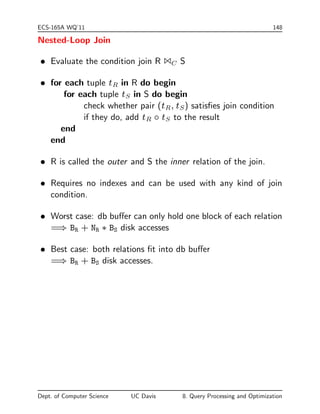
ECS-165A WQ'11 148 
Nested-Loop Join 
 Evaluate the condition join R 1C S 
 for each tuple tR in R do begin 
for each tuple tS in S do begin 
check whether pair (tR; tS) satis
es join condition 
if they do, add tR  tS to the result 
end 
end 
 R is called the outer and S the inner relation of the join. 
 Requires no indexes and can be used with any kind of join 
condition. 
 Worst case: db buer can only hold one block of each relation 
=) BR + NR  BS disk accesses 
 Best case: both relations
t into db buer 
=) BR + BS disk accesses. 
Dept. of Computer Science UC Davis 8. Query Processing and Optimization
ECS-165A WQ'11 149 
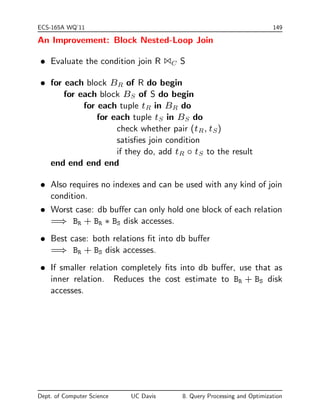
An Improvement: Block Nested-Loop Join 
 Evaluate the condition join R 1C S 
 for each block BR of R do begin 
for each block BS of S do begin 
for each tuple tR in BR do 
for each tuple tS in BS do 
check whether pair (tR; tS) 
satis
es join condition 
if they do, add tR  tS to the result 
end end end end 
 Also requires no indexes and can be used with any kind of join 
condition. 
 Worst case: db buer can only hold one block of each relation 
=) BR + BR  BS disk accesses. 
 Best case: both relations
t into db buer 
=) BR + BS disk accesses. 
 If smaller relation completely

8 query

  • 1.
    ECS-165A WQ'11 136 8. Query Processing Goals: Understand the basic concepts underlying the steps in query processing and optimization and estimating query processing cost; apply query optimization techniques; Contents: Overview Catalog Information for Cost Estimation Measures of Query Cost Selection Join Operations Other Operations Evaluation and Transformation of Expressions Query Processing Optimization Task: Find an ecient physical query plan (aka execution plan) for an SQL query Goal: Minimize the evaluation time for the query, i.e., compute query result as fast as possible Cost Factors: Disk accesses, read/write operations, [I/O, page transfer] (CPU time is typically ignored) Dept. of Computer Science UC Davis 8. Query Processing and Optimization
  • 2.
    ECS-165A WQ'11 137 Basic Steps in Processing an SQL Query (System Catalogs) SQL Query Relational Algebra Expression Optimizer Statistics Query Result Evaluation Engine Execution Plan Data Files Parser Translator Parsing and Translating { Translate the query into its internal form (parse tree). This is then translated into an expression of the relational algebra. { Parser checks syntax, validates relations, attributes and access permissions Evaluation { The query execution engine takes a physical query plan (aka execution plan), executes the plan, and returns the result. Optimization: Find the cheapest execution plan for a query Dept. of Computer Science UC Davis 8. Query Processing and Optimization
  • 3.
    ECS-165A WQ'11 138 A relational algebra expression may have many equivalent expressions, e.g., CName(Price5000((CUSTOMERS 1 ORDERS) 1 OFFERS)) CName((CUSTOMERS 1 ORDERS) 1 (Price5000(OFFERS))) Representation as logical query plan (a tree): o o CName Price 5000 CName Price 5000 OFFERS ORDERS CUSTOMERS ORDERS OFFERS CUSTOMERS Non-leaf nodes operations of relational algebra (with parameters); Leaf nodes relations A relational algebra expression can be evaluated in many ways. An annotated expression specifying detailed evaluation strategy is called the execution plan (includes, e.g., whether index is used, join algorithms, . . . ) Among all semantically equivalent expressions, the one with the least costly evaluation plan is chosen. Cost estimate of a plan is based on statistical information in the system catalogs. Dept. of Computer Science UC Davis 8. Query Processing and Optimization
  • 4.
    ECS-165A WQ'11 139 Catalog Information for Cost Estimation Information about relations and attributes: NR: number of tuples in the relation R. BR: number of blocks that contain tuples of the relation R. SR: size of a tuple of R. FR: blocking factor; number of tuples from R that
  • 5.
    t into one block (FR = dNR=BRe) V(A; R): number of distinct values for attribute A in R. SC(A; R): selectivity of attribute A average number of tuples of R that satisfy an equality condition on A. SC(A; R) = NR=V(A; R). Information about indexes: HTI: number of levels in index I (B+-tree). LBI: number of blocks occupied by leaf nodes in index I (
  • 6.
    rst-level blocks). ValI: number of distinct values for the search key. Some relevant tables in the Oracle system catalogs: USER TABLES USER TAB COLUMNS USER INDEXES NUM ROWS NUM DISTINCT BLEVEL BLOCKS LOW VALUE LEAF BLOCKS EMPTY BLOCKS HIGH VALUE DISTINCT KEYS AVG SPACE DENSITY AVG LEAF BLOCKS PER KEY CHAIN CNT NUM BUCKETS AVG ROW LEN LAST ANALYZED Dept. of Computer Science UC Davis 8. Query Processing and Optimization
  • 7.
    ECS-165A WQ'11 140 Measures of Query Cost There are many possible ways to estimate cost, e.g., based on disk accesses, CPU time, or communication overhead. Disk access is the predominant cost (in terms of time); relatively easy to estimate; therefore, number of block transfers from/to disk is typically used as measure. { Simplifying assumption: each block transfer has the same cost. Cost of algorithm (e.g., for join or selection) depends on database buer size; more memory for DB buer reduces disk accesses. Thus DB buer size is a parameter for estimating cost. We refer to the cost estimate of algorithm S as cost(S). We do not consider cost of writing output to disk. Selection Operation A=a(R) where a is a constant value, A an attribute of R File Scan { search algorithms that locate and retrieve records that satisfy a selection condition S1 { Linear search cost(S1)= BR Dept. of Computer Science UC Davis 8. Query Processing and Optimization
  • 8.
    ECS-165A WQ'11 141 Selection Operation (cont.) S2 { Binary search, i.e., the
  • 9.
    le ordered basedon attribute A (primary index) cost(S2) = dlog2(BR)e + SC(A; R) FR 1 { dlog2(BR)e cost to locate the
  • 10.
    rst tuple usingbinary search { Second term blocks that contain records satisfying the selection. { If A is primary key, then SC(A; R) = 1, hence cost(S2) = dlog2(BR)e. Dept. of Computer Science UC Davis 8. Query Processing and Optimization
  • 11.
    ECS-165A WQ'11 142 Example (for Employee DB) { FEmployee = 10; V(Deptno; Employee) = 50 (dierent departments) { NEmployee = 10; 000 (Relation Employee has 10,000 tuples) { Assume selection Deptno=20(Employee) and Employee is sorted on search key Deptno : =) 10,000/50 = 200 tuples in Employee belong to Deptno 20; (assuming an equal distribution) 200/10 = 20 blocks for these tuples =) A binary search
  • 12.
  • 13.
    rst block wouldrequire dlog2(1; 000)e = 10 block accesses Total cost of binary search is 10+20 block accesses (versus 1,000 for linear search and Employee not sorted by Deptno). Dept. of Computer Science UC Davis 8. Query Processing and Optimization
  • 14.
    ECS-165A WQ'11 143 Index scan { search algorithms that use an index (here, a B+-tree); selection condition is on search key of index S3 { Primary index I for A, A primary key, equality A = a cost(S3) = HTI + 1 (only 1 tuple satis
  • 15.
    es condition) S4 { Primary index I on non-key A equality A = a cost(S4) = HTI + SC(A; R) FR S5 { Non-primary (non-clustered) index on non-key A, equality A = a cost(S5) = HTI + SC(A; R) Worst case: each matching record resides in a dierent block. Example (Cont.): { Assume primary (B+-tree) index for attribute Deptno { 200/10=20 blocks accesses are required to read Employee tuples { If B+-tree index stores 20 pointers per (inner) node, then the B+-tree index must have between 3 and 5 leaf nodes and the entire tree has a depth of 2 =) a total of 22 blocks must be read. Dept. of Computer Science UC Davis 8. Query Processing and Optimization
  • 16.
    ECS-165A WQ'11 144 Selections Involving Comparisons Selections of the form Av(R) or Av(R) are implemented using a
  • 17.
    le scan orbinary search, or by using either a { S6 { A primary index on A, or { S7 { A secondary index on A (in this case, typically a linear
  • 18.
    le scan maybe cheaper; but this depends on the selectivity of A) Complex Selections General pattern: { Conjunction { 1^:::^n(R) { Disjunction { 1_:::_n(R) { Negation { :(R) The selectivity of a condition i is the probability that a tuple in the relation R satis
  • 19.
    es i. Ifsi is the number of tuples in R that satisfy i, then i's selectivity is estimated as si=NR. Dept. of Computer Science UC Davis 8. Query Processing and Optimization
  • 20.
    ECS-165A WQ'11 145 Join Operations There are several dierent algorithms that can be used to implement joins (natural-, equi-, condition-join) { Nested-Loop Join { Block Nested-Loop Join { Index Nested-Loop Join { Sort-Merge Join { Hash-Join Choice of a particular algorithm is based on cost estimate For this, join size estimates are required and in particular cost estimates for outer-level operations in a relational algebra expression. Example: Assume the query CUSTOMERS 1 ORDERS (with join attribute only being CName) { NCUSTOMERS = 5,000 tuples { FCUSTOMERS = 20, i.e., BCUSTOMERS = 5,000/20 = 250 blocks { NORDERS = 10,000 tuples { FORDERS = 25, i.e., BORDERS = 400 blocks { V(CName; ORDERS) = 2,500, meaning that in this relation, on average, each customer has four orders { Also assume that CName in ORDERS is a foreign key on CUSTOMERS Dept. of Computer Science UC Davis 8. Query Processing and Optimization
  • 21.
    ECS-165A WQ'11 146 Estimating the Size of Joins The Cartesian product R S results in NR NS tuples; each tuple requires SR + SS bytes. If schema(R) schema(S) = primary key for R, then a tuple of S will match with at most one tuple from R. Therefore, the number of tuples in R1S is not greater than NS If schema(R) schema(S) = foreign key in S referencing R, then the number of tuples in R1S is exactly NS. Other cases are symmetric. In the example query CUSTOMERS 1 ORDERS, CName in ORDERS is a foreign key of CUSTOMERS; the result thus has exactly NORDERS = 10,000 tuples If schema(R) schema(S) = fAg is not a key for R or S; assume that every tuple in R produces tuples in R 1 S. Then the number of tuples in R 1 S is estimated to be: NR NS V(A; S) If the reverse is true, the estimate is NR NS V(A; R) and the lower of the two estimates is probably the more accurate one. Dept. of Computer Science UC Davis 8. Query Processing and Optimization
  • 22.
    ECS-165A WQ'11 147 Size estimates for CUSTOMERS 1 ORDERS without using information about foreign keys: { V(CName; CUSTOMERS) = 5,000, and V(CName; ORDERS) = 2,500 { The two estimates are 5,000*10,000/2,500=20,000 and 5,000*10,000/5,000=10,000. We choose the lower estimate, which, in this case, is the same as our earlier computation using foreign key information. Dept. of Computer Science UC Davis 8. Query Processing and Optimization
  • 23.
    ECS-165A WQ'11 148 Nested-Loop Join Evaluate the condition join R 1C S for each tuple tR in R do begin for each tuple tS in S do begin check whether pair (tR; tS) satis
  • 24.
    es join condition if they do, add tR tS to the result end end R is called the outer and S the inner relation of the join. Requires no indexes and can be used with any kind of join condition. Worst case: db buer can only hold one block of each relation =) BR + NR BS disk accesses Best case: both relations
  • 25.
    t into dbbuer =) BR + BS disk accesses. Dept. of Computer Science UC Davis 8. Query Processing and Optimization
  • 26.
    ECS-165A WQ'11 149 An Improvement: Block Nested-Loop Join Evaluate the condition join R 1C S for each block BR of R do begin for each block BS of S do begin for each tuple tR in BR do for each tuple tS in BS do check whether pair (tR; tS) satis
  • 27.
    es join condition if they do, add tR tS to the result end end end end Also requires no indexes and can be used with any kind of join condition. Worst case: db buer can only hold one block of each relation =) BR + BR BS disk accesses. Best case: both relations
  • 28.
    t into dbbuer =) BR + BS disk accesses. If smaller relation completely