Chapter 3Chapter 3
Tuple and Domain Relational
Calculus
Tuple Relational CalculusTuple Relational Calculus
What is Tuple RelationalWhat is Tuple Relational
Calculus?Calculus?
 It is a non procedural query language: Describes
the desired information without giving a specific
procedure for obtaining that information.
 A query in tuple relational calculus is expresses
as:
{t | P(t)}
This represents a set of all tuples t such that
predicate P is true for t.
Sample QueriesSample Queries
Finding the branch – name, loan – number,
and amount for loans of over $ 1200
{t | t € loan t[amount] > 1200}
In English this query would mean: The set
of tuples t where t belongs to the loan
relation and the loan amount for each t is
greater than $ 1200.
Sample queries(cont….)Sample queries(cont….)
 Finding the loan – number for each loan of an
amount greater than $1200.
{t | З s € loan (t[loan – number] = s[loan –
number] s[amount > 1200)}
In English we would read the preceding statement
as “ The set of all tuples t such that there exists a
tuple s in relation loan for which the values of t
and s for the loan – number attribute are equal,
and the value of s for the amount attribute is
greater than $1200.”
Sample Queries(cont….)Sample Queries(cont….)
 The expression:
{t | -] r € customer (r[customer – name] =
t[customer – name]) (Џ u Є branch (u[branch –
city] = Brooklyn” => Э s Є depositor (t[customer
– name] = s[customer – name] З w Є account
(w[account – number- = s[account – number]
w[branch – name] = u[branch – name]))))}
In English, would mean “The set of all customers( i.e
customer name tuples t) such that for all tuples u in the
branch relation, if the value of u on attribute branch – city
is Brooklyn, then the customer has an account at the
branch whose name appears in the branch name attribute
of u”
Formal DefinitionFormal Definition
 As shown earlier, a tuple relational calculus expression is
of the form
{t | P(t)}
Where P is a formula.
 A formula may contain several tuple variables.
 A tuple variable is said to be a free variable unless it is
quantified by a З(there exists) or Џ(for all).
 Tuple variables that are quantified by З or Џ are called
bound variables.
 For ex, in the expression:
t Є loan З s Є customer(t[branch – name] = s[branch
– name])
t is a free variable and s is a bound variable.
Formal definition(cont….)Formal definition(cont….)
 A formula in relational calculus is made up of
atoms.
 An atom has one of the following forms.
1. S Є r, where s is a tuple variable and r is a relation.
2. S[x] © u[y], where s and u are tuple variables, x is an
attribute on which s is defined, y is an attribute on which
u is defined, and © is the comparison operator. It is
required that x and y have domains that can be compared
using ©.
3. S[x] © c, where s is a tuple variable, x is an attribute on
which s is defined, © is a comparison operator, and c is a
constant in the domain of x.
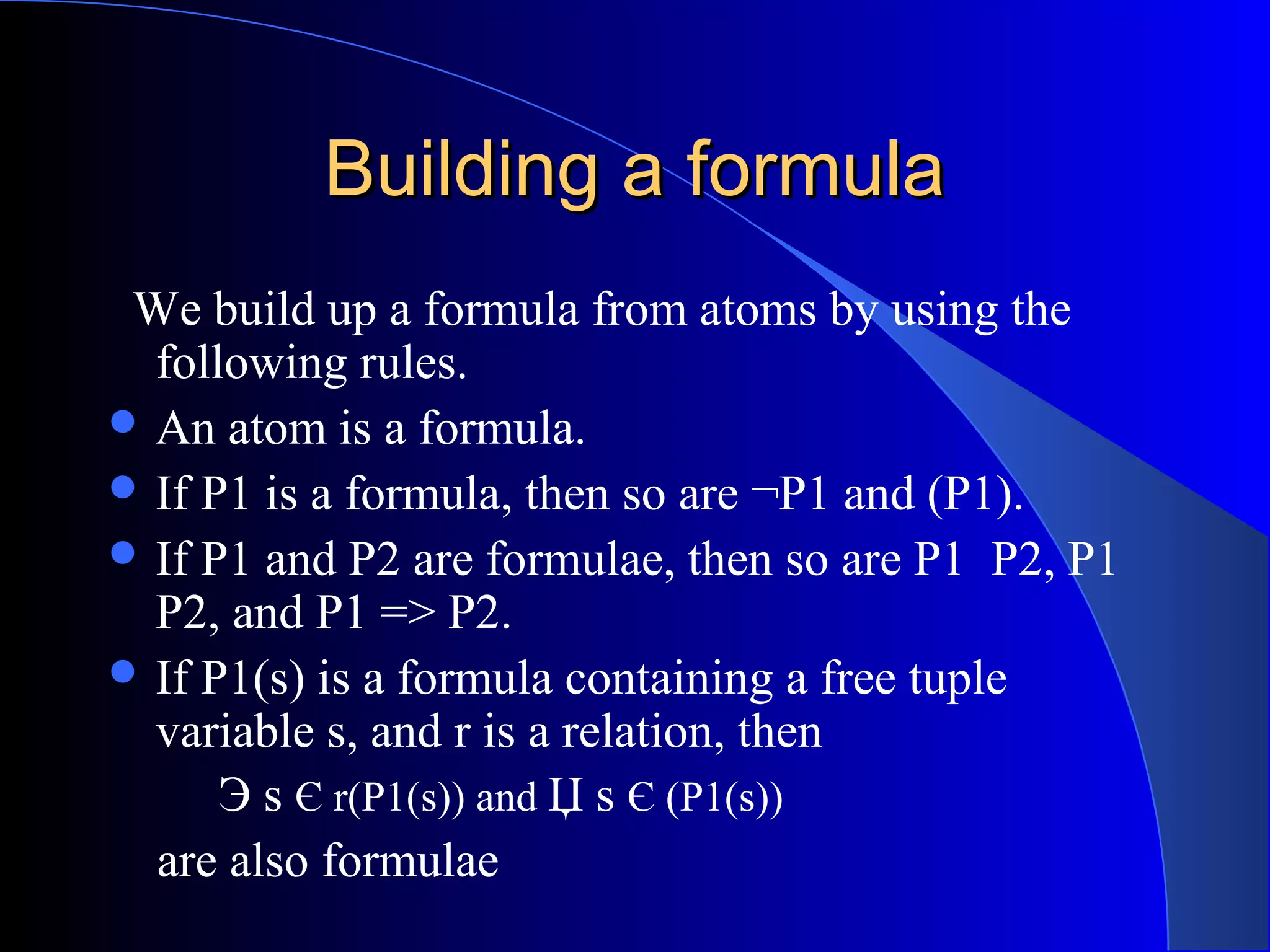
Building a formulaBuilding a formula
We build up a formula from atoms by using the
following rules.
 An atom is a formula.
 If P1 is a formula, then so are ¬P1 and (P1).
 If P1 and P2 are formulae, then so are P1 P2, P1
P2, and P1 => P2.
 If P1(s) is a formula containing a free tuple
variable s, and r is a relation, then
Э s Є r(P1(s)) and Џ s Є (P1(s))
are also formulae
Safety of Expressions – TheSafety of Expressions – The
concept of domainconcept of domain
 A tuple relational calculus may generate an
infinite relation. For ex:
{t | ¬(t Є loan)}
There are infinitely many tuples that are not in loan.
 To address this issue, we use the concept of domain of
tuple relational formula, P.
The domain of P, denoted dom(P) , is a set of all value
referenced by P.These include values mentioned in P itself,
as well as the values that appear in a tuple of a relation
mentioned in P.
For ex: dom(t Є loan t[amount] > 1200) is the set
containing 1200 as well as set of all values appearing in
loan.
Domain Relational CalculusDomain Relational Calculus
This is the second form of relational calculus
Uses domain variables that take on values
from an attribute domain, rather than values
for an entire tuple.
Closely related to tuple relational calculus.
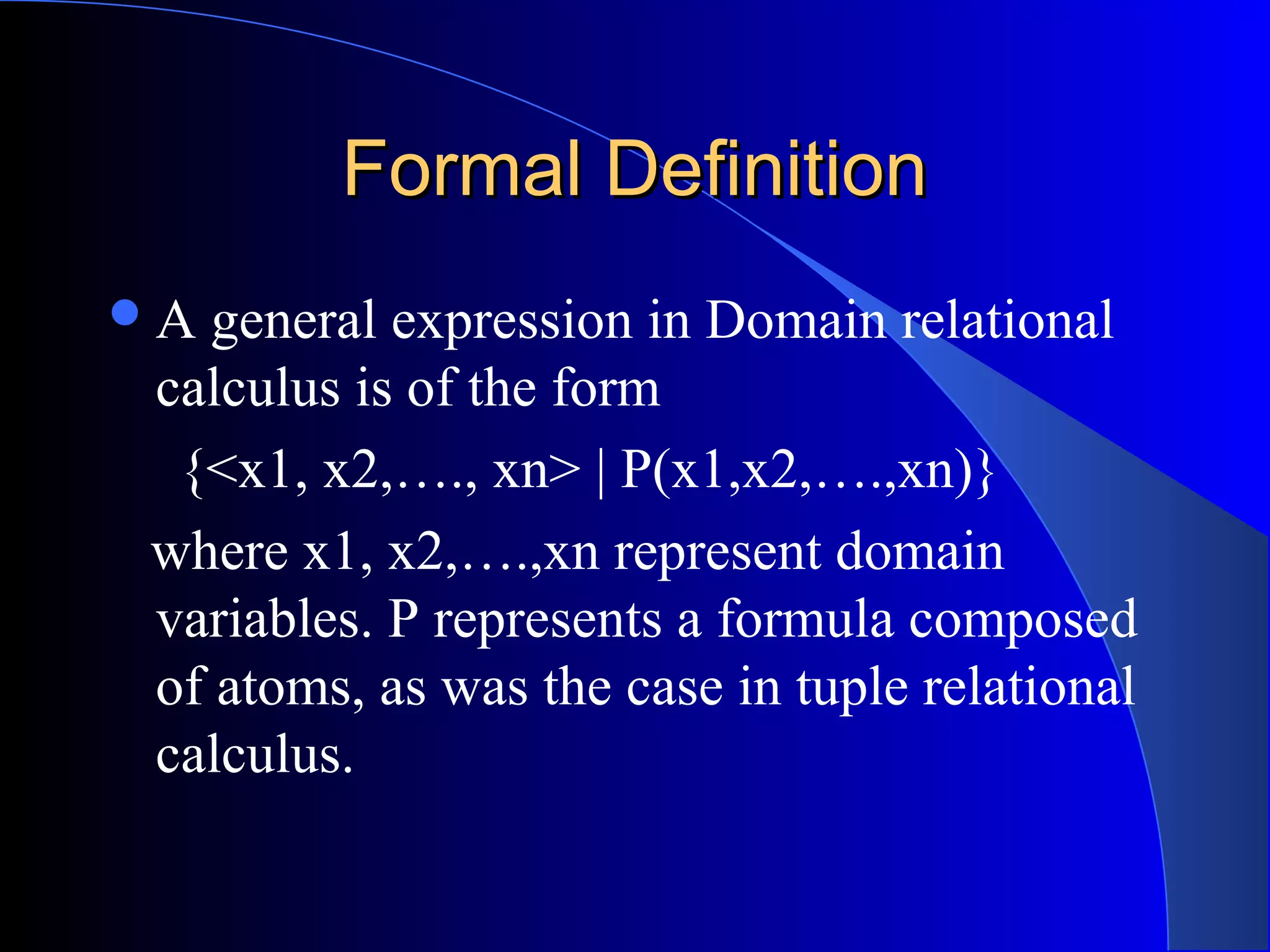
Formal DefinitionFormal Definition
A general expression in Domain relational
calculus is of the form
{<x1, x2,…., xn> | P(x1,x2,….,xn)}
where x1, x2,….,xn represent domain
variables. P represents a formula composed
of atoms, as was the case in tuple relational
calculus.
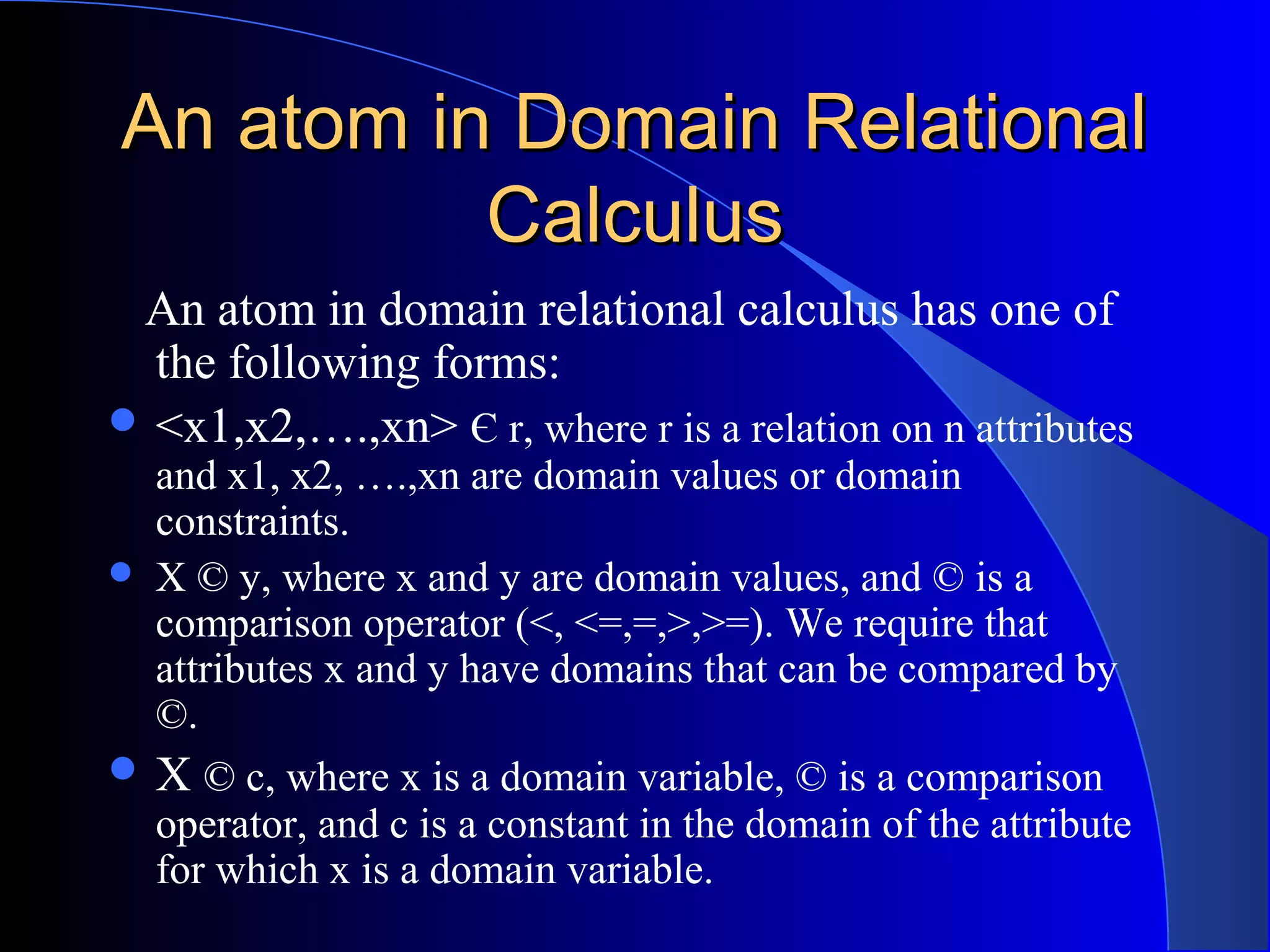
An atom in Domain RelationalAn atom in Domain Relational
CalculusCalculus
An atom in domain relational calculus has one of
the following forms:
 <x1,x2,….,xn> Є r, where r is a relation on n attributes
and x1, x2, ….,xn are domain values or domain
constraints.
 X © y, where x and y are domain values, and © is a
comparison operator (<, <=,=,>,>=). We require that
attributes x and y have domains that can be compared by
©.
 X © c, where x is a domain variable, © is a comparison
operator, and c is a constant in the domain of the attribute
for which x is a domain variable.
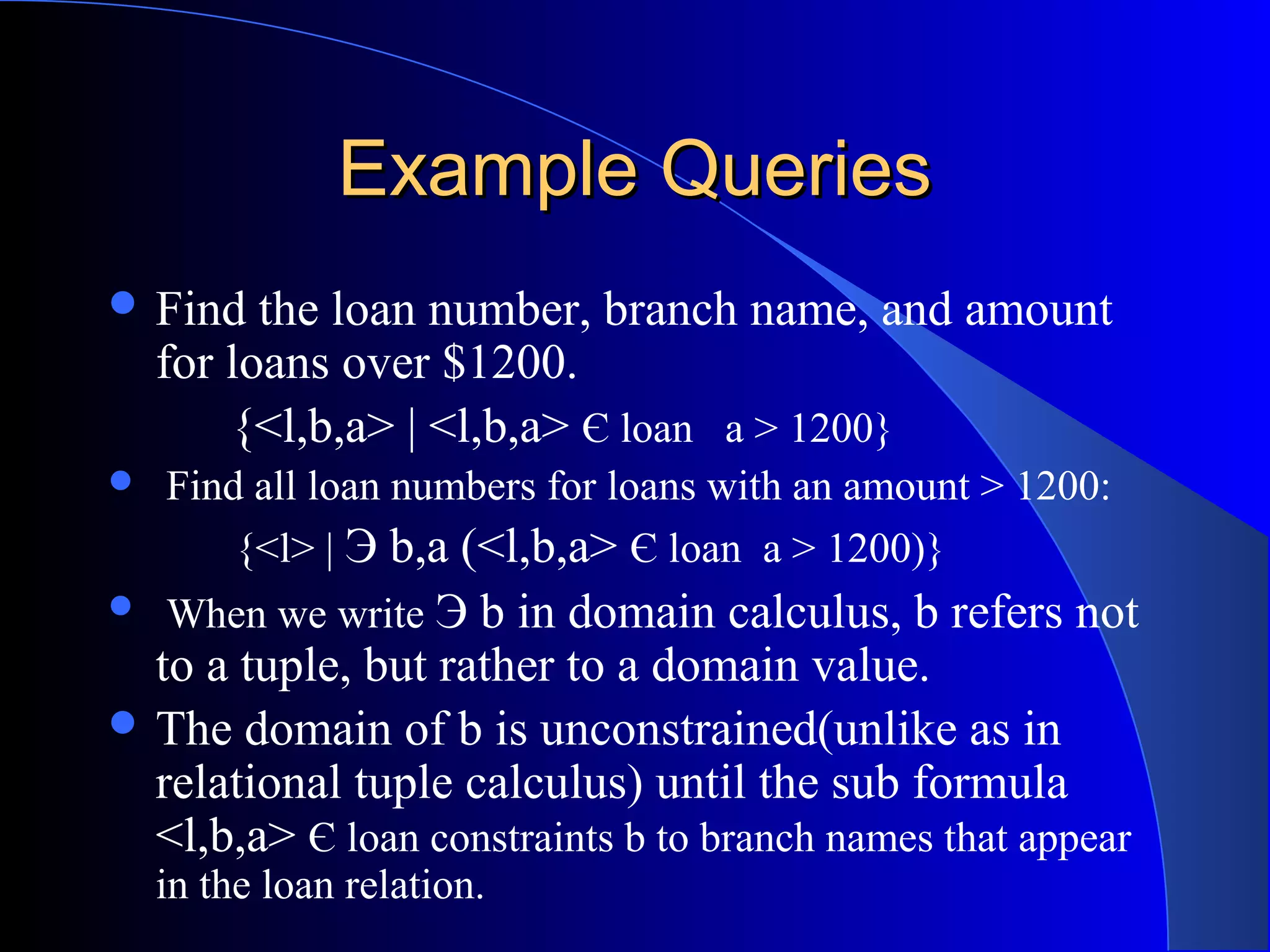
Example QueriesExample Queries
 Find the loan number, branch name, and amount
for loans over $1200.
{<l,b,a> | <l,b,a> Є loan a > 1200}
 Find all loan numbers for loans with an amount > 1200:
{<l> | Э b,a (<l,b,a> Є loan a > 1200)}
 When we write Э b in domain calculus, b refers not
to a tuple, but rather to a domain value.
 The domain of b is unconstrained(unlike as in
relational tuple calculus) until the sub formula
<l,b,a> Є loan constraints b to branch names that appear
in the loan relation.
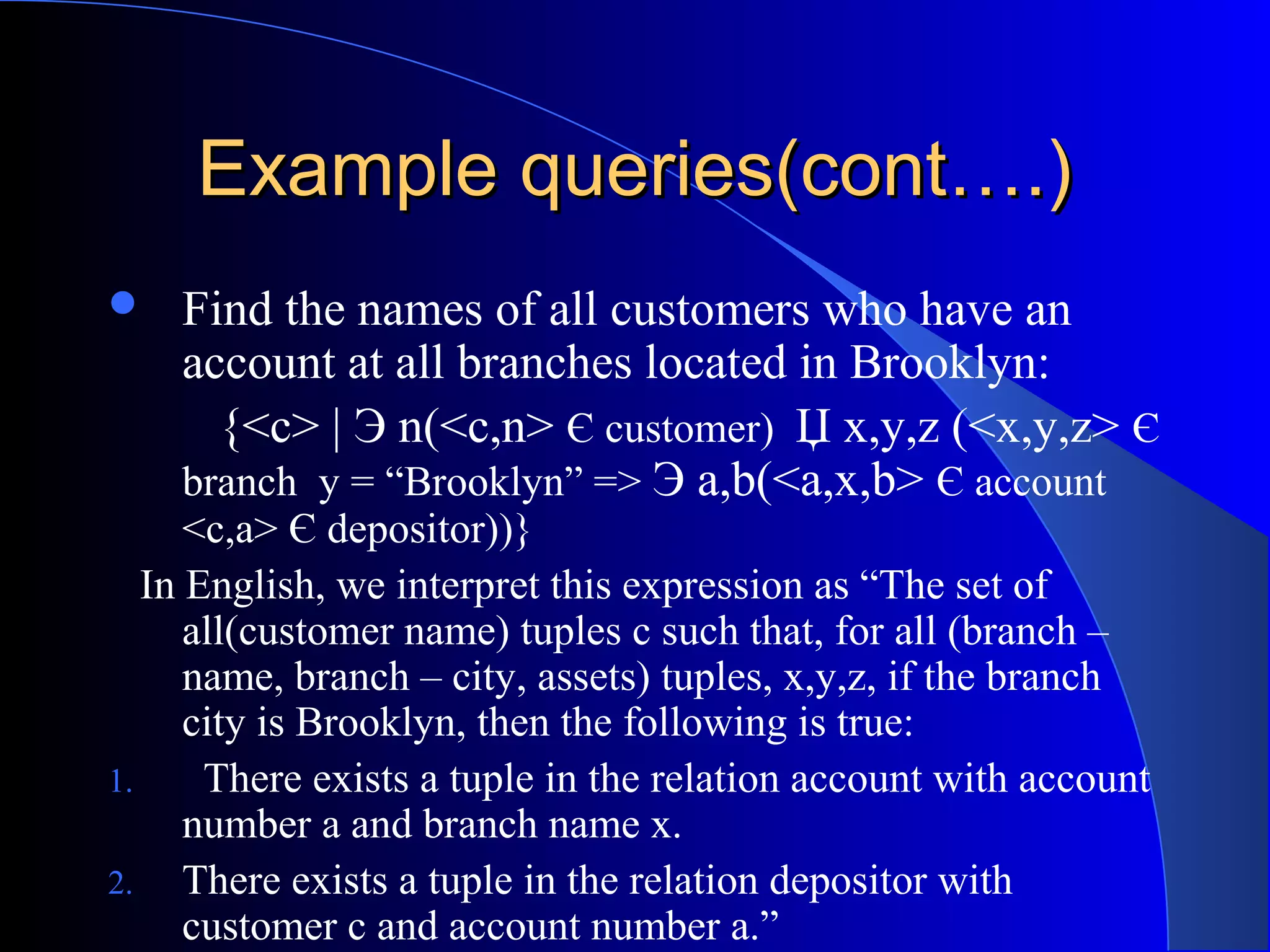
Example queries(cont….)Example queries(cont….)
 Find the names of all customers who have an
account at all branches located in Brooklyn:
{<c> | Э n(<c,n> Є customer) Џ x,y,z (<x,y,z> Є
branch y = “Brooklyn” => Э a,b(<a,x,b> Є account
<c,a> Є depositor))}
In English, we interpret this expression as “The set of
all(customer name) tuples c such that, for all (branch –
name, branch – city, assets) tuples, x,y,z, if the branch
city is Brooklyn, then the following is true:
1. There exists a tuple in the relation account with account
number a and branch name x.
2. There exists a tuple in the relation depositor with
customer c and account number a.”
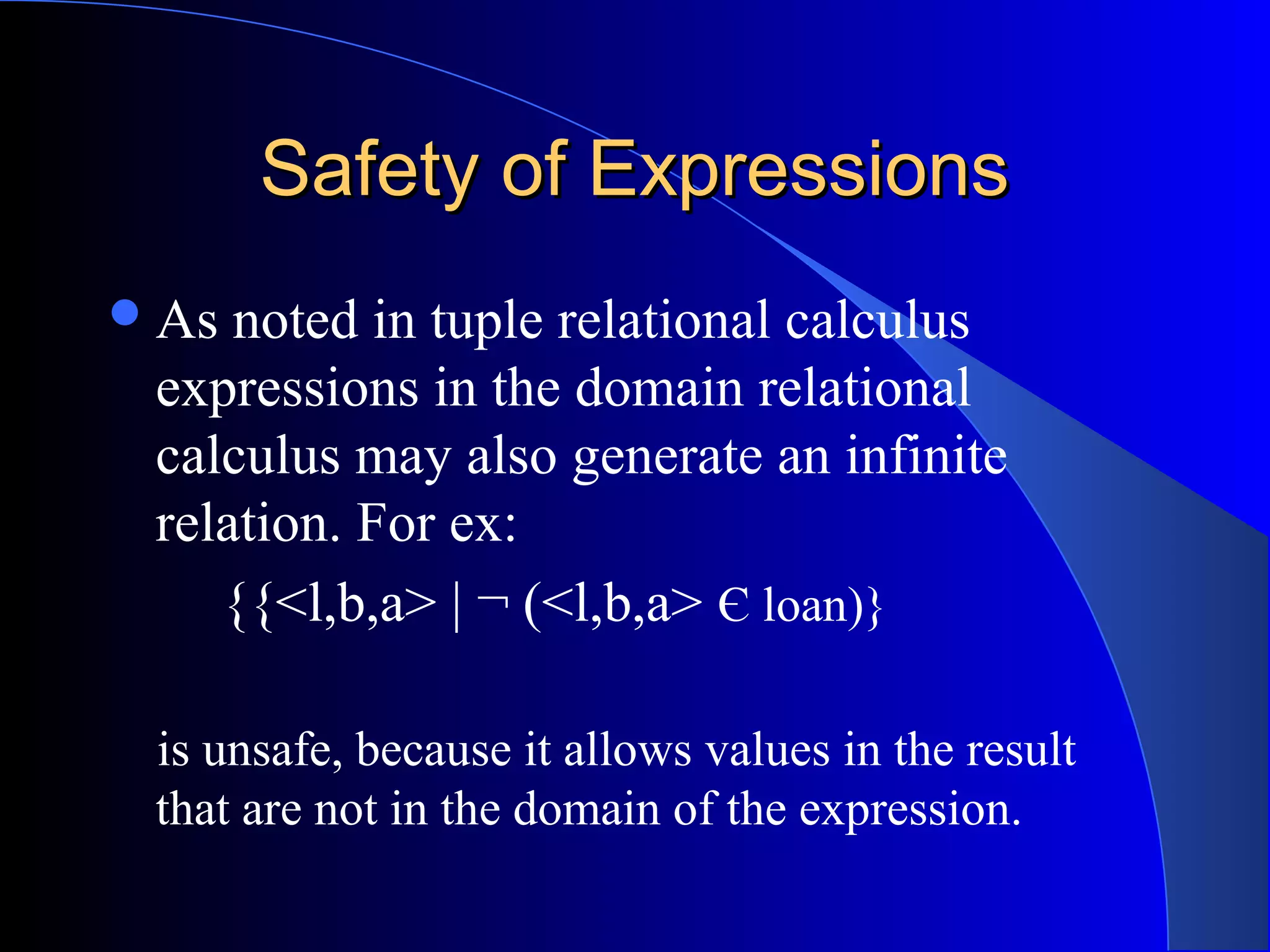
Safety of ExpressionsSafety of Expressions
As noted in tuple relational calculus
expressions in the domain relational
calculus may also generate an infinite
relation. For ex:
{{<l,b,a> | ¬ (<l,b,a> Є loan)}
is unsafe, because it allows values in the result
that are not in the domain of the expression.
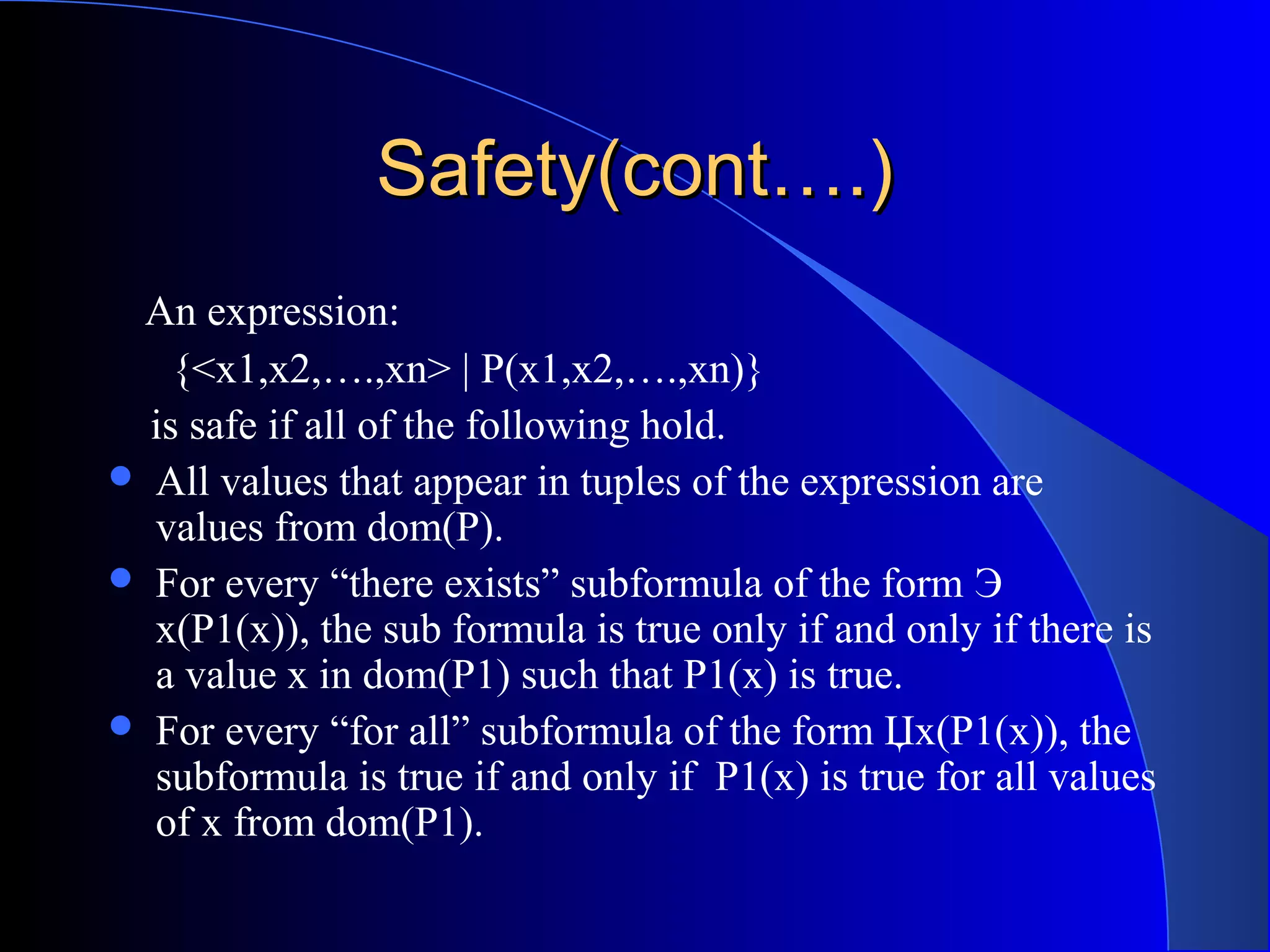
Safety(cont….)Safety(cont….)
An expression:
{<x1,x2,….,xn> | P(x1,x2,….,xn)}
is safe if all of the following hold.
 All values that appear in tuples of the expression are
values from dom(P).
 For every “there exists” subformula of the form Э
x(P1(x)), the sub formula is true only if and only if there is
a value x in dom(P1) such that P1(x) is true.
 For every “for all” subformula of the form Џx(P1(x)), the
subformula is true if and only if P1(x) is true for all values
of x from dom(P1).

1643 y є r relational calculus-1

  • 1.
    Chapter 3Chapter 3 Tupleand Domain Relational Calculus
  • 2.
    Tuple Relational CalculusTupleRelational Calculus
  • 3.
    What is TupleRelationalWhat is Tuple Relational Calculus?Calculus?  It is a non procedural query language: Describes the desired information without giving a specific procedure for obtaining that information.  A query in tuple relational calculus is expresses as: {t | P(t)} This represents a set of all tuples t such that predicate P is true for t.
  • 4.
    Sample QueriesSample Queries Findingthe branch – name, loan – number, and amount for loans of over $ 1200 {t | t € loan t[amount] > 1200} In English this query would mean: The set of tuples t where t belongs to the loan relation and the loan amount for each t is greater than $ 1200.
  • 5.
    Sample queries(cont….)Sample queries(cont….) Finding the loan – number for each loan of an amount greater than $1200. {t | З s € loan (t[loan – number] = s[loan – number] s[amount > 1200)} In English we would read the preceding statement as “ The set of all tuples t such that there exists a tuple s in relation loan for which the values of t and s for the loan – number attribute are equal, and the value of s for the amount attribute is greater than $1200.”
  • 6.
    Sample Queries(cont….)Sample Queries(cont….) The expression: {t | -] r € customer (r[customer – name] = t[customer – name]) (Џ u Є branch (u[branch – city] = Brooklyn” => Э s Є depositor (t[customer – name] = s[customer – name] З w Є account (w[account – number- = s[account – number] w[branch – name] = u[branch – name]))))} In English, would mean “The set of all customers( i.e customer name tuples t) such that for all tuples u in the branch relation, if the value of u on attribute branch – city is Brooklyn, then the customer has an account at the branch whose name appears in the branch name attribute of u”
  • 7.
    Formal DefinitionFormal Definition As shown earlier, a tuple relational calculus expression is of the form {t | P(t)} Where P is a formula.  A formula may contain several tuple variables.  A tuple variable is said to be a free variable unless it is quantified by a З(there exists) or Џ(for all).  Tuple variables that are quantified by З or Џ are called bound variables.  For ex, in the expression: t Є loan З s Є customer(t[branch – name] = s[branch – name]) t is a free variable and s is a bound variable.
  • 8.
    Formal definition(cont….)Formal definition(cont….) A formula in relational calculus is made up of atoms.  An atom has one of the following forms. 1. S Є r, where s is a tuple variable and r is a relation. 2. S[x] © u[y], where s and u are tuple variables, x is an attribute on which s is defined, y is an attribute on which u is defined, and © is the comparison operator. It is required that x and y have domains that can be compared using ©. 3. S[x] © c, where s is a tuple variable, x is an attribute on which s is defined, © is a comparison operator, and c is a constant in the domain of x.
  • 9.
    Building a formulaBuildinga formula We build up a formula from atoms by using the following rules.  An atom is a formula.  If P1 is a formula, then so are ¬P1 and (P1).  If P1 and P2 are formulae, then so are P1 P2, P1 P2, and P1 => P2.  If P1(s) is a formula containing a free tuple variable s, and r is a relation, then Э s Є r(P1(s)) and Џ s Є (P1(s)) are also formulae
  • 10.
    Safety of Expressions– TheSafety of Expressions – The concept of domainconcept of domain  A tuple relational calculus may generate an infinite relation. For ex: {t | ¬(t Є loan)} There are infinitely many tuples that are not in loan.  To address this issue, we use the concept of domain of tuple relational formula, P. The domain of P, denoted dom(P) , is a set of all value referenced by P.These include values mentioned in P itself, as well as the values that appear in a tuple of a relation mentioned in P. For ex: dom(t Є loan t[amount] > 1200) is the set containing 1200 as well as set of all values appearing in loan.
  • 11.
    Domain Relational CalculusDomainRelational Calculus This is the second form of relational calculus Uses domain variables that take on values from an attribute domain, rather than values for an entire tuple. Closely related to tuple relational calculus.
  • 12.
    Formal DefinitionFormal Definition Ageneral expression in Domain relational calculus is of the form {<x1, x2,…., xn> | P(x1,x2,….,xn)} where x1, x2,….,xn represent domain variables. P represents a formula composed of atoms, as was the case in tuple relational calculus.
  • 13.
    An atom inDomain RelationalAn atom in Domain Relational CalculusCalculus An atom in domain relational calculus has one of the following forms:  <x1,x2,….,xn> Є r, where r is a relation on n attributes and x1, x2, ….,xn are domain values or domain constraints.  X © y, where x and y are domain values, and © is a comparison operator (<, <=,=,>,>=). We require that attributes x and y have domains that can be compared by ©.  X © c, where x is a domain variable, © is a comparison operator, and c is a constant in the domain of the attribute for which x is a domain variable.
  • 14.
    Example QueriesExample Queries Find the loan number, branch name, and amount for loans over $1200. {<l,b,a> | <l,b,a> Є loan a > 1200}  Find all loan numbers for loans with an amount > 1200: {<l> | Э b,a (<l,b,a> Є loan a > 1200)}  When we write Э b in domain calculus, b refers not to a tuple, but rather to a domain value.  The domain of b is unconstrained(unlike as in relational tuple calculus) until the sub formula <l,b,a> Є loan constraints b to branch names that appear in the loan relation.
  • 15.
    Example queries(cont….)Example queries(cont….) Find the names of all customers who have an account at all branches located in Brooklyn: {<c> | Э n(<c,n> Є customer) Џ x,y,z (<x,y,z> Є branch y = “Brooklyn” => Э a,b(<a,x,b> Є account <c,a> Є depositor))} In English, we interpret this expression as “The set of all(customer name) tuples c such that, for all (branch – name, branch – city, assets) tuples, x,y,z, if the branch city is Brooklyn, then the following is true: 1. There exists a tuple in the relation account with account number a and branch name x. 2. There exists a tuple in the relation depositor with customer c and account number a.”
  • 16.
    Safety of ExpressionsSafetyof Expressions As noted in tuple relational calculus expressions in the domain relational calculus may also generate an infinite relation. For ex: {{<l,b,a> | ¬ (<l,b,a> Є loan)} is unsafe, because it allows values in the result that are not in the domain of the expression.
  • 17.
    Safety(cont….)Safety(cont….) An expression: {<x1,x2,….,xn> |P(x1,x2,….,xn)} is safe if all of the following hold.  All values that appear in tuples of the expression are values from dom(P).  For every “there exists” subformula of the form Э x(P1(x)), the sub formula is true only if and only if there is a value x in dom(P1) such that P1(x) is true.  For every “for all” subformula of the form Џx(P1(x)), the subformula is true if and only if P1(x) is true for all values of x from dom(P1).