1
Query ProcessingQuery Processing
Overview
Measures of Query Cost
Selection Operation
Sorting
Join Operation
Other Operations
Evaluation of Expressions
2
Basic Steps in Query ProcessingBasic Steps in Query Processing
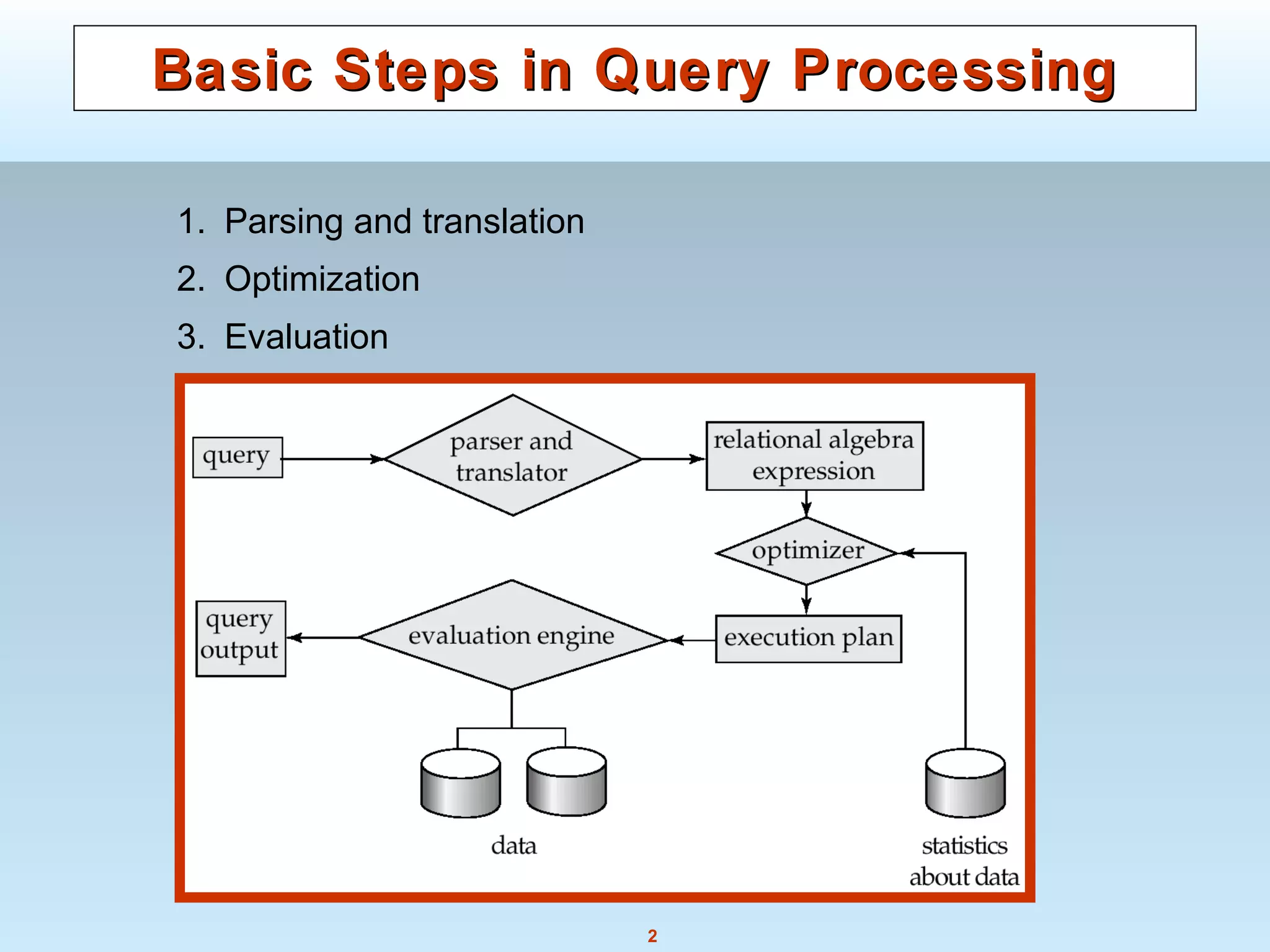
1. Parsing and translation
2. Optimization
3. Evaluation
3
Basic Steps in Query ProcessingBasic Steps in Query Processing
Parsing and translation
 translate the query into its internal form. This is then
translated into relational algebra.
 Parser checks syntax, verifies relations
Evaluation
 The query-execution engine takes a query-evaluation plan,
executes that plan, and returns the answers to the query.
4
Basic Steps in Query Processing :Basic Steps in Query Processing :
OptimizationOptimization
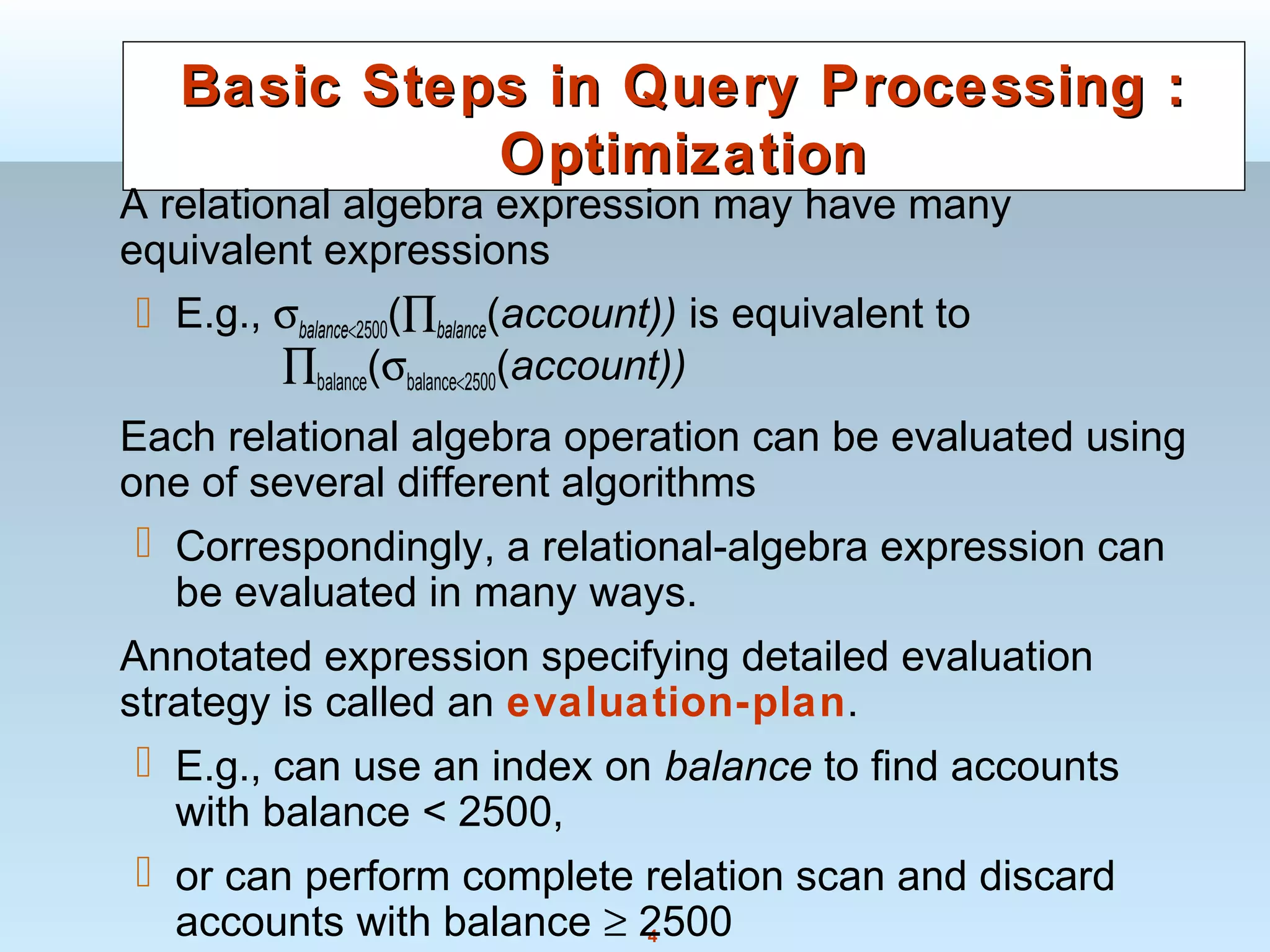
A relational algebra expression may have many
equivalent expressions
 E.g., σbalance<2500(∏balance(account)) is equivalent to
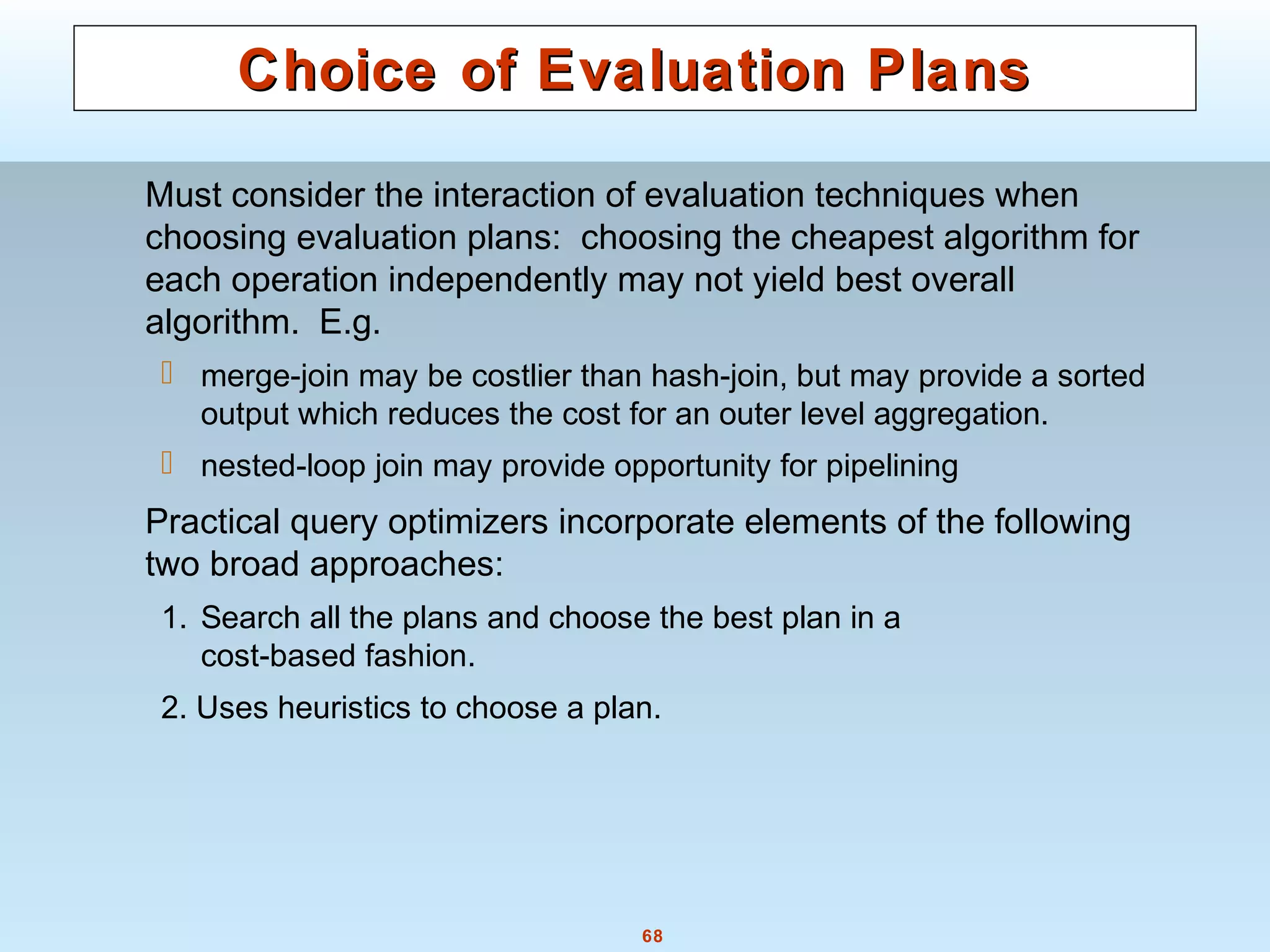
∏balance(σbalance<2500(account))
Each relational algebra operation can be evaluated using
one of several different algorithms
 Correspondingly, a relational-algebra expression can
be evaluated in many ways.
Annotated expression specifying detailed evaluation
strategy is called an evaluation-plan.
 E.g., can use an index on balance to find accounts
with balance < 2500,
 or can perform complete relation scan and discard
accounts with balance ≥ 2500
5
OptimizationOptimization
Query Optimization: Amongst all equivalent
evaluation plans choose the one with lowest
cost.
 Cost is estimated using statistical
information from the database catalog
e.g. number of tuples in each relation,
size of tuples, etc.
6
Measures of Query CostMeasures of Query Cost
Cost is generally measured as total elapsed
time for answering query
 Many factors contribute to time cost: disk
accesses, CPU, or even network
communication
Typically disk access is the predominant cost,
and is also relatively easy to estimate. It is
measured by taking into account
 Number of seeks * average-seek-cost
 Number of blocks read * average-block-
read-cost
 Number of blocks written * average-block-
write-cost
7
Measures of Query CostMeasures of Query Cost
For simplicity we just use number of block transfers from
disk as the cost measure
Costs depends on the size of the buffer in main memory
 Having more memory reduces need for disk access
 Amount of real memory available to buffer depends
on other concurrent OS processes, and hard to
determine ahead of actual execution
 We often use worst case estimates, assuming only
the minimum amount of memory needed for the
operation is available
Real systems take CPU cost into account, differentiate
between sequential and random I/O, and take buffer size
into account
8
Selection OperationSelection Operation
File scan – search algorithms that locate and retrieve records
that fulfill a selection condition.
Algorithm A1 (linear search). Scan each file block and test all
records to see whether they satisfy the selection condition.
 Cost estimate (number of disk blocks scanned) = br
br denotes number of blocks containing records from
relation r
 If selection is on a key attribute, cost = (br /2)
stop on finding record
 Linear search can be applied regardless of
selection condition or
ordering of records in the file, or
availability of indices
9
Selection OperationSelection Operation
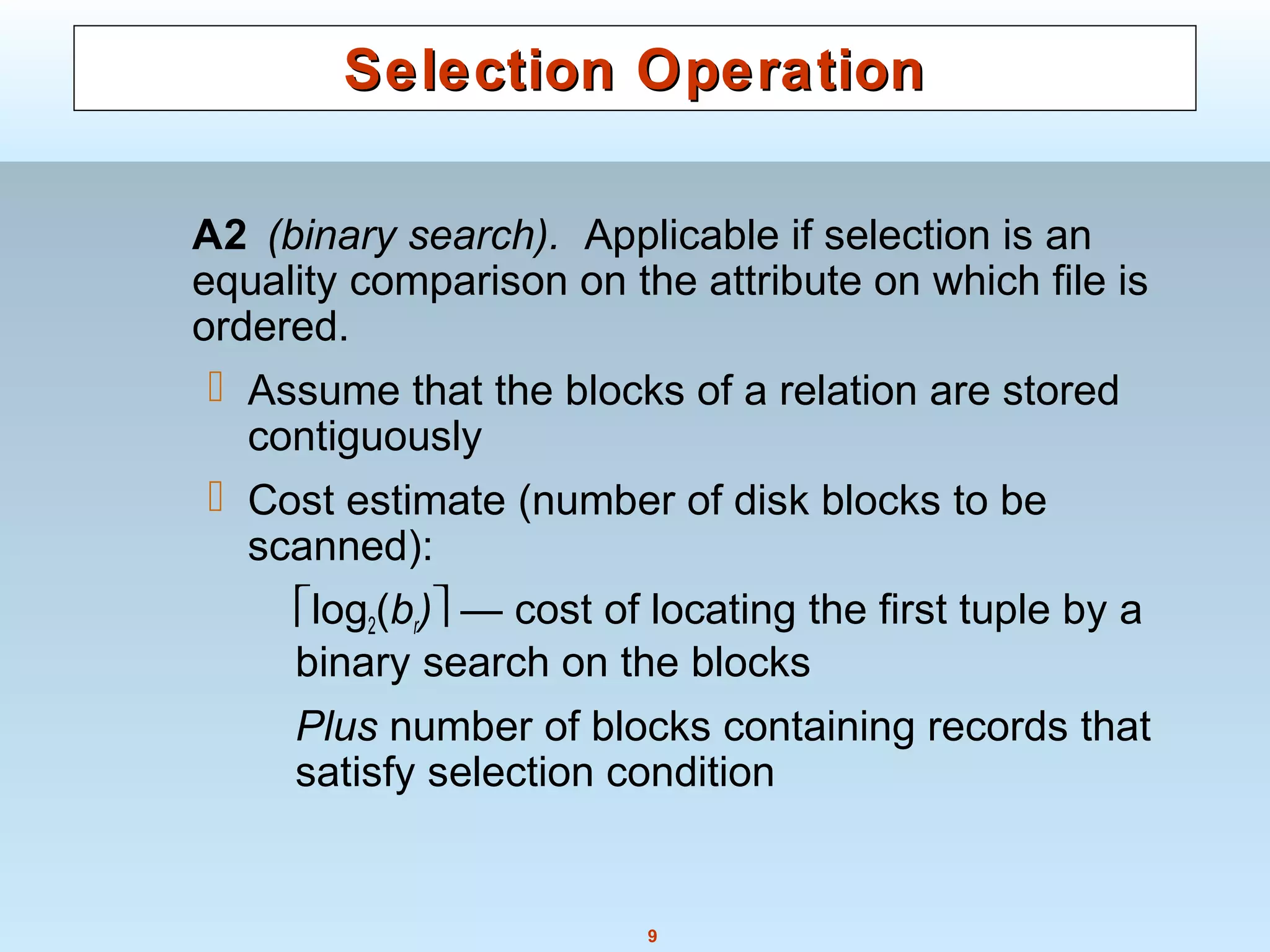
A2 (binary search). Applicable if selection is an
equality comparison on the attribute on which file is
ordered.
 Assume that the blocks of a relation are stored
contiguously
 Cost estimate (number of disk blocks to be
scanned):
log2(br) — cost of locating the first tuple by a
binary search on the blocks
Plus number of blocks containing records that
satisfy selection condition
10
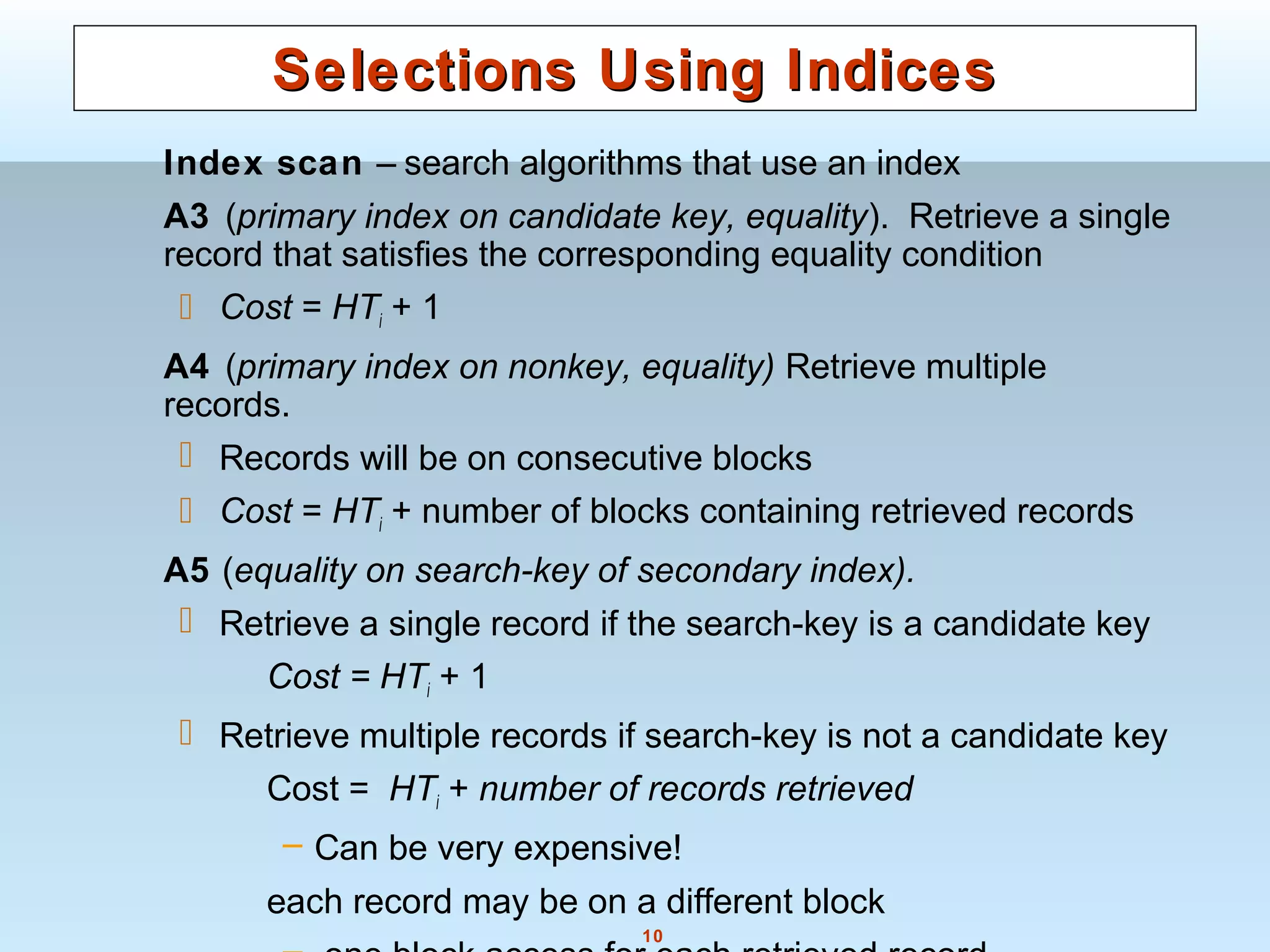
Selections Using IndicesSelections Using Indices
Index scan – search algorithms that use an index
A3 (primary index on candidate key, equality). Retrieve a single
record that satisfies the corresponding equality condition
 Cost = HTi + 1
A4 (primary index on nonkey, equality) Retrieve multiple
records.
 Records will be on consecutive blocks
 Cost = HTi + number of blocks containing retrieved records
A5 (equality on search-key of secondary index).
 Retrieve a single record if the search-key is a candidate key
Cost = HTi + 1
 Retrieve multiple records if search-key is not a candidate key
Cost = HTi + number of records retrieved
– Can be very expensive!
each record may be on a different block
11
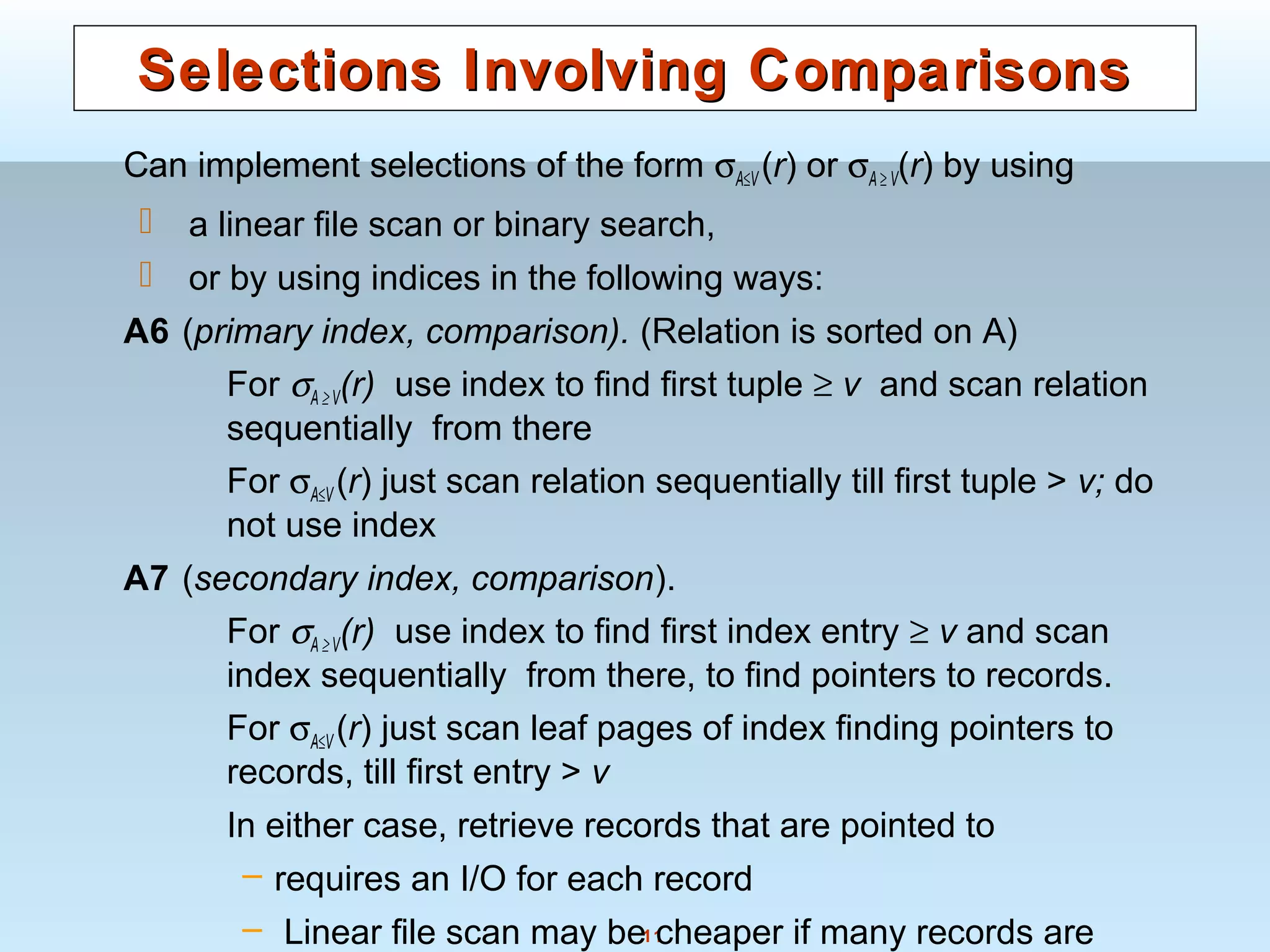
Selections Involving ComparisonsSelections Involving Comparisons
Can implement selections of the form σA≤V (r) or σA ≥ V(r) by using
 a linear file scan or binary search,
 or by using indices in the following ways:
A6 (primary index, comparison). (Relation is sorted on A)
For σA ≥ V(r) use index to find first tuple ≥ v and scan relation
sequentially from there
For σA≤V (r) just scan relation sequentially till first tuple > v; do
not use index
A7 (secondary index, comparison).
For σA ≥ V(r) use index to find first index entry ≥ v and scan
index sequentially from there, to find pointers to records.
For σA≤V (r) just scan leaf pages of index finding pointers to
records, till first entry > v
In either case, retrieve records that are pointed to
– requires an I/O for each record
– Linear file scan may be cheaper if many records are
12
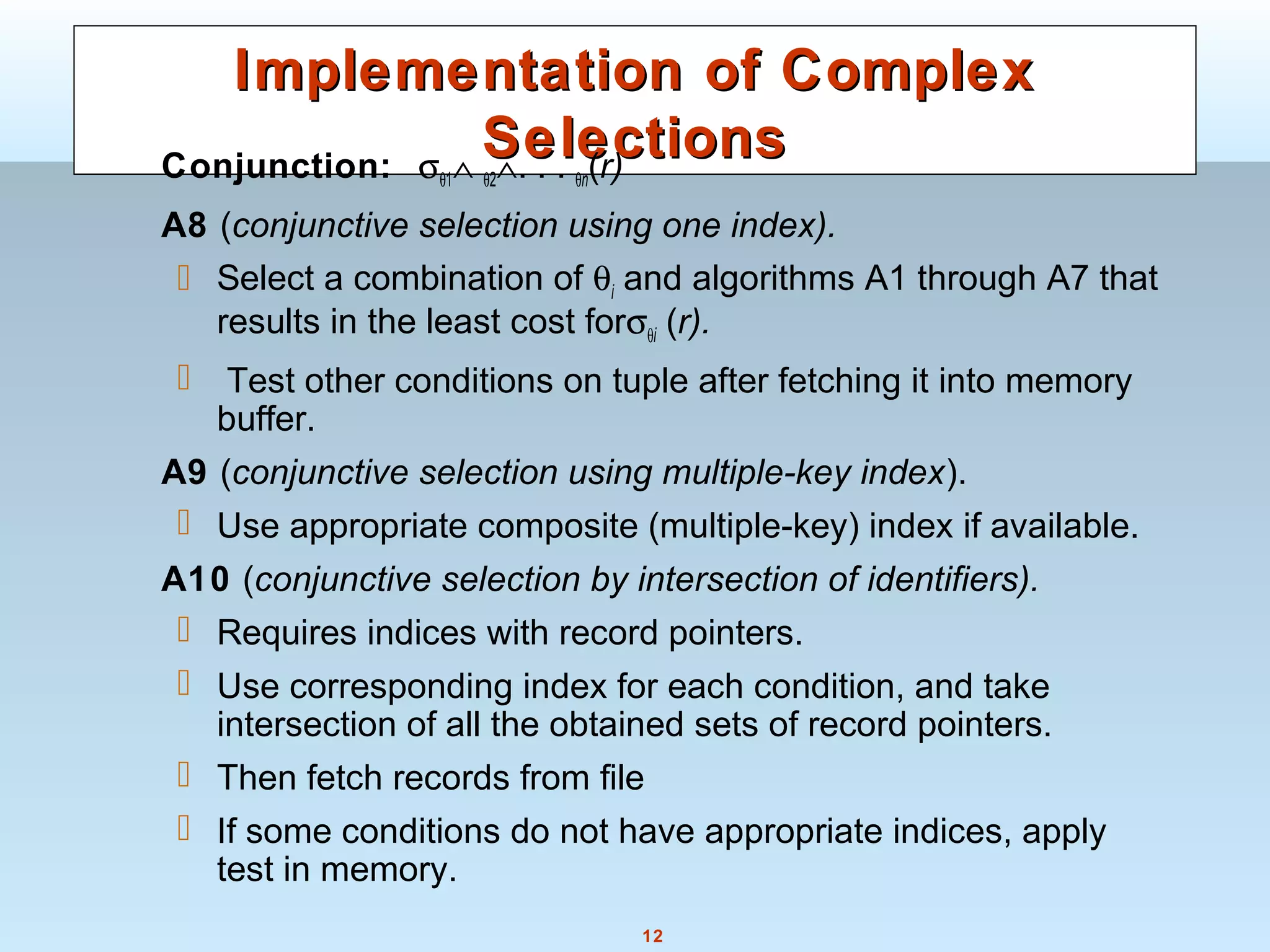
Implementation of ComplexImplementation of Complex
SelectionsSelectionsConjunction: σθ1∧ θ2∧. . . θn(r)
A8 (conjunctive selection using one index).
 Select a combination of θi and algorithms A1 through A7 that
results in the least cost forσθi (r).
 Test other conditions on tuple after fetching it into memory
buffer.
A9 (conjunctive selection using multiple-key index).
 Use appropriate composite (multiple-key) index if available.
A10 (conjunctive selection by intersection of identifiers).
 Requires indices with record pointers.
 Use corresponding index for each condition, and take
intersection of all the obtained sets of record pointers.
 Then fetch records from file
 If some conditions do not have appropriate indices, apply
test in memory.
13
Algorithms for Complex SelectionsAlgorithms for Complex Selections
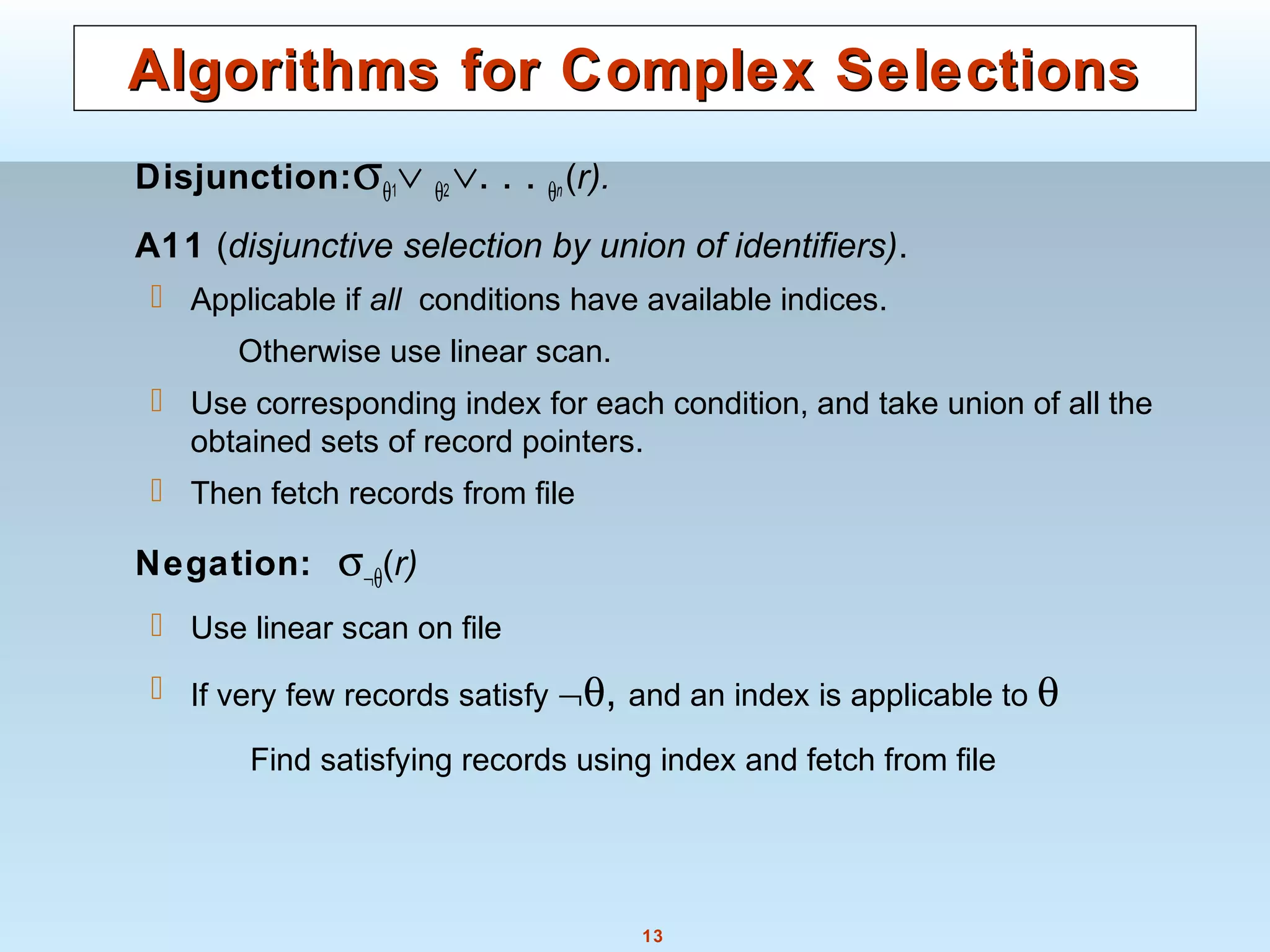
Disjunction:σθ1∨ θ2 ∨. . . θn(r).
A11 (disjunctive selection by union of identifiers).
 Applicable if all conditions have available indices.
Otherwise use linear scan.
 Use corresponding index for each condition, and take union of all the
obtained sets of record pointers.
 Then fetch records from file
Negation: σ¬θ(r)
 Use linear scan on file
 If very few records satisfy ¬θ, and an index is applicable to θ
Find satisfying records using index and fetch from file
14
SortingSorting
We may build an index on the relation, and then use the index to
read the relation in sorted order. May lead to one disk block
access for each tuple.
For relations that fit in memory, techniques like quicksort can be
used. For relations that don’t fit in memory, external
sort-merge is a good choice.
15
ExampleExample
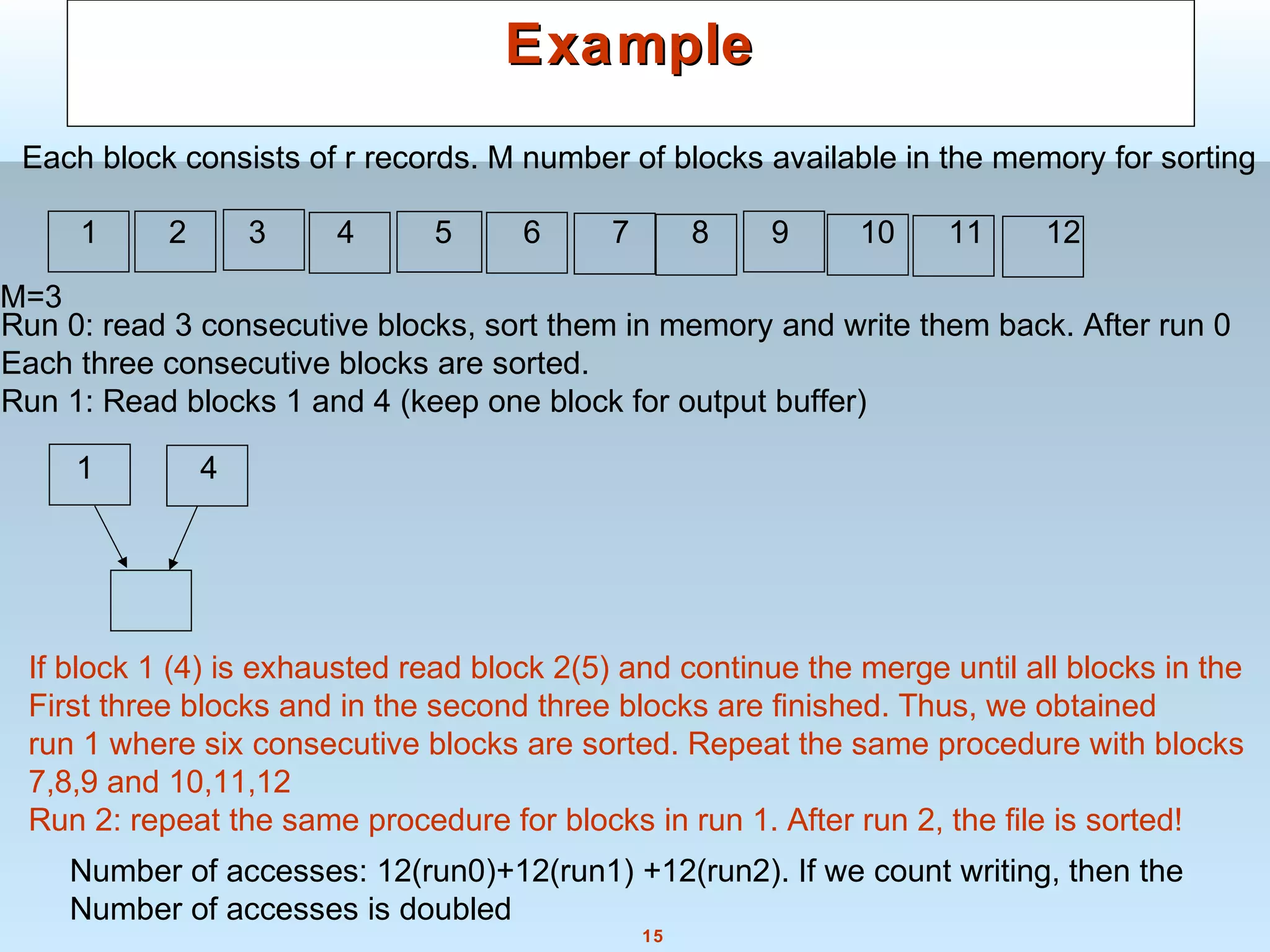
Each block consists of r records. M number of blocks available in the memory for sorting
M=3
1 2 3 4 5 6 7 8 9 10 11 12
Run 0: read 3 consecutive blocks, sort them in memory and write them back. After run 0
Each three consecutive blocks are sorted.
Run 1: Read blocks 1 and 4 (keep one block for output buffer)
1 4
If block 1 (4) is exhausted read block 2(5) and continue the merge until all blocks in the
First three blocks and in the second three blocks are finished. Thus, we obtained
run 1 where six consecutive blocks are sorted. Repeat the same procedure with blocks
7,8,9 and 10,11,12
Run 2: repeat the same procedure for blocks in run 1. After run 2, the file is sorted!
Number of accesses: 12(run0)+12(run1) +12(run2). If we count writing, then the
Number of accesses is doubled
16
External Sort-MergeExternal Sort-Merge
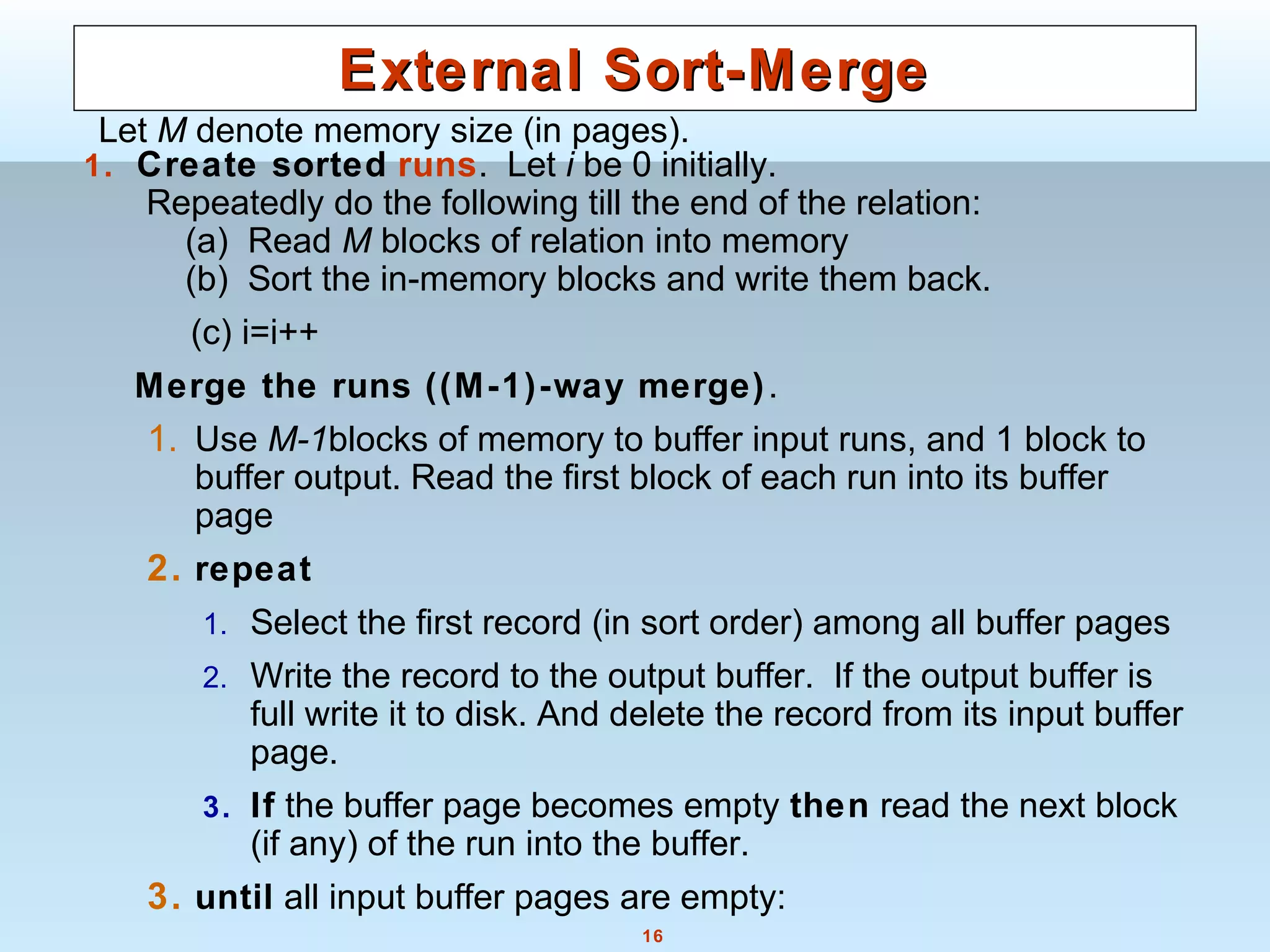
1. Create sorted runs. Let i be 0 initially.
Repeatedly do the following till the end of the relation:
(a) Read M blocks of relation into memory
(b) Sort the in-memory blocks and write them back.
(c) i=i++
Merge the runs ((M-1)-way merge).
1. Use M-1blocks of memory to buffer input runs, and 1 block to
buffer output. Read the first block of each run into its buffer
page
2. repeat
1. Select the first record (in sort order) among all buffer pages
2. Write the record to the output buffer. If the output buffer is
full write it to disk. And delete the record from its input buffer
page.
3. If the buffer page becomes empty then read the next block
(if any) of the run into the buffer.
3. until all input buffer pages are empty:
Let M denote memory size (in pages).
17
External Sort-MergeExternal Sort-Merge
If i ≥ M, several merge passes are required.
 In each pass, contiguous groups of M - 1
runs are merged.
 A pass reduces the number of runs by a
factor of M -1, and creates runs longer by
the same factor.
E.g. If M=11, and there are 90 runs,
one pass reduces the number of runs to
9, each 10 times the size of the initial
runs
 Repeated passes are performed till all
runs have been merged into one.
18
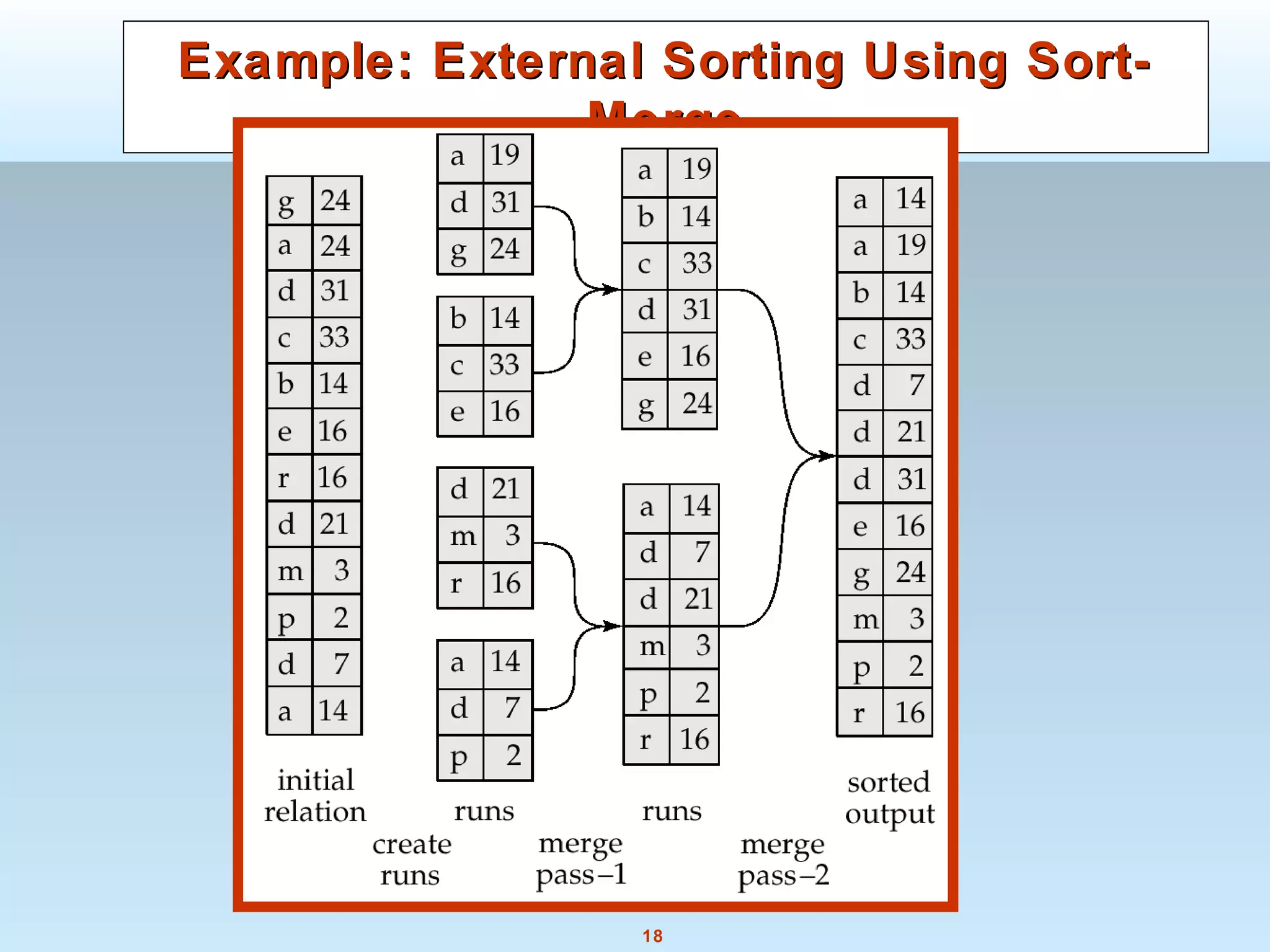
Example: External Sorting Using Sort-Example: External Sorting Using Sort-
MergeMerge
19
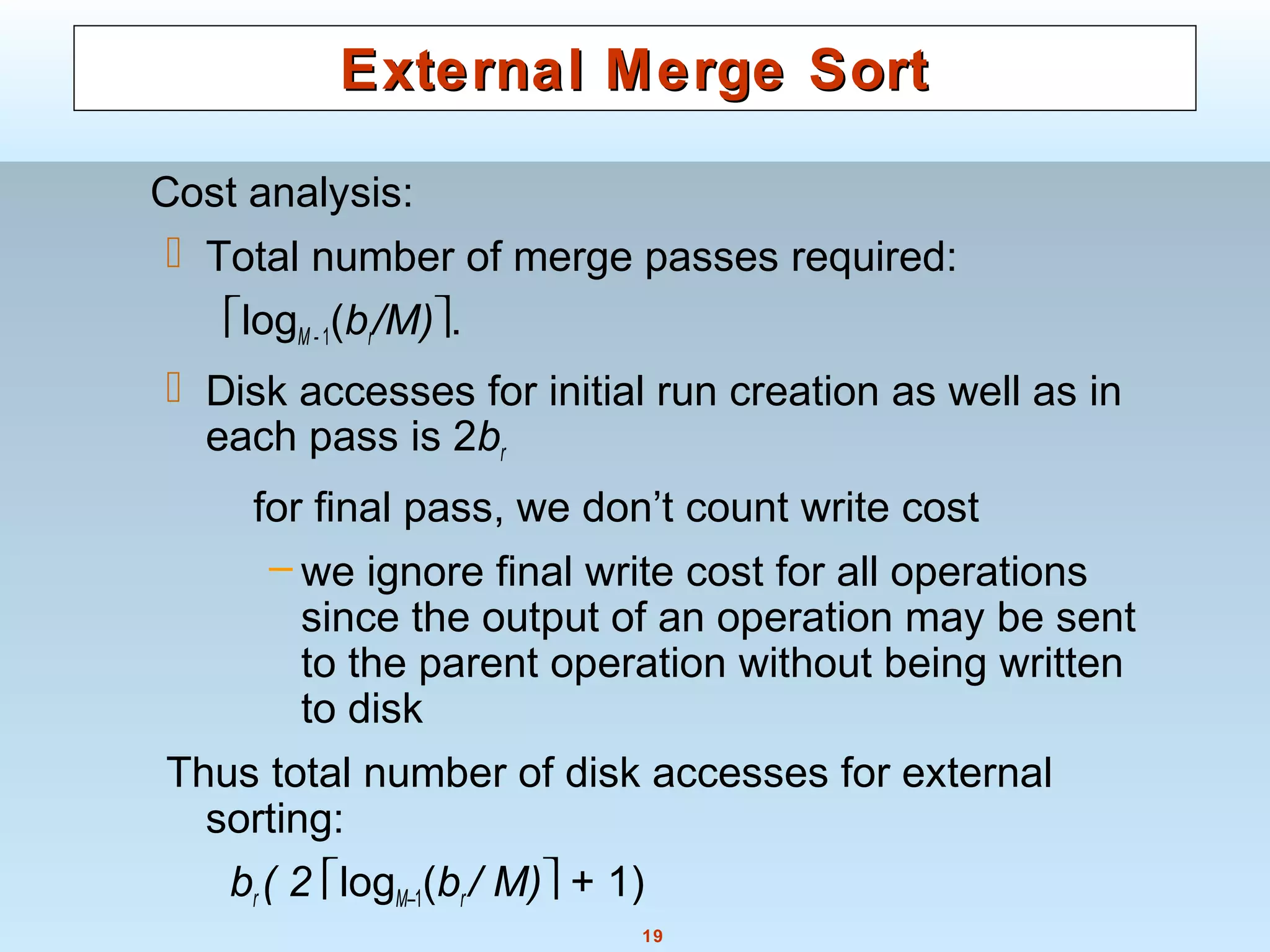
External Merge SortExternal Merge Sort
Cost analysis:
 Total number of merge passes required:
logM - 1(br/M).
 Disk accesses for initial run creation as well as in
each pass is 2br
for final pass, we don’t count write cost
– we ignore final write cost for all operations
since the output of an operation may be sent
to the parent operation without being written
to disk
Thus total number of disk accesses for external
sorting:
br ( 2 logM–1(br / M) + 1)
20
Join OperationJoin Operation
Several different algorithms to implement joins
 Nested-loop join
 Block nested-loop join
 Indexed nested-loop join
 Merge-join
 Hash-join
Choice based on cost estimate
Examples use the following information
 Number of records of customer: 10,000
depositor: 5000
 Number of blocks of customer: 400
depositor: 100
21
Nested-Loop JoinNested-Loop Join
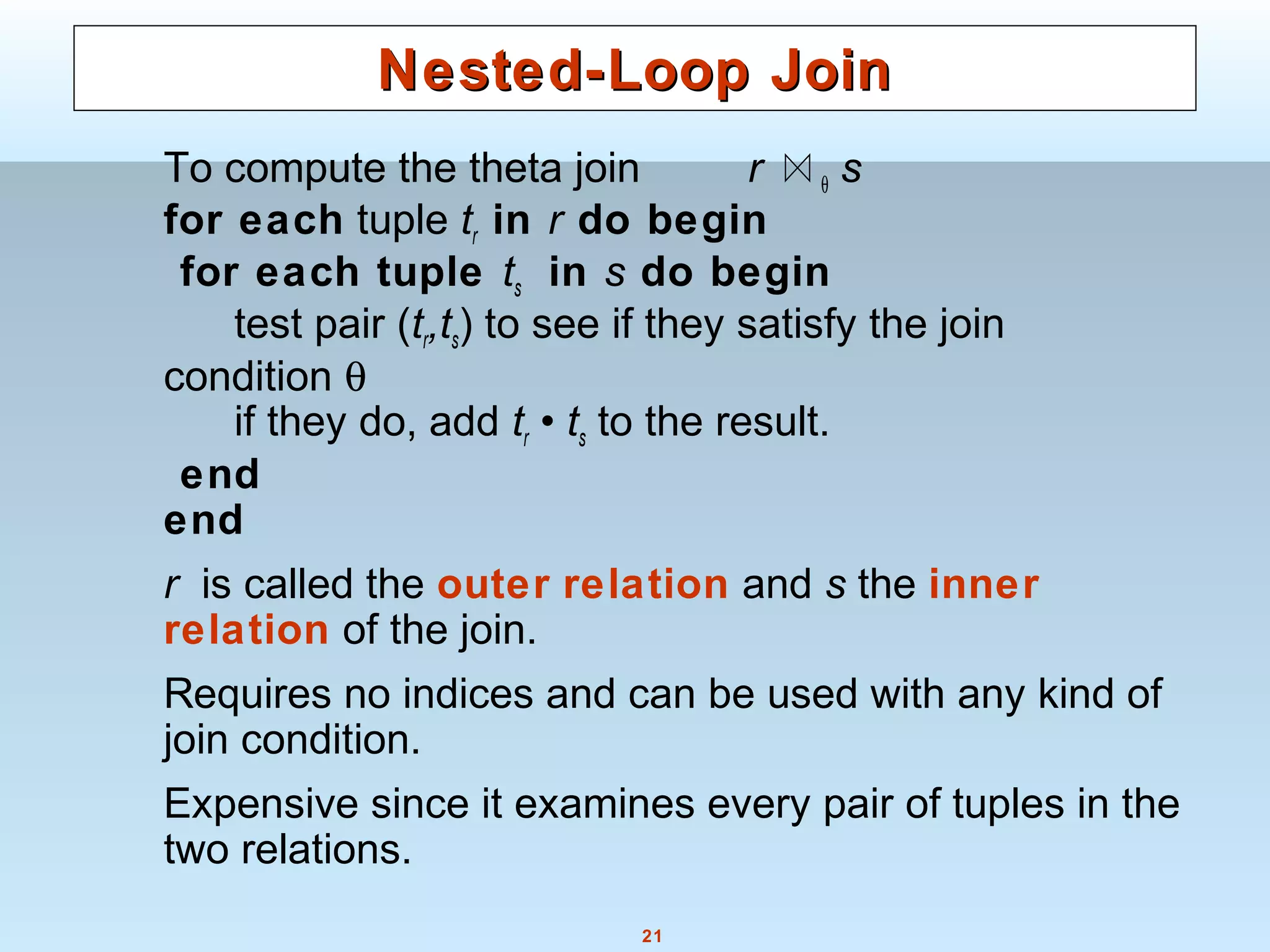
To compute the theta join r θ s
for each tuple tr in r do begin
for each tuple ts in s do begin
test pair (tr,ts) to see if they satisfy the join
condition θ
if they do, add tr • ts to the result.
end
end
r is called the outer relation and s the inner
relation of the join.
Requires no indices and can be used with any kind of
join condition.
Expensive since it examines every pair of tuples in the
two relations.
22
Nested-Loop JoinNested-Loop Join
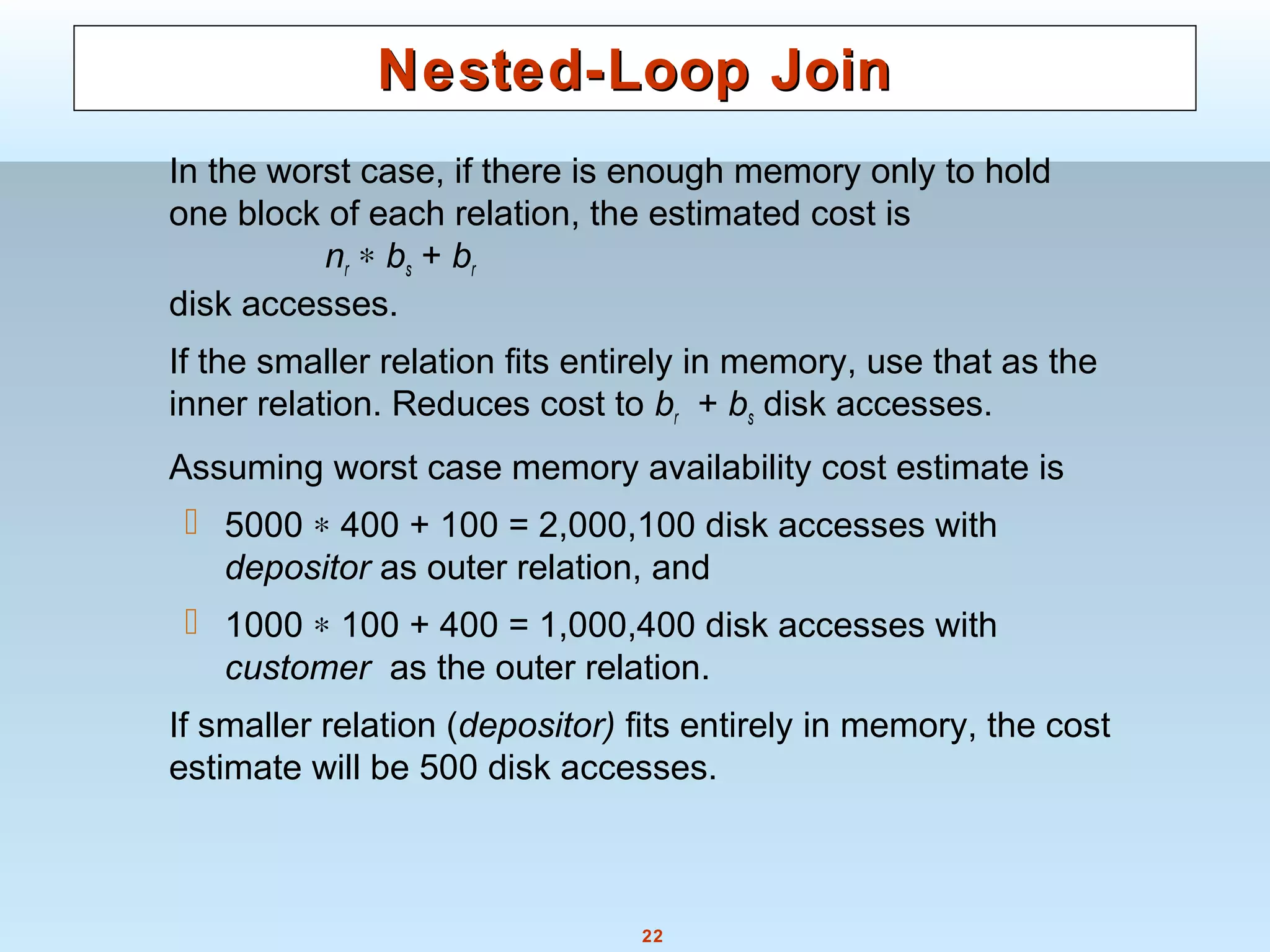
In the worst case, if there is enough memory only to hold
one block of each relation, the estimated cost is
nr ∗ bs + br
disk accesses.
If the smaller relation fits entirely in memory, use that as the
inner relation. Reduces cost to br + bs disk accesses.
Assuming worst case memory availability cost estimate is
 5000 ∗ 400 + 100 = 2,000,100 disk accesses with
depositor as outer relation, and
 1000 ∗ 100 + 400 = 1,000,400 disk accesses with
customer as the outer relation.
If smaller relation (depositor) fits entirely in memory, the cost
estimate will be 500 disk accesses.
23
Block Nested-Loop JoinBlock Nested-Loop Join
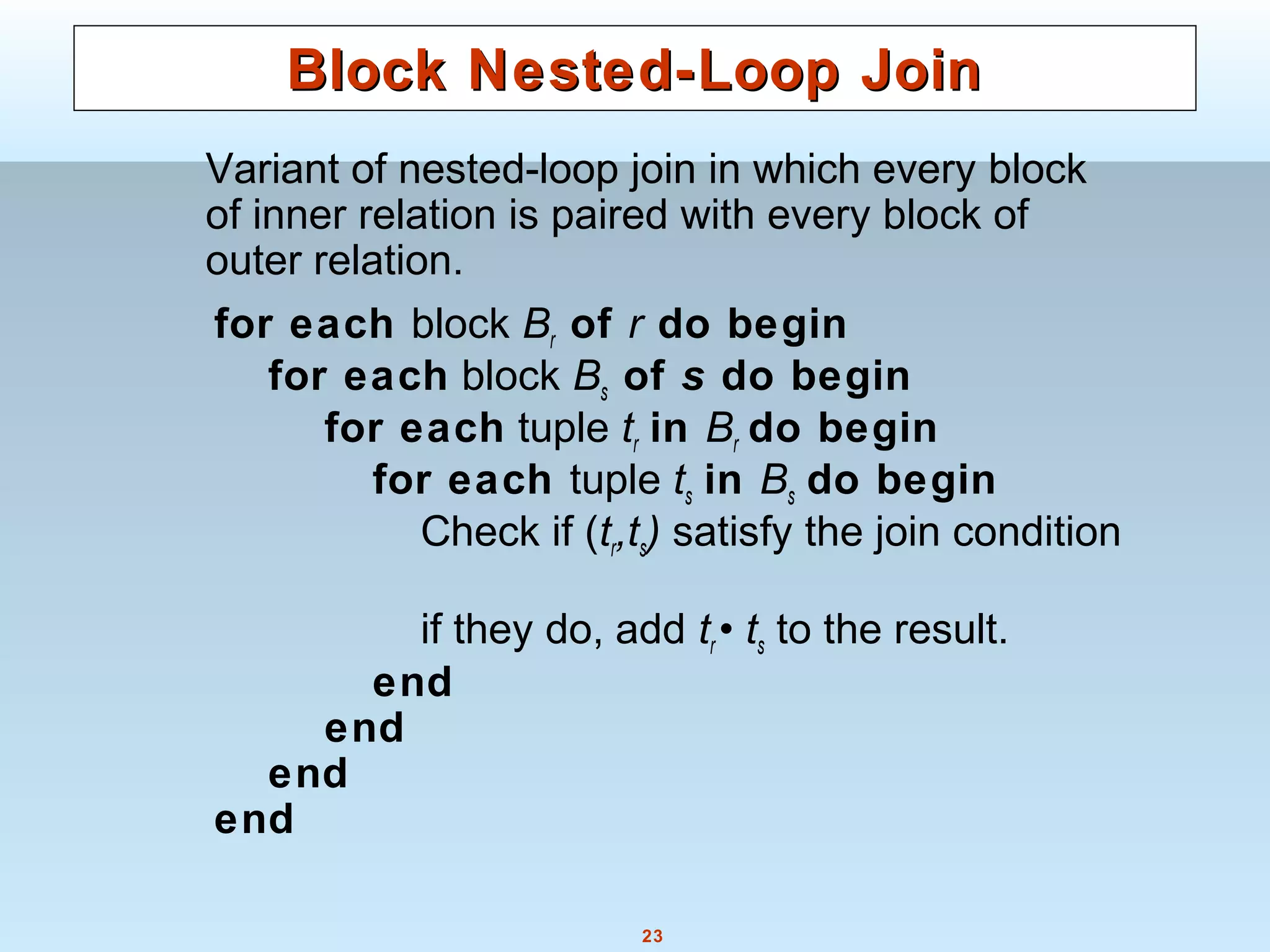
Variant of nested-loop join in which every block
of inner relation is paired with every block of
outer relation.
for each block Br of r do begin
for each block Bs of s do begin
for each tuple tr in Br do begin
for each tuple ts in Bs do begin
Check if (tr,ts) satisfy the join condition
if they do, add tr • ts to the result.
end
end
end
end
24
Block Nested-Loop JoinBlock Nested-Loop Join
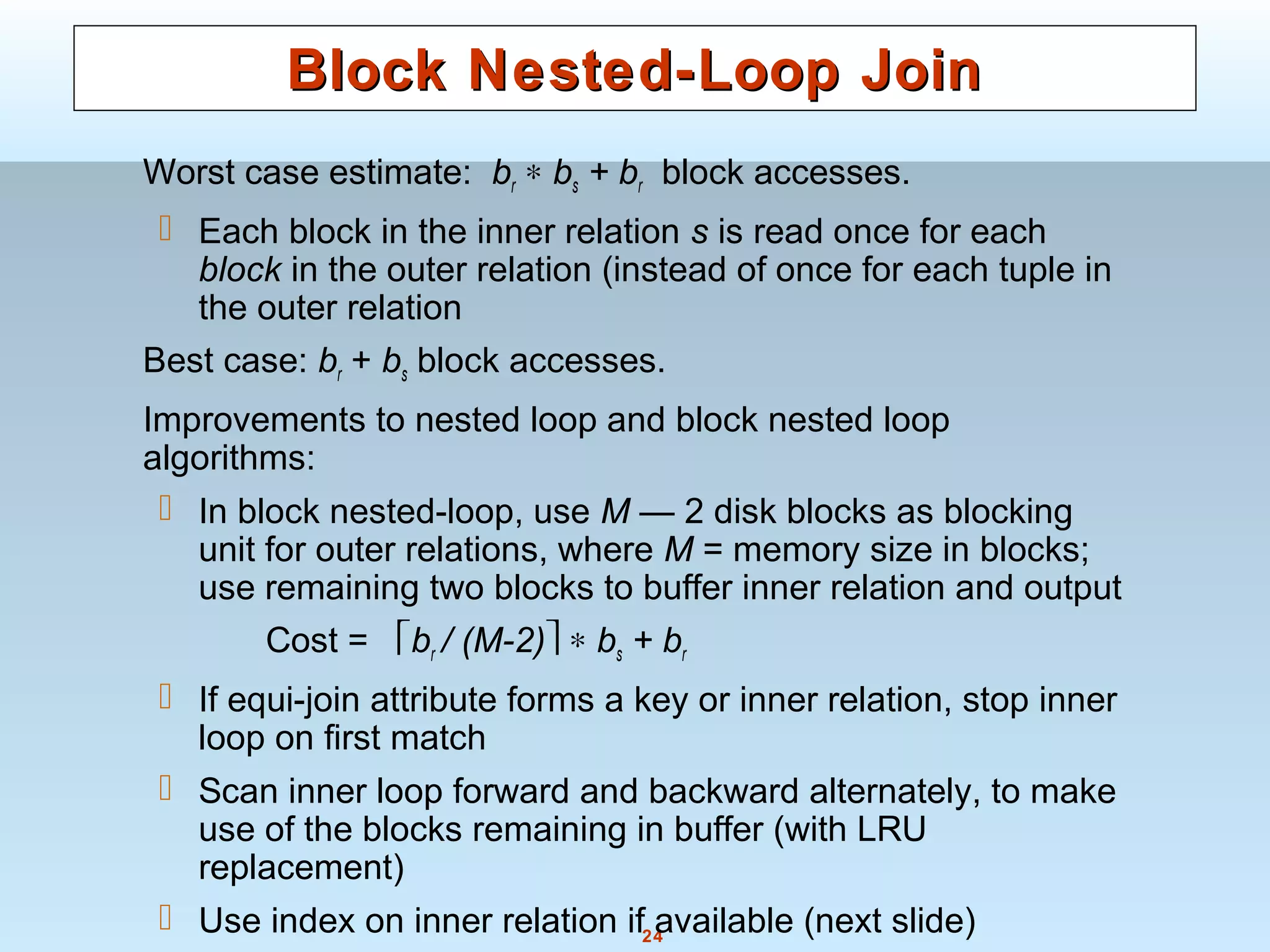
Worst case estimate: br ∗ bs + br block accesses.
 Each block in the inner relation s is read once for each
block in the outer relation (instead of once for each tuple in
the outer relation
Best case: br + bs block accesses.
Improvements to nested loop and block nested loop
algorithms:
 In block nested-loop, use M — 2 disk blocks as blocking
unit for outer relations, where M = memory size in blocks;
use remaining two blocks to buffer inner relation and output
Cost = br / (M-2) ∗ bs + br
 If equi-join attribute forms a key or inner relation, stop inner
loop on first match
 Scan inner loop forward and backward alternately, to make
use of the blocks remaining in buffer (with LRU
replacement)
 Use index on inner relation if available (next slide)
25
Indexed Nested-Loop JoinIndexed Nested-Loop Join
Index lookups can replace file scans if
 join is an equi-join or natural join and
 an index is available on the inner relation’s join attribute
Can construct an index just to compute a join.
For each tuple tr in the outer relation r, use the index to look up
tuples in s that satisfy the join condition with tuple tr.
Worst case: buffer has space for only one page of r, and, for each
tuple in r, we perform an index lookup on s.
Cost of the join: br + nr ∗ c
 Where c is the cost of traversing index and fetching all
matching s tuples for one tuple or r
 c can be estimated as cost of a single selection on s using the
join condition.
If indices are available on join attributes of both r and s,
use the relation with fewer tuples as the outer relation.
26
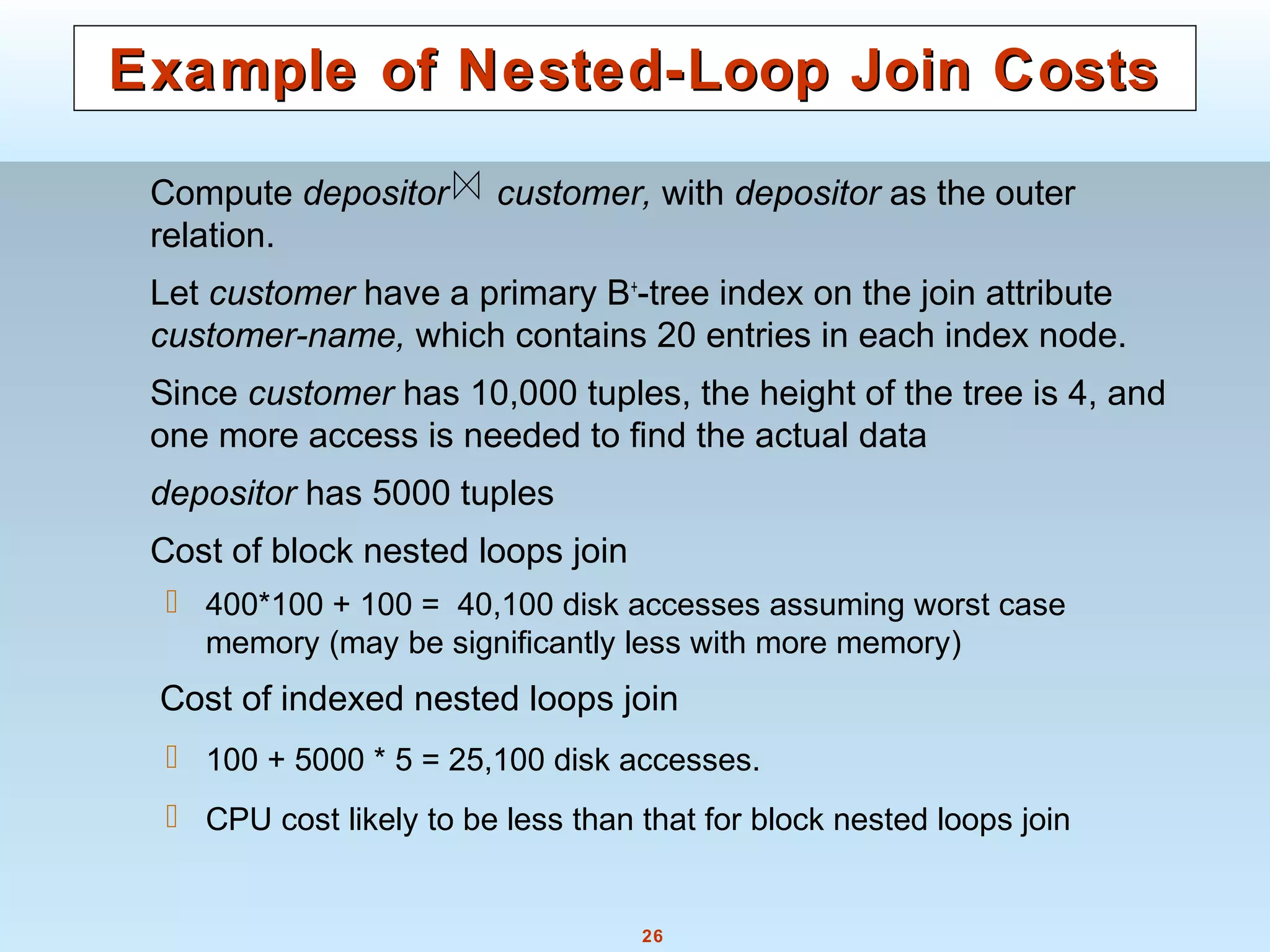
Example of Nested-Loop Join CostsExample of Nested-Loop Join Costs
Compute depositor customer, with depositor as the outer
relation.
Let customer have a primary B+
-tree index on the join attribute
customer-name, which contains 20 entries in each index node.
Since customer has 10,000 tuples, the height of the tree is 4, and
one more access is needed to find the actual data
depositor has 5000 tuples
Cost of block nested loops join
 400*100 + 100 = 40,100 disk accesses assuming worst case
memory (may be significantly less with more memory)
Cost of indexed nested loops join
 100 + 5000 * 5 = 25,100 disk accesses.
 CPU cost likely to be less than that for block nested loops join
27
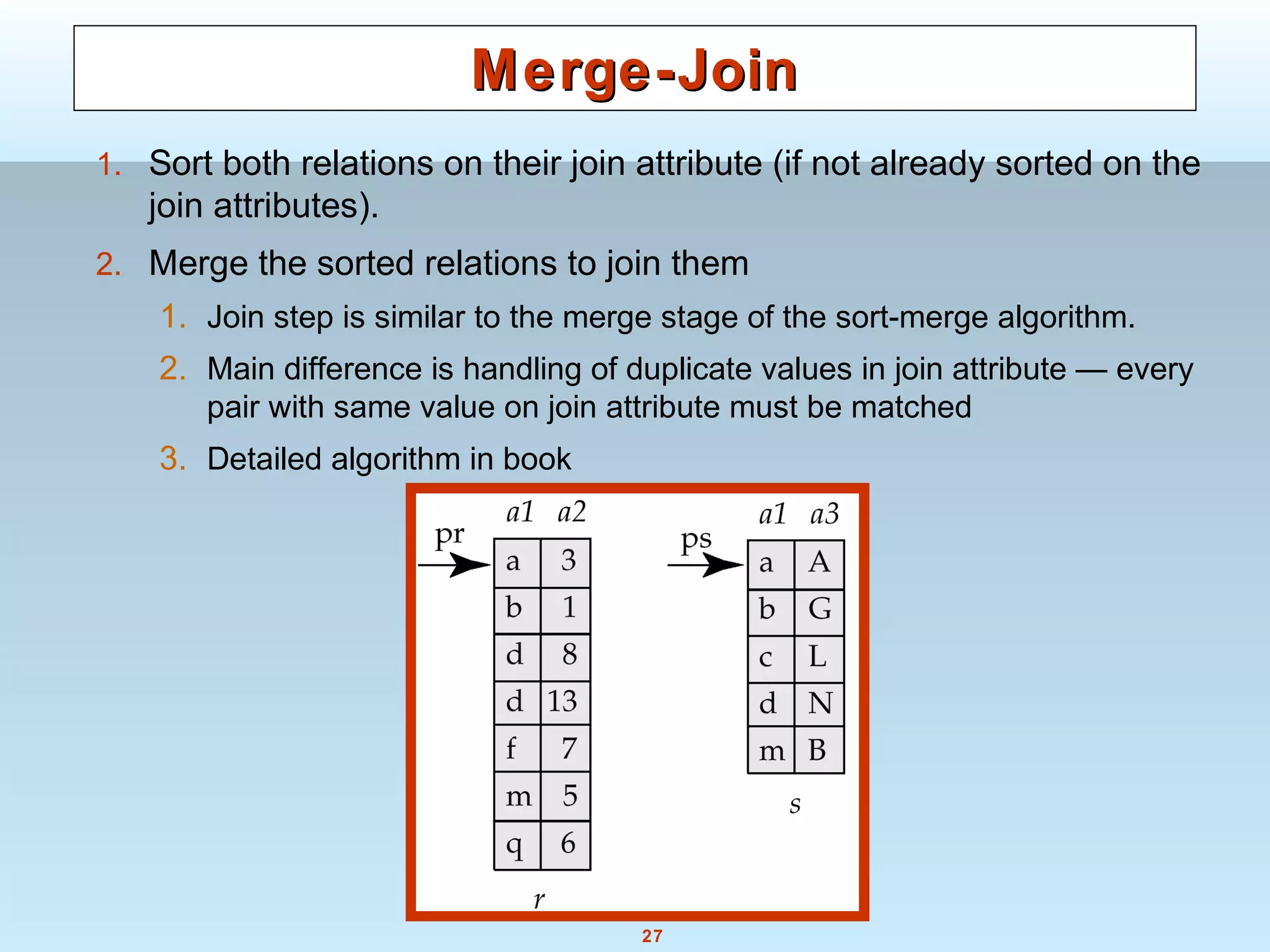
Merge-JoinMerge-Join
1. Sort both relations on their join attribute (if not already sorted on the
join attributes).
2. Merge the sorted relations to join them
1. Join step is similar to the merge stage of the sort-merge algorithm.
2. Main difference is handling of duplicate values in join attribute — every
pair with same value on join attribute must be matched
3. Detailed algorithm in book
28
Merge-JoinMerge-Join
Can be used only for equi-joins and natural joins
Each block needs to be read only once (assuming all tuples for
any given value of the join attributes fit in memory
Thus number of block accesses for merge-join is
br + bs + the cost of sorting if relations are unsorted.
29
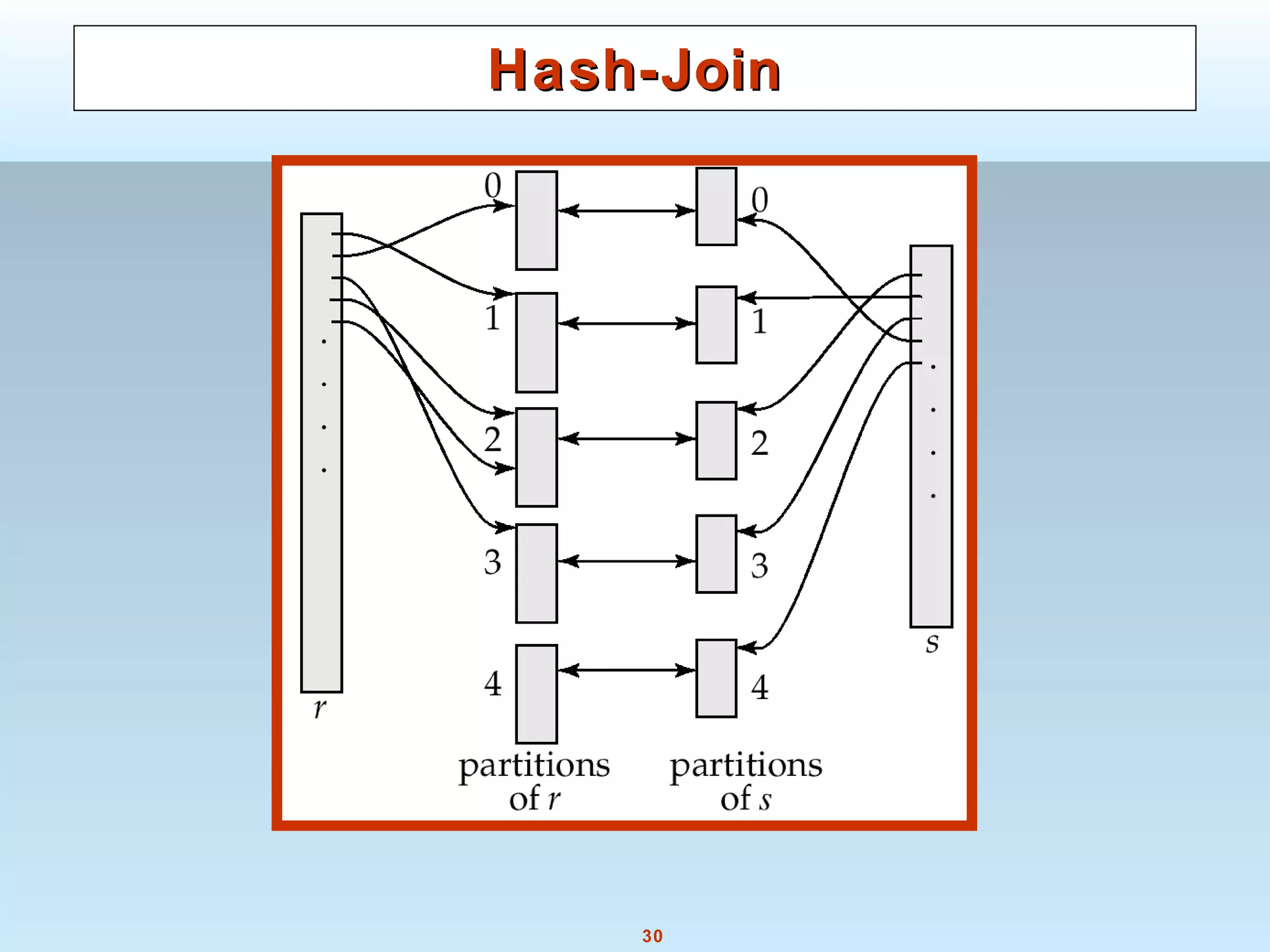
Hash-JoinHash-Join
Applicable for equi-joins and natural joins.
A hash function h is used to partition tuples of both relations
h maps JoinAttrs values to {0, 1, ..., n}, where JoinAttrs denotes
the common attributes of r and s used in the natural join.
 r0, r1, . . ., rn denote partitions of r tuples
Each tuple tr ∈ r is put in partition ri where i = h(tr[JoinAttrs]).
 r0,, r1. . ., rn denotes partitions of s tuples
Each tuple ts ∈s is put in partition si, where i = h(ts[JoinAttrs]).
Note: In book, ri is denoted as Hri, si is denoted as Hsi and
nis denoted as nh.
30
Hash-JoinHash-Join
31
Hash-JoinHash-Join
r tuples in ri need only to be compared with s tuples in si
Need not be compared with s tuples in any other partition,
since:
 an r tuple and an s tuple that satisfy the join condition will have
the same value for the join attributes.
 If that value is hashed to some value i, the r tuple has to be in ri
and the s tuple in si.
32
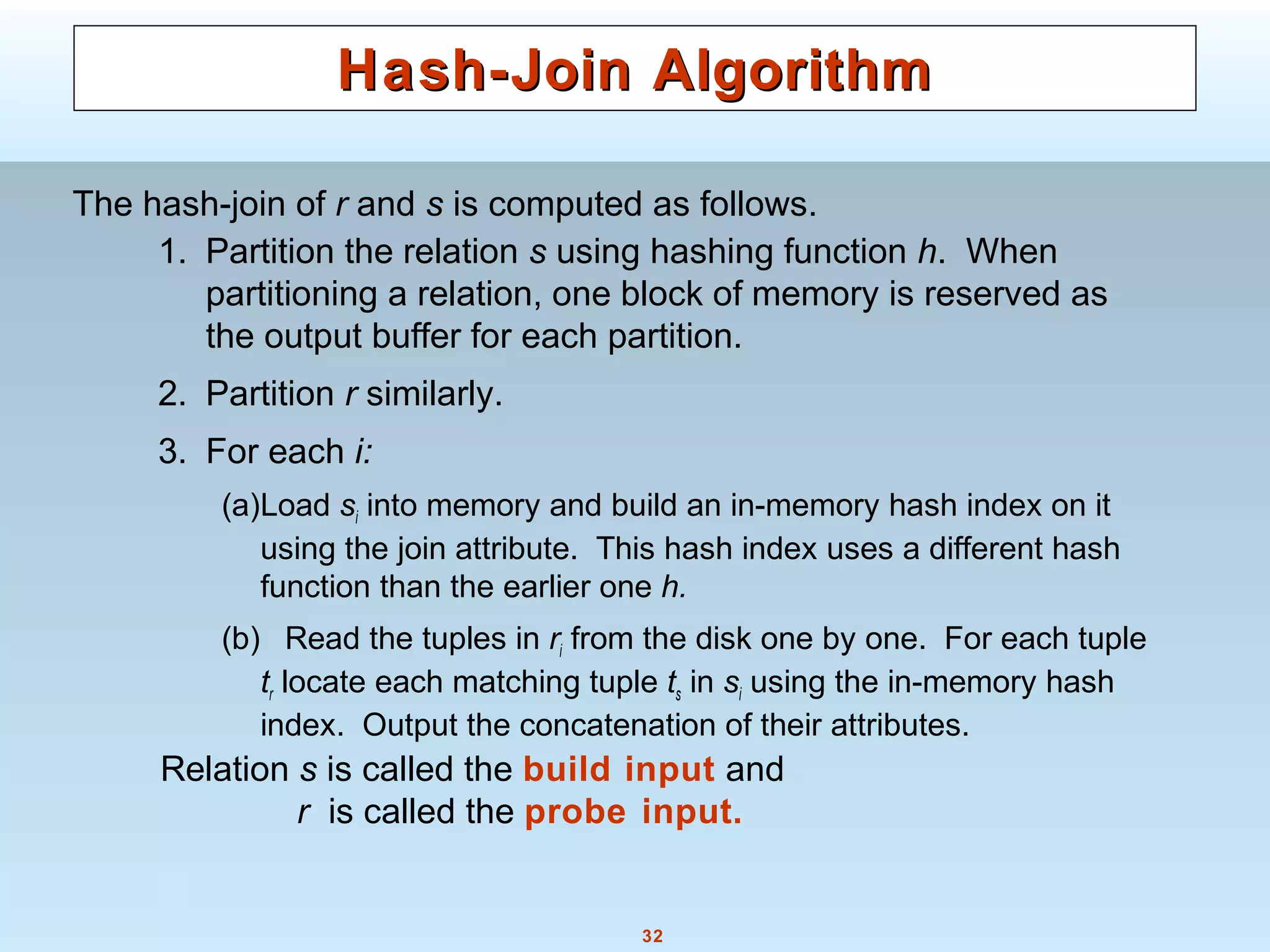
Hash-Join AlgorithmHash-Join Algorithm
1. Partition the relation s using hashing function h. When
partitioning a relation, one block of memory is reserved as
the output buffer for each partition.
2. Partition r similarly.
3. For each i:
(a)Load si into memory and build an in-memory hash index on it
using the join attribute. This hash index uses a different hash
function than the earlier one h.
(b) Read the tuples in ri from the disk one by one. For each tuple
tr locate each matching tuple ts in si using the in-memory hash
index. Output the concatenation of their attributes.
The hash-join of r and s is computed as follows.
Relation s is called the build input and
r is called the probe input.
33
Handling of OverflowsHandling of Overflows
Hash-table overflow occurs in partition si if si does not fit in
memory. Reasons could be
 Many tuples in s with same value for join attributes
 Bad hash function
Partitioning is said to be skewed if some partitions have
significantly more tuples than some others
Overflow resolution can be done in build phase
 Partition si is further partitioned using different hash function.
 Partition ri must be similarly partitioned.
Overflow avoidance performs partitioning carefully to avoid
overflows during build phase
 E.g. partition build relation into many partitions, then combine them
Both approaches fail with large numbers of duplicates
 Fallback option: use block nested loops join on overflowed
partitions
34
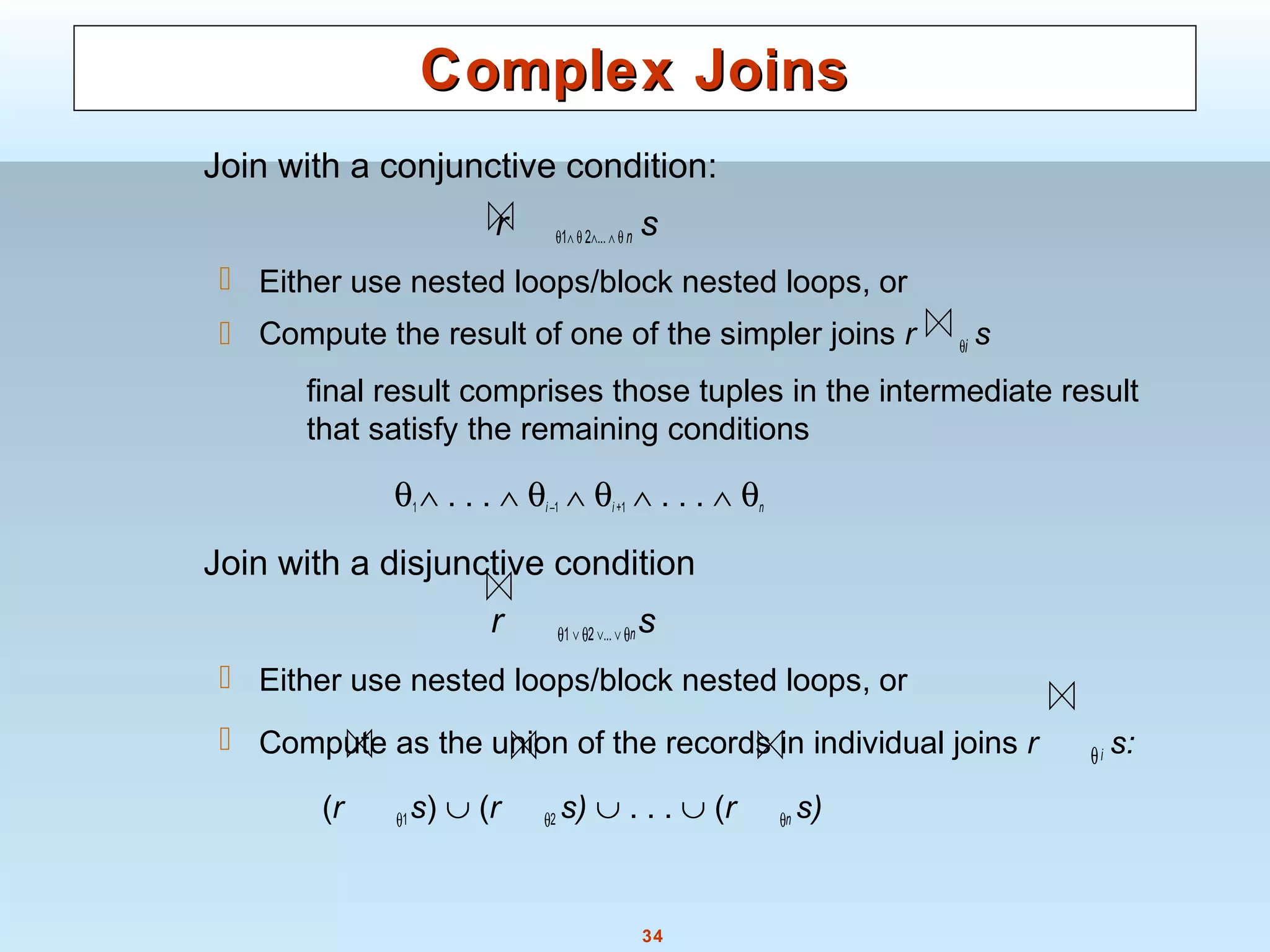
Complex JoinsComplex Joins
Join with a conjunctive condition:
r θ1∧ θ 2∧...∧ θ n s
 Either use nested loops/block nested loops, or
 Compute the result of one of the simpler joins r θi s
final result comprises those tuples in the intermediate result
that satisfy the remaining conditions
θ1 ∧ . . . ∧ θi –1 ∧ θi +1 ∧ . . . ∧ θn
Join with a disjunctive condition
r θ1 ∨ θ2 ∨...∨ θns
 Either use nested loops/block nested loops, or
 Compute as the union of the records in individual joins r θi s:
(r θ1s) ∪ (r θ2 s) ∪ . . . ∪ (r θn s)
35
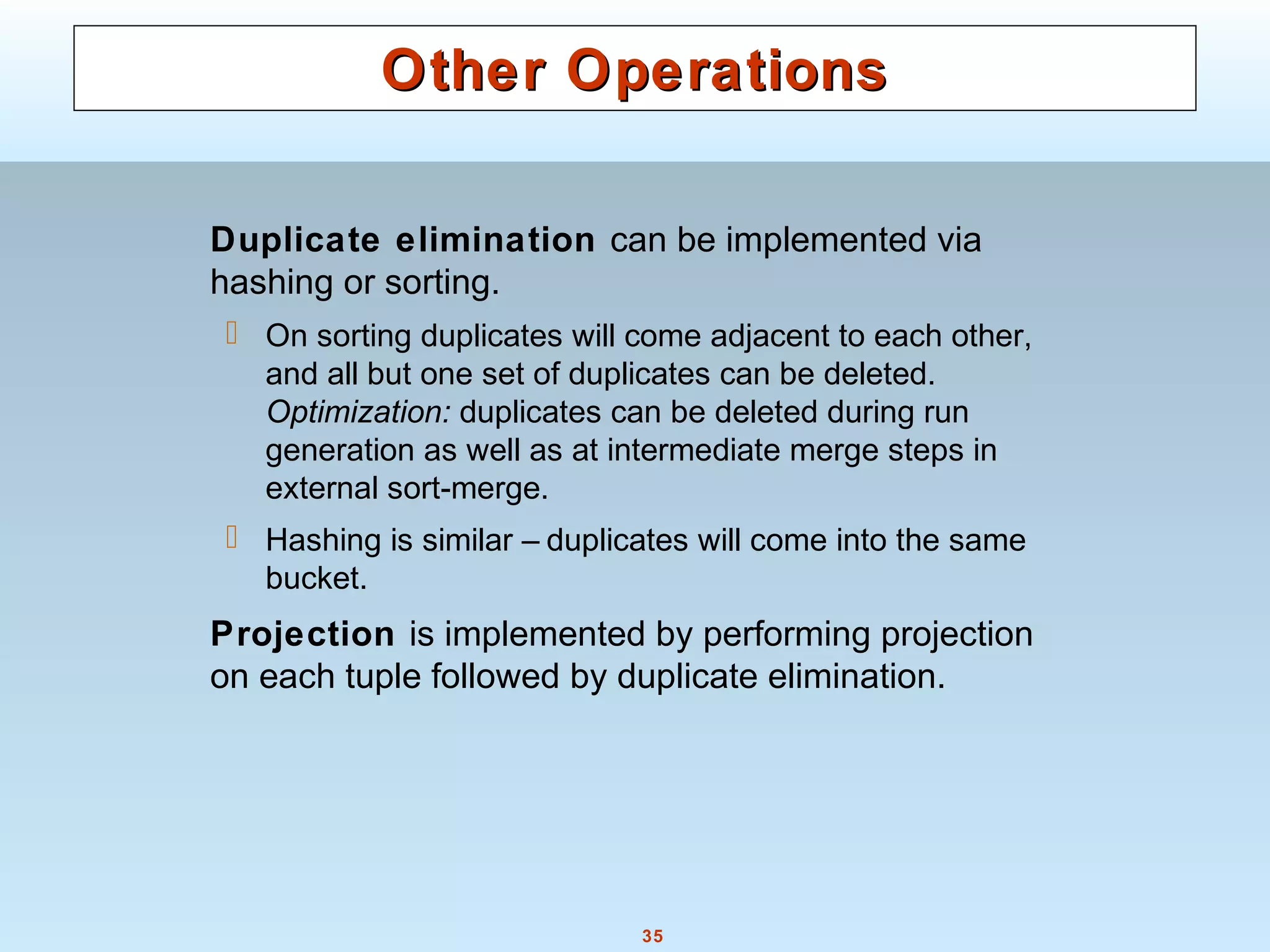
Other OperationsOther Operations
Duplicate elimination can be implemented via
hashing or sorting.
 On sorting duplicates will come adjacent to each other,
and all but one set of duplicates can be deleted.
Optimization: duplicates can be deleted during run
generation as well as at intermediate merge steps in
external sort-merge.
 Hashing is similar – duplicates will come into the same
bucket.
Projection is implemented by performing projection
on each tuple followed by duplicate elimination.
36
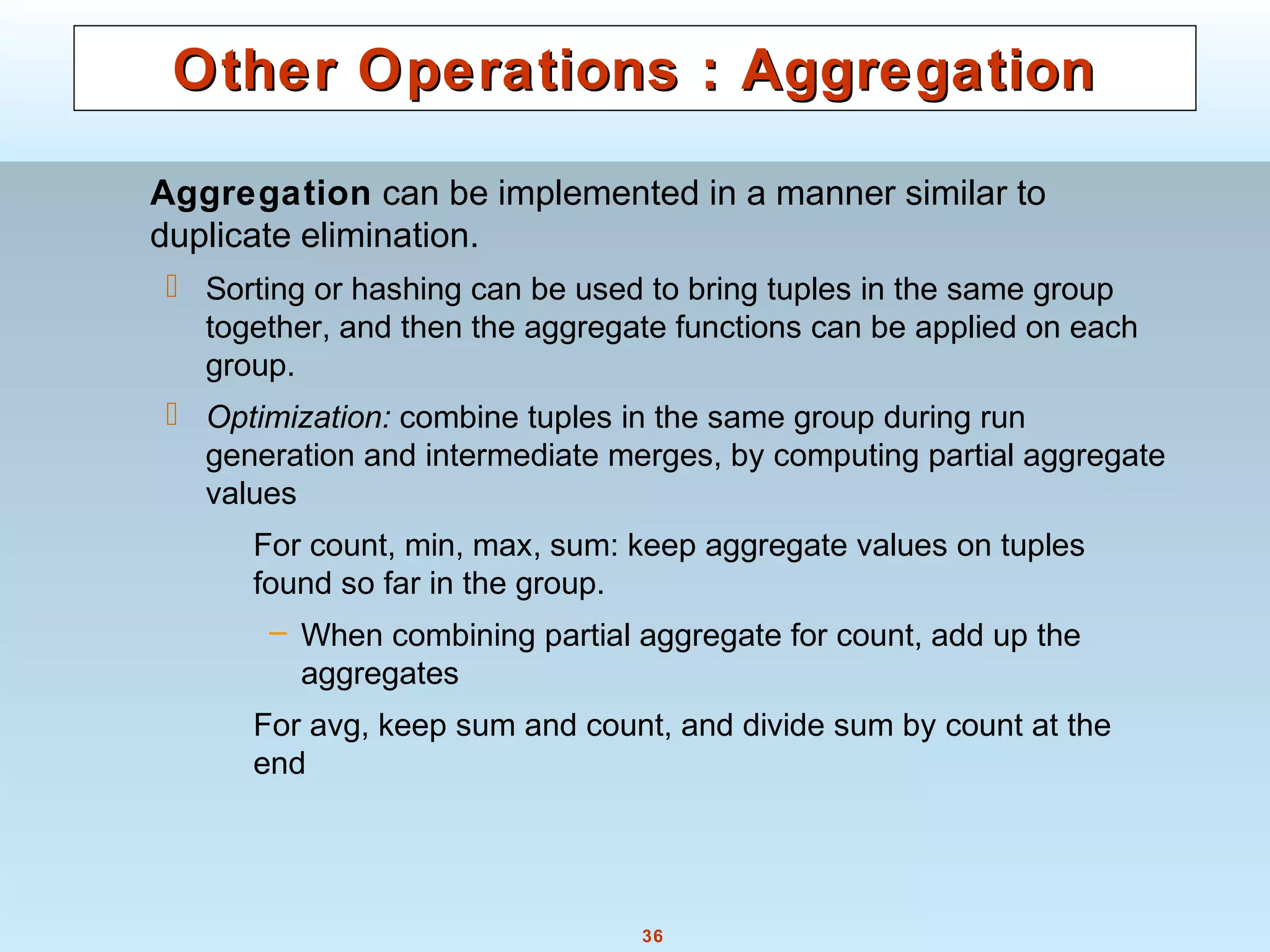
Other Operations : AggregationOther Operations : Aggregation
Aggregation can be implemented in a manner similar to
duplicate elimination.
 Sorting or hashing can be used to bring tuples in the same group
together, and then the aggregate functions can be applied on each
group.
 Optimization: combine tuples in the same group during run
generation and intermediate merges, by computing partial aggregate
values
For count, min, max, sum: keep aggregate values on tuples
found so far in the group.
– When combining partial aggregate for count, add up the
aggregates
For avg, keep sum and count, and divide sum by count at the
end
37
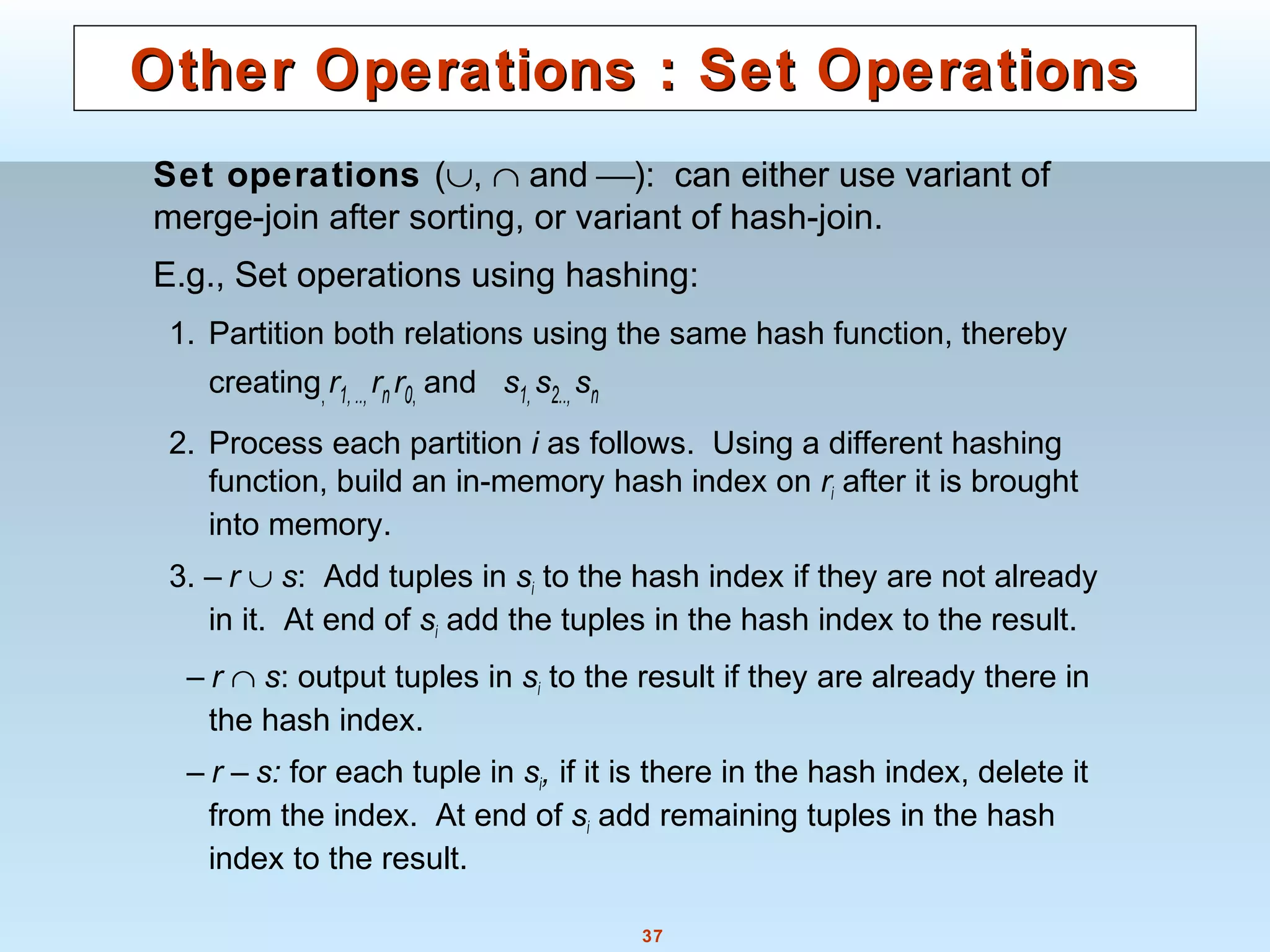
Other Operations : Set OperationsOther Operations : Set Operations
Set operations (∪, ∩ and ): can either use variant of
merge-join after sorting, or variant of hash-join.
E.g., Set operations using hashing:
1. Partition both relations using the same hash function, thereby
creating,r1, .., rn r0, and s1, s2.., sn
2. Process each partition i as follows. Using a different hashing
function, build an in-memory hash index on ri after it is brought
into memory.
3. – r ∪ s: Add tuples in si to the hash index if they are not already
in it. At end of si add the tuples in the hash index to the result.
– r ∩ s: output tuples in si to the result if they are already there in
the hash index.
– r – s: for each tuple in si, if it is there in the hash index, delete it
from the index. At end of si add remaining tuples in the hash
index to the result.
38
OptimizationOptimization
Generation of query-evaluation plans for an
expression involves several steps:
1. Generating logically equivalent expressions
Use equivalence rules to transform an
expression into an equivalent one.
2. Annotating resultant expressions to get alternative
query plans
3. Choosing the cheapest plan based on estimated
cost
The overall process is called cost based
optimization.
39
Statistical Information for CostStatistical Information for Cost
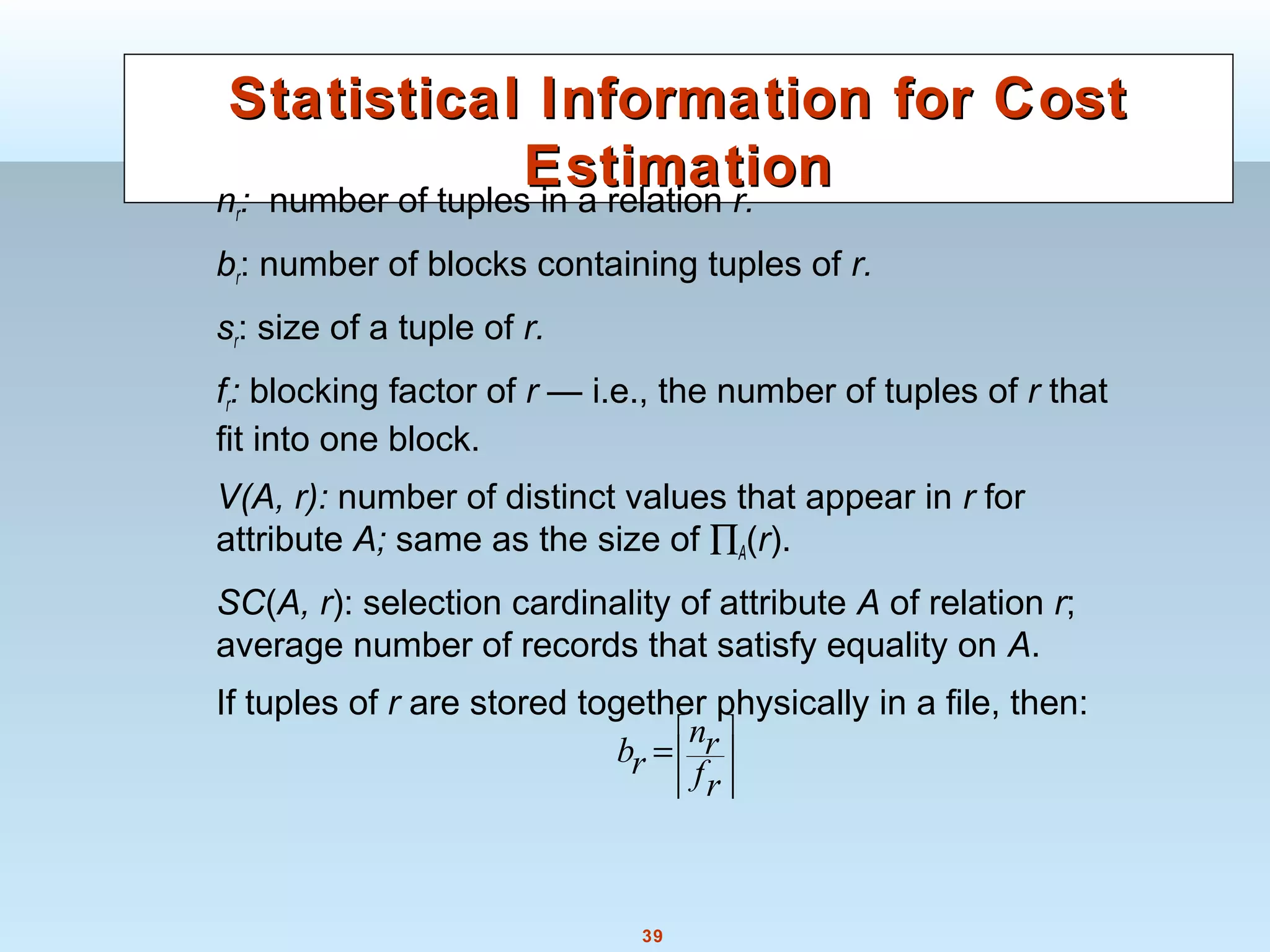
EstimationEstimationnr: number of tuples in a relation r.
br: number of blocks containing tuples of r.
sr: size of a tuple of r.
fr: blocking factor of r — i.e., the number of tuples of r that
fit into one block.
V(A, r): number of distinct values that appear in r for
attribute A; same as the size of ∏A(r).
SC(A, r): selection cardinality of attribute A of relation r;
average number of records that satisfy equality on A.
If tuples of r are stored together physically in a file, then:










=
rf
rn
rb
40
Catalog Information about IndicesCatalog Information about Indices
fi: average fan-out of internal nodes of index i, for
tree-structured indices such as B+-trees.
HTi: number of levels in index i — i.e., the height of i.
 For a balanced tree index (such as B+-tree) on attribute A
of relation r, HTi = logfi(V(A,r)).
 For a hash index, HTi is 1.
 LBi: number of lowest-level index blocks in i — i.e, the
number of blocks at the leaf level of the index.
41
Selection Size EstimationSelection Size Estimation
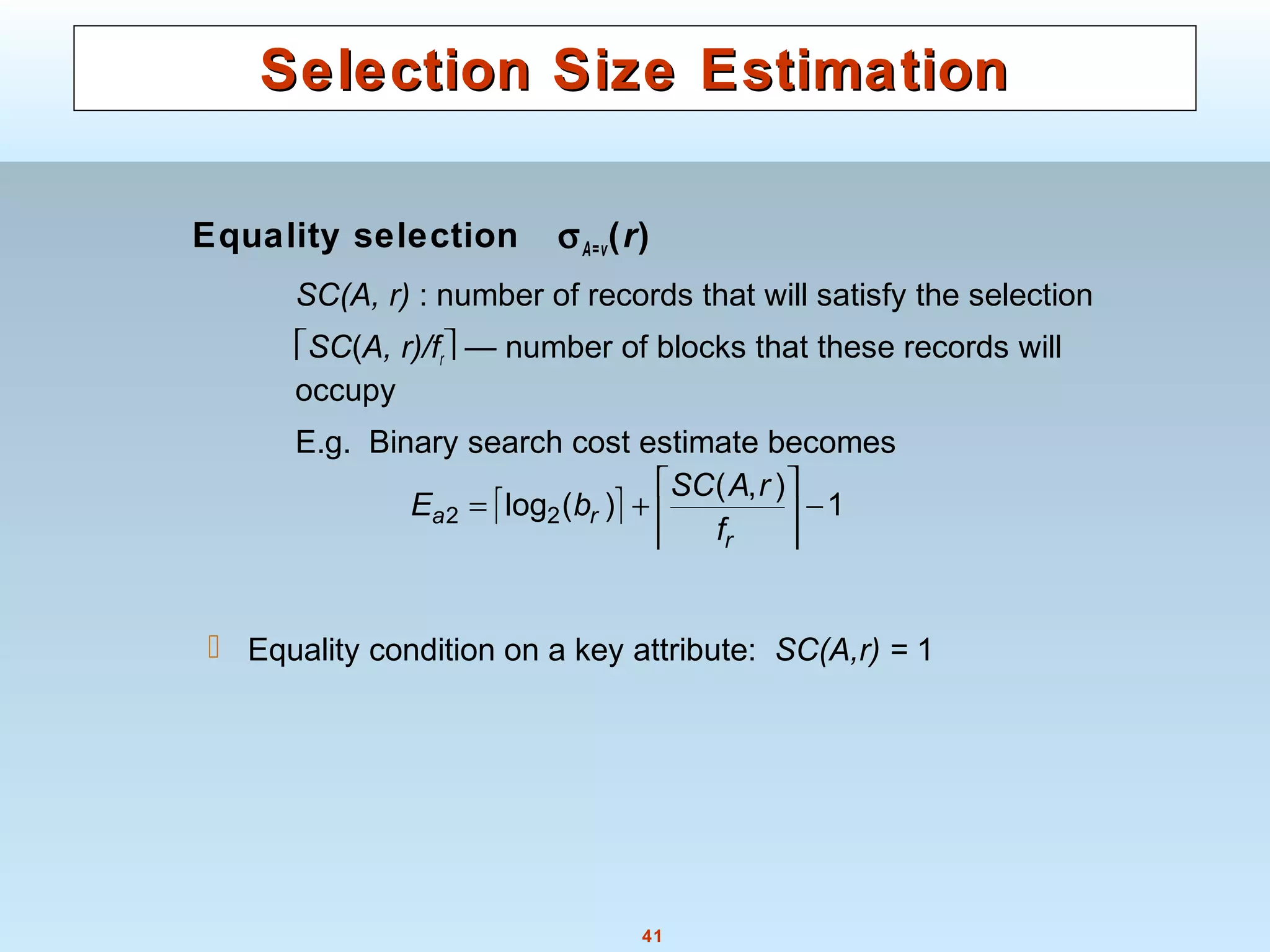
Equality selection σA=v(r)
SC(A, r) : number of records that will satisfy the selection
SC(A, r)/fr — number of blocks that these records will
occupy
E.g. Binary search cost estimate becomes
 Equality condition on a key attribute: SC(A,r) = 1
  1
),(
)(log22 −





+=
r
ra
f
rASC
bE
42
Statistical Information for ExamplesStatistical Information for Examples
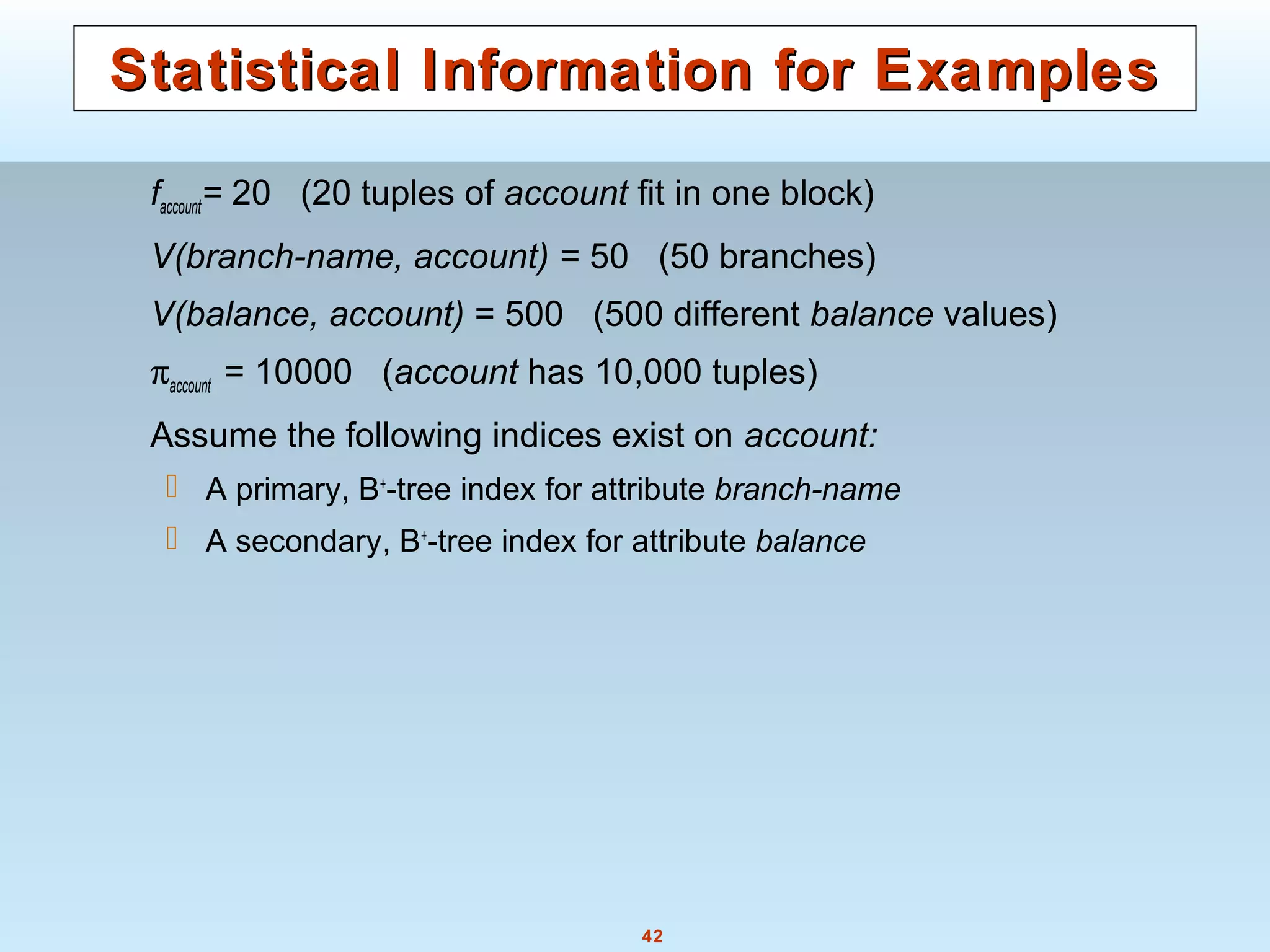
faccount= 20 (20 tuples of account fit in one block)
V(branch-name, account) = 50 (50 branches)
V(balance, account) = 500 (500 different balance values)
πaccount = 10000 (account has 10,000 tuples)
Assume the following indices exist on account:
 A primary, B+
-tree index for attribute branch-name
 A secondary, B+
-tree index for attribute balance
43
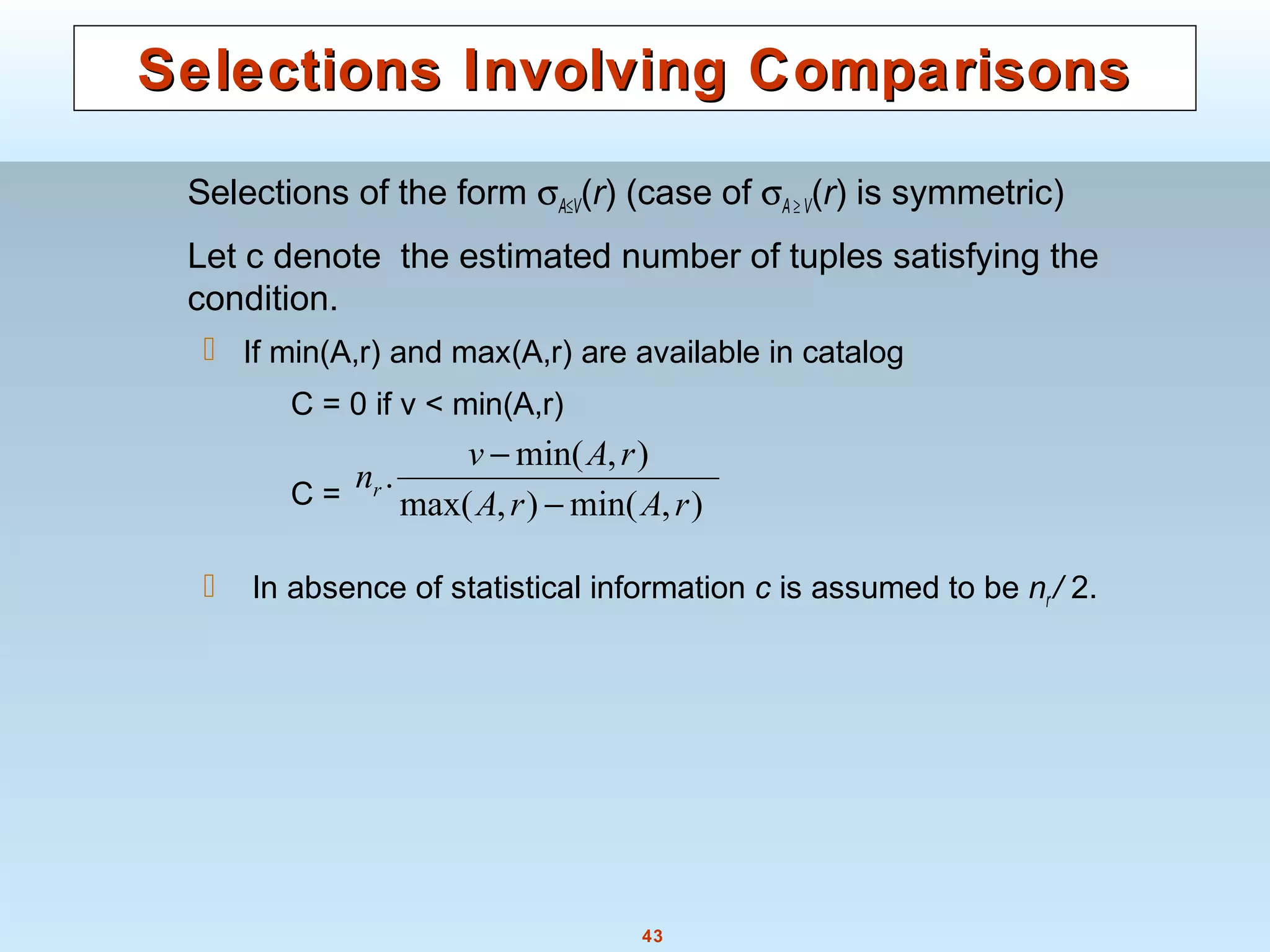
Selections Involving ComparisonsSelections Involving Comparisons
Selections of the form σA≤V(r) (case of σA ≥ V(r) is symmetric)
Let c denote the estimated number of tuples satisfying the
condition.
 If min(A,r) and max(A,r) are available in catalog
C = 0 if v < min(A,r)
C =
 In absence of statistical information c is assumed to be nr / 2.
),min(),max(
),min(
.
rArA
rAv
nr
−
−
44
Implementation of ComplexImplementation of Complex
SelectionsSelections
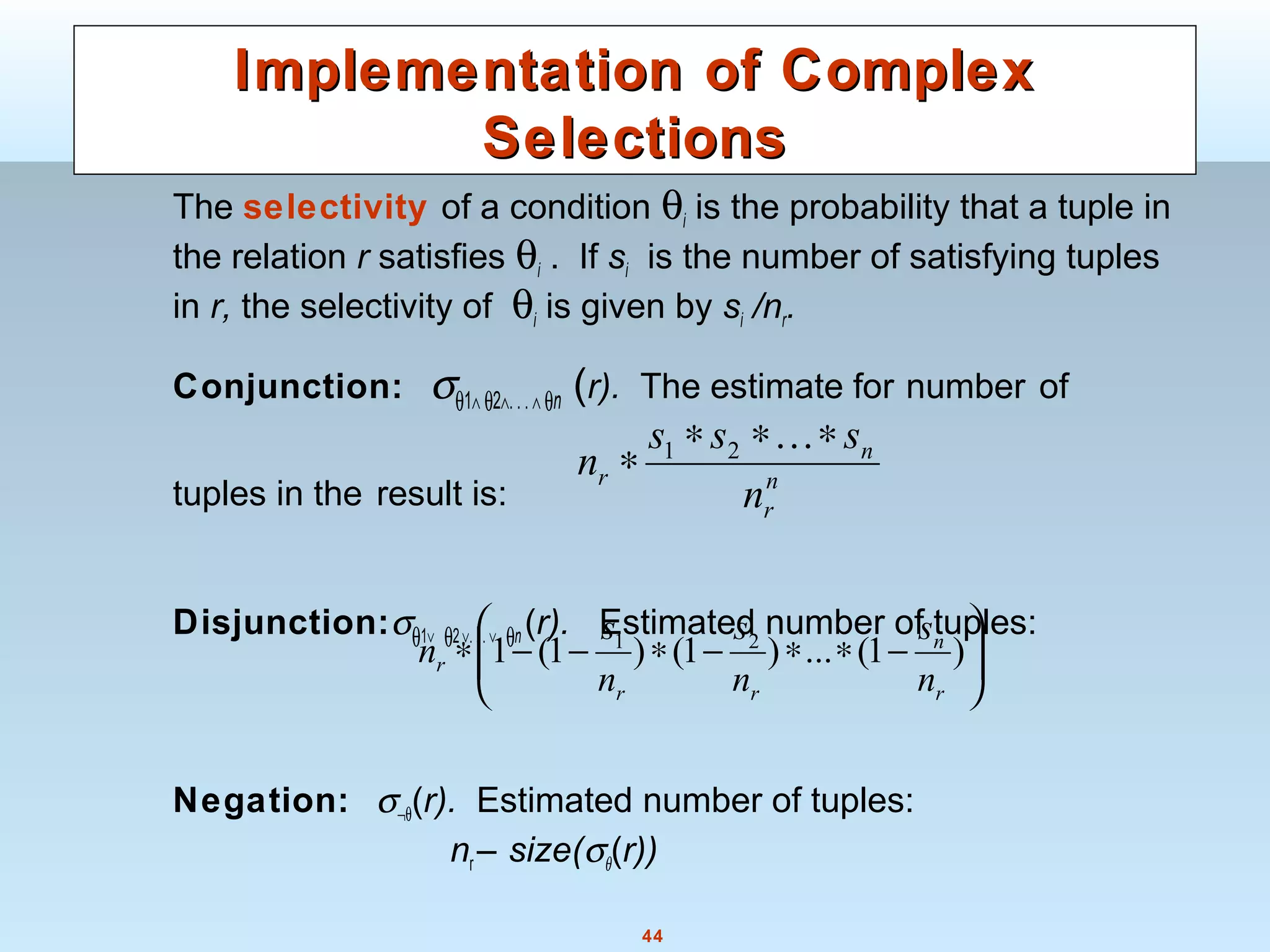
The selectivity of a condition θi is the probability that a tuple in
the relation r satisfies θi . If si is the number of satisfying tuples
in r, the selectivity of θi is given by si /nr.
Conjunction: σθ1∧ θ2∧.. .∧ θn (r). The estimate for number of
tuples in the result is:
Disjunction:σθ1∨ θ2∨. . . ∨ θn (r). Estimated number of tuples:
Negation: σ¬θ(r). Estimated number of tuples:
nr – size(σθ(r))
n
r
n
r
n
sss
n
∗∗∗
∗
...21






−∗∗−∗−−∗ )1(...)1()1(1 21
r
n
rr
r
n
s
n
s
n
s
n
45
Join Operation: Running ExampleJoin Operation: Running Example
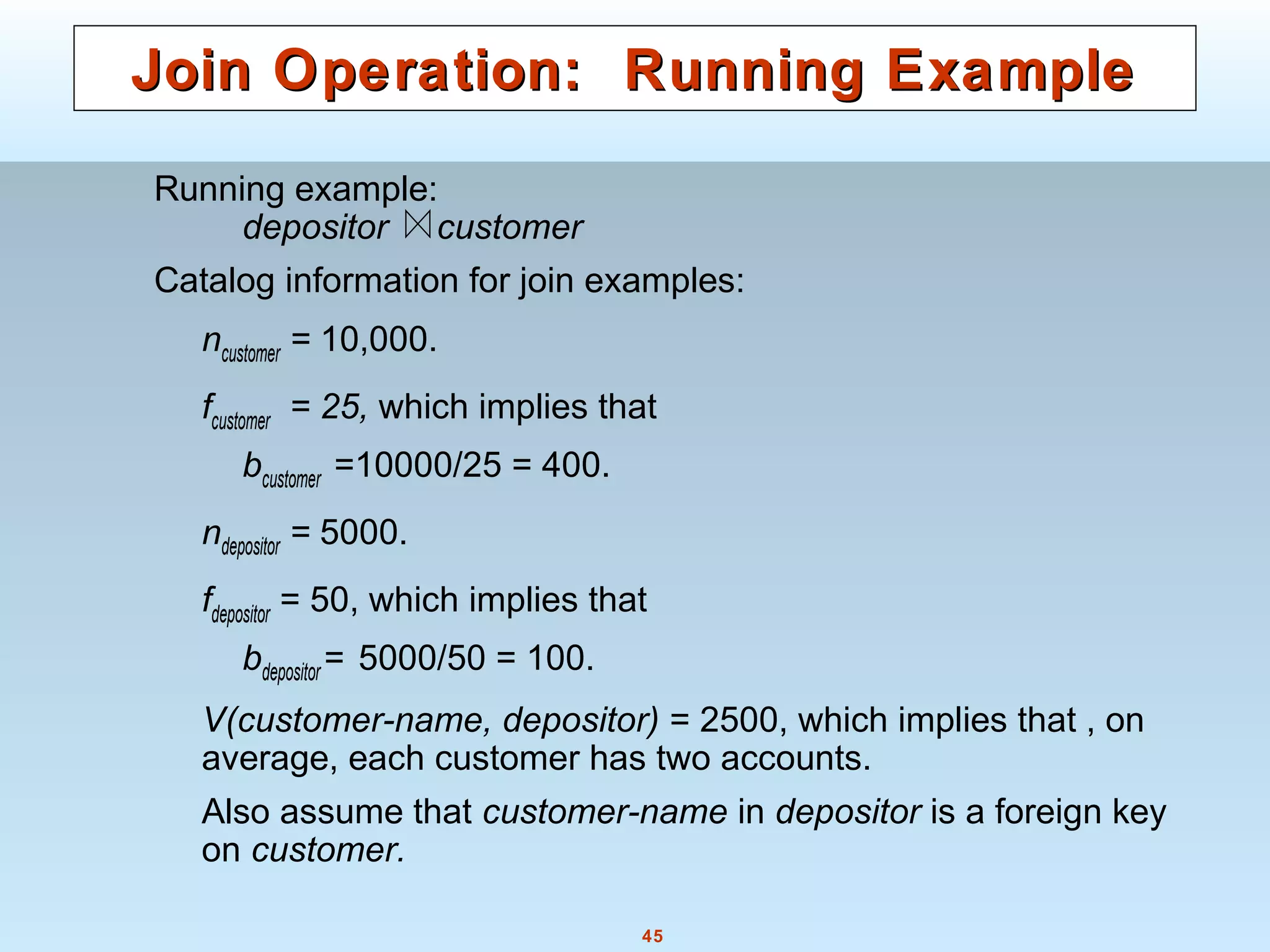
Running example:
depositor customer
Catalog information for join examples:
ncustomer = 10,000.
fcustomer = 25, which implies that
bcustomer =10000/25 = 400.
ndepositor = 5000.
fdepositor = 50, which implies that
bdepositor = 5000/50 = 100.
V(customer-name, depositor) = 2500, which implies that , on
average, each customer has two accounts.
Also assume that customer-name in depositor is a foreign key
on customer.
46
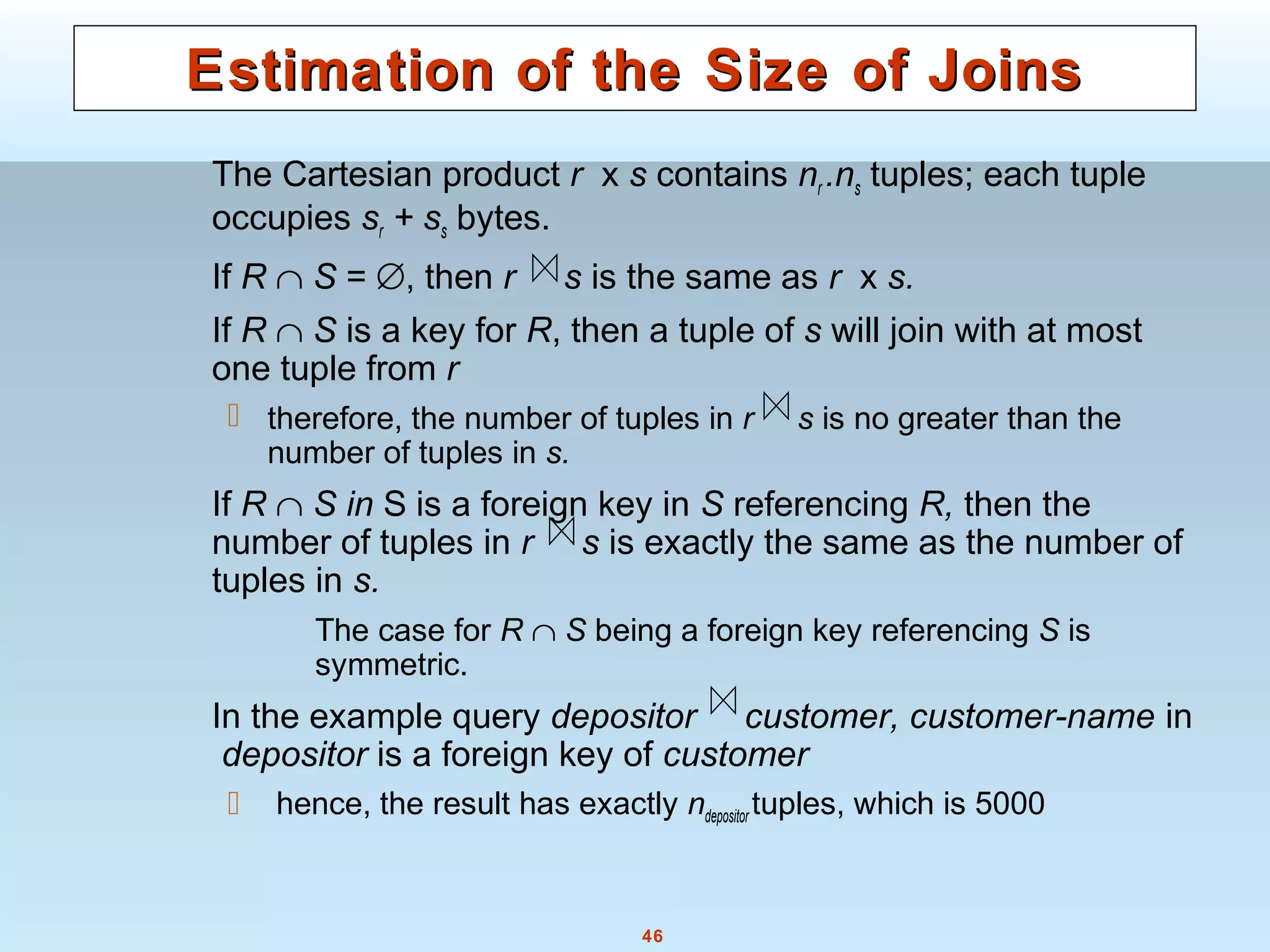
Estimation of the Size of JoinsEstimation of the Size of Joins
The Cartesian product r x s contains nr .ns tuples; each tuple
occupies sr + ss bytes.
If R ∩ S = ∅, then r s is the same as r x s.
If R ∩ S is a key for R, then a tuple of s will join with at most
one tuple from r
 therefore, the number of tuples in r s is no greater than the
number of tuples in s.
If R ∩ S in S is a foreign key in S referencing R, then the
number of tuples in r s is exactly the same as the number of
tuples in s.
The case for R ∩ S being a foreign key referencing S is
symmetric.
In the example query depositor customer, customer-name in
depositor is a foreign key of customer
 hence, the result has exactly ndepositor tuples, which is 5000
47
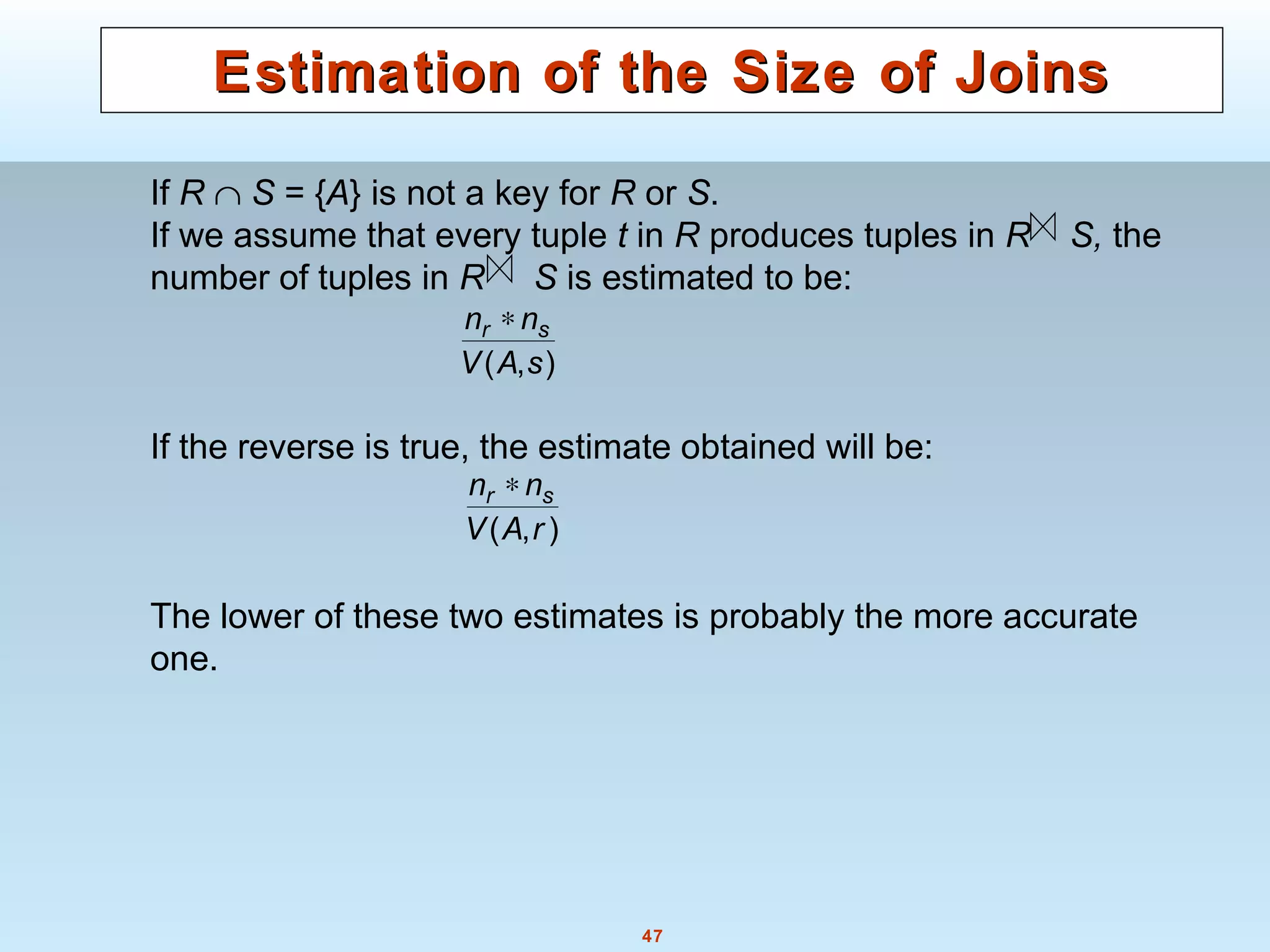
Estimation of the Size of JoinsEstimation of the Size of Joins
If R ∩ S = {A} is not a key for R or S.
If we assume that every tuple t in R produces tuples in R S, the
number of tuples in R S is estimated to be:
If the reverse is true, the estimate obtained will be:
The lower of these two estimates is probably the more accurate
one.
),( sAV
nn sr ∗
),( rAV
nn sr ∗
48
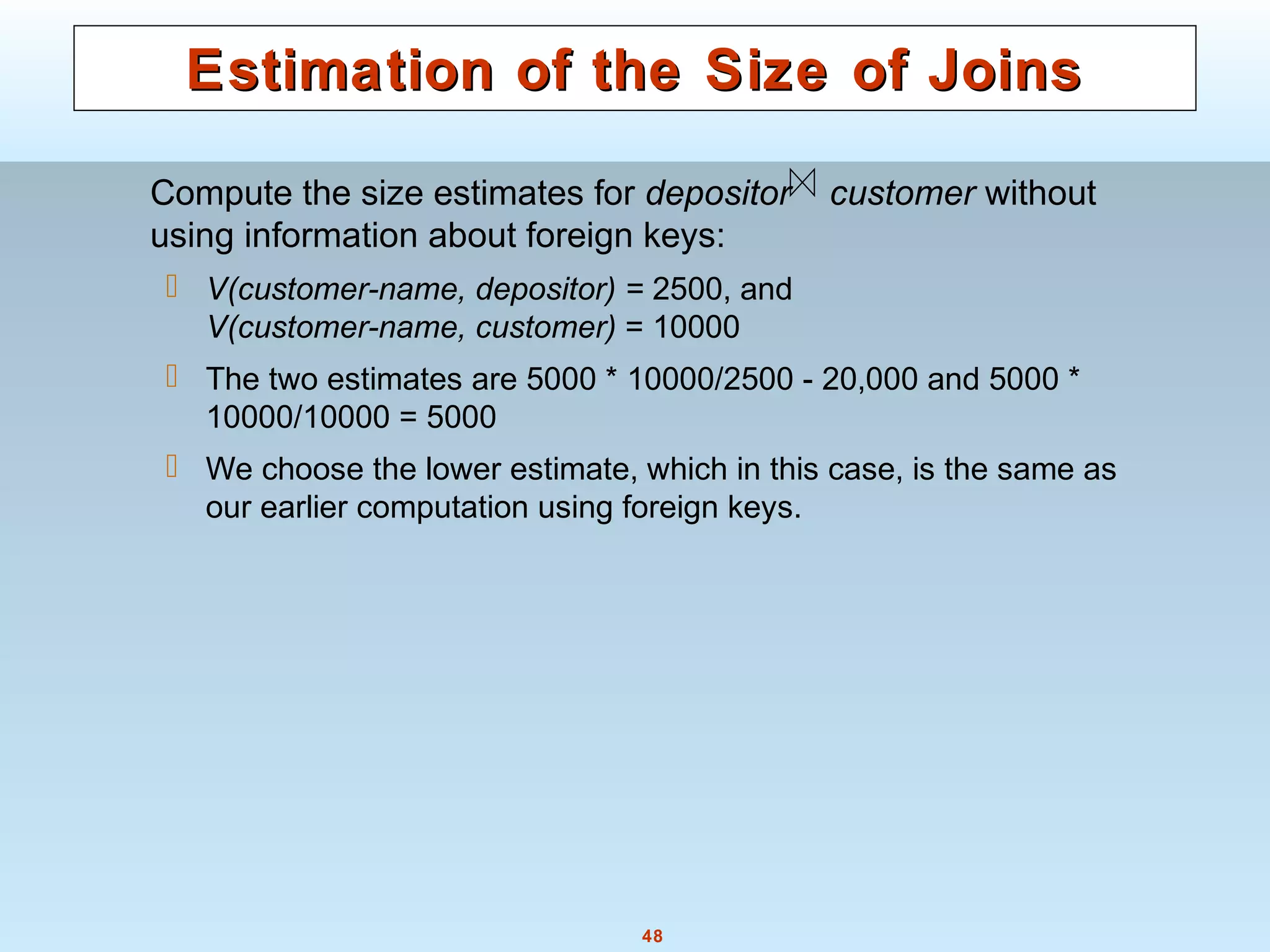
Estimation of the Size of JoinsEstimation of the Size of Joins
Compute the size estimates for depositor customer without
using information about foreign keys:
 V(customer-name, depositor) = 2500, and
V(customer-name, customer) = 10000
 The two estimates are 5000 * 10000/2500 - 20,000 and 5000 *
10000/10000 = 5000
 We choose the lower estimate, which in this case, is the same as
our earlier computation using foreign keys.
49
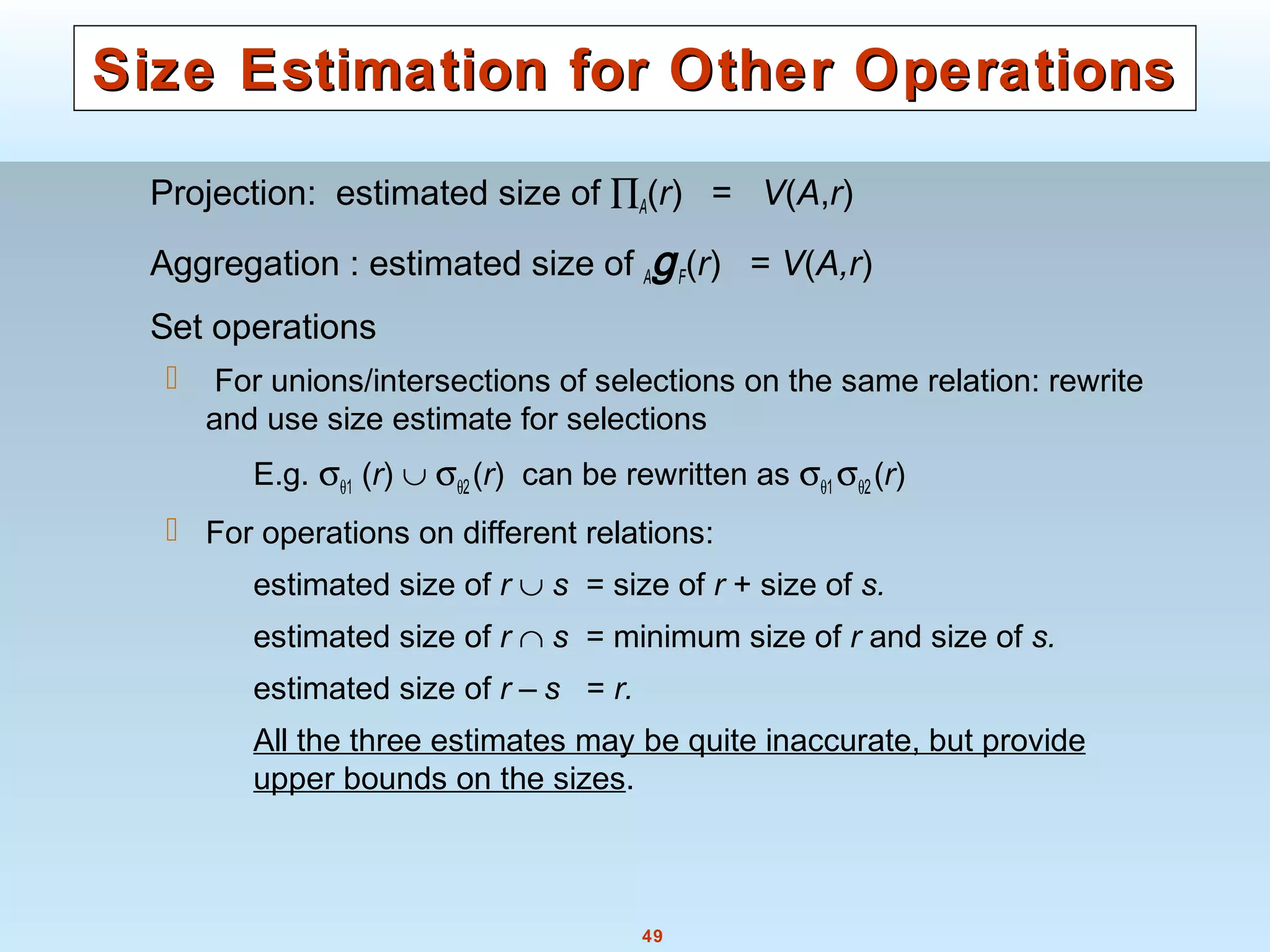
Size Estimation for Other OperationsSize Estimation for Other Operations
Projection: estimated size of ∏A(r) = V(A,r)
Aggregation : estimated size of AgF(r) = V(A,r)
Set operations
 For unions/intersections of selections on the same relation: rewrite
and use size estimate for selections
E.g. σθ1 (r) ∪ σθ2(r) can be rewritten as σθ1 σθ2(r)
 For operations on different relations:
estimated size of r ∪ s = size of r + size of s.
estimated size of r ∩ s = minimum size of r and size of s.
estimated size of r – s = r.
All the three estimates may be quite inaccurate, but provide
upper bounds on the sizes.
50
Estimation of Number of DistinctEstimation of Number of Distinct
ValuesValues
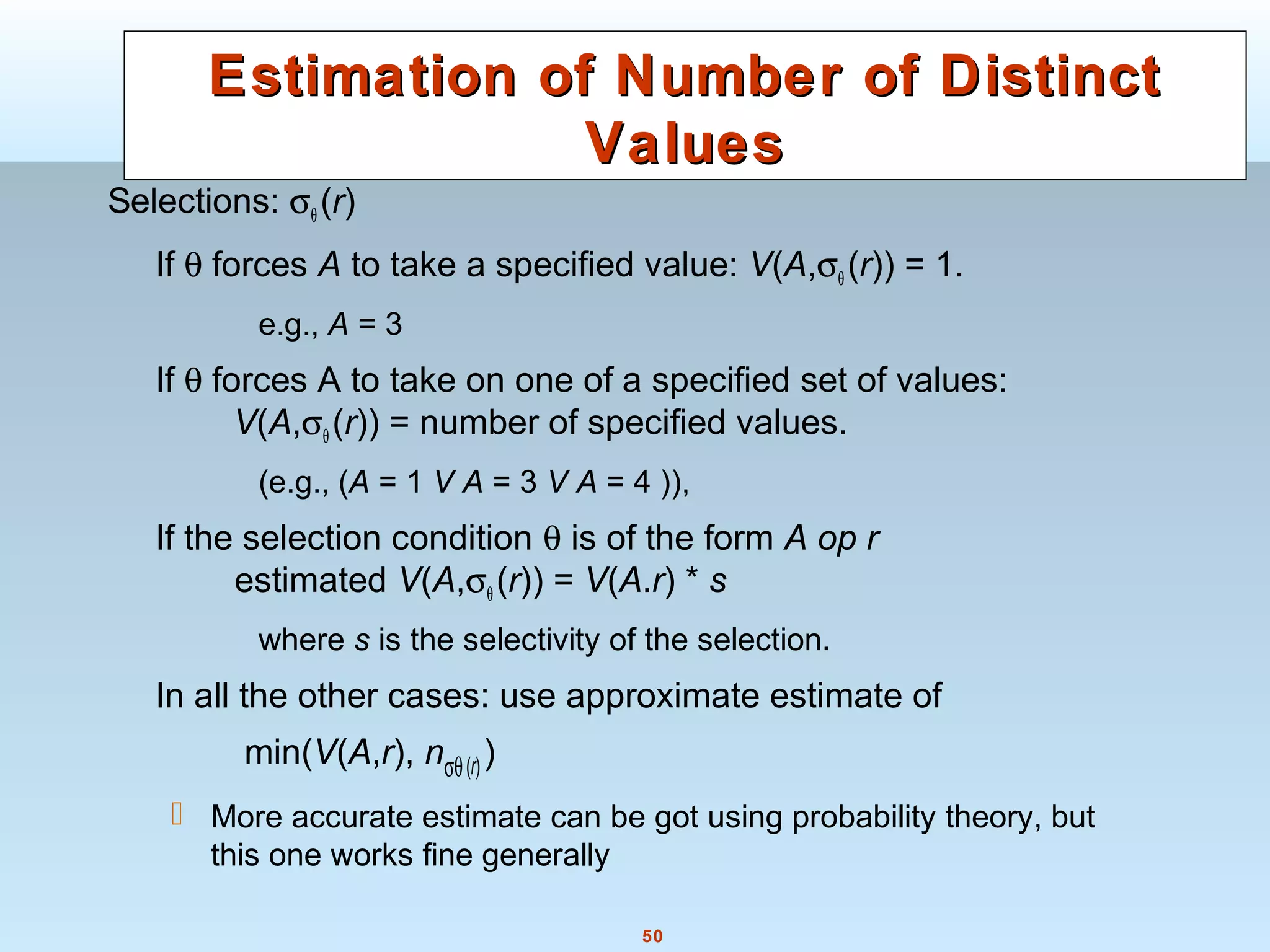
Selections: σθ (r)
If θ forces A to take a specified value: V(A,σθ (r)) = 1.
e.g., A = 3
If θ forces A to take on one of a specified set of values:
V(A,σθ (r)) = number of specified values.
(e.g., (A = 1 V A = 3 V A = 4 )),
If the selection condition θ is of the form A op r
estimated V(A,σθ (r)) = V(A.r) * s
where s is the selectivity of the selection.
In all the other cases: use approximate estimate of
min(V(A,r), nσθ(r))
 More accurate estimate can be got using probability theory, but
this one works fine generally
51
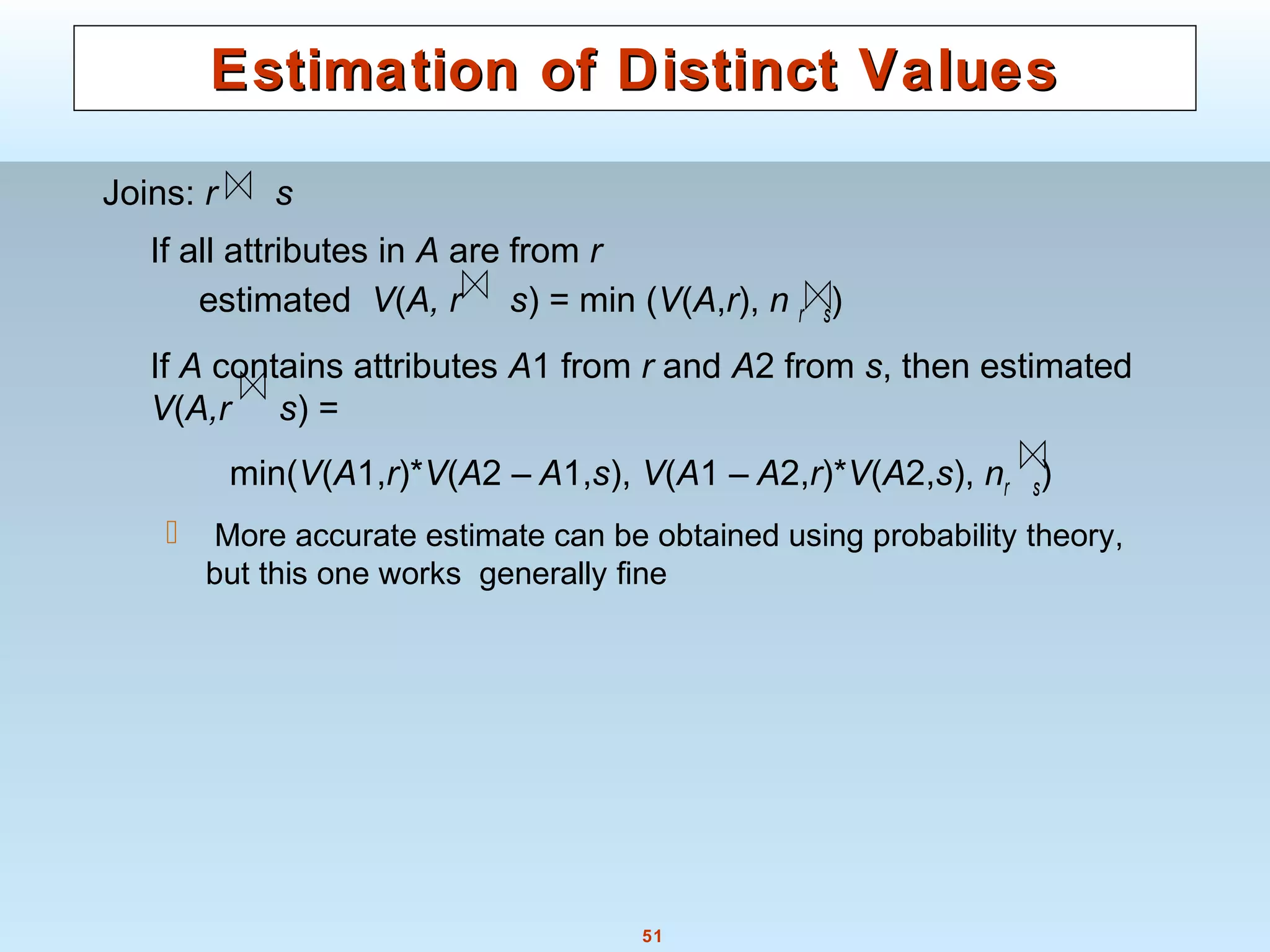
Estimation of Distinct ValuesEstimation of Distinct Values
Joins: r s
If all attributes in A are from r
estimated V(A, r s) = min (V(A,r), n r s)
If A contains attributes A1 from r and A2 from s, then estimated
V(A,r s) =
min(V(A1,r)*V(A2 – A1,s), V(A1 – A2,r)*V(A2,s), nr s)
 More accurate estimate can be obtained using probability theory,
but this one works generally fine
52
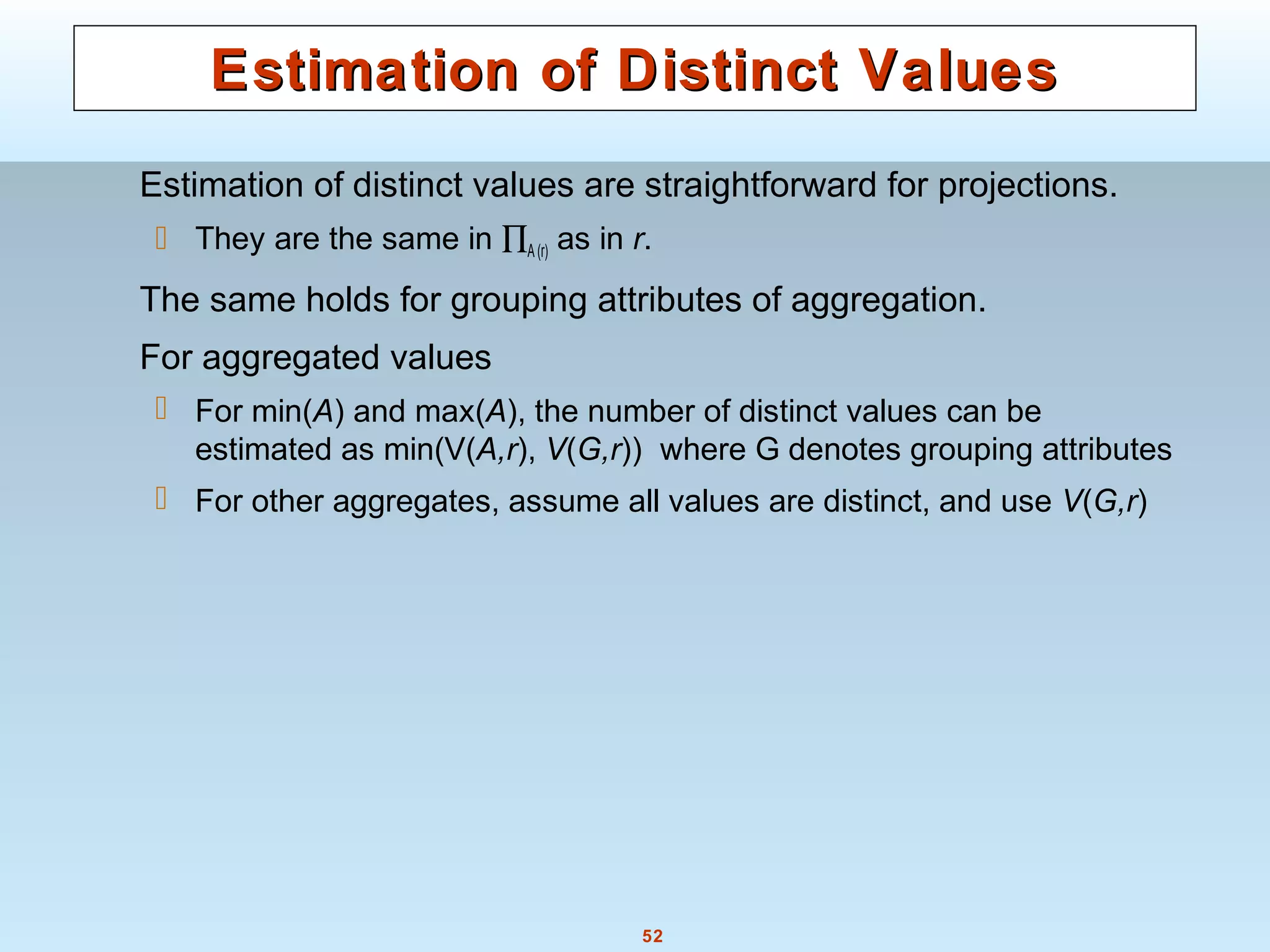
Estimation of Distinct ValuesEstimation of Distinct Values
Estimation of distinct values are straightforward for projections.
 They are the same in ∏A(r) as in r.
The same holds for grouping attributes of aggregation.
For aggregated values
 For min(A) and max(A), the number of distinct values can be
estimated as min(V(A,r), V(G,r)) where G denotes grouping attributes
 For other aggregates, assume all values are distinct, and use V(G,r)
53
Transformation of RelationalTransformation of Relational
ExpressionsExpressions
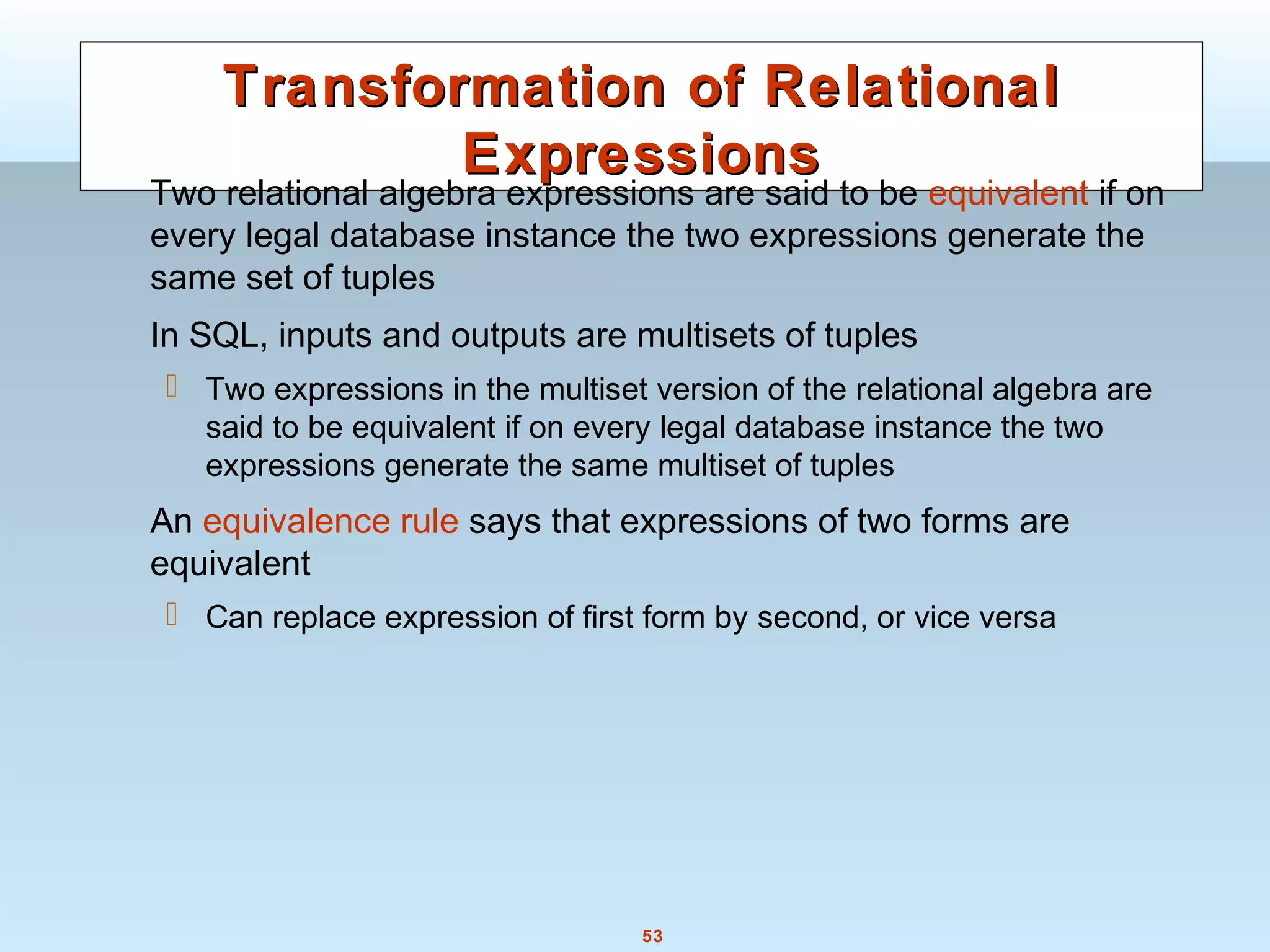
Two relational algebra expressions are said to be equivalent if on
every legal database instance the two expressions generate the
same set of tuples
In SQL, inputs and outputs are multisets of tuples
 Two expressions in the multiset version of the relational algebra are
said to be equivalent if on every legal database instance the two
expressions generate the same multiset of tuples
An equivalence rule says that expressions of two forms are
equivalent
 Can replace expression of first form by second, or vice versa
54
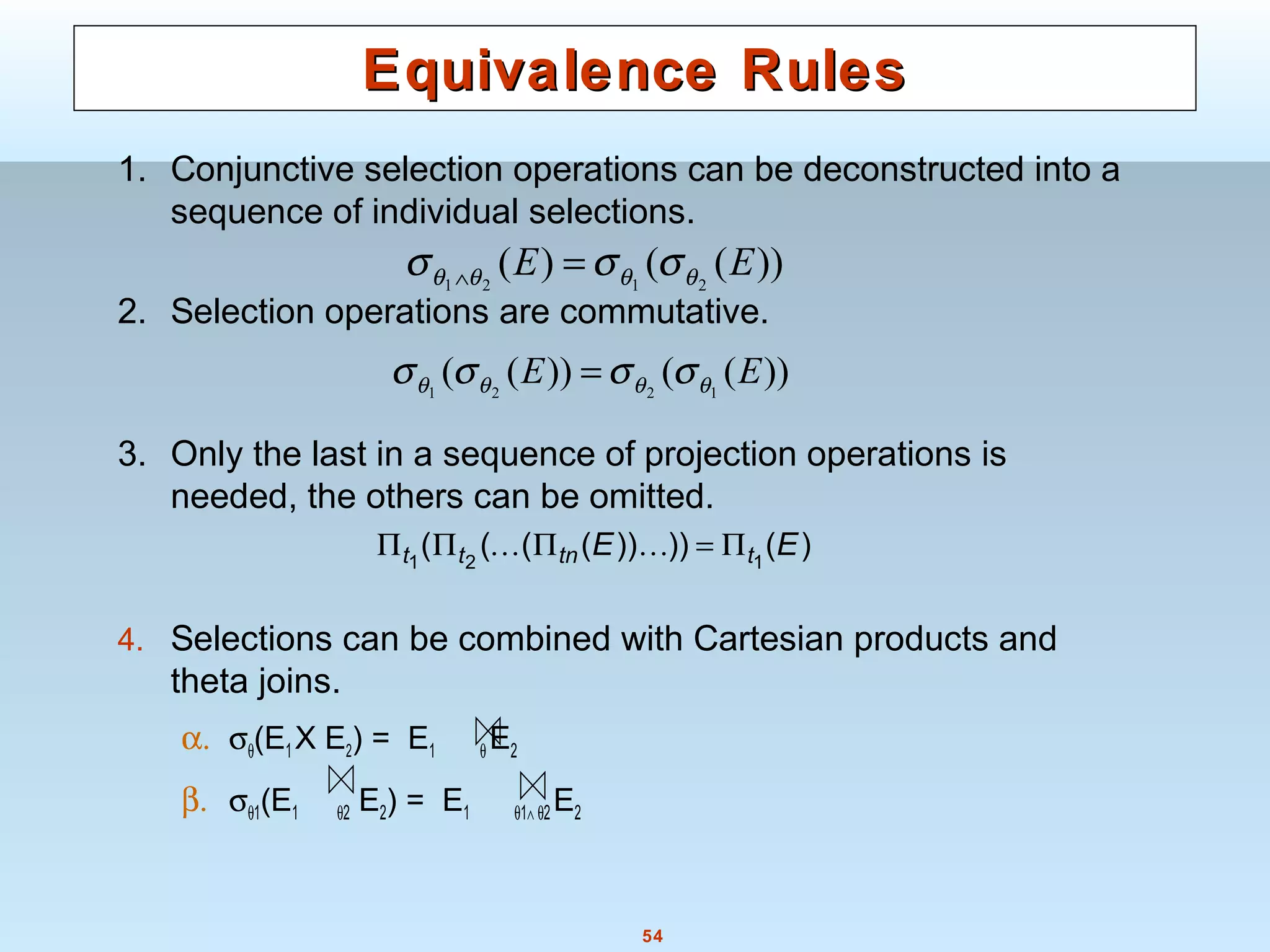
Equivalence RulesEquivalence Rules
1. Conjunctive selection operations can be deconstructed into a
sequence of individual selections.
2. Selection operations are commutative.
3. Only the last in a sequence of projection operations is
needed, the others can be omitted.
4. Selections can be combined with Cartesian products and
theta joins.
α. σθ(E1X E2) = E1 θ E2
β. σθ1(E1 θ2 E2) = E1 θ1∧ θ2E2
))(())(( 1221
EE θθθθ σσσσ =
))(()( 2121
EE θθθθ σσσ =∧
)())))(((( 121
EE ttntt Π=ΠΠΠ 
55
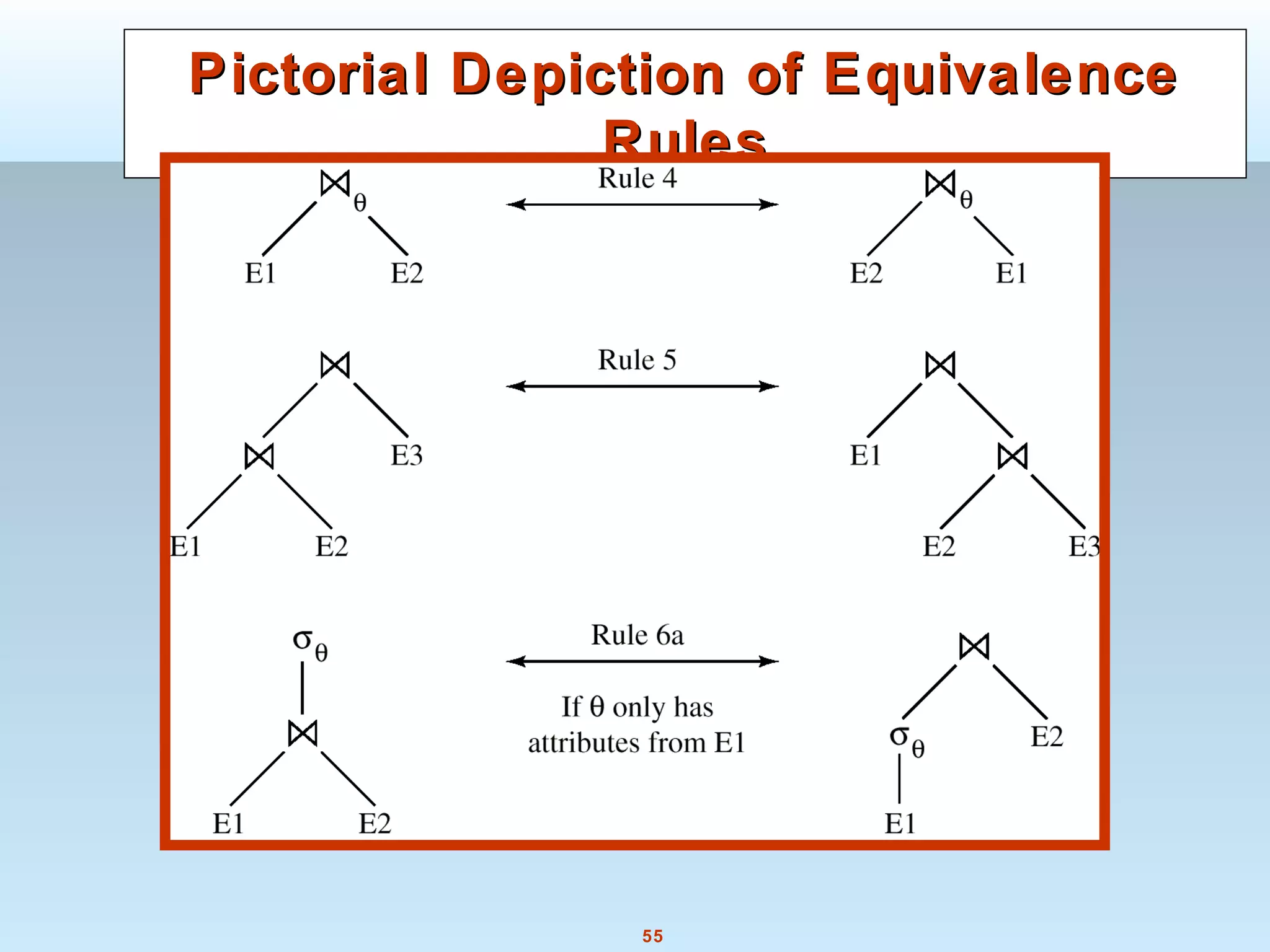
Pictorial Depiction of EquivalencePictorial Depiction of Equivalence
RulesRules
56
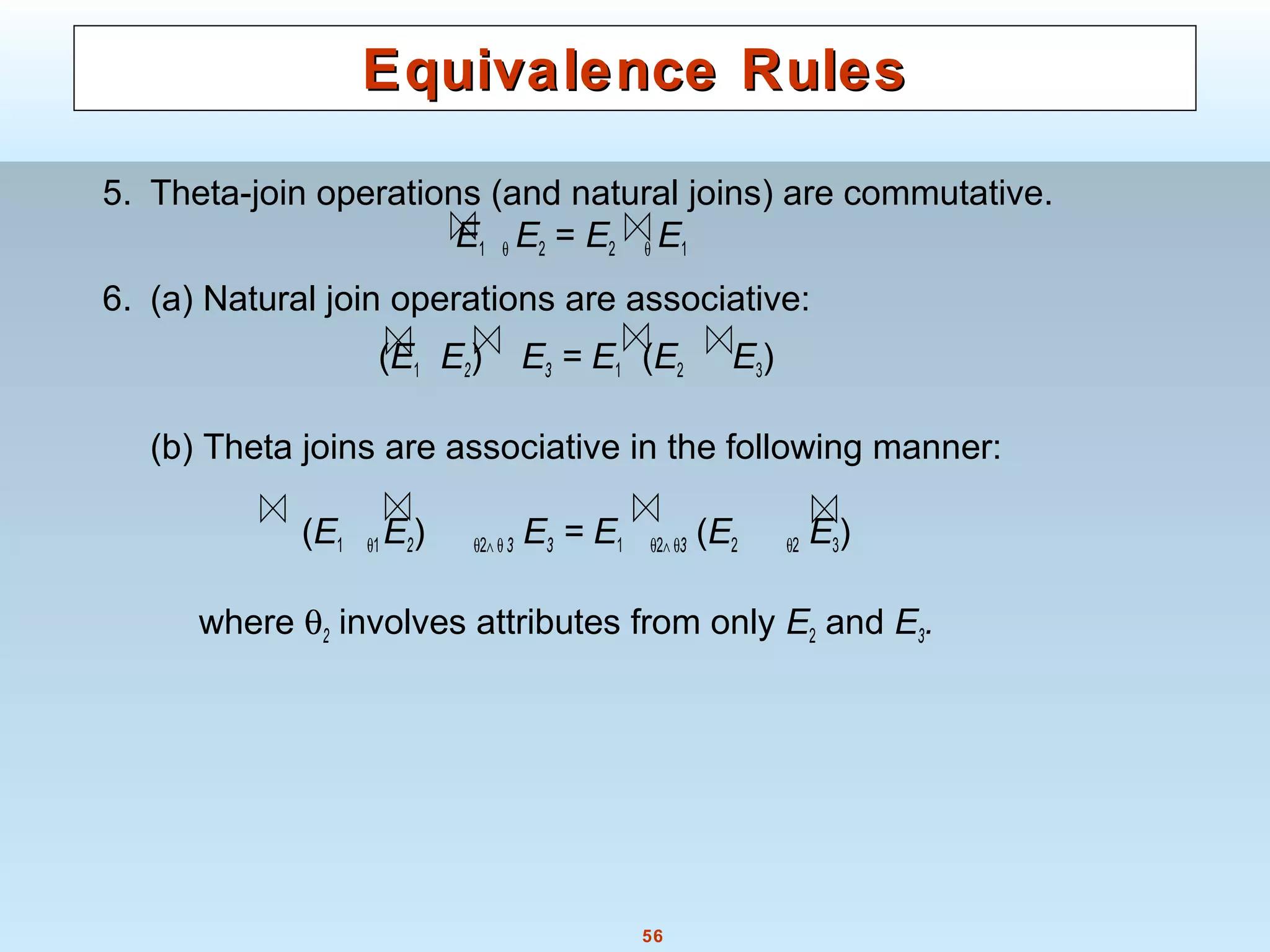
Equivalence RulesEquivalence Rules
5. Theta-join operations (and natural joins) are commutative.
E1 θ E2 = E2 θ E1
6. (a) Natural join operations are associative:
(E1 E2) E3 = E1 (E2 E3)
(b) Theta joins are associative in the following manner:
(E1 θ1 E2) θ2∧ θ 3 E3 = E1 θ2∧ θ3 (E2 θ2 E3)
where θ2 involves attributes from only E2 and E3.
57
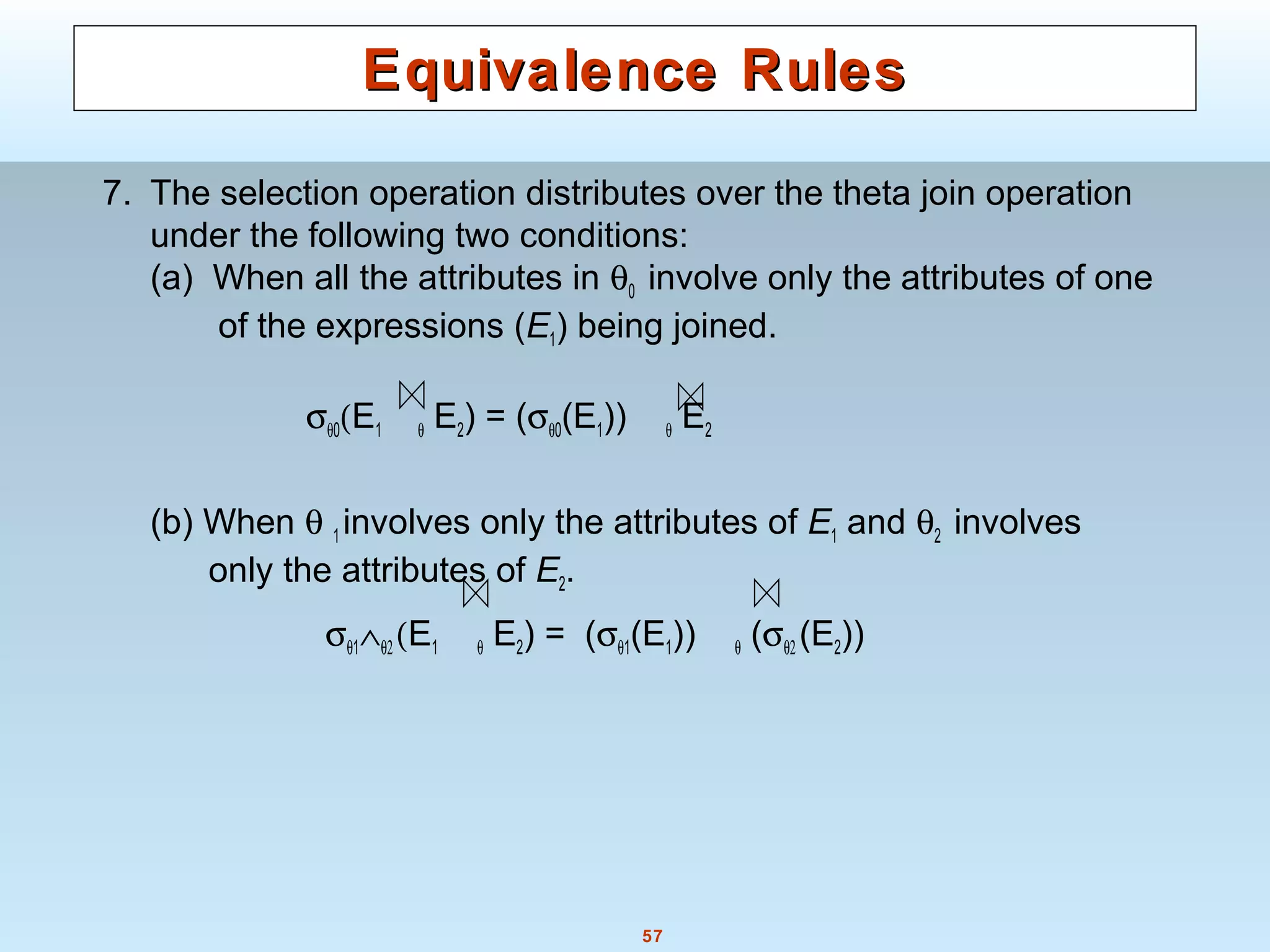
Equivalence RulesEquivalence Rules
7. The selection operation distributes over the theta join operation
under the following two conditions:
(a) When all the attributes in θ0 involve only the attributes of one
of the expressions (E1) being joined.
σθ0(E1 θ E2) = (σθ0(E1)) θ E2
(b) When θ 1 involves only the attributes of E1 and θ2 involves
only the attributes of E2.
σθ1∧θ2 (E1 θ E2) = (σθ1(E1)) θ (σθ2 (E2))
58
Equivalence RulesEquivalence Rules
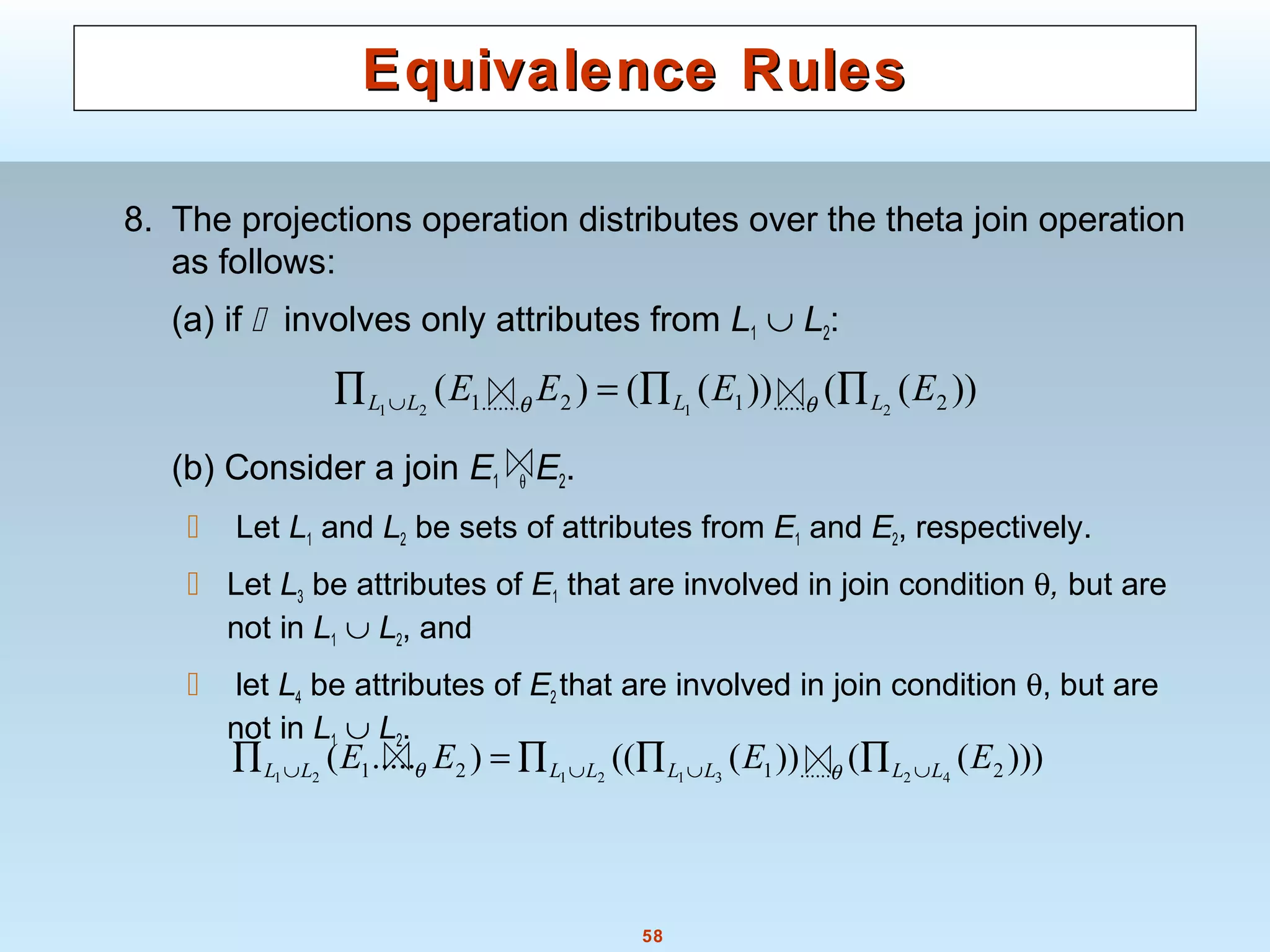
8. The projections operation distributes over the theta join operation
as follows:
(a) if  involves only attributes from L1 ∪ L2:
(b) Consider a join E1 θ E2.
 Let L1 and L2 be sets of attributes from E1 and E2, respectively.
 Let L3 be attributes of E1 that are involved in join condition θ, but are
not in L1 ∪ L2, and
 let L4 be attributes of E2 that are involved in join condition θ, but are
not in L1 ∪ L2.
))(())(()( 2......12.......1 2121
EEEE LLLL ∏∏=∏ ∪ θθ
)))(())((().....( 2......121 42312121
EEEE LLLLLLLL ∪∪∪∪ ∏∏∏=∏ θθ
59
Equivalence RulesEquivalence Rules
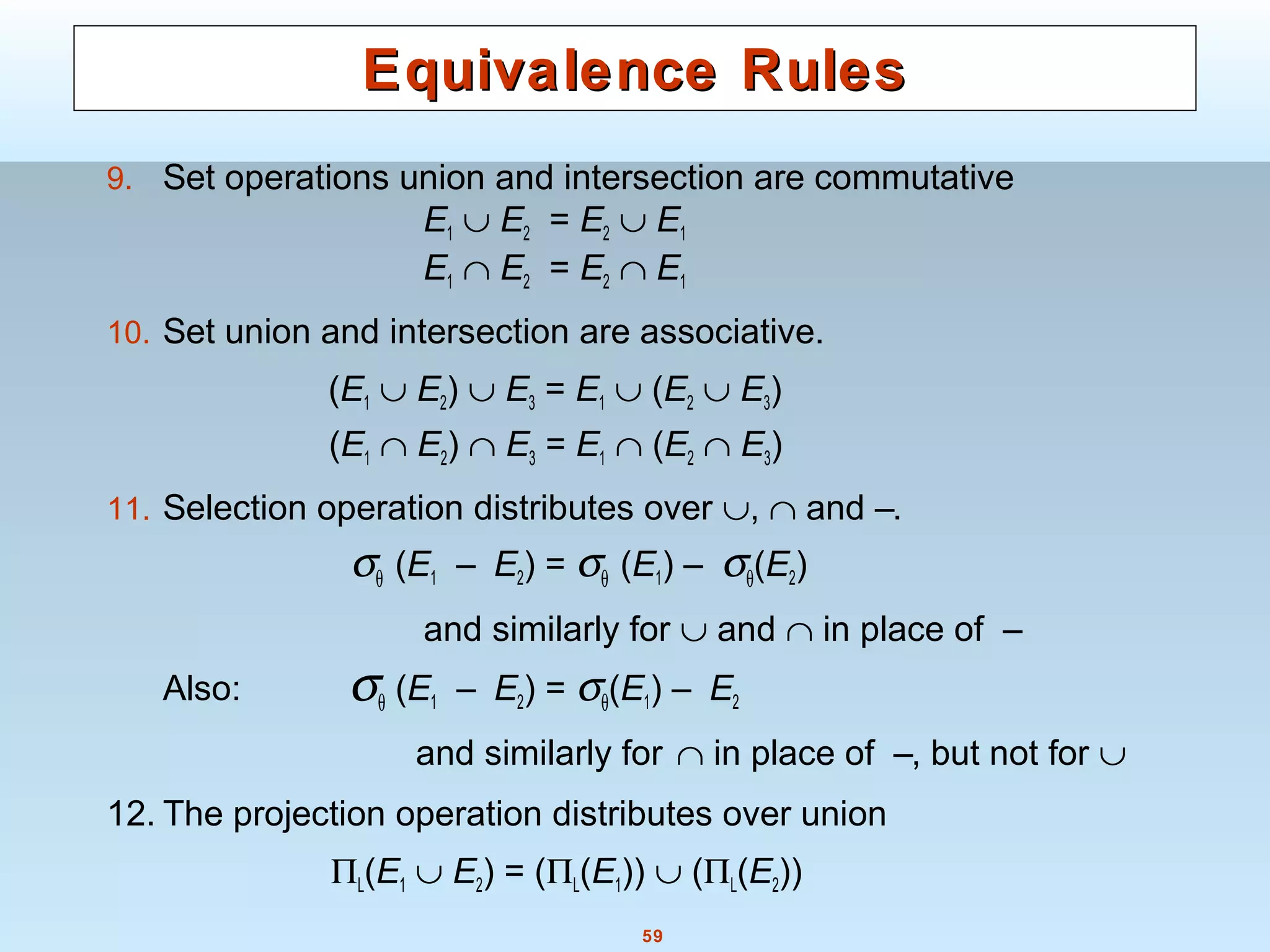
9. Set operations union and intersection are commutative
E1 ∪ E2 = E2 ∪ E1
E1 ∩ E2 = E2 ∩ E1
10. Set union and intersection are associative.
(E1 ∪ E2) ∪ E3 = E1 ∪ (E2 ∪ E3)
(E1 ∩ E2) ∩ E3 = E1 ∩ (E2 ∩ E3)
11. Selection operation distributes over ∪, ∩ and –.
σθ (E1 – E2) = σθ (E1) – σθ(E2)
and similarly for ∪ and ∩ in place of –
Also: σθ (E1 – E2) = σθ(E1) – E2
and similarly for ∩ in place of –, but not for ∪
12. The projection operation distributes over union
ΠL(E1 ∪ E2) = (ΠL(E1)) ∪ (ΠL(E2))
60
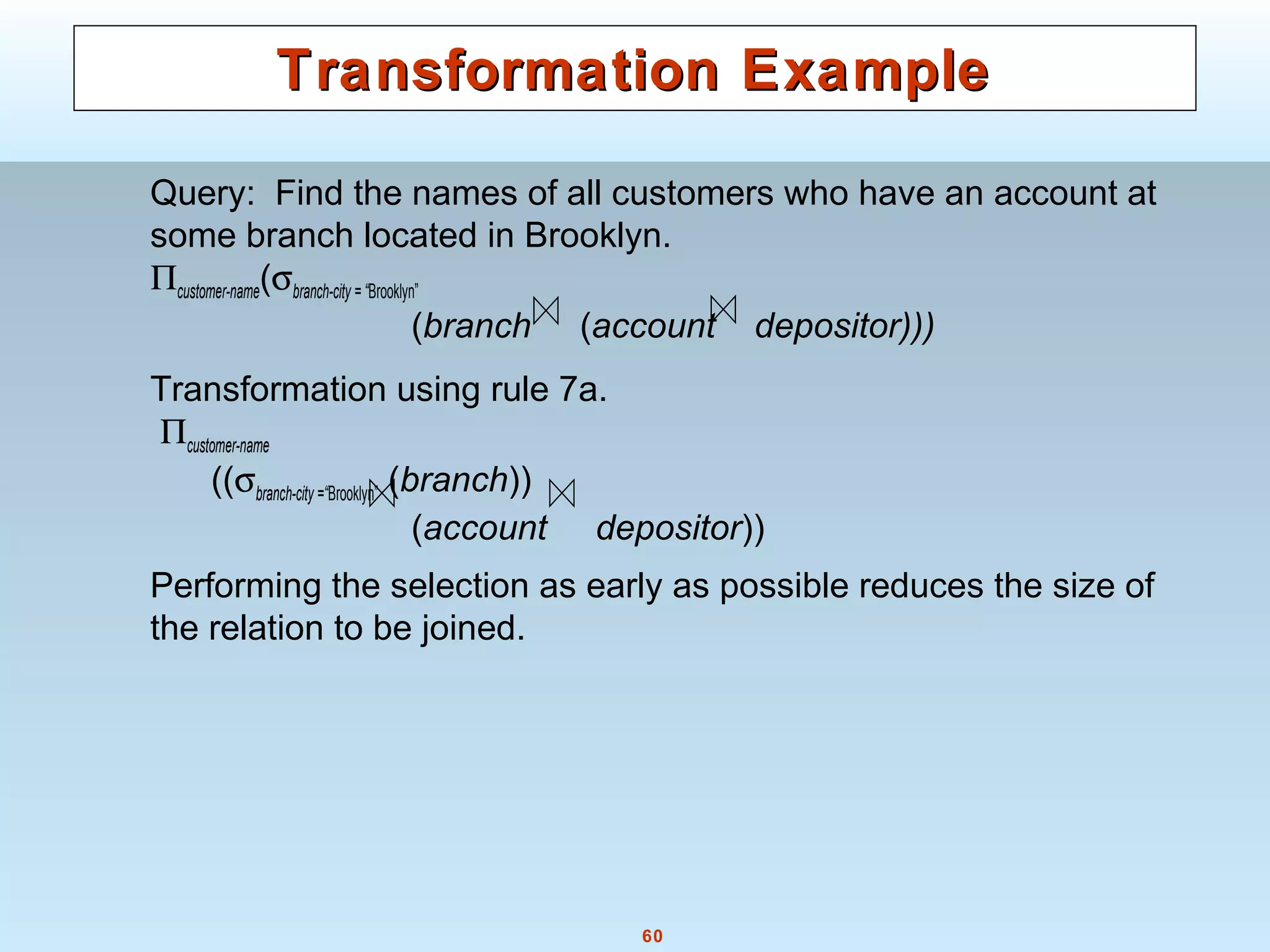
Transformation ExampleTransformation Example
Query: Find the names of all customers who have an account at
some branch located in Brooklyn.
Πcustomer-name(σbranch-city = “Brooklyn”
(branch (account depositor)))
Transformation using rule 7a.
Πcustomer-name
((σbranch-city =“Brooklyn” (branch))
(account depositor))
Performing the selection as early as possible reduces the size of
the relation to be joined.
61
Example with MultipleExample with Multiple
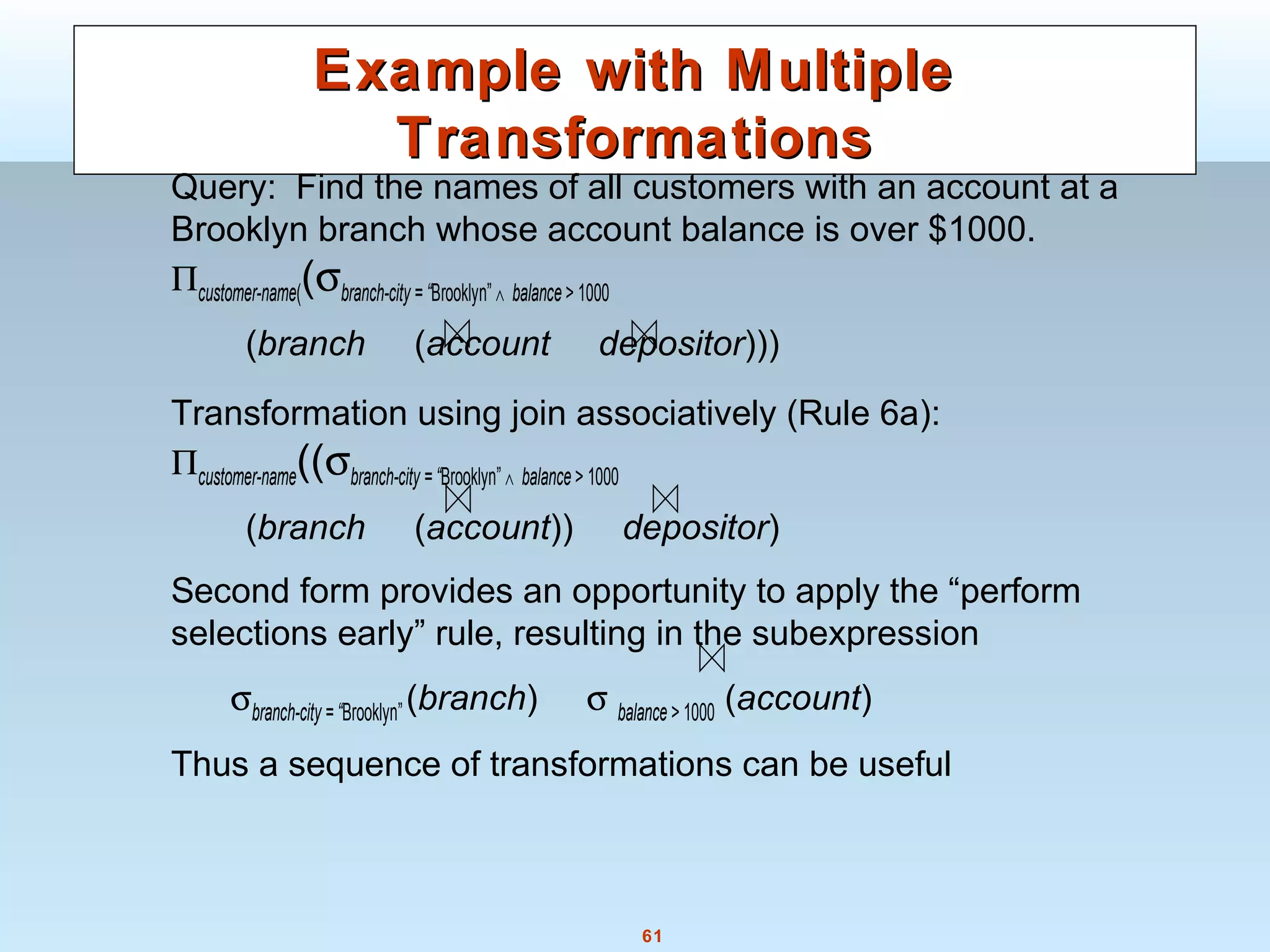
TransformationsTransformations
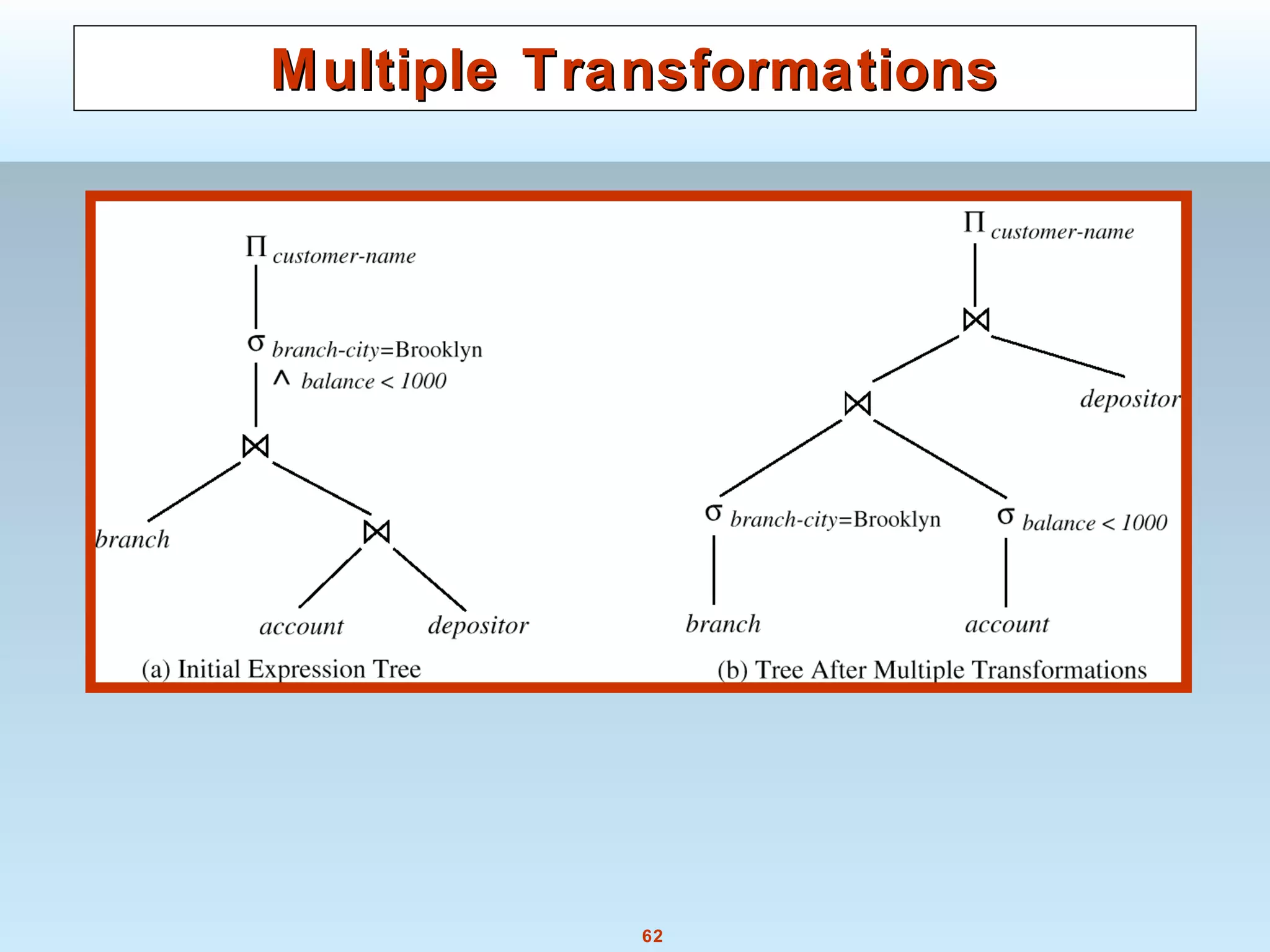
Query: Find the names of all customers with an account at a
Brooklyn branch whose account balance is over $1000.
Πcustomer-name((σbranch-city = “Brooklyn” ∧ balance > 1000
(branch (account depositor)))
Transformation using join associatively (Rule 6a):
Πcustomer-name((σbranch-city = “Brooklyn” ∧ balance > 1000
(branch (account)) depositor)
Second form provides an opportunity to apply the “perform
selections early” rule, resulting in the subexpression
σbranch-city = “Brooklyn”(branch) σ balance > 1000 (account)
Thus a sequence of transformations can be useful
62
Multiple TransformationsMultiple Transformations
63
Projection Operation ExampleProjection Operation Example
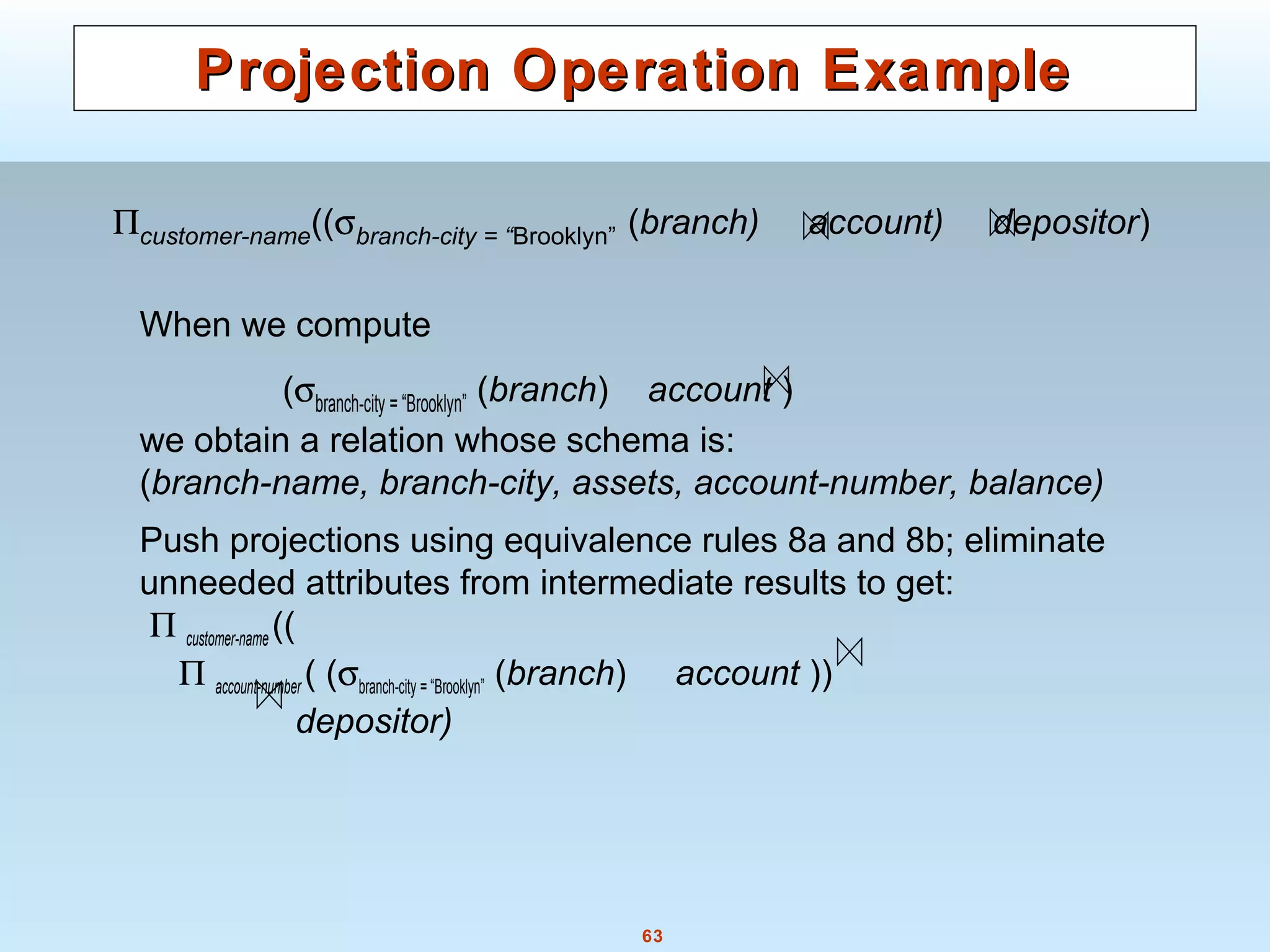
When we compute
(σbranch-city = “Brooklyn” (branch) account )
we obtain a relation whose schema is:
(branch-name, branch-city, assets, account-number, balance)
Push projections using equivalence rules 8a and 8b; eliminate
unneeded attributes from intermediate results to get:
Π customer-name ((
Π account-number ( (σbranch-city = “Brooklyn” (branch) account ))
depositor)
Πcustomer-name((σbranch-city = “Brooklyn” (branch) account) depositor)
64
Join Ordering ExampleJoin Ordering Example
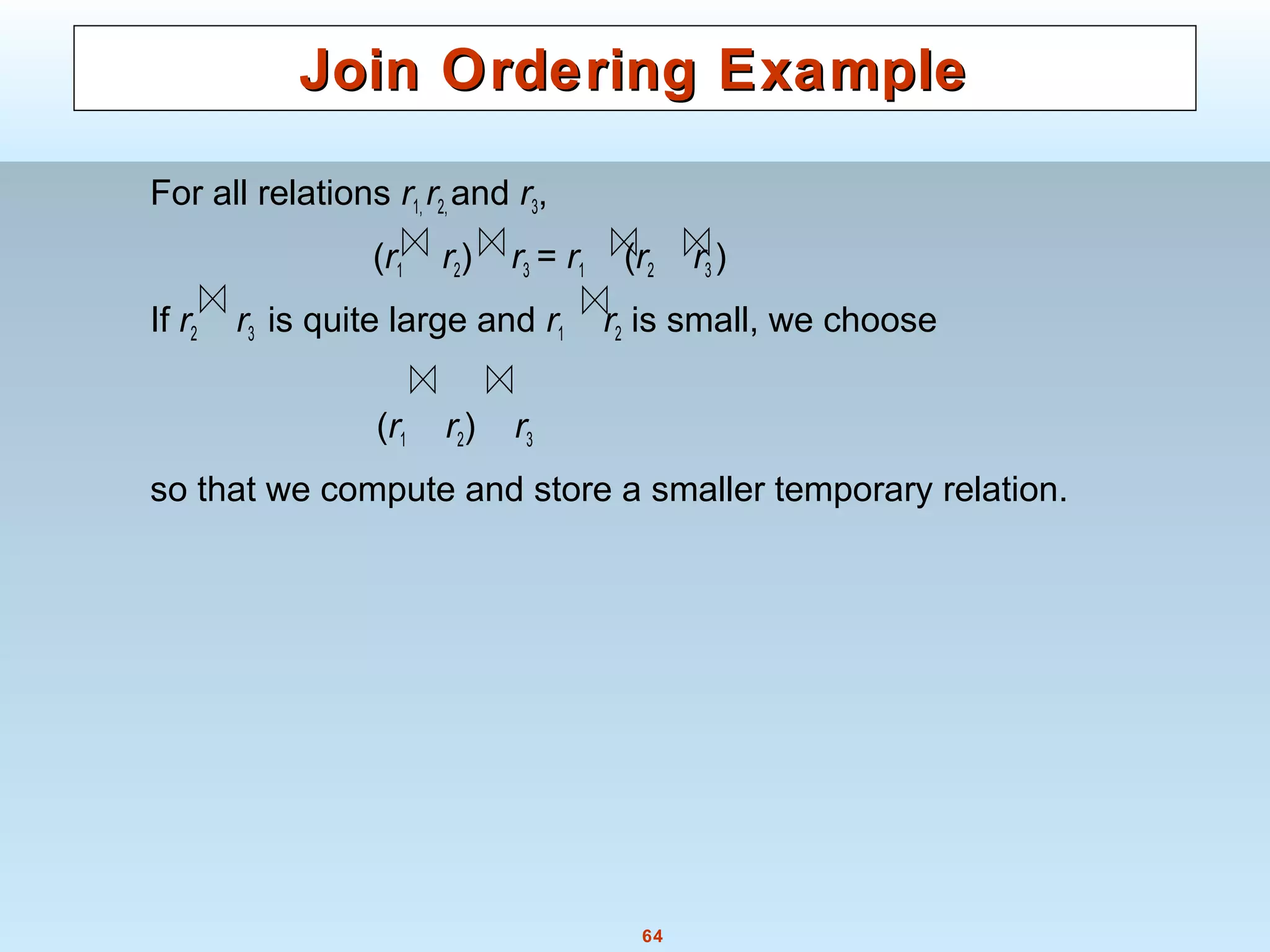
For all relations r1, r2, and r3,
(r1 r2) r3 = r1 (r2 r3 )
If r2 r3 is quite large and r1 r2 is small, we choose
(r1 r2) r3
so that we compute and store a smaller temporary relation.
65
Join Ordering ExampleJoin Ordering Example
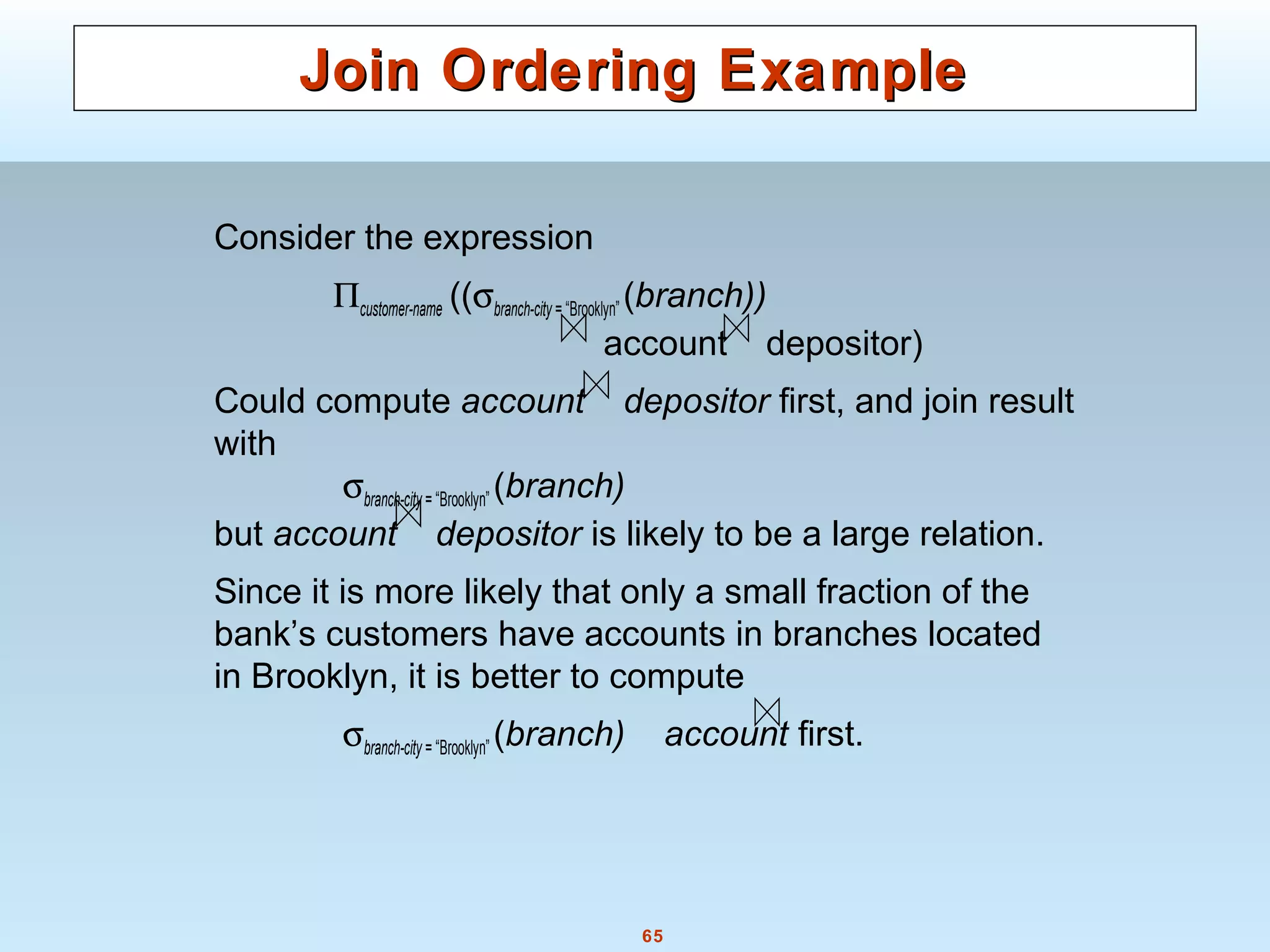
Consider the expression
Πcustomer-name ((σbranch-city = “Brooklyn” (branch))
account depositor)
Could compute account depositor first, and join result
with
σbranch-city = “Brooklyn” (branch)
but account depositor is likely to be a large relation.
Since it is more likely that only a small fraction of the
bank’s customers have accounts in branches located
in Brooklyn, it is better to compute
σbranch-city = “Brooklyn” (branch) account first.
66
Enumeration of EquivalentEnumeration of Equivalent
ExpressionsExpressions
Query optimizers use equivalence rules to systematically generate
expressions equivalent to the given expression
Conceptually, generate all equivalent expressions by repeatedly
executing the following step until no more expressions can be
found:
 for each expression found so far, use all applicable equivalence rules,
and add newly generated expressions to the set of expressions found
so far
The above approach is very expensive in space and time
Space requirements reduced by sharing common subexpressions:
 when E1 is generated from E2 by an equivalence rule, usually only the
top level of the two are different, subtrees below are the same and can
be shared
E.g. when applying join associativity
Time requirements are reduced by not generating all expressions
 More details shortly
67
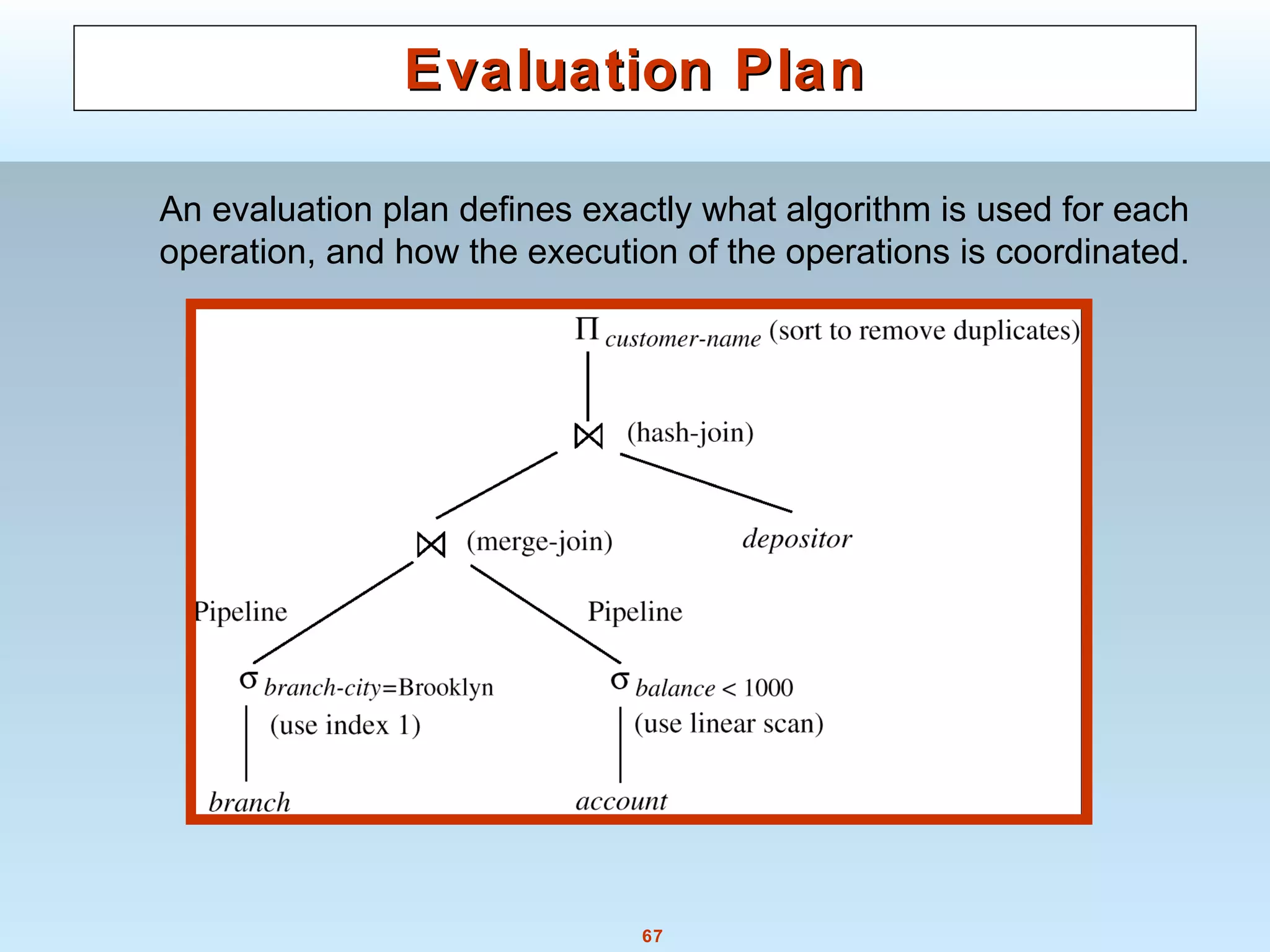
Evaluation PlanEvaluation Plan
An evaluation plan defines exactly what algorithm is used for each
operation, and how the execution of the operations is coordinated.
68
Choice of Evaluation PlansChoice of Evaluation Plans
Must consider the interaction of evaluation techniques when
choosing evaluation plans: choosing the cheapest algorithm for
each operation independently may not yield best overall
algorithm. E.g.
 merge-join may be costlier than hash-join, but may provide a sorted
output which reduces the cost for an outer level aggregation.
 nested-loop join may provide opportunity for pipelining
Practical query optimizers incorporate elements of the following
two broad approaches:
1. Search all the plans and choose the best plan in a
cost-based fashion.
2. Uses heuristics to choose a plan.
69
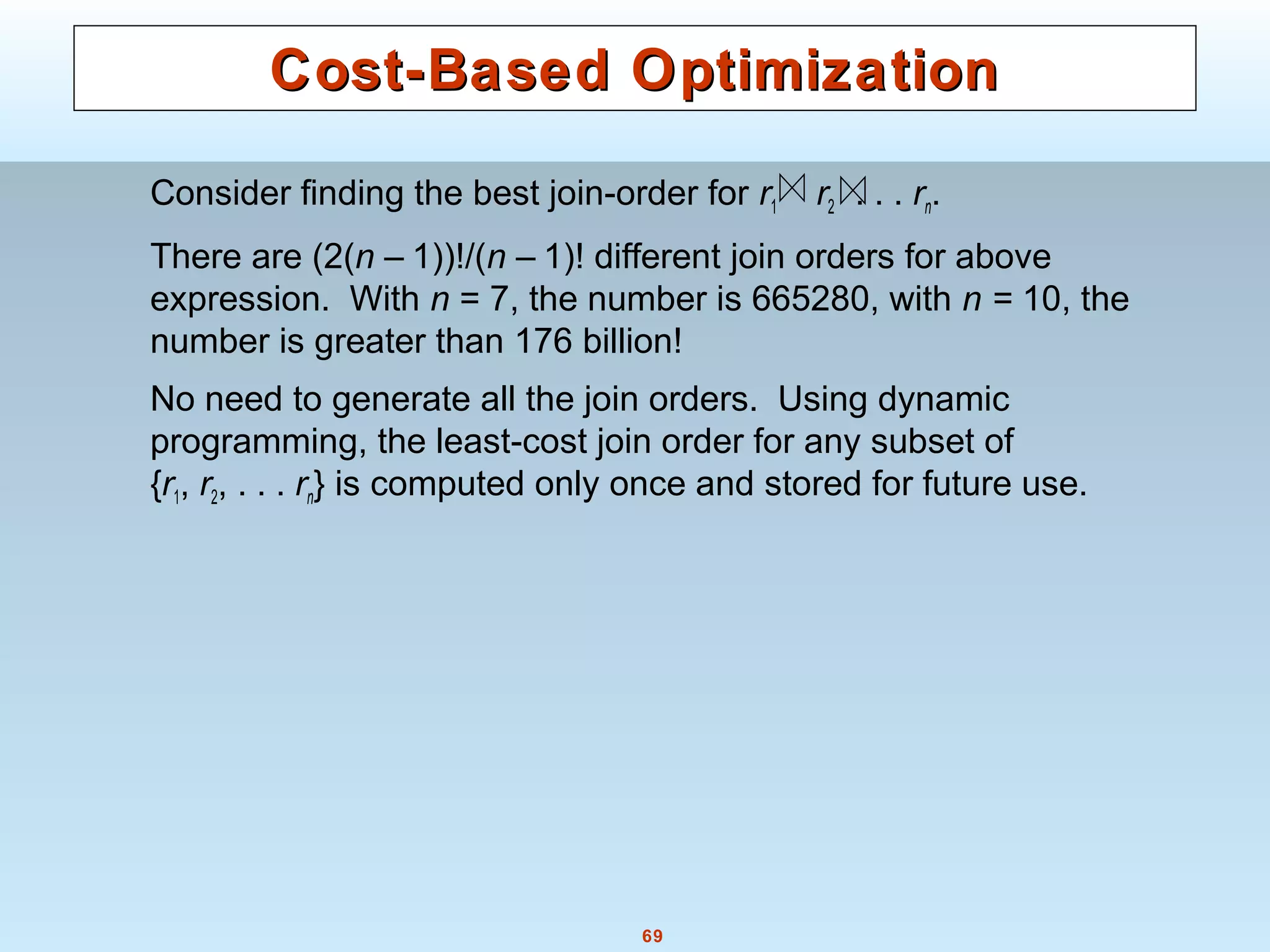
Cost-Based OptimizationCost-Based Optimization
Consider finding the best join-order for r1 r2 . . . rn.
There are (2(n – 1))!/(n – 1)! different join orders for above
expression. With n = 7, the number is 665280, with n = 10, the
number is greater than 176 billion!
No need to generate all the join orders. Using dynamic
programming, the least-cost join order for any subset of
{r1, r2, . . . rn} is computed only once and stored for future use.
70
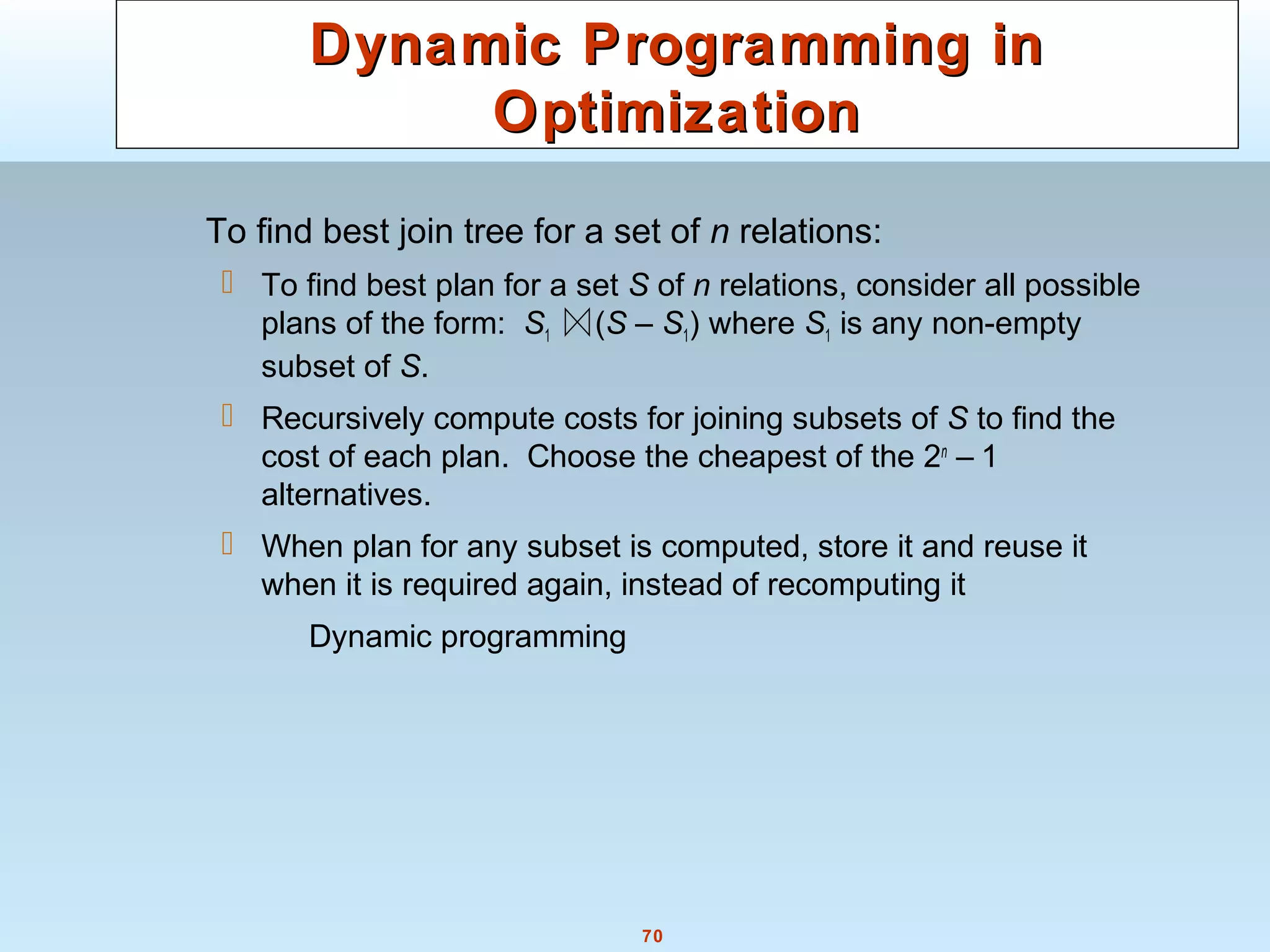
Dynamic Programming inDynamic Programming in
OptimizationOptimization
To find best join tree for a set of n relations:
 To find best plan for a set S of n relations, consider all possible
plans of the form: S1 (S – S1) where S1 is any non-empty
subset of S.
 Recursively compute costs for joining subsets of S to find the
cost of each plan. Choose the cheapest of the 2n
– 1
alternatives.
 When plan for any subset is computed, store it and reuse it
when it is required again, instead of recomputing it
Dynamic programming
71
Join Order Optimization AlgorithmJoin Order Optimization Algorithm
procedure findbestplan(S)
if (bestplan[S].cost ≠ ∞)
return bestplan[S]
// else bestplan[S] has not been computed earlier, compute it now
for each non-empty subset S1 of S such that S1 ≠ S
P1= findbestplan(S1)
P2= findbestplan(S - S1)
A = best algorithm for joining results of P1 and P2
cost = P1.cost + P2.cost + cost of A
if cost < bestplan[S].cost
bestplan[S].cost = cost
bestplan[S].plan = “execute P1.plan; execute P2.plan;
join results of P1 and P2 using A”
return bestplan[S]
72
Cost of OptimizationCost of Optimization
With dynamic programming time complexity of optimization with
bushy trees is O(3n
).
 With n = 10, this number is 59000 instead of 176 billion!
Space complexity is O(2n
)
Cost-based optimization is expensive, but worthwhile for queries
on large datasets (typical queries have small n, generally < 10)
73
Heuristic OptimizationHeuristic Optimization
Cost-based optimization is expensive, even with dynamic
programming.
Systems may use heuristics to reduce the number of choices
that must be made in a cost-based fashion.
Heuristic optimization transforms the query-tree by using a
set of rules that typically (but not in all cases) improve
execution performance:
 Perform selection early (reduces the number of tuples)
 Perform projection early (reduces the number of attributes)
 Perform most restrictive selection and join operations before
other similar operations.
 Some systems use only heuristics, others combine heuristics
with partial cost-based optimization.
74
Steps in Typical HeuristicSteps in Typical Heuristic
OptimizationOptimization
1. Deconstruct conjunctive selections into a sequence of single
selection operations (Equiv. rule 1.).
2. Move selection operations down the query tree for the
earliest possible execution (Equiv. rules 2, 7a, 7b, 11).
3. Execute first those selection and join operations that will
produce the smallest relations (Equiv. rule 6).
4. Replace Cartesian product operations that are followed by a
selection condition by join operations (Equiv. rule 4a).
5. Deconstruct and move as far down the tree as possible lists
of projection attributes, creating new projections where
needed (Equiv. rules 3, 8a, 8b, 12).

28890 lecture10

  • 1.
    1 Query ProcessingQuery Processing Overview Measuresof Query Cost Selection Operation Sorting Join Operation Other Operations Evaluation of Expressions
  • 2.
    2 Basic Steps inQuery ProcessingBasic Steps in Query Processing 1. Parsing and translation 2. Optimization 3. Evaluation
  • 3.
    3 Basic Steps inQuery ProcessingBasic Steps in Query Processing Parsing and translation  translate the query into its internal form. This is then translated into relational algebra.  Parser checks syntax, verifies relations Evaluation  The query-execution engine takes a query-evaluation plan, executes that plan, and returns the answers to the query.
  • 4.
    4 Basic Steps inQuery Processing :Basic Steps in Query Processing : OptimizationOptimization A relational algebra expression may have many equivalent expressions  E.g., σbalance<2500(∏balance(account)) is equivalent to ∏balance(σbalance<2500(account)) Each relational algebra operation can be evaluated using one of several different algorithms  Correspondingly, a relational-algebra expression can be evaluated in many ways. Annotated expression specifying detailed evaluation strategy is called an evaluation-plan.  E.g., can use an index on balance to find accounts with balance < 2500,  or can perform complete relation scan and discard accounts with balance ≥ 2500
  • 5.
    5 OptimizationOptimization Query Optimization: Amongstall equivalent evaluation plans choose the one with lowest cost.  Cost is estimated using statistical information from the database catalog e.g. number of tuples in each relation, size of tuples, etc.
  • 6.
    6 Measures of QueryCostMeasures of Query Cost Cost is generally measured as total elapsed time for answering query  Many factors contribute to time cost: disk accesses, CPU, or even network communication Typically disk access is the predominant cost, and is also relatively easy to estimate. It is measured by taking into account  Number of seeks * average-seek-cost  Number of blocks read * average-block- read-cost  Number of blocks written * average-block- write-cost
  • 7.
    7 Measures of QueryCostMeasures of Query Cost For simplicity we just use number of block transfers from disk as the cost measure Costs depends on the size of the buffer in main memory  Having more memory reduces need for disk access  Amount of real memory available to buffer depends on other concurrent OS processes, and hard to determine ahead of actual execution  We often use worst case estimates, assuming only the minimum amount of memory needed for the operation is available Real systems take CPU cost into account, differentiate between sequential and random I/O, and take buffer size into account
  • 8.
    8 Selection OperationSelection Operation Filescan – search algorithms that locate and retrieve records that fulfill a selection condition. Algorithm A1 (linear search). Scan each file block and test all records to see whether they satisfy the selection condition.  Cost estimate (number of disk blocks scanned) = br br denotes number of blocks containing records from relation r  If selection is on a key attribute, cost = (br /2) stop on finding record  Linear search can be applied regardless of selection condition or ordering of records in the file, or availability of indices
  • 9.
    9 Selection OperationSelection Operation A2(binary search). Applicable if selection is an equality comparison on the attribute on which file is ordered.  Assume that the blocks of a relation are stored contiguously  Cost estimate (number of disk blocks to be scanned): log2(br) — cost of locating the first tuple by a binary search on the blocks Plus number of blocks containing records that satisfy selection condition
  • 10.
    10 Selections Using IndicesSelectionsUsing Indices Index scan – search algorithms that use an index A3 (primary index on candidate key, equality). Retrieve a single record that satisfies the corresponding equality condition  Cost = HTi + 1 A4 (primary index on nonkey, equality) Retrieve multiple records.  Records will be on consecutive blocks  Cost = HTi + number of blocks containing retrieved records A5 (equality on search-key of secondary index).  Retrieve a single record if the search-key is a candidate key Cost = HTi + 1  Retrieve multiple records if search-key is not a candidate key Cost = HTi + number of records retrieved – Can be very expensive! each record may be on a different block
  • 11.
    11 Selections Involving ComparisonsSelectionsInvolving Comparisons Can implement selections of the form σA≤V (r) or σA ≥ V(r) by using  a linear file scan or binary search,  or by using indices in the following ways: A6 (primary index, comparison). (Relation is sorted on A) For σA ≥ V(r) use index to find first tuple ≥ v and scan relation sequentially from there For σA≤V (r) just scan relation sequentially till first tuple > v; do not use index A7 (secondary index, comparison). For σA ≥ V(r) use index to find first index entry ≥ v and scan index sequentially from there, to find pointers to records. For σA≤V (r) just scan leaf pages of index finding pointers to records, till first entry > v In either case, retrieve records that are pointed to – requires an I/O for each record – Linear file scan may be cheaper if many records are
  • 12.
    12 Implementation of ComplexImplementationof Complex SelectionsSelectionsConjunction: σθ1∧ θ2∧. . . θn(r) A8 (conjunctive selection using one index).  Select a combination of θi and algorithms A1 through A7 that results in the least cost forσθi (r).  Test other conditions on tuple after fetching it into memory buffer. A9 (conjunctive selection using multiple-key index).  Use appropriate composite (multiple-key) index if available. A10 (conjunctive selection by intersection of identifiers).  Requires indices with record pointers.  Use corresponding index for each condition, and take intersection of all the obtained sets of record pointers.  Then fetch records from file  If some conditions do not have appropriate indices, apply test in memory.
  • 13.
    13 Algorithms for ComplexSelectionsAlgorithms for Complex Selections Disjunction:σθ1∨ θ2 ∨. . . θn(r). A11 (disjunctive selection by union of identifiers).  Applicable if all conditions have available indices. Otherwise use linear scan.  Use corresponding index for each condition, and take union of all the obtained sets of record pointers.  Then fetch records from file Negation: σ¬θ(r)  Use linear scan on file  If very few records satisfy ¬θ, and an index is applicable to θ Find satisfying records using index and fetch from file
  • 14.
    14 SortingSorting We may buildan index on the relation, and then use the index to read the relation in sorted order. May lead to one disk block access for each tuple. For relations that fit in memory, techniques like quicksort can be used. For relations that don’t fit in memory, external sort-merge is a good choice.
  • 15.
    15 ExampleExample Each block consistsof r records. M number of blocks available in the memory for sorting M=3 1 2 3 4 5 6 7 8 9 10 11 12 Run 0: read 3 consecutive blocks, sort them in memory and write them back. After run 0 Each three consecutive blocks are sorted. Run 1: Read blocks 1 and 4 (keep one block for output buffer) 1 4 If block 1 (4) is exhausted read block 2(5) and continue the merge until all blocks in the First three blocks and in the second three blocks are finished. Thus, we obtained run 1 where six consecutive blocks are sorted. Repeat the same procedure with blocks 7,8,9 and 10,11,12 Run 2: repeat the same procedure for blocks in run 1. After run 2, the file is sorted! Number of accesses: 12(run0)+12(run1) +12(run2). If we count writing, then the Number of accesses is doubled
  • 16.
    16 External Sort-MergeExternal Sort-Merge 1.Create sorted runs. Let i be 0 initially. Repeatedly do the following till the end of the relation: (a) Read M blocks of relation into memory (b) Sort the in-memory blocks and write them back. (c) i=i++ Merge the runs ((M-1)-way merge). 1. Use M-1blocks of memory to buffer input runs, and 1 block to buffer output. Read the first block of each run into its buffer page 2. repeat 1. Select the first record (in sort order) among all buffer pages 2. Write the record to the output buffer. If the output buffer is full write it to disk. And delete the record from its input buffer page. 3. If the buffer page becomes empty then read the next block (if any) of the run into the buffer. 3. until all input buffer pages are empty: Let M denote memory size (in pages).
  • 17.
    17 External Sort-MergeExternal Sort-Merge Ifi ≥ M, several merge passes are required.  In each pass, contiguous groups of M - 1 runs are merged.  A pass reduces the number of runs by a factor of M -1, and creates runs longer by the same factor. E.g. If M=11, and there are 90 runs, one pass reduces the number of runs to 9, each 10 times the size of the initial runs  Repeated passes are performed till all runs have been merged into one.
  • 18.
    18 Example: External SortingUsing Sort-Example: External Sorting Using Sort- MergeMerge
  • 19.
    19 External Merge SortExternalMerge Sort Cost analysis:  Total number of merge passes required: logM - 1(br/M).  Disk accesses for initial run creation as well as in each pass is 2br for final pass, we don’t count write cost – we ignore final write cost for all operations since the output of an operation may be sent to the parent operation without being written to disk Thus total number of disk accesses for external sorting: br ( 2 logM–1(br / M) + 1)
  • 20.
    20 Join OperationJoin Operation Severaldifferent algorithms to implement joins  Nested-loop join  Block nested-loop join  Indexed nested-loop join  Merge-join  Hash-join Choice based on cost estimate Examples use the following information  Number of records of customer: 10,000 depositor: 5000  Number of blocks of customer: 400 depositor: 100
  • 21.
    21 Nested-Loop JoinNested-Loop Join Tocompute the theta join r θ s for each tuple tr in r do begin for each tuple ts in s do begin test pair (tr,ts) to see if they satisfy the join condition θ if they do, add tr • ts to the result. end end r is called the outer relation and s the inner relation of the join. Requires no indices and can be used with any kind of join condition. Expensive since it examines every pair of tuples in the two relations.
  • 22.
    22 Nested-Loop JoinNested-Loop Join Inthe worst case, if there is enough memory only to hold one block of each relation, the estimated cost is nr ∗ bs + br disk accesses. If the smaller relation fits entirely in memory, use that as the inner relation. Reduces cost to br + bs disk accesses. Assuming worst case memory availability cost estimate is  5000 ∗ 400 + 100 = 2,000,100 disk accesses with depositor as outer relation, and  1000 ∗ 100 + 400 = 1,000,400 disk accesses with customer as the outer relation. If smaller relation (depositor) fits entirely in memory, the cost estimate will be 500 disk accesses.
  • 23.
    23 Block Nested-Loop JoinBlockNested-Loop Join Variant of nested-loop join in which every block of inner relation is paired with every block of outer relation. for each block Br of r do begin for each block Bs of s do begin for each tuple tr in Br do begin for each tuple ts in Bs do begin Check if (tr,ts) satisfy the join condition if they do, add tr • ts to the result. end end end end
  • 24.
    24 Block Nested-Loop JoinBlockNested-Loop Join Worst case estimate: br ∗ bs + br block accesses.  Each block in the inner relation s is read once for each block in the outer relation (instead of once for each tuple in the outer relation Best case: br + bs block accesses. Improvements to nested loop and block nested loop algorithms:  In block nested-loop, use M — 2 disk blocks as blocking unit for outer relations, where M = memory size in blocks; use remaining two blocks to buffer inner relation and output Cost = br / (M-2) ∗ bs + br  If equi-join attribute forms a key or inner relation, stop inner loop on first match  Scan inner loop forward and backward alternately, to make use of the blocks remaining in buffer (with LRU replacement)  Use index on inner relation if available (next slide)
  • 25.
    25 Indexed Nested-Loop JoinIndexedNested-Loop Join Index lookups can replace file scans if  join is an equi-join or natural join and  an index is available on the inner relation’s join attribute Can construct an index just to compute a join. For each tuple tr in the outer relation r, use the index to look up tuples in s that satisfy the join condition with tuple tr. Worst case: buffer has space for only one page of r, and, for each tuple in r, we perform an index lookup on s. Cost of the join: br + nr ∗ c  Where c is the cost of traversing index and fetching all matching s tuples for one tuple or r  c can be estimated as cost of a single selection on s using the join condition. If indices are available on join attributes of both r and s, use the relation with fewer tuples as the outer relation.
  • 26.
    26 Example of Nested-LoopJoin CostsExample of Nested-Loop Join Costs Compute depositor customer, with depositor as the outer relation. Let customer have a primary B+ -tree index on the join attribute customer-name, which contains 20 entries in each index node. Since customer has 10,000 tuples, the height of the tree is 4, and one more access is needed to find the actual data depositor has 5000 tuples Cost of block nested loops join  400*100 + 100 = 40,100 disk accesses assuming worst case memory (may be significantly less with more memory) Cost of indexed nested loops join  100 + 5000 * 5 = 25,100 disk accesses.  CPU cost likely to be less than that for block nested loops join
  • 27.
    27 Merge-JoinMerge-Join 1. Sort bothrelations on their join attribute (if not already sorted on the join attributes). 2. Merge the sorted relations to join them 1. Join step is similar to the merge stage of the sort-merge algorithm. 2. Main difference is handling of duplicate values in join attribute — every pair with same value on join attribute must be matched 3. Detailed algorithm in book
  • 28.
    28 Merge-JoinMerge-Join Can be usedonly for equi-joins and natural joins Each block needs to be read only once (assuming all tuples for any given value of the join attributes fit in memory Thus number of block accesses for merge-join is br + bs + the cost of sorting if relations are unsorted.
  • 29.
    29 Hash-JoinHash-Join Applicable for equi-joinsand natural joins. A hash function h is used to partition tuples of both relations h maps JoinAttrs values to {0, 1, ..., n}, where JoinAttrs denotes the common attributes of r and s used in the natural join.  r0, r1, . . ., rn denote partitions of r tuples Each tuple tr ∈ r is put in partition ri where i = h(tr[JoinAttrs]).  r0,, r1. . ., rn denotes partitions of s tuples Each tuple ts ∈s is put in partition si, where i = h(ts[JoinAttrs]). Note: In book, ri is denoted as Hri, si is denoted as Hsi and nis denoted as nh.
  • 30.
  • 31.
    31 Hash-JoinHash-Join r tuples inri need only to be compared with s tuples in si Need not be compared with s tuples in any other partition, since:  an r tuple and an s tuple that satisfy the join condition will have the same value for the join attributes.  If that value is hashed to some value i, the r tuple has to be in ri and the s tuple in si.
  • 32.
    32 Hash-Join AlgorithmHash-Join Algorithm 1.Partition the relation s using hashing function h. When partitioning a relation, one block of memory is reserved as the output buffer for each partition. 2. Partition r similarly. 3. For each i: (a)Load si into memory and build an in-memory hash index on it using the join attribute. This hash index uses a different hash function than the earlier one h. (b) Read the tuples in ri from the disk one by one. For each tuple tr locate each matching tuple ts in si using the in-memory hash index. Output the concatenation of their attributes. The hash-join of r and s is computed as follows. Relation s is called the build input and r is called the probe input.
  • 33.
    33 Handling of OverflowsHandlingof Overflows Hash-table overflow occurs in partition si if si does not fit in memory. Reasons could be  Many tuples in s with same value for join attributes  Bad hash function Partitioning is said to be skewed if some partitions have significantly more tuples than some others Overflow resolution can be done in build phase  Partition si is further partitioned using different hash function.  Partition ri must be similarly partitioned. Overflow avoidance performs partitioning carefully to avoid overflows during build phase  E.g. partition build relation into many partitions, then combine them Both approaches fail with large numbers of duplicates  Fallback option: use block nested loops join on overflowed partitions
  • 34.
    34 Complex JoinsComplex Joins Joinwith a conjunctive condition: r θ1∧ θ 2∧...∧ θ n s  Either use nested loops/block nested loops, or  Compute the result of one of the simpler joins r θi s final result comprises those tuples in the intermediate result that satisfy the remaining conditions θ1 ∧ . . . ∧ θi –1 ∧ θi +1 ∧ . . . ∧ θn Join with a disjunctive condition r θ1 ∨ θ2 ∨...∨ θns  Either use nested loops/block nested loops, or  Compute as the union of the records in individual joins r θi s: (r θ1s) ∪ (r θ2 s) ∪ . . . ∪ (r θn s)
  • 35.
    35 Other OperationsOther Operations Duplicateelimination can be implemented via hashing or sorting.  On sorting duplicates will come adjacent to each other, and all but one set of duplicates can be deleted. Optimization: duplicates can be deleted during run generation as well as at intermediate merge steps in external sort-merge.  Hashing is similar – duplicates will come into the same bucket. Projection is implemented by performing projection on each tuple followed by duplicate elimination.
  • 36.
    36 Other Operations :AggregationOther Operations : Aggregation Aggregation can be implemented in a manner similar to duplicate elimination.  Sorting or hashing can be used to bring tuples in the same group together, and then the aggregate functions can be applied on each group.  Optimization: combine tuples in the same group during run generation and intermediate merges, by computing partial aggregate values For count, min, max, sum: keep aggregate values on tuples found so far in the group. – When combining partial aggregate for count, add up the aggregates For avg, keep sum and count, and divide sum by count at the end
  • 37.
    37 Other Operations :Set OperationsOther Operations : Set Operations Set operations (∪, ∩ and ): can either use variant of merge-join after sorting, or variant of hash-join. E.g., Set operations using hashing: 1. Partition both relations using the same hash function, thereby creating,r1, .., rn r0, and s1, s2.., sn 2. Process each partition i as follows. Using a different hashing function, build an in-memory hash index on ri after it is brought into memory. 3. – r ∪ s: Add tuples in si to the hash index if they are not already in it. At end of si add the tuples in the hash index to the result. – r ∩ s: output tuples in si to the result if they are already there in the hash index. – r – s: for each tuple in si, if it is there in the hash index, delete it from the index. At end of si add remaining tuples in the hash index to the result.
  • 38.
    38 OptimizationOptimization Generation of query-evaluationplans for an expression involves several steps: 1. Generating logically equivalent expressions Use equivalence rules to transform an expression into an equivalent one. 2. Annotating resultant expressions to get alternative query plans 3. Choosing the cheapest plan based on estimated cost The overall process is called cost based optimization.
  • 39.
    39 Statistical Information forCostStatistical Information for Cost EstimationEstimationnr: number of tuples in a relation r. br: number of blocks containing tuples of r. sr: size of a tuple of r. fr: blocking factor of r — i.e., the number of tuples of r that fit into one block. V(A, r): number of distinct values that appear in r for attribute A; same as the size of ∏A(r). SC(A, r): selection cardinality of attribute A of relation r; average number of records that satisfy equality on A. If tuples of r are stored together physically in a file, then:           = rf rn rb
  • 40.
    40 Catalog Information aboutIndicesCatalog Information about Indices fi: average fan-out of internal nodes of index i, for tree-structured indices such as B+-trees. HTi: number of levels in index i — i.e., the height of i.  For a balanced tree index (such as B+-tree) on attribute A of relation r, HTi = logfi(V(A,r)).  For a hash index, HTi is 1.  LBi: number of lowest-level index blocks in i — i.e, the number of blocks at the leaf level of the index.
  • 41.
    41 Selection Size EstimationSelectionSize Estimation Equality selection σA=v(r) SC(A, r) : number of records that will satisfy the selection SC(A, r)/fr — number of blocks that these records will occupy E.g. Binary search cost estimate becomes  Equality condition on a key attribute: SC(A,r) = 1   1 ),( )(log22 −      += r ra f rASC bE
  • 42.
    42 Statistical Information forExamplesStatistical Information for Examples faccount= 20 (20 tuples of account fit in one block) V(branch-name, account) = 50 (50 branches) V(balance, account) = 500 (500 different balance values) πaccount = 10000 (account has 10,000 tuples) Assume the following indices exist on account:  A primary, B+ -tree index for attribute branch-name  A secondary, B+ -tree index for attribute balance
  • 43.
    43 Selections Involving ComparisonsSelectionsInvolving Comparisons Selections of the form σA≤V(r) (case of σA ≥ V(r) is symmetric) Let c denote the estimated number of tuples satisfying the condition.  If min(A,r) and max(A,r) are available in catalog C = 0 if v < min(A,r) C =  In absence of statistical information c is assumed to be nr / 2. ),min(),max( ),min( . rArA rAv nr − −
  • 44.
    44 Implementation of ComplexImplementationof Complex SelectionsSelections The selectivity of a condition θi is the probability that a tuple in the relation r satisfies θi . If si is the number of satisfying tuples in r, the selectivity of θi is given by si /nr. Conjunction: σθ1∧ θ2∧.. .∧ θn (r). The estimate for number of tuples in the result is: Disjunction:σθ1∨ θ2∨. . . ∨ θn (r). Estimated number of tuples: Negation: σ¬θ(r). Estimated number of tuples: nr – size(σθ(r)) n r n r n sss n ∗∗∗ ∗ ...21       −∗∗−∗−−∗ )1(...)1()1(1 21 r n rr r n s n s n s n
  • 45.
    45 Join Operation: RunningExampleJoin Operation: Running Example Running example: depositor customer Catalog information for join examples: ncustomer = 10,000. fcustomer = 25, which implies that bcustomer =10000/25 = 400. ndepositor = 5000. fdepositor = 50, which implies that bdepositor = 5000/50 = 100. V(customer-name, depositor) = 2500, which implies that , on average, each customer has two accounts. Also assume that customer-name in depositor is a foreign key on customer.
  • 46.
    46 Estimation of theSize of JoinsEstimation of the Size of Joins The Cartesian product r x s contains nr .ns tuples; each tuple occupies sr + ss bytes. If R ∩ S = ∅, then r s is the same as r x s. If R ∩ S is a key for R, then a tuple of s will join with at most one tuple from r  therefore, the number of tuples in r s is no greater than the number of tuples in s. If R ∩ S in S is a foreign key in S referencing R, then the number of tuples in r s is exactly the same as the number of tuples in s. The case for R ∩ S being a foreign key referencing S is symmetric. In the example query depositor customer, customer-name in depositor is a foreign key of customer  hence, the result has exactly ndepositor tuples, which is 5000
  • 47.
    47 Estimation of theSize of JoinsEstimation of the Size of Joins If R ∩ S = {A} is not a key for R or S. If we assume that every tuple t in R produces tuples in R S, the number of tuples in R S is estimated to be: If the reverse is true, the estimate obtained will be: The lower of these two estimates is probably the more accurate one. ),( sAV nn sr ∗ ),( rAV nn sr ∗
  • 48.
    48 Estimation of theSize of JoinsEstimation of the Size of Joins Compute the size estimates for depositor customer without using information about foreign keys:  V(customer-name, depositor) = 2500, and V(customer-name, customer) = 10000  The two estimates are 5000 * 10000/2500 - 20,000 and 5000 * 10000/10000 = 5000  We choose the lower estimate, which in this case, is the same as our earlier computation using foreign keys.
  • 49.
    49 Size Estimation forOther OperationsSize Estimation for Other Operations Projection: estimated size of ∏A(r) = V(A,r) Aggregation : estimated size of AgF(r) = V(A,r) Set operations  For unions/intersections of selections on the same relation: rewrite and use size estimate for selections E.g. σθ1 (r) ∪ σθ2(r) can be rewritten as σθ1 σθ2(r)  For operations on different relations: estimated size of r ∪ s = size of r + size of s. estimated size of r ∩ s = minimum size of r and size of s. estimated size of r – s = r. All the three estimates may be quite inaccurate, but provide upper bounds on the sizes.
  • 50.
    50 Estimation of Numberof DistinctEstimation of Number of Distinct ValuesValues Selections: σθ (r) If θ forces A to take a specified value: V(A,σθ (r)) = 1. e.g., A = 3 If θ forces A to take on one of a specified set of values: V(A,σθ (r)) = number of specified values. (e.g., (A = 1 V A = 3 V A = 4 )), If the selection condition θ is of the form A op r estimated V(A,σθ (r)) = V(A.r) * s where s is the selectivity of the selection. In all the other cases: use approximate estimate of min(V(A,r), nσθ(r))  More accurate estimate can be got using probability theory, but this one works fine generally
  • 51.
    51 Estimation of DistinctValuesEstimation of Distinct Values Joins: r s If all attributes in A are from r estimated V(A, r s) = min (V(A,r), n r s) If A contains attributes A1 from r and A2 from s, then estimated V(A,r s) = min(V(A1,r)*V(A2 – A1,s), V(A1 – A2,r)*V(A2,s), nr s)  More accurate estimate can be obtained using probability theory, but this one works generally fine
  • 52.
    52 Estimation of DistinctValuesEstimation of Distinct Values Estimation of distinct values are straightforward for projections.  They are the same in ∏A(r) as in r. The same holds for grouping attributes of aggregation. For aggregated values  For min(A) and max(A), the number of distinct values can be estimated as min(V(A,r), V(G,r)) where G denotes grouping attributes  For other aggregates, assume all values are distinct, and use V(G,r)
  • 53.
    53 Transformation of RelationalTransformationof Relational ExpressionsExpressions Two relational algebra expressions are said to be equivalent if on every legal database instance the two expressions generate the same set of tuples In SQL, inputs and outputs are multisets of tuples  Two expressions in the multiset version of the relational algebra are said to be equivalent if on every legal database instance the two expressions generate the same multiset of tuples An equivalence rule says that expressions of two forms are equivalent  Can replace expression of first form by second, or vice versa
  • 54.
    54 Equivalence RulesEquivalence Rules 1.Conjunctive selection operations can be deconstructed into a sequence of individual selections. 2. Selection operations are commutative. 3. Only the last in a sequence of projection operations is needed, the others can be omitted. 4. Selections can be combined with Cartesian products and theta joins. α. σθ(E1X E2) = E1 θ E2 β. σθ1(E1 θ2 E2) = E1 θ1∧ θ2E2 ))(())(( 1221 EE θθθθ σσσσ = ))(()( 2121 EE θθθθ σσσ =∧ )())))(((( 121 EE ttntt Π=ΠΠΠ 
  • 55.
    55 Pictorial Depiction ofEquivalencePictorial Depiction of Equivalence RulesRules
  • 56.
    56 Equivalence RulesEquivalence Rules 5.Theta-join operations (and natural joins) are commutative. E1 θ E2 = E2 θ E1 6. (a) Natural join operations are associative: (E1 E2) E3 = E1 (E2 E3) (b) Theta joins are associative in the following manner: (E1 θ1 E2) θ2∧ θ 3 E3 = E1 θ2∧ θ3 (E2 θ2 E3) where θ2 involves attributes from only E2 and E3.
  • 57.
    57 Equivalence RulesEquivalence Rules 7.The selection operation distributes over the theta join operation under the following two conditions: (a) When all the attributes in θ0 involve only the attributes of one of the expressions (E1) being joined. σθ0(E1 θ E2) = (σθ0(E1)) θ E2 (b) When θ 1 involves only the attributes of E1 and θ2 involves only the attributes of E2. σθ1∧θ2 (E1 θ E2) = (σθ1(E1)) θ (σθ2 (E2))
  • 58.
    58 Equivalence RulesEquivalence Rules 8.The projections operation distributes over the theta join operation as follows: (a) if  involves only attributes from L1 ∪ L2: (b) Consider a join E1 θ E2.  Let L1 and L2 be sets of attributes from E1 and E2, respectively.  Let L3 be attributes of E1 that are involved in join condition θ, but are not in L1 ∪ L2, and  let L4 be attributes of E2 that are involved in join condition θ, but are not in L1 ∪ L2. ))(())(()( 2......12.......1 2121 EEEE LLLL ∏∏=∏ ∪ θθ )))(())((().....( 2......121 42312121 EEEE LLLLLLLL ∪∪∪∪ ∏∏∏=∏ θθ
  • 59.
    59 Equivalence RulesEquivalence Rules 9.Set operations union and intersection are commutative E1 ∪ E2 = E2 ∪ E1 E1 ∩ E2 = E2 ∩ E1 10. Set union and intersection are associative. (E1 ∪ E2) ∪ E3 = E1 ∪ (E2 ∪ E3) (E1 ∩ E2) ∩ E3 = E1 ∩ (E2 ∩ E3) 11. Selection operation distributes over ∪, ∩ and –. σθ (E1 – E2) = σθ (E1) – σθ(E2) and similarly for ∪ and ∩ in place of – Also: σθ (E1 – E2) = σθ(E1) – E2 and similarly for ∩ in place of –, but not for ∪ 12. The projection operation distributes over union ΠL(E1 ∪ E2) = (ΠL(E1)) ∪ (ΠL(E2))
  • 60.
    60 Transformation ExampleTransformation Example Query:Find the names of all customers who have an account at some branch located in Brooklyn. Πcustomer-name(σbranch-city = “Brooklyn” (branch (account depositor))) Transformation using rule 7a. Πcustomer-name ((σbranch-city =“Brooklyn” (branch)) (account depositor)) Performing the selection as early as possible reduces the size of the relation to be joined.
  • 61.
    61 Example with MultipleExamplewith Multiple TransformationsTransformations Query: Find the names of all customers with an account at a Brooklyn branch whose account balance is over $1000. Πcustomer-name((σbranch-city = “Brooklyn” ∧ balance > 1000 (branch (account depositor))) Transformation using join associatively (Rule 6a): Πcustomer-name((σbranch-city = “Brooklyn” ∧ balance > 1000 (branch (account)) depositor) Second form provides an opportunity to apply the “perform selections early” rule, resulting in the subexpression σbranch-city = “Brooklyn”(branch) σ balance > 1000 (account) Thus a sequence of transformations can be useful
  • 62.
  • 63.
    63 Projection Operation ExampleProjectionOperation Example When we compute (σbranch-city = “Brooklyn” (branch) account ) we obtain a relation whose schema is: (branch-name, branch-city, assets, account-number, balance) Push projections using equivalence rules 8a and 8b; eliminate unneeded attributes from intermediate results to get: Π customer-name (( Π account-number ( (σbranch-city = “Brooklyn” (branch) account )) depositor) Πcustomer-name((σbranch-city = “Brooklyn” (branch) account) depositor)
  • 64.
    64 Join Ordering ExampleJoinOrdering Example For all relations r1, r2, and r3, (r1 r2) r3 = r1 (r2 r3 ) If r2 r3 is quite large and r1 r2 is small, we choose (r1 r2) r3 so that we compute and store a smaller temporary relation.
  • 65.
    65 Join Ordering ExampleJoinOrdering Example Consider the expression Πcustomer-name ((σbranch-city = “Brooklyn” (branch)) account depositor) Could compute account depositor first, and join result with σbranch-city = “Brooklyn” (branch) but account depositor is likely to be a large relation. Since it is more likely that only a small fraction of the bank’s customers have accounts in branches located in Brooklyn, it is better to compute σbranch-city = “Brooklyn” (branch) account first.
  • 66.
    66 Enumeration of EquivalentEnumerationof Equivalent ExpressionsExpressions Query optimizers use equivalence rules to systematically generate expressions equivalent to the given expression Conceptually, generate all equivalent expressions by repeatedly executing the following step until no more expressions can be found:  for each expression found so far, use all applicable equivalence rules, and add newly generated expressions to the set of expressions found so far The above approach is very expensive in space and time Space requirements reduced by sharing common subexpressions:  when E1 is generated from E2 by an equivalence rule, usually only the top level of the two are different, subtrees below are the same and can be shared E.g. when applying join associativity Time requirements are reduced by not generating all expressions  More details shortly
  • 67.
    67 Evaluation PlanEvaluation Plan Anevaluation plan defines exactly what algorithm is used for each operation, and how the execution of the operations is coordinated.
  • 68.
    68 Choice of EvaluationPlansChoice of Evaluation Plans Must consider the interaction of evaluation techniques when choosing evaluation plans: choosing the cheapest algorithm for each operation independently may not yield best overall algorithm. E.g.  merge-join may be costlier than hash-join, but may provide a sorted output which reduces the cost for an outer level aggregation.  nested-loop join may provide opportunity for pipelining Practical query optimizers incorporate elements of the following two broad approaches: 1. Search all the plans and choose the best plan in a cost-based fashion. 2. Uses heuristics to choose a plan.
  • 69.
    69 Cost-Based OptimizationCost-Based Optimization Considerfinding the best join-order for r1 r2 . . . rn. There are (2(n – 1))!/(n – 1)! different join orders for above expression. With n = 7, the number is 665280, with n = 10, the number is greater than 176 billion! No need to generate all the join orders. Using dynamic programming, the least-cost join order for any subset of {r1, r2, . . . rn} is computed only once and stored for future use.
  • 70.
    70 Dynamic Programming inDynamicProgramming in OptimizationOptimization To find best join tree for a set of n relations:  To find best plan for a set S of n relations, consider all possible plans of the form: S1 (S – S1) where S1 is any non-empty subset of S.  Recursively compute costs for joining subsets of S to find the cost of each plan. Choose the cheapest of the 2n – 1 alternatives.  When plan for any subset is computed, store it and reuse it when it is required again, instead of recomputing it Dynamic programming
  • 71.
    71 Join Order OptimizationAlgorithmJoin Order Optimization Algorithm procedure findbestplan(S) if (bestplan[S].cost ≠ ∞) return bestplan[S] // else bestplan[S] has not been computed earlier, compute it now for each non-empty subset S1 of S such that S1 ≠ S P1= findbestplan(S1) P2= findbestplan(S - S1) A = best algorithm for joining results of P1 and P2 cost = P1.cost + P2.cost + cost of A if cost < bestplan[S].cost bestplan[S].cost = cost bestplan[S].plan = “execute P1.plan; execute P2.plan; join results of P1 and P2 using A” return bestplan[S]
  • 72.
    72 Cost of OptimizationCostof Optimization With dynamic programming time complexity of optimization with bushy trees is O(3n ).  With n = 10, this number is 59000 instead of 176 billion! Space complexity is O(2n ) Cost-based optimization is expensive, but worthwhile for queries on large datasets (typical queries have small n, generally < 10)
  • 73.
    73 Heuristic OptimizationHeuristic Optimization Cost-basedoptimization is expensive, even with dynamic programming. Systems may use heuristics to reduce the number of choices that must be made in a cost-based fashion. Heuristic optimization transforms the query-tree by using a set of rules that typically (but not in all cases) improve execution performance:  Perform selection early (reduces the number of tuples)  Perform projection early (reduces the number of attributes)  Perform most restrictive selection and join operations before other similar operations.  Some systems use only heuristics, others combine heuristics with partial cost-based optimization.
  • 74.
    74 Steps in TypicalHeuristicSteps in Typical Heuristic OptimizationOptimization 1. Deconstruct conjunctive selections into a sequence of single selection operations (Equiv. rule 1.). 2. Move selection operations down the query tree for the earliest possible execution (Equiv. rules 2, 7a, 7b, 11). 3. Execute first those selection and join operations that will produce the smallest relations (Equiv. rule 6). 4. Replace Cartesian product operations that are followed by a selection condition by join operations (Equiv. rule 4a). 5. Deconstruct and move as far down the tree as possible lists of projection attributes, creating new projections where needed (Equiv. rules 3, 8a, 8b, 12).