BY: LAURA OLSON
Basics of EBR:
What Are Electronic Batch
Records?
What Is a Batch Manufacturing Record?
Good Manufacturing Practices (GMP), the industry standard specifies that the
manufacturing process should be thoroughly documented. As manufacturing
processes are pre-defined to specifications and quality standards, documenting
each batch provides evidence that proper protocols have been diligently followed.
This aids in the production of quality, uniform goods.
During the manufacturing process, a written document is prepared that includes
detailed information about each particular batch.
Batch manufacturing records include information including:
• The step-by-step process for producing each batch
• Ingredients and components
• Verification that each step during processing is completed according to SOP
What Does a Batch Manufacturing Record Include?
Master Production and Control Records (MPCR) includes:
• Name of the product
• Name and codes of API, batch formula, batch or code number
• Identification of equipment, line and location used
• Start and finishing dates with processing and packaging
Batch Production and Control Records (BPCR) is the replica of MPCR & includes factual
information including:
• Material usage
• Dispensing activities
• Component weights
• Product output quantities
• Lot details
• Manufacturing nonconformance events/issues
• Quality sampling
• Test results
Bill of Materials (BOM)
• Raw materials needed for manufacturing finished product
• Required weight and quantity
What Does a Batch Manufacturing Record Include?
Generalized manufacturing instructions
• Clear, concise directions associated with the health and safety of operators
Equipment cleaning record
• Provide a checklist regarding the cleaning of all equipment used in the production
of each batch
• Record the previous product, batch and date of cleaning
Batch yield
• Calculate the yield of each batch at the end of every stage of production to
calculate product loss
• The calculated final yield at the end of the manufacturing process should not be
less than 99.00%
Abbreviations
• Make sure that the list of abbreviations used in all batch manufacturing records is
easy to understand
History of changes
• List all changes that occurred during manufacturing process
• Make sure that all revision numbers and dates of change are included
Electronic Batch Records (EBR)
and EBRS
What Are Electronic Batch Records?
Software applications the store and manage data electronically for each batch produced in
addition to the entire manufacturing process on a step-by-step basis.
EBR software typically relies on another system such as a manufacturing execution system
or enterprise resource planning system to systematically generate a formal master batch
record or EBR. This master record stores all the materials, processes and activities which
were required for the production of a given product.
Electronic batch records provide the structure and means for automatically compiling batch
production data into a formatted electronic document, reducing paper and manual records
for more accurate record keeping.
Data is recorded and stored in encrypted form, guaranteeing data privacy and security.
Why Use EBR Software?
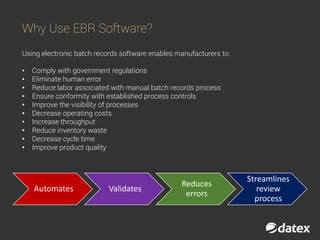
Using electronic batch records software enables manufacturers to:
• Comply with government regulations
• Eliminate human error
• Reduce labor associated with manual batch records process
• Ensure conformity with established process controls
• Improve the visibility of processes
• Decrease operating costs
• Increase throughput
• Reduce inventory waste
• Decrease cycle time
• Improve product quality
Automates Validates
Reduces
errors
Streamlines
review
process
What Does EBR Software Do?
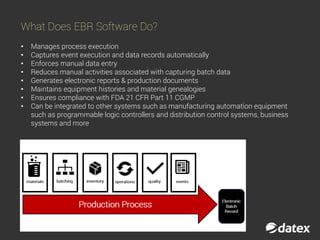
• Manages process execution
• Captures event execution and data records automatically
• Enforces manual data entry
• Reduces manual activities associated with capturing batch data
• Generates electronic reports & production documents
• Maintains equipment histories and material genealogies
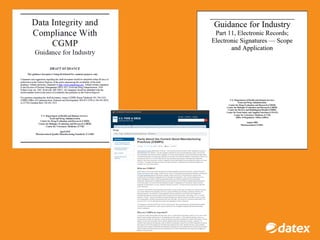
• Ensures compliance with FDA 21 CFR Part 11 CGMP
• Can be integrated to other systems such as manufacturing automation equipment
such as programmable logic controllers and distribution control systems, business
systems and more
Additional Functionality of Electronic Batch Record
Software
• Calculations
• May be able to perform simple to complex arithmetic operations
• Documents:
• Batch dates
• Batch weights
• Components in each batch
• Workers involved in handling & processing each batch
• Performs routine integrity checks of data
• Software tracks every piece of data inserted into electronic forms
• This makes it easy for batch coordinators to follow up on the processing of every
batch
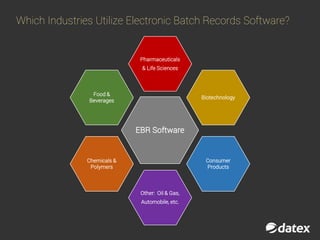
Which Industries Utilize Electronic Batch Records Software?
EBR Software
Pharmaceuticals
& Life Sciences
Biotechnology
Consumer
Products
Other: Oil & Gas,
Automobile, etc.
Chemicals &
Polymers
Food &
Beverages
What Are Electronic Batch Records?
800.933.2839
marketing@datexcorp.com
datexcorp.com
Contact Experts Today!

Basics of EBR: What Are Electronic Batch Records?

  • 1.
    BY: LAURA OLSON Basicsof EBR: What Are Electronic Batch Records?
  • 2.
    What Is aBatch Manufacturing Record? Good Manufacturing Practices (GMP), the industry standard specifies that the manufacturing process should be thoroughly documented. As manufacturing processes are pre-defined to specifications and quality standards, documenting each batch provides evidence that proper protocols have been diligently followed. This aids in the production of quality, uniform goods. During the manufacturing process, a written document is prepared that includes detailed information about each particular batch. Batch manufacturing records include information including: • The step-by-step process for producing each batch • Ingredients and components • Verification that each step during processing is completed according to SOP
  • 3.
    What Does aBatch Manufacturing Record Include? Master Production and Control Records (MPCR) includes: • Name of the product • Name and codes of API, batch formula, batch or code number • Identification of equipment, line and location used • Start and finishing dates with processing and packaging Batch Production and Control Records (BPCR) is the replica of MPCR & includes factual information including: • Material usage • Dispensing activities • Component weights • Product output quantities • Lot details • Manufacturing nonconformance events/issues • Quality sampling • Test results Bill of Materials (BOM) • Raw materials needed for manufacturing finished product • Required weight and quantity
  • 4.
    What Does aBatch Manufacturing Record Include? Generalized manufacturing instructions • Clear, concise directions associated with the health and safety of operators Equipment cleaning record • Provide a checklist regarding the cleaning of all equipment used in the production of each batch • Record the previous product, batch and date of cleaning Batch yield • Calculate the yield of each batch at the end of every stage of production to calculate product loss • The calculated final yield at the end of the manufacturing process should not be less than 99.00% Abbreviations • Make sure that the list of abbreviations used in all batch manufacturing records is easy to understand History of changes • List all changes that occurred during manufacturing process • Make sure that all revision numbers and dates of change are included
  • 5.
  • 6.
    What Are ElectronicBatch Records? Software applications the store and manage data electronically for each batch produced in addition to the entire manufacturing process on a step-by-step basis. EBR software typically relies on another system such as a manufacturing execution system or enterprise resource planning system to systematically generate a formal master batch record or EBR. This master record stores all the materials, processes and activities which were required for the production of a given product. Electronic batch records provide the structure and means for automatically compiling batch production data into a formatted electronic document, reducing paper and manual records for more accurate record keeping. Data is recorded and stored in encrypted form, guaranteeing data privacy and security.
  • 7.
    Why Use EBRSoftware? Using electronic batch records software enables manufacturers to: • Comply with government regulations • Eliminate human error • Reduce labor associated with manual batch records process • Ensure conformity with established process controls • Improve the visibility of processes • Decrease operating costs • Increase throughput • Reduce inventory waste • Decrease cycle time • Improve product quality Automates Validates Reduces errors Streamlines review process
  • 8.
    What Does EBRSoftware Do? • Manages process execution • Captures event execution and data records automatically • Enforces manual data entry • Reduces manual activities associated with capturing batch data • Generates electronic reports & production documents • Maintains equipment histories and material genealogies • Ensures compliance with FDA 21 CFR Part 11 CGMP • Can be integrated to other systems such as manufacturing automation equipment such as programmable logic controllers and distribution control systems, business systems and more
  • 9.
    Additional Functionality ofElectronic Batch Record Software • Calculations • May be able to perform simple to complex arithmetic operations • Documents: • Batch dates • Batch weights • Components in each batch • Workers involved in handling & processing each batch • Performs routine integrity checks of data • Software tracks every piece of data inserted into electronic forms • This makes it easy for batch coordinators to follow up on the processing of every batch
  • 10.
    Which Industries UtilizeElectronic Batch Records Software? EBR Software Pharmaceuticals & Life Sciences Biotechnology Consumer Products Other: Oil & Gas, Automobile, etc. Chemicals & Polymers Food & Beverages
  • 11.
    What Are ElectronicBatch Records?
  • 12.