© Cengage Learning 2015
7.6 What Is Fermentation?
• Like aerobic respiration, fermentation begins with
glycolysis in the cytoplasm
– In fermentation, pyruvate is not fully broken down to CO2
– Electrons do not move through electron transfer chains, so no
additional ATP forms
– NAD+ is regenerated, allowing glycolysis to continue
– The net yield is two ATP
© Cengage Learning 2015
What Is Fermentation? (cont’d.)
• Two fermentation pathways:
– Alcoholic fermentation: anaerobic sugar breakdown pathway
that produces ATP, CO2, and ethanol
– Lactate fermentation: anaerobic sugar breakdown pathway that
produces ATP and lactate
© Cengage Learning 2015
Alcoholic Fermentation
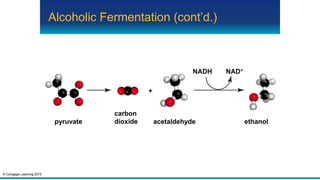
• Steps of alcoholic fermentation:
– 3-carbon pyruvate is split into carbon dioxide and 2-carbon
acetaldehyde
– Electrons and hydrogen are transferred from NADH to the
acetaldehyde, forming NAD+ and ethanol
© Cengage Learning 2015
Alcoholic Fermentation (cont’d.)
pyruvate
carbon
dioxide acetaldehyde
NAD+NADH
+
ethanol
© Cengage Learning 2015
Alcoholic Fermentation (cont’d.)
• Alcoholic fermentation in a fungus, Saccharomyces
cerevisiae, sustains these yeast cells as they grow and
reproduce
– Used to produce beer, wine, and bread
© Cengage Learning 2015
Lactate Fermentation
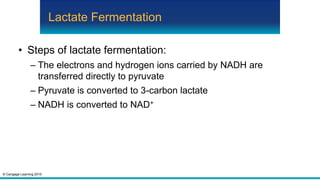
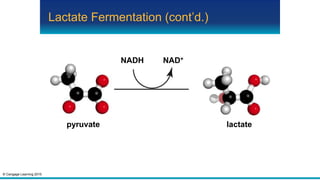
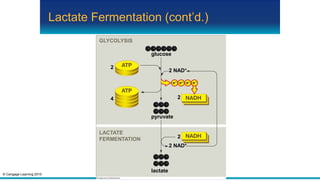
• Steps of lactate fermentation:
– The electrons and hydrogen ions carried by NADH are
transferred directly to pyruvate
– Pyruvate is converted to 3-carbon lactate
– NADH is converted to NAD+
© Cengage Learning 2015
Lactate Fermentation (cont’d.)
pyruvate lactate
NADH NAD+
© Cengage Learning 2015
Lactate Fermentation (cont’d.)
GLYCOLYSIS
LACTATE
FERMENTATION
glucose
2
4
2 NAD+
2
pyruvate
lactate
2
2 NAD+
© Cengage Learning 2015
Lactate Fermentation (cont’d.)
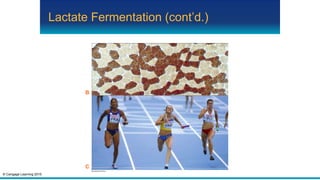
• Animal muscle cells carry out aerobic respiration and/or
lactate fermentation
– Red muscle fibers: many mitochondria and myoglobin; produce
ATP mainly by aerobic respiration
• Sustains prolonged activity
– White muscle fibers: contain few mitochondria and no
myoglobin; most ATP produced by lactate fermentation
• Useful for quick, strenuous activities
© Cengage Learning 2015
Lactate Fermentation (cont’d.)
B
C

7.6

  • 1.
    © Cengage Learning2015 7.6 What Is Fermentation? • Like aerobic respiration, fermentation begins with glycolysis in the cytoplasm – In fermentation, pyruvate is not fully broken down to CO2 – Electrons do not move through electron transfer chains, so no additional ATP forms – NAD+ is regenerated, allowing glycolysis to continue – The net yield is two ATP
  • 2.
    © Cengage Learning2015 What Is Fermentation? (cont’d.) • Two fermentation pathways: – Alcoholic fermentation: anaerobic sugar breakdown pathway that produces ATP, CO2, and ethanol – Lactate fermentation: anaerobic sugar breakdown pathway that produces ATP and lactate
  • 3.
    © Cengage Learning2015 Alcoholic Fermentation • Steps of alcoholic fermentation: – 3-carbon pyruvate is split into carbon dioxide and 2-carbon acetaldehyde – Electrons and hydrogen are transferred from NADH to the acetaldehyde, forming NAD+ and ethanol
  • 4.
    © Cengage Learning2015 Alcoholic Fermentation (cont’d.) pyruvate carbon dioxide acetaldehyde NAD+NADH + ethanol
  • 5.
    © Cengage Learning2015 Alcoholic Fermentation (cont’d.) • Alcoholic fermentation in a fungus, Saccharomyces cerevisiae, sustains these yeast cells as they grow and reproduce – Used to produce beer, wine, and bread
  • 6.
    © Cengage Learning2015 Lactate Fermentation • Steps of lactate fermentation: – The electrons and hydrogen ions carried by NADH are transferred directly to pyruvate – Pyruvate is converted to 3-carbon lactate – NADH is converted to NAD+
  • 7.
    © Cengage Learning2015 Lactate Fermentation (cont’d.) pyruvate lactate NADH NAD+
  • 8.
    © Cengage Learning2015 Lactate Fermentation (cont’d.) GLYCOLYSIS LACTATE FERMENTATION glucose 2 4 2 NAD+ 2 pyruvate lactate 2 2 NAD+
  • 9.
    © Cengage Learning2015 Lactate Fermentation (cont’d.) • Animal muscle cells carry out aerobic respiration and/or lactate fermentation – Red muscle fibers: many mitochondria and myoglobin; produce ATP mainly by aerobic respiration • Sustains prolonged activity – White muscle fibers: contain few mitochondria and no myoglobin; most ATP produced by lactate fermentation • Useful for quick, strenuous activities
  • 10.
    © Cengage Learning2015 Lactate Fermentation (cont’d.) B C

Editor's Notes

  • #9 Figure 7.8 Lactate fermentation.
  • #11 Figure 7.8 Lactate fermentation.