RESPIRATION
By: AvinashThappa
Central University of Jammu
Contents
1. Definition
2. Types of respiration
a. Aerobic respiration
b. Anaerobic respiration
4. Respiration in Plants.
5. Respiration in Animals
6. Human respiratory system
Definition
 The process of releasing energy from food is
called respiration.
Or
It is the process of oxidation of respiratory
substrate (mainly glucose) in the cells
resulting in the release of carbon dioxide,
water and energy.
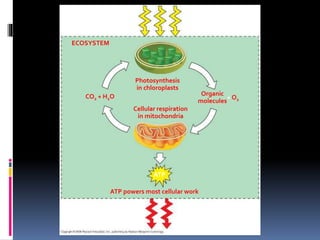
Light
energy
ECOSYSTEM
Photosynthesis
in chloroplasts
CO2 + H2O
Cellular respiration
in mitochondria
Organic
molecules
+ O2
ATP powers most cellular work
Heat
energy
ATP
Mitochondrion
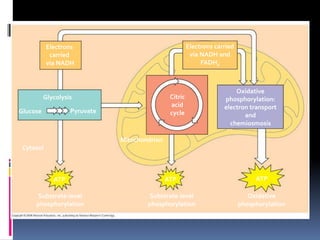
Substrate-level
phosphorylation
ATP
Cytosol
Glucose Pyruvate
Glycolysis
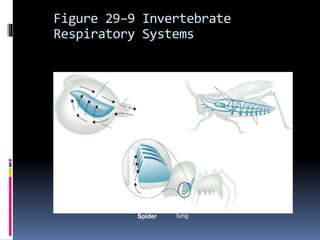
Electrons
carried
via NADH
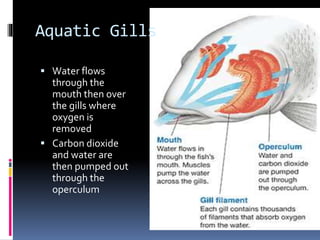
Substrate-level
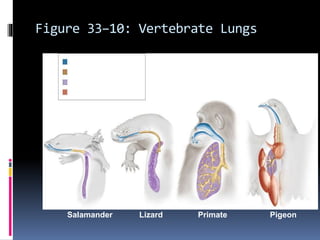
phosphorylation
ATP
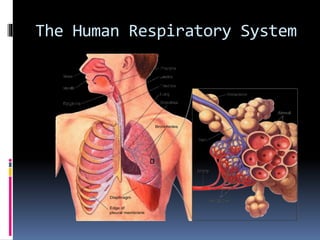
Electrons carried
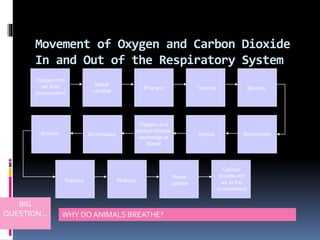
via NADH and
FADH2
Oxidative
phosphorylation
ATP
Citric
acid
cycle
Oxidative
phosphorylation:
electron transport
and
chemiosmosis
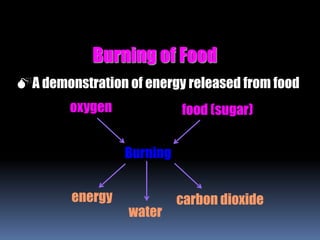
Burning of Food
A demonstration of energy released from food
Burning
energy
water
carbon dioxide
oxygen food (sugar)
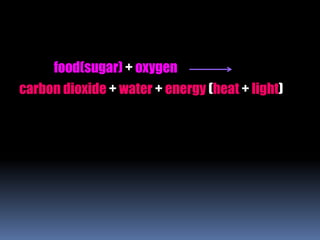
food(sugar) + oxygen
carbon dioxide + water + energy (heat + light)
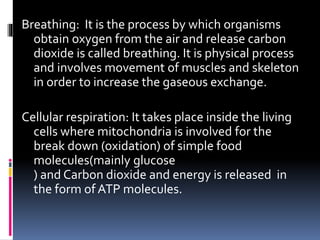
Breathing: It is the process by which organisms
obtain oxygen from the air and release carbon
dioxide is called breathing. It is physical process
and involves movement of muscles and skeleton
in order to increase the gaseous exchange.
Cellular respiration: It takes place inside the living
cells where mitochondria is involved for the
break down (oxidation) of simple food
molecules(mainly glucose
) and Carbon dioxide and energy is released in
the form of ATP molecules.
Types of cellular
respiration
 1. Aerobic respiration:
 2. Anaerobic respiration:
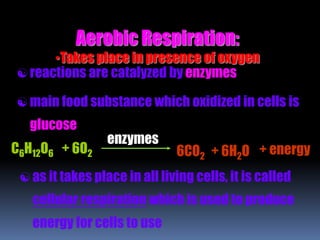
Aerobic Respiration:
•Takes place in presence of oxygen
reactions are catalyzed by enzymes
main food substance which oxidized in cells is
glucose
C6H12O6 + 6O2
enzymes
6CO2 + 6H2O + energy
as it takes place in all living cells, it is called
cellular respiration which is used to produce
energy for cells to use
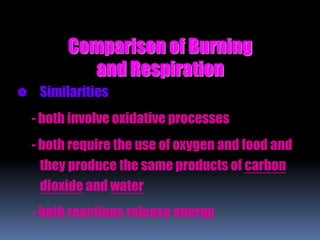
Comparison of Burning
and Respiration
 Similarities
- both involve oxidative processes
- both require the use of oxygen and food and
they produce the same products of carbon
dioxide and water
- both reactions release energy
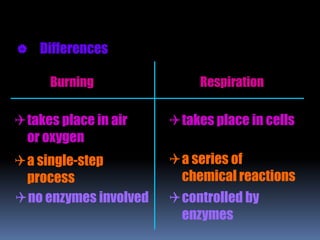
 Differences
Burning Respiration
takes place in air
or oxygen
takes place in cells
a single-step
process
a series of
chemical reactions
no enzymes involved controlled by
enzymes
Burning Respiration
 Differences
 energy release is
vigorous and not under
control
 energy release is
slower and under
control
 energy is released in
form of heat and light (a
flame can result)
 energy is released in
form of heat and an
energy-rich compound
ATP
 energy is mainly released as heat and ATP
during respiration in cells
 however, during respiration, some ATP should
be consumed first before other ATP can be
formed
 the ATP consumed is used to form other ATP
from ADP and phosphate groups
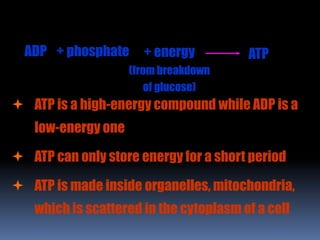
ADP + energy
(from breakdown
of glucose)
+ phosphate ATP
 ATP is a high-energy compound while ADP is a
low-energy one
 ATP can only store energy for a short period
 ATP is made inside organelles, mitochondria,
which is scattered in the cytoplasm of a cell
Anaerobic Respiration
respiration in human is mainly aerobic
respiration as oxygen is essential
when oxygen is not needed during respiration,
it is called anaerobic respiration
yeast and muscle cells are examples which
they can respire anaerobically for a short time
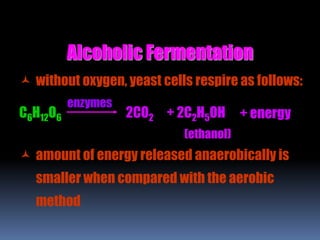
Alcoholic Fermentation
 without oxygen, yeast cells respire as follows:
C6H12O6 + energy+ 2C2H5OH
(ethanol)
2CO2
enzymes
 amount of energy released anaerobically is
smaller when compared with the aerobic
method
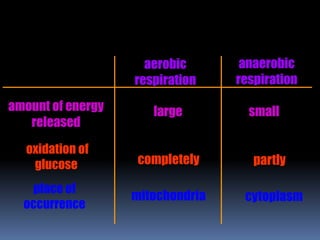
anaerobic
respiration
aerobic
respiration
amount of energy
released
large small
oxidation of
glucose completely partly
place of
occurrence
mitochondria cytoplasm
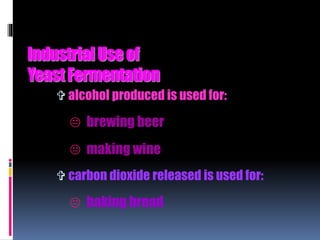
IndustrialUseof
YeastFermentation
 alcohol produced is used for:
 brewing beer
 making wine
 carbon dioxide released is used for:
 baking bread
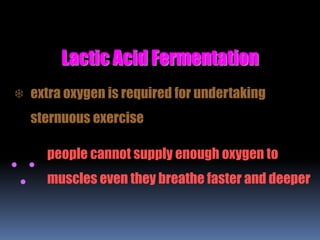
Lactic Acid Fermentation
 extra oxygen is required for undertaking
sternuous exercise
people cannot supply enough oxygen to
muscles even they breathe faster and deeper

 lactic acid will cause muscle fatigue and muscle
cramps if they are allowed to accumulate
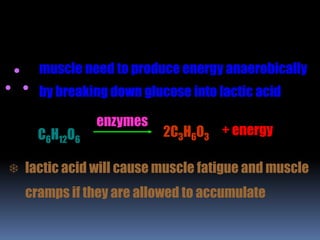
C6H12O6
2C3H6O3
+ energy
enzymes
muscle need to produce energy anaerobically
by breaking down glucose into lactic acid
 a large amount of oxygen is needed to break
down the accumulated lactic acid into carbon
dioxide and water or turn to glycogen in liver for
storage so we pant after doing exercise
 the amount of oxygen required to get rid of lactic
acid is called oxygen debt
Comparison of Aerobic and
Anaerobic Respiration
 Similarity
 Sugar is broken down to release energy
 ATP is made
 Both are controlled by enzymes
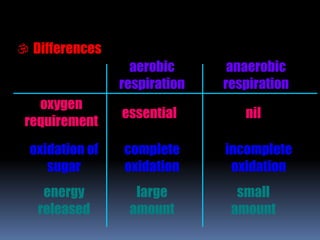
 Differences
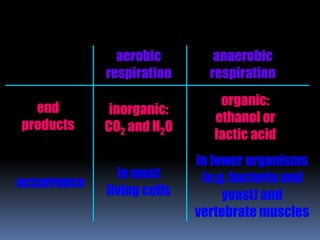
aerobic
respiration
anaerobic
respiration
complete
oxidation
incomplete
oxidation
oxidation of
sugar
essential
oxygen
requirement
nil
energy
released
large
amount
small
amount
aerobic
respiration
anaerobic
respiration
in most
living cells
in lower organisms
(e.g. bacteria and
yeast) and
vertebrate muscles
occurrence
inorganic:
CO2 and H2O
end
products
organic:
ethanol or
lactic acid
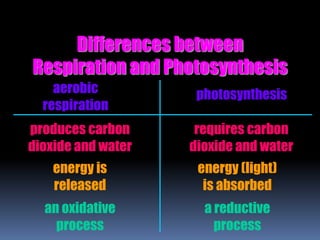
Differences between
Respiration and Photosynthesis
aerobic
respiration
photosynthesis
energy is
released
energy (light)
is absorbed
produces carbon
dioxide and water
requires carbon
dioxide and water
an oxidative
process
a reductive
process
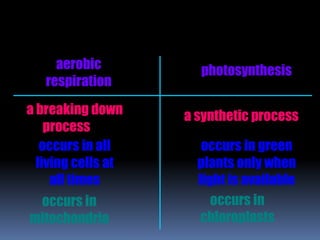
aerobic
respiration
photosynthesis
occurs in all
living cells at
all times
occurs in green
plants only when
light is available
a breaking down
process
a synthetic process
occurs in
mitochondria
occurs in
chloroplasts
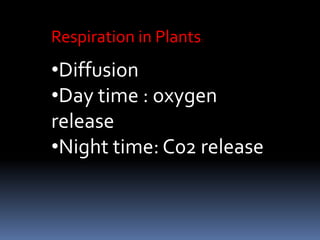
Respiration in Plants:
•Diffusion
•Day time : oxygen
release
•Night time: C02 release
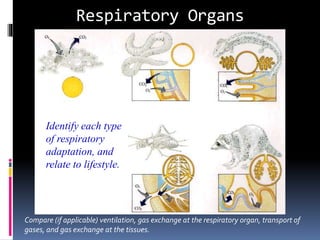
Respiratory Organs
Identify each type
of respiratory
adaptation, and
relate to lifestyle.
Compare (if applicable) ventilation, gas exchange at the respiratory organ, transport of
gases, and gas exchange at the tissues.
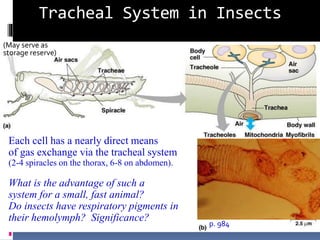
Tracheal System in Insects
Each cell has a nearly direct means
of gas exchange via the tracheal system
(2-4 spiracles on the thorax, 6-8 on abdomen).
What is the advantage of such a
system for a small, fast animal?
Do insects have respiratory pigments in
their hemolymph? Significance?
p. 984
(May serve as
storage reserve)
Challenges of Gas Exchange
related to Environment
Air vs.Water:
 20X more oxygen in air than in water (at the
same temp.)
 Diffusion of gas molecules is more rapid in air
 Air is less viscous than water
 ventilation (air) requires 1/10 the energy of water
breathing
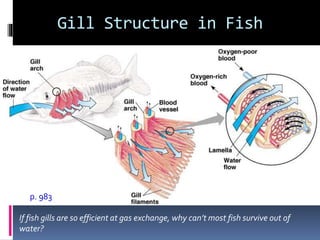
Gill Structure in Fish
p. 983
If fish gills are so efficient at gas exchange, why can’t most fish survive out of
water?
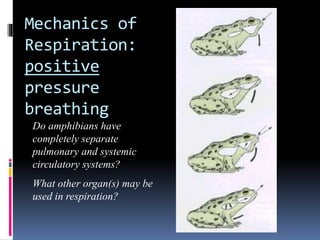
Mechanics of
Respiration:
positive
pressure
breathing
Do amphibians have
completely separate
pulmonary and systemic
circulatory systems?
What other organ(s) may be
used in respiration?
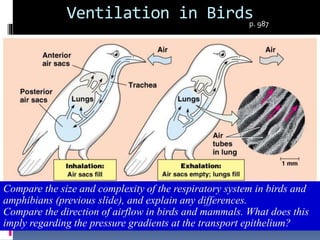
Ventilation in Birds
Compare the size and complexity of the respiratory system in birds and
amphibians (previous slide), and explain any differences.
Compare the direction of airflow in birds and mammals. What does this
imply regarding the pressure gradients at the transport epithelium?
p. 987
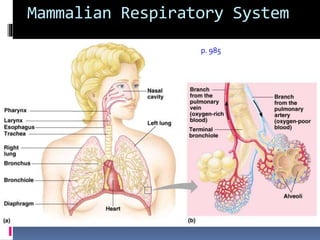
Mammalian Respiratory System
p. 985
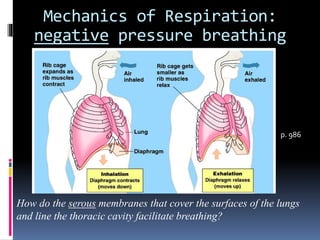
Mechanics of Respiration:
negative pressure breathing
How do the serous membranes that cover the surfaces of the lungs
and line the thoracic cavity facilitate breathing?
p. 986
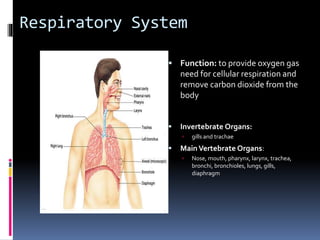
Respiratory System
 Function: to provide oxygen gas
need for cellular respiration and
remove carbon dioxide from the
body
 Invertebrate Organs:
 gills and trachae
 MainVertebrate Organs:
 Nose, mouth, pharynx, larynx, trachea,
bronchi, bronchioles, lungs, gills,
diaphragm
Respiration in animals
 Whether they live in water or on land, all animals
must respire.
 To respire means to take in oxygen and give off carbon
dioxide.
 Some animals rely of simple diffusion through
their skin to respire.
 While others…
 Have developed large complex organ systems
for respiration.
Invertebrate respiration
 Invertebrate respiratory organs have
 large surface areas
 Are in contact with air or water
 If require diffusion they must be moist.
Aquatic invertebrates
 Aquatic animals have naturally moist respiratory
surfaces, and some respire through diffusion
through their skin.
 Example: jellyfish and anemones
 Some larger aquatic animals like worms and
annelids exchange oxygen and carbon dioxide
through gills.
 Gills are organs that have lots of blood vessels that
bring blood close to the surface for gas exchange.
Terrestrial Invertebrates
 Terrestrial invertebrates have respiratory surfaces
covered with water or mucus. (This reduces water loss)
 There are many different respiratory specialized organs
in terrestrial invertebrates.
 Spiders use parallel book lungs
 Insects use openings called spiracles where air enters the body
and passes through a network of tracheal tubes for gas exchange
 Snails have a mantel cavity that is lined with moist tissue and an
extensive surface area of blood vessels.
How does respiration in aquatic invertebrates differ from that in
terrestrial invertebrates?
Section 29-2
Mollusk
Insect
Spider
Gill
Siphons
Movement of water
Book
lung
Airflow
Tracheal
tubes
Spiracles
Figure 29–9 Invertebrate
Respiratory Systems
Vertebrate respiratory systems
 Chordates have one of two basic structures
for respiration:
 Gills – for aquatic chordates
 Example: tunicates, fish and amphibians
 Lungs - for terrestrial chordates
 Examples: adult amphibians, reptiles, birds, and
mammals
Aquatic Gills
 Water flows
through the
mouth then over
the gills where
oxygen is
removed
 Carbon dioxide
and water are
then pumped out
through the
operculum
Vertebrate lungs
 As you move from amphibians to mammals the
surface area of the lungs increases
 Insures a greater amount of gas exchange (or a two
way flow of air).
 Birds, by contrast have lungs and air sacs which
have only a one-way flow of air.
 This allows for them to have constant contact with
fresh air.
 This adaptation enables them to fly at high altitudes
where there is less oxygen.
Section 33-3
Salamander Lizard PigeonPrimate
Nostrils, mouth, and
throat
Trachea
Lung
Air sac
Figure 33–10: Vertebrate Lungs
Section 37-3
Figure 37-13 The Respiratory System
The Human Respiratory System
Section 37-3
Flowchart
Oxygen and
carbon dioxide
exchange at
alveoli
Oxygen-rich
air from
environment
Bronchioles
Nasal
cavities
Pharynx Trachea Bronchi
BronchiolesAlveoli
Pharynx
Nasal
cavities
Carbon
dioxide-rich
air to the
environment
Bronchi
Trachea
Movement of Oxygen and Carbon Dioxide
In and Out of the Respiratory System
BIG
QUESTION… WHY DO ANIMALS BREATHE?

Respiration in Organisms

  • 1.
  • 2.
    Contents 1. Definition 2. Typesof respiration a. Aerobic respiration b. Anaerobic respiration 4. Respiration in Plants. 5. Respiration in Animals 6. Human respiratory system
  • 3.
    Definition  The processof releasing energy from food is called respiration. Or It is the process of oxidation of respiratory substrate (mainly glucose) in the cells resulting in the release of carbon dioxide, water and energy.
  • 4.
    Light energy ECOSYSTEM Photosynthesis in chloroplasts CO2 +H2O Cellular respiration in mitochondria Organic molecules + O2 ATP powers most cellular work Heat energy ATP
  • 5.
    Mitochondrion Substrate-level phosphorylation ATP Cytosol Glucose Pyruvate Glycolysis Electrons carried via NADH Substrate-level phosphorylation ATP Electronscarried via NADH and FADH2 Oxidative phosphorylation ATP Citric acid cycle Oxidative phosphorylation: electron transport and chemiosmosis
  • 6.
    Burning of Food Ademonstration of energy released from food Burning energy water carbon dioxide oxygen food (sugar)
  • 7.
    food(sugar) + oxygen carbondioxide + water + energy (heat + light)
  • 8.
    Breathing: It isthe process by which organisms obtain oxygen from the air and release carbon dioxide is called breathing. It is physical process and involves movement of muscles and skeleton in order to increase the gaseous exchange. Cellular respiration: It takes place inside the living cells where mitochondria is involved for the break down (oxidation) of simple food molecules(mainly glucose ) and Carbon dioxide and energy is released in the form of ATP molecules.
  • 9.
    Types of cellular respiration 1. Aerobic respiration:  2. Anaerobic respiration:
  • 10.
    Aerobic Respiration: •Takes placein presence of oxygen reactions are catalyzed by enzymes main food substance which oxidized in cells is glucose C6H12O6 + 6O2 enzymes 6CO2 + 6H2O + energy as it takes place in all living cells, it is called cellular respiration which is used to produce energy for cells to use
  • 11.
    Comparison of Burning andRespiration  Similarities - both involve oxidative processes - both require the use of oxygen and food and they produce the same products of carbon dioxide and water - both reactions release energy
  • 12.
     Differences Burning Respiration takesplace in air or oxygen takes place in cells a single-step process a series of chemical reactions no enzymes involved controlled by enzymes
  • 13.
    Burning Respiration  Differences energy release is vigorous and not under control  energy release is slower and under control  energy is released in form of heat and light (a flame can result)  energy is released in form of heat and an energy-rich compound
  • 14.
    ATP  energy ismainly released as heat and ATP during respiration in cells  however, during respiration, some ATP should be consumed first before other ATP can be formed  the ATP consumed is used to form other ATP from ADP and phosphate groups
  • 15.
    ADP + energy (frombreakdown of glucose) + phosphate ATP  ATP is a high-energy compound while ADP is a low-energy one  ATP can only store energy for a short period  ATP is made inside organelles, mitochondria, which is scattered in the cytoplasm of a cell
  • 16.
    Anaerobic Respiration respiration inhuman is mainly aerobic respiration as oxygen is essential when oxygen is not needed during respiration, it is called anaerobic respiration yeast and muscle cells are examples which they can respire anaerobically for a short time
  • 17.
    Alcoholic Fermentation  withoutoxygen, yeast cells respire as follows: C6H12O6 + energy+ 2C2H5OH (ethanol) 2CO2 enzymes  amount of energy released anaerobically is smaller when compared with the aerobic method
  • 18.
    anaerobic respiration aerobic respiration amount of energy released largesmall oxidation of glucose completely partly place of occurrence mitochondria cytoplasm
  • 19.
    IndustrialUseof YeastFermentation  alcohol producedis used for:  brewing beer  making wine  carbon dioxide released is used for:  baking bread
  • 20.
    Lactic Acid Fermentation extra oxygen is required for undertaking sternuous exercise people cannot supply enough oxygen to muscles even they breathe faster and deeper 
  • 21.
     lactic acidwill cause muscle fatigue and muscle cramps if they are allowed to accumulate C6H12O6 2C3H6O3 + energy enzymes muscle need to produce energy anaerobically by breaking down glucose into lactic acid
  • 22.
     a largeamount of oxygen is needed to break down the accumulated lactic acid into carbon dioxide and water or turn to glycogen in liver for storage so we pant after doing exercise  the amount of oxygen required to get rid of lactic acid is called oxygen debt
  • 23.
    Comparison of Aerobicand Anaerobic Respiration  Similarity  Sugar is broken down to release energy  ATP is made  Both are controlled by enzymes
  • 24.
  • 25.
    aerobic respiration anaerobic respiration in most living cells inlower organisms (e.g. bacteria and yeast) and vertebrate muscles occurrence inorganic: CO2 and H2O end products organic: ethanol or lactic acid
  • 26.
    Differences between Respiration andPhotosynthesis aerobic respiration photosynthesis energy is released energy (light) is absorbed produces carbon dioxide and water requires carbon dioxide and water an oxidative process a reductive process
  • 27.
    aerobic respiration photosynthesis occurs in all livingcells at all times occurs in green plants only when light is available a breaking down process a synthetic process occurs in mitochondria occurs in chloroplasts
  • 28.
    Respiration in Plants: •Diffusion •Daytime : oxygen release •Night time: C02 release
  • 29.
    Respiratory Organs Identify eachtype of respiratory adaptation, and relate to lifestyle. Compare (if applicable) ventilation, gas exchange at the respiratory organ, transport of gases, and gas exchange at the tissues.
  • 30.
    Tracheal System inInsects Each cell has a nearly direct means of gas exchange via the tracheal system (2-4 spiracles on the thorax, 6-8 on abdomen). What is the advantage of such a system for a small, fast animal? Do insects have respiratory pigments in their hemolymph? Significance? p. 984 (May serve as storage reserve)
  • 31.
    Challenges of GasExchange related to Environment Air vs.Water:  20X more oxygen in air than in water (at the same temp.)  Diffusion of gas molecules is more rapid in air  Air is less viscous than water  ventilation (air) requires 1/10 the energy of water breathing
  • 32.
    Gill Structure inFish p. 983 If fish gills are so efficient at gas exchange, why can’t most fish survive out of water?
  • 33.
    Mechanics of Respiration: positive pressure breathing Do amphibianshave completely separate pulmonary and systemic circulatory systems? What other organ(s) may be used in respiration?
  • 34.
    Ventilation in Birds Comparethe size and complexity of the respiratory system in birds and amphibians (previous slide), and explain any differences. Compare the direction of airflow in birds and mammals. What does this imply regarding the pressure gradients at the transport epithelium? p. 987
  • 35.
  • 36.
    Mechanics of Respiration: negativepressure breathing How do the serous membranes that cover the surfaces of the lungs and line the thoracic cavity facilitate breathing? p. 986
  • 37.
    Respiratory System  Function:to provide oxygen gas need for cellular respiration and remove carbon dioxide from the body  Invertebrate Organs:  gills and trachae  MainVertebrate Organs:  Nose, mouth, pharynx, larynx, trachea, bronchi, bronchioles, lungs, gills, diaphragm
  • 38.
    Respiration in animals Whether they live in water or on land, all animals must respire.  To respire means to take in oxygen and give off carbon dioxide.  Some animals rely of simple diffusion through their skin to respire.  While others…  Have developed large complex organ systems for respiration.
  • 39.
    Invertebrate respiration  Invertebraterespiratory organs have  large surface areas  Are in contact with air or water  If require diffusion they must be moist.
  • 40.
    Aquatic invertebrates  Aquaticanimals have naturally moist respiratory surfaces, and some respire through diffusion through their skin.  Example: jellyfish and anemones  Some larger aquatic animals like worms and annelids exchange oxygen and carbon dioxide through gills.  Gills are organs that have lots of blood vessels that bring blood close to the surface for gas exchange.
  • 41.
    Terrestrial Invertebrates  Terrestrialinvertebrates have respiratory surfaces covered with water or mucus. (This reduces water loss)  There are many different respiratory specialized organs in terrestrial invertebrates.  Spiders use parallel book lungs  Insects use openings called spiracles where air enters the body and passes through a network of tracheal tubes for gas exchange  Snails have a mantel cavity that is lined with moist tissue and an extensive surface area of blood vessels. How does respiration in aquatic invertebrates differ from that in terrestrial invertebrates?
  • 42.
    Section 29-2 Mollusk Insect Spider Gill Siphons Movement ofwater Book lung Airflow Tracheal tubes Spiracles Figure 29–9 Invertebrate Respiratory Systems
  • 43.
    Vertebrate respiratory systems Chordates have one of two basic structures for respiration:  Gills – for aquatic chordates  Example: tunicates, fish and amphibians  Lungs - for terrestrial chordates  Examples: adult amphibians, reptiles, birds, and mammals
  • 44.
    Aquatic Gills  Waterflows through the mouth then over the gills where oxygen is removed  Carbon dioxide and water are then pumped out through the operculum
  • 45.
    Vertebrate lungs  Asyou move from amphibians to mammals the surface area of the lungs increases  Insures a greater amount of gas exchange (or a two way flow of air).  Birds, by contrast have lungs and air sacs which have only a one-way flow of air.  This allows for them to have constant contact with fresh air.  This adaptation enables them to fly at high altitudes where there is less oxygen.
  • 46.
    Section 33-3 Salamander LizardPigeonPrimate Nostrils, mouth, and throat Trachea Lung Air sac Figure 33–10: Vertebrate Lungs
  • 47.
    Section 37-3 Figure 37-13The Respiratory System The Human Respiratory System
  • 48.
    Section 37-3 Flowchart Oxygen and carbondioxide exchange at alveoli Oxygen-rich air from environment Bronchioles Nasal cavities Pharynx Trachea Bronchi BronchiolesAlveoli Pharynx Nasal cavities Carbon dioxide-rich air to the environment Bronchi Trachea Movement of Oxygen and Carbon Dioxide In and Out of the Respiratory System BIG QUESTION… WHY DO ANIMALS BREATHE?