FUNDS FLOW ANALYSIS
•   Learning objectives:
•   Concept of funds flow statement
•   Preparation on total resource basis
•   Preparation on cash basis
•   FFS on working capital basis
•   Significance of FFS and its interpretation.
Introduction and concept of FFS
Over a period of time, every item of B/S
undergoes change. While a business may
show considerable profits, there may not be
adequate cash to meet business needs.
Or, in spite of borrowings, funds may not be
available to support inventory. Statement
of changes in financial position (SCFP)
answers all these questions.
Funds Flow Statement
• Funds Flow Statement (FFS) is also known as:
• Cash flow statement (presentation is different)
• Statement of sources and uses / applications of
  funds
• Statement of money provided and its disposition
• Summary of financial operations
• Financial expansion and replacement
• Statement of changes of financial position(SCFP)
FFS – the concept
• FFS captures movement of funds, whereas
  B/S indicates static picture of sources and
  uses of funds. FFS shows how did the
  business meet its expenses, liabilities and
  create assets during the year, how did it pay
  taxes and dividends and the sources of those
  funds. FFS is complementary to B/S, and
  PL statement.
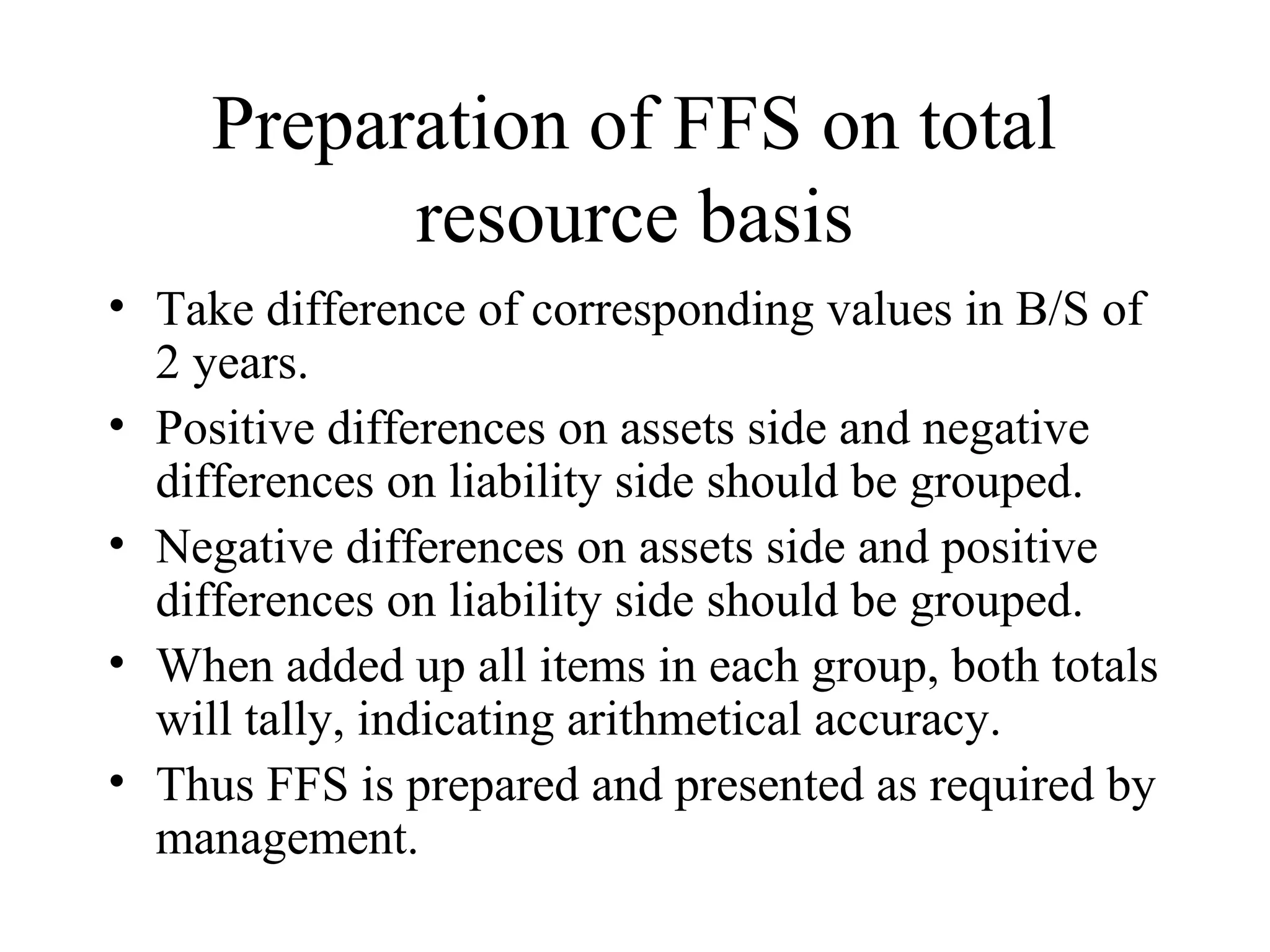
Preparation of FFS on total
           resource basis
• Take difference of corresponding values in B/S of
  2 years.
• Positive differences on assets side and negative
  differences on liability side should be grouped.
• Negative differences on assets side and positive
  differences on liability side should be grouped.
• When added up all items in each group, both totals
  will tally, indicating arithmetical accuracy.
• Thus FFS is prepared and presented as required by
  management.
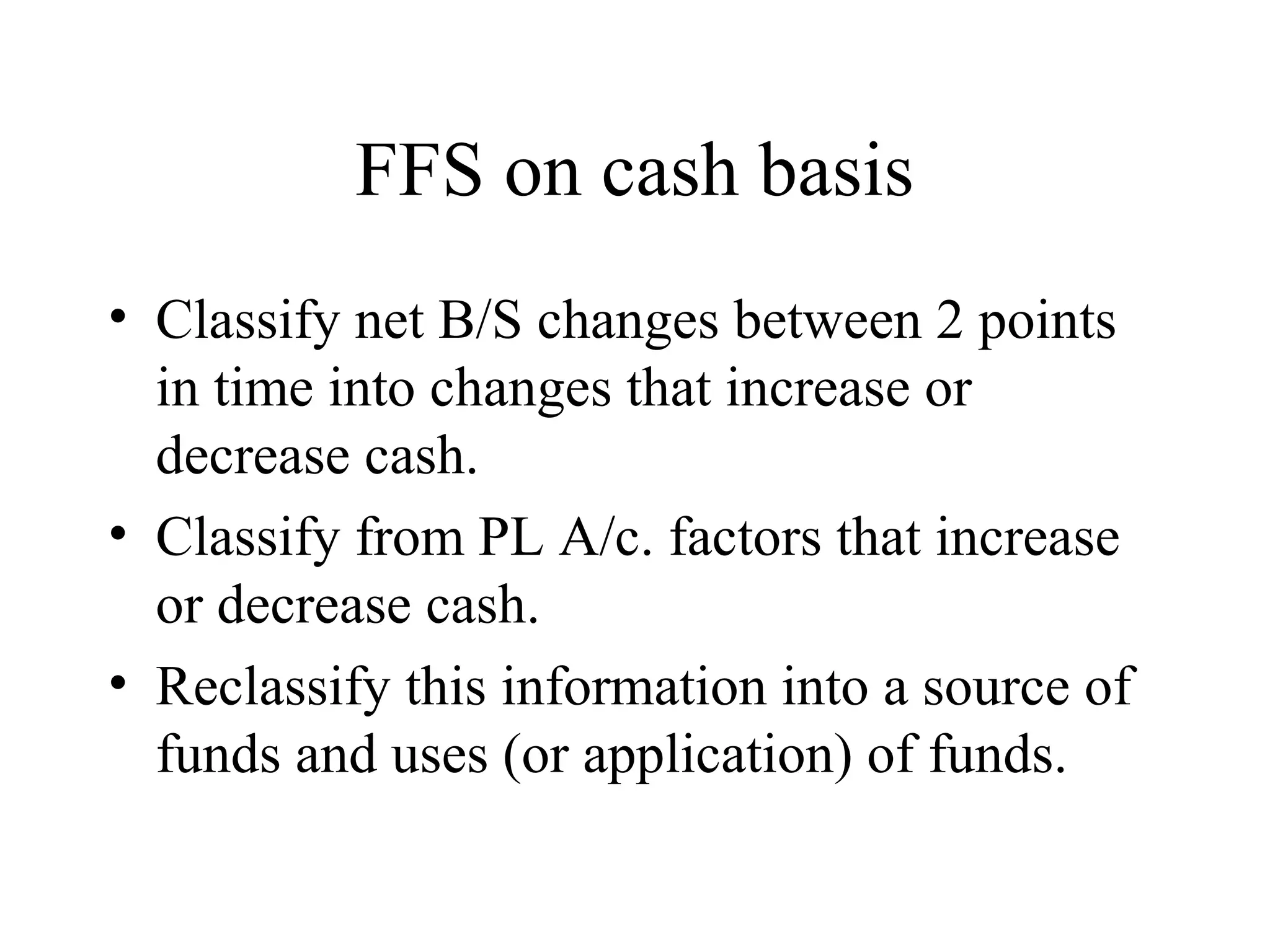
FFS on cash basis
• Classify net B/S changes between 2 points
  in time into changes that increase or
  decrease cash.
• Classify from PL A/c. factors that increase
  or decrease cash.
• Reclassify this information into a source of
  funds and uses (or application) of funds.
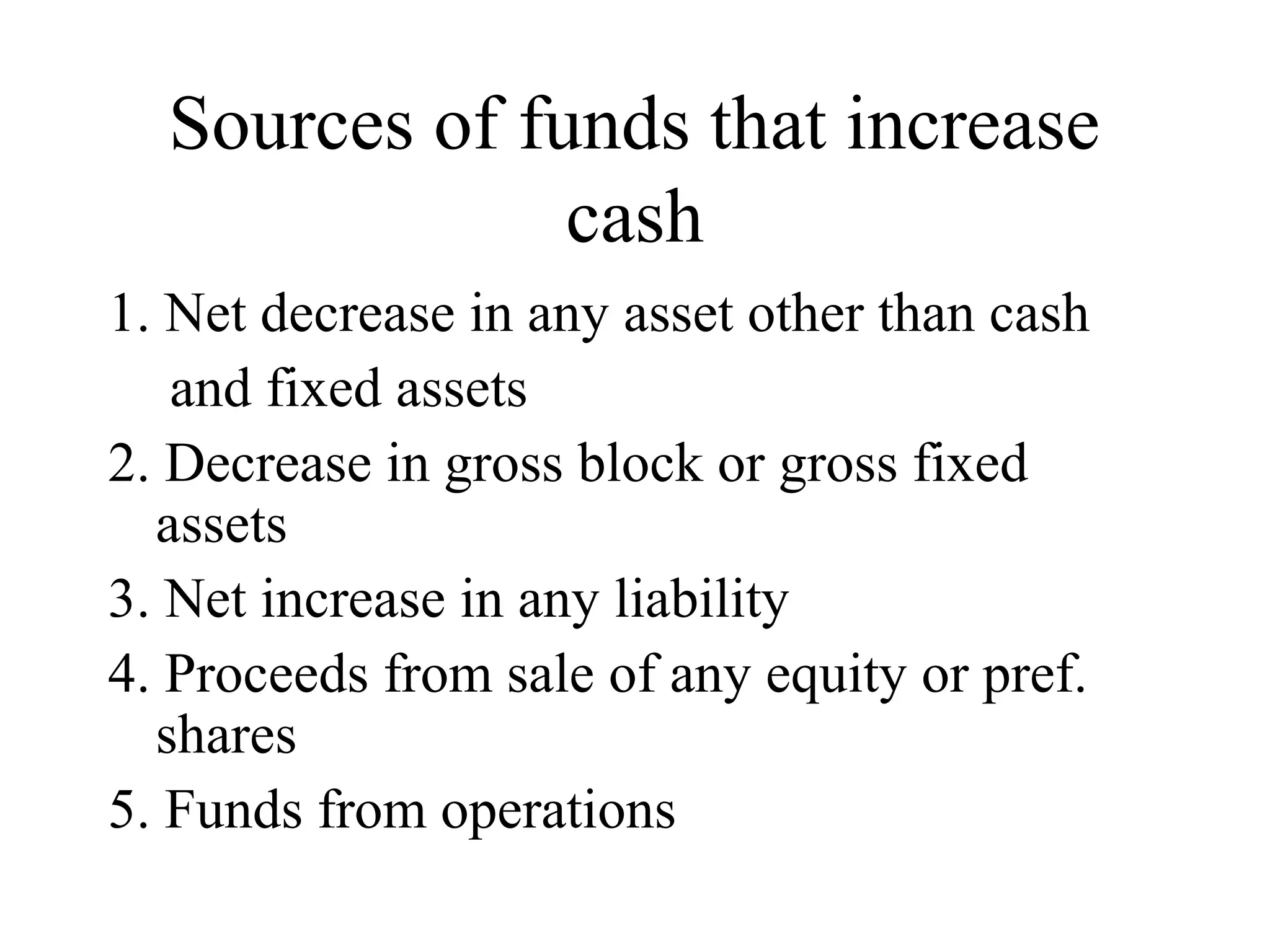
Sources of funds that increase
               cash
1. Net decrease in any asset other than cash
   and fixed assets
2. Decrease in gross block or gross fixed
  assets
3. Net increase in any liability
4. Proceeds from sale of any equity or pref.
  shares
5. Funds from operations
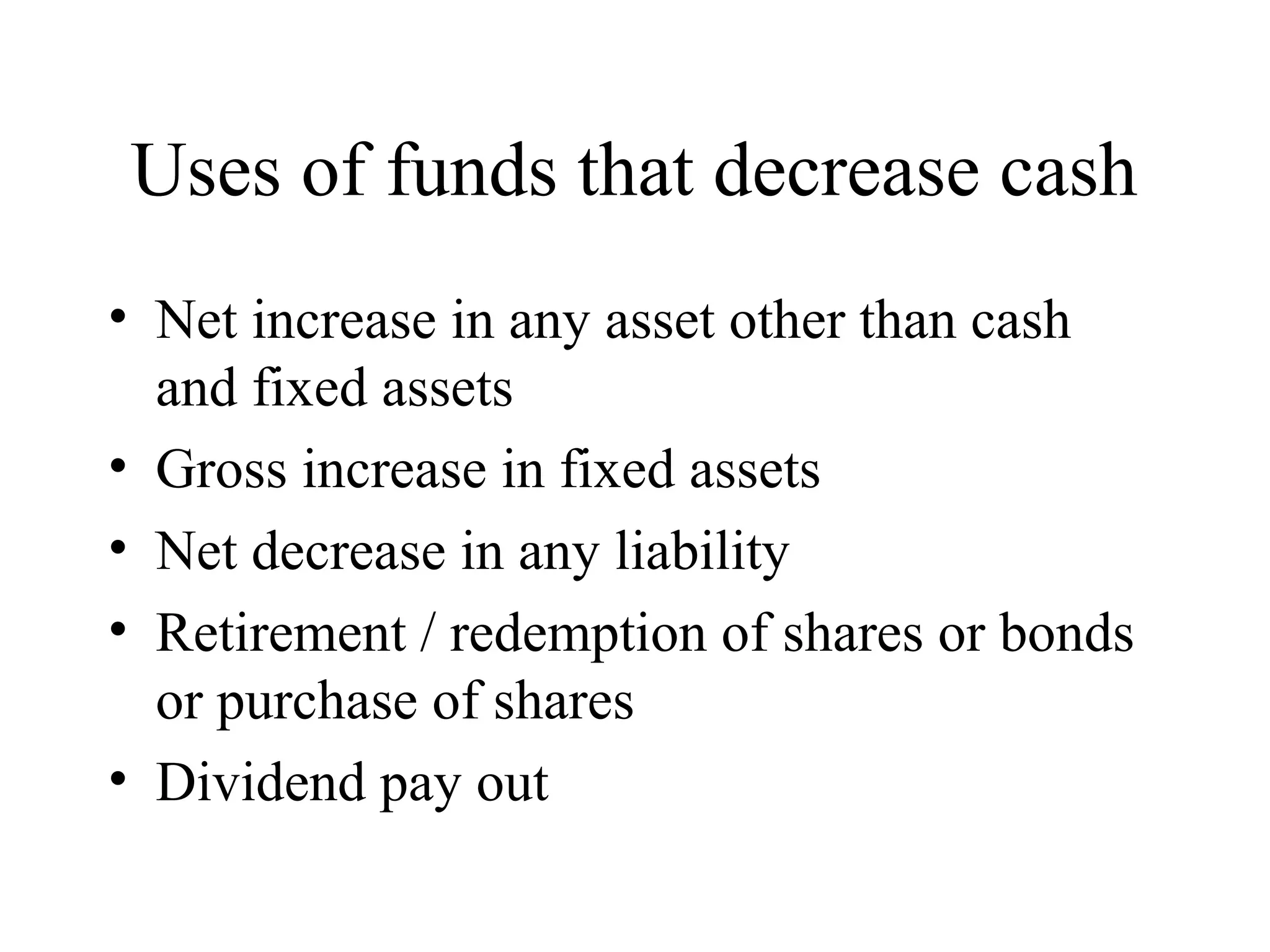
Uses of funds that decrease cash
• Net increase in any asset other than cash
  and fixed assets
• Gross increase in fixed assets
• Net decrease in any liability
• Retirement / redemption of shares or bonds
  or purchase of shares
• Dividend pay out
FFS on working capital basis
•   Increase in CA results in increase in WC
•   Decrease in CA results in decrease in WC
•   Increase in CL results in decrease in WC
•   Decrease in CL results in increase in WC
•   This statement is frequently used by bankers to
    determine whether minimum WC requirement is
    maintained by borrowers and to monitor
    borrowers’ cash credit a/c. or WC loan A/c.
Significance of FFS
• Detection of imbalances in cash flows and
  appropriate action
• Divisional performance appraisal
• Evaluation of firm’s financing
• Planning for future financing
Advantages-Funds Flow
            Statement
• 1. It gives the figure of flow of funds from
  operations. This is more relevant than the
  net profit revealed by PL A/c. Depn and
  amortization is charged at the discretion of
  management and hence, profit, which is
  after deducting above two charges, may not
  be representative of cash generated. In
  FFS, depn and non-cash charges are added
  back.
Advantages - FFS
• 2. Comparison of the figures of working
  capital budget with the figures of sources
  and applications of funds in the FFS enables
  management to ascertain how far the budget
  has been implemented. It also helps in
  preparation of budget for the subsequent
  period.
Limitations of Funds Flow
             Statement
• FFS shows flow of net working capital,
  which includes Stock of goods, Prepaid
  expenses, which do not contribute to the
  short term ability of the enterprise to pay its
  debts or liabilities. Because of these
  limitations, AS 3 (Revised) has done away
  with it and has recommended preparation of
  Cash Flow Statement.
Distinction- FFS & CFS.
• 1. FFS deals with changes in working
  capital position while CFS deals with
  changes in cash position between two
  points of time.
• 2. FFS does not contain opening and
  closing balances of cash and cash
  equivalents, but CFS gives both.
Distinction between FFS & CFS
• 3. FFS records sources of funds and
  application of funds, resulting in increase in
  working capital (WC) or decrease in WC.
  In case of CFS, difference is reflected in
  opening and closing cash and cash
  equivalents. 4. Statement showing WC
  changes is prepared along with FFS, but no
  such statement is prepared in case of CFS.
Distinction between FFS & CFS
• 5. FFS can be prepared if CFS by indirect
  method is made available. But one cannot
  prepare CFS from FFS. For CFS, statement
  showing changes in WC is required. To
  prepare CFS by direct method, cash
  received from Debtors and paid to Creditors
  and to employees, etc. are required.
Distinction between FFS & CFS
• 6. FFS is relevant in estimating firm’s
  ability to meet its long term liabilities. CFS
  is more relevant in estimating firm’s
  capacity to meet its liabilities over a short
  term. 7. FFS is not required by Companies
  Act or SEBI’s regulations. CFS must be
  prepared and circulated to shareholders of
  company, as per Co. Act and SEBI’ rules.
Distinction between FFS &
   Income Statement or PL A/c.
• 1. FFS matches funds raised during a period
  and funds applied or used. PL A/c. matches
  income and expenditure over a period.
• 2. FFS tells increase or decrease in NWC
  during a period , whereas PL A/c. reveals
  net profit or loss during the period.
• 3. FFS deals with revenue and capital items,
  whereas PL deals with only revenue items.
Distinction - FFS & PL A/c.
• 4. For preparing FFS, Income statement or
  PL is required. Income statement can be
  prepared without reference to FFS.
• 5. Preparation of FFS, though optional, is
  advantageous. Income statement is must.
• 6. No prescribed format for FFS. But for
  PLA/c. prescribed format must be followed
  by banks, ins.co. and electricity companies.
Dist-Statement Showing Changes
   in Working Capital & FFS
• 1. SSCWC notes the effect of changes in
  each one of the current assets and current
  liabilities on WC. FFS notes the effect of
  items other than current assets and current
  liabilities on WC.
• 2. Items appearing in SSCWC are
  constituents of WC, but items appearing in
  FFS are not constituents of WC.
Distinction - SSCWC and FFS
• 3. Only BS is required to prepare SSCWS,
  whereas to prepare FFS, PLA/c. and BS are
  required.
• 4. SSCWC is not presented in T form, but
  FFS can be presented in T form.
Why FFS is important
• Remember these words:
• In business,
         “CASH IS KING”
  Cash Flow Statement will be taken up in
  next session.
Assignment
• Prepare FFS or statement of sources and uses or
  application of funds from the Balance Sheet and
  Profit and Loss A/c. of any company. Comment
  on your findings.
• Prepare cash flow statement showing:
    Funds generated from operations,
    Funds generated from investing activities, and
    Funds generated from financing activities
   Compare with cash flows of earlier year and
  comment on observations.
Summary
• We have studied:
     the concept of cash flow & funds flow
     how to prepare and FFS?
     what are the methods of presentation of FFS?
     what is Cash Flow statement under Clause 32
       of Listing Agreement with stock exchange?
     what is the utility of FFS and interpretation?
     what is the significance of FFS?
Case study – Reliance Industries
• Preparation and Study of
      Funds Flow Statement of
      Reliance Industries Limited
      for the year 2007-08.
Source:
Annual Report of Reliance Industries Limited
           for Financial Year 2007-08
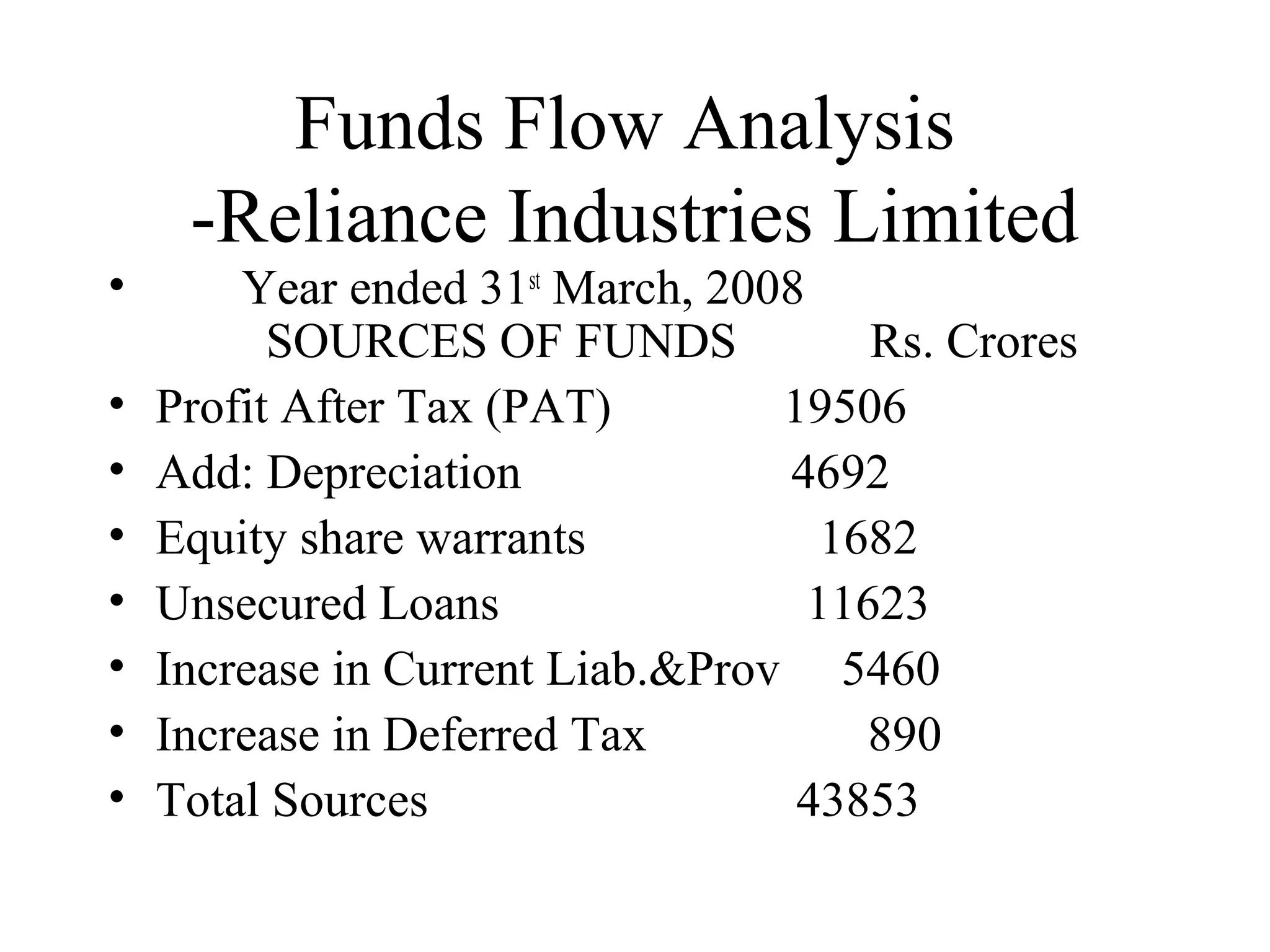
Funds Flow Analysis
     -Reliance Industries Limited
•       Year ended 31st March, 2008
          SOURCES OF FUNDS             Rs. Crores
•   Profit After Tax (PAT)        19506
•   Add: Depreciation             4692
•   Equity share warrants            1682
•   Unsecured Loans                 11623
•   Increase in Current Liab.&Prov 5460
•   Increase in Deferred Tax           890
•   Total Sources                  43853
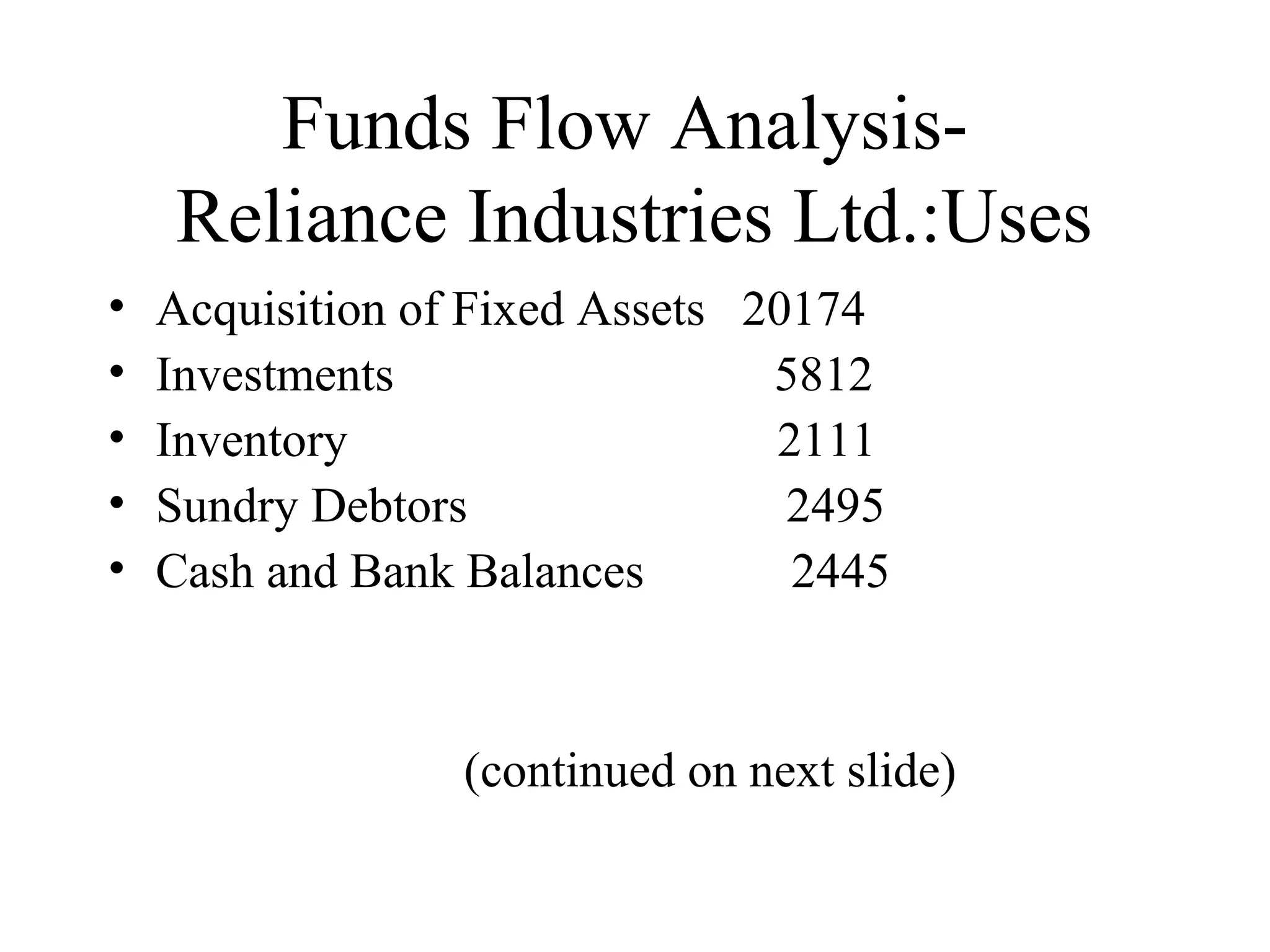
Funds Flow Analysis-
    Reliance Industries Ltd.:Uses
•   Acquisition of Fixed Assets 20174
•   Investments                  5812
•   Inventory                    2111
•   Sundry Debtors                2495
•   Cash and Bank Balances        2445


                  (continued on next slide)
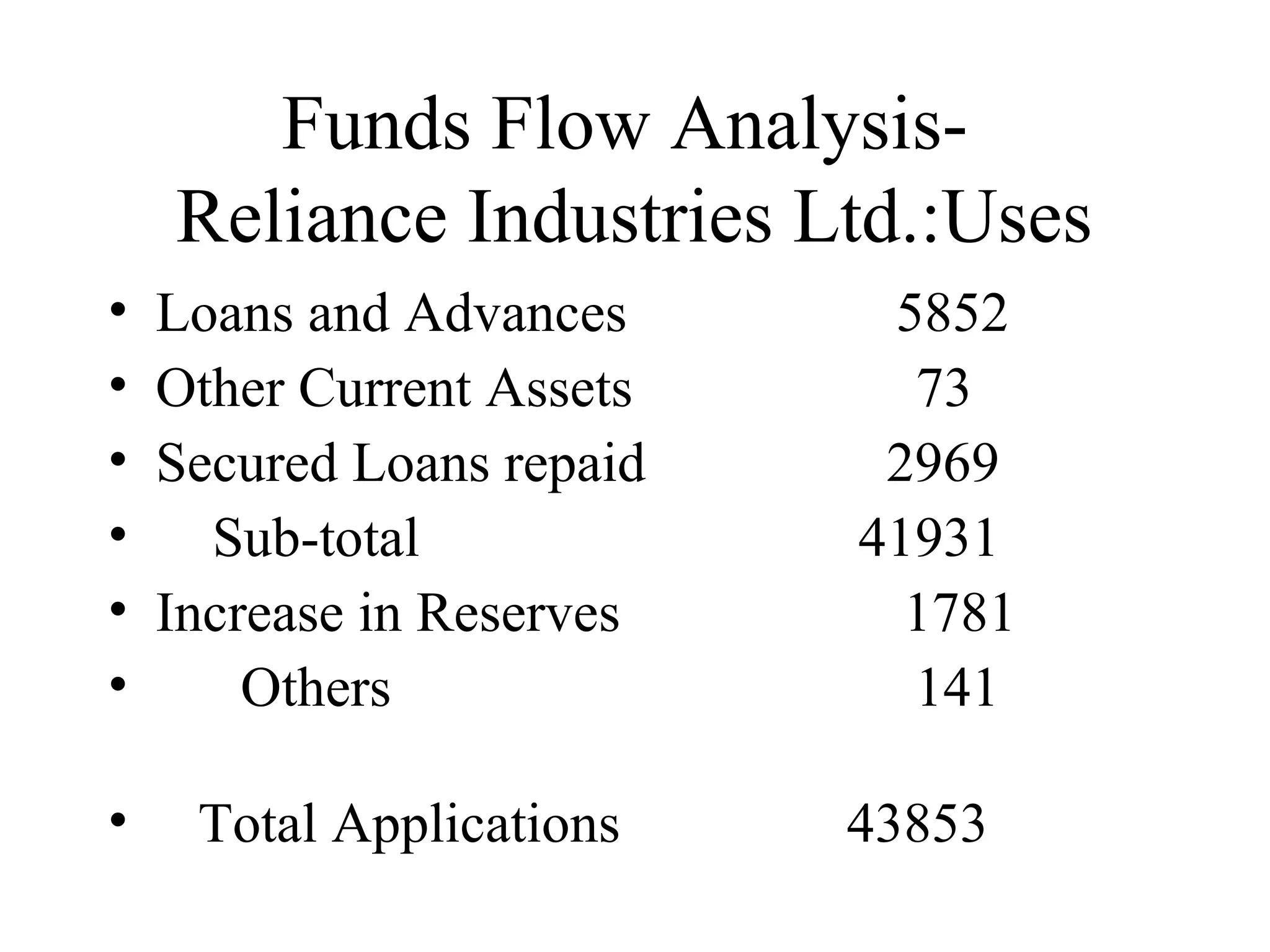
Funds Flow Analysis-
    Reliance Industries Ltd.:Uses
•   Loans and Advances      5852
•   Other Current Assets     73
•   Secured Loans repaid    2969
•     Sub-total            41931
•   Increase in Reserves     1781
•       Others               141

•    Total Applications    43853
Funds Flow Analysis-
    Reliance Industries Limited
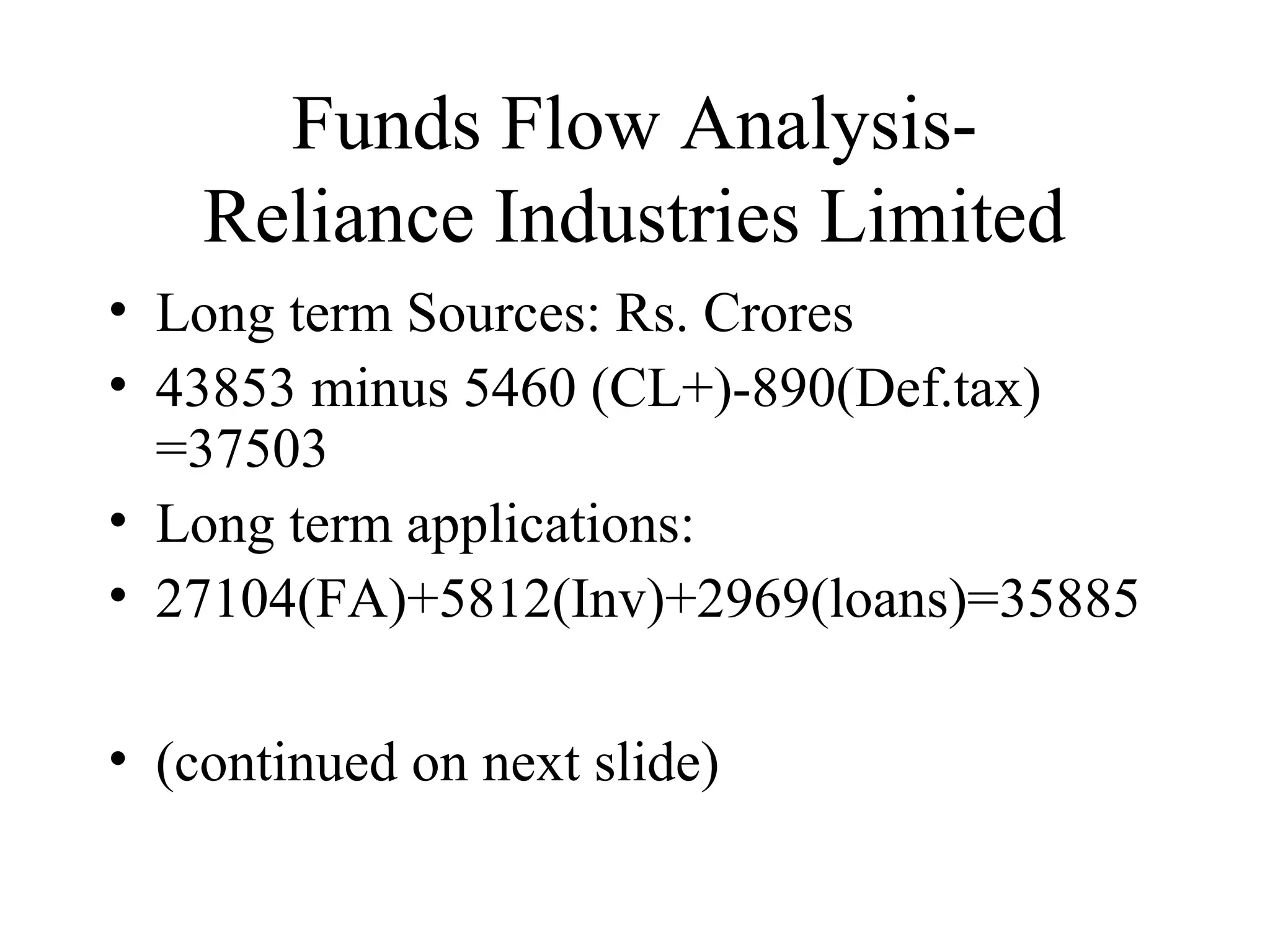
• Long term Sources: Rs. Crores
• 43853 minus 5460 (CL+)-890(Def.tax)
  =37503
• Long term applications:
• 27104(FA)+5812(Inv)+2969(loans)=35885

• (continued on next slide)
Funds Flow Analysis-
    Reliance Industries Limited
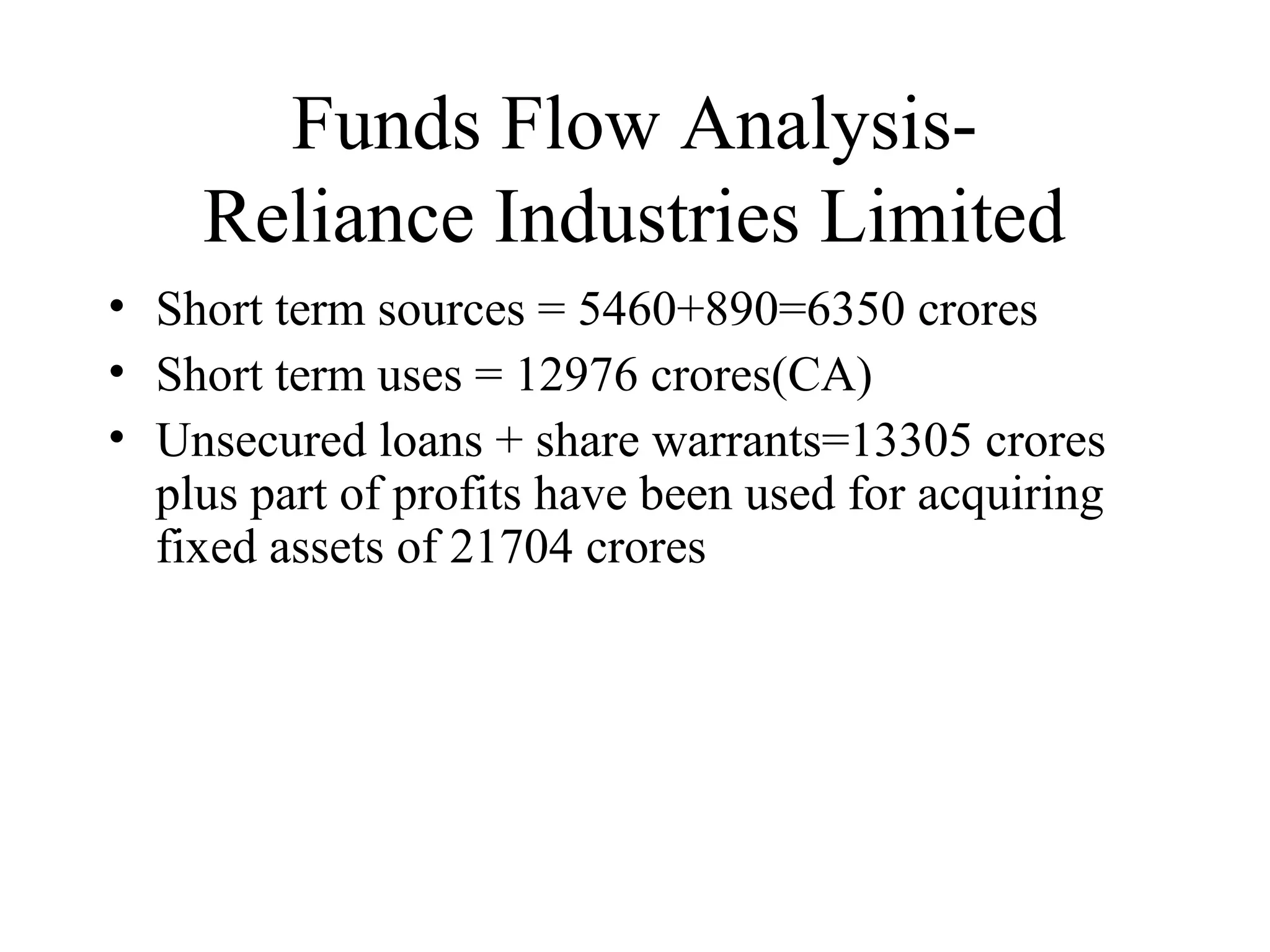
• Short term sources = 5460+890=6350 crores
• Short term uses = 12976 crores(CA)
• Unsecured loans + share warrants=13305 crores
  plus part of profits have been used for acquiring
  fixed assets of 21704 crores
Funds flow analysis-
   Reliance Industries Limited
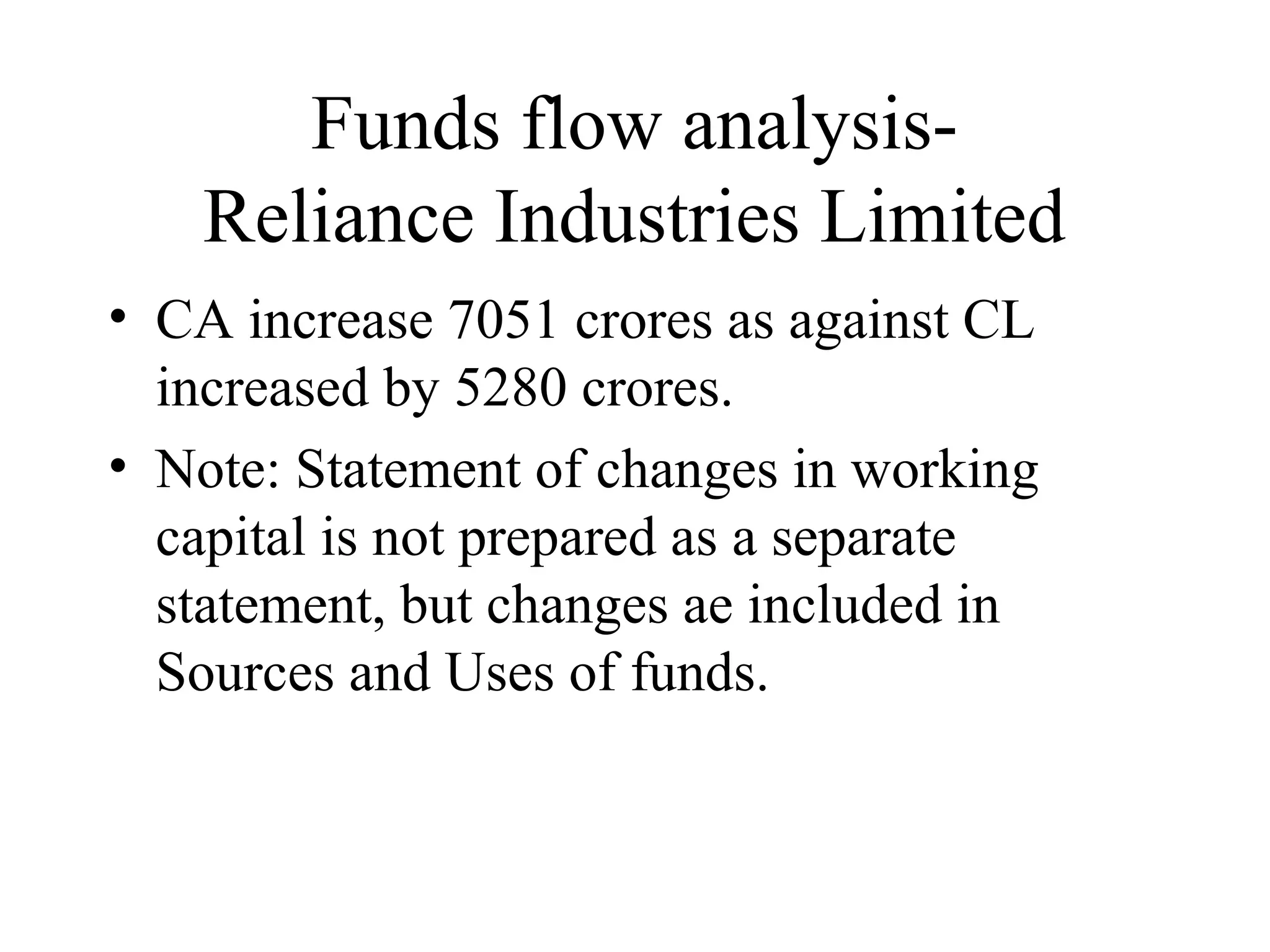
• CA increase 7051 crores as against CL
  increased by 5280 crores.
• Note: Statement of changes in working
  capital is not prepared as a separate
  statement, but changes ae included in
  Sources and Uses of funds.
Next Quiz
• 11th December, 2010. Date will be
  confirmed and time, and venue will be
  announced by Exam and Academics dept.
• Syllabus – All what has been taken up in
  class till 5th December, 2010.
• Mis Sem Exam or one more quiz will be
  conducted even earlier or this date may be
  advanced or pre-poned.

7. funds flow analysis

  • 1.
    FUNDS FLOW ANALYSIS • Learning objectives: • Concept of funds flow statement • Preparation on total resource basis • Preparation on cash basis • FFS on working capital basis • Significance of FFS and its interpretation.
  • 2.
    Introduction and conceptof FFS Over a period of time, every item of B/S undergoes change. While a business may show considerable profits, there may not be adequate cash to meet business needs. Or, in spite of borrowings, funds may not be available to support inventory. Statement of changes in financial position (SCFP) answers all these questions.
  • 3.
    Funds Flow Statement •Funds Flow Statement (FFS) is also known as: • Cash flow statement (presentation is different) • Statement of sources and uses / applications of funds • Statement of money provided and its disposition • Summary of financial operations • Financial expansion and replacement • Statement of changes of financial position(SCFP)
  • 4.
    FFS – theconcept • FFS captures movement of funds, whereas B/S indicates static picture of sources and uses of funds. FFS shows how did the business meet its expenses, liabilities and create assets during the year, how did it pay taxes and dividends and the sources of those funds. FFS is complementary to B/S, and PL statement.
  • 5.
    Preparation of FFSon total resource basis • Take difference of corresponding values in B/S of 2 years. • Positive differences on assets side and negative differences on liability side should be grouped. • Negative differences on assets side and positive differences on liability side should be grouped. • When added up all items in each group, both totals will tally, indicating arithmetical accuracy. • Thus FFS is prepared and presented as required by management.
  • 6.
    FFS on cashbasis • Classify net B/S changes between 2 points in time into changes that increase or decrease cash. • Classify from PL A/c. factors that increase or decrease cash. • Reclassify this information into a source of funds and uses (or application) of funds.
  • 7.
    Sources of fundsthat increase cash 1. Net decrease in any asset other than cash and fixed assets 2. Decrease in gross block or gross fixed assets 3. Net increase in any liability 4. Proceeds from sale of any equity or pref. shares 5. Funds from operations
  • 8.
    Uses of fundsthat decrease cash • Net increase in any asset other than cash and fixed assets • Gross increase in fixed assets • Net decrease in any liability • Retirement / redemption of shares or bonds or purchase of shares • Dividend pay out
  • 9.
    FFS on workingcapital basis • Increase in CA results in increase in WC • Decrease in CA results in decrease in WC • Increase in CL results in decrease in WC • Decrease in CL results in increase in WC • This statement is frequently used by bankers to determine whether minimum WC requirement is maintained by borrowers and to monitor borrowers’ cash credit a/c. or WC loan A/c.
  • 10.
    Significance of FFS •Detection of imbalances in cash flows and appropriate action • Divisional performance appraisal • Evaluation of firm’s financing • Planning for future financing
  • 11.
    Advantages-Funds Flow Statement • 1. It gives the figure of flow of funds from operations. This is more relevant than the net profit revealed by PL A/c. Depn and amortization is charged at the discretion of management and hence, profit, which is after deducting above two charges, may not be representative of cash generated. In FFS, depn and non-cash charges are added back.
  • 12.
    Advantages - FFS •2. Comparison of the figures of working capital budget with the figures of sources and applications of funds in the FFS enables management to ascertain how far the budget has been implemented. It also helps in preparation of budget for the subsequent period.
  • 13.
    Limitations of FundsFlow Statement • FFS shows flow of net working capital, which includes Stock of goods, Prepaid expenses, which do not contribute to the short term ability of the enterprise to pay its debts or liabilities. Because of these limitations, AS 3 (Revised) has done away with it and has recommended preparation of Cash Flow Statement.
  • 14.
    Distinction- FFS &CFS. • 1. FFS deals with changes in working capital position while CFS deals with changes in cash position between two points of time. • 2. FFS does not contain opening and closing balances of cash and cash equivalents, but CFS gives both.
  • 15.
    Distinction between FFS& CFS • 3. FFS records sources of funds and application of funds, resulting in increase in working capital (WC) or decrease in WC. In case of CFS, difference is reflected in opening and closing cash and cash equivalents. 4. Statement showing WC changes is prepared along with FFS, but no such statement is prepared in case of CFS.
  • 16.
    Distinction between FFS& CFS • 5. FFS can be prepared if CFS by indirect method is made available. But one cannot prepare CFS from FFS. For CFS, statement showing changes in WC is required. To prepare CFS by direct method, cash received from Debtors and paid to Creditors and to employees, etc. are required.
  • 17.
    Distinction between FFS& CFS • 6. FFS is relevant in estimating firm’s ability to meet its long term liabilities. CFS is more relevant in estimating firm’s capacity to meet its liabilities over a short term. 7. FFS is not required by Companies Act or SEBI’s regulations. CFS must be prepared and circulated to shareholders of company, as per Co. Act and SEBI’ rules.
  • 18.
    Distinction between FFS& Income Statement or PL A/c. • 1. FFS matches funds raised during a period and funds applied or used. PL A/c. matches income and expenditure over a period. • 2. FFS tells increase or decrease in NWC during a period , whereas PL A/c. reveals net profit or loss during the period. • 3. FFS deals with revenue and capital items, whereas PL deals with only revenue items.
  • 19.
    Distinction - FFS& PL A/c. • 4. For preparing FFS, Income statement or PL is required. Income statement can be prepared without reference to FFS. • 5. Preparation of FFS, though optional, is advantageous. Income statement is must. • 6. No prescribed format for FFS. But for PLA/c. prescribed format must be followed by banks, ins.co. and electricity companies.
  • 20.
    Dist-Statement Showing Changes in Working Capital & FFS • 1. SSCWC notes the effect of changes in each one of the current assets and current liabilities on WC. FFS notes the effect of items other than current assets and current liabilities on WC. • 2. Items appearing in SSCWC are constituents of WC, but items appearing in FFS are not constituents of WC.
  • 21.
    Distinction - SSCWCand FFS • 3. Only BS is required to prepare SSCWS, whereas to prepare FFS, PLA/c. and BS are required. • 4. SSCWC is not presented in T form, but FFS can be presented in T form.
  • 22.
    Why FFS isimportant • Remember these words: • In business, “CASH IS KING” Cash Flow Statement will be taken up in next session.
  • 23.
    Assignment • Prepare FFSor statement of sources and uses or application of funds from the Balance Sheet and Profit and Loss A/c. of any company. Comment on your findings. • Prepare cash flow statement showing: Funds generated from operations, Funds generated from investing activities, and Funds generated from financing activities Compare with cash flows of earlier year and comment on observations.
  • 24.
    Summary • We havestudied: the concept of cash flow & funds flow how to prepare and FFS? what are the methods of presentation of FFS? what is Cash Flow statement under Clause 32 of Listing Agreement with stock exchange? what is the utility of FFS and interpretation? what is the significance of FFS?
  • 25.
    Case study –Reliance Industries • Preparation and Study of Funds Flow Statement of Reliance Industries Limited for the year 2007-08. Source: Annual Report of Reliance Industries Limited for Financial Year 2007-08
  • 26.
    Funds Flow Analysis -Reliance Industries Limited • Year ended 31st March, 2008 SOURCES OF FUNDS Rs. Crores • Profit After Tax (PAT) 19506 • Add: Depreciation 4692 • Equity share warrants 1682 • Unsecured Loans 11623 • Increase in Current Liab.&Prov 5460 • Increase in Deferred Tax 890 • Total Sources 43853
  • 27.
    Funds Flow Analysis- Reliance Industries Ltd.:Uses • Acquisition of Fixed Assets 20174 • Investments 5812 • Inventory 2111 • Sundry Debtors 2495 • Cash and Bank Balances 2445 (continued on next slide)
  • 28.
    Funds Flow Analysis- Reliance Industries Ltd.:Uses • Loans and Advances 5852 • Other Current Assets 73 • Secured Loans repaid 2969 • Sub-total 41931 • Increase in Reserves 1781 • Others 141 • Total Applications 43853
  • 29.
    Funds Flow Analysis- Reliance Industries Limited • Long term Sources: Rs. Crores • 43853 minus 5460 (CL+)-890(Def.tax) =37503 • Long term applications: • 27104(FA)+5812(Inv)+2969(loans)=35885 • (continued on next slide)
  • 30.
    Funds Flow Analysis- Reliance Industries Limited • Short term sources = 5460+890=6350 crores • Short term uses = 12976 crores(CA) • Unsecured loans + share warrants=13305 crores plus part of profits have been used for acquiring fixed assets of 21704 crores
  • 31.
    Funds flow analysis- Reliance Industries Limited • CA increase 7051 crores as against CL increased by 5280 crores. • Note: Statement of changes in working capital is not prepared as a separate statement, but changes ae included in Sources and Uses of funds.
  • 32.
    Next Quiz • 11thDecember, 2010. Date will be confirmed and time, and venue will be announced by Exam and Academics dept. • Syllabus – All what has been taken up in class till 5th December, 2010. • Mis Sem Exam or one more quiz will be conducted even earlier or this date may be advanced or pre-poned.