If you are called to the scene of death
(Is there suspicion of foul play )
• No foul play is suspected ( death obviously natural)
• If death due to natural causes( do not need
to examine the body
• Foul play is suspected
• If death is not due to natural causes (accident/suicide/
homicide/undetermined)
• Go to scene and examine the body and scene
1
EXAMINATION OF THE SCENE OF
DEATH
•Correlation of findings of scene with autopsy
findings and history of case is necessary for proper
death investigation so that following can be elicited:
• What happened(What?)
• The medical cause of death (Why?)
• The time of death(When ?)
• The manner of death (How?)
• The place of death (Where?)
• The identity of deceased ( Who?)
2
LOCARD’ PRINCIPLE
“ When any two objects come into contact there is
always transfer of material from each of objects
to the other”. This theory has got following
implications for crime scene:-
a. Perpetrator will take away traces of victim and
scene
b. Victim will retain traces of perpetrator and 3may
transfer traces of him or herself on to perpetrator
c. Perpetrator will leave behind traces of him or
herself at the scene
3
•Control of scene
•Police are in control of scene of death
•Doctor should not approach the body until
specifically requested to do so by investing
officer or police officer, usually only after
photographs and video recordings have been
taken and finger prints examinations have
been completed
4
Functions of forensic medical expert at
scene may include the following
a. Confirmation or pronouncement of death
b. Observation of the scene of death
c. Assessment of the time of death
d. Offering an opinion as to possible nature of death as opposed to
cause of death
e. Ensuring the trace evidence from body or its surroundings is not
removed or destroyed
f. Preventing contamination of body or scene by introduction of
foreign material
g. Collecting specimens from the body and scene of death, if
indicated
h. Assisting in removal of the body , if necessary
5
Prevention of loss of trace elements and
contamination of scene of death
ACTION
1. Gloves hands used carelessly
2. Standing on blood, tyre
marks or foot prints
3. moving clothing or body of
deceased
4. Placing blanket over body
5. Failure to wear protective
foot wear or clothing
6. Touching door handles,
weapons, telephones and
other objects with bare
hands
• RESULTS
1. Erasure of finger prints
2. Destruction of evidence
3. Mistaken inferences being
drawn for complete
impression of sexual assault
4. Transfer of foreign fibres on to
body
5. Traces of doctor or
investigator may contaminate
scene
6. Obliteration or addition of
finger prints
6
• Action
7. Smoking
8. Wiping hands on towels or
other items
9. Using toilet or hand basin
• Results
7. Contamination of scene
with ash or cigarette butts
8. Traces of doctor or
investigator may
contaminate scene
9. Flushing of evidence and
possible obliteration or
addition of finger prints .
7
Equipment to be included in crime scene
kit
a. Rubber gloves ( latex and heavy duty)
b. Disposable waterproof aprons, masks and plastic overshoes
c. Thermometer
d. Disposable syringes and hypodermic needles of varying sizes
e. Scalpels and disposable scalpel blades,Forceps and scissors
g. Swabs, glass slides and cytological fixative
h. Screw top specimen containers and envelopes
i. Labels, Adhesive plaster and tape
j. Note paper, pen , pencil and charts for recording injuries, Hand
lens, ruler and tape measure
k. Plastic bags of varying sizes and paper bags
l. Camera and torch
8
Protocol for examination at scene of death
a. Record time requested to attend scene and identity of person making
request
b. On arrival at scene report to officer in charge and identify yourself
c. Establish from officer in charge what is required of you
d. Wear protective clothing and approach body via a pre-determined route
after having obtaining permission to do so
e. Confirm person is dead
f. Describe body as found at site including posture
clothing , visible injuries , complemented by notes, diagrams and
photographs if possible
g. Examine the body for injuries
h. Establish time of death (check for rigor, hypostasis, obtain insect larvae
etc)
9
Protocol for examination at scene of death –
continued
•Collect trace evidence and take necessary
precautions to prevent loss of trace evidence or
contamination of body during removal to the
mortuary
•Physical evidence “ any material which can be used
to link a suspect , a weapon or a scene to a crime”
•Types of Physical evidence : two main categories :
1. biological evidence
2. non-biological evidence
10
Biological evidence
a. Blood
b. Semen
c. Hair
d. Tissue
e. Fingernails
f. Bite marks
g. saliva
11
Non biological evidence
• The most common form encountered by medical examiner is
a. Clothing
b. Bullets/shotgun pellets,wadding
c. Fibres
d. Paint
e. Glass
f. soil
12
Preservation of physical evidence on the
body
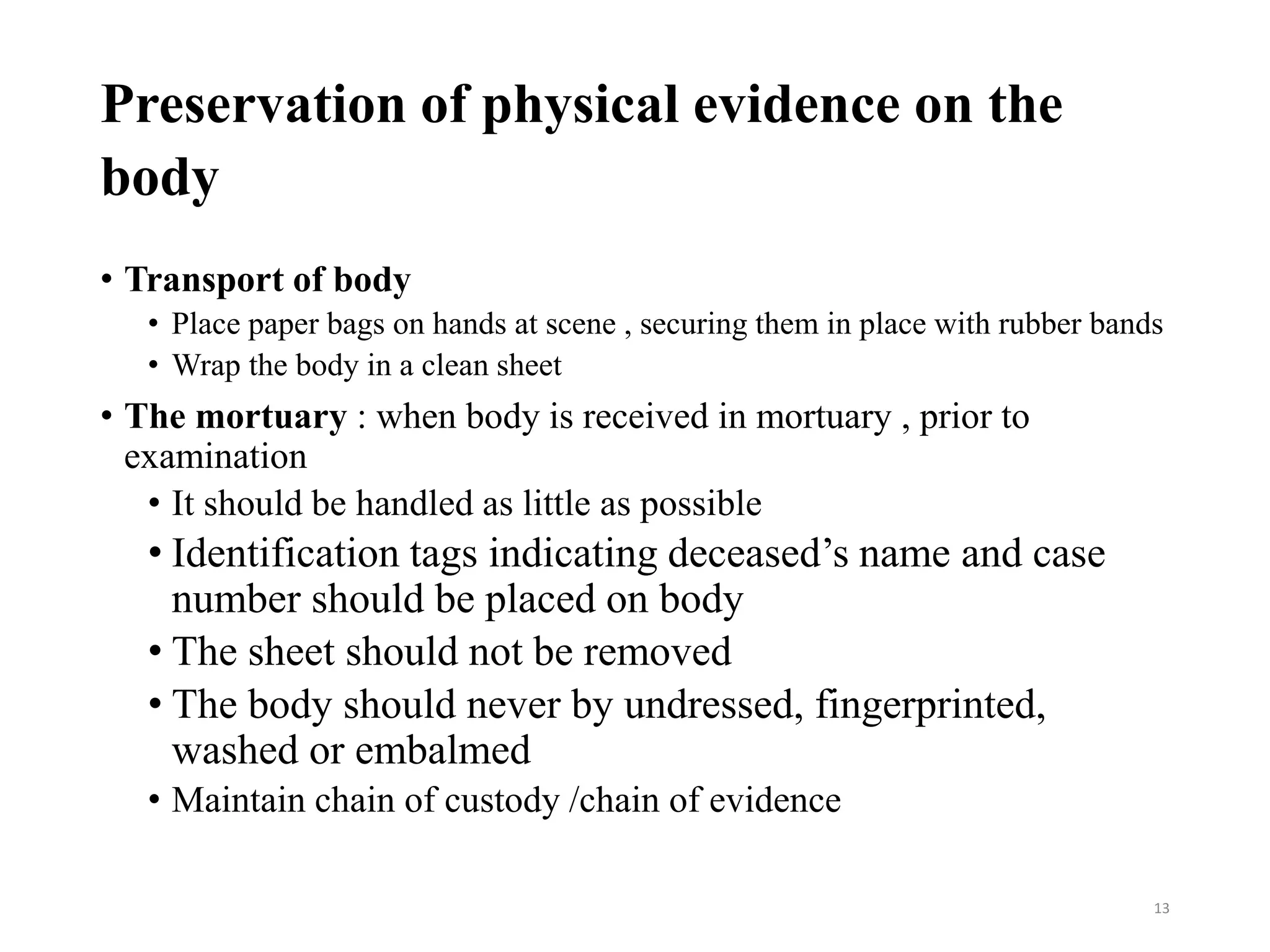
• Transport of body
• Place paper bags on hands at scene , securing them in place with rubber bands
• Wrap the body in a clean sheet
• The mortuary : when body is received in mortuary , prior to
examination
• It should be handled as little as possible
• Identification tags indicating deceased’s name and case
number should be placed on body
• The sheet should not be removed
• The body should never by undressed, fingerprinted,
washed or embalmed
• Maintain chain of custody /chain of evidence
13
• The body should be handled a very little at the scene.
• In cases of violent deaths, paper bags should be secured
around the hands so that no trace evidence will be lost.
• Plastic bags should not to be used to cover the hands to avoid
condensation in cold room and possible loss of trace
evidence when it is moved to warm environment.
• The body should be wrapped in a clean, white sheet or plastic
bag.
14
15
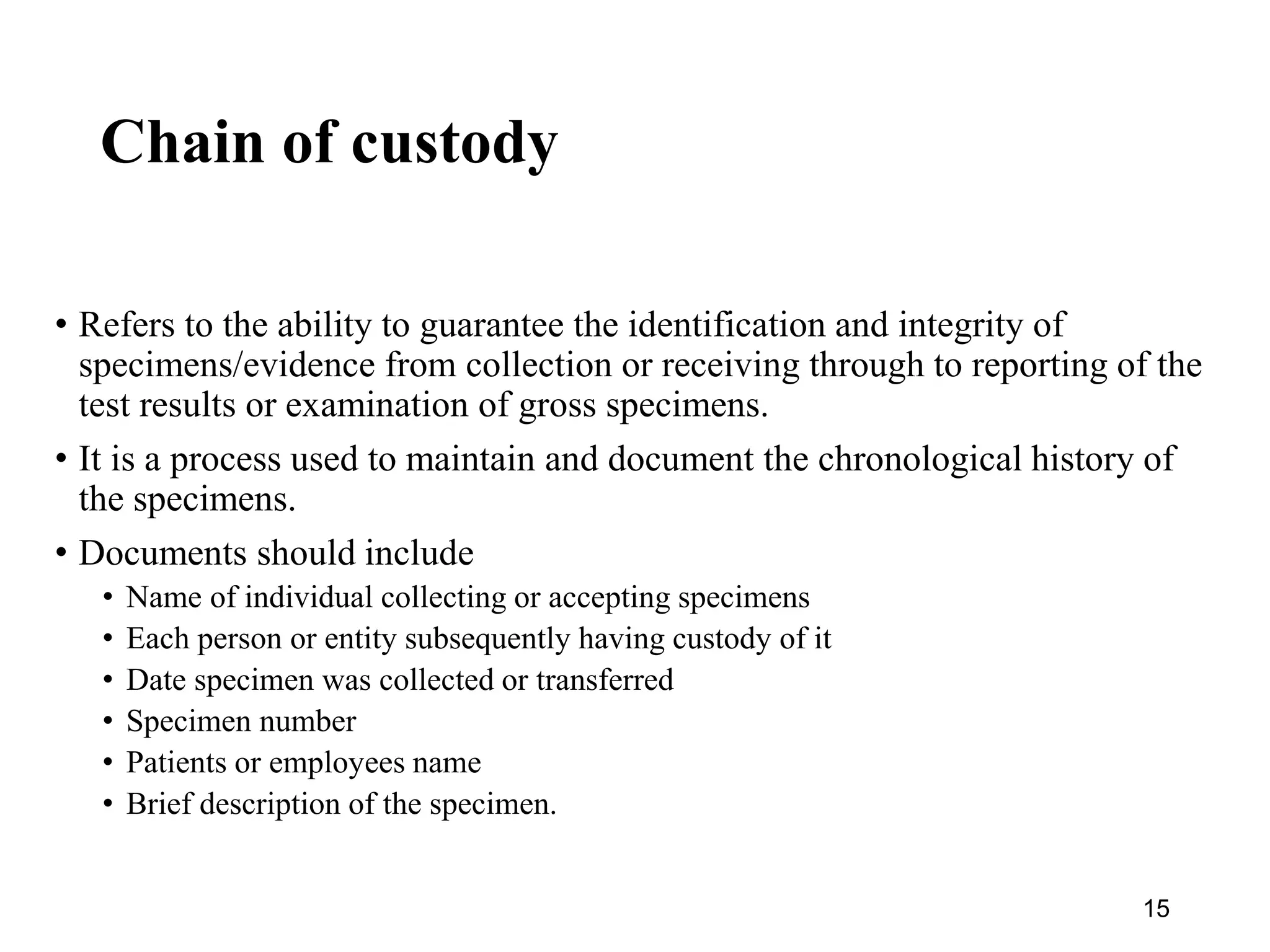
Chain of custody
• Refers to the ability to guarantee the identification and integrity of
specimens/evidence from collection or receiving through to reporting of the
test results or examination of gross specimens.
• It is a process used to maintain and document the chronological history of
the specimens.
• Documents should include
• Name of individual collecting or accepting specimens
• Each person or entity subsequently having custody of it
• Date specimen was collected or transferred
• Specimen number
• Patients or employees name
• Brief description of the specimen.

TRACE EVIDENCE.ppt

  • 1.
    If you arecalled to the scene of death (Is there suspicion of foul play ) • No foul play is suspected ( death obviously natural) • If death due to natural causes( do not need to examine the body • Foul play is suspected • If death is not due to natural causes (accident/suicide/ homicide/undetermined) • Go to scene and examine the body and scene 1
  • 2.
    EXAMINATION OF THESCENE OF DEATH •Correlation of findings of scene with autopsy findings and history of case is necessary for proper death investigation so that following can be elicited: • What happened(What?) • The medical cause of death (Why?) • The time of death(When ?) • The manner of death (How?) • The place of death (Where?) • The identity of deceased ( Who?) 2
  • 3.
    LOCARD’ PRINCIPLE “ Whenany two objects come into contact there is always transfer of material from each of objects to the other”. This theory has got following implications for crime scene:- a. Perpetrator will take away traces of victim and scene b. Victim will retain traces of perpetrator and 3may transfer traces of him or herself on to perpetrator c. Perpetrator will leave behind traces of him or herself at the scene 3
  • 4.
    •Control of scene •Policeare in control of scene of death •Doctor should not approach the body until specifically requested to do so by investing officer or police officer, usually only after photographs and video recordings have been taken and finger prints examinations have been completed 4
  • 5.
    Functions of forensicmedical expert at scene may include the following a. Confirmation or pronouncement of death b. Observation of the scene of death c. Assessment of the time of death d. Offering an opinion as to possible nature of death as opposed to cause of death e. Ensuring the trace evidence from body or its surroundings is not removed or destroyed f. Preventing contamination of body or scene by introduction of foreign material g. Collecting specimens from the body and scene of death, if indicated h. Assisting in removal of the body , if necessary 5
  • 6.
    Prevention of lossof trace elements and contamination of scene of death ACTION 1. Gloves hands used carelessly 2. Standing on blood, tyre marks or foot prints 3. moving clothing or body of deceased 4. Placing blanket over body 5. Failure to wear protective foot wear or clothing 6. Touching door handles, weapons, telephones and other objects with bare hands • RESULTS 1. Erasure of finger prints 2. Destruction of evidence 3. Mistaken inferences being drawn for complete impression of sexual assault 4. Transfer of foreign fibres on to body 5. Traces of doctor or investigator may contaminate scene 6. Obliteration or addition of finger prints 6
  • 7.
    • Action 7. Smoking 8.Wiping hands on towels or other items 9. Using toilet or hand basin • Results 7. Contamination of scene with ash or cigarette butts 8. Traces of doctor or investigator may contaminate scene 9. Flushing of evidence and possible obliteration or addition of finger prints . 7
  • 8.
    Equipment to beincluded in crime scene kit a. Rubber gloves ( latex and heavy duty) b. Disposable waterproof aprons, masks and plastic overshoes c. Thermometer d. Disposable syringes and hypodermic needles of varying sizes e. Scalpels and disposable scalpel blades,Forceps and scissors g. Swabs, glass slides and cytological fixative h. Screw top specimen containers and envelopes i. Labels, Adhesive plaster and tape j. Note paper, pen , pencil and charts for recording injuries, Hand lens, ruler and tape measure k. Plastic bags of varying sizes and paper bags l. Camera and torch 8
  • 9.
    Protocol for examinationat scene of death a. Record time requested to attend scene and identity of person making request b. On arrival at scene report to officer in charge and identify yourself c. Establish from officer in charge what is required of you d. Wear protective clothing and approach body via a pre-determined route after having obtaining permission to do so e. Confirm person is dead f. Describe body as found at site including posture clothing , visible injuries , complemented by notes, diagrams and photographs if possible g. Examine the body for injuries h. Establish time of death (check for rigor, hypostasis, obtain insect larvae etc) 9
  • 10.
    Protocol for examinationat scene of death – continued •Collect trace evidence and take necessary precautions to prevent loss of trace evidence or contamination of body during removal to the mortuary •Physical evidence “ any material which can be used to link a suspect , a weapon or a scene to a crime” •Types of Physical evidence : two main categories : 1. biological evidence 2. non-biological evidence 10
  • 11.
    Biological evidence a. Blood b.Semen c. Hair d. Tissue e. Fingernails f. Bite marks g. saliva 11
  • 12.
    Non biological evidence •The most common form encountered by medical examiner is a. Clothing b. Bullets/shotgun pellets,wadding c. Fibres d. Paint e. Glass f. soil 12
  • 13.
    Preservation of physicalevidence on the body • Transport of body • Place paper bags on hands at scene , securing them in place with rubber bands • Wrap the body in a clean sheet • The mortuary : when body is received in mortuary , prior to examination • It should be handled as little as possible • Identification tags indicating deceased’s name and case number should be placed on body • The sheet should not be removed • The body should never by undressed, fingerprinted, washed or embalmed • Maintain chain of custody /chain of evidence 13
  • 14.
    • The bodyshould be handled a very little at the scene. • In cases of violent deaths, paper bags should be secured around the hands so that no trace evidence will be lost. • Plastic bags should not to be used to cover the hands to avoid condensation in cold room and possible loss of trace evidence when it is moved to warm environment. • The body should be wrapped in a clean, white sheet or plastic bag. 14
  • 15.
    15 Chain of custody •Refers to the ability to guarantee the identification and integrity of specimens/evidence from collection or receiving through to reporting of the test results or examination of gross specimens. • It is a process used to maintain and document the chronological history of the specimens. • Documents should include • Name of individual collecting or accepting specimens • Each person or entity subsequently having custody of it • Date specimen was collected or transferred • Specimen number • Patients or employees name • Brief description of the specimen.