Unit 3
Design against fluctuating load
Prepared By
Prof. M.C. Shinde[9970160753]
Mech. Engg. Dept., JSCOE, Hadapsar
Unit 3
Design against fluctuating load
Session 3.1 Stress Concentration ,Causes & Remedies,
Fatigue Load & Failure
Prepared By
Prof. M.C. Shinde
Mech. Engg. Dept., JSCOE, Hadapsar
Stress concentration - causes & remedies, fluctuating
stresses, fatigue failures, S-N curve, endurance limit,
notch sensitivity, endurance strength modifying
factors, design for finite and infinite life, cumulative
damage in fatigue failure, Soderberg, Gerber,
Goodman, Modified Goodman diagrams, Fatigue
design of components under combined stresses:-
Theoretical treatment only
SPPU Syllabus Content
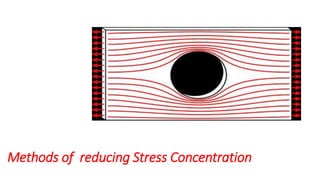
Stress Concentration
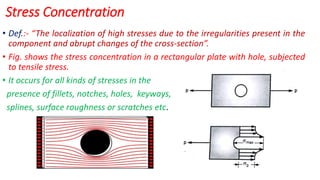
• Def.:- “The localization of high stresses due to the irregularities present in the
component and abrupt changes of the cross-section”.
• Fig. shows the stress concentration in a rectangular plate with hole, subjected
to tensile stress.
• It occurs for all kinds of stresses in the
presence of fillets, notches, holes, keyways,
splines, surface roughness or scratches etc.
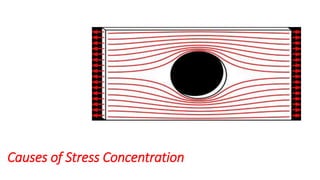
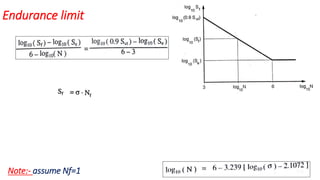
Causes of Stress Concentration
1.Abrupt change of cross-section
• Certain features of machine components such as oil holes or oil grooves,
keyways and splines, and screw threads result in discontinuities in the cross-
section of the component. There is stress concentration in the vicinity of these
discontinuities.
2.Poor Surface Finish
• Machining scratches, stamp marks or inspection marks are surface
irregularities, which cause stress concentration.
3.Localised loading
• Machine components are subjected to forces. These forces act either at a point
or over a small area on the component. Since the area is small, the pressure at
these points is excessive. This results in stress concentration.
The examples of these load applications are as follows:
(a) Contact between the meshing teeth of the driving and the driven gear

(b) Contact between the cam and the follower
(c) Contact between the balls and the races of ball bearing
(d) Contact between the rail and the wheel
(e) Contact between the crane hook and the chain
4.Variation in the material properties
• In design of machine components, it is assumed that the material is
homogeneous throughout the component.
• In practice, there is variation in material properties from one end to another
due to the following factors:
(a) internal cracks and flaws like blow holes;
(b) cavities in welds;
(c) air holes in steel components; and
(d) non-metallic or foreign inclusions.
These variations act as discontinuities
Methods of reducing Stress Concentration
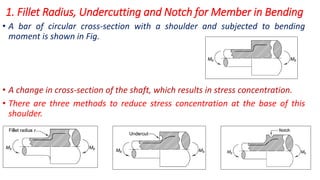
1. Fillet Radius, Undercutting and Notch for Member in Bending
• A bar of circular cross-section with a shoulder and subjected to bending
moment is shown in Fig.
• A change in cross-section of the shaft, which results in stress concentration.
• There are three methods to reduce stress concentration at the base of this
shoulder.
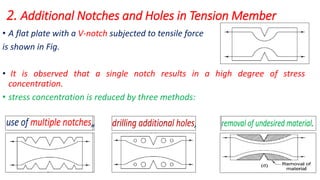
2. Additional Notches and Holes in Tension Member
• A flat plate with a V-notch subjected to tensile force
is shown in Fig.
• It is observed that a single notch results in a high degree of stress
concentration.
• stress concentration is reduced by three methods:
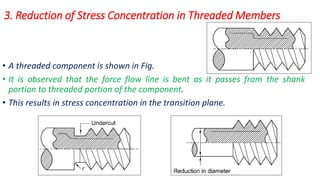
3. Reduction of Stress Concentration in Threaded Members
• A threaded component is shown in Fig.
• It is observed that the force flow line is bent as it passes from the shank
portion to threaded portion of the component.
• This results in stress concentration in the transition plane.
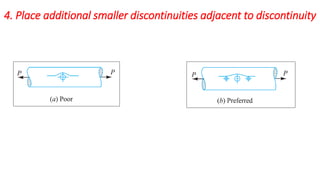
4. Place additional smaller discontinuities adjacent to discontinuity
1.Write short note on Stress Concentration
2.With the neat sketches explain method of reduction
of Stress Concentration
Assignment 3.1
Unit 3
Design against fluctuating load
Session 3.2 Stress Concentration Factor, Fluctuating
Stresses, Fatigue Load & Endurance Limit
Prepared By
Prof. M.C. Shinde
Mech. Engg. Dept., JSCOE, Hadapsar
Stress Concentration Factor
1) Theoretical Or Form Stress Concentration Factor
2) Fatigue Stress Concentration Factor
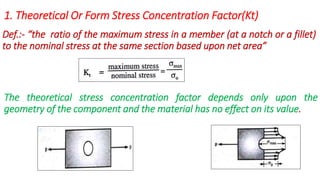
1. Theoretical Or Form Stress Concentration Factor(Kt)
Def.:- “the ratio of the maximum stress in a member (at a notch or a fillet)
to the nominal stress at the same section based upon net area”
The theoretical stress concentration factor depends only upon the
geometry of the component and the material has no effect on its value.
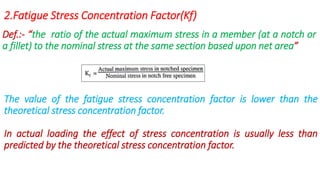
2.Fatigue Stress Concentration Factor(Kf)
Def.:- “the ratio of the actual maximum stress in a member (at a notch or
a fillet) to the nominal stress at the same section based upon net area”
The value of the fatigue stress concentration factor is lower than the
theoretical stress concentration factor.
In actual loading the effect of stress concentration is usually less than
predicted by the theoretical stress concentration factor.
Fatigue load & fatigue failures
Fatigue (fluctuating ) loads: the loads which vary in magnitude and or
direction wrt time are Fatigue loads
Fatigue failures:- when the mechanical component is subjected to
fluctuating loads it fails at stress considerably below the ultimate strength
such type of failure is known as fatigue failure.
A fatigue failure begins with a small crack. The initial crack is so minute
that it cannot be detected by the naked eye.
The crack initiates at point of discontinuity in the component, such as
change in a cross section, key way or hole. Once a crack is initiated the
crack progresses more rapidly.
The cracks are not visible till they reach the surface and by the time cracks
reach the surface the failure has already occurred
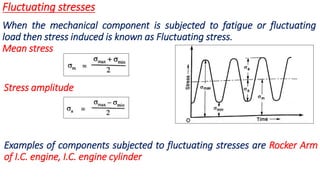
Fluctuating stresses
When the mechanical component is subjected to fatigue or fluctuating
load then stress induced is known as Fluctuating stress.
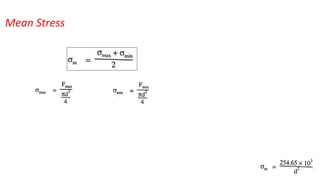
Mean stress
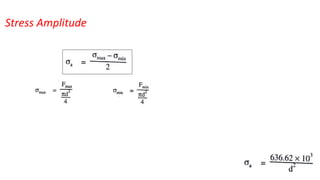
Stress amplitude
Examples of components subjected to fluctuating stresses are Rocker Arm
of I.C. engine, I.C. engine cylinder
Special cases of fluctuating stresses
1) Completely reversed stresses
2) Repeated stresses
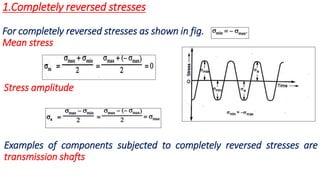
1.Completely reversed stresses
For completely reversed stresses as shown in fig.
Mean stress
Stress amplitude
Examples of components subjected to completely reversed stresses are
transmission shafts
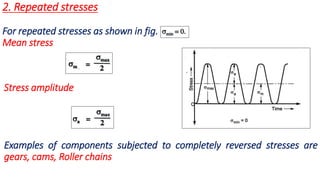
2. Repeated stresses
For repeated stresses as shown in fig.
Mean stress
Stress amplitude
Examples of components subjected to completely reversed stresses are
gears, cams, Roller chains
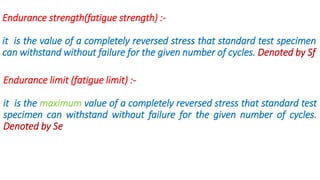
Endurance strength(fatigue strength) :-
it is the value of a completely reversed stress that standard test specimen
can withstand without failure for the given number of cycles. Denoted by Sf
Endurance limit (fatigue limit) :-
it is the maximum value of a completely reversed stress that standard test
specimen can withstand without failure for the given number of cycles.
Denoted by Se
1.What is stress concentration Factor
2.Write short note on Fluctuating Stresses
3.Define Fluctuating load ,Fatigue Failure
Assignment 3.2
Unit 3
Design against fluctuating load
Session 3.3 S-N Diagram, Moore Test, Endurance limit
Modifying factors
Prepared By
Prof. M.C. Shinde
Mech. Engg. Dept., JSCOE, Hadapsar
R R Moore Fatigue Test
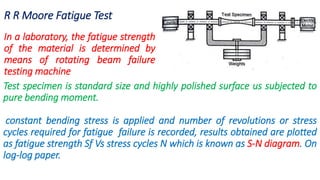
In a laboratory, the fatigue strength
of the material is determined by
means of rotating beam failure
testing machine
Test specimen is standard size and highly polished surface us subjected to
pure bending moment.
constant bending stress is applied and number of revolutions or stress
cycles required for fatigue failure is recorded, results obtained are plotted
as fatigue strength Sf Vs stress cycles N which is known as S-N diagram. On
log-log paper.
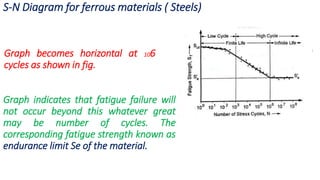
S-N Diagram for ferrous materials ( Steels)
Graph becomes horizontal at 106
cycles as shown in fig.
Graph indicates that fatigue failure will
not occur beyond this whatever great
may be number of cycles. The
corresponding fatigue strength known as
endurance limit Se of the material.
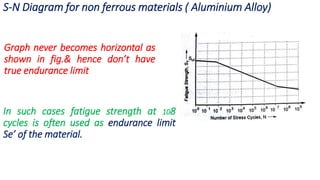
S-N Diagram for non ferrous materials ( Aluminium Alloy)
Graph never becomes horizontal as
shown in fig.& hence don’t have
true endurance limit
In such cases fatigue strength at 108
cycles is often used as endurance limit
Se’ of the material.
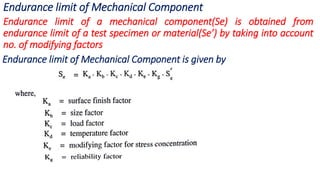
Endurance limit of Mechanical Component
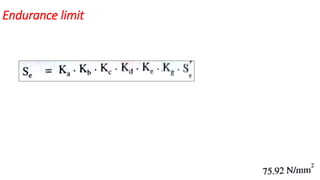
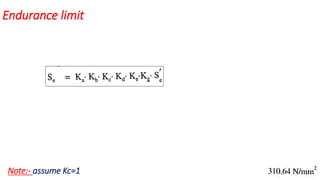
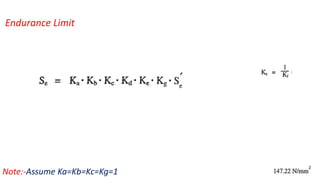
Endurance limit of a mechanical component(Se) is obtained from
endurance limit of a test specimen or material(Se’) by taking into account
no. of modifying factors
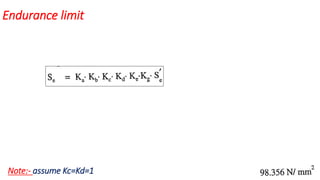
Endurance limit of Mechanical Component is given by
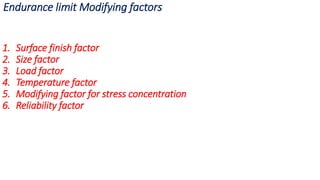
Endurance limit Modifying factors
1. Surface finish factor
2. Size factor
3. Load factor
4. Temperature factor
5. Modifying factor for stress concentration
6. Reliability factor
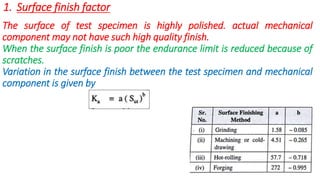
1. Surface finish factor
The surface of test specimen is highly polished. actual mechanical
component may not have such high quality finish.
When the surface finish is poor the endurance limit is reduced because of
scratches.
Variation in the surface finish between the test specimen and mechanical
component is given by
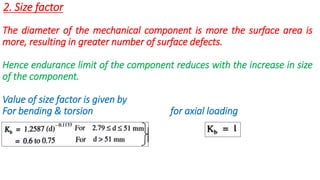
2. Size factor
The diameter of the mechanical component is more the surface area is
more, resulting in greater number of surface defects.
Hence endurance limit of the component reduces with the increase in size
of the component.
Value of size factor is given by
For bending & torsion for axial loading
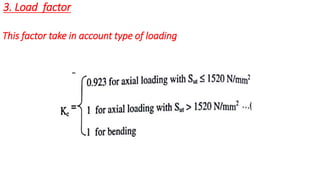
3. Load factor
This factor take in account type of loading
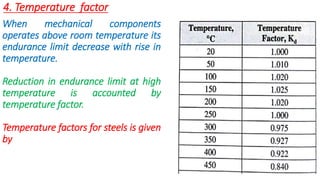
4. Temperature factor
When mechanical components
operates above room temperature its
endurance limit decrease with rise in
temperature.
Reduction in endurance limit at high
temperature is accounted by
temperature factor.
Temperature factors for steels is given
by
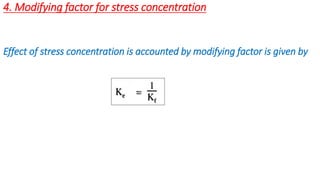
4. Modifying factor for stress concentration
Effect of stress concentration is accounted by modifying factor is given by
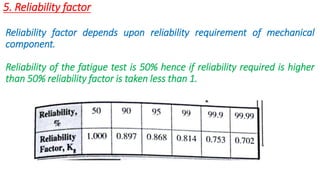
5. Reliability factor
Reliability factor depends upon reliability requirement of mechanical
component.
Reliability of the fatigue test is 50% hence if reliability required is higher
than 50% reliability factor is taken less than 1.
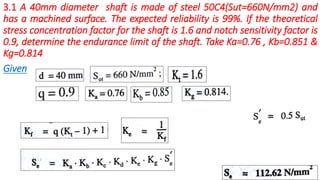
3.1 A 40mm diameter shaft is made of steel 50C4(Sut=660N/mm2) and
has a machined surface. The expected reliability is 99%. If the theoretical
stress concentration factor for the shaft is 1.6 and notch sensitivity factor is
0.9, determine the endurance limit of the shaft. Take Ka=0.76 , Kb=0.851 &
Kg=0.814
Given
1.Draw S-N diagram for Steel & Aluminium
2.List & explain Factors affecting the endurance
Strength.
3. Write a short note on Moore Test
Assignment 3.3
Unit 3
Design against fluctuating load
Session 3.4 : Design of components subjected to
completely reversed stresses for finite life
Prepared By
Prof. M.C. Shinde
Mech. Engg. Dept., JSCOE, Hadapsar
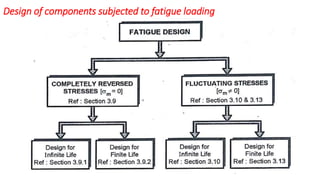
Design of components subjected to fatigue loading
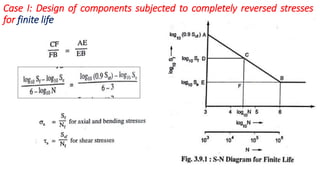
Case I: Design of components subjected to completely reversed stresses
for finite life
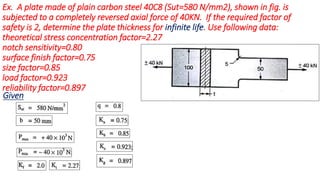
Ex. A plate made of plain carbon steel 40C8 (Sut=580 N/mm2), shown in fig. is
subjected to a completely reversed axial force of 40KN. If the required factor of
safety is 2, determine the plate thickness for infinite life. Use following data:
theoretical stress concentration factor=2.27
notch sensitivity=0.80
surface finish factor=0.75
size factor=0.85
load factor=0.923
reliability factor=0.897
Given
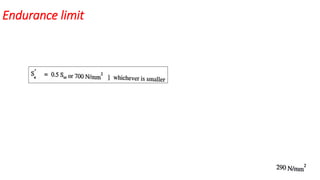
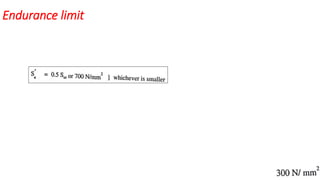
Endurance limit
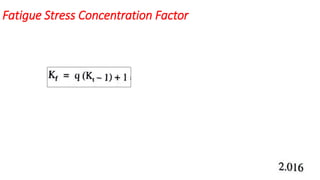
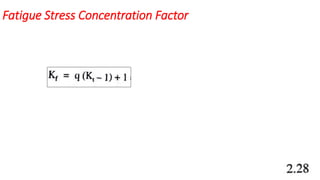
Fatigue Stress Concentration Factor
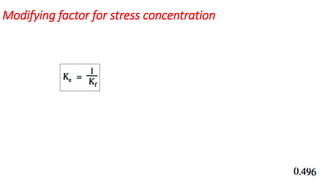
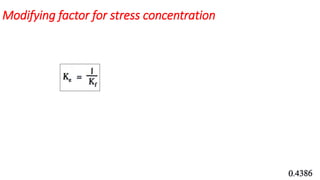
Modifying factor for stress concentration
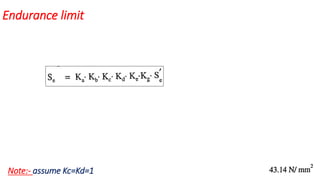
Endurance limit
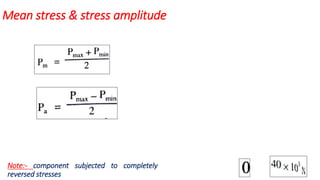
Mean stress & stress amplitude
Note:- component subjected to completely
reversed stresses
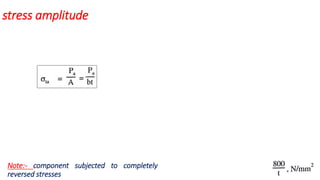
stress amplitude
Note:- component subjected to completely
reversed stresses
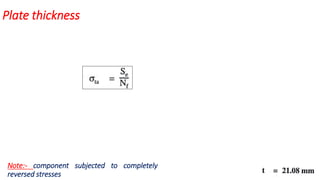
Plate thickness
Note:- component subjected to completely
reversed stresses
Ex. Solve Problem taken in this session in notebook and upload it
on Moodle under Assignment 3.4
Assignment 3.4
Unit 3
Design against fluctuating load
Session 3.5 : Numericals on Design of components
subjected to completely reversed stresses for finite
life
Prepared By
Prof. M.C. Shinde
Mech. Engg. Dept., JSCOE, Hadapsar
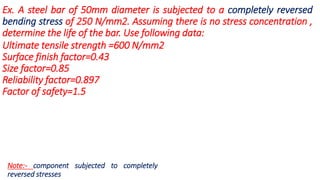
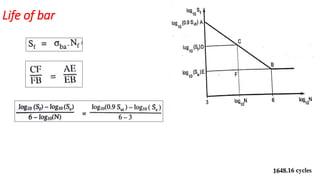
Ex. A steel bar of 50mm diameter is subjected to a completely reversed
bending stress of 250 N/mm2. Assuming there is no stress concentration ,
determine the life of the bar. Use following data:
Note:- component subjected to completely
reversed stresses
Ultimate tensile strength =600 N/mm2
Surface finish factor=0.43
Size factor=0.85
Reliability factor=0.897
Factor of safety=1.5
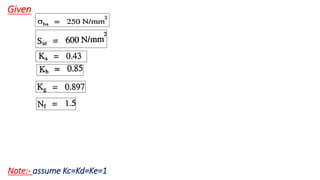
Given
Note:- assume Kc=Kd=Ke=1
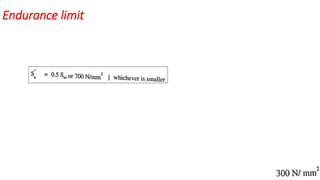
Endurance limit
Endurance limit
Note:- assume Kc=Kd=1
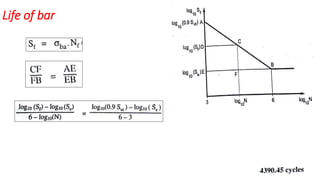
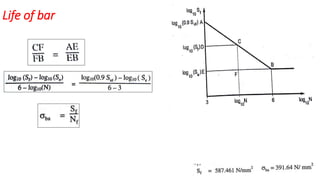
Life of bar
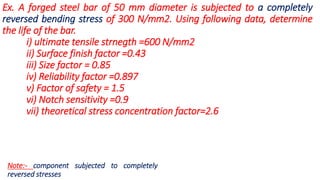
Ex. A forged steel bar of 50 mm diameter is subjected to a completely
reversed bending stress of 300 N/mm2. Using following data, determine
the life of the bar.
i) ultimate tensile strnegth =600 N/mm2
ii) Surface finish factor =0.43
iii) Size factor = 0.85
iv) Reliability factor =0.897
v) Factor of safety = 1.5
vi) Notch sensitivity =0.9
vii) theoretical stress concentration factor=2.6
Note:- component subjected to completely
reversed stresses
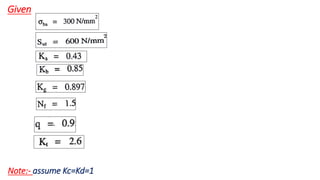
Given
Note:- assume Kc=Kd=1
Endurance limit
Fatigue Stress Concentration Factor
Modifying factor for stress concentration
Endurance limit
Note:- assume Kc=Kd=1
Life of bar
Ex. A steel bar of 100mm diameter is subjected to a completely
reversed bending stress of 500 N/mm2. Assuming there is no stress
concentration , determine the life of the bar. Use following data:
Ultimate tensile strength =800 N/mm2
Surface finish factor=0.63
Size factor=0.55
Reliability factor=0.787
Factor of safety=1.5
Assignment 3.5
Unit 3
Design against fluctuating load
Session 3.6: Design of components subjected to
completely reversed stress for infinite life
Prepared By
Prof. M.C. Shinde
Mech. Engg. Dept., JSCOE, Hadapsar
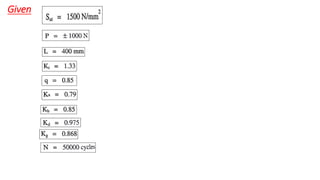
Ex. A cantilever beam of circular cross section made of alloy steel 30
Ni4CrL(Sut=1500N/mm2), fixed at one end and subjected to a completely reversed
force of 1000N at the free end. The force in perpendicular to the axis of the beam.
The distance between the fixed and free end of the cantilever beam is 400mm. The
theoretical stress concentration factor and notch sensitivity are 1.33 & 0.85
respectively. The surface finish factor and size factor are 0.79 & 0.85 respectively.
The temperature factor & reliability factor are 0.975 and 0.868 respectively. The
desired life of the beam is 50000 cycles. If the required factor of safety is 1.5,
determine the diameter of the beam.
Note:- component subjected to completely
reversed stresses
Given
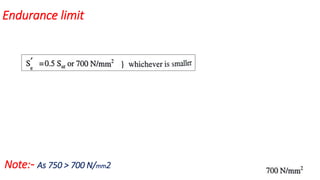
Endurance limit
Note:- As 750 > 700 N/mm2
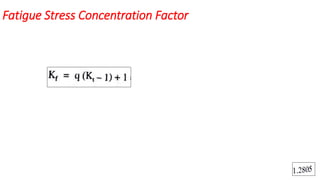
Fatigue Stress Concentration Factor
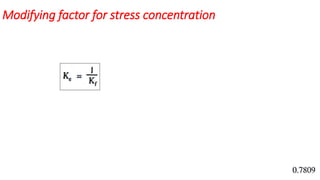
Modifying factor for stress concentration
Endurance limit
Note:- assume Kc=1
Life of bar
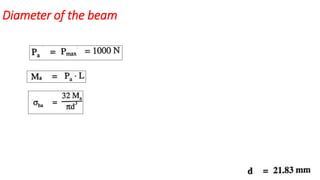
Diameter of the beam
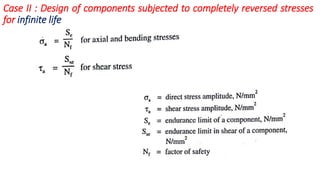
Case II : Design of components subjected to completely reversed stresses
for infinite life
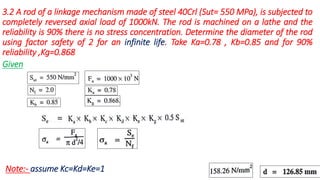
3.2 A rod of a linkage mechanism made of steel 40Crl (Sut= 550 MPa), is subjected to
completely reversed axial load of 1000kN. The rod is machined on a lathe and the
reliability is 90% there is no stress concentration. Determine the diameter of the rod
using factor safety of 2 for an infinite life. Take Ka=0.78 , Kb=0.85 and for 90%
reliability ,Kg=0.868
Given
Note:- assume Kc=Kd=Ke=1
A rod of a linkage mechanism made of steel 40Crl (Sut= 750 MPa),
is subjected to completely reversed axial load of 800kN. The rod is
machined on a lathe and the reliability is 85% there is no stress
concentration. Determine the diameter of the rod using factor
safety of 1.5 for an infinite life. Take Ka=0.74 , Kb=0.82 and for 80%
reliability ,Kg=0.748
Assignment 3.6
Unit 3
Design against fluctuating load
Session 3.7: Design of components with cumulative
damage in fatigue failure- Miner’s Equation
Prepared By
Prof. M.C. Shinde
Mech. Engg. Dept., JSCOE, Hadapsar
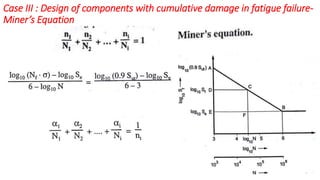
Case III : Design of components with cumulative damage in fatigue failure-
Miner’s Equation
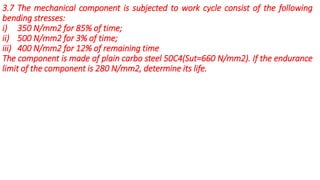
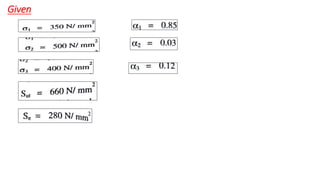
3.7 The mechanical component is subjected to work cycle consist of the following
bending stresses:
i) 350 N/mm2 for 85% of time;
ii) 500 N/mm2 for 3% of time;
iii) 400 N/mm2 for 12% of remaining time
The component is made of plain carbo steel 50C4(Sut=660 N/mm2). If the endurance
limit of the component is 280 N/mm2, determine its life.
Given
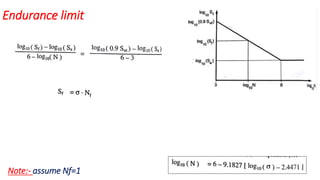
Endurance limit
Note:- assume Nf=1
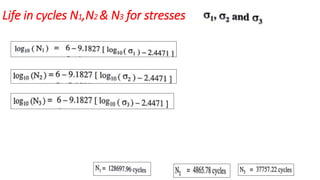
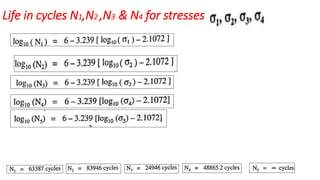
Life in cycles N1,N2 & N3 for stresses
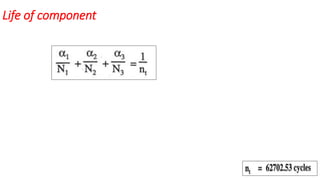
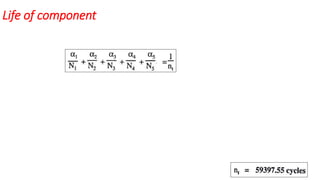
Life of component
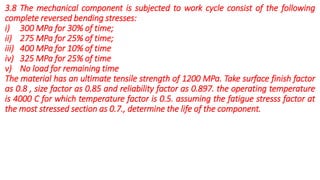
3.8 The mechanical component is subjected to work cycle consist of the following
complete reversed bending stresses:
i) 300 MPa for 30% of time;
ii) 275 MPa for 25% of time;
iii) 400 MPa for 10% of time
iv) 325 MPa for 25% of time
v) No load for remaining time
The material has an ultimate tensile strength of 1200 MPa. Take surface finish factor
as 0.8 , size factor as 0.85 and reliability factor as 0.897. the operating temperature
is 4000 C for which temperature factor is 0.5. assuming the fatigue stresss factor at
the most stressed section as 0.7., determine the life of the component.
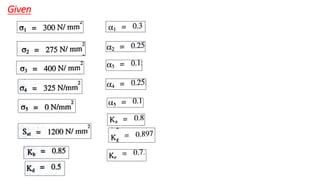
Given
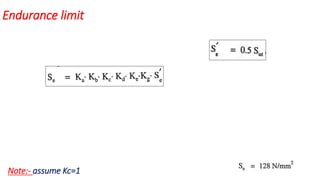
Endurance limit
Note:- assume Kc=1
Endurance limit
Note:- assume Nf=1
Life in cycles N1,N2 ,N3 & N4 for stresses
Life of component
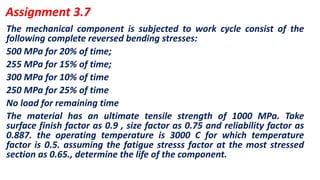
The mechanical component is subjected to work cycle consist of the
following complete reversed bending stresses:
500 MPa for 20% of time;
255 MPa for 15% of time;
300 MPa for 10% of time
250 MPa for 25% of time
No load for remaining time
The material has an ultimate tensile strength of 1000 MPa. Take
surface finish factor as 0.9 , size factor as 0.75 and reliability factor as
0.887. the operating temperature is 3000 C for which temperature
factor is 0.5. assuming the fatigue stresss factor at the most stressed
section as 0.65., determine the life of the component.
Assignment 3.7
Unit 3
Design against fluctuating load
Session 3.8: Gerber, Soderberg and Goodman
Criterion
Prepared By
Prof. M.C. Shinde
Mech. Engg. Dept., JSCOE, Hadapsar
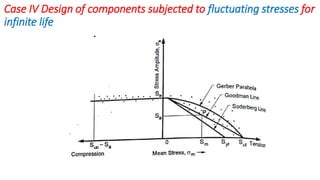
Case IV Design of components subjected to fluctuating stresses for
infinite life
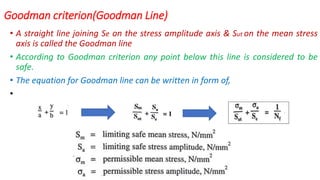
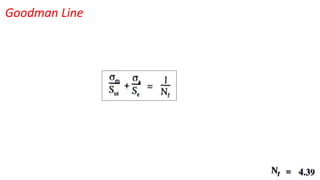
Goodman criterion(Goodman Line)
• A straight line joining Se on the stress amplitude axis & Sut on the mean stress
axis is called the Goodman line
• According to Goodman criterion any point below this line is considered to be
safe.
• The equation for Goodman line can be written in form of,
•
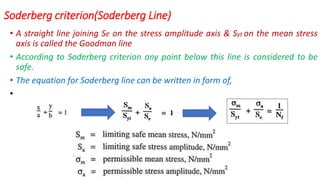
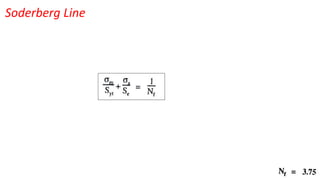
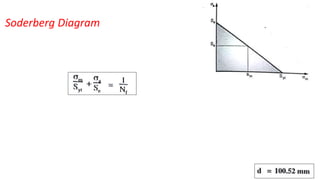
Soderberg criterion(Soderberg Line)
• A straight line joining Se on the stress amplitude axis & Syt on the mean stress
axis is called the Goodman line
• According to Soderberg criterion any point below this line is considered to be
safe.
• The equation for Soderberg line can be written in form of,
•
Gerber criterion(Gerber Parabola)
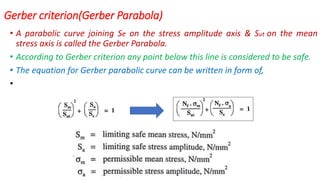
• A parabolic curve joining Se on the stress amplitude axis & Sut on the mean
stress axis is called the Gerber Parabola.
• According to Gerber criterion any point below this line is considered to be safe.
• The equation for Gerber parabolic curve can be written in form of,
•
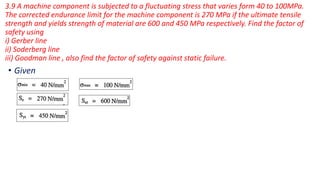
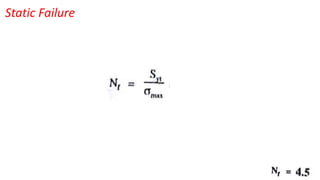
3.9 A machine component is subjected to a fluctuating stress that varies form 40 to 100MPa.
The corrected endurance limit for the machine component is 270 MPa if the ultimate tensile
strength and yields strength of material are 600 and 450 MPa respectively. Find the factor of
safety using
i) Gerber line
ii) Soderberg line
iii) Goodman line , also find the factor of safety against static failure.
• Given
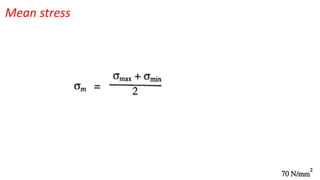
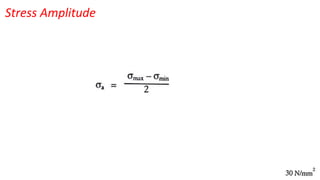
Mean stress
Stress Amplitude
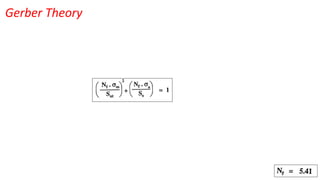
Gerber Theory
Soderberg Line
Goodman Line
Static Failure
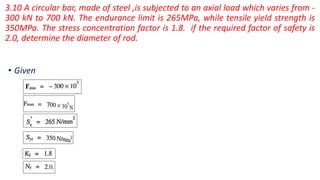
3.10 A circular bar, made of steel ,is subjected to an axial load which varies from -
300 kN to 700 kN. The endurance limit is 265MPa, while tensile yield strength is
350MPa. The stress concentration factor is 1.8. if the required factor of safety is
2.0, determine the diameter of rod.
• Given
Endurance Limit
Note:-Assume Ka=Kb=Kc=Kg=1
Mean Stress
Stress Amplitude
Soderberg Diagram
1. Explain Geber Criterion
2. Explain Soderberg Criterion
3. Explain Goodman Criterion
4. A machine component is subjected to a fluctuating stress that varies
form 50 to 200MPa. The corrected endurance limit for the machine
component is 350 MPa if the ultimate tensile strength and yields
strength of material are 800 and 950 MPa respectively. Find the
factor of safety using
i) Gerber line
ii) Soderberg line
iii) Goodman line , also find the factor of safety against static
failure.
Assignment 3.8

Unit 3 Design of Fluctuating Loads

  • 1.
    Unit 3 Design againstfluctuating load Prepared By Prof. M.C. Shinde[9970160753] Mech. Engg. Dept., JSCOE, Hadapsar
  • 2.
    Unit 3 Design againstfluctuating load Session 3.1 Stress Concentration ,Causes & Remedies, Fatigue Load & Failure Prepared By Prof. M.C. Shinde Mech. Engg. Dept., JSCOE, Hadapsar
  • 3.
    Stress concentration -causes & remedies, fluctuating stresses, fatigue failures, S-N curve, endurance limit, notch sensitivity, endurance strength modifying factors, design for finite and infinite life, cumulative damage in fatigue failure, Soderberg, Gerber, Goodman, Modified Goodman diagrams, Fatigue design of components under combined stresses:- Theoretical treatment only SPPU Syllabus Content
  • 4.
    Stress Concentration • Def.:-“The localization of high stresses due to the irregularities present in the component and abrupt changes of the cross-section”. • Fig. shows the stress concentration in a rectangular plate with hole, subjected to tensile stress. • It occurs for all kinds of stresses in the presence of fillets, notches, holes, keyways, splines, surface roughness or scratches etc.
  • 5.
    Causes of StressConcentration
  • 6.
    1.Abrupt change ofcross-section • Certain features of machine components such as oil holes or oil grooves, keyways and splines, and screw threads result in discontinuities in the cross- section of the component. There is stress concentration in the vicinity of these discontinuities.
  • 7.
    2.Poor Surface Finish •Machining scratches, stamp marks or inspection marks are surface irregularities, which cause stress concentration.
  • 8.
    3.Localised loading • Machinecomponents are subjected to forces. These forces act either at a point or over a small area on the component. Since the area is small, the pressure at these points is excessive. This results in stress concentration. The examples of these load applications are as follows: (a) Contact between the meshing teeth of the driving and the driven gear (b) Contact between the cam and the follower (c) Contact between the balls and the races of ball bearing (d) Contact between the rail and the wheel (e) Contact between the crane hook and the chain
  • 9.
    4.Variation in thematerial properties • In design of machine components, it is assumed that the material is homogeneous throughout the component. • In practice, there is variation in material properties from one end to another due to the following factors: (a) internal cracks and flaws like blow holes; (b) cavities in welds; (c) air holes in steel components; and (d) non-metallic or foreign inclusions. These variations act as discontinuities
  • 10.
    Methods of reducingStress Concentration
  • 11.
    1. Fillet Radius,Undercutting and Notch for Member in Bending • A bar of circular cross-section with a shoulder and subjected to bending moment is shown in Fig. • A change in cross-section of the shaft, which results in stress concentration. • There are three methods to reduce stress concentration at the base of this shoulder.
  • 12.
    2. Additional Notchesand Holes in Tension Member • A flat plate with a V-notch subjected to tensile force is shown in Fig. • It is observed that a single notch results in a high degree of stress concentration. • stress concentration is reduced by three methods:
  • 13.
    3. Reduction ofStress Concentration in Threaded Members • A threaded component is shown in Fig. • It is observed that the force flow line is bent as it passes from the shank portion to threaded portion of the component. • This results in stress concentration in the transition plane.
  • 14.
    4. Place additionalsmaller discontinuities adjacent to discontinuity
  • 15.
    1.Write short noteon Stress Concentration 2.With the neat sketches explain method of reduction of Stress Concentration Assignment 3.1
  • 16.
    Unit 3 Design againstfluctuating load Session 3.2 Stress Concentration Factor, Fluctuating Stresses, Fatigue Load & Endurance Limit Prepared By Prof. M.C. Shinde Mech. Engg. Dept., JSCOE, Hadapsar
  • 17.
    Stress Concentration Factor 1)Theoretical Or Form Stress Concentration Factor 2) Fatigue Stress Concentration Factor
  • 18.
    1. Theoretical OrForm Stress Concentration Factor(Kt) Def.:- “the ratio of the maximum stress in a member (at a notch or a fillet) to the nominal stress at the same section based upon net area” The theoretical stress concentration factor depends only upon the geometry of the component and the material has no effect on its value.
  • 19.
    2.Fatigue Stress ConcentrationFactor(Kf) Def.:- “the ratio of the actual maximum stress in a member (at a notch or a fillet) to the nominal stress at the same section based upon net area” The value of the fatigue stress concentration factor is lower than the theoretical stress concentration factor. In actual loading the effect of stress concentration is usually less than predicted by the theoretical stress concentration factor.
  • 20.
    Fatigue load &fatigue failures Fatigue (fluctuating ) loads: the loads which vary in magnitude and or direction wrt time are Fatigue loads Fatigue failures:- when the mechanical component is subjected to fluctuating loads it fails at stress considerably below the ultimate strength such type of failure is known as fatigue failure. A fatigue failure begins with a small crack. The initial crack is so minute that it cannot be detected by the naked eye. The crack initiates at point of discontinuity in the component, such as change in a cross section, key way or hole. Once a crack is initiated the crack progresses more rapidly. The cracks are not visible till they reach the surface and by the time cracks reach the surface the failure has already occurred
  • 21.
    Fluctuating stresses When themechanical component is subjected to fatigue or fluctuating load then stress induced is known as Fluctuating stress. Mean stress Stress amplitude Examples of components subjected to fluctuating stresses are Rocker Arm of I.C. engine, I.C. engine cylinder
  • 22.
    Special cases offluctuating stresses 1) Completely reversed stresses 2) Repeated stresses
  • 23.
    1.Completely reversed stresses Forcompletely reversed stresses as shown in fig. Mean stress Stress amplitude Examples of components subjected to completely reversed stresses are transmission shafts
  • 24.
    2. Repeated stresses Forrepeated stresses as shown in fig. Mean stress Stress amplitude Examples of components subjected to completely reversed stresses are gears, cams, Roller chains
  • 25.
    Endurance strength(fatigue strength):- it is the value of a completely reversed stress that standard test specimen can withstand without failure for the given number of cycles. Denoted by Sf Endurance limit (fatigue limit) :- it is the maximum value of a completely reversed stress that standard test specimen can withstand without failure for the given number of cycles. Denoted by Se
  • 26.
    1.What is stressconcentration Factor 2.Write short note on Fluctuating Stresses 3.Define Fluctuating load ,Fatigue Failure Assignment 3.2
  • 27.
    Unit 3 Design againstfluctuating load Session 3.3 S-N Diagram, Moore Test, Endurance limit Modifying factors Prepared By Prof. M.C. Shinde Mech. Engg. Dept., JSCOE, Hadapsar
  • 28.
    R R MooreFatigue Test In a laboratory, the fatigue strength of the material is determined by means of rotating beam failure testing machine Test specimen is standard size and highly polished surface us subjected to pure bending moment. constant bending stress is applied and number of revolutions or stress cycles required for fatigue failure is recorded, results obtained are plotted as fatigue strength Sf Vs stress cycles N which is known as S-N diagram. On log-log paper.
  • 29.
    S-N Diagram forferrous materials ( Steels) Graph becomes horizontal at 106 cycles as shown in fig. Graph indicates that fatigue failure will not occur beyond this whatever great may be number of cycles. The corresponding fatigue strength known as endurance limit Se of the material.
  • 30.
    S-N Diagram fornon ferrous materials ( Aluminium Alloy) Graph never becomes horizontal as shown in fig.& hence don’t have true endurance limit In such cases fatigue strength at 108 cycles is often used as endurance limit Se’ of the material.
  • 31.
    Endurance limit ofMechanical Component Endurance limit of a mechanical component(Se) is obtained from endurance limit of a test specimen or material(Se’) by taking into account no. of modifying factors Endurance limit of Mechanical Component is given by
  • 32.
    Endurance limit Modifyingfactors 1. Surface finish factor 2. Size factor 3. Load factor 4. Temperature factor 5. Modifying factor for stress concentration 6. Reliability factor
  • 33.
    1. Surface finishfactor The surface of test specimen is highly polished. actual mechanical component may not have such high quality finish. When the surface finish is poor the endurance limit is reduced because of scratches. Variation in the surface finish between the test specimen and mechanical component is given by
  • 34.
    2. Size factor Thediameter of the mechanical component is more the surface area is more, resulting in greater number of surface defects. Hence endurance limit of the component reduces with the increase in size of the component. Value of size factor is given by For bending & torsion for axial loading
  • 35.
    3. Load factor Thisfactor take in account type of loading
  • 36.
    4. Temperature factor Whenmechanical components operates above room temperature its endurance limit decrease with rise in temperature. Reduction in endurance limit at high temperature is accounted by temperature factor. Temperature factors for steels is given by
  • 37.
    4. Modifying factorfor stress concentration Effect of stress concentration is accounted by modifying factor is given by
  • 38.
    5. Reliability factor Reliabilityfactor depends upon reliability requirement of mechanical component. Reliability of the fatigue test is 50% hence if reliability required is higher than 50% reliability factor is taken less than 1.
  • 39.
    3.1 A 40mmdiameter shaft is made of steel 50C4(Sut=660N/mm2) and has a machined surface. The expected reliability is 99%. If the theoretical stress concentration factor for the shaft is 1.6 and notch sensitivity factor is 0.9, determine the endurance limit of the shaft. Take Ka=0.76 , Kb=0.851 & Kg=0.814 Given
  • 40.
    1.Draw S-N diagramfor Steel & Aluminium 2.List & explain Factors affecting the endurance Strength. 3. Write a short note on Moore Test Assignment 3.3
  • 41.
    Unit 3 Design againstfluctuating load Session 3.4 : Design of components subjected to completely reversed stresses for finite life Prepared By Prof. M.C. Shinde Mech. Engg. Dept., JSCOE, Hadapsar
  • 42.
    Design of componentssubjected to fatigue loading
  • 43.
    Case I: Designof components subjected to completely reversed stresses for finite life
  • 44.
    Ex. A platemade of plain carbon steel 40C8 (Sut=580 N/mm2), shown in fig. is subjected to a completely reversed axial force of 40KN. If the required factor of safety is 2, determine the plate thickness for infinite life. Use following data: theoretical stress concentration factor=2.27 notch sensitivity=0.80 surface finish factor=0.75 size factor=0.85 load factor=0.923 reliability factor=0.897 Given
  • 45.
  • 46.
  • 47.
    Modifying factor forstress concentration
  • 48.
  • 49.
    Mean stress &stress amplitude Note:- component subjected to completely reversed stresses
  • 50.
    stress amplitude Note:- componentsubjected to completely reversed stresses
  • 51.
    Plate thickness Note:- componentsubjected to completely reversed stresses
  • 52.
    Ex. Solve Problemtaken in this session in notebook and upload it on Moodle under Assignment 3.4 Assignment 3.4
  • 53.
    Unit 3 Design againstfluctuating load Session 3.5 : Numericals on Design of components subjected to completely reversed stresses for finite life Prepared By Prof. M.C. Shinde Mech. Engg. Dept., JSCOE, Hadapsar
  • 54.
    Ex. A steelbar of 50mm diameter is subjected to a completely reversed bending stress of 250 N/mm2. Assuming there is no stress concentration , determine the life of the bar. Use following data: Note:- component subjected to completely reversed stresses Ultimate tensile strength =600 N/mm2 Surface finish factor=0.43 Size factor=0.85 Reliability factor=0.897 Factor of safety=1.5
  • 55.
  • 56.
  • 57.
  • 58.
  • 59.
    Ex. A forgedsteel bar of 50 mm diameter is subjected to a completely reversed bending stress of 300 N/mm2. Using following data, determine the life of the bar. i) ultimate tensile strnegth =600 N/mm2 ii) Surface finish factor =0.43 iii) Size factor = 0.85 iv) Reliability factor =0.897 v) Factor of safety = 1.5 vi) Notch sensitivity =0.9 vii) theoretical stress concentration factor=2.6 Note:- component subjected to completely reversed stresses
  • 60.
  • 61.
  • 62.
  • 63.
    Modifying factor forstress concentration
  • 64.
  • 65.
  • 66.
    Ex. A steelbar of 100mm diameter is subjected to a completely reversed bending stress of 500 N/mm2. Assuming there is no stress concentration , determine the life of the bar. Use following data: Ultimate tensile strength =800 N/mm2 Surface finish factor=0.63 Size factor=0.55 Reliability factor=0.787 Factor of safety=1.5 Assignment 3.5
  • 67.
    Unit 3 Design againstfluctuating load Session 3.6: Design of components subjected to completely reversed stress for infinite life Prepared By Prof. M.C. Shinde Mech. Engg. Dept., JSCOE, Hadapsar
  • 68.
    Ex. A cantileverbeam of circular cross section made of alloy steel 30 Ni4CrL(Sut=1500N/mm2), fixed at one end and subjected to a completely reversed force of 1000N at the free end. The force in perpendicular to the axis of the beam. The distance between the fixed and free end of the cantilever beam is 400mm. The theoretical stress concentration factor and notch sensitivity are 1.33 & 0.85 respectively. The surface finish factor and size factor are 0.79 & 0.85 respectively. The temperature factor & reliability factor are 0.975 and 0.868 respectively. The desired life of the beam is 50000 cycles. If the required factor of safety is 1.5, determine the diameter of the beam. Note:- component subjected to completely reversed stresses
  • 69.
  • 70.
  • 71.
  • 72.
    Modifying factor forstress concentration
  • 73.
  • 74.
  • 75.
  • 76.
    Case II :Design of components subjected to completely reversed stresses for infinite life
  • 77.
    3.2 A rodof a linkage mechanism made of steel 40Crl (Sut= 550 MPa), is subjected to completely reversed axial load of 1000kN. The rod is machined on a lathe and the reliability is 90% there is no stress concentration. Determine the diameter of the rod using factor safety of 2 for an infinite life. Take Ka=0.78 , Kb=0.85 and for 90% reliability ,Kg=0.868 Given Note:- assume Kc=Kd=Ke=1
  • 78.
    A rod ofa linkage mechanism made of steel 40Crl (Sut= 750 MPa), is subjected to completely reversed axial load of 800kN. The rod is machined on a lathe and the reliability is 85% there is no stress concentration. Determine the diameter of the rod using factor safety of 1.5 for an infinite life. Take Ka=0.74 , Kb=0.82 and for 80% reliability ,Kg=0.748 Assignment 3.6
  • 79.
    Unit 3 Design againstfluctuating load Session 3.7: Design of components with cumulative damage in fatigue failure- Miner’s Equation Prepared By Prof. M.C. Shinde Mech. Engg. Dept., JSCOE, Hadapsar
  • 80.
    Case III :Design of components with cumulative damage in fatigue failure- Miner’s Equation
  • 81.
    3.7 The mechanicalcomponent is subjected to work cycle consist of the following bending stresses: i) 350 N/mm2 for 85% of time; ii) 500 N/mm2 for 3% of time; iii) 400 N/mm2 for 12% of remaining time The component is made of plain carbo steel 50C4(Sut=660 N/mm2). If the endurance limit of the component is 280 N/mm2, determine its life.
  • 82.
  • 83.
  • 84.
    Life in cyclesN1,N2 & N3 for stresses
  • 85.
  • 86.
    3.8 The mechanicalcomponent is subjected to work cycle consist of the following complete reversed bending stresses: i) 300 MPa for 30% of time; ii) 275 MPa for 25% of time; iii) 400 MPa for 10% of time iv) 325 MPa for 25% of time v) No load for remaining time The material has an ultimate tensile strength of 1200 MPa. Take surface finish factor as 0.8 , size factor as 0.85 and reliability factor as 0.897. the operating temperature is 4000 C for which temperature factor is 0.5. assuming the fatigue stresss factor at the most stressed section as 0.7., determine the life of the component.
  • 87.
  • 88.
  • 89.
  • 90.
    Life in cyclesN1,N2 ,N3 & N4 for stresses
  • 91.
  • 92.
    The mechanical componentis subjected to work cycle consist of the following complete reversed bending stresses: 500 MPa for 20% of time; 255 MPa for 15% of time; 300 MPa for 10% of time 250 MPa for 25% of time No load for remaining time The material has an ultimate tensile strength of 1000 MPa. Take surface finish factor as 0.9 , size factor as 0.75 and reliability factor as 0.887. the operating temperature is 3000 C for which temperature factor is 0.5. assuming the fatigue stresss factor at the most stressed section as 0.65., determine the life of the component. Assignment 3.7
  • 93.
    Unit 3 Design againstfluctuating load Session 3.8: Gerber, Soderberg and Goodman Criterion Prepared By Prof. M.C. Shinde Mech. Engg. Dept., JSCOE, Hadapsar
  • 94.
    Case IV Designof components subjected to fluctuating stresses for infinite life
  • 95.
    Goodman criterion(Goodman Line) •A straight line joining Se on the stress amplitude axis & Sut on the mean stress axis is called the Goodman line • According to Goodman criterion any point below this line is considered to be safe. • The equation for Goodman line can be written in form of, •
  • 96.
    Soderberg criterion(Soderberg Line) •A straight line joining Se on the stress amplitude axis & Syt on the mean stress axis is called the Goodman line • According to Soderberg criterion any point below this line is considered to be safe. • The equation for Soderberg line can be written in form of, •
  • 97.
    Gerber criterion(Gerber Parabola) •A parabolic curve joining Se on the stress amplitude axis & Sut on the mean stress axis is called the Gerber Parabola. • According to Gerber criterion any point below this line is considered to be safe. • The equation for Gerber parabolic curve can be written in form of, •
  • 98.
    3.9 A machinecomponent is subjected to a fluctuating stress that varies form 40 to 100MPa. The corrected endurance limit for the machine component is 270 MPa if the ultimate tensile strength and yields strength of material are 600 and 450 MPa respectively. Find the factor of safety using i) Gerber line ii) Soderberg line iii) Goodman line , also find the factor of safety against static failure. • Given
  • 99.
  • 100.
  • 101.
  • 102.
  • 103.
  • 104.
  • 105.
    3.10 A circularbar, made of steel ,is subjected to an axial load which varies from - 300 kN to 700 kN. The endurance limit is 265MPa, while tensile yield strength is 350MPa. The stress concentration factor is 1.8. if the required factor of safety is 2.0, determine the diameter of rod. • Given
  • 106.
  • 107.
  • 108.
  • 109.
  • 110.
    1. Explain GeberCriterion 2. Explain Soderberg Criterion 3. Explain Goodman Criterion 4. A machine component is subjected to a fluctuating stress that varies form 50 to 200MPa. The corrected endurance limit for the machine component is 350 MPa if the ultimate tensile strength and yields strength of material are 800 and 950 MPa respectively. Find the factor of safety using i) Gerber line ii) Soderberg line iii) Goodman line , also find the factor of safety against static failure. Assignment 3.8