Presented by:
Lutuf ullah 16TE55
Rubaisha 16TE59
Fabiha 16TE69
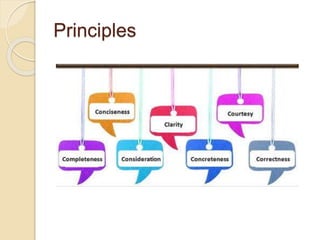
Principles
Conciseness
 means provide short and essential
message in limited words to the
audience.
 Avoid from using excessive and
needless words.
 comprehensible to the audience.
 Benefits.
How to achieve?
Eliminate wordy expressions.
Include only relevant
information.
Avoid repitation.
Completeness
 Complete means the message contains all
the relevant information required by reader or
listener.
 No missing information.
 Develops and enhances reputation of an
organization.
 No additional cost is inaccured in conveying
extra message if the communication is
complete.
 Helps in better decision making by the
audience/readers/recievers.
Persuades the audience.
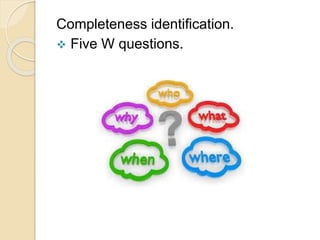
Completeness identification.
 Five W questions.
Clarity
 clarity implies emphasizing on
specific message or goal at a time.
 it makes understanding easier.
 complete clarity of thoughts enhances
the meaning of message.
 clear message make use of exact
and appropriate words.
Consideration
 Consideration implies stepping into the
shoes of others.
 effective communication must take the
audience into consideration i-e;
 the audience point of view.
 mindset
 background
• to ensure that the self respect of the
audience is maintained and their emotions
are not at harm.
• modify your words in message to suit
audiences need while making your message
complete.
Courtesy
 courtesy/ courteous communication.
 Insult. TYPES
1) Directly insult.
2) Indirectly insult.
 or hidden insult.
i-e: I love that you are confident enough
not to care about how you look.
Rules for Courteousness
1) Be sincerely,
o Tactful.
o Thoughtful.
o Appreciative.
2) Use expressions that show respect.
3) Choose non discriminatory
expressions.
Courtesy cost nothing but it wins many
a lasting friend!
Concretness
 Concreteness means the message
should be specific instead of general.
 Requirements.
a) use facts and figures instead of using
generic.
b) use image building words.
c) use action words.
d) avoid un-certainity.
General
1) He is very intelligent student of
class, and stood first in class.
Specific
2) Ali’s GPA in E.E 16batch
session was 3.95/4, he stood first
in his class.
i-e : The camera has a
system that gives good
pictures.
i-e :
1) Marie walked to school.
2) Louis thought about the
math problem
Correctness
 Correct in communication implies that
communication free from errors.
a) Written form.
Grammatical, punctuation, spellings.
b) Verbal form.
 Feelings.
 Sound.
 Time bounded.
7 C's of communication Presentation

7 C's of communication Presentation

  • 2.
    Presented by: Lutuf ullah16TE55 Rubaisha 16TE59 Fabiha 16TE69
  • 3.
  • 4.
    Conciseness  means provideshort and essential message in limited words to the audience.  Avoid from using excessive and needless words.  comprehensible to the audience.  Benefits. How to achieve? Eliminate wordy expressions. Include only relevant information. Avoid repitation.
  • 5.
    Completeness  Complete meansthe message contains all the relevant information required by reader or listener.  No missing information.  Develops and enhances reputation of an organization.  No additional cost is inaccured in conveying extra message if the communication is complete.  Helps in better decision making by the audience/readers/recievers. Persuades the audience.
  • 6.
  • 7.
    Clarity  clarity impliesemphasizing on specific message or goal at a time.  it makes understanding easier.  complete clarity of thoughts enhances the meaning of message.  clear message make use of exact and appropriate words.
  • 8.
    Consideration  Consideration impliesstepping into the shoes of others.  effective communication must take the audience into consideration i-e;  the audience point of view.  mindset  background • to ensure that the self respect of the audience is maintained and their emotions are not at harm. • modify your words in message to suit audiences need while making your message complete.
  • 9.
    Courtesy  courtesy/ courteouscommunication.  Insult. TYPES 1) Directly insult. 2) Indirectly insult.  or hidden insult. i-e: I love that you are confident enough not to care about how you look.
  • 10.
    Rules for Courteousness 1)Be sincerely, o Tactful. o Thoughtful. o Appreciative. 2) Use expressions that show respect. 3) Choose non discriminatory expressions. Courtesy cost nothing but it wins many a lasting friend!
  • 11.
    Concretness  Concreteness meansthe message should be specific instead of general.  Requirements. a) use facts and figures instead of using generic. b) use image building words. c) use action words. d) avoid un-certainity. General 1) He is very intelligent student of class, and stood first in class. Specific 2) Ali’s GPA in E.E 16batch session was 3.95/4, he stood first in his class. i-e : The camera has a system that gives good pictures. i-e : 1) Marie walked to school. 2) Louis thought about the math problem
  • 12.
    Correctness  Correct incommunication implies that communication free from errors. a) Written form. Grammatical, punctuation, spellings. b) Verbal form.  Feelings.  Sound.  Time bounded.