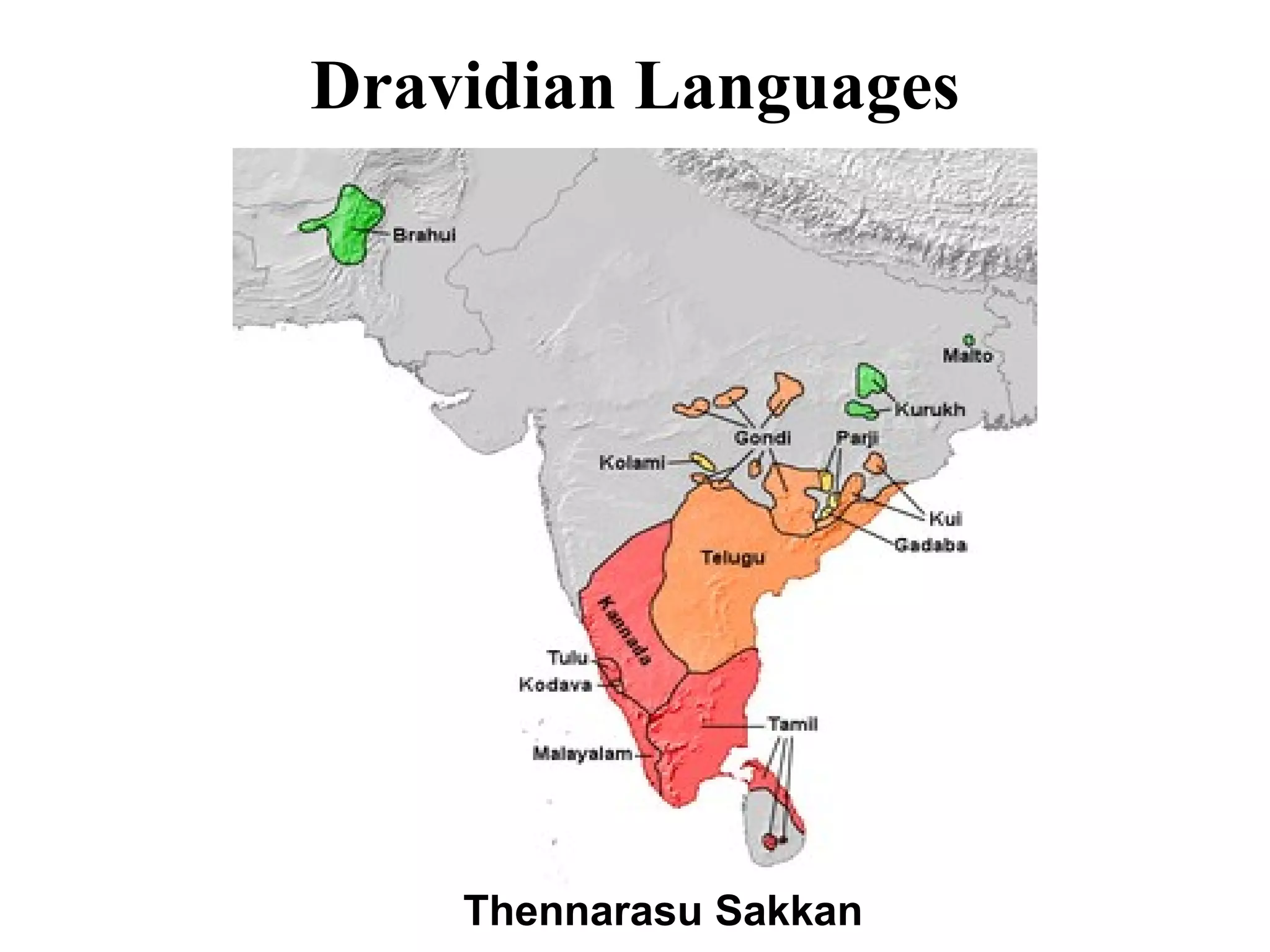
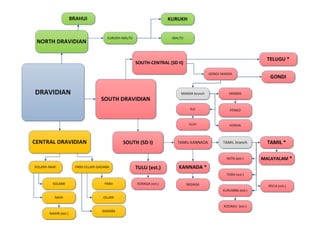
Dravidian Languages
Thennarasu Sakkan
Case suffixes in Dravidian - M. Andronov
1. The Nominative Case
2. The Genitive Case
3. The Accusative Case
4. The Dative Case
5. The Objective Case
6. The Comitative Case
7. The Instrumental Case
8. The Comitative-Instrumental Case
9. The Ablative Case
10. The Instrumental- Ablative Case
11. The Locative Case
12. The Instrumental- (Ablative-) Locative Case
13. The Ablative-Locative Case
14. The Lative, Adessive, Terminative, and Allative Cases
15. The Etymology of Case Suffixes
16. Vocative Forms
Case marker in Malayalam
1. Nominative
As a rule the Nominative has no suffix of its own
(or has a zero). The nominative noun denotes
the subject of the sentence.
– Ashraf eluti
• Ashraf write-PAST
• „Ashraf wrote‟
– kaarru viiśi
• wind blow-PAST
• „ Wind blew‟
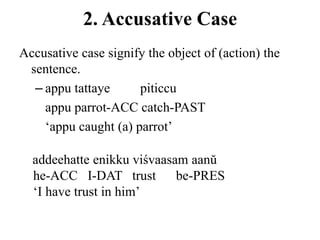
2. Accusative Case
Accusative case signify the object of (action) the
sentence.
– appu tattaye piticcu
appu parrot-ACC catch-PAST
„appu caught (a) parrot‟
addeehatte enikku viśvaasam aanŭ
he-ACC I-DAT trust be-PRES
„I have trust in him‟
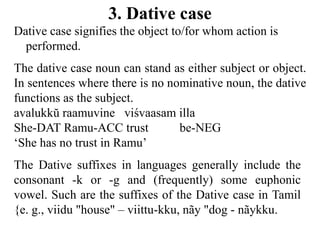
3. Dative case
Dative case signifies the object to/for whom action is
performed.
The dative case noun can stand as either subject or object.
In sentences where there is no nominative noun, the dative
functions as the subject.
avalukkŭ raamuvine viśvaasam illa
She-DAT Ramu-ACC trust be-NEG
„She has no trust in Ramu‟
The Dative suffixes in languages generally include the
consonant -k or -g and (frequently) some euphonic
vowel. Such are the suffixes of the Dative case in Tamil
{e. g., viidu "house" – viittu-kku, nãy "dog - nãykku.
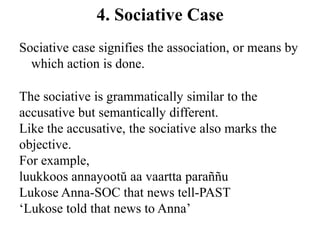
4. Sociative Case
Sociative case signifies the association, or means by
which action is done.
The sociative is grammatically similar to the
accusative but semantically different.
Like the accusative, the sociative also marks the
objective.
For example,
luukkoos annayootŭ aa vaartta paraññu
Lukose Anna-SOC that news tell-PAST
„Lukose told that news to Anna‟
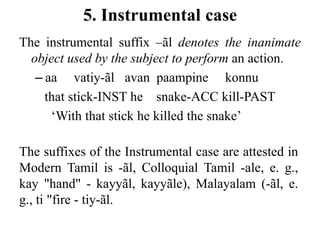
5. Instrumental case
The instrumental suffix –ãl denotes the inanimate
object used by the subject to perform an action.
– aa vatiy-ãl avan paampine konnu
that stick-INST he snake-ACC kill-PAST
„With that stick he killed the snake‟
The suffixes of the Instrumental case are attested in
Modern Tamil is -ãl, Colloquial Tamil -ale, e. g.,
kay "hand" - kayyãl, kayyãle), Malayalam (-ãl, e.
g., ti "fire - tiy-ãl.
6. Locative Case
The locative case denotes spatial and temporal
meanings.
– aval murrattŭ ninnu
she courtyard-LOC stand-PAST
„She stood in the courtyard‟
kuttikal bassil kayarunnu
children bus-LOC board-PRES
„The children are boarding the bus‟
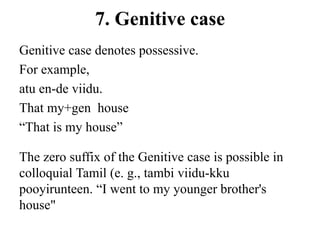
7. Genitive case
Genitive case denotes possessive.
For example,
atu en-de viidu.
That my+gen house
“That is my house”
The zero suffix of the Genitive case is possible in
colloquial Tamil (e. g., tambi viidu-kku
pooyirunteen. “I went to my younger brother's
house"
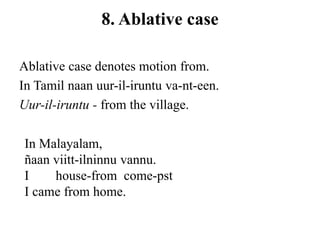
8. Ablative case
Ablative case denotes motion from.
In Tamil naan uur-il-iruntu va-nt-een.
Uur-il-iruntu - from the village.
In Malayalam,
ñaan viitt-ilninnu vannu.
I house-from come-pst
I came from home.
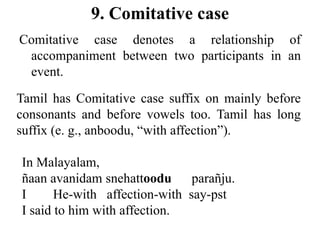
9. Comitative case
Comitative case denotes a relationship of
accompaniment between two participants in an
event.
Tamil has Comitative case suffix on mainly before
consonants and before vowels too. Tamil has long
suffix (e. g., anboodu, “with affection”).
In Malayalam,
ñaan avanidam snehattoodu parañju.
I He-with affection-with say-pst
I said to him with affection.
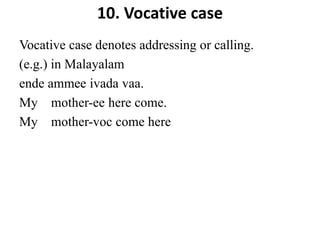
10. Vocative case
Vocative case denotes addressing or calling.
(e.g.) in Malayalam
ende ammee ivada vaa.
My mother-ee here come.
My mother-voc come here
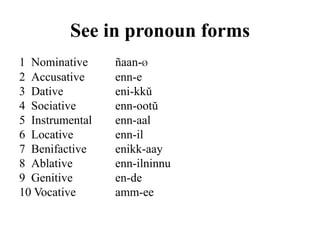
See in pronoun forms
1 Nominative ñaan-Ø
2 Accusative enn-e
3 Dative eni-kkŭ
4 Sociative enn-ootŭ
5 Instrumental enn-aal
6 Locative enn-il
7 Benifactive enikk-aay
8 Ablative enn-ilninnu
9 Genitive en-de
10 Vocative amm-ee
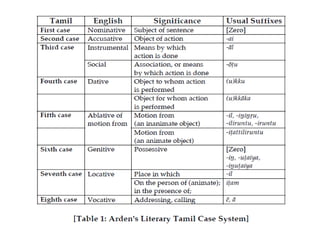
7 case system in dravidian

7 case system in dravidian

  • 1.
  • 3.
    Case suffixes inDravidian - M. Andronov 1. The Nominative Case 2. The Genitive Case 3. The Accusative Case 4. The Dative Case 5. The Objective Case 6. The Comitative Case 7. The Instrumental Case 8. The Comitative-Instrumental Case 9. The Ablative Case 10. The Instrumental- Ablative Case 11. The Locative Case 12. The Instrumental- (Ablative-) Locative Case 13. The Ablative-Locative Case 14. The Lative, Adessive, Terminative, and Allative Cases 15. The Etymology of Case Suffixes 16. Vocative Forms
  • 4.
    Case marker inMalayalam 1. Nominative As a rule the Nominative has no suffix of its own (or has a zero). The nominative noun denotes the subject of the sentence. – Ashraf eluti • Ashraf write-PAST • „Ashraf wrote‟ – kaarru viiśi • wind blow-PAST • „ Wind blew‟
  • 5.
    2. Accusative Case Accusativecase signify the object of (action) the sentence. – appu tattaye piticcu appu parrot-ACC catch-PAST „appu caught (a) parrot‟ addeehatte enikku viśvaasam aanŭ he-ACC I-DAT trust be-PRES „I have trust in him‟
  • 6.
    3. Dative case Dativecase signifies the object to/for whom action is performed. The dative case noun can stand as either subject or object. In sentences where there is no nominative noun, the dative functions as the subject. avalukkŭ raamuvine viśvaasam illa She-DAT Ramu-ACC trust be-NEG „She has no trust in Ramu‟ The Dative suffixes in languages generally include the consonant -k or -g and (frequently) some euphonic vowel. Such are the suffixes of the Dative case in Tamil {e. g., viidu "house" – viittu-kku, nãy "dog - nãykku.
  • 7.
    4. Sociative Case Sociativecase signifies the association, or means by which action is done. The sociative is grammatically similar to the accusative but semantically different. Like the accusative, the sociative also marks the objective. For example, luukkoos annayootŭ aa vaartta paraññu Lukose Anna-SOC that news tell-PAST „Lukose told that news to Anna‟
  • 8.
    5. Instrumental case Theinstrumental suffix –ãl denotes the inanimate object used by the subject to perform an action. – aa vatiy-ãl avan paampine konnu that stick-INST he snake-ACC kill-PAST „With that stick he killed the snake‟ The suffixes of the Instrumental case are attested in Modern Tamil is -ãl, Colloquial Tamil -ale, e. g., kay "hand" - kayyãl, kayyãle), Malayalam (-ãl, e. g., ti "fire - tiy-ãl.
  • 9.
    6. Locative Case Thelocative case denotes spatial and temporal meanings. – aval murrattŭ ninnu she courtyard-LOC stand-PAST „She stood in the courtyard‟ kuttikal bassil kayarunnu children bus-LOC board-PRES „The children are boarding the bus‟
  • 10.
    7. Genitive case Genitivecase denotes possessive. For example, atu en-de viidu. That my+gen house “That is my house” The zero suffix of the Genitive case is possible in colloquial Tamil (e. g., tambi viidu-kku pooyirunteen. “I went to my younger brother's house"
  • 11.
    8. Ablative case Ablativecase denotes motion from. In Tamil naan uur-il-iruntu va-nt-een. Uur-il-iruntu - from the village. In Malayalam, ñaan viitt-ilninnu vannu. I house-from come-pst I came from home.
  • 12.
    9. Comitative case Comitativecase denotes a relationship of accompaniment between two participants in an event. Tamil has Comitative case suffix on mainly before consonants and before vowels too. Tamil has long suffix (e. g., anboodu, “with affection”). In Malayalam, ñaan avanidam snehattoodu parañju. I He-with affection-with say-pst I said to him with affection.
  • 13.
    10. Vocative case Vocativecase denotes addressing or calling. (e.g.) in Malayalam ende ammee ivada vaa. My mother-ee here come. My mother-voc come here
  • 14.
    See in pronounforms 1 Nominative ñaan-Ø 2 Accusative enn-e 3 Dative eni-kkŭ 4 Sociative enn-ootŭ 5 Instrumental enn-aal 6 Locative enn-il 7 Benifactive enikk-aay 8 Ablative enn-ilninnu 9 Genitive en-de 10 Vocative amm-ee