MORPHOLOGY
“Case Markings”
Dini Massitoh
Siti Agniah Nurul Zannah
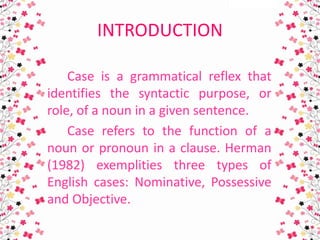
INTRODUCTION
Case is a grammatical reflex that
identifies the syntactic purpose, or
role, of a noun in a given sentence.
Case refers to the function of a
noun or pronoun in a clause. Herman
(1982) exemplities three types of
English cases: Nominative, Possessive
and Objective.
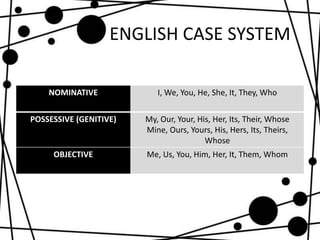
ENGLISH CASE SYSTEM
NOMINATIVE I, We, You, He, She, It, They, Who
POSSESSIVE (GENITIVE) My, Our, Your, His, Her, Its, Their, Whose
Mine, Ours, Yours, His, Hers, Its, Theirs,
Whose
OBJECTIVE Me, Us, You, Him, Her, It, Them, Whom
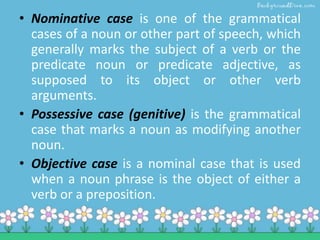
• Nominative case is one of the grammatical
cases of a noun or other part of speech, which
generally marks the subject of a verb or the
predicate noun or predicate adjective, as
supposed to its object or other verb
arguments.
• Possessive case (genitive) is the grammatical
case that marks a noun as modifying another
noun.
• Objective case is a nominal case that is used
when a noun phrase is the object of either a
verb or a preposition.
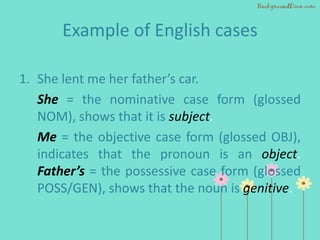
Example of English cases
1. She lent me her father’s car.
She = the nominative case form (glossed
NOM), shows that it is subject.
Me = the objective case form (glossed OBJ),
indicates that the pronoun is an object.
Father’s = the possessive case form (glossed
POSS/GEN), shows that the noun is genitive.
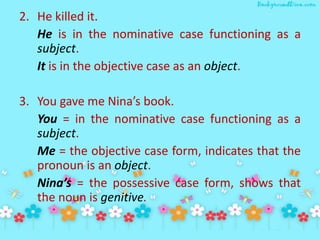
2. He killed it.
He is in the nominative case functioning as a
subject.
It is in the objective case as an object.
3. You gave me Nina’s book.
You = in the nominative case functioning as a
subject.
Me = the objective case form, indicates that the
pronoun is an object.
Nina’s = the possessive case form, shows that
the noun is genitive.
Morphology case marking

Morphology case marking

  • 1.
  • 2.
    INTRODUCTION Case is agrammatical reflex that identifies the syntactic purpose, or role, of a noun in a given sentence. Case refers to the function of a noun or pronoun in a clause. Herman (1982) exemplities three types of English cases: Nominative, Possessive and Objective.
  • 3.
    ENGLISH CASE SYSTEM NOMINATIVEI, We, You, He, She, It, They, Who POSSESSIVE (GENITIVE) My, Our, Your, His, Her, Its, Their, Whose Mine, Ours, Yours, His, Hers, Its, Theirs, Whose OBJECTIVE Me, Us, You, Him, Her, It, Them, Whom
  • 4.
    • Nominative caseis one of the grammatical cases of a noun or other part of speech, which generally marks the subject of a verb or the predicate noun or predicate adjective, as supposed to its object or other verb arguments. • Possessive case (genitive) is the grammatical case that marks a noun as modifying another noun. • Objective case is a nominal case that is used when a noun phrase is the object of either a verb or a preposition.
  • 5.
    Example of Englishcases 1. She lent me her father’s car. She = the nominative case form (glossed NOM), shows that it is subject. Me = the objective case form (glossed OBJ), indicates that the pronoun is an object. Father’s = the possessive case form (glossed POSS/GEN), shows that the noun is genitive.
  • 6.
    2. He killedit. He is in the nominative case functioning as a subject. It is in the objective case as an object. 3. You gave me Nina’s book. You = in the nominative case functioning as a subject. Me = the objective case form, indicates that the pronoun is an object. Nina’s = the possessive case form, shows that the noun is genitive.