Models of Morphology
Thennarasu Sakkan
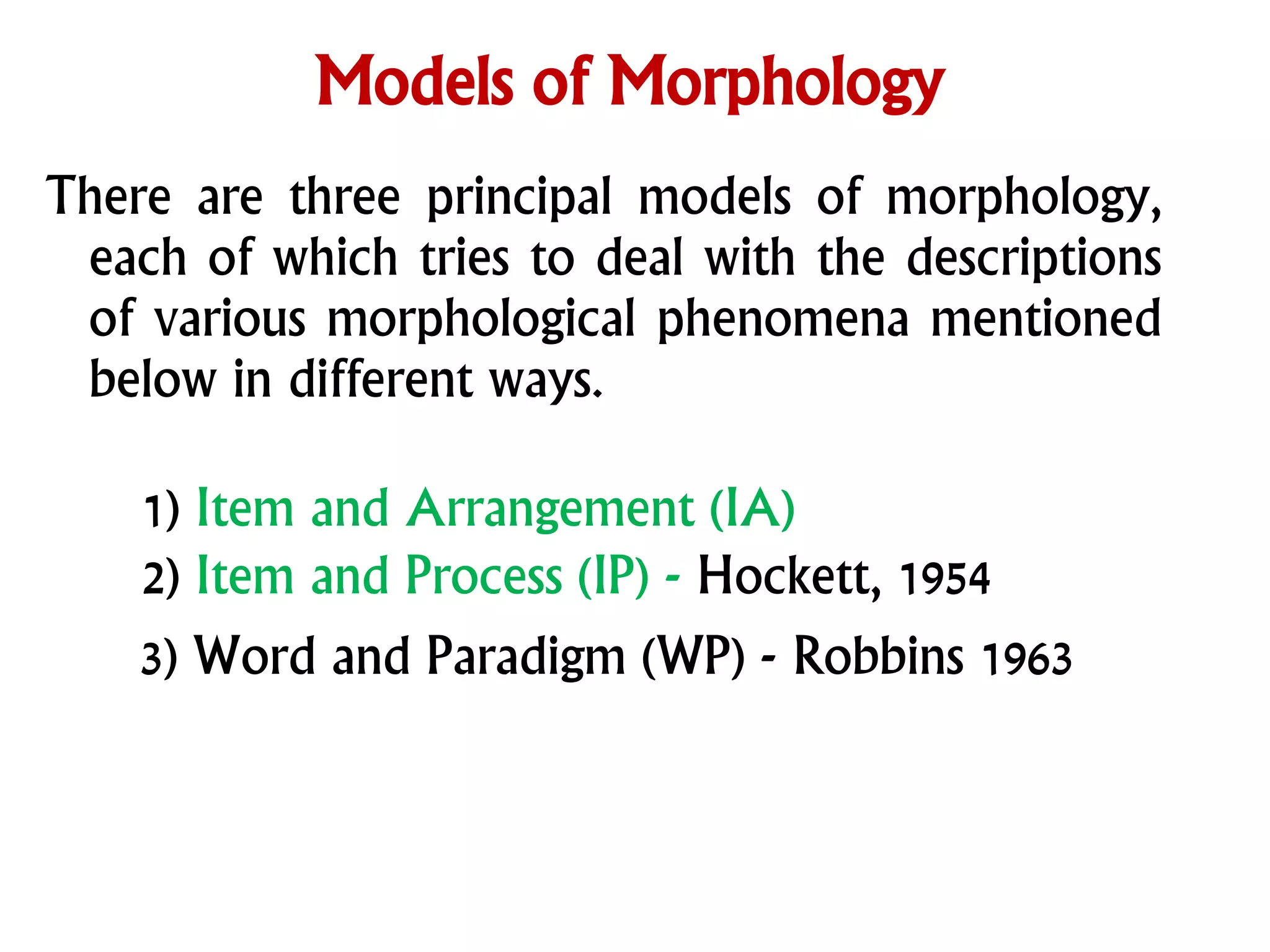
Models of Morphology
There are three principal models of morphology,
each of which tries to deal with the descriptions
of various morphological phenomena mentioned
below in different ways.
1) Item and Arrangement (IA)
2) Item and Process (IP) - Hockett, 1954
3) Word and Paradigm (WP) - Robbins 1963
Item and Arrangement
In morpheme-based morphological approach, word-
forms are analyzed as sequences of concatenated
morphemes.
In a word like kuṭṭikaḷkkumātramāṭi we say that the
morphemes are [kuṭṭi]N, -kaḷ]pl, -kku]dat,
mātram]only, -ā]interogative -ṭi]voc. are inflectional
suffixes.
This way of analyzing word-forms as if they were
made of morphemes attached to each other like
beads on a string is called Item-and-Arrangement
model of morphology.
Item-and-Process
The Item-and-Process model underlie the Lexeme-based
approach to Morphology.
In this model, instead of analyzing a word-form as a set of
morphemes arranged in sequence, a word is said to be the
result of applying rules that alter a given lexeme in order to
produce a new word.
An inflectional rule takes a lexeme, changes it as is required
by the rule, and outputs a word-form. E.g. cā, cettāṉ.
The Item-and-Process approach bypasses the difficulties
inherent in the Item-and-Arrangement approach.
In English;
Go, went, gone
men, feet, sung etc.
In Malayalam???
Word-and-Paradigm
The Word-and-Paradigm model of morphology is the
basis for Word-based morphological approaches to
languages.
This approach considers the notion of paradigm as
its central concept.
Instead of stating rules to combine morphemes into
word-forms, or to generate word-forms from stems,
word-based morphology makes generalizations that
hold between various forms of inflectional
paradigms.
The crucial concept underlying this approach is
that it is difficult to make generalizations with out
exceptions either by Item and Arrangement or
Item and Process model.
Under the Word-and-Paradigm model, words are
treated as whole words that are related to each
other by analogical rules.
Words are categorized on the pattern that they
share with the other members of the group.
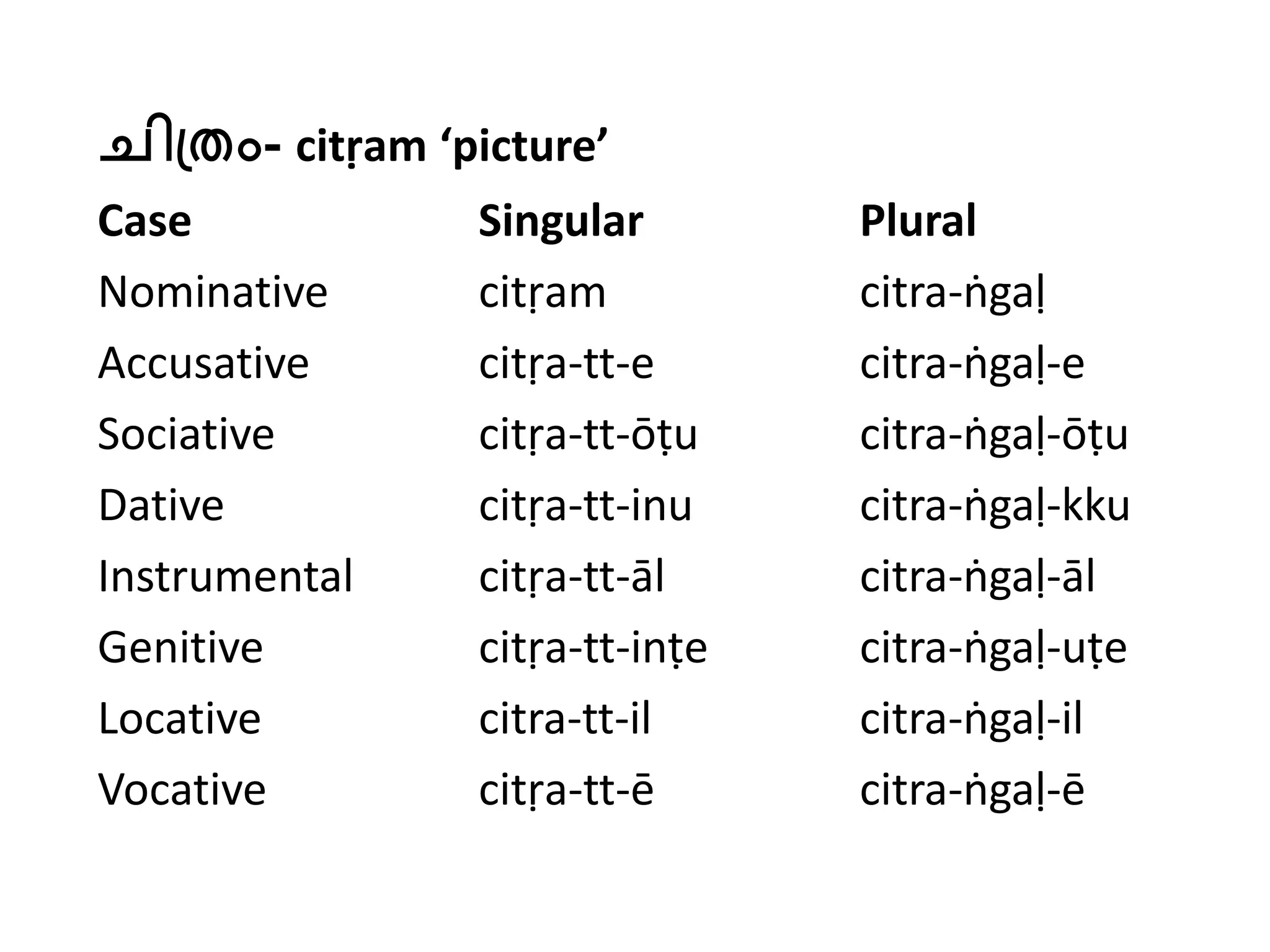
ചിത്രം- citṛam ‘picture’
Case Singular Plural
Nominative citṛam citra-ṅgaḷ
Accusative citṛa-tt-e citra-ṅgaḷ-e
Sociative citṛa-tt-ōṭu citra-ṅgaḷ-ōṭu
Dative citṛa-tt-inu citra-ṅgaḷ-kku
Instrumental citṛa-tt-āl citra-ṅgaḷ-āl
Genitive citṛa-tt-inṭe citra-ṅgaḷ-uṭe
Locative citra-tt-il citra-ṅgaḷ-il
Vocative citṛa-tt-ē citra-ṅgaḷ-ē
കൃഷി- kṛṣi ‘Agriculture’
Case Singular Plural
Nominative kṛṣi kṛṣi-kaḷ
Accusative kṛṣi-y-e kṛṣi-kaḷ-e
Sociative kṛṣi-y-ōṭu kṛṣi-kaḷ-ōṭu
Dative kṛṣi-kku kṛṣi-kaḷ-kku
Instrumental kṛṣi-y-āl kṛṣi-kaḷ-āl
Genitive kṛṣi-y-uṭe kṛṣi-kaḷ-uṭe
Locative kṛṣi-y-il kṛṣi-kaḷ-il
Vocative kṛṣi-y-ē kṛṣi-kaḷ-ē
Any Questions?

3 models of morphology

  • 1.
  • 2.
    Models of Morphology Thereare three principal models of morphology, each of which tries to deal with the descriptions of various morphological phenomena mentioned below in different ways. 1) Item and Arrangement (IA) 2) Item and Process (IP) - Hockett, 1954 3) Word and Paradigm (WP) - Robbins 1963
  • 3.
    Item and Arrangement Inmorpheme-based morphological approach, word- forms are analyzed as sequences of concatenated morphemes. In a word like kuṭṭikaḷkkumātramāṭi we say that the morphemes are [kuṭṭi]N, -kaḷ]pl, -kku]dat, mātram]only, -ā]interogative -ṭi]voc. are inflectional suffixes. This way of analyzing word-forms as if they were made of morphemes attached to each other like beads on a string is called Item-and-Arrangement model of morphology.
  • 4.
    Item-and-Process The Item-and-Process modelunderlie the Lexeme-based approach to Morphology. In this model, instead of analyzing a word-form as a set of morphemes arranged in sequence, a word is said to be the result of applying rules that alter a given lexeme in order to produce a new word. An inflectional rule takes a lexeme, changes it as is required by the rule, and outputs a word-form. E.g. cā, cettāṉ. The Item-and-Process approach bypasses the difficulties inherent in the Item-and-Arrangement approach.
  • 5.
    In English; Go, went,gone men, feet, sung etc. In Malayalam???
  • 6.
    Word-and-Paradigm The Word-and-Paradigm modelof morphology is the basis for Word-based morphological approaches to languages. This approach considers the notion of paradigm as its central concept. Instead of stating rules to combine morphemes into word-forms, or to generate word-forms from stems, word-based morphology makes generalizations that hold between various forms of inflectional paradigms.
  • 7.
    The crucial conceptunderlying this approach is that it is difficult to make generalizations with out exceptions either by Item and Arrangement or Item and Process model. Under the Word-and-Paradigm model, words are treated as whole words that are related to each other by analogical rules. Words are categorized on the pattern that they share with the other members of the group.
  • 8.
    ചിത്രം- citṛam ‘picture’ CaseSingular Plural Nominative citṛam citra-ṅgaḷ Accusative citṛa-tt-e citra-ṅgaḷ-e Sociative citṛa-tt-ōṭu citra-ṅgaḷ-ōṭu Dative citṛa-tt-inu citra-ṅgaḷ-kku Instrumental citṛa-tt-āl citra-ṅgaḷ-āl Genitive citṛa-tt-inṭe citra-ṅgaḷ-uṭe Locative citra-tt-il citra-ṅgaḷ-il Vocative citṛa-tt-ē citra-ṅgaḷ-ē
  • 9.
    കൃഷി- kṛṣi ‘Agriculture’ CaseSingular Plural Nominative kṛṣi kṛṣi-kaḷ Accusative kṛṣi-y-e kṛṣi-kaḷ-e Sociative kṛṣi-y-ōṭu kṛṣi-kaḷ-ōṭu Dative kṛṣi-kku kṛṣi-kaḷ-kku Instrumental kṛṣi-y-āl kṛṣi-kaḷ-āl Genitive kṛṣi-y-uṭe kṛṣi-kaḷ-uṭe Locative kṛṣi-y-il kṛṣi-kaḷ-il Vocative kṛṣi-y-ē kṛṣi-kaḷ-ē
  • 10.