UNIT 1
• Introduction to Automaton
• Mathematical concepts
• Formal Languages: Strings, Languages,
Properties
• Finite Representation : Regular Expressions
• Problems related to regular expressions
• Finite Automata :Deterministic Finite Automata
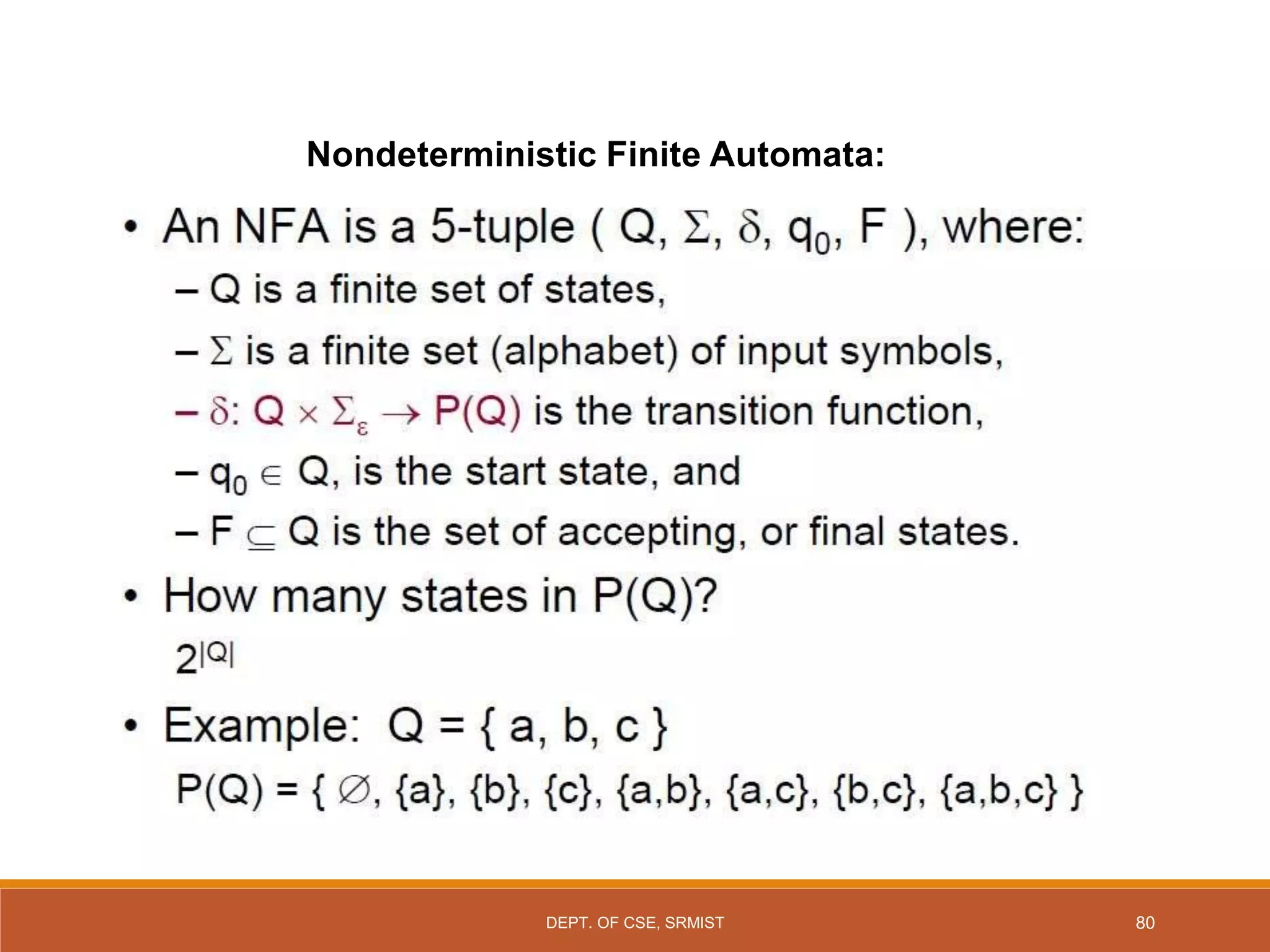
• Nondeterministic Finite Automata
• Finite Automaton with €- moves
• Problems related to Deterministic and
Nondeterministic Finite Automata
• Problems related to Finite Automaton with €-
moves
• Minimization of DFA
• Problems related to Minimization of DFA
• Regular Languages : Equivalence of Finite
Automata and Regular Languages
• Equivalence of Finite Automata and Regular
Grammars
• Problems related to Equivalence of Finite
Automata and Regular Languages and Regular
Grammars
• Variants of Finite Automata :Two-way Finite
Automaton Mealy Machines
• Properties of Regular Languages: Closure
Properties
• Set Theoretic Properties & Other Properties
• Pumping Lemma
1
DEPT. OF CSE, SRMIST
Introduction of Automaton
An automata is an abstract self-propelled computing device which follows a predetermined sequence of operations
automatically.
Automata-based programming is a programming paradigm in which the program or its part, is thought as a model of a
finite state machine or any other formal automation.
What is Automata Theory?
• Automata theory is the study of abstract computational devices
• Abstract devices are (simplified) models of real computations
• Computations happen everywhere: On your laptop, on your cell phone, in nature, …
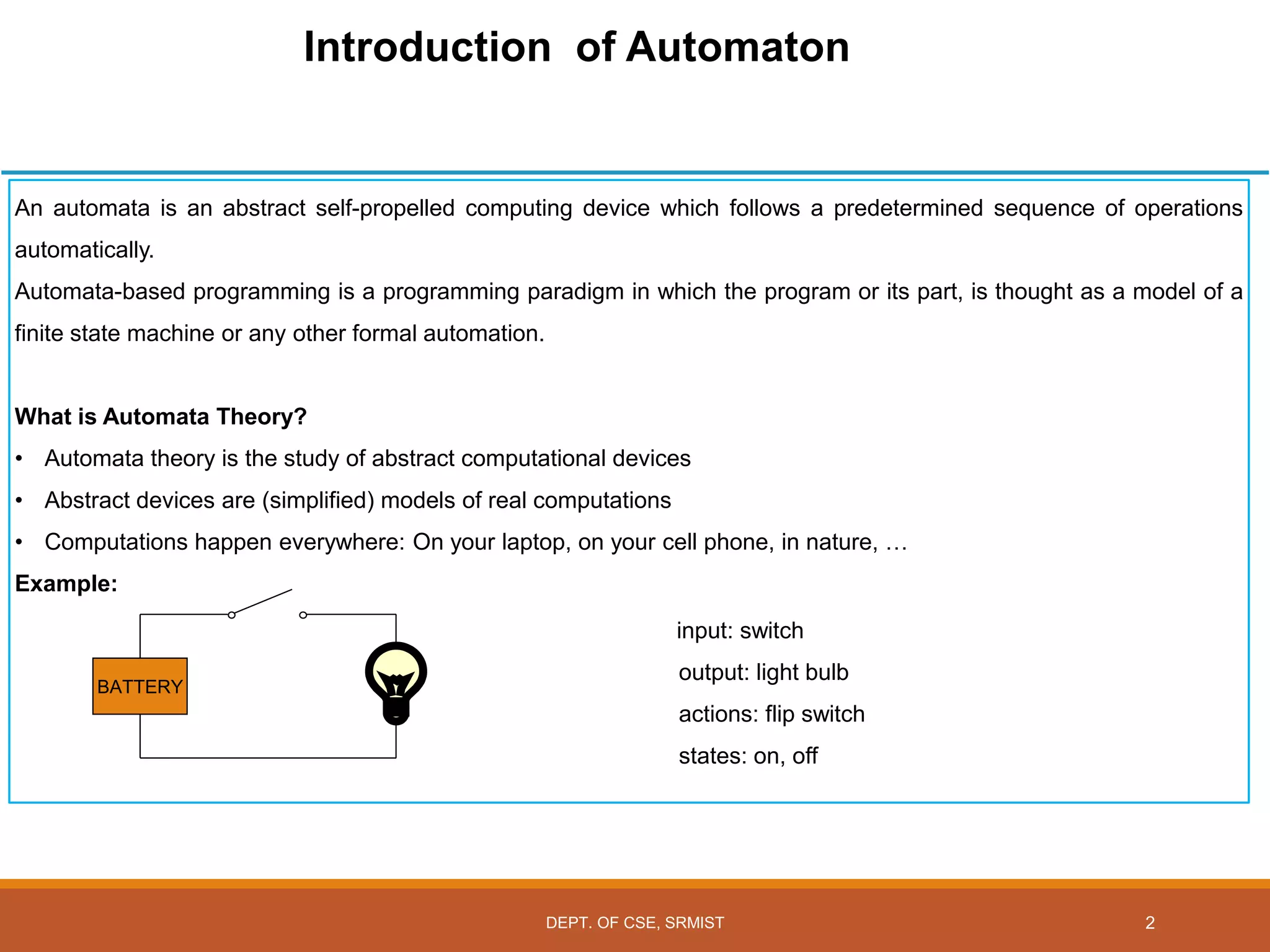
Example:
input: switch
output: light bulb
actions: flip switch
states: on, off
BATTERY
2
DEPT. OF CSE, SRMIST
3
1. Electric Switch
2. Fan Regulator
3. Automatic door controller
4. Binary string with divisible by 4
DEPT. OF CSE, SRMIST
Simple Computer
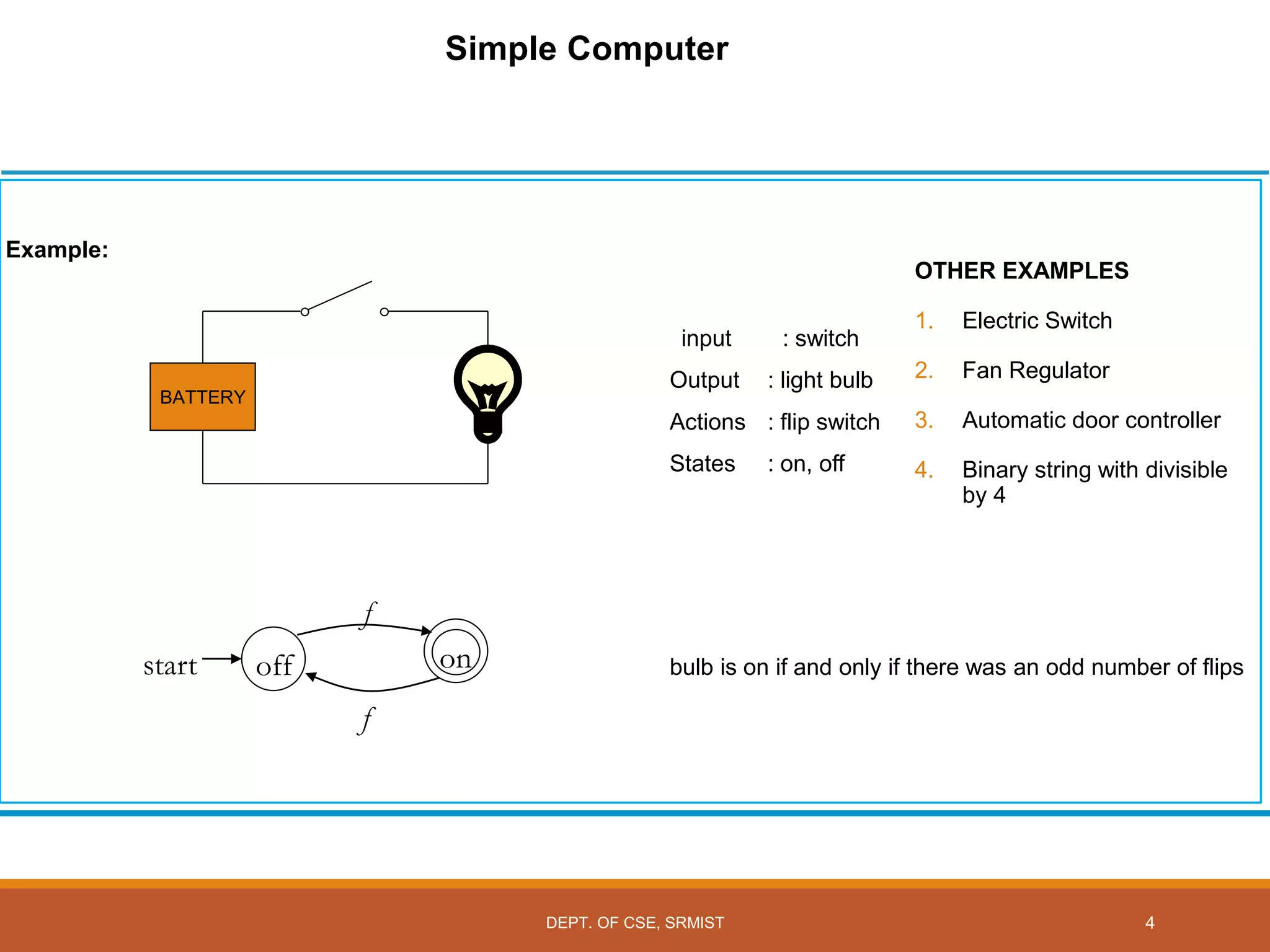
Example:
input : switch
Output : light bulb
Actions : flip switch
States : on, off
bulb is on if and only if there was an odd number of flips
BATTERY
off on
start
f
f
4
OTHER EXAMPLES
1. Electric Switch
2. Fan Regulator
3. Automatic door controller
4. Binary string with divisible
by 4
DEPT. OF CSE, SRMIST
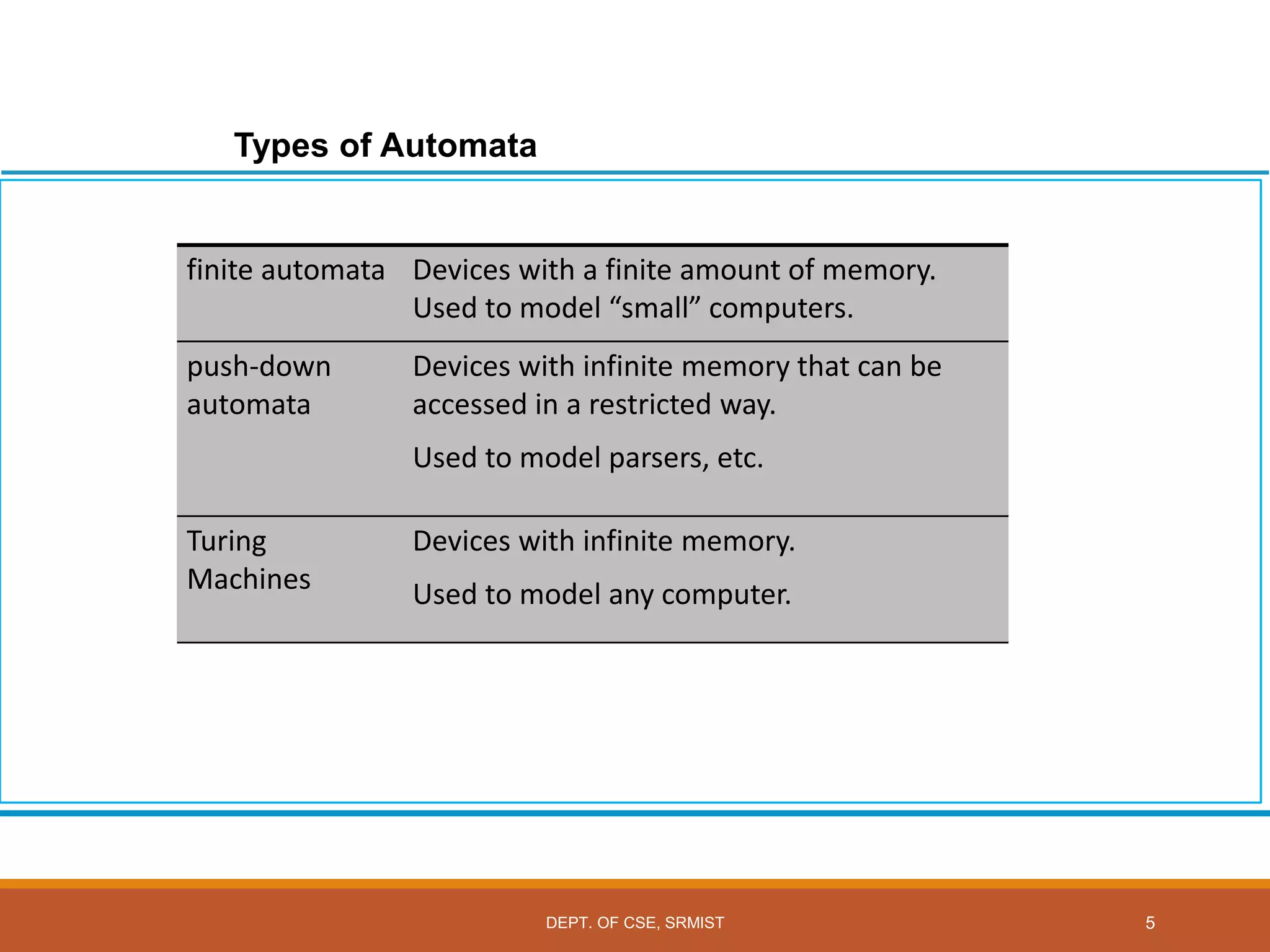
Types of Automata
finite automata Devices with a finite amount of memory.
Used to model “small” computers.
push-down
automata
Devices with infinite memory that can be
accessed in a restricted way.
Used to model parsers, etc.
Turing
Machines
Devices with infinite memory.
Used to model any computer.
5
DEPT. OF CSE, SRMIST
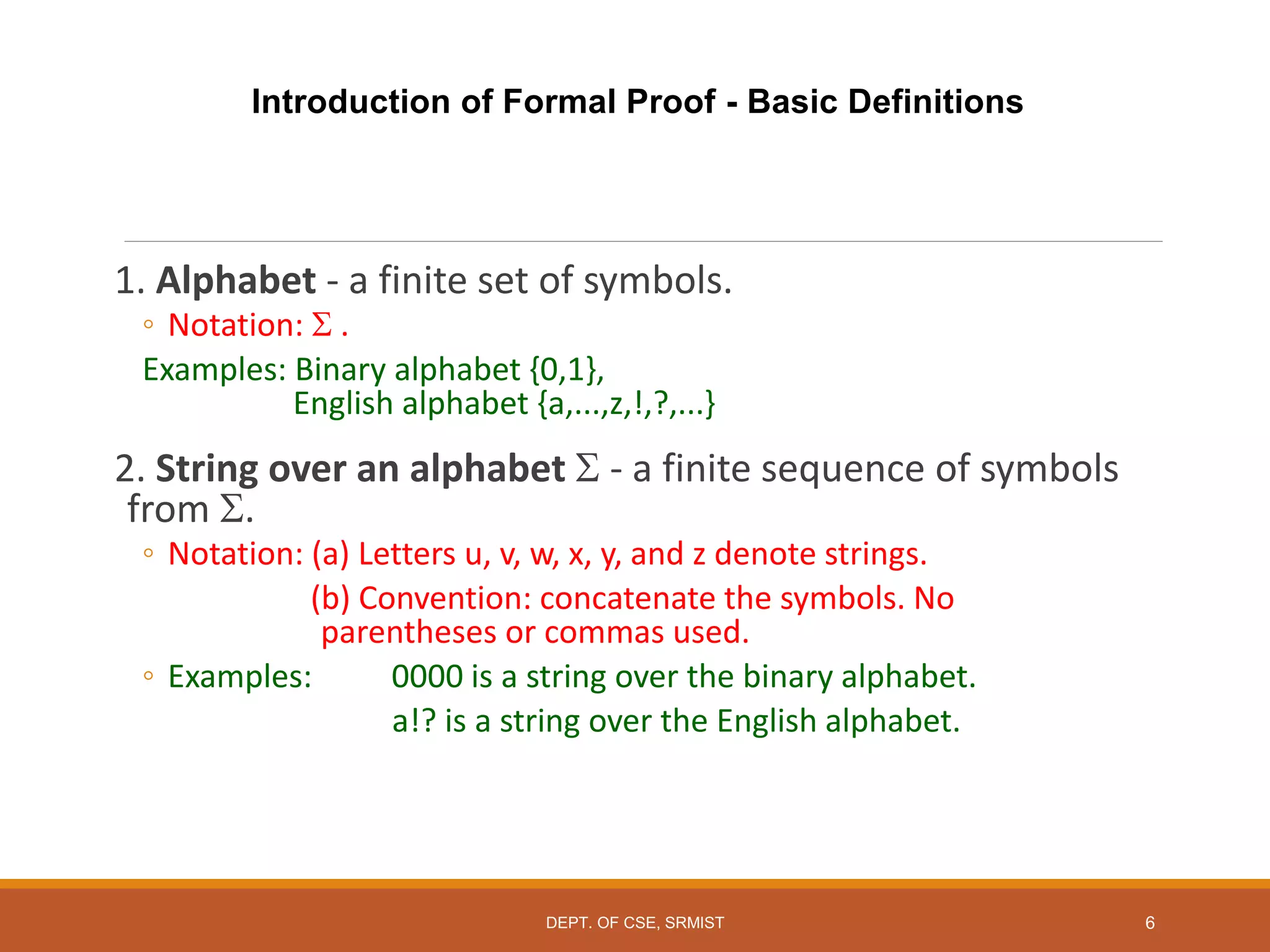
Introduction of Formal Proof - Basic Definitions
1. Alphabet - a finite set of symbols.
◦ Notation:  .
Examples: Binary alphabet {0,1},
English alphabet {a,...,z,!,?,...}
2. String over an alphabet  - a finite sequence of symbols
from .
◦ Notation: (a) Letters u, v, w, x, y, and z denote strings.
(b) Convention: concatenate the symbols. No
parentheses or commas used.
◦ Examples: 0000 is a string over the binary alphabet.
a!? is a string over the English alphabet.
6
DEPT. OF CSE, SRMIST
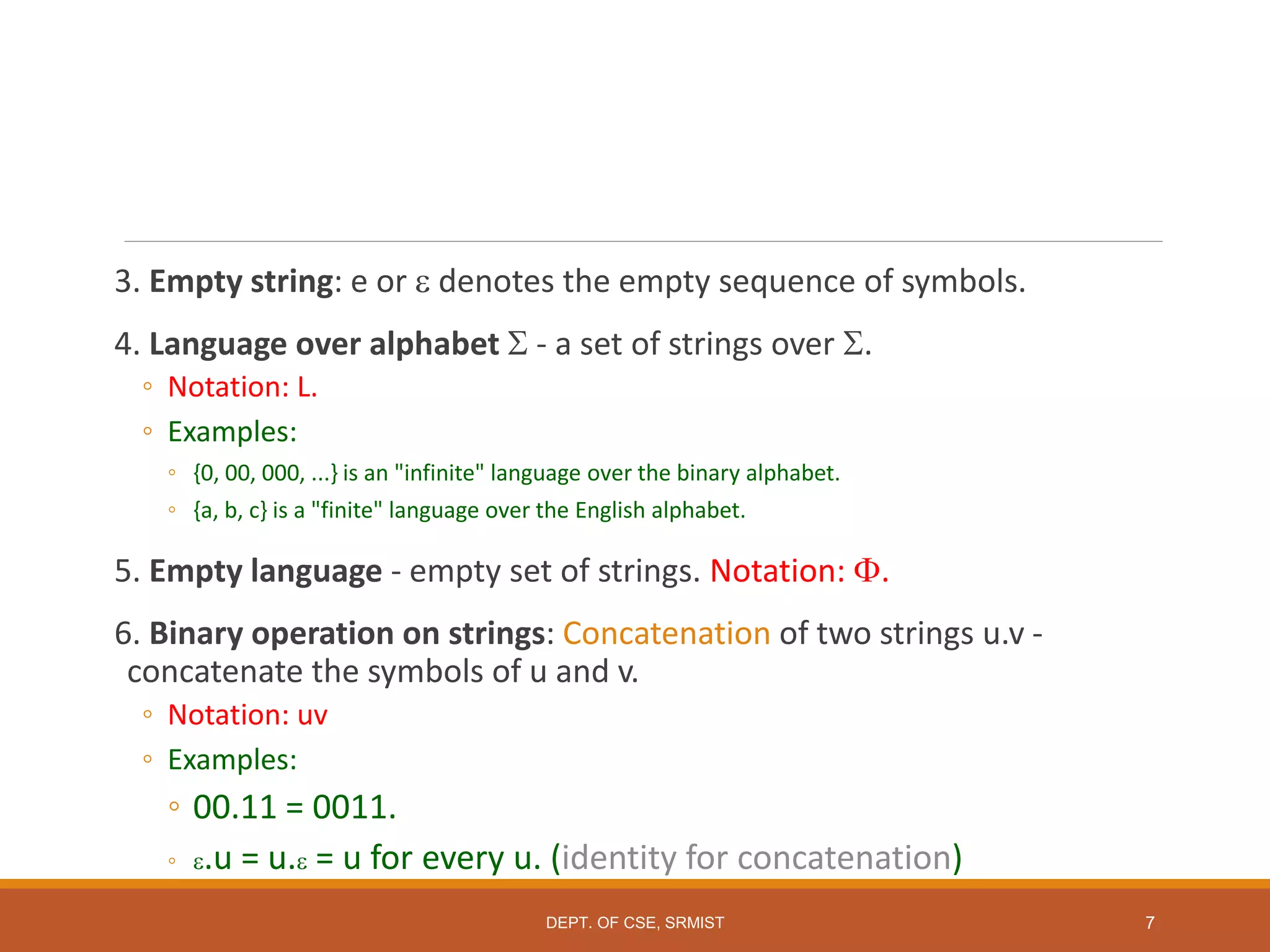
3. Empty string: e or  denotes the empty sequence of symbols.
4. Language over alphabet  - a set of strings over .
◦ Notation: L.
◦ Examples:
◦ {0, 00, 000, ...} is an "infinite" language over the binary alphabet.
◦ {a, b, c} is a "finite" language over the English alphabet.
5. Empty language - empty set of strings. Notation: .
6. Binary operation on strings: Concatenation of two strings u.v -
concatenate the symbols of u and v.
◦ Notation: uv
◦ Examples:
◦ 00.11 = 0011.
◦ .u = u. = u for every u. (identity for concatenation)
7
DEPT. OF CSE, SRMIST
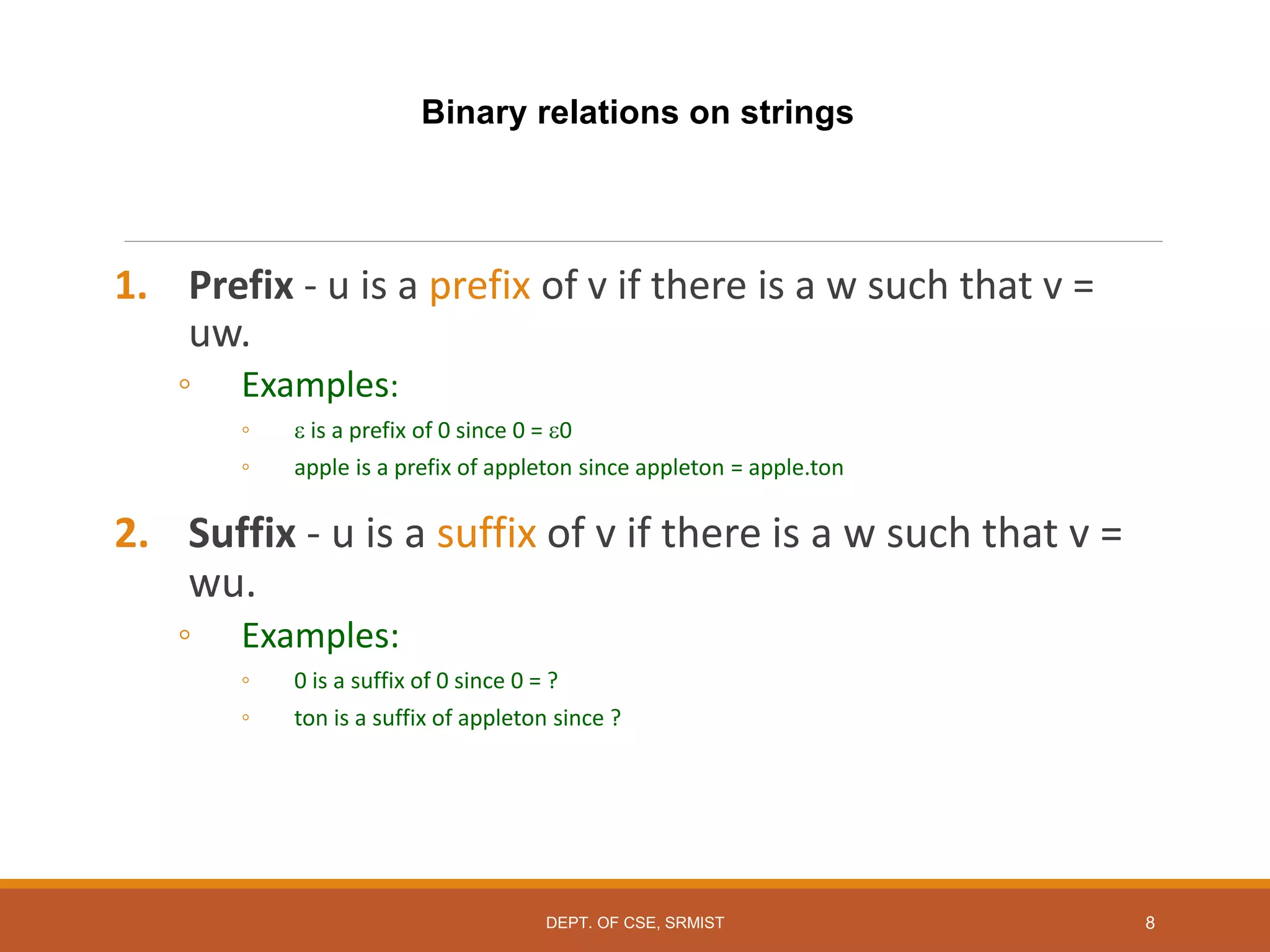
Binary relations on strings
1. Prefix - u is a prefix of v if there is a w such that v =
uw.
◦ Examples:
◦  is a prefix of 0 since 0 = 0
◦ apple is a prefix of appleton since appleton = apple.ton
2. Suffix - u is a suffix of v if there is a w such that v =
wu.
◦ Examples:
◦ 0 is a suffix of 0 since 0 = ?
◦ ton is a suffix of appleton since ?
8
DEPT. OF CSE, SRMIST
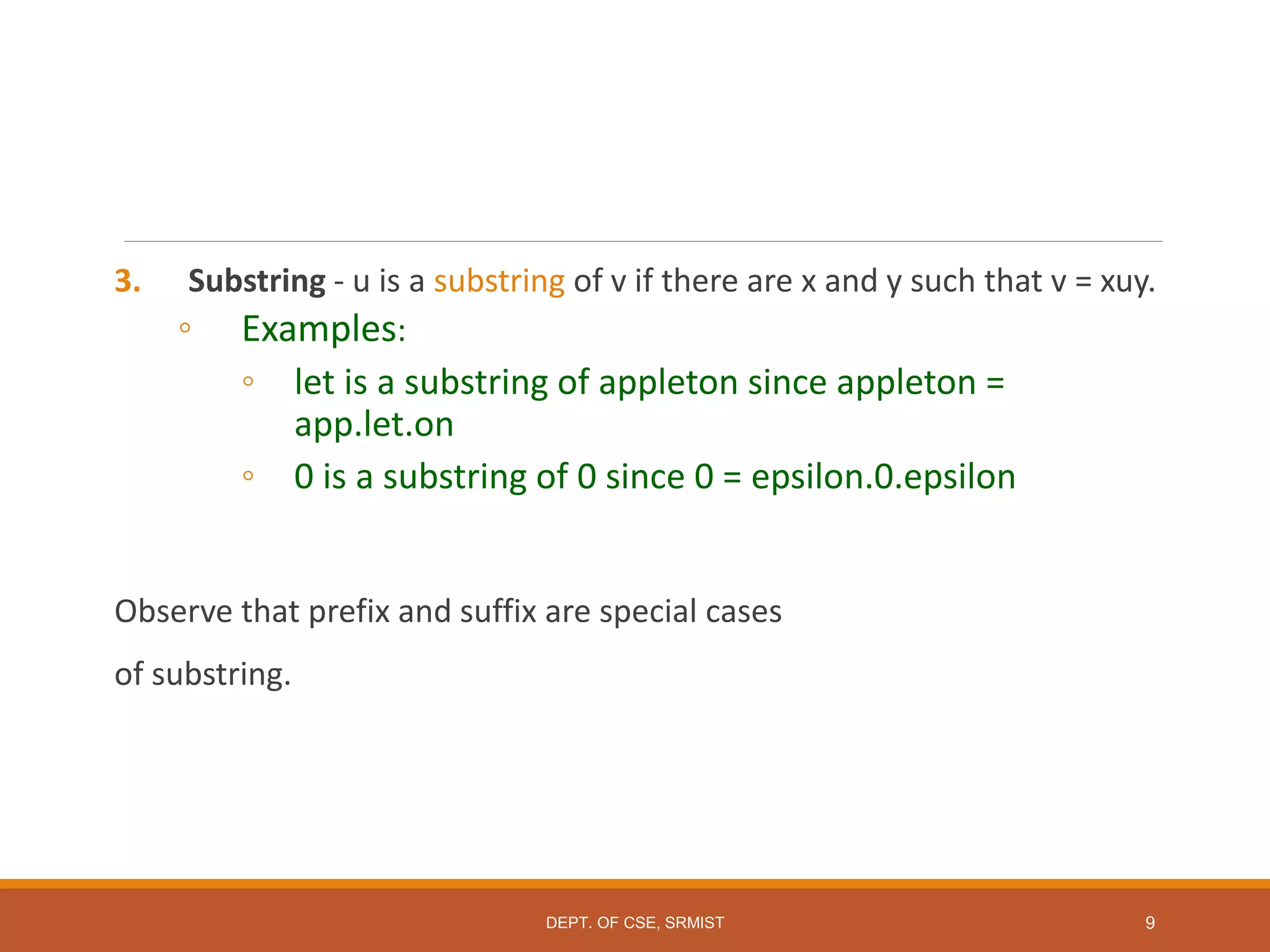
3. Substring - u is a substring of v if there are x and y such that v = xuy.
◦ Examples:
◦ let is a substring of appleton since appleton =
app.let.on
◦ 0 is a substring of 0 since 0 = epsilon.0.epsilon
Observe that prefix and suffix are special cases
of substring.
9
DEPT. OF CSE, SRMIST
Applications of the Concepts AND New Developments
Applications include:
◦ Text processing (editors, etc.)
◦ Compiler design
◦ Verification through model checking
Development’s include :
DNA Computing
Quantum Turing Machines
10
DEPT. OF CSE, SRMIST
Introduction to Mathematical concepts
Inductive Proof
Deductive Proof
11
DEPT. OF CSE, SRMIST
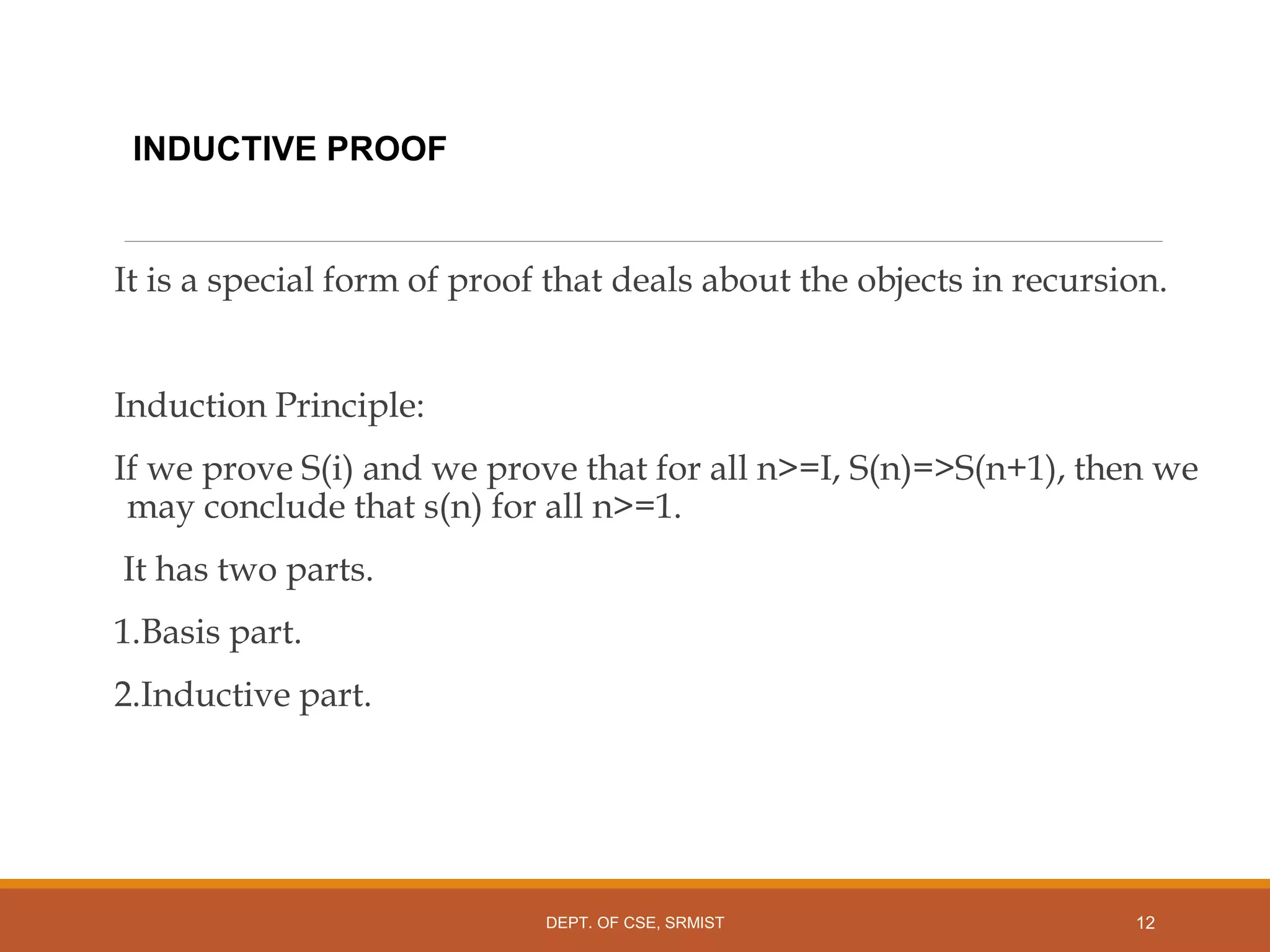
INDUCTIVE PROOF
It is a special form of proof that deals about the objects in recursion.
Induction Principle:
If we prove S(i) and we prove that for all n>=I, S(n)=>S(n+1), then we
may conclude that s(n) for all n>=1.
It has two parts.
1.Basis part.
2.Inductive part.
12
DEPT. OF CSE, SRMIST
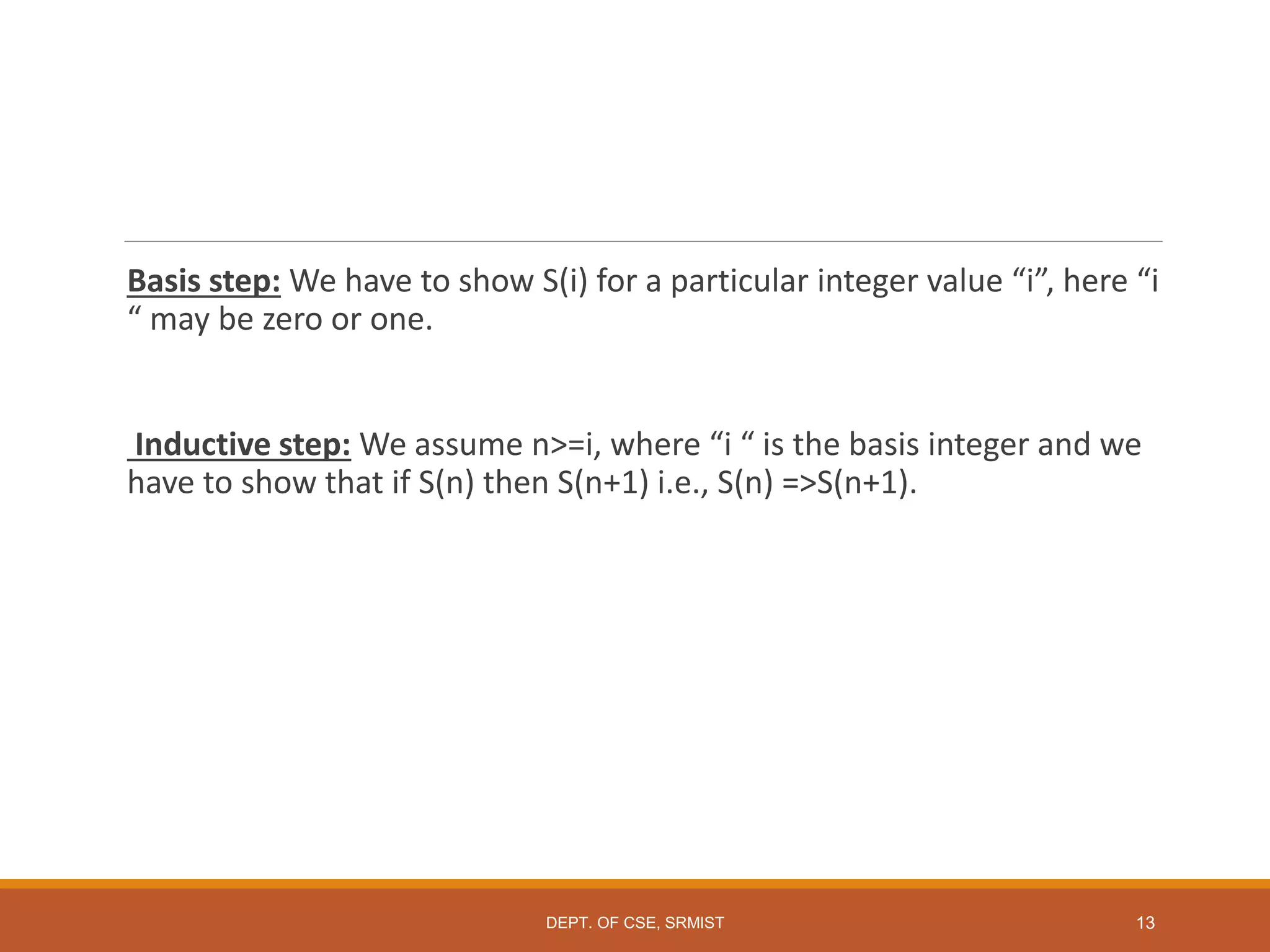
Basis step: We have to show S(i) for a particular integer value “i”, here “i
“ may be zero or one.
Inductive step: We assume n>=i, where “i “ is the basis integer and we
have to show that if S(n) then S(n+1) i.e., S(n) =>S(n+1).
DEPT. OF CSE, SRMIST 13
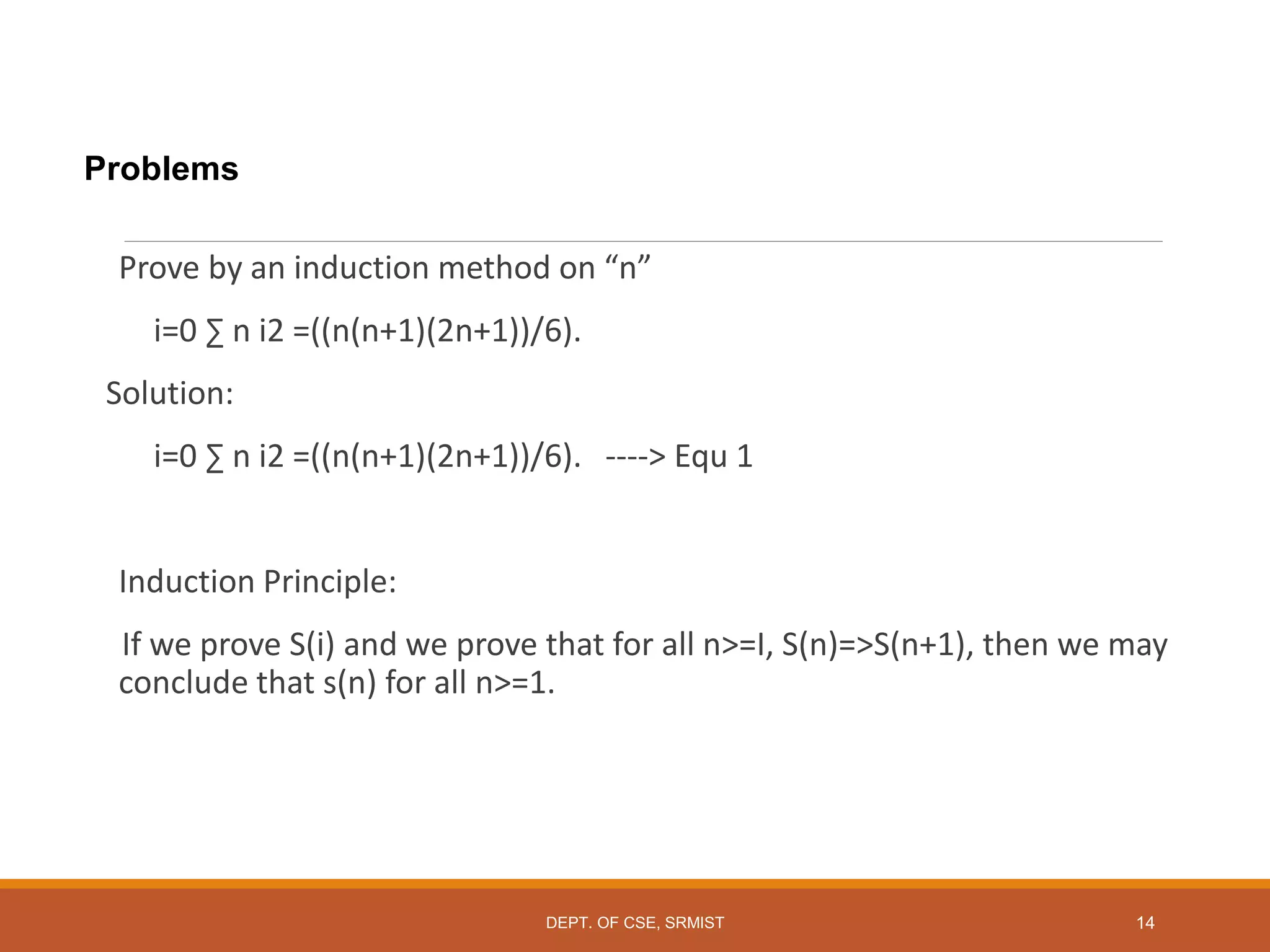
Problems
Prove by an induction method on “n”
i=0 ∑ n i2 =((n(n+1)(2n+1))/6).
Solution:
i=0 ∑ n i2 =((n(n+1)(2n+1))/6). ----> Equ 1
Induction Principle:
If we prove S(i) and we prove that for all n>=I, S(n)=>S(n+1), then we may
conclude that s(n) for all n>=1.
DEPT. OF CSE, SRMIST 14
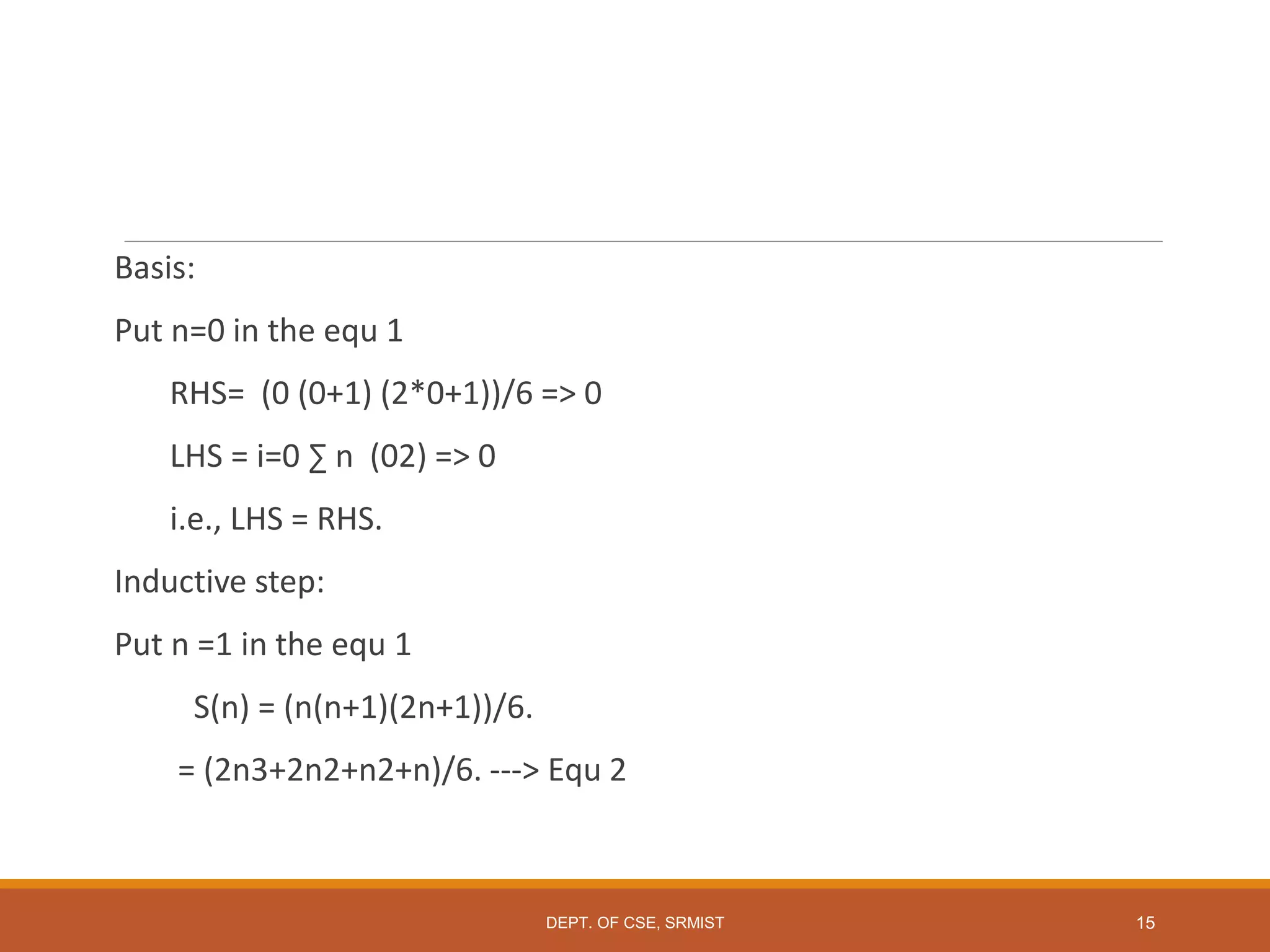
Basis:
Put n=0 in the equ 1
RHS= (0 (0+1) (2*0+1))/6 => 0
LHS = i=0 ∑ n (02) => 0
i.e., LHS = RHS.
Inductive step:
Put n =1 in the equ 1
S(n) = (n(n+1)(2n+1))/6.
= (2n3+2n2+n2+n)/6. ---> Equ 2
DEPT. OF CSE, SRMIST 15
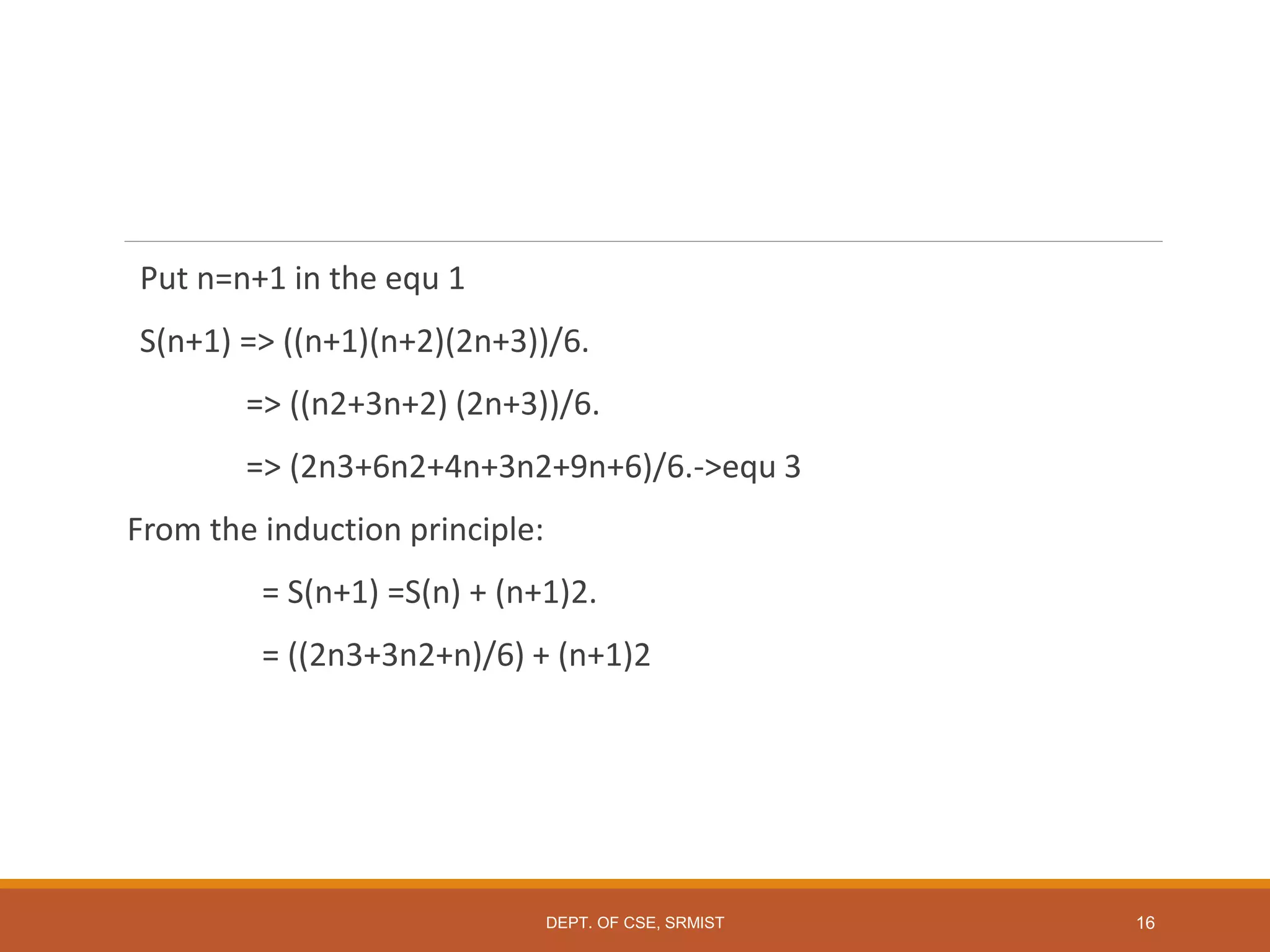
Put n=n+1 in the equ 1
S(n+1) => ((n+1)(n+2)(2n+3))/6.
=> ((n2+3n+2) (2n+3))/6.
=> (2n3+6n2+4n+3n2+9n+6)/6.->equ 3
From the induction principle:
= S(n+1) =S(n) + (n+1)2.
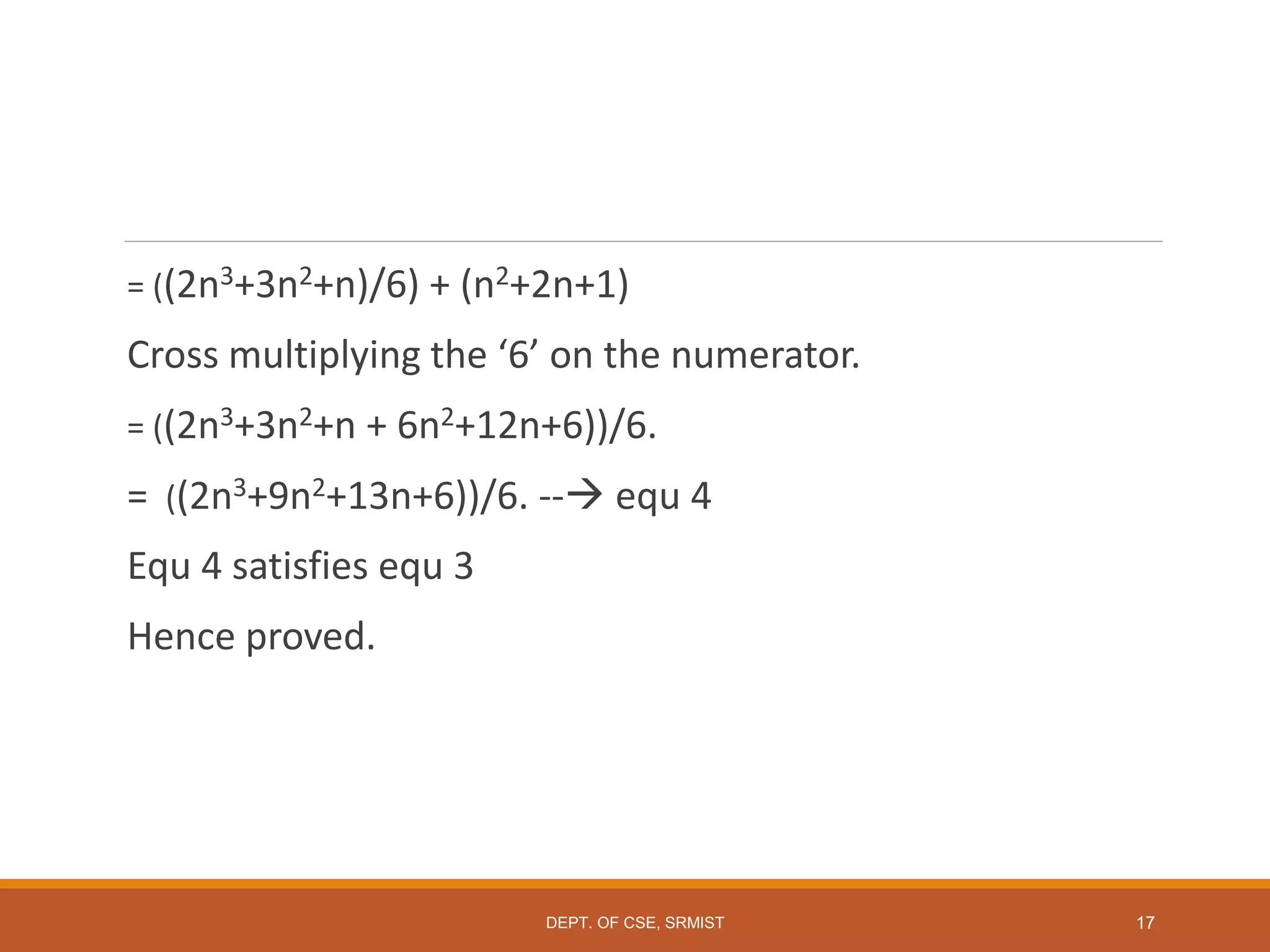
= ((2n3+3n2+n)/6) + (n+1)2
DEPT. OF CSE, SRMIST 16
= ((2n3+3n2+n)/6) + (n2+2n+1)
Cross multiplying the ‘6’ on the numerator.
= ((2n3+3n2+n + 6n2+12n+6))/6.
= ((2n3+9n2+13n+6))/6. -- equ 4
Equ 4 satisfies equ 3
Hence proved.
DEPT. OF CSE, SRMIST 17
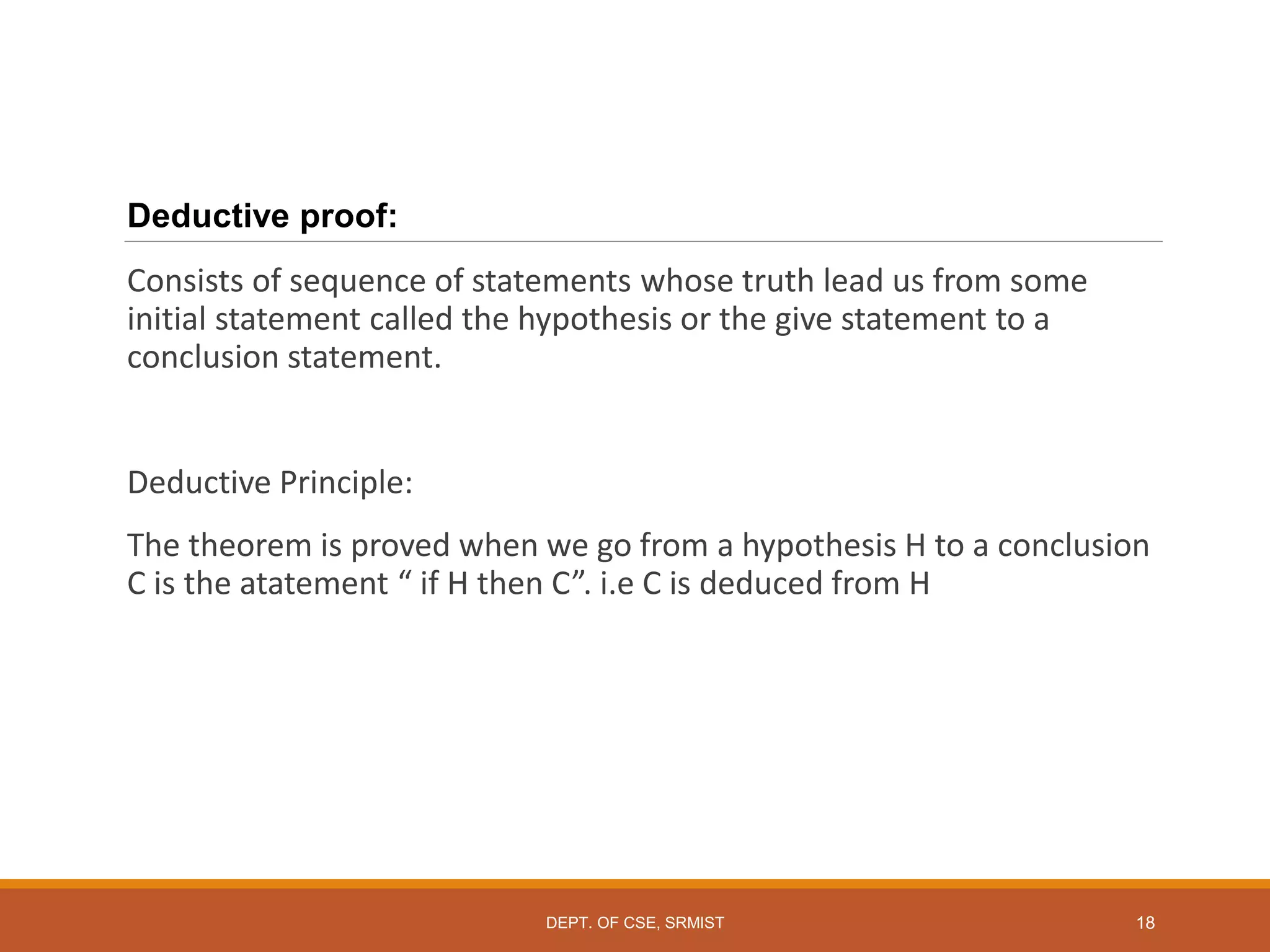
Deductive proof:
Consists of sequence of statements whose truth lead us from some
initial statement called the hypothesis or the give statement to a
conclusion statement.
Deductive Principle:
The theorem is proved when we go from a hypothesis H to a conclusion
C is the atatement “ if H then C”. i.e C is deduced from H
18
DEPT. OF CSE, SRMIST
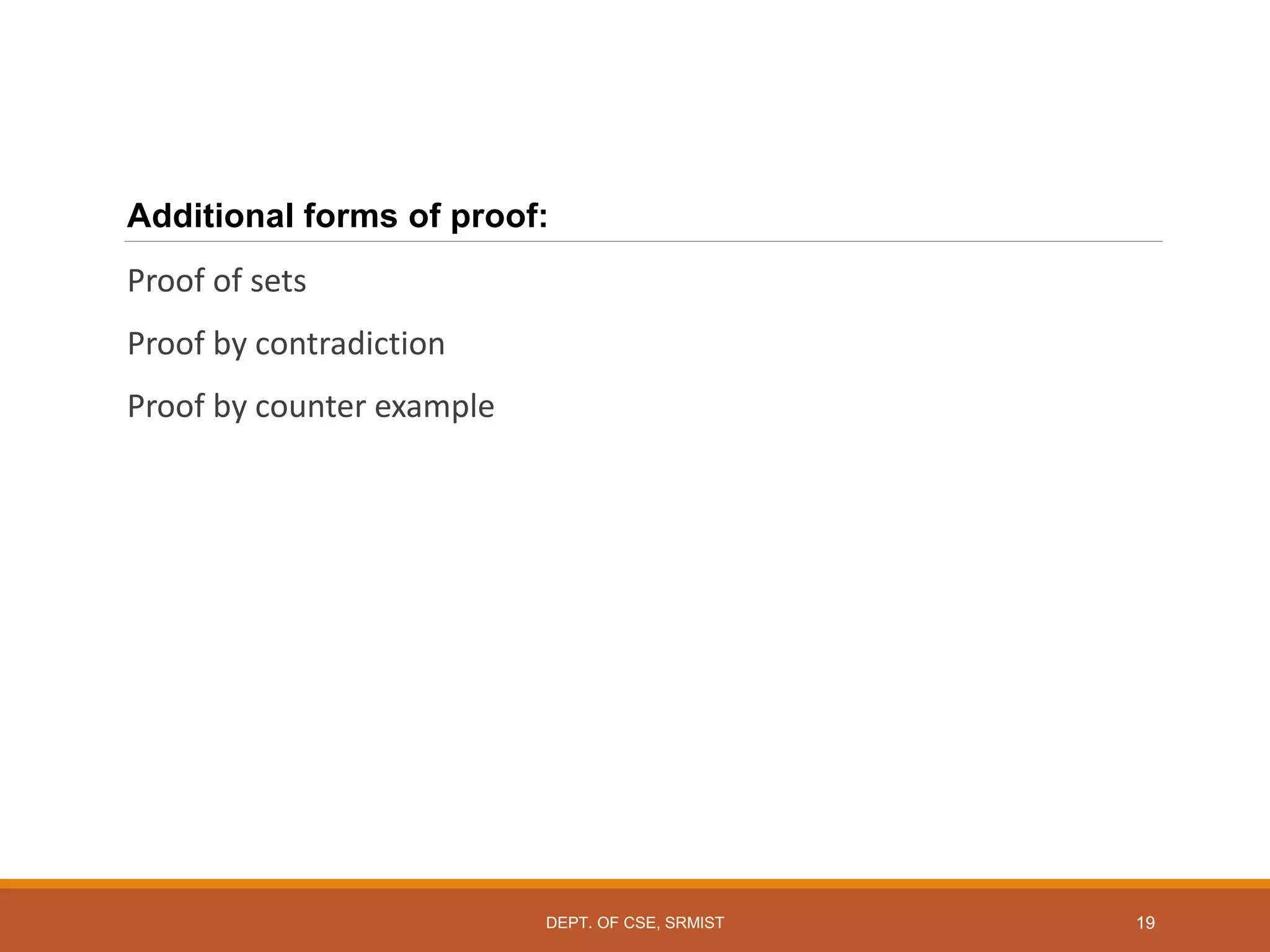
Additional forms of proof:
Proof of sets
Proof by contradiction
Proof by counter example
19
DEPT. OF CSE, SRMIST
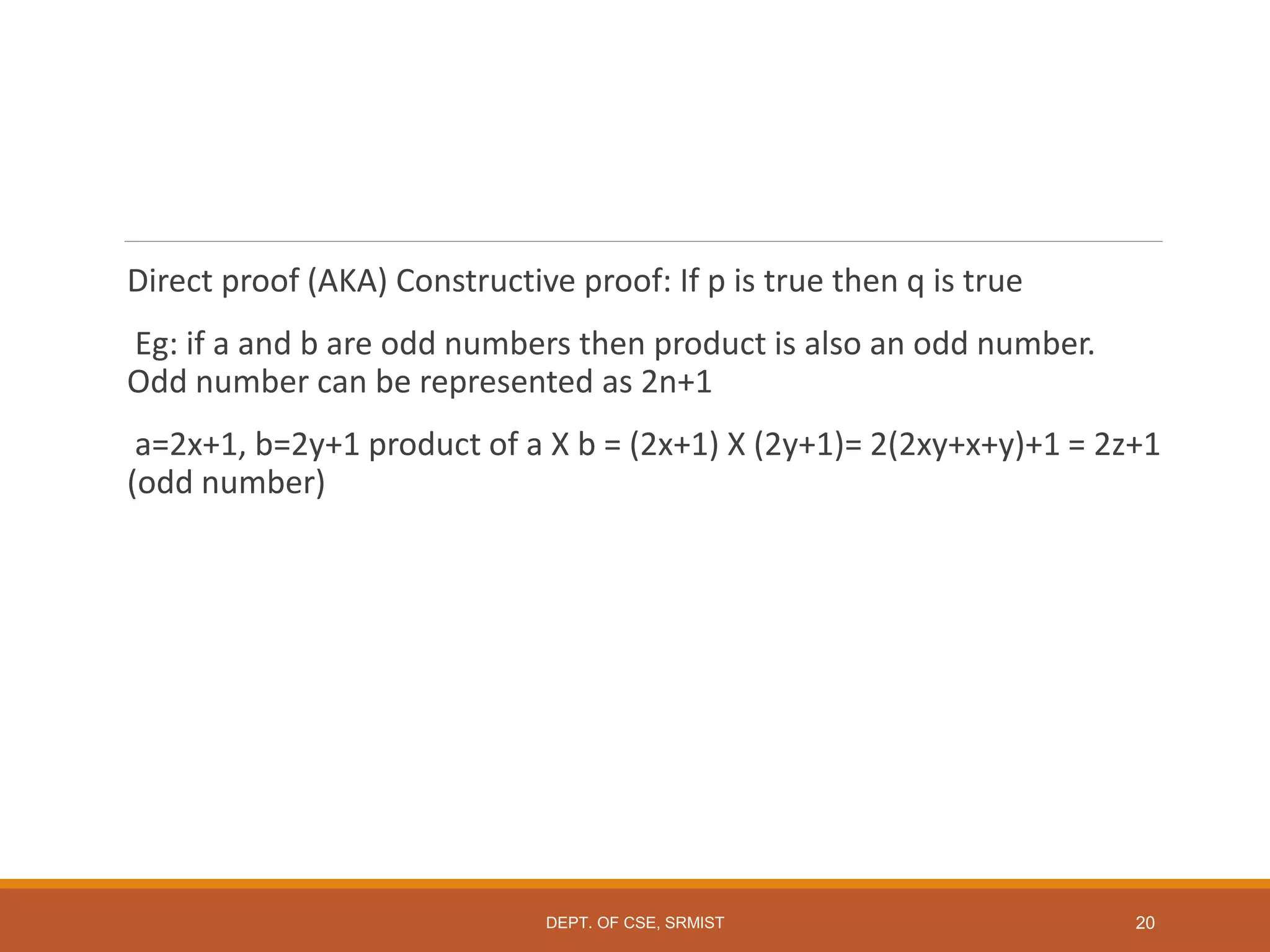
Direct proof (AKA) Constructive proof: If p is true then q is true
Eg: if a and b are odd numbers then product is also an odd number.
Odd number can be represented as 2n+1
a=2x+1, b=2y+1 product of a X b = (2x+1) X (2y+1)= 2(2xy+x+y)+1 = 2z+1
(odd number)
20
DEPT. OF CSE, SRMIST
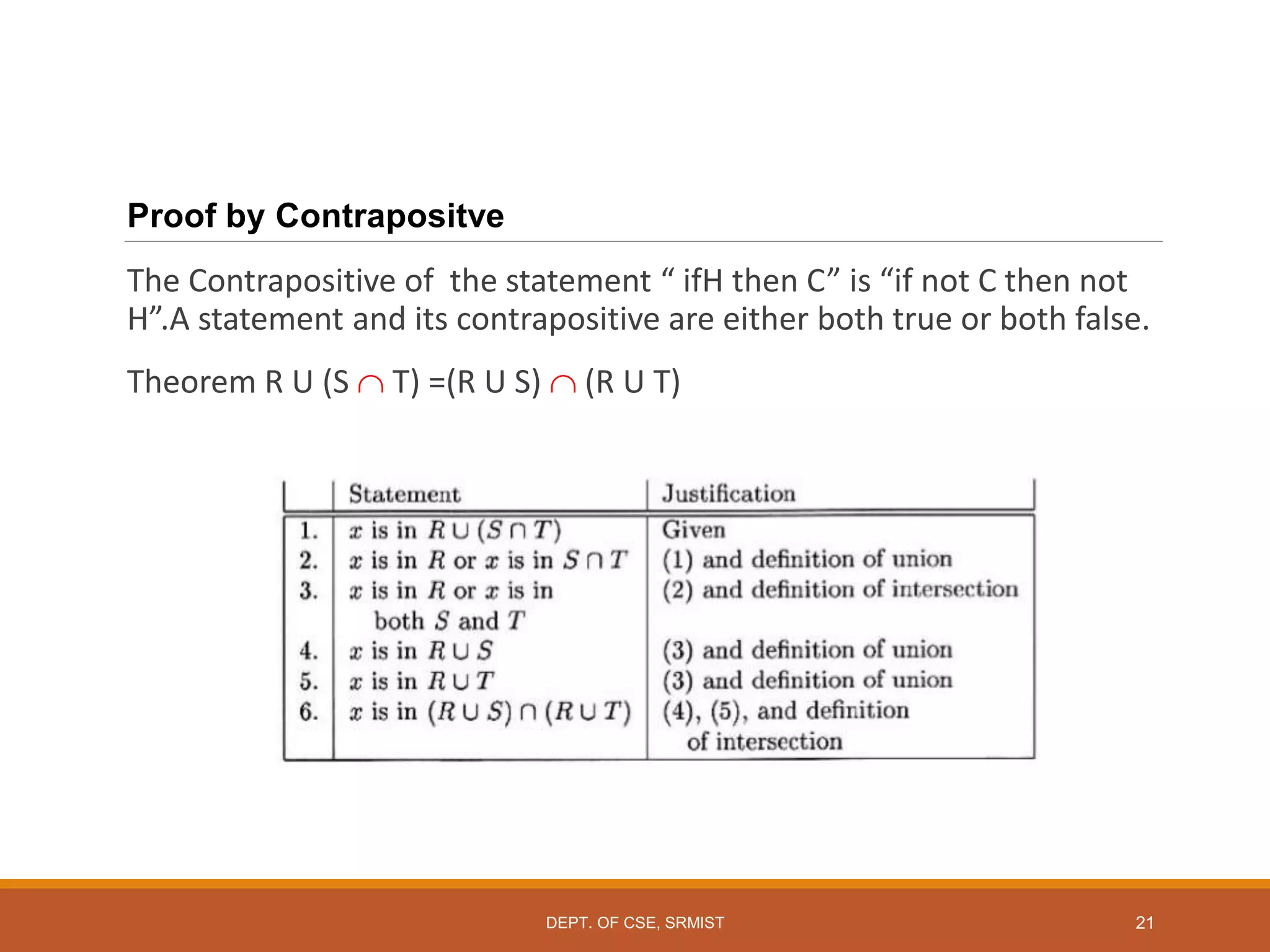
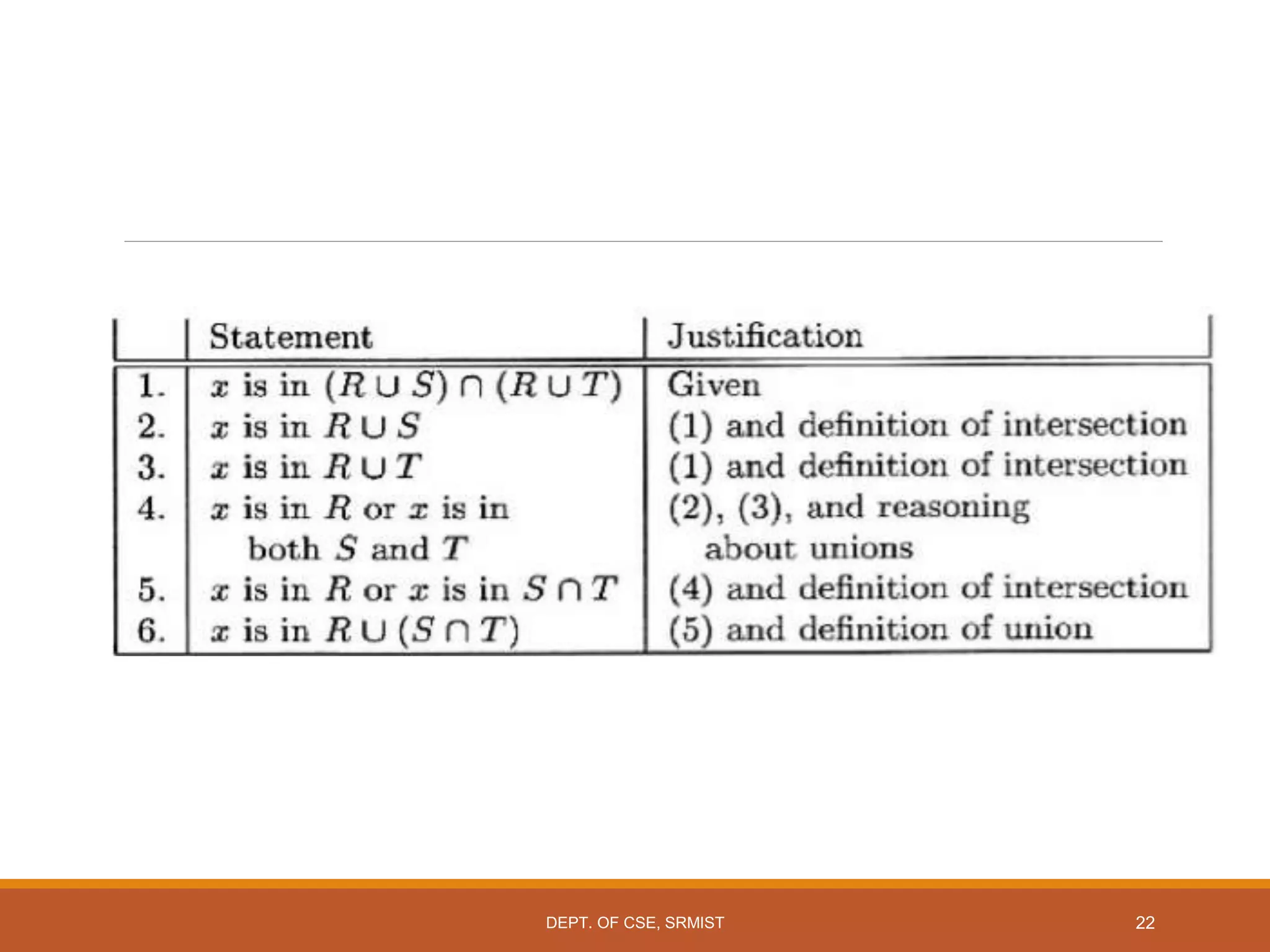
Proof by Contrapositve
The Contrapositive of the statement “ ifH then C” is “if not C then not
H”.A statement and its contrapositive are either both true or both false.
Theorem R U (S  T) =(R U S)  (R U T)
21
DEPT. OF CSE, SRMIST
22
DEPT. OF CSE, SRMIST
Proof by Contradiction:
H and not C implies falsehood.
23
DEPT. OF CSE, SRMIST
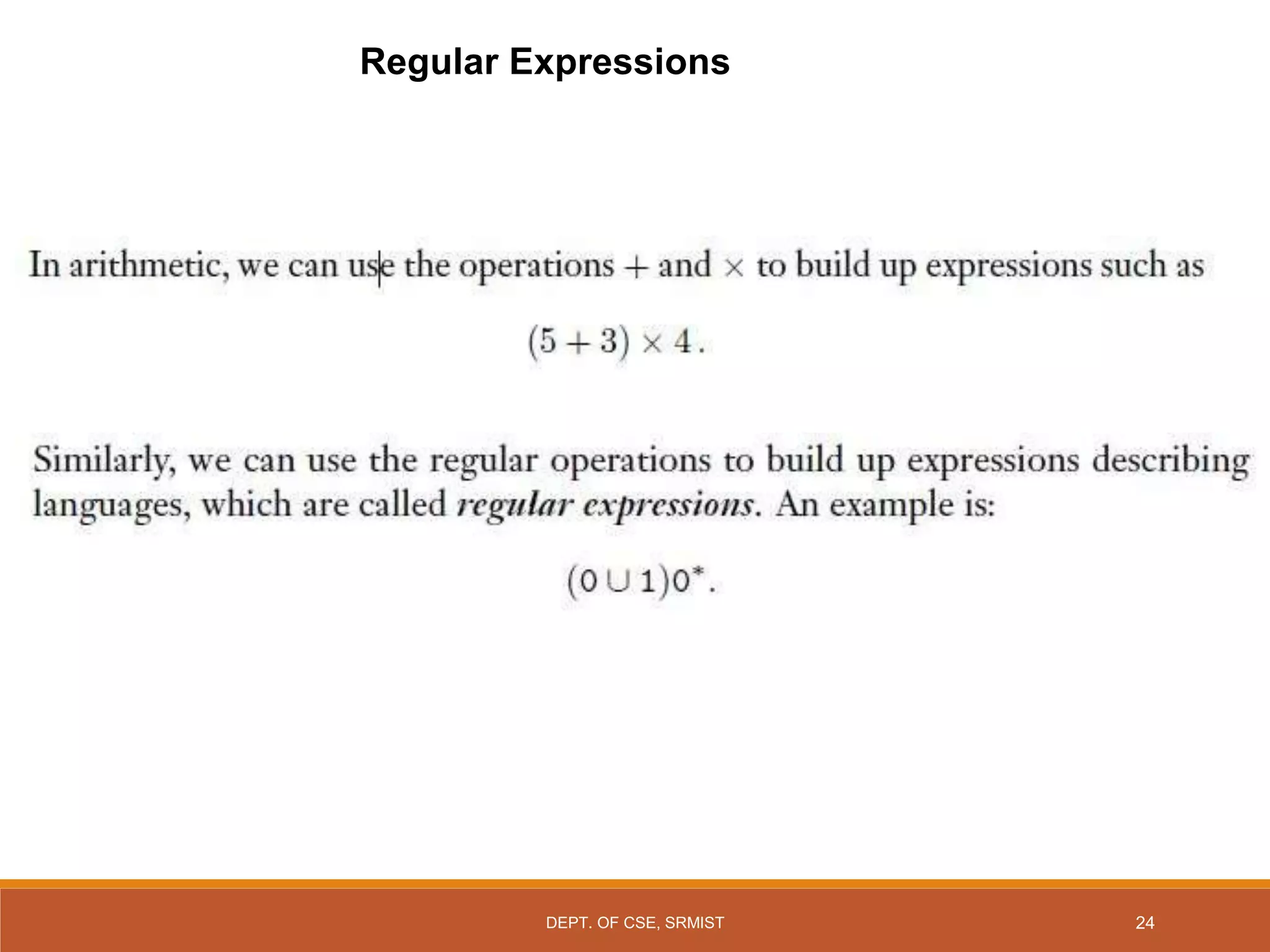
Regular Expressions
24
DEPT. OF CSE, SRMIST
25
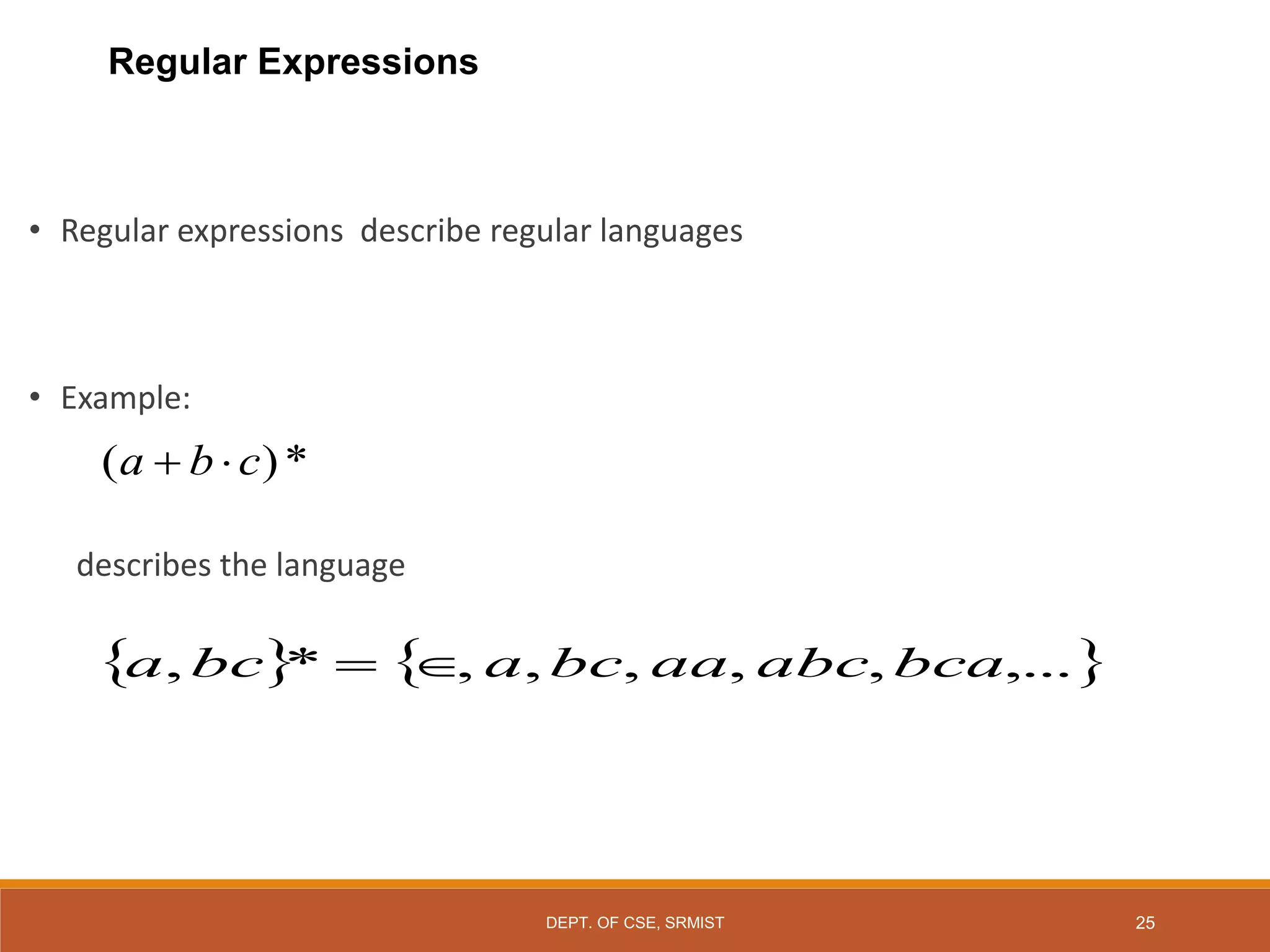
• Regular expressions describe regular languages
• Example:
describes the language
*
)
( c
b
a 

   
,...
,
,
,
,
,
*
, bca
abc
aa
bc
a
bc
a 

Regular Expressions
DEPT. OF CSE, SRMIST
26
 
1
1
2
1
2
1
*
r
r
r
r
r
r


Are regular
Expressions
2
r
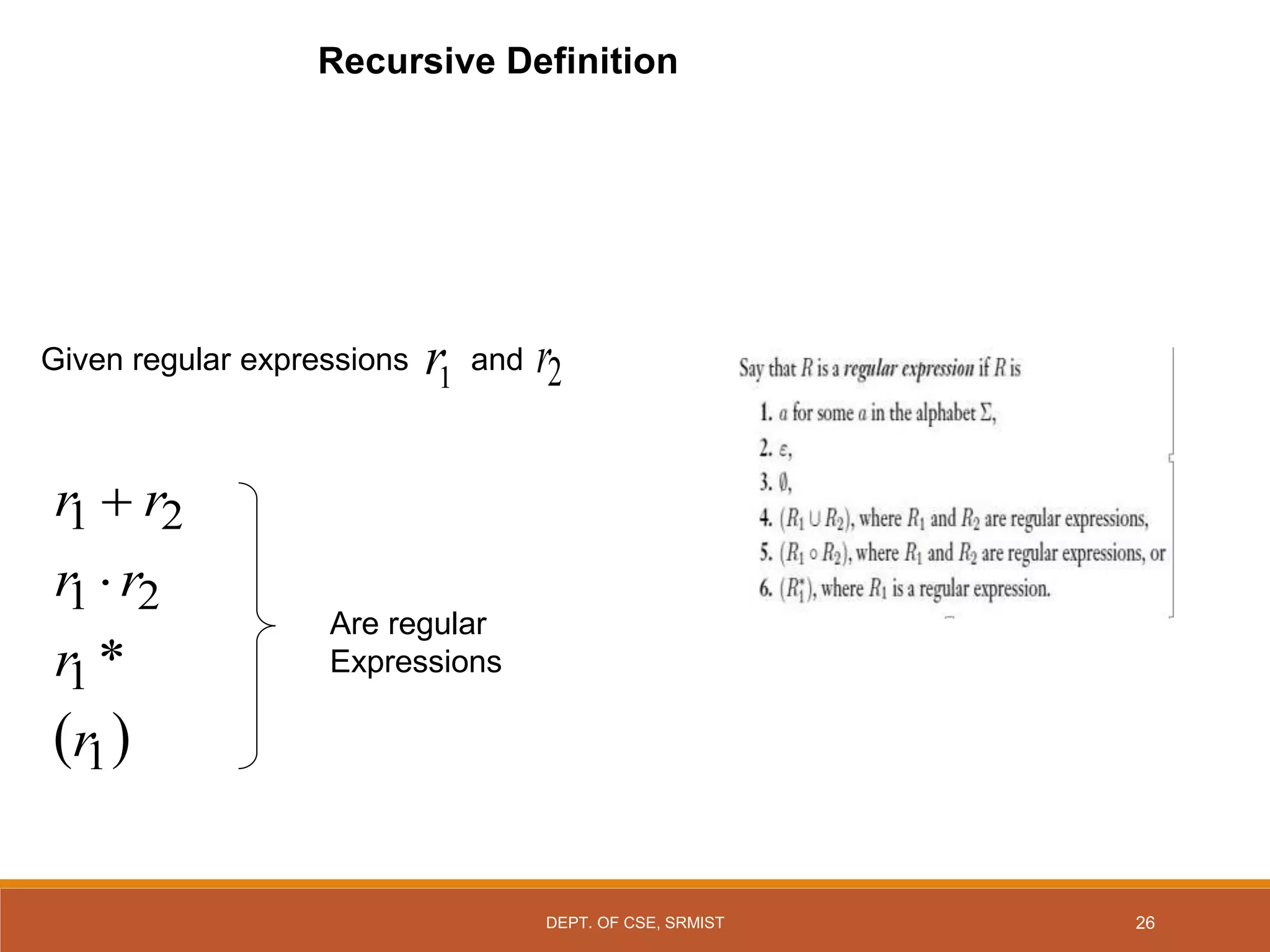
Given regular expressions and
Recursive Definition
1
r
DEPT. OF CSE, SRMIST
27
  )
(
* 



 c
c
b
a
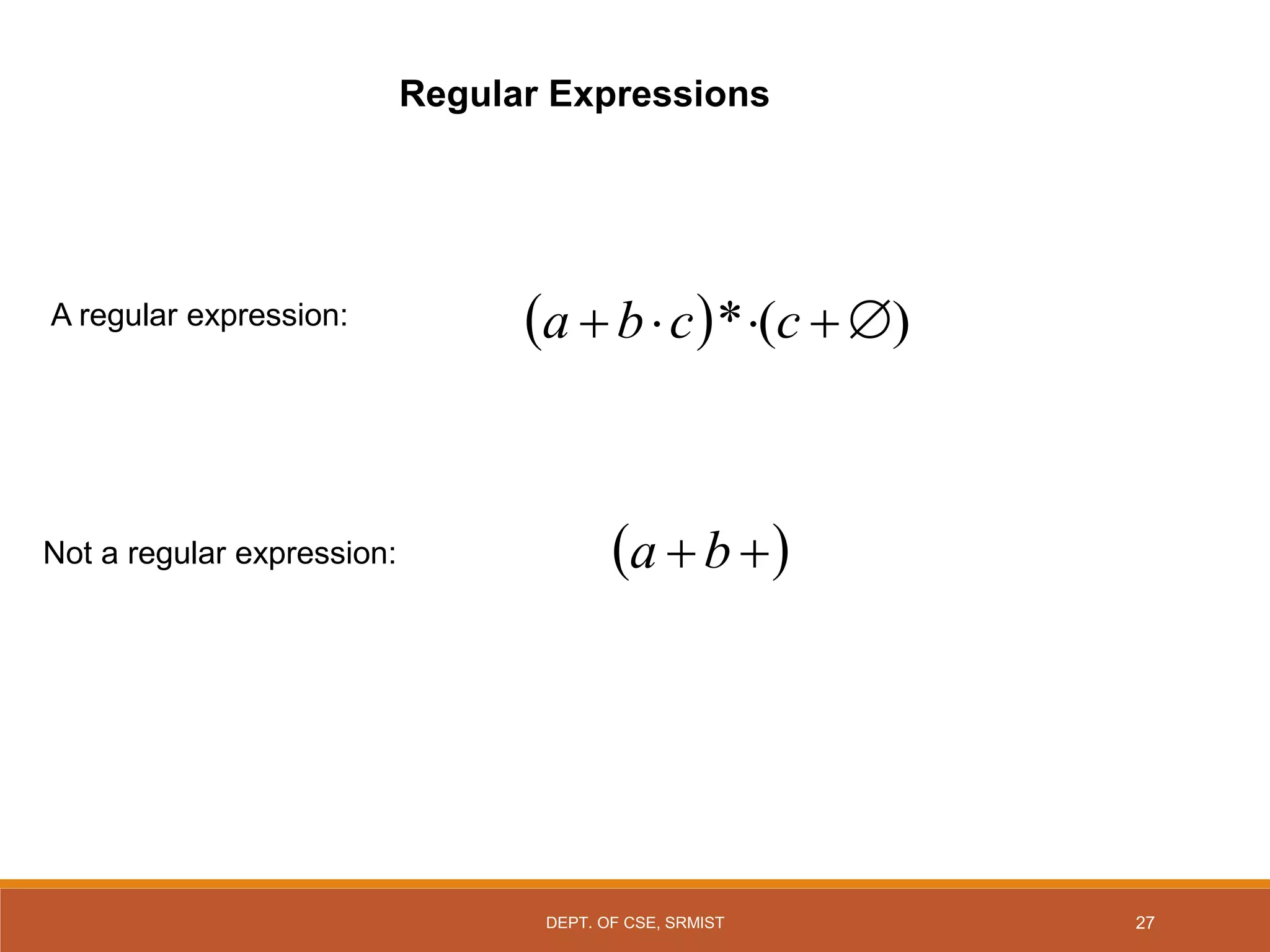
A regular expression:
 

b
a
Not a regular expression:
Regular Expressions
DEPT. OF CSE, SRMIST
28
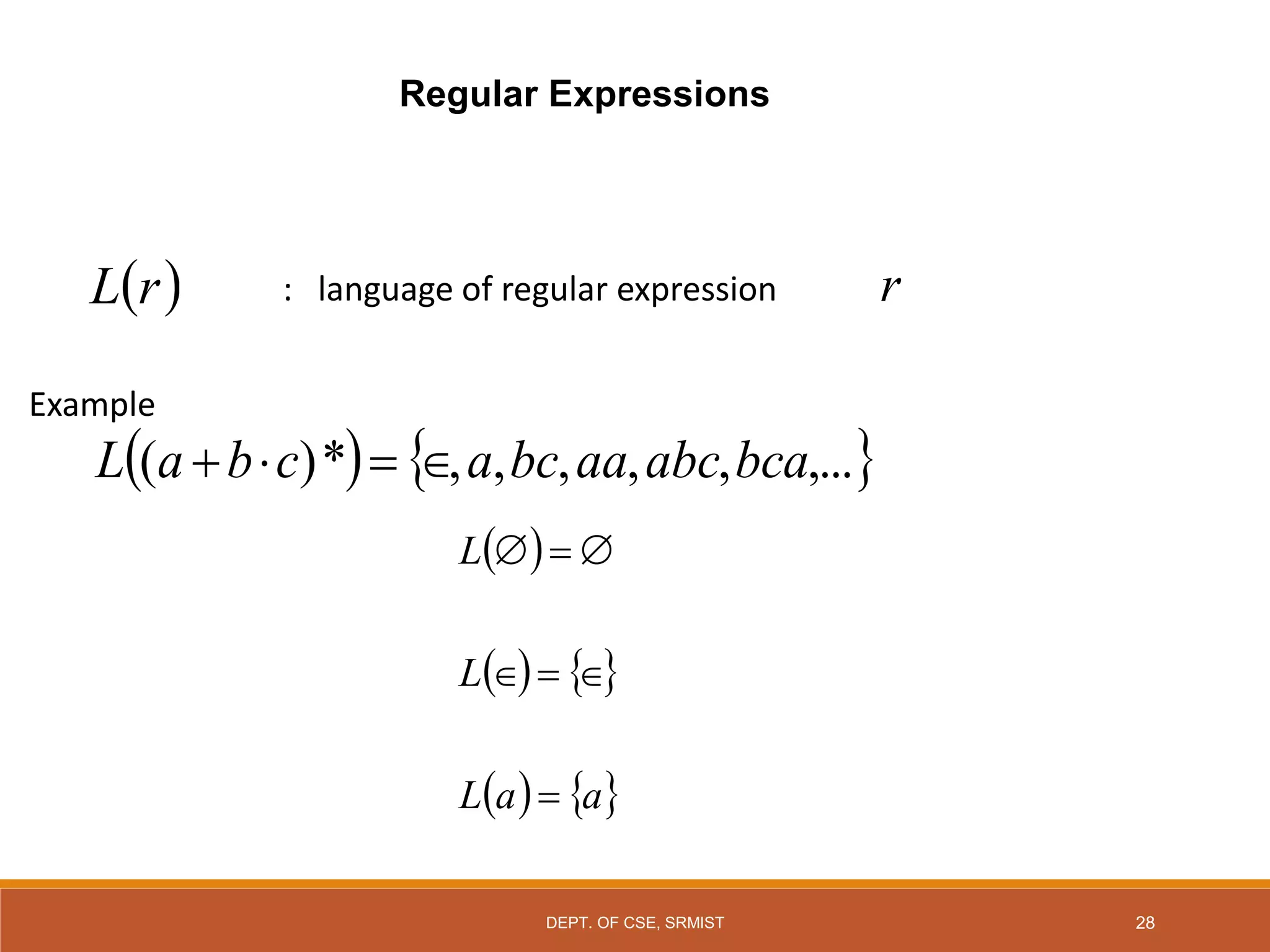
: language of regular expression
Example
 
r
L r
   
,...
,
,
,
,
,
*
)
( bca
abc
aa
bc
a
c
b
a
L 



 
   
   
a
a
L
L
L







Regular Expressions
DEPT. OF CSE, SRMIST
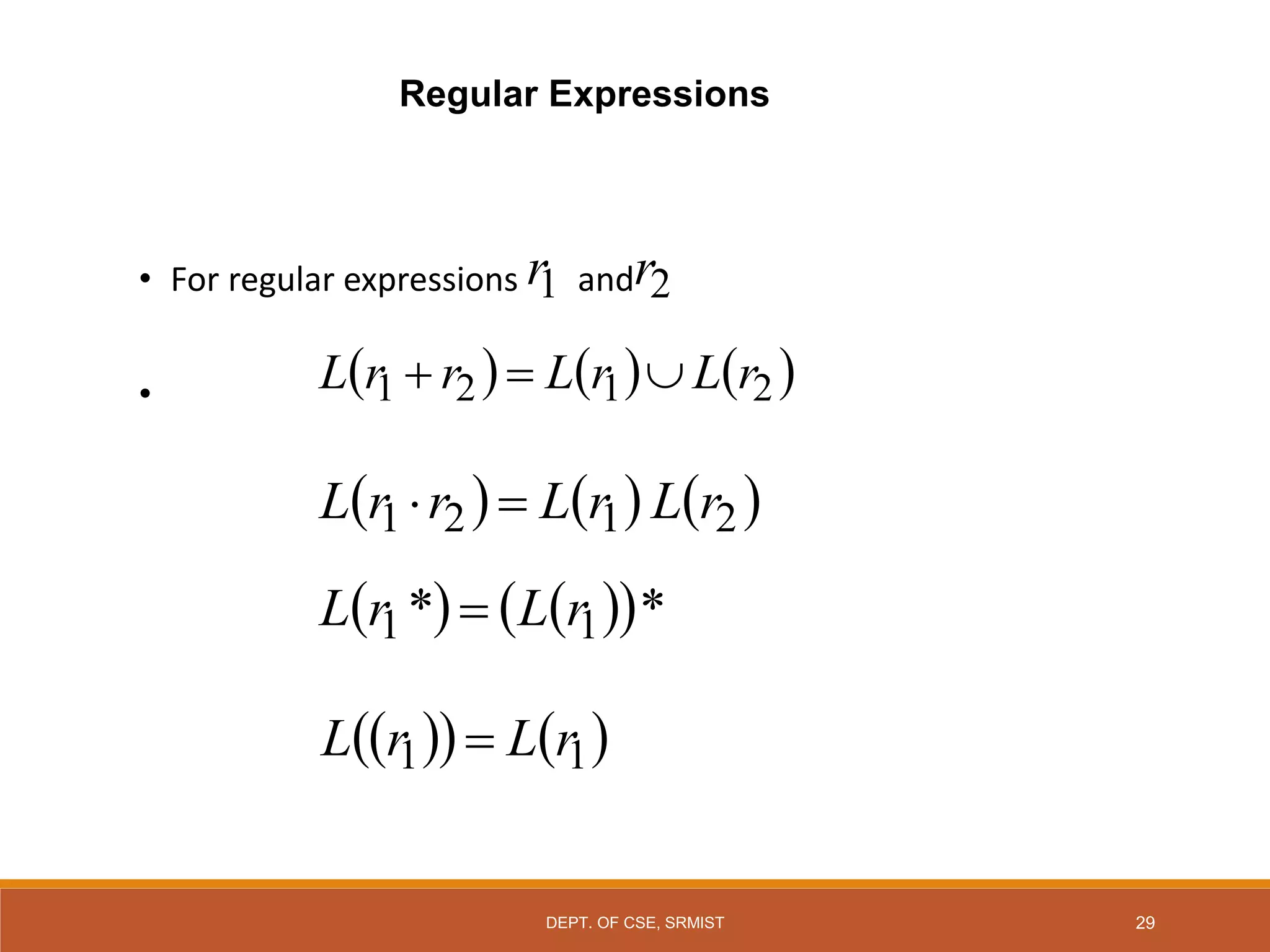
29
• For regular expressions and
•
1
r 2
r
     
2
1
2
1 r
L
r
L
r
r
L 


     
2
1
2
1 r
L
r
L
r
r
L 

   
 *
* 1
1 r
L
r
L 
 
   
1
1 r
L
r
L 
Regular Expressions
DEPT. OF CSE, SRMIST
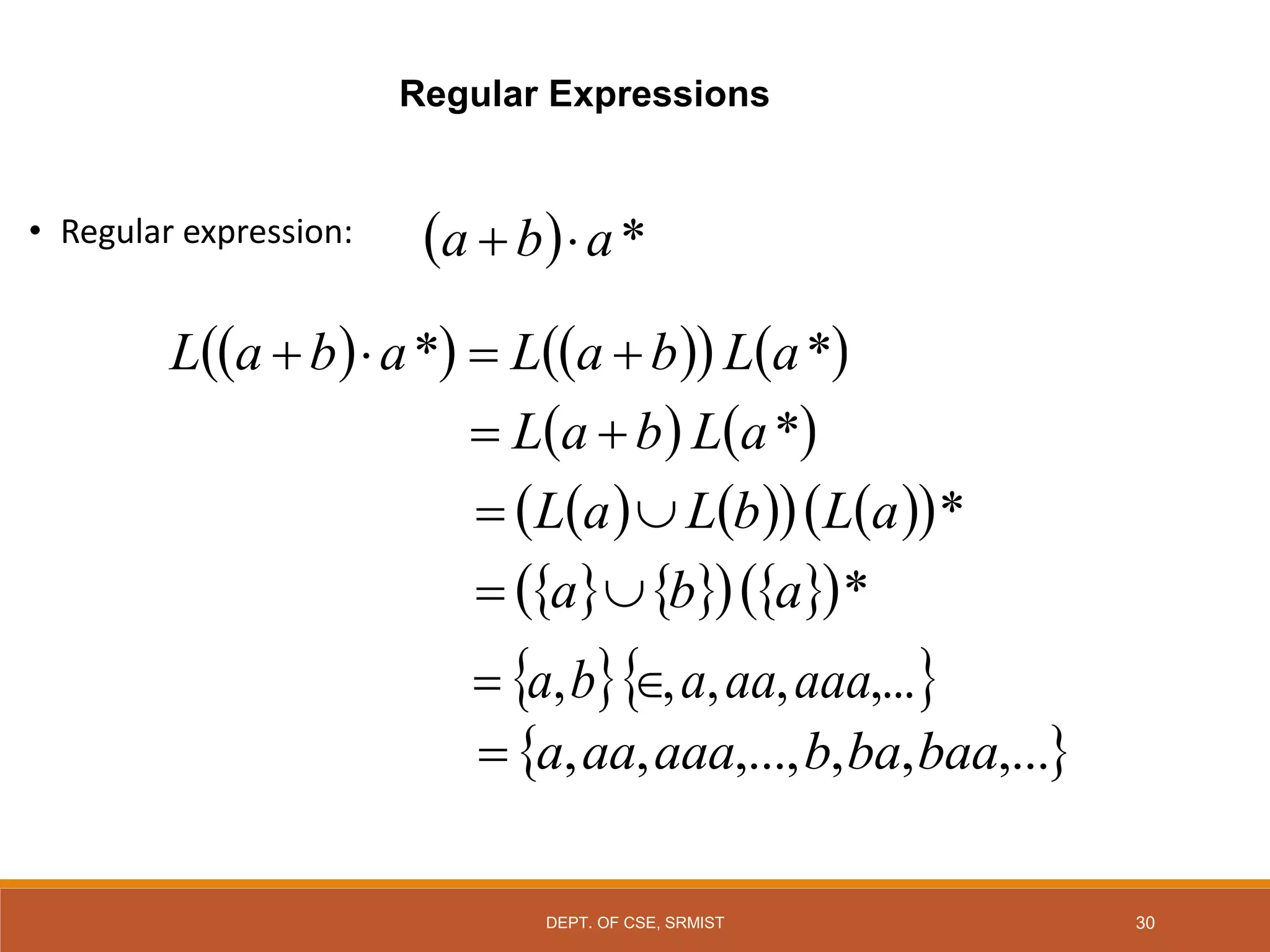
30
• Regular expression:   *
a
b
a 

 
 
*
a
b
a
L 
  
   
*
a
L
b
a
L 

   
*
a
L
b
a
L 

   
   
 *
a
L
b
L
a
L 

   
   
 *
a
b
a 

  
,...
,
,
,
, aaa
aa
a
b
a 

 
,...
,
,
,...,
,
, baa
ba
b
aaa
aa
a

Regular Expressions
DEPT. OF CSE, SRMIST
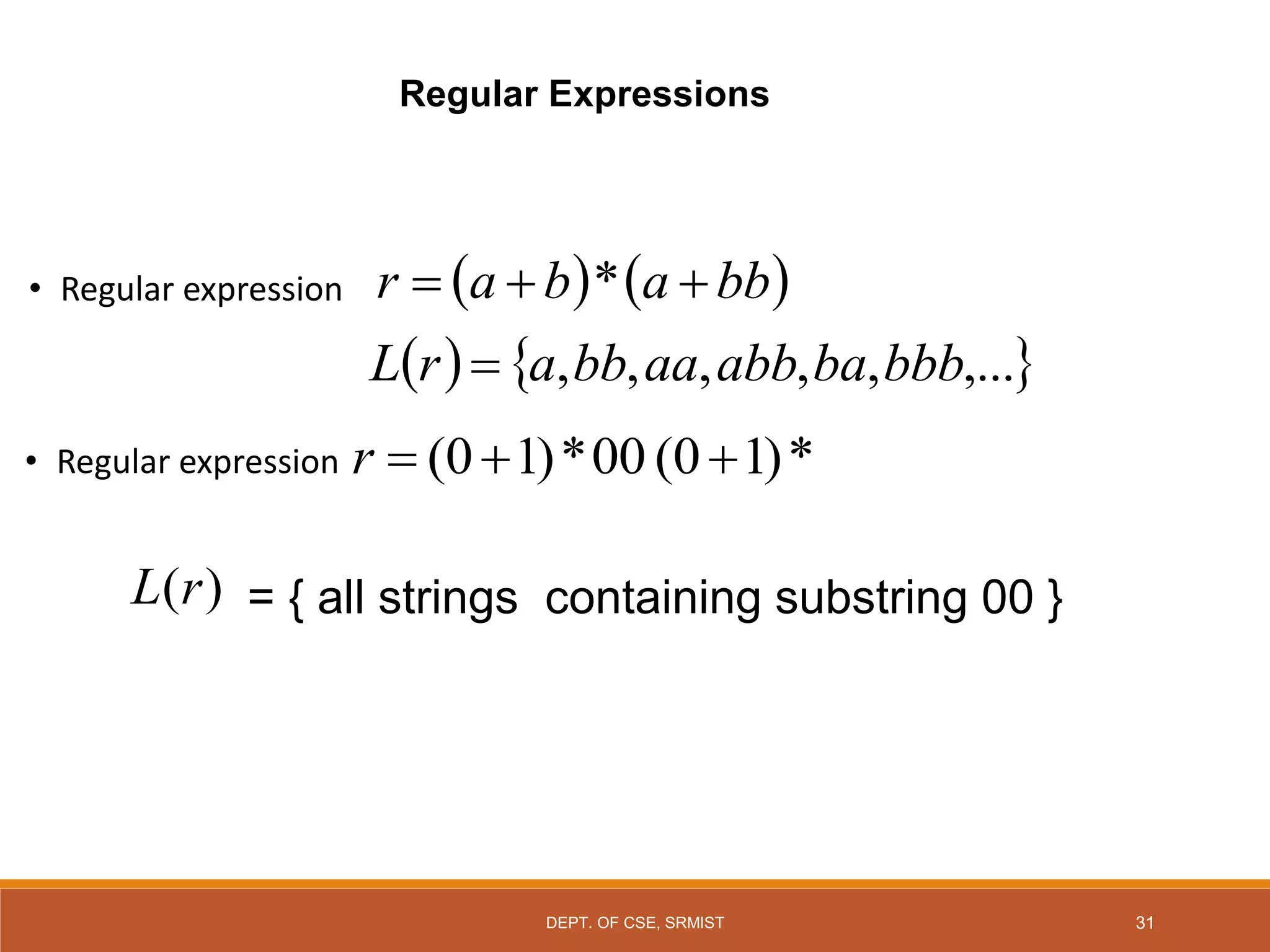
31
• Regular expression
   
bb
a
b
a
r 

 *
   
,...
,
,
,
,
, bbb
ba
abb
aa
bb
a
r
L 
• Regular expression
*
)
1
0
(
00
*
)
1
0
( 


r
)
(r
L = { all strings containing substring 00 }
Regular Expressions
DEPT. OF CSE, SRMIST
32
DEPT. OF CSE, SRMIST
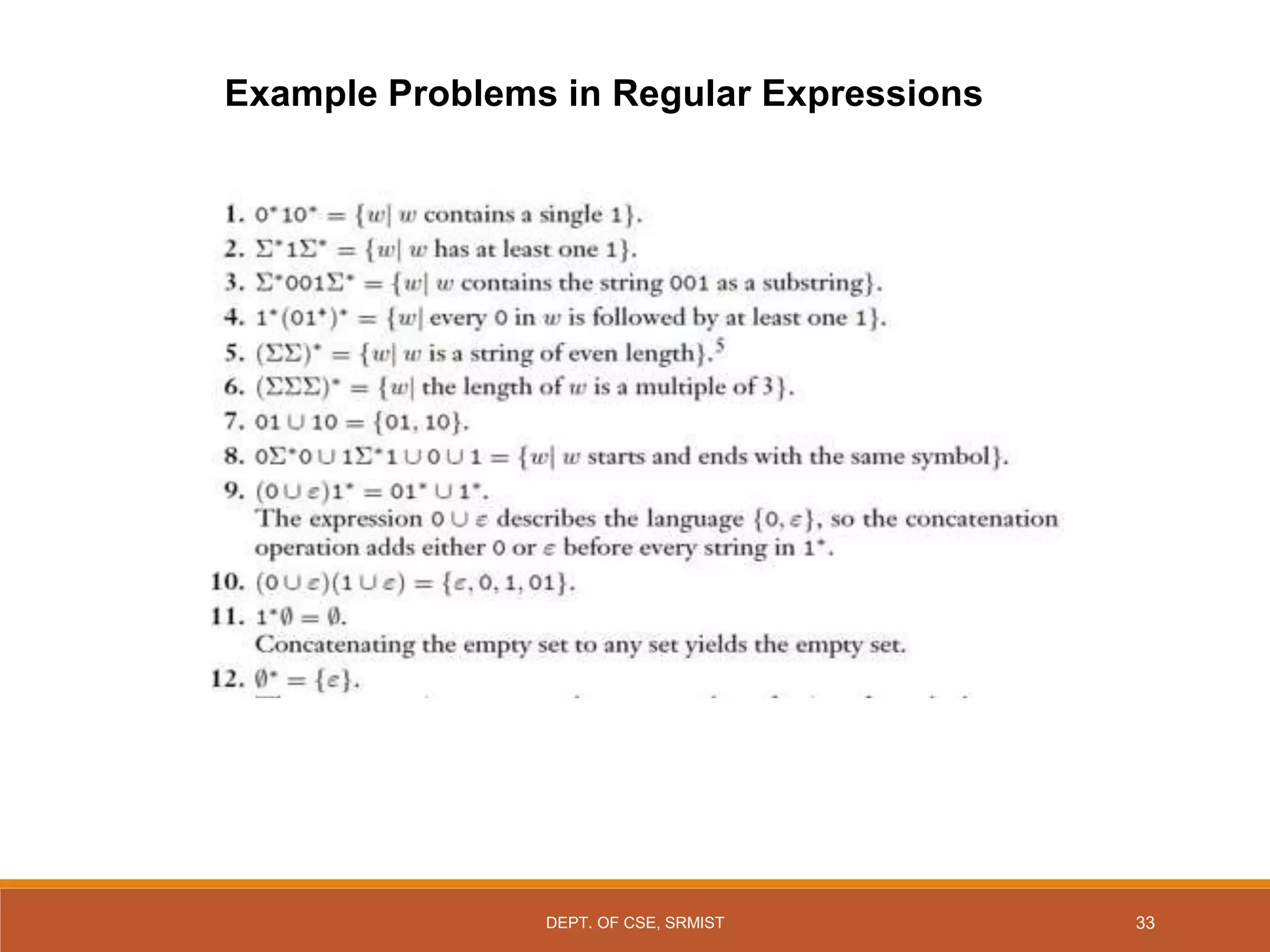
33
Example Problems in Regular Expressions
DEPT. OF CSE, SRMIST
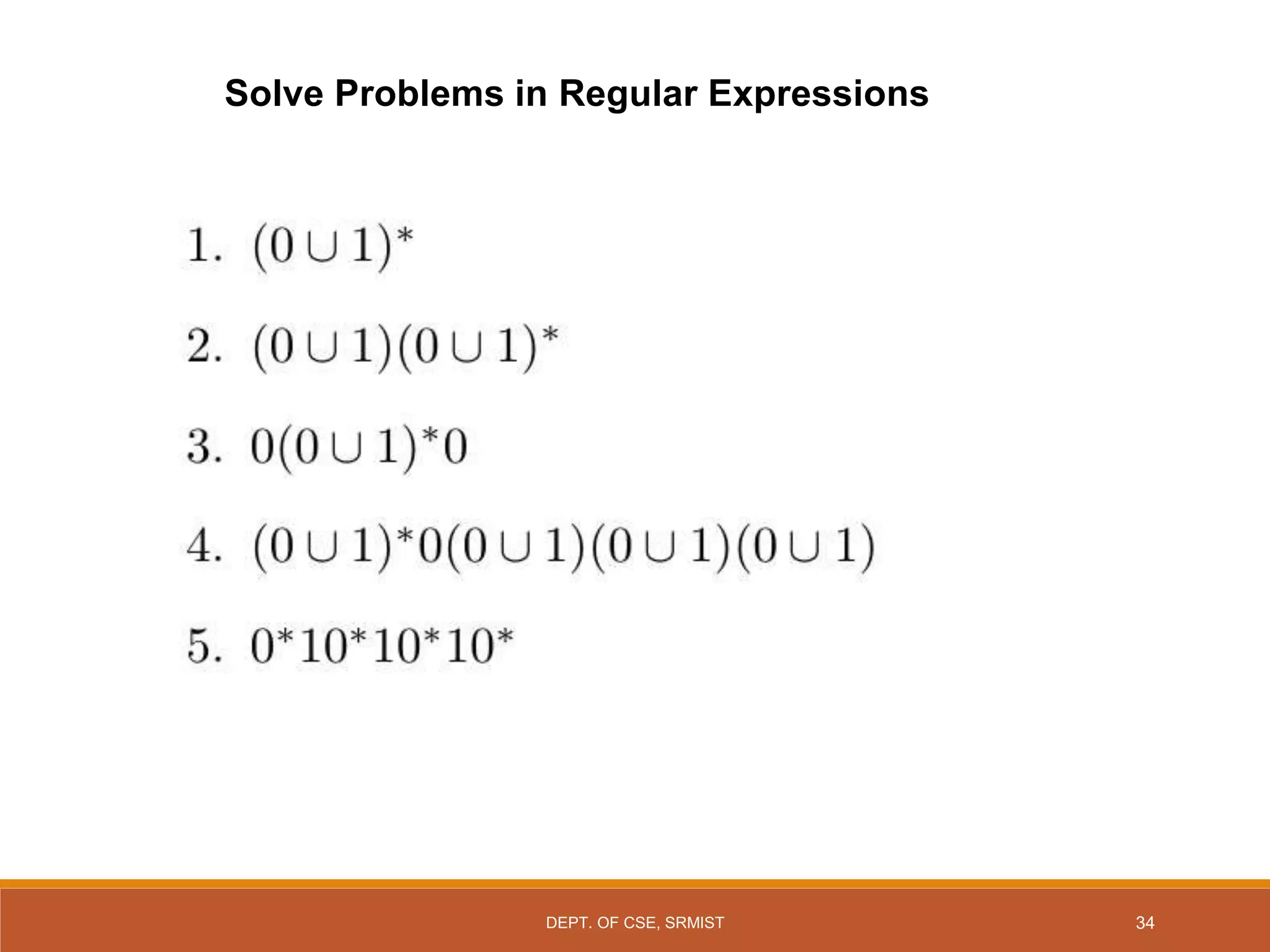
34
Solve Problems in Regular Expressions
DEPT. OF CSE, SRMIST
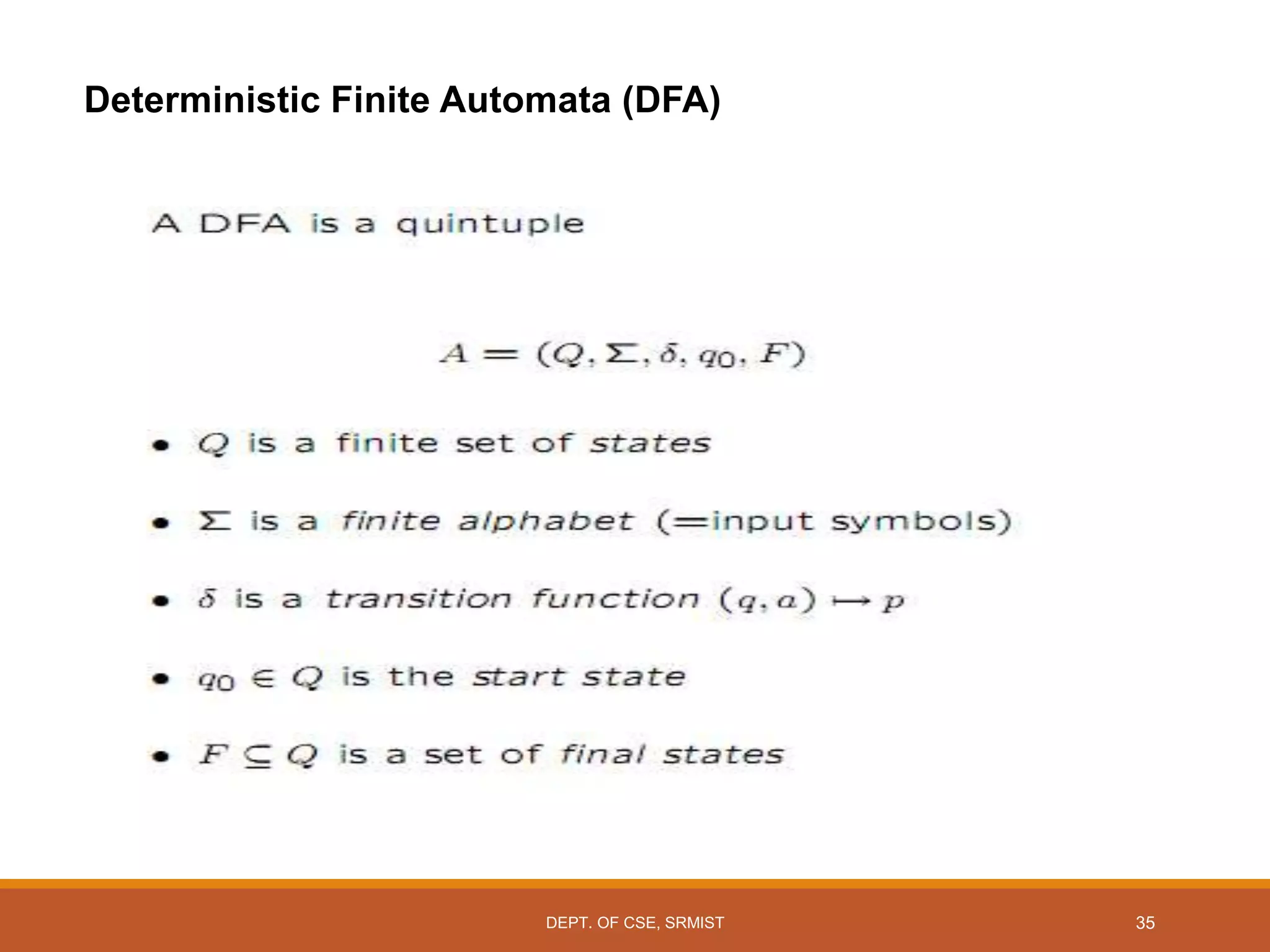
Deterministic Finite Automata (DFA)
DEPT. OF CSE, SRMIST 35
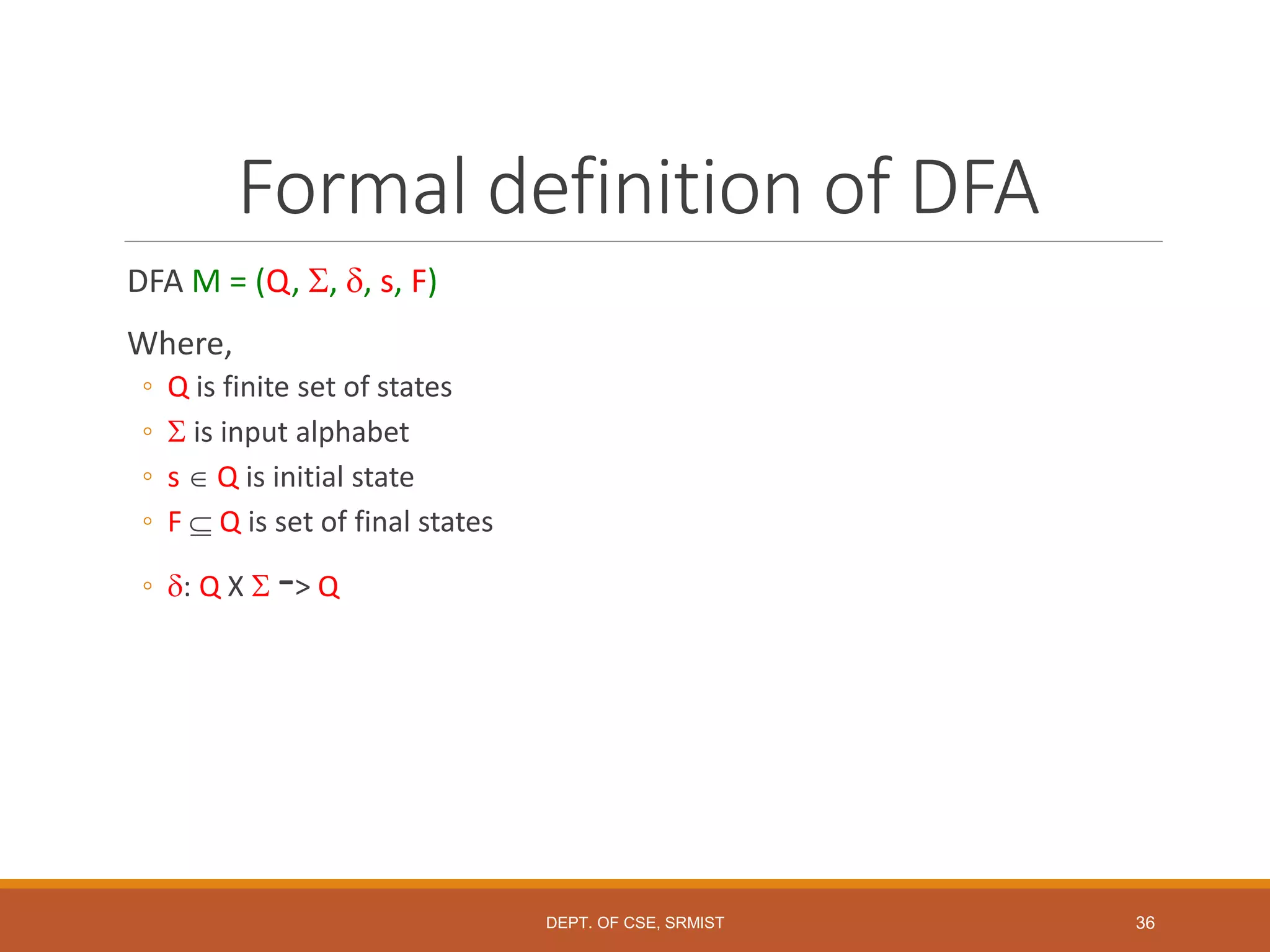
36
Formal definition of DFA
DFA M = (Q, , , s, F)
Where,
◦ Q is finite set of states
◦  is input alphabet
◦ s  Q is initial state
◦ F  Q is set of final states
◦ : Q X  -> Q
DEPT. OF CSE, SRMIST
37
DFA
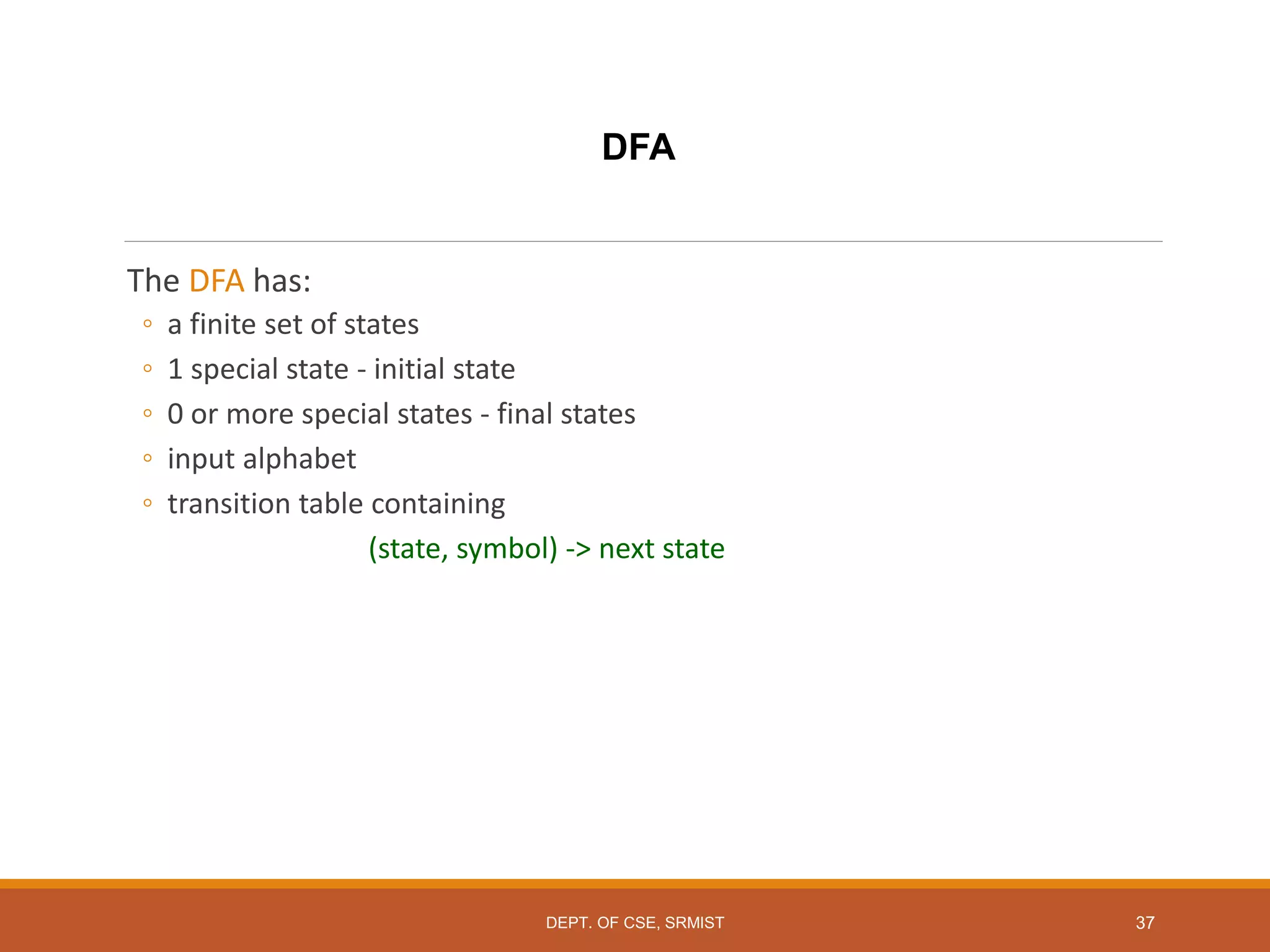
The DFA has:
◦ a finite set of states
◦ 1 special state - initial state
◦ 0 or more special states - final states
◦ input alphabet
◦ transition table containing
(state, symbol) -> next state
DEPT. OF CSE, SRMIST
38
How does a DFA work?
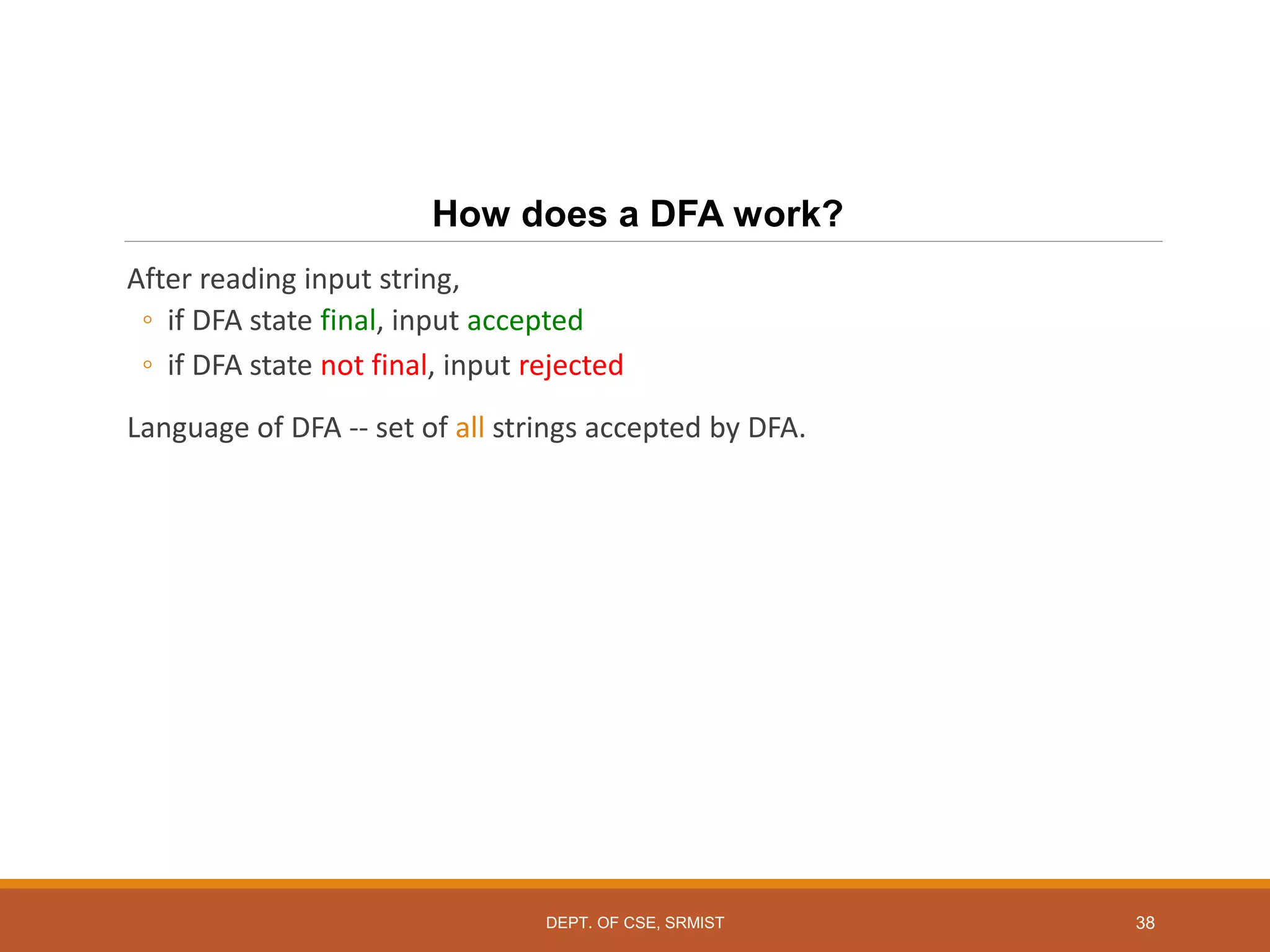
After reading input string,
◦ if DFA state final, input accepted
◦ if DFA state not final, input rejected
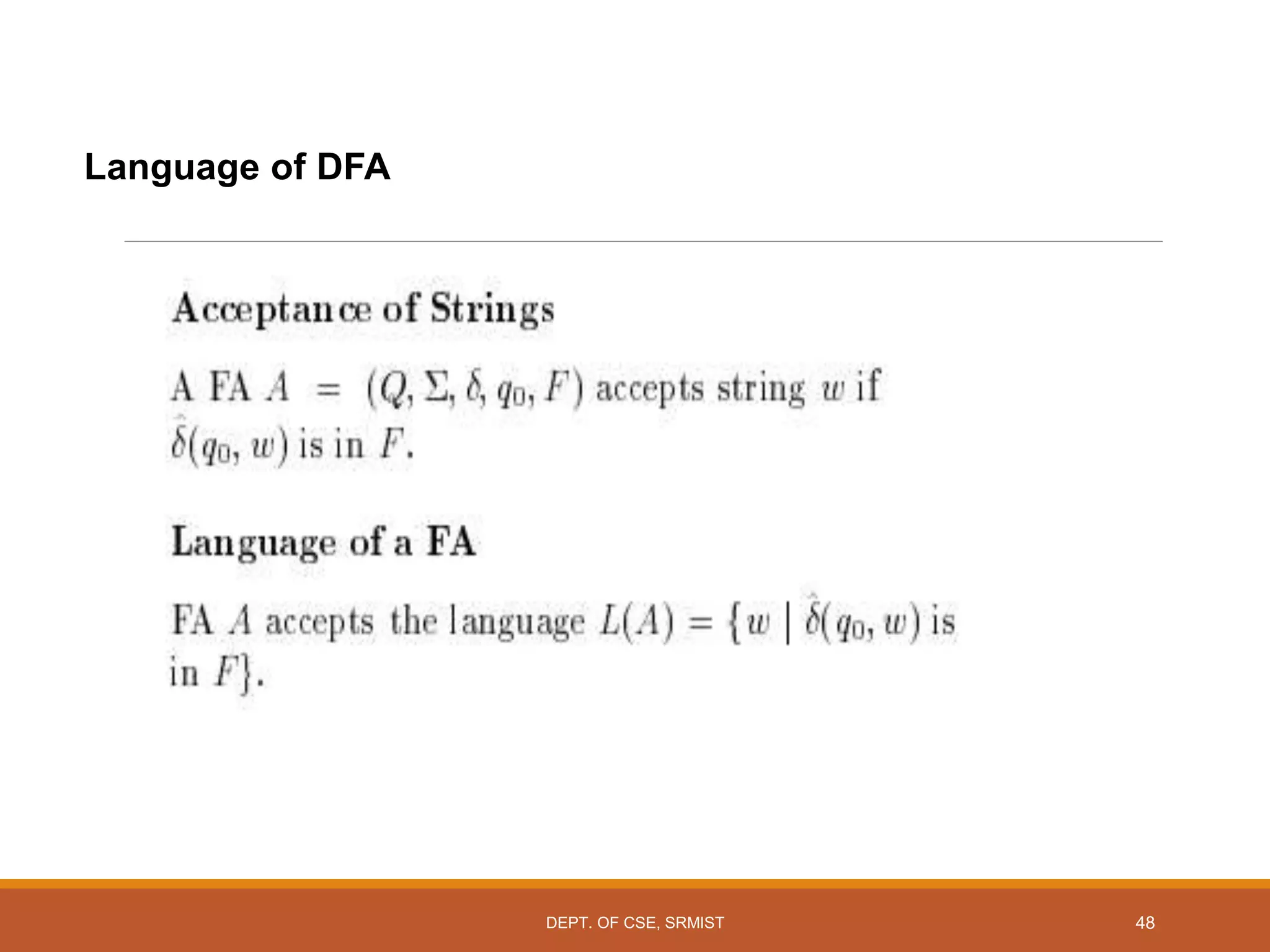
Language of DFA -- set of all strings accepted by DFA.
DEPT. OF CSE, SRMIST
39
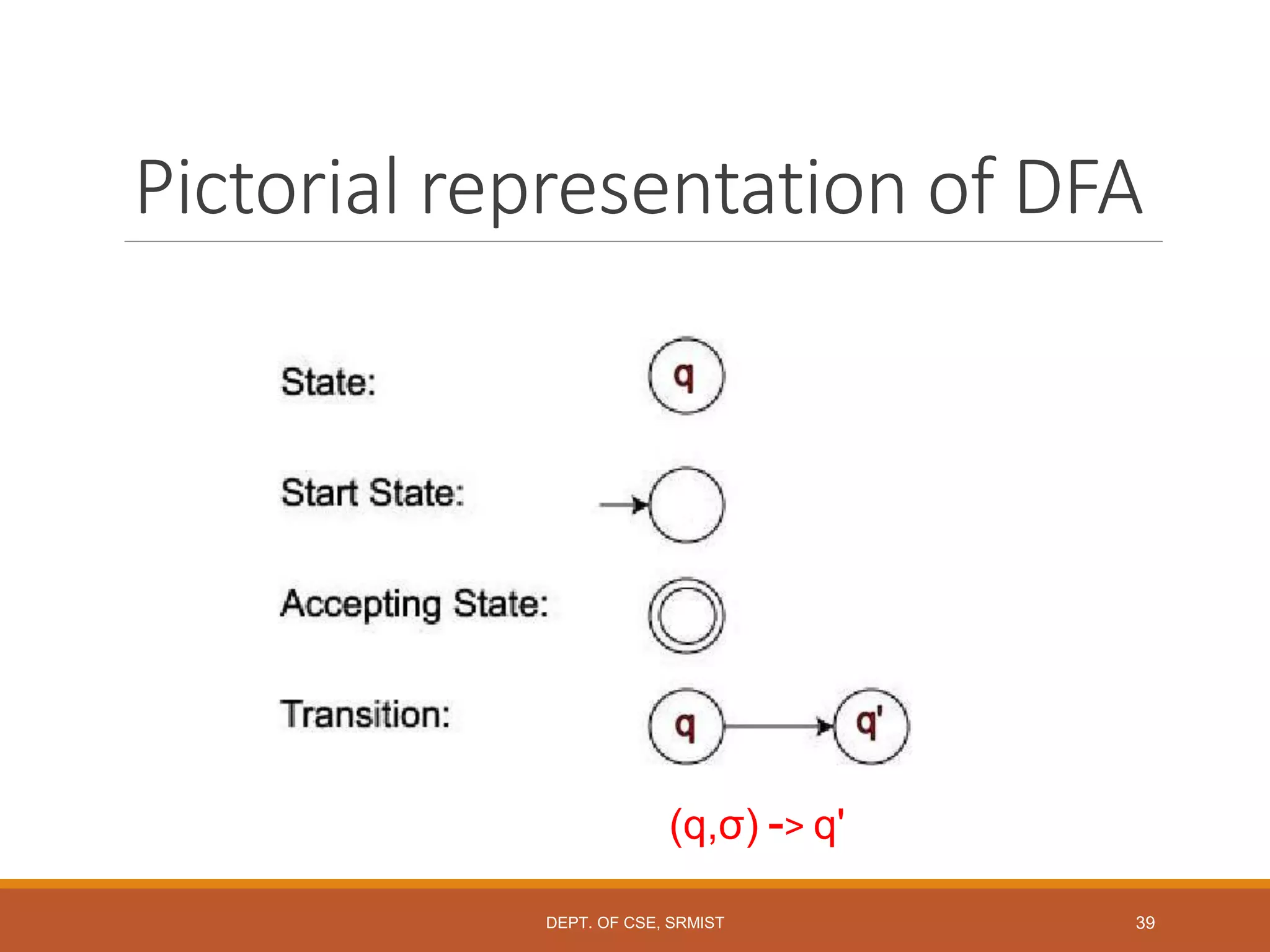
Pictorial representation of DFA
(q,σ) -> q'
DEPT. OF CSE, SRMIST
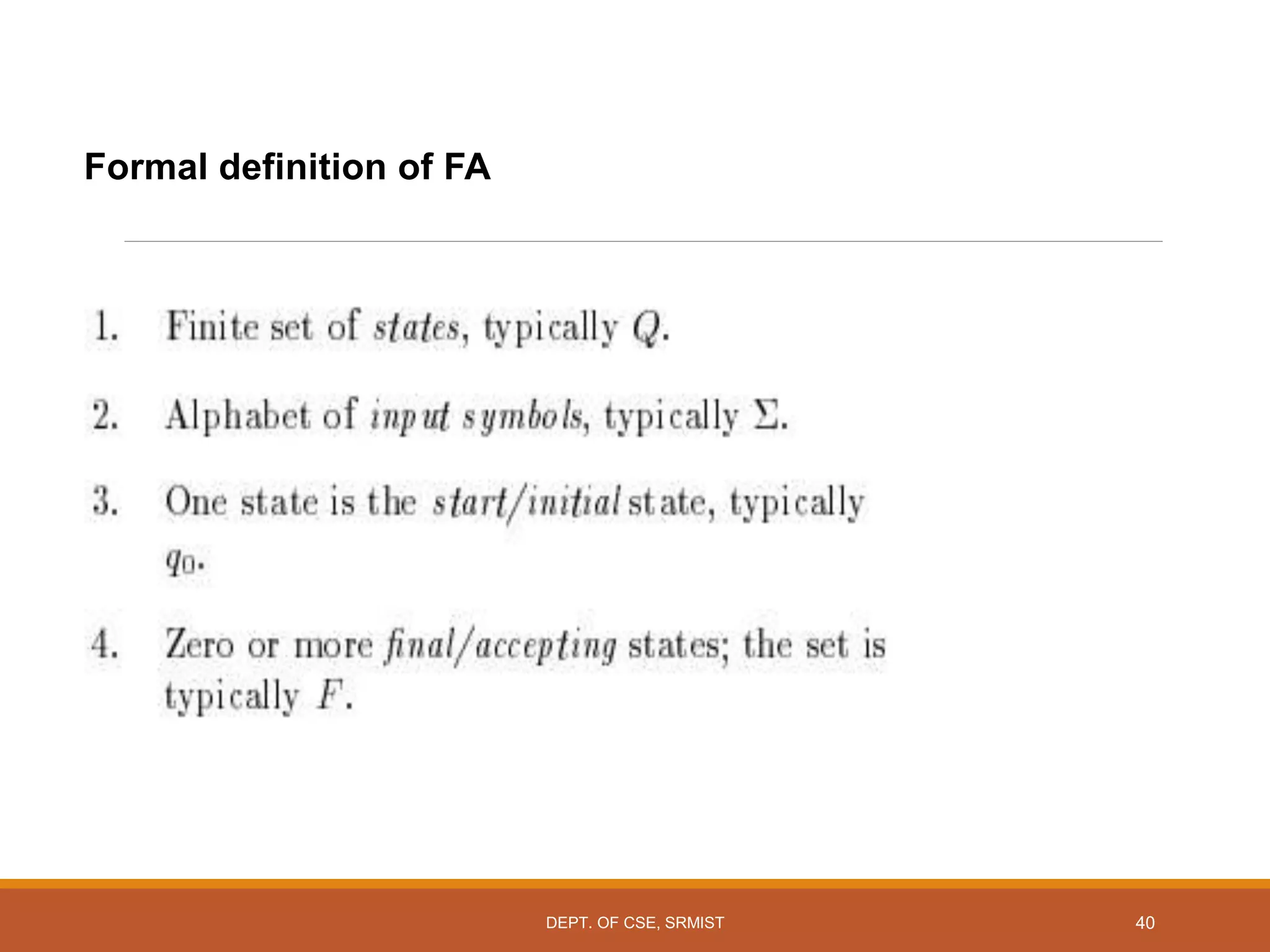
Formal definition of FA
DEPT. OF CSE, SRMIST 40
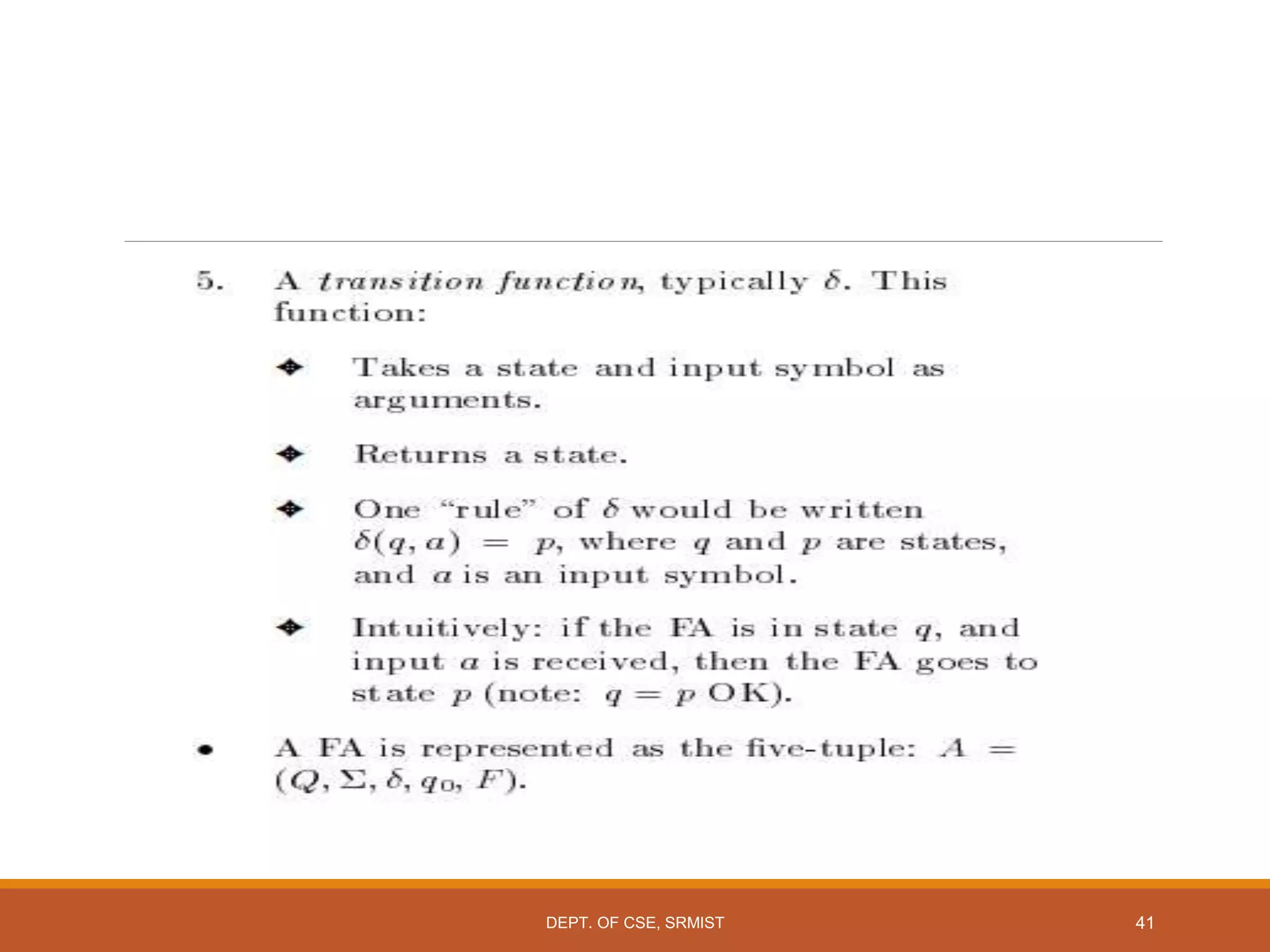
DEPT. OF CSE, SRMIST 41
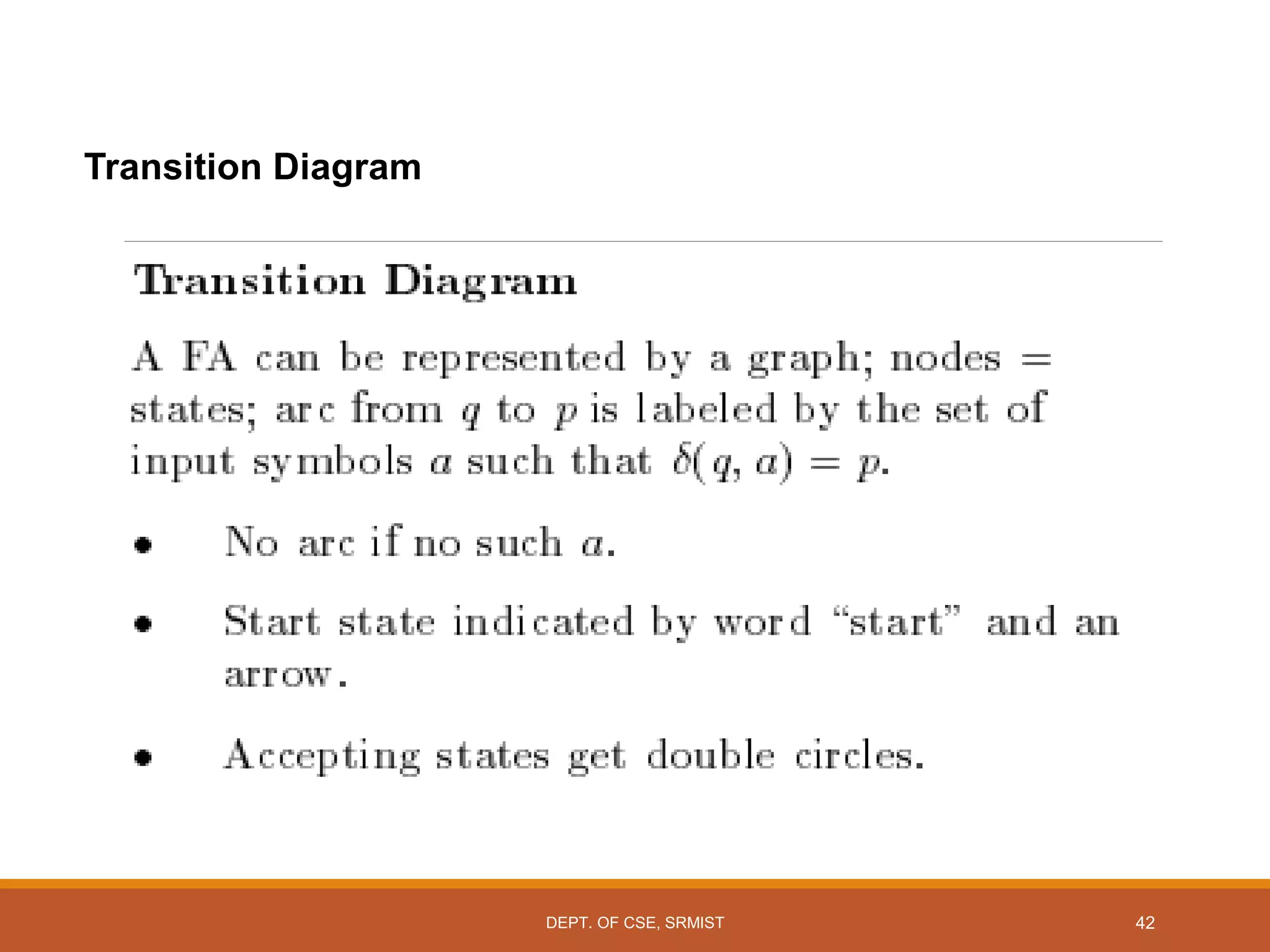
Transition Diagram
DEPT. OF CSE, SRMIST 42
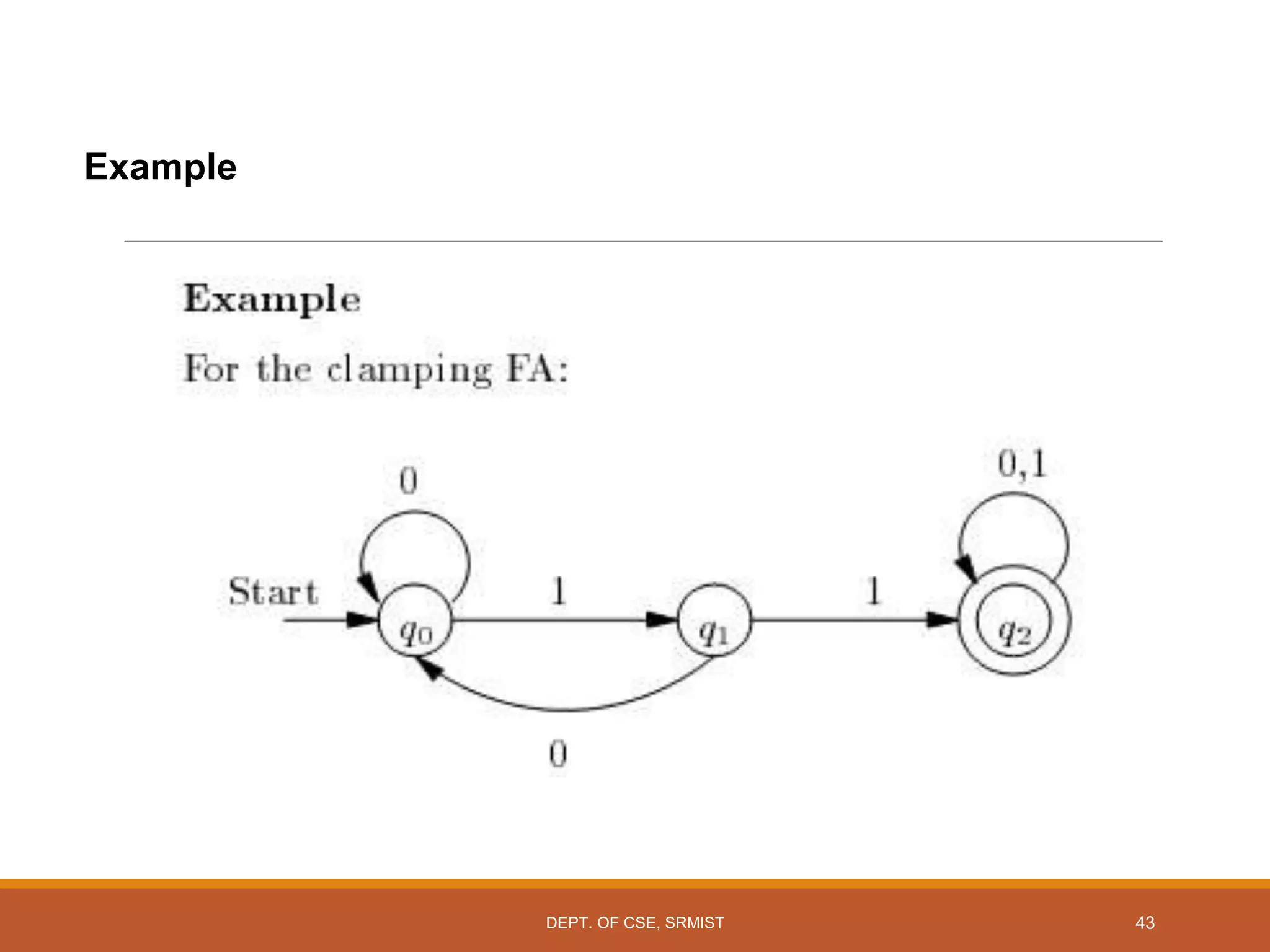
Example
DEPT. OF CSE, SRMIST 43
Transition table
A transition table is a conventional tabular representation of functions like δ
that takes the two argument and returns another state.
The row of the table corresponding to the states.
The column of the table corresponding to the inputs.
DEPT. OF CSE, SRMIST 44
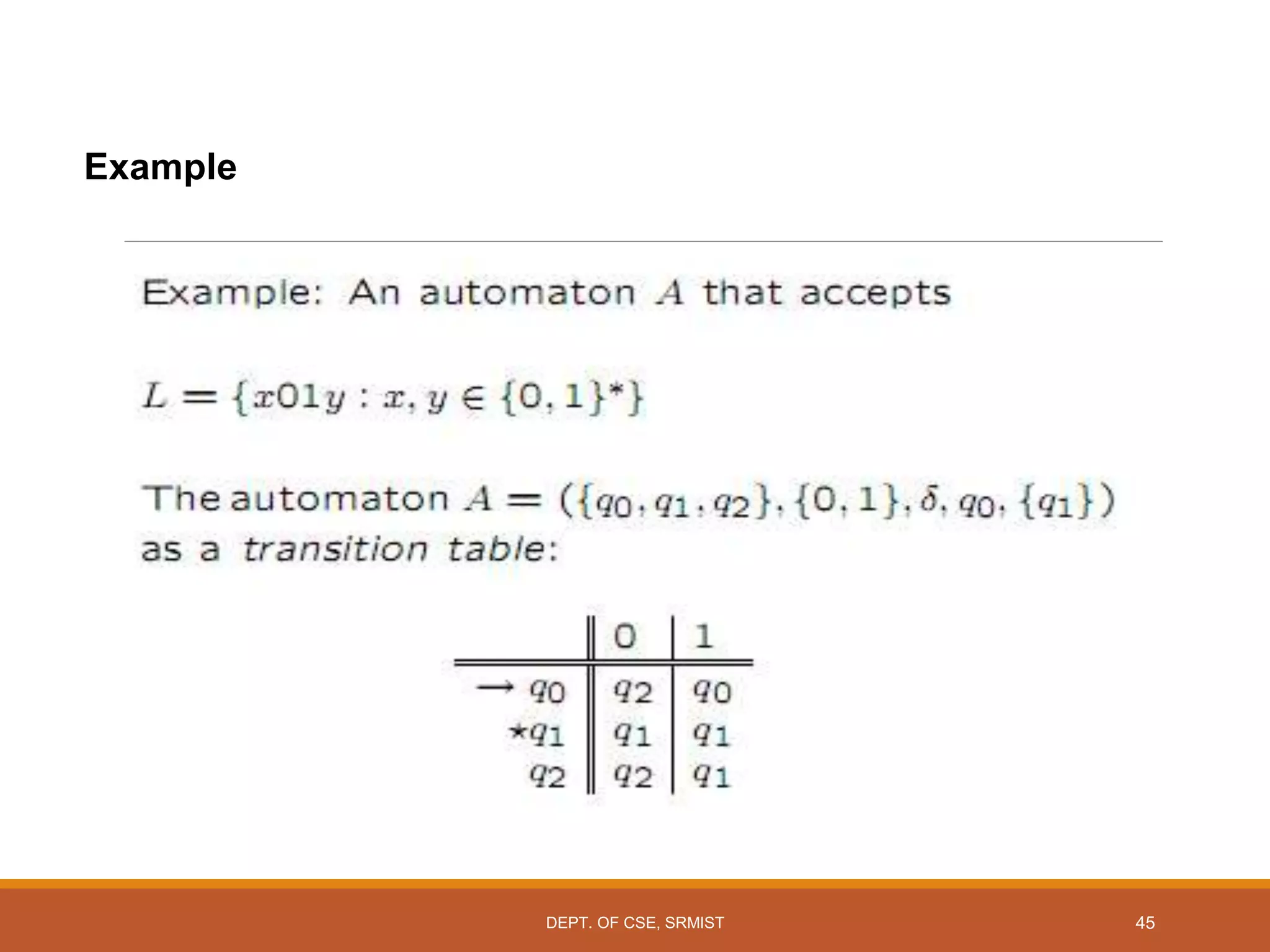
Example
DEPT. OF CSE, SRMIST 45
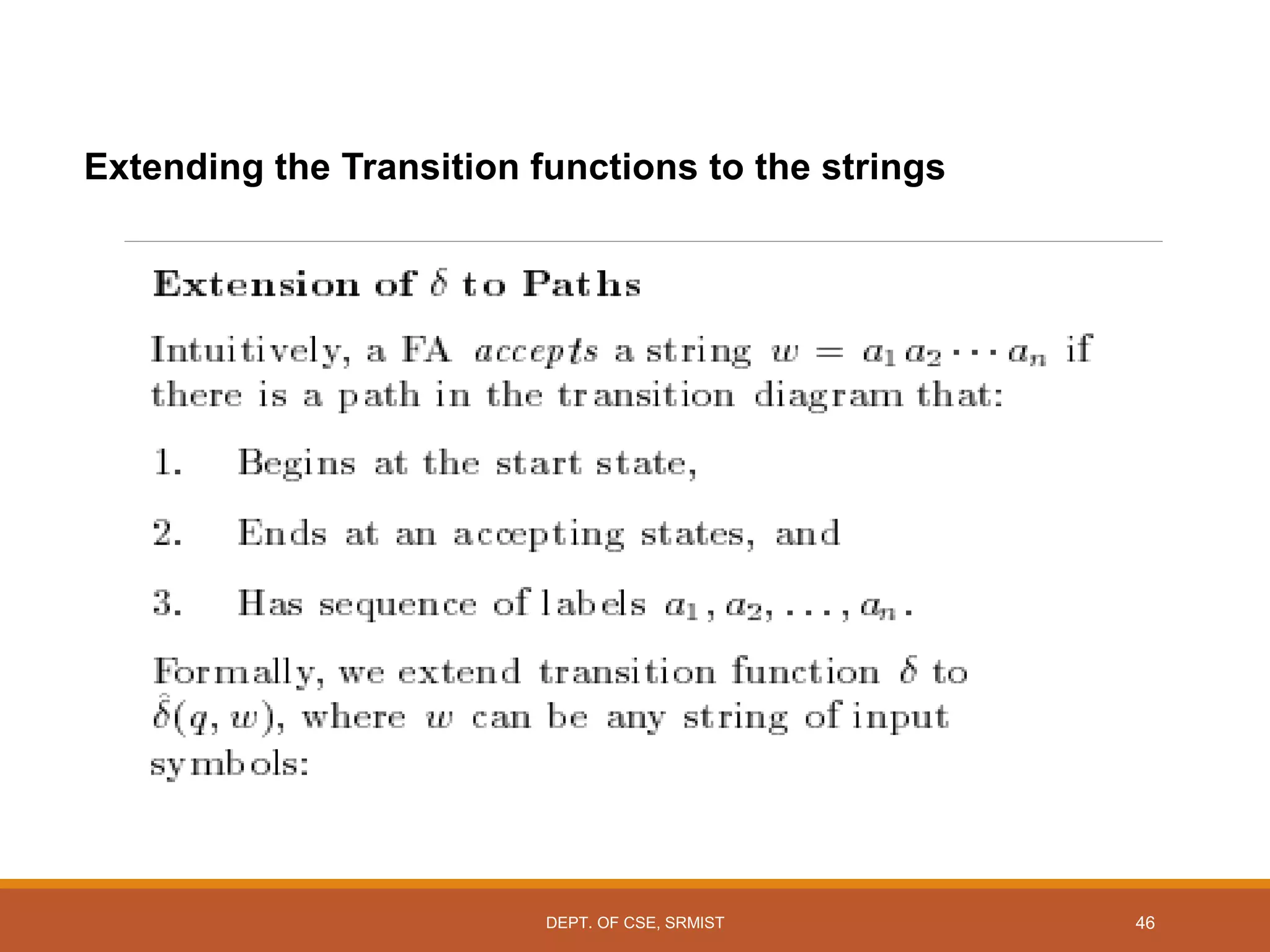
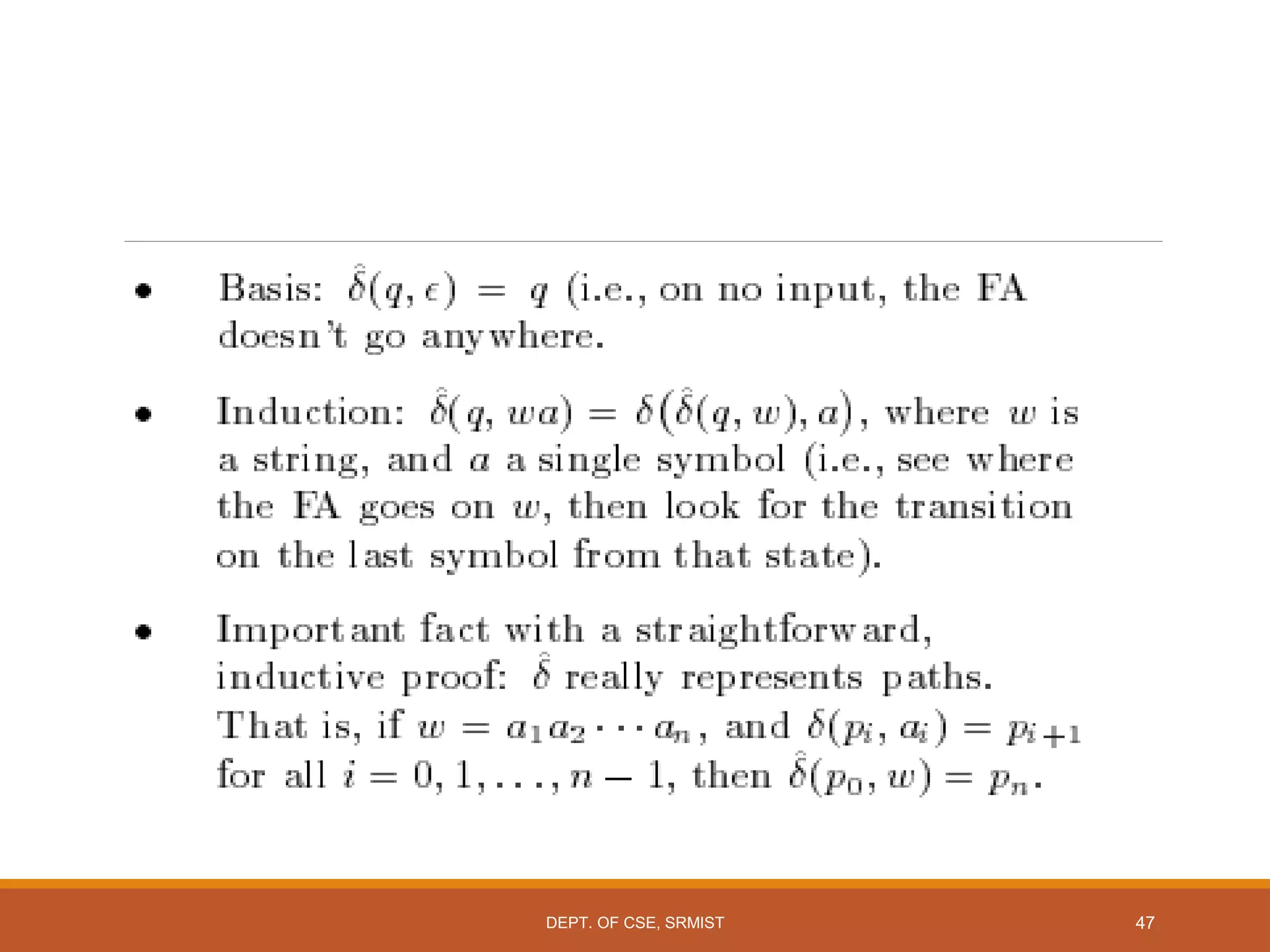
Extending the Transition functions to the strings
DEPT. OF CSE, SRMIST 46
DEPT. OF CSE, SRMIST 47
Language of DFA
DEPT. OF CSE, SRMIST 48
49
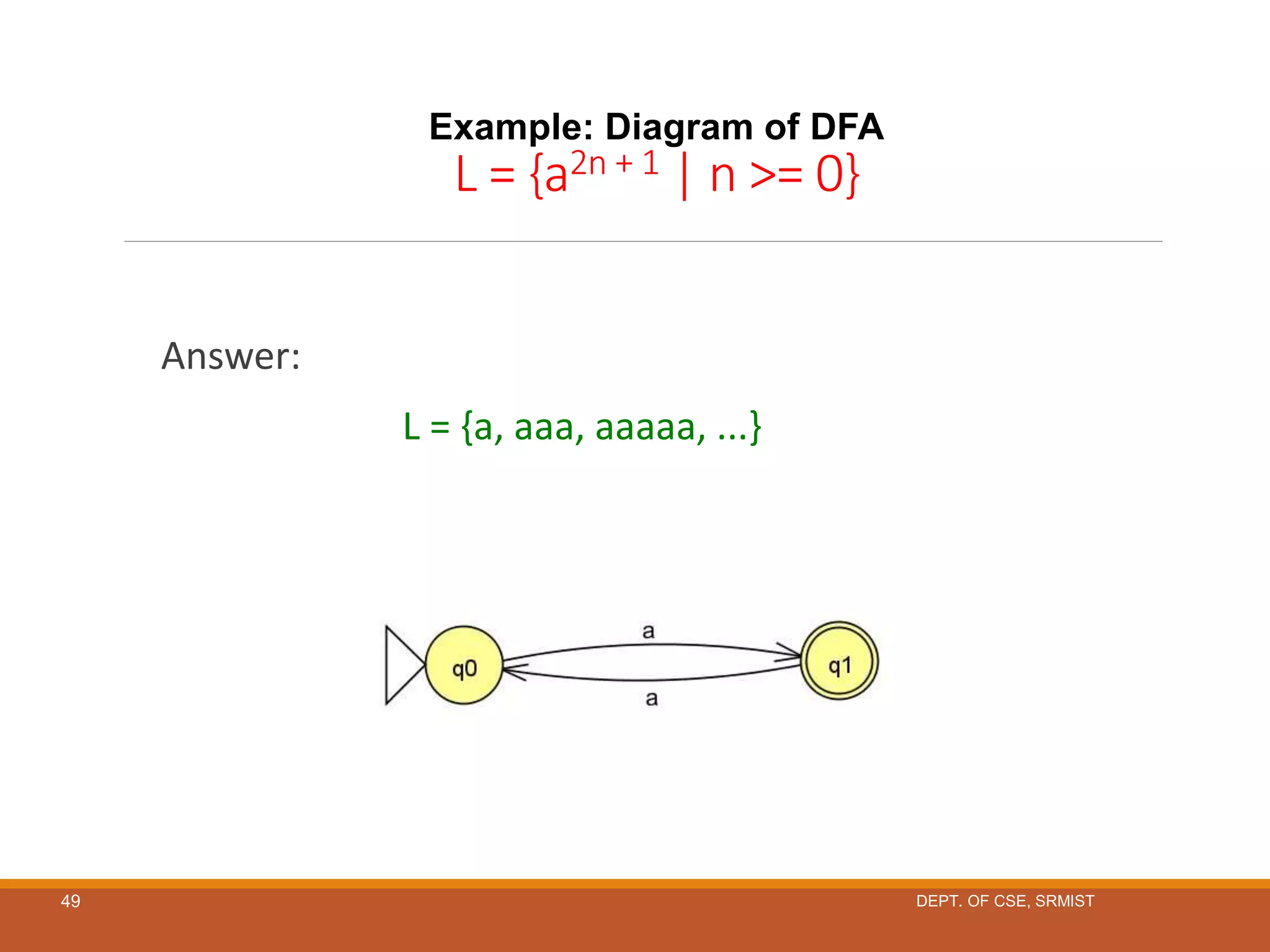
Example: Diagram of DFA
L = {a2n + 1 | n >= 0}
Answer:
L = {a, aaa, aaaaa, ...}
DEPT. OF CSE, SRMIST
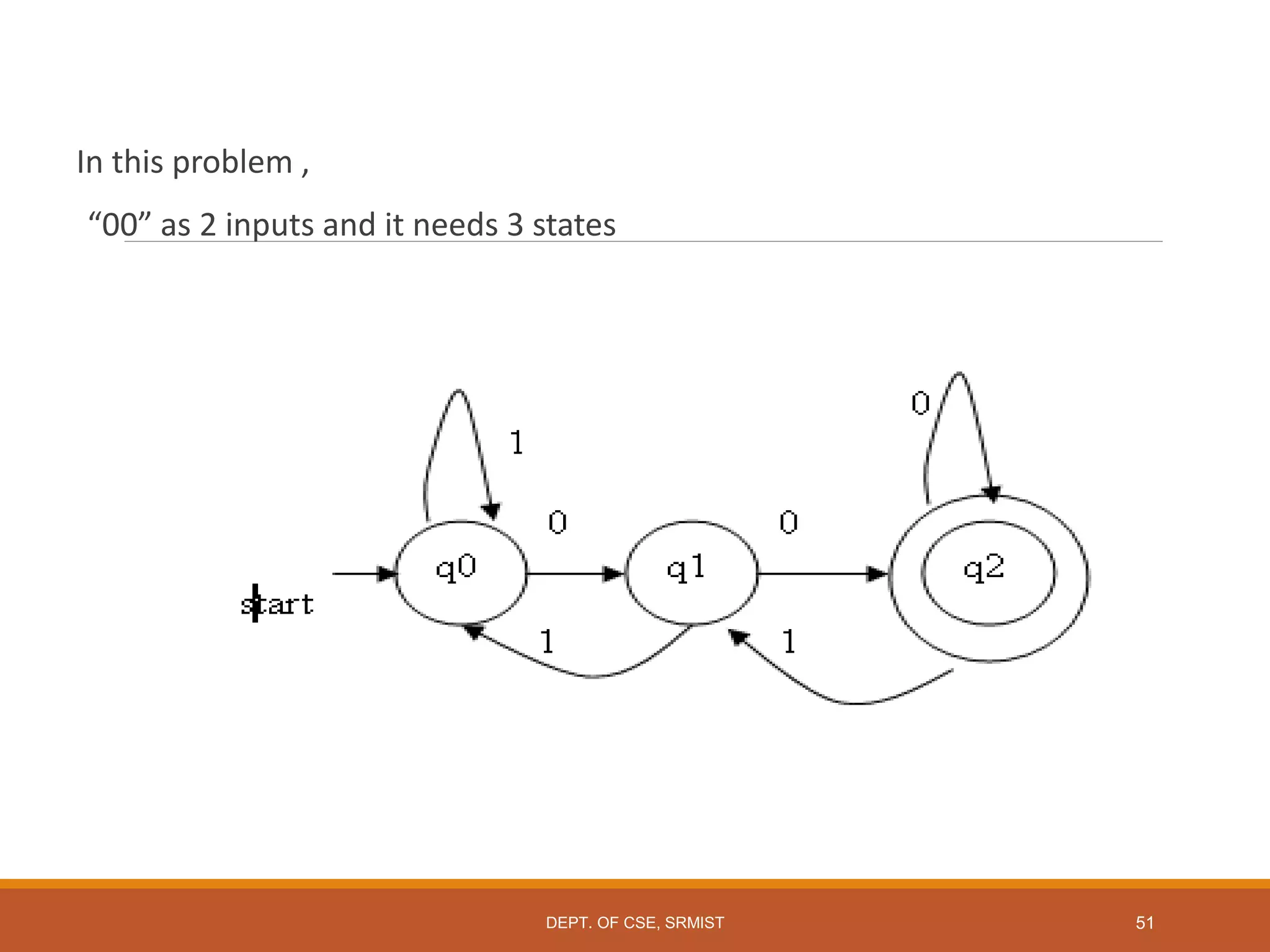
Given a DFA accepting the following language over the alphabet {0,1}
Set of all the strings ending with 00.
Problem 1
DEPT. OF CSE, SRMIST 50
In this problem ,
“00” as 2 inputs and it needs 3 states
DEPT. OF CSE, SRMIST 51
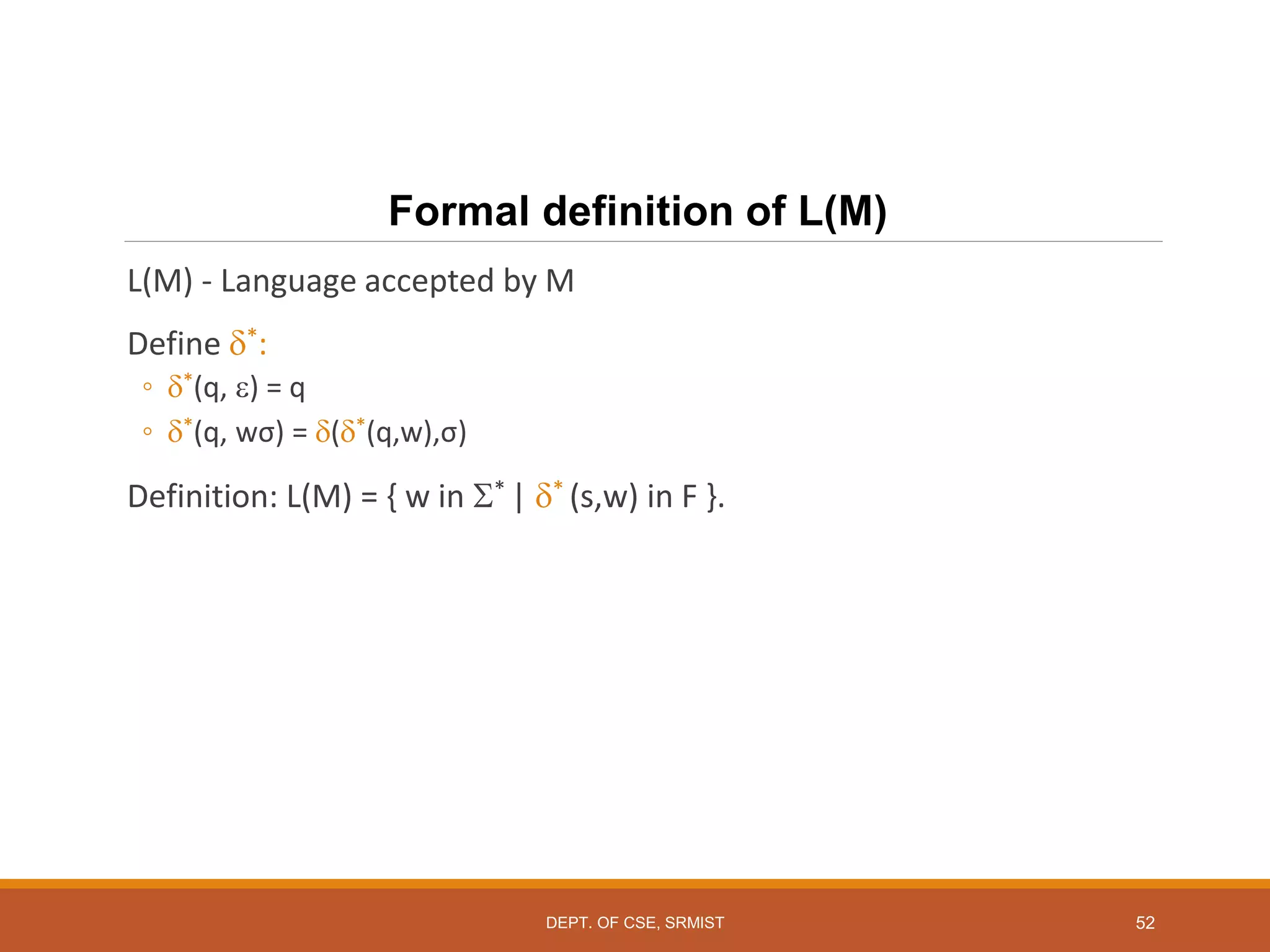
52
Formal definition of L(M)
L(M) - Language accepted by M
Define *:
◦ *(q, ) = q
◦ *(q, wσ) = (*(q,w),σ)
Definition: L(M) = { w in * | * (s,w) in F }.
DEPT. OF CSE, SRMIST
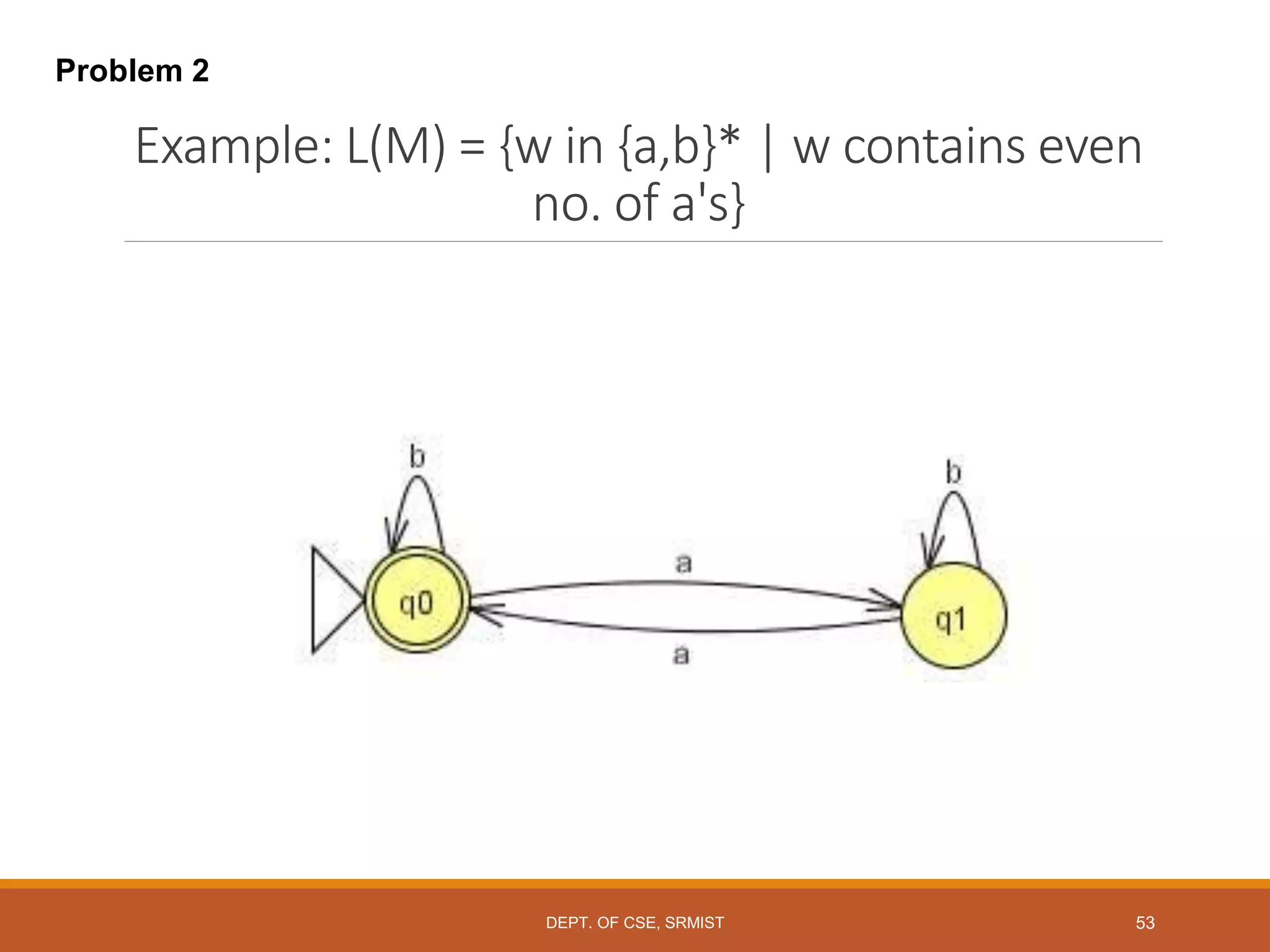
53
Example: L(M) = {w in {a,b}* | w contains even
no. of a's}
Problem 2
DEPT. OF CSE, SRMIST
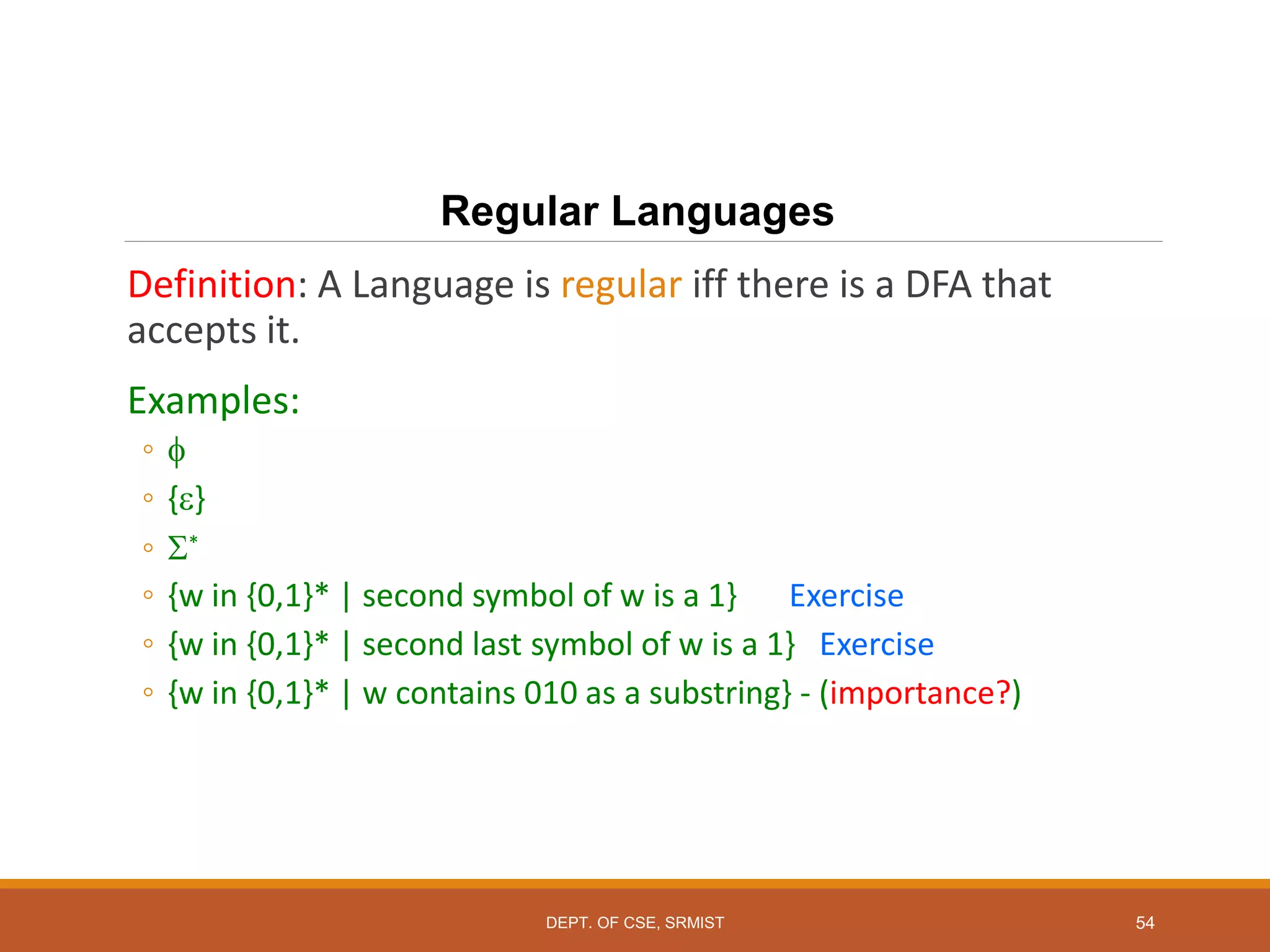
54
Regular Languages
Definition: A Language is regular iff there is a DFA that
accepts it.
Examples:
◦ 
◦ {}
◦ *
◦ {w in {0,1}* | second symbol of w is a 1} Exercise
◦ {w in {0,1}* | second last symbol of w is a 1} Exercise
◦ {w in {0,1}* | w contains 010 as a substring} - (importance?)
DEPT. OF CSE, SRMIST
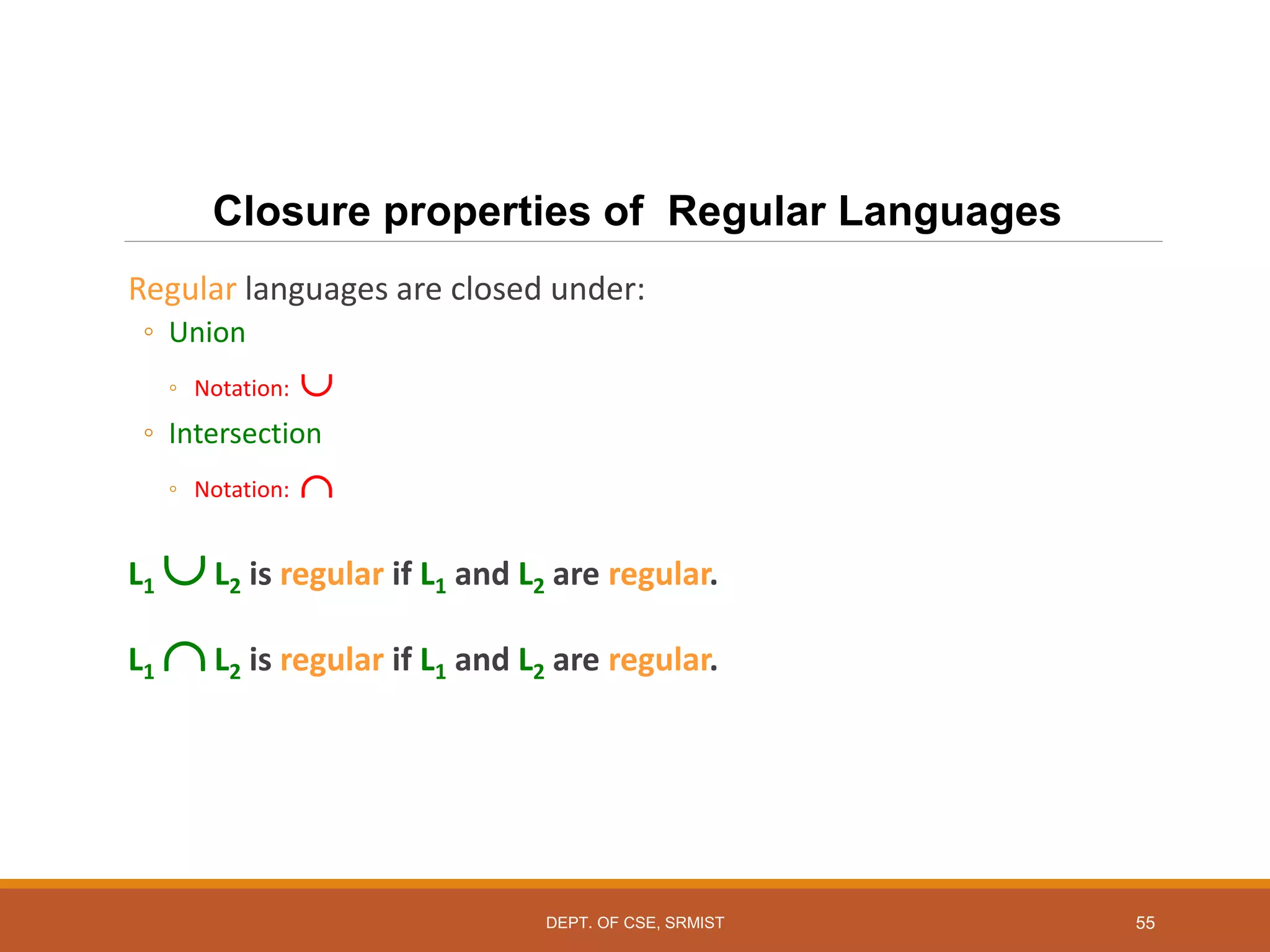
55
Closure properties of Regular Languages
Regular languages are closed under:
◦ Union
◦ Notation: 
◦ Intersection
◦ Notation: 
L1 L2 is regular if L1 and L2 are regular.
L1 L2 is regular if L1 and L2 are regular.
DEPT. OF CSE, SRMIST
56
Examples
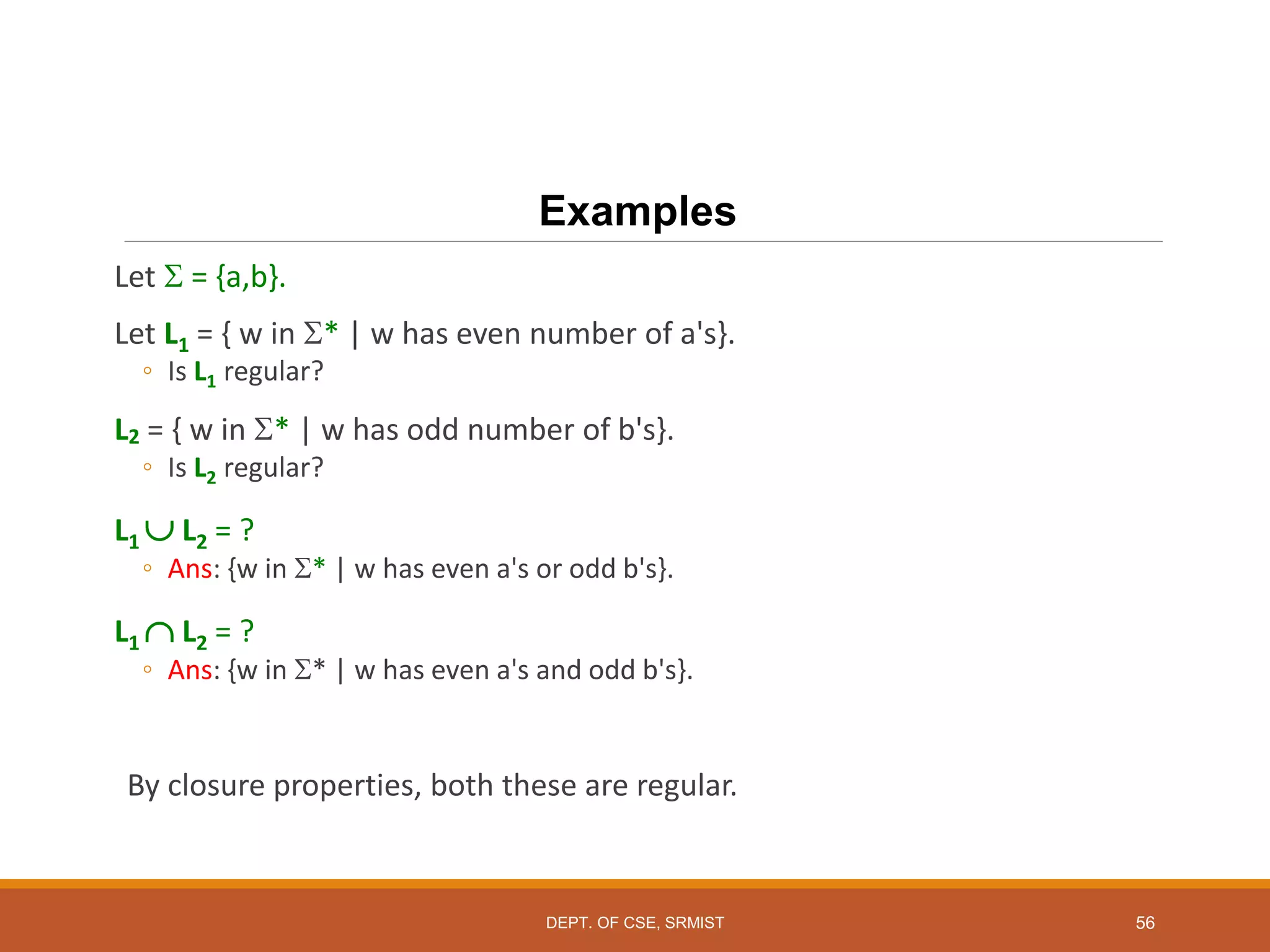
Let  = {a,b}.
Let L1 = { w in * | w has even number of a's}.
◦ Is L1 regular?
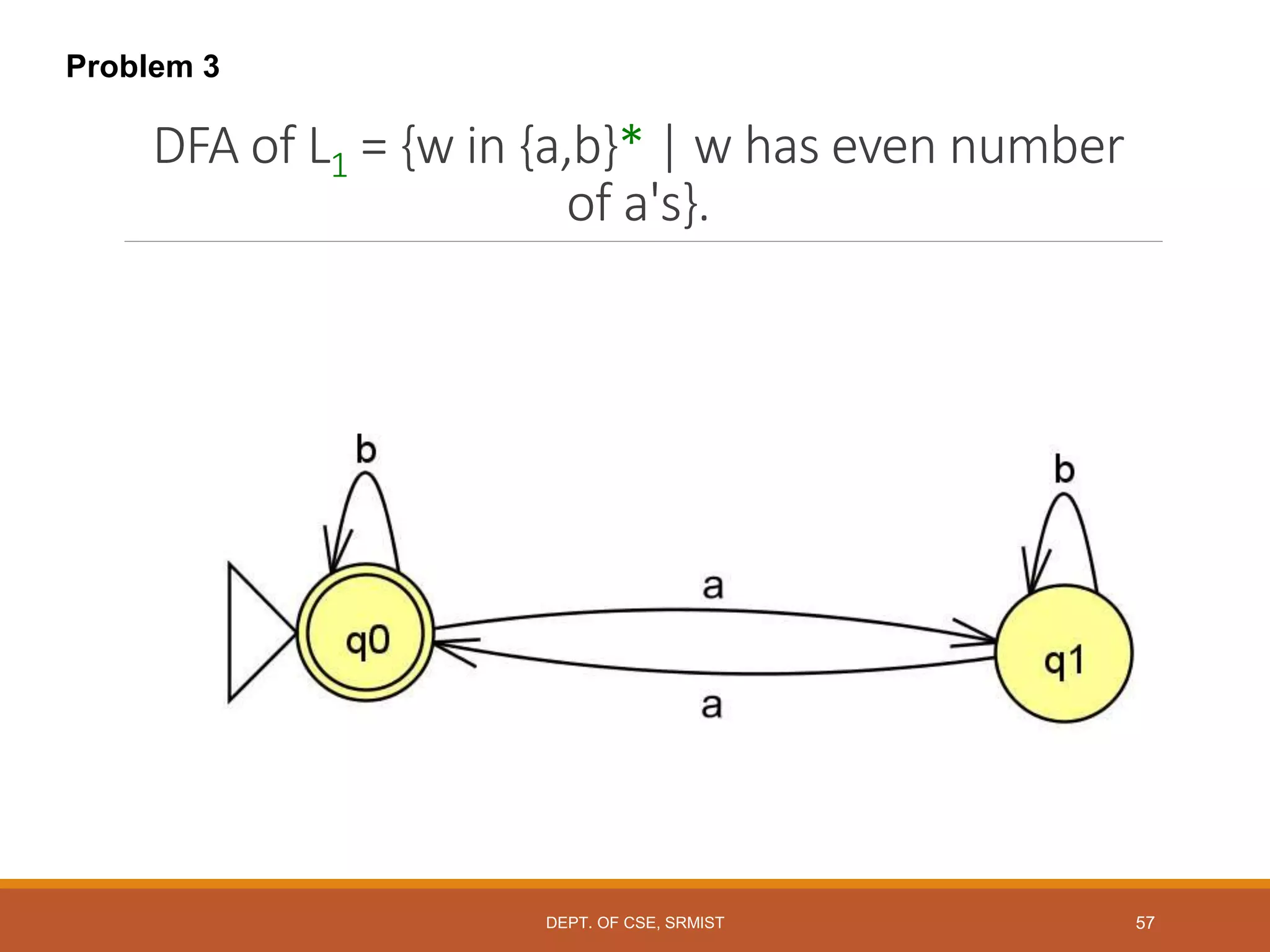
L2 = { w in * | w has odd number of b's}.
◦ Is L2 regular?
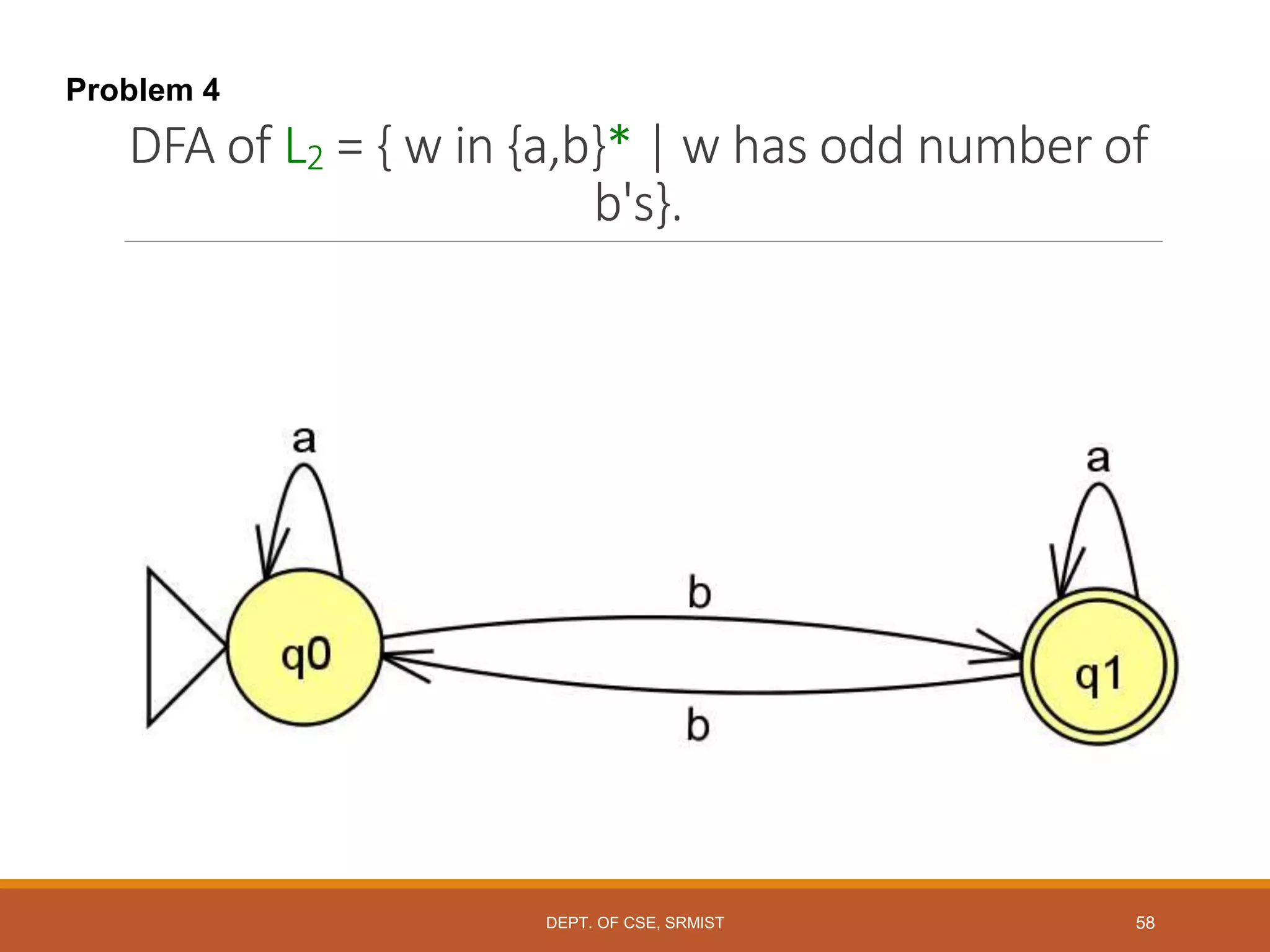
L1  L2 = ?
◦ Ans: {w in * | w has even a's or odd b's}.
L1  L2 = ?
◦ Ans: {w in * | w has even a's and odd b's}.
By closure properties, both these are regular.
DEPT. OF CSE, SRMIST
57
DFA of L1 = {w in {a,b}* | w has even number
of a's}.
Problem 3
DEPT. OF CSE, SRMIST
58
DFA of L2 = { w in {a,b}* | w has odd number of
b's}.
Problem 4
DEPT. OF CSE, SRMIST
59
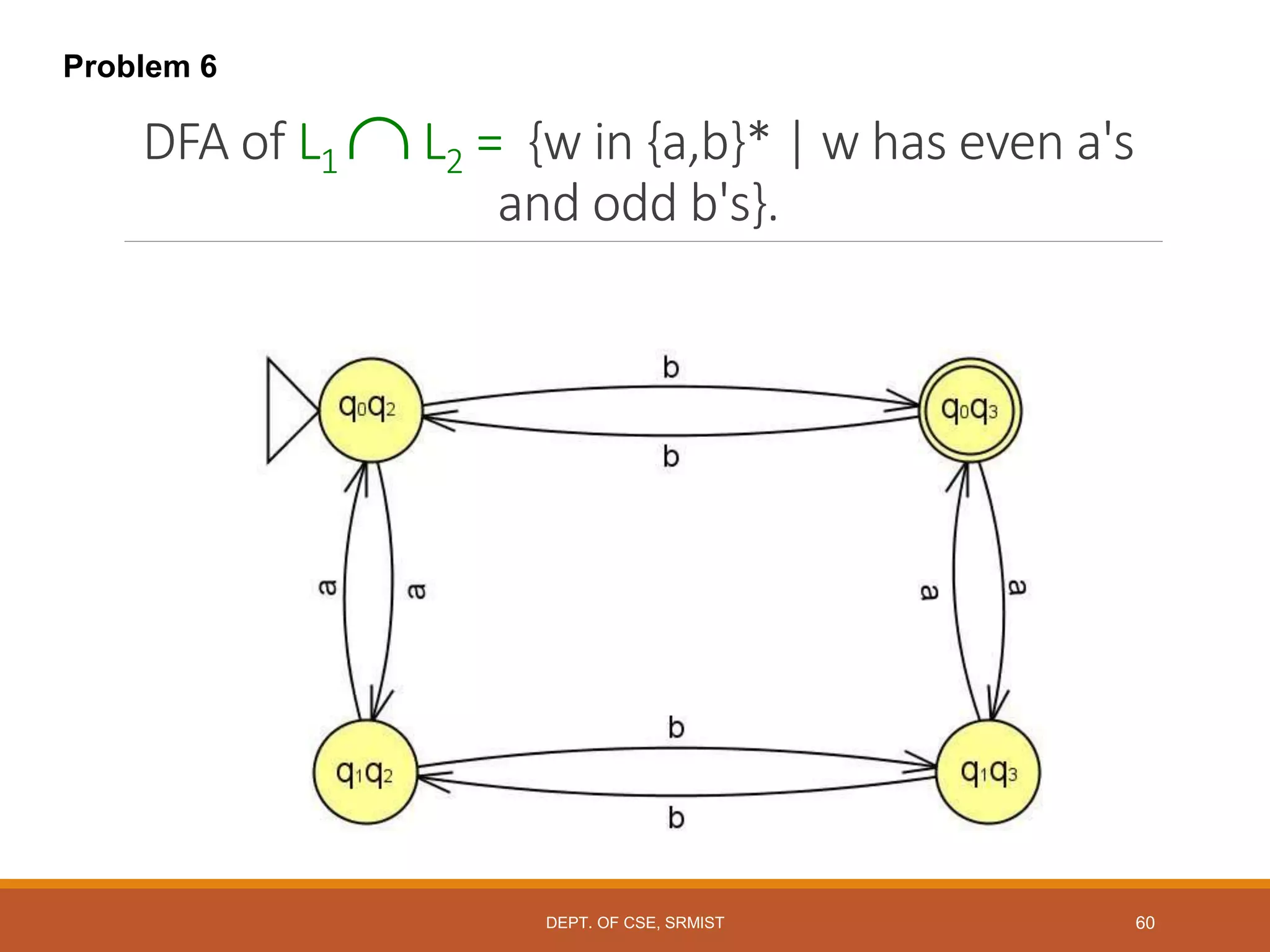
DFA of L1 L2 = {w in {a,b}* | w has even a's
or odd b's}.
Problem 5
DEPT. OF CSE, SRMIST
60
DFA of L1 L2 = {w in {a,b}* | w has even a's
and odd b's}.
Problem 6
DEPT. OF CSE, SRMIST
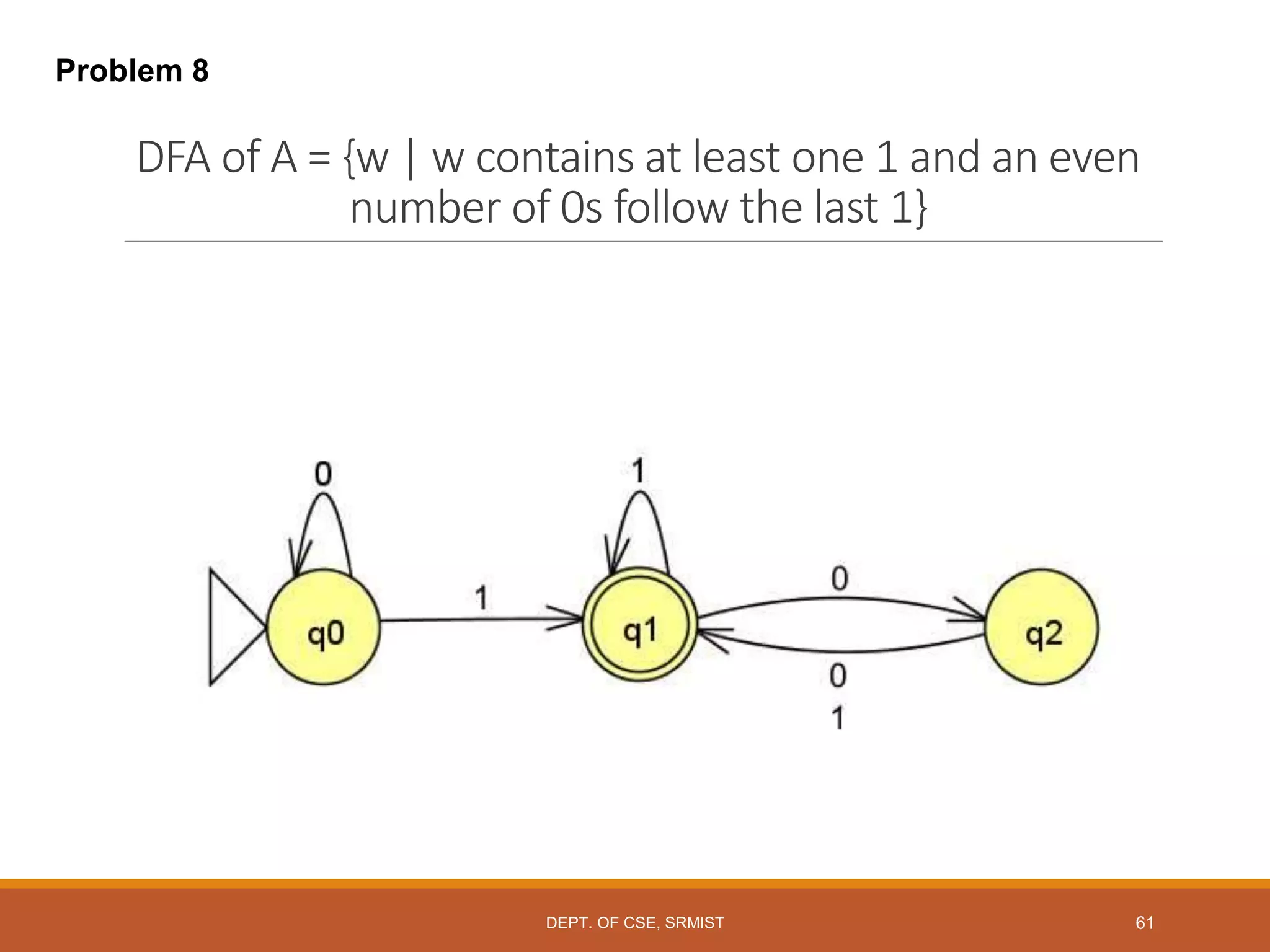
61
DFA of A = {w | w contains at least one 1 and an even
number of 0s follow the last 1}
Problem 8
DEPT. OF CSE, SRMIST
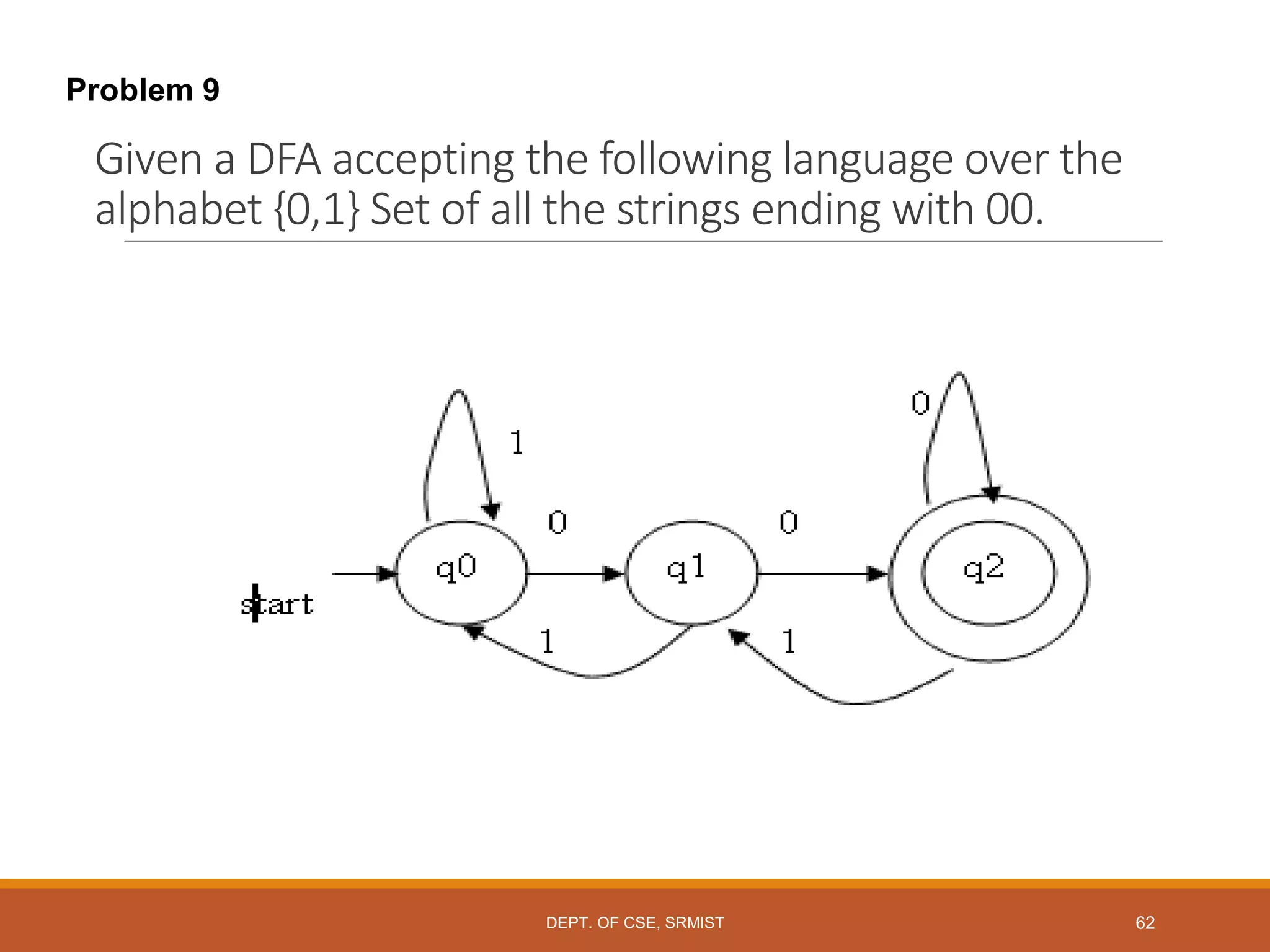
Given a DFA accepting the following language over the
alphabet {0,1} Set of all the strings ending with 00.
Problem 9
DEPT. OF CSE, SRMIST 62
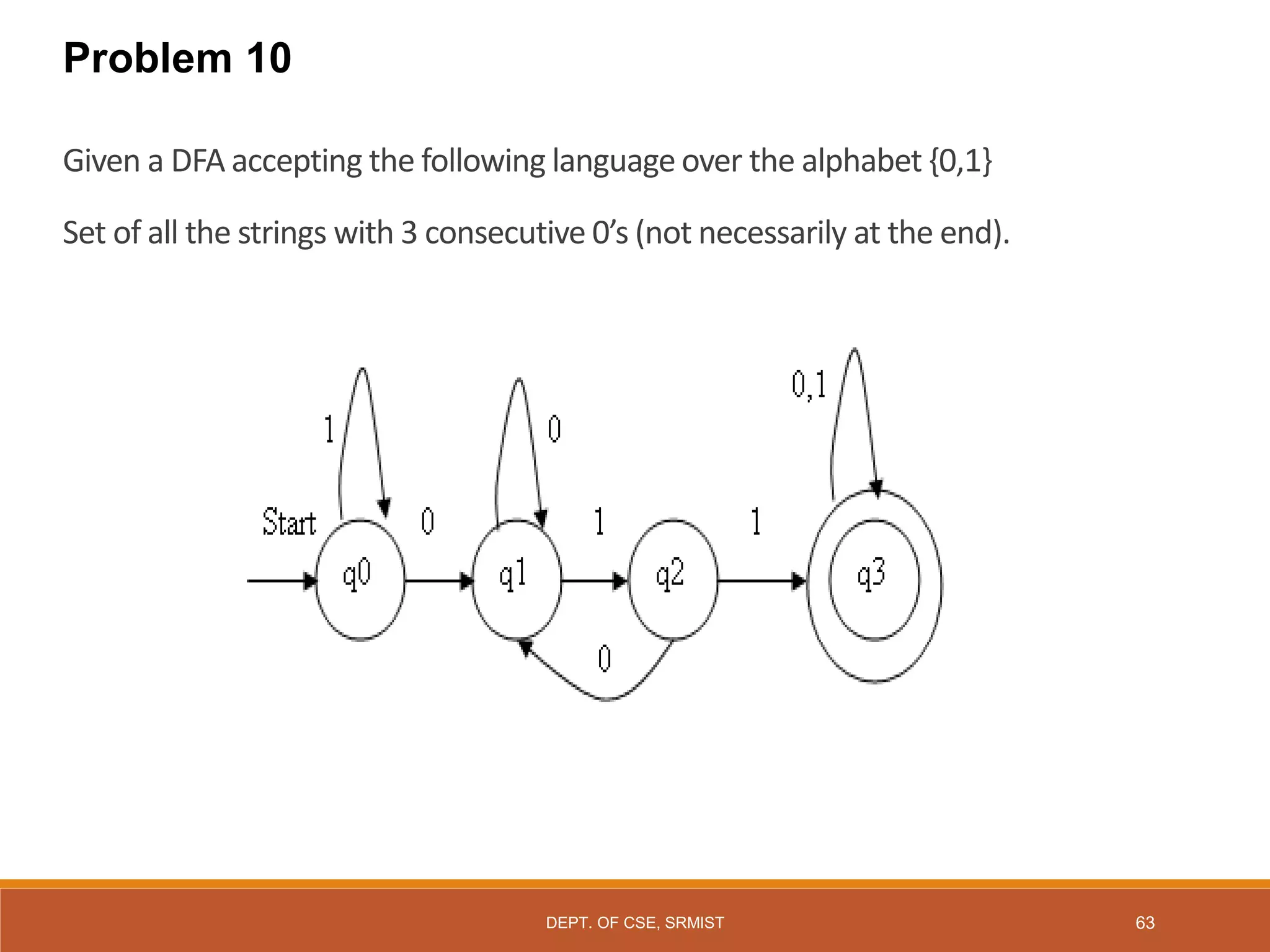
Problem 10
Given a DFA accepting the following language over the alphabet {0,1}
Set of all the strings with 3 consecutive 0’s (not necessarily at the end).
DEPT. OF CSE, SRMIST 63
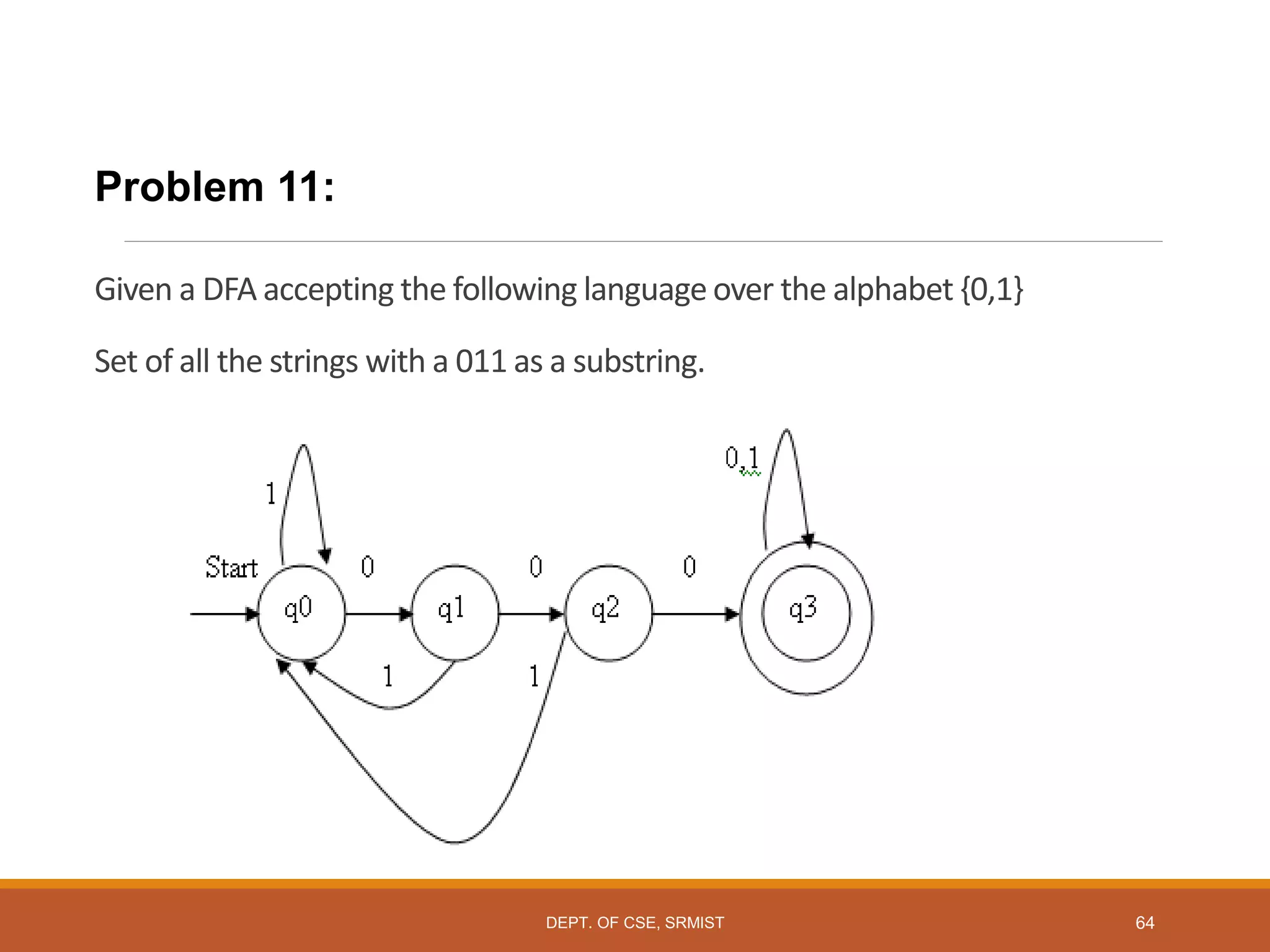
Problem 11:
Given a DFA accepting the following language over the alphabet {0,1}
Set of all the strings with a 011 as a substring.
DEPT. OF CSE, SRMIST 64
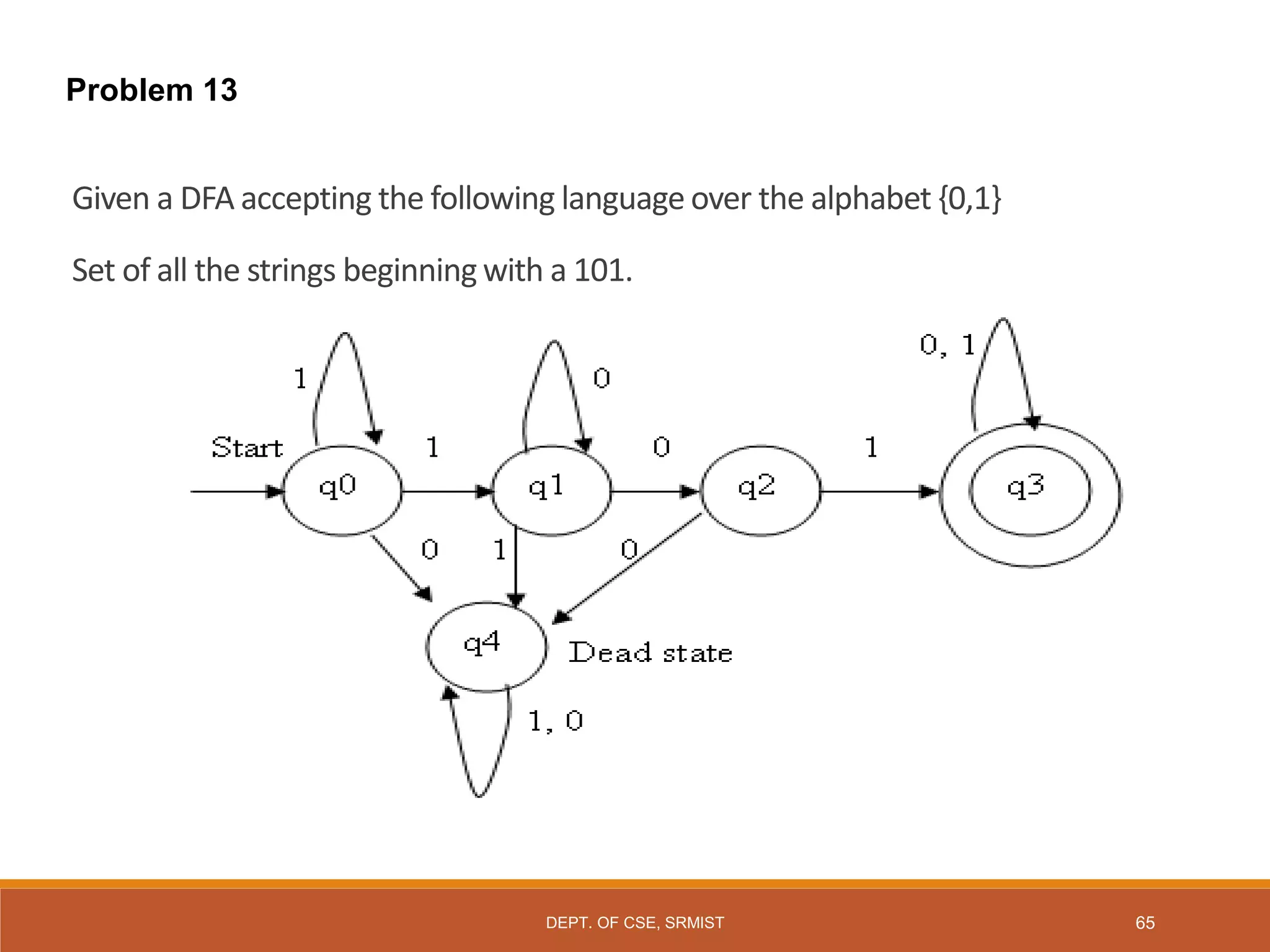
Given a DFA accepting the following language over the alphabet {0,1}
Set of all the strings beginning with a 101.
Problem 13
DEPT. OF CSE, SRMIST 65
Given a DFA accepting the following language over the alphabet {0,1}
Set of all the strings with three consecutive zeros.
Problem 14
DEPT. OF CSE, SRMIST 66
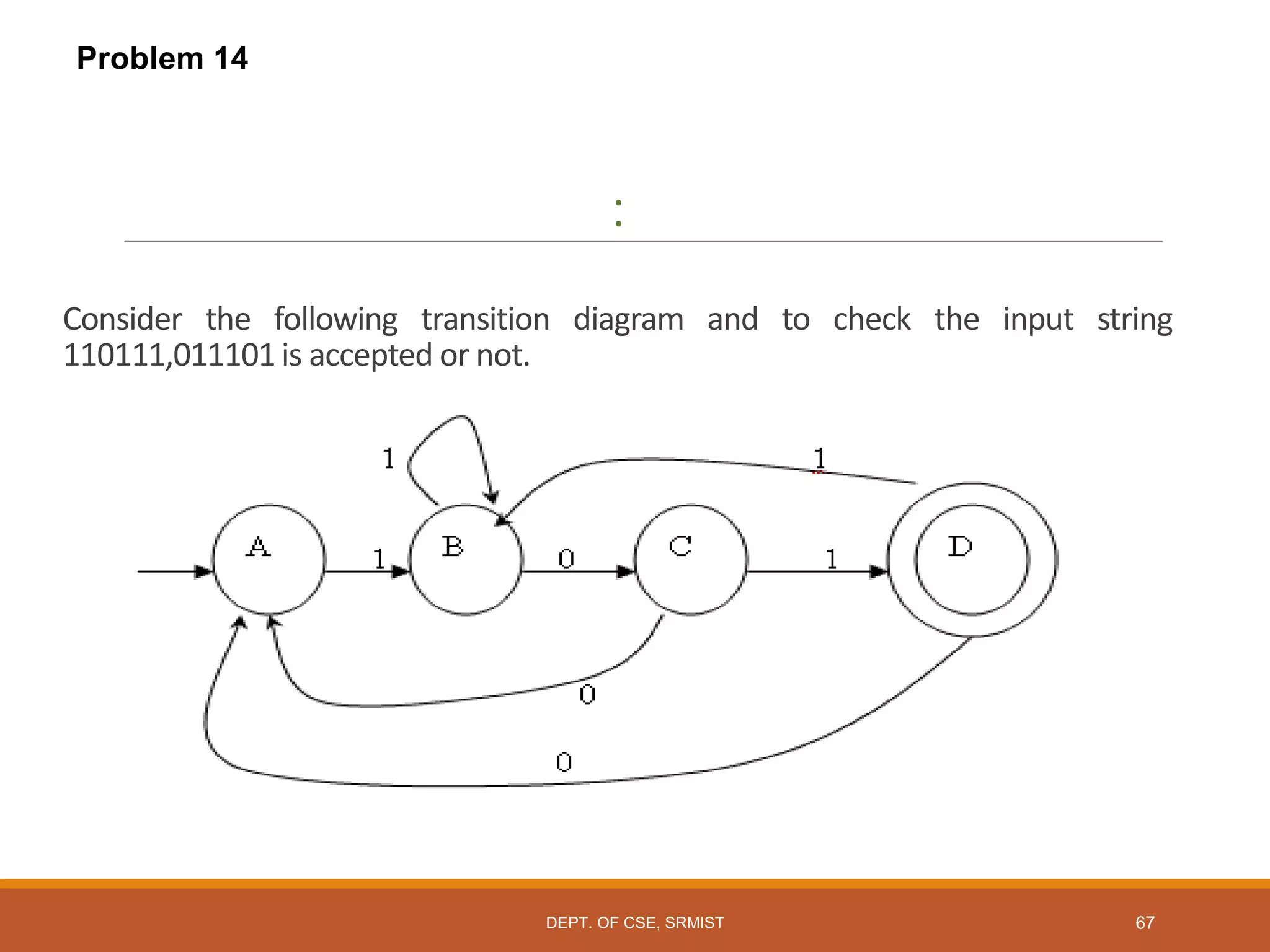
:
Consider the following transition diagram and to check the input string
110111,011101 is accepted or not.
Problem 14
DEPT. OF CSE, SRMIST 67
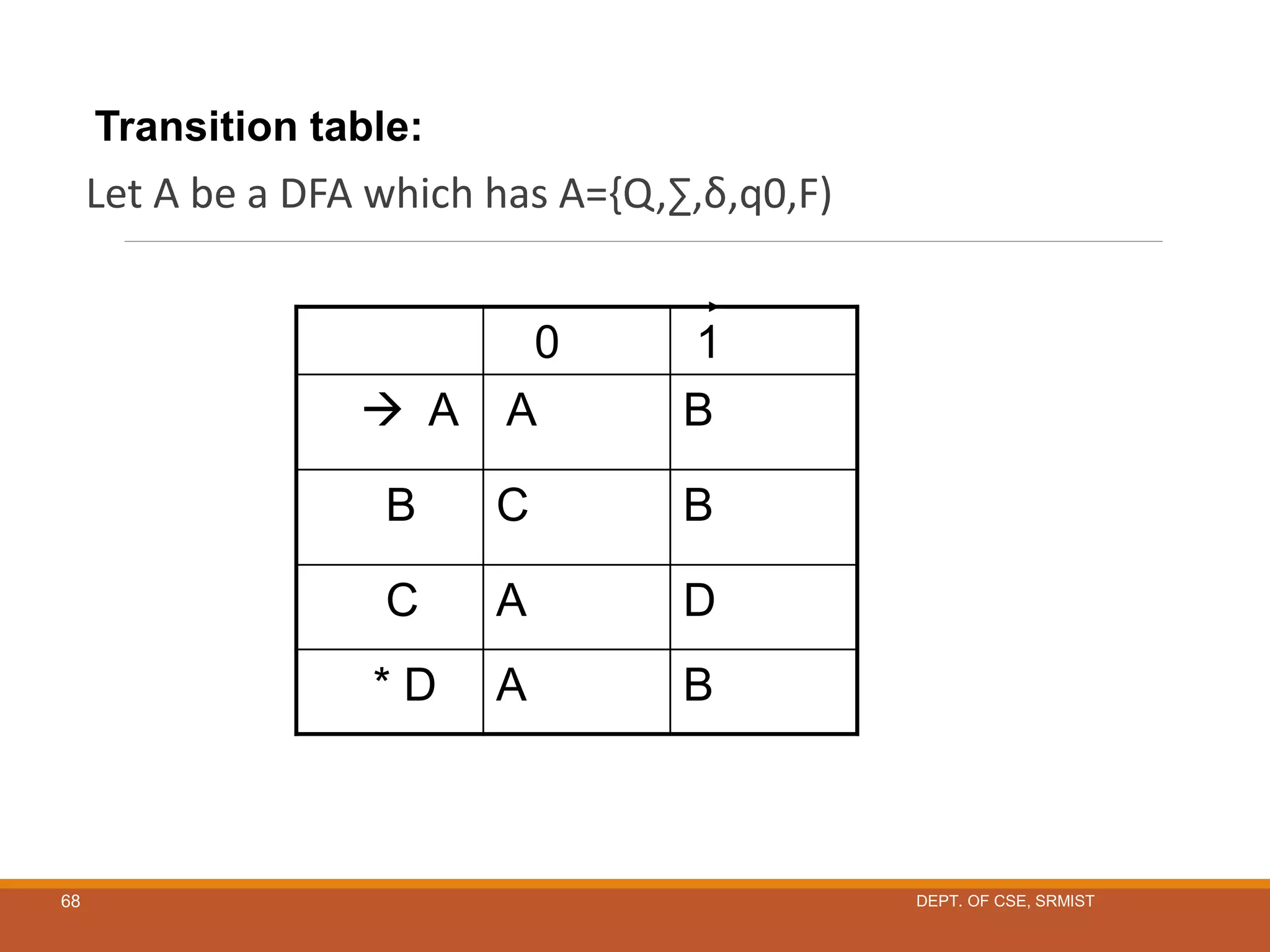
Transition table:
Let A be a DFA which has A={Q,∑,δ,q0,F)
0 1
 A A B
B C B
C A D
* D A B
DEPT. OF CSE, SRMIST
68
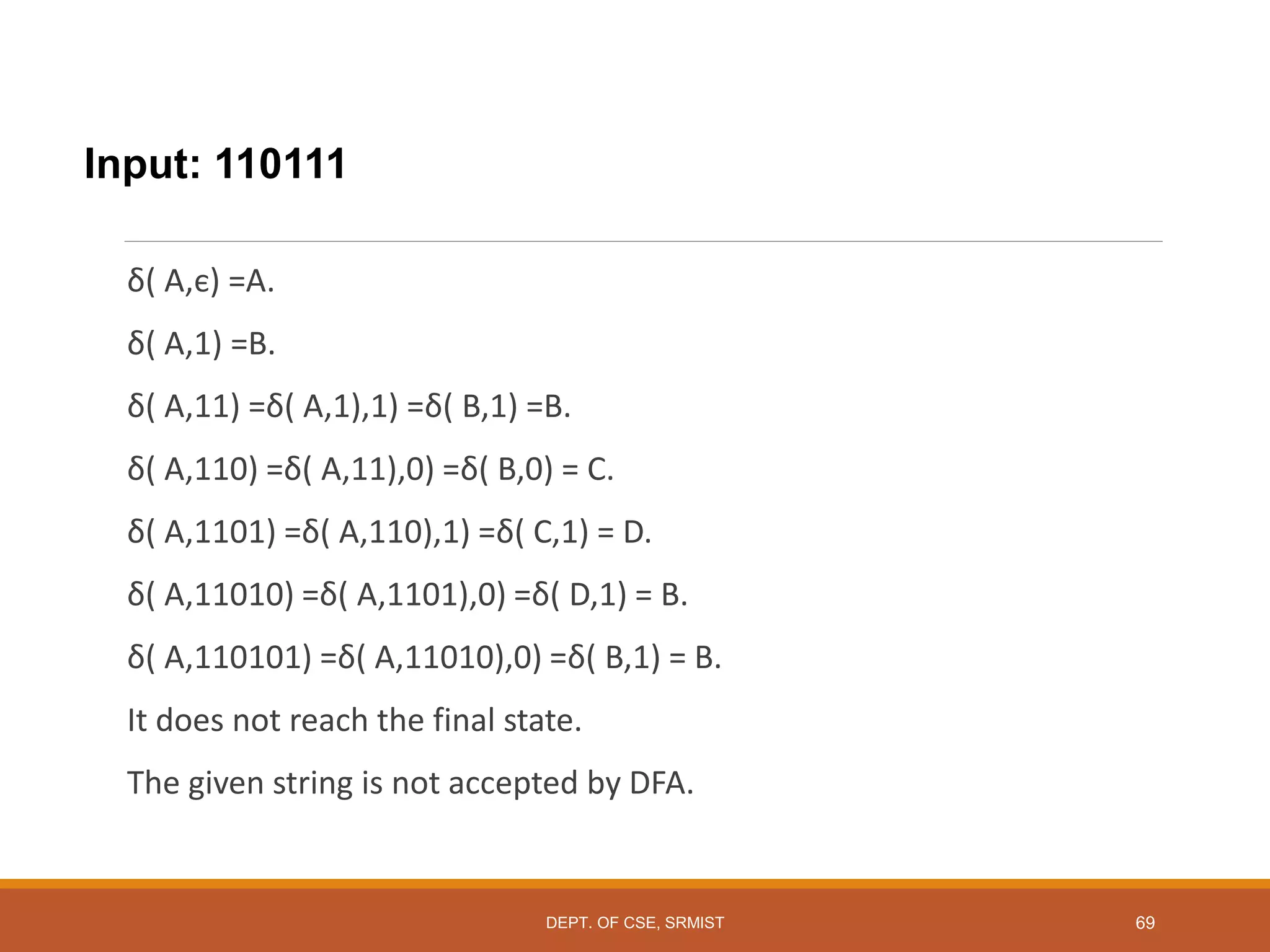
Input: 110111
δ( A,є) =A.
δ( A,1) =B.
δ( A,11) =δ( A,1),1) =δ( B,1) =B.
δ( A,110) =δ( A,11),0) =δ( B,0) = C.
δ( A,1101) =δ( A,110),1) =δ( C,1) = D.
δ( A,11010) =δ( A,1101),0) =δ( D,1) = B.
δ( A,110101) =δ( A,11010),0) =δ( B,1) = B.
It does not reach the final state.
The given string is not accepted by DFA.
DEPT. OF CSE, SRMIST 69
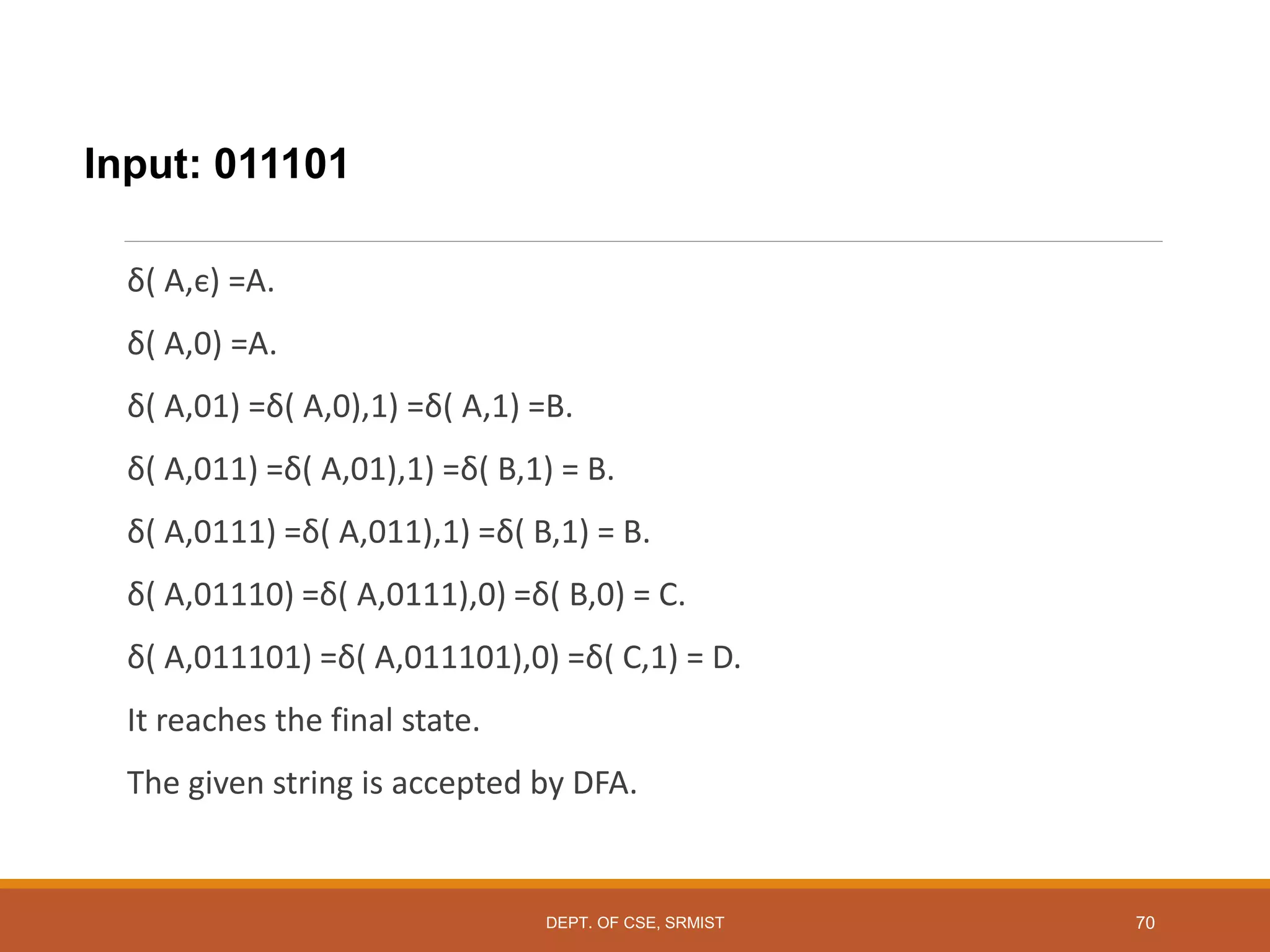
Input: 011101
δ( A,є) =A.
δ( A,0) =A.
δ( A,01) =δ( A,0),1) =δ( A,1) =B.
δ( A,011) =δ( A,01),1) =δ( B,1) = B.
δ( A,0111) =δ( A,011),1) =δ( B,1) = B.
δ( A,01110) =δ( A,0111),0) =δ( B,0) = C.
δ( A,011101) =δ( A,011101),0) =δ( C,1) = D.
It reaches the final state.
The given string is accepted by DFA.
DEPT. OF CSE, SRMIST 70
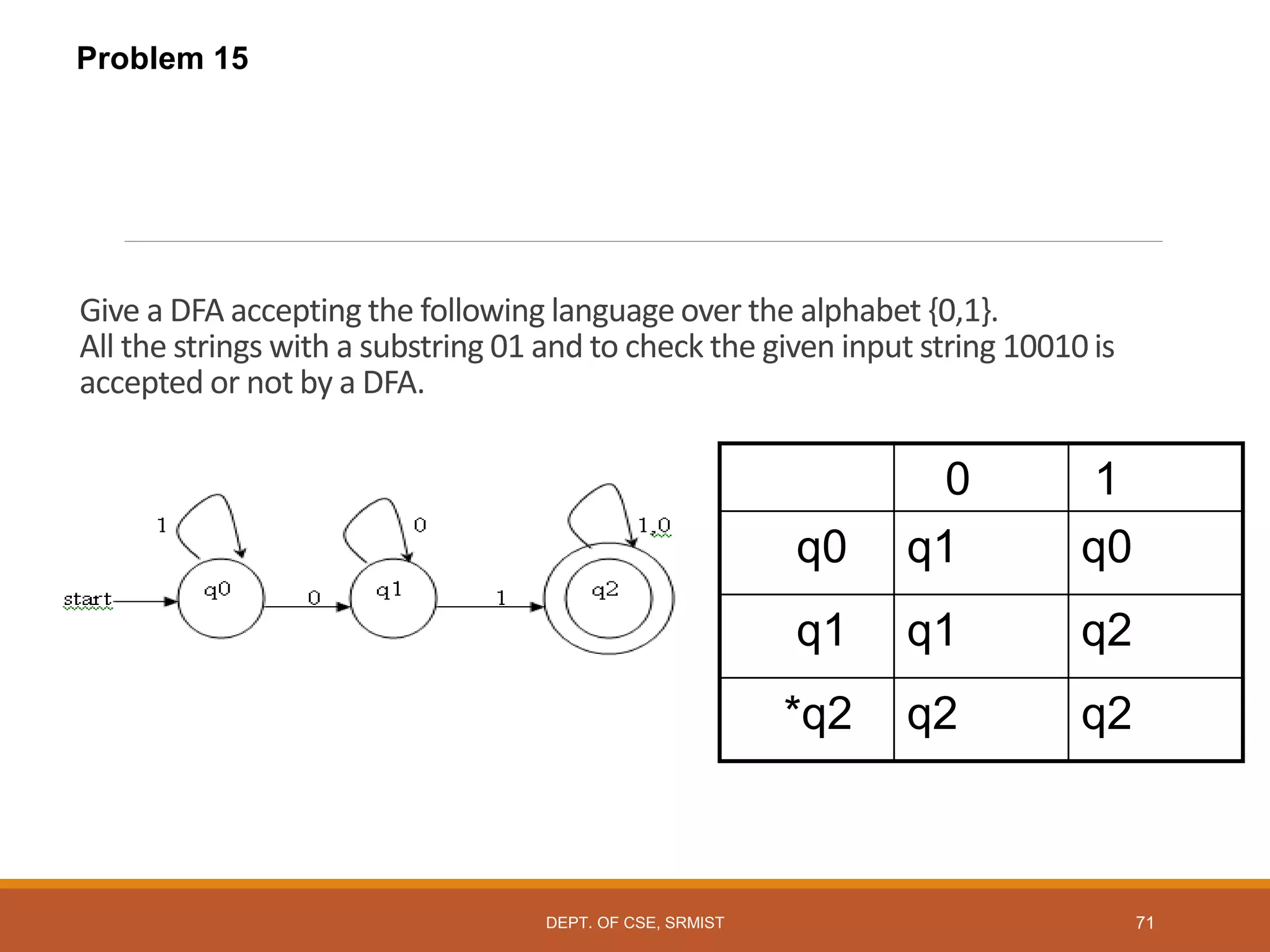
Give a DFA accepting the following language over the alphabet {0,1}.
All the strings with a substring 01 and to check the given input string 10010 is
accepted or not by a DFA.
Problem 15
0 1
q0 q1 q0
q1 q1 q2
*q2 q2 q2
DEPT. OF CSE, SRMIST 71
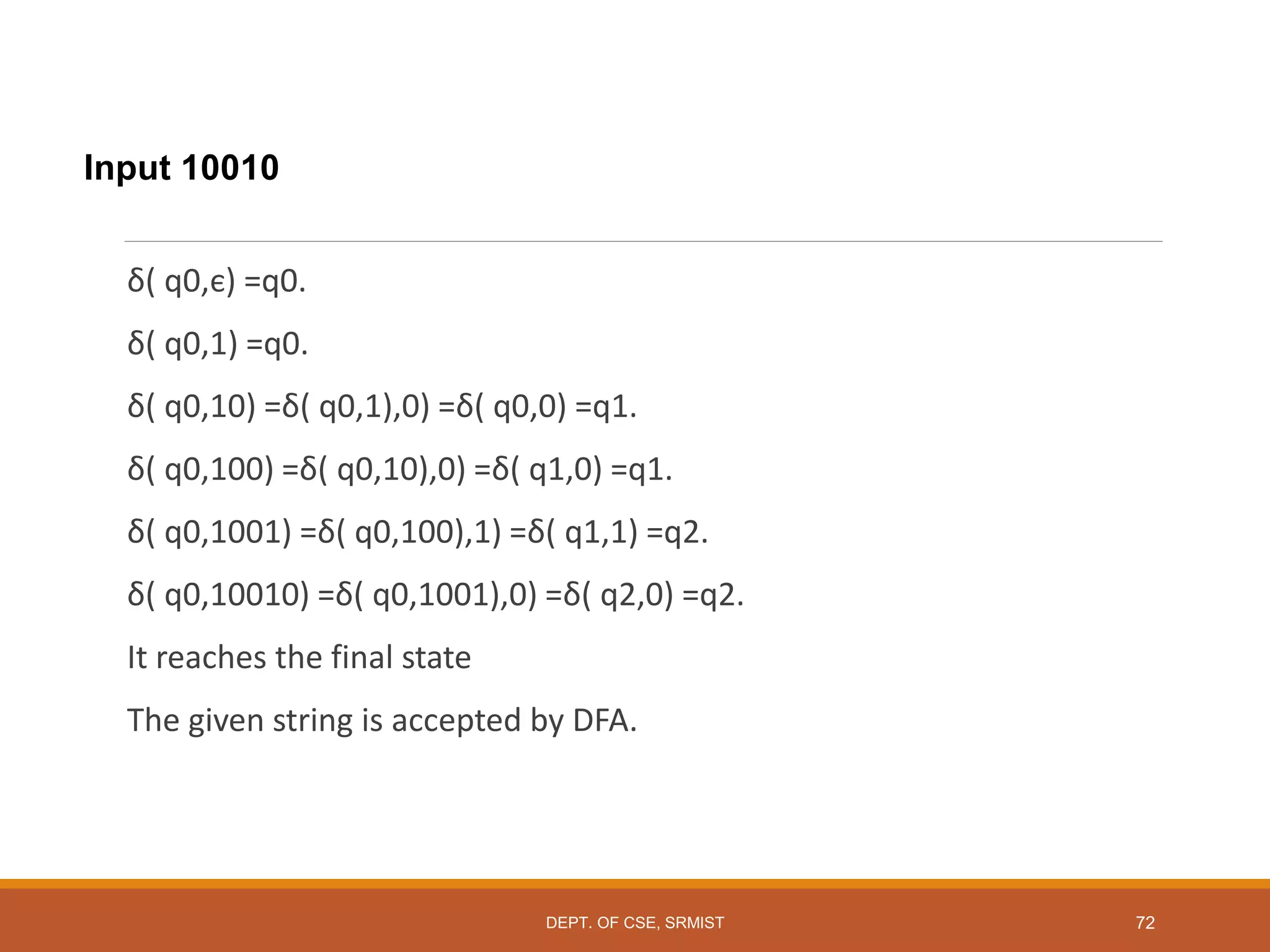
Input 10010
δ( q0,є) =q0.
δ( q0,1) =q0.
δ( q0,10) =δ( q0,1),0) =δ( q0,0) =q1.
δ( q0,100) =δ( q0,10),0) =δ( q1,0) =q1.
δ( q0,1001) =δ( q0,100),1) =δ( q1,1) =q2.
δ( q0,10010) =δ( q0,1001),0) =δ( q2,0) =q2.
It reaches the final state
The given string is accepted by DFA.
DEPT. OF CSE, SRMIST 72
Problem16 :
Design a DFA to accept the language
L ={w/w has an even number of 0’s and even number of 1’s}and to check the given
input strings are 110101 and 10010 is accepted or not by an DFA.
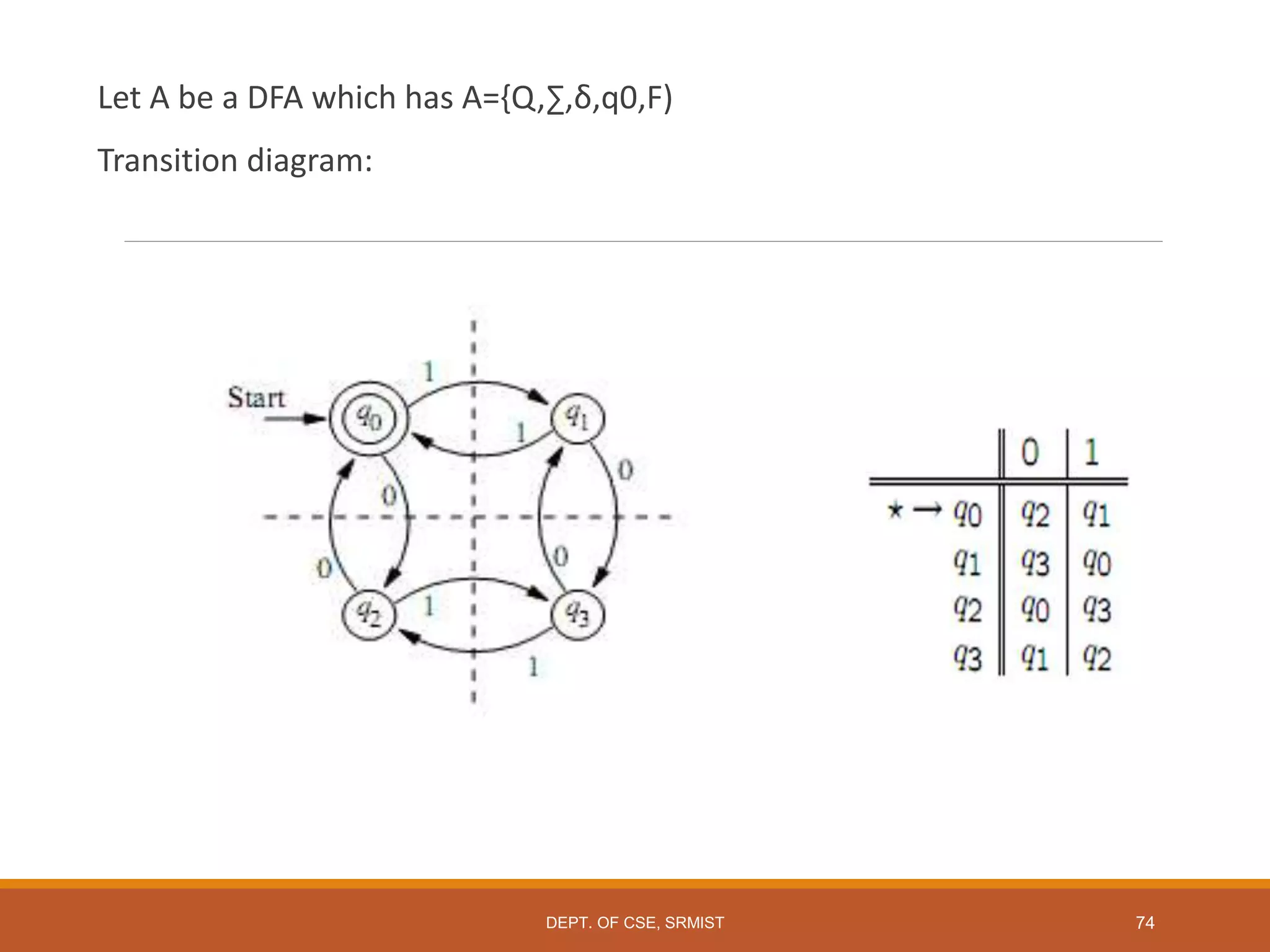
It has the 4 states like q0,q1,q2,q3.
q0: Number of 1’s and number of 0’s are even.
q1: Number of 0’s is even and number of 1’s is odd.
q2: Number of 0’s is odd and number of 1’s is even.
q3: Number of 0’s and number of 1’s are odd.
DEPT. OF CSE, SRMIST 73
Let A be a DFA which has A={Q,∑,δ,q0,F)
Transition diagram:
DEPT. OF CSE, SRMIST 74
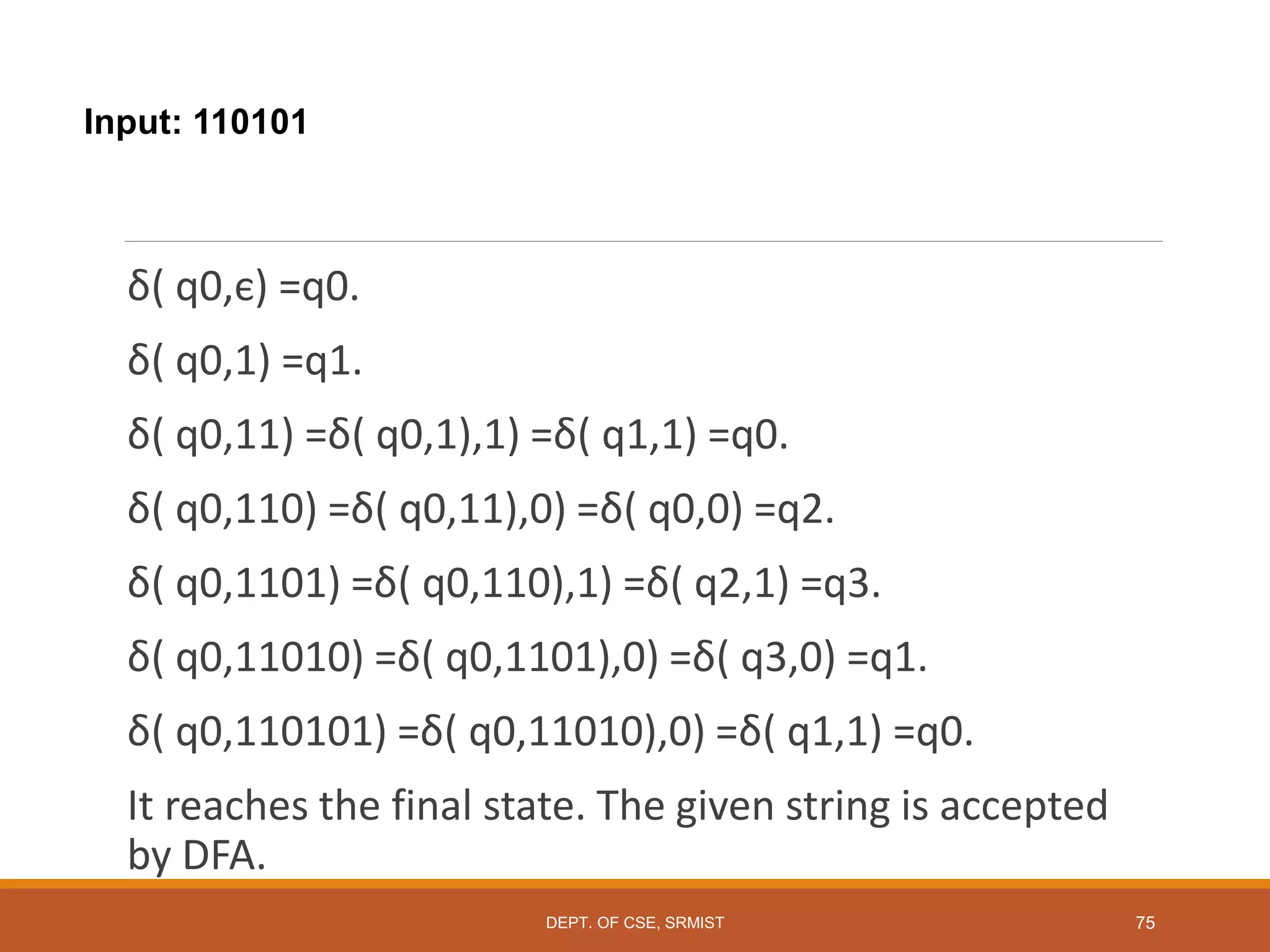
Input: 110101
δ( q0,є) =q0.
δ( q0,1) =q1.
δ( q0,11) =δ( q0,1),1) =δ( q1,1) =q0.
δ( q0,110) =δ( q0,11),0) =δ( q0,0) =q2.
δ( q0,1101) =δ( q0,110),1) =δ( q2,1) =q3.
δ( q0,11010) =δ( q0,1101),0) =δ( q3,0) =q1.
δ( q0,110101) =δ( q0,11010),0) =δ( q1,1) =q0.
It reaches the final state. The given string is accepted
by DFA.
DEPT. OF CSE, SRMIST 75
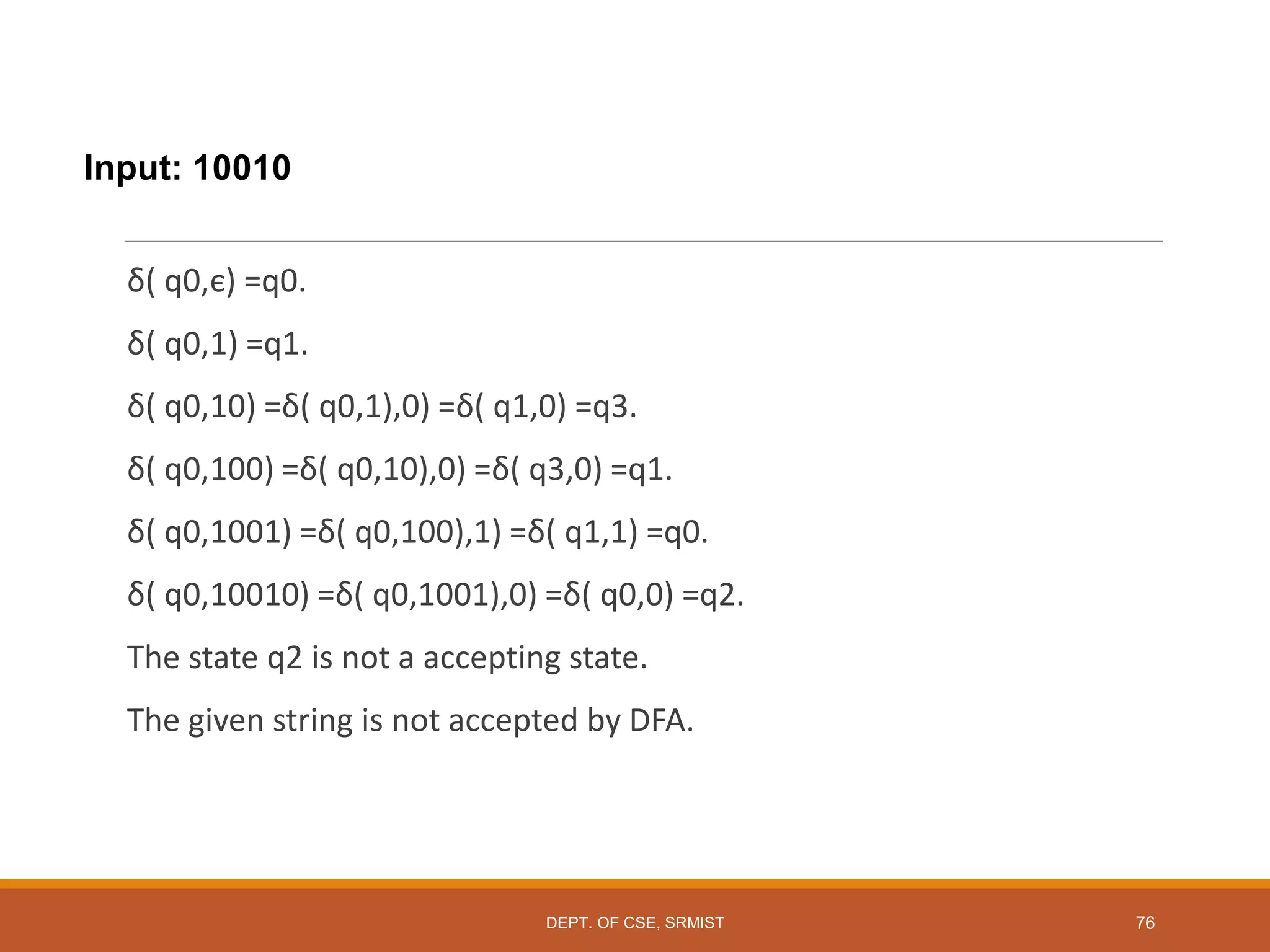
Input: 10010
δ( q0,є) =q0.
δ( q0,1) =q1.
δ( q0,10) =δ( q0,1),0) =δ( q1,0) =q3.
δ( q0,100) =δ( q0,10),0) =δ( q3,0) =q1.
δ( q0,1001) =δ( q0,100),1) =δ( q1,1) =q0.
δ( q0,10010) =δ( q0,1001),0) =δ( q0,0) =q2.
The state q2 is not a accepting state.
The given string is not accepted by DFA.
DEPT. OF CSE, SRMIST 76
77
Nondeterministic Finite Automaton (NFA)
Generalization of DFA. Allows:
◦ 0 or more next states for the same (q, ).
◦ Guessing
◦ Transitions labeled by the empty string.
◦ Changing state without reading input
Motivation: Flexibility.
◦ Easier to prove many closure properties.
DEPT. OF CSE, SRMIST
78
How does an NFA work?
w is accepted by an NFA provided there is a sequence of guesses that
leads to a final state.
Language accepted by NFA is the set of all strings accepted by it.
DEPT. OF CSE, SRMIST
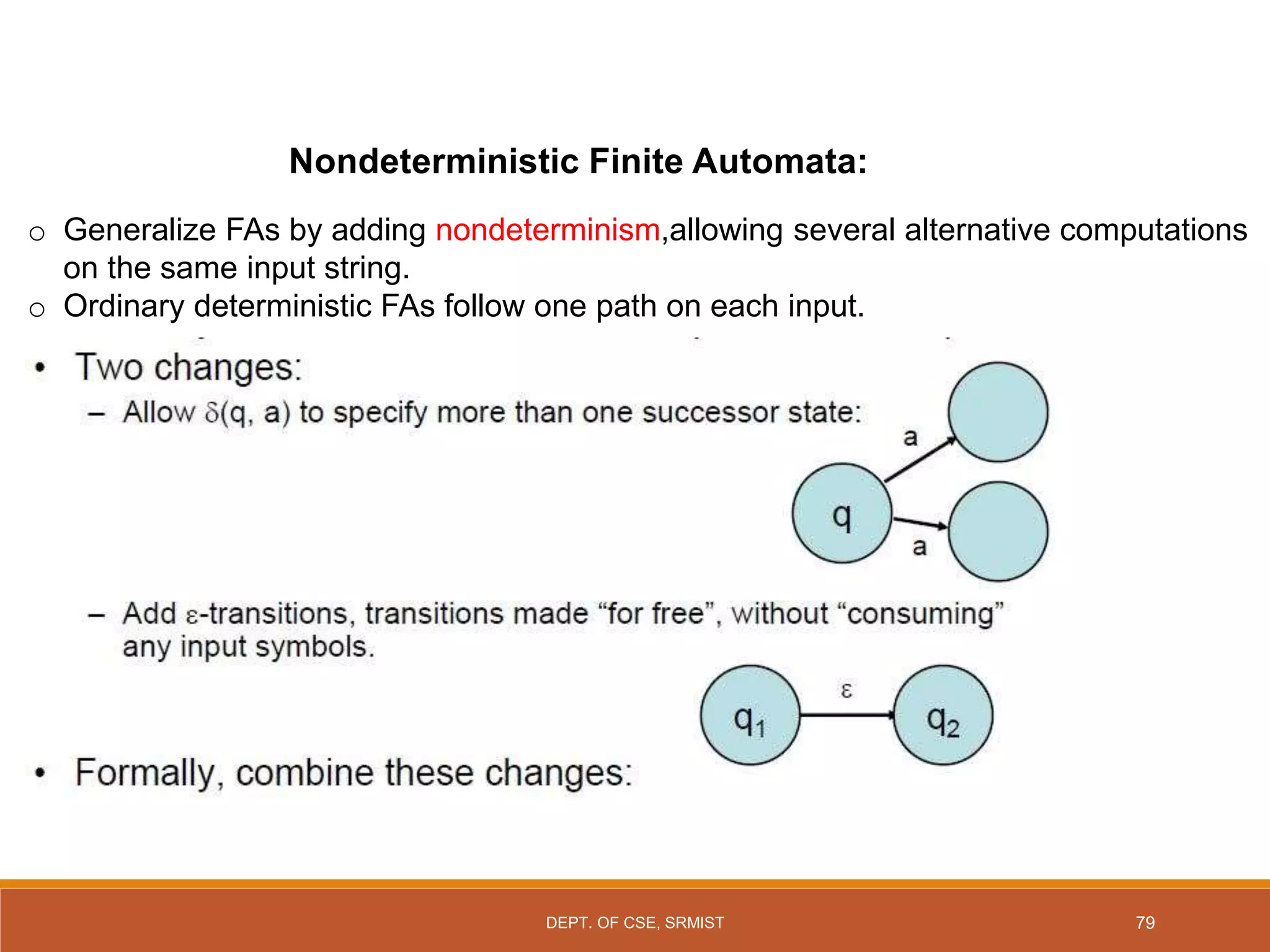
Nondeterministic Finite Automata:
o Generalize FAs by adding nondeterminism,allowing several alternative computations
on the same input string.
o Ordinary deterministic FAs follow one path on each input.
79
DEPT. OF CSE, SRMIST
Nondeterministic Finite Automata:
80
DEPT. OF CSE, SRMIST
Nondeterministic Finite Automata:
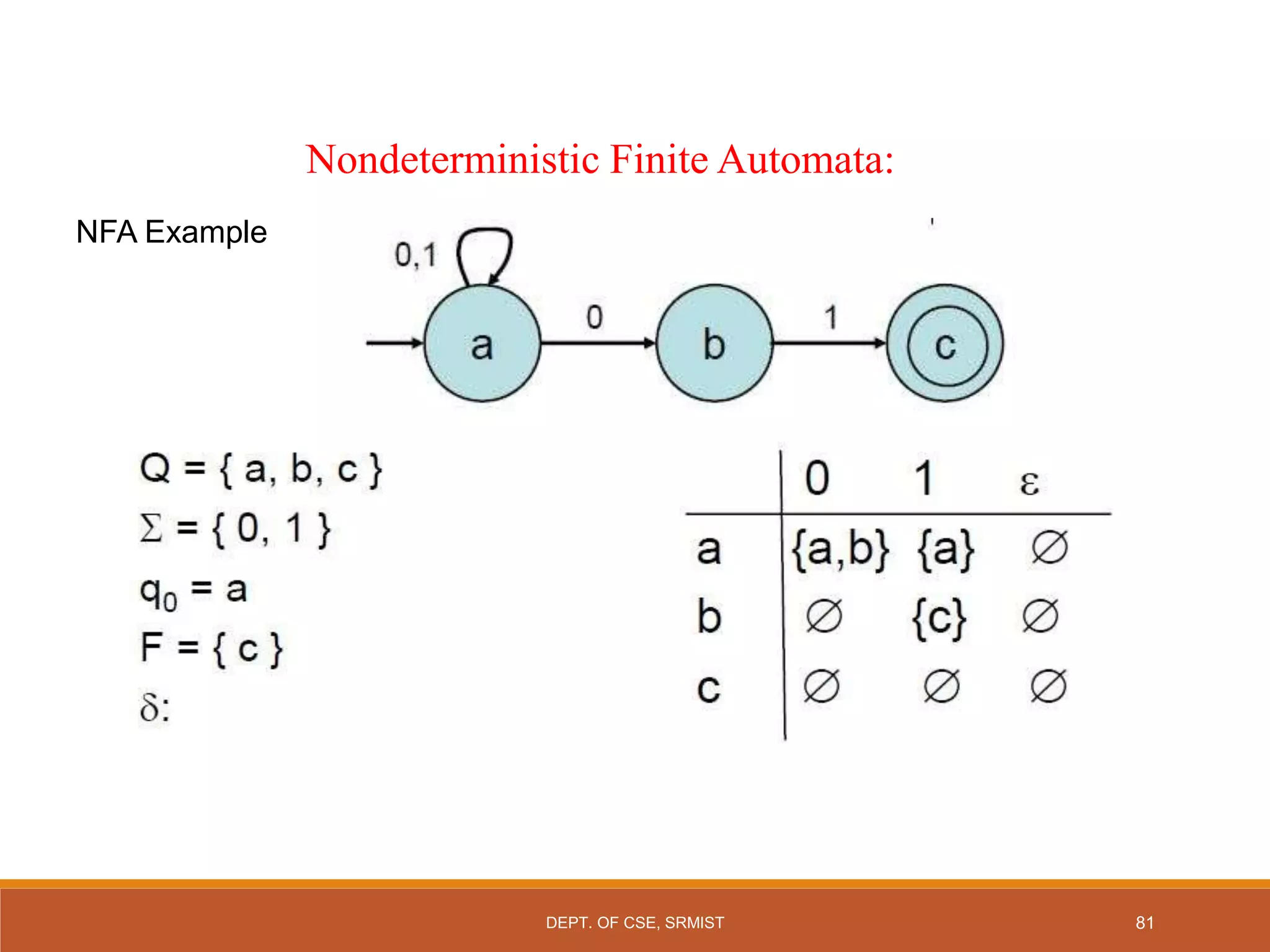
NFA Example
81
DEPT. OF CSE, SRMIST
Nondeterministic Finite Automata:
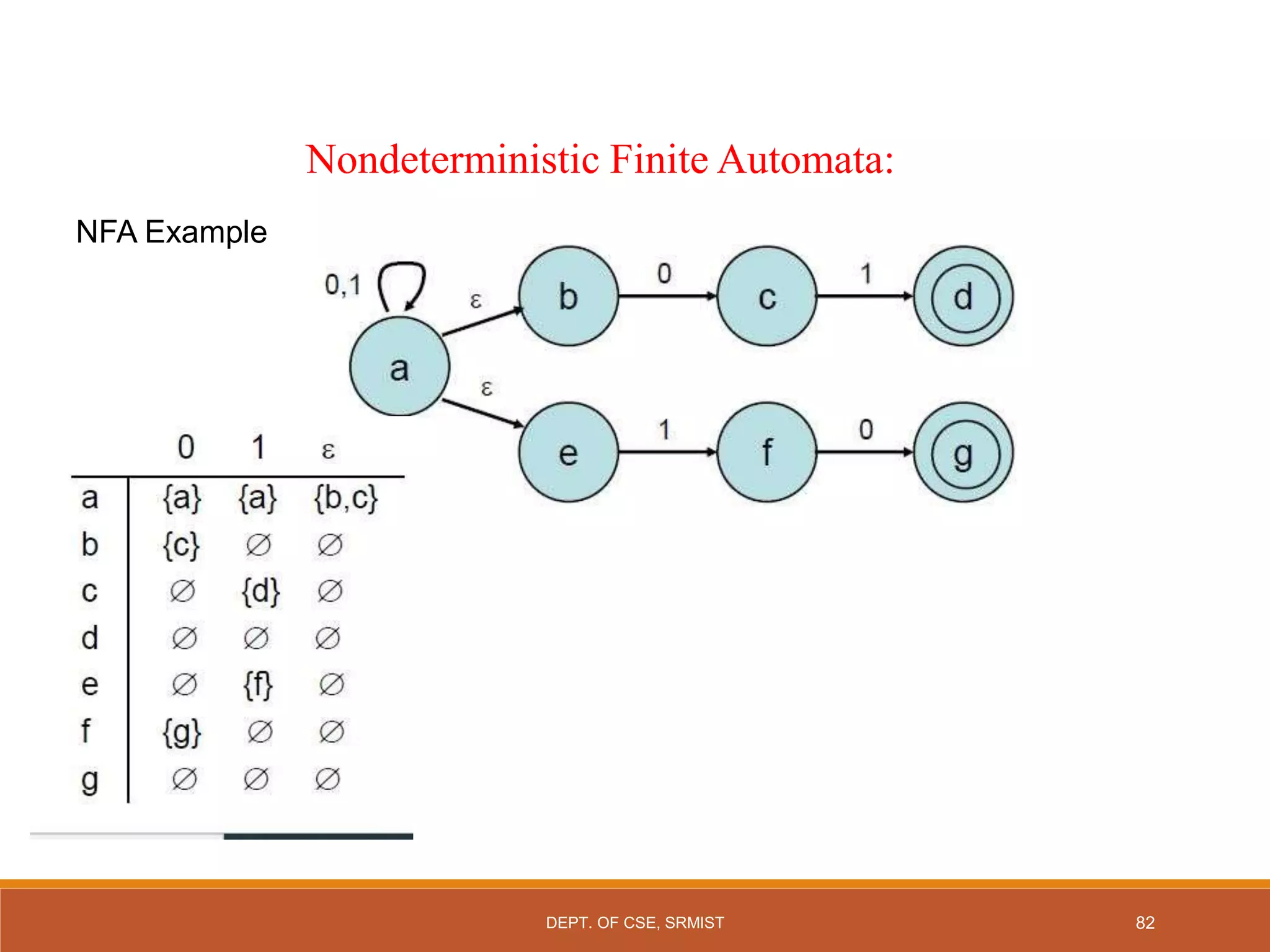
NFA Example
82
DEPT. OF CSE, SRMIST
83
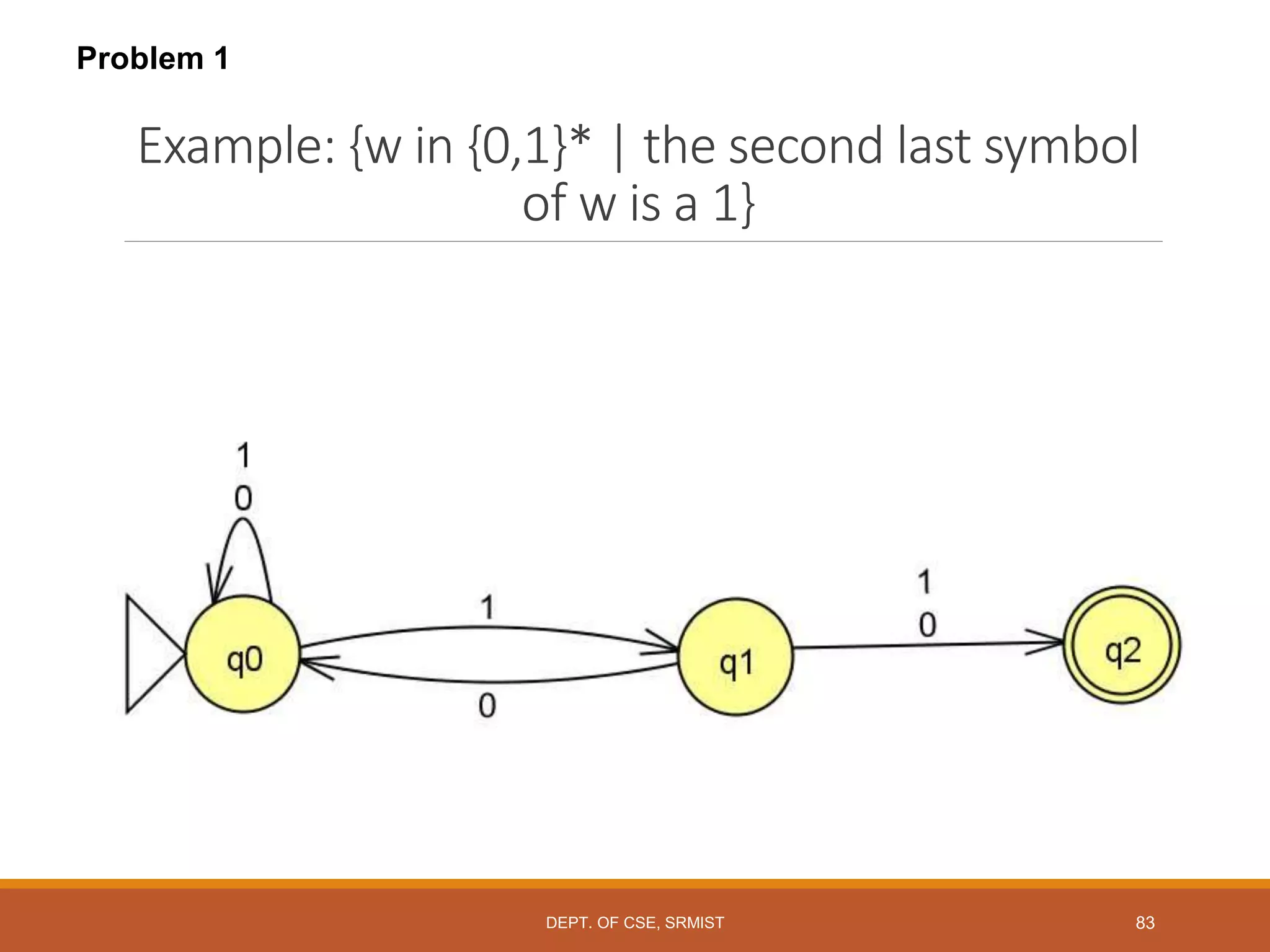
Example: {w in {0,1}* | the second last symbol
of w is a 1}
Problem 1
DEPT. OF CSE, SRMIST
84
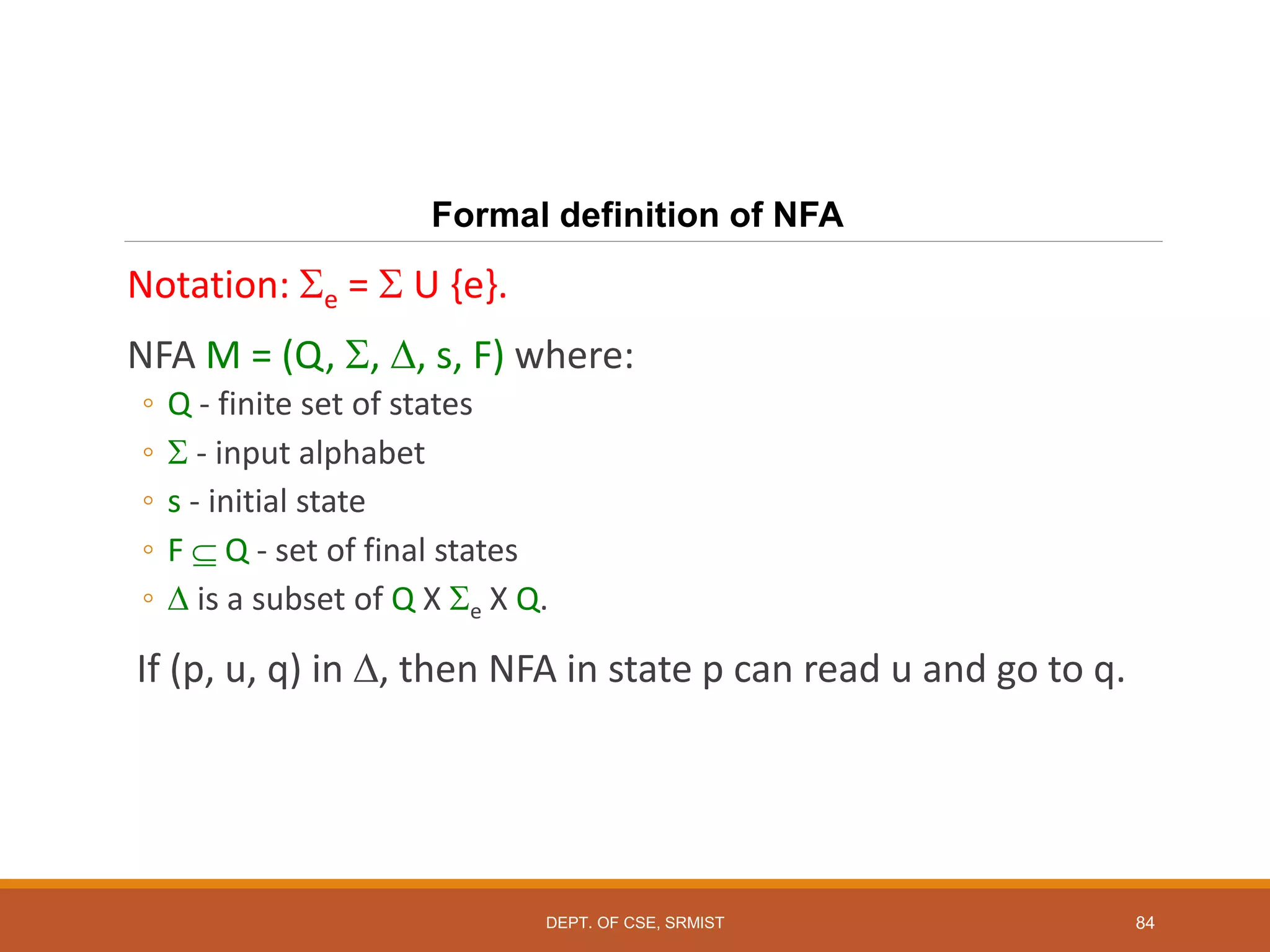
Formal definition of NFA
Notation: e =  U {e}.
NFA M = (Q, , , s, F) where:
◦ Q - finite set of states
◦  - input alphabet
◦ s - initial state
◦ F  Q - set of final states
◦  is a subset of Q X e X Q.
If (p, u, q) in , then NFA in state p can read u and go to q.
DEPT. OF CSE, SRMIST
85
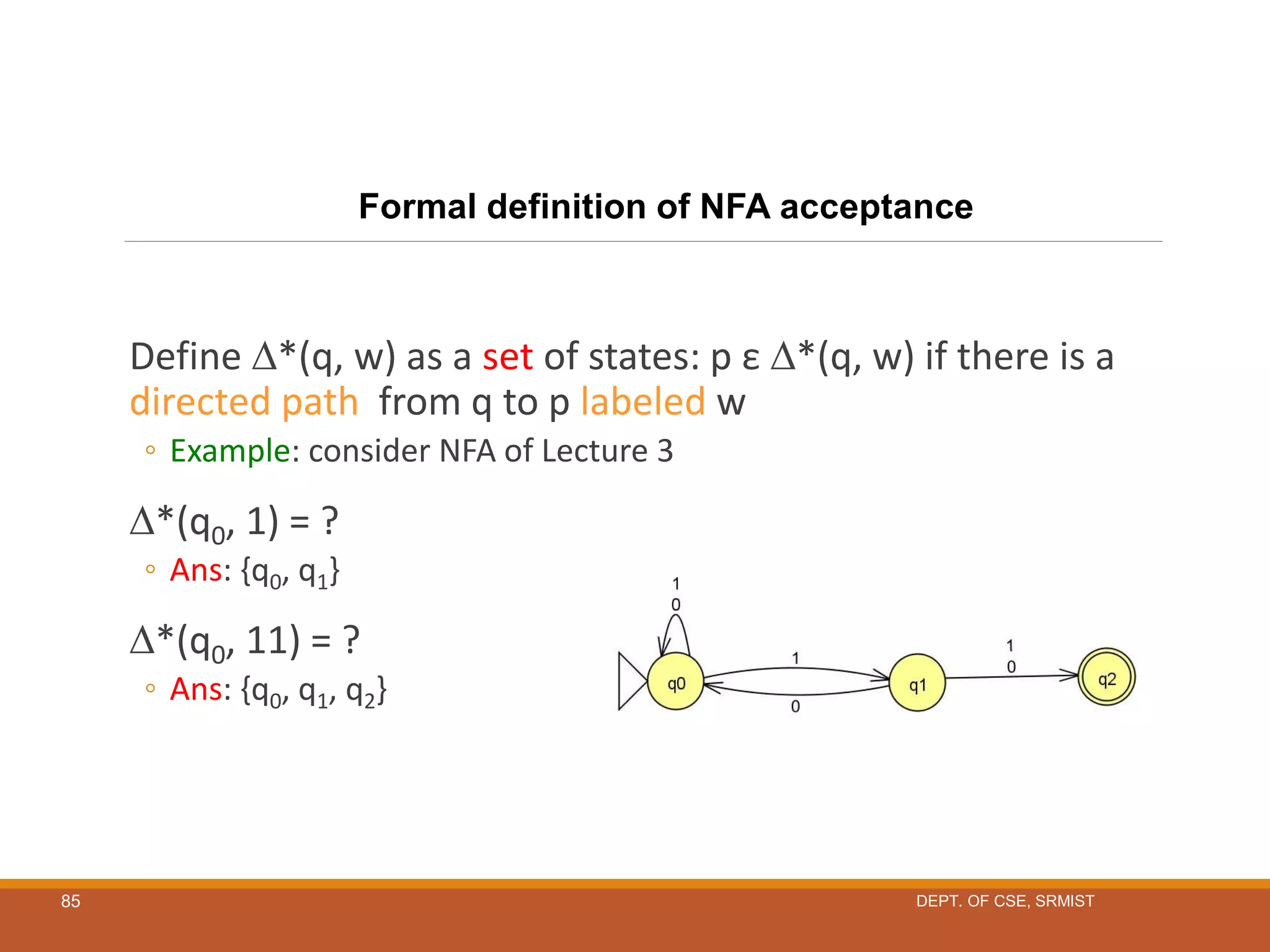
Define *(q, w) as a set of states: p ε *(q, w) if there is a
directed path from q to p labeled w
◦ Example: consider NFA of Lecture 3
*(q0, 1) = ?
◦ Ans: {q0, q1}
*(q0, 11) = ?
◦ Ans: {q0, q1, q2}
Formal definition of NFA acceptance
DEPT. OF CSE, SRMIST
86
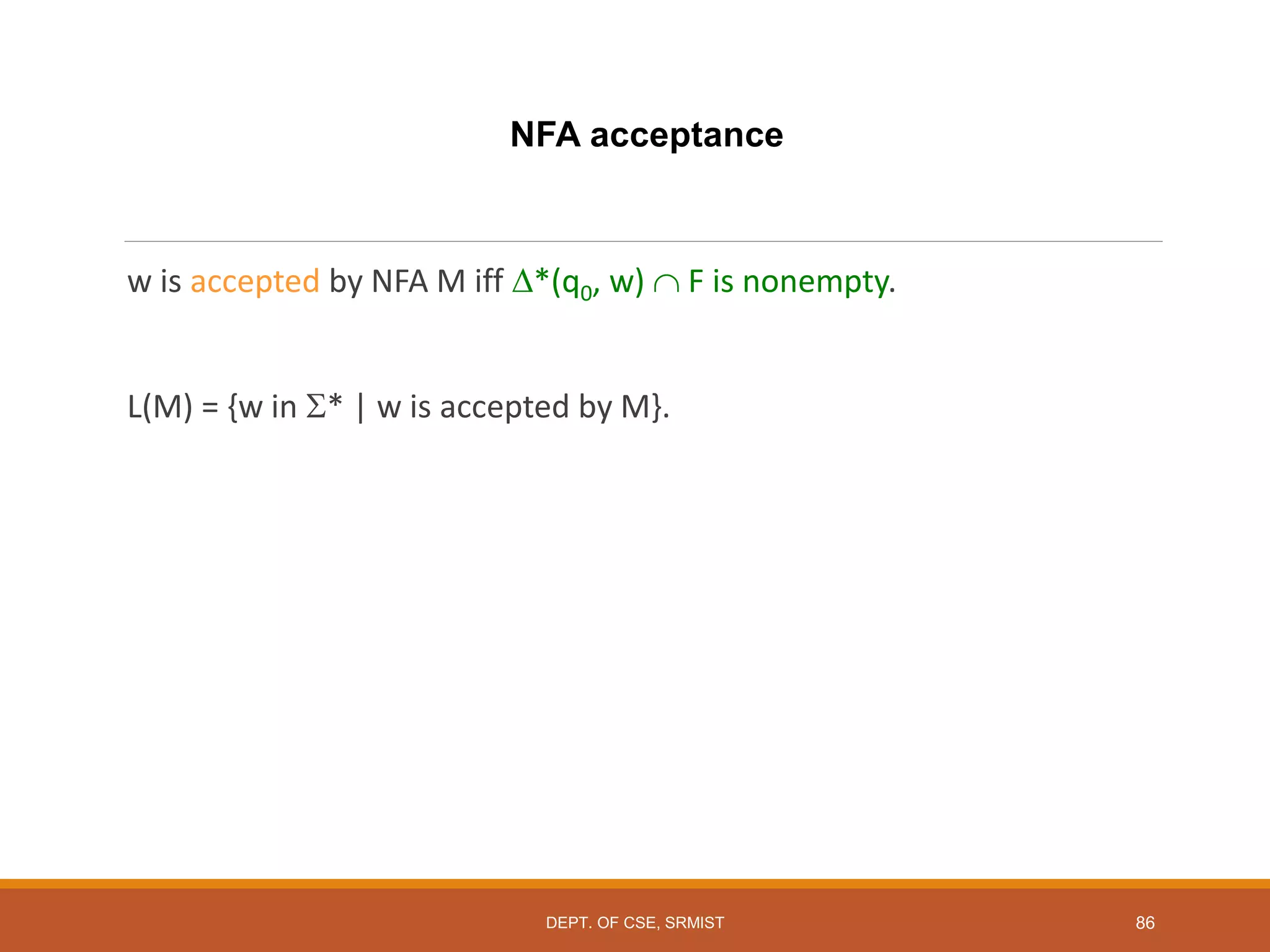
NFA acceptance
w is accepted by NFA M iff *(q0, w)  F is nonempty.
L(M) = {w in * | w is accepted by M}.
DEPT. OF CSE, SRMIST
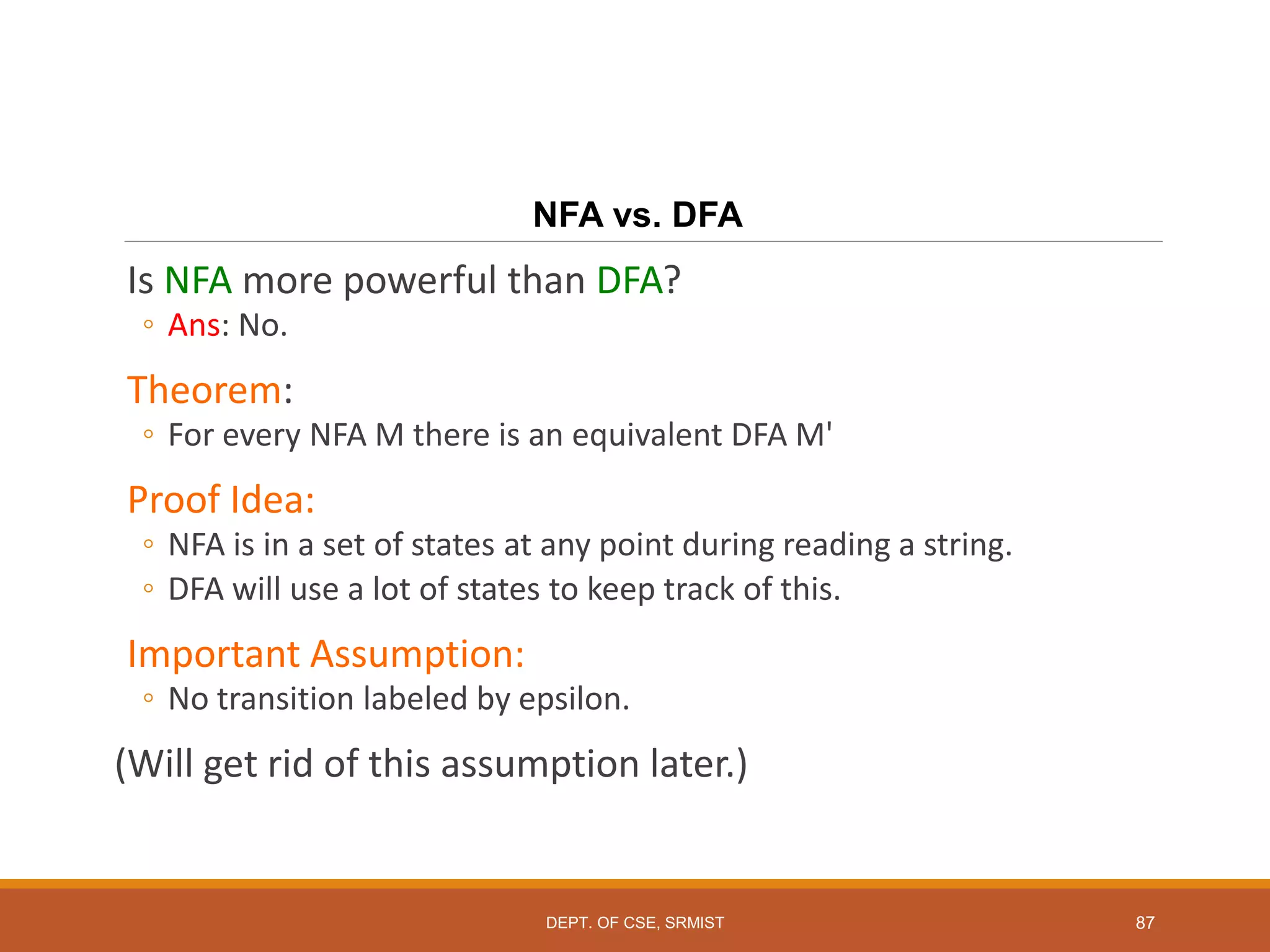
NFA vs. DFA
Is NFA more powerful than DFA?
◦ Ans: No.
Theorem:
◦ For every NFA M there is an equivalent DFA M'
Proof Idea:
◦ NFA is in a set of states at any point during reading a string.
◦ DFA will use a lot of states to keep track of this.
Important Assumption:
◦ No transition labeled by epsilon.
(Will get rid of this assumption later.)
87
DEPT. OF CSE, SRMIST
88
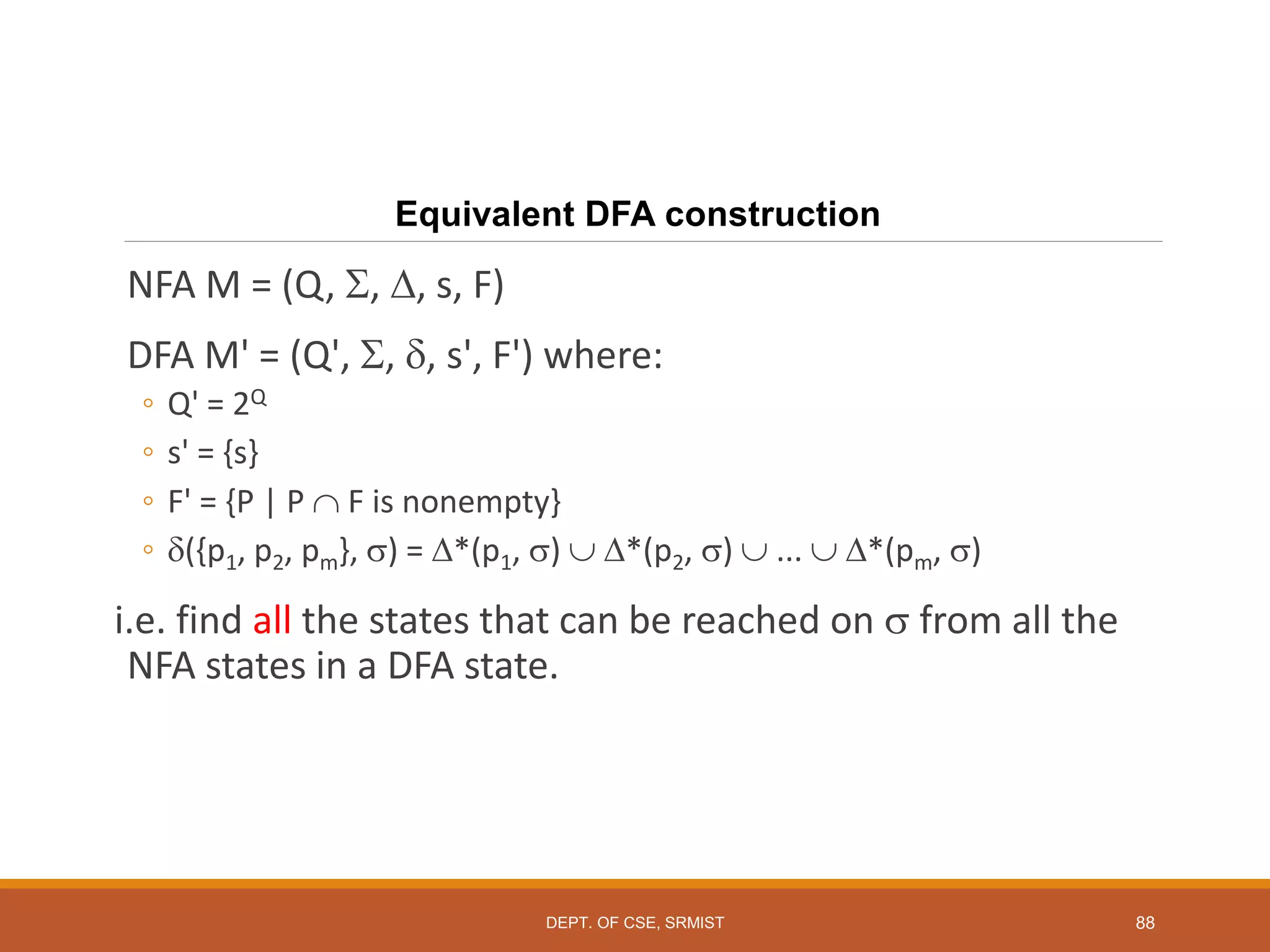
Equivalent DFA construction
NFA M = (Q, , , s, F)
DFA M' = (Q', , , s', F') where:
◦ Q' = 2Q
◦ s' = {s}
◦ F' = {P | P  F is nonempty}
◦ ({p1, p2, pm}, ) = *(p1, )  *(p2, )  ...  *(pm, )
i.e. find all the states that can be reached on  from all the
NFA states in a DFA state.
DEPT. OF CSE, SRMIST
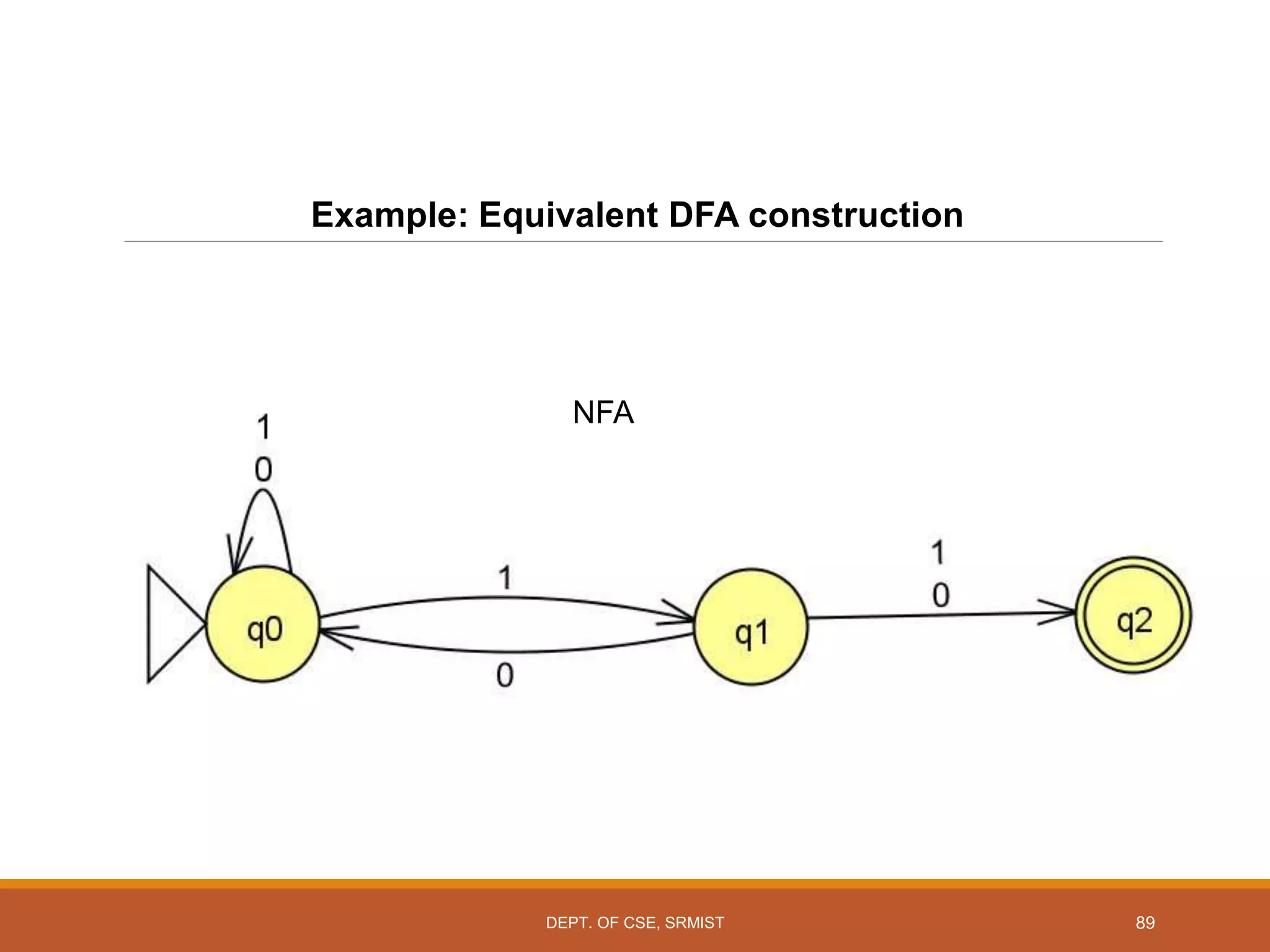
89
Example: Equivalent DFA construction
NFA
DEPT. OF CSE, SRMIST
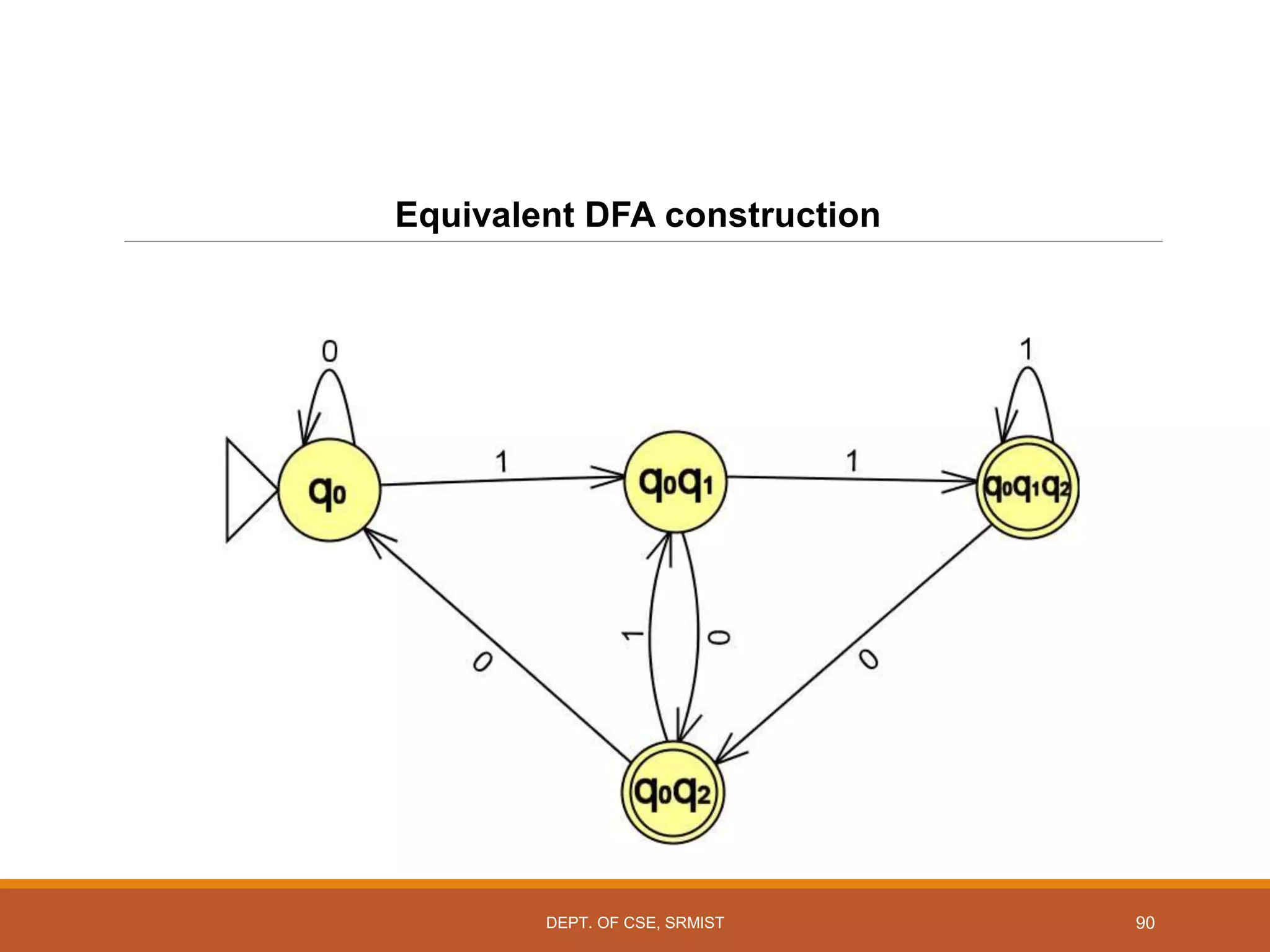
90
Equivalent DFA construction
DEPT. OF CSE, SRMIST
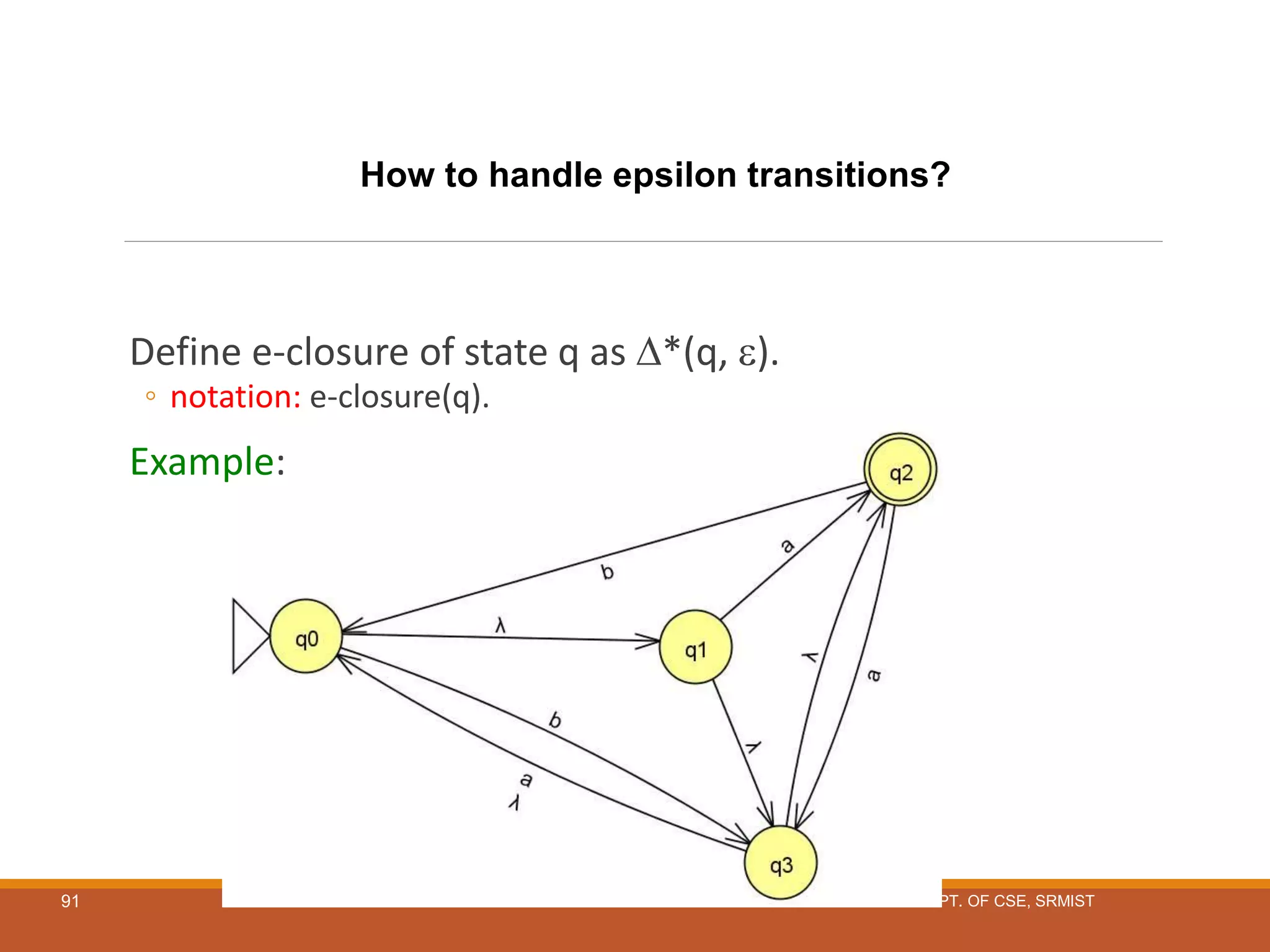
91
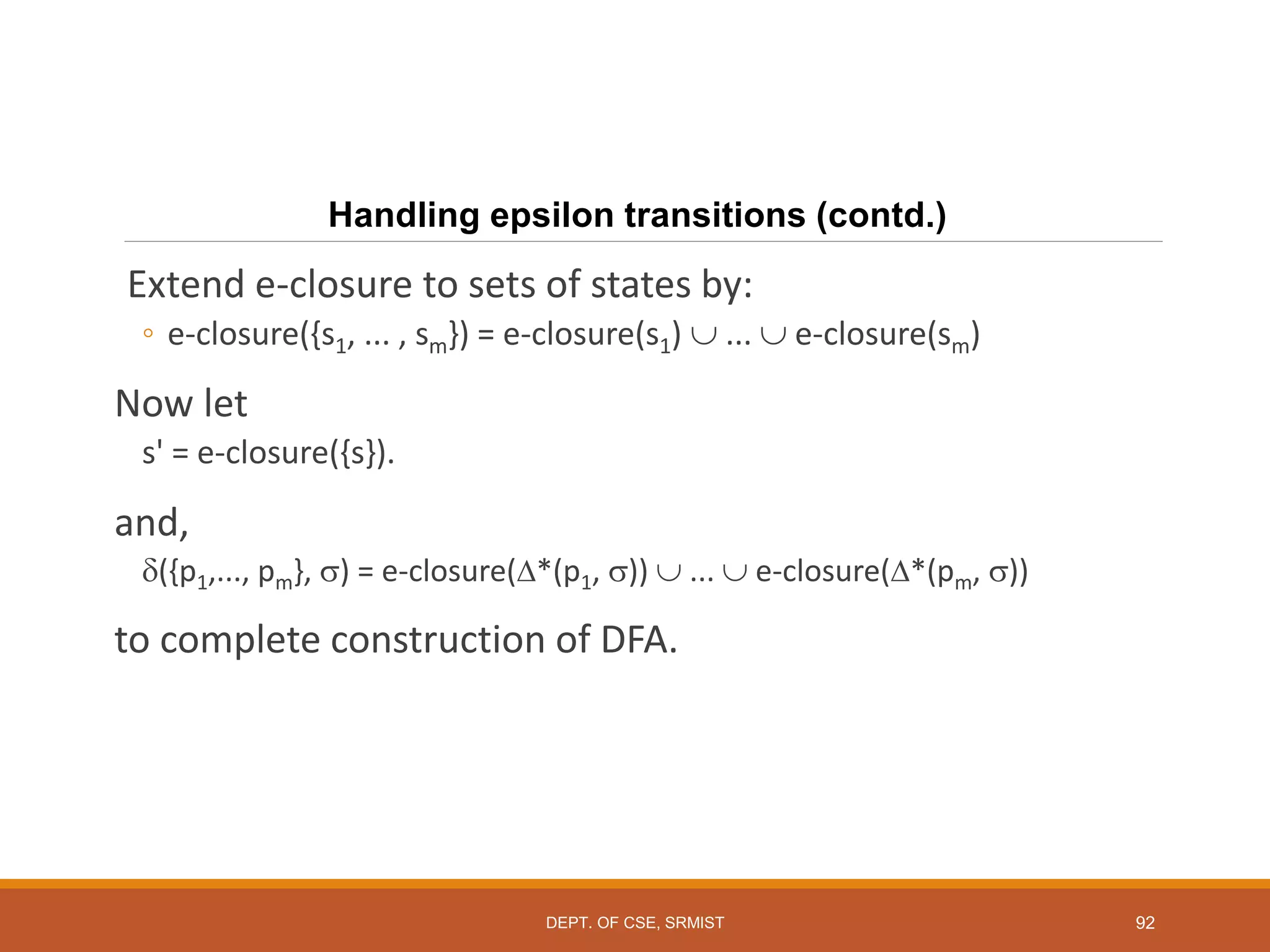
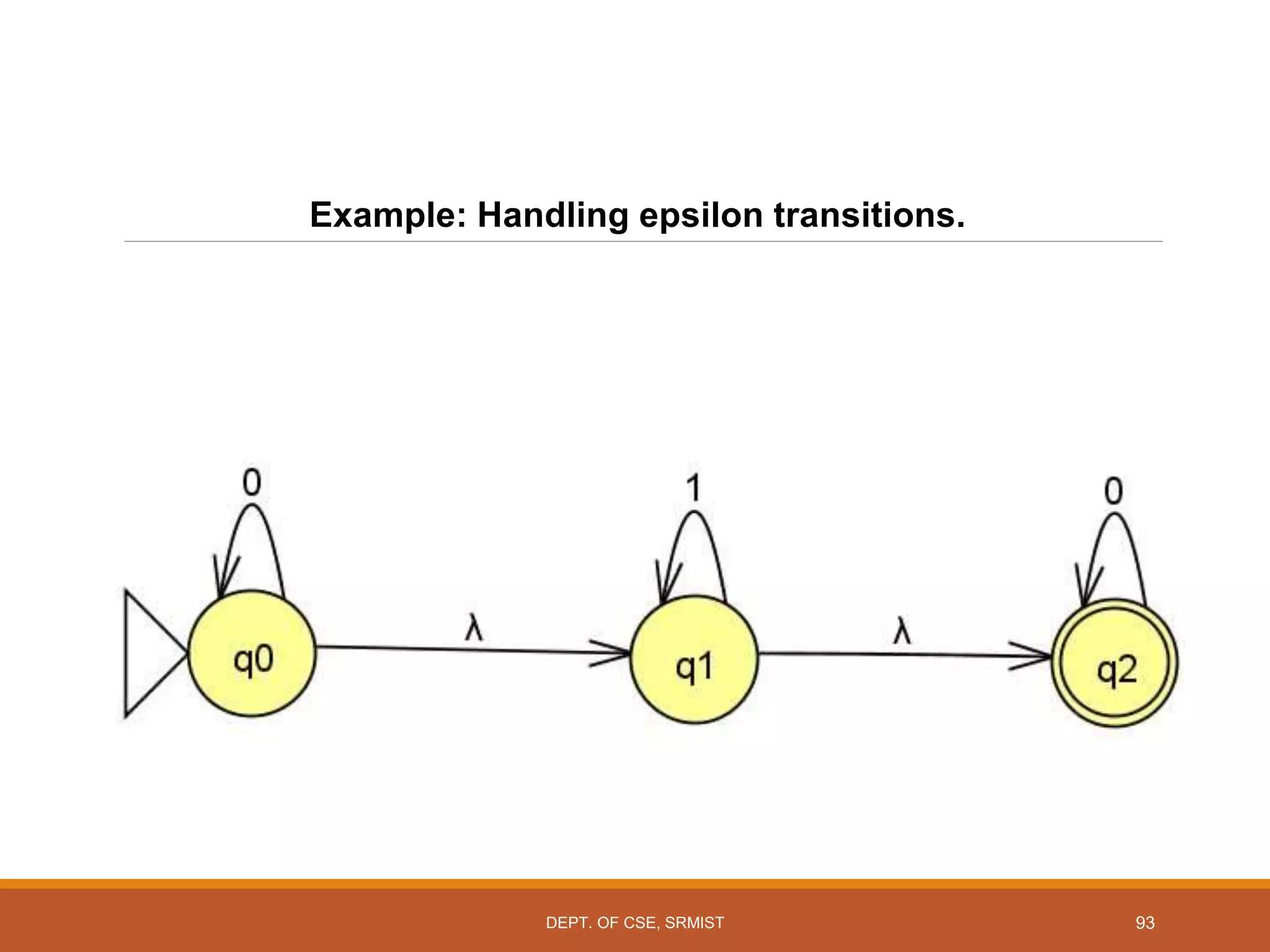
How to handle epsilon transitions?
Define e-closure of state q as *(q, ).
◦ notation: e-closure(q).
Example:
DEPT. OF CSE, SRMIST
92
Handling epsilon transitions (contd.)
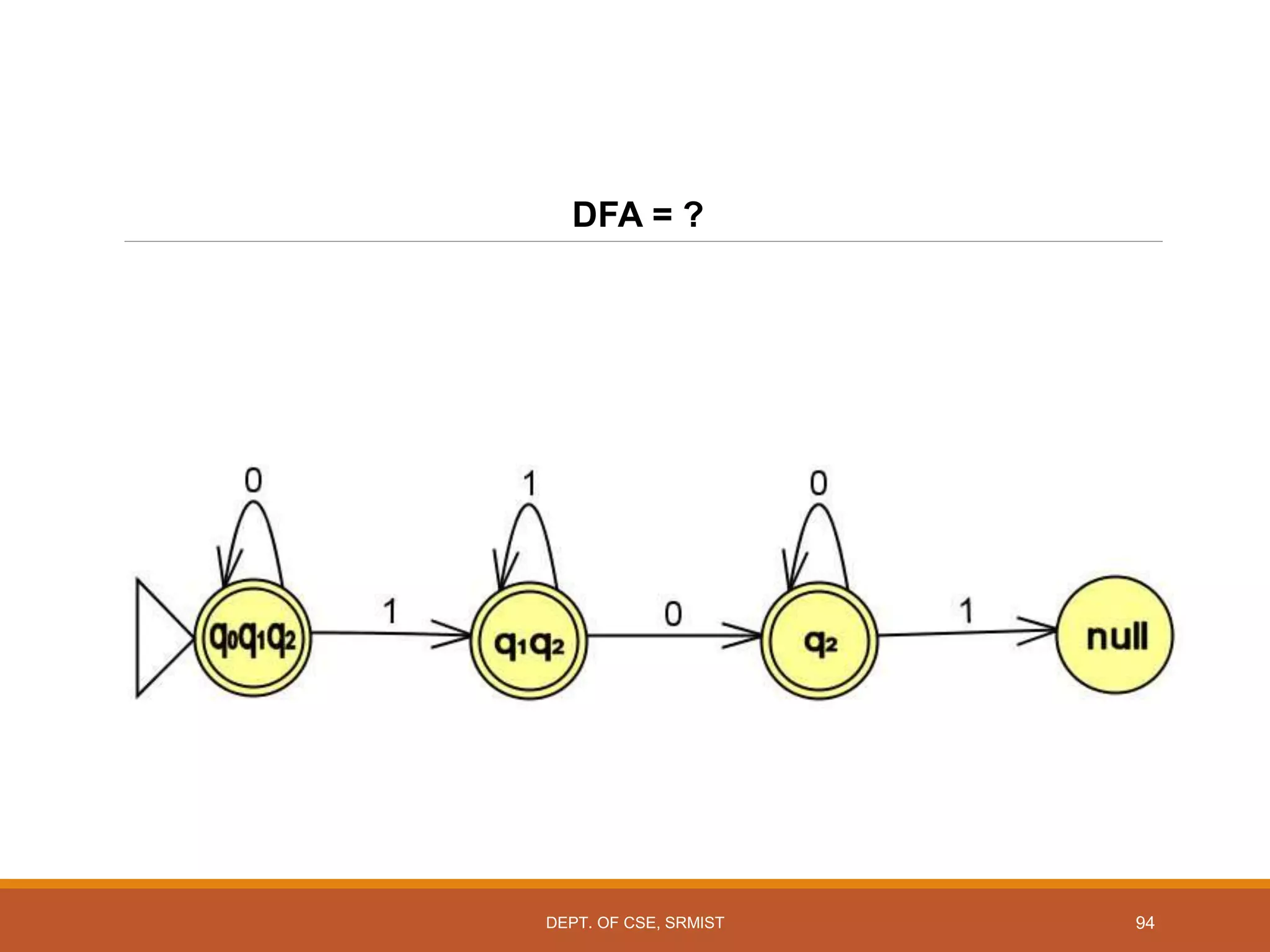
Extend e-closure to sets of states by:
◦ e-closure({s1, ... , sm}) = e-closure(s1)  ...  e-closure(sm)
Now let
s' = e-closure({s}).
and,
({p1,..., pm}, ) = e-closure(*(p1, ))  ...  e-closure(*(pm, ))
to complete construction of DFA.
DEPT. OF CSE, SRMIST
93
Example: Handling epsilon transitions.
DEPT. OF CSE, SRMIST
94
DFA = ?
DEPT. OF CSE, SRMIST
95
Language Operations
1. Concatenation. Notation: LL' or just LL'
◦ L  L' = {uv | u in L, v in L'}.
2. Kleene Star. Notation: L*
◦ L* = { w in * | w = w1...wk for some k >= 0 and each wi in L}.
Examples: if L = {a(2n+1) | n >= 0}. L' = {b(2n) | n > = 0}.
LL' = ?
◦ Ans: LL' = {a(2n+1) b(2m) | n, m > = 0}
L* = ?
◦ Ans: {an | n >= 0}
U, ., * are called regular operations.
DEPT. OF CSE, SRMIST
Closure properties of regular languages.
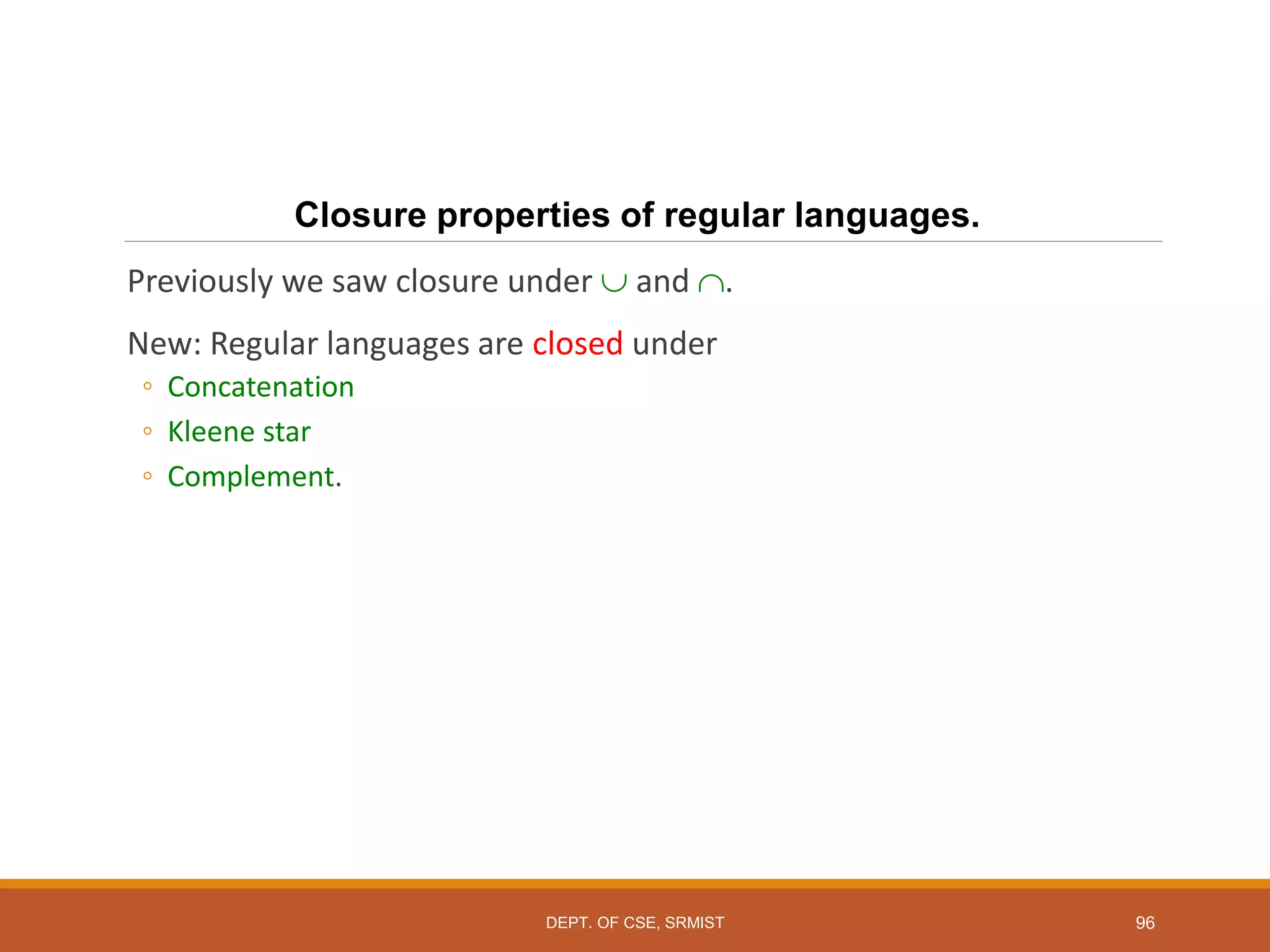
Previously we saw closure under  and .
New: Regular languages are closed under
◦ Concatenation
◦ Kleene star
◦ Complement.
96
DEPT. OF CSE, SRMIST
97
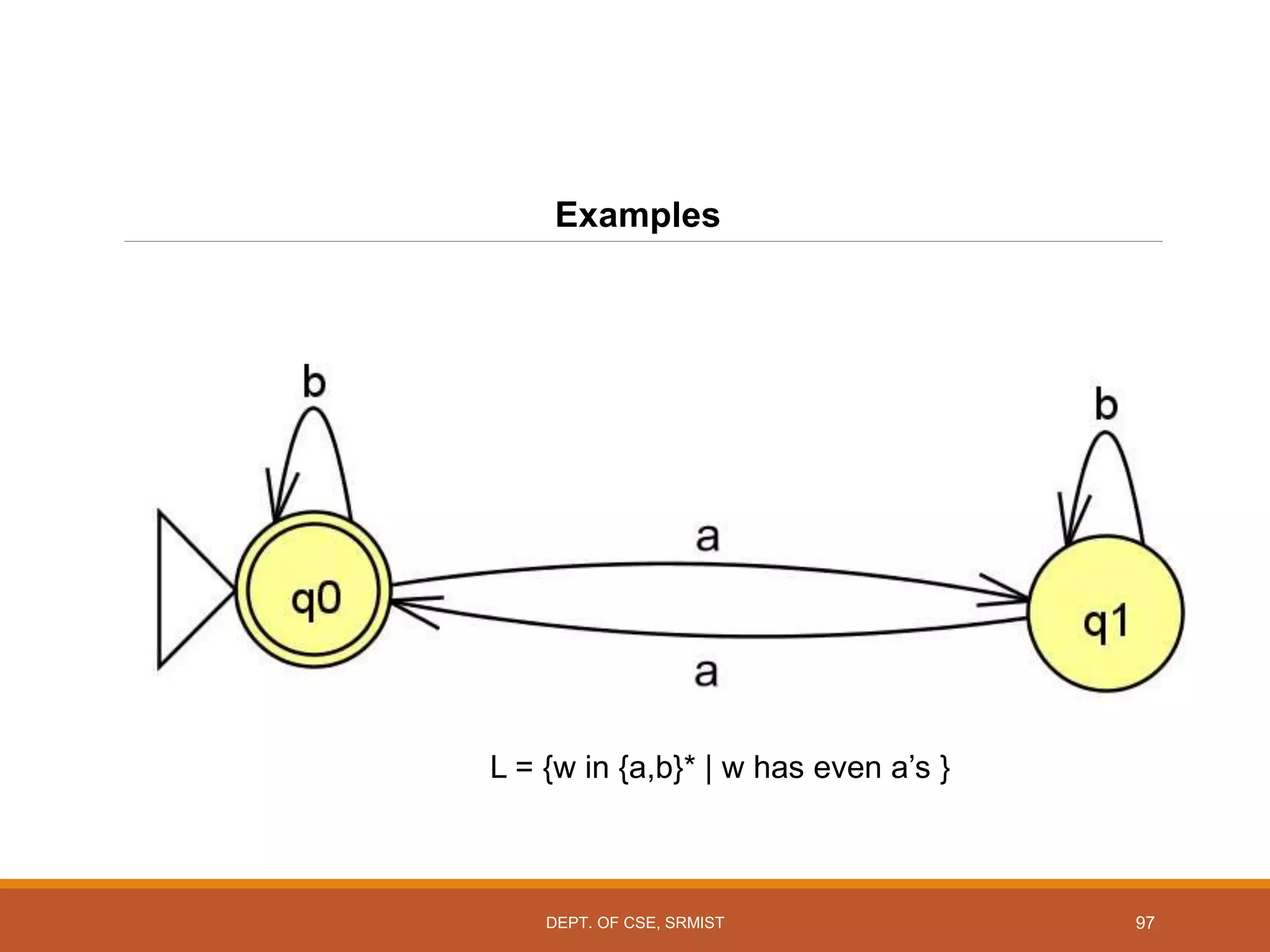
Examples
L = {w in {a,b}* | w has even a’s }
DEPT. OF CSE, SRMIST
98
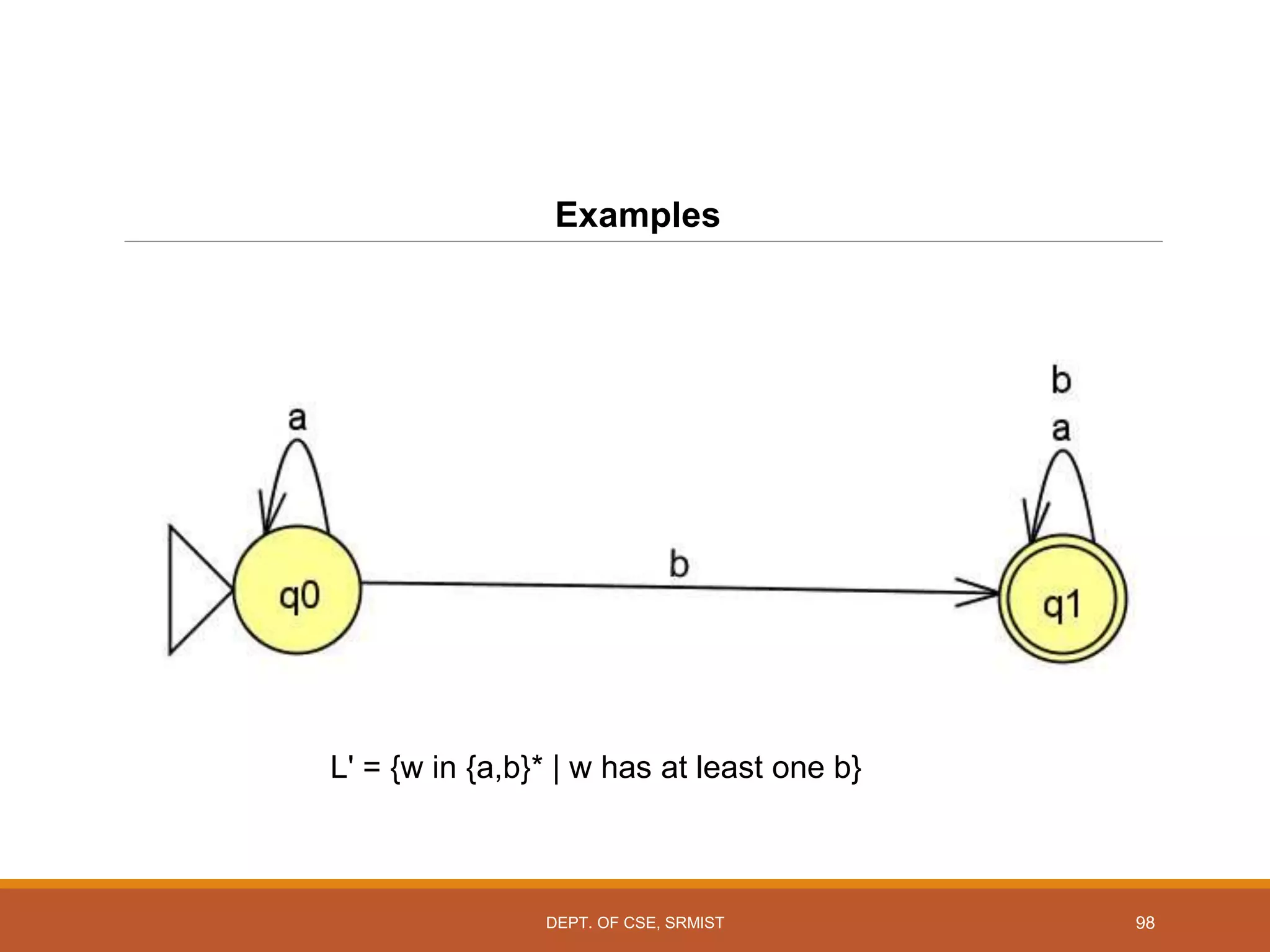
Examples
L' = {w in {a,b}* | w has at least one b}
DEPT. OF CSE, SRMIST
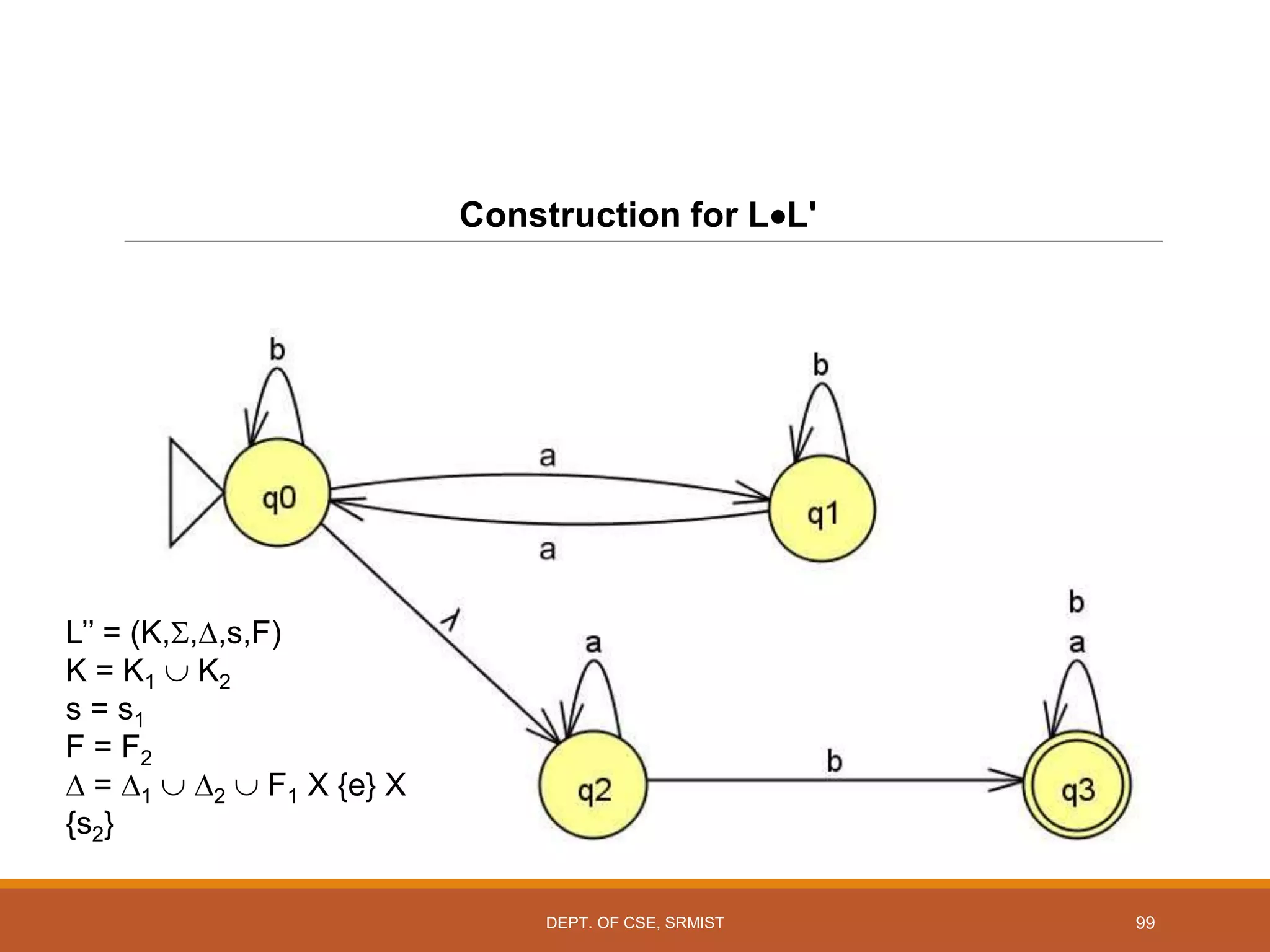
99
Construction for LL'
L’’ = (K,,,s,F)
K = K1  K2
s = s1
F = F2
 = 1  2  F1 X {e} X
{s2}
DEPT. OF CSE, SRMIST
100
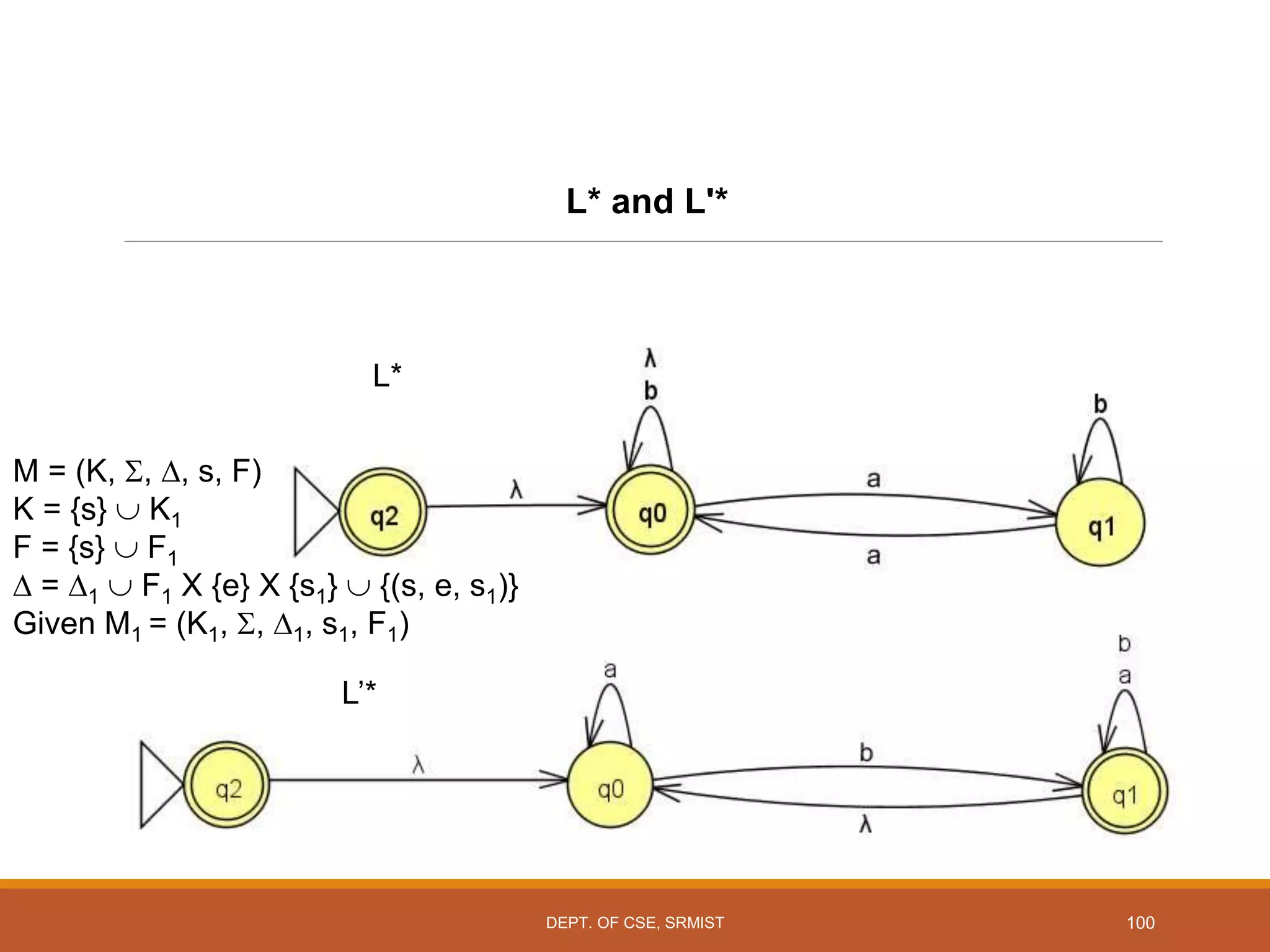
L* and L'*
L*
L’*
M = (K, , , s, F)
K = {s}  K1
F = {s}  F1
 = 1  F1 X {e} X {s1}  {(s, e, s1)}
Given M1 = (K1, , 1, s1, F1)
DEPT. OF CSE, SRMIST
101
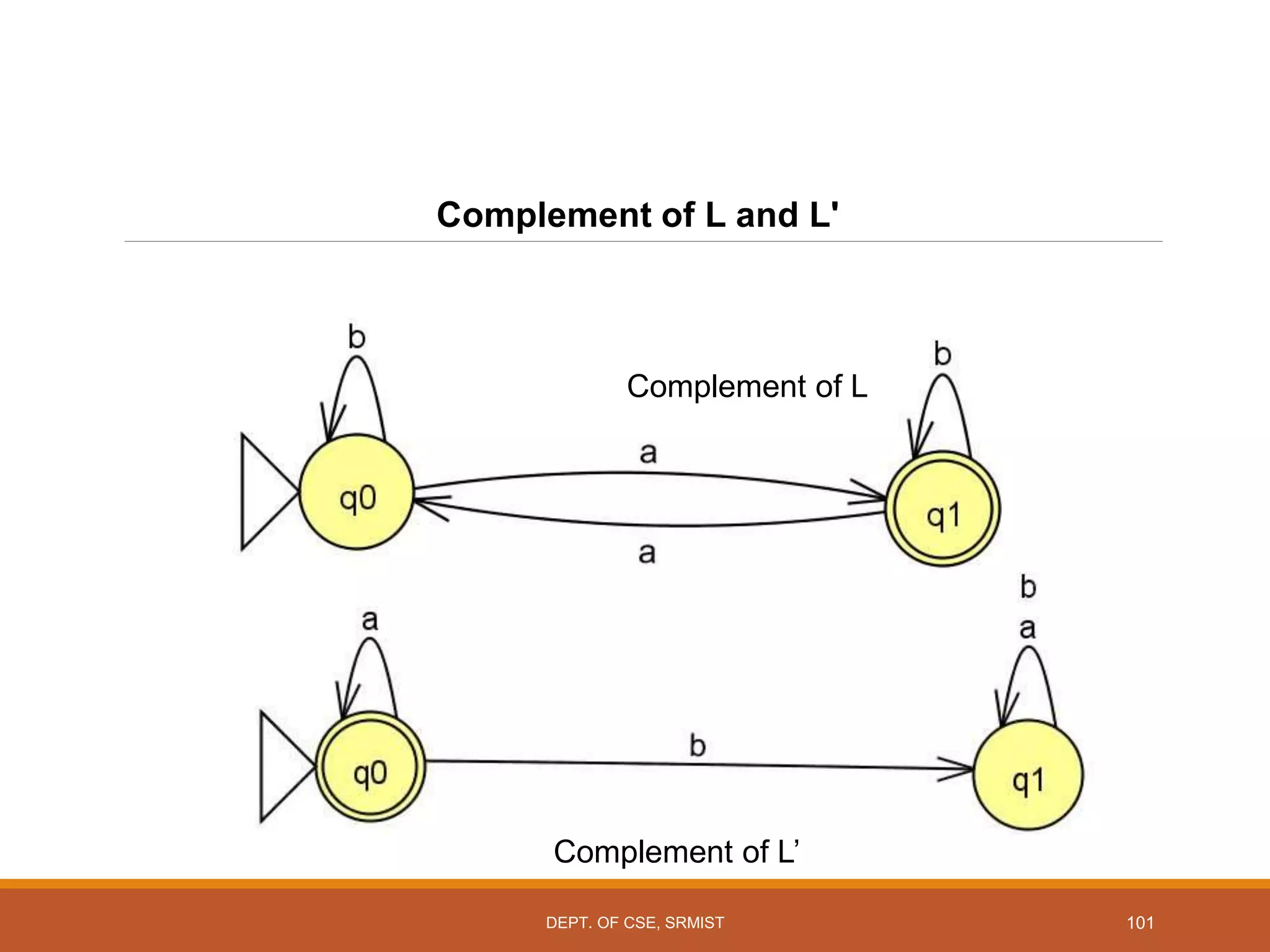
Complement of L and L'
Complement of L
Complement of L’
DEPT. OF CSE, SRMIST
102
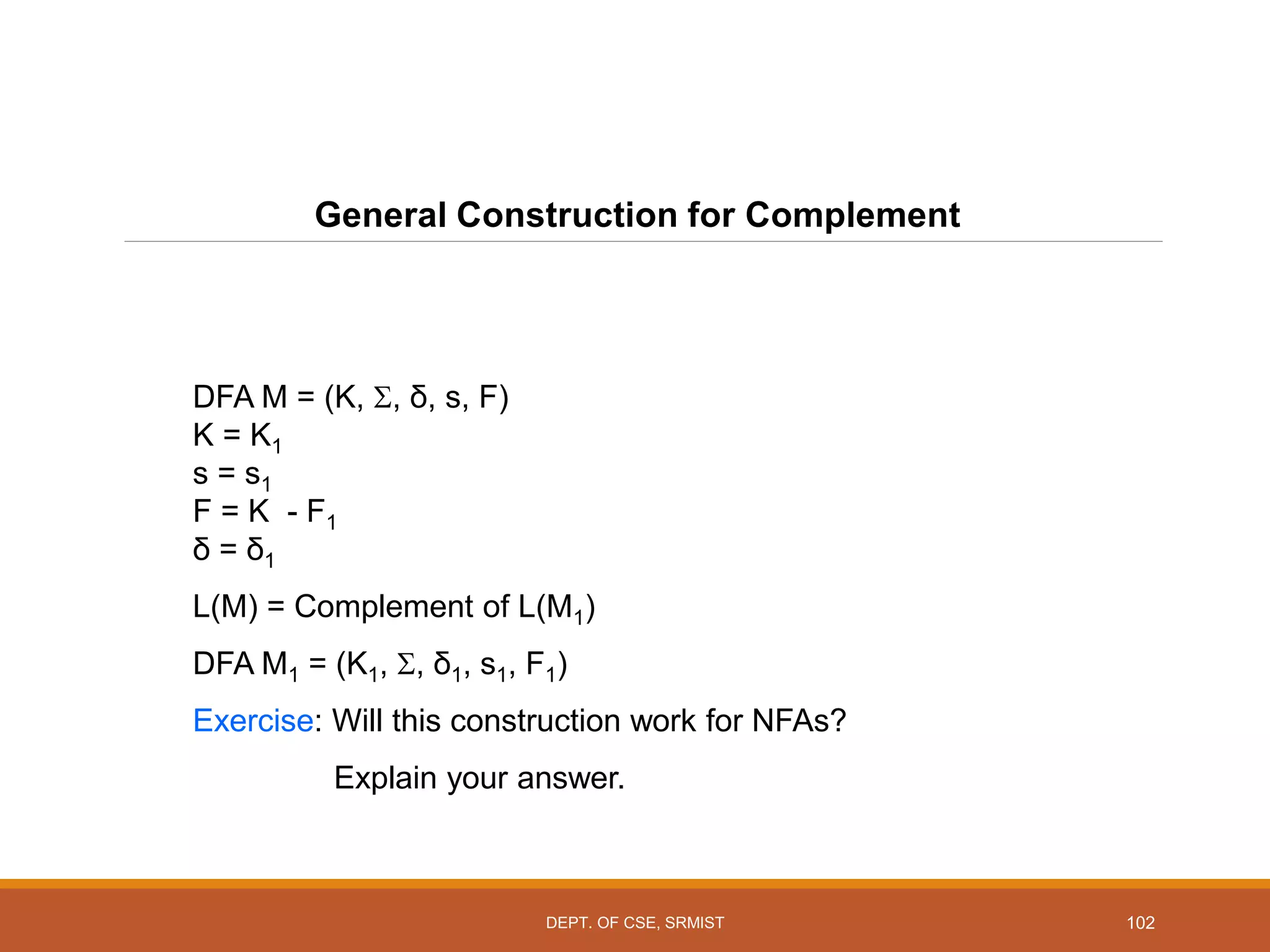
General Construction for Complement
DFA M = (K, , δ, s, F)
K = K1
s = s1
F = K - F1
δ = δ1
L(M) = Complement of L(M1)
DFA M1 = (K1, , δ1, s1, F1)
Exercise: Will this construction work for NFAs?
Explain your answer.
DEPT. OF CSE, SRMIST
103
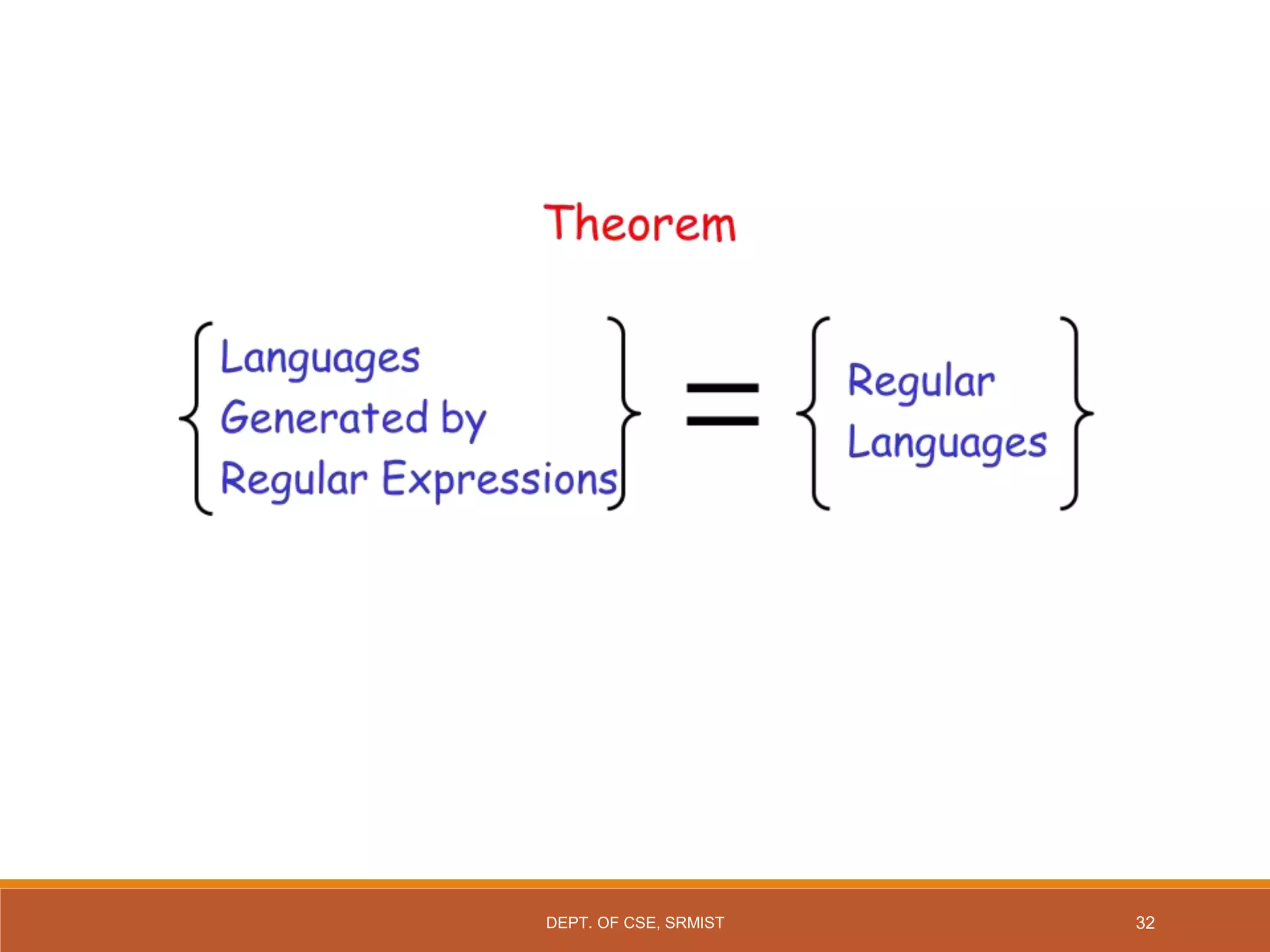
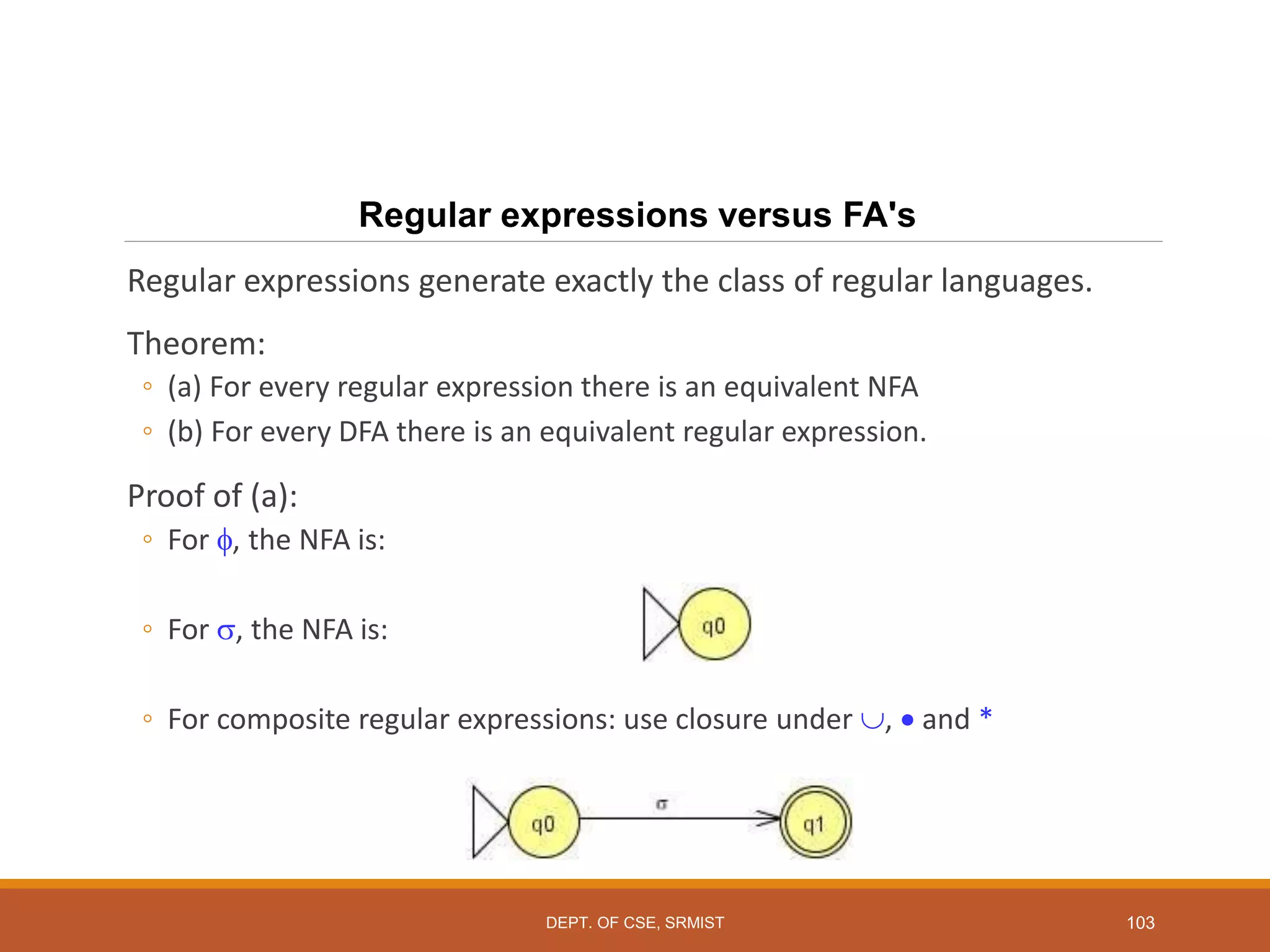
Regular expressions generate exactly the class of regular languages.
Theorem:
◦ (a) For every regular expression there is an equivalent NFA
◦ (b) For every DFA there is an equivalent regular expression.
Proof of (a):
◦ For , the NFA is:
◦ For , the NFA is:
◦ For composite regular expressions: use closure under ,  and *
Regular expressions versus FA's
DEPT. OF CSE, SRMIST
104
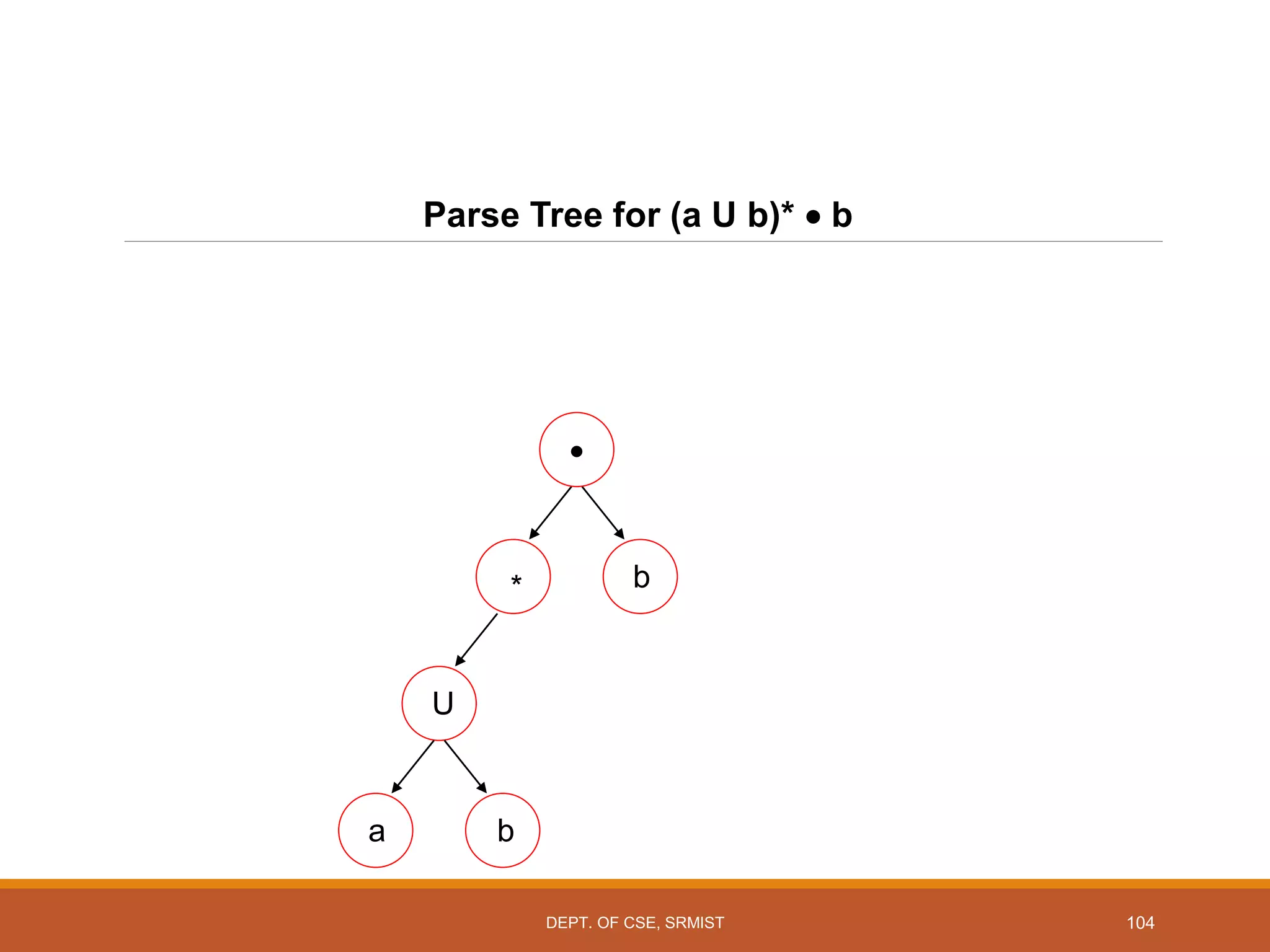
Parse Tree for (a U b)*  b

b
*
U
a b
DEPT. OF CSE, SRMIST
105
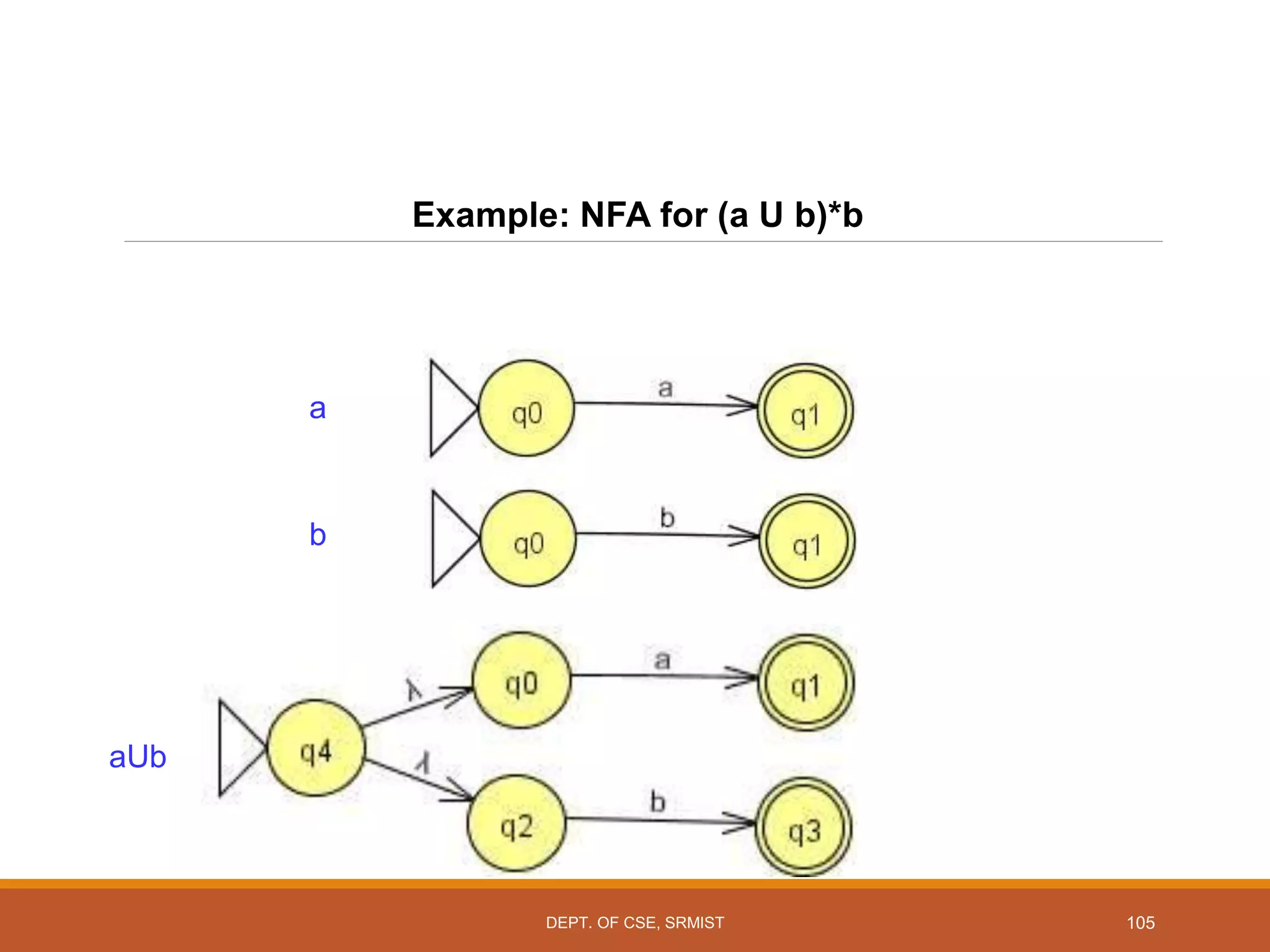
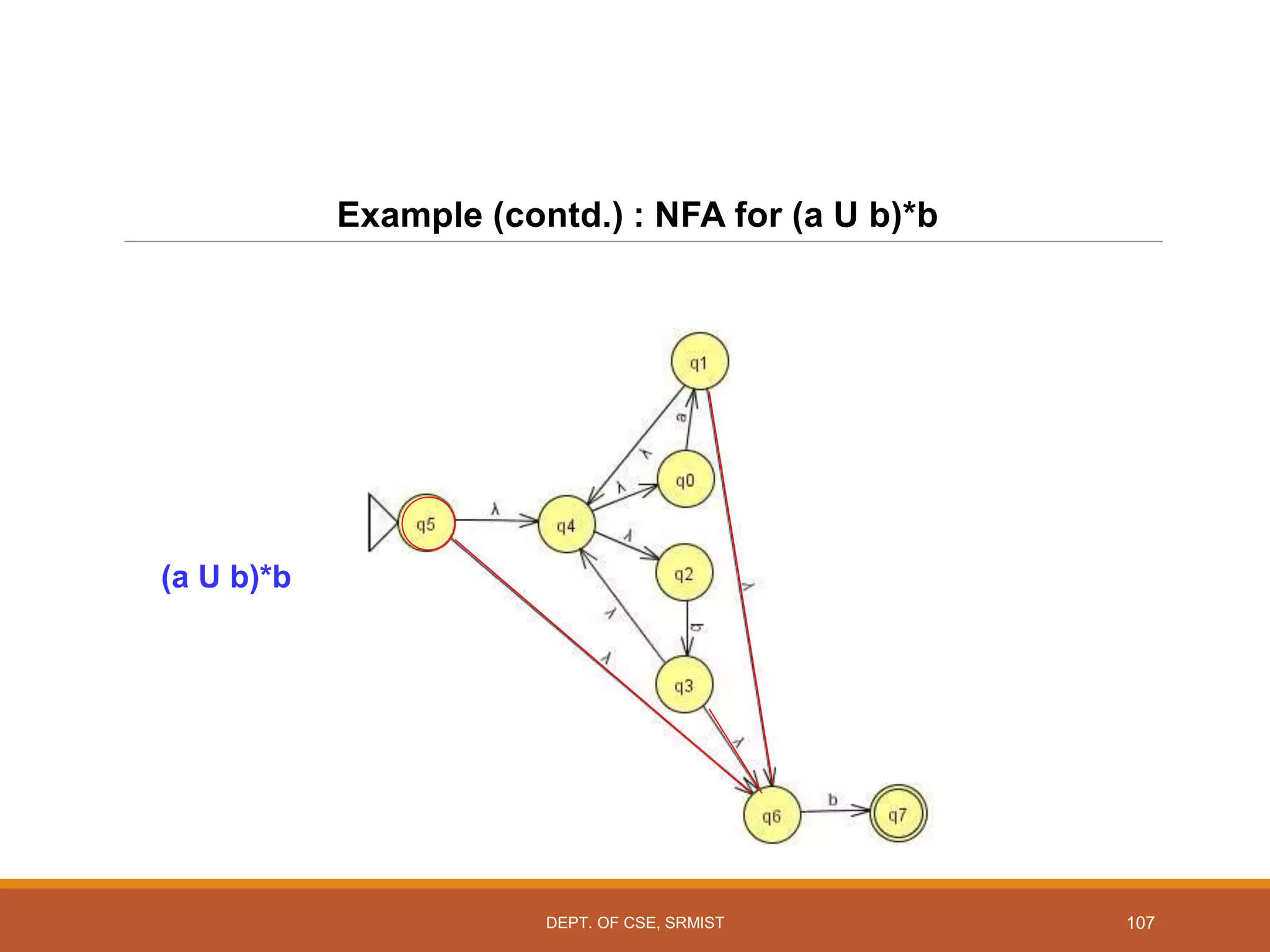
Example: NFA for (a U b)*b
a
b
aUb
DEPT. OF CSE, SRMIST
106
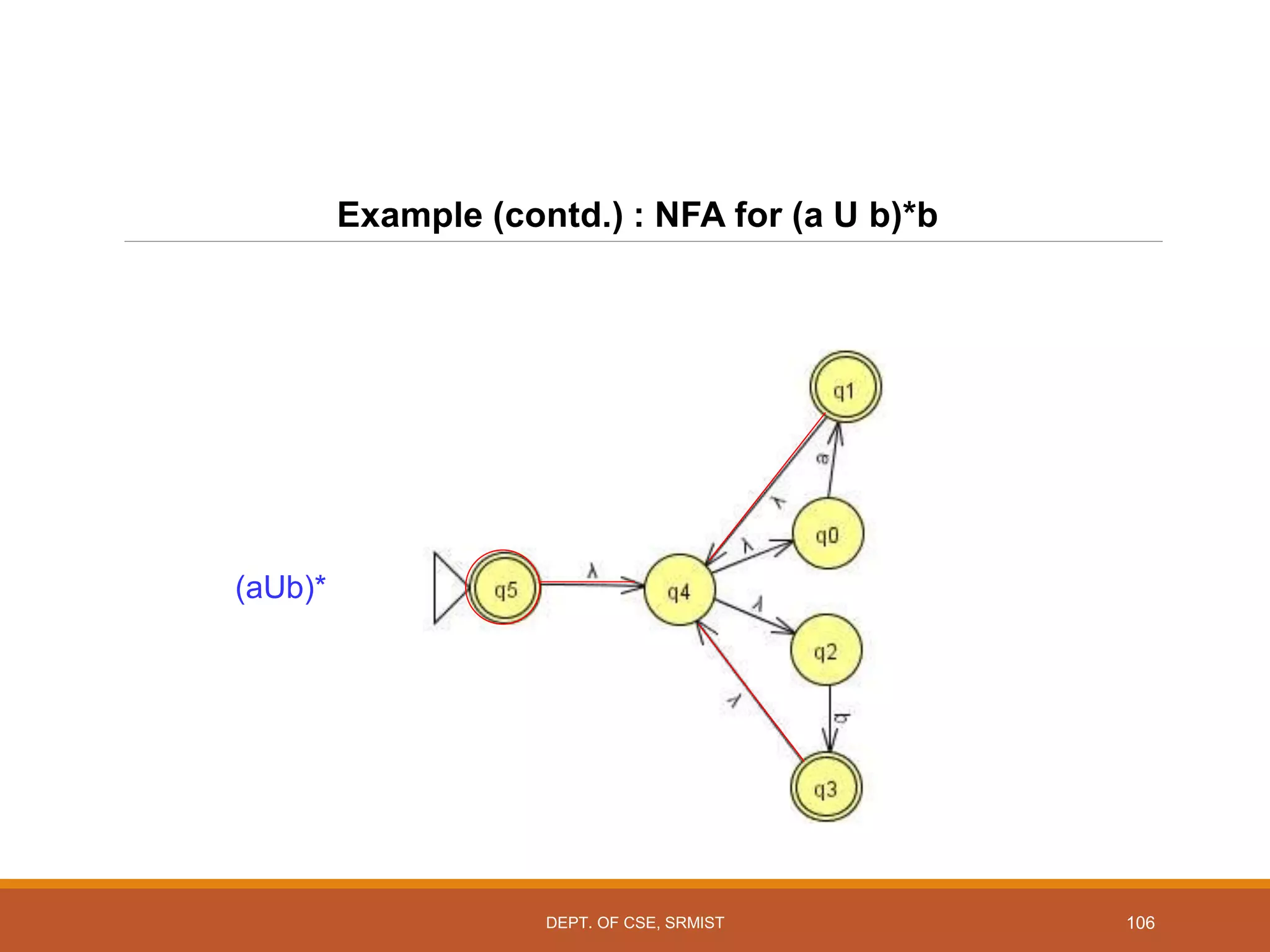
Example (contd.) : NFA for (a U b)*b
(aUb)*
DEPT. OF CSE, SRMIST
107
Example (contd.) : NFA for (a U b)*b
(a U b)*b
DEPT. OF CSE, SRMIST
108
DFA  regular expression
Easier to do:
◦ DFA  GNFA  regular expression.
GNFA (Generalized NFA)
◦ labels of transitions can be regular expressions.
Need special GNFA that satisfies:
(1) start state has no incoming transition
(2) only one final state
(3) final state has no outgoing transition.
DEPT. OF CSE, SRMIST
109
DFA  regular expression (contd.)
Idea:
◦ Convert DFA  special GNFA.
◦ Eliminate all states, except start and final state, one state at a time.
◦ Output the label on the single transition left at the end.
DEPT. OF CSE, SRMIST
110
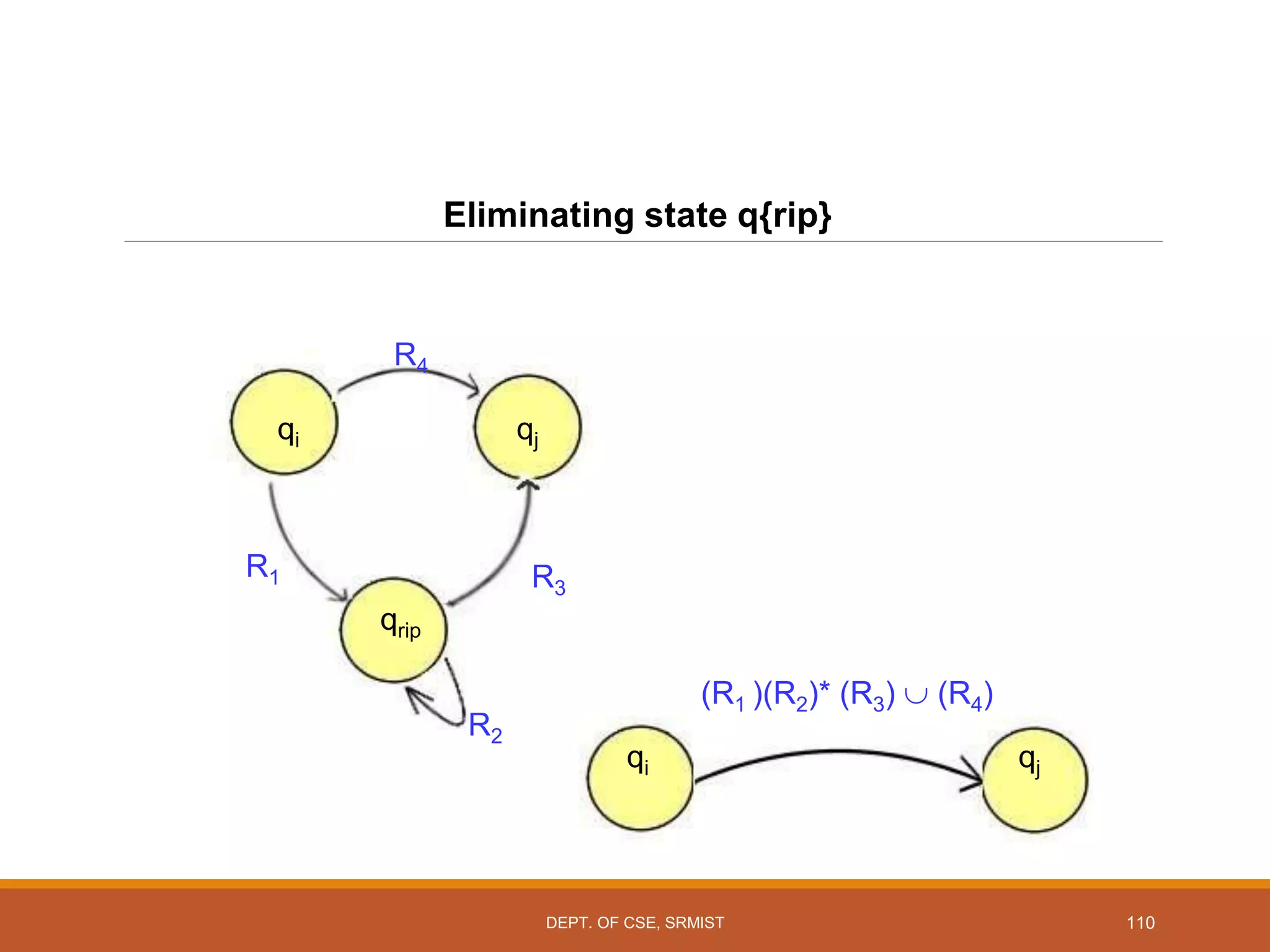
Eliminating state q{rip}
R4
R3
R1
(R1 )(R2)* (R3)  (R4)
R2
qi
qrip
qj
qi qj
DEPT. OF CSE, SRMIST
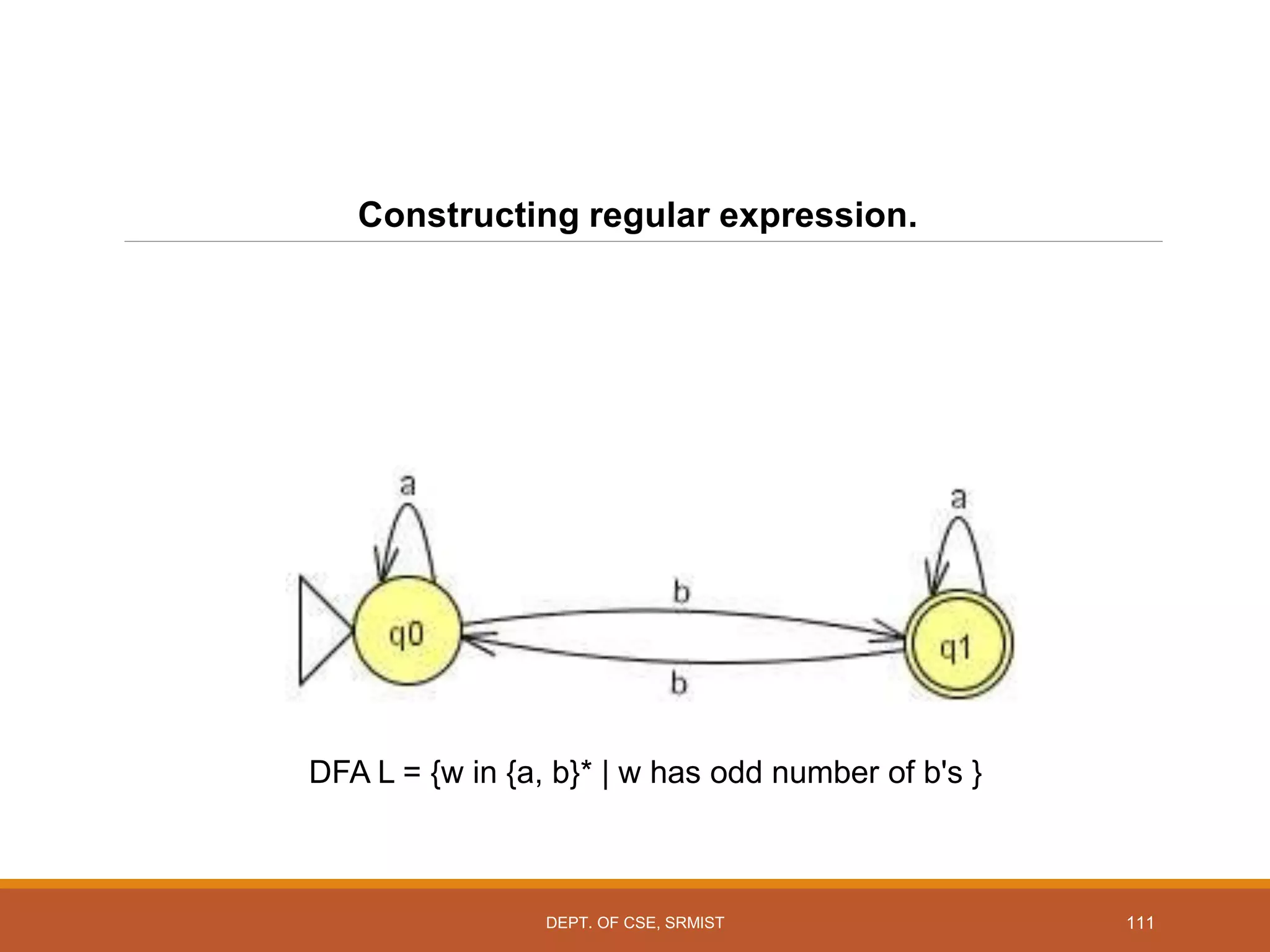
111
Constructing regular expression.
DFA L = {w in {a, b}* | w has odd number of b's }
DEPT. OF CSE, SRMIST
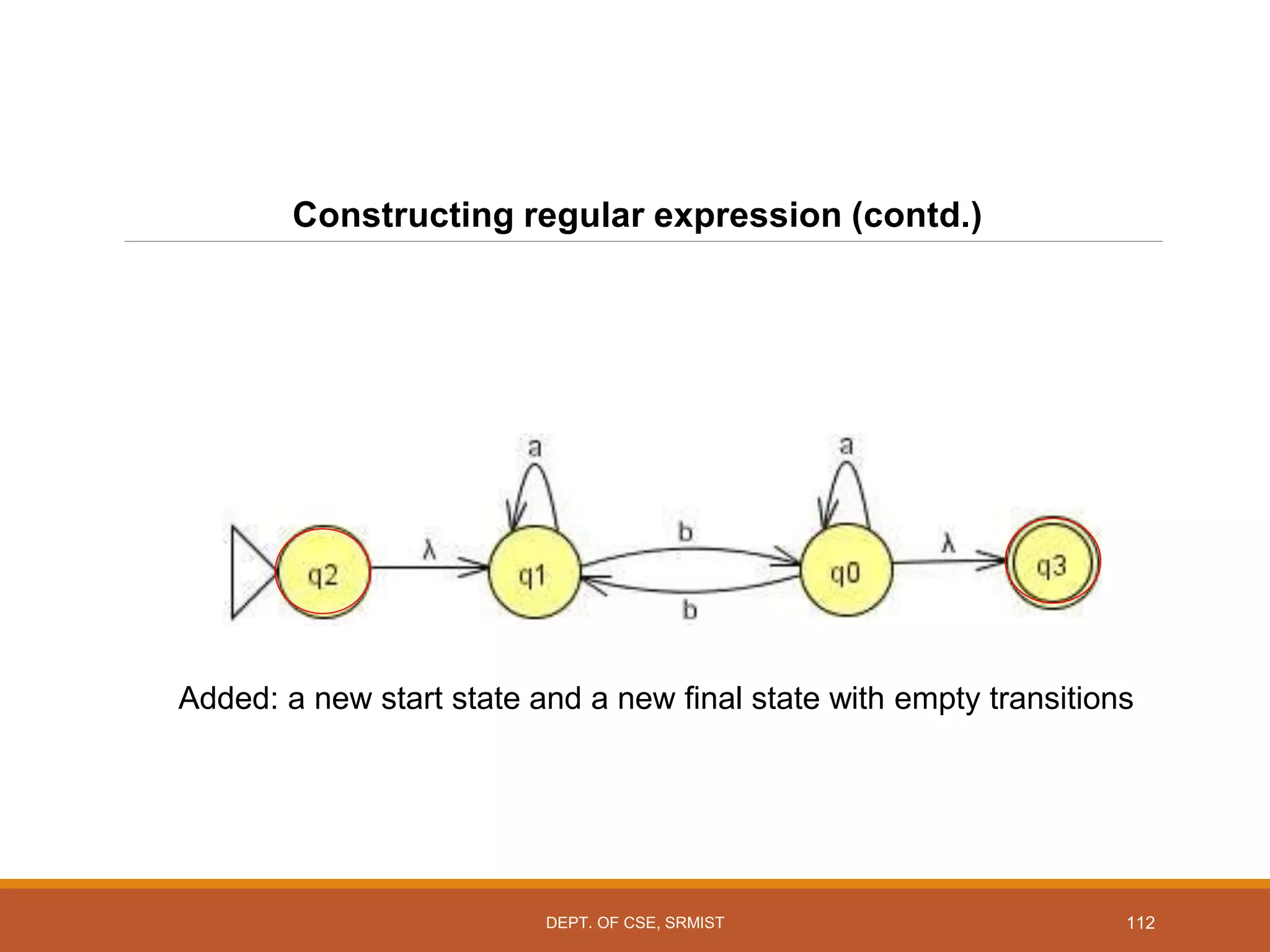
112
Constructing regular expression (contd.)
Added: a new start state and a new final state with empty transitions
DEPT. OF CSE, SRMIST
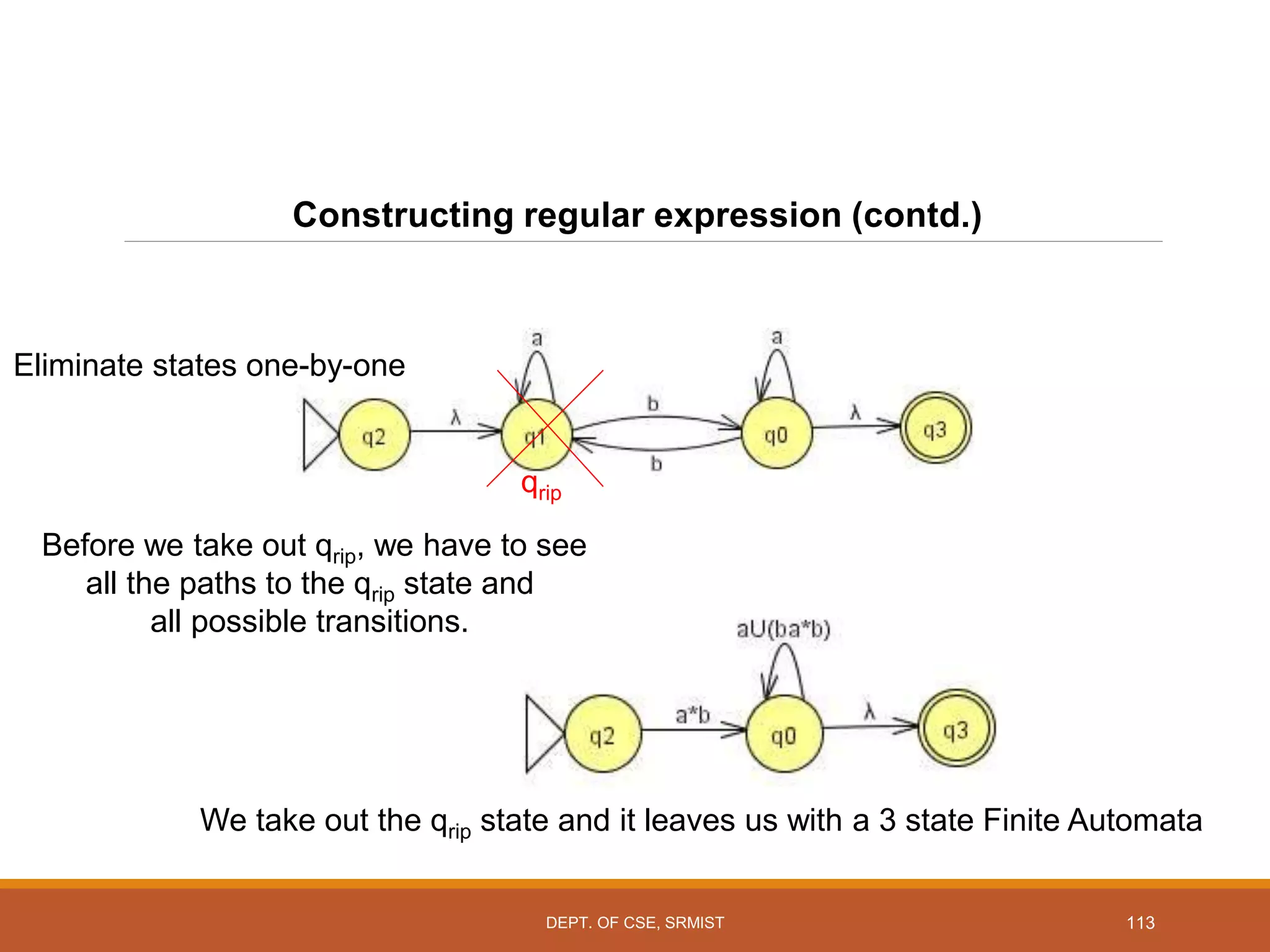
113
Constructing regular expression (contd.)
qrip
We take out the qrip state and it leaves us with a 3 state Finite Automata
Before we take out qrip, we have to see
all the paths to the qrip state and
all possible transitions.
Eliminate states one-by-one
DEPT. OF CSE, SRMIST
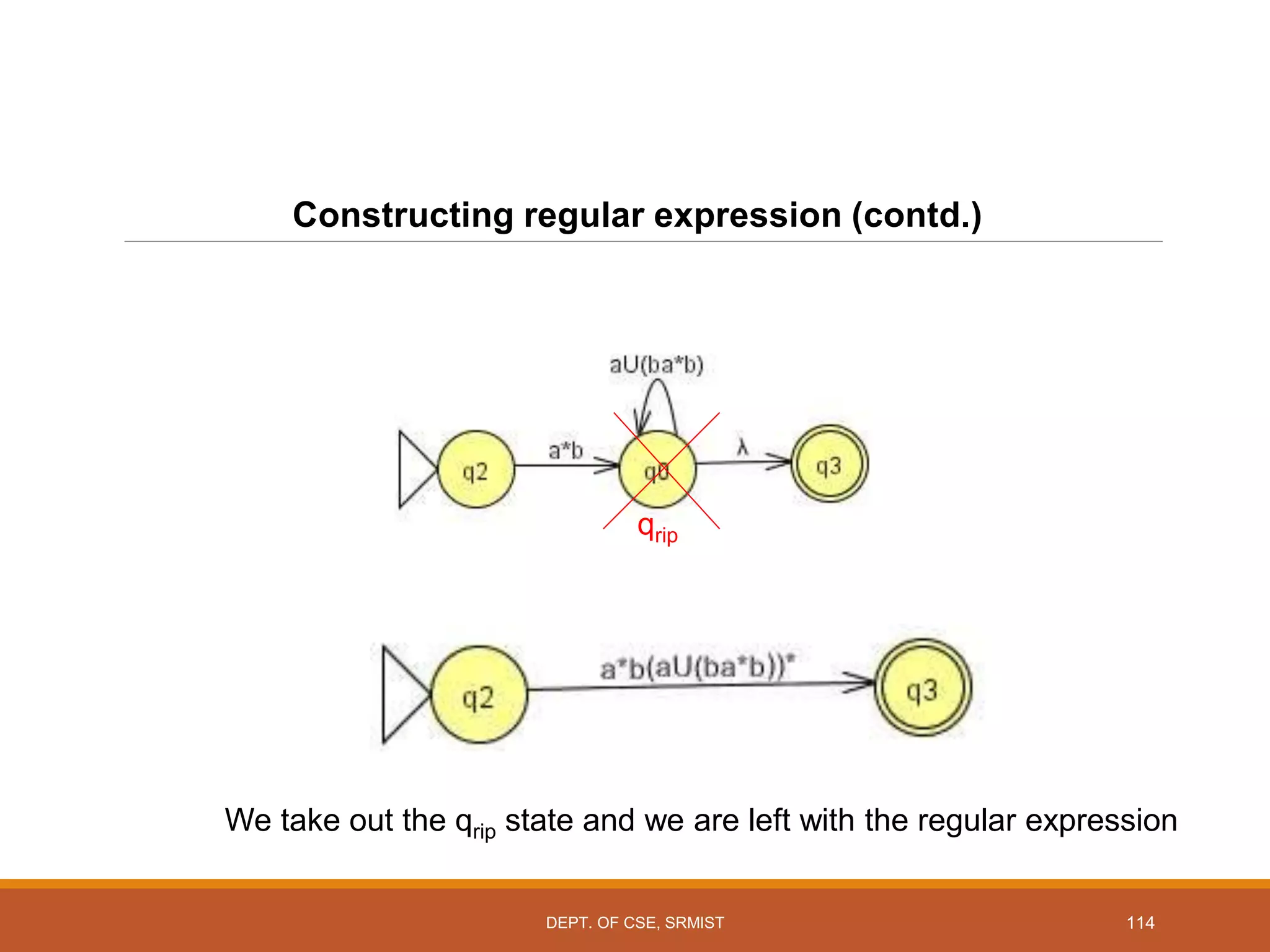
114
Constructing regular expression (contd.)
qrip
We take out the qrip state and we are left with the regular expression
DEPT. OF CSE, SRMIST
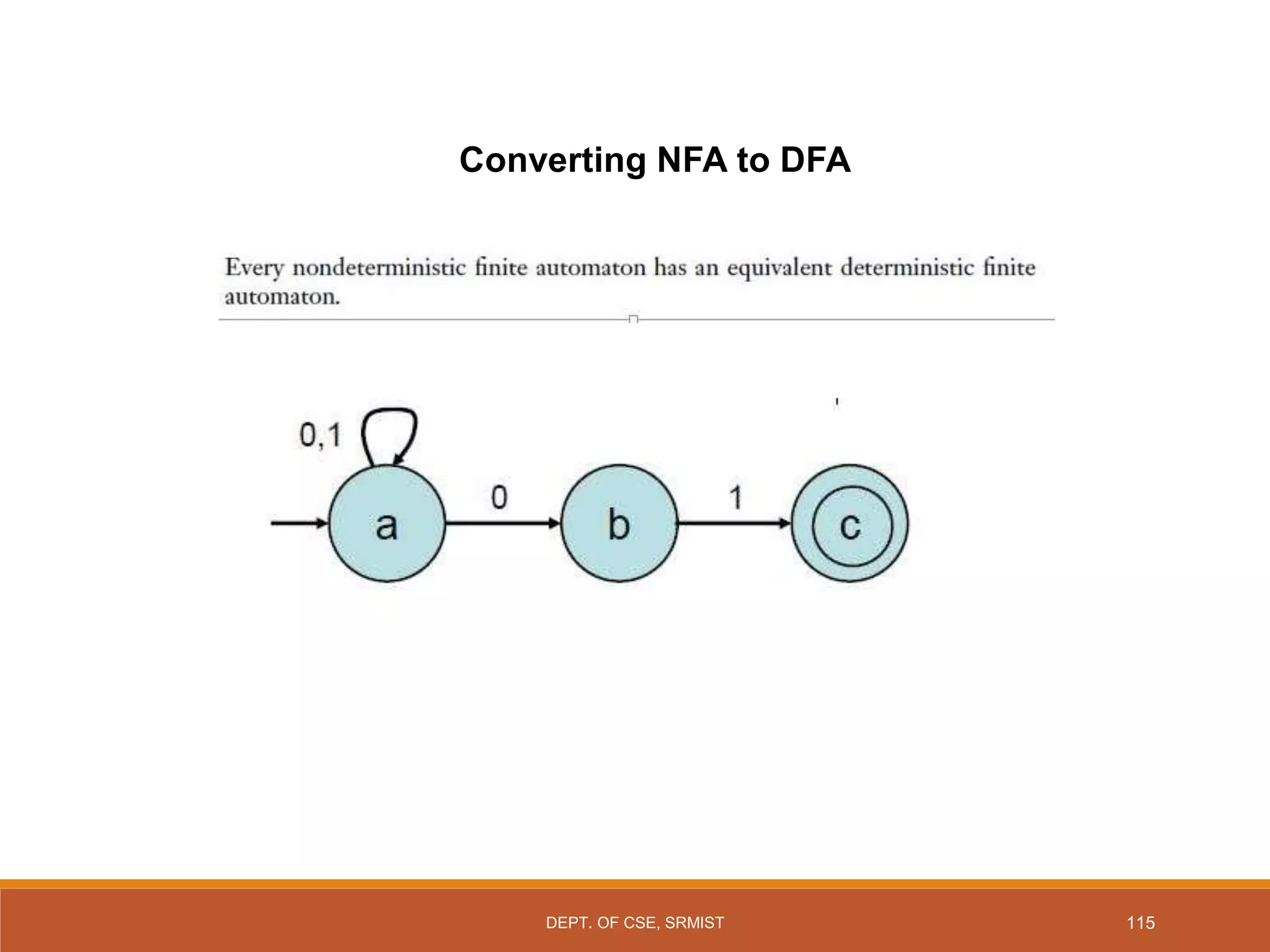
Converting NFA to DFA
115
DEPT. OF CSE, SRMIST
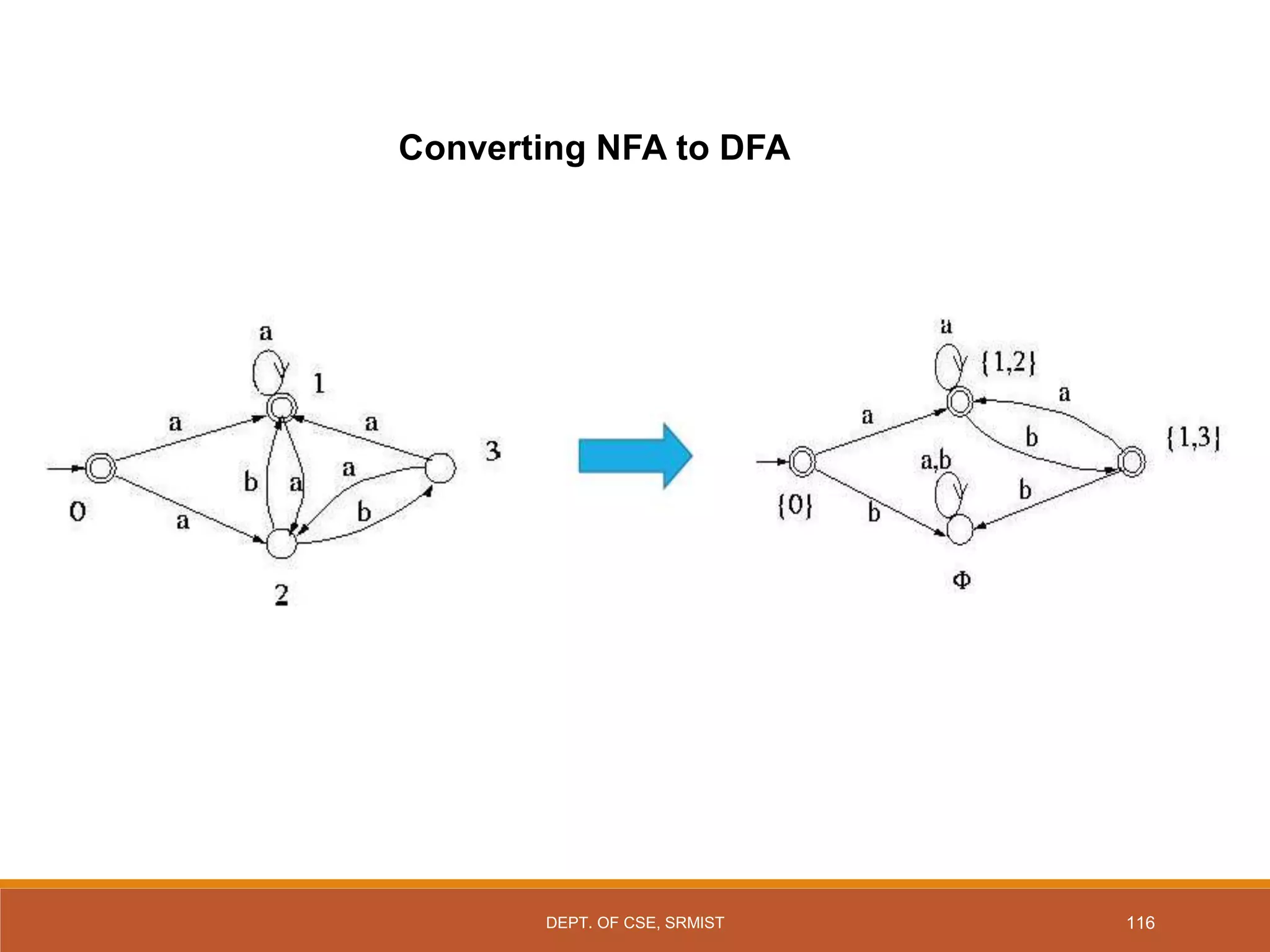
116
Converting NFA to DFA
DEPT. OF CSE, SRMIST
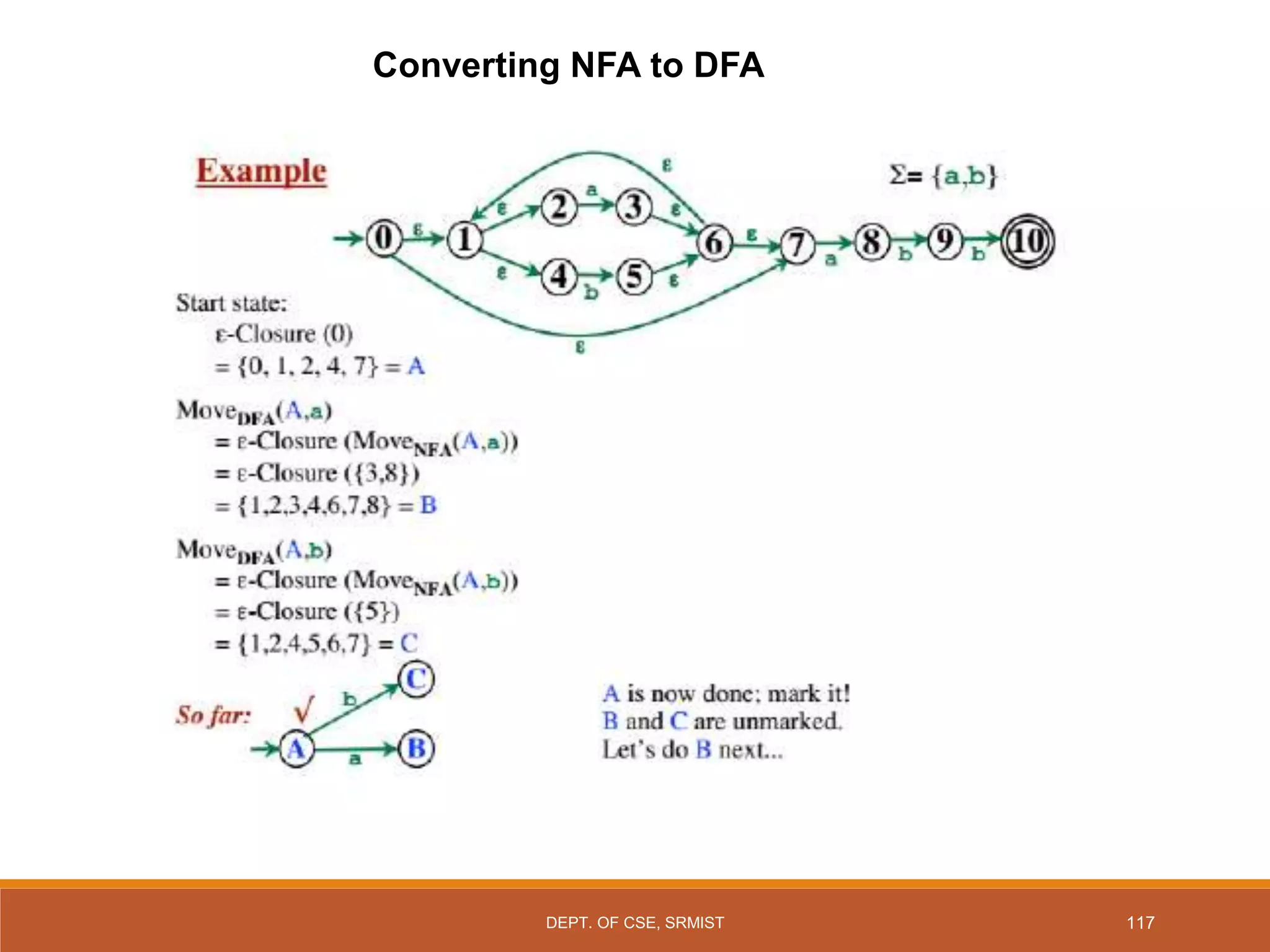
117
Converting NFA to DFA
DEPT. OF CSE, SRMIST
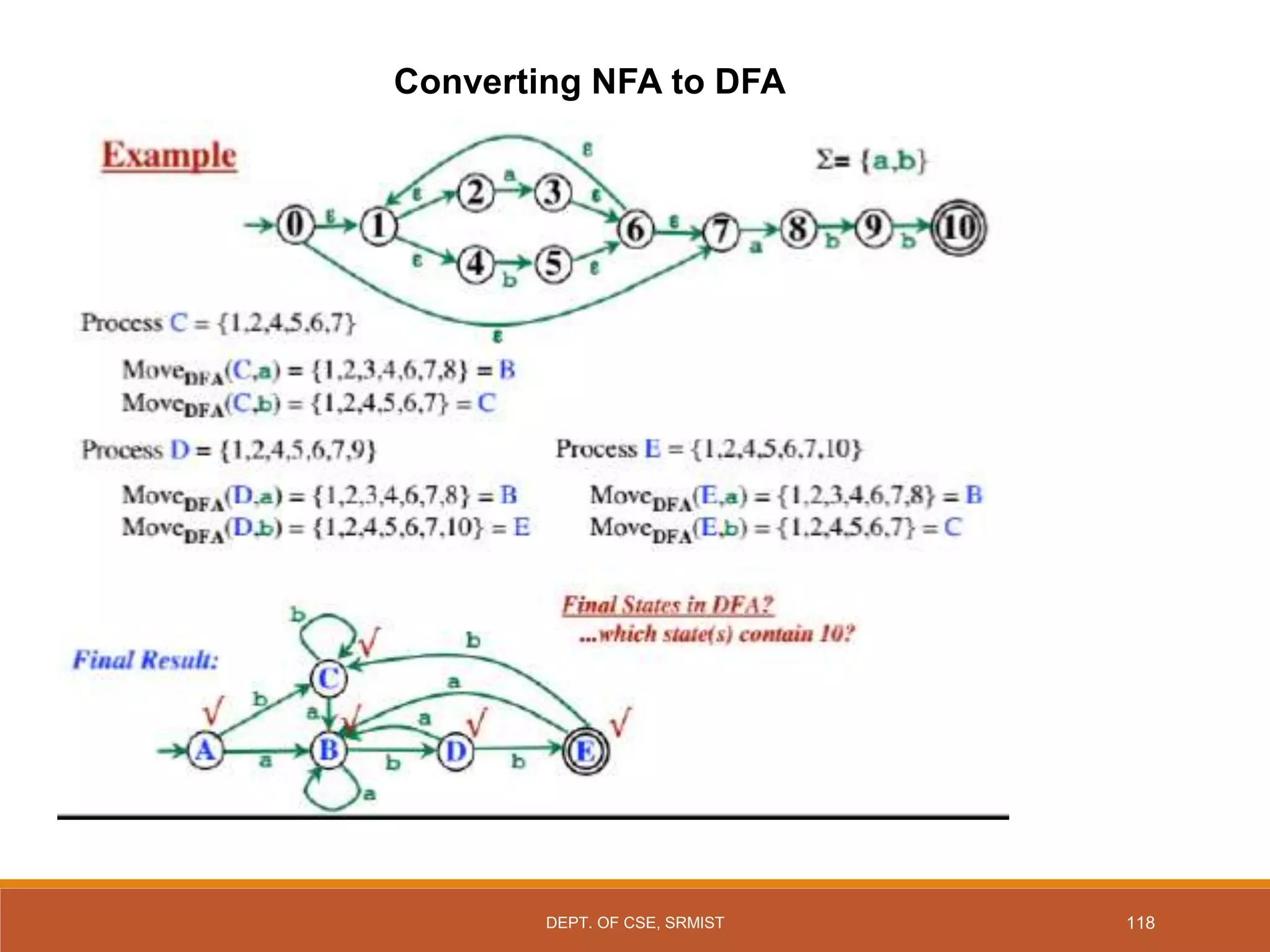
118
Converting NFA to DFA
DEPT. OF CSE, SRMIST
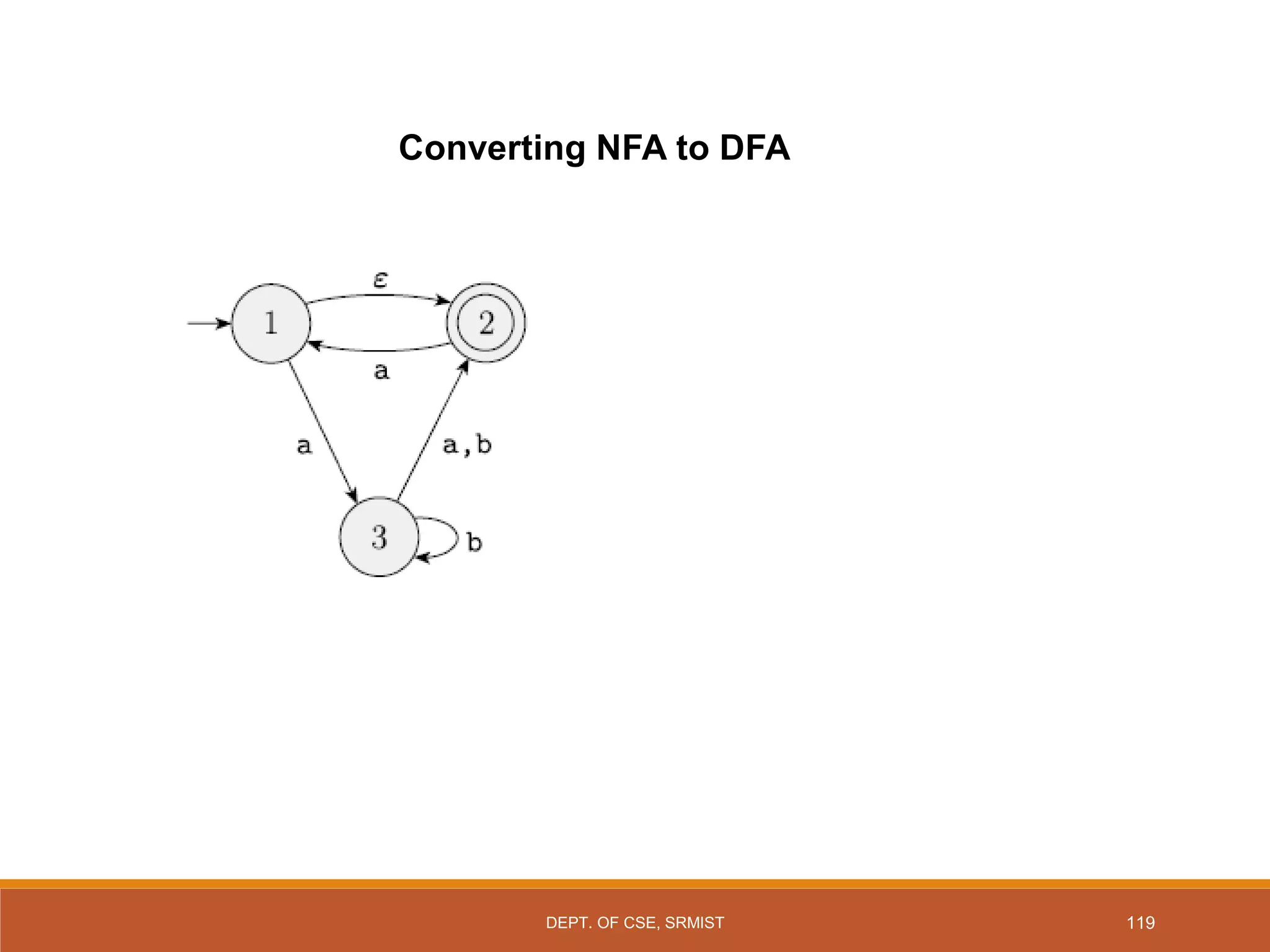
119
Converting NFA to DFA
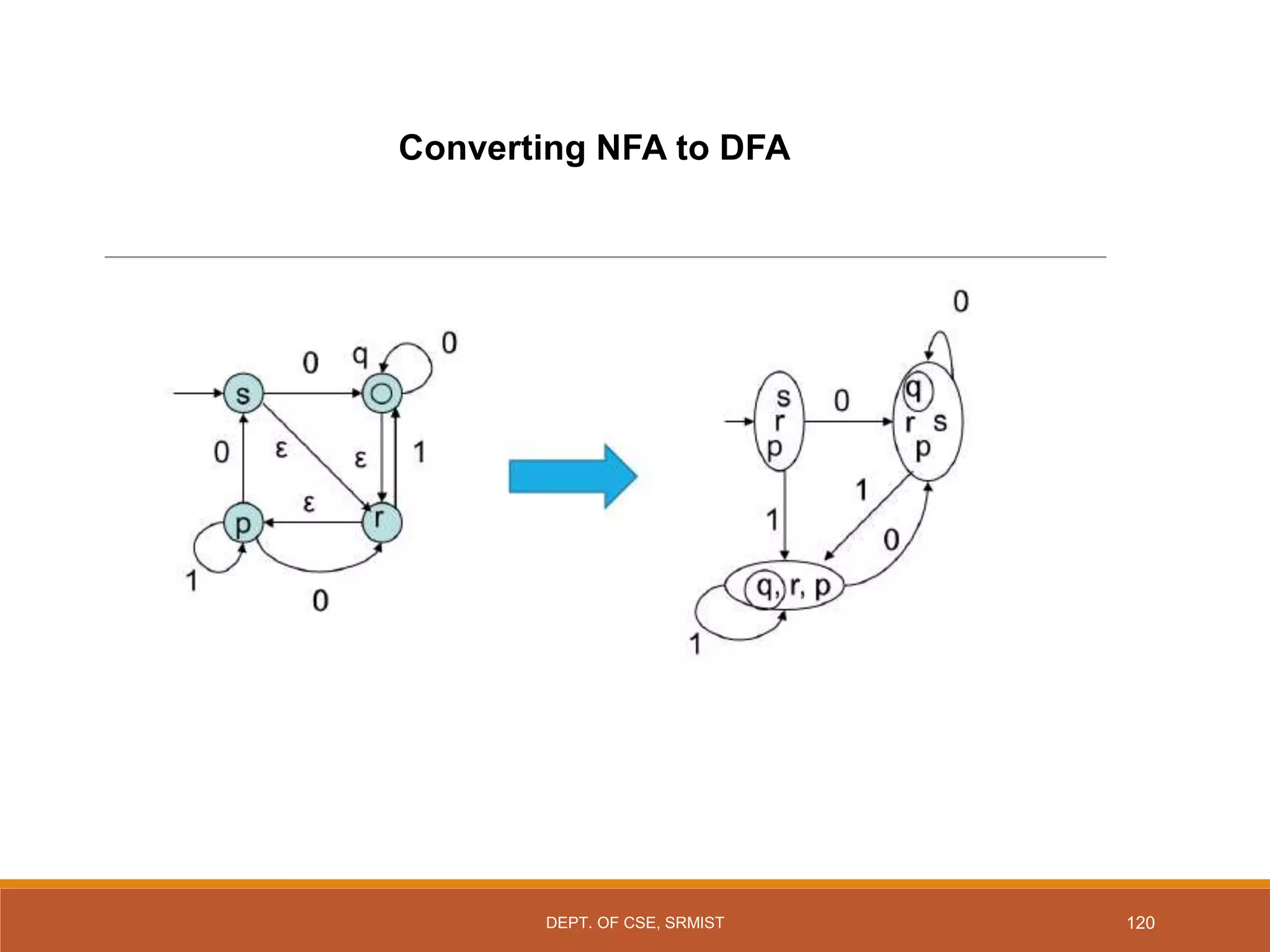
DEPT. OF CSE, SRMIST
120
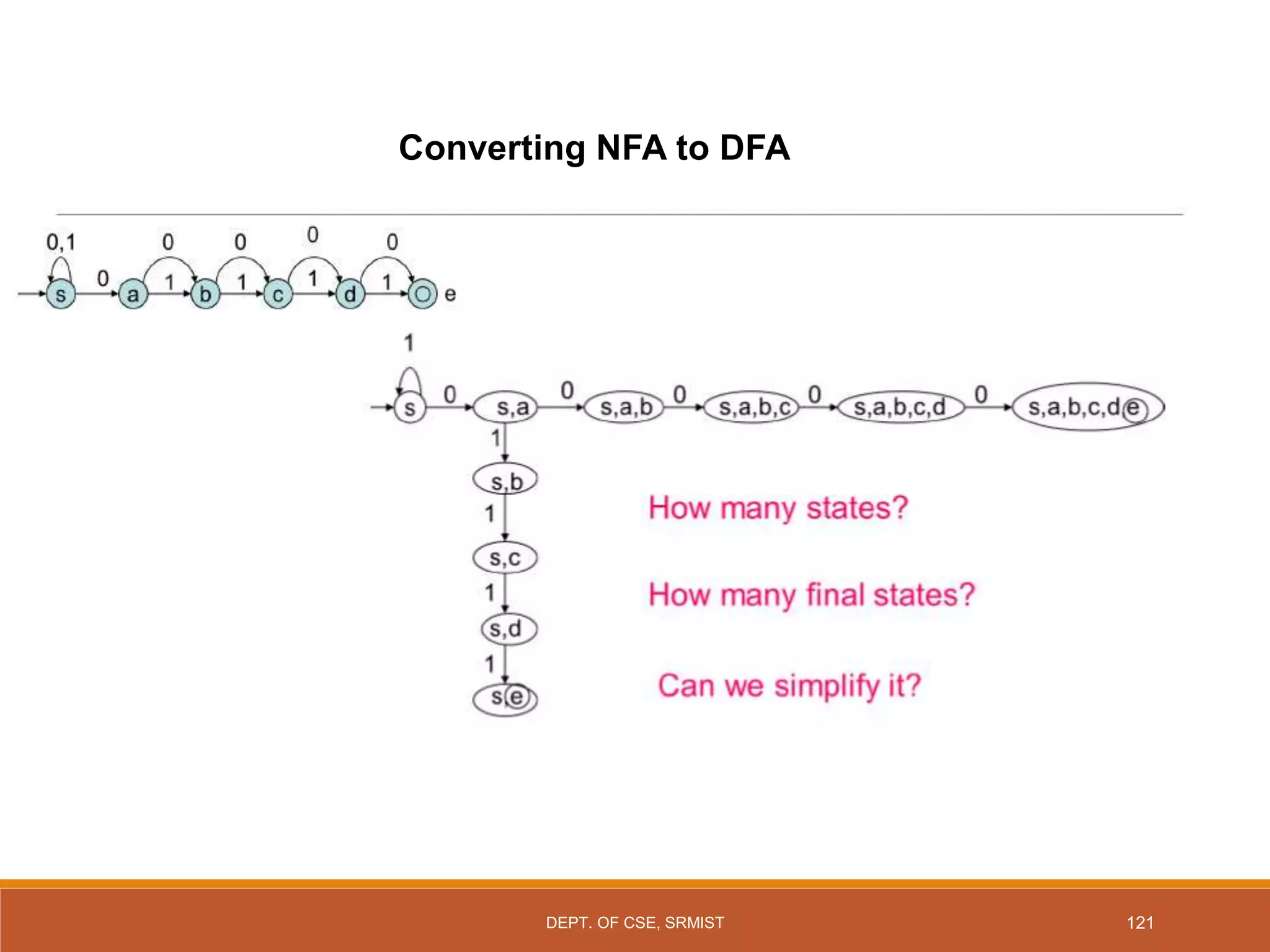
Converting NFA to DFA
DEPT. OF CSE, SRMIST
121
Converting NFA to DFA
DEPT. OF CSE, SRMIST
122
DEPT. OF CSE, SRMIST
123
DEPT. OF CSE, SRMIST
124
DEPT. OF CSE, SRMIST
125
DEPT. OF CSE, SRMIST
126
DEPT. OF CSE, SRMIST
127
DEPT. OF CSE, SRMIST
128
DEPT. OF CSE, SRMIST
129
DEPT. OF CSE, SRMIST
130
DEPT. OF CSE, SRMIST
131
DEPT. OF CSE, SRMIST
132
DEPT. OF CSE, SRMIST
133
DEPT. OF CSE, SRMIST
134
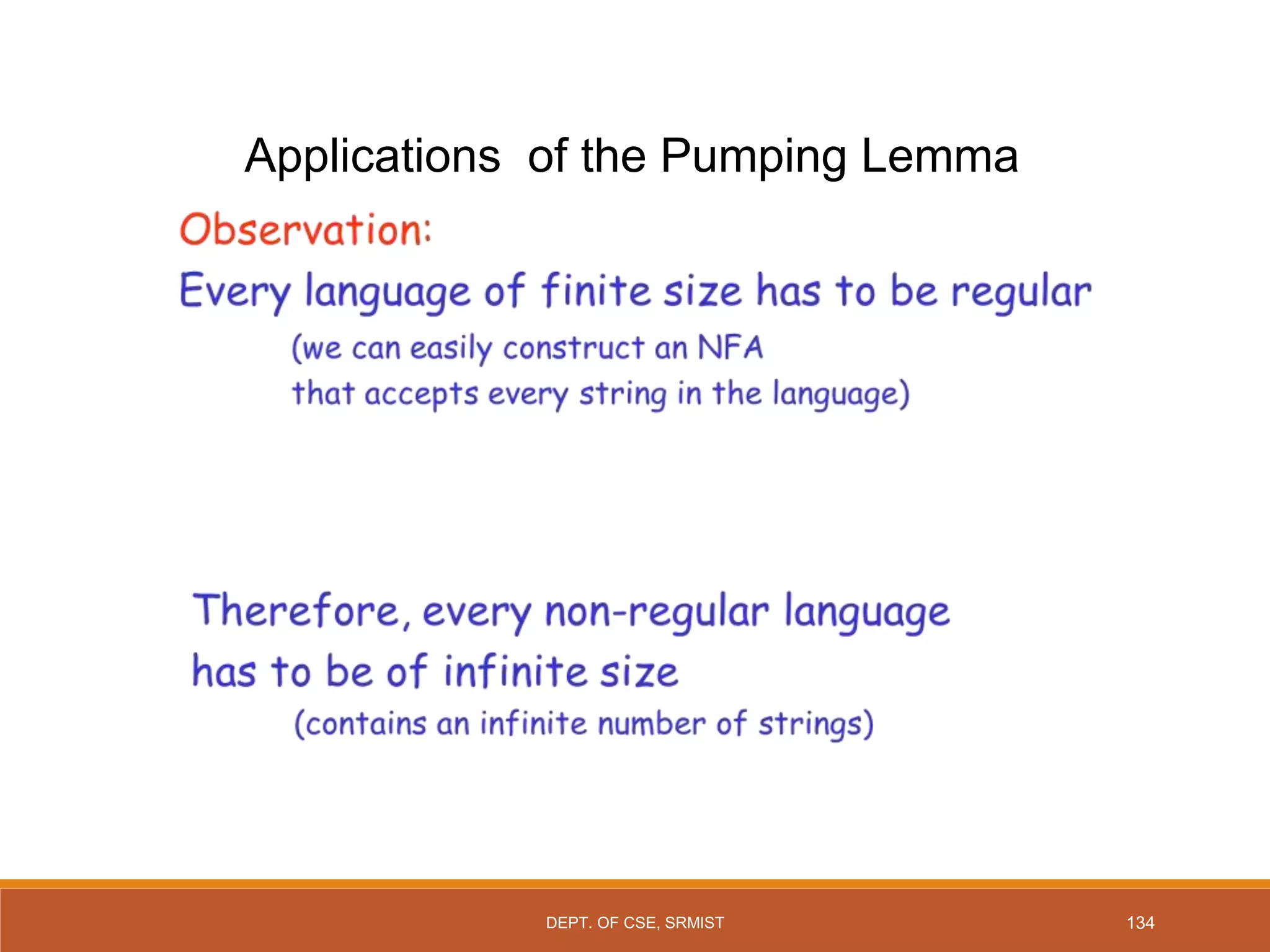
Applications of the Pumping Lemma
DEPT. OF CSE, SRMIST
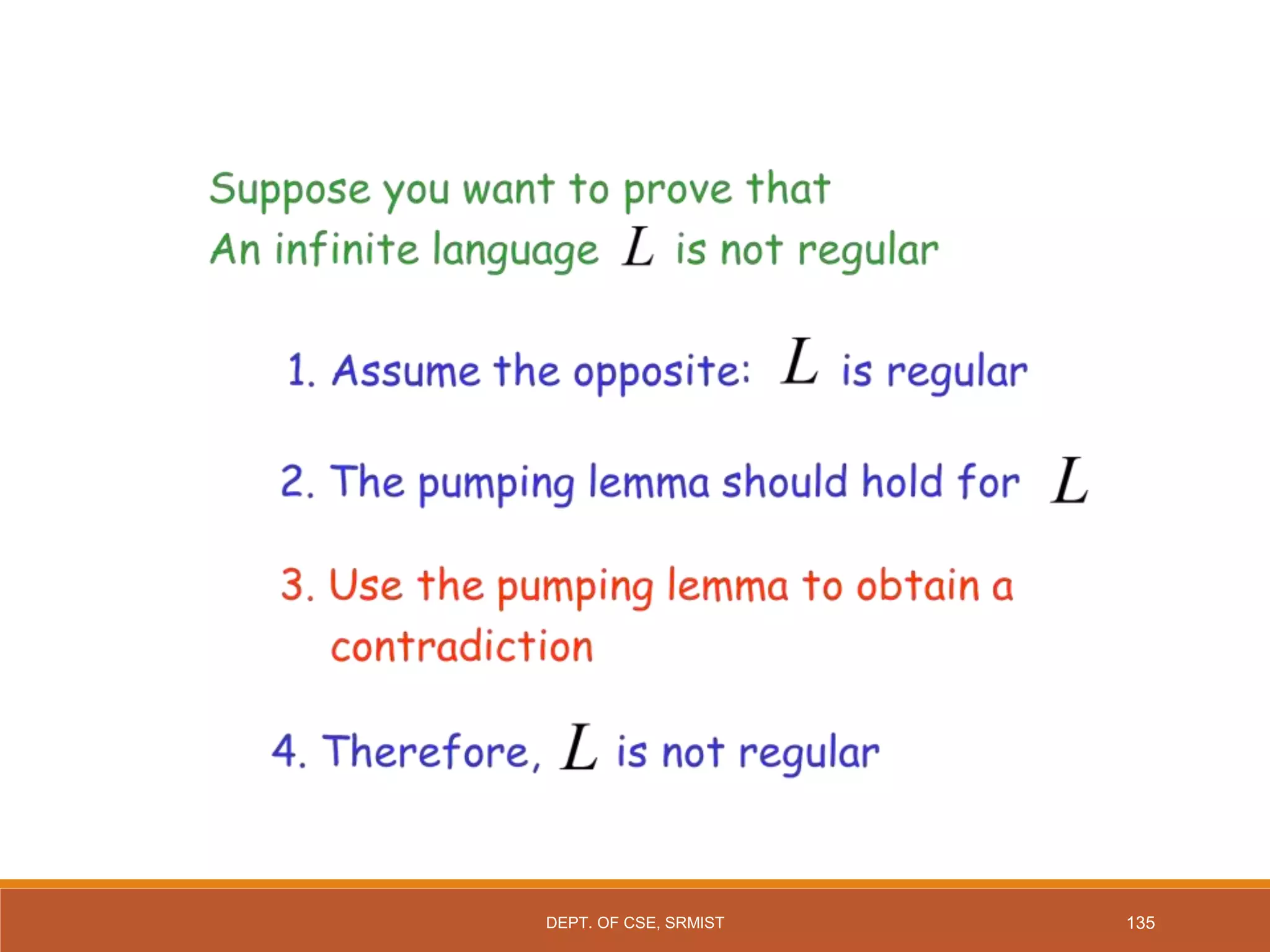
135
DEPT. OF CSE, SRMIST
136
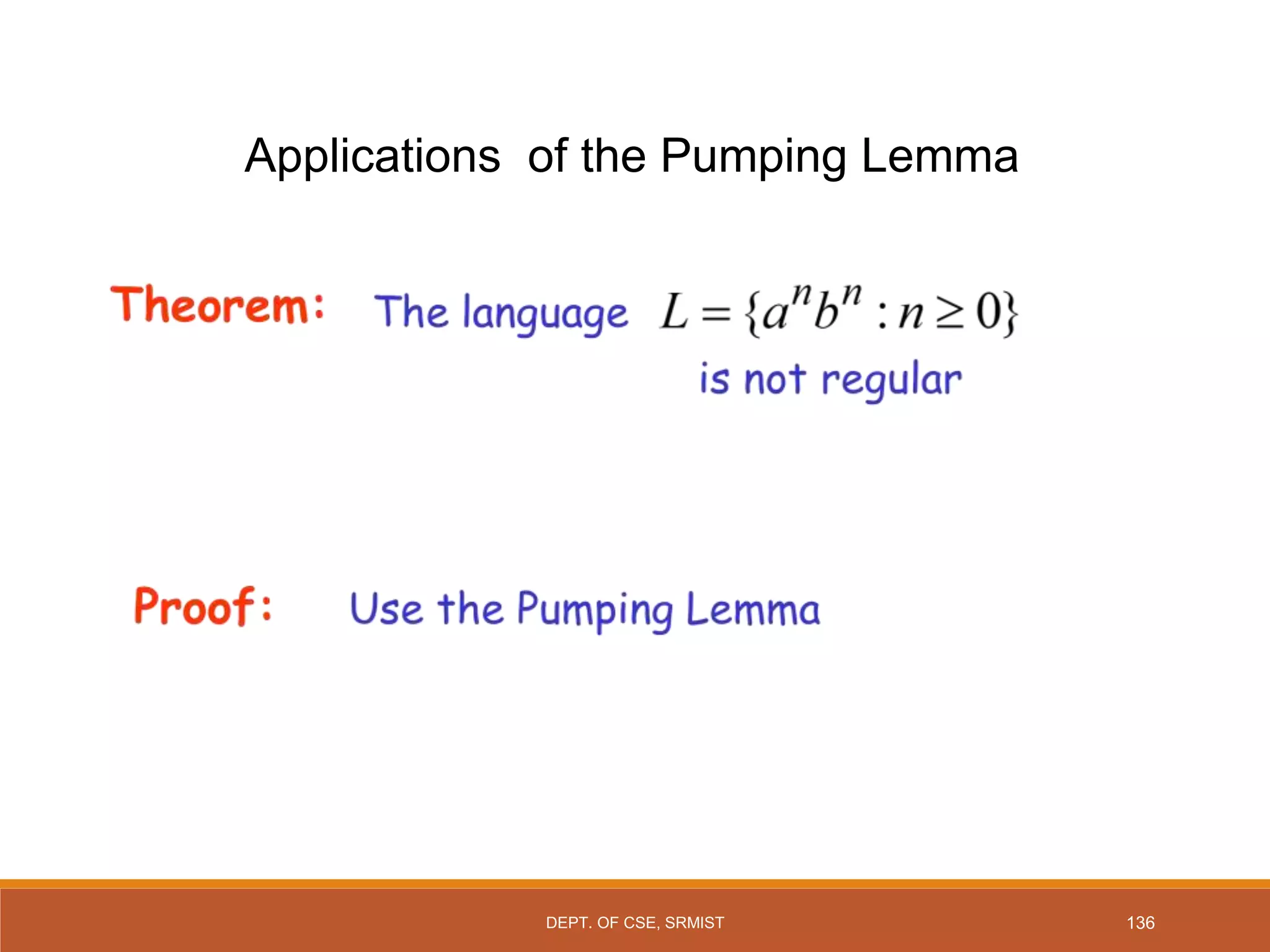
Applications of the Pumping Lemma
DEPT. OF CSE, SRMIST
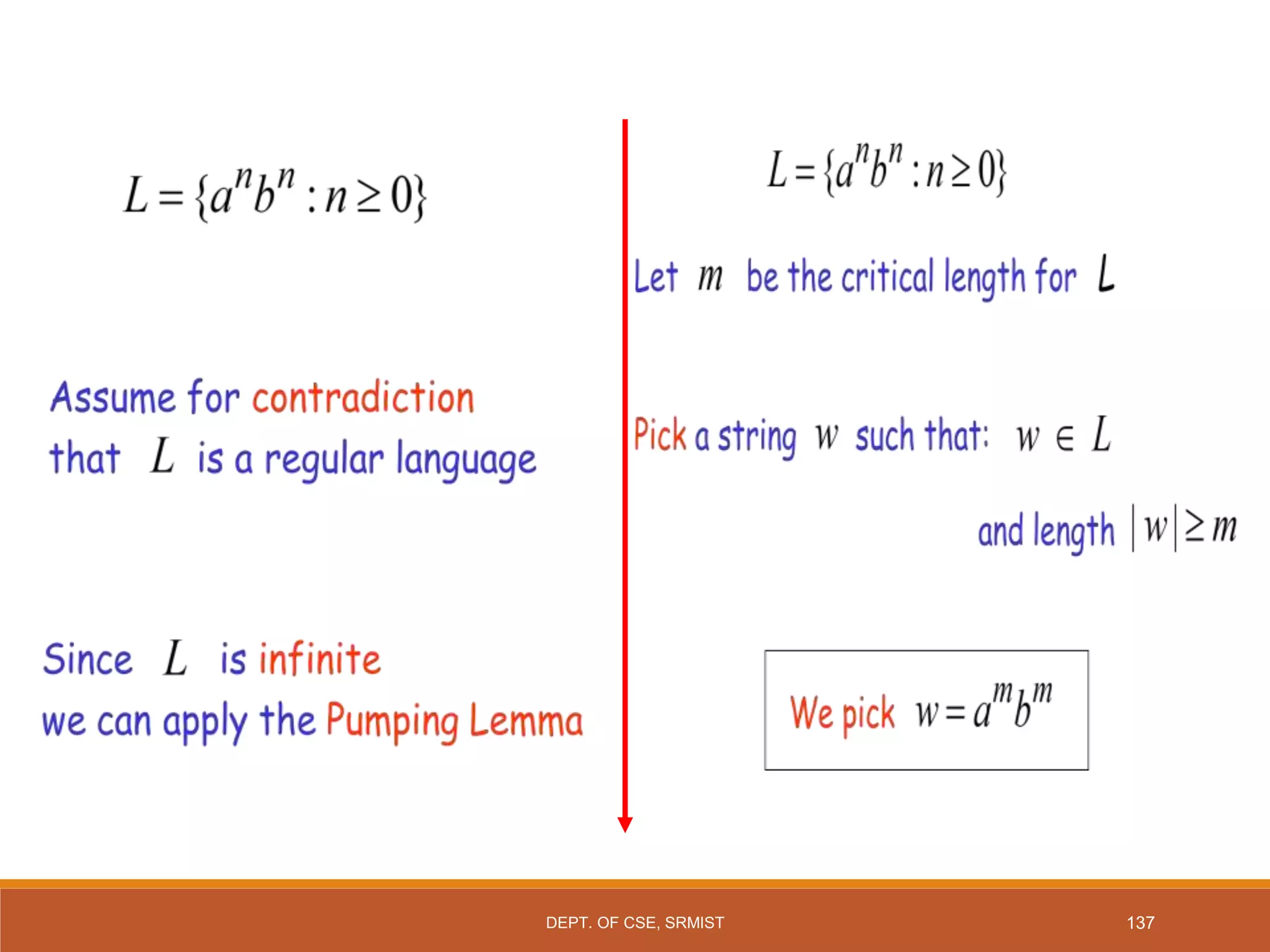
137
DEPT. OF CSE, SRMIST
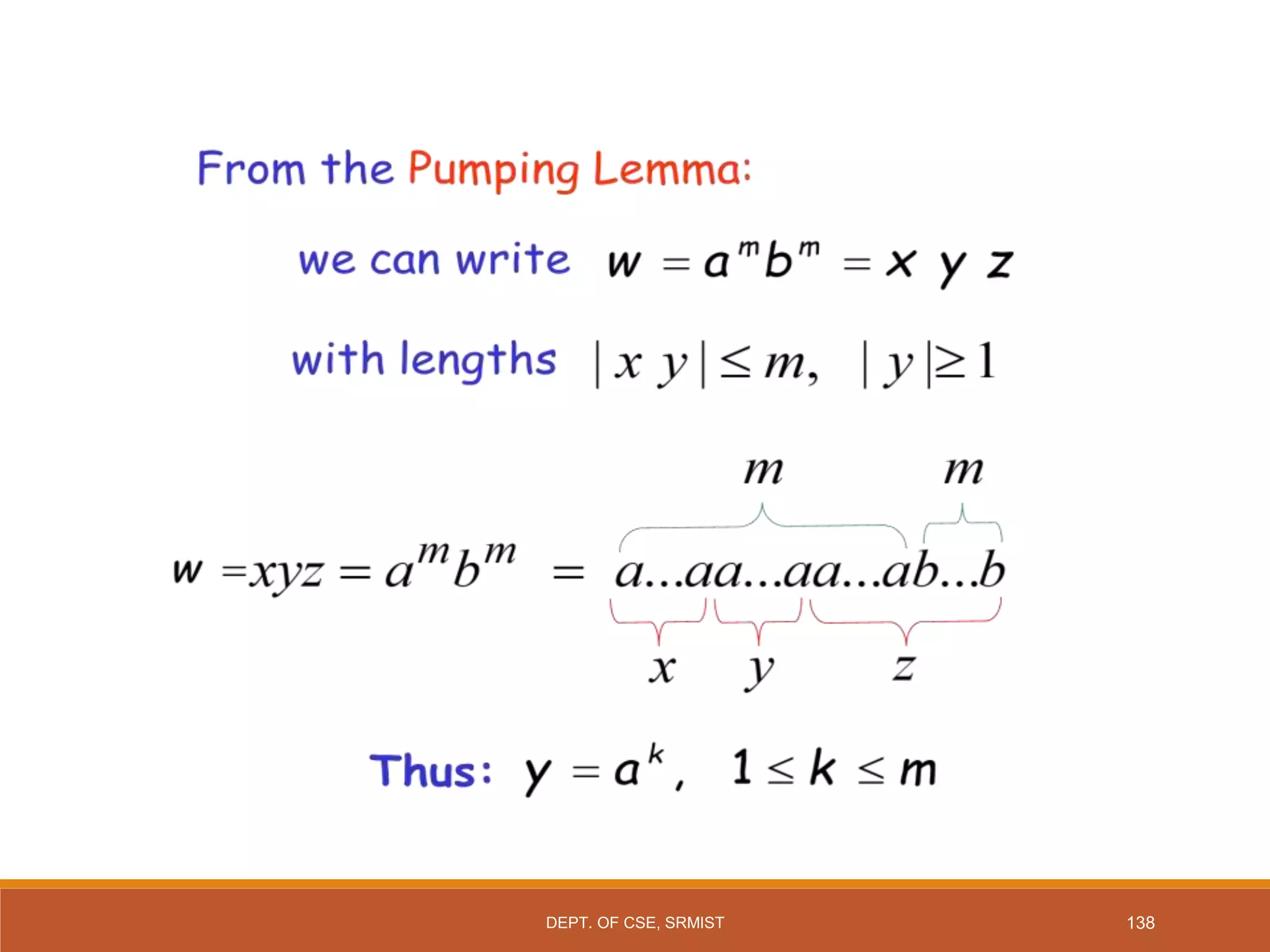
138
DEPT. OF CSE, SRMIST
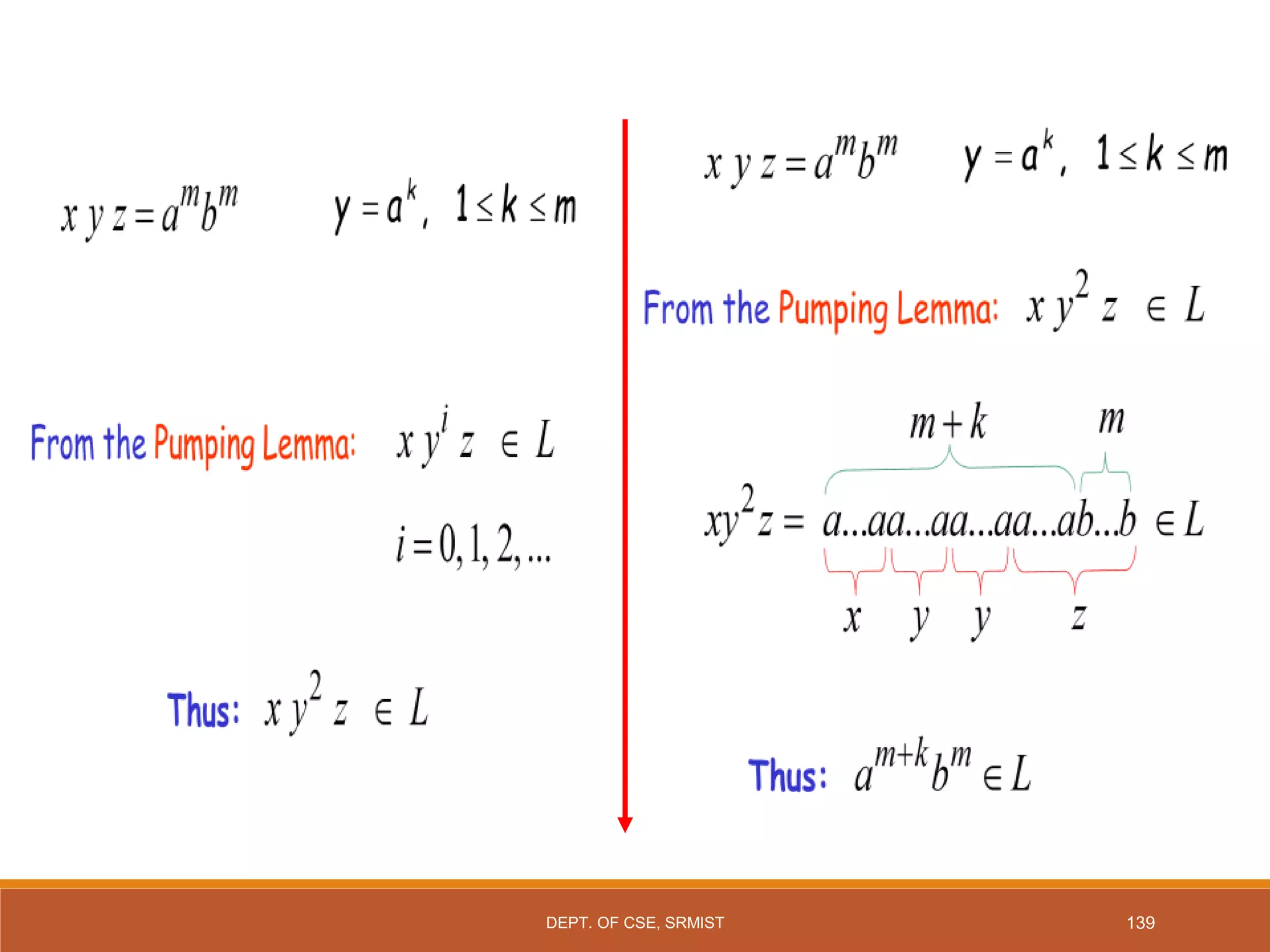
139
DEPT. OF CSE, SRMIST
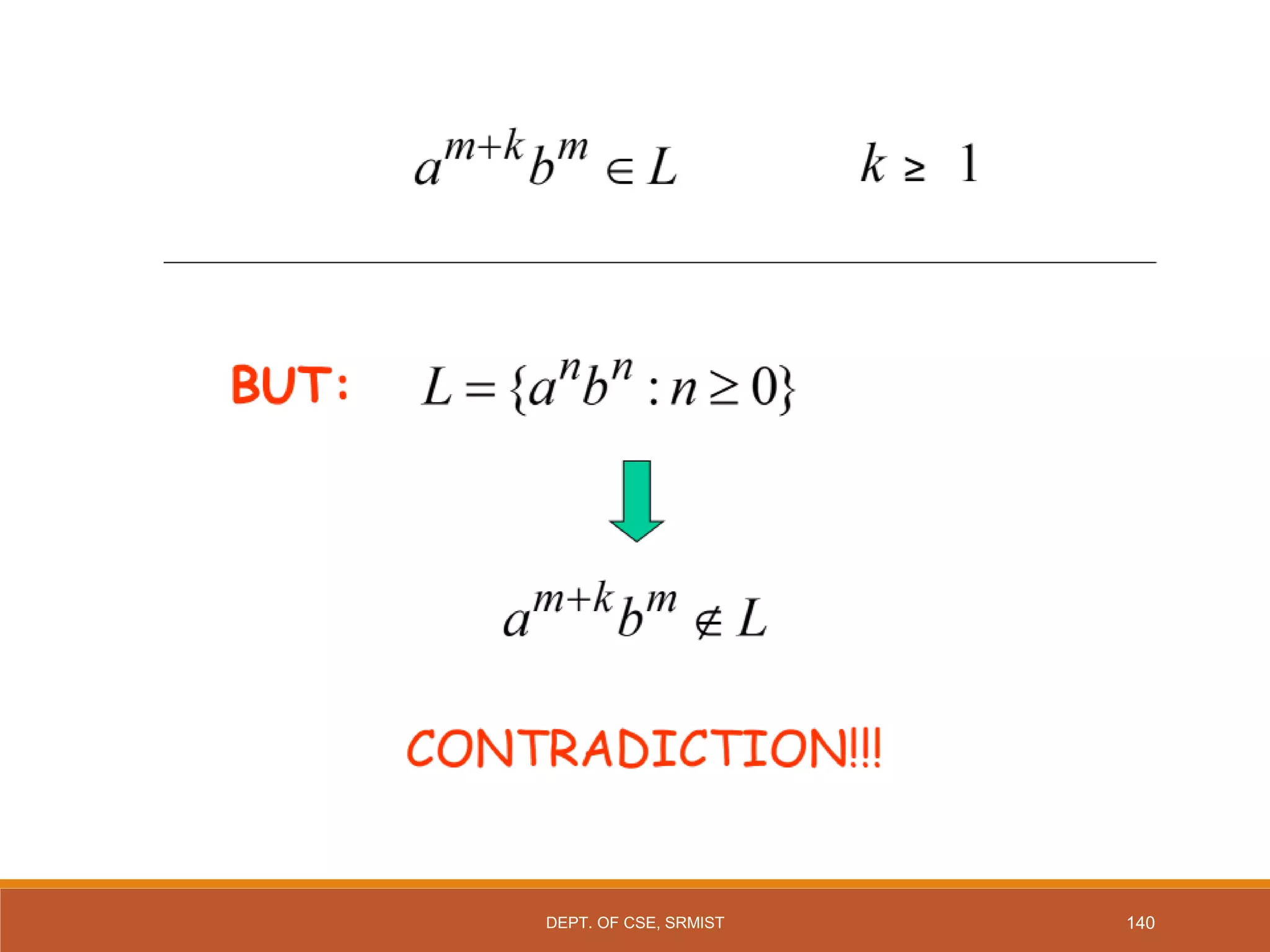
140
DEPT. OF CSE, SRMIST

Theory of computation:Finite Automata, Regualr Expression, Pumping Lemma

  • 1.
    UNIT 1 • Introductionto Automaton • Mathematical concepts • Formal Languages: Strings, Languages, Properties • Finite Representation : Regular Expressions • Problems related to regular expressions • Finite Automata :Deterministic Finite Automata • Nondeterministic Finite Automata • Finite Automaton with €- moves • Problems related to Deterministic and Nondeterministic Finite Automata • Problems related to Finite Automaton with €- moves • Minimization of DFA • Problems related to Minimization of DFA • Regular Languages : Equivalence of Finite Automata and Regular Languages • Equivalence of Finite Automata and Regular Grammars • Problems related to Equivalence of Finite Automata and Regular Languages and Regular Grammars • Variants of Finite Automata :Two-way Finite Automaton Mealy Machines • Properties of Regular Languages: Closure Properties • Set Theoretic Properties & Other Properties • Pumping Lemma 1 DEPT. OF CSE, SRMIST
  • 2.
    Introduction of Automaton Anautomata is an abstract self-propelled computing device which follows a predetermined sequence of operations automatically. Automata-based programming is a programming paradigm in which the program or its part, is thought as a model of a finite state machine or any other formal automation. What is Automata Theory? • Automata theory is the study of abstract computational devices • Abstract devices are (simplified) models of real computations • Computations happen everywhere: On your laptop, on your cell phone, in nature, … Example: input: switch output: light bulb actions: flip switch states: on, off BATTERY 2 DEPT. OF CSE, SRMIST
  • 3.
    3 1. Electric Switch 2.Fan Regulator 3. Automatic door controller 4. Binary string with divisible by 4 DEPT. OF CSE, SRMIST
  • 4.
    Simple Computer Example: input :switch Output : light bulb Actions : flip switch States : on, off bulb is on if and only if there was an odd number of flips BATTERY off on start f f 4 OTHER EXAMPLES 1. Electric Switch 2. Fan Regulator 3. Automatic door controller 4. Binary string with divisible by 4 DEPT. OF CSE, SRMIST
  • 5.
    Types of Automata finiteautomata Devices with a finite amount of memory. Used to model “small” computers. push-down automata Devices with infinite memory that can be accessed in a restricted way. Used to model parsers, etc. Turing Machines Devices with infinite memory. Used to model any computer. 5 DEPT. OF CSE, SRMIST
  • 6.
    Introduction of FormalProof - Basic Definitions 1. Alphabet - a finite set of symbols. ◦ Notation:  . Examples: Binary alphabet {0,1}, English alphabet {a,...,z,!,?,...} 2. String over an alphabet  - a finite sequence of symbols from . ◦ Notation: (a) Letters u, v, w, x, y, and z denote strings. (b) Convention: concatenate the symbols. No parentheses or commas used. ◦ Examples: 0000 is a string over the binary alphabet. a!? is a string over the English alphabet. 6 DEPT. OF CSE, SRMIST
  • 7.
    3. Empty string:e or  denotes the empty sequence of symbols. 4. Language over alphabet  - a set of strings over . ◦ Notation: L. ◦ Examples: ◦ {0, 00, 000, ...} is an "infinite" language over the binary alphabet. ◦ {a, b, c} is a "finite" language over the English alphabet. 5. Empty language - empty set of strings. Notation: . 6. Binary operation on strings: Concatenation of two strings u.v - concatenate the symbols of u and v. ◦ Notation: uv ◦ Examples: ◦ 00.11 = 0011. ◦ .u = u. = u for every u. (identity for concatenation) 7 DEPT. OF CSE, SRMIST
  • 8.
    Binary relations onstrings 1. Prefix - u is a prefix of v if there is a w such that v = uw. ◦ Examples: ◦  is a prefix of 0 since 0 = 0 ◦ apple is a prefix of appleton since appleton = apple.ton 2. Suffix - u is a suffix of v if there is a w such that v = wu. ◦ Examples: ◦ 0 is a suffix of 0 since 0 = ? ◦ ton is a suffix of appleton since ? 8 DEPT. OF CSE, SRMIST
  • 9.
    3. Substring -u is a substring of v if there are x and y such that v = xuy. ◦ Examples: ◦ let is a substring of appleton since appleton = app.let.on ◦ 0 is a substring of 0 since 0 = epsilon.0.epsilon Observe that prefix and suffix are special cases of substring. 9 DEPT. OF CSE, SRMIST
  • 10.
    Applications of theConcepts AND New Developments Applications include: ◦ Text processing (editors, etc.) ◦ Compiler design ◦ Verification through model checking Development’s include : DNA Computing Quantum Turing Machines 10 DEPT. OF CSE, SRMIST
  • 11.
    Introduction to Mathematicalconcepts Inductive Proof Deductive Proof 11 DEPT. OF CSE, SRMIST
  • 12.
    INDUCTIVE PROOF It isa special form of proof that deals about the objects in recursion. Induction Principle: If we prove S(i) and we prove that for all n>=I, S(n)=>S(n+1), then we may conclude that s(n) for all n>=1. It has two parts. 1.Basis part. 2.Inductive part. 12 DEPT. OF CSE, SRMIST
  • 13.
    Basis step: Wehave to show S(i) for a particular integer value “i”, here “i “ may be zero or one. Inductive step: We assume n>=i, where “i “ is the basis integer and we have to show that if S(n) then S(n+1) i.e., S(n) =>S(n+1). DEPT. OF CSE, SRMIST 13
  • 14.
    Problems Prove by aninduction method on “n” i=0 ∑ n i2 =((n(n+1)(2n+1))/6). Solution: i=0 ∑ n i2 =((n(n+1)(2n+1))/6). ----> Equ 1 Induction Principle: If we prove S(i) and we prove that for all n>=I, S(n)=>S(n+1), then we may conclude that s(n) for all n>=1. DEPT. OF CSE, SRMIST 14
  • 15.
    Basis: Put n=0 inthe equ 1 RHS= (0 (0+1) (2*0+1))/6 => 0 LHS = i=0 ∑ n (02) => 0 i.e., LHS = RHS. Inductive step: Put n =1 in the equ 1 S(n) = (n(n+1)(2n+1))/6. = (2n3+2n2+n2+n)/6. ---> Equ 2 DEPT. OF CSE, SRMIST 15
  • 16.
    Put n=n+1 inthe equ 1 S(n+1) => ((n+1)(n+2)(2n+3))/6. => ((n2+3n+2) (2n+3))/6. => (2n3+6n2+4n+3n2+9n+6)/6.->equ 3 From the induction principle: = S(n+1) =S(n) + (n+1)2. = ((2n3+3n2+n)/6) + (n+1)2 DEPT. OF CSE, SRMIST 16
  • 17.
    = ((2n3+3n2+n)/6) +(n2+2n+1) Cross multiplying the ‘6’ on the numerator. = ((2n3+3n2+n + 6n2+12n+6))/6. = ((2n3+9n2+13n+6))/6. -- equ 4 Equ 4 satisfies equ 3 Hence proved. DEPT. OF CSE, SRMIST 17
  • 18.
    Deductive proof: Consists ofsequence of statements whose truth lead us from some initial statement called the hypothesis or the give statement to a conclusion statement. Deductive Principle: The theorem is proved when we go from a hypothesis H to a conclusion C is the atatement “ if H then C”. i.e C is deduced from H 18 DEPT. OF CSE, SRMIST
  • 19.
    Additional forms ofproof: Proof of sets Proof by contradiction Proof by counter example 19 DEPT. OF CSE, SRMIST
  • 20.
    Direct proof (AKA)Constructive proof: If p is true then q is true Eg: if a and b are odd numbers then product is also an odd number. Odd number can be represented as 2n+1 a=2x+1, b=2y+1 product of a X b = (2x+1) X (2y+1)= 2(2xy+x+y)+1 = 2z+1 (odd number) 20 DEPT. OF CSE, SRMIST
  • 21.
    Proof by Contrapositve TheContrapositive of the statement “ ifH then C” is “if not C then not H”.A statement and its contrapositive are either both true or both false. Theorem R U (S  T) =(R U S)  (R U T) 21 DEPT. OF CSE, SRMIST
  • 22.
  • 23.
    Proof by Contradiction: Hand not C implies falsehood. 23 DEPT. OF CSE, SRMIST
  • 24.
  • 25.
    25 • Regular expressionsdescribe regular languages • Example: describes the language * ) ( c b a       ,... , , , , , * , bca abc aa bc a bc a   Regular Expressions DEPT. OF CSE, SRMIST
  • 26.
    26   1 1 2 1 2 1 * r r r r r r   Are regular Expressions 2 r Givenregular expressions and Recursive Definition 1 r DEPT. OF CSE, SRMIST
  • 27.
    27   ) ( *     c c b a A regular expression:    b a Not a regular expression: Regular Expressions DEPT. OF CSE, SRMIST
  • 28.
    28 : language ofregular expression Example   r L r     ,... , , , , , * ) ( bca abc aa bc a c b a L               a a L L L        Regular Expressions DEPT. OF CSE, SRMIST
  • 29.
    29 • For regularexpressions and • 1 r 2 r       2 1 2 1 r L r L r r L          2 1 2 1 r L r L r r L        * * 1 1 r L r L        1 1 r L r L  Regular Expressions DEPT. OF CSE, SRMIST
  • 30.
    30 • Regular expression:  * a b a       * a b a L         * a L b a L       * a L b a L            * a L b L a L            * a b a      ,... , , , , aaa aa a b a     ,... , , ,..., , , baa ba b aaa aa a  Regular Expressions DEPT. OF CSE, SRMIST
  • 31.
    31 • Regular expression    bb a b a r    *     ,... , , , , , bbb ba abb aa bb a r L  • Regular expression * ) 1 0 ( 00 * ) 1 0 (    r ) (r L = { all strings containing substring 00 } Regular Expressions DEPT. OF CSE, SRMIST
  • 32.
  • 33.
    33 Example Problems inRegular Expressions DEPT. OF CSE, SRMIST
  • 34.
    34 Solve Problems inRegular Expressions DEPT. OF CSE, SRMIST
  • 35.
    Deterministic Finite Automata(DFA) DEPT. OF CSE, SRMIST 35
  • 36.
    36 Formal definition ofDFA DFA M = (Q, , , s, F) Where, ◦ Q is finite set of states ◦  is input alphabet ◦ s  Q is initial state ◦ F  Q is set of final states ◦ : Q X  -> Q DEPT. OF CSE, SRMIST
  • 37.
    37 DFA The DFA has: ◦a finite set of states ◦ 1 special state - initial state ◦ 0 or more special states - final states ◦ input alphabet ◦ transition table containing (state, symbol) -> next state DEPT. OF CSE, SRMIST
  • 38.
    38 How does aDFA work? After reading input string, ◦ if DFA state final, input accepted ◦ if DFA state not final, input rejected Language of DFA -- set of all strings accepted by DFA. DEPT. OF CSE, SRMIST
  • 39.
    39 Pictorial representation ofDFA (q,σ) -> q' DEPT. OF CSE, SRMIST
  • 40.
    Formal definition ofFA DEPT. OF CSE, SRMIST 40
  • 41.
    DEPT. OF CSE,SRMIST 41
  • 42.
  • 43.
  • 44.
    Transition table A transitiontable is a conventional tabular representation of functions like δ that takes the two argument and returns another state. The row of the table corresponding to the states. The column of the table corresponding to the inputs. DEPT. OF CSE, SRMIST 44
  • 45.
  • 46.
    Extending the Transitionfunctions to the strings DEPT. OF CSE, SRMIST 46
  • 47.
    DEPT. OF CSE,SRMIST 47
  • 48.
    Language of DFA DEPT.OF CSE, SRMIST 48
  • 49.
    49 Example: Diagram ofDFA L = {a2n + 1 | n >= 0} Answer: L = {a, aaa, aaaaa, ...} DEPT. OF CSE, SRMIST
  • 50.
    Given a DFAaccepting the following language over the alphabet {0,1} Set of all the strings ending with 00. Problem 1 DEPT. OF CSE, SRMIST 50
  • 51.
    In this problem, “00” as 2 inputs and it needs 3 states DEPT. OF CSE, SRMIST 51
  • 52.
    52 Formal definition ofL(M) L(M) - Language accepted by M Define *: ◦ *(q, ) = q ◦ *(q, wσ) = (*(q,w),σ) Definition: L(M) = { w in * | * (s,w) in F }. DEPT. OF CSE, SRMIST
  • 53.
    53 Example: L(M) ={w in {a,b}* | w contains even no. of a's} Problem 2 DEPT. OF CSE, SRMIST
  • 54.
    54 Regular Languages Definition: ALanguage is regular iff there is a DFA that accepts it. Examples: ◦  ◦ {} ◦ * ◦ {w in {0,1}* | second symbol of w is a 1} Exercise ◦ {w in {0,1}* | second last symbol of w is a 1} Exercise ◦ {w in {0,1}* | w contains 010 as a substring} - (importance?) DEPT. OF CSE, SRMIST
  • 55.
    55 Closure properties ofRegular Languages Regular languages are closed under: ◦ Union ◦ Notation:  ◦ Intersection ◦ Notation:  L1 L2 is regular if L1 and L2 are regular. L1 L2 is regular if L1 and L2 are regular. DEPT. OF CSE, SRMIST
  • 56.
    56 Examples Let  ={a,b}. Let L1 = { w in * | w has even number of a's}. ◦ Is L1 regular? L2 = { w in * | w has odd number of b's}. ◦ Is L2 regular? L1  L2 = ? ◦ Ans: {w in * | w has even a's or odd b's}. L1  L2 = ? ◦ Ans: {w in * | w has even a's and odd b's}. By closure properties, both these are regular. DEPT. OF CSE, SRMIST
  • 57.
    57 DFA of L1= {w in {a,b}* | w has even number of a's}. Problem 3 DEPT. OF CSE, SRMIST
  • 58.
    58 DFA of L2= { w in {a,b}* | w has odd number of b's}. Problem 4 DEPT. OF CSE, SRMIST
  • 59.
    59 DFA of L1L2 = {w in {a,b}* | w has even a's or odd b's}. Problem 5 DEPT. OF CSE, SRMIST
  • 60.
    60 DFA of L1L2 = {w in {a,b}* | w has even a's and odd b's}. Problem 6 DEPT. OF CSE, SRMIST
  • 61.
    61 DFA of A= {w | w contains at least one 1 and an even number of 0s follow the last 1} Problem 8 DEPT. OF CSE, SRMIST
  • 62.
    Given a DFAaccepting the following language over the alphabet {0,1} Set of all the strings ending with 00. Problem 9 DEPT. OF CSE, SRMIST 62
  • 63.
    Problem 10 Given aDFA accepting the following language over the alphabet {0,1} Set of all the strings with 3 consecutive 0’s (not necessarily at the end). DEPT. OF CSE, SRMIST 63
  • 64.
    Problem 11: Given aDFA accepting the following language over the alphabet {0,1} Set of all the strings with a 011 as a substring. DEPT. OF CSE, SRMIST 64
  • 65.
    Given a DFAaccepting the following language over the alphabet {0,1} Set of all the strings beginning with a 101. Problem 13 DEPT. OF CSE, SRMIST 65
  • 66.
    Given a DFAaccepting the following language over the alphabet {0,1} Set of all the strings with three consecutive zeros. Problem 14 DEPT. OF CSE, SRMIST 66
  • 67.
    : Consider the followingtransition diagram and to check the input string 110111,011101 is accepted or not. Problem 14 DEPT. OF CSE, SRMIST 67
  • 68.
    Transition table: Let Abe a DFA which has A={Q,∑,δ,q0,F) 0 1  A A B B C B C A D * D A B DEPT. OF CSE, SRMIST 68
  • 69.
    Input: 110111 δ( A,є)=A. δ( A,1) =B. δ( A,11) =δ( A,1),1) =δ( B,1) =B. δ( A,110) =δ( A,11),0) =δ( B,0) = C. δ( A,1101) =δ( A,110),1) =δ( C,1) = D. δ( A,11010) =δ( A,1101),0) =δ( D,1) = B. δ( A,110101) =δ( A,11010),0) =δ( B,1) = B. It does not reach the final state. The given string is not accepted by DFA. DEPT. OF CSE, SRMIST 69
  • 70.
    Input: 011101 δ( A,є)=A. δ( A,0) =A. δ( A,01) =δ( A,0),1) =δ( A,1) =B. δ( A,011) =δ( A,01),1) =δ( B,1) = B. δ( A,0111) =δ( A,011),1) =δ( B,1) = B. δ( A,01110) =δ( A,0111),0) =δ( B,0) = C. δ( A,011101) =δ( A,011101),0) =δ( C,1) = D. It reaches the final state. The given string is accepted by DFA. DEPT. OF CSE, SRMIST 70
  • 71.
    Give a DFAaccepting the following language over the alphabet {0,1}. All the strings with a substring 01 and to check the given input string 10010 is accepted or not by a DFA. Problem 15 0 1 q0 q1 q0 q1 q1 q2 *q2 q2 q2 DEPT. OF CSE, SRMIST 71
  • 72.
    Input 10010 δ( q0,є)=q0. δ( q0,1) =q0. δ( q0,10) =δ( q0,1),0) =δ( q0,0) =q1. δ( q0,100) =δ( q0,10),0) =δ( q1,0) =q1. δ( q0,1001) =δ( q0,100),1) =δ( q1,1) =q2. δ( q0,10010) =δ( q0,1001),0) =δ( q2,0) =q2. It reaches the final state The given string is accepted by DFA. DEPT. OF CSE, SRMIST 72
  • 73.
    Problem16 : Design aDFA to accept the language L ={w/w has an even number of 0’s and even number of 1’s}and to check the given input strings are 110101 and 10010 is accepted or not by an DFA. It has the 4 states like q0,q1,q2,q3. q0: Number of 1’s and number of 0’s are even. q1: Number of 0’s is even and number of 1’s is odd. q2: Number of 0’s is odd and number of 1’s is even. q3: Number of 0’s and number of 1’s are odd. DEPT. OF CSE, SRMIST 73
  • 74.
    Let A bea DFA which has A={Q,∑,δ,q0,F) Transition diagram: DEPT. OF CSE, SRMIST 74
  • 75.
    Input: 110101 δ( q0,є)=q0. δ( q0,1) =q1. δ( q0,11) =δ( q0,1),1) =δ( q1,1) =q0. δ( q0,110) =δ( q0,11),0) =δ( q0,0) =q2. δ( q0,1101) =δ( q0,110),1) =δ( q2,1) =q3. δ( q0,11010) =δ( q0,1101),0) =δ( q3,0) =q1. δ( q0,110101) =δ( q0,11010),0) =δ( q1,1) =q0. It reaches the final state. The given string is accepted by DFA. DEPT. OF CSE, SRMIST 75
  • 76.
    Input: 10010 δ( q0,є)=q0. δ( q0,1) =q1. δ( q0,10) =δ( q0,1),0) =δ( q1,0) =q3. δ( q0,100) =δ( q0,10),0) =δ( q3,0) =q1. δ( q0,1001) =δ( q0,100),1) =δ( q1,1) =q0. δ( q0,10010) =δ( q0,1001),0) =δ( q0,0) =q2. The state q2 is not a accepting state. The given string is not accepted by DFA. DEPT. OF CSE, SRMIST 76
  • 77.
    77 Nondeterministic Finite Automaton(NFA) Generalization of DFA. Allows: ◦ 0 or more next states for the same (q, ). ◦ Guessing ◦ Transitions labeled by the empty string. ◦ Changing state without reading input Motivation: Flexibility. ◦ Easier to prove many closure properties. DEPT. OF CSE, SRMIST
  • 78.
    78 How does anNFA work? w is accepted by an NFA provided there is a sequence of guesses that leads to a final state. Language accepted by NFA is the set of all strings accepted by it. DEPT. OF CSE, SRMIST
  • 79.
    Nondeterministic Finite Automata: oGeneralize FAs by adding nondeterminism,allowing several alternative computations on the same input string. o Ordinary deterministic FAs follow one path on each input. 79 DEPT. OF CSE, SRMIST
  • 80.
  • 81.
    Nondeterministic Finite Automata: NFAExample 81 DEPT. OF CSE, SRMIST
  • 82.
    Nondeterministic Finite Automata: NFAExample 82 DEPT. OF CSE, SRMIST
  • 83.
    83 Example: {w in{0,1}* | the second last symbol of w is a 1} Problem 1 DEPT. OF CSE, SRMIST
  • 84.
    84 Formal definition ofNFA Notation: e =  U {e}. NFA M = (Q, , , s, F) where: ◦ Q - finite set of states ◦  - input alphabet ◦ s - initial state ◦ F  Q - set of final states ◦  is a subset of Q X e X Q. If (p, u, q) in , then NFA in state p can read u and go to q. DEPT. OF CSE, SRMIST
  • 85.
    85 Define *(q, w)as a set of states: p ε *(q, w) if there is a directed path from q to p labeled w ◦ Example: consider NFA of Lecture 3 *(q0, 1) = ? ◦ Ans: {q0, q1} *(q0, 11) = ? ◦ Ans: {q0, q1, q2} Formal definition of NFA acceptance DEPT. OF CSE, SRMIST
  • 86.
    86 NFA acceptance w isaccepted by NFA M iff *(q0, w)  F is nonempty. L(M) = {w in * | w is accepted by M}. DEPT. OF CSE, SRMIST
  • 87.
    NFA vs. DFA IsNFA more powerful than DFA? ◦ Ans: No. Theorem: ◦ For every NFA M there is an equivalent DFA M' Proof Idea: ◦ NFA is in a set of states at any point during reading a string. ◦ DFA will use a lot of states to keep track of this. Important Assumption: ◦ No transition labeled by epsilon. (Will get rid of this assumption later.) 87 DEPT. OF CSE, SRMIST
  • 88.
    88 Equivalent DFA construction NFAM = (Q, , , s, F) DFA M' = (Q', , , s', F') where: ◦ Q' = 2Q ◦ s' = {s} ◦ F' = {P | P  F is nonempty} ◦ ({p1, p2, pm}, ) = *(p1, )  *(p2, )  ...  *(pm, ) i.e. find all the states that can be reached on  from all the NFA states in a DFA state. DEPT. OF CSE, SRMIST
  • 89.
    89 Example: Equivalent DFAconstruction NFA DEPT. OF CSE, SRMIST
  • 90.
  • 91.
    91 How to handleepsilon transitions? Define e-closure of state q as *(q, ). ◦ notation: e-closure(q). Example: DEPT. OF CSE, SRMIST
  • 92.
    92 Handling epsilon transitions(contd.) Extend e-closure to sets of states by: ◦ e-closure({s1, ... , sm}) = e-closure(s1)  ...  e-closure(sm) Now let s' = e-closure({s}). and, ({p1,..., pm}, ) = e-closure(*(p1, ))  ...  e-closure(*(pm, )) to complete construction of DFA. DEPT. OF CSE, SRMIST
  • 93.
    93 Example: Handling epsilontransitions. DEPT. OF CSE, SRMIST
  • 94.
    94 DFA = ? DEPT.OF CSE, SRMIST
  • 95.
    95 Language Operations 1. Concatenation.Notation: LL' or just LL' ◦ L  L' = {uv | u in L, v in L'}. 2. Kleene Star. Notation: L* ◦ L* = { w in * | w = w1...wk for some k >= 0 and each wi in L}. Examples: if L = {a(2n+1) | n >= 0}. L' = {b(2n) | n > = 0}. LL' = ? ◦ Ans: LL' = {a(2n+1) b(2m) | n, m > = 0} L* = ? ◦ Ans: {an | n >= 0} U, ., * are called regular operations. DEPT. OF CSE, SRMIST
  • 96.
    Closure properties ofregular languages. Previously we saw closure under  and . New: Regular languages are closed under ◦ Concatenation ◦ Kleene star ◦ Complement. 96 DEPT. OF CSE, SRMIST
  • 97.
    97 Examples L = {win {a,b}* | w has even a’s } DEPT. OF CSE, SRMIST
  • 98.
    98 Examples L' = {win {a,b}* | w has at least one b} DEPT. OF CSE, SRMIST
  • 99.
    99 Construction for LL' L’’= (K,,,s,F) K = K1  K2 s = s1 F = F2  = 1  2  F1 X {e} X {s2} DEPT. OF CSE, SRMIST
  • 100.
    100 L* and L'* L* L’* M= (K, , , s, F) K = {s}  K1 F = {s}  F1  = 1  F1 X {e} X {s1}  {(s, e, s1)} Given M1 = (K1, , 1, s1, F1) DEPT. OF CSE, SRMIST
  • 101.
    101 Complement of Land L' Complement of L Complement of L’ DEPT. OF CSE, SRMIST
  • 102.
    102 General Construction forComplement DFA M = (K, , δ, s, F) K = K1 s = s1 F = K - F1 δ = δ1 L(M) = Complement of L(M1) DFA M1 = (K1, , δ1, s1, F1) Exercise: Will this construction work for NFAs? Explain your answer. DEPT. OF CSE, SRMIST
  • 103.
    103 Regular expressions generateexactly the class of regular languages. Theorem: ◦ (a) For every regular expression there is an equivalent NFA ◦ (b) For every DFA there is an equivalent regular expression. Proof of (a): ◦ For , the NFA is: ◦ For , the NFA is: ◦ For composite regular expressions: use closure under ,  and * Regular expressions versus FA's DEPT. OF CSE, SRMIST
  • 104.
    104 Parse Tree for(a U b)*  b  b * U a b DEPT. OF CSE, SRMIST
  • 105.
    105 Example: NFA for(a U b)*b a b aUb DEPT. OF CSE, SRMIST
  • 106.
    106 Example (contd.) :NFA for (a U b)*b (aUb)* DEPT. OF CSE, SRMIST
  • 107.
    107 Example (contd.) :NFA for (a U b)*b (a U b)*b DEPT. OF CSE, SRMIST
  • 108.
    108 DFA  regularexpression Easier to do: ◦ DFA  GNFA  regular expression. GNFA (Generalized NFA) ◦ labels of transitions can be regular expressions. Need special GNFA that satisfies: (1) start state has no incoming transition (2) only one final state (3) final state has no outgoing transition. DEPT. OF CSE, SRMIST
  • 109.
    109 DFA  regularexpression (contd.) Idea: ◦ Convert DFA  special GNFA. ◦ Eliminate all states, except start and final state, one state at a time. ◦ Output the label on the single transition left at the end. DEPT. OF CSE, SRMIST
  • 110.
    110 Eliminating state q{rip} R4 R3 R1 (R1)(R2)* (R3)  (R4) R2 qi qrip qj qi qj DEPT. OF CSE, SRMIST
  • 111.
    111 Constructing regular expression. DFAL = {w in {a, b}* | w has odd number of b's } DEPT. OF CSE, SRMIST
  • 112.
    112 Constructing regular expression(contd.) Added: a new start state and a new final state with empty transitions DEPT. OF CSE, SRMIST
  • 113.
    113 Constructing regular expression(contd.) qrip We take out the qrip state and it leaves us with a 3 state Finite Automata Before we take out qrip, we have to see all the paths to the qrip state and all possible transitions. Eliminate states one-by-one DEPT. OF CSE, SRMIST
  • 114.
    114 Constructing regular expression(contd.) qrip We take out the qrip state and we are left with the regular expression DEPT. OF CSE, SRMIST
  • 115.
    Converting NFA toDFA 115 DEPT. OF CSE, SRMIST
  • 116.
    116 Converting NFA toDFA DEPT. OF CSE, SRMIST
  • 117.
    117 Converting NFA toDFA DEPT. OF CSE, SRMIST
  • 118.
    118 Converting NFA toDFA DEPT. OF CSE, SRMIST
  • 119.
    119 Converting NFA toDFA DEPT. OF CSE, SRMIST
  • 120.
    120 Converting NFA toDFA DEPT. OF CSE, SRMIST
  • 121.
    121 Converting NFA toDFA DEPT. OF CSE, SRMIST
  • 122.
  • 123.
  • 124.
  • 125.
  • 126.
  • 127.
  • 128.
  • 129.
  • 130.
  • 131.
  • 132.
  • 133.
  • 134.
    134 Applications of thePumping Lemma DEPT. OF CSE, SRMIST
  • 135.
  • 136.
    136 Applications of thePumping Lemma DEPT. OF CSE, SRMIST
  • 137.
  • 138.
  • 139.
  • 140.