Discrete Mathematics
Chapter 1:
Fundamentals of Logic
1
Presented By,
Nandini S R
Department of Computer Science
1.1 Propositions
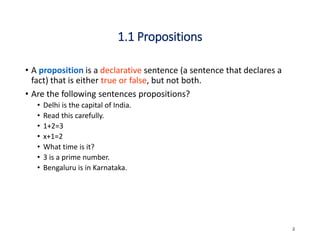
• A proposition is a declarative sentence (a sentence that declares a
fact) that is either true or false, but not both.
• Are the following sentences propositions?
• Delhi is the capital of India.
• Read this carefully.
• 1+2=3
• x+1=2
• What time is it?
• 3 is a prime number.
• Bengaluru is in Karnataka.
2
1.1 Propositions
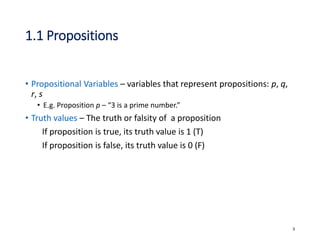
• Propositional Variables – variables that represent propositions: p, q,
r, s
• E.g. Proposition p – “3 is a prime number.”
• Truth values – The truth or falsity of a proposition
If proposition is true, its truth value is 1 (T)
If proposition is false, its truth value is 0 (F)
3
Logical connectives
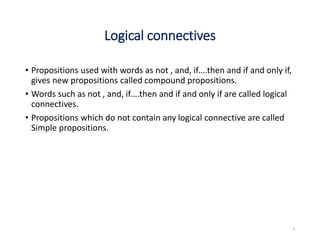
• Propositions used with words as not , and, if….then and if and only if,
gives new propositions called compound propositions.
• Words such as not , and, if….then and if and only if are called logical
connectives.
• Propositions which do not contain any logical connective are called
Simple propositions.
4
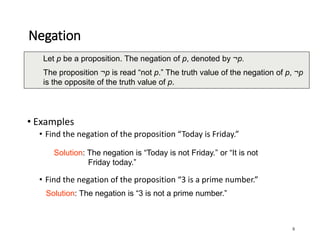
Negation
• Examples
• Find the negation of the proposition “Today is Friday.”
• Find the negation of the proposition “3 is a prime number.”
5
Let p be a proposition. The negation of p, denoted by ¬p.
The proposition ¬p is read “not p.” The truth value of the negation of p, ¬p
is the opposite of the truth value of p.
Solution: The negation is “Today is not Friday.” or “It is not
Friday today.”
Solution: The negation is “3 is not a prime number.”
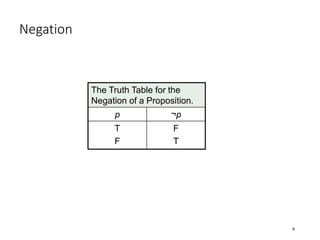
Negation
The Truth Table for the
Negation of a Proposition.
p ¬p
T
F
F
T
6
Conjuction
• Examples
• Find the conjunction of the propositions p and q where p is the
proposition “9 is a prime number.” and q is the proposition “2+5=7”, and
the truth value of the conjunction.
7
Let p and q be propositions. The conjunction of p and q, denoted by
p Λ q, is the proposition “p and q”. The conjunction p Λ q is true when
both p and q are true and is false otherwise.
Solution: The conjunction is the proposition “9 is a prime number
and 2+5=7.” The proposition is False.
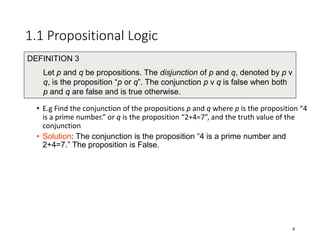
1.1 Propositional Logic
• E.g Find the conjunction of the propositions p and q where p is the proposition “4
is a prime number.” or q is the proposition “2+4=7”, and the truth value of the
conjunction
• Solution: The conjunction is the proposition “4 is a prime number and
2+4=7.” The proposition is False.
8
DEFINITION 3
Let p and q be propositions. The disjunction of p and q, denoted by p ν
q, is the proposition “p or q”. The conjunction p ν q is false when both
p and q are false and is true otherwise.
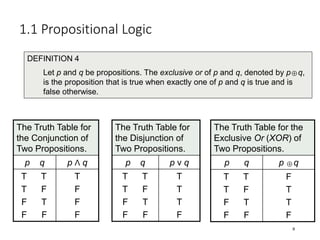
1.1 Propositional Logic
The Truth Table for the
Exclusive Or (XOR) of
Two Propositions.
p q p q
T T
T F
F T
F F
F
T
T
F

The Truth Table for
the Conjunction of
Two Propositions.
p q p Λ q
T T
T F
F T
F F
T
F
F
F
The Truth Table for
the Disjunction of
Two Propositions.
p q p ν q
T T
T F
F T
F F
T
T
T
F
9
DEFINITION 4
Let p and q be propositions. The exclusive or of p and q, denoted by p q,
is the proposition that is true when exactly one of p and q is true and is
false otherwise.


1.1 Propositional Logic

10
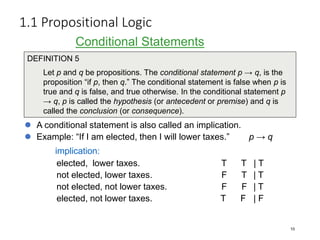
DEFINITION 5
Let p and q be propositions. The conditional statement p → q, is the
proposition “if p, then q.” The conditional statement is false when p is
true and q is false, and true otherwise. In the conditional statement p
→ q, p is called the hypothesis (or antecedent or premise) and q is
called the conclusion (or consequence).
Conditional Statements
 A conditional statement is also called an implication.
 Example: “If I am elected, then I will lower taxes.” p → q
implication:
elected, lower taxes. T T | T
not elected, lower taxes. F T | T
not elected, not lower taxes. F F | T
elected, not lower taxes. T F | F
1.1 Propositional Logic
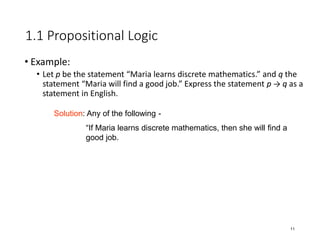
• Example:
• Let p be the statement “Maria learns discrete mathematics.” and q the
statement “Maria will find a good job.” Express the statement p → q as a
statement in English.
11
Solution: Any of the following -
“If Maria learns discrete mathematics, then she will find a
good job.
1.1 Propositional Logic
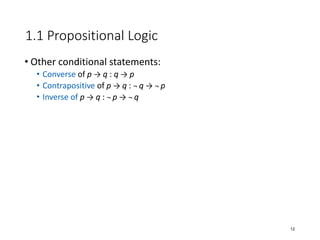
• Other conditional statements:
• Converse of p → q : q → p
• Contrapositive of p → q : ¬ q → ¬ p
• Inverse of p → q : ¬ p → ¬ q
12
1.1 Propositional Logic
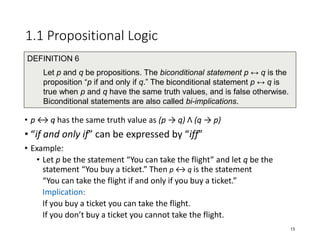
• p ↔ q has the same truth value as (p → q) Λ (q → p)
• “if and only if” can be expressed by “iff”
• Example:
• Let p be the statement “You can take the flight” and let q be the
statement “You buy a ticket.” Then p ↔ q is the statement
“You can take the flight if and only if you buy a ticket.”
Implication:
If you buy a ticket you can take the flight.
If you don’t buy a ticket you cannot take the flight.
13
DEFINITION 6
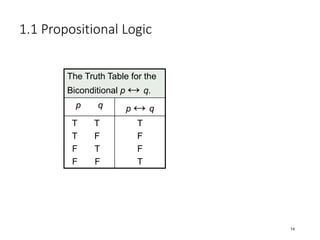
Let p and q be propositions. The biconditional statement p ↔ q is the
proposition “p if and only if q.” The biconditional statement p ↔ q is
true when p and q have the same truth values, and is false otherwise.
Biconditional statements are also called bi-implications.
1.1 Propositional Logic
The Truth Table for the
Biconditional p ↔ q.
p q p ↔ q
T T
T F
F T
F F
T
F
F
T
14
1.1 Propositional Logic
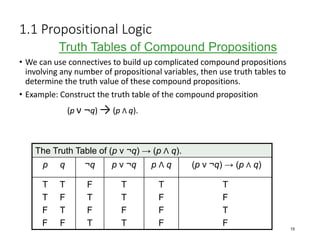
• We can use connectives to build up complicated compound propositions
involving any number of propositional variables, then use truth tables to
determine the truth value of these compound propositions.
• Example: Construct the truth table of the compound proposition
(p ν ¬q) → (p Λ q).
The Truth Table of (p ν ¬q) → (p Λ q).
p q ¬q p ν ¬q p Λ q (p ν ¬q) → (p Λ q)
T T
T F
F T
F F
F
T
F
T
T
T
F
T
T
F
F
F
T
F
T
F
15
Truth Tables of Compound Propositions
1.1 Propositional Logic
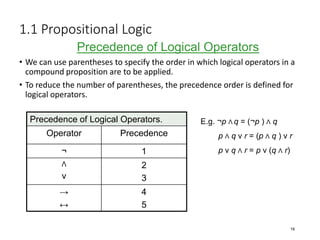
• We can use parentheses to specify the order in which logical operators in a
compound proposition are to be applied.
• To reduce the number of parentheses, the precedence order is defined for
logical operators.
Precedence of Logical Operators.
Operator Precedence
¬ 1
Λ
ν
2
3
→
↔
4
5
16
Precedence of Logical Operators
E.g. ¬p Λ q = (¬p ) Λ q
p Λ q ν r = (p Λ q ) ν r
p ν q Λ r = p ν (q Λ r)
1.1 Propositional Logic
• Example: How can this English sentence be translated into a logical
expression?
“You can access the Internet from campus only if you are a
computer science major or you are not a freshman.”
17
Solution: Let p, q, and r represent “You can access the Internet from
campus,” “You are a computer science major,” and “You are
a freshman.” The sentence can be translated into:
p → (q ν ¬r).
1.1 Propositional Logic
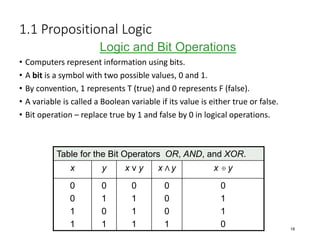
• Computers represent information using bits.
• A bit is a symbol with two possible values, 0 and 1.
• By convention, 1 represents T (true) and 0 represents F (false).
• A variable is called a Boolean variable if its value is either true or false.
• Bit operation – replace true by 1 and false by 0 in logical operations.
Table for the Bit Operators OR, AND, and XOR.
x y x ν y x Λ y x y
0
0
1
1
0
1
0
1
0
1
1
1
0
0
0
1
0
1
1
0

18
Logic and Bit Operations
1.1 Propositional Logic
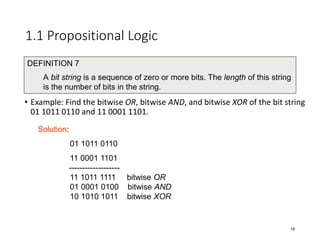
• Example: Find the bitwise OR, bitwise AND, and bitwise XOR of the bit string
01 1011 0110 and 11 0001 1101.
19
DEFINITION 7
A bit string is a sequence of zero or more bits. The length of this string
is the number of bits in the string.
Solution:
01 1011 0110
11 0001 1101
-------------------
11 1011 1111 bitwise OR
01 0001 0100 bitwise AND
10 1010 1011 bitwise XOR
1.2 Propositional Equivalences
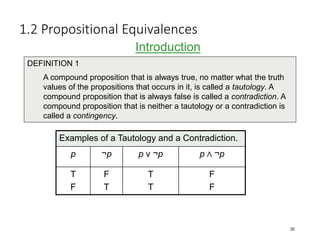
Examples of a Tautology and a Contradiction.
p ¬p p ν ¬p p Λ ¬p
T
F
F
T
T
T
F
F
20
DEFINITION 1
A compound proposition that is always true, no matter what the truth
values of the propositions that occurs in it, is called a tautology. A
compound proposition that is always false is called a contradiction. A
compound proposition that is neither a tautology or a contradiction is
called a contingency.
Introduction
1.2 Propositional Equivalences
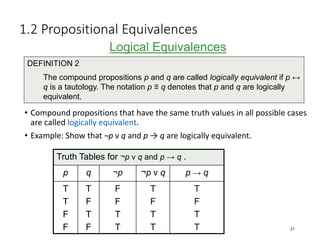
• Compound propositions that have the same truth values in all possible cases
are called logically equivalent.
• Example: Show that ¬p ν q and p → q are logically equivalent.
Truth Tables for ¬p ν q and p → q .
p q ¬p ¬p ν q p → q
T
T
F
F
T
F
T
F
F
F
T
T
T
F
T
T
T
F
T
T 21
DEFINITION 2
The compound propositions p and q are called logically equivalent if p ↔
q is a tautology. The notation p ≡ q denotes that p and q are logically
equivalent.
Logical Equivalences
1.2 Propositional Equivalences
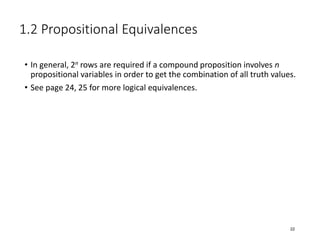
• In general, 2n rows are required if a compound proposition involves n
propositional variables in order to get the combination of all truth values.
• See page 24, 25 for more logical equivalences.
22
1.2 Propositional Equivalences
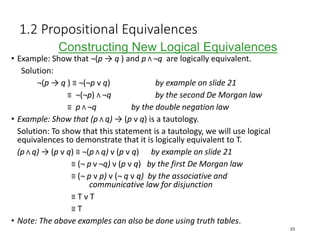
• Example: Show that ¬(p → q ) and p Λ ¬q are logically equivalent.
Solution:
¬(p → q ) ≡ ¬(¬p ν q) by example on slide 21
≡ ¬(¬p) Λ ¬q by the second De Morgan law
≡ p Λ ¬q by the double negation law
• Example: Show that (p Λ q) → (p ν q) is a tautology.
Solution: To show that this statement is a tautology, we will use logical
equivalences to demonstrate that it is logically equivalent to T.
(p Λ q) → (p ν q) ≡ ¬(p Λ q) ν (p ν q) by example on slide 21
≡ (¬ p ν ¬q) ν (p ν q) by the first De Morgan law
≡ (¬ p ν p) ν (¬ q ν q) by the associative and
communicative law for disjunction
≡ T ν T
≡ T
• Note: The above examples can also be done using truth tables.
23
Constructing New Logical Equivalences

Discrete mathematics Chapter1 presentation.ppt

  • 1.
    Discrete Mathematics Chapter 1: Fundamentalsof Logic 1 Presented By, Nandini S R Department of Computer Science
  • 2.
    1.1 Propositions • Aproposition is a declarative sentence (a sentence that declares a fact) that is either true or false, but not both. • Are the following sentences propositions? • Delhi is the capital of India. • Read this carefully. • 1+2=3 • x+1=2 • What time is it? • 3 is a prime number. • Bengaluru is in Karnataka. 2
  • 3.
    1.1 Propositions • PropositionalVariables – variables that represent propositions: p, q, r, s • E.g. Proposition p – “3 is a prime number.” • Truth values – The truth or falsity of a proposition If proposition is true, its truth value is 1 (T) If proposition is false, its truth value is 0 (F) 3
  • 4.
    Logical connectives • Propositionsused with words as not , and, if….then and if and only if, gives new propositions called compound propositions. • Words such as not , and, if….then and if and only if are called logical connectives. • Propositions which do not contain any logical connective are called Simple propositions. 4
  • 5.
    Negation • Examples • Findthe negation of the proposition “Today is Friday.” • Find the negation of the proposition “3 is a prime number.” 5 Let p be a proposition. The negation of p, denoted by ¬p. The proposition ¬p is read “not p.” The truth value of the negation of p, ¬p is the opposite of the truth value of p. Solution: The negation is “Today is not Friday.” or “It is not Friday today.” Solution: The negation is “3 is not a prime number.”
  • 6.
    Negation The Truth Tablefor the Negation of a Proposition. p ¬p T F F T 6
  • 7.
    Conjuction • Examples • Findthe conjunction of the propositions p and q where p is the proposition “9 is a prime number.” and q is the proposition “2+5=7”, and the truth value of the conjunction. 7 Let p and q be propositions. The conjunction of p and q, denoted by p Λ q, is the proposition “p and q”. The conjunction p Λ q is true when both p and q are true and is false otherwise. Solution: The conjunction is the proposition “9 is a prime number and 2+5=7.” The proposition is False.
  • 8.
    1.1 Propositional Logic •E.g Find the conjunction of the propositions p and q where p is the proposition “4 is a prime number.” or q is the proposition “2+4=7”, and the truth value of the conjunction • Solution: The conjunction is the proposition “4 is a prime number and 2+4=7.” The proposition is False. 8 DEFINITION 3 Let p and q be propositions. The disjunction of p and q, denoted by p ν q, is the proposition “p or q”. The conjunction p ν q is false when both p and q are false and is true otherwise.
  • 9.
    1.1 Propositional Logic TheTruth Table for the Exclusive Or (XOR) of Two Propositions. p q p q T T T F F T F F F T T F  The Truth Table for the Conjunction of Two Propositions. p q p Λ q T T T F F T F F T F F F The Truth Table for the Disjunction of Two Propositions. p q p ν q T T T F F T F F T T T F 9 DEFINITION 4 Let p and q be propositions. The exclusive or of p and q, denoted by p q, is the proposition that is true when exactly one of p and q is true and is false otherwise.  
  • 10.
    1.1 Propositional Logic  10 DEFINITION5 Let p and q be propositions. The conditional statement p → q, is the proposition “if p, then q.” The conditional statement is false when p is true and q is false, and true otherwise. In the conditional statement p → q, p is called the hypothesis (or antecedent or premise) and q is called the conclusion (or consequence). Conditional Statements  A conditional statement is also called an implication.  Example: “If I am elected, then I will lower taxes.” p → q implication: elected, lower taxes. T T | T not elected, lower taxes. F T | T not elected, not lower taxes. F F | T elected, not lower taxes. T F | F
  • 11.
    1.1 Propositional Logic •Example: • Let p be the statement “Maria learns discrete mathematics.” and q the statement “Maria will find a good job.” Express the statement p → q as a statement in English. 11 Solution: Any of the following - “If Maria learns discrete mathematics, then she will find a good job.
  • 12.
    1.1 Propositional Logic •Other conditional statements: • Converse of p → q : q → p • Contrapositive of p → q : ¬ q → ¬ p • Inverse of p → q : ¬ p → ¬ q 12
  • 13.
    1.1 Propositional Logic •p ↔ q has the same truth value as (p → q) Λ (q → p) • “if and only if” can be expressed by “iff” • Example: • Let p be the statement “You can take the flight” and let q be the statement “You buy a ticket.” Then p ↔ q is the statement “You can take the flight if and only if you buy a ticket.” Implication: If you buy a ticket you can take the flight. If you don’t buy a ticket you cannot take the flight. 13 DEFINITION 6 Let p and q be propositions. The biconditional statement p ↔ q is the proposition “p if and only if q.” The biconditional statement p ↔ q is true when p and q have the same truth values, and is false otherwise. Biconditional statements are also called bi-implications.
  • 14.
    1.1 Propositional Logic TheTruth Table for the Biconditional p ↔ q. p q p ↔ q T T T F F T F F T F F T 14
  • 15.
    1.1 Propositional Logic •We can use connectives to build up complicated compound propositions involving any number of propositional variables, then use truth tables to determine the truth value of these compound propositions. • Example: Construct the truth table of the compound proposition (p ν ¬q) → (p Λ q). The Truth Table of (p ν ¬q) → (p Λ q). p q ¬q p ν ¬q p Λ q (p ν ¬q) → (p Λ q) T T T F F T F F F T F T T T F T T F F F T F T F 15 Truth Tables of Compound Propositions
  • 16.
    1.1 Propositional Logic •We can use parentheses to specify the order in which logical operators in a compound proposition are to be applied. • To reduce the number of parentheses, the precedence order is defined for logical operators. Precedence of Logical Operators. Operator Precedence ¬ 1 Λ ν 2 3 → ↔ 4 5 16 Precedence of Logical Operators E.g. ¬p Λ q = (¬p ) Λ q p Λ q ν r = (p Λ q ) ν r p ν q Λ r = p ν (q Λ r)
  • 17.
    1.1 Propositional Logic •Example: How can this English sentence be translated into a logical expression? “You can access the Internet from campus only if you are a computer science major or you are not a freshman.” 17 Solution: Let p, q, and r represent “You can access the Internet from campus,” “You are a computer science major,” and “You are a freshman.” The sentence can be translated into: p → (q ν ¬r).
  • 18.
    1.1 Propositional Logic •Computers represent information using bits. • A bit is a symbol with two possible values, 0 and 1. • By convention, 1 represents T (true) and 0 represents F (false). • A variable is called a Boolean variable if its value is either true or false. • Bit operation – replace true by 1 and false by 0 in logical operations. Table for the Bit Operators OR, AND, and XOR. x y x ν y x Λ y x y 0 0 1 1 0 1 0 1 0 1 1 1 0 0 0 1 0 1 1 0  18 Logic and Bit Operations
  • 19.
    1.1 Propositional Logic •Example: Find the bitwise OR, bitwise AND, and bitwise XOR of the bit string 01 1011 0110 and 11 0001 1101. 19 DEFINITION 7 A bit string is a sequence of zero or more bits. The length of this string is the number of bits in the string. Solution: 01 1011 0110 11 0001 1101 ------------------- 11 1011 1111 bitwise OR 01 0001 0100 bitwise AND 10 1010 1011 bitwise XOR
  • 20.
    1.2 Propositional Equivalences Examplesof a Tautology and a Contradiction. p ¬p p ν ¬p p Λ ¬p T F F T T T F F 20 DEFINITION 1 A compound proposition that is always true, no matter what the truth values of the propositions that occurs in it, is called a tautology. A compound proposition that is always false is called a contradiction. A compound proposition that is neither a tautology or a contradiction is called a contingency. Introduction
  • 21.
    1.2 Propositional Equivalences •Compound propositions that have the same truth values in all possible cases are called logically equivalent. • Example: Show that ¬p ν q and p → q are logically equivalent. Truth Tables for ¬p ν q and p → q . p q ¬p ¬p ν q p → q T T F F T F T F F F T T T F T T T F T T 21 DEFINITION 2 The compound propositions p and q are called logically equivalent if p ↔ q is a tautology. The notation p ≡ q denotes that p and q are logically equivalent. Logical Equivalences
  • 22.
    1.2 Propositional Equivalences •In general, 2n rows are required if a compound proposition involves n propositional variables in order to get the combination of all truth values. • See page 24, 25 for more logical equivalences. 22
  • 23.
    1.2 Propositional Equivalences •Example: Show that ¬(p → q ) and p Λ ¬q are logically equivalent. Solution: ¬(p → q ) ≡ ¬(¬p ν q) by example on slide 21 ≡ ¬(¬p) Λ ¬q by the second De Morgan law ≡ p Λ ¬q by the double negation law • Example: Show that (p Λ q) → (p ν q) is a tautology. Solution: To show that this statement is a tautology, we will use logical equivalences to demonstrate that it is logically equivalent to T. (p Λ q) → (p ν q) ≡ ¬(p Λ q) ν (p ν q) by example on slide 21 ≡ (¬ p ν ¬q) ν (p ν q) by the first De Morgan law ≡ (¬ p ν p) ν (¬ q ν q) by the associative and communicative law for disjunction ≡ T ν T ≡ T • Note: The above examples can also be done using truth tables. 23 Constructing New Logical Equivalences