The Strategic
Marketing Process
How to Structure Your Marketing
activities to achieve Better Results
 Second Edition – 2013


                            STRATEGY

                                                                     TOOLS


                                      CUSTOMER
                                     ACQUISITION


written by Moderandi Inc., creators of the marketing planning and management app at www.MarketingMo.com.
The Strategic Marketing Process


This guide was written by the team at Moderandi Inc., creator of the Marketing MoTM planning and
management web app.

Marketers use our app to:

›   Create plans in 3 clicks for over 300 common marketing activities
›   Receive step-by-step guidance for each subject covered in this guide
›   organize and manage their marketing activities

If you like this guide, feel free to dig deeper at www.MarketingMo.com.


Copyright Moderandi Inc. 2013. all rights reserved. no portion of this publication may be reproduced in any
form by any electronic or mechanical means without written permission from Moderandi Inc.

ISBn Print: 978-0-9887431-0-6
Introduction
                   “It was the best of times, it was the worst of times . . .”
                                           Charles Dickens, A Tale of Two Cities


The Internet has fundamentally changed the marketing function, causing the greatest shift in the field since the inven-
tion of the television.

Digital marketing, social media and mobile devices have dramatically changed how we connect with our audiences.
They’ve created a tremendous opportunity, as well as a tremendous burden.

The marketing function has become complicated.

No longer can we rely on print, publicity and a media buyer to distribute our catchy ad campaign; marketing nowadays
requires heavy IT resources and an understanding of complex metrics to effectively (and profitably) connect with our
market—busier people, who have shorter attention spans, and often suffer from information overload.

Social media, search engine marketing, email marketing, mobile devices, website optimization, content marketing . . .
it’s impossible for an individual marketer to master them all, in addition to their traditional media activities. And then
there’s strategic planning, creative development and financial measurement.

It’s overwhelming. And it has caused many marketers to specialize, focusing on a single medium as their area of
expertise.

But the reality in most small to mid-size enterprises (SMEs) is that their marketing team only has room for a handful
of specialists, if any. Most don’t have the budget to employ experts in all the necessary marketing mediums needed
to effectively reach their audience. And even if they do have the budget, they often don’t have enough work to justify
hiring full-time specialists.

If you’re not a specialist hired solely for your expertise, you’re forced to know a little about a lot—to be well-versed in
how to use a combination of digital and traditional mediums to effectively meet your revenue goals.

For the typical marketer at an SME, it’s created a quandary:

  Identifying the “right things” to be doing, and then learning how to do them well

Many would argue that it’s more difficult for marketers to determine what we should be doing, instead of how to do
things right.

If we’re not sure what we should be doing, it’s easy to dive into the hot new tactic of the moment . . . without having
a strong understanding of how it ties into the rest of our revenue-generation activities.

Specialization makes it easier to perform tactics well, but specialists aren’t necessarily the best resource to determine
strategy—the “right things” to be doing. Specialists typically favor their own area of expertise.


Download hundreds of plans for these                                            Share                                     iii
marketing activities at www.MarketingMO.com.                                    this ebook:
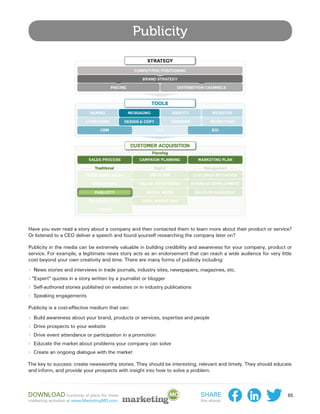
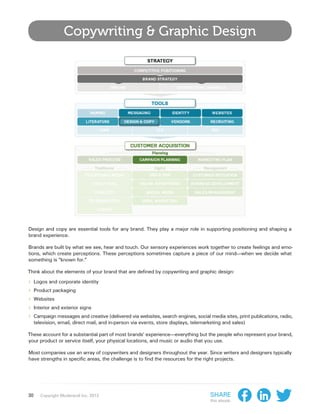
The 30,000-Foot Approach
This guide defines a marketing process that you can use to put structure around your daily, monthly and annual revenue-
generating activities. It will help you gain a better understanding of what you should be doing, and how it fits into your
overall strategy and departmental activities.

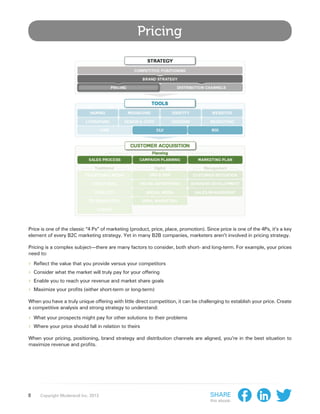
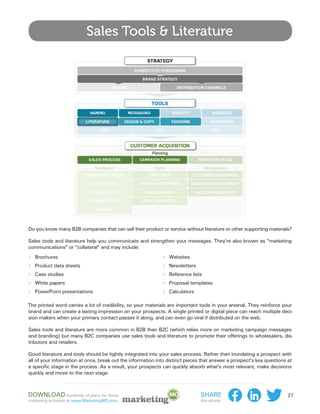
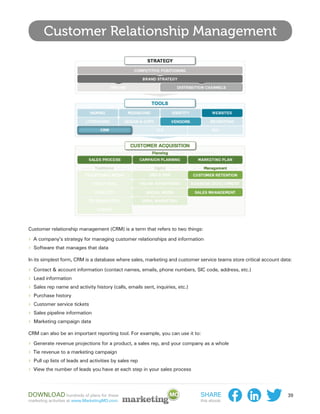
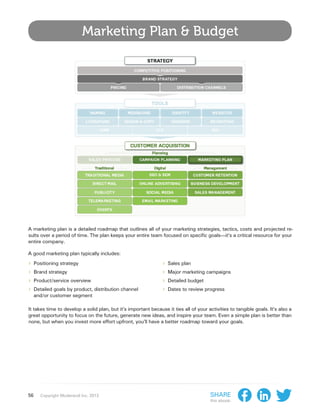
The guide groups common activities into three buckets, to clarify how the activities fit together in the revenue-generation
process:

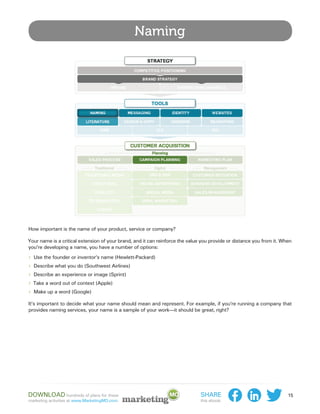
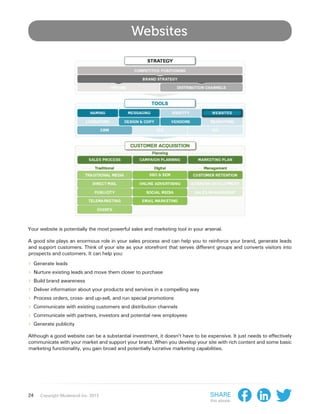
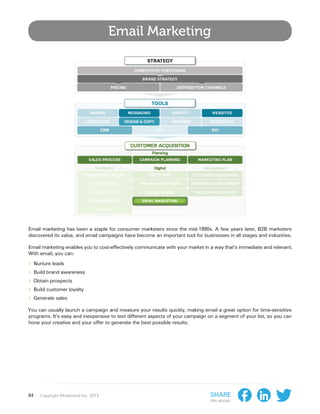
›› Strategy: Your high-level conceptualization of how your offering will penetrate your market. This is your global, long-
     term, go-to-market strategy, and it may cover 5 to 10 years.
›› Tools: The collateral, assets, software and processes that you use during the tactical execution of your strategies.
›› Customer Acquisition: The marketing mediums and tactics that you use to execute your strategies to achieve your
     goals.

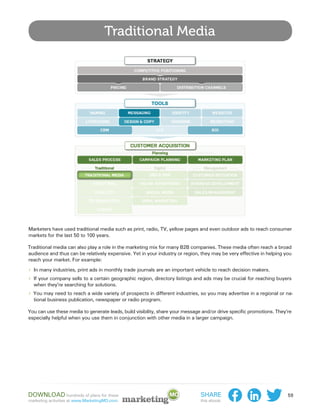
Visualizing these buckets helps to reinforce the need for strategy before tactics. Search engine marketing is a marketing
medium in the customer acquisition bucket. It’s not a strategy—it’s a tactic, supported by tools (your website, sales
literature, messaging, etc.), which should be tied to a strategy.

Our process covers more than just traditional marketing and ties together all go-to-market business activities: strategic
planning, financial planning and measurement, creative development, marketing execution and sales, and customer
retention.

Since marketing is always evolving, don’t shy away from subjects and ideas that are new. Good marketers are always
learning.

Embrace marketing, and most importantly, enjoy creating value for your market and communicating the value of your
activities to your team.


iv      Copyright Moderandi Inc. 2013                                               Share
                                                                                    this ebook:
Table of Contents

   Strategy                                    Customer Acquisition
     1	    Competitive Positioning
                                                Planning
     5	    Brand Strategy
                                                49	 Sales Process
     8	Pricing
                                                52	 Campaign Planning
     11	 Distribution Channels
                                                56	 Marketing Plan & Budget


   Tools                                        Traditional
                                                59	 Traditional Media
     15	Naming
                                                62	 Direct Mail
     19	Messaging
                                                65	Publicity
     22	 Corporate Identity
                                                68	Telemarketing
     24	Websites
                                                71	 Trade Shows & Events
     27	 Sales Tools & Literature
     30	 Copywriting & Graphic Design
                                                Digital
     33	 Vendor Selection
                                                74	 SEO and SEM
     36	Recruiting
                                                77	Online Advertising
     39	 Customer Relationship Management
                                                80	 Social Media
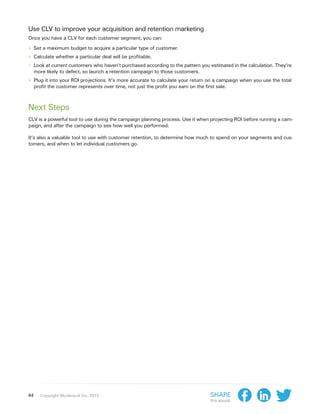
     42	 Customer Lifetime Value
                                                84	 Email Marketing
     45	 Return on Investment

                                                Management
                                                87	 Customer Retention
                                                90	 Business Development
                                                93	 Sales Management
                                                96	What’s Next?


Download hundreds of plans for these                      Share               v
marketing activities at www.MarketingMO.com.              this ebook:
Competitive Positioning


What sets your product, service or company apart from your competitors? What value do you provide and how is it
different from the alternatives?

Competitive positioning is about defining how you’ll differentiate your offering and create value for your market. It’s
about carving out a spot in the competitive landscape, putting your stake in the ground, and winning mindshare in the
marketplace—being known for a certain “something.”

A good positioning strategy is influenced by:

›› Market profile: Size, competitors, stage of growth
›› Customer segments or personas: Groups of prospects with similar wants & needs
›› Competitive analysis: Strengths, weaknesses, opportunities and threats in the landscape
›› Method for delivering value: How you deliver value to your market at the highest level
When your market clearly sees how your offering is different from that of your competition, it’s easier to influence the
market and win mindshare. Without differentiation, it takes more time and budget to entice the market to engage with
you; as a result, many companies end up competing on price—a tough position to sustain over the long term.

One of the key elements that many small to mid-size companies overlook is how they provide value at the highest level.
There are three essential methods for delivering value: operational excellence, product leadership and customer intimacy.


Download hundreds of plans for these                                          Share                                     1
marketing activities at www.MarketingMO.com.                                  this ebook:
Here is a hypothetical example of each:

    Operational Excellence                  Product Leadership                       Customer Intimacy

    Herringer customers don’t want bells    Orange Technology’s customers            Starboard’s market is flooded with
    and whistles; they just want a good     care most about quality—they want        products at all points of the price
    product at the lowest possible price.   the best product.                        spectrum.

    Herringer focuses on operational        Orange is completely dedicated           Yet, Starboard’s customers want
    excellence so they can continually      to innovation and quality. They’re       more than a product off the shelf;
    offer the lowest price in the market.   constantly working on product            they want customized solutions.
    For example, they just patented         improvements and new ideas to            So Starboard’s strategy is to know
    a new machine that dramatically         bring to market. They know what          as much as possible about their
    lowers their manufacturing costs.       their competitors are doing and are      customers’ businesses so they can
    They’re not trying to create new or     completely focused on staying one        deliver the correct solutions over
    better products; they just want to      step ahead in order to capture a         time.
    produce more volume at a lower          greater share of their market.
    cost.                                                                            Starboard knows that they can’t
                                            Orange’s brand and culture is all        just say “We offer great service.”
    Herringer’s method for delivering       about product leadership; their          Starboard delivers on their strategy
    value is operational excellence;        market recognizes it and is willing to   in every interaction with their market.
    it’s a key driver of their long-term    pay for it.
    strategy, and their positioning
    reflects it.


These companies have a complete understanding of how they deliver value to their market. It’s part of their strategy,
which makes it easier for them to win a position in their respective markets.

Here’s another way to think of it:

    You can provide the best offering, the cheapest offering, or the most comprehensive offering, but you can’t provide
    all three.

Another key factor in your positioning is your competition. Sure, you need to put your stake in the ground and claim
your turf. But is it turf that you can own? Can you realistically beat your competition to own it?

Rather than leaving your market positioning to chance, establish a strategy. What you’re ultimately striving for is to be
known for something—to own mindshare of the market. This is typically easier for consumer product lines than for B2B
companies, because positioning a single product against three to five competitors is a simpler task than positioning a
mid-size B2B company with numerous offerings in numerous markets.

Owning a strong position in the market is challenging for most small- to mid-size companies, but you have a better
chance of achieving it if you clearly define a strategy and build your brand around it.


2      Copyright Moderandi Inc. 2013                                                 Share
                                                                                     this ebook:
Do you see your company in any of these scenarios?

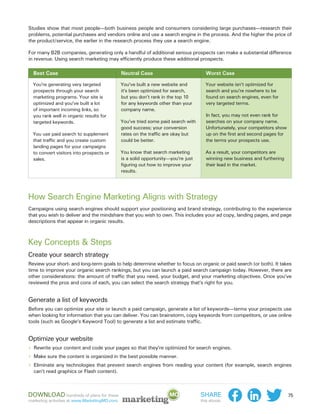
  Best Case                                    Neutral Case                               Worst Case

  You provide a one-of-a-kind offering         Your offering is somewhat different        Your market sees little difference
  that your market needs and wants;            from—and better than—those                 between you and your competitors,
  you have strong differentiation from         of your competitors, and you               and your name is not recognized.
  your competitors.                            communicate that difference
                                               (though probably not as consistently       Because of this, you have to spend
  Your market knows your name and              as you should).                            precious budget and time educating
  associates it with that “one thing”                                                     the market at each touch point. You
  that you’re known for.                       Some of your market knows your             often end up competing solely on
                                               name, but they describe you in             price, though your business isn’t
  And you continually deliver on               different ways; you’re not yet known       optimized to continue profitably
  it—perception is reality—so you              for that “one thing,” but at least         with falling prices.
  continue to win mindshare in your            you’re occasionally recognized.
  market, defending your turf and                                                         You have to fight long and hard for
  influencing your market.                     You know that you could make a             every sale. It’s very difficult to meet
                                               greater impact on your market with         your revenue and profit goals.
                                               stronger positioning.


How Competitive Positioning Aligns with Strategy
The concept of positioning is entirely strategic. It’s the first element to address in strategic marketing, and everything
else is aligned to it. Jack Trout and Al Ries defined the concept years ago in their landmark book Positioning: The Battle
for Your Mind.

While the concept is simple—to be known for a single thing in the mind of the customer—the road to achieve it can
be complex. It’s best to have a clear understanding of your market—demographics, segments, their pains, how well
you and your competitors provide solutions, how you truly provide value, and your strengths and weaknesses—before
making this decision.

A fully-informed decision is vital, because you’ll allocate a significant amount of resources in your journey to achieve it.


Key Concepts & Steps
Profile your market
›› Document the size of your market.
›› Identify your major competitors and how they’re positioned.
›› Determine whether your market is in the introductory, growth, mature, or declining stage of its life. This “lifecycle
  stage” affects your strategy.


Segment your market
›› Understand the problems that your market faces. Talk with prospects and customers, or conduct research if you
  have the time, budget and opportunity. Uncover their true wants and needs—you’ll learn a great deal about what
  you can deliver to solve their problems and beat your competitors.
›› Group your prospects into “segments” or “personas” that have similar problems and can use your offering in similar
  ways. By grouping prospects into segments or personas, you can efficiently market to each group.


Download hundreds of plans for these                                                  Share                                         3
marketing activities at www.MarketingMO.com.                                          this ebook:
Define how you deliver value
›› At the highest level, there are three core types of value that a company can deliver: operational efficiency (the lowest
    price), product leadership (the best product), or customer intimacy (the best solution & service). Determine which
    one you’re best equipped to deliver; your decision is your method for delivering value.


Evaluate your competition
›› List your competitors. Include any that can solve your customers’ problems, even if the competitors’ solutions are
    much different from yours—they’re still your competition.
›› Rate yourself and your direct competitors based on operational efficiency (price), product leadership and customer
    intimacy. It’s easy to think you’re the best, so be as impartial as you can be.


Stake a position
›› Identify areas where your competition is vulnerable.
›› Determine whether you can focus on those vulnerable areas—they’re major opportunities.
›› Make a decision on how to position your offering or company.

Select the mindshare you want to own, and create your strategy to achieve it
›› Review the components of your market and evaluate what you want to be known for in the future. Condense all
    your research and analysis into the “one thing” that you want to be known for, and design your long-term strategy
    to achieve it.


Next Steps
Develop a brand strategy to help you communicate your positioning and solidify your value every time you touch your
market. Together, these two strategies are the essential building blocks for your business.


4      Copyright Moderandi Inc. 2013                                                  Share
                                                                                      this ebook:
Brand Strategy


How do you define a brand? Is it a logo, a name or a slogan, or a graphic design or a color scheme?

Your brand is the entire experience that your market has with your offering or company. It’s what you stand for, a
promise that you make, and the personality that you convey.

And while it includes your logo, your color palette and your slogan, these are only creative elements that convey your
brand. In reality, your brand lives in the day-to-day interactions you have with your market:

›› The images you convey
›› The messages you deliver on your website and in your campaigns
›› The way your employees interact with customers
›› A customer’s opinion of you versus your competition
 Branding is crucial for products and services sold in huge consumer markets. It’s also important in B2B because it
 helps you stand out from your competition. It brings your competitive positioning to life; it defines you as a certain
“something” in the mind of your market.

Think about successful consumer brands like Apple, Disney or Starbucks. You probably know what each brand repre-
sents. Now imagine that you’re competing against one of these brands. If you want to capture significant market share,
start with a strong positioning and brand or you won’t be successful.


Download hundreds of plans for these                                          Share                                   5
marketing activities at www.MarketingMO.com.                                  this ebook:
If you’re B2C, it’s likely that a few brands dominate your market. If you’re B2B, there may or may not be a strong brand
in your market. But when you put two companies up against each other, the one that represents something valuable
and memorable will have an easier time reaching, engaging, and converting customers. It’s a perception—and for most,
perception equals reality.

Successful branding creates “brand equity”—the amount of money that customers are willing to pay just because it’s
your brand. Brand equity is an intangible asset that can be tracked on your balance sheet, and can make your company
more valuable over the long term.

Instead of allowing your market to brand you, strive to have their experience with your brand align with your strategy.

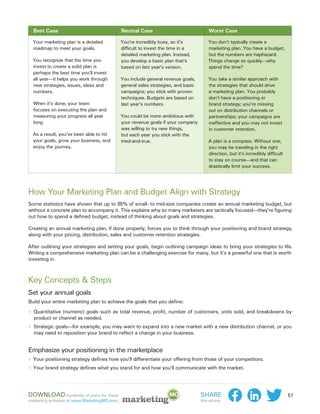
    Best Case                              Neutral Case                            Worst Case

     Your market recognizes your name,    The market may not have a                You don’t have a brand strategy
     knows exactly what you deliver,      consistent view or impression of         and it shows. It’s more difficult to
     and you’re known for that certain    your offering, but you think that it’s   communicate with your market and
    “something” in their mind.            positive overall.                        convince them to buy. They don’t
                                                                                   have a clear impression of your
    You deliver a consistent experience   You haven’t thought a lot about          offering or why it’s better.
    that the market has come to expect,   branding because it doesn’t seem
    both visually and operationally, at   necessarily relevant, but you admit      What you do, what you say, and
    every market interaction.             that you can do a better job of          how you say it, may contradict each
                                          communicating consistently with          other and confuse your market.
    Customer acquisition happens          the market.
    quickly because your brand                                                     Competitors who communicate
    influences your market.               You’re not helping yourself, but         effectively have a better shot at
                                          you’re not hurting yourself either.      winning customers.


How Brand Strategy Aligns with Strategy
At its title suggests, brand strategy is completely strategic; it’s your plan for how to achieve your desired positioning—
how to become known for that certain “something.” It describes the consistent experience that you desire to deliver
to your market at each touch point.


Key Concepts & Steps
Audit your existing brand
›› If you have an existing brand, conduct a survey of your market and your stakeholders to understand how they view
    your brand. This will give you an understanding of where you are and how much work needs to be done to get to
    where you want to be.
›› Before creating your survey, outline what you think your brand should stand for, so you have criteria to evaluate
    against the responses. If you’re not sure how to create your brand criteria, complete the next steps, and then con-
    duct your audit.


Define your brand architecture
›› Evaluate the features and benefits of your product / service. A feature is an attribute—a color, a configuration; a
    benefit is what that feature does for the customer.
›› Identify which benefits are emotional (instead of functional)—the most powerful brand strategies tap into emotions,
    even among business buyers.
›› Review the emotional benefits and boil them down to your brand pillars—the three things that your brand should
    mean to your market.


6      Copyright Moderandi Inc. 2013                                               Share
                                                                                   this ebook:
Define your brand experience
›› Think of your brand as a person with a distinct personality. Describe him or her, and then convey these traits in
  everything that you do and create.
›› Determine your brand promise—the one thing that you deliver each time you interact with your market.

Write your brand story and positioning statement
›› Write your 25-word positioning statement that conveys the essence of your brand. It conveys who you are, what you
  do, for whom, and one or two emotional benefits from interacting with your brand. Use it throughout your marketing
  materials.
›› Write your brand story. This should convey your personality, your purpose—the difference that you’re trying to make
  with your product, service or company. It builds credibility, differentiates you from your competition, and gives the
  market a reason to listen to you. Seth Godin says that the two elements that must come together in a brand story are:
  ›› The story you can confidently tell
  ›› The worldview the buyer tells herself
  When those align, you win.


Define your brand visual and operational requirements
›› Choose colors, fonts and other visual elements that match your personality.
›› Determine how your employees will interact with your market to convey your personality and ensure your brand
 “lives” within your company.


Next Steps
Together with your competitive positioning strategy, your brand strategy is the essence of what you represent. A great
brand strategy helps you communicate more effectively with your market, so be true to it in every interaction you have
with your prospects and customers.

For example, you’ll reinforce your brand strategy through your pricing, your distribution channels, your name and cor-
porate identity, your messages, your literature, your website and your marketing campaigns.


Download hundreds of plans for these                                         Share                                    7
marketing activities at www.MarketingMO.com.                                 this ebook:
Pricing


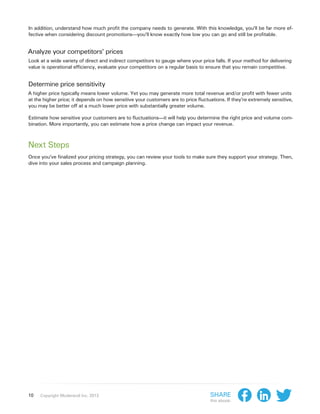
Price is one of the classic “4 Ps” of marketing (product, price, place, promotion). Since price is one of the 4Ps, it’s a key
element of every B2C marketing strategy. Yet in many B2B companies, marketers aren’t involved in pricing strategy.

Pricing is a complex subject—there are many factors to consider, both short- and long-term. For example, your prices
need to:

›› Reflect the value that you provide versus your competitors
›› Consider what the market will truly pay for your offering
›› Enable you to reach your revenue and market share goals
›› Maximize your profits (either short-term or long-term)
When you have a truly unique offering with little direct competition, it can be challenging to establish your price. Create
a competitive analysis and strong strategy to understand:

›› What your prospects might pay for other solutions to their problems
›› Where your price should fall in relation to theirs
When your pricing, positioning, brand strategy and distribution channels are aligned, you’re in the best situation to
maximize revenue and profits.


8    Copyright Moderandi Inc. 2013                                                    Share
                                                                                      this ebook:
Do you see your company in one of these scenarios?

  Best Case                                    Neutral Case                                 Worst Case

  Company A provides a premium                 Company B charges an average                 Company C provides business
  product, sold through carefully-             price for an average product.                consulting services.
  selected retail outlets.
                                               When they’re behind their sales              To grow, they drop their hourly
  Their pricing is typically 15% above         targets, individual reps are given the       rates by up to 40%. This gives
  the competition—they’re the most             green light to discount if needed to         them access to an entire new set of
  expensive product in their class.            meet their sales quotas.                     clients.

  Their demand curve is relatively             Management doesn’t want to get               Low rates mean they can’t afford
  inelastic, meaning that their market         in a price war, but is willing to            the same top-tier consulting talent.
  isn’t that sensitive to price. Much          ensure that they hit their short-term
  of that results from the carefully           numbers.                                     The quality of their offering suffers,
  selected positioning and branding                                                         and they end up providing mediocre
  over the past five years.                    Management knows that they could             service for both markets.
                                               spend more in R&D to differentiate
  Company A’s products never go on             their offering and have greater              By lowering the price of their
  sale, and retailers strictly adhere to       pricing power, but they haven’t yet         “prestige” brand to access a new
  pricing rules and brand guidelines.          committed the budget to do so.               market, Company C has increased
                                                                                            its revenue, while reducing its profit
                                                                                            margin and damaging its brand.


How Pricing Aligns with Strategy
It’s best to define your positioning, create your brand strategy, and identify your distribution channels before you de-
velop your pricing strategy. By doing so, you’ll ensure that your pricing reflects your value and reinforces your brand.

For example, if your method for delivering value is product leadership, you shouldn’t discount heavily or compete on
price; you should also minimize pricing conflicts with any channel partners.

Your pricing influences how the market perceives your offering. If you’re perceived as a commodity, you must either
change the market’s perception via a new positioning strategy, or compete on price and focus on innovating to keep
costs low so you can still make a profit.


Key Concepts & Steps
Align your pricing strategy to your method for delivering value
Your price sends a strong message to your market—it needs to be consistent with the value you’re delivering.

›› If your method for delivering value is operational efficiency, then your price needs to be extremely competitive.
›› If your method for delivering value is product leadership or customer intimacy, a low price sends the wrong message.
  After all, if a luxury item isn’t expensive, is it really a luxury?


Understand your cost structure and profitability goals
Companies calculate these costs differently, so verify the exact calculations your company uses for:

›› Cost of goods sold (COGS): the cost to physically produce a product or service
›› Gross profit: the difference between the revenue you earn on a product and the cost to physically produce it


Download hundreds of plans for these                                                    Share                                        9
marketing activities at www.MarketingMO.com.                                            this ebook:
In addition, understand how much profit the company needs to generate. With this knowledge, you’ll be far more ef-
fective when considering discount promotions—you’ll know exactly how low you can go and still be profitable.


Analyze your competitors’ prices
Look at a wide variety of direct and indirect competitors to gauge where your price falls. If your method for delivering
value is operational efficiency, evaluate your competitors on a regular basis to ensure that you remain competitive.


Determine price sensitivity
A higher price typically means lower volume. Yet you may generate more total revenue and/or profit with fewer units
at the higher price; it depends on how sensitive your customers are to price fluctuations. If they’re extremely sensitive,
you may be better off at a much lower price with substantially greater volume.

Estimate how sensitive your customers are to fluctuations—it will help you determine the right price and volume com-
bination. More importantly, you can estimate how a price change can impact your revenue.


Next Steps
Once you’ve finalized your pricing strategy, you can review your tools to make sure they support your strategy. Then,
dive into your sales process and campaign planning.


10   Copyright Moderandi Inc. 2013                                                 Share
                                                                                   this ebook:
Distribution Channels


Distribution, also known as placement, is one of the classic “4 Ps” of marketing (product, promotion, price, placement).
It’s a key element of your strategy—it helps you expand your reach to penetrate your market.

B2B and B2C companies can sell through a single channel or through multiple channels that may include:

›› Direct/Internet: Selling through your own e-commerce website.
›› Direct/Sales Team: One or more sales teams that you employ directly. You may use multiple teams that specialize
  in different products or customer segments.
›› Direct/Catalog: Selling through your own catalog.
›› Retail: Retailers sell directly to end-users via a physical store, a website or a catalog.
›› Wholesaler/Distributor: A company that buys products in bulk from many manufacturers and then resells smaller
  volumes to resellers or retailers.
›› Value-Added Reseller (VAR): A VAR works with end-users to provide custom solutions that may include multiple
  products and services from different manufacturers.
›› Consultant: A consultant develops relationships with companies and provides various types of services; they may
  recommend a manufacturer’s product or simply purchase it to deliver a solution to their client.
›› Dealer: A company or person who buys inventory from either a manufacturer or a distributor, then resells it to an
  end-user.
›› Sales Agent/Manufacturer’s Rep: You can outsource your sales function to a company that sells different manu-
  facturers’ products to a group of similar customers in a specific territory.


Download hundreds of plans for these                                             Share                               11
marketing activities at www.MarketingMO.com.                                     this ebook:
Here are three distribution examples:

                                                                                       Sell Through a VAR
  Direct to End-Users                        Sell Through a Dealer Network
                                                                                       (Value-Added Reseller)

  You have a sales team that sells           You sell a product through a             You sell a product to a company
  directly to Fortune 100 companies.         geographical network of dealers,         who bundles it with services or
                                             who sell to end-users in their areas.    other products and resells it. That
  You have a second product line for         The dealers may service the product      company is called a Value Added
  small businesses. Instead of using         as well.                                 Reseller (VAR) because it adds
  your sales team, you sell this line                                                 value to your product.
  directly to end-users through your         Your dealers are essentially your
  website and marketing campaigns.           customers, and you have a strong         A VAR may work with an end-user
                                             program to train and support them        to determine the right products and
  You have two markets and two               with marketing campaigns and             configurations, and then implement
  distribution channels.                     materials.                               a system that includes your product.


To create a good distribution program, focus on the needs of your end-users.

›› If users need personalized service, you can utilize a local dealer network or reseller program to provide that service.
›› If your users prefer to buy online, you can create an e-commerce website and fulfillment system and sell direct; you
     can also sell to another online retailer or distributor that can offer your product on their own sites.
›› You can build your own specialized sales team to prospect and close deals directly with customers.
Wholesalers, resellers, retailers, consultants and agents already have resources and relationships to quickly bring your
product to market. If you sell through these groups instead of (or in addition to) selling direct, treat the entire channel
as a group of customers—and they are, since they’re buying your product and reselling it. Understand their needs and
deliver strong marketing programs; you’ll maximize everyone’s revenue in the process.

  Best Case                                   Neutral Case                             Worst Case

  You’ve used one or more                    You’re using one or more                  You probably aren’t hitting your
  distribution channels to grow              distribution channels with average        revenue goals because your
  your revenue and market share              success. You may not have as many         distribution strategy is in trouble.
  more quickly than you would have           channel partners as you’d like, but
  otherwise.                                 your current system is working            With your current system, you may
                                             moderately well.                          not be effectively reaching your
  Your end-users get the information                                                   end-users; your prospects probably
  and service they need before and           You devote resources to the               aren’t getting the information and
  after the sale.                            program, but you wonder whether           service they need to buy your
                                             you’d be better off building an           product.
  If you reach your end-user through         alternative distribution method—one
  wholesalers, VARs or other channel         that could help you grow more             Your current system may also be
  partners, you’ve created many              aggressively than you are growing         difficult to manage. For example,
  successful marketing programs to           now.                                      channel members may not sell at
  drive revenue through your channel                                                   your suggested price; they don’t
  and you’re committed to their                                                        follow up on leads you deliver; they
  success.                                                                             don’t service the product very well
                                                                                       and you’re taking calls from angry
                                                                                       customers.


12      Copyright Moderandi Inc. 2013                                                  Share
                                                                                       this ebook:
How Distribution Aligns with Strategy
Your distribution channels should support your positioning and brand strategy. These methods of reaching your market
should be natural ways to access your market segments, and support the experience that your brand delivers.

For example, if you’re selling a unique product that has little competition and is considered “high-end,” you don’t want to
be carried in Walmart, where the majority of shoppers are looking for low-priced products that they’re already familiar with.

Or, if you’re an enterprise software vendor, you should be working with professional services firms who have deep
experience with complex enterprise software deployments, and are a natural fit to engage with the types of companies
that you target.

You can evaluate a new distribution channel or improve your channel marketing / management at any time. It’s espe-
cially important to think about distribution when you’re going after a new customer segment, releasing a new product,
or looking for ways to aggressively grow your business.


Key Concepts & Steps
Evaluate how your end-users need to buy
Your distribution strategy should deliver the information and service your prospects need. For each customer segment,
consider:

›› How and where they prefer to buy
›› Whether they need personalized education and training
›› Whether they need additional products or services to be used along with yours
›› Whether your product needs to be customized or installed
›› Whether your product needs to be serviced

Match end-user needs to a distribution strategy
›› If your end-users need a great deal of information and service, your company can deliver it directly through a sales
  force. You can also build a channel of qualified resellers or consultants. The size of the market and your price will
  probably dictate which scenario is best.
›› If the buying process is fairly straightforward, you can sell direct via a website/catalog or perhaps through a whole-
  sale/retail structure. You may also use an inbound telemarketing group or a field sales team.
›› If you need complete control over your product’s delivery and service, adding a channel partner probably isn’t right
  for you.


Identify natural partners
If you want to grow beyond the direct model, look for companies that have relationships with your end-users. If con-
sultants, wholesalers or retailers already reach your customer base, they’re natural partners.


Build your channel
If you’re setting up a distribution channel with one or more partners, treat it as a sales process:

›› Approach the potential channel partner and “sell” the value of the partnership.
›› Establish goals, service requirements and reporting requirements.
›› Deliver inventory (if necessary) and sales/support materials.
›› Train the partner.
›› Run promotions and programs to support the partner and help them increase sales.


Download hundreds of plans for these                                             Share                                    13
marketing activities at www.MarketingMO.com.                                     this ebook:
Minimize pricing conflicts
If you use multiple channels, carefully map out the price for each step in your channel, and include a fair profit for each
type of partner. Then compare the price that the end-user will pay—if a customer can buy from one channel at a lower
price than from another, your partners will rightfully have concerns. Pricing conflict is common, and it can jeopardize
your entire strategy, so do your best to map out the price at each step and develop the best solution possible.


Drive revenue through the channel
Service your channel partners as you’d service your best customers and work with them to drive revenue. For example,
provide them with marketing funds or materials to promote your products; run campaigns to generate leads and for-
ward them to your partners.


Next Steps
If you’re creating a new channel, you’ll need a pricing strategy. You’ll also need to deliver sales tools and literature,
and a sales process.

When your channel is up and running, you can start launching marketing campaigns to channel partners and end-users,
and manage the campaigns and partners throughout the year.


14   Copyright Moderandi Inc. 2013                                                  Share
                                                                                    this ebook:
Naming


How important is the name of your product, service or company?

Your name is a critical extension of your brand, and it can reinforce the value you provide or distance you from it. When
you’re developing a name, you have a number of options:

›› Use the founder or inventor’s name (Hewlett-Packard)
›› Describe what you do (Southwest Airlines)
›› Describe an experience or image (Sprint)
›› Take a word out of context (Apple)
›› Make up a word (Google)
It’s important to decide what your name should mean and represent. For example, if you’re running a company that
provides naming services, your name is a sample of your work—it should be great, right?


Download hundreds of plans for these                                           Share                                   15
marketing activities at www.MarketingMO.com.                                   this ebook:
Here are some companies that provide naming services:

  Unique                                   Average                                 Forgettable

  These companies appear to be             These companies all sound the           These naming agencies have
  more creative and better at finding      same:                                   forgettable names:
  a name that stands out from the
                                           ››   The Naming Co.                     ›› Werner & Stevens
  competition:
                                           ››   Brighter Naming                    ›› Wollenski Associates
  ›› A Hundred Monkeys                     ››   Tradebrand
  ›› Igor                                  ››   Catchword                          (While they are hypothetical
                                           ››   Namebase                           examples, there are a lot of naming
                                           ››   Lasting Names                      companies named after their
                                           ››   Name One!                          founders!)


All of these companies may provide great services, have many years of experience, and have terrific track records. If
you needed to select three companies to bid on your naming project, which companies would you contact? Are you
more likely to call a company with a unique name, an average name, or a forgettable name?

This example reinforces that you have one chance to make a first impression. Many of your potential customers might
know virtually nothing about your company, product or service, and a great name can make a positive impression and
open doors. A weak name can close them.

The name selection process is especially challenging because there are more than 26 million businesses in the United
States. U.S. trademark law protects business names, so when you find one you like, make sure you can use it. If you
infringe on a trademark, you could be forced to abandon your new name after investing a lot of time and money in it.

Also think about your internet marketing goals, since you may have to find a URL to match your name. There are almost
200 million domain names registered worldwide, and some experts believe that over 98% of words in the dictionary
are registered as domain names.

Don’t let these challenges stop you from finding the best name you can—there’s a lot at stake.

  Best Case                                Neutral Case                            Worst Case

  A great name can create buzz,            You look and sound like everybody       A poor name can neutralize or even
  position you as a true leader and        else.                                   negate the work you do to build a
  innovator, and reinforce your                                                    position in the market.
  positioning and brand in a word          You’ve missed an opportunity to
  or two.                                  convey an important message, but        You may have trouble generating
                                           at least you’re not hurting yourself.   interest in your company, product
  That’s powerful. It can convey a                                                 or service, forcing you to spend
  culture, a position, and differentiate                                           more time and money educating the
  the company from the rest of the                                                 market about your value.
  market.
                                                                                   A poor name can also limit your
                                                                                   opportunities if you expand into
                                                                                   other markets.


16   Copyright Moderandi Inc. 2013                                                 Share
                                                                                   this ebook:
How Naming Aligns with Strategy
Your company name is the anchor for your brand strategy—typically the first thing that the market sees and hears.

Your name, logo, packaging (colors, fonts, and design), location (if the market visits your store or offices), tagline or
slogan, and unique ownable specialty (your mindshare) all work in concert to create a perception.

When launching a new consumer product, seasoned marketers often create their positioning, brand, distribution and
pricing strategies before they select a product name, to ensure that all are aligned at launch. With tens of millions of
dollars at stake, it’s important to get it right the first time.

Most small-to-midsize companies select a name to open their business, then build their brand, distribution and pricing
over time. That’s fine, but it’s important to work to align them, to give you the best chance at delivering a repeatable
brand experience and owning a unique perception in the mind of the market.


Key Concepts & Steps
Do you need to hire a consultant or agency to help with your name?
With a good process and strategy, you can probably develop a good name on your own. However, you may not have
the resources or desire to handle the project internally. While it’s no guarantee that a firm or consultant will develop a
better name, they may do it more quickly and objectively.

There are a number of factors to consider, including:

›› The
     stakes—if you’re investing a lot of money into launching a new product to a major market with established
  competition, the stakes are high.
›› Your confidence in your team’s creative firepower or objectivity.
›› The amount of time and energy you have to devote to the project.
›› Whether you can afford to bring in an outside resource.

Develop a strategy
›› Determine what your name needs to accomplish.
›› Decide how it will work with existing product or service names (if applicable).
›› Determine what kind of name to develop—descriptive, invented, founder’s name, etc.
›› Develop objective criteria to evaluate the names you generate.

Generate plenty of potential names
If you’re competing beyond your local area, you may find that many of your potential names (or URLs) are already
taken, so you’ll need to create a long list. Invite a variety of people to a brainstorming session. Plan it well and capture
every idea for further evaluation.


Evaluate the list against your criteria
Your goal is to objectively find the name that meets your criteria, so be careful about asking friends and family whether
they “like” a name. For example, a name that raises eyebrows may do so because it’s different—and it may be the
most memorable and powerful one in the bunch.


Download hundreds of plans for these                                             Share                                    17
marketing activities at www.MarketingMO.com.                                     this ebook:
Also test the name to make sure it:

›› Sounds good over the phone
›› Won’t be constantly mispronounced or misspelled, which defeats the purpose of a name
›› Isn’t confusing
›› Conveys what you need it to convey
›› Has a URL that works with it

Protect your name
It’s important to protect your name to the appropriate degree. If you choose a name that infringes on another com-
pany’s trademark, you could receive a cease-and-desist letter and have to go to court and/or change your name after
months or even years of use.

By protecting your name, you also gain the ability to prevent future competitors from using it.


Next Steps
After you select a new name, you can create your logo and corporate identity, and then begin creating the messages
to use throughout your sales tools and literature, and your campaign creative.


18   Copyright Moderandi Inc. 2013                                                Share
                                                                                  this ebook:
Messaging


How do you respond when someone asks “what does your company/product/service do?” Do all your team members
answer the same way? Is your response compelling enough to make the listener want to learn more, or do you sound
like everyone else?

“Messages” are written and verbal statements that quickly describe what you do and how you’re different. They’re used
 throughout your interactions with your market such as:

›› The “elevator pitch”—the 30-second response to “what do you do?”
›› Sales and marketing materials—sales literature, websites, presentations and campaigns
›› The introductory statement in a phone call
›› Press releases—the blurb at the bottom of the release that explains what the company does
›› Slogans
›› Your mission statement
Good messages emphasize and support your positioning and brand strategy. They hone in on what’s important to your
market and communicate it consistently and effectively.


Download hundreds of plans for these                                        Share                                  19
marketing activities at www.MarketingMO.com.                                this ebook:
Best Case                               Neutral Case                            Worst Case

  By carefully crafting your messages,    Ho-hum messages don’t help you          Without a set of documented
  you can strengthen your positioning,    stand out, but as long as they’re not   messages, individual team members
  your brand and the reasons your         inaccurate or poorly written, they      do their own authoring. The results
  markets should buy from you.            probably won’t hurt.                    are inconsistent and rarely good.

  It’s easy to communicate your value.    You are missing out on the              Weak and inconsistent messages
  The market “gets it” very quickly,      opportunity to strengthen your          confuse the market and can
  speeding up the sales process.          position.                               contradict the other strategies
                                                                                  you’ve worked hard to implement.


How Messaging Aligns with Strategy
Consistent messaging is essential to communicating the ideas and concepts of your competitive positioning and brand
strategy to your market. It allows you to effectively communicate what you stand for and the value that your offering
provides.

Your messages should have a personality, a tone, and a purpose, and should align with the elements of your brand to
be most effective.


Key Concepts & Steps
Define your writing style and requirements
Before you start writing, define your style requirements—tone, voice, style, vocabulary—to ensure the writing will be
consistent and match your brand strategy.


Create an elevator pitch
The elevator pitch describes who you are, what you do, who your customers are and why they should buy from you.
After you’ve written it, read it out loud to see how it sounds and how long it takes (no more than 30 seconds).


Create your positioning statements
Write statements of various lengths—25, 50 and 100 words—so you have a message length that fits a variety of materi-
als. The shorter statements focus on the value and positioning; the longer statements also include features and benefits.


Create a tagline/slogan
Your tagline/slogan is a more succinct phrase used in campaigns. It can be a few words or a short phrase—and for
most business writers, it’s harder to create. You may want to hire a copywriter for this one.


Create your mission statement
An average mission statement describes why you’re in business. A great mission statement is compelling, shows why
you’re different and conveys your company’s personality.


Determine where to use the messages
Make sure to use your new messages consistently. Train your team to use the messages and audit your materials
periodically to make sure they’re still working in the future.


20   Copyright Moderandi Inc. 2013                                                 Share
                                                                                   this ebook:
Next Steps
Your messages feed all of your communication with your market. Use them in your sales tools and literature, your
website and in your marketing campaigns.


Download hundreds of plans for these                                     Share                                21
marketing activities at www.MarketingMO.com.                             this ebook:
Corporate Identity


When was the last time someone gave you a fantastic business card? Did you turn it over and look at it closely? Did
you comment on it? And did you generate some sort of impression of that person and company?

Corporate identity is an extension of your brand and includes everything that has your logo or contact information on it:
››   Business cards                                ››   Proposal/quote templates
››   Envelopes                                     ››   Invoices/statements
››   Letterhead                                    ››   Memos
››   Mailing labels                                ››   Signage
››   Email templates & signatures                  ››   Promotional items
››   Fax covers

Many companies spend time and money on things like business cards yet overlook proposal templates, invoices and
email signatures—items that your prospects and customers see more frequently. When an employee customizes an
email template with unusual designs or fonts, it can contradict an expensive and serious business card—and convey
a far different impression to the customer.

Each element in your identity should use the same fonts, colors, and layout. The design itself may not be incredibly
important unless you’re in a creative field, but consistency and professionalism make an impression. In many cases it
may be a first impression, so why not make a good one?


22     Copyright Moderandi Inc. 2013                                               Share
                                                                                   this ebook:
Best Case                                    Neutral Case                             Worst Case

  Every touch with your prospects              Some of your identity is great           Your prospects and customers see
  and customers is consistent and              and other things, like invoices or       a mishmash of poorly-produced
  professional. They see a simple,             shipping labels, don’t match up.         identity. They may wonder how you
  effective design that conveys your           Prospects and customers probably         can deliver the product or service
  brand and delivers a consistent              notice, but you don’t think it’s a       you’re selling if you can’t produce a
  experience.                                  problem.                                 professional-looking document.


How Corporate Identity Aligns with Strategy
Your corporate identity represents your company brand. It should support the visual brand requirements of your brand
strategy, and be consistent throughout all of your print and digital materials.


Key Concepts & Steps
Evaluate your current identity usage
If you’re already in business, does all of your identity reflect your brand?

Check everything from invoices and shipping labels to email signatures. Make sure that your logo is used correctly
(sometimes they get re-sized) and that all of your materials are consistent with your positioning and brand strategy.
For example, if you’re focusing on innovative, expensive new products but you have flimsy business cards, you’re not
reinforcing your brand.


Create professional, consistent templates for every touch point with your market
Use a consistent style for everything your company sends out. It may take only ten minutes to create a better template,
and that template may be seen by hundreds or thousands of prospects and customers over time.


Keep inventory
Templates can be altered or misplaced. Make sure that your team knows how to use them and check them regularly.


Next Steps
Once you’ve finished evaluating your identity, the typical next step is to focus on your sales tools and literature, as
well as your website.


Download hundreds of plans for these                                                Share                                       23
marketing activities at www.MarketingMO.com.                                        this ebook:
Websites


Your website is potentially the most powerful sales and marketing tool in your arsenal.

A good site plays an enormous role in your sales process and can help you to reinforce your brand, generate leads
and support customers. Think of your site as your storefront that serves different groups and converts visitors into
prospects and customers. It can help you:

›› Generate leads
›› Nurture existing leads and move them closer to purchase
›› Build brand awareness
›› Deliver information about your products and services in a compelling way
›› Process orders, cross- and up-sell, and run special promotions
›› Communicate with existing customers and distribution channels
›› Communicate with partners, investors and potential new employees
›› Generate publicity
Although a good website can be a substantial investment, it doesn’t have to be expensive. It just needs to effectively
communicate with your market and support your brand. When you develop your site with rich content and some basic
marketing functionality, you gain broad and potentially lucrative marketing capabilities.


24   Copyright Moderandi Inc. 2013                                               Share
                                                                                 this ebook:
Best Case                                    Neutral Case                                Worst Case

  Your site is more than a brochure—           You have a standard site with               Your site works against you. It may
  it sells. You use it for a variety of        basic information plus a few press          be the design, content (or lack of),
  internet marketing campaigns:                releases and newsletters.                   writing, or functionality. It doesn’t
  search, social, email, webinars,                                                         support your positioning and you
  ongoing communications, publicity            You’ve tried some internet                  can’t use it any internet marketing
  and more.                                    marketing with mixed results. You           campaigns.
                                               know your prospects look at your
  Your content is relevant; you know           site and it could be better, but it’s       You wince when prospects ask for
  how many leads your campaigns                no different than your competitors.         the URL; you know that they don’t
  generate and what those leads cost.                                                      get a good impression from your
                                               There are bigger priorities than a          site and your competitors look
  You can quickly create landing               site redesign, but you suspect that         better and stronger.
  pages for campaigns so you can               more content and functionality
  convert traffic into prospects.              would give you more marketing               You can’t quantify whether you’ve
                                               power.                                      lost any business—but you know
                                                                                           that you probably have.


How Websites Align with Strategy
Before building (or redesigning) a website, make sure that you’ve reviewed your competitive positioning and brand
strategy. Your website should support them. The copy on your website should reflect the consistent messages that
you’ve developed.

For many businesses, their website is their most important marketing tool—it is often a customer’s first experience
with the brand. Your website may also play an integral role in your sales process and customer retention programs.


Key Concepts & Steps
Develop your project team and timeline
›› Work backwards from key deadlines to create your project timeline. Give yourself plenty of leeway since website
  projects can easily hit snags.
›› If you’re launching a sophisticated site, make sure you’ve included all of the relevant departments in your project team.

Define your needs
Before you hire a designer or developer, decide what your site needs to accomplish:

›› Your major goals.
›› How the site will support online and traditional marketing campaigns.
›› How the site will help you generate leads, nurture prospects, communicate with your market, process orders and
  provide customer service.
›› The information and functionality you believe you’ll need.
›› Whether a basic design is fine or whether you’ll need something more unique and customized.


Download hundreds of plans for these                                                   Share                                       25
marketing activities at www.MarketingMO.com.                                           this ebook:
Develop your content
›› Determine a preliminary game plan for your internet marketing efforts so that your site can support them.
›› List the “users” who will visit your site: new prospects, existing prospects, customers, partners, media, job applicants,
     vendors, etc.
›› Develop a list of the information and tools (“content”) that each user wants to find on your site.
›› Review competitor and industry sites for additional ideas.

Organize the content
Organize your content so users can quickly find what they need. You’ll also need to incorporate search engine optimiza-
tion (SEO) techniques to help with search engine rankings. For example, your home page is most important to search
engines; if you don’t get that page optimized for specific keywords, you won’t rank as highly.


Identify the functionality you’ll need
Different types of functionality often require different programming solutions.

›› Determine whether you want to allow customers to do things like view product details, process orders, and access
     their records on the site.
›› Evaluate other functionality such as support forums, search, calculators, streaming video, etc.
›› Determine the type of content management system you need to support your SEO and SEM needs.

Develop your design requirements
Like your sales literature, your site should support your brand. Use your regular color palette, typefaces and personality
traits as much as possible.


Identify any last requirements
›› Requirements for updating and managing the content
›› Programming technologies you do and don’t want in the site
›› Reporting requirements

Qualify and hire vendors
Unless you have an in-house web development team, hire vendor(s) for design, programming, copywriting and/or SEO.
Review their past work and talk with recent clients to make sure that you’re comfortable with their strategy and skills.


Next Steps
Once you’ve finished your site, use it in your marketing campaigns to communicate with your market.


26      Copyright Moderandi Inc. 2013                                                Share
                                                                                     this ebook:
Sales Tools & Literature


Do you know many B2B companies that can sell their product or service without literature or other supporting materials?

Sales tools and literature help you communicate and strengthen your messages. They’re also known as “marketing
communications” or “collateral” and may include:
››   Brochures                                               ››   Websites
››   Product data sheets                                     ››   Newsletters
››   Case studies                                            ››   Reference lists
››   White papers                                            ››   Proposal templates
››   PowerPoint presentations                                ››   Calculators

The printed word carries a lot of credibility, so your materials are important tools in your arsenal. They reinforce your
brand and can create a lasting impression on your prospects. A single printed or digital piece can reach multiple deci-
sion makers when your primary contact passes it along, and can even go viral if distributed on the web.

Sales tools and literature are more common in B2B than B2C (which relies more on marketing campaign messages
and branding) but many B2C companies use sales tools and literature to promote their offerings to wholesalers, dis-
tributors and retailers.

Good literature and tools should be tightly integrated into your sales process. Rather than inundating a prospect with
all of your information at once, break out the information into distinct pieces that answer a prospect’s key questions at
a specific stage in the process. As a result, your prospects can quickly absorb what’s most relevant, make decisions
quickly and move to the next stage.


Download hundreds of plans for these                                            Share                                  27
marketing activities at www.MarketingMO.com.                                    this ebook:
Best Case                                Neutral Case                             Worst Case

  Your sales literature and tools          Your literature and tools are typical    Your literature and tools
  are strong components of your            and general.                             don’t support your brand and
  marketing arsenal. They convey                                                    positioning—they’re working
  your brand, speak directly to your       They convey much of the                  against you.
  market, and deliver the right amount     information your prospects need,
  of information at the right time.        but lack the singular focus to be as     You haven’t defined your typical
                                           effective as they could be.              selling process for moving
  They truly help you move prospects                                                prospects through the buying
  through the sales process as quickly                                              process, and haven’t created
  as possible.                                                                      sales tools to address the typical
                                                                                    questions buyers have as they
                                                                                    evaluate your product or service.


How Sales Tools and Literature Align with Strategy
Your sales tools and literature should support your positioning, brand strategy and messaging. They’re used to drill
down into more specific areas of your offering.


Key Concepts & Steps
Analyze your current materials
If you feel that your existing literature and tools could be more effective, take inventory:

›› Review each piece to determine its sole focus.
›› Ask your sales team and others for feedback on whether the piece is effective.
›› Make sure that the piece supports your positioning and brand strategy.
›› Make sure that each piece is delivered at the right time.

Determine what materials you need
List the steps of your sales process, then:

›› Brainstorm about the materials you could use to answer a prospect’s questions at each step.
›› Define a singular purpose for each piece of literature or tool.

Write, design & print your materials
To develop your content, focus on the singular purpose of each piece.

›› Outline the content that should be included in each piece.
›› Hire vendors for design and writing if needed.
›› Research and write the content.
›› Develop your design requirements.
›› Design the piece.
›› Get quotes and work with your chosen printer to ensure that you’re happy with the final outcome.


28   Copyright Moderandi Inc. 2013                                                  Share
                                                                                    this ebook:
Train your team to use the materials
Make sure that everyone understands the purpose of each piece and when to use it.


Next Steps
Determine where and how to use your sales tools and literature—on your website, with your sales team, and in your
marketing campaigns.

Your sales tools should align with your sales process, to provide the granular details that prospects need as they move
through the steps of their buying decision.


Download hundreds of plans for these                                         Share                                   29
marketing activities at www.MarketingMO.com.                                 this ebook:
Copywriting & Graphic Design


Design and copy are essential tools for any brand. They play a major role in supporting positioning and shaping a
brand experience.

Brands are built by what we see, hear and touch. Our sensory experiences work together to create feelings and emo-
tions, which create perceptions. These perceptions sometimes capture a piece of our mind—when we decide what
something is “known for.”

Think about the elements of your brand that are defined by copywriting and graphic design:

›› Logos and corporate identity
›› Product packaging
›› Websites
›› Interior and exterior signs
›› Campaign messages and creative (delivered via websites, search engines, social media sites, print publications, radio,
     television, email, direct mail, and in-person via events, store displays, telemarketing and sales)

These account for a substantial part of most brands’ experience—everything but the people who represent your brand,
your product or service itself, your physical locations, and music or audio that you use.

Most companies use an array of copywriters and designers throughout the year. Since writers and designers typically
have strengths in specific areas, the challenge is to find the resources for the right projects.


30      Copyright Moderandi Inc. 2013                                                 Share
                                                                                      this ebook:
For example, copywriters can specialize in ad print ad copy, website copy, TV and radio copy, articles and blog posts,
press releases, creative storytelling, white papers and brochures, presentation writing, technical writing, or persuasive
sales copy.

Designers often specialize in logos and corporate identity, digital design for websites, print ad design, print brochure
design, digital presentation design, illustration, photography selection, or interactive design.

A great web designer might produce mediocre print ads; a great ad copywriter might produce thin website copy.

The key to maximizing the effectiveness of your copy and design is to understand what types of skills you need for
different projects, and have access to a talent pool (or be able to find the right talent for the job). Once you have the
right resource in place, a well-written creative brief (which includes detailed brand guidelines) should give your creative
resource the understanding they need to do their job.

  Best Case                                    Neutral Case                              Worst Case

  Your copy and design are powerful;           Your copy and design aren’t bad—          Naturally, the worst case scenario
  they communicate your objectives             some is really effective and some         is that your copy is poorly written,
  simply, in a memorable way and are           isn’t.                                    and your design unappealing. Your
  consistent across all mediums.                                                         materials are inconsistent, and often
                                               You realize that your team has            create a negative impression with
  This doesn’t mean that all the copy          strengths and weaknesses, but you         your market.
  is the same; it simply means that            don’t have alternative options so
  the design and copy consistently             you make do with what you have.           You have scant copywriting and
  work together to convey your                                                           design resources, either due to lack
  personality and create a consistent          You know that you could create            of budget, or an inability to find the
  experience.                                  a more consistent and effective           right resources for the right project.
                                               experience, but you don’t feel that
  Your market “gets it” quickly . . . and      it’s hurting you too much.                Your competitors’ brands are
  you leave a lasting impression.                                                        stronger, and you feel that you’re
                                                                                         losing market share because of it.


How Copywriting and Graphic Design Align with Strategy
It’s difficult to build a strong brand without effective and consistent copy and design. They play a major role in shaping
your brand, affecting most of the touchpoints with your market.

They’re a critical tool for executing your positioning and brand strategy—they’re a key part of your tactics—this is
where you “do things right.”


Key Concepts & Steps
Identify the strengths of your resources
Review the skills of your in-house team and pool of contractors and create a list or database that identifies who excels
at specific types of work.


Create a project timeline for each marketing piece
Provide a reasonable amount of time between each step so each team member can deliver on schedule. The earlier
you get started, the better your results.


Download hundreds of plans for these                                                 Share                                        31
marketing activities at www.MarketingMO.com.                                         this ebook:
Determine what content will be in the piece
Content should drive the design, not the reverse. If you start with design and try to fill in content later, the piece may
not be nearly as effective. Identify the copy, graphics, photos or charts that you’ll need in your piece before starting
the design process.


Use a creative brief
A creative brief is an overview for a project. It can be simple or lengthy, depending on the complexity of the project
and the amount of background information your team needs. A good creative brief defines:

›› Deadlines
›› Goals, including the action you want the recipients to take after seeing the piece
›› Audience
›› Content
›› Background information about the product, service, audience, company, etc.
›› Branding requirements including the desired color palette, logo usage, fonts, voice, tone and personality to convey

Establish criteria for the designs
It’s much easier to evaluate design concepts when you have specific criteria to measure against. Establish those cri-
teria upfront so your design team understands what they need to deliver, and then use them to choose concepts and
provide feedback.


Pay attention to proofs and the press check
Make sure that you have a very thorough review process in place—a typo in an ad or brochure can be an expensive
and embarrassing error. And conduct a thorough press check so your printed materials completely match your re-
quirements and vision; you wouldn’t want your brochure printed on the wrong paper or your colors to be mismatched.


Next Steps
Keep looking for good copywriters and graphic designers with strengths in different areas.

With a good team of resources, you’ll have someone to call on, no matter what type of campaign idea or tool you
dream up.


32   Copyright Moderandi Inc. 2013                                                  Share
                                                                                    this ebook:
Vendor Selection


Vendors play a key role in most company’s marketing activities. The explosive growth of the Internet has fundamentally
changed the marketing function, giving marketers a tremendous amount of new avenues to use for connecting with
their audiences.

The downside for marketers is the challenge of choosing which new digital mediums to use, and executing the tactics
in these new areas.

Some marketing leaders have decided to focus their departments on designing strategies and carefully managing
outsourced vendors that handle execution. Outsourcing allows marketers to gain deep expertise across a number of
different areas, providing better results at a lower cost than if they hired the talent for in-house execution.

For example, a seasoned marketing director and a team of a few marketing managers and coordinators could leverage
vendors to:

›› Build and execute digital marketing campaigns, including social media campaigns, online advertising, and SEO and SEM
›› Design and build websites, microsites and mobile apps
›› Purchase traditional media in print, radio and television
›› Write persuasive copy for sales tools and presentations
›› Design brand elements, including logos and corporate identity
›› Generate online and offline publicity
›› Create print collateral, including brochures, data sheets, posters and signage
›› Use telemarketing to reach their audience


Download hundreds of plans for these                                         Share                                   33
marketing activities at www.MarketingMO.com.                                 this ebook:
›› Create product packaging and displays
›› Design and fulfill direct mail campaigns
›› Manage events
The most successful marketing departments using this “outsourced” model understand what types of vendors they
need to execute their strategy, have a well-defined vetting and vendor selection process, and carefully manage vendor
deliverables, timeframes and costs.
Do you see your company in any of these scenarios?

  Best Case                               Neutral Case                            Worst Case

  You have a clear understanding of       You use some vendors for specific       You rarely use vendors, trying to get
  the specific types of vendors that      activities. Some perform well, and      as much done in-house as possible,
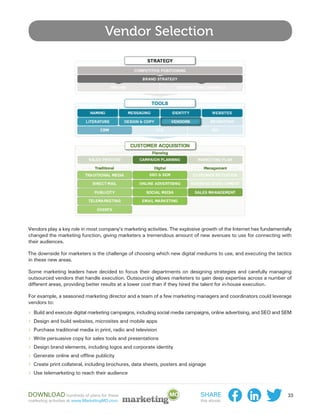
  you need, and have either a pool        others don’t, extending deadlines,      but you wish you could outsource
  of well-qualified vendors to choose     producing mediocre work and going       more to increase your bandwidth,
  from, or understand how to select       over budget.                            and get better results.
  and manage a new vendor.
                                          After handing off a project, you        When you do outsource a project,
  Your team requires vendors to           check in occasionally to see how        it’s a crapshoot whether you’re
  adhere to strict project scopes,        the vendor is progressing, but as       going to get what you expect.
  deadlines and costs, and you always     the deadline nears, you’re a bit
  have a clear understanding of a         nervous—hoping for good results.        You wish that your team did a better
  vendor’s performance.                   Often times you get them, but it        job managing vendors’ progress,
                                          doesn’t surprise you when you don’t.    or at the minimum, could get the
  As a result, your vendors                                                       vendors to deliver decent work on
  consistently deliver great results      If you had more reliable vendors,       time.
  that are on time and on budget.         you’d be able to contribute
  This gives you time to focus            more efforts to measuring and           You shy away from using new
  on developing strategies and            improving campaign performance,         vendors, because you never know
  measuring results. Your vendors         and designing new strategies to         what you’re going to get, and when
  truly enhance your business.            enhance your positioning and build      you spend precious budget and
                                          your brand.                             receive poor results, you end up
                                                                                  looking bad to your executive team.


How Vendor Selection Aligns with Strategy
Some vendors can be very helpful creating strategies in their areas of expertise, but others might develop strategies
to promote the service that they’re selling (i.e. to win or expand the engagement), so it’s important to have a strong
understanding of your goals before engaging a vendor on a big project.

Additionally, most vendors’ work directly represents your brand, so make sure that these vendors have a strong under-
standing of your positioning and brand strategy, and ask them to show how their work supports it.


Key Concepts & Steps
Define your needs and timeline
Determine exactly what you’re looking for before you start your vendor search. You may want to set an initial budget,
and then develop a timeline for your search, especially if you have important deadlines to meet. If you don’t address
this beforehand, certain vendors may drive this process, adhering to a schedule that fits them, instead of what fits you.


34   Copyright Moderandi Inc. 2013                                                 Share
                                                                                   this ebook:
Identify and analyze vendors
Use the Web and ask for referrals to find a list of qualified vendors. Develop a list of qualifying questions and narrow
the field to a handful of companies.


Create your RFP
If you’re looking for very simple, straightforward services, you can ask bidders to provide a proposal and quote. For
more complex or intangible projects, it’s better to create a Request for Proposal (RFP) that asks bidders to respond to
very specific questions in a consistent fashion. A standard RFP is especially helpful when:

›› The vendor is providing a comprehensive service
›› The project is intangible or has many elements, such as a website
›› You have very specific evaluation criteria and need to compare “apples to apples”
›› You’re evaluating a large number of bidders (more than four)
Then, evaluate, negotiate and award the project:

›› Rate your bidders on the important criteria and narrow the field.
›› Negotiate pricing and terms with your finalists, but remember the adage “You get what you pay for.” Don’t just
  choose the lowest bid—choose the vendor that best meets your criteria for success and fits within your budget.


Next Steps
Continue to improve your vendor research, RFPs, and vendor management. If you rely on vendors for collateral and
customer acquisition activities, treat them as key members of your team. Good vendor selection and management will
help you improve results.


Download hundreds of plans for these                                          Share                                   35
marketing activities at www.MarketingMO.com.                                  this ebook:
Recruiting


Many CEOs have gone on record saying “Our people are our greatest asset.”

For many companies, their people heavily influence their brand. Think of a service company—the people delivering the
service have the most interaction with the marketplace, and sometimes define the entire brand experience.

In some product companies and in most B2B companies, the sales and customer service teams play a heavy role in a
customer’s experience with the company.

The simplest way to build your team, department or company with good people who will represent your brand is to
have a well-defined recruiting program.

Like marketing, recruiting is both an art and a science:

›› Art: Getting to know a candidate to understand whether s/he is the best fit for the job.
›› Science: Defining detailed job requirements so you can search for the right candidates; conducting a wide search;
     using a process for evaluating candidates; and measuring results.

Marketing leaders need to recruit talented people to help them turn their strategies into reality—coordinators, designers,
managers, account reps, sales reps, telemarketers, and business development reps.

If you’re a marketing leader, you might not currently influence hiring decisions with the sales team or in other areas
of the company. While you don’t have to become a human resources expert, if people in ANY area of your company
represent your brand, it’s a good idea to have your hiring teams evaluate your market-facing candidates against your
brand personality traits.


36     Copyright Moderandi Inc. 2013                                               Share
                                                                                   this ebook:
When your company hires people that naturally represent your brand, it’s a lot easier to deliver a consistent brand
experience in the marketplace.

And when you use a standardized recruiting process for people involved in marketing and sales, you should end up
with more consistent results.

Do you see your company in any of these scenarios?

  Best Case                                    Neutral Case                            Worst Case

  Every market-facing employee                 Some of your market-facing              You haven’t outlined your brand
  understands your brand personality           employees represent your brand          personality traits, but if you did, you’re
  traits and the experience that you           well, but others don’t. The people      sure that not all of your market-facing
  want to deliver. You have a strong           in charge of your hiring have your      employees would fit them. There are
  marketing and sales team with the            brand guidelines, but you’re not        simply too many different types of
  right skill sets to build the marketing      sure whether they’re adhered to—        personalities. And if you did define
  tools and execute the customer               you control the hires on your team,     your brand and share it with your
  acquisition activities that support          but not in other departments,           executive team, you’re not sure
  your strategy.                               including sales.                        whether they’d even buy into it.

  Before each hire, you develop a              You create job descriptions before      You have some team members who
  solid job description, compensation          you recruit and you usually receive     aren’t qualified for their roles. They
  plan and job profile so you’re               an acceptable number of résumés.        require a great deal of management
  sure about the qualifications and                                                    and you’re concerned about the time
  personality type you need for the            Sometimes the process drags             that it’ll take to replace them.
  position.                                    out longer than it should, and
                                               you’ve hired some candidates            It’s difficult to find qualified
  You screen and interview your                that weren’t a great fit. You do        candidates, especially because
  candidates efficiently and when you          have some average performers on         experience is expensive. Morale
  hire someone, s/he’s excited about           your team, but there are no major       isn’t great and people view their
  the job. You have little turnover and        issues.                                 job as tedious—there isn’t a lot of
  your employees are truly a valuable                                                  excitement and positive energy in
  asset to the company.                                                                your team.


How Recruiting Aligns with Strategy
Every market-facing employee contributes to your brand experience, so getting the right people aboard directly affects
the execution of your brand strategy.

You need talented people in your department to help you shape your strategies and manage execution, so good recruit-
ing practices are an essential element in any high-performing marketing department.

And, if your positioning is clear and your brand is strong, candidates that support what you stand for will come to you;
recruiting for a strong, well-defined brand is far easier than recruiting for an unknown, or poorly-defined brand.


Key Concepts & Steps
Share your brand guidelines with your entire leadership team
›› Have all of the people in your company understand your brand’s personality traits, and the experience that you wish
  to deliver.
›› Use these during your screening and interviewing process. If people don’t fit them, don’t hire them.
›› Incent your people to refer potential new employees who fit your criteria.


Download hundreds of plans for these                                                 Share                                          37
marketing activities at www.MarketingMO.com.                                         this ebook:
Define the position
›› Evaluate the job responsibilities and prioritize the skills and experience that your candidates will need.
›› Develop specific criteria you’ll use to evaluate your candidates.

Write a compelling ad
›› A good ad inspires qualified candidates to apply for the position. It needs to stand out among the ads they’ll be
     reviewing, and it needs to convey credibility, your brand and your personality.
›› Think of your ad as a sales pitch to a prospect and write it carefully.

Cast a wide net
›› Referrals are a great source for qualified candidates. Encourage everyone in your company to contact vendors, cus-
     tomers, friends and family about open positions. Create a job description that they can pass around.
›› Advertise in appropriate publications and websites. If you’re concerned about cost, measure your cost per applicant
     and per hire, and then use the best-performing sources the next time around.
›› If you’re not finding qualified candidates, keep investing . . . don’t settle for mediocre applicants just because you
     don’t want to spend more money looking.
›› If you’re doing a lot of hiring, make sure to post open jobs on your website and include content that speaks to ap-
     plicants. Good candidates will look at your site to learn about the company.


Follow your process
›› Create a process and follow it: résumé review, phone screen, interview, second interview, reference check, and of-
     fer. A good process saves time—for example, don’t invite a candidate for live interviews if you haven’t completed a
     good phone screen. You may find that they’re not a good fit during the phone call.
›› Respect the time and talent of all your candidates. Thank them for interviewing and let them know when you’ve
     extended an offer to someone else. You never know when you’ll cross paths again.


Next Steps
After you bring aboard new marketing and sales employees, make sure that they understand your positioning, brand
strategy and messaging so they can deliver on them every day.


38      Copyright Moderandi Inc. 2013                                                  Share
                                                                                       this ebook:
Customer Relationship Management


Customer relationship management (CRM) is a term that refers to two things:

›› A company’s strategy for managing customer relationships and information
›› Software that manages that data
In its simplest form, CRM is a database where sales, marketing and customer service teams store critical account data:

›› Contact & account information (contact names, emails, phone numbers, SIC code, address, etc.)
›› Lead information
›› Sales rep name and activity history (calls, emails sent, inquiries, etc.)
›› Purchase history
›› Customer service tickets
›› Sales pipeline information
›› Marketing campaign data
CRM can also be an important reporting tool. For example, you can use it to:

›› Generate revenue projections for a product, a sales rep, and your company as a whole
›› Tie revenue to a marketing campaign
›› Pull up lists of leads and activities by sales rep
›› View the number of leads you have at each step in your sales process


Download hundreds of plans for these                                         Share                                  39
marketing activities at www.MarketingMO.com.                                 this ebook:
›› Track your progress against your goals
›› Manage marketing campaigns
›› Capture leads from your website
›› Minimize the time your team spends creating manual sales & activity reports
Here are three examples of how different companies can use CRM:

  Enterprise CRM                          Mid-Market CRM                         Small Company CRM

  Company A is a national insurance       Company B’s 60 employees use           Company C has four sales reps, two
  company that sells direct to            CRM to manage 8,000 customer           account managers and a marketing
  consumers and uses a single CRM         records and thousands of prospects.    manager. They use a web-based
  system.                                 The system links to the “request       system and pay per user per month.
                                          information” form on the company’s
 Thousands of sales reps across the       website. Leads are intelligently       They started with a simple version
 country log in, enter prospect data      routed directly to the sales rep for   and upgraded when they needed
 and use the system to manage their       that territory.                        more functionality.
 sales activities.
                                          The CRM links to the company’s         Their system tracks leads by
 At regional and corporate offices,       accounting software. When orders       campaign, assigns leads to sales
 many departments use the data            appear in the CRM system, they         reps, tracks account activity,
 to run-real time reports—revenue         also appear in the appropriate         estimates revenue, launches and
 projections, sales metrics, customer     financial reports. The operations      measures marketing campaigns,
 growth, customer satisfaction, and       team uses the system to fulfill        and stores templates for sales
 ROI for marketing campaigns—to           orders and track shipping and          letters, emails and presentations.
 effectively manage the business.         service history.


Every company needs to store this information somewhere, and there are CRM products with very simple functionality,
as well as complex multi-million dollar versions to handle almost any need. When you use the right CRM system, you
gain knowledge and power to keep your team on track and measure progress against goals.

  Best Case                               Neutral Case                           Worst Case

 Your CRM matches your marketing,         Your CRM meets your basic needs.       You don’t have a solid system for
 sales, customer service and              Your team uses it fairly regularly,    managing customer information—
 retention strategies.                    but you have to keep on them to        it’s kept in various files or databases
                                          update data.                           that aren’t linked.
  It’s easy to use and provides reports
  that eliminate the need to generate     It doesn’t have all of the reporting   It’s difficult and time-consuming to
  tedious manual reports. It integrates   capabilities that you’d like, and      create revenue projections, sales
  with other software like accounting     revenue reporting tends to be          reports and marketing campaign
  and inventory, enabling your entire     manual, so there’s some lost sales     reports.
  team to view important data and         productivity.
  reports in real time.                                                          The result is lost revenue,
                                          It’s fine, but it probably isn’t the   productivity and opportunity.
                                          best solution.


How CRM Aligns with Strategy
When you define your positioning and brand strategies, part of your strategy might be to provide excellent customer
service and build customer relationships. This would require a powerful CRM system.


40   Copyright Moderandi Inc. 2013                                               Share
                                                                                 this ebook:
Key Concepts & Steps
Analyze your needs
If you’re new to CRM or have a system that could be improved, define what you need.

›› Decide what information your team should be able to access and how they’ll use it.
›› Identify who needs to use the system and where they’re located (i.e. in different offices).
›› Determine what reports you’ll want to generate, particularly your revenue and pipeline reports.
›› Identify the marketing programs that you’d like to be able to run and how that information can help you better man-
  age your accounts.

If you’ve outgrown your current system, you may be able to purchase add-ins to give your existing system more power.
You may also decide to evaluate new systems to gain the true functionality you need.


Evaluate and compare CRM software
Once you’ve defined your requirements, look for a CRM package that satisfies them. Remember that many systems
come in several versions. You can start with a basic version and upgrade as you grow, but make sure the upgrade
process is seamless.


Implement and monitor your system
When you’re nearing the end of your selection process, prepare for implementation.

›› Create an implementation team.
›› Develop a schedule for key tasks: configuring fields, migrating data, creating reports, training users.
›› Create a solid training plan.
›› Launch the software.
›› Perform follow-up training to ensure that your team uses the software as planned. Most implementations fail because
  employees don’t use the software properly.
›› Gather feedback and modify the software configuration as needed—make it as intuitive and powerful as possible.


Next Steps
Many CRM systems have evolved to include marketing modules that you can use in your marketing campaign execu-
tion. CRM software can dramatically improve your sales process and sales management, so make sure that your entire
team understands how to effectively use the software.


Download hundreds of plans for these                                         Share                                  41
marketing activities at www.MarketingMO.com.                                 this ebook:
Customer Lifetime Value


Do you know what an average customer is truly worth to your company? By calculating your Customer Lifetime Value
(CLV), you’ll be able to answer that question.

CLV is the amount of profit that a customer delivers to your company for as long as the customer is buying from you.
It’s typically calculated as the net present value (the value in today’s dollars) of the profit that you’ll earn from all of
a customer’s purchases over time. When you know your CLV, you have an extremely powerful tool that helps with:

›› Acquisition: You’ll have a better understanding of what you can spend to acquire customers.
›› Targeting: You’ll know which customer segment delivers the most profit to your company and you can focus mar-
     keting efforts on that segment.
›› Return on investment: By using CLV in your ROI calculations for marketing campaigns, you’ll have a much more
     accurate measure of campaign performance.
›› Customer retention: You can determine how much you can spend to profitably retain customers.
›› Single-customer profitability: You can calculate the profitability of an individual customer.
CLV becomes more important as your marketing budget rises and your customer base grows. Yet even an early-stage
company can benefit by using simple CLV estimates.


42     Copyright Moderandi Inc. 2013                                                 Share
                                                                                     this ebook:
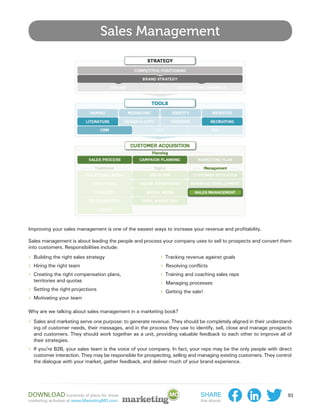
Best Case                                    Neutral Case                              Worst Case

  You know how much an average                 You have an idea of who your most         You don’t know how much a
  customer in each of your segments            valuable customers are, but you’re        customer is worth or how much
  is worth to you.                             not really sure how much you              you should spend on acquisition or
                                               should spend to acquire or retain         retention.
  You focus your acquisition efforts           them.
  on your most valuable segments,                                                        You’re not sure what your marketing
  and you know how much you can                Your ROI measurements for your            budget should be, and you’re
  spend to profitably retain your              marketing campaigns are probably          not confident in the quality of the
  customers.                                   very general, though still helpful.       investments you’re making.


How CLV Aligns with Strategy
Knowing your customer lifetime value is helpful when evaluating your market segments to determine which are the
most profitable. This information can be used when evaluating your positioning strategy to determine if you should
strengthen your position within a particular segment or market, or target entirely new segments.


Key Concepts & Steps
Confirm your formulas
There are several figures you’ll need for your CLV calculations:

›› Cost of goods sold (COGS): the cost to physically produce a product or service
›› Gross profit: the difference between the price of your product and the COGS
Companies calculate these figures differently, so your first step is to confirm the formulas your company uses.


Determine your customer segments
The CLV calculation is most valuable when you measure it by customer segment—similar groups of customers who
use your products/services in a similar way.


For each segment, determine how long an average customer stays with you—their “life-
time”
Review your customers’ buying patterns and calculate the total number of purchases they make and the time between
those purchases.


Calculate your CLV for each segment
Once you know the average lifetime, you’ll calculate:

›› The total profit you earn on all of their purchases.
›› The probability that they’ll make successive purchases.
›› The value of future revenue if you had the cash today.


Download hundreds of plans for these                                                 Share                                     43
marketing activities at www.MarketingMO.com.                                         this ebook:
Use CLV to improve your acquisition and retention marketing
Once you have a CLV for each customer segment, you can:

›› Set a maximum budget to acquire a particular type of customer.
›› Calculate whether a particular deal will be profitable.
›› Look at current customers who haven’t purchased according to the pattern you estimated in the calculation. They’re
     more likely to defect, so launch a retention campaign to those customers.
›› Plug it into your ROI projections. It’s more accurate to calculate your return on a campaign when you use the total
     profit the customer represents over time, not just the profit you earn on the first sale.


Next Steps
CLV is a powerful tool to use during the campaign planning process. Use it when projecting ROI before running a cam-
paign, and after the campaign to see how well you performed.

It’s also a valuable tool to use with customer retention, to determine how much to spend on your segments and cus-
tomers, and when to let individual customers go.


44      Copyright Moderandi Inc. 2013                                                 Share
                                                                                      this ebook:
Return on Investment


Marketing campaigns and initiatives are best treated as investments, not expenses. You’re investing in enhancing your
brand, building awareness, generating leads and driving sales. And like any smart investment, they should be measured,
monitored and evaluated against other marketing investments to ensure that you’re spending your money wisely.

Return on investment (ROI) is a measure of the profit earned from each investment. Like the “return” you earn on your
portfolio or bank account, it’s calculated as a percentage. In the simplest terms, the calculation is:

                                                 (Return – Investment)
                                                       Investment


To express it as a percentage, multiply your result by 100.

ROI calculations for marketing campaigns and initiatives can be complex. With many variables on both the return side
and the investment (cost) side, understanding your ROI formula is essential in order to produce the best possible results.

For example, marketers may consider varied definitions of return, including:

›› Total revenue (or gross receipts or turnover, depending on your organization type and location) defined as the top
  line sales generated from the campaign.
›› Gross profit (or a gross profit estimate) defined as revenue minus the cost of goods to produce/deliver a product or
  service. Many marketers simply use the company’s COG percentage (say 20%) and deduct it from the total revenue.
›› Net profit, which is gross profit minus expenses.


Download hundreds of plans for these                                           Share                                   45
marketing activities at www.MarketingMO.com.                                   this ebook:
On the investment side, it’s easy for marketers to input the media costs as the investment. But what other costs should
you include? When executing your campaign, you might include:

 ›› Creative costs
 ›› Printing costs
 ›› Technical costs (such as email platforms and website coding)
 ›› Management time
 ›› Cost of sales


Basic Marketing ROI Formulas
One basic formula uses the gross margin for units sold in the campaign and the marketing investment for the campaign:

                                               Gross Profit – Marketing Investment
                                                       Marketing Investment


You can also use the Customer Lifetime Value (CLV) instead of gross profit. CLV is a measure of the profit generated
by a single customer or set of customers over their lifetime with your company.

                                        Customer Lifetime Value – Marketing Investment
                                                       Marketing Investment


 However, some companies deduct other expenses:

             Gross Profit (or CLV) – Marketing Investment – *Overhead Allocation – *Incremental Expenses
                                                       Marketing Investment


*These expenses are typically tracked in “Sales and General Expenses” in overhead, but some companies deduct them in ROI calculations to
 provide a closer estimate of the true profit that their marketing campaigns are generating for the company.

The components for calculating marketing ROI can be different for each organization, but with solid ROI calculations,
you can focus on campaigns that deliver the greatest return. For example, if one campaign generates a 15% ROI and
the other 50%, where will you invest your marketing budget next time? If your entire marketing budget only returns 6%
and the stock market returns 12%, your company can earn more profit by investing in the stock market.

Understanding ROI helps you improve your ongoing campaigns. When you tweak your offer or launch a campaign using
a different list, you can compare ROI and focus on the version with the best performance.

Finally, ROI helps you justify marketing investments. In tough times, companies often slash their marketing budgets—
a dangerous move since marketing is an investment that produces revenue. By focusing on ROI, you can help your
company move away from the idea that marketing is a fluffy expense that can be cut when times get tough.


46     Copyright Moderandi Inc. 2013                                                          Share
                                                                                              this ebook:
Best Case                                    Neutral Case                               Worst Case

  You measure and track the ROI of             You calculate ROI on some                  You don’t measure the performance
  all of your marketing investments.           investments, but because it can            of any of your investments.
  Your campaigns deliver the highest           get complex, you don’t attempt to
  possible return and you’re able to           measure it at all times.                   In fact, marketing is viewed as a
  improve them over time.                                                                 cost, rather than an investment.
                                               You have a general idea of how your
  Your organization understands                investments perform relative to each       Your company isn’t sure what works
  and agrees with the choices you              other, but you can’t pinpoint the          and what doesn’t work, and it’s a
  make because there is solid data to          exact return you’re generating. And        struggle to meet goals.
  support your investments.                    in tough times, your budget is cut.


How ROI Aligns with Strategy
Return on investment calculations are powerful tools to use in campaign planning and execution. Use them to determine
whether you can execute short-term marketing strategies profitably. ROI can be heavily influenced by the strength of
your brand and your pricing. Strong brands can typically acquire customers at a lower cost than weak brands, increas-
ing marketing ROI.


Key Concepts & Steps
Confirm your formulas
There are several figures you’ll need for your ROI calculations:

›› Cost of goods sold (COGS): The cost to physically produce a product or service.
›› Marketing investment: Typically you’d include just the cost of the media, not production costs or time invested by
  certain employees. In certain cases, it may be better to include all of those figures.
›› Revenue: It can be tricky to tie revenue to a particular campaign, especially when you run a variety of campaigns
  and have a long sales process. Your finance team may have some suggestions for estimating this figure.

Companies calculate these figures differently, so confirm the formulas your company uses—your finance team or ac-
countant can guide you.


Establish an ROI threshold
Set an ROI goal for your entire budget and individual campaigns. Set a floor as well. By doing so, you gain more power
over your budget. If you project that a campaign won’t hit the threshold, don’t run it. If you can’t get an ongoing cam-
paign over the threshold, cut it and put your money elsewhere.


Set your marketing budget
When you have an ROI goal and annual revenue/profit goals, you can calculate the amount of money you should spend
on marketing—just solve the ROI formula for the “investment” figure. You’ll be more confident that you’re spending
the right amount of money to meet your goals.


Calculate ROI on campaigns; track and improve your results
Tracking ROI can be tricky with complex marketing campaigns. With a commitment and a good reporting process, you
can build solid measurements, even if you have to estimate during the process.


Download hundreds of plans for these                                                  Share                                    47
marketing activities at www.MarketingMO.com.                                          this ebook:
It’s not feasible to track ROI on every marketing investment, though, as some, such as branding and PR are not worth
the effort tracking. Many marketers simply separate their budget into two buckets—strategic spend, and campaign
spending based on ROI projections.


Next Steps
By having a strong understanding of marketing ROI, you’re able to better understand where to allocate your marketing
budget—on the tools and campaigns that will produce a positive return.

Use your ROI calculations to continually improve your campaigns; test new ways to increase your ROI and spend your
money on the campaigns that produce the greatest return for your company.


48   Copyright Moderandi Inc. 2013                                              Share
                                                                                this ebook:
Sales Process


How do prospects decide to purchase your product or service? Does a single decision maker find your product or ser-
vice and buy on the spot, or does s/he go through many steps and approvals first? Perhaps there are multiple people
or departments involved in the decision, each with their own needs?

A sales process is a defined series of steps you follow as you guide prospects from initial contact to purchase. They’re
far more common in B2B than in B2C, but many high-ticket B2C items (such as real estate or autos) to have a distinct
sales process.

Your sales process begins when you first identify a new prospect or the prospect engages with you. Here’s an example:

  Step 1                   Step 2                 Step 3                  Step 4                  Step 5

  A prospect               A sales rep calls      An in-person            Your team submits       The prospect signs
  responds to              the prospect           meeting and             a proposal to the       an agreement
  a campaign               to explain your        product demo            prospect.               and makes first
  and requests             product.               takes place.                                    payment.
  information.


Download hundreds of plans for these                                          Share                                    49
marketing activities at www.MarketingMO.com.                                  this ebook:
A documented sales process is a flowchart that explains:

›› Each distinct step a prospect takes
›› Knowledge the prospect needs to move to the next step
›› Literature and tools you provide to help the prospect move forward faster
›› The length of time a prospect needs at each step
›› Conversion rates: the percentage of prospects who move from one step to the next
With a documented sales process, you have a powerful tool that enables you to:

›› Sell more efficiently
›› Generate more accurate sales and revenue reports
›› Estimate the revenue and return on investment (ROI) of your marketing campaigns
›› See which stages take the most time and find new ways to move prospects forward
›› Create better sales tools and literature
›› Minimize the amount of time your reps spend on estimates and forecasts
Do you see your company in one of these scenarios?

  Best Case                               Neutral Case                           Worst Case

  You have a well-designed sales         You may or may not have a defined       You don’t have a process or you
  process that measures the number       sales process. You generally            use one that doesn’t match how
  of prospects you have at each stage,   follow the same steps to create a       prospects want to buy.
  how long they stay in each stage,      customer, but there’s a big variance
  and the revenue that your entire       in the amount of time it takes to       You deliver all of the information
  pipeline represents.                   close each one. In fact, even your      about your offering but then seem
                                         strongest reps have trouble closing     to lose control of the prospect.
  You deliver the right amount of        certain types of prospects.             Some prospects end up buying,
  information that prospects need at                                             but you don’t know why the others
  each step, which helps them make       Your forecasts are probably all         don’t.
  decisions quickly and move to the      manual and generally accurate, but
  next stage.                            you wish that you had a reliable        It’s a constant battle to figure out
                                         snapshot to show exactly how            how many real prospects you have
  You use your sales process to          many accounts are at a certain          and what they’re worth. Your sales
  create more successful marketing       stage and what you need to do to        team often spends valuable time
  campaigns because you can predict      close.                                  creating manual reports instead
  how many leads will become                                                     of selling, which further hurts your
  customers and what those leads will                                            marketing and sales performance.
  be worth to your company.


How Sales Process Aligns with Strategy
If you have multiple distribution channels, you might find that you have a different sales process for each. And, you
could have a different sales process for each offering you provide within an existing channel, so it’s valuable to docu-
ment the buying steps that your market prefers to take for each offering within each channel combination.

Your sales processes are also influenced by your positioning, brand strategy and pricing. Your brand personality should
be evident at each step in the process. For example, if you’re delivering a luxury experience, don’t use pushy and ag-
gressive sales tactics, and don’t use price discounts to convert prospects to customers.


50   Copyright Moderandi Inc. 2013                                                Share
                                                                                  this ebook:
Key Concepts & Steps
Determine how your prospects buy
List the steps that you think prospects logically take from the time they recognize a problem to the time that they pur-
chase a solution. Talk with customers or ask your sales reps for more insight. Figure out what steps they take, what
they need to know at each step, and how you can deliver that information most effectively.


Create your process
For each step your prospects need to take, list:

›› What the prospect needs to learn
›› Sales tools and literature that you can provide to help the prospect move forward
›› The length of time that a prospect needs at that step
›› The percentage of prospects who move from each step to the next (your “conversion rate”)

Integrate your process into your CRM
It’s helpful to add each sales process to your customer relationship management (CRM) software so that each account
is assigned to a stage at all times. That allows you to run reports to measure your progress and improve your sales
management.


Project campaign results and revenue
When you have a sales process with conversion rates, you can quickly generate solid pipeline and revenue reports. For
example, if you have 50 prospects at the presentation stage, your conversion metrics may show that 20% will become
customers. That means those 50 prospects should deliver 10 new customers. Your conversion metrics will also tell
you when that should happen and how much revenue those prospect represent.

You can use a similar calculation to project results from new marketing campaigns. For example, if a campaign should
produce 100 qualified leads, you can estimate the number of meetings, presentations, and new customers that the
campaign will generate.


Improve your process to maximize revenue
When you have a defined process, it’s easier to test ideas for improving results. For example, you can:

›› Identify spots where prospects get “stuck” in the process and try new materials or messages to help them move
  forward
›› Measure how well different reps convert at each step and help those that aren’t doing as well
›› See how leads from different marketing campaigns convert, and use that information to improve your campaigns
›› Create campaigns to “recycle” leads that fall out of the process at various spots


Next Steps
After you’ve documented your sales process, decide which sales tools and literature should be delivered at each step.

You’ll also use your sales process in your sales management to measure the success of your marketing campaigns: for
each campaign, you will be able to see how many leads entered the process and made it through each step.


Download hundreds of plans for these                                          Share                                  51
marketing activities at www.MarketingMO.com.                                  this ebook:
Campaign Planning


For many companies, marketing campaigns are the main method for both communicating with their market to reinforce
their positioning and for customer acquisition.

Good campaigns follow a theme and include a series of touches with the market. It’s noisy in the marketplace, and a
message delivered once through a single medium rarely makes a difference. While there’s no magic number regarding
the best frequency for a message to make an impact, opinions range from three to twenty times, with seven being an
old marketing adage.

Many marketing campaigns contain an overarching theme, which can be leveraged over extended periods of time with
multiple variations, or different elements, to tell an entire story.

An example would be The Duck campaign launched by the American Family Life Assurance Company in 2000. While
the company had been in business since 1955, it had only a 12% brand recognition rate before the campaign launched.
The company used the Kaplan Thaler Group to improve its name recognition. Kaplan created a new character, the
Aflac Duck, who appeared in ads featuring customers who had trouble remembering the insurance company’s name.
In the ads, the duck appeared in the background and quacked the name “Aflac” (while usually ending up in a funny
predicament).

You’ve seen them, right? As a result of the long-running campaign, Aflac’s brand recognition jumped from 12% to 90%,
and increased sales catapulted Aflac into a leadership position in the supplemental insurance market.


52   Copyright Moderandi Inc. 2013                                             Share
                                                                               this ebook:
Large consumer marketers typically use ad agencies (both traditional media and digital media agencies) to design their
campaign creative, handle the media buys, and track results. These are often multi-million dollar endeavors, and have
brought us such memorable advertising campaigns as:

››“Just Do It” – Nike
››“The Most Interesting Man in the World” – Dos Equis
››“Where’s the Beef?” – Wendy’s
››“We Try Harder” – Avis
››“Absolutely, Positively Overnight” – FedEx
While most small- to mid-market companies can’t afford the multi-million dollar ad budgets from the Madison Avenue
agencies, they can create effective and memorable campaigns leveraging different media such as:
›› Online media, including interactive ads and                ›› Radio
  banners on website                                          ›› Television
›› Print media                                                ›› Telemarketing
›› Social media                                               ›› Events and trade shows
›› Publicity                                                  ›› Search engines
›› Direct mail                                                ›› Outdoor media
›› Email

True marketing campaigns are more than just advertisements. Complex campaigns leverage multiple mediums, use a
sequence of messages over an extended timeframe, support positioning, define a brand experience, and handle the
campaign fulfillment and selling.

Campaigns can also be simple—using a single medium, with a single message and call-to-action. Here are three ex-
amples of very simple campaigns:

                                               Drive Existing Prospects to
                                                                                         Promote an Offer for a Special
  Generate New Leads                           Your Trade Show Booth & VIP
                                                                                         Occasion
                                               Reception

  1.	 Use a paid search ad promotion           1.	 Mail a postcard to attendees 3        1.	 Run banner ads on industry
      with a special theme or call-to-             weeks before the show; invite             websites and targeted email
      action to generate traffic to your           them to your booth with an                newsletters, driving traffic to
      website.                                     intriguing incentive.                     a special landing page to take
                                                                                             advantage of a special offer such
  2.	 Receive information requests             2.	 Mail a special invite to key              as a sale, or free promotion.
      from prospects via a landing                 prospects and customers for a
      page form.                                   VIP reception. Ask them to RSVP       2.	Send out a special email to your
                                                   by phone, email or URL.                  house list to promote the offer.
  3.	 Email the requested information.
                                               3.	Call key prospects and customers       3.	Create an intriguing story and tie
  4.	 Call the prospect; qualify the              as a second effort.                       it to your offer. Write a search-
      prospect further and determine                                                        optimized press release and post
      next steps.                              4.	 Send an email to all confirmed           it on your site; distribute the
                                                   attendees 3 days before the              release and pitch the story to a
                                                   event.                                   key industry reporter.

                                               5.	Email the non-respondents one          4.	 Run paid search ads driving
                                                  last time.                                 traffic to the landing page.


Download hundreds of plans for these                                                 Share                                       53
marketing activities at www.MarketingMO.com.                                         this ebook:
It’s good practice to start with your company’s annual goals and work backwards to develop campaigns to meet those
numbers. For example, when you know how many new customers you need, you can calculate how many leads you’ll
need, and then design campaigns to generate that number of leads over the course of the year.

With solid planning, a jolt of creativity, and a focus on measurement, you’ll be in a strong position for success.

  Best Case                                 Neutral Case                            Worst Case

  You plan and execute your                 Your campaigns aren’t the most          Your marketing programs tend to be
  campaigns to hit specific goals. You      creative or the splashiest, but         reactive—suddenly you’re low on
  don’t always hit them, but you test       you’ve hit many of your marketing       leads or falling short of your goals
  and improve different elements; the       goals. You don’t test, but your         and you launch a campaign to fix
  ROI on your overall budget is above       response rate is fine. You don’t        the problem.
  your goal.                                know your ROI, but you know
                                            generally which campaigns work          Since your programs don’t seem
  You focus on an offer and call-           best.                                   to work, it’s difficult to gain budget
  to-action, and you touch your                                                     approval for future campaigns
  prospects several times and follow        When you’re faced with ambitious        that could be better-planned and
  up when appropriate.                      annual goals, you have problems         executed.
                                            gaining budget approval. Since you
  You recognize the challenges in           stick with the same campaigns, year     It’s a vicious cycle and you don’t
  measuring results, but you do what        in and year out, it’s also difficult    know how to get out of it.
  you can; it helps you improve the         to figure out how to generate
  next time around.                         additional leads.


How Campaign Planning Aligns with Strategy
Your marketing campaigns are the vehicles for connecting with your marketplace, to generate leads and sales, and to
position you as that certain “something.”

Campaign copy and creative should always support your brand strategy and messages, even if you’re running a tacti-
cal lead generation campaign. They’re one of the most effective customer acquisition tactics in your marketing arsenal.


Key Concepts & Steps
Quantify your goals
›› Plan your campaigns to meet your annual revenue and volume goals. For example, if you’re trying to generate 100
     new customers, use your sales process conversion rates to figure out how many leads you’ll need and when you’ll
     need them.
›› Think about how you’ll use different media. For example, if you’re B2B, your sales team may be able to generate 30%
     of your leads through prospecting; the rest may come from telemarketing, email, social media, direct mail, search
     marketing, webinars, trade shows, etc.


Generate campaign ideas and strategies
›› Identify all of the business goals that will need marketing support. You may need campaigns to generate and nurture
     prospects, to sell direct or through a channel, or to market to existing customers.
›› Evaluate ideas and options (traditional sales activities, Internet marketing, social media, telemarketing, direct mail,
     email and publicity) to determine which ones are most effective for meeting a particular goal.


54      Copyright Moderandi Inc. 2013                                                Share
                                                                                     this ebook:
Target your audience
›› With more specific targeting, you can speak more directly to the prospect and raise your response rates in the process.

Deliver one or two key messages and your call-to-action
›› If you include every detail about your offering, it’s easy for prospects to become overwhelmed. Move a prospect
  just one step at a time.
›› Be creative—your market is bombarded with messages daily, so grab their attention and engage them.

Create your budget and estimate your return on investment
Projecting campaign ROI is a powerful exercise that forces you to think through and estimate results for the important
metrics of your campaign:

›› Impressions, or exposure to your campaign creative
›› Conversions, or those who take action from the impression
›› The steps required to move from a conversion to a customer
›› The number of units sold, and the profit from each
›› The items of your campaign budget
›› The estimated ROI of your campaign

Plan your fulfillment
›› Your fulfillment processes can help or hurt your close rate, so be sure you outline your requirements. For example,
  if you’re running a campaign where prospects request a software demo, and it doesn’t arrive for a week, your pros-
  pects may lose interest.


Plan to measure
When you measure your campaigns, it’s easier to gain budget approval the next time around. You’ll also know exactly
which programs produce the highest return.

›› Establish how you’ll measure the success of each campaign. If there are variables you can’t measure, decide how
  you will account for those results.
›› Identify how you’ll capture the data you need to track responses to your campaign—unique phone numbers, unique
  URLs, etc.


Continually test and improve
›› Even on a small campaign, you can evaluate your ad, your copy, your list or other factors before you spend your
  entire budget.
›› Choose a subset of your list or two versions of an ad; test them in small quantities and choose the best one for rollout.
  Then you can test a second variable against the winner of the first test.
›› Keep the testing cycle going and track your results over time. You’ll improve your response rates and your return
  on investment.


Next Steps
After you plan your campaign, it’s time to focus on tactical execution. That means having a deep understanding of
the media you’re using, carefully planning your media buys, tracking your results, and following the best practices and
steps for each media you use.


Download hundreds of plans for these                                            Share                                    55
marketing activities at www.MarketingMO.com.                                    this ebook:
Marketing Plan & Budget


A marketing plan is a detailed roadmap that outlines all of your marketing strategies, tactics, costs and projected re-
sults over a period of time. The plan keeps your entire team focused on specific goals—it’s a critical resource for your
entire company.

A good marketing plan typically includes:
›› Positioning strategy                                         ›› Sales plan
›› Brand strategy                                               ›› Major marketing campaigns
›› Product/service overview                                     ›› Detailed budget
›› Detailed goals by product, distribution channel              ›› Dates to review progress
     and/or customer segment

It takes time to develop a solid plan, but it’s important because it ties all of your activities to tangible goals. It’s also a
great opportunity to focus on the future, generate new ideas, and inspire your team. Even a simple plan is better than
none, but when you invest more effort upfront, you’ll have a better roadmap toward your goals.


56     Copyright Moderandi Inc. 2013                                                   Share
                                                                                       this ebook:
Best Case                                    Neutral Case                              Worst Case

  Your marketing plan is a detailed            You’re incredibly busy, so it’s           You don’t typically create a
  roadmap to meet your goals.                  difficult to invest the time in a         marketing plan. You have a budget,
                                               detailed marketing plan. Instead,         but the numbers are haphazard.
  You recognize that the time you              you develop a basic plan that’s           Things change so quickly—why
  invest to create a solid plan is             based on last year’s version.             spend the time?
  perhaps the best time you’ll invest
  all year—it helps you work through           You include general revenue goals,        You take a similar approach with
  new strategies, issues, ideas and            general sales strategies, and basic       the strategies that should drive
  numbers.                                     campaigns; you stick with proven          a marketing plan. You probably
                                               techniques. Budgets are based on          don’t have a positioning or
  When it’s done, your team                    last year’s numbers.                      brand strategy; you’re missing
  focuses on executing the plan and                                                      out on distribution channels or
  measuring your progress all year             You could be more ambitious with          partnerships; your campaigns are
  long.                                        your revenue goals if your company        ineffective and you may not invest
                                               was willing to try new things,            in customer retention.
  As a result, you’ve been able to hit         but each year you stick with the
  your goals, grow your business, and          tried-and-true.                           A plan is a compass. Without one,
  enjoy the journey.                                                                     you may be traveling in the right
                                                                                         direction, but it’s incredibly difficult
                                                                                         to stay on course—and that can
                                                                                         drastically limit your success.


How Your Marketing Plan and Budget Align with Strategy
Some statistics have shown that up to 85% of small- to mid-size companies create an annual marketing budget, but
without a concrete plan to accompany it. This explains why so many marketers are tactically focused—they’re figuring
out how to spend a defined budget, instead of thinking about goals and strategies.

Creating an annual marketing plan, if done properly, forces you to think through your positioning and brand strategy,
along with your pricing, distribution, sales and customer retention strategies.

After outlining your strategies and setting your goals, begin outlining campaign ideas to bring your strategies to life.
Writing a comprehensive marketing plan can be a challenging exercise for many, but it’s a powerful one that is worth
investing in.


Key Concepts & Steps
Set your annual goals
Build your entire marketing plan to achieve the goals that you define:

›› Quantitative (numeric) goals such as total       revenue, profit, number of customers, units sold, and breakdowns by
  product or channel as needed.
›› Strategic goals—for example, you may want to expand into a new market with a new distribution channel, or you
  may need to reposition your brand to reflect a change in your business.


Emphasize your positioning in the marketplace
›› Your positioning strategy defines how you’ll differentiate your offering from those of your competitors.
›› Your brand strategy defines what you stand for and how you’ll communicate with the market.


Download hundreds of plans for these                                                 Share                                          57
marketing activities at www.MarketingMO.com.                                         this ebook:
Outline any plans for product or service improvements
If you need to do anything to strengthen your product line and better deliver on your positioning, address those issues
in your plan.


Develop your tactical sales plan
›› The number of sales reps you’ll need and the markets they’ll target
›› Whether you’ll need to develop new compensation plans, or hire and train new personnel
›› Top priority markets, industries or customer segments; if you have a list of key prospects, include them
›› Your plan for managing current customers
›› Plans for launching any new distribution channels and driving revenue through existing channels

Outline your major marketing campaigns
You don’t need to list every campaign—just outline your major promotional plans for the year. You’ll need to set your
budget too, so the more planning you do now, the better. Your plans should include:

›› The top three campaigns you’ll run to generate leads, nurture customers, close, and/or market to existing customers
›› The media you’ll use (for example, email, social, online, print, telemarketing, trade shows, publicity, etc.)
›› Tools, technologies or resources you’ll need—for example, a new website, an email service provider, or a new piece
     of software
›› Your estimated ROI and other financial goals

Develop a budget
›› Budgeting can be a difficult process. Many companies just estimate or base it on their previous year’s spend. An esti-
     mate is better than nothing, but if you’ve defined your major campaigns and needs, you can develop better numbers.
›› You can use ROI to determine the appropriate total budget for your marketing efforts.

Revisit your plan regularly
›› The planning process itself is immensely valuable, but if you don’t review the plan regularly, it’s easy to lose focus.
     Periodically revisit the plan, and measure your progress.


Next Steps
When you’ve finished your plan, it’s time to execute. You may need to create new messages, literature, websites or
other tools and processes for your campaigns, but after that, focus on customer acquisition.


58     Copyright Moderandi Inc. 2013                                               Share
                                                                                   this ebook:
Traditional Media


Marketers have used traditional media such as print, radio, TV, yellow pages and even outdoor ads to reach consumer
markets for the last 50 to 100 years.

Traditional media can also play a role in the marketing mix for many B2B companies. These media often reach a broad
audience and thus can be relatively expensive. Yet in your industry or region, they may be very effective in helping you
reach your market. For example:

›› In many industries, print ads in monthly trade journals are an important vehicle to reach decision makers.
›› If your company sells to a certain geographic region, directory listings and ads may be crucial for reaching buyers
  when they’re searching for solutions.
›› You may need to reach a wide variety of prospects in different industries, so you may advertise in a regional or na-
  tional business publication, newspaper or radio program.

You can use these media to generate leads, build visibility, share your message and/or drive specific promotions. They’re
especially helpful when you use them in conjunction with other media in a larger campaign.


Download hundreds of plans for these                                           Share                                   59
marketing activities at www.MarketingMO.com.                                   this ebook:
Here are two sample campaigns that incorporate traditional media:

  Use Print & Online to Generate Leads                          Use Radio to Generate Leads & Awareness

  To generate leads, you run a print ad in an industry          You run a schedule of :30 ads on a talk radio show that
  journal and a banner ad on the publication’s website and      reaches a broad base of businesspeople in your industry
  in their monthly subscriber email.                            or region.

  The prospect calls to take advantage of your offer, or        As part of your package, you buy exclusive sponsorship
  visits a unique landing page on your website and fills out    of the show. You receive special mentions throughout
  a form.                                                       the show, and you use the entire campaign to drive
                                                                traffic to a specific landing page on your website. The
  A sales rep calls and sets up an in-person presentation.      page continues your message, captures the prospect’s
                                                                information or encourages a phone call.

                                                                Your telemarketing team qualifies leads and transfers hot
                                                                prospects to your sales team.


It’s important to treat these programs as longer-term investments because responses tend to come in gradually—they
aren’t as immediate or measurable as internet marketing, telemarketing or direct mail. Targeting may be an issue and
you may not be able to measure the branding impact of your campaign, but they’re solid vehicles when they’re in line
with your goals or used in a larger campaign.

  Best Case                                 Neutral Case                            Worst Case

  You understand the strengths and          You run a sprinkling of traditional     You don’t evaluate your media
  limitations of traditional media,         media campaigns and generally           buys very carefully. You don’t
  and you use them effectively in           track the number of responses           have specific goals and thus can’t
  campaigns to drive awareness and          that they generate. You know they       measure whether you’re successful
  response.                                 work to some degree, but you            or not. You don’t really test your
                                            can’t quantify the results. The ads     ads either—they offer a lot of
  You test your campaigns to improve        themselves are mediocre, but you        information and you can’t really
  them over time and you measure            rarely test them to improve.            say whether they work either for
  the campaigns to the best of your                                                 branding or direct response.
  ability. While you don’t measure the      You know it’s important to be in the
  value of your brand-building, you         vehicles you choose, and you stick      You’re wasting your budget and
  do adjust your ROI calculations to        with the same tactics because your      time on programs that could be
  incorporate an allowance for that         competitors are doing the same          vastly improved.
  value.                                    thing.


How Traditional Media Aligns with Strategy
Campaigns using traditional media should support your positioning and brand strategy, contributing to the experience
that you wish to deliver and the mindshare that you wish to own.

Additionally, make sure that your traditional media campaign is aligned to the goals that you’ve established in your
campaign plan.


60   Copyright Moderandi Inc. 2013                                                   Share
                                                                                     this ebook:
Key Concepts & Steps
Develop a strong strategy
First, determine what you need to accomplish. For example, you may need to generate a specific number of leads, raise
your visibility in a certain industry or geography, or communicate a key message across different media. Set tangible
goals for your traditional media plan.

Each traditional media vehicle has benefits and drawbacks. When you’ve defined your goals, you can decide which
vehicle will work best. Make sure you plan how to measure your campaign as well.


Decide whether to buy media in-house or through an agency
Media buying can be a tricky and time-consuming process. If you have a lot of media to buy, you may want to hire
an agency. You’ll pay for their services, but they may also have more buying power to negotiate better deals and find
ways to reach your target market more cost-effectively.


Consider targeting when comparing costs
Media sales reps may quote you a flat rate for a particular ad or they may quote a cost per thousand (CPM) impressions.
You may pay a higher CPM for a more targeted media than a general one, but if you calculate your cost per targeted
impression instead, you can truly compare apples to apples.


Create a compelling ad and call-to-action
Your ad needs to grab the attention of your market—be creative, but keep your message simple and clear. Include a call-
to-action—encourage prospects to call or visit a special landing page to learn more about a particular offer or program.


Continually test, refine and improve
It’s wise to test any campaign before spending your entire budget. If you’re considering multiple publications for print
ads, run the same ad in two different ones to see which generates the best response. Or test different headlines and
offers. Your goal is to find the ads and publications that generate the best response, and then run them for the remain-
der of your campaign.


Next Steps
As you design and manage campaigns using traditional media, evaluate the effectiveness of the tools used in the
campaign, measure your results, and focus on continuous improvement.


Download hundreds of plans for these                                          Share                                  61
marketing activities at www.MarketingMO.com.                                  this ebook:
Direct Mail


For many years, direct mail has been an important marketing vehicle. Even though many companies have turned to
email and internet marketing, a targeted and well-produced mail campaign can still be highly effective.

Direct mail campaigns can generate leads, promote special offers, support other campaigns, communicate with cus-
tomers and raise your visibility in your market. You can be very simple or wildly creative depending on your goals—for
example, you can use a:

›› Handwritten note
›› Simple but effective sales letter
›› Postcard with a four-color image on one side and a printed message on the back
›› Digitally-printed brochure with the prospect’s name printed in the headline and body copy
›› Dimensional piece that you develop for a specific purpose
Direct mail can be an effective vehicle for a B2B company if you focus on strategic, targeted mailings instead of large
bulk mail campaigns, which draw very low response rates at much higher costs than online marketing. Instead, consider
using mail to:

›› Invite current customers and top prospects to an event you’re holding at a trade show
›› Send product literature with the prospect’s name and custom specifications printed into      the brochure itself (via
     digital printing)
›› Announce a compelling sale


62      Copyright Moderandi Inc. 2013                                             Share
                                                                                  this ebook:
Here are three sample mail campaigns:

  Generate New Leads                           Nurture Existing Leads                      Cross-Sell Current Customers

  Mail a personalized, hand-signed             Mail a quarterly “industry update”          Develop a piece that delivers a
  letter to targeted prospects. Quickly        or case study with graphs and               compelling case for your current
  introduce your value proposition;            reference info—more than you’d              customers to buy related products
  invite prospects to call or visit your       be able to provide in an email              and services. Include a strong call-
  website to view a demo, download             newsletter. Focus the piece on a            to-action; encourage customers to
  a special report, or request a quote.        typical objection prospects have            call or visit your website to learn
  Follow up with a phone call a week           before they buy.                            more and buy.
  later.


If you’re B2B, it’s better to think about mail as an integral part of a larger campaign. Don’t just mail and wait for the
phone to ring. Instead, plan a campaign that starts with an introduction via mail, then perhaps a follow-up phone call
from a sales rep and a demo delivered via email or via social media.

When you use the right strategy and execution, direct mail can be a strong addition to your marketing arsenal.

  Best Case                                    Neutral Case                                Worst Case

  You’re happy with the ROI on your            You’ve had some success with mail           You’ve used mail in the past but
  mail campaigns.                              campaigns. Sometimes they’re spur-          felt that it was a waste of money.
                                               of-the moment; you know that you            The list was expensive and didn’t
  You design each piece to grab                could do a better job of planning           necessarily have the right contact
  attention, convey a simple message           ahead and focusing your message.            names. The mail piece and postage
  and move the prospect toward                 You typically use mail in conjunction       were expensive and contained a lot
  action.                                      with a phone call.                          of information, yet it didn’t generate
                                                                                           the response you planned.
  You test your mailings and tweak             You don’t really test your campaigns
  the headlines, envelopes or offers           and try to improve results, but your        You had counted on it generating
  to increase response, and you use            response rates are acceptable.              a lot of leads that you ended up
  targeted and current lists.                                                              having to find elsewhere.


How Direct Mail Aligns with Strategy
Campaigns using direct mail should support your positioning and brand strategy, contributing to the experience that
you wish to deliver and the mindshare that you wish to own.

Additionally, make sure that your direct mail campaign is tied to the goals you’ve established in your campaign plan.


Key Concepts & Steps
Define your goals
Tie your campaign to a specific objective—for example, the number of responses that you need or the number of
customers you want to generate. Then design your campaign to meet your specific goal.


Target your audience
Narrow your audience as much as you can—you’ll be able to speak more directly to your prospects with better results.
You’ll also save on postage and production.


Download hundreds of plans for these                                                   Share                                        63
marketing activities at www.MarketingMO.com.                                           this ebook:
Focus on the offer
Don’t overwhelm your audience with every detail about your product and company. Focus on the offer itself—the
purpose for the mailing, the call-to-action. For example, if you’re promoting a software demo, explain what the demo
will help them learn and why they should request it now. Touch on the key benefits, but don’t muddy your message
by including every detail about the software and the history of your company.


Develop your content, then your creative
First determine how much copy you’ll need, what kind of graphics or photography you’ll include, how to promote the
offer, etc. Once you’ve defined the content you’ll need to achieve your goals, start the design process. If you’re work-
ing with a design and/or writing team, explain your requirements in a creative brief so you’re all on the same page.


Tackle the campaign logistics
Make sure that you plan how your piece will be folded, stuffed, addressed, stamped, mailed, etc. If you’re running large
campaigns, you may want to hire a vendor to handle this step.


Test, measure and continually improve
Mail is a terrific media for testing—you can select a random set of records from your list, send your mailing, measure
your response, then tweak the mailing and send it to another subset. You can improve the list targeting, your offer,
the envelope design, the copy and the design itself. Commit to continuous improvement and use what you learn in all
future campaigns.


Next Steps
As you design and manage campaigns using direct mail, evaluate the effectiveness of the tools used in the campaign,
and focus on continually improving your tactical execution.


64   Copyright Moderandi Inc. 2013                                                Share
                                                                                  this ebook:
Publicity


Have you ever read a story about a company and then contacted them to learn more about their product or service?
Or listened to a CEO deliver a speech and found yourself researching the company later on?

Publicity in the media can be extremely valuable in building credibility and awareness for your company, product or
service. For example, a legitimate news story acts as an endorsement that can reach a wide audience for very little
cost beyond your own creativity and time. There are many forms of publicity including:

›› News stories and interviews in trade journals, industry sites, newspapers, magazines, etc.
››“Expert” quotes in a story written by a journalist or blogger
›› Self-authored stories published on websites or in industry publications
›› Speaking engagements
Publicity is a cost-effective medium that can:

›› Build awareness about your brand, products or services, expertise and people
›› Drive prospects to your website
›› Drive event attendance or participation in a promotion
›› Educate the market about problems your company can solve
›› Create an ongoing dialogue with the market
The key to success: create newsworthy stories. They should be interesting, relevant and timely. They should educate
and inform, and provide your prospects with insight into how to solve a problem.


Download hundreds of plans for these                                         Share                               65
marketing activities at www.MarketingMO.com.                                 this ebook:
Even if you don’t think you have newsworthy content to share with the world, you can benefit by implementing small
newsworthy programs (such as charity work) that will raise your visibility. At the very least, you should include news
releases on your website; they help improve search engine rankings and enable prospects to see what you’ve been doing.

Publicity isn’t about luck—it’s about investing in a good PR program, and it can really pay off over time.

  Best Case                                    Neutral Case                            Worst Case

  Your company is very well known in your      You use PR sporadically with            You don’t use any form of public
  industry. When you launch a product or       mixed results—an occasional             relations. You may be a startup
  release a newsworthy story, important        blurb in an industry journal, a         or an established company, but
  publications write about you, and you’re     miscellaneous quote as an expert.       you’re not known by journalists
  often quoted in industry articles.                                                   in your industry. You see your
                                               You put press releases on your          competitors featured in industry
  You capitalize on the role the Internet      website and distribute them online,     publications even when your
  plays in publicity—your press releases       knowing that they make your site        solution may be better; your
  drive prospects and customers to your        more interesting to prospects, but      company doesn’t seem to have
  website. You also use blogs or other         you’re not sure whether you’re          that level of credibility, and
  online publicity techniques to create a      gaining the full benefit from your      you’re not sure how to get it.
  strong presence on the Internet.             efforts.


How Publicity Aligns with Strategy
Campaigns using publicity should support your positioning and convey your brand’s personality.

Additionally, make sure that your publicity campaign is tied to the goals that you’ve established in your campaign plan.


Key Concepts & Steps
Create a publicity strategy
Don’t just “shotgun” press releases when you need to drum up some attention. Plan your publicity strategy as you
would any marketing campaign:

›› Develop a calendar that ties story ideas to key events and spreads your content out over the year.
›› List events that may offer good speaking opportunities.
›› Identify publications, reporters and bloggers who cover subjects that are relevant for your company.
›› Create traditional and online press materials to give reporters supporting and background information for their stories.
›› Know the audience for each story and carefully target your media.

Develop newsworthy story ideas
Every day, journalists are bombarded with press releases touting new product launches, business alliances, research
discoveries, etc. But journalists don’t just make announcements—they need to tell compelling stories that their readers
will find interesting and useful. A trade journal may run a one-paragraph blurb about a new product, but to get headlines,
photos, interviews and full-page coverage, you need to develop real stories.

Like movies, good news stories are often about conflict. An endless stream of positive information is boring. Instead,
develop stories with substance: Good vs. Evil, Nature vs. Nurture, Race Against Time, Company A vs. Company B,
Employee Against the World, Company vs. the System.

In addition, good stories can “go viral” when you distribute them on the web.


66   Copyright Moderandi Inc. 2013                                                   Share
                                                                                     this ebook:
Market your stories and expertise
Journalists need stories. When you have a story, you have something to offer. With a quick, courteous phone call and
a simple pitch, you may find a journalist who says, “Yes, I’m interested in that story, send me your material.” That
three-minute phone call could make a substantial difference in your campaign success.

Reach out when you identify a potential speaking engagement or find a journalist or blogger who may want to quote
an expert from your company. Be sure to prepare a short pitch and support materials as well.


Use the Internet
Many PR experts say the traditional press release is dead. These days, a worthwhile PR strategy has to capitalize on
the Internet.

›› Write a second version of your normal releases with rich keywords and a format that helps search engines easily
  find the release.
›› Post your search-friendly releases on your site—they should be represented as an actual page on the site, not a PDF.
›› Send your release to Internet news distribution services.
›› Consider adding an RSS feed to your site—it will send updated content to other publishers.
›› Distribute your releases via Twitter, Facebook, Digg and other social media sites.


Next Steps
As you design and manage publicity campaigns, evaluate the effectiveness of the tools used in the campaign, and
focus on continually improving your tactical execution.

It’s difficult to measure the return on publicity, but if you’re really focused on creating stories and reaching out, you
have sound potential for success. One big story or important speaking engagement could generate fantastic results,
so keep at it!


Download hundreds of plans for these                                          Share                                   67
marketing activities at www.MarketingMO.com.                                  this ebook:
Telemarketing


The phrase “cold calling” sends chills down the spines of many businesspeople. It’s often viewed as an intimidating,
difficult, and boring process . . . and that means it doesn’t get done as often as it should.

Telemarketing campaigns help companies reach a group of targeted prospects or customers to communicate a mes-
sage, gather feedback, and determine a next step for the relationship. Telemarketing can be an important part of any
marketing strategy—for example, you can use it to:

›› Generate leads
›› Qualify prospects who have downloaded information from your website or attended a webinar
›› Follow up on a direct mail or email offer
›› Take orders for special promotions
›› Keep your marketing database current
›› Conduct marketing research
In many companies, sales reps should make hundreds or thousands of cold calls every month to set appointments
and/or generate leads. But busy reps usually prefer to work on closing their existing pipeline. Prospecting often slips
on the priority list; as a result, the sales pipeline isn’t always filled with new prospects.

If cold calling is an effective way to introduce your company to new prospects, don’t ignore it. Instead of forcing a sales
team to devote time to prospecting, many companies use an in-house or outsourced telemarketing group to make a
high volume of calls, find decision makers and qualify leads for the field sales group.


68   Copyright Moderandi Inc. 2013                                                  Share
                                                                                    this ebook:
When telemarketers handle prospecting, salespeople can spend 100% of their time selling and closing. Your company
can produce more revenue in the same amount of time; your reps earn more commission, they’re doing what they love,
and they’re more satisfied with their jobs.

You can use a telemarketing team in a variety of campaigns:

  Outbound Lead Generation                     Outbound Campaign Support                   Inbound Sales Support

  Company A’s telemarketers call               Company B increases their                   Company C makes sure that
  targeted lists. They identify the            response rates by including a               prospects who visit their website
  decision maker, ask qualifying               phone call in campaigns. For                can call and speak with someone
  questions, and gauge the prospect’s          example, when they hold an event            immediately. They use an inbound
  needs and interest level. If a               at a trade show, they call prospects        sales support team to answer
  prospect meets certain criteria,             before mailing an invite to lift their      questions and probe callers. The
  the telemarketer sets a follow-up            response rate. They also follow up          reps send follow-up materials and
  appointment for a sales rep.                 with those who don’t respond.               a field sales rep follows up with the
                                                                                           most qualified prospects.


With the right strategy and proper management, a good telemarketing operation can produce great value for your
company.

  Best Case                                    Neutral Case                                Worst Case

  You have a team or vendor to                 You have a vendor or in-house               You don’t have a telemarketing
  prequalify leads and handle inbound          team and their performance is               operation. Sales reps make their
  and outbound calls for marketing             average.                                    own cold-calls but they simply don’t
  campaigns.                                                                               make enough.
                                               If they’re in-house, you have some
  Your team successfully represents            statistics, but not enough, and             When prospects call from your
  your brand to your market. You               there’s a fair amount of turnover on        website, there frequently isn’t a
  have strong management in                    the team.                                   person available to talk with them live.
  place and can easily report on key
  statistics: contacts per hour, stats         In fact, you’re always training             And when you need to include a
  by rep, etc.                                 someone new. You see the value in           phone call in a marketing campaign,
                                               using telemarketing and you think           it’s an enormous battle to get reps
  You set goals and hit them                   your operation could improve.               to make calls.
  consistently.


How Telemarketing Aligns with Strategy
Campaigns using telemarketing should support your positioning and brand strategy. Most of this is conveyed through
each individual telemarketer, so write your scripts and train your reps to adhere to the personality traits of your brand.


Key Concepts & Steps
Set your goals
You can use telemarketing in many ways; brainstorm the campaigns that will work best for your company. For example,
you may need to generate leads for your sales team or use telemarketing to support other marketing campaigns.


Download hundreds of plans for these                                                    Share                                         69
marketing activities at www.MarketingMO.com.                                            this ebook:
Forecast and budget; determine whether to build in-house or outsource
›› Estimate your call volume, and then think about hours of operation, fluctuations in call volume, and the skill set you’ll
     need in your reps.
›› Your call volume also drives your headcount, software, phone system and the office space you’ll need.
›› These requirements will help you decide whether to use a vendor or hire and manage a team in-house. If you reach
     out to vendors, having these requirements ready will make your discussions easier and faster.
›› Budget for everything including headcount, software licenses, bonuses and management.

Develop good scripts
Reps will need to capture attention, build value, and close; a good script will help them do it consistently.

›› Make your scripts conversational, simple, and focused on the end goal.
›› It helps to make and listen to calls as you’re developing and refining your script. What looks good on paper may not
     work on the phone.
›› Get feedback from your team as well.

Train and coach your team
Regular coaching and quality assurance is crucial.

›› Engage your reps, role-play and guide them through calls.
›› Listen to calls regularly, evaluate your reps and coach them to improve their performance.

Report your results
›› Define the reports that you’ll need—your system may not be able to provide all of the data, but you can probably
     find an alternate solution.
›› Use reports to consistently evaluate progress and improve your campaigns.


Next Steps
As you design and manage telemarketing campaigns, evaluate the effectiveness of the tools used in the campaign, and
focus on continually improving your tactical execution.

Once your campaign is running, it’s all about execution, so manage your team and devote the resources necessary
for success.


70      Copyright Moderandi Inc. 2013                                                Share
                                                                                     this ebook:
Trade Shows & Events


There’s an old saying in business that “people buy from people.” If that’s the case, it’s a good idea to get people to-
gether as often as possible!

Trade shows and events are gatherings for people with common interests to achieve a goal. B2B and B2C companies
use them to generate leads, nurture prospects, build brand awareness, conduct training, or enhance relationships with
existing partners and customers. Options include:

›› Trade shows: You can have an exhibit booth, sponsor roundtable discussions or speeches, arrange for one of your
  executives give a presentation or sit on a panel, advertise in show publications and/or host your own reception.
›› Seminars or conferences: Sponsor an industry conference or create a seminar and market it to your prospects.
›› Networking meetings: Participate in and/or sponsor industry or local meetings; you can also create a one-time or
  ongoing breakfast or lunch meeting series for your prospects to attend.
›› Webinars: Webinars are online seminars with slides and audio; you can use them to generate leads and communicate
  with large groups at a lower cost than a live meeting.
›› Events for the arts, sports or charities: You can participate in these events as a sponsor with advertising, blocks
  of tickets, promotions and a reception for your VIPs.


Download hundreds of plans for these                                         Share                                   71
marketing activities at www.MarketingMO.com.                                 this ebook:
Many shows and events are major investments with numerous logistics:
›› Event planning                                         ›› Promotion
›› Travel                                                 ›› Sales materials
›› Shipping                                               ›› Sales follow-up
›› Set-up                                                 ›› Measurement
›› Exhibit booth design and materials

When executed properly, a great event could produce a large percentage of the leads that a company needs to gener-
ate over an entire year. With a halfhearted strategy, companies usually get lackluster results.

Do you see your company in any of these scenarios?

  Best Case                              Neutral Case                           Worst Case

  You use trade shows, special           You regularly attend trade shows       You exhibit at trade shows and you’re
  events and/or webinars to              and you’ve tried a few webinars        never satisfied with your results. It’s
  generate new prospects and reach       with mixed results—there’s a lot       hard to stand around for days and you
  out to existing prospects and          of competition for your prospects’     know that leads fall through the cracks
  customers.                             attention.                             in the weeks afterward.

  You stand out from your                At shows, your team does a             Your competitors are always doing
  competitors, deliver compelling        decent job of qualifying leads and     something big at the shows but you
  information and create meaningful      following up; you know that you        haven’t been able to afford anything
  dialog with your market.               generate new business but you          but your booth.
                                         don’t know how much.
  You set goals and measure                                                     You haven’t tried any other events
  them, and you know your ROI            It seems like you could be             because they’re an enormous effort for
  validates the investment. You also     generating a lot more business         very little payoff. You’ve never really
  implement marketing programs           from these programs, but you’re        been able to measure the results from
  and continue dialog after the event    not sure how to do it.                 the shows that you attend—you get a
  so that leads don’t fall through the                                          handful of leads and that seems to be it.
  cracks.


With a solid strategy, plan, investment and measurement, events can be an exciting marketing medium for B2B or
B2C marketers.


How Trade Shows and Events Align with Strategy
Your events and presence at trade shows should support your positioning and brand strategy. For events, your location,
theme, visuals, host or MC, refreshments, and entertainment or giveaways all work together to create an impression
of your brand. For trade shows, it’s your booth, materials, giveaways, and people that create the impression.


Key Concepts & Steps
Choose an event that matches your need
›› Define your marketing objectives: generate leads, nurture existing leads, build relationships, train and educate, or
     raise visibility/brand awareness.
›› Focus on the types of events that will help you meet your goals: industry events and shows, networking events,
     seminars and conferences, sponsored events, charity events, webinars and more.
›› Brainstorm to create a list of events and themes that will fit with your goals.


72      Copyright Moderandi Inc. 2013                                                Share
                                                                                     this ebook:
Outline your event strategy
Understand what your prospects need and how you can deliver it during the event. For example, think about the content
that your prospects want and how you should structure the event.


Create your event plan
›› Once you have a strategy, start the planning process: time, date, location, theme, event flow, materials, script, re-
  sponsibilities and more.
›› Plan for sales-related activities: what happens with new leads, how you’ll prioritize leads, follow-up timing, materials
  they should receive, etc.


Promote your event
›› To drive attendance or participation, develop a thorough promotional campaign with a strong call-to-action.
›› Use multiple media to touch your market frequently and consistently.
›› If you’re sponsoring another company’s event, be sure to promote your participation—don’t leave it up to someone
  else to drive your traffic.


Script your event and execute
A good event script and plan will help you execute without problems. Create a detailed timeline; rehearse appropriate
activities with your team; make sure everyone clearly understands their responsibilities.


Measure your event’s success
›› Review your goals-to-actual measurements and share the results with your team.
›› Document everything you learned so you can use that information next time.


Next Steps
Trade shows and events typically generate new relationships or foster existing ones. It’s important to set solid follow-
up procedures with your team so that valuable leads don’t fall through the cracks.

As you design and manage events and attend trade shows, evaluate the effectiveness of your strategy and focus on
continually improving your tactical execution.


Download hundreds of plans for these                                            Share                                    73
marketing activities at www.MarketingMO.com.                                    this ebook:
SEO and SEM


Search marketing is about gaining visibility on search engines when users search for terms that relate to your business.
For most companies, ranking high in the search results isn’t luck—it’s a result of solid effort in one or both categories
of search marketing:

  Organic search (SEO): When you enter a keyword or phrase into a search engine like Google or Bing, the organic
  results are displayed in the main body of the page.

 When your market searches for information about your products and services, you want to rank highly in search engine
 results. By optimizing your site, you can improve your ranking for important search terms and phrases (keywords).
 You can also improve your rank by getting other important sites to link to yours.

  Paid search (SEM): Paid search enables you to buy listings in the “sponsored” area of a search engine. There are
  a variety of paid search programs, but the most common is called pay-per-click (PPC), meaning you only pay for a
  listing when a prospect clicks your ad.

In search marketing, companies focus on driving more traffic to targeted areas of their website. They use search to:

›› Generate new leads
›› Sell products
›› Build their brand
›› Divert traffic from their competitors


74   Copyright Moderandi Inc. 2013                                                 Share
                                                                                   this ebook:
Studies show that most people—both business people and consumers considering large purchases—research their
problems, potential purchases and vendors online and use a search engine in the process. And the higher the price of
the product/service, the earlier in the research process they use a search engine.

For many B2B companies, generating only a handful of additional serious prospects can make a substantial difference
in revenue. Using search marketing may efficiently produce these additional prospects.

  Best Case                                    Neutral Case                           Worst Case

  You’re generating very targeted              You’ve built a new website and         Your website isn’t optimized for
  prospects through your search                it’s been optimized for search,        search and you’re nowhere to be
  marketing programs. Your site is             but you don’t rank in the top 10       found on search engines, even for
  optimized and you’ve built a lot             for any keywords other than your       very targeted terms.
  of important incoming links, so              company name.
  you rank well in organic results for                                                In fact, you may not even rank for
  targeted keywords.                           You’ve tried some paid search with     searches on your company name.
                                               good success; your conversion          Unfortunately, your competitors show
  You use paid search to supplement            rates on the traffic are okay but      up on the first and second pages for
  that traffic and you create custom           could be better.                       the terms your prospects use.
  landing pages for your campaigns
  to convert visitors into prospects or        You know that search marketing         As a result, your competitors are
  sales.                                       is a solid opportunity—you’re just     winning new business and furthering
                                               figuring out how to improve your       their lead in the market.
                                               results.


How Search Engine Marketing Aligns with Strategy
Campaigns using search engines should support your positioning and brand strategy, contributing to the experience
that you wish to deliver and the mindshare that you wish to own. This includes your ad copy, landing pages, and page
descriptions that appear in organic results.


Key Concepts & Steps
Create your search strategy
Review your short- and long-term goals to help determine whether to focus on organic or paid search (or both). It takes
time to improve your organic search rankings, but you can launch a paid search campaign today. However, there are
other considerations: the amount of traffic that you need, your budget, and your marketing objectives. Once you’ve
reviewed the pros and cons of each, you can select the search strategy that’s right for you.


Generate a list of keywords
Before you can optimize your site or launch a paid campaign, generate a list of keywords—terms your prospects use
when looking for information that you can deliver. You can brainstorm, copy keywords from competitors, or use online
tools (such as Google’s Keyword Tool) to generate a list and estimate traffic.


Optimize your website
›› Rewrite your content and code your pages so that they’re optimized for search engines.
›› Make sure the content is organized in the best possible manner.
›› Eliminate any technologies that prevent search engines from reading your content (for example, search engines
  can’t read graphics or Flash content).


Download hundreds of plans for these                                                Share                                    75
marketing activities at www.MarketingMO.com.                                        this ebook:
›› Register your site in important directories that play a vital role in search engine results.
›› If you don’t have anyone on staff that is an SEO expert, hire an outside specialist.

Generate inbound links
Search engines reward you when sites link to yours—they assume that your site must be valuable and you’ll rank higher
in search results. The higher the “page rank” of the sites that link to you, the more they help to raise your own ranking.
You want links from popular industry authorities, recognized directories, and reputable companies and organizations.


Implement additional Internet campaigns
These programs can improve your search results:

›› Using social media, online advertising and online PR to generate traffic and links
›› Including a blog on your site
›› Distributing search-optimized press releases on the web
›› Creating RSS feeds to distribute updated content from your site to other websites

Start testing paid search
To begin using paid search, you’ll:

›› Develop targeted landing pages for each campaign
›› Write your ad(s)
›› Create an account with a search network
›› Set up your campaign with the network
›› Set a daily or monthly budget
›› Start tracking your results


Next Steps
As you design and manage campaigns using search engines, evaluate the effectiveness of the tools used in the cam-
paign, and focus on continually improving your tactical execution.

Pay close attention to click-through rates and conversion rates; for most paid search campaigns, the difference between
positive and negative ROI is thorough testing and detailed management.


76   Copyright Moderandi Inc. 2013                                                    Share
                                                                                      this ebook:
Online Advertising


Internet marketing isn’t just for consumer marketers or large B2B firms—it’s a powerful vehicle for companies of all sizes.

Online advertising offers marketers an opportunity to reach very broad or very targeted prospects to generate leads,
communicate a message and raise visibility. The term refers to three general types of campaigns:

›› Banner ads placed on other websites
›› Ads or sponsored content on targeted email newsletters
›› Affiliate programs that enable you to put your ad on another company’s website and in return you pay a commission
  on clicks or sales

While a B2B marketer has a smaller universe of prospects than a consumer marketer, the value of each prospect is
typically far greater. With a targeted campaign and a good offer, you may only need to generate a handful of highly
qualified prospects to produce substantial revenue.


Download hundreds of plans for these                                            Share                                   77
marketing activities at www.MarketingMO.com.                                    this ebook:
Here are three examples of online ad campaigns:

  Generate New Leads                        Direct Sales                              Increase Your Visibility

  Promote a white paper, webinar            Run ads to sell a particular product      Run a campaign to share a message,
  or demo that can help prospects           or service. Drive prospects to a          promote an event or offer, or raise
  who are in the early phases of their      special landing page that describes       awareness about your products.
  research. Drive them to a special         your offer in detail. You create          Your goal is twofold: Drive click-
  landing page where you provide            supplemental pages to provide             throughs and generate awareness.
  details about the offer and capture       additional information if needed.         You use landing pages designed to
  key pieces of data so you can follow      You focus on converting those             convert a visitor into a prospect or
  up when the prospect is ready.            prospects into sales.                     customer.


What are the benefits of online advertising?

›› Timing: Reach people when they’re actively looking for information and solutions.
›› Immediacy: You can test and launch very quickly and generate response almost immediately.
›› Targeting: You can deliver your message to very specific audiences.
›› Lead generation and nurturing: You can capture prospects early, provide valuable information, and nurture them
     throughout the sales process.
›› Cost: You can reach a large audience quickly and at a lower cost than many other types of media.
›› Scalability: You can run campaigns of any size, at any budget level.
As with any marketing program, it’s important to develop a good strategy, target your audience, test, measure and
improve—especially because it’s easy and inexpensive to test different aspects of your campaigns in order to generate
the best possible results.

  Best Case                              Neutral Case                                  Worst Case

  Your online ad campaigns               You run campaigns periodically and            You’ve advertised on a few sites
  are a strong element in your           they’re moderately successful. Prices are     and generated some traffic, but
  marketing mix.                         high, but you reach a targeted audience.      you don’t have data to indicate
                                                                                       whether your campaigns are
  You use them to generate               You occasionally test and tweak your          successful beyond initial visits.
  prospects and customers,               ads, but it isn’t a priority.
  but gaining visibility is also                                                       You don’t create special landing
  important. You calculate ROI so        Since you use cost per click to measure       pages—you drive visitors to your
  you can compare the return of          success, you can’t accurately calculate       home page, and you rarely test
  these investments compared to          ROI, but you’re satisfied with what you’re    your ads.
  your other programs.                   paying for traffic.
                                                                                       You cringe at the prices for the
  You continually test your ads          You think you can generate even more          sites you’d really like to use, and
  and landing pages to maximize          traffic, but without better metrics,          you think you’re wasting money
  your response rates.                   you can’t divert more funds to these          since you’re paying for impressions
                                         campaigns.                                    not clicks.


How Online Advertising Aligns with Strategy
Campaigns using online media should support your positioning and brand strategy, contributing to the experience that
you wish to deliver and the mindshare that you wish to own.

This includes your ad graphics, copy, as well as your landing pages and conversion process.


78     Copyright Moderandi Inc. 2013                                                  Share
                                                                                      this ebook:
Key Concepts & Steps
Before you launch an online campaign, it’s important to have a good website that can measure your traffic and convert
visitors to prospects or customers. It’s also helpful to address your online campaigns in your annual marketing plan
and budget.


Develop a tangible goal
For example, determine how many click-throughs or leads that you need to generate, and then estimate your response
rates to figure out how many impressions you’ll need. Make sure that you know how you’ll measure your campaign
as well.


Target your audience
Profile and target your audience. You can reach a large audience with your ad, but that doesn’t mean you should—nar-
row targeting means you can speak more directly to the needs of your target market.


Create a good offer and compelling call-to-action
Your ad needs to generate interest and get people to click through to your website to learn more—give them a reason,
a benefit. Keep your message simple and clear.


Focus on conversion
When you run a great ad, continue the message and momentum on your website. Don’t drive prospects to your home
page—instead, create unique landing pages that focus on the topic you used to generate their interest. Focus and sell!


Test your ad variables
It’s easy and inexpensive to test your online campaigns. You can test the offer, the design of your ad, the size and loca-
tion of the ad, or the sites that you choose. Start with the element that’s most important—for example, the offer—and
create two versions of the ad. Then run them against each other to see which one performs best.


Next Steps
As you design and manage campaigns using online media, evaluate the effectiveness of the tools used in the campaign,
and focus on continually improving your tactical execution.

Keep refining your online campaigns and your website to drive and convert traffic.


Download hundreds of plans for these                                           Share                                   79
marketing activities at www.MarketingMO.com.                                   this ebook:
Social Media


By now, everyone is probably familiar with social media. But how many marketers truly understand how to use social
media to achieve business goals?

Social media describes the category of websites that allow people to connect, communicate and share information
in real time on the Internet. Social media allows almost anyone to be a publisher—to disseminate information quickly
without controls.

Social media has become a powerful tool that marketers can use to:

›› Build brand awareness
›› Interact directly with customers and the market
›› Launch promotions
›› Distribute news
›› Generate leads
›› Monitor competitors
›› Build links
›› Connect with thought-leaders
›› Find out how the market perceives you
›› Establish thought-leadership
›› Gather market research
›› Facilitate sales


80   Copyright Moderandi Inc. 2013                                              Share
                                                                                this ebook:
Social media evolved from the “Web 2.0” technologies in the early 2000s—blogging platforms and wikis. The number
of social media websites—or from a marketers’ perspective, social media tools—is immense. From 2006 to 2012, it
was estimated that there were over 300 popular social media websites. There are probably thousands of others, and
over 100,000,000 blogs.

Since most social media websites are free, it’s easy to “go social” and start interacting with others. There are substantial
costs to make it effective, however, such as graphic design, content development, publishing and account management,
listening to the conversation, responding to feedback and monitoring and managing performance.

Social media works well for certain types of business goals, but not so well for others. Since the barriers to start are
so low, many marketers begin using social media without a carefully crafted plan and without the proper commitment,
which typically leads to wasted time and a lost investment. Worse yet, the crowd can be a harsh critic and negative
information moves through the Web instantaneously, punishing bad social campaigns or a company’s negative behavior.

The good news is that most social media sites fall into a handful of different categories:

›› Social Bookmarking: Interaction by tagging websites and searching through websites bookmarked by other people.
›› Social News & Voting: Interaction by voting for shared articles and content and commenting on them.
›› Social Content: Blogs, micro blogs (Twitter), wikis, presentations, documents, photo and video sharing. Interact by
  sharing information and commenting on user submissions.
›› Social Networking: Interaction by adding friends, commenting on profiles, joining groups and having discussions.
  A number of these sites include features from the other categories.

If you’re just starting with social media, thinking about the categories instead of all the individual sites (Facebook, Twit-
ter, Slideshare, LinkedIn, Tumblr, etc.) makes it easier to understand how to use them to achieve your business goals.

  Best Case                                    Neutral Case                               Worst Case

  Social media isn’t just a promotional        Encompass Healthcare is a large,           Digital Training & Distribution
  channel for Julie’s Chocolates; it’s a       multi-state healthcare agency. They        creates and delivers industry-
  way to interact with their customers         have a substantial marketing budget,       specific training videos for a variety
  and enhance their brand.                     focusing mostly on traditional media       of technical products.
                                               such as print, radio and television.
  Julie’s marketing director commits                                                      The company uses its sales reps
  25% of her marketing budget to               The company has created a                  as the primary delivery channel for
  social media. She uses Facebook              Facebook page and regularly                information about what’s happening
  to launch promotions and gain                tweets on Twitter, but the content         in the industry. And, the sales reps
  customer feedback, Twitter to                is generally a rehash of the ads and       handle the marketing function,
  interact with fans and promote               promotions from their traditional          generating new leads and turning
  sales, and YouTube and Vimeo to              media campaigns.                           prospects into customers on a one-
  distribute humorous videos about                                                        to-one basis.
  how the team comes up with ideas             The marketing team knows
  for new candy shapes.                        they should have a social media            Years ago, the company launched a
                                               presence, but no one is dedicated to       quarterly newsletter and, while their
  Social media plays an integral               using social media to interact with        market appreciated the information,
  role in Julie’s brand strategy. It           the market and bring their brand           the company didn’t make a
  adds personality to the brand and            directly to members; they simply           concerted effort to keep it alive.
  connects it directly to their market.        view it as another place to promote
                                               themselves.                                Since the company focuses little
                                                                                          effort on marketing, it has no
                                                                                          interest in dedicating time and
                                                                                          resources to interacting with its
                                                                                          market using social media.


Download hundreds of plans for these                                                  Share                                        81
marketing activities at www.MarketingMO.com.                                          this ebook:
As you’re considering how you might use social media, here’s a helpful tip: think of social media as a cocktail party . . .
online. You can mingle and share information and participate in a global conversation. But remember that once you
publish something socially, whether it’s a comment or piece of content, you’ve lost control of it and it can be indexed
by the search engines, sometimes forever.

Since you have no control over how the crowd speaks about your company or brand, an unhappy customer can gener-
ate quite a buzz. An example is United Airlines, who damaged a customer’s guitar and refused to replace it, spawning
the hit YouTube song United Breaks Guitars, decrying United’s customer service and brand.


How Social Media Aligns with Strategy
Campaigns using social should support your positioning and brand strategy, contributing to the experience that you
wish to deliver and the mindshare that you wish to own.

This includes the graphic design of your social media sites, but more importantly, it’s influenced by the communication
from your people—the responses, tone, and messages that they convey.


Key Concepts and Steps
Most social media campaigns use multiple social media websites and are tied into your own website. Make sure that
your site is updated and can handle social media success (i.e. a lot of traffic) if you achieve it. And make sure that it
reflects your brand.


Develop your campaign around specific business goals
Don’t go social just because everyone else is. Determine your specific business goals and decide if social media can
help you accomplish them.


Research and listen
Since social media is a conversation, the first step before planning any campaign is to take the time to listen to the
conversation. See what’s happening on numerous sites, identify the influencers and think about the conversation:

›› Should you participate?
›› How can you participate and add value?
›› Will participating help you achieve your business goals?

Create a social media plan
Few campaigns will be successful without a plan, and it’s just as important with social media. Carefully target your
audience, determine the message you desire to communicate, secure the creative and technical resources you need,
and plan the time on your calendar to execute.


Invest in quality content
Most social media campaigns involve content, whether it’s commentary, excerpts, thoughts, presentations, pictures
or video. The Web is cluttered, so distribute the highest-quality content possible.


82   Copyright Moderandi Inc. 2013                                                  Share
                                                                                    this ebook:
Commit the time to manage and interact
While some social media campaigns become instant hits, they’re the exception, not the norm. B2C marketers can typi-
cally create more interesting campaigns that garner immediate feedback. Most B2B marketers find that the nature of
their content requires more hard work to distribute and generate conversation. Many successful B2B campaigns have
taken months of laborious work, day-in and day-out, to build a following and generate buzz.


Be respectful and follow best practices
Online conversation moves quickly, and sometimes feedback can be harsh. It’s a good idea to avoid negativity, and be
respectful of others, especially your critics. Be transparent, admit mistakes, and handle your online conversations with
great care—you never know how they can influence public perception about you or your brand.


Measure and refine
Whether you’re measuring specific metrics like number of followers, links, group interactions or web traffic, or a return
on your social media investment, review your data to see how you’re progressing and what adjustments you might
need to make. This will help you see if one element of your campaign is working better than another, enabling you to
shift resources there for better performance.


Next Steps
As you design and manage campaigns using social media, evaluate the effectiveness of the tools used in the campaign,
and focus on continually improving your tactical execution.

Social media has evolved faster than almost any other medium in history. What’s hot today isn’t always popular tomor-
row. Remember Friendster? There’s no guarantee Facebook and Twitter will stay on top . . . keep up-to-date on the trends.


Download hundreds of plans for these                                           Share                                   83
marketing activities at www.MarketingMO.com.                                   this ebook:
Email Marketing


Email marketing has been a staple for consumer marketers since the mid-1990s. A few years later, B2B marketers
discovered its value, and email campaigns have become an important tool for businesses in all stages and industries.

Email marketing enables you to cost-effectively communicate with your market in a way that’s immediate and relevant.
With email, you can:

›› Nurture leads
›› Build brand awareness
›› Obtain prospects
›› Build customer loyalty
›› Generate sales
You can usually launch a campaign and measure your results quickly, making email a great option for time-sensitive
programs. It’s easy and inexpensive to test different aspects of your campaign on a segment of your list, so you can
hone your creative and your offer to generate the best possible results.


84   Copyright Moderandi Inc. 2013                                              Share
                                                                                this ebook:
Here are three sample email campaigns:

  Generate New Leads                           Direct Sales                               Build Brand Awareness

  Rent a list and send a short,                Create a special offer for your            Use email to keep in touch with
  compelling message to generate               current prospects and customers;           prospects and customers. Deliver
  interest in your product. Drive              compel them to click to your               timely, valuable information that
  prospects to a special page on your          website to learn and buy.                  makes them want to read your
  website to download a white paper,                                                      messages. Add news about your
  a demo or other offer. Capture basic                                                    company, special offers, etc., but
  information and follow up via phone                                                     focus on content and information
  several days later.                                                                     rather than pure sales.


Email is more editorial than advertising, and it’s powerful because it can support and even drive a sales process. Yet,
like any medium, it has its challenges. B2C email marketing to cold lists has a terrible response rate. Social media is
reducing people’s reliance on email. Businesspeople often still receive hundreds of emails (or more) each day, so B2B
marketers need to get past spam filters and give people a reason to read. You’ll also need a strong offer, valuable
editorial content, appropriate design and a good fulfillment and measurement process.

While you can reach a wide audience with email, that doesn’t mean you should. It’s most effective when you really
target so you can speak to specific needs. Think of it as a one-to-one communication—personalized, relevant and
timely—not a blast.

If you’ve used email in the past, do you see your company in one of these scenarios?

  Best Case                                    Neutral Case                               Worst Case

  You have a strong email program              You perform some email marketing           You use email as a quick-fix—when
  with very specific goals.                    and are generally satisfied with the       you’re low on leads, you do a blast
                                               results. You send announcements            message; if you haven’t reached out
  You use technology to deliver                about products and offers; you             to customers in a while, you create
  your messages effectively. Your              occasionally use email to generate         a quick newsletter.
  campaigns offer strong content               leads or keep your name in front of
  and messages; you create custom              existing ones.                             You generally don’t target your
  landing pages to convert clicks to                                                      prospects—you blast one message
  prospects.                                   You occasionally test a campaign           to your entire list. You don’t test
                                               before launch, but it isn’t a major        your campaigns, and you don’t
  You continually test your designs,           priority. You know that your               know how many of your messages
  copy, list and offer to improve your         campaigns could be stronger, but           are actually delivered.
  response. As a result, you usually           you haven’t had time to improve
  meet your ROI and business goals.            them.


How Email Marketing Aligns with Strategy
Campaigns using email should support your positioning and brand strategy, contributing to the experience that you
wish to deliver and the mindshare that you wish to own. This includes your email design, copy, delivery frequency,
CAN-SPAM compliance and opt-out procedure.


Download hundreds of plans for these                                                  Share                                     85
marketing activities at www.MarketingMO.com.                                          this ebook:
Key Concepts & Steps
Use email to meet the goals you set in your annual marketing plan; you can also use them as part of a broader market-
ing campaign. You’ll also need to make sure your website is strong enough to support your campaign.


Develop your campaign around specific goals
Take the time to strategize and plan your campaign:

›› Develop a tangible objective—for example, to generate a specific number of leads, demo requests, meetings, or
     purchases.
›› Profile and target your audience.
›› Create a good offer and compelling call-to-action, and present it early in your message—readers skim.
›› Plan a series of emails to create an ongoing campaign—it takes multiple touches to generate response.
›› Don’t forget fulfillment—if your prospects expect a phone call or email, deliver it quickly or you could lose their interest.

Invest in good content
You probably don’t want all of your emails to focus on product or service promotions. Readers will tire of them. Instead,
offer information that’s relevant to your recipients. It’s an investment to develop that content, but it’s the content that
gets people to open your messages and continue to read them over time.


Choose the right technology
If you’ve never launched an email campaign, you’ll probably need to use an email service provider (ESP), typically a
web-based service. Choose a reputable ESP to help you stay compliant with spam legislation and get your messages
to your prospects’ inboxes—a major challenge in email marketing. A good ESP can raise your delivery rate, manage
your opt-in and opt-out process, keep your email list clean and provide reports that can help you improve your results.


Be respectful and follow industry practices
Make sure that you’re following accepted industry practices—you’ll improve your probability of success.

›› Mail to your house list regularly—even corporate emails change rapidly. The more time between campaigns, the
     higher your rate of bad addresses—and those “bounces” could trigger spam alerts.
›› Make sure your recipients can easily opt-out of future communications.
›› If you’re buying or renting a list, make sure it’s an “opt-in” list.

Continually test, refine and improve
It’s always wise to test before launching a campaign. If you’re working with a new ESP or list, evaluate your delivery
and response rate before you roll out. Keep testing and improving your subject lines, headlines and copy, design, offer,
landing pages, even the delivery timing. You’ll improve all your campaigns in the process.


Next Steps
As your use of email increases, keep learning about open rates, subject lines, list fatigue, and other ways to improve
your campaigns.


86     Copyright Moderandi Inc. 2013                                                    Share
                                                                                        this ebook:
Customer Retention


How much have you invested in your marketing programs over the last few years? Thousands? Tens of thousands?
Millions? Tens of millions?

Customer retention is about keeping the customers that you already spent money to acquire. And if you’re in an industry
where your customers make multiple purchases over the years, your entire team should be very focused on retaining
those customers by:

›› Delivering service that’s consistent with your brand
›› Cross-selling, up-selling and asking for referrals from existing customers
›› Developing programs to increase customer loyalty and decrease turnover
›› Knowing the lifetime value for different segments and using that data to improve your marketing
›› Prioritizing retention as a major focus in your annual marketing plan
Studies show that it costs ten times more to generate a new customer than to maintain an existing one. If you have a
small number of customers, losing a few could cripple your company. Even if you have a large number of customers,
a small increase in your retention rate should dramatically increase your profits.

In his book The Loyalty Effect, Fred Reichheld writes that “a 5% improvement in customer retention rates will yield
between a 25% to 100% increase in profits across a wide range of industries.”


Download hundreds of plans for these                                         Share                                   87
marketing activities at www.MarketingMO.com.                                 this ebook:
With strong retention marketing, it’s much easier to grow your revenue and profitability. Do you see your company in
any of these scenarios?

  Best Case                               Neutral Case                          Worst Case

  Your company is focused on              You know how important it is          You don’t formally market to your
  customer retention and it has paid      to retain customers. The reps         current customers. You know that
  off. Renewals are high; you put a lot   who service existing customers        your service could be better, but you
  of effort into campaigns and service    are good, but you’ve lost some        haven’t had the time to develop an
  for existing customers. Incentives      customers that you shouldn’t have.    improvement plan. You definitely
  encourage sales and support reps        You’ve sent out some surveys          have more turnover than you’d like.
  to keep customers happy, and you        but haven’t done much with the
  use financial modeling and surveys      data from them. And you struggle      As a result, you’re continually
  to identify problems and focus on       with the commission on sales to       investing to generate new customers.
  vulnerable customers.                   existing customers—some people        Your revenue and profit margins are
                                          argue that you shouldn’t pay at all   much lower than they could be, and
  Your revenue has grown                  because they’re house accounts.       the churning takes its toll on your
  substantially each year because                                               organization.
  you’re adding new customers             As a result, you have to replace
  without losing current ones.            numerous current customers
                                          each year.


How Customer Retention Aligns with Strategy
Customer service, retention activities and campaigns to existing customers should support your positioning and brand
strategy, contributing to the experience that you wish to deliver and the mindshare that you wish to own.

You can work on your customer retention strategy at any time, and marketing campaigns to them may be an important
part of your strategy. You may also decide to increase your focus on retention when you’re writing your annual market-
ing plan. But if you’re losing customers, don’t hesitate to focus your energy on retention right now.


Key Concepts & Steps
Determine your retention strategy
Your positioning and brand strategy should drive your retention plan. For example, if your method for delivering value
is customer intimacy, your customers are expecting great customer service. If they’re buying on price, you’ll usually
focus more on automating service to minimize costs.


Build your team
In some B2B industries, the original sales rep is the best person to manage an existing client—for example, the account
may require ongoing selling. In other cases, it’s better to transition the customer to an account rep who focuses on
day-to-day management.

Once you’ve decided how to structure the team, determine how many people that you’ll need and start recruiting.


Pay commission for renewals and growing the business
Your current customers are your most valuable asset—if your sales reps don’t earn commission on renewals, they’ll
have more incentive to spend their time chasing new business instead.


88   Copyright Moderandi Inc. 2013                                                Share
                                                                                  this ebook:
Market to existing customers
Put as much effort into your current customer campaigns as you put into the rest of your marketing programs. Know
your audience, grab their attention, focus on the offer, measure your results. Use campaigns to:

›› Nurture your customer relationships
›› Encourage customers to buy again
›› Expand your relationships by cross-selling, up-selling and asking for referrals
›› Identify customers who are at risk of defecting
›› Continually deliver on your brand promise

Measure purchase intent and loyalty, not “satisfaction”
Customer feedback can help you improve your products and enhance your relationship with your customers. However,
it’s not effective to measure “customer satisfaction” because it’s so vague. “Satisfied” doesn’t mean they intend to
keep buying. Instead, focus on behavior: Ask whether they intend to buy again and why or why not. Ask what three
things you can improve upon and whether they’ll provide referrals. These questions provide more actionable insight
than “satisfaction.”


Use data to evaluate large groups of customers
If you don’t have personal relationships with your customers, use data to identify customers who haven’t purchased
in the normal timeframe. They may be at risk of defecting and you can launch retention campaigns and encourage
them to stay.


Next Steps
Refine and improve your customer retention strategy and execution—it may deliver the highest ROI of all of your mar-
keting programs.

Service and manage your customer base, evaluate the effectiveness of the tools used, and focus on continually improv-
ing your tactical execution.


Download hundreds of plans for these                                           Share                              89
marketing activities at www.MarketingMO.com.                                   this ebook:
Business Development


Organizations apply the term “business development” (a.k.a. “biz dev”) to a variety of activities.

In this section, “business development” refers to high-level partnerships that generate revenue, create better products
and/or increase efficiency. These partnerships can help you:

›› Access new markets
›› Increase sales to existing markets
›› Improve your access to technology
›› Boost your productivity
›› Gain capital (human or financial)
In a true partnership, companies collaborate to achieve a common goal. It’s more than a short-term promotion, such
as a special offer or marketing to each other’s customers. Instead, it’s an agreement to do business together while
sharing responsibilities, resources, risks and rewards.


90   Copyright Moderandi Inc. 2013                                                 Share
                                                                                   this ebook:
Here are three examples of true partnerships:

  To Create New Products                       To Increase Efficiency                       To Create New Services

  A computer manufacturer enters a             A software company has a fantastic           A design firm partners with a direct
  partnership with a fashion designer          new product but is inundated with            mail fulfillment firm to offer each
  to create a limited-edition laptop           customer service calls that they             other’s services to their respective
  and matching case.                           can’t handle. They approach a                clients.
                                               telemarketing firm that specializes in
  They create a team of employees              the software industry.                       Each company promotes the
  from both companies to design and                                                         partnership to new prospects and
  market the product. The computer             Instead of just hiring the                   existing customers. They offer
  manufacturer produces the                    telemarketing firm, they create a            the service with a single point of
  computers, the designer creates the          partnership. The telemarketing               contact—if a design client needs
  bag, and they share revenue fairly           firm provides service for a greatly          mail services, the design firm
  based on their contributions and             reduced fee, then receives a                 manages the implementation rather
  cost structure.                              substantial commission for selling           than just referring the client to the
                                               the software company’s other                 mail firm.
                                               related software. The partners work
                                               closely together to maximize their           Each company bills the other at
                                               revenue on the sales program.                special rates so there’s room
                                                                                            for a fair markup, providing each
                                                                                            company with additional revenue.


In these examples, each company has distinct responsibilities in the partnership. They each devote resources (either
time or money) to the program, and if it fails, they have similar levels of risk. They’ve also fairly divided the rewards.

The first step in a successful partnership is structure; the right arrangement aligns both companies toward an important
common goal. The second step is execution; a partnership should be managed like any business with careful attention
to detail, solid communication and focus on the end goals.

With the right structure and management, your business development deals have the greatest potential for success.

  Best Case                                    Neutral Case                                 Worst Case

  The partnership is balanced and              Your partnership isn’t balanced—             You enter into a partnership and
  productive for both parties.                 perhaps you have more                        invest substantial resources, but the
                                               responsibilities and resources               partnership goes awry.
  You share responsibilities, resources,       allocated or you don’t share fairly in
  risks and rewards, and the                   the rewards.                                 Your “partner” isn’t delivering as
  partnership delivers substantial                                                          needed and you don’t have much
  revenue, cost savings or new                 It produces value, though not what           recourse—your partner isn’t really
  opportunities for both companies.            you had expected; you hope that              providing resources or sharing risk.
                                               the situation will improve with time.
                                                                                            As a result, you end the partnership
                                                                                            and lose valuable time and money
                                                                                            on the deal.


Since these partnerships involve multiple departments in each company, there are usually a number of people involved
in the deal. It’s often an executive or high-level “biz dev” person leading the process for each company, although in small
companies, a sales or marketing executive will typically take the reins. However, creating a partnership is more complex
than pure sales—it requires a solid understanding of the business and operational objectives of multiple organizations.


Download hundreds of plans for these                                                    Share                                       91
marketing activities at www.MarketingMO.com.                                            this ebook:
How Business Development Aligns with Strategy
Partnerships that you create from your business development efforts should support your positioning and brand strategy,
contributing to the experience that you wish to deliver and the mindshare that you wish to own.

Choose partnerships carefully; the wrong one can hurt your perception in the marketplace and damage your brand.


Key Concepts & Steps
Identify potential partnerships
Brainstorm to identify partnerships that can help you meet your goals. For example, there may be related companies
with customer relationships in a different market; you may have vendors or suppliers who can help you improve your
products or firms that can help you round out your services.

Think about structure as well—the resources that each party would provide, how the partnership would be managed
and what each party would invest and earn.


Identify the right “biz dev” person to lead the project
A good “biz dev” person has a broad understanding of business strategy and operations; s/he can also negotiate and
close a complex sale. It’s a different skill set than many sales reps offer, but you may have a rep or executive on your
team who can do these kinds of deals—or you may tackle it yourself.


Pitch a partnership
Develop a strong pitch to capture the attention of your potential partners; focus on the high-level benefits for each party.
As you move through the sales process, cover all aspects of the partnership including detailed structure and terms.


Share responsibilities, resources, risks and rewards
You have a much stronger chance of success when a partnership is balanced. As you negotiate the deal, make sure
that your interests are completely aligned and that each party is contributing in all areas.


Next Steps
As you set up partnerships resulting from business development activities, evaluate the effectiveness of the partnership,
and focus on continually improving your tactical execution.

Make sure that your company manages and executes its responsibilities, so that you’ll reap the full benefits. As part
of the partnership you may launch new marketing campaigns—treat them as you would any other marketing program.


92   Copyright Moderandi Inc. 2013                                                   Share
                                                                                     this ebook:
Sales Management


Improving your sales management is one of the easiest ways to increase your revenue and profitability.

Sales management is about leading the people and process your company uses to sell to prospects and convert them
into customers. Responsibilities include:
›› Building the right sales strategy                       ›› Tracking revenue against goals
›› Hiring the right team                                   ›› Resolving conflicts
›› Creating the right compensation plans,                  ›› Training and coaching sales reps
  territories and quotas                                   ›› Managing processes
›› Setting the right projections                           ›› Getting the sale!
›› Motivating your team

Why are we talking about sales management in a marketing book?

›› Sales and marketing serve one purpose: to generate revenue. They should be completely aligned in their understand-
  ing of customer needs, their messages, and in the process they use to identify, sell, close and manage prospects
  and customers. They should work together as a unit, providing valuable feedback to each other to improve all of
  their strategies.
›› If you’re B2B, your sales team is the voice of your company. In fact, your reps may be the only people with direct
  customer interaction. They may be responsible for prospecting, selling and managing existing customers. They control
  the dialogue with your market, gather feedback, and deliver much of your brand experience.


Download hundreds of plans for these                                         Share                                  93
marketing activities at www.MarketingMO.com.                                 this ebook:
›› The sales team will make or break your marketing efforts. Even if you’re not personally responsible for the sales team,
     it’s important to understand their role and draw on that knowledge to create better marketing programs.
›› When departments aren’t aligned, your company wastes time and opportunity. For example, when salespeople rewrite
     literature and tools to their liking, your messages are diluted and salespeople are doing something other than selling.

Small improvements in your team’s skills and processes can often produce substantial results. Even great salespeople
can benefit from coaching; if your team is struggling, there’s room for improvement. And with the right attention to
your pipeline and goals, you can make sure that you’re on track to hit your numbers and make adjustments as needed.

  Best Case                                  Neutral Case                            Worst Case

  Your sales team is a revenue-             There are strong and weak players        Your sales team isn’t strong.
  producing machine. They have the          on the sales team.                       You may not have a dedicated
  right skills and experience; they’re                                               sales manager to help improve
  motivated to come in each day and          Some require a lot more hand-           performance. They may not have
  close business.                            holding than you’d like; there isn’t    enough experience, especially if
                                             always time to give them the help       you’re a small company that can’t
  You coach them regularly to                they need.                              yet afford the big hitters.
  improve their performance. When
  problems arise, they’re dealt with        As a result, their close ratios are      You have a pipeline but don’t know
  swiftly.                                  much lower. They’re probably not         what’s happening with prospects; it
                                            hitting their quotas, but they’re not    takes longer than it should to close
  The sales team does a great               a major liability to the company.        deals. You suspect that you need an
  job delivering the company’s                                                       entirely new sales operation.
  brand experience, messages and
  personality.


How Sales Management Aligns with Strategy
Your sales team should support your positioning and brand strategy, contributing to the experience that you wish to
deliver and the mindshare that you wish to own.

This is accomplished by good hiring, training and strong management. Have your team represent the personality traits
of your brand, and look to hire people that fit them well.


Key Concepts & Steps
Create the right compensation plan and tie it to your revenue goals
Great salespeople want to make money. Tie the plan to your revenue goals and make sure that you’re compensating
your reps for the right things. For example, if your reps don’t earn commission for managing “house” accounts, they’ll
spend their time going after new business, and you could lose valuable existing customers.


Set realistic quotas
Be realistic about what a salesperson can accomplish in a set timeframe. Good salespeople can be demotivated by
unrealistic quotas, which can lead to turnover.


Hire the right people
To build a great team, start with a strong recruiting effort. Create a detailed job description so you know exactly what you
need in your candidates. Cast a wide net, use a thorough interview process, and go after the candidates you really want.


94     Copyright Moderandi Inc. 2013                                                  Share
                                                                                      this ebook:
Coach and provide feedback
A good manager actively works with the sales team. Train your reps thoroughly and coach them to improve their skills.
Go on calls, establish performance measurements, and provide feedback. If a rep has trouble in a particular area, cre-
ate an action plan and measure improvement.


Generate good reports
You’ll need good sales reports to measure team and individual progress. Yet you don’t want your sales reps to spend
valuable sales time creating manual lists and reports. Instead, develop automated reporting processes—for example,
create reports in your CRM system. With good reports, you can identify problems early and take action quickly.


Motivate!
Good sales reps want to get better—encourage them to read, attend seminars, network, and keep refining their skills.


Next Steps
As you manage your sales team throughout the year, evaluate the effectiveness of your people, process and tools, and
focus on continually improving your tactical execution.

Hire the right people, manage them well, and celebrate their success!


Download hundreds of plans for these                                        Share                                  95
marketing activities at www.MarketingMO.com.                                this ebook:
What’s Next?
If you’ve made it this far, congratulations!

Hopefully you’ve identified some opportunities to improve your marketing by clarifying strategies, evaluating which
tactics to use, and adopting new ways to improve your tactical execution, keeping a balance of focus on understanding
what to be doing, and doing things well.

As you and your team explore ideas for new marketing programs, think about where they fall in the process, and how
they can support your strategy in the marketplace.

Continue learning and improving all of your marketing programs; strive to land in the “best case” scenarios used
throughout this guidebook.

Good luck!

To download plans for the activities in this guide, and access a set of “standard operating procedures” for completing
each marketing task, visit www.MarketingMO.com.


96   Copyright Moderandi Inc. 2013                                               Share
                                                                                 this ebook:

The Strategic Marketing Process - How to Structure Your Marketing Activities to Achieve Better Results

  • 1.
    The Strategic Marketing Process Howto Structure Your Marketing activities to achieve Better Results Second Edition – 2013 STRATEGY TOOLS CUSTOMER ACQUISITION written by Moderandi Inc., creators of the marketing planning and management app at www.MarketingMo.com.
  • 2.
    The Strategic MarketingProcess This guide was written by the team at Moderandi Inc., creator of the Marketing MoTM planning and management web app. Marketers use our app to: › Create plans in 3 clicks for over 300 common marketing activities › Receive step-by-step guidance for each subject covered in this guide › organize and manage their marketing activities If you like this guide, feel free to dig deeper at www.MarketingMo.com. Copyright Moderandi Inc. 2013. all rights reserved. no portion of this publication may be reproduced in any form by any electronic or mechanical means without written permission from Moderandi Inc. ISBn Print: 978-0-9887431-0-6
  • 3.
    Introduction “It was the best of times, it was the worst of times . . .” Charles Dickens, A Tale of Two Cities The Internet has fundamentally changed the marketing function, causing the greatest shift in the field since the inven- tion of the television. Digital marketing, social media and mobile devices have dramatically changed how we connect with our audiences. They’ve created a tremendous opportunity, as well as a tremendous burden. The marketing function has become complicated. No longer can we rely on print, publicity and a media buyer to distribute our catchy ad campaign; marketing nowadays requires heavy IT resources and an understanding of complex metrics to effectively (and profitably) connect with our market—busier people, who have shorter attention spans, and often suffer from information overload. Social media, search engine marketing, email marketing, mobile devices, website optimization, content marketing . . . it’s impossible for an individual marketer to master them all, in addition to their traditional media activities. And then there’s strategic planning, creative development and financial measurement. It’s overwhelming. And it has caused many marketers to specialize, focusing on a single medium as their area of expertise. But the reality in most small to mid-size enterprises (SMEs) is that their marketing team only has room for a handful of specialists, if any. Most don’t have the budget to employ experts in all the necessary marketing mediums needed to effectively reach their audience. And even if they do have the budget, they often don’t have enough work to justify hiring full-time specialists. If you’re not a specialist hired solely for your expertise, you’re forced to know a little about a lot—to be well-versed in how to use a combination of digital and traditional mediums to effectively meet your revenue goals. For the typical marketer at an SME, it’s created a quandary: Identifying the “right things” to be doing, and then learning how to do them well Many would argue that it’s more difficult for marketers to determine what we should be doing, instead of how to do things right. If we’re not sure what we should be doing, it’s easy to dive into the hot new tactic of the moment . . . without having a strong understanding of how it ties into the rest of our revenue-generation activities. Specialization makes it easier to perform tactics well, but specialists aren’t necessarily the best resource to determine strategy—the “right things” to be doing. Specialists typically favor their own area of expertise. Download hundreds of plans for these Share iii marketing activities at www.MarketingMO.com. this ebook:
  • 4.
    The 30,000-Foot Approach Thisguide defines a marketing process that you can use to put structure around your daily, monthly and annual revenue- generating activities. It will help you gain a better understanding of what you should be doing, and how it fits into your overall strategy and departmental activities. The guide groups common activities into three buckets, to clarify how the activities fit together in the revenue-generation process: ›› Strategy: Your high-level conceptualization of how your offering will penetrate your market. This is your global, long- term, go-to-market strategy, and it may cover 5 to 10 years. ›› Tools: The collateral, assets, software and processes that you use during the tactical execution of your strategies. ›› Customer Acquisition: The marketing mediums and tactics that you use to execute your strategies to achieve your goals. Visualizing these buckets helps to reinforce the need for strategy before tactics. Search engine marketing is a marketing medium in the customer acquisition bucket. It’s not a strategy—it’s a tactic, supported by tools (your website, sales literature, messaging, etc.), which should be tied to a strategy. Our process covers more than just traditional marketing and ties together all go-to-market business activities: strategic planning, financial planning and measurement, creative development, marketing execution and sales, and customer retention. Since marketing is always evolving, don’t shy away from subjects and ideas that are new. Good marketers are always learning. Embrace marketing, and most importantly, enjoy creating value for your market and communicating the value of your activities to your team. iv Copyright Moderandi Inc. 2013 Share this ebook:
  • 5.
    Table of Contents Strategy Customer Acquisition 1 Competitive Positioning Planning 5 Brand Strategy 49 Sales Process 8 Pricing 52 Campaign Planning 11 Distribution Channels 56 Marketing Plan & Budget Tools Traditional 59 Traditional Media 15 Naming 62 Direct Mail 19 Messaging 65 Publicity 22 Corporate Identity 68 Telemarketing 24 Websites 71 Trade Shows & Events 27 Sales Tools & Literature 30 Copywriting & Graphic Design Digital 33 Vendor Selection 74 SEO and SEM 36 Recruiting 77 Online Advertising 39 Customer Relationship Management 80 Social Media 42 Customer Lifetime Value 84 Email Marketing 45 Return on Investment Management 87 Customer Retention 90 Business Development 93 Sales Management 96 What’s Next? Download hundreds of plans for these Share v marketing activities at www.MarketingMO.com. this ebook:
  • 7.
    Competitive Positioning What setsyour product, service or company apart from your competitors? What value do you provide and how is it different from the alternatives? Competitive positioning is about defining how you’ll differentiate your offering and create value for your market. It’s about carving out a spot in the competitive landscape, putting your stake in the ground, and winning mindshare in the marketplace—being known for a certain “something.” A good positioning strategy is influenced by: ›› Market profile: Size, competitors, stage of growth ›› Customer segments or personas: Groups of prospects with similar wants & needs ›› Competitive analysis: Strengths, weaknesses, opportunities and threats in the landscape ›› Method for delivering value: How you deliver value to your market at the highest level When your market clearly sees how your offering is different from that of your competition, it’s easier to influence the market and win mindshare. Without differentiation, it takes more time and budget to entice the market to engage with you; as a result, many companies end up competing on price—a tough position to sustain over the long term. One of the key elements that many small to mid-size companies overlook is how they provide value at the highest level. There are three essential methods for delivering value: operational excellence, product leadership and customer intimacy. Download hundreds of plans for these Share 1 marketing activities at www.MarketingMO.com. this ebook:
  • 8.
    Here is ahypothetical example of each: Operational Excellence Product Leadership Customer Intimacy Herringer customers don’t want bells Orange Technology’s customers Starboard’s market is flooded with and whistles; they just want a good care most about quality—they want products at all points of the price product at the lowest possible price. the best product. spectrum. Herringer focuses on operational Orange is completely dedicated Yet, Starboard’s customers want excellence so they can continually to innovation and quality. They’re more than a product off the shelf; offer the lowest price in the market. constantly working on product they want customized solutions. For example, they just patented improvements and new ideas to So Starboard’s strategy is to know a new machine that dramatically bring to market. They know what as much as possible about their lowers their manufacturing costs. their competitors are doing and are customers’ businesses so they can They’re not trying to create new or completely focused on staying one deliver the correct solutions over better products; they just want to step ahead in order to capture a time. produce more volume at a lower greater share of their market. cost. Starboard knows that they can’t Orange’s brand and culture is all just say “We offer great service.” Herringer’s method for delivering about product leadership; their Starboard delivers on their strategy value is operational excellence; market recognizes it and is willing to in every interaction with their market. it’s a key driver of their long-term pay for it. strategy, and their positioning reflects it. These companies have a complete understanding of how they deliver value to their market. It’s part of their strategy, which makes it easier for them to win a position in their respective markets. Here’s another way to think of it: You can provide the best offering, the cheapest offering, or the most comprehensive offering, but you can’t provide all three. Another key factor in your positioning is your competition. Sure, you need to put your stake in the ground and claim your turf. But is it turf that you can own? Can you realistically beat your competition to own it? Rather than leaving your market positioning to chance, establish a strategy. What you’re ultimately striving for is to be known for something—to own mindshare of the market. This is typically easier for consumer product lines than for B2B companies, because positioning a single product against three to five competitors is a simpler task than positioning a mid-size B2B company with numerous offerings in numerous markets. Owning a strong position in the market is challenging for most small- to mid-size companies, but you have a better chance of achieving it if you clearly define a strategy and build your brand around it. 2 Copyright Moderandi Inc. 2013 Share this ebook:
  • 9.
    Do you seeyour company in any of these scenarios? Best Case Neutral Case Worst Case You provide a one-of-a-kind offering Your offering is somewhat different Your market sees little difference that your market needs and wants; from—and better than—those between you and your competitors, you have strong differentiation from of your competitors, and you and your name is not recognized. your competitors. communicate that difference (though probably not as consistently Because of this, you have to spend Your market knows your name and as you should). precious budget and time educating associates it with that “one thing” the market at each touch point. You that you’re known for. Some of your market knows your often end up competing solely on name, but they describe you in price, though your business isn’t And you continually deliver on different ways; you’re not yet known optimized to continue profitably it—perception is reality—so you for that “one thing,” but at least with falling prices. continue to win mindshare in your you’re occasionally recognized. market, defending your turf and You have to fight long and hard for influencing your market. You know that you could make a every sale. It’s very difficult to meet greater impact on your market with your revenue and profit goals. stronger positioning. How Competitive Positioning Aligns with Strategy The concept of positioning is entirely strategic. It’s the first element to address in strategic marketing, and everything else is aligned to it. Jack Trout and Al Ries defined the concept years ago in their landmark book Positioning: The Battle for Your Mind. While the concept is simple—to be known for a single thing in the mind of the customer—the road to achieve it can be complex. It’s best to have a clear understanding of your market—demographics, segments, their pains, how well you and your competitors provide solutions, how you truly provide value, and your strengths and weaknesses—before making this decision. A fully-informed decision is vital, because you’ll allocate a significant amount of resources in your journey to achieve it. Key Concepts & Steps Profile your market ›› Document the size of your market. ›› Identify your major competitors and how they’re positioned. ›› Determine whether your market is in the introductory, growth, mature, or declining stage of its life. This “lifecycle stage” affects your strategy. Segment your market ›› Understand the problems that your market faces. Talk with prospects and customers, or conduct research if you have the time, budget and opportunity. Uncover their true wants and needs—you’ll learn a great deal about what you can deliver to solve their problems and beat your competitors. ›› Group your prospects into “segments” or “personas” that have similar problems and can use your offering in similar ways. By grouping prospects into segments or personas, you can efficiently market to each group. Download hundreds of plans for these Share 3 marketing activities at www.MarketingMO.com. this ebook:
  • 10.
    Define how youdeliver value ›› At the highest level, there are three core types of value that a company can deliver: operational efficiency (the lowest price), product leadership (the best product), or customer intimacy (the best solution & service). Determine which one you’re best equipped to deliver; your decision is your method for delivering value. Evaluate your competition ›› List your competitors. Include any that can solve your customers’ problems, even if the competitors’ solutions are much different from yours—they’re still your competition. ›› Rate yourself and your direct competitors based on operational efficiency (price), product leadership and customer intimacy. It’s easy to think you’re the best, so be as impartial as you can be. Stake a position ›› Identify areas where your competition is vulnerable. ›› Determine whether you can focus on those vulnerable areas—they’re major opportunities. ›› Make a decision on how to position your offering or company. Select the mindshare you want to own, and create your strategy to achieve it ›› Review the components of your market and evaluate what you want to be known for in the future. Condense all your research and analysis into the “one thing” that you want to be known for, and design your long-term strategy to achieve it. Next Steps Develop a brand strategy to help you communicate your positioning and solidify your value every time you touch your market. Together, these two strategies are the essential building blocks for your business. 4 Copyright Moderandi Inc. 2013 Share this ebook:
  • 11.
    Brand Strategy How doyou define a brand? Is it a logo, a name or a slogan, or a graphic design or a color scheme? Your brand is the entire experience that your market has with your offering or company. It’s what you stand for, a promise that you make, and the personality that you convey. And while it includes your logo, your color palette and your slogan, these are only creative elements that convey your brand. In reality, your brand lives in the day-to-day interactions you have with your market: ›› The images you convey ›› The messages you deliver on your website and in your campaigns ›› The way your employees interact with customers ›› A customer’s opinion of you versus your competition Branding is crucial for products and services sold in huge consumer markets. It’s also important in B2B because it helps you stand out from your competition. It brings your competitive positioning to life; it defines you as a certain “something” in the mind of your market. Think about successful consumer brands like Apple, Disney or Starbucks. You probably know what each brand repre- sents. Now imagine that you’re competing against one of these brands. If you want to capture significant market share, start with a strong positioning and brand or you won’t be successful. Download hundreds of plans for these Share 5 marketing activities at www.MarketingMO.com. this ebook:
  • 12.
    If you’re B2C,it’s likely that a few brands dominate your market. If you’re B2B, there may or may not be a strong brand in your market. But when you put two companies up against each other, the one that represents something valuable and memorable will have an easier time reaching, engaging, and converting customers. It’s a perception—and for most, perception equals reality. Successful branding creates “brand equity”—the amount of money that customers are willing to pay just because it’s your brand. Brand equity is an intangible asset that can be tracked on your balance sheet, and can make your company more valuable over the long term. Instead of allowing your market to brand you, strive to have their experience with your brand align with your strategy. Best Case Neutral Case Worst Case Your market recognizes your name, The market may not have a You don’t have a brand strategy knows exactly what you deliver, consistent view or impression of and it shows. It’s more difficult to and you’re known for that certain your offering, but you think that it’s communicate with your market and “something” in their mind. positive overall. convince them to buy. They don’t have a clear impression of your You deliver a consistent experience You haven’t thought a lot about offering or why it’s better. that the market has come to expect, branding because it doesn’t seem both visually and operationally, at necessarily relevant, but you admit What you do, what you say, and every market interaction. that you can do a better job of how you say it, may contradict each communicating consistently with other and confuse your market. Customer acquisition happens the market. quickly because your brand Competitors who communicate influences your market. You’re not helping yourself, but effectively have a better shot at you’re not hurting yourself either. winning customers. How Brand Strategy Aligns with Strategy At its title suggests, brand strategy is completely strategic; it’s your plan for how to achieve your desired positioning— how to become known for that certain “something.” It describes the consistent experience that you desire to deliver to your market at each touch point. Key Concepts & Steps Audit your existing brand ›› If you have an existing brand, conduct a survey of your market and your stakeholders to understand how they view your brand. This will give you an understanding of where you are and how much work needs to be done to get to where you want to be. ›› Before creating your survey, outline what you think your brand should stand for, so you have criteria to evaluate against the responses. If you’re not sure how to create your brand criteria, complete the next steps, and then con- duct your audit. Define your brand architecture ›› Evaluate the features and benefits of your product / service. A feature is an attribute—a color, a configuration; a benefit is what that feature does for the customer. ›› Identify which benefits are emotional (instead of functional)—the most powerful brand strategies tap into emotions, even among business buyers. ›› Review the emotional benefits and boil them down to your brand pillars—the three things that your brand should mean to your market. 6 Copyright Moderandi Inc. 2013 Share this ebook:
  • 13.
    Define your brandexperience ›› Think of your brand as a person with a distinct personality. Describe him or her, and then convey these traits in everything that you do and create. ›› Determine your brand promise—the one thing that you deliver each time you interact with your market. Write your brand story and positioning statement ›› Write your 25-word positioning statement that conveys the essence of your brand. It conveys who you are, what you do, for whom, and one or two emotional benefits from interacting with your brand. Use it throughout your marketing materials. ›› Write your brand story. This should convey your personality, your purpose—the difference that you’re trying to make with your product, service or company. It builds credibility, differentiates you from your competition, and gives the market a reason to listen to you. Seth Godin says that the two elements that must come together in a brand story are: ›› The story you can confidently tell ›› The worldview the buyer tells herself When those align, you win. Define your brand visual and operational requirements ›› Choose colors, fonts and other visual elements that match your personality. ›› Determine how your employees will interact with your market to convey your personality and ensure your brand “lives” within your company. Next Steps Together with your competitive positioning strategy, your brand strategy is the essence of what you represent. A great brand strategy helps you communicate more effectively with your market, so be true to it in every interaction you have with your prospects and customers. For example, you’ll reinforce your brand strategy through your pricing, your distribution channels, your name and cor- porate identity, your messages, your literature, your website and your marketing campaigns. Download hundreds of plans for these Share 7 marketing activities at www.MarketingMO.com. this ebook:
  • 14.
    Pricing Price is oneof the classic “4 Ps” of marketing (product, price, place, promotion). Since price is one of the 4Ps, it’s a key element of every B2C marketing strategy. Yet in many B2B companies, marketers aren’t involved in pricing strategy. Pricing is a complex subject—there are many factors to consider, both short- and long-term. For example, your prices need to: ›› Reflect the value that you provide versus your competitors ›› Consider what the market will truly pay for your offering ›› Enable you to reach your revenue and market share goals ›› Maximize your profits (either short-term or long-term) When you have a truly unique offering with little direct competition, it can be challenging to establish your price. Create a competitive analysis and strong strategy to understand: ›› What your prospects might pay for other solutions to their problems ›› Where your price should fall in relation to theirs When your pricing, positioning, brand strategy and distribution channels are aligned, you’re in the best situation to maximize revenue and profits. 8 Copyright Moderandi Inc. 2013 Share this ebook:
  • 15.
    Do you seeyour company in one of these scenarios? Best Case Neutral Case Worst Case Company A provides a premium Company B charges an average Company C provides business product, sold through carefully- price for an average product. consulting services. selected retail outlets. When they’re behind their sales To grow, they drop their hourly Their pricing is typically 15% above targets, individual reps are given the rates by up to 40%. This gives the competition—they’re the most green light to discount if needed to them access to an entire new set of expensive product in their class. meet their sales quotas. clients. Their demand curve is relatively Management doesn’t want to get Low rates mean they can’t afford inelastic, meaning that their market in a price war, but is willing to the same top-tier consulting talent. isn’t that sensitive to price. Much ensure that they hit their short-term of that results from the carefully numbers. The quality of their offering suffers, selected positioning and branding and they end up providing mediocre over the past five years. Management knows that they could service for both markets. spend more in R&D to differentiate Company A’s products never go on their offering and have greater By lowering the price of their sale, and retailers strictly adhere to pricing power, but they haven’t yet “prestige” brand to access a new pricing rules and brand guidelines. committed the budget to do so. market, Company C has increased its revenue, while reducing its profit margin and damaging its brand. How Pricing Aligns with Strategy It’s best to define your positioning, create your brand strategy, and identify your distribution channels before you de- velop your pricing strategy. By doing so, you’ll ensure that your pricing reflects your value and reinforces your brand. For example, if your method for delivering value is product leadership, you shouldn’t discount heavily or compete on price; you should also minimize pricing conflicts with any channel partners. Your pricing influences how the market perceives your offering. If you’re perceived as a commodity, you must either change the market’s perception via a new positioning strategy, or compete on price and focus on innovating to keep costs low so you can still make a profit. Key Concepts & Steps Align your pricing strategy to your method for delivering value Your price sends a strong message to your market—it needs to be consistent with the value you’re delivering. ›› If your method for delivering value is operational efficiency, then your price needs to be extremely competitive. ›› If your method for delivering value is product leadership or customer intimacy, a low price sends the wrong message. After all, if a luxury item isn’t expensive, is it really a luxury? Understand your cost structure and profitability goals Companies calculate these costs differently, so verify the exact calculations your company uses for: ›› Cost of goods sold (COGS): the cost to physically produce a product or service ›› Gross profit: the difference between the revenue you earn on a product and the cost to physically produce it Download hundreds of plans for these Share 9 marketing activities at www.MarketingMO.com. this ebook:
  • 16.
    In addition, understandhow much profit the company needs to generate. With this knowledge, you’ll be far more ef- fective when considering discount promotions—you’ll know exactly how low you can go and still be profitable. Analyze your competitors’ prices Look at a wide variety of direct and indirect competitors to gauge where your price falls. If your method for delivering value is operational efficiency, evaluate your competitors on a regular basis to ensure that you remain competitive. Determine price sensitivity A higher price typically means lower volume. Yet you may generate more total revenue and/or profit with fewer units at the higher price; it depends on how sensitive your customers are to price fluctuations. If they’re extremely sensitive, you may be better off at a much lower price with substantially greater volume. Estimate how sensitive your customers are to fluctuations—it will help you determine the right price and volume com- bination. More importantly, you can estimate how a price change can impact your revenue. Next Steps Once you’ve finalized your pricing strategy, you can review your tools to make sure they support your strategy. Then, dive into your sales process and campaign planning. 10 Copyright Moderandi Inc. 2013 Share this ebook:
  • 17.
    Distribution Channels Distribution, alsoknown as placement, is one of the classic “4 Ps” of marketing (product, promotion, price, placement). It’s a key element of your strategy—it helps you expand your reach to penetrate your market. B2B and B2C companies can sell through a single channel or through multiple channels that may include: ›› Direct/Internet: Selling through your own e-commerce website. ›› Direct/Sales Team: One or more sales teams that you employ directly. You may use multiple teams that specialize in different products or customer segments. ›› Direct/Catalog: Selling through your own catalog. ›› Retail: Retailers sell directly to end-users via a physical store, a website or a catalog. ›› Wholesaler/Distributor: A company that buys products in bulk from many manufacturers and then resells smaller volumes to resellers or retailers. ›› Value-Added Reseller (VAR): A VAR works with end-users to provide custom solutions that may include multiple products and services from different manufacturers. ›› Consultant: A consultant develops relationships with companies and provides various types of services; they may recommend a manufacturer’s product or simply purchase it to deliver a solution to their client. ›› Dealer: A company or person who buys inventory from either a manufacturer or a distributor, then resells it to an end-user. ›› Sales Agent/Manufacturer’s Rep: You can outsource your sales function to a company that sells different manu- facturers’ products to a group of similar customers in a specific territory. Download hundreds of plans for these Share 11 marketing activities at www.MarketingMO.com. this ebook:
  • 18.
    Here are threedistribution examples: Sell Through a VAR Direct to End-Users Sell Through a Dealer Network (Value-Added Reseller) You have a sales team that sells You sell a product through a You sell a product to a company directly to Fortune 100 companies. geographical network of dealers, who bundles it with services or who sell to end-users in their areas. other products and resells it. That You have a second product line for The dealers may service the product company is called a Value Added small businesses. Instead of using as well. Reseller (VAR) because it adds your sales team, you sell this line value to your product. directly to end-users through your Your dealers are essentially your website and marketing campaigns. customers, and you have a strong A VAR may work with an end-user program to train and support them to determine the right products and You have two markets and two with marketing campaigns and configurations, and then implement distribution channels. materials. a system that includes your product. To create a good distribution program, focus on the needs of your end-users. ›› If users need personalized service, you can utilize a local dealer network or reseller program to provide that service. ›› If your users prefer to buy online, you can create an e-commerce website and fulfillment system and sell direct; you can also sell to another online retailer or distributor that can offer your product on their own sites. ›› You can build your own specialized sales team to prospect and close deals directly with customers. Wholesalers, resellers, retailers, consultants and agents already have resources and relationships to quickly bring your product to market. If you sell through these groups instead of (or in addition to) selling direct, treat the entire channel as a group of customers—and they are, since they’re buying your product and reselling it. Understand their needs and deliver strong marketing programs; you’ll maximize everyone’s revenue in the process. Best Case Neutral Case Worst Case You’ve used one or more You’re using one or more You probably aren’t hitting your distribution channels to grow distribution channels with average revenue goals because your your revenue and market share success. You may not have as many distribution strategy is in trouble. more quickly than you would have channel partners as you’d like, but otherwise. your current system is working With your current system, you may moderately well. not be effectively reaching your Your end-users get the information end-users; your prospects probably and service they need before and You devote resources to the aren’t getting the information and after the sale. program, but you wonder whether service they need to buy your you’d be better off building an product. If you reach your end-user through alternative distribution method—one wholesalers, VARs or other channel that could help you grow more Your current system may also be partners, you’ve created many aggressively than you are growing difficult to manage. For example, successful marketing programs to now. channel members may not sell at drive revenue through your channel your suggested price; they don’t and you’re committed to their follow up on leads you deliver; they success. don’t service the product very well and you’re taking calls from angry customers. 12 Copyright Moderandi Inc. 2013 Share this ebook:
  • 19.
    How Distribution Alignswith Strategy Your distribution channels should support your positioning and brand strategy. These methods of reaching your market should be natural ways to access your market segments, and support the experience that your brand delivers. For example, if you’re selling a unique product that has little competition and is considered “high-end,” you don’t want to be carried in Walmart, where the majority of shoppers are looking for low-priced products that they’re already familiar with. Or, if you’re an enterprise software vendor, you should be working with professional services firms who have deep experience with complex enterprise software deployments, and are a natural fit to engage with the types of companies that you target. You can evaluate a new distribution channel or improve your channel marketing / management at any time. It’s espe- cially important to think about distribution when you’re going after a new customer segment, releasing a new product, or looking for ways to aggressively grow your business. Key Concepts & Steps Evaluate how your end-users need to buy Your distribution strategy should deliver the information and service your prospects need. For each customer segment, consider: ›› How and where they prefer to buy ›› Whether they need personalized education and training ›› Whether they need additional products or services to be used along with yours ›› Whether your product needs to be customized or installed ›› Whether your product needs to be serviced Match end-user needs to a distribution strategy ›› If your end-users need a great deal of information and service, your company can deliver it directly through a sales force. You can also build a channel of qualified resellers or consultants. The size of the market and your price will probably dictate which scenario is best. ›› If the buying process is fairly straightforward, you can sell direct via a website/catalog or perhaps through a whole- sale/retail structure. You may also use an inbound telemarketing group or a field sales team. ›› If you need complete control over your product’s delivery and service, adding a channel partner probably isn’t right for you. Identify natural partners If you want to grow beyond the direct model, look for companies that have relationships with your end-users. If con- sultants, wholesalers or retailers already reach your customer base, they’re natural partners. Build your channel If you’re setting up a distribution channel with one or more partners, treat it as a sales process: ›› Approach the potential channel partner and “sell” the value of the partnership. ›› Establish goals, service requirements and reporting requirements. ›› Deliver inventory (if necessary) and sales/support materials. ›› Train the partner. ›› Run promotions and programs to support the partner and help them increase sales. Download hundreds of plans for these Share 13 marketing activities at www.MarketingMO.com. this ebook:
  • 20.
    Minimize pricing conflicts Ifyou use multiple channels, carefully map out the price for each step in your channel, and include a fair profit for each type of partner. Then compare the price that the end-user will pay—if a customer can buy from one channel at a lower price than from another, your partners will rightfully have concerns. Pricing conflict is common, and it can jeopardize your entire strategy, so do your best to map out the price at each step and develop the best solution possible. Drive revenue through the channel Service your channel partners as you’d service your best customers and work with them to drive revenue. For example, provide them with marketing funds or materials to promote your products; run campaigns to generate leads and for- ward them to your partners. Next Steps If you’re creating a new channel, you’ll need a pricing strategy. You’ll also need to deliver sales tools and literature, and a sales process. When your channel is up and running, you can start launching marketing campaigns to channel partners and end-users, and manage the campaigns and partners throughout the year. 14 Copyright Moderandi Inc. 2013 Share this ebook:
  • 21.
    Naming How important isthe name of your product, service or company? Your name is a critical extension of your brand, and it can reinforce the value you provide or distance you from it. When you’re developing a name, you have a number of options: ›› Use the founder or inventor’s name (Hewlett-Packard) ›› Describe what you do (Southwest Airlines) ›› Describe an experience or image (Sprint) ›› Take a word out of context (Apple) ›› Make up a word (Google) It’s important to decide what your name should mean and represent. For example, if you’re running a company that provides naming services, your name is a sample of your work—it should be great, right? Download hundreds of plans for these Share 15 marketing activities at www.MarketingMO.com. this ebook:
  • 22.
    Here are somecompanies that provide naming services: Unique Average Forgettable These companies appear to be These companies all sound the These naming agencies have more creative and better at finding same: forgettable names: a name that stands out from the ›› The Naming Co. ›› Werner & Stevens competition: ›› Brighter Naming ›› Wollenski Associates ›› A Hundred Monkeys ›› Tradebrand ›› Igor ›› Catchword (While they are hypothetical ›› Namebase examples, there are a lot of naming ›› Lasting Names companies named after their ›› Name One! founders!) All of these companies may provide great services, have many years of experience, and have terrific track records. If you needed to select three companies to bid on your naming project, which companies would you contact? Are you more likely to call a company with a unique name, an average name, or a forgettable name? This example reinforces that you have one chance to make a first impression. Many of your potential customers might know virtually nothing about your company, product or service, and a great name can make a positive impression and open doors. A weak name can close them. The name selection process is especially challenging because there are more than 26 million businesses in the United States. U.S. trademark law protects business names, so when you find one you like, make sure you can use it. If you infringe on a trademark, you could be forced to abandon your new name after investing a lot of time and money in it. Also think about your internet marketing goals, since you may have to find a URL to match your name. There are almost 200 million domain names registered worldwide, and some experts believe that over 98% of words in the dictionary are registered as domain names. Don’t let these challenges stop you from finding the best name you can—there’s a lot at stake. Best Case Neutral Case Worst Case A great name can create buzz, You look and sound like everybody A poor name can neutralize or even position you as a true leader and else. negate the work you do to build a innovator, and reinforce your position in the market. positioning and brand in a word You’ve missed an opportunity to or two. convey an important message, but You may have trouble generating at least you’re not hurting yourself. interest in your company, product That’s powerful. It can convey a or service, forcing you to spend culture, a position, and differentiate more time and money educating the the company from the rest of the market about your value. market. A poor name can also limit your opportunities if you expand into other markets. 16 Copyright Moderandi Inc. 2013 Share this ebook:
  • 23.
    How Naming Alignswith Strategy Your company name is the anchor for your brand strategy—typically the first thing that the market sees and hears. Your name, logo, packaging (colors, fonts, and design), location (if the market visits your store or offices), tagline or slogan, and unique ownable specialty (your mindshare) all work in concert to create a perception. When launching a new consumer product, seasoned marketers often create their positioning, brand, distribution and pricing strategies before they select a product name, to ensure that all are aligned at launch. With tens of millions of dollars at stake, it’s important to get it right the first time. Most small-to-midsize companies select a name to open their business, then build their brand, distribution and pricing over time. That’s fine, but it’s important to work to align them, to give you the best chance at delivering a repeatable brand experience and owning a unique perception in the mind of the market. Key Concepts & Steps Do you need to hire a consultant or agency to help with your name? With a good process and strategy, you can probably develop a good name on your own. However, you may not have the resources or desire to handle the project internally. While it’s no guarantee that a firm or consultant will develop a better name, they may do it more quickly and objectively. There are a number of factors to consider, including: ›› The stakes—if you’re investing a lot of money into launching a new product to a major market with established competition, the stakes are high. ›› Your confidence in your team’s creative firepower or objectivity. ›› The amount of time and energy you have to devote to the project. ›› Whether you can afford to bring in an outside resource. Develop a strategy ›› Determine what your name needs to accomplish. ›› Decide how it will work with existing product or service names (if applicable). ›› Determine what kind of name to develop—descriptive, invented, founder’s name, etc. ›› Develop objective criteria to evaluate the names you generate. Generate plenty of potential names If you’re competing beyond your local area, you may find that many of your potential names (or URLs) are already taken, so you’ll need to create a long list. Invite a variety of people to a brainstorming session. Plan it well and capture every idea for further evaluation. Evaluate the list against your criteria Your goal is to objectively find the name that meets your criteria, so be careful about asking friends and family whether they “like” a name. For example, a name that raises eyebrows may do so because it’s different—and it may be the most memorable and powerful one in the bunch. Download hundreds of plans for these Share 17 marketing activities at www.MarketingMO.com. this ebook:
  • 24.
    Also test thename to make sure it: ›› Sounds good over the phone ›› Won’t be constantly mispronounced or misspelled, which defeats the purpose of a name ›› Isn’t confusing ›› Conveys what you need it to convey ›› Has a URL that works with it Protect your name It’s important to protect your name to the appropriate degree. If you choose a name that infringes on another com- pany’s trademark, you could receive a cease-and-desist letter and have to go to court and/or change your name after months or even years of use. By protecting your name, you also gain the ability to prevent future competitors from using it. Next Steps After you select a new name, you can create your logo and corporate identity, and then begin creating the messages to use throughout your sales tools and literature, and your campaign creative. 18 Copyright Moderandi Inc. 2013 Share this ebook:
  • 25.
    Messaging How do yourespond when someone asks “what does your company/product/service do?” Do all your team members answer the same way? Is your response compelling enough to make the listener want to learn more, or do you sound like everyone else? “Messages” are written and verbal statements that quickly describe what you do and how you’re different. They’re used throughout your interactions with your market such as: ›› The “elevator pitch”—the 30-second response to “what do you do?” ›› Sales and marketing materials—sales literature, websites, presentations and campaigns ›› The introductory statement in a phone call ›› Press releases—the blurb at the bottom of the release that explains what the company does ›› Slogans ›› Your mission statement Good messages emphasize and support your positioning and brand strategy. They hone in on what’s important to your market and communicate it consistently and effectively. Download hundreds of plans for these Share 19 marketing activities at www.MarketingMO.com. this ebook:
  • 26.
    Best Case Neutral Case Worst Case By carefully crafting your messages, Ho-hum messages don’t help you Without a set of documented you can strengthen your positioning, stand out, but as long as they’re not messages, individual team members your brand and the reasons your inaccurate or poorly written, they do their own authoring. The results markets should buy from you. probably won’t hurt. are inconsistent and rarely good. It’s easy to communicate your value. You are missing out on the Weak and inconsistent messages The market “gets it” very quickly, opportunity to strengthen your confuse the market and can speeding up the sales process. position. contradict the other strategies you’ve worked hard to implement. How Messaging Aligns with Strategy Consistent messaging is essential to communicating the ideas and concepts of your competitive positioning and brand strategy to your market. It allows you to effectively communicate what you stand for and the value that your offering provides. Your messages should have a personality, a tone, and a purpose, and should align with the elements of your brand to be most effective. Key Concepts & Steps Define your writing style and requirements Before you start writing, define your style requirements—tone, voice, style, vocabulary—to ensure the writing will be consistent and match your brand strategy. Create an elevator pitch The elevator pitch describes who you are, what you do, who your customers are and why they should buy from you. After you’ve written it, read it out loud to see how it sounds and how long it takes (no more than 30 seconds). Create your positioning statements Write statements of various lengths—25, 50 and 100 words—so you have a message length that fits a variety of materi- als. The shorter statements focus on the value and positioning; the longer statements also include features and benefits. Create a tagline/slogan Your tagline/slogan is a more succinct phrase used in campaigns. It can be a few words or a short phrase—and for most business writers, it’s harder to create. You may want to hire a copywriter for this one. Create your mission statement An average mission statement describes why you’re in business. A great mission statement is compelling, shows why you’re different and conveys your company’s personality. Determine where to use the messages Make sure to use your new messages consistently. Train your team to use the messages and audit your materials periodically to make sure they’re still working in the future. 20 Copyright Moderandi Inc. 2013 Share this ebook:
  • 27.
    Next Steps Your messagesfeed all of your communication with your market. Use them in your sales tools and literature, your website and in your marketing campaigns. Download hundreds of plans for these Share 21 marketing activities at www.MarketingMO.com. this ebook:
  • 28.
    Corporate Identity When wasthe last time someone gave you a fantastic business card? Did you turn it over and look at it closely? Did you comment on it? And did you generate some sort of impression of that person and company? Corporate identity is an extension of your brand and includes everything that has your logo or contact information on it: ›› Business cards ›› Proposal/quote templates ›› Envelopes ›› Invoices/statements ›› Letterhead ›› Memos ›› Mailing labels ›› Signage ›› Email templates & signatures ›› Promotional items ›› Fax covers Many companies spend time and money on things like business cards yet overlook proposal templates, invoices and email signatures—items that your prospects and customers see more frequently. When an employee customizes an email template with unusual designs or fonts, it can contradict an expensive and serious business card—and convey a far different impression to the customer. Each element in your identity should use the same fonts, colors, and layout. The design itself may not be incredibly important unless you’re in a creative field, but consistency and professionalism make an impression. In many cases it may be a first impression, so why not make a good one? 22 Copyright Moderandi Inc. 2013 Share this ebook:
  • 29.
    Best Case Neutral Case Worst Case Every touch with your prospects Some of your identity is great Your prospects and customers see and customers is consistent and and other things, like invoices or a mishmash of poorly-produced professional. They see a simple, shipping labels, don’t match up. identity. They may wonder how you effective design that conveys your Prospects and customers probably can deliver the product or service brand and delivers a consistent notice, but you don’t think it’s a you’re selling if you can’t produce a experience. problem. professional-looking document. How Corporate Identity Aligns with Strategy Your corporate identity represents your company brand. It should support the visual brand requirements of your brand strategy, and be consistent throughout all of your print and digital materials. Key Concepts & Steps Evaluate your current identity usage If you’re already in business, does all of your identity reflect your brand? Check everything from invoices and shipping labels to email signatures. Make sure that your logo is used correctly (sometimes they get re-sized) and that all of your materials are consistent with your positioning and brand strategy. For example, if you’re focusing on innovative, expensive new products but you have flimsy business cards, you’re not reinforcing your brand. Create professional, consistent templates for every touch point with your market Use a consistent style for everything your company sends out. It may take only ten minutes to create a better template, and that template may be seen by hundreds or thousands of prospects and customers over time. Keep inventory Templates can be altered or misplaced. Make sure that your team knows how to use them and check them regularly. Next Steps Once you’ve finished evaluating your identity, the typical next step is to focus on your sales tools and literature, as well as your website. Download hundreds of plans for these Share 23 marketing activities at www.MarketingMO.com. this ebook:
  • 30.
    Websites Your website ispotentially the most powerful sales and marketing tool in your arsenal. A good site plays an enormous role in your sales process and can help you to reinforce your brand, generate leads and support customers. Think of your site as your storefront that serves different groups and converts visitors into prospects and customers. It can help you: ›› Generate leads ›› Nurture existing leads and move them closer to purchase ›› Build brand awareness ›› Deliver information about your products and services in a compelling way ›› Process orders, cross- and up-sell, and run special promotions ›› Communicate with existing customers and distribution channels ›› Communicate with partners, investors and potential new employees ›› Generate publicity Although a good website can be a substantial investment, it doesn’t have to be expensive. It just needs to effectively communicate with your market and support your brand. When you develop your site with rich content and some basic marketing functionality, you gain broad and potentially lucrative marketing capabilities. 24 Copyright Moderandi Inc. 2013 Share this ebook:
  • 31.
    Best Case Neutral Case Worst Case Your site is more than a brochure— You have a standard site with Your site works against you. It may it sells. You use it for a variety of basic information plus a few press be the design, content (or lack of), internet marketing campaigns: releases and newsletters. writing, or functionality. It doesn’t search, social, email, webinars, support your positioning and you ongoing communications, publicity You’ve tried some internet can’t use it any internet marketing and more. marketing with mixed results. You campaigns. know your prospects look at your Your content is relevant; you know site and it could be better, but it’s You wince when prospects ask for how many leads your campaigns no different than your competitors. the URL; you know that they don’t generate and what those leads cost. get a good impression from your There are bigger priorities than a site and your competitors look You can quickly create landing site redesign, but you suspect that better and stronger. pages for campaigns so you can more content and functionality convert traffic into prospects. would give you more marketing You can’t quantify whether you’ve power. lost any business—but you know that you probably have. How Websites Align with Strategy Before building (or redesigning) a website, make sure that you’ve reviewed your competitive positioning and brand strategy. Your website should support them. The copy on your website should reflect the consistent messages that you’ve developed. For many businesses, their website is their most important marketing tool—it is often a customer’s first experience with the brand. Your website may also play an integral role in your sales process and customer retention programs. Key Concepts & Steps Develop your project team and timeline ›› Work backwards from key deadlines to create your project timeline. Give yourself plenty of leeway since website projects can easily hit snags. ›› If you’re launching a sophisticated site, make sure you’ve included all of the relevant departments in your project team. Define your needs Before you hire a designer or developer, decide what your site needs to accomplish: ›› Your major goals. ›› How the site will support online and traditional marketing campaigns. ›› How the site will help you generate leads, nurture prospects, communicate with your market, process orders and provide customer service. ›› The information and functionality you believe you’ll need. ›› Whether a basic design is fine or whether you’ll need something more unique and customized. Download hundreds of plans for these Share 25 marketing activities at www.MarketingMO.com. this ebook:
  • 32.
    Develop your content ››Determine a preliminary game plan for your internet marketing efforts so that your site can support them. ›› List the “users” who will visit your site: new prospects, existing prospects, customers, partners, media, job applicants, vendors, etc. ›› Develop a list of the information and tools (“content”) that each user wants to find on your site. ›› Review competitor and industry sites for additional ideas. Organize the content Organize your content so users can quickly find what they need. You’ll also need to incorporate search engine optimiza- tion (SEO) techniques to help with search engine rankings. For example, your home page is most important to search engines; if you don’t get that page optimized for specific keywords, you won’t rank as highly. Identify the functionality you’ll need Different types of functionality often require different programming solutions. ›› Determine whether you want to allow customers to do things like view product details, process orders, and access their records on the site. ›› Evaluate other functionality such as support forums, search, calculators, streaming video, etc. ›› Determine the type of content management system you need to support your SEO and SEM needs. Develop your design requirements Like your sales literature, your site should support your brand. Use your regular color palette, typefaces and personality traits as much as possible. Identify any last requirements ›› Requirements for updating and managing the content ›› Programming technologies you do and don’t want in the site ›› Reporting requirements Qualify and hire vendors Unless you have an in-house web development team, hire vendor(s) for design, programming, copywriting and/or SEO. Review their past work and talk with recent clients to make sure that you’re comfortable with their strategy and skills. Next Steps Once you’ve finished your site, use it in your marketing campaigns to communicate with your market. 26 Copyright Moderandi Inc. 2013 Share this ebook:
  • 33.
    Sales Tools &Literature Do you know many B2B companies that can sell their product or service without literature or other supporting materials? Sales tools and literature help you communicate and strengthen your messages. They’re also known as “marketing communications” or “collateral” and may include: ›› Brochures ›› Websites ›› Product data sheets ›› Newsletters ›› Case studies ›› Reference lists ›› White papers ›› Proposal templates ›› PowerPoint presentations ›› Calculators The printed word carries a lot of credibility, so your materials are important tools in your arsenal. They reinforce your brand and can create a lasting impression on your prospects. A single printed or digital piece can reach multiple deci- sion makers when your primary contact passes it along, and can even go viral if distributed on the web. Sales tools and literature are more common in B2B than B2C (which relies more on marketing campaign messages and branding) but many B2C companies use sales tools and literature to promote their offerings to wholesalers, dis- tributors and retailers. Good literature and tools should be tightly integrated into your sales process. Rather than inundating a prospect with all of your information at once, break out the information into distinct pieces that answer a prospect’s key questions at a specific stage in the process. As a result, your prospects can quickly absorb what’s most relevant, make decisions quickly and move to the next stage. Download hundreds of plans for these Share 27 marketing activities at www.MarketingMO.com. this ebook:
  • 34.
    Best Case Neutral Case Worst Case Your sales literature and tools Your literature and tools are typical Your literature and tools are strong components of your and general. don’t support your brand and marketing arsenal. They convey positioning—they’re working your brand, speak directly to your They convey much of the against you. market, and deliver the right amount information your prospects need, of information at the right time. but lack the singular focus to be as You haven’t defined your typical effective as they could be. selling process for moving They truly help you move prospects prospects through the buying through the sales process as quickly process, and haven’t created as possible. sales tools to address the typical questions buyers have as they evaluate your product or service. How Sales Tools and Literature Align with Strategy Your sales tools and literature should support your positioning, brand strategy and messaging. They’re used to drill down into more specific areas of your offering. Key Concepts & Steps Analyze your current materials If you feel that your existing literature and tools could be more effective, take inventory: ›› Review each piece to determine its sole focus. ›› Ask your sales team and others for feedback on whether the piece is effective. ›› Make sure that the piece supports your positioning and brand strategy. ›› Make sure that each piece is delivered at the right time. Determine what materials you need List the steps of your sales process, then: ›› Brainstorm about the materials you could use to answer a prospect’s questions at each step. ›› Define a singular purpose for each piece of literature or tool. Write, design & print your materials To develop your content, focus on the singular purpose of each piece. ›› Outline the content that should be included in each piece. ›› Hire vendors for design and writing if needed. ›› Research and write the content. ›› Develop your design requirements. ›› Design the piece. ›› Get quotes and work with your chosen printer to ensure that you’re happy with the final outcome. 28 Copyright Moderandi Inc. 2013 Share this ebook:
  • 35.
    Train your teamto use the materials Make sure that everyone understands the purpose of each piece and when to use it. Next Steps Determine where and how to use your sales tools and literature—on your website, with your sales team, and in your marketing campaigns. Your sales tools should align with your sales process, to provide the granular details that prospects need as they move through the steps of their buying decision. Download hundreds of plans for these Share 29 marketing activities at www.MarketingMO.com. this ebook:
  • 36.
    Copywriting & GraphicDesign Design and copy are essential tools for any brand. They play a major role in supporting positioning and shaping a brand experience. Brands are built by what we see, hear and touch. Our sensory experiences work together to create feelings and emo- tions, which create perceptions. These perceptions sometimes capture a piece of our mind—when we decide what something is “known for.” Think about the elements of your brand that are defined by copywriting and graphic design: ›› Logos and corporate identity ›› Product packaging ›› Websites ›› Interior and exterior signs ›› Campaign messages and creative (delivered via websites, search engines, social media sites, print publications, radio, television, email, direct mail, and in-person via events, store displays, telemarketing and sales) These account for a substantial part of most brands’ experience—everything but the people who represent your brand, your product or service itself, your physical locations, and music or audio that you use. Most companies use an array of copywriters and designers throughout the year. Since writers and designers typically have strengths in specific areas, the challenge is to find the resources for the right projects. 30 Copyright Moderandi Inc. 2013 Share this ebook:
  • 37.
    For example, copywriterscan specialize in ad print ad copy, website copy, TV and radio copy, articles and blog posts, press releases, creative storytelling, white papers and brochures, presentation writing, technical writing, or persuasive sales copy. Designers often specialize in logos and corporate identity, digital design for websites, print ad design, print brochure design, digital presentation design, illustration, photography selection, or interactive design. A great web designer might produce mediocre print ads; a great ad copywriter might produce thin website copy. The key to maximizing the effectiveness of your copy and design is to understand what types of skills you need for different projects, and have access to a talent pool (or be able to find the right talent for the job). Once you have the right resource in place, a well-written creative brief (which includes detailed brand guidelines) should give your creative resource the understanding they need to do their job. Best Case Neutral Case Worst Case Your copy and design are powerful; Your copy and design aren’t bad— Naturally, the worst case scenario they communicate your objectives some is really effective and some is that your copy is poorly written, simply, in a memorable way and are isn’t. and your design unappealing. Your consistent across all mediums. materials are inconsistent, and often You realize that your team has create a negative impression with This doesn’t mean that all the copy strengths and weaknesses, but you your market. is the same; it simply means that don’t have alternative options so the design and copy consistently you make do with what you have. You have scant copywriting and work together to convey your design resources, either due to lack personality and create a consistent You know that you could create of budget, or an inability to find the experience. a more consistent and effective right resources for the right project. experience, but you don’t feel that Your market “gets it” quickly . . . and it’s hurting you too much. Your competitors’ brands are you leave a lasting impression. stronger, and you feel that you’re losing market share because of it. How Copywriting and Graphic Design Align with Strategy It’s difficult to build a strong brand without effective and consistent copy and design. They play a major role in shaping your brand, affecting most of the touchpoints with your market. They’re a critical tool for executing your positioning and brand strategy—they’re a key part of your tactics—this is where you “do things right.” Key Concepts & Steps Identify the strengths of your resources Review the skills of your in-house team and pool of contractors and create a list or database that identifies who excels at specific types of work. Create a project timeline for each marketing piece Provide a reasonable amount of time between each step so each team member can deliver on schedule. The earlier you get started, the better your results. Download hundreds of plans for these Share 31 marketing activities at www.MarketingMO.com. this ebook:
  • 38.
    Determine what contentwill be in the piece Content should drive the design, not the reverse. If you start with design and try to fill in content later, the piece may not be nearly as effective. Identify the copy, graphics, photos or charts that you’ll need in your piece before starting the design process. Use a creative brief A creative brief is an overview for a project. It can be simple or lengthy, depending on the complexity of the project and the amount of background information your team needs. A good creative brief defines: ›› Deadlines ›› Goals, including the action you want the recipients to take after seeing the piece ›› Audience ›› Content ›› Background information about the product, service, audience, company, etc. ›› Branding requirements including the desired color palette, logo usage, fonts, voice, tone and personality to convey Establish criteria for the designs It’s much easier to evaluate design concepts when you have specific criteria to measure against. Establish those cri- teria upfront so your design team understands what they need to deliver, and then use them to choose concepts and provide feedback. Pay attention to proofs and the press check Make sure that you have a very thorough review process in place—a typo in an ad or brochure can be an expensive and embarrassing error. And conduct a thorough press check so your printed materials completely match your re- quirements and vision; you wouldn’t want your brochure printed on the wrong paper or your colors to be mismatched. Next Steps Keep looking for good copywriters and graphic designers with strengths in different areas. With a good team of resources, you’ll have someone to call on, no matter what type of campaign idea or tool you dream up. 32 Copyright Moderandi Inc. 2013 Share this ebook:
  • 39.
    Vendor Selection Vendors playa key role in most company’s marketing activities. The explosive growth of the Internet has fundamentally changed the marketing function, giving marketers a tremendous amount of new avenues to use for connecting with their audiences. The downside for marketers is the challenge of choosing which new digital mediums to use, and executing the tactics in these new areas. Some marketing leaders have decided to focus their departments on designing strategies and carefully managing outsourced vendors that handle execution. Outsourcing allows marketers to gain deep expertise across a number of different areas, providing better results at a lower cost than if they hired the talent for in-house execution. For example, a seasoned marketing director and a team of a few marketing managers and coordinators could leverage vendors to: ›› Build and execute digital marketing campaigns, including social media campaigns, online advertising, and SEO and SEM ›› Design and build websites, microsites and mobile apps ›› Purchase traditional media in print, radio and television ›› Write persuasive copy for sales tools and presentations ›› Design brand elements, including logos and corporate identity ›› Generate online and offline publicity ›› Create print collateral, including brochures, data sheets, posters and signage ›› Use telemarketing to reach their audience Download hundreds of plans for these Share 33 marketing activities at www.MarketingMO.com. this ebook:
  • 40.
    ›› Create productpackaging and displays ›› Design and fulfill direct mail campaigns ›› Manage events The most successful marketing departments using this “outsourced” model understand what types of vendors they need to execute their strategy, have a well-defined vetting and vendor selection process, and carefully manage vendor deliverables, timeframes and costs. Do you see your company in any of these scenarios? Best Case Neutral Case Worst Case You have a clear understanding of You use some vendors for specific You rarely use vendors, trying to get the specific types of vendors that activities. Some perform well, and as much done in-house as possible, you need, and have either a pool others don’t, extending deadlines, but you wish you could outsource of well-qualified vendors to choose producing mediocre work and going more to increase your bandwidth, from, or understand how to select over budget. and get better results. and manage a new vendor. After handing off a project, you When you do outsource a project, Your team requires vendors to check in occasionally to see how it’s a crapshoot whether you’re adhere to strict project scopes, the vendor is progressing, but as going to get what you expect. deadlines and costs, and you always the deadline nears, you’re a bit have a clear understanding of a nervous—hoping for good results. You wish that your team did a better vendor’s performance. Often times you get them, but it job managing vendors’ progress, doesn’t surprise you when you don’t. or at the minimum, could get the As a result, your vendors vendors to deliver decent work on consistently deliver great results If you had more reliable vendors, time. that are on time and on budget. you’d be able to contribute This gives you time to focus more efforts to measuring and You shy away from using new on developing strategies and improving campaign performance, vendors, because you never know measuring results. Your vendors and designing new strategies to what you’re going to get, and when truly enhance your business. enhance your positioning and build you spend precious budget and your brand. receive poor results, you end up looking bad to your executive team. How Vendor Selection Aligns with Strategy Some vendors can be very helpful creating strategies in their areas of expertise, but others might develop strategies to promote the service that they’re selling (i.e. to win or expand the engagement), so it’s important to have a strong understanding of your goals before engaging a vendor on a big project. Additionally, most vendors’ work directly represents your brand, so make sure that these vendors have a strong under- standing of your positioning and brand strategy, and ask them to show how their work supports it. Key Concepts & Steps Define your needs and timeline Determine exactly what you’re looking for before you start your vendor search. You may want to set an initial budget, and then develop a timeline for your search, especially if you have important deadlines to meet. If you don’t address this beforehand, certain vendors may drive this process, adhering to a schedule that fits them, instead of what fits you. 34 Copyright Moderandi Inc. 2013 Share this ebook:
  • 41.
    Identify and analyzevendors Use the Web and ask for referrals to find a list of qualified vendors. Develop a list of qualifying questions and narrow the field to a handful of companies. Create your RFP If you’re looking for very simple, straightforward services, you can ask bidders to provide a proposal and quote. For more complex or intangible projects, it’s better to create a Request for Proposal (RFP) that asks bidders to respond to very specific questions in a consistent fashion. A standard RFP is especially helpful when: ›› The vendor is providing a comprehensive service ›› The project is intangible or has many elements, such as a website ›› You have very specific evaluation criteria and need to compare “apples to apples” ›› You’re evaluating a large number of bidders (more than four) Then, evaluate, negotiate and award the project: ›› Rate your bidders on the important criteria and narrow the field. ›› Negotiate pricing and terms with your finalists, but remember the adage “You get what you pay for.” Don’t just choose the lowest bid—choose the vendor that best meets your criteria for success and fits within your budget. Next Steps Continue to improve your vendor research, RFPs, and vendor management. If you rely on vendors for collateral and customer acquisition activities, treat them as key members of your team. Good vendor selection and management will help you improve results. Download hundreds of plans for these Share 35 marketing activities at www.MarketingMO.com. this ebook:
  • 42.
    Recruiting Many CEOs havegone on record saying “Our people are our greatest asset.” For many companies, their people heavily influence their brand. Think of a service company—the people delivering the service have the most interaction with the marketplace, and sometimes define the entire brand experience. In some product companies and in most B2B companies, the sales and customer service teams play a heavy role in a customer’s experience with the company. The simplest way to build your team, department or company with good people who will represent your brand is to have a well-defined recruiting program. Like marketing, recruiting is both an art and a science: ›› Art: Getting to know a candidate to understand whether s/he is the best fit for the job. ›› Science: Defining detailed job requirements so you can search for the right candidates; conducting a wide search; using a process for evaluating candidates; and measuring results. Marketing leaders need to recruit talented people to help them turn their strategies into reality—coordinators, designers, managers, account reps, sales reps, telemarketers, and business development reps. If you’re a marketing leader, you might not currently influence hiring decisions with the sales team or in other areas of the company. While you don’t have to become a human resources expert, if people in ANY area of your company represent your brand, it’s a good idea to have your hiring teams evaluate your market-facing candidates against your brand personality traits. 36 Copyright Moderandi Inc. 2013 Share this ebook:
  • 43.
    When your companyhires people that naturally represent your brand, it’s a lot easier to deliver a consistent brand experience in the marketplace. And when you use a standardized recruiting process for people involved in marketing and sales, you should end up with more consistent results. Do you see your company in any of these scenarios? Best Case Neutral Case Worst Case Every market-facing employee Some of your market-facing You haven’t outlined your brand understands your brand personality employees represent your brand personality traits, but if you did, you’re traits and the experience that you well, but others don’t. The people sure that not all of your market-facing want to deliver. You have a strong in charge of your hiring have your employees would fit them. There are marketing and sales team with the brand guidelines, but you’re not simply too many different types of right skill sets to build the marketing sure whether they’re adhered to— personalities. And if you did define tools and execute the customer you control the hires on your team, your brand and share it with your acquisition activities that support but not in other departments, executive team, you’re not sure your strategy. including sales. whether they’d even buy into it. Before each hire, you develop a You create job descriptions before You have some team members who solid job description, compensation you recruit and you usually receive aren’t qualified for their roles. They plan and job profile so you’re an acceptable number of résumés. require a great deal of management sure about the qualifications and and you’re concerned about the time personality type you need for the Sometimes the process drags that it’ll take to replace them. position. out longer than it should, and you’ve hired some candidates It’s difficult to find qualified You screen and interview your that weren’t a great fit. You do candidates, especially because candidates efficiently and when you have some average performers on experience is expensive. Morale hire someone, s/he’s excited about your team, but there are no major isn’t great and people view their the job. You have little turnover and issues. job as tedious—there isn’t a lot of your employees are truly a valuable excitement and positive energy in asset to the company. your team. How Recruiting Aligns with Strategy Every market-facing employee contributes to your brand experience, so getting the right people aboard directly affects the execution of your brand strategy. You need talented people in your department to help you shape your strategies and manage execution, so good recruit- ing practices are an essential element in any high-performing marketing department. And, if your positioning is clear and your brand is strong, candidates that support what you stand for will come to you; recruiting for a strong, well-defined brand is far easier than recruiting for an unknown, or poorly-defined brand. Key Concepts & Steps Share your brand guidelines with your entire leadership team ›› Have all of the people in your company understand your brand’s personality traits, and the experience that you wish to deliver. ›› Use these during your screening and interviewing process. If people don’t fit them, don’t hire them. ›› Incent your people to refer potential new employees who fit your criteria. Download hundreds of plans for these Share 37 marketing activities at www.MarketingMO.com. this ebook:
  • 44.
    Define the position ››Evaluate the job responsibilities and prioritize the skills and experience that your candidates will need. ›› Develop specific criteria you’ll use to evaluate your candidates. Write a compelling ad ›› A good ad inspires qualified candidates to apply for the position. It needs to stand out among the ads they’ll be reviewing, and it needs to convey credibility, your brand and your personality. ›› Think of your ad as a sales pitch to a prospect and write it carefully. Cast a wide net ›› Referrals are a great source for qualified candidates. Encourage everyone in your company to contact vendors, cus- tomers, friends and family about open positions. Create a job description that they can pass around. ›› Advertise in appropriate publications and websites. If you’re concerned about cost, measure your cost per applicant and per hire, and then use the best-performing sources the next time around. ›› If you’re not finding qualified candidates, keep investing . . . don’t settle for mediocre applicants just because you don’t want to spend more money looking. ›› If you’re doing a lot of hiring, make sure to post open jobs on your website and include content that speaks to ap- plicants. Good candidates will look at your site to learn about the company. Follow your process ›› Create a process and follow it: résumé review, phone screen, interview, second interview, reference check, and of- fer. A good process saves time—for example, don’t invite a candidate for live interviews if you haven’t completed a good phone screen. You may find that they’re not a good fit during the phone call. ›› Respect the time and talent of all your candidates. Thank them for interviewing and let them know when you’ve extended an offer to someone else. You never know when you’ll cross paths again. Next Steps After you bring aboard new marketing and sales employees, make sure that they understand your positioning, brand strategy and messaging so they can deliver on them every day. 38 Copyright Moderandi Inc. 2013 Share this ebook:
  • 45.
    Customer Relationship Management Customerrelationship management (CRM) is a term that refers to two things: ›› A company’s strategy for managing customer relationships and information ›› Software that manages that data In its simplest form, CRM is a database where sales, marketing and customer service teams store critical account data: ›› Contact & account information (contact names, emails, phone numbers, SIC code, address, etc.) ›› Lead information ›› Sales rep name and activity history (calls, emails sent, inquiries, etc.) ›› Purchase history ›› Customer service tickets ›› Sales pipeline information ›› Marketing campaign data CRM can also be an important reporting tool. For example, you can use it to: ›› Generate revenue projections for a product, a sales rep, and your company as a whole ›› Tie revenue to a marketing campaign ›› Pull up lists of leads and activities by sales rep ›› View the number of leads you have at each step in your sales process Download hundreds of plans for these Share 39 marketing activities at www.MarketingMO.com. this ebook:
  • 46.
    ›› Track yourprogress against your goals ›› Manage marketing campaigns ›› Capture leads from your website ›› Minimize the time your team spends creating manual sales & activity reports Here are three examples of how different companies can use CRM: Enterprise CRM Mid-Market CRM Small Company CRM Company A is a national insurance Company B’s 60 employees use Company C has four sales reps, two company that sells direct to CRM to manage 8,000 customer account managers and a marketing consumers and uses a single CRM records and thousands of prospects. manager. They use a web-based system. The system links to the “request system and pay per user per month. information” form on the company’s Thousands of sales reps across the website. Leads are intelligently They started with a simple version country log in, enter prospect data routed directly to the sales rep for and upgraded when they needed and use the system to manage their that territory. more functionality. sales activities. The CRM links to the company’s Their system tracks leads by At regional and corporate offices, accounting software. When orders campaign, assigns leads to sales many departments use the data appear in the CRM system, they reps, tracks account activity, to run-real time reports—revenue also appear in the appropriate estimates revenue, launches and projections, sales metrics, customer financial reports. The operations measures marketing campaigns, growth, customer satisfaction, and team uses the system to fulfill and stores templates for sales ROI for marketing campaigns—to orders and track shipping and letters, emails and presentations. effectively manage the business. service history. Every company needs to store this information somewhere, and there are CRM products with very simple functionality, as well as complex multi-million dollar versions to handle almost any need. When you use the right CRM system, you gain knowledge and power to keep your team on track and measure progress against goals. Best Case Neutral Case Worst Case Your CRM matches your marketing, Your CRM meets your basic needs. You don’t have a solid system for sales, customer service and Your team uses it fairly regularly, managing customer information— retention strategies. but you have to keep on them to it’s kept in various files or databases update data. that aren’t linked. It’s easy to use and provides reports that eliminate the need to generate It doesn’t have all of the reporting It’s difficult and time-consuming to tedious manual reports. It integrates capabilities that you’d like, and create revenue projections, sales with other software like accounting revenue reporting tends to be reports and marketing campaign and inventory, enabling your entire manual, so there’s some lost sales reports. team to view important data and productivity. reports in real time. The result is lost revenue, It’s fine, but it probably isn’t the productivity and opportunity. best solution. How CRM Aligns with Strategy When you define your positioning and brand strategies, part of your strategy might be to provide excellent customer service and build customer relationships. This would require a powerful CRM system. 40 Copyright Moderandi Inc. 2013 Share this ebook:
  • 47.
    Key Concepts &Steps Analyze your needs If you’re new to CRM or have a system that could be improved, define what you need. ›› Decide what information your team should be able to access and how they’ll use it. ›› Identify who needs to use the system and where they’re located (i.e. in different offices). ›› Determine what reports you’ll want to generate, particularly your revenue and pipeline reports. ›› Identify the marketing programs that you’d like to be able to run and how that information can help you better man- age your accounts. If you’ve outgrown your current system, you may be able to purchase add-ins to give your existing system more power. You may also decide to evaluate new systems to gain the true functionality you need. Evaluate and compare CRM software Once you’ve defined your requirements, look for a CRM package that satisfies them. Remember that many systems come in several versions. You can start with a basic version and upgrade as you grow, but make sure the upgrade process is seamless. Implement and monitor your system When you’re nearing the end of your selection process, prepare for implementation. ›› Create an implementation team. ›› Develop a schedule for key tasks: configuring fields, migrating data, creating reports, training users. ›› Create a solid training plan. ›› Launch the software. ›› Perform follow-up training to ensure that your team uses the software as planned. Most implementations fail because employees don’t use the software properly. ›› Gather feedback and modify the software configuration as needed—make it as intuitive and powerful as possible. Next Steps Many CRM systems have evolved to include marketing modules that you can use in your marketing campaign execu- tion. CRM software can dramatically improve your sales process and sales management, so make sure that your entire team understands how to effectively use the software. Download hundreds of plans for these Share 41 marketing activities at www.MarketingMO.com. this ebook:
  • 48.
    Customer Lifetime Value Doyou know what an average customer is truly worth to your company? By calculating your Customer Lifetime Value (CLV), you’ll be able to answer that question. CLV is the amount of profit that a customer delivers to your company for as long as the customer is buying from you. It’s typically calculated as the net present value (the value in today’s dollars) of the profit that you’ll earn from all of a customer’s purchases over time. When you know your CLV, you have an extremely powerful tool that helps with: ›› Acquisition: You’ll have a better understanding of what you can spend to acquire customers. ›› Targeting: You’ll know which customer segment delivers the most profit to your company and you can focus mar- keting efforts on that segment. ›› Return on investment: By using CLV in your ROI calculations for marketing campaigns, you’ll have a much more accurate measure of campaign performance. ›› Customer retention: You can determine how much you can spend to profitably retain customers. ›› Single-customer profitability: You can calculate the profitability of an individual customer. CLV becomes more important as your marketing budget rises and your customer base grows. Yet even an early-stage company can benefit by using simple CLV estimates. 42 Copyright Moderandi Inc. 2013 Share this ebook:
  • 49.
    Best Case Neutral Case Worst Case You know how much an average You have an idea of who your most You don’t know how much a customer in each of your segments valuable customers are, but you’re customer is worth or how much is worth to you. not really sure how much you you should spend on acquisition or should spend to acquire or retain retention. You focus your acquisition efforts them. on your most valuable segments, You’re not sure what your marketing and you know how much you can Your ROI measurements for your budget should be, and you’re spend to profitably retain your marketing campaigns are probably not confident in the quality of the customers. very general, though still helpful. investments you’re making. How CLV Aligns with Strategy Knowing your customer lifetime value is helpful when evaluating your market segments to determine which are the most profitable. This information can be used when evaluating your positioning strategy to determine if you should strengthen your position within a particular segment or market, or target entirely new segments. Key Concepts & Steps Confirm your formulas There are several figures you’ll need for your CLV calculations: ›› Cost of goods sold (COGS): the cost to physically produce a product or service ›› Gross profit: the difference between the price of your product and the COGS Companies calculate these figures differently, so your first step is to confirm the formulas your company uses. Determine your customer segments The CLV calculation is most valuable when you measure it by customer segment—similar groups of customers who use your products/services in a similar way. For each segment, determine how long an average customer stays with you—their “life- time” Review your customers’ buying patterns and calculate the total number of purchases they make and the time between those purchases. Calculate your CLV for each segment Once you know the average lifetime, you’ll calculate: ›› The total profit you earn on all of their purchases. ›› The probability that they’ll make successive purchases. ›› The value of future revenue if you had the cash today. Download hundreds of plans for these Share 43 marketing activities at www.MarketingMO.com. this ebook:
  • 50.
    Use CLV toimprove your acquisition and retention marketing Once you have a CLV for each customer segment, you can: ›› Set a maximum budget to acquire a particular type of customer. ›› Calculate whether a particular deal will be profitable. ›› Look at current customers who haven’t purchased according to the pattern you estimated in the calculation. They’re more likely to defect, so launch a retention campaign to those customers. ›› Plug it into your ROI projections. It’s more accurate to calculate your return on a campaign when you use the total profit the customer represents over time, not just the profit you earn on the first sale. Next Steps CLV is a powerful tool to use during the campaign planning process. Use it when projecting ROI before running a cam- paign, and after the campaign to see how well you performed. It’s also a valuable tool to use with customer retention, to determine how much to spend on your segments and cus- tomers, and when to let individual customers go. 44 Copyright Moderandi Inc. 2013 Share this ebook:
  • 51.
    Return on Investment Marketingcampaigns and initiatives are best treated as investments, not expenses. You’re investing in enhancing your brand, building awareness, generating leads and driving sales. And like any smart investment, they should be measured, monitored and evaluated against other marketing investments to ensure that you’re spending your money wisely. Return on investment (ROI) is a measure of the profit earned from each investment. Like the “return” you earn on your portfolio or bank account, it’s calculated as a percentage. In the simplest terms, the calculation is: (Return – Investment) Investment To express it as a percentage, multiply your result by 100. ROI calculations for marketing campaigns and initiatives can be complex. With many variables on both the return side and the investment (cost) side, understanding your ROI formula is essential in order to produce the best possible results. For example, marketers may consider varied definitions of return, including: ›› Total revenue (or gross receipts or turnover, depending on your organization type and location) defined as the top line sales generated from the campaign. ›› Gross profit (or a gross profit estimate) defined as revenue minus the cost of goods to produce/deliver a product or service. Many marketers simply use the company’s COG percentage (say 20%) and deduct it from the total revenue. ›› Net profit, which is gross profit minus expenses. Download hundreds of plans for these Share 45 marketing activities at www.MarketingMO.com. this ebook:
  • 52.
    On the investmentside, it’s easy for marketers to input the media costs as the investment. But what other costs should you include? When executing your campaign, you might include: ›› Creative costs ›› Printing costs ›› Technical costs (such as email platforms and website coding) ›› Management time ›› Cost of sales Basic Marketing ROI Formulas One basic formula uses the gross margin for units sold in the campaign and the marketing investment for the campaign: Gross Profit – Marketing Investment Marketing Investment You can also use the Customer Lifetime Value (CLV) instead of gross profit. CLV is a measure of the profit generated by a single customer or set of customers over their lifetime with your company. Customer Lifetime Value – Marketing Investment Marketing Investment However, some companies deduct other expenses: Gross Profit (or CLV) – Marketing Investment – *Overhead Allocation – *Incremental Expenses Marketing Investment *These expenses are typically tracked in “Sales and General Expenses” in overhead, but some companies deduct them in ROI calculations to provide a closer estimate of the true profit that their marketing campaigns are generating for the company. The components for calculating marketing ROI can be different for each organization, but with solid ROI calculations, you can focus on campaigns that deliver the greatest return. For example, if one campaign generates a 15% ROI and the other 50%, where will you invest your marketing budget next time? If your entire marketing budget only returns 6% and the stock market returns 12%, your company can earn more profit by investing in the stock market. Understanding ROI helps you improve your ongoing campaigns. When you tweak your offer or launch a campaign using a different list, you can compare ROI and focus on the version with the best performance. Finally, ROI helps you justify marketing investments. In tough times, companies often slash their marketing budgets— a dangerous move since marketing is an investment that produces revenue. By focusing on ROI, you can help your company move away from the idea that marketing is a fluffy expense that can be cut when times get tough. 46 Copyright Moderandi Inc. 2013 Share this ebook:
  • 53.
    Best Case Neutral Case Worst Case You measure and track the ROI of You calculate ROI on some You don’t measure the performance all of your marketing investments. investments, but because it can of any of your investments. Your campaigns deliver the highest get complex, you don’t attempt to possible return and you’re able to measure it at all times. In fact, marketing is viewed as a improve them over time. cost, rather than an investment. You have a general idea of how your Your organization understands investments perform relative to each Your company isn’t sure what works and agrees with the choices you other, but you can’t pinpoint the and what doesn’t work, and it’s a make because there is solid data to exact return you’re generating. And struggle to meet goals. support your investments. in tough times, your budget is cut. How ROI Aligns with Strategy Return on investment calculations are powerful tools to use in campaign planning and execution. Use them to determine whether you can execute short-term marketing strategies profitably. ROI can be heavily influenced by the strength of your brand and your pricing. Strong brands can typically acquire customers at a lower cost than weak brands, increas- ing marketing ROI. Key Concepts & Steps Confirm your formulas There are several figures you’ll need for your ROI calculations: ›› Cost of goods sold (COGS): The cost to physically produce a product or service. ›› Marketing investment: Typically you’d include just the cost of the media, not production costs or time invested by certain employees. In certain cases, it may be better to include all of those figures. ›› Revenue: It can be tricky to tie revenue to a particular campaign, especially when you run a variety of campaigns and have a long sales process. Your finance team may have some suggestions for estimating this figure. Companies calculate these figures differently, so confirm the formulas your company uses—your finance team or ac- countant can guide you. Establish an ROI threshold Set an ROI goal for your entire budget and individual campaigns. Set a floor as well. By doing so, you gain more power over your budget. If you project that a campaign won’t hit the threshold, don’t run it. If you can’t get an ongoing cam- paign over the threshold, cut it and put your money elsewhere. Set your marketing budget When you have an ROI goal and annual revenue/profit goals, you can calculate the amount of money you should spend on marketing—just solve the ROI formula for the “investment” figure. You’ll be more confident that you’re spending the right amount of money to meet your goals. Calculate ROI on campaigns; track and improve your results Tracking ROI can be tricky with complex marketing campaigns. With a commitment and a good reporting process, you can build solid measurements, even if you have to estimate during the process. Download hundreds of plans for these Share 47 marketing activities at www.MarketingMO.com. this ebook:
  • 54.
    It’s not feasibleto track ROI on every marketing investment, though, as some, such as branding and PR are not worth the effort tracking. Many marketers simply separate their budget into two buckets—strategic spend, and campaign spending based on ROI projections. Next Steps By having a strong understanding of marketing ROI, you’re able to better understand where to allocate your marketing budget—on the tools and campaigns that will produce a positive return. Use your ROI calculations to continually improve your campaigns; test new ways to increase your ROI and spend your money on the campaigns that produce the greatest return for your company. 48 Copyright Moderandi Inc. 2013 Share this ebook:
  • 55.
    Sales Process How doprospects decide to purchase your product or service? Does a single decision maker find your product or ser- vice and buy on the spot, or does s/he go through many steps and approvals first? Perhaps there are multiple people or departments involved in the decision, each with their own needs? A sales process is a defined series of steps you follow as you guide prospects from initial contact to purchase. They’re far more common in B2B than in B2C, but many high-ticket B2C items (such as real estate or autos) to have a distinct sales process. Your sales process begins when you first identify a new prospect or the prospect engages with you. Here’s an example: Step 1 Step 2 Step 3 Step 4 Step 5 A prospect A sales rep calls An in-person Your team submits The prospect signs responds to the prospect meeting and a proposal to the an agreement a campaign to explain your product demo prospect. and makes first and requests product. takes place. payment. information. Download hundreds of plans for these Share 49 marketing activities at www.MarketingMO.com. this ebook:
  • 56.
    A documented salesprocess is a flowchart that explains: ›› Each distinct step a prospect takes ›› Knowledge the prospect needs to move to the next step ›› Literature and tools you provide to help the prospect move forward faster ›› The length of time a prospect needs at each step ›› Conversion rates: the percentage of prospects who move from one step to the next With a documented sales process, you have a powerful tool that enables you to: ›› Sell more efficiently ›› Generate more accurate sales and revenue reports ›› Estimate the revenue and return on investment (ROI) of your marketing campaigns ›› See which stages take the most time and find new ways to move prospects forward ›› Create better sales tools and literature ›› Minimize the amount of time your reps spend on estimates and forecasts Do you see your company in one of these scenarios? Best Case Neutral Case Worst Case You have a well-designed sales You may or may not have a defined You don’t have a process or you process that measures the number sales process. You generally use one that doesn’t match how of prospects you have at each stage, follow the same steps to create a prospects want to buy. how long they stay in each stage, customer, but there’s a big variance and the revenue that your entire in the amount of time it takes to You deliver all of the information pipeline represents. close each one. In fact, even your about your offering but then seem strongest reps have trouble closing to lose control of the prospect. You deliver the right amount of certain types of prospects. Some prospects end up buying, information that prospects need at but you don’t know why the others each step, which helps them make Your forecasts are probably all don’t. decisions quickly and move to the manual and generally accurate, but next stage. you wish that you had a reliable It’s a constant battle to figure out snapshot to show exactly how how many real prospects you have You use your sales process to many accounts are at a certain and what they’re worth. Your sales create more successful marketing stage and what you need to do to team often spends valuable time campaigns because you can predict close. creating manual reports instead how many leads will become of selling, which further hurts your customers and what those leads will marketing and sales performance. be worth to your company. How Sales Process Aligns with Strategy If you have multiple distribution channels, you might find that you have a different sales process for each. And, you could have a different sales process for each offering you provide within an existing channel, so it’s valuable to docu- ment the buying steps that your market prefers to take for each offering within each channel combination. Your sales processes are also influenced by your positioning, brand strategy and pricing. Your brand personality should be evident at each step in the process. For example, if you’re delivering a luxury experience, don’t use pushy and ag- gressive sales tactics, and don’t use price discounts to convert prospects to customers. 50 Copyright Moderandi Inc. 2013 Share this ebook:
  • 57.
    Key Concepts &Steps Determine how your prospects buy List the steps that you think prospects logically take from the time they recognize a problem to the time that they pur- chase a solution. Talk with customers or ask your sales reps for more insight. Figure out what steps they take, what they need to know at each step, and how you can deliver that information most effectively. Create your process For each step your prospects need to take, list: ›› What the prospect needs to learn ›› Sales tools and literature that you can provide to help the prospect move forward ›› The length of time that a prospect needs at that step ›› The percentage of prospects who move from each step to the next (your “conversion rate”) Integrate your process into your CRM It’s helpful to add each sales process to your customer relationship management (CRM) software so that each account is assigned to a stage at all times. That allows you to run reports to measure your progress and improve your sales management. Project campaign results and revenue When you have a sales process with conversion rates, you can quickly generate solid pipeline and revenue reports. For example, if you have 50 prospects at the presentation stage, your conversion metrics may show that 20% will become customers. That means those 50 prospects should deliver 10 new customers. Your conversion metrics will also tell you when that should happen and how much revenue those prospect represent. You can use a similar calculation to project results from new marketing campaigns. For example, if a campaign should produce 100 qualified leads, you can estimate the number of meetings, presentations, and new customers that the campaign will generate. Improve your process to maximize revenue When you have a defined process, it’s easier to test ideas for improving results. For example, you can: ›› Identify spots where prospects get “stuck” in the process and try new materials or messages to help them move forward ›› Measure how well different reps convert at each step and help those that aren’t doing as well ›› See how leads from different marketing campaigns convert, and use that information to improve your campaigns ›› Create campaigns to “recycle” leads that fall out of the process at various spots Next Steps After you’ve documented your sales process, decide which sales tools and literature should be delivered at each step. You’ll also use your sales process in your sales management to measure the success of your marketing campaigns: for each campaign, you will be able to see how many leads entered the process and made it through each step. Download hundreds of plans for these Share 51 marketing activities at www.MarketingMO.com. this ebook:
  • 58.
    Campaign Planning For manycompanies, marketing campaigns are the main method for both communicating with their market to reinforce their positioning and for customer acquisition. Good campaigns follow a theme and include a series of touches with the market. It’s noisy in the marketplace, and a message delivered once through a single medium rarely makes a difference. While there’s no magic number regarding the best frequency for a message to make an impact, opinions range from three to twenty times, with seven being an old marketing adage. Many marketing campaigns contain an overarching theme, which can be leveraged over extended periods of time with multiple variations, or different elements, to tell an entire story. An example would be The Duck campaign launched by the American Family Life Assurance Company in 2000. While the company had been in business since 1955, it had only a 12% brand recognition rate before the campaign launched. The company used the Kaplan Thaler Group to improve its name recognition. Kaplan created a new character, the Aflac Duck, who appeared in ads featuring customers who had trouble remembering the insurance company’s name. In the ads, the duck appeared in the background and quacked the name “Aflac” (while usually ending up in a funny predicament). You’ve seen them, right? As a result of the long-running campaign, Aflac’s brand recognition jumped from 12% to 90%, and increased sales catapulted Aflac into a leadership position in the supplemental insurance market. 52 Copyright Moderandi Inc. 2013 Share this ebook:
  • 59.
    Large consumer marketerstypically use ad agencies (both traditional media and digital media agencies) to design their campaign creative, handle the media buys, and track results. These are often multi-million dollar endeavors, and have brought us such memorable advertising campaigns as: ››“Just Do It” – Nike ››“The Most Interesting Man in the World” – Dos Equis ››“Where’s the Beef?” – Wendy’s ››“We Try Harder” – Avis ››“Absolutely, Positively Overnight” – FedEx While most small- to mid-market companies can’t afford the multi-million dollar ad budgets from the Madison Avenue agencies, they can create effective and memorable campaigns leveraging different media such as: ›› Online media, including interactive ads and ›› Radio banners on website ›› Television ›› Print media ›› Telemarketing ›› Social media ›› Events and trade shows ›› Publicity ›› Search engines ›› Direct mail ›› Outdoor media ›› Email True marketing campaigns are more than just advertisements. Complex campaigns leverage multiple mediums, use a sequence of messages over an extended timeframe, support positioning, define a brand experience, and handle the campaign fulfillment and selling. Campaigns can also be simple—using a single medium, with a single message and call-to-action. Here are three ex- amples of very simple campaigns: Drive Existing Prospects to Promote an Offer for a Special Generate New Leads Your Trade Show Booth & VIP Occasion Reception 1. Use a paid search ad promotion 1. Mail a postcard to attendees 3 1. Run banner ads on industry with a special theme or call-to- weeks before the show; invite websites and targeted email action to generate traffic to your them to your booth with an newsletters, driving traffic to website. intriguing incentive. a special landing page to take advantage of a special offer such 2. Receive information requests 2. Mail a special invite to key as a sale, or free promotion. from prospects via a landing prospects and customers for a page form. VIP reception. Ask them to RSVP 2. Send out a special email to your by phone, email or URL. house list to promote the offer. 3. Email the requested information. 3. Call key prospects and customers 3. Create an intriguing story and tie 4. Call the prospect; qualify the as a second effort. it to your offer. Write a search- prospect further and determine optimized press release and post next steps. 4. Send an email to all confirmed it on your site; distribute the attendees 3 days before the release and pitch the story to a event. key industry reporter. 5. Email the non-respondents one 4. Run paid search ads driving last time. traffic to the landing page. Download hundreds of plans for these Share 53 marketing activities at www.MarketingMO.com. this ebook:
  • 60.
    It’s good practiceto start with your company’s annual goals and work backwards to develop campaigns to meet those numbers. For example, when you know how many new customers you need, you can calculate how many leads you’ll need, and then design campaigns to generate that number of leads over the course of the year. With solid planning, a jolt of creativity, and a focus on measurement, you’ll be in a strong position for success. Best Case Neutral Case Worst Case You plan and execute your Your campaigns aren’t the most Your marketing programs tend to be campaigns to hit specific goals. You creative or the splashiest, but reactive—suddenly you’re low on don’t always hit them, but you test you’ve hit many of your marketing leads or falling short of your goals and improve different elements; the goals. You don’t test, but your and you launch a campaign to fix ROI on your overall budget is above response rate is fine. You don’t the problem. your goal. know your ROI, but you know generally which campaigns work Since your programs don’t seem You focus on an offer and call- best. to work, it’s difficult to gain budget to-action, and you touch your approval for future campaigns prospects several times and follow When you’re faced with ambitious that could be better-planned and up when appropriate. annual goals, you have problems executed. gaining budget approval. Since you You recognize the challenges in stick with the same campaigns, year It’s a vicious cycle and you don’t measuring results, but you do what in and year out, it’s also difficult know how to get out of it. you can; it helps you improve the to figure out how to generate next time around. additional leads. How Campaign Planning Aligns with Strategy Your marketing campaigns are the vehicles for connecting with your marketplace, to generate leads and sales, and to position you as that certain “something.” Campaign copy and creative should always support your brand strategy and messages, even if you’re running a tacti- cal lead generation campaign. They’re one of the most effective customer acquisition tactics in your marketing arsenal. Key Concepts & Steps Quantify your goals ›› Plan your campaigns to meet your annual revenue and volume goals. For example, if you’re trying to generate 100 new customers, use your sales process conversion rates to figure out how many leads you’ll need and when you’ll need them. ›› Think about how you’ll use different media. For example, if you’re B2B, your sales team may be able to generate 30% of your leads through prospecting; the rest may come from telemarketing, email, social media, direct mail, search marketing, webinars, trade shows, etc. Generate campaign ideas and strategies ›› Identify all of the business goals that will need marketing support. You may need campaigns to generate and nurture prospects, to sell direct or through a channel, or to market to existing customers. ›› Evaluate ideas and options (traditional sales activities, Internet marketing, social media, telemarketing, direct mail, email and publicity) to determine which ones are most effective for meeting a particular goal. 54 Copyright Moderandi Inc. 2013 Share this ebook:
  • 61.
    Target your audience ››With more specific targeting, you can speak more directly to the prospect and raise your response rates in the process. Deliver one or two key messages and your call-to-action ›› If you include every detail about your offering, it’s easy for prospects to become overwhelmed. Move a prospect just one step at a time. ›› Be creative—your market is bombarded with messages daily, so grab their attention and engage them. Create your budget and estimate your return on investment Projecting campaign ROI is a powerful exercise that forces you to think through and estimate results for the important metrics of your campaign: ›› Impressions, or exposure to your campaign creative ›› Conversions, or those who take action from the impression ›› The steps required to move from a conversion to a customer ›› The number of units sold, and the profit from each ›› The items of your campaign budget ›› The estimated ROI of your campaign Plan your fulfillment ›› Your fulfillment processes can help or hurt your close rate, so be sure you outline your requirements. For example, if you’re running a campaign where prospects request a software demo, and it doesn’t arrive for a week, your pros- pects may lose interest. Plan to measure When you measure your campaigns, it’s easier to gain budget approval the next time around. You’ll also know exactly which programs produce the highest return. ›› Establish how you’ll measure the success of each campaign. If there are variables you can’t measure, decide how you will account for those results. ›› Identify how you’ll capture the data you need to track responses to your campaign—unique phone numbers, unique URLs, etc. Continually test and improve ›› Even on a small campaign, you can evaluate your ad, your copy, your list or other factors before you spend your entire budget. ›› Choose a subset of your list or two versions of an ad; test them in small quantities and choose the best one for rollout. Then you can test a second variable against the winner of the first test. ›› Keep the testing cycle going and track your results over time. You’ll improve your response rates and your return on investment. Next Steps After you plan your campaign, it’s time to focus on tactical execution. That means having a deep understanding of the media you’re using, carefully planning your media buys, tracking your results, and following the best practices and steps for each media you use. Download hundreds of plans for these Share 55 marketing activities at www.MarketingMO.com. this ebook:
  • 62.
    Marketing Plan &Budget A marketing plan is a detailed roadmap that outlines all of your marketing strategies, tactics, costs and projected re- sults over a period of time. The plan keeps your entire team focused on specific goals—it’s a critical resource for your entire company. A good marketing plan typically includes: ›› Positioning strategy ›› Sales plan ›› Brand strategy ›› Major marketing campaigns ›› Product/service overview ›› Detailed budget ›› Detailed goals by product, distribution channel ›› Dates to review progress and/or customer segment It takes time to develop a solid plan, but it’s important because it ties all of your activities to tangible goals. It’s also a great opportunity to focus on the future, generate new ideas, and inspire your team. Even a simple plan is better than none, but when you invest more effort upfront, you’ll have a better roadmap toward your goals. 56 Copyright Moderandi Inc. 2013 Share this ebook:
  • 63.
    Best Case Neutral Case Worst Case Your marketing plan is a detailed You’re incredibly busy, so it’s You don’t typically create a roadmap to meet your goals. difficult to invest the time in a marketing plan. You have a budget, detailed marketing plan. Instead, but the numbers are haphazard. You recognize that the time you you develop a basic plan that’s Things change so quickly—why invest to create a solid plan is based on last year’s version. spend the time? perhaps the best time you’ll invest all year—it helps you work through You include general revenue goals, You take a similar approach with new strategies, issues, ideas and general sales strategies, and basic the strategies that should drive numbers. campaigns; you stick with proven a marketing plan. You probably techniques. Budgets are based on don’t have a positioning or When it’s done, your team last year’s numbers. brand strategy; you’re missing focuses on executing the plan and out on distribution channels or measuring your progress all year You could be more ambitious with partnerships; your campaigns are long. your revenue goals if your company ineffective and you may not invest was willing to try new things, in customer retention. As a result, you’ve been able to hit but each year you stick with the your goals, grow your business, and tried-and-true. A plan is a compass. Without one, enjoy the journey. you may be traveling in the right direction, but it’s incredibly difficult to stay on course—and that can drastically limit your success. How Your Marketing Plan and Budget Align with Strategy Some statistics have shown that up to 85% of small- to mid-size companies create an annual marketing budget, but without a concrete plan to accompany it. This explains why so many marketers are tactically focused—they’re figuring out how to spend a defined budget, instead of thinking about goals and strategies. Creating an annual marketing plan, if done properly, forces you to think through your positioning and brand strategy, along with your pricing, distribution, sales and customer retention strategies. After outlining your strategies and setting your goals, begin outlining campaign ideas to bring your strategies to life. Writing a comprehensive marketing plan can be a challenging exercise for many, but it’s a powerful one that is worth investing in. Key Concepts & Steps Set your annual goals Build your entire marketing plan to achieve the goals that you define: ›› Quantitative (numeric) goals such as total revenue, profit, number of customers, units sold, and breakdowns by product or channel as needed. ›› Strategic goals—for example, you may want to expand into a new market with a new distribution channel, or you may need to reposition your brand to reflect a change in your business. Emphasize your positioning in the marketplace ›› Your positioning strategy defines how you’ll differentiate your offering from those of your competitors. ›› Your brand strategy defines what you stand for and how you’ll communicate with the market. Download hundreds of plans for these Share 57 marketing activities at www.MarketingMO.com. this ebook:
  • 64.
    Outline any plansfor product or service improvements If you need to do anything to strengthen your product line and better deliver on your positioning, address those issues in your plan. Develop your tactical sales plan ›› The number of sales reps you’ll need and the markets they’ll target ›› Whether you’ll need to develop new compensation plans, or hire and train new personnel ›› Top priority markets, industries or customer segments; if you have a list of key prospects, include them ›› Your plan for managing current customers ›› Plans for launching any new distribution channels and driving revenue through existing channels Outline your major marketing campaigns You don’t need to list every campaign—just outline your major promotional plans for the year. You’ll need to set your budget too, so the more planning you do now, the better. Your plans should include: ›› The top three campaigns you’ll run to generate leads, nurture customers, close, and/or market to existing customers ›› The media you’ll use (for example, email, social, online, print, telemarketing, trade shows, publicity, etc.) ›› Tools, technologies or resources you’ll need—for example, a new website, an email service provider, or a new piece of software ›› Your estimated ROI and other financial goals Develop a budget ›› Budgeting can be a difficult process. Many companies just estimate or base it on their previous year’s spend. An esti- mate is better than nothing, but if you’ve defined your major campaigns and needs, you can develop better numbers. ›› You can use ROI to determine the appropriate total budget for your marketing efforts. Revisit your plan regularly ›› The planning process itself is immensely valuable, but if you don’t review the plan regularly, it’s easy to lose focus. Periodically revisit the plan, and measure your progress. Next Steps When you’ve finished your plan, it’s time to execute. You may need to create new messages, literature, websites or other tools and processes for your campaigns, but after that, focus on customer acquisition. 58 Copyright Moderandi Inc. 2013 Share this ebook:
  • 65.
    Traditional Media Marketers haveused traditional media such as print, radio, TV, yellow pages and even outdoor ads to reach consumer markets for the last 50 to 100 years. Traditional media can also play a role in the marketing mix for many B2B companies. These media often reach a broad audience and thus can be relatively expensive. Yet in your industry or region, they may be very effective in helping you reach your market. For example: ›› In many industries, print ads in monthly trade journals are an important vehicle to reach decision makers. ›› If your company sells to a certain geographic region, directory listings and ads may be crucial for reaching buyers when they’re searching for solutions. ›› You may need to reach a wide variety of prospects in different industries, so you may advertise in a regional or na- tional business publication, newspaper or radio program. You can use these media to generate leads, build visibility, share your message and/or drive specific promotions. They’re especially helpful when you use them in conjunction with other media in a larger campaign. Download hundreds of plans for these Share 59 marketing activities at www.MarketingMO.com. this ebook:
  • 66.
    Here are twosample campaigns that incorporate traditional media: Use Print & Online to Generate Leads Use Radio to Generate Leads & Awareness To generate leads, you run a print ad in an industry You run a schedule of :30 ads on a talk radio show that journal and a banner ad on the publication’s website and reaches a broad base of businesspeople in your industry in their monthly subscriber email. or region. The prospect calls to take advantage of your offer, or As part of your package, you buy exclusive sponsorship visits a unique landing page on your website and fills out of the show. You receive special mentions throughout a form. the show, and you use the entire campaign to drive traffic to a specific landing page on your website. The A sales rep calls and sets up an in-person presentation. page continues your message, captures the prospect’s information or encourages a phone call. Your telemarketing team qualifies leads and transfers hot prospects to your sales team. It’s important to treat these programs as longer-term investments because responses tend to come in gradually—they aren’t as immediate or measurable as internet marketing, telemarketing or direct mail. Targeting may be an issue and you may not be able to measure the branding impact of your campaign, but they’re solid vehicles when they’re in line with your goals or used in a larger campaign. Best Case Neutral Case Worst Case You understand the strengths and You run a sprinkling of traditional You don’t evaluate your media limitations of traditional media, media campaigns and generally buys very carefully. You don’t and you use them effectively in track the number of responses have specific goals and thus can’t campaigns to drive awareness and that they generate. You know they measure whether you’re successful response. work to some degree, but you or not. You don’t really test your can’t quantify the results. The ads ads either—they offer a lot of You test your campaigns to improve themselves are mediocre, but you information and you can’t really them over time and you measure rarely test them to improve. say whether they work either for the campaigns to the best of your branding or direct response. ability. While you don’t measure the You know it’s important to be in the value of your brand-building, you vehicles you choose, and you stick You’re wasting your budget and do adjust your ROI calculations to with the same tactics because your time on programs that could be incorporate an allowance for that competitors are doing the same vastly improved. value. thing. How Traditional Media Aligns with Strategy Campaigns using traditional media should support your positioning and brand strategy, contributing to the experience that you wish to deliver and the mindshare that you wish to own. Additionally, make sure that your traditional media campaign is aligned to the goals that you’ve established in your campaign plan. 60 Copyright Moderandi Inc. 2013 Share this ebook:
  • 67.
    Key Concepts &Steps Develop a strong strategy First, determine what you need to accomplish. For example, you may need to generate a specific number of leads, raise your visibility in a certain industry or geography, or communicate a key message across different media. Set tangible goals for your traditional media plan. Each traditional media vehicle has benefits and drawbacks. When you’ve defined your goals, you can decide which vehicle will work best. Make sure you plan how to measure your campaign as well. Decide whether to buy media in-house or through an agency Media buying can be a tricky and time-consuming process. If you have a lot of media to buy, you may want to hire an agency. You’ll pay for their services, but they may also have more buying power to negotiate better deals and find ways to reach your target market more cost-effectively. Consider targeting when comparing costs Media sales reps may quote you a flat rate for a particular ad or they may quote a cost per thousand (CPM) impressions. You may pay a higher CPM for a more targeted media than a general one, but if you calculate your cost per targeted impression instead, you can truly compare apples to apples. Create a compelling ad and call-to-action Your ad needs to grab the attention of your market—be creative, but keep your message simple and clear. Include a call- to-action—encourage prospects to call or visit a special landing page to learn more about a particular offer or program. Continually test, refine and improve It’s wise to test any campaign before spending your entire budget. If you’re considering multiple publications for print ads, run the same ad in two different ones to see which generates the best response. Or test different headlines and offers. Your goal is to find the ads and publications that generate the best response, and then run them for the remain- der of your campaign. Next Steps As you design and manage campaigns using traditional media, evaluate the effectiveness of the tools used in the campaign, measure your results, and focus on continuous improvement. Download hundreds of plans for these Share 61 marketing activities at www.MarketingMO.com. this ebook:
  • 68.
    Direct Mail For manyyears, direct mail has been an important marketing vehicle. Even though many companies have turned to email and internet marketing, a targeted and well-produced mail campaign can still be highly effective. Direct mail campaigns can generate leads, promote special offers, support other campaigns, communicate with cus- tomers and raise your visibility in your market. You can be very simple or wildly creative depending on your goals—for example, you can use a: ›› Handwritten note ›› Simple but effective sales letter ›› Postcard with a four-color image on one side and a printed message on the back ›› Digitally-printed brochure with the prospect’s name printed in the headline and body copy ›› Dimensional piece that you develop for a specific purpose Direct mail can be an effective vehicle for a B2B company if you focus on strategic, targeted mailings instead of large bulk mail campaigns, which draw very low response rates at much higher costs than online marketing. Instead, consider using mail to: ›› Invite current customers and top prospects to an event you’re holding at a trade show ›› Send product literature with the prospect’s name and custom specifications printed into the brochure itself (via digital printing) ›› Announce a compelling sale 62 Copyright Moderandi Inc. 2013 Share this ebook:
  • 69.
    Here are threesample mail campaigns: Generate New Leads Nurture Existing Leads Cross-Sell Current Customers Mail a personalized, hand-signed Mail a quarterly “industry update” Develop a piece that delivers a letter to targeted prospects. Quickly or case study with graphs and compelling case for your current introduce your value proposition; reference info—more than you’d customers to buy related products invite prospects to call or visit your be able to provide in an email and services. Include a strong call- website to view a demo, download newsletter. Focus the piece on a to-action; encourage customers to a special report, or request a quote. typical objection prospects have call or visit your website to learn Follow up with a phone call a week before they buy. more and buy. later. If you’re B2B, it’s better to think about mail as an integral part of a larger campaign. Don’t just mail and wait for the phone to ring. Instead, plan a campaign that starts with an introduction via mail, then perhaps a follow-up phone call from a sales rep and a demo delivered via email or via social media. When you use the right strategy and execution, direct mail can be a strong addition to your marketing arsenal. Best Case Neutral Case Worst Case You’re happy with the ROI on your You’ve had some success with mail You’ve used mail in the past but mail campaigns. campaigns. Sometimes they’re spur- felt that it was a waste of money. of-the moment; you know that you The list was expensive and didn’t You design each piece to grab could do a better job of planning necessarily have the right contact attention, convey a simple message ahead and focusing your message. names. The mail piece and postage and move the prospect toward You typically use mail in conjunction were expensive and contained a lot action. with a phone call. of information, yet it didn’t generate the response you planned. You test your mailings and tweak You don’t really test your campaigns the headlines, envelopes or offers and try to improve results, but your You had counted on it generating to increase response, and you use response rates are acceptable. a lot of leads that you ended up targeted and current lists. having to find elsewhere. How Direct Mail Aligns with Strategy Campaigns using direct mail should support your positioning and brand strategy, contributing to the experience that you wish to deliver and the mindshare that you wish to own. Additionally, make sure that your direct mail campaign is tied to the goals you’ve established in your campaign plan. Key Concepts & Steps Define your goals Tie your campaign to a specific objective—for example, the number of responses that you need or the number of customers you want to generate. Then design your campaign to meet your specific goal. Target your audience Narrow your audience as much as you can—you’ll be able to speak more directly to your prospects with better results. You’ll also save on postage and production. Download hundreds of plans for these Share 63 marketing activities at www.MarketingMO.com. this ebook:
  • 70.
    Focus on theoffer Don’t overwhelm your audience with every detail about your product and company. Focus on the offer itself—the purpose for the mailing, the call-to-action. For example, if you’re promoting a software demo, explain what the demo will help them learn and why they should request it now. Touch on the key benefits, but don’t muddy your message by including every detail about the software and the history of your company. Develop your content, then your creative First determine how much copy you’ll need, what kind of graphics or photography you’ll include, how to promote the offer, etc. Once you’ve defined the content you’ll need to achieve your goals, start the design process. If you’re work- ing with a design and/or writing team, explain your requirements in a creative brief so you’re all on the same page. Tackle the campaign logistics Make sure that you plan how your piece will be folded, stuffed, addressed, stamped, mailed, etc. If you’re running large campaigns, you may want to hire a vendor to handle this step. Test, measure and continually improve Mail is a terrific media for testing—you can select a random set of records from your list, send your mailing, measure your response, then tweak the mailing and send it to another subset. You can improve the list targeting, your offer, the envelope design, the copy and the design itself. Commit to continuous improvement and use what you learn in all future campaigns. Next Steps As you design and manage campaigns using direct mail, evaluate the effectiveness of the tools used in the campaign, and focus on continually improving your tactical execution. 64 Copyright Moderandi Inc. 2013 Share this ebook:
  • 71.
    Publicity Have you everread a story about a company and then contacted them to learn more about their product or service? Or listened to a CEO deliver a speech and found yourself researching the company later on? Publicity in the media can be extremely valuable in building credibility and awareness for your company, product or service. For example, a legitimate news story acts as an endorsement that can reach a wide audience for very little cost beyond your own creativity and time. There are many forms of publicity including: ›› News stories and interviews in trade journals, industry sites, newspapers, magazines, etc. ››“Expert” quotes in a story written by a journalist or blogger ›› Self-authored stories published on websites or in industry publications ›› Speaking engagements Publicity is a cost-effective medium that can: ›› Build awareness about your brand, products or services, expertise and people ›› Drive prospects to your website ›› Drive event attendance or participation in a promotion ›› Educate the market about problems your company can solve ›› Create an ongoing dialogue with the market The key to success: create newsworthy stories. They should be interesting, relevant and timely. They should educate and inform, and provide your prospects with insight into how to solve a problem. Download hundreds of plans for these Share 65 marketing activities at www.MarketingMO.com. this ebook:
  • 72.
    Even if youdon’t think you have newsworthy content to share with the world, you can benefit by implementing small newsworthy programs (such as charity work) that will raise your visibility. At the very least, you should include news releases on your website; they help improve search engine rankings and enable prospects to see what you’ve been doing. Publicity isn’t about luck—it’s about investing in a good PR program, and it can really pay off over time. Best Case Neutral Case Worst Case Your company is very well known in your You use PR sporadically with You don’t use any form of public industry. When you launch a product or mixed results—an occasional relations. You may be a startup release a newsworthy story, important blurb in an industry journal, a or an established company, but publications write about you, and you’re miscellaneous quote as an expert. you’re not known by journalists often quoted in industry articles. in your industry. You see your You put press releases on your competitors featured in industry You capitalize on the role the Internet website and distribute them online, publications even when your plays in publicity—your press releases knowing that they make your site solution may be better; your drive prospects and customers to your more interesting to prospects, but company doesn’t seem to have website. You also use blogs or other you’re not sure whether you’re that level of credibility, and online publicity techniques to create a gaining the full benefit from your you’re not sure how to get it. strong presence on the Internet. efforts. How Publicity Aligns with Strategy Campaigns using publicity should support your positioning and convey your brand’s personality. Additionally, make sure that your publicity campaign is tied to the goals that you’ve established in your campaign plan. Key Concepts & Steps Create a publicity strategy Don’t just “shotgun” press releases when you need to drum up some attention. Plan your publicity strategy as you would any marketing campaign: ›› Develop a calendar that ties story ideas to key events and spreads your content out over the year. ›› List events that may offer good speaking opportunities. ›› Identify publications, reporters and bloggers who cover subjects that are relevant for your company. ›› Create traditional and online press materials to give reporters supporting and background information for their stories. ›› Know the audience for each story and carefully target your media. Develop newsworthy story ideas Every day, journalists are bombarded with press releases touting new product launches, business alliances, research discoveries, etc. But journalists don’t just make announcements—they need to tell compelling stories that their readers will find interesting and useful. A trade journal may run a one-paragraph blurb about a new product, but to get headlines, photos, interviews and full-page coverage, you need to develop real stories. Like movies, good news stories are often about conflict. An endless stream of positive information is boring. Instead, develop stories with substance: Good vs. Evil, Nature vs. Nurture, Race Against Time, Company A vs. Company B, Employee Against the World, Company vs. the System. In addition, good stories can “go viral” when you distribute them on the web. 66 Copyright Moderandi Inc. 2013 Share this ebook:
  • 73.
    Market your storiesand expertise Journalists need stories. When you have a story, you have something to offer. With a quick, courteous phone call and a simple pitch, you may find a journalist who says, “Yes, I’m interested in that story, send me your material.” That three-minute phone call could make a substantial difference in your campaign success. Reach out when you identify a potential speaking engagement or find a journalist or blogger who may want to quote an expert from your company. Be sure to prepare a short pitch and support materials as well. Use the Internet Many PR experts say the traditional press release is dead. These days, a worthwhile PR strategy has to capitalize on the Internet. ›› Write a second version of your normal releases with rich keywords and a format that helps search engines easily find the release. ›› Post your search-friendly releases on your site—they should be represented as an actual page on the site, not a PDF. ›› Send your release to Internet news distribution services. ›› Consider adding an RSS feed to your site—it will send updated content to other publishers. ›› Distribute your releases via Twitter, Facebook, Digg and other social media sites. Next Steps As you design and manage publicity campaigns, evaluate the effectiveness of the tools used in the campaign, and focus on continually improving your tactical execution. It’s difficult to measure the return on publicity, but if you’re really focused on creating stories and reaching out, you have sound potential for success. One big story or important speaking engagement could generate fantastic results, so keep at it! Download hundreds of plans for these Share 67 marketing activities at www.MarketingMO.com. this ebook:
  • 74.
    Telemarketing The phrase “coldcalling” sends chills down the spines of many businesspeople. It’s often viewed as an intimidating, difficult, and boring process . . . and that means it doesn’t get done as often as it should. Telemarketing campaigns help companies reach a group of targeted prospects or customers to communicate a mes- sage, gather feedback, and determine a next step for the relationship. Telemarketing can be an important part of any marketing strategy—for example, you can use it to: ›› Generate leads ›› Qualify prospects who have downloaded information from your website or attended a webinar ›› Follow up on a direct mail or email offer ›› Take orders for special promotions ›› Keep your marketing database current ›› Conduct marketing research In many companies, sales reps should make hundreds or thousands of cold calls every month to set appointments and/or generate leads. But busy reps usually prefer to work on closing their existing pipeline. Prospecting often slips on the priority list; as a result, the sales pipeline isn’t always filled with new prospects. If cold calling is an effective way to introduce your company to new prospects, don’t ignore it. Instead of forcing a sales team to devote time to prospecting, many companies use an in-house or outsourced telemarketing group to make a high volume of calls, find decision makers and qualify leads for the field sales group. 68 Copyright Moderandi Inc. 2013 Share this ebook:
  • 75.
    When telemarketers handleprospecting, salespeople can spend 100% of their time selling and closing. Your company can produce more revenue in the same amount of time; your reps earn more commission, they’re doing what they love, and they’re more satisfied with their jobs. You can use a telemarketing team in a variety of campaigns: Outbound Lead Generation Outbound Campaign Support Inbound Sales Support Company A’s telemarketers call Company B increases their Company C makes sure that targeted lists. They identify the response rates by including a prospects who visit their website decision maker, ask qualifying phone call in campaigns. For can call and speak with someone questions, and gauge the prospect’s example, when they hold an event immediately. They use an inbound needs and interest level. If a at a trade show, they call prospects sales support team to answer prospect meets certain criteria, before mailing an invite to lift their questions and probe callers. The the telemarketer sets a follow-up response rate. They also follow up reps send follow-up materials and appointment for a sales rep. with those who don’t respond. a field sales rep follows up with the most qualified prospects. With the right strategy and proper management, a good telemarketing operation can produce great value for your company. Best Case Neutral Case Worst Case You have a team or vendor to You have a vendor or in-house You don’t have a telemarketing prequalify leads and handle inbound team and their performance is operation. Sales reps make their and outbound calls for marketing average. own cold-calls but they simply don’t campaigns. make enough. If they’re in-house, you have some Your team successfully represents statistics, but not enough, and When prospects call from your your brand to your market. You there’s a fair amount of turnover on website, there frequently isn’t a have strong management in the team. person available to talk with them live. place and can easily report on key statistics: contacts per hour, stats In fact, you’re always training And when you need to include a by rep, etc. someone new. You see the value in phone call in a marketing campaign, using telemarketing and you think it’s an enormous battle to get reps You set goals and hit them your operation could improve. to make calls. consistently. How Telemarketing Aligns with Strategy Campaigns using telemarketing should support your positioning and brand strategy. Most of this is conveyed through each individual telemarketer, so write your scripts and train your reps to adhere to the personality traits of your brand. Key Concepts & Steps Set your goals You can use telemarketing in many ways; brainstorm the campaigns that will work best for your company. For example, you may need to generate leads for your sales team or use telemarketing to support other marketing campaigns. Download hundreds of plans for these Share 69 marketing activities at www.MarketingMO.com. this ebook:
  • 76.
    Forecast and budget;determine whether to build in-house or outsource ›› Estimate your call volume, and then think about hours of operation, fluctuations in call volume, and the skill set you’ll need in your reps. ›› Your call volume also drives your headcount, software, phone system and the office space you’ll need. ›› These requirements will help you decide whether to use a vendor or hire and manage a team in-house. If you reach out to vendors, having these requirements ready will make your discussions easier and faster. ›› Budget for everything including headcount, software licenses, bonuses and management. Develop good scripts Reps will need to capture attention, build value, and close; a good script will help them do it consistently. ›› Make your scripts conversational, simple, and focused on the end goal. ›› It helps to make and listen to calls as you’re developing and refining your script. What looks good on paper may not work on the phone. ›› Get feedback from your team as well. Train and coach your team Regular coaching and quality assurance is crucial. ›› Engage your reps, role-play and guide them through calls. ›› Listen to calls regularly, evaluate your reps and coach them to improve their performance. Report your results ›› Define the reports that you’ll need—your system may not be able to provide all of the data, but you can probably find an alternate solution. ›› Use reports to consistently evaluate progress and improve your campaigns. Next Steps As you design and manage telemarketing campaigns, evaluate the effectiveness of the tools used in the campaign, and focus on continually improving your tactical execution. Once your campaign is running, it’s all about execution, so manage your team and devote the resources necessary for success. 70 Copyright Moderandi Inc. 2013 Share this ebook:
  • 77.
    Trade Shows &Events There’s an old saying in business that “people buy from people.” If that’s the case, it’s a good idea to get people to- gether as often as possible! Trade shows and events are gatherings for people with common interests to achieve a goal. B2B and B2C companies use them to generate leads, nurture prospects, build brand awareness, conduct training, or enhance relationships with existing partners and customers. Options include: ›› Trade shows: You can have an exhibit booth, sponsor roundtable discussions or speeches, arrange for one of your executives give a presentation or sit on a panel, advertise in show publications and/or host your own reception. ›› Seminars or conferences: Sponsor an industry conference or create a seminar and market it to your prospects. ›› Networking meetings: Participate in and/or sponsor industry or local meetings; you can also create a one-time or ongoing breakfast or lunch meeting series for your prospects to attend. ›› Webinars: Webinars are online seminars with slides and audio; you can use them to generate leads and communicate with large groups at a lower cost than a live meeting. ›› Events for the arts, sports or charities: You can participate in these events as a sponsor with advertising, blocks of tickets, promotions and a reception for your VIPs. Download hundreds of plans for these Share 71 marketing activities at www.MarketingMO.com. this ebook:
  • 78.
    Many shows andevents are major investments with numerous logistics: ›› Event planning ›› Promotion ›› Travel ›› Sales materials ›› Shipping ›› Sales follow-up ›› Set-up ›› Measurement ›› Exhibit booth design and materials When executed properly, a great event could produce a large percentage of the leads that a company needs to gener- ate over an entire year. With a halfhearted strategy, companies usually get lackluster results. Do you see your company in any of these scenarios? Best Case Neutral Case Worst Case You use trade shows, special You regularly attend trade shows You exhibit at trade shows and you’re events and/or webinars to and you’ve tried a few webinars never satisfied with your results. It’s generate new prospects and reach with mixed results—there’s a lot hard to stand around for days and you out to existing prospects and of competition for your prospects’ know that leads fall through the cracks customers. attention. in the weeks afterward. You stand out from your At shows, your team does a Your competitors are always doing competitors, deliver compelling decent job of qualifying leads and something big at the shows but you information and create meaningful following up; you know that you haven’t been able to afford anything dialog with your market. generate new business but you but your booth. don’t know how much. You set goals and measure You haven’t tried any other events them, and you know your ROI It seems like you could be because they’re an enormous effort for validates the investment. You also generating a lot more business very little payoff. You’ve never really implement marketing programs from these programs, but you’re been able to measure the results from and continue dialog after the event not sure how to do it. the shows that you attend—you get a so that leads don’t fall through the handful of leads and that seems to be it. cracks. With a solid strategy, plan, investment and measurement, events can be an exciting marketing medium for B2B or B2C marketers. How Trade Shows and Events Align with Strategy Your events and presence at trade shows should support your positioning and brand strategy. For events, your location, theme, visuals, host or MC, refreshments, and entertainment or giveaways all work together to create an impression of your brand. For trade shows, it’s your booth, materials, giveaways, and people that create the impression. Key Concepts & Steps Choose an event that matches your need ›› Define your marketing objectives: generate leads, nurture existing leads, build relationships, train and educate, or raise visibility/brand awareness. ›› Focus on the types of events that will help you meet your goals: industry events and shows, networking events, seminars and conferences, sponsored events, charity events, webinars and more. ›› Brainstorm to create a list of events and themes that will fit with your goals. 72 Copyright Moderandi Inc. 2013 Share this ebook:
  • 79.
    Outline your eventstrategy Understand what your prospects need and how you can deliver it during the event. For example, think about the content that your prospects want and how you should structure the event. Create your event plan ›› Once you have a strategy, start the planning process: time, date, location, theme, event flow, materials, script, re- sponsibilities and more. ›› Plan for sales-related activities: what happens with new leads, how you’ll prioritize leads, follow-up timing, materials they should receive, etc. Promote your event ›› To drive attendance or participation, develop a thorough promotional campaign with a strong call-to-action. ›› Use multiple media to touch your market frequently and consistently. ›› If you’re sponsoring another company’s event, be sure to promote your participation—don’t leave it up to someone else to drive your traffic. Script your event and execute A good event script and plan will help you execute without problems. Create a detailed timeline; rehearse appropriate activities with your team; make sure everyone clearly understands their responsibilities. Measure your event’s success ›› Review your goals-to-actual measurements and share the results with your team. ›› Document everything you learned so you can use that information next time. Next Steps Trade shows and events typically generate new relationships or foster existing ones. It’s important to set solid follow- up procedures with your team so that valuable leads don’t fall through the cracks. As you design and manage events and attend trade shows, evaluate the effectiveness of your strategy and focus on continually improving your tactical execution. Download hundreds of plans for these Share 73 marketing activities at www.MarketingMO.com. this ebook:
  • 80.
    SEO and SEM Searchmarketing is about gaining visibility on search engines when users search for terms that relate to your business. For most companies, ranking high in the search results isn’t luck—it’s a result of solid effort in one or both categories of search marketing: Organic search (SEO): When you enter a keyword or phrase into a search engine like Google or Bing, the organic results are displayed in the main body of the page. When your market searches for information about your products and services, you want to rank highly in search engine results. By optimizing your site, you can improve your ranking for important search terms and phrases (keywords). You can also improve your rank by getting other important sites to link to yours. Paid search (SEM): Paid search enables you to buy listings in the “sponsored” area of a search engine. There are a variety of paid search programs, but the most common is called pay-per-click (PPC), meaning you only pay for a listing when a prospect clicks your ad. In search marketing, companies focus on driving more traffic to targeted areas of their website. They use search to: ›› Generate new leads ›› Sell products ›› Build their brand ›› Divert traffic from their competitors 74 Copyright Moderandi Inc. 2013 Share this ebook:
  • 81.
    Studies show thatmost people—both business people and consumers considering large purchases—research their problems, potential purchases and vendors online and use a search engine in the process. And the higher the price of the product/service, the earlier in the research process they use a search engine. For many B2B companies, generating only a handful of additional serious prospects can make a substantial difference in revenue. Using search marketing may efficiently produce these additional prospects. Best Case Neutral Case Worst Case You’re generating very targeted You’ve built a new website and Your website isn’t optimized for prospects through your search it’s been optimized for search, search and you’re nowhere to be marketing programs. Your site is but you don’t rank in the top 10 found on search engines, even for optimized and you’ve built a lot for any keywords other than your very targeted terms. of important incoming links, so company name. you rank well in organic results for In fact, you may not even rank for targeted keywords. You’ve tried some paid search with searches on your company name. good success; your conversion Unfortunately, your competitors show You use paid search to supplement rates on the traffic are okay but up on the first and second pages for that traffic and you create custom could be better. the terms your prospects use. landing pages for your campaigns to convert visitors into prospects or You know that search marketing As a result, your competitors are sales. is a solid opportunity—you’re just winning new business and furthering figuring out how to improve your their lead in the market. results. How Search Engine Marketing Aligns with Strategy Campaigns using search engines should support your positioning and brand strategy, contributing to the experience that you wish to deliver and the mindshare that you wish to own. This includes your ad copy, landing pages, and page descriptions that appear in organic results. Key Concepts & Steps Create your search strategy Review your short- and long-term goals to help determine whether to focus on organic or paid search (or both). It takes time to improve your organic search rankings, but you can launch a paid search campaign today. However, there are other considerations: the amount of traffic that you need, your budget, and your marketing objectives. Once you’ve reviewed the pros and cons of each, you can select the search strategy that’s right for you. Generate a list of keywords Before you can optimize your site or launch a paid campaign, generate a list of keywords—terms your prospects use when looking for information that you can deliver. You can brainstorm, copy keywords from competitors, or use online tools (such as Google’s Keyword Tool) to generate a list and estimate traffic. Optimize your website ›› Rewrite your content and code your pages so that they’re optimized for search engines. ›› Make sure the content is organized in the best possible manner. ›› Eliminate any technologies that prevent search engines from reading your content (for example, search engines can’t read graphics or Flash content). Download hundreds of plans for these Share 75 marketing activities at www.MarketingMO.com. this ebook:
  • 82.
    ›› Register yoursite in important directories that play a vital role in search engine results. ›› If you don’t have anyone on staff that is an SEO expert, hire an outside specialist. Generate inbound links Search engines reward you when sites link to yours—they assume that your site must be valuable and you’ll rank higher in search results. The higher the “page rank” of the sites that link to you, the more they help to raise your own ranking. You want links from popular industry authorities, recognized directories, and reputable companies and organizations. Implement additional Internet campaigns These programs can improve your search results: ›› Using social media, online advertising and online PR to generate traffic and links ›› Including a blog on your site ›› Distributing search-optimized press releases on the web ›› Creating RSS feeds to distribute updated content from your site to other websites Start testing paid search To begin using paid search, you’ll: ›› Develop targeted landing pages for each campaign ›› Write your ad(s) ›› Create an account with a search network ›› Set up your campaign with the network ›› Set a daily or monthly budget ›› Start tracking your results Next Steps As you design and manage campaigns using search engines, evaluate the effectiveness of the tools used in the cam- paign, and focus on continually improving your tactical execution. Pay close attention to click-through rates and conversion rates; for most paid search campaigns, the difference between positive and negative ROI is thorough testing and detailed management. 76 Copyright Moderandi Inc. 2013 Share this ebook:
  • 83.
    Online Advertising Internet marketingisn’t just for consumer marketers or large B2B firms—it’s a powerful vehicle for companies of all sizes. Online advertising offers marketers an opportunity to reach very broad or very targeted prospects to generate leads, communicate a message and raise visibility. The term refers to three general types of campaigns: ›› Banner ads placed on other websites ›› Ads or sponsored content on targeted email newsletters ›› Affiliate programs that enable you to put your ad on another company’s website and in return you pay a commission on clicks or sales While a B2B marketer has a smaller universe of prospects than a consumer marketer, the value of each prospect is typically far greater. With a targeted campaign and a good offer, you may only need to generate a handful of highly qualified prospects to produce substantial revenue. Download hundreds of plans for these Share 77 marketing activities at www.MarketingMO.com. this ebook:
  • 84.
    Here are threeexamples of online ad campaigns: Generate New Leads Direct Sales Increase Your Visibility Promote a white paper, webinar Run ads to sell a particular product Run a campaign to share a message, or demo that can help prospects or service. Drive prospects to a promote an event or offer, or raise who are in the early phases of their special landing page that describes awareness about your products. research. Drive them to a special your offer in detail. You create Your goal is twofold: Drive click- landing page where you provide supplemental pages to provide throughs and generate awareness. details about the offer and capture additional information if needed. You use landing pages designed to key pieces of data so you can follow You focus on converting those convert a visitor into a prospect or up when the prospect is ready. prospects into sales. customer. What are the benefits of online advertising? ›› Timing: Reach people when they’re actively looking for information and solutions. ›› Immediacy: You can test and launch very quickly and generate response almost immediately. ›› Targeting: You can deliver your message to very specific audiences. ›› Lead generation and nurturing: You can capture prospects early, provide valuable information, and nurture them throughout the sales process. ›› Cost: You can reach a large audience quickly and at a lower cost than many other types of media. ›› Scalability: You can run campaigns of any size, at any budget level. As with any marketing program, it’s important to develop a good strategy, target your audience, test, measure and improve—especially because it’s easy and inexpensive to test different aspects of your campaigns in order to generate the best possible results. Best Case Neutral Case Worst Case Your online ad campaigns You run campaigns periodically and You’ve advertised on a few sites are a strong element in your they’re moderately successful. Prices are and generated some traffic, but marketing mix. high, but you reach a targeted audience. you don’t have data to indicate whether your campaigns are You use them to generate You occasionally test and tweak your successful beyond initial visits. prospects and customers, ads, but it isn’t a priority. but gaining visibility is also You don’t create special landing important. You calculate ROI so Since you use cost per click to measure pages—you drive visitors to your you can compare the return of success, you can’t accurately calculate home page, and you rarely test these investments compared to ROI, but you’re satisfied with what you’re your ads. your other programs. paying for traffic. You cringe at the prices for the You continually test your ads You think you can generate even more sites you’d really like to use, and and landing pages to maximize traffic, but without better metrics, you think you’re wasting money your response rates. you can’t divert more funds to these since you’re paying for impressions campaigns. not clicks. How Online Advertising Aligns with Strategy Campaigns using online media should support your positioning and brand strategy, contributing to the experience that you wish to deliver and the mindshare that you wish to own. This includes your ad graphics, copy, as well as your landing pages and conversion process. 78 Copyright Moderandi Inc. 2013 Share this ebook:
  • 85.
    Key Concepts &Steps Before you launch an online campaign, it’s important to have a good website that can measure your traffic and convert visitors to prospects or customers. It’s also helpful to address your online campaigns in your annual marketing plan and budget. Develop a tangible goal For example, determine how many click-throughs or leads that you need to generate, and then estimate your response rates to figure out how many impressions you’ll need. Make sure that you know how you’ll measure your campaign as well. Target your audience Profile and target your audience. You can reach a large audience with your ad, but that doesn’t mean you should—nar- row targeting means you can speak more directly to the needs of your target market. Create a good offer and compelling call-to-action Your ad needs to generate interest and get people to click through to your website to learn more—give them a reason, a benefit. Keep your message simple and clear. Focus on conversion When you run a great ad, continue the message and momentum on your website. Don’t drive prospects to your home page—instead, create unique landing pages that focus on the topic you used to generate their interest. Focus and sell! Test your ad variables It’s easy and inexpensive to test your online campaigns. You can test the offer, the design of your ad, the size and loca- tion of the ad, or the sites that you choose. Start with the element that’s most important—for example, the offer—and create two versions of the ad. Then run them against each other to see which one performs best. Next Steps As you design and manage campaigns using online media, evaluate the effectiveness of the tools used in the campaign, and focus on continually improving your tactical execution. Keep refining your online campaigns and your website to drive and convert traffic. Download hundreds of plans for these Share 79 marketing activities at www.MarketingMO.com. this ebook:
  • 86.
    Social Media By now,everyone is probably familiar with social media. But how many marketers truly understand how to use social media to achieve business goals? Social media describes the category of websites that allow people to connect, communicate and share information in real time on the Internet. Social media allows almost anyone to be a publisher—to disseminate information quickly without controls. Social media has become a powerful tool that marketers can use to: ›› Build brand awareness ›› Interact directly with customers and the market ›› Launch promotions ›› Distribute news ›› Generate leads ›› Monitor competitors ›› Build links ›› Connect with thought-leaders ›› Find out how the market perceives you ›› Establish thought-leadership ›› Gather market research ›› Facilitate sales 80 Copyright Moderandi Inc. 2013 Share this ebook:
  • 87.
    Social media evolvedfrom the “Web 2.0” technologies in the early 2000s—blogging platforms and wikis. The number of social media websites—or from a marketers’ perspective, social media tools—is immense. From 2006 to 2012, it was estimated that there were over 300 popular social media websites. There are probably thousands of others, and over 100,000,000 blogs. Since most social media websites are free, it’s easy to “go social” and start interacting with others. There are substantial costs to make it effective, however, such as graphic design, content development, publishing and account management, listening to the conversation, responding to feedback and monitoring and managing performance. Social media works well for certain types of business goals, but not so well for others. Since the barriers to start are so low, many marketers begin using social media without a carefully crafted plan and without the proper commitment, which typically leads to wasted time and a lost investment. Worse yet, the crowd can be a harsh critic and negative information moves through the Web instantaneously, punishing bad social campaigns or a company’s negative behavior. The good news is that most social media sites fall into a handful of different categories: ›› Social Bookmarking: Interaction by tagging websites and searching through websites bookmarked by other people. ›› Social News & Voting: Interaction by voting for shared articles and content and commenting on them. ›› Social Content: Blogs, micro blogs (Twitter), wikis, presentations, documents, photo and video sharing. Interact by sharing information and commenting on user submissions. ›› Social Networking: Interaction by adding friends, commenting on profiles, joining groups and having discussions. A number of these sites include features from the other categories. If you’re just starting with social media, thinking about the categories instead of all the individual sites (Facebook, Twit- ter, Slideshare, LinkedIn, Tumblr, etc.) makes it easier to understand how to use them to achieve your business goals. Best Case Neutral Case Worst Case Social media isn’t just a promotional Encompass Healthcare is a large, Digital Training & Distribution channel for Julie’s Chocolates; it’s a multi-state healthcare agency. They creates and delivers industry- way to interact with their customers have a substantial marketing budget, specific training videos for a variety and enhance their brand. focusing mostly on traditional media of technical products. such as print, radio and television. Julie’s marketing director commits The company uses its sales reps 25% of her marketing budget to The company has created a as the primary delivery channel for social media. She uses Facebook Facebook page and regularly information about what’s happening to launch promotions and gain tweets on Twitter, but the content in the industry. And, the sales reps customer feedback, Twitter to is generally a rehash of the ads and handle the marketing function, interact with fans and promote promotions from their traditional generating new leads and turning sales, and YouTube and Vimeo to media campaigns. prospects into customers on a one- distribute humorous videos about to-one basis. how the team comes up with ideas The marketing team knows for new candy shapes. they should have a social media Years ago, the company launched a presence, but no one is dedicated to quarterly newsletter and, while their Social media plays an integral using social media to interact with market appreciated the information, role in Julie’s brand strategy. It the market and bring their brand the company didn’t make a adds personality to the brand and directly to members; they simply concerted effort to keep it alive. connects it directly to their market. view it as another place to promote themselves. Since the company focuses little effort on marketing, it has no interest in dedicating time and resources to interacting with its market using social media. Download hundreds of plans for these Share 81 marketing activities at www.MarketingMO.com. this ebook:
  • 88.
    As you’re consideringhow you might use social media, here’s a helpful tip: think of social media as a cocktail party . . . online. You can mingle and share information and participate in a global conversation. But remember that once you publish something socially, whether it’s a comment or piece of content, you’ve lost control of it and it can be indexed by the search engines, sometimes forever. Since you have no control over how the crowd speaks about your company or brand, an unhappy customer can gener- ate quite a buzz. An example is United Airlines, who damaged a customer’s guitar and refused to replace it, spawning the hit YouTube song United Breaks Guitars, decrying United’s customer service and brand. How Social Media Aligns with Strategy Campaigns using social should support your positioning and brand strategy, contributing to the experience that you wish to deliver and the mindshare that you wish to own. This includes the graphic design of your social media sites, but more importantly, it’s influenced by the communication from your people—the responses, tone, and messages that they convey. Key Concepts and Steps Most social media campaigns use multiple social media websites and are tied into your own website. Make sure that your site is updated and can handle social media success (i.e. a lot of traffic) if you achieve it. And make sure that it reflects your brand. Develop your campaign around specific business goals Don’t go social just because everyone else is. Determine your specific business goals and decide if social media can help you accomplish them. Research and listen Since social media is a conversation, the first step before planning any campaign is to take the time to listen to the conversation. See what’s happening on numerous sites, identify the influencers and think about the conversation: ›› Should you participate? ›› How can you participate and add value? ›› Will participating help you achieve your business goals? Create a social media plan Few campaigns will be successful without a plan, and it’s just as important with social media. Carefully target your audience, determine the message you desire to communicate, secure the creative and technical resources you need, and plan the time on your calendar to execute. Invest in quality content Most social media campaigns involve content, whether it’s commentary, excerpts, thoughts, presentations, pictures or video. The Web is cluttered, so distribute the highest-quality content possible. 82 Copyright Moderandi Inc. 2013 Share this ebook:
  • 89.
    Commit the timeto manage and interact While some social media campaigns become instant hits, they’re the exception, not the norm. B2C marketers can typi- cally create more interesting campaigns that garner immediate feedback. Most B2B marketers find that the nature of their content requires more hard work to distribute and generate conversation. Many successful B2B campaigns have taken months of laborious work, day-in and day-out, to build a following and generate buzz. Be respectful and follow best practices Online conversation moves quickly, and sometimes feedback can be harsh. It’s a good idea to avoid negativity, and be respectful of others, especially your critics. Be transparent, admit mistakes, and handle your online conversations with great care—you never know how they can influence public perception about you or your brand. Measure and refine Whether you’re measuring specific metrics like number of followers, links, group interactions or web traffic, or a return on your social media investment, review your data to see how you’re progressing and what adjustments you might need to make. This will help you see if one element of your campaign is working better than another, enabling you to shift resources there for better performance. Next Steps As you design and manage campaigns using social media, evaluate the effectiveness of the tools used in the campaign, and focus on continually improving your tactical execution. Social media has evolved faster than almost any other medium in history. What’s hot today isn’t always popular tomor- row. Remember Friendster? There’s no guarantee Facebook and Twitter will stay on top . . . keep up-to-date on the trends. Download hundreds of plans for these Share 83 marketing activities at www.MarketingMO.com. this ebook:
  • 90.
    Email Marketing Email marketinghas been a staple for consumer marketers since the mid-1990s. A few years later, B2B marketers discovered its value, and email campaigns have become an important tool for businesses in all stages and industries. Email marketing enables you to cost-effectively communicate with your market in a way that’s immediate and relevant. With email, you can: ›› Nurture leads ›› Build brand awareness ›› Obtain prospects ›› Build customer loyalty ›› Generate sales You can usually launch a campaign and measure your results quickly, making email a great option for time-sensitive programs. It’s easy and inexpensive to test different aspects of your campaign on a segment of your list, so you can hone your creative and your offer to generate the best possible results. 84 Copyright Moderandi Inc. 2013 Share this ebook:
  • 91.
    Here are threesample email campaigns: Generate New Leads Direct Sales Build Brand Awareness Rent a list and send a short, Create a special offer for your Use email to keep in touch with compelling message to generate current prospects and customers; prospects and customers. Deliver interest in your product. Drive compel them to click to your timely, valuable information that prospects to a special page on your website to learn and buy. makes them want to read your website to download a white paper, messages. Add news about your a demo or other offer. Capture basic company, special offers, etc., but information and follow up via phone focus on content and information several days later. rather than pure sales. Email is more editorial than advertising, and it’s powerful because it can support and even drive a sales process. Yet, like any medium, it has its challenges. B2C email marketing to cold lists has a terrible response rate. Social media is reducing people’s reliance on email. Businesspeople often still receive hundreds of emails (or more) each day, so B2B marketers need to get past spam filters and give people a reason to read. You’ll also need a strong offer, valuable editorial content, appropriate design and a good fulfillment and measurement process. While you can reach a wide audience with email, that doesn’t mean you should. It’s most effective when you really target so you can speak to specific needs. Think of it as a one-to-one communication—personalized, relevant and timely—not a blast. If you’ve used email in the past, do you see your company in one of these scenarios? Best Case Neutral Case Worst Case You have a strong email program You perform some email marketing You use email as a quick-fix—when with very specific goals. and are generally satisfied with the you’re low on leads, you do a blast results. You send announcements message; if you haven’t reached out You use technology to deliver about products and offers; you to customers in a while, you create your messages effectively. Your occasionally use email to generate a quick newsletter. campaigns offer strong content leads or keep your name in front of and messages; you create custom existing ones. You generally don’t target your landing pages to convert clicks to prospects—you blast one message prospects. You occasionally test a campaign to your entire list. You don’t test before launch, but it isn’t a major your campaigns, and you don’t You continually test your designs, priority. You know that your know how many of your messages copy, list and offer to improve your campaigns could be stronger, but are actually delivered. response. As a result, you usually you haven’t had time to improve meet your ROI and business goals. them. How Email Marketing Aligns with Strategy Campaigns using email should support your positioning and brand strategy, contributing to the experience that you wish to deliver and the mindshare that you wish to own. This includes your email design, copy, delivery frequency, CAN-SPAM compliance and opt-out procedure. Download hundreds of plans for these Share 85 marketing activities at www.MarketingMO.com. this ebook:
  • 92.
    Key Concepts &Steps Use email to meet the goals you set in your annual marketing plan; you can also use them as part of a broader market- ing campaign. You’ll also need to make sure your website is strong enough to support your campaign. Develop your campaign around specific goals Take the time to strategize and plan your campaign: ›› Develop a tangible objective—for example, to generate a specific number of leads, demo requests, meetings, or purchases. ›› Profile and target your audience. ›› Create a good offer and compelling call-to-action, and present it early in your message—readers skim. ›› Plan a series of emails to create an ongoing campaign—it takes multiple touches to generate response. ›› Don’t forget fulfillment—if your prospects expect a phone call or email, deliver it quickly or you could lose their interest. Invest in good content You probably don’t want all of your emails to focus on product or service promotions. Readers will tire of them. Instead, offer information that’s relevant to your recipients. It’s an investment to develop that content, but it’s the content that gets people to open your messages and continue to read them over time. Choose the right technology If you’ve never launched an email campaign, you’ll probably need to use an email service provider (ESP), typically a web-based service. Choose a reputable ESP to help you stay compliant with spam legislation and get your messages to your prospects’ inboxes—a major challenge in email marketing. A good ESP can raise your delivery rate, manage your opt-in and opt-out process, keep your email list clean and provide reports that can help you improve your results. Be respectful and follow industry practices Make sure that you’re following accepted industry practices—you’ll improve your probability of success. ›› Mail to your house list regularly—even corporate emails change rapidly. The more time between campaigns, the higher your rate of bad addresses—and those “bounces” could trigger spam alerts. ›› Make sure your recipients can easily opt-out of future communications. ›› If you’re buying or renting a list, make sure it’s an “opt-in” list. Continually test, refine and improve It’s always wise to test before launching a campaign. If you’re working with a new ESP or list, evaluate your delivery and response rate before you roll out. Keep testing and improving your subject lines, headlines and copy, design, offer, landing pages, even the delivery timing. You’ll improve all your campaigns in the process. Next Steps As your use of email increases, keep learning about open rates, subject lines, list fatigue, and other ways to improve your campaigns. 86 Copyright Moderandi Inc. 2013 Share this ebook:
  • 93.
    Customer Retention How muchhave you invested in your marketing programs over the last few years? Thousands? Tens of thousands? Millions? Tens of millions? Customer retention is about keeping the customers that you already spent money to acquire. And if you’re in an industry where your customers make multiple purchases over the years, your entire team should be very focused on retaining those customers by: ›› Delivering service that’s consistent with your brand ›› Cross-selling, up-selling and asking for referrals from existing customers ›› Developing programs to increase customer loyalty and decrease turnover ›› Knowing the lifetime value for different segments and using that data to improve your marketing ›› Prioritizing retention as a major focus in your annual marketing plan Studies show that it costs ten times more to generate a new customer than to maintain an existing one. If you have a small number of customers, losing a few could cripple your company. Even if you have a large number of customers, a small increase in your retention rate should dramatically increase your profits. In his book The Loyalty Effect, Fred Reichheld writes that “a 5% improvement in customer retention rates will yield between a 25% to 100% increase in profits across a wide range of industries.” Download hundreds of plans for these Share 87 marketing activities at www.MarketingMO.com. this ebook:
  • 94.
    With strong retentionmarketing, it’s much easier to grow your revenue and profitability. Do you see your company in any of these scenarios? Best Case Neutral Case Worst Case Your company is focused on You know how important it is You don’t formally market to your customer retention and it has paid to retain customers. The reps current customers. You know that off. Renewals are high; you put a lot who service existing customers your service could be better, but you of effort into campaigns and service are good, but you’ve lost some haven’t had the time to develop an for existing customers. Incentives customers that you shouldn’t have. improvement plan. You definitely encourage sales and support reps You’ve sent out some surveys have more turnover than you’d like. to keep customers happy, and you but haven’t done much with the use financial modeling and surveys data from them. And you struggle As a result, you’re continually to identify problems and focus on with the commission on sales to investing to generate new customers. vulnerable customers. existing customers—some people Your revenue and profit margins are argue that you shouldn’t pay at all much lower than they could be, and Your revenue has grown because they’re house accounts. the churning takes its toll on your substantially each year because organization. you’re adding new customers As a result, you have to replace without losing current ones. numerous current customers each year. How Customer Retention Aligns with Strategy Customer service, retention activities and campaigns to existing customers should support your positioning and brand strategy, contributing to the experience that you wish to deliver and the mindshare that you wish to own. You can work on your customer retention strategy at any time, and marketing campaigns to them may be an important part of your strategy. You may also decide to increase your focus on retention when you’re writing your annual market- ing plan. But if you’re losing customers, don’t hesitate to focus your energy on retention right now. Key Concepts & Steps Determine your retention strategy Your positioning and brand strategy should drive your retention plan. For example, if your method for delivering value is customer intimacy, your customers are expecting great customer service. If they’re buying on price, you’ll usually focus more on automating service to minimize costs. Build your team In some B2B industries, the original sales rep is the best person to manage an existing client—for example, the account may require ongoing selling. In other cases, it’s better to transition the customer to an account rep who focuses on day-to-day management. Once you’ve decided how to structure the team, determine how many people that you’ll need and start recruiting. Pay commission for renewals and growing the business Your current customers are your most valuable asset—if your sales reps don’t earn commission on renewals, they’ll have more incentive to spend their time chasing new business instead. 88 Copyright Moderandi Inc. 2013 Share this ebook:
  • 95.
    Market to existingcustomers Put as much effort into your current customer campaigns as you put into the rest of your marketing programs. Know your audience, grab their attention, focus on the offer, measure your results. Use campaigns to: ›› Nurture your customer relationships ›› Encourage customers to buy again ›› Expand your relationships by cross-selling, up-selling and asking for referrals ›› Identify customers who are at risk of defecting ›› Continually deliver on your brand promise Measure purchase intent and loyalty, not “satisfaction” Customer feedback can help you improve your products and enhance your relationship with your customers. However, it’s not effective to measure “customer satisfaction” because it’s so vague. “Satisfied” doesn’t mean they intend to keep buying. Instead, focus on behavior: Ask whether they intend to buy again and why or why not. Ask what three things you can improve upon and whether they’ll provide referrals. These questions provide more actionable insight than “satisfaction.” Use data to evaluate large groups of customers If you don’t have personal relationships with your customers, use data to identify customers who haven’t purchased in the normal timeframe. They may be at risk of defecting and you can launch retention campaigns and encourage them to stay. Next Steps Refine and improve your customer retention strategy and execution—it may deliver the highest ROI of all of your mar- keting programs. Service and manage your customer base, evaluate the effectiveness of the tools used, and focus on continually improv- ing your tactical execution. Download hundreds of plans for these Share 89 marketing activities at www.MarketingMO.com. this ebook:
  • 96.
    Business Development Organizations applythe term “business development” (a.k.a. “biz dev”) to a variety of activities. In this section, “business development” refers to high-level partnerships that generate revenue, create better products and/or increase efficiency. These partnerships can help you: ›› Access new markets ›› Increase sales to existing markets ›› Improve your access to technology ›› Boost your productivity ›› Gain capital (human or financial) In a true partnership, companies collaborate to achieve a common goal. It’s more than a short-term promotion, such as a special offer or marketing to each other’s customers. Instead, it’s an agreement to do business together while sharing responsibilities, resources, risks and rewards. 90 Copyright Moderandi Inc. 2013 Share this ebook:
  • 97.
    Here are threeexamples of true partnerships: To Create New Products To Increase Efficiency To Create New Services A computer manufacturer enters a A software company has a fantastic A design firm partners with a direct partnership with a fashion designer new product but is inundated with mail fulfillment firm to offer each to create a limited-edition laptop customer service calls that they other’s services to their respective and matching case. can’t handle. They approach a clients. telemarketing firm that specializes in They create a team of employees the software industry. Each company promotes the from both companies to design and partnership to new prospects and market the product. The computer Instead of just hiring the existing customers. They offer manufacturer produces the telemarketing firm, they create a the service with a single point of computers, the designer creates the partnership. The telemarketing contact—if a design client needs bag, and they share revenue fairly firm provides service for a greatly mail services, the design firm based on their contributions and reduced fee, then receives a manages the implementation rather cost structure. substantial commission for selling than just referring the client to the the software company’s other mail firm. related software. The partners work closely together to maximize their Each company bills the other at revenue on the sales program. special rates so there’s room for a fair markup, providing each company with additional revenue. In these examples, each company has distinct responsibilities in the partnership. They each devote resources (either time or money) to the program, and if it fails, they have similar levels of risk. They’ve also fairly divided the rewards. The first step in a successful partnership is structure; the right arrangement aligns both companies toward an important common goal. The second step is execution; a partnership should be managed like any business with careful attention to detail, solid communication and focus on the end goals. With the right structure and management, your business development deals have the greatest potential for success. Best Case Neutral Case Worst Case The partnership is balanced and Your partnership isn’t balanced— You enter into a partnership and productive for both parties. perhaps you have more invest substantial resources, but the responsibilities and resources partnership goes awry. You share responsibilities, resources, allocated or you don’t share fairly in risks and rewards, and the the rewards. Your “partner” isn’t delivering as partnership delivers substantial needed and you don’t have much revenue, cost savings or new It produces value, though not what recourse—your partner isn’t really opportunities for both companies. you had expected; you hope that providing resources or sharing risk. the situation will improve with time. As a result, you end the partnership and lose valuable time and money on the deal. Since these partnerships involve multiple departments in each company, there are usually a number of people involved in the deal. It’s often an executive or high-level “biz dev” person leading the process for each company, although in small companies, a sales or marketing executive will typically take the reins. However, creating a partnership is more complex than pure sales—it requires a solid understanding of the business and operational objectives of multiple organizations. Download hundreds of plans for these Share 91 marketing activities at www.MarketingMO.com. this ebook:
  • 98.
    How Business DevelopmentAligns with Strategy Partnerships that you create from your business development efforts should support your positioning and brand strategy, contributing to the experience that you wish to deliver and the mindshare that you wish to own. Choose partnerships carefully; the wrong one can hurt your perception in the marketplace and damage your brand. Key Concepts & Steps Identify potential partnerships Brainstorm to identify partnerships that can help you meet your goals. For example, there may be related companies with customer relationships in a different market; you may have vendors or suppliers who can help you improve your products or firms that can help you round out your services. Think about structure as well—the resources that each party would provide, how the partnership would be managed and what each party would invest and earn. Identify the right “biz dev” person to lead the project A good “biz dev” person has a broad understanding of business strategy and operations; s/he can also negotiate and close a complex sale. It’s a different skill set than many sales reps offer, but you may have a rep or executive on your team who can do these kinds of deals—or you may tackle it yourself. Pitch a partnership Develop a strong pitch to capture the attention of your potential partners; focus on the high-level benefits for each party. As you move through the sales process, cover all aspects of the partnership including detailed structure and terms. Share responsibilities, resources, risks and rewards You have a much stronger chance of success when a partnership is balanced. As you negotiate the deal, make sure that your interests are completely aligned and that each party is contributing in all areas. Next Steps As you set up partnerships resulting from business development activities, evaluate the effectiveness of the partnership, and focus on continually improving your tactical execution. Make sure that your company manages and executes its responsibilities, so that you’ll reap the full benefits. As part of the partnership you may launch new marketing campaigns—treat them as you would any other marketing program. 92 Copyright Moderandi Inc. 2013 Share this ebook:
  • 99.
    Sales Management Improving yoursales management is one of the easiest ways to increase your revenue and profitability. Sales management is about leading the people and process your company uses to sell to prospects and convert them into customers. Responsibilities include: ›› Building the right sales strategy ›› Tracking revenue against goals ›› Hiring the right team ›› Resolving conflicts ›› Creating the right compensation plans, ›› Training and coaching sales reps territories and quotas ›› Managing processes ›› Setting the right projections ›› Getting the sale! ›› Motivating your team Why are we talking about sales management in a marketing book? ›› Sales and marketing serve one purpose: to generate revenue. They should be completely aligned in their understand- ing of customer needs, their messages, and in the process they use to identify, sell, close and manage prospects and customers. They should work together as a unit, providing valuable feedback to each other to improve all of their strategies. ›› If you’re B2B, your sales team is the voice of your company. In fact, your reps may be the only people with direct customer interaction. They may be responsible for prospecting, selling and managing existing customers. They control the dialogue with your market, gather feedback, and deliver much of your brand experience. Download hundreds of plans for these Share 93 marketing activities at www.MarketingMO.com. this ebook:
  • 100.
    ›› The salesteam will make or break your marketing efforts. Even if you’re not personally responsible for the sales team, it’s important to understand their role and draw on that knowledge to create better marketing programs. ›› When departments aren’t aligned, your company wastes time and opportunity. For example, when salespeople rewrite literature and tools to their liking, your messages are diluted and salespeople are doing something other than selling. Small improvements in your team’s skills and processes can often produce substantial results. Even great salespeople can benefit from coaching; if your team is struggling, there’s room for improvement. And with the right attention to your pipeline and goals, you can make sure that you’re on track to hit your numbers and make adjustments as needed. Best Case Neutral Case Worst Case Your sales team is a revenue- There are strong and weak players Your sales team isn’t strong. producing machine. They have the on the sales team. You may not have a dedicated right skills and experience; they’re sales manager to help improve motivated to come in each day and Some require a lot more hand- performance. They may not have close business. holding than you’d like; there isn’t enough experience, especially if always time to give them the help you’re a small company that can’t You coach them regularly to they need. yet afford the big hitters. improve their performance. When problems arise, they’re dealt with As a result, their close ratios are You have a pipeline but don’t know swiftly. much lower. They’re probably not what’s happening with prospects; it hitting their quotas, but they’re not takes longer than it should to close The sales team does a great a major liability to the company. deals. You suspect that you need an job delivering the company’s entirely new sales operation. brand experience, messages and personality. How Sales Management Aligns with Strategy Your sales team should support your positioning and brand strategy, contributing to the experience that you wish to deliver and the mindshare that you wish to own. This is accomplished by good hiring, training and strong management. Have your team represent the personality traits of your brand, and look to hire people that fit them well. Key Concepts & Steps Create the right compensation plan and tie it to your revenue goals Great salespeople want to make money. Tie the plan to your revenue goals and make sure that you’re compensating your reps for the right things. For example, if your reps don’t earn commission for managing “house” accounts, they’ll spend their time going after new business, and you could lose valuable existing customers. Set realistic quotas Be realistic about what a salesperson can accomplish in a set timeframe. Good salespeople can be demotivated by unrealistic quotas, which can lead to turnover. Hire the right people To build a great team, start with a strong recruiting effort. Create a detailed job description so you know exactly what you need in your candidates. Cast a wide net, use a thorough interview process, and go after the candidates you really want. 94 Copyright Moderandi Inc. 2013 Share this ebook:
  • 101.
    Coach and providefeedback A good manager actively works with the sales team. Train your reps thoroughly and coach them to improve their skills. Go on calls, establish performance measurements, and provide feedback. If a rep has trouble in a particular area, cre- ate an action plan and measure improvement. Generate good reports You’ll need good sales reports to measure team and individual progress. Yet you don’t want your sales reps to spend valuable sales time creating manual lists and reports. Instead, develop automated reporting processes—for example, create reports in your CRM system. With good reports, you can identify problems early and take action quickly. Motivate! Good sales reps want to get better—encourage them to read, attend seminars, network, and keep refining their skills. Next Steps As you manage your sales team throughout the year, evaluate the effectiveness of your people, process and tools, and focus on continually improving your tactical execution. Hire the right people, manage them well, and celebrate their success! Download hundreds of plans for these Share 95 marketing activities at www.MarketingMO.com. this ebook:
  • 102.
    What’s Next? If you’vemade it this far, congratulations! Hopefully you’ve identified some opportunities to improve your marketing by clarifying strategies, evaluating which tactics to use, and adopting new ways to improve your tactical execution, keeping a balance of focus on understanding what to be doing, and doing things well. As you and your team explore ideas for new marketing programs, think about where they fall in the process, and how they can support your strategy in the marketplace. Continue learning and improving all of your marketing programs; strive to land in the “best case” scenarios used throughout this guidebook. Good luck! To download plans for the activities in this guide, and access a set of “standard operating procedures” for completing each marketing task, visit www.MarketingMO.com. 96 Copyright Moderandi Inc. 2013 Share this ebook: