The Making Of Regional
Cultures
THE MAKING OF REGIONAL
CULTURES
O ne of the commonest ways of describing people is in
terms of the language they speak. When we refer to a
person as a Tamil or an Oriya, this usually means that he
or she speaks Tamil or Oriya and lives in Tamil Nadu or
Orissa. We also tend to associate each region with
distinctive kinds of food, clothes, poetry, dance, music
and painting. Sometimes we take these identities for
granted and assume that they have existed from time
immemorial. However, the frontiers separating regions
have evolved over time (and in fact are still changing).
Also, what we understand as regional cultures today are
often the product of complex processes of intermixing of
local traditions with ideas from other parts of the
subcontinent
The Cheras and the Development of
Malayalam
The Chera kingdom of Mahodayapuram was
established in the ninth century in the south-
western part of the peninsula, part of
present-day Kerala. It is likely that Malayalam
was spoken in this area. The rulers introduced
the Malayalam language and script in their
inscriptions. In fact, this is one of the earliest
examples of the use of a regional language in
official records in the subcontinent.
SANSKRITIC TRADICTIONS
the Cheras also drew upon Sanskritic traditions. The
temple theatre of Kerala, which is traced to this
period, borrowed stories from the Sanskrit epics.
The first literary works in Malayalam, dated to about
the twelfth century, are directly indebted to Sanskrit.
Interestingly enough, a fourteenth-century text, the
Lilatilakam, dealing with grammar and poetics, was
composed in Manipravalam literally, “diamonds and
corals” referring to the two languages, Sanskrit and
the regional language.
RULERS AND RELIGIOUS TRADITIONS
In other regions, regional cultures grew around
religious traditions. The best example of this
process is the cult of Jagannatha (literally, lord
of the world, a name for Vishnu) at Puri, Orissa.
To date, the local tribal people make the
wooden image of the deity, which suggests that
the deity was originally a local god, who was
later identified with Vishnu.
THE JAGNNATHA CULT
In other regions, regional cultures grew around religious
traditions. The best example of this process is the cult of
Jagannatha (literally, lord of the world, a name for Vishnu) at
Puri, Orissa. To date, the local tribal people make the wooden
image of the deity, which suggests that the deity was originally a
local god, who was later identified with Vishnu. As the temple
gained in importance as a centre of pilgrimage, its authority in
social and political matters also increased. All those who
conquered Orissa, such as the Mughals, the Marathas and the
English East India Company, attempted to gain control over the
temple. They felt that this would make their rule acceptable to
the local people.
RAJPUTS TRADICTIONS OF HEROISM
In the nineteenth century, the region that constitutes most of
present-day Rajasthan, was called Rajputana by the British. the
Rajputs are often recognised as contributing to the distinctive
culture of Rajasthan. Most of the present-day state of
Rajasthan was ruled by various Rajput families. Prithviraj was
one such ruler. These rulers cherished the ideal of the hero who
fought valiantly, often choosing death on the battlefield rather
than face defeat. Stories about Rajput heroes were recorded in
poems and songs, which were recited by specially trained
minstrels. These preserved the memories of heroes and were
expected to inspire others to follow their example. Ordinary
people were also attracted by these stories – which often
depicted dramatic situations, and a range of strong emotions –
loyalty, friendship, love, valour, anger, etc.
THE STORY OF KATHAK
If heroic traditions can be found in different regions in different
forms, the same is true of dance. at the history of one dance form,
Kathak, now associated with several parts of north India. The term
kathak is derived from katha, a word used in Sanskrit and other
languages for story. The kathaks were originally a caste of story-
tellers in temples of north India, who embellished their
performances with gestures and songs. Kathak began evolving into a
distinct mode of dance in the fifteenth and sixteenth centuries with
the spread of the bhakti movement. The legends of Radha-Krishna
were enacted in folk plays called rasa lila, which combined folk
dance with the basic gestures of the kathak story-tellers rapid
footwork, elaborate costumes, as well as on the enactment of
stories.
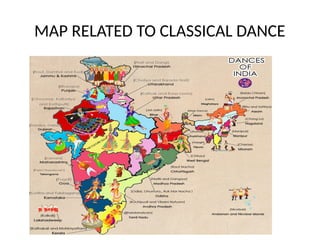
MAP RELATED TO CLASSICAL DANCE
Painting for Patrons: The Tradition
of Miniatures
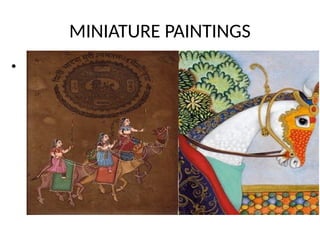
Another tradition that developed in different ways was that of
miniature painting. Miniatures (as their very name suggests) are
small-sized paintings, generally done in water colour on cloth or
paper. The earliest miniatures were on palm leaves or wood. Some
of the most beautiful of these, found in western India, were used
to illustrate Jaina texts. The Mughal emperors Akbar, Jahangir and
Shah Jahan patronised highly skilled painters who primarily
illustrated manuscripts containing historical accounts and poetry.
These were generally painted in brilliant colours and portrayed
court scenes, scenes of battle or hunting, and other aspects of
social life. They were often exchanged as gifts and were viewed
only by an exclusive few – the emperor and his close associates.
MINIATURE PAINTINGS
•
The Growth of a Regional Language
As we saw at the outset, we often tend to identify regions in terms of
the language spoken by the people. So, we assume that people in
Bengal always spoke Bengali. while Bengali is now recognised as a
language derived from Sanskrit, early Sanskrit texts (mid-first
millennium BCE) suggest that the people of Bengal did not speak
Sanskritic languages From the fourth-third centuries BCE, commercial
ties began to develop between Bengal and Magadha (south Bihar),
which may have led to the growing influence of Sanskrit. During the
fourth century the Gupta rulers established political control over north
Bengal and began to settle Brahmanas in this area. Thus, the linguistic
and cultural influence from the mid-Ganga valley became stronger. In
the seventh century the Chinese traveller Xuan Zang observed that
languages related to Sanskrit were in use all over Bengal.
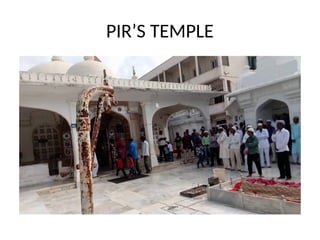
PER’S AND TEMPLES
The early settlers sought some order and
assurance in the unstable conditions of the new
settlements .Pir A Persian word meaning a
spiritual guide. These were provided by
community leaders, who also functioned as
teachers and adjudicators and were sometimes
ascribed with supernatural powers. People
referred to them with affection and respect as
pirs.
PIR’S TEMPLE
FISH AS FOOD
Traditional food habits are generally based on locally available items of
food. Bengal is a riverine plain which produces plenty of rice and fish.
Understandably, these two items figure prominently in the menu of
even poor Bengalis. Fishing has always been an important occupation
and Bengali literature contains several references to fish. What is
more, terracotta plaques on the walls of temples and viharas
(Buddhist monasteries) depict scenes of fish being dressed and taken
to the market in baskets. Brahmanas were not allowed to eat
nonvegetarian food, but the popularity of fish in the local diet made
the Brahmanical
authorities relax this prohibition for the Bengal Brahmanas. The
Brihaddharma Purana, a thirteenth-century Sanskrit text from Bengal,
permitted the local Brahmanas to eat certain varieties of fish.
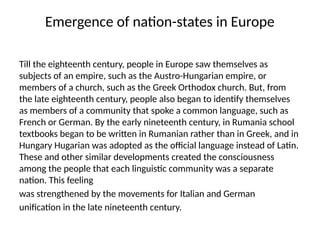
Emergence of nation-states in Europe
Till the eighteenth century, people in Europe saw themselves as
subjects of an empire, such as the Austro-Hungarian empire, or
members of a church, such as the Greek Orthodox church. But, from
the late eighteenth century, people also began to identify themselves
as members of a community that spoke a common language, such as
French or German. By the early nineteenth century, in Rumania school
textbooks began to be written in Rumanian rather than in Greek, and in
Hungary Hugarian was adopted as the official language instead of Latin.
These and other similar developments created the consciousness
among the people that each linguistic community was a separate
nation. This feeling
was strengthened by the movements for Italian and German
unification in the late nineteenth century.
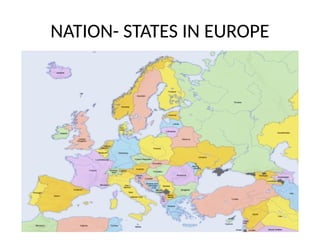
NATION- STATES IN EUROPE
HOME WORKS
01. Why did minstrels proclaim the achievements of
heroes?
02. Why do we know much more about the cultural
practices of rulers than about those of ordinary
people?
03. Why did conquerors try to control the temple of
Jagannatha at Puri?
04. Why were temples built in Bengal ?